

IEC TS 62257-200:2026
(Main)Renewable energy off-grid systems - Part 200: System selection and design
General Information
- Abstract
IEC TS 62257-200:2026 provides a method for describing the results to be achieved by the electrification system independently of the technical solutions that could be implemented.
The purpose of this part of IEC 62257 is to provide a method to assist designers of renewable energy systems, project contractors and project developers to design the electrification system for isolated sites while matching the identified needs. This part of IEC 62257 assesses the needs of the users and the different power system architectures which can be used for meeting these needs. In relation to the needs of the different participants to the project, functional requirements to be achieved by the production and distribution subsystems are listed.
This document provides technical standardization to different stakeholders (including but not limited to project developers, financing agencies, testing agencies, installers, etc.) involved in electrification projects for access to electricity for those not solely connected to the regional grid, through the setting up of off-grid renewable energy and hybrid systems (including micro-grids) with a voltage less than or equal to 1 000 V for AC (alternating current) or a voltage less than or equal to 1 500 V for DC (direct current). This document could be used for rural electrification, also for electrification of remote sites in developed countries, or any requirement for electricity access that cannot be met by attaching solely to the national utility grid. They promote the use of renewable energies, but at this time they do not deal with clean-energy mechanisms development (CO2 emissions, carbon credit, etc.).
- Status
- Published
- Publication Date
- 10-Mar-2026
- Technical Committee
- TC 82 - Solar photovoltaic energy systems
- Drafting Committee
- JWG 1 - TC 82/JWG 1
- Current Stage
- PPUB - Publication issued
- Start Date
- 11-Mar-2026
- Completion Date
- 20-Mar-2026
Overview
IEC TS 62257-200:2026 is a technical specification developed by the International Electrotechnical Commission (IEC) that provides a structured method for the selection and design of renewable energy off-grid systems. This standard is a key reference for professionals involved in rural electrification and electrification of remote or isolated sites where access to the main utility grid is not feasible or economical. It aims to assist system designers, project developers, contractors, and other stakeholders in developing effective electrification solutions that are tailored to specific user needs, site conditions, and available resources.
The technical specification is applicable to the design of off-grid and hybrid renewable energy systems, including microgrids, operating at voltages up to 1,000 V AC or 1,500 V DC. IEC TS 62257-200:2026 is especially relevant for projects aimed at expanding energy access, enhancing quality of life, and supporting sustainable development objectives, particularly in areas where grid extension is not practical.
Key Topics
The standard covers essential aspects of off-grid system design and selection:
- User Needs Assessment: Guidance on evaluating the energy demands of users, including load types and expected supply quality.
- System Architecture Selection: Methods for identifying appropriate system configurations such as individual electrification systems (IES), isolated microgrids, or hybrid systems.
- Resource Evaluation: Outlines procedures for assessing local renewable resources (solar, wind, hydro, biomass) and referencing reputable data sources.
- Functional Requirements: Describes minimum performance criteria for production subsystems (micropower plants), distribution networks, and end-user installations.
- System Sizing: Offers a stepwise approach to define and compare different design proposals, including performance specifications for key components like photovoltaic arrays, wind turbines, batteries, and inverters.
- Monitoring and Maintenance: Lists required measurement and data recording parameters for system components to aid ongoing operation and maintenance.
- Project Stakeholder Involvement: Identifies participants in the system sizing and design process, ensuring alignment with financial, regulatory, and operational expectations.
Applications
IEC TS 62257-200:2026 serves a wide range of practical applications, including:
- Rural Electrification: Facilitates the deployment of off-grid renewable or hybrid energy systems to increase electricity access in remote or underserved communities.
- Remote Site Electrification: Suitable for energy supply for isolated infrastructure such as telecommunications, healthcare facilities, and schools in both developing and developed countries.
- Project Development: Valuable to project developers, financing agencies, contractors, and installers for specifying functional and technical requirements independently of specific technologies.
- Quality Assurance: Provides benchmarks for testing agencies and system evaluators assessing compliance, performance, and reliability of off-grid solutions.
- Energy Sector Planning: Supports energy planners and policymakers in comparing different decentralized energy solutions and in aligning with sustainable development goals.
Related Standards
Several standards complement IEC TS 62257-200:2026 in the domain of renewable energy off-grid systems:
- IEC TS 62257 series: Covers different aspects of renewable energy off-grid systems. IEC TS 62257-100 offers an overview, while other parts focus on detailed technical or operational elements.
- IEC TS 61836: Addresses terms, definitions, and symbols for solar photovoltaic energy systems, essential for consistent terminology in system design.
- ESMAP (World Bank Energy Sector Management Assistance Program) Tier Structure: Provides a reference for classifying electrification levels and aligning system designs with international benchmarks.
By adhering to IEC TS 62257-200:2026, stakeholders ensure a consistent, needs-orientated, and technically robust approach to designing and implementing renewable energy off-grid systems that accelerate access to electricity and foster sustainable progress worldwide.
Relations
- Effective Date
- 13-Mar-2026
Get Certified
Connect with accredited certification bodies for this standard

DNV
DNV is an independent assurance and risk management provider.

Lloyd's Register
Lloyd's Register is a global professional services organisation specialising in engineering and technology.
DNV Energy Systems
Energy and renewable energy certification.
Sponsored listings
Frequently Asked Questions
IEC TS 62257-200:2026 is a technical specification published by the International Electrotechnical Commission (IEC). Its full title is "Renewable energy off-grid systems - Part 200: System selection and design". This standard covers: IEC TS 62257-200:2026 provides a method for describing the results to be achieved by the electrification system independently of the technical solutions that could be implemented. The purpose of this part of IEC 62257 is to provide a method to assist designers of renewable energy systems, project contractors and project developers to design the electrification system for isolated sites while matching the identified needs. This part of IEC 62257 assesses the needs of the users and the different power system architectures which can be used for meeting these needs. In relation to the needs of the different participants to the project, functional requirements to be achieved by the production and distribution subsystems are listed. This document provides technical standardization to different stakeholders (including but not limited to project developers, financing agencies, testing agencies, installers, etc.) involved in electrification projects for access to electricity for those not solely connected to the regional grid, through the setting up of off-grid renewable energy and hybrid systems (including micro-grids) with a voltage less than or equal to 1 000 V for AC (alternating current) or a voltage less than or equal to 1 500 V for DC (direct current). This document could be used for rural electrification, also for electrification of remote sites in developed countries, or any requirement for electricity access that cannot be met by attaching solely to the national utility grid. They promote the use of renewable energies, but at this time they do not deal with clean-energy mechanisms development (CO2 emissions, carbon credit, etc.).
IEC TS 62257-200:2026 provides a method for describing the results to be achieved by the electrification system independently of the technical solutions that could be implemented. The purpose of this part of IEC 62257 is to provide a method to assist designers of renewable energy systems, project contractors and project developers to design the electrification system for isolated sites while matching the identified needs. This part of IEC 62257 assesses the needs of the users and the different power system architectures which can be used for meeting these needs. In relation to the needs of the different participants to the project, functional requirements to be achieved by the production and distribution subsystems are listed. This document provides technical standardization to different stakeholders (including but not limited to project developers, financing agencies, testing agencies, installers, etc.) involved in electrification projects for access to electricity for those not solely connected to the regional grid, through the setting up of off-grid renewable energy and hybrid systems (including micro-grids) with a voltage less than or equal to 1 000 V for AC (alternating current) or a voltage less than or equal to 1 500 V for DC (direct current). This document could be used for rural electrification, also for electrification of remote sites in developed countries, or any requirement for electricity access that cannot be met by attaching solely to the national utility grid. They promote the use of renewable energies, but at this time they do not deal with clean-energy mechanisms development (CO2 emissions, carbon credit, etc.).
IEC TS 62257-200:2026 is classified under the following ICS (International Classification for Standards) categories: 27.160 - Solar energy engineering. The ICS classification helps identify the subject area and facilitates finding related standards.
IEC TS 62257-200:2026 has the following relationships with other standards: It is inter standard links to IEC TS 62257-4:2015. Understanding these relationships helps ensure you are using the most current and applicable version of the standard.
IEC TS 62257-200:2026 is available in PDF format for immediate download after purchase. The document can be added to your cart and obtained through the secure checkout process. Digital delivery ensures instant access to the complete standard document.
Standards Content (Sample)
IEC TS 62257-200 ®
Edition 1.0 2026-03
TECHNICAL
SPECIFICATION
Renewable energy off-grid systems -
Part 200: System selection and design
ICS 27.160 ISBN 978-2-8327-1117-0
All rights reserved. Unless otherwise specified, no part of this publication may be reproduced or utilized in any form or
by any means, electronic or mechanical, including photocopying and microfilm, without permission in writing from either
IEC or IEC's member National Committee in the country of the requester. If you have any questions about IEC copyright
or have an enquiry about obtaining additional rights to this publication, please contact the address below or your local
IEC member National Committee for further information.
IEC Secretariat Tel.: +41 22 919 02 11
3, rue de Varembé info@iec.ch
CH-1211 Geneva 20 www.iec.ch
Switzerland
About the IEC
The International Electrotechnical Commission (IEC) is the leading global organization that prepares and publishes
International Standards for all electrical, electronic and related technologies.
About IEC publications
The technical content of IEC publications is kept under constant review by the IEC. Please make sure that you have the
latest edition, a corrigendum or an amendment might have been published.
IEC publications search - IEC Products & Services Portal - products.iec.ch
webstore.iec.ch/advsearchform Discover our powerful search engine and read freely all the
The advanced search enables to find IEC publications by a publications previews, graphical symbols and the glossary.
variety of criteria (reference number, text, technical With a subscription you will always have access to up to date
committee, …). It also gives information on projects, content tailored to your needs.
replaced and withdrawn publications.
Electropedia - www.electropedia.org
The world's leading online dictionary on electrotechnology,
IEC Just Published - webstore.iec.ch/justpublished
Stay up to date on all new IEC publications. Just Published containing more than 22 500 terminological entries in English
details all new publications released. Available online and and French, with equivalent terms in 25 additional languages.
once a month by email. Also known as the International Electrotechnical Vocabulary
(IEV) online.
IEC Customer Service Centre - webstore.iec.ch/csc
If you wish to give us your feedback on this publication or
need further assistance, please contact the Customer
Service Centre: sales@iec.ch.
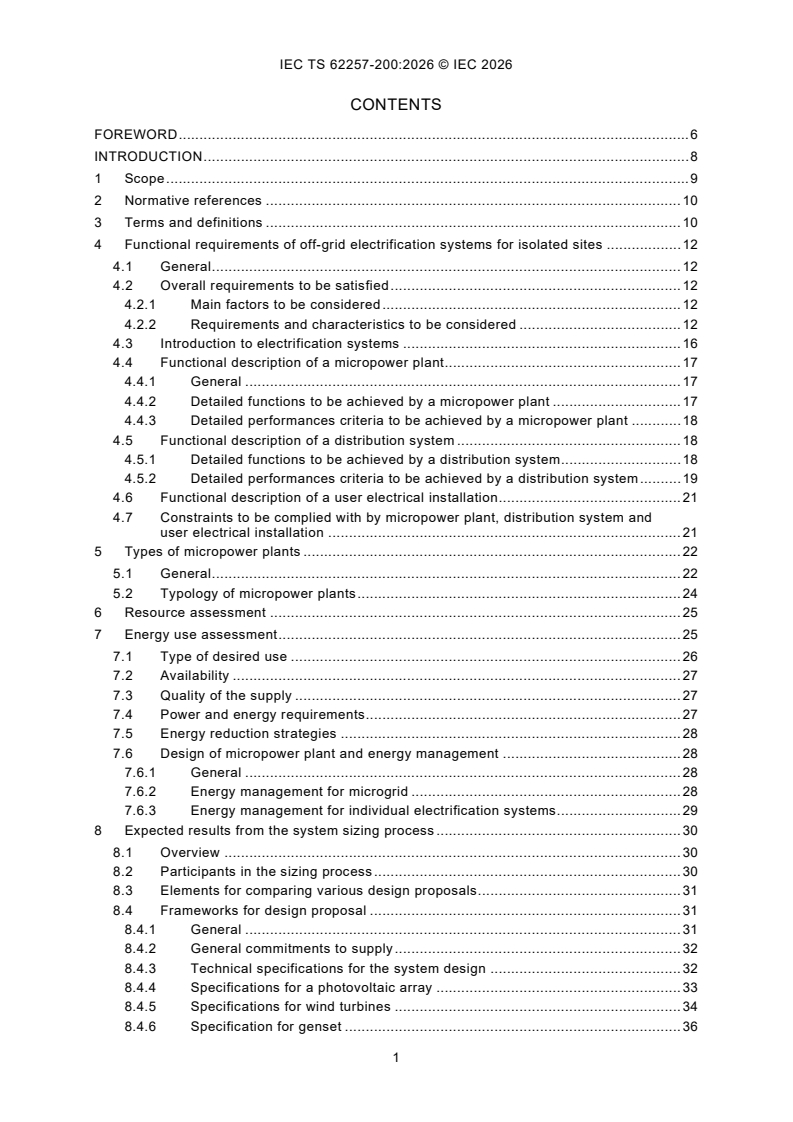
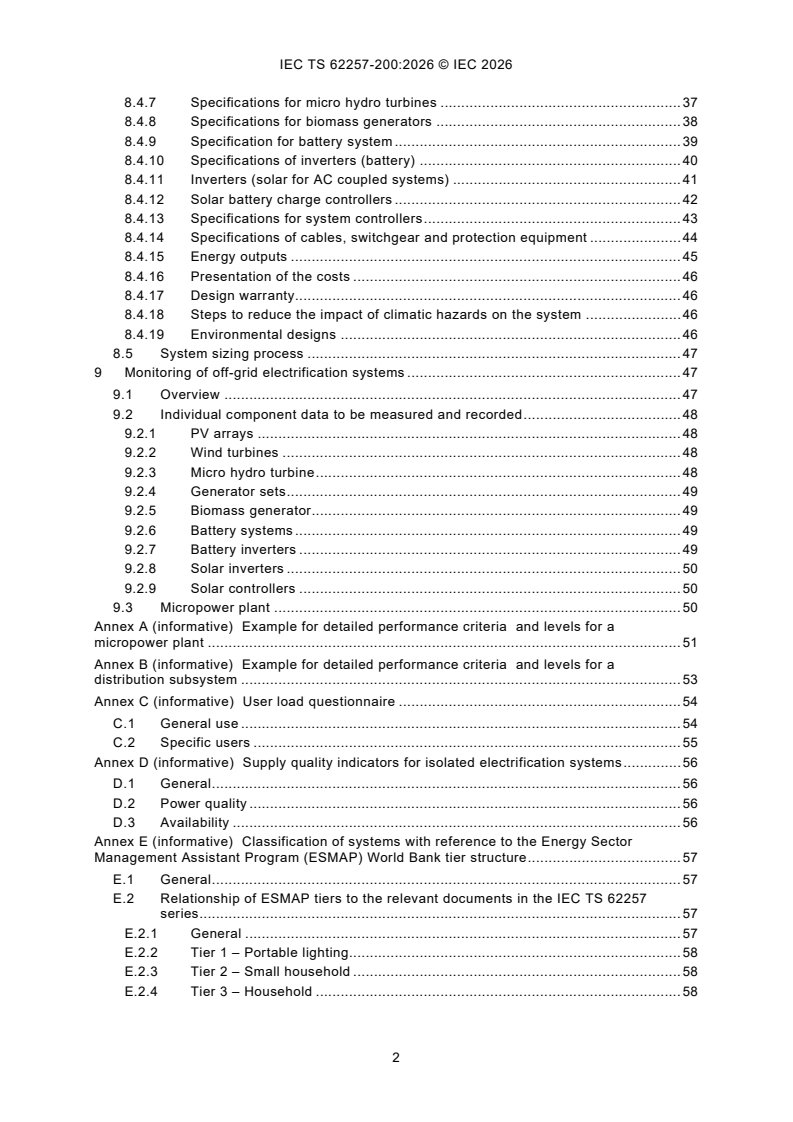
CONTENTS
FOREWORD . 6
INTRODUCTION . 8
1 Scope . 9
2 Normative references . 10
3 Terms and definitions . 10
4 Functional requirements of off-grid electrification systems for isolated sites . 12
4.1 General . 12
4.2 Overall requirements to be satisfied . 12
4.2.1 Main factors to be considered . 12
4.2.2 Requirements and characteristics to be considered . 12
4.3 Introduction to electrification systems . 16
4.4 Functional description of a micropower plant. 17
4.4.1 General . 17
4.4.2 Detailed functions to be achieved by a micropower plant . 17
4.4.3 Detailed performances criteria to be achieved by a micropower plant . 18
4.5 Functional description of a distribution system . 18
4.5.1 Detailed functions to be achieved by a distribution system . 18
4.5.2 Detailed performances criteria to be achieved by a distribution system . 19
4.6 Functional description of a user electrical installation . 21
4.7 Constraints to be complied with by micropower plant, distribution system and
user electrical installation . 21
5 Types of micropower plants . 22
5.1 General . 22
5.2 Typology of micropower plants . 24
6 Resource assessment . 25
7 Energy use assessment . 25
7.1 Type of desired use . 26
7.2 Availability . 27
7.3 Quality of the supply . 27
7.4 Power and energy requirements . 27
7.5 Energy reduction strategies . 28
7.6 Design of micropower plant and energy management . 28
7.6.1 General . 28
7.6.2 Energy management for microgrid . 28
7.6.3 Energy management for individual electrification systems . 29
8 Expected results from the system sizing process . 30
8.1 Overview . 30
8.2 Participants in the sizing process . 30
8.3 Elements for comparing various design proposals . 31
8.4 Frameworks for design proposal . 31
8.4.1 General . 31
8.4.2 General commitments to supply . 32
8.4.3 Technical specifications for the system design . 32
8.4.4 Specifications for a photovoltaic array . 33
8.4.5 Specifications for wind turbines . 34
8.4.6 Specification for genset . 36
8.4.7 Specifications for micro hydro turbines . 37
8.4.8 Specifications for biomass generators . 38
8.4.9 Specification for battery system . 39
8.4.10 Specifications of inverters (battery) . 40
8.4.11 Inverters (solar for AC coupled systems) . 41
8.4.12 Solar battery charge controllers . 42
8.4.13 Specifications for system controllers . 43
8.4.14 Specifications of cables, switchgear and protection equipment . 44
8.4.15 Energy outputs . 45
8.4.16 Presentation of the costs . 46
8.4.17 Design warranty. 46
8.4.18 Steps to reduce the impact of climatic hazards on the system . 46
8.4.19 Environmental designs . 46
8.5 System sizing process . 47
9 Monitoring of off-grid electrification systems . 47
9.1 Overview . 47
9.2 Individual component data to be measured and recorded . 48
9.2.1 PV arrays . 48
9.2.2 Wind turbines . 48
9.2.3 Micro hydro turbine . 48
9.2.4 Generator sets . 49
9.2.5 Biomass generator. 49
9.2.6 Battery systems . 49
9.2.7 Battery inverters . 49
9.2.8 Solar inverters . 50
9.2.9 Solar controllers . 50
9.3 Micropower plant . 50
Annex A (informative) Example for detailed performance criteria and levels for a
micropower plant . 51
Annex B (informative) Example for detailed performance criteria and levels for a
distribution subsystem . 53
Annex C (informative) User load questionnaire . 54
C.1 General use . 54
C.2 Specific users . 55
Annex D (informative) Supply quality indicators for isolated electrification systems . 56
D.1 General . 56
D.2 Power quality . 56
D.3 Availability . 56
Annex E (informative) Classification of systems with reference to the Energy Sector
Management Assistant Program (ESMAP) World Bank tier structure . 57
E.1 General . 57
E.2 Relationship of ESMAP tiers to the relevant documents in the IEC TS 62257
series . 57
E.2.1 General . 57
E.2.2 Tier 1 – Portable lighting. 58
E.2.3 Tier 2 – Small household . 58
E.2.4 Tier 3 – Household . 58
E.2.5 Tier 4 – Commercial . 58
E.2.6 Tier 5 – Commercial enterprise . 59
E.2.7 Tier 6 – Small communal or large commercial . 59
E.2.8 Tier 7 – Large communal or industrial . 59
Annex F (informative) Architecture of systems . 60
F.1 Type T I – REN systems operating with no storage (only when solar, wind or
water energy sourcesare available)– REN production . 60
F.2 Type T I – Individual electrification systems – REN generation with energy
storage . 62
F.3 Type T I – Individual electrification systems – (REN and diesel) production
without energy storage . 66
F.4 Type T I – Individual electrification systems – (RE and diesel) production
with energy storage . 68
F.5 Type T I – Individual electrification systems – Genset only without storage . 71
F.6 Type T I – Individual electrification systems – Genset only with storage . 72
F.7 Type T M – Microgrid – REN only without storage . 72
F.8 Type T M – Microgrid – REN Micropower plant supplying a distribution
system . 72
F.9 Type T M – Microgrid – Multi sources micropower plant (RE and diesel)
without energy storage, supplying a distribution system . 76
F.10 Type T M – Microgrid – Multi sources micropower plant (RE and diesel) with
energy storage supplying a microgrid . 76
F.11 Type T M – Microgrid – Diesel micropower plant supplying a distribution
system . 81
F.12 Type T M – Microgrid – Diesel micropower plant with energy storage
supplying a distribution system . 81
F.13 Microgrid – Distributed RE micropower plant . 81
Bibliography . 82
Figure 1 – Factors involved in the design of a system . 12
Figure 2 – Functional diagram of a distribution system with one micropower plant . 20
Figure 3 – Functional diagram of a distribution system with one central micropower
plant and distributed RE micropower plant . 21
Figure 4 – Example of AC micropower plants . 23
Figure 5 – Example of DC micropower plants . 24
Figure E.1 – ESMAP tiers for use cases . 57
Figure F.1 – Type T I-a (left) and T I-b (right) systems . 61
1 1
Figure F.2 – Type T I-c (left) and T I-d (right) systems . 62
1 1
Figure F.3 – Type T I system DC coupled system . 64
Figure F.4 – Type T I system AC coupled system. 65
Figure F.5 – Type T I system . 67
Figure F.6 – Type T I-b system . 68
Figure F.7 – Type T I system DC coupled . 70
Figure F.8 – Type T I system AC coupled . 71
Figure F.9 – General architecture of a micropower plant supplying a distribution system . 73
Figure F.10 – Type T M system DC Coupled . 74
Figure F.11 – Type T M system AC coupled . 75
Figure F.12 – Type T M-a system DC coupled. 79
Figure F.13 – Type T M-a system AC coupled . 80
Table 1 – Technical factors – Requirements or characteristics to be considered for an
isolated microgrid created via a project . 13
Table 2 – Technical factors – requirements or characteristics to be considered for
individual electrification systems created for a system user or owner . 13
Table 3 – Economic factors – requirements and characteristics to be considered for a
microgrid supplied via a project. 14
Table 4 – Economic factors – requirements and characteristics to be considered
individual electrification systems supplied to a system user or owner . 14
Table 5 – Site characteristics . 14
Table 6 – Regulations and requirements to be considered . 16
Table 7 – Typology of isolated electrification systems . 24
Table 8 – Application types and types of uses. 26
Table 9 – Expected quality of the supply . 27
Table 10 – Participants in the sizing process for a project . 31
Table 11 – Participants in the sizing process for a system provided by IES . 31
Table 12 – Perspectives to be considered for electrifications systems provided through
a project . 32
Table 13 – Photovoltaic array specifications . 33
Table 14 – Specifications for photovoltaic array supporting structure . 34
Table 15 – Specifications for the wind turbine . 35
Table 16 – Specifications for wind turbine structure . 36
Table 17 – Specifications for the genset . 37
Table 18 – Specifications for micro hydro turbines . 38
Table 19 – Specifications for biomass generators . 39
Table 20 – Specifications for battery systems . 40
Table 21 – Specifications for inverter (battery) . 41
Table 22 – Specifications for solar inverter . 42
Table 23 – Specifications for solar controller. 43
Table 24 – Specifications for system controllers . 43
Table 25 – Specifications of cables, switchgear and protection equipment . 44
Table 26 – Energy output from renewable energies . 45
Table 27 – Energy output from fossil energies . 45
Table 28 – Energy output from storage . 45
Table A.1 – Detailed performance criteria and levels for a production subsystem. 51
Table A.2 – Typical example of Table A.1 . 52
Table B.1 – Detailed performance criteria and levels for a distribution subsystem . 53
Table B.2 – Typical example of functional specifications . 53
Table C.1 – General user load questionnaire . 54
Table C.2 – Specific user load questionnaire . 55
Table D.1 – Availability and power quality indicators . 56
Table F.1 – List of cases, type T I . 60
Table F.2 – List of cases, type T I . 66
Table F.3 – List of cases, type T M . 76
Table F.4 – List of cases, type T M . 77
INTERNATIONAL ELECTROTECHNICAL COMMISSION
____________
Renewable energy off-grid systems -
Part 200: System selection and design
FOREWORD
1) The International Electrotechnical Commission (IEC) is a worldwide organization for standardization comprising
all national electrotechnical committees (IEC National Committees). The object of IEC is to promote international
co-operation on all questions concerning standardization in the electrical and electronic fields. To this end and
in addition to other activities, IEC publishes International Standards, Technical Specifications, Technical Reports,
Publicly Available Specifications (PAS) and Guides (hereafter referred to as “IEC Publication(s)”). Their
preparation is entrusted to technical committees; any IEC National Committee interested in the subject dealt with
may participate in this preparatory work. International, governmental and non-governmental organizations liaising
with the IEC also participate in this preparation. IEC collaborates closely with the International Organization for
Standardization (ISO) in accordance with conditions determined by agreement between the two organizations.
2) The formal decisions or agreements of IEC on technical matters express, as nearly as possible, an international
consensus of opinion on the relevant subjects since each technical committee has representation from all
interested IEC National Committees.
3) IEC Publications have the form of recommendations for international use and are accepted by IEC National
Committees in that sense. While all reasonable efforts are made to ensure that the technical content of IEC
Publications is accurate, IEC cannot be held responsible for the way in which they are used or for any
misinterpretation by any end user.
4) In order to promote international uniformity, IEC National Committees undertake to apply IEC Publications
transparently to the maximum extent possible in their national and regional publications. Any divergence between
any IEC Publication and the corresponding national or regional publication shall be clearly indicated in the latter.
5) IEC itself does not provide any attestation of conformity. Independent certification bodies provide conformity
assessment services and, in some areas, access to IEC marks of conformity. IEC is not responsible for any
services carried out by independent certification bodies.
6) All users should ensure that they have the latest edition of this publication.
7) No liability shall attach to IEC or its directors, employees, servants or agents including individual experts and
members of its technical committees and IEC National Committees for any personal injury, property damage or
other damage of any nature whatsoever, whether direct or indirect, or for costs (including legal fees) and
expenses arising out of the publication, use of, or reliance upon, this IEC Publication or any other IEC
Publications.
8) Attention is drawn to the Normative references cited in this publication. Use of the referenced publications is
indispensable for the correct application of this publication.
9) IEC draws attention to the possibility that the implementation of this document may involve the use of (a)
patent(s). IEC takes no position concerning the evidence, validity or applicability of any claimed patent rights in
respect thereof. As of the date of publication of this document, IEC had not] received notice of (a) patent(s),
which may be required to implement this document. However, implementers are cautioned that this may not
represent the latest information, which may be obtained from the patent database available at
https://patents.iec.ch. IEC shall not be held responsible for identifying any or all such patent rights.
IEC TS 62257-200 has been prepared by IEC technical committee 82. Solar photovoltaic energy
systems. It is a Technical Specification.
This first edition cancels and replaces the second edition of IEC 62257-4 published in 2015. It
constitutes a technical revision.
This edition includes the following significant technical changes with respect to the previous
edition:
a) The previous edition focussed on isolated electrification systems provided through projects
only. This version includes isolated electrification systems that could be supplied directly to
a user by a system supplier.
b) Information that was previously included in IEC TS 62257-2 that was directly relevant to
system design has been moved to be included in this version.
c) The operation of numerous micropower plants typologies has changed due to changes in
features and functions of inverters. The typologies of the various powerplants have been
updated to reflect these changes.
The text of this Technical Specification is based on the following documents:
Draft Report on voting
82/2505/DTS 82/2573/RVDTS
Full information on the voting for its approval can be found in the report on voting indicated in
the above table.
The language used for the development of this Technical Specification is English.
This document was drafted in accordance with ISO/IEC Directives, Part 2, and developed in
accordance with ISO/IEC Directives, Part 1 and ISO/IEC Directives, IEC Supplement, available
at www.iec.ch/members_experts/refdocs. The main document types developed by IEC are
described in greater detail at www.iec.ch/publications.
A list of all parts in the IEC 62257 series, published under the general title Renewable energy
off-grid systems, can be found on the IEC website.
Future standards in this series will carry the new general title as cited above. Titles of existing
standards in this series will be updated at the time of the next edition.
The committee has decided that the contents of this document will remain unchanged until the
stability date indicated on the IEC website under webstore.iec.ch in the data related to the
specific document. At this date, the document will be
– reconfirmed,
– withdrawn, or
– revised.
INTRODUCTION
The IEC 62257 series provides technical standardization to different stakeholders (including
but not limited to project developers, financing agencies, testing agencies, installers, etc.)
involved in electrification projects for access to electricity for those not solely connected to the
regional grid, through the setting up of off-grid renewable energy and hybrid systems (including
micro-grids) with a voltage less than or equal to 1 000 V for AC (alternating current) or a voltage
less than or equal to 1 500 V for DC (direct current).
Access to electricity is one of the predominant policy actions designed to increase the well-
being of populations, together with access to clean water, improved healthcare, education,
personal advancement and economic development. Increasing access to electricity through
utilization of renewable off-grid electricity also directly or indirectly supports various United
Nations Sustainability Development Goals (https://sdgs.un.org/goals), depending on the
application.
Several strategies can be adopted to implement electrification and improve access to electricity
in rural and urban settings, including the ability for connection to a national or regional electricity
grid. The IEC 62257 series applies to cases where the utility grid is too far away, the individual
demand centres are too small to make grid access economical, off-grid solutions provide an
economical option, and where autonomous power systems can be used to supply these services.
These technical specifications are used to:
a) choose the right solution for the right place with the optimal technology,
b) design, purchase and install the product(s) or system to optimal compliancy,
c) operate and maintain the system.
The IEC 62257 technical specifications focus on enabling access to electricity by concentrating
on, but not being specific to, developing countries. This series is not to be considered as all-
inclusive for access to electricity. That means that the technical specifications could be used
for rural electrification, also for electrification of remote sites in developed countries, or any
requirement for electricity access that cannot be met by attaching solely to the national utility
grid. They promote the use of renewable energies, but at this time they do not deal with clean-
energy mechanisms development (CO emissions, carbon credit, etc.). The series does allow
for other types of energy, such as diesel generators, to be included as part of a hybrid renewable
energy off-grid system.
This consistent set of documents can be considered as a whole, with different parts focusing
on specific aspects of renewable energy off-grid systems. However, several parts are intended
to be read as stand-alone documents depending on their intended application.
IEC TS 62257-100 provides an overview of the various topics covered by this series.
Additionally, the content and scopes of individual documents, available at the website
webstore.iec.ch, provide potential users with the intended application for each document. For
further information on planned documents to be published under the new IEC 62257 numbering
scheme, IEC TC 82 committee members can refer to the annex in the JWG1 Program of Work
circulated after each JWG1 meeting, or to the Planned Work Programme on the www.iec.ch
TC 82 website.
One of the main objectives of this series is to provide the minimum sufficient recommendations,
including items for safety, sustainability of systems and at the lowest life cycle cost, relevant to
the renewable energy and hybrid off-grid systems field of application.
1 Scope
This part of IEC 62257 provides a method for describing the results to be achieved by the
electrification system independently of the technical solutions that could be implemented.
The purpose of this part of IEC 62257 is to provide a method to assist designers of renewable
energy systems, project contractors and project developers to design the electrification system
for isolated sites while matching the identified needs. This part of IEC 62257 assesses the
needs of the users and the different power system architectures which can be used for meeting
these needs. In relation to the needs of the different participants to the project, functional
requirements to be achieved by the production and distribution subsystems are listed.
In Clause 4, the functional requirements of off-grid electrifications systems are described.
These include the micropower plant, distribution system for isolated microgrids and the user’s
electrical installation providing power to their loads.
In Clause 5, the types of micropower plants that can be installed within an individual
electrification system (IES) or isolated microgrid are described.
In Clause 6, resource assessment (solar, wind, hydro, biomass) and data sources (PVGIS,
Global Solar Atlas, NASA POWER, etc.) are outlined.
In Clause 7, the requirement to undertake load energy assessment is described and includes
the relationship between the available energy, the design of the system and the user’s
expectation.
In Clause 8, the information that has been used in the design process and should be specified
in any design documentation to allow the participants to select the equipment or component
able to fulfil the functional requirements are listed.
To allow and facilitate the management of the micropower plant and the maintenance of the
whole electrification system, some information is collected and monitored.
In Clause 9, the required measurement parameters for each component (PV, wind, hydro,
genset, battery, inverters, controllers) to support operation and maintenance are listed.
The steps to follow this part of IEC 62257 when designing an off-grid electrification system are
as follows:
Step 1: Conduct a resource assessment (see Clause 6).
Step 2: Conduct a load assessment (see Clause 7).
Step 3: The designer uses the information obtained in the two assessments to determine the
type and configuration of the micropower plant (see Clause 5) and to select or specify the
micropower plant components (equipment) (see Clause 8).
Step 4: The designer should develop a monitoring plan that will support the ongoing operation
and maintenance of the off-grid electrification system (refer to Clause 9).
2 Normative references
The following documents are referred to in the text in such a way that some or all of their content
constitutes requirements of this document. For dated references, only the edition cited applies.
For undated references, the latest edition of the referenced document (including any
amendments) applies.
IEC TS 61836, Solar photovoltaic energy systems - Terms, definitions and symbols
3 Terms and definitions
For the purposes of this document, the terms and definitions given in IEC TS 61836 and the
following apply.
ISO and IEC maintain terminology databases for use in standardization at the following
addresses:
– IEC Electropedia: available at https://www.electropedia.org/
– ISO Online browsing platform: available at https://www.iso.org/obp
3.1
battery system
system comprising one or more cells, modules or batteries
Note 1 to entry: Depending on the type of technology, the battery system can include one or multiple battery
management systems, battery management modules, auxiliary supporting or protective equipment for the system.
3.2
dispatchable power system
generating system that is capable of generating electricity as required by its interconnected
electrical distribution system
Note 1 to entry: For example, a fuel-based engine-powered generator is dispatchable.
3.3
distributed RE micropower plant
micropower plant that uses a single resource and is interconnected at the users’ electrical
installation
3.4
distribution system
electrical facility and its components including poles, transformers, disconnects, relays,
isolators and wires for the purpose of distributing electrical energy from micropower plant to
customers
3.5
genset
GS
engine-generator set consisting of a fuel-driven engine coupled to an electric generator
3.6
hybrid system
multi-sources system with at least two different kind of generation technologies
3.7
individual electrification system
IES
small electric power station (micropower plant system) that supplies electricity to one
consumption point, such as a household, usually from a single energy resource
3.8
isolated microgrid
micropower plant using a single or multiple energy resource connections and distribution
system, not currently connected to a national or regional grid that supplies electricity to multiple
consumption connections
3.9
isolated site
location not connected to the utility grid
3.10
microgrid
grid isolated from other grids and that is intended to serve only for the distribution of electricity
Note 1 to entry: A microgrid usually serves villages and is supplied by either fossil-fuel generators or renewable
energy generators, or both.
3.11
micropower plant
power plant that produces electrical power using a single resource or hybrid system
3.12
non-dispatchable power system
generating system that is capable of generating electricity only at specific times to its
interconnected electrical distribution system
Note 1 to entry: For example, generators involving intermittent renewable energy resources such as solar and wind
power are non-dispatchable.
3.13
renewable
REN
generation system where the energy source is renewable
3.14
renewable energy
RE
energy from a source that is not depleted when used
3.15
storage
means for keeping and preserving energy produced by one of the generators of the system so
that it can be reconverted through the system into electricity
3.16
user electrical installation
protection devices, switchgear and wiring that provides power from a microgrid or from a
micropower plant to the user’s electrical appliances
4 Functional requirements of off-grid electrification systems for isolated sites
4.1 General
Clause 4 provides a method for describing the results to be achieved by electrification systems
for isolated sites. It describes the characteristics expected from these installations based on
production of electricity from either renewable or fossil energy sources, or both.
This stage of defining the expected results of production precedes the technical dimensioning
and details engineering stages.
4.2 Overall requirements to be satisfied
4.2.1 Main factors to be considered
Figure 1 illustrates the main factors influencing the design of the micropower plant.
Figure 1 – Factors involved in the design of a system
4.2.2 Requirements and characteristics to be considered
For each of the factors depicted in Figure 1, detailed requirements or characteristics to be
considered shall be identified. These requirements and characteristics are defined in Table 1
to Table 6. Table 1 and Table 3 pertain to systems provided to a microgrid, typically through a
project, while Table 2 and Table 4 pertain to systems provided to an individual electrification
system, typically for a single system owner or user. Not all the detailed characteristics outlined
in Table 5 and Table 6 are necessary for IES.
Table 1 – Technical factors – Requirements or characteristics
to be considered for an isolated microgrid created via a project
Nature of participant Requirements or characteristics
Project developer or owner Compliance with the general specification and relevant standards.
Efficient use of energy (demand side management).
Project implementer or Easiest possible implementation. Limited constraints in terms of transportation
subcontractor means and lifting apparatus.
Technology compatible with limited skills of local manpower.
Limited installation work duration on field.
Standardized equipment.
Simple operational rules to cope with possible limited skills of local operating
Operator
agents.
Simple mounting tools.
Reliable equipment.
Simple management rules.
Clear and unambiguous contractual rules not liable to lead to situations of dispute
or litigation.
Relevant technical choices
Limited spare parts variety.
Maintenance contractor Reliable and easy-to replace on site equipment.
Limited spare parts variety.
System designer Compliance with the general specification and relevant standards.
Efficient use of energy (demand side management).
Easiest possible implementation. Limited constraints in terms of transportation
means and lifting apparatus.
Limited installation work duration on field.
Standardized equipment.
Reliable and easy-to replace on site equipment.
Limited spare parts variety
Different users or loads Types of energy services including total energy and maximum demand requirements
(see Annex C).
Table 2 – Technical factors – requirements or characteristics to be considered for
individual electrification systems created for a system user or owner
Nature of participant Requirements or characteristics
System designer Compliance with the general specification and relevant standards.
Efficient use of energy (demand side management).
Easiest possible implementation. Limited constraints in terms of transportation
means and lifting apparatus.
Limited installation work duration on field.
Standardized equipment.
Reliable and easy-to replace on site equipment.
Limited spare parts variety
System owner or user Types of energy services including total energy and maximum demand.
See Annex C.
Efficient use of energy (demand side management).
Reliable equipment.
Simple operational rules.
Table 3 – Economic factors – requireme
...