

IEC TS 62257-4:2015
(Main)Recommendations for renewable energy and hybrid systems for rural electrification - Part 4: System selection and design
General Information
- Abstract
IEC TS 62257-4:2015(E) provides a method for describing the results to be achieved by the electrification system independently of the technical solutions that could be implemented. The purpose is to provide a method to assist project contractors and project developers to select and design the electrification system for isolated sites while matching the identified needs, such as those described in IEC TS 62257-2. The main technical changes with regard to the previous edition are as follows:
- redefine the maximum AC voltage from 500 V to 1 000 V, the maximum DC voltage from 750 V to 1 500 V;
- removal of the limitation of 100 kVA system size.
This publication is to be read in conjunction with IEC 62257 series.
- Status
- Replaced
- Publication Date
- 10-Dec-2015
- Technical Committee
- TC 82 - Solar photovoltaic energy systems
- Drafting Committee
- JWG 1 - TC 82/JWG 1
Overview
IEC TS 62257-4:2015 - "Recommendations for renewable energy and hybrid systems for rural electrification - Part 4: System selection and design" is a technical specification that guides the selection and design of off‑grid and isolated electrification systems. It provides a method to describe the functional results required from an electrification system independent of specific technical solutions, helping project contractors and developers match identified community needs (for example as described in IEC TS 62257-2). The 2015 edition updates include increased maximum voltages (AC to 1 000 V, DC to 1 500 V) and removal of the previous 100 kVA system-size limitation.
Key topics and technical requirements
- Functional requirements for production, distribution (rural micro‑grids) and demand subsystems, including performance criteria and subsystem constraints.
- System selection and sizing: a recommended sizing process, participants, inputs, assumptions and steps to compare design proposals.
- Energy management rules: functional descriptions for energy management in isolated systems and demand‑side management strategies.
- Equipment characteristics: recommended technical attributes for PV arrays, wind turbines, generator sets, micro‑hydro, biomass generators, power converters, controllers, batteries, wiring and metering.
- Data acquisition and monitoring: levels of data collection, information for operators/energy managers/users and guidance for scientific data collection to support system management.
- Economic and lifecycle considerations: presentation of costs, life‑cycle costs, levelized cost of energy and warranty/guarantee requirements (annexes include cost calculation formulas and sizing process examples).
- Environmental, social and climatic resilience: guidance on assessing environmental/social impacts and reducing climatic hazard impacts on system performance.
Applications and who uses it
IEC TS 62257-4:2015 is practical for:
- Project developers and system designers selecting and sizing hybrid renewable or off‑grid systems and rural micro‑grids.
- Contractors and equipment suppliers preparing proposals that meet specified functional outcomes.
- Utilities, NGOs and government agencies planning rural electrification schemes, policy or procurement specifications.
- Energy managers and operators implementing monitoring, data acquisition and energy management strategies.
Use cases include design of PV‑battery mini‑grids, hybrid wind/PV/diesel systems, micro‑hydro village electrification and community electrification projects that require clear functional specifications, performance guarantees and lifecycle cost analysis.
Related standards
- Read in conjunction with the IEC 62257 series for broader recommendations on renewable energy and hybrid systems for rural electrification.
- Useful alongside standards for specific equipment (PV modules, batteries, inverters) and local electrical safety/regulatory requirements.
Keywords: IEC TS 62257-4:2015, rural electrification, renewable energy, hybrid systems, system selection, system design, micro‑grid, off‑grid, sizing, energy management, photovoltaic, batteries, wind, micro hydro.
Relations
- Replaced By
IEC TS 62257-200:2026 - Renewable energy off-grid systems - Part 200: System selection and design - Effective Date
- 13-Mar-2026
- Effective Date
- 05-Sep-2023
Get Certified
Connect with accredited certification bodies for this standard

DNV
DNV is an independent assurance and risk management provider.

Lloyd's Register
Lloyd's Register is a global professional services organisation specialising in engineering and technology.
DNV Energy Systems
Energy and renewable energy certification.
Sponsored listings
Frequently Asked Questions
IEC TS 62257-4:2015 is a technical specification published by the International Electrotechnical Commission (IEC). Its full title is "Recommendations for renewable energy and hybrid systems for rural electrification - Part 4: System selection and design". This standard covers: IEC TS 62257-4:2015(E) provides a method for describing the results to be achieved by the electrification system independently of the technical solutions that could be implemented. The purpose is to provide a method to assist project contractors and project developers to select and design the electrification system for isolated sites while matching the identified needs, such as those described in IEC TS 62257-2. The main technical changes with regard to the previous edition are as follows: - redefine the maximum AC voltage from 500 V to 1 000 V, the maximum DC voltage from 750 V to 1 500 V; - removal of the limitation of 100 kVA system size. This publication is to be read in conjunction with IEC 62257 series.
IEC TS 62257-4:2015(E) provides a method for describing the results to be achieved by the electrification system independently of the technical solutions that could be implemented. The purpose is to provide a method to assist project contractors and project developers to select and design the electrification system for isolated sites while matching the identified needs, such as those described in IEC TS 62257-2. The main technical changes with regard to the previous edition are as follows: - redefine the maximum AC voltage from 500 V to 1 000 V, the maximum DC voltage from 750 V to 1 500 V; - removal of the limitation of 100 kVA system size. This publication is to be read in conjunction with IEC 62257 series.
IEC TS 62257-4:2015 is classified under the following ICS (International Classification for Standards) categories: 27.160 - Solar energy engineering. The ICS classification helps identify the subject area and facilitates finding related standards.
IEC TS 62257-4:2015 has the following relationships with other standards: It is inter standard links to IEC TS 62257-200:2026, IEC TS 62257-4:2005. Understanding these relationships helps ensure you are using the most current and applicable version of the standard.
IEC TS 62257-4:2015 is available in PDF format for immediate download after purchase. The document can be added to your cart and obtained through the secure checkout process. Digital delivery ensures instant access to the complete standard document.
Standards Content (Sample)
IEC TS 62257-4 ®
Edition 2.0 2015-12
TECHNICAL
SPECIFICATION
Recommendations for renewable energy and hybrid systems for rural
electrification –
Part 4: System selection and design
All rights reserved. Unless otherwise specified, no part of this publication may be reproduced or utilized in any form
or by any means, electronic or mechanical, including photocopying and microfilm, without permission in writing from
either IEC or IEC's member National Committee in the country of the requester. If you have any questions about IEC
copyright or have an enquiry about obtaining additional rights to this publication, please contact the address below or
your local IEC member National Committee for further information.
IEC Central Office Tel.: +41 22 919 02 11
3, rue de Varembé Fax: +41 22 919 03 00
CH-1211 Geneva 20 info@iec.ch
Switzerland www.iec.ch
About the IEC
The International Electrotechnical Commission (IEC) is the leading global organization that prepares and publishes
International Standards for all electrical, electronic and related technologies.
About IEC publications
The technical content of IEC publications is kept under constant review by the IEC. Please make sure that you have the
latest edition, a corrigenda or an amendment might have been published.
IEC Catalogue - webstore.iec.ch/catalogue Electropedia - www.electropedia.org
The stand-alone application for consulting the entire The world's leading online dictionary of electronic and
bibliographical information on IEC International Standards, electrical terms containing more than 30 000 terms and
Technical Specifications, Technical Reports and other definitions in English and French, with equivalent terms in 15
documents. Available for PC, Mac OS, Android Tablets and additional languages. Also known as the International
iPad. Electrotechnical Vocabulary (IEV) online.
IEC publications search - www.iec.ch/searchpub IEC Glossary - std.iec.ch/glossary
The advanced search enables to find IEC publications by a More than 60 000 electrotechnical terminology entries in
variety of criteria (reference number, text, technical English and French extracted from the Terms and Definitions
committee,…). It also gives information on projects, replaced clause of IEC publications issued since 2002. Some entries
and withdrawn publications. have been collected from earlier publications of IEC TC 37,
77, 86 and CISPR.
IEC Just Published - webstore.iec.ch/justpublished
Stay up to date on all new IEC publications. Just Published IEC Customer Service Centre - webstore.iec.ch/csc
details all new publications released. Available online and If you wish to give us your feedback on this publication or
also once a month by email. need further assistance, please contact the Customer Service
Centre: csc@iec.ch.
IEC TS 62257-4 ®
Edition 2.0 2015-12
TECHNICAL
SPECIFICATION
Recommendations for renewable energy and hybrid systems for rural
electrification –
Part 4: System selection and design
INTERNATIONAL
ELECTROTECHNICAL
COMMISSION
ICS 27.160 ISBN 978-2-8322-3071-8
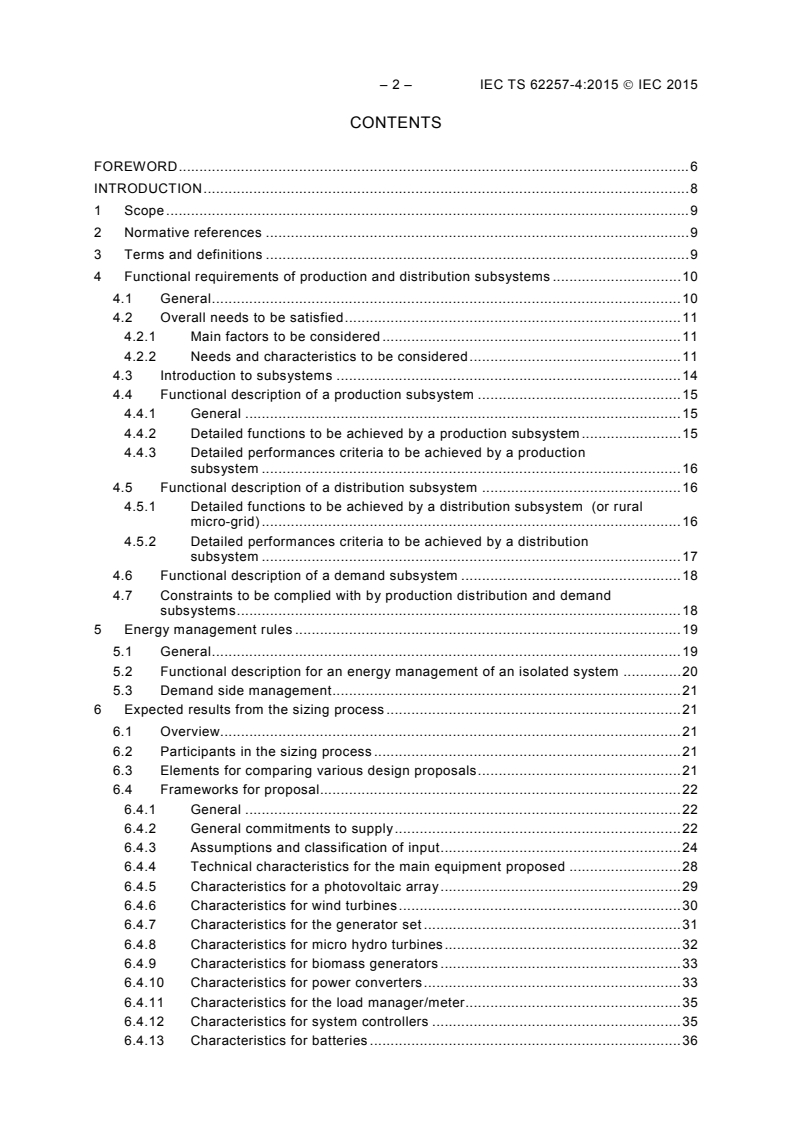
– 2 – IEC TS 62257-4:2015 IEC 2015
CONTENTS
FOREWORD . 6
INTRODUCTION . 8
1 Scope . 9
2 Normative references . 9
3 Terms and definitions . 9
4 Functional requirements of production and distribution subsystems . 10
4.1 General . 10
4.2 Overall needs to be satisfied . 11
4.2.1 Main factors to be considered . 11
4.2.2 Needs and characteristics to be considered . 11
4.3 Introduction to subsystems . 14
4.4 Functional description of a production subsystem . 15
4.4.1 General . 15
4.4.2 Detailed functions to be achieved by a production subsystem . 15
4.4.3 Detailed performances criteria to be achieved by a production
subsystem . 16
4.5 Functional description of a distribution subsystem . 16
4.5.1 Detailed functions to be achieved by a distribution subsystem (or rural
micro-grid) . 16
4.5.2 Detailed performances criteria to be achieved by a distribution
subsystem . 17
4.6 Functional description of a demand subsystem . 18
4.7 Constraints to be complied with by production distribution and demand
subsystems . 18
5 Energy management rules . 19
5.1 General . 19
5.2 Functional description for an energy management of an isolated system . 20
5.3 Demand side management . 21
6 Expected results from the sizing process . 21
6.1 Overview. 21
6.2 Participants in the sizing process . 21
6.3 Elements for comparing various design proposals . 21
6.4 Frameworks for proposal. 22
6.4.1 General . 22
6.4.2 General commitments to supply . 22
6.4.3 Assumptions and classification of input . 24
6.4.4 Technical characteristics for the main equipment proposed . 28
6.4.5 Characteristics for a photovoltaic array . 29
6.4.6 Characteristics for wind turbines . 30
6.4.7 Characteristics for the generator set . 31
6.4.8 Characteristics for micro hydro turbines . 32
6.4.9 Characteristics for biomass generators . 33
6.4.10 Characteristics for power converters . 33
6.4.11 Characteristics for the load manager/meter. 35
6.4.12 Characteristics for system controllers . 35
6.4.13 Characteristics for batteries . 36
6.4.14 Characteristics for links and wiring . 37
6.4.15 Energy outputs . 37
6.4.16 Presentation of the costs . 38
6.4.17 Design warranty . 38
6.4.18 Steps to reduce the impact of climatic hazards on system performance . 39
6.4.19 Presentation of the environmental and social impact. 39
6.4.20 Presentation of the socio- economic impact assessment. 39
6.5 Proposal for a sizing process . 39
6.6 Impact of design assumptions on system sizing and cost . 39
6.7 Guarantee of results . 41
7 Data acquisition rules for system management . 41
7.1 Overview. 41
7.2 General . 41
7.3 Levels of data acquisition and data necessity. 42
7.3.1 General . 42
7.3.2 Information to provide to the energy manager and relevant data to be
collected . 42
7.3.3 Information to provide to the operator and relevant data to be collected . 44
7.3.4 Information to provide to the user and relevant data to be collected . 45
7.3.5 Summary of the information required . 46
7.3.6 Scientific data collection . 46
7.4 Data to be collected . 46
7.5 Operating conditions, electrical and engineering requirements for data
acquisition . 48
Annex A (informative) Example for detailed performance criteria and levels for a
production subsystem . 49
Annex B (informative) Example for detailed performance criteria and levels for a
distribution subsystem . 50
Annex C (informative) Example framework for proposal specification . 51
C.1 Knowledge of site . 51
C.2 Knowledge of consumption data . 51
C.3 Knowledge of resources . 52
C.4 Technical characteristics for the main equipment proposed . 53
C.4.1 Photovoltaic modules . 53
C.4.2 Modules supporting structure . 53
C.5 Characteristics for wind turbines . 53
C.5.1 Wind turbine . 53
C.5.2 Structure support . 54
C.6 Characteristics for the generator set . 54
C.7 Characteristics for micro hydro turbine . 55
C.8 Characteristics for biomass generators . 55
C.9 Characteristics for power converters . 55
C.10 Characteristics for load manager/meter . 56
C.11 Characteristics for system controllers . 57
C.12 Characteristics for battery . 57
C.13 Energy outputs . 58
C.13.1 From renewable energies . 58
C.13.2 From fossil energies . 58
Annex D (informative) Formula for costs calculations . 59
– 4 – IEC TS 62257-4:2015 IEC 2015
D.1 Yearly cash flow. 59
D.2 Calculation of total life cycle cost . 59
D.3 Calculation of the levelized cost of energy . 60
D.4 Annualized maintenance, operating, and replacement expense. 60
D.5 Further economic calculations applicable to energy businesses . 61
Annex E (informative) Proposal for a sizing process . 63
E.1 General . 63
E.2 Comments on the proposed sizing process . 64
E.2.1 General . 64
E.2.2 Step 01: Definition of power requirements to be fulfilled . 65
E.2.3 Step 02: Conversion of available weather data into relevant data . 66
E.2.4 Step 03: Statement of economic data to be accounted for. 67
E.2.5 Step 04: Inventory of the constraints to account for . 67
E.2.6 Step 05: Management assumptions . 68
E.2.7 Step 06: Technical choices . 69
E.2.8 Step 07: Calculations . 70
E.2.9 Step 08: Analysis of the results. 70
E.2.10 Step 09: Examination of the opportunity of other choices . 71
E.2.11 Step 10: Change in technical choices . 71
E.2.12 Step 11: Definition of desired equipment characteristics . 71
E.2.13 Step 12: Identification of existing/available equipment complying with
the characteristics . 71
E.2.14 Step 13: New calculations . 71
E.2.15 Step 14: Analysis of the results. 71
E.2.16 Step 15: Examining the opportunity of other choices . 71
E.2.17 Step 16: New choices of equipment . 71
E.2.18 Step 17: Technical characteristics for the finally chosen equipment . 72
E.2.19 Step 18: Forwarding the results to the project implementer . 72
E.2.20 Step 19: Modification of the input data . 72
Figure 1 – Factors involved in the design of a system . 11
Figure 2 – Functional diagram of a radial structure for rural micro-grid . 18
Figure 3 – Functional impact of energy management and safety . 19
Figure E.1 – Sizing process flow chart . 64
Table 1 – Technical factors – needs or characteristics to be considered . 12
Table 2 – Economic factors – needs and characteristics to be considered . 12
Table 3 – Site characteristics . 13
Table 4 – Regulations and requirements to be considered . 14
Table 5 – Participants in the sizing process . 21
Table 6 – Perspectives to be considered . 23
Table 7 – Commitments indicators . 24
Table 8 – Knowledge of site . 25
Table 9 – Knowledge of consumption data . 26
Table 10 – Knowledge of resources: data accuracy levels . 26
Table 11 – Knowledge of resources: data retained for considered site . 28
Table 12 – Knowledge of resources: range of data history . 28
Table 13 – Characteristics for photovoltaic modules . 29
Table 14 – Characteristics for modules supporting structure . 29
Table 15 – Characteristics for the wind turbine . 30
Table 16 – Characteristics for wind turbine structure . 30
Table 17 – Characteristics for the generator set . 31
Table 18 – Characteristics for micro hydro turbines . 32
Table 19 – Characteristics for biomass generators . 33
Table 20 – Characteristics for power converters . 34
Table 21 – Characteristics for load manager/meter . 35
Table 22 – Characteristics for system controllers . 36
Table 23 – Characteristics for batteries . 36
Table 24 – Characteristics for links and wiring . 37
Table 25 – Energy output from renewable energies. 37
Table 26 – Energy output from fossil energies . 37
Table 27 – Energy output from storage . 38
Table 28 – Incidence of energy management assumptions on system sizing . 40
Table 29 – Incidence of cost management assumptions on system dimensions . 41
Table 30 – Information required by the energy manager and data to collect . 43
Table 31 – Information required by the operator and data to collect . 45
Table 32 – Information required by the user and data to collect . 45
Table 33 – Summary of the needed information . 46
Table 34 – Minimum set of data to be collected . 47
Table 35 – Relationship between required information and system architecture . 48
Table A.1 – Detailed performance criteria and levels for a production subsystem . 49
Table A.2 – Typical example of Table A.1 . 49
Table B.1 – Detailed performance criteria and levels for a distribution subsystem . 50
Table B.2 – Typical example of Table B.2 . 50
Table E.1 – Description of utilities to be power supplied . 65
Table E.2 – Consumption characteristics . 66
Table E.3 – Meteorological data used for sizing . 66
Table E.4 – Proposals for types of cost to be accounted for . 67
Table E.5 – Site constraints inventory . 67
Table E.6 – Impact of energy management assumptions on plant sizing . 68
Table E.7 – Impact of cost management assumptions on plant sizing . 69
– 6 – IEC TS 62257-4:2015 IEC 2015
INTERNATIONAL ELECTROTECHNICAL COMMISSION
____________
RECOMMENDATIONS FOR RENEWABLE ENERGY
AND HYBRID SYSTEMS FOR RURAL ELECTRIFICATION –
Part 4: System selection and design
FOREWORD
1) The International Electrotechnical Commission (IEC) is a worldwide organization for standardization comprising
all national electrotechnical committees (IEC National Committees). The object of IEC is to promote
international co-operation on all questions concerning standardization in the electrical and electronic fields. To
this end and in addition to other activities, IEC publishes International Standards, Technical Specifications,
Technical Reports, Publicly Available Specifications (PAS) and Guides (hereafter referred to as “IEC
Publication(s)”). Their preparation is entrusted to technical committees; any IEC National Committee interested
in the subject dealt with may participate in this preparatory work. International, governmental and non-
governmental organizations liaising with the IEC also participate in this preparation. IEC collaborates closely
with the International Organization for Standardization (ISO) in accordance with conditions determined by
agreement between the two organizations.
2) The formal decisions or agreements of IEC on technical matters express, as nearly as possible, an international
consensus of opinion on the relevant subjects since each technical committee has representation from all
interested IEC National Committees.
3) IEC Publications have the form of recommendations for international use and are accepted by IEC National
Committees in that sense. While all reasonable efforts are made to ensure that the technical content of IEC
Publications is accurate, IEC cannot be held responsible for the way in which they are used or for any
misinterpretation by any end user.
4) In order to promote international uniformity, IEC National Committees undertake to apply IEC Publications
transparently to the maximum extent possible in their national and regional publications. Any divergence
between any IEC Publication and the corresponding national or regional publication shall be clearly indicated in
the latter.
5) IEC itself does not provide any attestation of conformity. Independent certification bodies provide conformity
assessment services and, in some areas, access to IEC marks of conformity. IEC is not responsible for any
services carried out by independent certification bodies.
6) All users should ensure that they have the latest edition of this publication.
7) No liability shall attach to IEC or its directors, employees, servants or agents including individual experts and
members of its technical committees and IEC National Committees for any personal injury, property damage or
other damage of any nature whatsoever, whether direct or indirect, or for costs (including legal fees) and
expenses arising out of the publication, use of, or reliance upon, this IEC Publication or any other IEC
Publications.
8) Attention is drawn to the Normative references cited in this publication. Use of the referenced publications is
indispensable for the correct application of this publication.
9) Attention is drawn to the possibility that some of the elements of this IEC Publication may be the subject of
patent rights. IEC shall not be held responsible for identifying any or all such patent rights.
The main task of IEC technical committees is to prepare International Standards. In
exceptional circumstances, a technical committee may propose the publication of a technical
specification when
• the required support cannot be obtained for the publication of an International Standard,
despite repeated efforts, or
• the subject is still under technical development or where, for any other reason, there is the
future but no immediate possibility of an agreement on an International Standard.
Technical specifications are subject to review within three years of publication to decide
whether they can be transformed into International Standards.
IEC 62257-4, which is a technical specification, has been prepared by IEC technical
committee 82: Solar photovoltaic energy systems.
This second edition cancels and replaces the first edition issued in 2005. It constitutes a
technical revision.
The main technical changes with regard to the previous edition are as follows:
– redefine the maximum AC voltage from 500 V to 1 000 V, the maximum DC voltage from
750 V to 1 500 V;
– removal of the limitation of 100 kVA system size. Hence the removal of the word “small” in
the title and related references in this technical specification.
This technical specification is to be used in conjunction with the IEC 62257 series.
The text of this technical specification is based on the following documents:
Enquiry draft Report on voting
82/949/DTS 82/1000A/RVC
Full information on the voting for the approval of this technical specification can be found in
the report on voting indicated in the above table.
This publication has been drafted in accordance with the ISO/IEC Directives, Part 2.
A list of all parts in the IEC 62257 series, published under the general title Recommendations
for renewable energy and hybrid systems for rural electrification, can be found on the IEC
website.
Future standards in this series will carry the new general title as cited above. Titles of existing
standards in this series will be updated at the time of the next edition.
The committee has decided that the contents of this publication will remain unchanged until
the stability date indicated on the IEC website under "http://webstore.iec.ch" in the data
related to the specific publication. At this date, the publication will be
• transformed into an International standard,
• reconfirmed,
• withdrawn,
• replaced by a revised edition, or
• amended.
A bilingual version of this publication may be issued at a later date.
– 8 – IEC TS 62257-4:2015 IEC 2015
INTRODUCTION
The IEC 62257 series intends to provide to different players involved in rural electrification
projects (such as project implementers, project contractors, project supervisors, installers,
etc.) documents for the setting up of renewable energy and hybrid systems with AC voltage
below 1 000 V and DC voltage below 1 500 V.
These documents are recommendations:
• to choose the right system for the right place;
• to design the system;
• to operate and maintain the system.
These documents are focused only on rural electrification concentrating on but not specific to
developing countries. They should not be considered as all inclusive to rural electrification.
The documents try to promote the use of renewable energies in rural electrification; they do
not deal with clean mechanisms developments at this time (CO emission, carbon credit, etc.).
Further developments in this field could be introduced in future steps.
This consistent set of documents is best considered as a whole with different parts
corresponding to items for safety, sustainability of systems aiming at the lowest life cycle cost
as possible. One of the main objectives is to provide the minimum sufficient requirements,
relevant to the field of application that is: renewable energy and hybrid off-grid systems.
RECOMMENDATIONS FOR RENEWABLE ENERGY
AND HYBRID SYSTEMS FOR RURAL ELECTRIFICATION –
Part 4: System selection and design
1 Scope
This part of IEC 62257 provides a method for describing the results to be achieved by the
electrification system independently of the technical solutions that could be implemented.
The purpose of this part of IEC 62257 is to provide a method to assist project contractors and
project developers to select and design the electrification system for isolated sites while
matching the identified needs, such as those described in IEC TS 62257-2. IEC TS 62257-2
assesses the needs of the users and the different power system architectures which can be
used for meeting these needs. In relation to the needs of the different participants to the
project, functional requirements that shall be achieved by the production and distribution
subsystems are listed.
In Clause 5, energy management rules to be considered are described. These are key issues
as they have a great influence on the sizing of the electrification system.
In Clause 6, the informations provided by the system sizing process to allow the participants
to select the equipment or component able to fulfil the functional requirements are listed.
To allow and facilitate the management of the micro-power plant and the maintenance of the
whole electrification system, some information is collected and monitored.
Clause 7 is dedicated to defining the parameters and specifying rules for data acquisition.
2 Normative references
The following documents, in whole or in part, are normatively referenced in this document and
are indispensable for its application. For dated references, only the edition cited applies. For
undated references, the latest edition of the referenced document (including any
amendments) applies.
IEC TS 62257-2:2015, Recommendations for renewable energy and hybrid systems for rural
electrification – Part 2: From requirements to a range of electrification systems
IEC TS 62257-3:2015, Recommendations for renewable energy and hybrid systems for rural
electrification – Part 3: Project development and management
3 Terms and definitions
For the purposes of this document, the following terms and definitions apply.
3.1
renewable energy
RE
energy from a source that is not depleted when used
– 10 – IEC TS 62257-4:2015 IEC 2015
3.2
hybrid system
multi-sources system with at least two different kind of technologies
3.3
dispatchable power system
power system considered dispatchable if delivered power is available at any specified time,
e.g diesel generator
3.4
non-dispatchable power system
power system considered non-dispatchable system when it is resource dependent and whose
power might not be available at a specified time, e.g solar grid connected system
3.5
storage
storage of energy produced by one of the generators of the system and which can be
reconverted through the system into electricity
3.6
rural mini-power plant
power plant that produces less than 100 kVA through the use of a single resource or hybrid
system
3.7
rural mini-grid
grid that transfers a capacity level less than 100 kVA and powered by a micro-power plant
3.8
individual electrification system
IES
micro-power plant system that supplies electricity to one consumption point usually with a
single energy resource point
3.9
collective electrification system
CES
micro-power plant and micro-grid that supplies electricity to multiple consumption points using
a single or multiple energy resource points
3.10
isolated site
electric characteristic to define a specific location not currently connected to a national/
regional grid
3.11
remote site
remote area
geographic characteristic to define a specific location far from developed infrastructures,
specifically energy distribution
4 Functional requirements of production and distribution subsystems
4.1 General
The purpose of Clause 4 is to provide a method for describing the results to be achieved by
electrification systems for isolated sites as defined in IEC TS 62257-2. It describes the
characteristics expected from these installations based on production of electricity from
renewable and/or fossil energy sources.
This stage of defining the expected results of production precedes the technical dimensioning
and details engineering stages.
4.2 Overall needs to be satisfied
4.2.1 Main factors to be considered
Figure 1 illustrates the main factors influencing the design of the micro-power plant.
Technical factors involved Economic factors involved in
in the system the system implementation
implementation
System design
International/national/local
Site characteristics
regulations and technical
standard requirements
IEC
Figure 1 – Factors involved in the design of a system
4.2.2 Needs and characteristics to be considered
For each of the factors depicted in Figure 1, detailed needs or characteristics to be
considered shall be identified. These needs and characteristics are defined in Tables 1 to 4.
– 12 – IEC TS 62257-4:2015 IEC 2015
Table 1 – Technical factors – needs or characteristics to be considered
Nature of participant Needs or characteristics
Project developer/owner Compliance with the general specification and relevant standards.
Efficient use of energy (demand side management).
Project Easiest possible implementation: limited constraints in terms of transportation
implementer/subcontractor means and lifting apparatus.
Technology compatible with limited skills of local manpower.
Limited installation work duration on field.
Standardized equipment.
Operator Simple operational rules to cope with possible limited skills of local operating
agents.
Simple mounting tools.
Reliable equipment.
Simple management rules.
Clear and unambiguous contractual rules not liable to lead to situations of dispute
or litigation.
Relevant technical choices/customer management.
Limited spare parts variety.
Maintenance contractor Reliable and easy-to replace on site equipment.
Limited spare parts variety.
Different users/loads Types of energy services (see IEC TS 62257-2:2015, Annex B).
Table 2 – Economic factors – needs and characteristics to be considered
Nature of participant Needs or characteristics
Project developer/owner Balance between initial capital costs and operational costs to make the project
profitable and sustainable.
Project implementer Balance between equipment cost (purchase and installation) and specified level of
reliability.
Subcontractor To make a correct living while fulfilling the project implementer’s requirements.
Operator Operational costs as low as possible.
Maintenance contractor To have an economically viable activity while fulfilling the operator’s requirements.
The different users/loads Available services promised (lighting, TV, etc.) at the contractual level of quality,
for the agreed price.
Table 3 – Site characteristics
General
characteristics Detailed characteristics Comments
of site
Geographical Weather statistics (T°, General information about the standard conditions at the site.
environment humidity, wind, precipitation,
etc.)
Climate and severe weather or The characteristics of the climate at the site will affect the
other local hazards design of the system and the nature of its constituent
equipment.
One may mention:
• temperature differences;
• hygrometry differences;
• rainfall and snowfall;
• superimposed loads on structures (caused by wind,
cyclones, frost, etc.);
• pollution (sand, salt, dust, other pollutant wastes).
Energy resources Definition of local energy resources. See Table 4 for further
details.
Means of access to and General access to the site, bridges road conditions and ease
around the site of access around the site (streets, rivers, etc.) will affect the
difficulty in crossing obstacles and anticipating changes in the
micro distribution network, etc.
Nature of soil (geological This affects the type of structure (overhead or buried power
environment) lines) to be set up and the execution of certain installations
(for example grounding system depending on the resistively
characteristics of the ground and system foundations).
Geographical distribution of This is a major factor in the cost of the distribution
the user points infrastructures. The scatter or concentration of the user
points, their probable evolution (near or remote) time-wise
and space-wise, will affect choices concerning the topology of
the distribution network.
Human Distance to/between homes /
environment loads – production system
Type of homes /loads
Acceptable noise level
Acceptable waste disposal
level
Type of building to house the
rural micro-power plant
Biological Fauna
environment
Flora
Type of tree cover
Technical Type of grid in place, if any
environment (overhead, buried)
Civil engineering
Quality of existing building This may be either an ally or an enemy as regards to certain
solutions for providing supports for conductors (the physical
quality of the building, its height, etc.)
Possible local maintenance at
site
Available telecommunication
facilities
Equipment restrictions
Local technical skills level
Soil resistivity
– 14 – IEC TS 62257-4:2015 IEC 2015
General
characteristics Detailed characteristics Comments
of site
Sociological Energy needs of customers How much energy will consumers need and be willing to pay
environment for.
Energy consumption habits Load profiles for the community.
Type of clientele Distribution by a grid will take place on the basis of:
• Sociological criteria (rules of society, living habits).
• Economic criteria combining the grid and the rural micro-
power plant shall cost less than the sum of isolated
individual production/distribution facilities whilst providing
the same service.
• Technical criteria (a guaranteed level of service, security,
etc.).
Economic Cost of fuel delivered to site
environment
Cost of technical services
Economic environments in
place
Solvability of customers
Tariff basis for service
Table 4 – Regulations and requirements to be considered
Regulatory area References
Procurement quality
Electrical safety
Distribution conditions
Buildings Generation/distribution To be filled for each project
Fuel storage
Fuel transport
Local environmental impact
Classified site
Miscellaneous decrees
Possibility of recycling equipment
Production/distribution specification
Import duties
Regulatory authorities
Local labor requirements
4.3 Introduction to subsystems
An electrification system shall be considered as a subsystem if it fulfills the following functions:
a) ensuring a power supply service (production subsystem);
and
b) providing an electric power distribution service (distribution subsystem);
and
c) providing a service to the user (demand subsystem);
whilst at the same time complying with constraints (acting on all subsystems);
1) individual Electrification Systems (IES) for single users/loads incorporate two
subsystems:
• an electrical power production subsystem,
• a demand subsystem for utilizing this electrical power.
2) collective Electrification Systems (CES) for multiple users incorporate three
subsystems:
• an electrical power production subsystem (rural micro-power plant);
• a distribution grid for sharing this power to individual users (rural micro-grid);
• a demand subsystem including home wiring and user’s electrical appliances for all
individual users.
These subsystems may correspond to systems operated and maintained by different persons
or bodies. In certain cases, the entire system may be owned, operated and used by the same
person.
4.4 Functional description of a production subsystem
4.4.1 General
The function of a production subsystem is to supply electric power and energy to an individual
customer or a combination of permanent customers. This generating subsystem shall be
capable of fulfilling its mission, despite contingencies of availability of the renewable and/or
fossil energy sources supplying it and by managing the consumption patterns of the
customers.
The technical objectives assigned to such an installation can be summarised in the following
essential points:
• to produce and store the energy in a cost effective manner,
• if “REN” sources are used:
– to give precedence to use of REN where they are locally available,
– to store energy from the REN sources whenever they are available,
– to use the back-up energy sources (generator sets) to meet the specified level of
service when REN are not available or sufficient.
4.4.2 Detailed functions to be achieved by a production subsystem
From a functional view point, a production subsystem is a system capable of:
Ensuring a power supply service consisting of:
a) Generating electric power
The different sources and architectures are described in IEC TS 62257-2.
This function embodies everything needed to produce electric power corresponding to the
necessary characteristics of voltage, frequency, harmonics, po
...