

IEC TS 61724-2:2025
(Main)Photovoltaic system performance - Part 2: Power performance index and capacity evaluation method
General Information
- Abstract
IEC TS 61724-2:2025 applies to grid-connected PV systems comprising at least one inverter.
The test evaluates the PV system only in conditions where output is unconstrained by limitations in AC power output from the inverters. This document defines a test of a PV system's power performance index (PPI). PPI, defined in IEC 61724‑1, is the ratio of a system's measured power output under test conditions to its expected output at those conditions based on the system's design.
The test is intended to be performed over a short period of typically three to five days and is typically used to satisfy a contractual performance guarantee as part of the final completion of a PV power plant. This second edition cancels and replaces the first edition published in 2016. This edition includes the following significant technical changes with respect to the previous edition:
a) Adapting the document for bifacial PV systems, in accordance with the latest edition of IEC 61724‑1 and current industry practices.
b) Adapting the test procedure to account for the limited times of unconstrained system operation which are now common because of high DC-to-AC ratios (clipping) and interconnection limits (curtailment).
c) Adapting the test procedure to achieve a test that can be performed in a short time of three to five days during favourable conditions.
d) Focusing the document more heavily on the use of modern PV system modelling software to obtain the expected performance of the system under test.
e) Simplifying the mathematical procedure for calculating the test results.
f) Clearly identifying test elections (optional choices to be made in conducting the test) and providing a template for documenting these elections.
g) Clarifying the discussion of the test boundary that separates tested variables from untested variables.
h) Expanding and clarifying the discussion of data filtering.
- Status
- Published
- Publication Date
- 21-Sep-2025
- Technical Committee
- TC 82 - Solar photovoltaic energy systems
- Drafting Committee
- WG 3 - TC 82/WG 3
- Current Stage
- PPUB - Publication issued
- Start Date
- 22-Sep-2025
- Completion Date
- 05-Sep-2025

Overview
IEC TS 61724-2:2025 sets out the technical specification for evaluating the power performance of grid-connected photovoltaic (PV) systems, specifically those incorporating at least one inverter. Developed by the International Electrotechnical Commission (IEC), this standard defines the method to test the Power Performance Index (PPI), a crucial indicator used to assess whether a PV system's actual power output under specific test conditions meets design expectations.
The test described in IEC TS 61724-2:2025 is typically conducted over a concise period of three to five days and is widely used to confirm that newly commissioned PV power plants meet contractual performance guarantees. This edition (2025) introduces important updates, reflecting advancements in PV technology, expanded use of bifacial modules, and new industry practices in system modeling and data processing.
Key Topics
Power Performance Index (PPI):
PPI measures the ratio of measured AC power produced by the PV system to the expected output, as predicted using the system design parameters and environmental conditions.Unconstrained Operation Testing:
The test is valid only during periods when the system output is not limited by inverter AC capacity (no clipping or curtailment).Test Elections:
These are choices regarding procedures, measurement approaches, and maintenance (like module cleaning vs. soiling compensation). Test elections set the boundaries of the assessment and must be documented, as they directly influence what aspects of the PV system are evaluated.Measurement and Data Collection:
Weather parameters (irradiance, temperature, wind speed) and system output are measured according to guidelines in IEC 61724-1. Measurement intervals are typically kept short (around one minute) to improve data resolution and accuracy.Performance Modeling:
The expected power is calculated using modern PV system modeling software, which factors in module specifications, site orientation, irradiance, and temperature data.Adaptation for Bifacial PV Systems:
The standard now accommodates bifacial systems, aligning with how these modules interact with environmental variables and system layouts.Short-Term Test Focus:
Emphasis is on tests that can be performed efficiently-usually within five days-while ensuring reliability even with prevalent industry challenges like high DC-to-AC ratio systems.Data Filtering and Test Boundaries:
Expanded guidance clarifies how to filter data (such as excluding periods of shading or invalid sensor readings) and accurately define what is being tested.Template for Documenting Test Elections:
To ensure total transparency and reproducibility, a standardized template for documenting all procedural decisions is included.
Applications
Commissioning of PV Power Plants:
Owners, operators, and EPC contractors use IEC TS 61724-2 for verifying that a completed PV system meets performance guarantees before handover.Contract Performance Guarantees:
The method offers a standardized and internationally recognized approach for contractual capacity tests for grid-connected PV installations.Quality Assurance and Performance Benchmarking:
By defining clear procedures and boundaries, the standard supports fair comparison across different sites and technologies.Utility-Scale and Commercial PV Projects:
Suitable for large installations, including those with bifacial modules and advanced tracking systems.Troubleshooting and Post-Performance Analysis:
The detailed documentation of measurement approaches and filtering criteria aids in diagnosing performance issues and optimizing operation.
Related Standards
IEC 61724-1:2021 - Photovoltaic system performance – Part 1: Monitoring
Details the requirements for monitoring PV system parameters and sensor specifications, forming the foundational measurement basis for IEC TS 61724-2.IEC TS 61724-3 - Photovoltaic system performance – Part 3: Energy performance evaluation method
Describes procedures for evaluating PV system performance over extended time frames, including during periods of constrained operation.IEC TS 61836 - Solar photovoltaic energy systems – Terms and symbols
Provides authoritative definitions and standard terminology relevant to PV performance evaluation.
Keywords: IEC TS 61724-2, photovoltaic system performance, power performance index, PV system capacity test, PV commissioning, bifacial PV, grid-connected PV system, IEC standards, PV performance evaluation, PV system modeling.
Relations
- Effective Date
- 05-Sep-2023
Get Certified
Connect with accredited certification bodies for this standard

DNV
DNV is an independent assurance and risk management provider.

Lloyd's Register
Lloyd's Register is a global professional services organisation specialising in engineering and technology.
DNV Energy Systems
Energy and renewable energy certification.
Sponsored listings
Frequently Asked Questions
IEC TS 61724-2:2025 is a technical specification published by the International Electrotechnical Commission (IEC). Its full title is "Photovoltaic system performance - Part 2: Power performance index and capacity evaluation method". This standard covers: IEC TS 61724-2:2025 applies to grid-connected PV systems comprising at least one inverter. The test evaluates the PV system only in conditions where output is unconstrained by limitations in AC power output from the inverters. This document defines a test of a PV system's power performance index (PPI). PPI, defined in IEC 61724‑1, is the ratio of a system's measured power output under test conditions to its expected output at those conditions based on the system's design. The test is intended to be performed over a short period of typically three to five days and is typically used to satisfy a contractual performance guarantee as part of the final completion of a PV power plant. This second edition cancels and replaces the first edition published in 2016. This edition includes the following significant technical changes with respect to the previous edition: a) Adapting the document for bifacial PV systems, in accordance with the latest edition of IEC 61724‑1 and current industry practices. b) Adapting the test procedure to account for the limited times of unconstrained system operation which are now common because of high DC-to-AC ratios (clipping) and interconnection limits (curtailment). c) Adapting the test procedure to achieve a test that can be performed in a short time of three to five days during favourable conditions. d) Focusing the document more heavily on the use of modern PV system modelling software to obtain the expected performance of the system under test. e) Simplifying the mathematical procedure for calculating the test results. f) Clearly identifying test elections (optional choices to be made in conducting the test) and providing a template for documenting these elections. g) Clarifying the discussion of the test boundary that separates tested variables from untested variables. h) Expanding and clarifying the discussion of data filtering.
IEC TS 61724-2:2025 applies to grid-connected PV systems comprising at least one inverter. The test evaluates the PV system only in conditions where output is unconstrained by limitations in AC power output from the inverters. This document defines a test of a PV system's power performance index (PPI). PPI, defined in IEC 61724‑1, is the ratio of a system's measured power output under test conditions to its expected output at those conditions based on the system's design. The test is intended to be performed over a short period of typically three to five days and is typically used to satisfy a contractual performance guarantee as part of the final completion of a PV power plant. This second edition cancels and replaces the first edition published in 2016. This edition includes the following significant technical changes with respect to the previous edition: a) Adapting the document for bifacial PV systems, in accordance with the latest edition of IEC 61724‑1 and current industry practices. b) Adapting the test procedure to account for the limited times of unconstrained system operation which are now common because of high DC-to-AC ratios (clipping) and interconnection limits (curtailment). c) Adapting the test procedure to achieve a test that can be performed in a short time of three to five days during favourable conditions. d) Focusing the document more heavily on the use of modern PV system modelling software to obtain the expected performance of the system under test. e) Simplifying the mathematical procedure for calculating the test results. f) Clearly identifying test elections (optional choices to be made in conducting the test) and providing a template for documenting these elections. g) Clarifying the discussion of the test boundary that separates tested variables from untested variables. h) Expanding and clarifying the discussion of data filtering.
IEC TS 61724-2:2025 is classified under the following ICS (International Classification for Standards) categories: 27.160 - Solar energy engineering. The ICS classification helps identify the subject area and facilitates finding related standards.
IEC TS 61724-2:2025 has the following relationships with other standards: It is inter standard links to IEC TS 61724-2:2016. Understanding these relationships helps ensure you are using the most current and applicable version of the standard.
IEC TS 61724-2:2025 is available in PDF format for immediate download after purchase. The document can be added to your cart and obtained through the secure checkout process. Digital delivery ensures instant access to the complete standard document.
Standards Content (Sample)
IEC TS 61724-2 ®
Edition 2.0 2025-09
TECHNICAL
SPECIFICATION
Photovoltaic system performance -
Part 2: Power performance index and capacity evaluation method
ICS 27.160 ISBN 978-2-8327-0656-5
All rights reserved. Unless otherwise specified, no part of this publication may be reproduced or utilized in any form or
by any means, electronic or mechanical, including photocopying and microfilm, without permission in writing from either
IEC or IEC's member National Committee in the country of the requester. If you have any questions about IEC copyright
or have an enquiry about obtaining additional rights to this publication, please contact the address below or your local
IEC member National Committee for further information.
IEC Secretariat Tel.: +41 22 919 02 11
3, rue de Varembé info@iec.ch
CH-1211 Geneva 20 www.iec.ch
Switzerland
About the IEC
The International Electrotechnical Commission (IEC) is the leading global organization that prepares and publishes
International Standards for all electrical, electronic and related technologies.
About IEC publications
The technical content of IEC publications is kept under constant review by the IEC. Please make sure that you have the
latest edition, a corrigendum or an amendment might have been published.
IEC publications search - IEC Products & Services Portal - products.iec.ch
webstore.iec.ch/advsearchform Discover our powerful search engine and read freely all the
The advanced search enables to find IEC publications by a publications previews, graphical symbols and the glossary.
variety of criteria (reference number, text, technical With a subscription you will always have access to up to date
committee, …). It also gives information on projects, content tailored to your needs.
replaced and withdrawn publications.
Electropedia - www.electropedia.org
The world's leading online dictionary on electrotechnology,
IEC Just Published - webstore.iec.ch/justpublished
Stay up to date on all new IEC publications. Just Published containing more than 22 500 terminological entries in English
details all new publications released. Available online and and French, with equivalent terms in 25 additional languages.
once a month by email. Also known as the International Electrotechnical Vocabulary
(IEV) online.
IEC Customer Service Centre - webstore.iec.ch/csc
If you wish to give us your feedback on this publication or
need further assistance, please contact the Customer
Service Centre: sales@iec.ch.
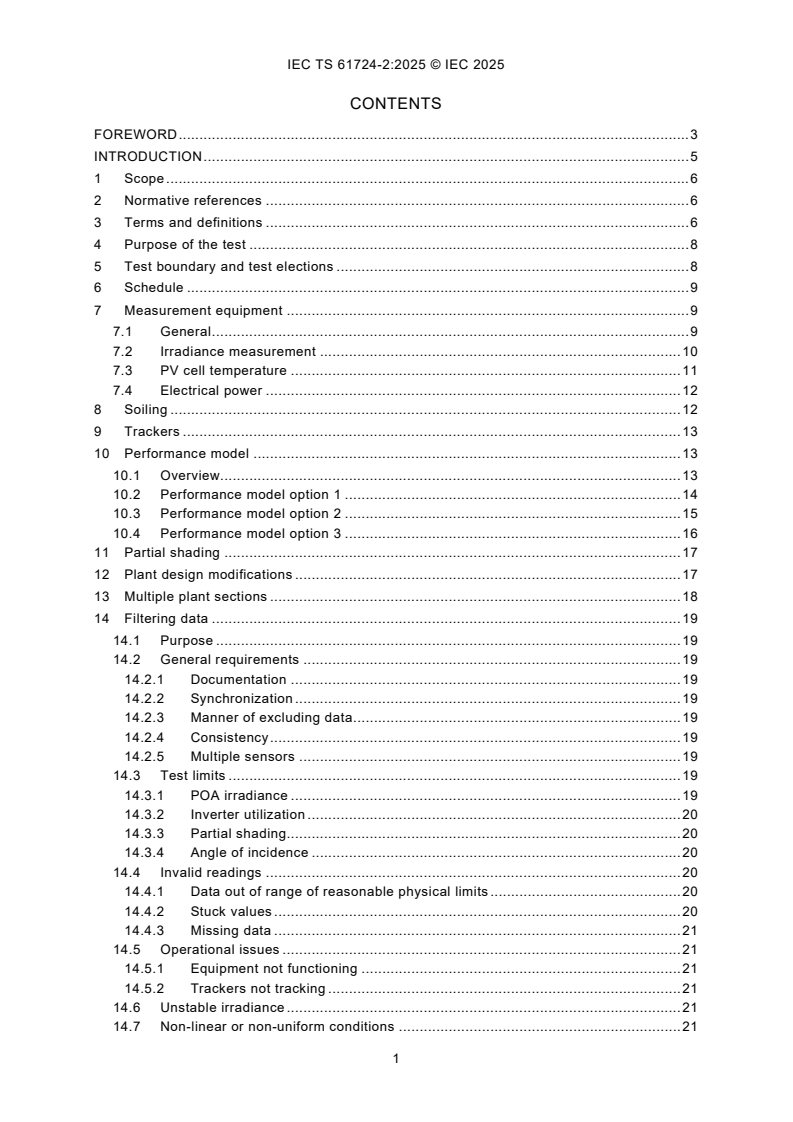
CONTENTS
FOREWORD . 3
INTRODUCTION . 5
1 Scope . 6
2 Normative references . 6
3 Terms and definitions . 6
4 Purpose of the test . 8
5 Test boundary and test elections . 8
6 Schedule . 9
7 Measurement equipment . 9
7.1 General . 9
7.2 Irradiance measurement . 10
7.3 PV cell temperature . 11
7.4 Electrical power . 12
8 Soiling . 12
9 Trackers . 13
10 Performance model . 13
10.1 Overview. 13
10.2 Performance model option 1 . 14
10.3 Performance model option 2 . 15
10.4 Performance model option 3 . 16
11 Partial shading . 17
12 Plant design modifications . 17
13 Multiple plant sections . 18
14 Filtering data . 19
14.1 Purpose . 19
14.2 General requirements . 19
14.2.1 Documentation . 19
14.2.2 Synchronization . 19
14.2.3 Manner of excluding data . 19
14.2.4 Consistency . 19
14.2.5 Multiple sensors . 19
14.3 Test limits . 19
14.3.1 POA irradiance . 19
14.3.2 Inverter utilization . 20
14.3.3 Partial shading. 20
14.3.4 Angle of incidence . 20
14.4 Invalid readings . 20
14.4.1 Data out of range of reasonable physical limits . 20
14.4.2 Stuck values . 20
14.4.3 Missing data . 21
14.5 Operational issues . 21
14.5.1 Equipment not functioning . 21
14.5.2 Trackers not tracking . 21
14.6 Unstable irradiance . 21
14.7 Non-linear or non-uniform conditions . 21
15 Procedure . 22
15.1 Determine and document test elections . 22
15.2 Acquire measured data . 22
15.3 Filter the data . 22
15.4 Determine coefficients of the performance equation, if used . 22
15.5 Calculate expected power . 22
15.6 Calculate power performance index (PPI) . 22
16 Test report . 23
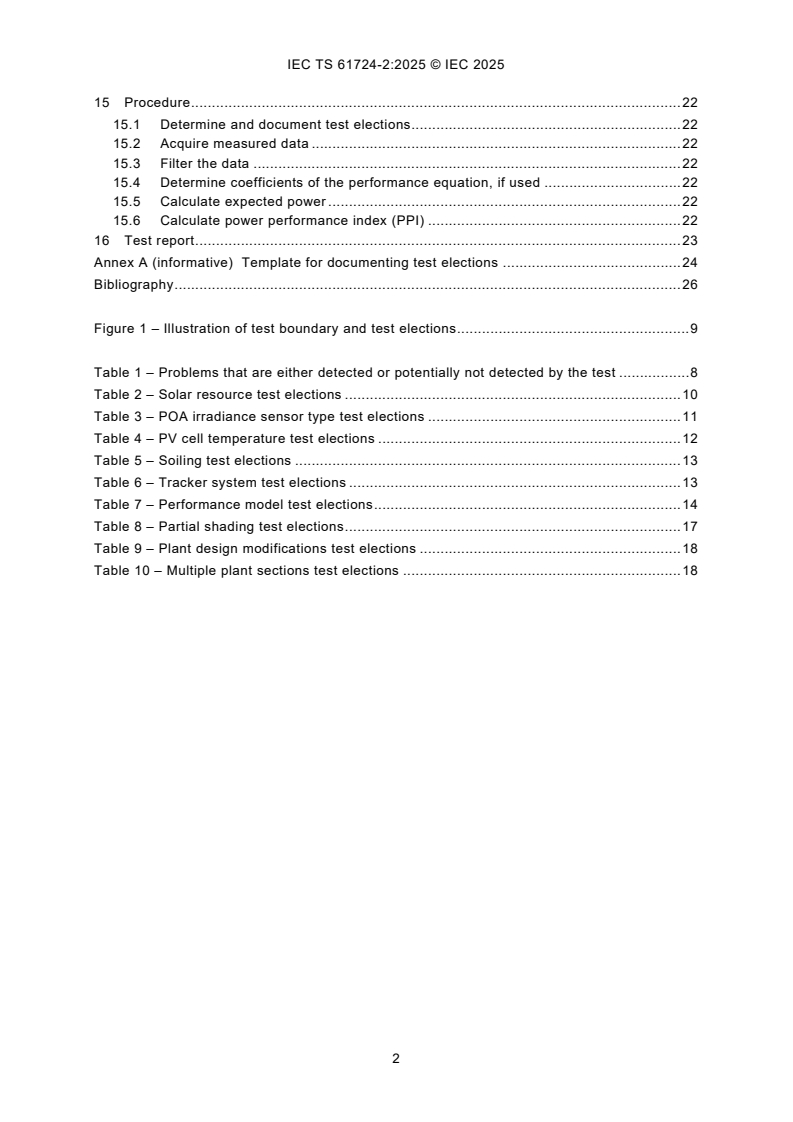
Annex A (informative) Template for documenting test elections . 24
Bibliography . 26
Figure 1 – Illustration of test boundary and test elections . 9
Table 1 – Problems that are either detected or potentially not detected by the test . 8
Table 2 – Solar resource test elections . 10
Table 3 – POA irradiance sensor type test elections . 11
Table 4 – PV cell temperature test elections . 12
Table 5 – Soiling test elections . 13
Table 6 – Tracker system test elections . 13
Table 7 – Performance model test elections . 14
Table 8 – Partial shading test elections . 17
Table 9 – Plant design modifications test elections . 18
Table 10 – Multiple plant sections test elections . 18
INTERNATIONAL ELECTROTECHNICAL COMMISSION
____________
Photovoltaic system performance -
Part 2: Power performance index and capacity evaluation method
FOREWORD
1) The International Electrotechnical Commission (IEC) is a worldwide organization for standardization comprising
all national electrotechnical committees (IEC National Committees). The object of IEC is to promote international
co-operation on all questions concerning standardization in the electrical and electronic fields. To this end and
in addition to other activities, IEC publishes International Standards, Technical Specifications, Technical Reports,
Publicly Available Specifications (PAS) and Guides (hereafter referred to as "IEC Publication(s)"). Their
preparation is entrusted to technical committees; any IEC National Committee interested in the subject dealt with
may participate in this preparatory work. International, governmental and non-governmental organizations liaising
with the IEC also participate in this preparation. IEC collaborates closely with the International Organization for
Standardization (ISO) in accordance with conditions determined by agreement between the two organizations.
2) The formal decisions or agreements of IEC on technical matters express, as nearly as possible, an international
consensus of opinion on the relevant subjects since each technical committee has representation from all
interested IEC National Committees.
3) IEC Publications have the form of recommendations for international use and are accepted by IEC National
Committees in that sense. While all reasonable efforts are made to ensure that the technical content of IEC
Publications is accurate, IEC cannot be held responsible for the way in which they are used or for any
misinterpretation by any end user.
4) In order to promote international uniformity, IEC National Committees undertake to apply IEC Publications
transparently to the maximum extent possible in their national and regional publications. Any divergence between
any IEC Publication and the corresponding national or regional publication shall be clearly indicated in the latter.
5) IEC itself does not provide any attestation of conformity. Independent certification bodies provide conformity
assessment services and, in some areas, access to IEC marks of conformity. IEC is not responsible for any
services carried out by independent certification bodies.
6) All users should ensure that they have the latest edition of this publication.
7) No liability shall attach to IEC or its directors, employees, servants or agents including individual experts and
members of its technical committees and IEC National Committees for any personal injury, property damage or
other damage of any nature whatsoever, whether direct or indirect, or for costs (including legal fees) and
expenses arising out of the publication, use of, or reliance upon, this IEC Publication or any other IEC
Publications.
8) Attention is drawn to the Normative references cited in this publication. Use of the referenced publications is
indispensable for the correct application of this publication.
9) IEC draws attention to the possibility that the implementation of this document may involve the use of (a)
patent(s). IEC takes no position concerning the evidence, validity or applicability of any claimed patent rights in
respect thereof. As of the date of publication of this document, IEC had not received notice of (a) patent(s), which
may be required to implement this document. However, implementers are cautioned that this may not represent
the latest information, which may be obtained from the patent database available at https://patents.iec.ch. IEC
shall not be held responsible for identifying any or all such patent rights.
IEC TS 61724-2 has been prepared by IEC technical committee 82: Solar photovoltaic energy
systems. It is a Technical Specification.
This second edition cancels and replaces the first edition published in 2016. This edition
constitutes a technical revision.
This edition includes the following significant technical changes with respect to the previous
edition:
a) Adapting the document for bifacial PV systems, in accordance with the latest edition of
IEC 61724-1 and current industry practices.
b) Adapting the test procedure to account for the limited times of unconstrained system
operation which are now common because of high DC-to-AC ratios (clipping) and
interconnection limits (curtailment).
c) Adapting the test procedure to achieve a test that can be performed in a short time of three
to five days during favorable conditions.
d) Focusing the document more heavily on the use of modern PV system modeling software to
obtain the expected performance of the system under test.
e) Simplifying the mathematical procedure for calculating the test results.
f) Clearly identifying test elections (optional choices to be made in conducting the test) and
providing a template for documenting these elections.
g) Clarifying the discussion of the test boundary that separates tested variables from untested
variables.
h) Expanding and clarifying the discussion of data filtering.
The text of this Technical Specification is based on the following documents:
Draft Report on voting
82/2386/DTS 82/2484/RVDTS
Full information on the voting for its approval can be found in the report on voting indicated in
the above table.
The language used for the development of this Technical Specification is English.
This document was drafted in accordance with ISO/IEC Directives, Part 2, and developed in
accordance with ISO/IEC Directives, Part 1 and ISO/IEC Directives, IEC Supplement, available
at www.iec.ch/members_experts/refdocs. The main document types developed by IEC are
described in greater detail at www.iec.ch/publications.
A list of all parts in the IEC 61724 series, published under the general title Photovoltaic system
performance, can be found on the IEC website.
The committee has decided that the contents of this document will remain unchanged until the
stability date indicated on the IEC website under webstore.iec.ch in the data related to the
specific document. At this date, the document will be
• reconfirmed,
• withdrawn, or
• revised.
INTRODUCTION
This document defines a test of a PV system's power performance index (PPI). PPI, defined in
IEC 61724-1, is the ratio of a system's measured power output under test conditions to its
expected output at those conditions based on the system's design.
NOTE This type of test is sometimes referred to as a capacity test, whose result is a capacity test ratio, which is
equivalent to PPI.
The test is intended to be performed over a short period of typically three to five days and is
typically used to satisfy a contractual performance guarantee as part of the final completion of
a PV power plant.
1 Scope
The test applies to grid-connected PV systems comprising at least one inverter.
The test evaluates the PV system only in conditions where output is unconstrained by limitations
in AC power output from the inverters. Accordingly:
• Data used for the test is limited to times when inverters are maximum-power-point tracking,
so that PV system output power is unconstrained by inverter limitations (clipping) or
interconnection limits (curtailment).
• The maximum operational capacity of the system can ultimately be determined by maximum
inverter output.
Results of a performance test can be affected by various choices made in the procedure.
Therefore, this document clarifies how test choices ("test elections") affect the boundary
between external variables and the part of the system being tested.
For a procedure that evaluates system performance over an extended period, including during
constrained operation, refer to IEC TS 61724-3, Photovoltaic system performance – Part 3:
Energy performance evaluation method.
2 Normative references
The following documents are referred to in the text in such a way that some or all of their content
constitutes requirements of this document. For dated references, only the edition cited applies.
For undated references, the latest edition of the referenced document (including any
amendments) applies.
IEC 61724-1:2021, Photovoltaic system performance - Part 1: Monitoring
3 Terms and definitions
For the purposes of this document, the terms and definitions given in IEC TS 61836 and the
following apply.
ISO and IEC maintain terminology databases for use in standardization at the following
addresses:
• IEC Electropedia: available at https://www.electropedia.org/
• ISO Online browsing platform: available at https://www.iso.org/obp
3.1
maximum-power-point tracking
inverter is maximizing the DC array's output power
3.2
unconstrained operation
operation when all inverters are freely performing maximum-power-point tracking
3.3
constrained operation
operation when output of inverter(s) is limited below the maximum possible by maximum-power-
point tracking, due to either inverter maximum output capacity (clipping) or grid interconnection
limits (curtailment)
3.4
weather conditions
environmental conditions including solar irradiance, ambient temperature, wind speed, and
precipitation
3.5
test conditions
conditions at which the test is performed, including weather conditions
3.6
performance model
simulation model used to calculate the predicted or expected PV power generation based on
the design parameters of the system and specific weather conditions
3.7
performance model software
software package used to implement the performance model
3.8
performance equation
simplified equation that captures the behavior of the performance model over a limited range of
conditions
3.9
measured power
measured AC electric power that is generated by the PV system at time point index i
3.10
expected power
power generation of a PV system that is expected at the test conditions based on the
performance model at time point index i
3.11
power performance index
PPI
ratio of the measured power to the expected power at the test conditions
3.12
test boundary
differentiation between the part of the system under test versus external variables
3.13
DC-to-AC ratio
ratio of total module DC power ratings to total inverter AC output ratings
3.14
inverter utilization
fraction of inverter AC output power relative to the inverter's AC power rating
3.15
test election
choice made regarding the test procedure which can significantly affect which aspects of the
system are within the test boundary, which models are used, or how results are determined,
and which should be documented for the parties to the test
4 Purpose of the test
This test is intended to be used to demonstrate that the system operation matches the design
expectations, typically during commissioning, for unconstrained operation only.
Table 1 summarizes potential system problems that the test is capable of detecting or
potentially not detecting.
Table 1 – Problems that are either detected or potentially not detected by the test
Problems which can be detected Problems which might not be detected
• Strings offline • Inverter maximum output below ratings
• Inverters offline • Pre-construction resource assessment errors
• Trackers offline • Module or system degradation
• Module underperformance • Long-term operational issues
• Inverter underperformance • Low availability
• Irradiance transposition modeling errors • Under-estimation of auxiliary loads with seasonal
variability
• DC performance modeling errors
• Higher than expected cable losses
• Higher than expected soiling
• Tilt angle not matching the design
• Deviations from original design
• Tracker performance deviations
NOTE 1 Test elections can modify which of these NOTE 2 Many of the problems which might not be
problems are detected by the test. detected can be evaluated using IEC TS 61724-3.
5 Test boundary and test elections
Many choices regarding measured parameters, model selection, and site maintenance can
affect the results of the test. These choices are called test elections.
As illustrated in Figure 1:
• When test elections cause the effect of a particular factor to affect the final test result, the
factor is inside the test boundary. This means that the factor is part of the system that is
being tested.
• When test elections cause the effect of a particular factor to be expected not to affect the
test result, the factor is outside the test boundary. This means that although the factor can
affect system performance, it is expected that it does not affect the test result, typically
because the factor will affect measured and expected power in the same way.
Possible test elections are addressed throughout this document with an indication of how these
elections affect the test boundary, where relevant.
In some cases, making a particular test election to address one problem can have the
unintended consequence of removing a different test factor from inside the test boundary even
though that factor is desired to be tested. In these cases, a separate test may be performed to
assess whether the excluded factor is within design expectations.
NOTE For example, as provided in Table 6, fixing trackers at horizontal tilt to mitigate constrained operation
(clipping) during the test means that tracker behaviour is not tested. In this case, a separate test of tracker behaviour
could be performed.
Test elections should be agreed in advance by parties to the test, if possible, and should be
documented in the test report.
Annex A lists all test elections in this document and provides a template for documenting test
elections.
Figure 1 – Illustration of test boundary and test elections
6 Schedule
Data collection for the test is intended to be performed over a short period of less than one
week, if possible, although the user can elect to use a longer period.
Acquiring sufficient data in unconstrained operation within a short period can require specific
test elections, including modifications of the system operation, as discussed below. For
example, see the note in Table 6.
The test may be completed at any time of year when acceptable test values can be reliably
generated. Deviation from target conditions and the effects of variable angle of incidence can
increase the uncertainty at some times of the year. Systems at high latitudes should be tested
during a time of year that allows the data requirements outlined in Clause 14 and Clause 15 to
be fulfilled during the test period.
Some PV modules show measurable performance changes within hours or days of being
installed in the field, including light-induced degradation or metastability, while others do not.
The test should be performed after any initial module performance degradation is complete.
7 Measurement equipment
7.1 General
To perform the test, input to the PV system (weather conditions) and output from the PV system
(power delivered to the grid or a load) shall be measured.
Measurement equipment and procedures shall conform to IEC 61724-1, which specifies all
parameters to be measured and the number and types of sensors to be used. For utility-scale
systems, the equipment used shall conform to Class A of IEC 61724-1. Class B of IEC 61724-1
might not support all options of this document.
All parameters required by IEC 61724-1 shall be measured, including parameters not explicitly
mentioned in this document.
Details of all measurement equipment and sensors, including number and type of sensors and
dates of calibration, cleaning, and inspection shall be documented.
The recommended data aggregation recording interval (see IEC 61724-1) for all parameters is
one minute. Longer intervals are not recommended.
NOTE Longer aggregation intervals can adversely affect the ability to collect sufficient data for high DC-to-AC ratio
systems in sunny conditions when inverters can frequently experience constrained operation (clipping) or, depending
on test elections, introduce bias by masking periods of constrained inverter operation.
7.2 Irradiance measurement
Two options are provided for the source of solar resource measurements as listed in Table 2.
The choice between these options affects the test boundary, as described in Table 2, and the
method of performing model calculations, as described in Clause 10.
Table 2 – Solar resource test elections
Test election Procedure Impacts
Solar resource option 1 – outside Measurements used for the test Irradiance transposition model is
the plane of array include global horizontal irradiance inside the test boundary: any
(GHI) and albedo (for bifacial inaccuracies of the irradiance
systems), and optionally either transposition model used by the PV
diffuse horizontal irradiance (DHI) performance model software (e.g.
or direct-normal irradiance (DNI), prediction of rear irradiance) will
or both. contribute to the test result by
modifying the expected power.
For bifacial systems, requires
IEC 61724-1 bifacial option 1. If neither DHI or DNI, are
measured: irradiance
decomposition inaccuracies are
inside the test boundary and can
affect the test result.
Solar resource option 2: inside the Measurements used for the test Irradiance transposition model is
plane of array include front-side and (for bifacial outside* the test boundary:
systems) rear-side plane-of-array expected power is derived from
(POA) irradiance. POA measurements
For bifacial systems, requires *Except during periods of partial
IEC 61724-1 bifacial option 2. shading, when the performance
model can use irradiance
transposition from POA to estimate
module performance in
performance model option 2.
POA irradiance measurement may be performed with either pyranometers, PV reference cells,
or PV reference modules as provided in Table 3.
For bifacial systems, the ground albedo and shading conditions of the area near either rear-
side irradiance sensors or reference modules, or both, should be representative of conditions
throughout the array.
Rear POA measurements may be performed with either pyranometers or reference cells with
no difference in performance modelling procedure.
When using a reference module, total front plus rear POA irradiance is directly obtained. See
Clause 10.
Table 3 – POA irradiance sensor type test elections
Test election Procedure Impacts
Pyranometer – Use a pyranometer which provides broadband (spectrally Performance model
broadband with global flat) measurement response and global angular software spectral and
angular response response. angular corrections can
be inside the test
Set options in the performance model software to
boundary: inaccuracy in
account for the PV modules' angular response (incidence
the performance model
angle modifier, IAM) and, optionally and recommended,
software spectral and
the spectral response, when estimating power.
angular correction
affects the test result by
Environmental data (e.g. ambient temperature and
modifying the expected
humidity) can be needed for spectral correction.
power.
PV reference cell – Use PV reference cells that provide a spectral response Irradiance measurement
spectral and angular accounts for spectral
and angular response similar to that of the PV modules.
response similar to response of modules.
Set options in the performance model software to ignore
modules
spectral correction. Set options in the performance
model software to ignore the module's angular response
(incidence angle modifier (IAM)) or filter the data to
exclude time points when the solar angle of incidence
(AOI) causes the IAM of the cells or the modules to be
< 0,99, e.g. AOI > 30°.
PV reference module Use calibrated PV reference modules (see notes) Irradiance measurement
identical to those in the PV array, therefore providing a accounts for spectral
spectral response and angular response exactly response of modules.
matching the PV array.
For bifacial systems,
Set options in the performance model software to ignore total front plus rear POA
spectral correction. Set options in the performance irradiance is directly
model software to ignore the module's angular response provided.
(incidence angle modifier (IAM)) OR filter the data to
exclude time points when the solar angle of incidence
(AOI) causes the IAM of the cells or the modules to be
< 0,99, e.g. AOI > 30°.
NOTE 1 Rear-side irradiance sensors and reference modules should be placed interior to the array, at least 5 m
from the end of a row and avoiding array borders, to avoid edge-brightening end effects that can result in rear-
side irradiance non-representative of the conditions throughout the array.
NOTE 2 PV reference modules can be either standalone (not connected to the array) or in-situ (within the array,
for example measured with in-situ I-V tracers).
NOTE 3 PV reference module short-circuit current shall be calibrated at a reference condition of irradiance and
temperature. Modules should be pre-conditioned prior to calibration. Calibration can be performed in a laboratory
according to IEC 60904-1 or IEC 60904-1-2 or in the field using emerging methods (for an example, see "Irradiance
Monitoring for Bifacial PV Systems' Performance and Capacity Testing", Chris Deline et al, IEEE Journal of
Photovoltaics, 2024.)
NOTE 4 To calculate the effective irradiance measured by a PV reference module, measure the module's short-
circuit current I and temperature and calculate the irradiance
T GG⋅I⋅ 1/−αT⋅(−T ) I
( )
sc ref sc ref sc,ref
where G is the irradiance at the calibration reference condition (e.g. 1 000 W/m for STC), α is the module's
ref
temperature coefficient at short-circuit, T is the temperature at the reference condition (e.g. 25 °C at STC),
ref
and I is the module's calibrated short-circuit current at the reference condition.
sc,ref
7.3 PV cell temperature
The performance of a PV system can be corrected for PV cell temperature. The PV cell
temperature estimated by a performance model can be based on various measurements as well
as mathematical treatment in the model. The more general term "PV temperature" is used for
the temperature as used in the model.
=
PV temperature can either be directly measured using back-of-module temperature sensors or
estimated from ambient temperature and wind speed. This choice affects the test boundary, as
described in Table 4, and the method of performing model calculations, as described in
Clause 10.
Table 4 – PV cell temperature test elections
Test election Procedure Impacts
Estimate PV cell temperature Estimate PV cell temperature at PV cell temperature estimation
each time point from based on the performance model is
measurements of ambient inside the test boundary: any
temperature, irradiance and wind inaccuracies in the PV cell
temperature estimation used by the
speed.
performance model, including
This estimation should be
differences between modelled and
performed by the performance
actual temperatures caused by
model software.
thermal inertia of the modules,
racking systems and other impacts
to air flow, will contribute to the
uncertainty of the test result by
modifying the expected power.
Measure PV temperature with Use direct measurements of PV PV cell temperature estimation
back-of-module temperature module temperature at each time based on the performance model is
sensors point. outside the test boundary: the
expected power is based on
Optionally, correct the offset
measured PV temperatures,
between PV cell temperature and
therefore any inaccuracies in the
measured back-of-module
performance model's estimation of
temperature based on thermal
temperature are not tested.
resistance of the module, POA
irradiance, reflection losses and Results could be affected by
electrical yield. See comments sensor placement due to
below. temperature non-uniformity,
installation method, and response
time vs. irradiance.
NOTE 1 Internal PV cell temperatures are typically up to ~ 1 °C higher than temperatures on the back of the PV
module, due to heat transport between the cells and the module's exterior surfaces. The magnitude of this
difference depends on the module construction. In addition, the temperature on the module surface can be up to
~ 1 °C higher than that measured by a back-of-module temperature sensor, due to heat transport through the
adhesive layer used to bond the sensor. Follow provisions in IEC 61724-1 regarding back-of-module temperature
sensors to minimize this error. Thus, total offsets between cell temperature and measured back-of-module
temperature could be up to ~ 2 °C. Optionally, a correction can be made to account for this difference; however,
note that performing or not performing the correction moves details of the module thermal performance and the
sensor attachment method inside or outside the test boundary.
NOTE 2 Corrections can also be made to account for small temporal differences between actual module
temperature, which changes rapidly, and measured module temperature with back-of-module temperature
sensors, which will lag the module temperature changes in time. Corrections can be made by comparing the
irradiance and back-of-module temperature profiles during the day to determine the amount of temperature shift.
NOTE 3 For more information on temporal effects in temperature estimation, see the paper "Comparative Study
for Time-specific Ross Coefficient and Overall Ross Coefficient for Estimation of Photovoltaic Module
Temperature" (10.1109/CSUDET47057.2019.9214602).
7.4 Electrical power
Electrical power measurements used in the final test result for PPI should be from high-accuracy
plant-level measurements (IEC 61724-1:2021, 11.2 and Table 6), not from lower-accuracy
inverter-level measurements (IEC 61724-1:2021, 11.1 and Table 5). Lower-accuracy
inverter-level measurements may be used for troubleshooting and filtering purposes.
8 Soiling
Table 5 lists test elections related to PV module soiling.
Table 5 – Soiling test elections
Test election Procedure Impacts
Evaluate system cleaning as part of Clean irradiance sensors prior to System cleanliness is inside the
the test and during* the test, but do not test boundary: any losses due to
clean modules. soiling on the modules contributes
negatively to system performance
evaluation.
Exclude soiling from the test, by Clean both irradiance sensors and System cleanliness is outside the
cleaning modules prior to and during* the test boundary: the system is clean
test. during the test.
Exclude soiling from the test, by Clean irradiance sensors prior to System cleanliness is outside the
compensating and during* the test, but do not test boundary: the system power is
clean modules. compensated for soiling. Some
uncertainty is introduced.
Measure the soiling loss during the
test.
Run the performance model using
measured soiling loss.
NOTE It is not recommended to assume that irradiance sensors and modules are equally dirty.
* Frequency of cleaning during the test is at the discretion of the parties performing the test and depends on
rate of soiling accumulation.
9 Trackers
Table 6 lists test elections related to tracker systems.
Table 6 – Tracker system test elections
Test election Procedure Impacts
Trackers operate normally Allow trackers to operate as Tracker operation is inside the test
boundary: any deviation of tracker
designed.
operation from the design
expectations may affect the test
result.
Modify tracker operation to mitigate Fix trackers at a horizontal angle or Tracker operation is outside the
clipping for high DC-to-AC ratio other non-sun-tracking angle to test boundary: normal tracker
systems eliminate clipping and obtain operation is not tested. Tracker
unconstrained operation during a operation should be evaluated
greater portion of the day. separately.
Adjust the performance model to Uncertainty can be increased
match the fixed tracker position. because reflection losses (incident
angle modifier effects) are not
considered as in normal operation.
10 Performance model
10.1 Overview
Performing the test requires running the system performance model using measured weather
data to determine the expected power at the test conditions. This is done by inputting measured
weather data into the performance model.
However, inputting weather data to performance model software can be complicated by various
factors, including the software's ability to process different irradiance input types and its ability
to process sub-hourly inputs.
Therefore, this document provides three performance model options which are summarised in
Table 7 and defined further below. Each option can have further variations depending on other
test elections, such as the election for modelled vs. measured PV cell temperature (Table 4).
Table 7 – Performance model test elections
Test election Test procedure Impacts
Performance model option 1 • Use solar resource option 1, See test boundary impacts of solar
solar resource outside the resource option 1 in Table 2.
plane of array, per Table 2.
• See details in 10.2.
Performance model option 2 • Use solar resource option 2, See test boundary impacts of solar
solar resource in the plane of resource option 2 in Table 2.
array, per Table 2.
• See details in 10.3.
Performance model option 3 • Approximate the software-
derived performance model by
regression to a simpler
performance equation.
• Decouples software limitations
from the test.
• See details in 10.4.
10.2 Performance model option 1
For this option, as shown in Table 7, use solar resource option 1 per Table 2, corresponding to
irradiance measured outside the plane of array, and directly input the measured weather into
the performance model software when calculating the expected power in Clause 15.
Observe additional requirements of Table 3 according to irradiance sensor type.
This option requires at least the following capabilities from the performance model software:
• Input sub-hourly data with at least one-minute resolution.
• Input GHI and, optionally, DHI or DNI values.
• Calculate PV cell temperature from measured ambient temperature and wind speed, if using
this test election (see Table 4).
• Input measured PV temperature from back-of-module temperature sensors, if using this test
election (Table 4).
• Calculate spectral correction factors for PV modules, in particular thin film modules, from
input environmental data such as either relative humidity or precipitable water vapor
content.
• Upload measured tracker angles for each timestep or default to backtracking or true tracking
models.
• Upload measured soiling and albedo data for each timestep.
Document the exact modelling software version used when performing this test. Preferably the
software version should be the same as that used for any predicted performance during the
system design phase.
For this option, measurement of diffuse irradiance is recommended (see Table 2), especially if
the test conditions include any shading of the modules, including row-to-row shading.
10.3 Performance model option 2
For this option, as shown in Table 7, use solar resource option 2 per Table 2, corresponding to
irradiance measured within the plane of array, and directly input the measured weather into the
performance model software when calculating the expected power in Clause 15.
Observe additional requirements of Table 3 according to irradiance sensor type.
This option requires at least the following capabilities from the performance model software:
• Input sub-hourly data with at least one-minute resolution.
• Predict system performance based on inputting POA irradiance, including rear POA
irradiance when applicable.
• Calculate PV cell temperature from ambient temperature and wind speed, if using this test
election (see Table 4).
• Input measured PV temperature from back-of-module temperature sensors, if using this test
election (Table 4).
• Calculate spectral correction factors for PV modules, in particular thin film modules, from
input environmental data such as either relative humidity or precipitable water vapor
content, or ability to turn off spectral and incidence angle modifier models when using
reference cells or modules for irradiance measuremen
...