

IEC TS 62257-9-8:2025
(Main)Renewable energy off-grid systems - Part 9-8: Integrated systems - Requirements for stand-alone renewable energy products with power ratings less than or equal to 350 W
General Information
- Abstract
IEC TS 62257-9-8:2025 provides baseline requirements for quality, durability and truth in advertising to protect consumers of off-grid renewable energy products. Evaluation of these requirements is based on tests described in IEC TS 62257-9-5. This document can be used alone or in conjunction with other international standards that address the safety and durability of components of off-grid renewable energy products.
This document applies to stand-alone renewable energy products having the following characteristics:
- The products are powered by photovoltaic (PV) modules or electromechanical power generating devices (such as dynamos), or are designed to use grid electricity to charge a battery or other energy-storage device for off-grid use. The requirements may also be appropriate as guidance for evaluating the quality of products with other power sources, such as thermoelectric generators.
- The peak power rating of the PV module or other power generating device is less than or equal to 350 W.
- The system evaluated includes all the loads (lighting, television, radio, fan, etc.) and load adapter cables that are sold or included as part of the kit or integrated into kit components.
- The PV module maximum power point voltage and the working voltage of any other components in the kit do not exceed 35 V. Exceptions are made for AC-to-DC converters that meet appropriate safety standards, and systems that include PV modules (or combinations of PV modules) with open-circuit voltage greater than 35 V that meet additional safety requirements beyond those assessed in IEC TS 62257-9-5.
This document includes provisions related to safety; however, it is not intended to be a comprehensive safety standard. In particular, this document is not intended to be used as an alternative to safety standards such as IEC 62368-1 or the IEC 60335 series for appliances such as radios and televisions that are included with stand-alone renewable energy products. Nor is it intended to replace the safety requirements of IEC 62281 or UN 38.3 for battery safety during transport, or safety requirements of IEC 61730-1 and IEC 61730-2 for PV modules intended for use outside the context of stand-alone renewable energy products.
- Status
- Published
- Publication Date
- 12-Jan-2025
- Technical Committee
- TC 82 - Solar photovoltaic energy systems
- Drafting Committee
- JWG 1 - TC 82/JWG 1
- Current Stage
- PPUB - Publication issued
- Start Date
- 13-Jan-2025
- Completion Date
- 20-Dec-2024
Buy Documents
IEC TS 62257-9-8:2025 - Renewable energy off-grid systems - Part 9-8: Integrated systems - Requirements for stand-alone renewable energy products with power ratings less than or equal to 350 W/13/2025
IEC TS 62257-9-8:2025 RLV - Renewable energy off-grid systems - Part 9-8: Integrated systems - Requirements for stand-alone renewable energy products with power ratings less than or equal to 350 W Released:1/13/2025
Overview
IEC TS 62257-9-8:2025 is a Technical Specification that defines baseline quality, durability and truth-in-advertising requirements for stand‑alone renewable energy products used in off‑grid systems. It applies to integrated kits and products powered by photovoltaic (PV) modules, electromechanical generators (e.g., dynamos), or designed to use grid electricity to charge batteries for off‑grid use. The standard covers products with a peak power rating ≤ 350 W and generally limits PV module maximum power-point and component working voltages to ≤ 35 V (with specified exceptions). Evaluation of many requirements is based on tests described in IEC TS 62257-9-5.
Key topics and requirements
- Scope & product types: Stand‑alone kits including loads (lighting, TV, radio, fans) and adapter cables integrated or sold with the kit.
- Performance & truth‑in‑advertising: Requirements for advertised run time, charging time, lumen output and reporting methods to ensure consumers receive accurate product claims.
- Testing framework: Initial, recurring and retesting pathways; options for accelerated verification, pay‑as‑you‑go targeted testing, and handling of product families/similar products.
- Electrical limits & ports: Voltage and port requirements, voltage converters, multi‑output port behavior and labeling for current limits and combined outputs.
- Battery requirements: Provision of battery specification sheets, charge control, special provisions for lithium‑based batteries, deep discharge and overcharge protection and battery durability.
- Quality & durability: Ingress protection, drop tests, soldering/electronics quality, connector and cable durability, miswiring protection, and PV module overvoltage controls.
- Safety considerations: Includes safety-related provisions but is not a replacement for appliance or transport safety standards; highlights where additional safety standards apply.
- Consumer information: Warranty, date of manufacture, required user manuals and component replacement guidance.
- Normative annexes: PV partial‑shading, visual screening and durability tests, testing of similar products and documentation lists.
Applications and who uses it
IEC TS 62257-9-8 is practical for:
- Manufacturers and product designers of off‑grid solar kits and small stand‑alone renewable products (≤350 W).
- Test laboratories and certification bodies evaluating product quality, durability and advertised performance (in combination with IEC TS 62257‑9‑5).
- Procurement agencies, NGOs and donors buying off‑grid systems for rural electrification who need reliable acceptance criteria.
- Retailers and distributors who must ensure truth‑in‑advertising and accurate labeling.
- Regulators and standards committees integrating consumer protection and minimum quality thresholds into national programs.
Related standards
This document is to be used alongside other safety and durability standards, for example:
- IEC TS 62257-9-5 (test methods referenced)
- IEC 62368‑1, IEC 60335 series (appliance safety)
- IEC 61730‑1 / IEC 61730‑2 (PV module safety)
- IEC 62281, UN 38.3 (battery transport safety)
Keywords: IEC TS 62257-9-8, renewable energy off‑grid systems, off‑grid solar, stand‑alone renewable energy products, PV modules, battery requirements, quality and durability, truth-in-advertising, off‑grid systems standard.
Relations
- Effective Date
- 05-Sep-2023
Buy Documents
IEC TS 62257-9-8:2025 - Renewable energy off-grid systems - Part 9-8: Integrated systems - Requirements for stand-alone renewable energy products with power ratings less than or equal to 350 W/13/2025
IEC TS 62257-9-8:2025 RLV - Renewable energy off-grid systems - Part 9-8: Integrated systems - Requirements for stand-alone renewable energy products with power ratings less than or equal to 350 W Released:1/13/2025
Get Certified
Connect with accredited certification bodies for this standard

DNV
DNV is an independent assurance and risk management provider.

Lloyd's Register
Lloyd's Register is a global professional services organisation specialising in engineering and technology.
DNV Energy Systems
Energy and renewable energy certification.
Sponsored listings
Frequently Asked Questions
IEC TS 62257-9-8:2025 is a technical specification published by the International Electrotechnical Commission (IEC). Its full title is "Renewable energy off-grid systems - Part 9-8: Integrated systems - Requirements for stand-alone renewable energy products with power ratings less than or equal to 350 W". This standard covers: IEC TS 62257-9-8:2025 provides baseline requirements for quality, durability and truth in advertising to protect consumers of off-grid renewable energy products. Evaluation of these requirements is based on tests described in IEC TS 62257-9-5. This document can be used alone or in conjunction with other international standards that address the safety and durability of components of off-grid renewable energy products. This document applies to stand-alone renewable energy products having the following characteristics: - The products are powered by photovoltaic (PV) modules or electromechanical power generating devices (such as dynamos), or are designed to use grid electricity to charge a battery or other energy-storage device for off-grid use. The requirements may also be appropriate as guidance for evaluating the quality of products with other power sources, such as thermoelectric generators. - The peak power rating of the PV module or other power generating device is less than or equal to 350 W. - The system evaluated includes all the loads (lighting, television, radio, fan, etc.) and load adapter cables that are sold or included as part of the kit or integrated into kit components. - The PV module maximum power point voltage and the working voltage of any other components in the kit do not exceed 35 V. Exceptions are made for AC-to-DC converters that meet appropriate safety standards, and systems that include PV modules (or combinations of PV modules) with open-circuit voltage greater than 35 V that meet additional safety requirements beyond those assessed in IEC TS 62257-9-5. This document includes provisions related to safety; however, it is not intended to be a comprehensive safety standard. In particular, this document is not intended to be used as an alternative to safety standards such as IEC 62368-1 or the IEC 60335 series for appliances such as radios and televisions that are included with stand-alone renewable energy products. Nor is it intended to replace the safety requirements of IEC 62281 or UN 38.3 for battery safety during transport, or safety requirements of IEC 61730-1 and IEC 61730-2 for PV modules intended for use outside the context of stand-alone renewable energy products.
IEC TS 62257-9-8:2025 provides baseline requirements for quality, durability and truth in advertising to protect consumers of off-grid renewable energy products. Evaluation of these requirements is based on tests described in IEC TS 62257-9-5. This document can be used alone or in conjunction with other international standards that address the safety and durability of components of off-grid renewable energy products. This document applies to stand-alone renewable energy products having the following characteristics: - The products are powered by photovoltaic (PV) modules or electromechanical power generating devices (such as dynamos), or are designed to use grid electricity to charge a battery or other energy-storage device for off-grid use. The requirements may also be appropriate as guidance for evaluating the quality of products with other power sources, such as thermoelectric generators. - The peak power rating of the PV module or other power generating device is less than or equal to 350 W. - The system evaluated includes all the loads (lighting, television, radio, fan, etc.) and load adapter cables that are sold or included as part of the kit or integrated into kit components. - The PV module maximum power point voltage and the working voltage of any other components in the kit do not exceed 35 V. Exceptions are made for AC-to-DC converters that meet appropriate safety standards, and systems that include PV modules (or combinations of PV modules) with open-circuit voltage greater than 35 V that meet additional safety requirements beyond those assessed in IEC TS 62257-9-5. This document includes provisions related to safety; however, it is not intended to be a comprehensive safety standard. In particular, this document is not intended to be used as an alternative to safety standards such as IEC 62368-1 or the IEC 60335 series for appliances such as radios and televisions that are included with stand-alone renewable energy products. Nor is it intended to replace the safety requirements of IEC 62281 or UN 38.3 for battery safety during transport, or safety requirements of IEC 61730-1 and IEC 61730-2 for PV modules intended for use outside the context of stand-alone renewable energy products.
IEC TS 62257-9-8:2025 is classified under the following ICS (International Classification for Standards) categories: 27.160 - Solar energy engineering. The ICS classification helps identify the subject area and facilitates finding related standards.
IEC TS 62257-9-8:2025 has the following relationships with other standards: It is inter standard links to IEC TS 62257-9-8:2020. Understanding these relationships helps ensure you are using the most current and applicable version of the standard.
IEC TS 62257-9-8:2025 is available in PDF format for immediate download after purchase. The document can be added to your cart and obtained through the secure checkout process. Digital delivery ensures instant access to the complete standard document.
Standards Content (Sample)
IEC TS 62257-9-8 ®
Edition 2.0 2025-01
TECHNICAL
SPECIFICATION
colour
inside
Renewable energy off-grid systems –
Part 9-8: Integrated systems – Requirements for stand-alone renewable energy
products with power ratings less than or equal to 350 W
All rights reserved. Unless otherwise specified, no part of this publication may be reproduced or utilized in any form
or by any means, electronic or mechanical, including photocopying and microfilm, without permission in writing from
either IEC or IEC's member National Committee in the country of the requester. If you have any questions about IEC
copyright or have an enquiry about obtaining additional rights to this publication, please contact the address below or
your local IEC member National Committee for further information.
IEC Secretariat Tel.: +41 22 919 02 11
3, rue de Varembé info@iec.ch
CH-1211 Geneva 20 www.iec.ch
Switzerland
About the IEC
The International Electrotechnical Commission (IEC) is the leading global organization that prepares and publishes
International Standards for all electrical, electronic and related technologies.
About IEC publications
The technical content of IEC publications is kept under constant review by the IEC. Please make sure that you have the
latest edition, a corrigendum or an amendment might have been published.
IEC publications search - webstore.iec.ch/advsearchform IEC Products & Services Portal - products.iec.ch
The advanced search enables to find IEC publications by a Discover our powerful search engine and read freely all the
variety of criteria (reference number, text, technical publications previews, graphical symbols and the glossary.
committee, …). It also gives information on projects, replaced With a subscription you will always have access to up to date
and withdrawn publications. content tailored to your needs.
IEC Just Published - webstore.iec.ch/justpublished
Electropedia - www.electropedia.org
Stay up to date on all new IEC publications. Just Published
The world's leading online dictionary on electrotechnology,
details all new publications released. Available online and once
containing more than 22 500 terminological entries in English
a month by email.
and French, with equivalent terms in 25 additional languages.
Also known as the International Electrotechnical Vocabulary
IEC Customer Service Centre - webstore.iec.ch/csc
(IEV) online.
If you wish to give us your feedback on this publication or need
further assistance, please contact the Customer Service
Centre: sales@iec.ch.
IEC TS 62257-9-8 ®
Edition 2.0 2025-01
TECHNICAL
SPECIFICATION
colour
inside
Renewable energy off-grid systems –
Part 9-8: Integrated systems – Requirements for stand-alone renewable energy
products with power ratings less than or equal to 350 W
INTERNATIONAL
ELECTROTECHNICAL
COMMISSION
ICS 27.160 ISBN 978-2-8327-0057-0
– 2 – IEC TS 62257-9-8:2025 © IEC 2025
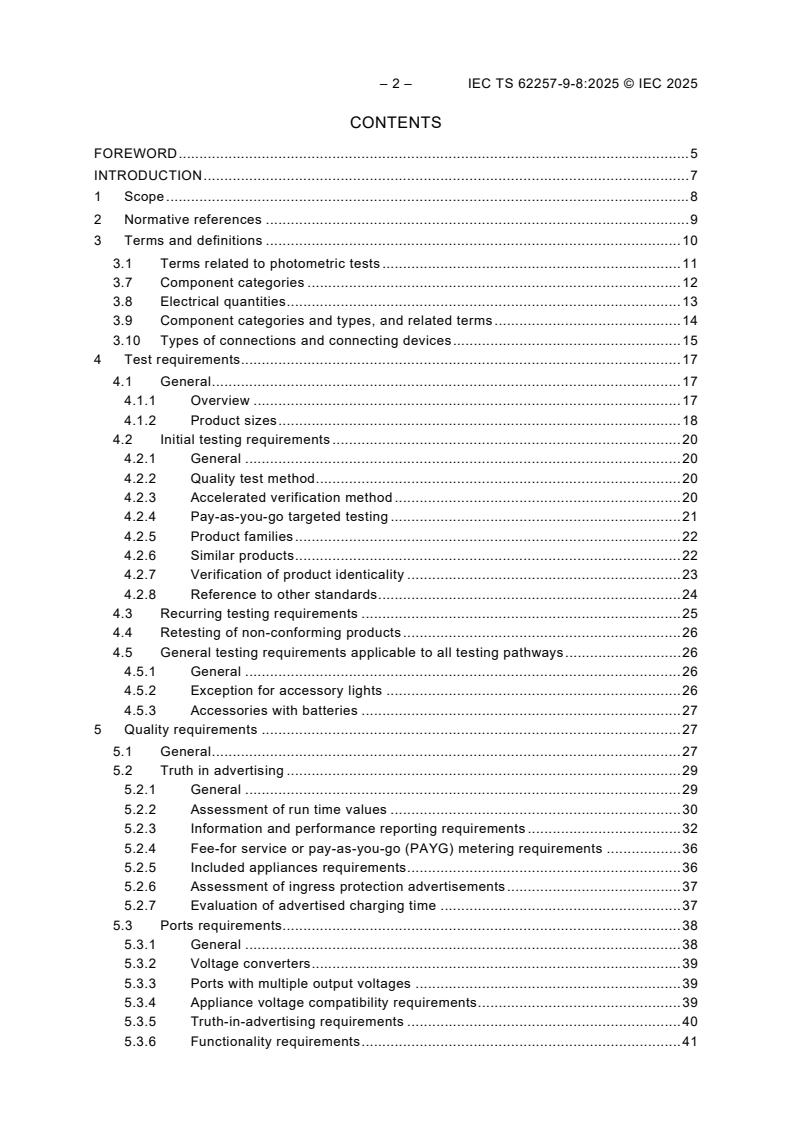
CONTENTS
FOREWORD . 5
INTRODUCTION . 7
1 Scope . 8
2 Normative references . 9
3 Terms and definitions . 10
3.1 Terms related to photometric tests . 11
3.7 Component categories . 12
3.8 Electrical quantities . 13
3.9 Component categories and types, and related terms . 14
3.10 Types of connections and connecting devices . 15
4 Test requirements . 17
4.1 General . 17
4.1.1 Overview . 17
4.1.2 Product sizes . 18
4.2 Initial testing requirements . 20
4.2.1 General . 20
4.2.2 Quality test method . 20
4.2.3 Accelerated verification method . 20
4.2.4 Pay-as-you-go targeted testing . 21
4.2.5 Product families . 22
4.2.6 Similar products . 22
4.2.7 Verification of product identicality . 23
4.2.8 Reference to other standards . 24
4.3 Recurring testing requirements . 25
4.4 Retesting of non-conforming products . 26
4.5 General testing requirements applicable to all testing pathways . 26
4.5.1 General . 26
4.5.2 Exception for accessory lights . 26
4.5.3 Accessories with batteries . 27
5 Quality requirements . 27
5.1 General . 27
5.2 Truth in advertising . 29
5.2.1 General . 29
5.2.2 Assessment of run time values . 30
5.2.3 Information and performance reporting requirements . 32
5.2.4 Fee-for service or pay-as-you-go (PAYG) metering requirements . 36
5.2.5 Included appliances requirements . 36
5.2.6 Assessment of ingress protection advertisements . 37
5.2.7 Evaluation of advertised charging time . 37
5.3 Ports requirements. 38
5.3.1 General . 38
5.3.2 Voltage converters . 39
5.3.3 Ports with multiple output voltages . 39
5.3.4 Appliance voltage compatibility requirements . 39
5.3.5 Truth-in-advertising requirements . 40
5.3.6 Functionality requirements . 41
5.4 Lumen maintenance . 45
5.5 Health and safety . 45
5.5.1 AC-DC power supply safety . 45
5.5.2 Hazardous substances . 46
5.5.3 Overload protection . 46
5.5.4 Wiring and connector safety . 46
5.5.5 Additional tests for PV modules . 47
5.5.6 Requirements for systems with large PV modules or arrays . 48
5.6 Battery requirements . 49
5.6.1 Provision of battery specification sheets . 49
5.6.2 Battery charge control . 49
5.6.3 Specific requirements for lithium-based batteries . 51
5.6.4 Battery durability . 53
5.6.5 Authentication of battery documents . 53
5.7 Quality and durability . 54
5.7.1 General . 54
5.7.2 Physical and water ingress protection . 54
5.7.3 Drop test requirements . 57
5.7.4 Soldering and electronics quality . 58
5.7.5 Switch, gooseneck, connector, and moving parts durability . 58
5.7.6 Strain relief durability . 59
5.7.7 Outdoor cable durability (size B products only) . 59
5.7.8 PV overvoltage requirement . 60
5.7.9 Miswiring protection requirement . 61
5.7.10 Requirements specific to systems with non‑plug‑and‑play connections . 61
5.8 Consumer information . 63
5.8.1 Warranty requirements . 63
5.8.2 Date of manufacture . 64
5.8.3 User manual requirements (size B products only) . 65
5.8.4 Component replacement methods (size B products only) . 65
5.8.5 Port information requirements . 66
Annex A (normative) Testing of similar products . 69
A.1 General . 69
A.2 Guidelines . 69
A.2.1 Visual screening . 69
A.2.2 Lumen maintenance and light output . 69
A.2.3 Charge controller testing. 70
A.2.4 PV modules . 70
A.2.5 Battery durability testing . 70
A.2.6 Connector durability testing . 70
A.2.7 Battery testing, full-battery run time, solar run time, and energy service
calculations . 71
A.2.8 Miswiring protection . 71
A.2.9 Output overload . 71
A.2.10 PV overvoltage . 71
A.2.11 Assessment of DC ports . 71
A.2.12 Power consumption and charging efficiency. 72
A.2.13 Voltage range . 72
A.2.14 Changes to firmware or software . 72
– 4 – IEC TS 62257-9-8:2025 © IEC 2025
Annex B (informative) List of documentation to solicit . 73
B.1 General . 73
B.2 Documentation to request . 73
Bibliography . 75
Figure 1 – Example water protection warning label or instruction . 56
Figure 2 – Decision process to determine whether or not a component is subject to the
drop test . 57
Figure 3 – Example labelling for a product with four ports having a combined current
limit of 3,5 A and a separate port having a current limit of 8 A. The five ports together
can supply a total of 11,5 A . 67
Figure 4 – Example labelling for a product with five ports having a combined current
limit of 8 A and a subset of four ports having a combined current limit of 3,5 A . 67
Table 1 – Summary of test requirements and alternatives – Initial testing requirements
to determine compliance with Clause 5 . 18
Table 2 – Summary of test requirements – recurring testing requirements to ensure
continued compliance with Clause 5 . 18
Table 3 – Summary of quality requirements . 28
Table 4 – Renewal requirements and acceptable alternative test procedures for PV
tests . 47
Table 5 – Default battery deep discharge protection voltage specifications . 50
Table 6 – Default battery overcharge protection voltage specifications. 50
Table 7 – Summary of battery safety testing requirements of 5.6.3.1 through 5.6.3.2 . 52
Table 8 – Physical ingress protection requirements . 54
Table 9 – Water protection requirements . 55
INTERNATIONAL ELECTROTECHNICAL COMMISSION
____________
RENEWABLE ENERGY OFF-GRID SYSTEMS –
Part 9-8: Integrated systems – Requirements for stand-alone renewable
energy products with power ratings less than or equal to 350 W
FOREWORD
1) The International Electrotechnical Commission (IEC) is a worldwide organization for standardization comprising
all national electrotechnical committees (IEC National Committees). The object of IEC is to promote international
co-operation on all questions concerning standardization in the electrical and electronic fields. To this end and
in addition to other activities, IEC publishes International Standards, Technical Specifications, Technical Reports,
Publicly Available Specifications (PAS) and Guides (hereafter referred to as “IEC Publication(s)”). Their
preparation is entrusted to technical committees; any IEC National Committee interested in the subject dealt with
may participate in this preparatory work. International, governmental and non-governmental organizations liaising
with the IEC also participate in this preparation. IEC collaborates closely with the International Organization for
Standardization (ISO) in accordance with conditions determined by agreement between the two organizations.
2) The formal decisions or agreements of IEC on technical matters express, as nearly as possible, an international
consensus of opinion on the relevant subjects since each technical committee has representation from all
interested IEC National Committees.
3) IEC Publications have the form of recommendations for international use and are accepted by IEC National
Committees in that sense. While all reasonable efforts are made to ensure that the technical content of IEC
Publications is accurate, IEC cannot be held responsible for the way in which they are used or for any
misinterpretation by any end user.
4) In order to promote international uniformity, IEC National Committees undertake to apply IEC Publications
transparently to the maximum extent possible in their national and regional publications. Any divergence between
any IEC Publication and the corresponding national or regional publication shall be clearly indicated in the latter.
5) IEC itself does not provide any attestation of conformity. Independent certification bodies provide conformity
assessment services and, in some areas, access to IEC marks of conformity. IEC is not responsible for any
services carried out by independent certification bodies.
6) All users should ensure that they have the latest edition of this publication.
7) No liability shall attach to IEC or its directors, employees, servants or agents including individual experts and
members of its technical committees and IEC National Committees for any personal injury, property damage or
other damage of any nature whatsoever, whether direct or indirect, or for costs (including legal fees) and
expenses arising out of the publication, use of, or reliance upon, this IEC Publication or any other IEC
Publications.
8) Attention is drawn to the Normative references cited in this publication. Use of the referenced publications is
indispensable for the correct application of this publication.
9) IEC draws attention to the possibility that the implementation of this document may involve the use of (a)
patent(s). IEC takes no position concerning the evidence, validity or applicability of any claimed patent rights in
respect thereof. As of the date of publication of this document, IEC had not received notice of (a) patent(s), which
may be required to implement this document. However, implementers are cautioned that this may not represent
the latest information, which may be obtained from the patent database available at https://patents.iec.ch. IEC
shall not be held responsible for identifying any or all such patent rights.
IEC TS 62257-9-8 has been prepared by IEC technical committee 82: Solar photovoltaic energy
systems. It is a Technical Specification.
This second edition cancels and replaces the first edition issued in 2020. It constitutes a
technical revision.
This edition includes the following significant technical changes with respect to the previous
edition:
a) Removed the PV module wiring inspection, partial shading test, and visual screening and
durability tests for photovoltaic modules. Applicable tests are now referenced from
IEC TS 62257-9-5.
b) Increased the interval for recurring testing from two years to three years.
– 6 – IEC TS 62257-9-8:2025 © IEC 2025
c) Tightened the truth-in-advertising tolerance for numerical aspects other than luminous flux
from 15 % to 10 %.
d) Revised consumer information requirements to allow more flexibility and remove
requirements for information that is not known to be valuable to consumers.
e) Simplified and reorganized the requirements for 12 V and 5 V ports, and allow non-standard
output voltages if clearly marked.
f) Added requirements for ports with USB fast charging support.
g) Revised the requirements for non-plug-and-play products to allow connectors that require
special tools or training in products installed by trained technicians.
h) Clarified cell- and pack-level safety requirements for single-cell lithium batteries.
The text of this Technical Specification is based on the following documents:
Draft Report on voting
82/2292/DTS 82/2321/RVDTS
Full information on the voting for its approval can be found in the report on voting indicated in
the above table.
The language used for the development of this Technical Specification is English.
This document was drafted in accordance with ISO/IEC Directives, Part 2, and developed in
accordance with ISO/IEC Directives, Part 1 and ISO/IEC Directives, IEC Supplement, available
at www.iec.ch/members_experts/refdocs. The main document types developed by IEC are
described in greater detail at www.iec.ch/publications.
A list of all parts in the IEC 62257 series, published under the general title Renewable energy
off-grid systems, can be found on the IEC website.
Future standards in this series will carry the new general title as cited above. Titles of existing
standards in this series will be updated at the time of the next edition.
The committee has decided that the contents of this document will remain unchanged until the
stability date indicated on the IEC website under webstore.iec.ch in the data related to the
specific document. At this date, the document will be
• reconfirmed,
• withdrawn, or
• revised.
INTRODUCTION
The IEC 62257 series provides support and strategies for institutions involved in rural
electrification projects. It documents technical approaches for designing, building, testing, and
maintaining off-grid renewable energy and hybrid systems with AC nominal voltage below
500 V, DC nominal voltage below 750 V and nominal power below 100 kVA.
This series provides recommendations to support buyers who want to connect with good quality
options in the market:
• to choose the right system for the right place,
• to design the system, and
• to operate and maintain the system.
This series is focused only on technical aspects of rural off-grid electrification concentrating on,
but not specific to, developing countries. They are not considered as all inclusive to rural
electrification. The documents do not describe a range of factors that can determine project or
product success: environmental, social, economic, service capabilities, and others. Further
developments in this field could be introduced in future steps.
This series is best considered as a whole with different parts corresponding to items for safety,
sustainability of systems, and costs. The main objectives are to support the capabilities of
households and communities that use small renewable energy and hybrid off-grid systems and
inform organizations and institutions in the off-grid power market.
The purpose of this document is to provide baseline standards for quality, durability and truth-
in-advertising to protect consumers of stand-alone renewable energy products. This document
is specifically related to renewable energy products that are packaged and made available to
end-use consumers at the point of purchase as single, stand-alone products that do not require
additional system components to function. This document applies to products with peak power
ratings of 350 W or less. While most provisions apply to all products in this range, a few are
applicable only to products with peak power ratings greater than 10,5 W and less than or equal
to 350 W.
The term "stand-alone renewable energy product" is used in this document to describe this
class of products. Other equivalent terms, including "off-grid solar" or "rechargeable," are often
used by companies, distributors, and other stakeholders to describe these products. Many of
these systems meet the definition of type T I (individual electrification systems with energy
storage) in IEC TS 62257-2.
The intended users of this document are:
• Market support programmes that support the off-grid lighting market with financing,
consumer education, awareness, and other services;
• Companies and distributors that need to verify the quality and performance of products;
• Bulk procurement programmes that facilitate or place large orders of products; and,
• trade regulators such as government policymakers and officials who craft and implement
trade and tax policy.
This document establishes minimum requirements for quality standards and warranty
requirements. Products are compared to specifications based on test results from
IEC TS 62257-9-5 and other information about the product. The requirements are designed to
be widely applicable across different markets, countries, and regions.
– 8 – IEC TS 62257-9-8:2025 © IEC 2025
RENEWABLE ENERGY OFF-GRID SYSTEMS –
Part 9-8: Integrated systems – Requirements for stand-alone renewable
energy products with power ratings less than or equal to 350 W
1 Scope
This part of the IEC 62257 series provides baseline requirements for quality, durability and truth
in advertising to protect consumers of off-grid renewable energy products. Evaluation of these
requirements is based on tests described in IEC TS 62257-9-5. This document can be used
alone or in conjunction with other international standards that address the safety and durability
of components of off-grid renewable energy products.
This document applies to stand-alone renewable energy products having the following
characteristics:
• The products are powered by photovoltaic (PV) modules or electromechanical power
generating devices (such as dynamos), or are designed to use grid electricity to charge a
battery or other energy-storage device for off-grid use. The requirements may also be
appropriate as guidance for evaluating the quality of products with other power sources,
such as thermoelectric generators.
• The peak power rating of the PV module or other power generating device is less than or
equal to 350 W.
• All components required to provide basic energy services are sold and installed as a kit,
included as a part of a family of products as defined in 4.2.5, or integrated into a single
component, including at a minimum:
– a battery, batteries or other energy storage device(s);
– power generating device, such as a solar panel, capable of charging the battery,
batteries or other energy storage device(s);
– cables, switches, wiring, connectors and protective devices sufficient to connect the
power generating device, power control unit(s) and energy storage device(s).
• The system evaluated includes all the loads (lighting, television, radio, fan, etc.) and load
adapter cables that are sold or included as part of the kit or integrated into kit components.
• The PV module maximum power point voltage and the working voltage of any other
components in the kit do not exceed 35 V. Exceptions are made for AC-to-DC converters
that meet appropriate safety standards, and systems that include PV modules (or
combinations of PV modules) with open-circuit voltage greater than 35 V that meet
additional safety requirements beyond those assessed in IEC TS 62257-9-5.
NOTE This voltage limit corresponds to the definition of decisive voltage classification A (DVC-A) for wet locations
in IEC 62109-1. The limits of 240 W, 35 V and 8 A are consistent with the definition of Class III in IEC 61730-1.
• These requirements cover only DC outputs and loads. Products that include inverters, AC
outputs or outlets, or AC appliances are not within the scope of this document. Products can
have AC inputs.
• No design expertise is required to choose appropriate system components.
• All electrical connections, except for permanent connections made at the time of installation,
can be made using plug-and-socket connectors without the use of any tools.
This document includes provisions related to safety; however, it is not intended to be a
comprehensive safety standard. In particular, this document is not intended to be used as an
alternative to safety standards such as IEC 62368-1 or the IEC 60335 series for appliances
such as radios and televisions that are included with stand-alone renewable energy products.
Nor is it intended to replace the safety requirements of IEC 62281 or UN 38.3 for battery safety
during transport, or safety requirements of IEC 61730-1 and IEC 61730-2 for PV modules
intended for use outside the context of stand-alone renewable energy products.
This document does not address electromagnetic compatibility (EMC). Field experience has not
shown EMC to be a major concern in typical applications of stand-alone renewable energy
products within the scope of this document. In applications where EMC is a concern (e.g.
systems that include medical devices), the standards relevant to the specific application should
be referenced.
2 Normative references
The following documents are referred to in the text in such a way that some or all of their content
constitutes requirements of this document. For dated references, only the edition cited applies.
For undated references, the latest edition of the referenced document (including any
amendments) applies.
IEC 60335-1, Household and similar electrical appliances – Safety – Part 1: General
requirements
IEC 60335-2-29, Household and similar electrical appliances – Safety – Part 2-29: Particular
requirements for battery chargers
IEC 60364-7-712:2017, Low voltage electrical installations – Part 7-712: Requirements for
special installations or locations – Solar photovoltaic (PV) power supply systems
IEC 60529, Degrees of protection provided by enclosures (IP Code)
IEC 60598-1, Luminaires – Part 1: General requirements and tests
IEC 61215-1, Terrestrial photovoltaic (PV) modules – Design qualification and type approval –
Part 1: Test requirements
IEC 61215-2, Terrestrial photovoltaic (PV) modules – Design qualification and type approval –
Part 2: Test procedures
IEC 61730-1, Photovoltaic (PV) module safety qualification – Part 1: Requirements for
construction
IEC 61730-2, Photovoltaic (PV) module safety qualification – Part 2: Requirements for testing
IEC TS 61836, Solar photovoltaic energy systems – Terms, definitions and symbols
IEC 62109-1, Safety of power converters for use in photovoltaic power systems – Part 1:
General requirements
IEC 62133-2, Secondary cells and batteries containing alkaline or other non-acid electrolytes –
Safety requirements for portable sealed secondary cells, and for batteries made from them, for
use in portable applications – Part 2: Lithium systems
– 10 – IEC TS 62257-9-8:2025 © IEC 2025
IEC TS 62257-9-5:2024, Recommendations for renewable energy and hybrid systems for rural
electrification: Integrated systems – Laboratory evaluation of stand-alone renewable energy
products for rural electrification
IEC TS 62257-12-1, Recommendations for renewable energy and hybrid systems for rural
electrification – Part 12-1: Laboratory evaluation of lamps and lighting appliances for off-grid
electricity systems
IEC 62281, Safety of primary and secondary lithium cells and batteries during transport
IEC 62368-1, Audio/video, information and communication technology equipment – Part 1:
Safety requirements
IEC 62619, Secondary cells and batteries containing alkaline or other non-acid electrolytes –
Safety requirements for secondary lithium cells and batteries, for use in industrial applications
IEC 62790, Junction boxes for photovoltaic modules – Safety requirements and tests
IEC TS 63163, Terrestrial photovoltaic (PV) modules for consumer products – Design
qualification and type approval
ISO 4892 (all parts), Plastics – Methods of exposure to laboratory light sources
ANSI/CAN/UL 9540, Energy Storage Systems and Equipment
UL 1741, Standard for inverters, converters, controllers and interconnection system equipment
for use with distributed energy resources
UL 1973, Standard for batteries for use in stationary, vehicle auxiliary power and light electric
rail (LER) applications
UL 2054, Standard for Household and Commercial Batteries
UL 61730-1, Photovoltaic (PV) module safety qualification – Part 1: Requirements for
construction
UL 61730-2, Photovoltaic (PV) module safety qualification – Part 2: Requirements for testing
UL 62133-2, Secondary cells and batteries containing alkaline or other non-acid electrolytes –
Safety requirements for portable sealed secondary cells, and for batteries made from them, for
use in portable applications
United Nations. Recommendations on the transport of dangerous goods: manual of tests and
criteria, Section 38.3: Lithium batteries (UN 38.3)
3 Terms and definitions
For the purposes of this document, the terms and definitions given in IEC TS 61836 and the
following apply.
ISO and IEC maintain terminological databases for use in standardization at the following
addresses:
• IEC Electropedia: available at http://www.electropedia.org/
• ISO Online browsing platform: available at http://www.iso.org/obp
3.1 Terms related to photometric tests
3.1.1
illuminance
E
v
density of incident luminous flux with respect to area at a point on a real or imaginary surface
dΦ
v
E =
v
dA
where Φv is luminous flux and A is the area on which the luminous flux is incident
−2
Note 1 to entry: The illuminance is expressed in lux (lx = lm·m ).
[SOURCE: IEC 60050-845:2020, 845-21-060, modified – Notes 1, 2, and 4 have been omitted.]
3.1.2
full width half maximum
FWHM
range of a variable over which a given characteristic is greater than 50 % of its maximum value
Note 1 to entry: FWHM can be applied to characteristics such as radiation patterns, spectral linewidths, etc., and
the variable can be wavelength, spatial or angular properties, etc., as appropriate.
[SOURCE: IEC 60050-731:1991, 731-01-57, modified – in note 1, "may" has been replaced with
"can".]
3.2
LED
light emitting diode
solid state device embodying a p-n junction, emitting incoherent optical radiation when excited
by an electric current
[SOURCE: IEC 60050-845:2020, 845-27-050, modified – The notes have been omitted.]
3.3
power supply
electric energy converter which draws electric energy from a source and supplies it in a
specified form to a load
[SOURCE: IEC 60050-151:2001, 151-13-76]
3.4
overvoltage protection
protection intended to operate when the power system voltage is in excess of a predetermined
value
[SOURCE: IEC 60050-448:1995, 448-14-32]
3.5
cell block
group of cells in a battery connected together in parallel configuration with or without protective
devices (e.g. fuse or positive temperature coefficient device (PTC)) and monitoring circuitry
Note 1 to entry: The cell block is not ready for use in an application because it is not yet fitted with its final housing,
terminal arrangement and electronic control device.
[SOURCE: IEC 62619:2022, 3.8]
– 12 – IEC TS 62257-9-8:2025 © IEC 2025
3.6
IP Code
coding system to indicate the degrees of protection provided by an enclosure against access to
hazardous parts, ingress of solid foreign objects, ingress of water and to give additional
information in connection with such protection
Note 1 to entry: In this document, certain IP Codes can be estimated using procedures in IEC TS 62257-9-5, which
provides a simplified and lower-cost alternative to IEC 60529. The procedure in IEC TS 62257-9-5 evaluates
protection against ingress of solid foreign objects and water, but not protection against access to hazardous parts.
[SOURCE: IEC 60529:1989, 3.4, modified – note 1 has been added.]
3.7 Component categories
3.7.1
portable
connected in a way that makes a product or subsystem easy for an individual to carry
Note 1 to entry: Products or subsystems are portable when two or more of the main components (energy source,
energy storage, and light source) are connected in this way.
[SOURCE: IEC TS 62257-9-5:2024, 3.18]
3.7.2
fixed
designed for permanent or semi-permanent mounting and use in place
Note 1 to entry: Products or subsystems are fixed when the main components (energy source, energy storage, and
light source) are designed in this way.
[SOURCE: IEC TS 62257-9-5:2024, 3.19]
3.7.3
separate
without PV module or with a PV module connected to other components via a cable with a
length of at least 3 m
Note 1 to entry: The length criterion allows the PV module to collect energy outdoors while the other product
components remain indoors.
[SOURCE: IEC TS 62257-9-5:2024, 3.20, modified – the 3 m length specification has been
incorporated into the definition.]
3.7.4
integrated
with a PV module incorporated into another component or connected to another component
(other than a fixed outdoor component) via a cable with a length less than 3 m
Note 1 to entry: The length of the cable is insufficient for the PV module to collect energy outdoors while the other
product components remain indoors.
[SOURCE: IEC TS 62257-9-5:2024, 3.21, modified – the 3 m length specification has been
incorporated into the definition.]
3.7.5
component
constituent part of a product which cannot be physically divided into smaller
parts as part of normal installation and use
Note 1 to entry: Examples of components include main units, power control units, appliances, PV modules, external
batteries, and cables.
[SOURCE: IEC 60050-151:2001, 151-11-21, modified – "device" has been replaced with
"product" and "without losing its particular function" with "as part of normal installation and use,”
and the note has been added.]
3.8 Electrical quantities
3.8.1
capacity
electric charge which a battery or battery cell can deliver under
specified discharge conditions
Note 1 to entry: The SI unit for electric charge, or quantity of electricity, is the coulomb (1 C = 1 A·s) but in practice,
capacity is usually expressed in ampere hours (Ah).
[SOURCE: IEC 60050-482:2020, 482-03-14]
3.8.2
standby loss
current drawn from a product's battery with the product switched off
[SOURCE: IEC TS 62257-9-5:2024, 3.25]
3.8.3
standard operating voltage
standardized voltage corresponding to a typical battery operating point during discharge
[SOURCE: IEC TS 62257-9-5:2024, 3.31]
3.8.4
typical battery discharge voltage
battery voltage corresponding to the "typical operating point" (e.g. the operating point resulting
in the average value of power) during discharge
Note 1 to entry: The typical battery discharge voltage is an outcome of the full-battery run time test, while the
standard operating voltage depends only on the battery chemistry and number of cells.
[SOURCE: IEC TS 62257-9-5:2024, 3.32]
3.8.5
appliance operating voltage
voltage supplied to an appliance by a port when the appliance is operating at a particular setting
and the power control unit battery is at the typical battery discharge voltage
[SOURCE: IEC TS 62257-9-5:2024, 3.33]
– 14 – IEC TS 62257-9-8:2025 © IEC 2025
3.9 Component categories and types, and related terms
3.9.1
product
complete stand-alone renewable energy product or kit, typically including an energy source,
power control unit(s), one or more lights or other appliances, wiring, and other accessories, and
sold or distributed as a kit
Note 1 to entry: The product is the unit to which the IEC TS 62257-9-5 test report applies.
Note 2 to entry: The complete definition of a stand-alone renewable energy product is given in
IEC TS 62257-9-5:2024, 4.1.1.
3.9.2
appliance
device that performs a specific function providing service to an end user, such as a light, radio,
mobile device, or television set
[SOURCE: IEC TS 62257-9-5:2024, 3.26]
3.9.3
mobile device
basic mobile phone, feature phone, smartphone, tablet computer, or similar portable
communication and/or computing device having an internal rechargeable battery
Note 1 to entry: Larger portable devices, such as laptop computers, can also be considered mobile devices, but
some provisions (e.g. related to charging current and ports) may not be applicable.
Note 2 to entry: A mobile device is an appliance.
[SOURCE: IEC TS 62257-9-5:2024, 3.27]
3.9.4
power control unit
component of a stand-alone renewable energy product that includes a battery and one or more
ports plus, typically, the associated battery management, voltage regulation and overload
protection components
Note 1 to entry: In the case of a product with a single power control unit, the power control unit is often referred to
as the "main unit" or "control box." A power control unit can include appliance functionality such as a light or built-in
radio. A portable appliance (such as a light) with internal battery is a power control unit if it includes a port.
[SOURCE: IEC TS 62257-9-5:2024, 3.29]
3.9.5
main unit
component or assembly including an input for connecting the primary energy source (e.g. solar,
grid or mechanical charger), a battery, and one or more built-in appliance(s) or port(s)
Note 1 to entry: A power control unit can be a main unit, though a main unit does not necessarily have a port.
Note 2 to entry: A product can contain more than one main unit.
[SOURCE: IEC TS 62257-9-5:2024, 3.30]
3.9.6
port
connector (typically a socket) on a component that can supply power to an appliance
Note 1 to entry: This definition applies when the word "port" is used without qualification in this document. The word
"port" can also be used more generally to refer to any socket (receptacle).
[SOURCE: IEC TS 62257-9-5:2024, 3.28]
3.9.7
barrel jack
low-voltage DC power socket with a central pin, accepting a
...
IEC TS 62257-9-8 ®
Edition 2.0 2025-01
REDLINE VERSION
TECHNICAL
SPECIFICATION
colour
inside
Renewable energy and hybrid systems for rural electrification off-grid systems –
Part 9-8: Integrated systems – Requirements for stand-alone renewable energy
products with power ratings less than or equal to 350 W
All rights reserved. Unless otherwise specified, no part of this publication may be reproduced or utilized in any form
or by any means, electronic or mechanical, including photocopying and microfilm, without permission in writing from
either IEC or IEC's member National Committee in the country of the requester. If you have any questions about IEC
copyright or have an enquiry about obtaining additional rights to this publication, please contact the address below or
your local IEC member National Committee for further information.
IEC Secretariat Tel.: +41 22 919 02 11
3, rue de Varembé info@iec.ch
CH-1211 Geneva 20 www.iec.ch
Switzerland
About the IEC
The International Electrotechnical Commission (IEC) is the leading global organization that prepares and publishes
International Standards for all electrical, electronic and related technologies.
About IEC publications
The technical content of IEC publications is kept under constant review by the IEC. Please make sure that you have the
latest edition, a corrigendum or an amendment might have been published.
IEC publications search - webstore.iec.ch/advsearchform IEC Products & Services Portal - products.iec.ch
The advanced search enables to find IEC publications by a Discover our powerful search engine and read freely all the
variety of criteria (reference number, text, technical publications previews, graphical symbols and the glossary.
committee, …). It also gives information on projects, replaced With a subscription you will always have access to up to date
and withdrawn publications. content tailored to your needs.
IEC Just Published - webstore.iec.ch/justpublished
Electropedia - www.electropedia.org
Stay up to date on all new IEC publications. Just Published
The world's leading online dictionary on electrotechnology,
details all new publications released. Available online and once
containing more than 22 500 terminological entries in English
a month by email.
and French, with equivalent terms in 25 additional languages.
Also known as the International Electrotechnical Vocabulary
IEC Customer Service Centre - webstore.iec.ch/csc
(IEV) online.
If you wish to give us your feedback on this publication or need
further assistance, please contact the Customer Service
Centre: sales@iec.ch.
IEC TS 62257-9-8 ®
Edition 2.0 2025-01
REDLINE VERSION
TECHNICAL
SPECIFICATION
colour
inside
Renewable energy and hybrid systems for rural electrification off-grid systems
Part 9-8: Integrated systems – Requirements for stand-alone renewable energy
products with power ratings less than or equal to 350 W
INTERNATIONAL
ELECTROTECHNICAL
COMMISSION
ICS 27.160 ISBN 978-2-8327-0145-4
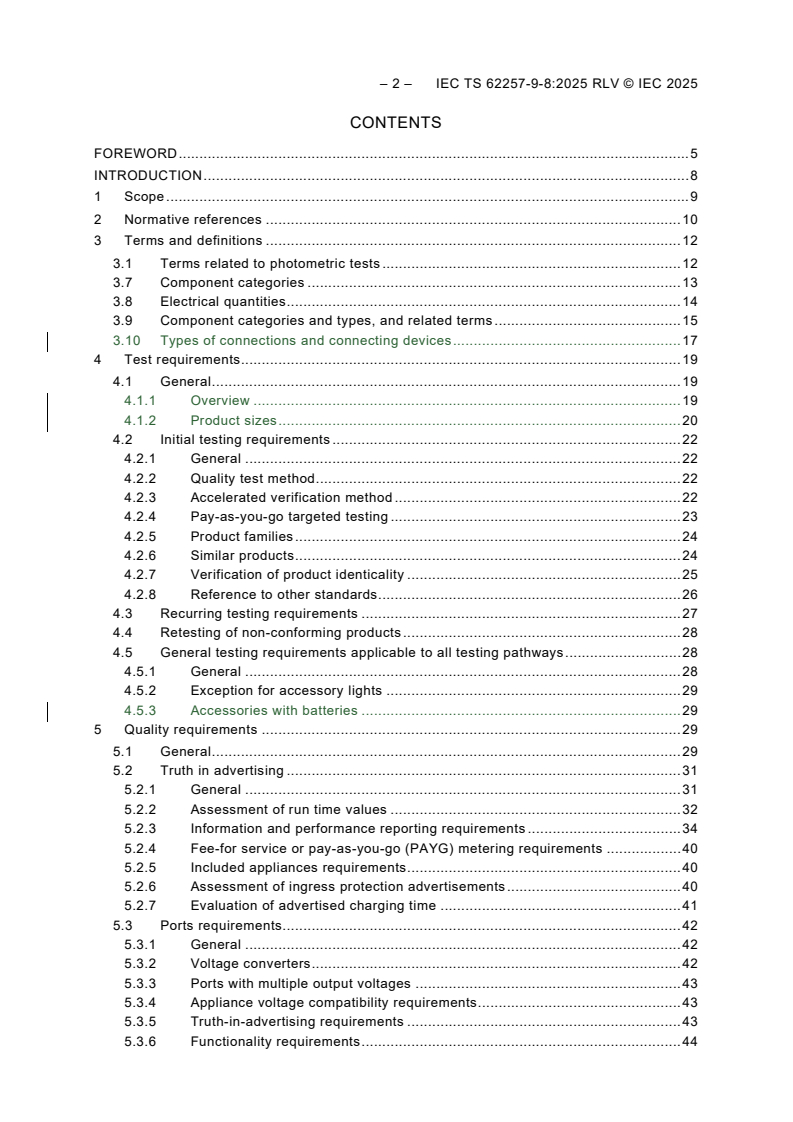
– 2 – IEC TS 62257-9-8:2025 RLV © IEC 2025
CONTENTS
FOREWORD . 5
INTRODUCTION . 8
1 Scope . 9
2 Normative references . 10
3 Terms and definitions . 12
3.1 Terms related to photometric tests . 12
3.7 Component categories . 13
3.8 Electrical quantities . 14
3.9 Component categories and types, and related terms . 15
3.10 Types of connections and connecting devices . 17
4 Test requirements . 19
4.1 General . 19
4.1.1 Overview . 19
4.1.2 Product sizes . 20
4.2 Initial testing requirements . 22
4.2.1 General . 22
4.2.2 Quality test method . 22
4.2.3 Accelerated verification method . 22
4.2.4 Pay-as-you-go targeted testing . 23
4.2.5 Product families . 24
4.2.6 Similar products . 24
4.2.7 Verification of product identicality . 25
4.2.8 Reference to other standards . 26
4.3 Recurring testing requirements . 27
4.4 Retesting of non-conforming products . 28
4.5 General testing requirements applicable to all testing pathways . 28
4.5.1 General . 28
4.5.2 Exception for accessory lights . 29
4.5.3 Accessories with batteries . 29
5 Quality requirements . 29
5.1 General . 29
5.2 Truth in advertising . 31
5.2.1 General . 31
5.2.2 Assessment of run time values . 32
5.2.3 Information and performance reporting requirements . 34
5.2.4 Fee-for service or pay-as-you-go (PAYG) metering requirements . 40
5.2.5 Included appliances requirements . 40
5.2.6 Assessment of ingress protection advertisements . 40
5.2.7 Evaluation of advertised charging time . 41
5.3 Ports requirements. 42
5.3.1 General . 42
5.3.2 Voltage converters . 42
5.3.3 Ports with multiple output voltages . 43
5.3.4 Appliance voltage compatibility requirements . 43
5.3.5 Truth-in-advertising requirements . 43
5.3.6 Functionality requirements . 44
5.4 Lumen maintenance . 49
5.5 Health and safety . 50
5.5.1 AC-DC power supply safety . 50
5.5.2 Hazardous substances . 51
5.5.3 Overload protection . 51
5.5.4 Wiring and connector safety . 51
5.5.5 Additional tests for PV modules . 52
5.5.6 Requirements for systems with large PV modules or arrays . 55
5.6 Battery requirements . 56
5.6.1 Provision of battery specification sheets . 56
5.6.2 Battery charge control . 56
5.6.3 Specific requirements for lithium-based batteries . 58
5.6.4 Battery durability . 60
5.6.5 Authentication of battery documents . 60
5.7 Quality and durability . 61
5.7.1 General . 61
5.7.2 Physical and water ingress protection . 61
5.7.3 Drop test requirements . 64
5.7.4 Soldering and electronics quality . 66
5.7.5 Switch, gooseneck, connector, and moving parts durability . 66
5.7.6 Strain relief durability . 67
5.7.7 Outdoor cable durability (size B products only) . 68
5.7.8 PV overvoltage requirement . 69
5.7.9 Miswiring protection requirement . 69
5.7.10 Requirements specific to systems with non‑plug‑and‑play connections . 69
5.8 Consumer information . 72
5.8.1 Warranty requirements . 72
5.8.2 Date of manufacture . 72
5.8.3 User manual requirements (size B products only) . 73
5.8.4 Component replacement methods (size B products only) . 74
5.8.5 Port information requirements . 75
Annex A (normative) Testing of similar products . 78
A.1 General . 78
A.2 Guidelines . 78
A.2.1 Visual screening . 78
A.2.2 Lumen maintenance and light output . 78
A.2.3 Charge controller testing. 79
A.2.4 PV modules . 79
A.2.5 Battery durability testing . 79
A.2.6 Connector durability testing . 79
A.2.7 Battery testing, full-battery run time, solar run time, and energy service
calculations . 80
A.2.8 Miswiring protection . 80
A.2.9 Output overload . 80
A.2.10 PV overvoltage . 80
A.2.11 Assessment of DC ports . 81
A.2.12 Power consumption and charging efficiency. 81
A.2.13 Voltage range . 81
A.2.14 Changes to firmware or software . 81
– 4 – IEC TS 62257-9-8:2025 RLV © IEC 2025
Annex B (normative) Partial shading test for photovoltaic modules .
B.1 General .
B.2 Equipment requirements .
B.3 Test prerequisites .
B.4 Procedure .
B.5 Calculations .
B.6 Pass criteria .
B.7 Reporting .
Annex C (normative) Visual screening and durability tests for photovoltaic modules .
C.1 General .
C.2 Durability of markings test .
C.3 Sharp edge test .
C.4 Screw connections test .
C.5 Impact test .
C.6 Bending or folding test .
C.7 Reporting .
Annex B (informative) List of documentation to solicit . 93
B.1 General . 93
B.2 Documentation to request . 93
Bibliography . 95
Figure 1 – Example water protection warning label or instruction . 64
Figure 2 – Decision process to determine whether or not a component is subject to the
drop test . 65
Figure 3 – Example labelling for a product with four ports having a combined current
limit of 3,5 A and a separate port having a current limit of 8 A. The five ports together
can supply a total of 11,5 A . 75
Figure 4 – Example labelling for a product with five ports having a combined current
limit of 8 A and a subset of four ports having a combined current limit of 3,5 A . 76
Table 1 – Summary of test requirements and alternatives – Initial testing requirements
to determine compliance with Clause 5 . 20
Table 2 – Summary of test requirements – recurring testing requirements to ensure
continued compliance with Clause 5 . 20
Table 3 – Summary of quality requirements . 30
Table 4 – Sample size and renewal requirements for PV tests .
Table 4 – Renewal requirements and acceptable alternative test procedures for PV
tests . 52
Table 5 – Examples of maximum current ratings .
Table 5 – Default battery deep discharge protection voltage specifications . 57
Table 6 – Default battery overcharge protection voltage specifications. 57
Table 7 – Summary of battery safety testing requirements of 5.6.3.1 through 5.6.3.2 . 59
Table 8 – Physical ingress protection requirements . 61
Table 9 – Water protection requirements . 62
INTERNATIONAL ELECTROTECHNICAL COMMISSION
____________
RENEWABLE ENERGY AND HYBRID SYSTEMS
FOR RURAL ELECTRIFICATION OFF-GRID SYSTEMS –
Part 9-8: Integrated systems – Requirements for stand-alone renewable
energy products with power ratings less than or equal to 350 W
FOREWORD
1) The International Electrotechnical Commission (IEC) is a worldwide organization for standardization comprising
all national electrotechnical committees (IEC National Committees). The object of IEC is to promote international
co-operation on all questions concerning standardization in the electrical and electronic fields. To this end and
in addition to other activities, IEC publishes International Standards, Technical Specifications, Technical Reports,
Publicly Available Specifications (PAS) and Guides (hereafter referred to as “IEC Publication(s)”). Their
preparation is entrusted to technical committees; any IEC National Committee interested in the subject dealt with
may participate in this preparatory work. International, governmental and non-governmental organizations liaising
with the IEC also participate in this preparation. IEC collaborates closely with the International Organization for
Standardization (ISO) in accordance with conditions determined by agreement between the two organizations.
2) The formal decisions or agreements of IEC on technical matters express, as nearly as possible, an international
consensus of opinion on the relevant subjects since each technical committee has representation from all
interested IEC National Committees.
3) IEC Publications have the form of recommendations for international use and are accepted by IEC National
Committees in that sense. While all reasonable efforts are made to ensure that the technical content of IEC
Publications is accurate, IEC cannot be held responsible for the way in which they are used or for any
misinterpretation by any end user.
4) In order to promote international uniformity, IEC National Committees undertake to apply IEC Publications
transparently to the maximum extent possible in their national and regional publications. Any divergence between
any IEC Publication and the corresponding national or regional publication shall be clearly indicated in the latter.
5) IEC itself does not provide any attestation of conformity. Independent certification bodies provide conformity
assessment services and, in some areas, access to IEC marks of conformity. IEC is not responsible for any
services carried out by independent certification bodies.
6) All users should ensure that they have the latest edition of this publication.
7) No liability shall attach to IEC or its directors, employees, servants or agents including individual experts and
members of its technical committees and IEC National Committees for any personal injury, property damage or
other damage of any nature whatsoever, whether direct or indirect, or for costs (including legal fees) and
expenses arising out of the publication, use of, or reliance upon, this IEC Publication or any other IEC
Publications.
8) Attention is drawn to the Normative references cited in this publication. Use of the referenced publications is
indispensable for the correct application of this publication.
9) IEC draws attention to the possibility that the implementation of this document may involve the use of (a)
patent(s). IEC takes no position concerning the evidence, validity or applicability of any claimed patent rights in
respect thereof. As of the date of publication of this document, IEC had not received notice of (a) patent(s), which
may be required to implement this document. However, implementers are cautioned that this may not represent
the latest information, which may be obtained from the patent database available at https://patents.iec.ch. IEC
shall not be held responsible for identifying any or all such patent rights.
This redline version of the official IEC Standard allows the user to identify the changes
made to the previous edition IEC TS 62257-9-8:2020. A vertical bar appears in the margin
wherever a change has been made. Additions are in green text, deletions are in
strikethrough red text.
– 6 – IEC TS 62257-9-8:2025 RLV © IEC 2025
IEC TS 62257-9-8 has been prepared by IEC technical committee 82: Solar photovoltaic energy
systems. It is a Technical Specification.
This second edition cancels and replaces the first edition issued in 2020. It constitutes a
technical revision.
This edition includes the following significant technical changes with respect to the previous
edition:
a) Removed the PV module wiring inspection, partial shading test, and visual screening and
durability tests for photovoltaic modules. Applicable tests are now referenced from
IEC TS 62257-9-5.
b) Increased the interval for recurring testing from two years to three years.
c) Tightened the truth-in-advertising tolerance for numerical aspects other than luminous flux
from 15 % to 10 %.
d) Revised consumer information requirements to allow more flexibility and remove
requirements for information that is not known to be valuable to consumers.
e) Simplified and reorganized the requirements for 12 V and 5 V ports, and allow non-standard
output voltages if clearly marked.
f) Added requirements for ports with USB fast charging support.
g) Revised the requirements for non-plug-and-play products to allow connectors that require
special tools or training in products installed by trained technicians.
h) Clarified cell- and pack-level safety requirements for single-cell lithium batteries.
The text of this Technical Specification is based on the following documents:
Draft Report on voting
82/2292/DTS 82/2321/RVDTS
Full information on the voting for its approval can be found in the report on voting indicated in
the above table.
The language used for the development of this Technical Specification is English.
This document was drafted in accordance with ISO/IEC Directives, Part 2, and developed in
accordance with ISO/IEC Directives, Part 1 and ISO/IEC Directives, IEC Supplement, available
at www.iec.ch/members_experts/refdocs. The main document types developed by IEC are
described in greater detail at www.iec.ch/publications.
A list of all parts in the IEC 62257 series, published under the general title Renewable energy
off-grid systems, can be found on the IEC website.
Future standards in this series will carry the new general title as cited above. Titles of existing
standards in this series will be updated at the time of the next edition.
The committee has decided that the contents of this document will remain unchanged until the
stability date indicated on the IEC website under webstore.iec.ch in the data related to the
specific document. At this date, the document will be
• reconfirmed,
• withdrawn, or
• revised.
IMPORTANT – The "colour inside" logo on the cover page of this document indicates
that it contains colours which are considered to be useful for the correct understanding
of its contents. Users should therefore print this document using a colour printer.
– 8 – IEC TS 62257-9-8:2025 RLV © IEC 2025
INTRODUCTION
The IEC 62257 series provides support and strategies for institutions involved in rural
electrification projects. It documents technical approaches for designing, building, testing, and
maintaining off-grid renewable energy and hybrid systems with AC nominal voltage below
500 V, DC nominal voltage below 750 V and nominal power below 100 kVA.
This series provides recommendations to support buyers who want to connect with good quality
options in the market:
• to choose the right system for the right place,
• to design the system, and
• to operate and maintain the system.
This series is focused only on technical aspects of rural off-grid electrification concentrating on,
but not specific to, developing countries. They are not considered as all inclusive to rural
electrification. The documents do not describe a range of factors that can determine project or
product success: environmental, social, economic, service capabilities, and others. Further
developments in this field could be introduced in future steps.
This series is best considered as a whole with different parts corresponding to items for safety,
sustainability of systems, and costs. The main objectives are to support the capabilities of
households and communities that use small renewable energy and hybrid off-grid systems and
inform organizations and institutions in the off-grid power market.
The purpose of this document is to provide baseline standards for quality, durability and truth-
in-advertising to protect consumers of stand-alone renewable energy products. This document
is specifically related to renewable energy products that are packaged and made available to
end-use consumers at the point of purchase as single, stand-alone products that do not require
additional system components to function. This document applies to products with peak power
ratings of 350 W or less. While most provisions apply to all products in this range, a few are
applicable only to products with peak power ratings greater than 10,5 W and less than or equal
to 350 W.
The term "stand-alone renewable energy product" is used in this document to describe this
class of products. Other equivalent terms, including "off-grid solar" or "rechargeable," are often
used by manufacturers companies, distributors, and other stakeholders to describe these
products. Many of these systems meet the definition of type T I (individual electrification
systems with energy storage) in IEC TS 62257-2.
The intended users of this document are:
• Market support programmes that support the off-grid lighting market with financing,
consumer education, awareness, and other services;
• manufacturers Companies and distributors that need to verify the quality and performance
of products;
• Bulk procurement programmes that facilitate or place large orders of products; and,
• trade regulators such as government policymakers and officials who craft and implement
trade and tax policy.
This document establishes minimum requirements for quality standards and warranty
requirements. Products are compared to specifications based on test results from
IEC TS 62257-9-5 and other information about the product. The requirements are designed to
be widely applicable across different markets, countries, and regions.
RENEWABLE ENERGY AND HYBRID SYSTEMS
FOR RURAL ELECTRIFICATION OFF-GRID SYSTEMS –
Part 9-8: Integrated systems – Requirements for stand-alone renewable
energy products with power ratings less than or equal to 350 W
1 Scope
This part of the IEC 62257 series provides baseline requirements for quality, durability and truth
in advertising to protect consumers of off-grid renewable energy products. Evaluation of these
requirements is based on tests described in IEC TS 62257-9-5. This document can be used
alone or in conjunction with other international standards that address the safety and durability
of components of off-grid renewable energy products.
This document applies to stand-alone renewable energy products having the following
characteristics:
• The products are powered by photovoltaic (PV) modules or electromechanical power
generating devices (such as dynamos), or are designed to use grid electricity to charge a
battery or other energy-storage device for off-grid use. The requirements may also be
appropriate as guidance for evaluating the quality of devices products with other power
sources, such as thermoelectric generators.
• The peak power rating of the PV module or other power generating device is less than or
equal to 350 W.
• All components required to provide basic energy services are sold/ and installed as a kit,
included as a part of a family of products as defined in 4.2.5, or integrated into a single
component, including at a minimum:
– a battery, batteries or other energy storage device(s);
– power generating device, such as a solar panel, capable of charging the battery,
batteries or other energy storage device(s);
– cables, switches, wiring, connectors and protective devices sufficient to connect the
power generating device, power control unit(s) and energy storage device(s).
• The system evaluated includes all the loads (lighting, television, radio, fan, etc.) and load
adapter cables that are sold or included as part of the kit or integrated into kit components.
• The PV module maximum power point voltage and the working voltage of any other
components in the kit do not exceed 35 V. Exceptions are made for AC-to-DC converters
that meet appropriate safety standards, and systems that include PV modules (or
combinations of PV modules) with ratings that exceed 240 W at peak power, 35 V at open
circuit or 8 A at short circuit are subject to open-circuit voltage greater than 35 V that meet
additional safety requirements beyond those assessed in IEC TS 62257-9-5.
NOTE This voltage limit corresponds to the definition of decisive voltage classification A (DVC-A) for wet locations
in IEC 62109-1:2010. The limits of 240 W, 35 V and 8 A are consistent with the definition of Class III in IEC 61730-
1.
• These requirements cover only DC outputs and loads. Products that include inverters, AC
outputs/ or outlets, or AC appliances are not within the scope of this document. Products
can have AC inputs.
• No design expertise is required to choose appropriate system components.
• All electrical connections, except for permanent connections made at the time of installation,
can be made using plug-and-socket connectors without the use of any tools. All connections
made in the field are straightforward to make and do not require technical expertise, such
as wrapping wire in a specific direction, soldering, or crimping.
– 10 – IEC TS 62257-9-8:2025 RLV © IEC 2025
This document includes provisions related to safety; however, it is not intended to be a
comprehensive safety standard. In particular, this document is not intended to be used as an
alternative to safety standards such as IEC 62368-1 or the IEC 60335 series for appliances
such as radios and televisions that are included with stand-alone renewable energy products.
Nor is it intended to replace the safety requirements of IEC 62281 or UN 38.3 for battery safety
during transport, or safety requirements of IEC 61730-1 and IEC 61730-2 for PV modules
intended for use outside the context of stand-alone renewable energy products.
This document does not address electromagnetic compatibility (EMC). Field experience has not
shown EMC to be a major concern in typical applications of stand-alone renewable energy
products within the scope of this document. In applications where EMC is a concern (e.g.
systems that include medical devices), the standards relevant to the specific application should
be referenced.
2 Normative references
The following documents are referred to in the text in such a way that some or all of their content
constitutes requirements of this document. For dated references, only the edition cited applies.
For undated references, the latest edition of the referenced document (including any
amendments) applies.
IEC 60335-1, Household and similar electrical appliances – Safety – Part 1: General
requirements
IEC 60335-2-29, Household and similar electrical appliances – Safety – Part 2-29: Particular
requirements for battery chargers
IEC 60364-7-712:2017, Low voltage electrical installations – Part 7-712: Requirements for
special installations or locations – Solar photovoltaic (PV) power supply systems
IEC 60529, Degrees of protection provided by enclosures (IP Code)
IEC 60598-1, Luminaires – Part 1: General requirements and tests
IEC 60904-9, Photovoltaic devices – Part 9: Solar simulator performance requirements
IEC 61215 (all parts), Terrestrial photovoltaic (PV) modules – Design qualification and type
approval
IEC 61215-1, Terrestrial photovoltaic (PV) modules – Design qualification and type approval –
Part 1: Test requirements
IEC 61215-2, Terrestrial photovoltaic (PV) modules – Design qualification and type approval –
Part 2: Test procedures
IEC 61730 (all parts). Photovoltaic (PV) module safety qualification
IEC 61730-1, Photovoltaic (PV) module safety qualification – Part 1: Requirements for
construction
IEC 61730-2, Photovoltaic (PV) module safety qualification – Part 2: Requirements for testing
IEC TS 61836, Solar photovoltaic energy systems – Terms, definitions and symbols
IEC 62109-1:2010, Safety of power converters for use in photovoltaic power systems – Part 1:
General requirements
IEC 62133-2, Secondary cells and batteries containing alkaline or other non-acid electrolytes –
Safety requirements for portable sealed secondary lithium cells, and for batteries made from
them, for use in portable applications – Part 2: Lithium systems
IEC TS 62257-9-5:2024, Recommendations for renewable energy and hybrid systems for rural
electrification: Integrated systems – Laboratory evaluation of stand-alone renewable energy
products for rural electrification
IEC TS 62257-12-1, Recommendations for renewable energy and hybrid systems for rural
electrification – Part 12-1: Selection Laboratory evaluation of lamps and lighting appliances for
off-grid electricity systems
IEC 62281, Safety of primary and secondary lithium cells and batteries during transport
IEC 62368-1, Audio/video, information and communication technology equipment – Part 1:
Safety requirements
IEC 62619, Secondary cells and batteries containing alkaline or other non-acid electrolytes –
Safety requirements for secondary lithium cells and batteries, for use in industrial applications
IEC 62790, Junction boxes for photovoltaic modules – Safety requirements and tests
IEC 62930, Electric cables for photovoltaic systems with a voltage rating of 1,5 kV DC
IEC TS 63163, Terrestrial photovoltaic (PV) modules for consumer products – Design
qualification and type approval
ISO 4892 (all parts), Plastics – Methods of exposure to laboratory light sources
EN 50618, Electric cables for photovoltaic systems
HD 605, Electric cables – Additional test methods
ANSI/CAN/UL 9540, Energy Storage Systems and Equipment
UL 1741, Standard for inverters, converters, controllers and interconnection system equipment
for use with distributed energy resources
UL 1973, Standard for batteries for use in stationary, vehicle auxiliary power and light electric
rail (LER) applications
UL 2054, Standard for Household and Commercial Batteries
UL 61730-1, Photovoltaic (PV) module safety qualification – Part 1: Requirements for
construction
UL 61730-2, Photovoltaic (PV) module safety qualification – Part 2: Requirements for testing
UL 62133-2, Secondary cells and batteries containing alkaline or other non-acid electrolytes –
Safety requirements for portable sealed secondary cells, and for batteries made from them, for
use in portable applications
United Nations. Recommendations on the transport of dangerous goods: manual of tests and
criteria, Section 38.3: Lithium batteries (UN 38.3)
– 12 – IEC TS 62257-9-8:2025 RLV © IEC 2025
3 Terms and definitions
For the purposes of this document, the terms and definitions given in IEC TS 61836 and the
following apply.
ISO and IEC maintain terminological databases for use in standardization at the following
addresses:
• IEC Electropedia: available at http://www.electropedia.org/
• ISO Online browsing platform: available at http://www.iso.org/obp
3.1 Terms related to photometric tests
3.1.1
illuminance
E
areal density of the luminous flux incident at a point on a surface
[SOURCE: ANSI/IES RP-16-17, 3.3.1]
E
v
density of incident luminous flux with respect to area at a point on a real or imaginary surface
dΦ
v
E =
v
dA
where Φv is luminous flux and A is the area on which the luminous flux is incident
−2
Note 1 to entry: The illuminance is expressed in lux (lx = lm·m ).
[SOURCE: IEC 60050-845:2020, 845-21-060, modified – Notes 1, 2, and 4 have been omitted.]
3.1.2
colour rendering index
CRI
measure of the degree to which the psychophysical colour of an object illuminated by the test
illuminant conforms to that of the same object illuminated by the reference illuminant, suitable
allowance having been made for the state of chromatic adaptation
[SOURCE: IEC 60050-845:1987, 845-02-61, modified – The symbol "R" has been replaced by
"CRI" and the note has been omitted.]
3.1.3
correlated colour temperature
CCT
temperature of the Planckian radiator whose perceived colour most closely resembles that of a
given stimulus at the same brightness and under specified viewing conditions
Note 1 to entry: The correlated colour temperature is expressed in kelvins (K).
[SOURCE: IEC 60050-845:1987, 845-03-50, modified – Notes 1 and 2 have been replaced by
a new note to entry.]
3.1.2
full width half maximum
FWHM
range of a variable over which a given characteristic is greater than 50 % of its maximum value
Note 1 to entry: FWHM can be applied to characteristics such as radiation patterns, spectral linewidths, etc., and
the variable can be wavelength, spatial or angular properties, etc., as appropriate.
[SOURCE: IEC 60050-731:1991, 731-01-57, modified – in note 1, "may" has been replaced with
"can".]
3.2
LED
light emitting diode
solid state device embodying a p-n junction, emitting incoherent optical radiation when excited
by an electric current
[SOURCE: IEC 60050-845: 19872020, 845-04-40]27-050, modified – The notes have been
omitted.]
3.3
power supply
electric energy converter which draws electric energy from a source and supplies it in a
specified form to a load
[SOURCE: IEC 60050-151:2001, 151-13-76]
3.4
overvoltage protection
protection intended to operate when the power system voltage is in excess of a predetermined
value
[SOURCE: IEC 60050-448:1995, 448-14-32]
3.5
cell block
group of cells in a battery connected together in parallel configuration with or without protective
devices (e.g. fuse or positive temperature coefficient device (PTC))) and monitoring circuitry
Note 1 to entry: The cell block is not ready for use in an application because it is not yet fitted with its final housing,
terminal arrangement and electronic control device.
[SOURCE: IEC 62619:20172022, 3.8]
3.6
IP Code
coding system to indicate the degrees of protection provided by an enclosure against access to
hazardous parts, ingress of solid foreign objects, ingress of water and to give additional
information in connection with such protection
Note 1 to entry: In this document, certain IP Codes can be estimated using procedures in IEC TS 62257-9-5, which
provides a simplified and lower-cost alternative to IEC 60529. The procedure in IEC TS 62257-9-5 evaluates
protection against ingress of solid foreign objects and water, but not protection against access to hazardous parts.
[SOURCE: IEC 60529:1989, 3.4, modified – note 1 has been added.]
3.7 Component categories
3.7.1
portable
connected in a way that makes a product or subsystem easy for an individual to carry
Note 1 to entry: Products or subsystems are portable when two or more of the main components (energy source,
energy storage, and light source) are connected in this way.
– 14 – IEC TS 62257-9-8:2025 RLV © IEC 2025
[SOURCE: IEC TS 62257-9-5:20182024, 3.1718]
3.7.2
fixed
designed for permanent or semi-permanent mounting and use in place
Note 1 to entry: Products or subsystems are fixed when the main components (energy source, energy storage, and
light source) are designed in this way.
[SOURCE: IEC TS 62257-9-5:20182024, 3.1819]
3.7.3
separate
without solar PV module or with a solar PV module connected to other components via a cable
with a length of at least 3 m
Note 1 to entry: The length criterion allows the solar PV module to collect energy outdoors while the other product
components remain indoors.
[SOURCE: IEC TS 62257-9-5:20182024, 3.1920, modified – the 3 m length specification has
been incorporated into the definition.]
3.7.4
integrated
with a solar PV module integrated incorporated into another component or connected to another
component (other than a fixed outdoor component) via a cable with a length less than 3 m
Note 1 to entry: The length of the cable is insufficient fo
...