

IEC TR 63139:2026
(Main)Explanation and background information on electrical safety requirements in TC 34 standards
General Information
- Abstract
IEC TR 63139:2026 provides explanations and background information on electrical safety requirements in TC 34 standards.
- Status
- Published
- Publication Date
- 05-Mar-2026
- Technical Committee
- TC 34 - Lighting
- Drafting Committee
- WG 7 - TC 34/WG 7
- Current Stage
- PPUB - Publication issued
- Start Date
- 06-Mar-2026
- Completion Date
- 27-Mar-2026
Buy Documents
IEC TR 63139:2026 - Explanation and background information on electrical safety requirements in TC 34 standards
REDLINE IEC TR 63139:2026 RLV - Explanation and background information on electrical safety requirements in TC 34 standards
Overview
IEC TR 63139:2026 is a technical report from the International Electrotechnical Commission (IEC) that provides comprehensive explanations and background information on electrical safety requirements in TC 34 standards. IEC TC 34 focuses on lighting products, including luminaires and controlgear, and this report underpins safety approaches applied within these standards, especially as they evolve to incorporate new technologies such as LED light sources and advanced controllable products. The document is intended to enhance understanding and facilitate consistent implementation of electrical safety requirements by clarifying the rationale behind key technical decisions and safety protocols in related IEC standards.
Key Topics
- Calculation of Working Voltages in Insulation Failure:
IEC TR 63139:2026 outlines methods for calculating increased working voltages that may appear if insulation fails between supply and output circuits within lighting equipment. This ensures design safety under foreseeable fault conditions. - Insulation Requirements and Coordination:
The report explains insulation requirements between live parts and accessible conductive parts, covering fault scenarios including double/reinforced insulation. It provides guidance for both primary (supply) and secondary (output) side insulation, referencing corresponding clauses in IEC 60598-1 and IEC 61347-1. - Failure Mode Analysis:
A detailed analysis of potential circuit failures (earth faults, bonding failures, and insulation breakdowns) is presented, ensuring informed safety design in lighting systems. - Protective Extra Low Voltage (PELV) and SELV Systems:
IEC TR 63139:2026 explains the application and requirements of PELV circuits, their differences from SELV, and the integration of such systems for improved safety and reliability, especially in LED applications. Voltage limitations, touch current, and earth connections are discussed with a focus on risk minimization. - Control Line and Low Voltage Supply Separation:
The document highlights the importance of maintaining defined insulation between control conductors and mains supply in interconnected lighting systems, crucial to system-wide electrical safety.
Applications
IEC TR 63139:2026 serves as a valuable reference for a broad range of stakeholders within the lighting industry and the wider electrical sector:
- Lighting Equipment Manufacturers:
Use the technical background to develop and certify luminaires, controlgear, and systems in compliance with IEC TC 34 safety requirements, streamlining product development and ensuring consistent international safety levels. - Standards Developers and Regulatory Authorities:
Reference the rationale provided for harmonizing or updating national and regional electrical safety standards with global best practices, ensuring that the latest safety thinking is incorporated into local regulations. - Testing and Certification Bodies:
Rely on the explanations and failure analyses to guide type testing, conformity assessment, and issue certificates for compliance with insulation and protective measures. - System Integrators and Building Installers:
Implement robust and code-compliant lighting installations, especially when integrating advanced control systems and interconnected luminaires using common buses. - Maintenance and Engineering Professionals:
Understand the safety intent behind insulation and voltage requirements, aiding in troubleshooting, system upgrades, and ensuring long-term operational safety.
Related Standards
IEC TR 63139:2026 is closely linked to several foundational and product-specific IEC standards, including:
- IEC 60598-1: General requirements and tests for luminaires, providing baseline safety conditions.
- IEC 61347-1: Safety requirements for lamp controlgear.
- IEC 61140: Protection against electric shock - Common aspects for installation and equipment safety.
- IEC 60364-4-41: Protection for safety - Protection against electric shock in low-voltage installations.
- IEC 61558-1: Safety requirements for transformers.
- IEC 60449: (withdrawn) Reference for voltage bands and ELV definitions.
For further details, consult the IEC Electropedia for terminology and the latest editions via the IEC webstore.
Keywords: IEC TR 63139:2026, electrical safety, TC 34, insulation requirements, lighting standards, controlgear, luminaire safety, PELV, SELV, fault analysis, IEC 60598-1, IEC 61347-1, lighting systems safety, electrotechnical standards.
Relations
- Effective Date
- 26-Oct-2025
Buy Documents
IEC TR 63139:2026 - Explanation and background information on electrical safety requirements in TC 34 standards
REDLINE IEC TR 63139:2026 RLV - Explanation and background information on electrical safety requirements in TC 34 standards
Get Certified
Connect with accredited certification bodies for this standard

IMQ S.p.A. (Certification)
Italian electrical product certification.

SLG Prüf- und Zertifizierungs GmbH
German testing and certification body.

UL Solutions
Global safety science company with testing, inspection and certification.
Sponsored listings
Frequently Asked Questions
IEC TR 63139:2026 is a technical report published by the International Electrotechnical Commission (IEC). Its full title is "Explanation and background information on electrical safety requirements in TC 34 standards". This standard covers: IEC TR 63139:2026 provides explanations and background information on electrical safety requirements in TC 34 standards.
IEC TR 63139:2026 provides explanations and background information on electrical safety requirements in TC 34 standards.
IEC TR 63139:2026 is classified under the following ICS (International Classification for Standards) categories: 29.140.01 - Lamps in general. The ICS classification helps identify the subject area and facilitates finding related standards.
IEC TR 63139:2026 has the following relationships with other standards: It is inter standard links to IEC TR 63139:2018. Understanding these relationships helps ensure you are using the most current and applicable version of the standard.
IEC TR 63139:2026 is available in PDF format for immediate download after purchase. The document can be added to your cart and obtained through the secure checkout process. Digital delivery ensures instant access to the complete standard document.
Standards Content (Sample)
IEC TR 63139 ®
Edition 2.0 2026-03
TECHNICAL
REPORT
Explanation and background information on electrical safety requirements in
TC 34 standards
ICS 29.140.01 ISBN 978-2-8327-1089-0
All rights reserved. Unless otherwise specified, no part of this publication may be reproduced or utilized in any form or
by any means, electronic or mechanical, including photocopying and microfilm, without permission in writing from either
IEC or IEC's member National Committee in the country of the requester. If you have any questions about IEC copyright
or have an enquiry about obtaining additional rights to this publication, please contact the address below or your local
IEC member National Committee for further information.
IEC Secretariat Tel.: +41 22 919 02 11
3, rue de Varembé info@iec.ch
CH-1211 Geneva 20 www.iec.ch
Switzerland
About the IEC
The International Electrotechnical Commission (IEC) is the leading global organization that prepares and publishes
International Standards for all electrical, electronic and related technologies.
About IEC publications
The technical content of IEC publications is kept under constant review by the IEC. Please make sure that you have the
latest edition, a corrigendum or an amendment might have been published.
IEC publications search - IEC Products & Services Portal - products.iec.ch
webstore.iec.ch/advsearchform Discover our powerful search engine and read freely all the
The advanced search enables to find IEC publications by a publications previews, graphical symbols and the glossary.
variety of criteria (reference number, text, technical With a subscription you will always have access to up to date
committee, …). It also gives information on projects, content tailored to your needs.
replaced and withdrawn publications.
Electropedia - www.electropedia.org
The world's leading online dictionary on electrotechnology,
IEC Just Published - webstore.iec.ch/justpublished
Stay up to date on all new IEC publications. Just Published containing more than 22 500 terminological entries in English
details all new publications released. Available online and and French, with equivalent terms in 25 additional languages.
once a month by email. Also known as the International Electrotechnical Vocabulary
(IEV) online.
IEC Customer Service Centre - webstore.iec.ch/csc
If you wish to give us your feedback on this publication or
need further assistance, please contact the Customer
Service Centre: sales@iec.ch.
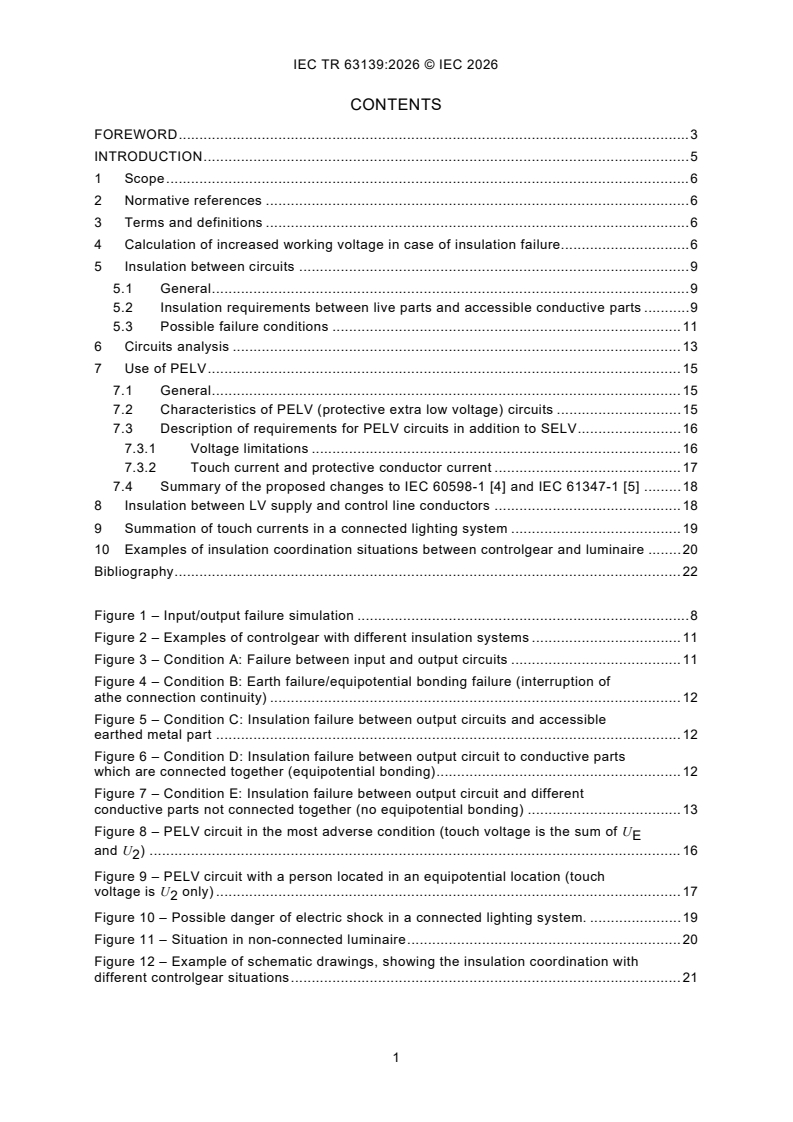
CONTENTS
FOREWORD . 3
INTRODUCTION . 5
1 Scope . 6
2 Normative references . 6
3 Terms and definitions . 6
4 Calculation of increased working voltage in case of insulation failure. 6
5 Insulation between circuits . 9
5.1 General . 9
5.2 Insulation requirements between live parts and accessible conductive parts . 9
5.3 Possible failure conditions . 11
6 Circuits analysis . 13
7 Use of PELV . 15
7.1 General . 15
7.2 Characteristics of PELV (protective extra low voltage) circuits . 15
7.3 Description of requirements for PELV circuits in addition to SELV . 16
7.3.1 Voltage limitations . 16
7.3.2 Touch current and protective conductor current . 17
7.4 Summary of the proposed changes to IEC 60598-1 [4] and IEC 61347-1 [5] . 18
8 Insulation between LV supply and control line conductors . 18
9 Summation of touch currents in a connected lighting system . 19
10 Examples of insulation coordination situations between controlgear and luminaire . 20
Bibliography . 22
Figure 1 – Input/output failure simulation . 8
Figure 2 – Examples of controlgear with different insulation systems . 11
Figure 3 – Condition A: Failure between input and output circuits . 11
Figure 4 – Condition B: Earth failure/equipotential bonding failure (interruption of
athe connection continuity) . 12
Figure 5 – Condition C: Insulation failure between output circuits and accessible
earthed metal part . 12
Figure 6 – Condition D: Insulation failure between output circuit to conductive parts
which are connected together (equipotential bonding) . 12
Figure 7 – Condition E: Insulation failure between output circuit and different
conductive parts not connected together (no equipotential bonding) . 13
Figure 8 – PELV circuit in the most adverse condition (touch voltage is the sum of U
E
and U ) . 16
Figure 9 – PELV circuit with a person located in an equipotential location (touch
voltage is U only) . 17
Figure 10 – Possible danger of electric shock in a connected lighting system. . 19
Figure 11 – Situation in non-connected luminaire . 20
Figure 12 – Example of schematic drawings, showing the insulation coordination with
different controlgear situations . 21
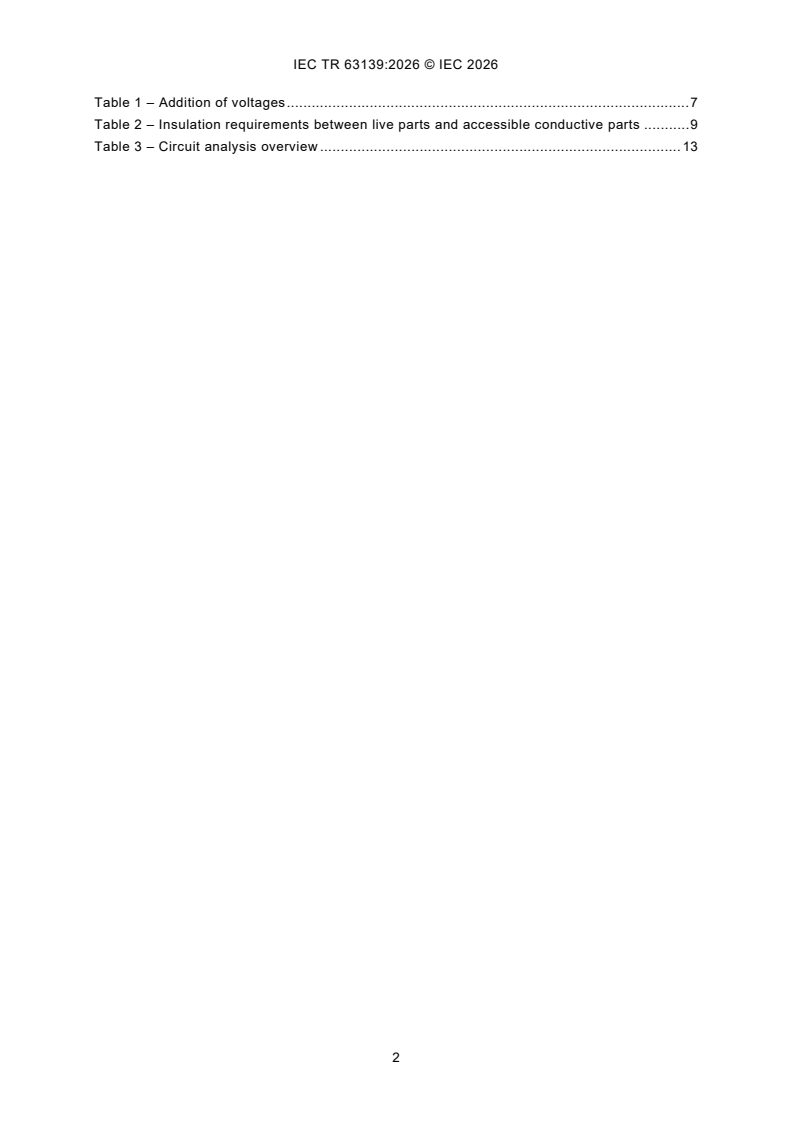
Table 1 – Addition of voltages . 7
Table 2 – Insulation requirements between live parts and accessible conductive parts . 9
Table 3 – Circuit analysis overview . 13
INTERNATIONAL ELECTROTECHNICAL COMMISSION
____________
Explanation and background information on electrical safety
requirements in TC 34 standards
FOREWORD
1) The International Electrotechnical Commission (IEC) is a worldwide organization for
standardization comprising all national electrotechnical committees (IEC National Committees).
The object of IEC is to promote international co-operation on all questions concerning
standardization in the electrical and electronic fields. To this end and in addition to other
activities, IEC publishes International Standards, Technical Specifications, Technical Reports,
Publicly Available Specifications (PAS) and Guides (hereafter referred to as "IEC
Publication(s)"). Their preparation is entrusted to technical committees; any IEC National
Committee interested in the subject dealt with may participate in this preparatory work.
International, governmental and non-governmental organizations liaising with the IEC also
participate in this preparation. IEC collaborates closely with the International Organization for
Standardization (ISO) in accordance with conditions determined by agreement between the two
organizations.
2) The formal decisions or agreements of IEC on technical matters express, as nearly as
possible, an international consensus of opinion on the relevant subjects since each technical
committee has representation from all interested IEC National Committees.
3) IEC Publications have the form of recommendations for international use and are accepted
by IEC National Committees in that sense. While all reasonable efforts are made to ensure that
the technical content of IEC Publications is accurate, IEC cannot be held responsible for the
way in which they are used or for any misinterpretation by any end user.
4) In order to promote international uniformity, IEC National Committees undertake to apply IEC
Publications transparently to the maximum extent possible in their national and regional
publications. Any divergence between any IEC Publication and the corresponding national or
regional publication shall be clearly indicated in the latter.
5) IEC itself does not provide any attestation of conformity. Independent certification bodies
provide conformity assessment services and, in some areas, access to IEC marks of conformity.
IEC is not responsible for any services carried out by independent certification bodies.
6) All users should ensure that they have the latest edition of this publication.
7) No liability shall attach to IEC or its directors, employees, servants or agents including
individual experts and members of its technical committees and IEC National Committees for
any personal injury, property damage or other damage of any nature whatsoever, whether direct
or indirect, or for costs (including legal fees) and expenses arising out of the publication, use
of, or reliance upon, this IEC Publication or any other IEC Publications.
8) Attention is drawn to the Normative references cited in this publication. Use of the referenced
publications is indispensable for the correct application of this publication.
9) IEC draws attention to the possibility that the implementation of this document may involve
the use of (a) patent(s). IEC takes no position concerning the evidence, validity or applicability
of any claimed patent rights in respect thereof. As of the date of publication of this document,
IEC had not received notice of (a) patent(s), which may be required to implement this document.
However, implementers are cautioned that this may not represent the latest information, which
may be obtained from the patent database available at https://patents.iec.ch. IEC shall not be
held responsible for identifying any or all such patent rights.
IEC TR 63139 has been prepared by IEC technical committee 34: Lighting. It is a Technical
Report.
This second edition cancels and replaces the first edition published in 2018. This edition
constitutes a technical revision.
This edition includes the following significant technical changes with respect to the previous
edition:
a) new title and scope to enable the adding of further new subjects to the content of this
document in the future;
b) new Clause 9 providing background information regarding the possible addition of currents
in a lighting installation where luminaires are interconnected via their control ports;
c) new Clause 10 transferring Annex S of IEC 61347-1:2015 [1] (Examples of controlgear
insulation coordination) from the controlgear safety standard into this document.
The text of this Technical Report is based on the following documents:
Draft Report on voting
34/1416/DTR 34/1435/RVDTR
Full information on the voting for its approval can be found in the report on voting indicated in
the above table.
The language used for the development of this Technical Report is English.
This document was drafted in accordance with ISO/IEC Directives, Part 2, and developed in
accordance with ISO/IEC Directives, Part 1 and ISO/IEC Directives, IEC Supplement, available
at www.iec.ch/members_experts/refdocs. The main document types developed by IEC are
described in greater detail at www.iec.ch/publications.
The committee has decided that the contents of this document will remain unchanged until the
stability date indicated on the IEC website under webstore.iec.ch in the data related to the
specific document. At this date, the document will be
– reconfirmed,
– withdrawn, or
– revised.
INTRODUCTION
This document provides background information to the following subjects being introduced into
IEC TC 34 standards to cover new technologies associated with the use of LED light sources
and controllable products.
This document consists of the following subdivisions:
Clause 4 - Calculation of increased working voltage in case of insulation failure;
Clause 5 - Insulation between circuits following the circuits analysis in Clause 6;
Clause 7 - Use of protective extra low voltage (PELV);
Clause 8 - Insulation between LV supply and control line conductors;
Clause 9 - Summation of touch currents in a connected lighting system;
Clause 10 - Examples of insulation coordination situations between controlgear and luminaire.
1 Scope
This document provides explanations and background information on electrical safety
requirements in TC 34 standards.
2 Normative references
There are no normative references in this document.
3 Terms and definitions
No terms and definitions are listed in this document.
ISO and IEC maintain terminology databases for use in standardization at the following
addresses:
– IEC Electropedia: available at https://www.electropedia.org/
– ISO Online browsing platform: available at https://www.iso.org/obp
4 Calculation of increased working voltage in case of insulation failure
Insulation requirements between live parts and accessible conductive parts as a function of the
controlgear input/output insulation classification and the insulation class of the luminaire are
given in IEC 60598-1:2024 [2], Table T.1 and IEC 61347-1:2024 [3], Table M.1.
Insulation requirements in TC 34 standards are based on a hazard assessment with the
assumption that a certain failure will occur.
The required insulation is normally based on the working voltage U , but in some specific
OUT
failure cases when the basic insulation between supply and output of a controlgear fails, the
supply voltage is added to U . For controlgear with double or reinforced insulation between
OUT
primary (U ) and secondary (U ) this type of failure is not expected.
SUPPLY OUT
In case of failure of the basic insulation within the controlgear the following assumptions are
made:
– there is an increased output voltage,
– the luminaire remains working, and the increased voltage is present for a time long enough
to create a conduction track across the insulation (known as tracking).
For 50/60 Hz transformers inside the controlgear, this failure condition results in the addition of
the voltages that can be calculated by the simple summation of the two values. In electronic
controlgear this situation can result in a more complex summation due to the complexity of the
oscillating circuit that can influence the result.
The best method to check the output voltage in case of insulation failure is to measure the
output voltage directly on a sample of controlgear with the fault simulated. The failure of the
insulation and the output voltage is measured against earth (or zero potential). This method
has been found not to be practical due to the following reasons:
– differing supply conditions (voltage/frequency);
– difficulty in simulating exactly the failure condition;
– difficulty in making accurate and reproducible measurements.
For the above-mentioned reasons the mathematical calculation of the sum of the voltages has
been found to be more appropriate, reproducible and easy to calculate, even if the result can
in some cases be lower than the real measurement. Designing and testing the insulation
properties of the output circuit with an increased voltage value is considered as a necessary
safety provision to cover this first failure condition which can occur inside basic insulated
controlgear.
The approximation given by the mathematical calculation is considered to provide sufficient
severity, compared to the possible practical failure voltage, to ensure the safety of the product
through its lifetime. With the appropriate formula in Table 1 most of the expected failure cases
are covered. Higher voltages occurring in very rare cases will not have any serious impact.
The formulas used for combining the input and output voltages of the controlgear, with basic
insulation between supply and output, are given in Table 1.
Table 1 – Addition of voltages
U U Phase relationship Voltage calculation for insulation design
supply OUT
AC AC Same frequency and See Formula (1)
no phase shift
AC AC Same frequency and See Formula (2)
with phase shift
AC AC Different frequency See Formula (3)
AC DC No phase shift See Formula (4)
DC AC No phase shift See Formula (5)
DC DC No phase shift See Formula (6)
NOTE 1 Voltages in this Table 1 are RMS values.
NOTE 2 The AC and DC calculation is typical for LED applications.
𝑈𝑈 =𝑈𝑈 +𝑈𝑈 (1)
AC1 AC2
2 2
� (2)
𝑈𝑈 = 𝑈𝑈 +𝑈𝑈 +2𝑈𝑈 𝑈𝑈 cos𝜑𝜑
AC1 AC2
AC1 AC2
2 2
� (3)
𝑈𝑈 = 𝑈𝑈 +𝑈𝑈
AC1 AC2
2 2
(4)
𝑈𝑈 =�𝑈𝑈 +𝑈𝑈
AC DC
2 2
(5)
𝑈𝑈 =�𝑈𝑈 +𝑈𝑈
DC AC
𝑈𝑈 =𝑈𝑈 +𝑈𝑈 (6)
DC1 DC2
Figure 1 shows the simulation of the possible fault between input and output terminals (red line)
with the mathematical calculation providing the expected output voltage that can occur.
Figure 1 – Input/output failure simulation
For background information, Formula (4) and Formula (5) for the specific case of a combination
of an AC and DC voltage are derived from the following Formula (7) to Formula (11). It can be
regarded as a showcase for any of the formulas from Table 1.
Value U is the RMS value (U ) of the voltage u(t).
RMS
𝑇𝑇
𝑢𝑢 (𝑡𝑡)𝑑𝑑𝑡𝑡
∫
0 (7)
�
𝑈𝑈 =
𝑇𝑇
In the particular case given, u(t) consists of an AC (sinusoidal) part with peak voltage U and
frequency ω and a DC part U . It can be derived that
DC
𝑇𝑇 𝑇𝑇
2 2
( ( ) )
∫ 𝑢𝑢 (𝑡𝑡)𝑑𝑑𝑡𝑡 ∫ 𝑈𝑈 sin𝜔𝜔𝑡𝑡 +𝑈𝑈 𝑑𝑑𝑡𝑡
1 DC
2 0 0
𝑈𝑈 = =
𝑇𝑇 𝑇𝑇
(8)
2 𝑇𝑇 𝑇𝑇 𝑇𝑇
𝑈𝑈 2𝑈𝑈𝑈𝑈 1
1 1 DC
2 2
= � sin (𝜔𝜔𝑡𝑡)𝑑𝑑𝑡𝑡+ � sin(𝜔𝜔𝑡𝑡)𝑑𝑑𝑡𝑡+ � 𝑈𝑈 𝑑𝑑𝑡𝑡
DC
𝑇𝑇 𝑇𝑇 𝑇𝑇
0 0 0
Evaluating this integral yields
1𝑈𝑈 1 2𝑈𝑈𝑈𝑈 1
1 1 DC
2 𝑡𝑡=𝑇𝑇 𝑡𝑡=𝑇𝑇
(9)
𝑈𝑈 = �𝑡𝑡− sin(𝜔𝜔𝑡𝑡)cos(𝜔𝜔𝑡𝑡)�│ − cos(𝜔𝜔𝑡𝑡)│ + 𝑈𝑈 𝑇𝑇
𝑡𝑡=0 𝑡𝑡=0 DC
2𝑇𝑇 𝜔𝜔 𝑇𝑇𝜔𝜔 𝑇𝑇
𝑈𝑈
2 2
(10)
𝑈𝑈 = +𝑈𝑈
DC
And thus,
𝑈𝑈
2 2 2
(11)
�
𝑈𝑈 = +𝑈𝑈 =�𝑈𝑈 +𝑈𝑈
DC AC DC
5 Insulation between circuits
5.1 General
New requirements have been added to those in IEC 60598-1 [4] and IEC 61347-1 [5] concerning
the requirements for insulation between different types of circuit and to conductive accessible
parts. For insulation requirements between live parts and accessible conductive parts and
examples of controlgear with different insulation systems, see Table 2 and Figure 2.
In case of a failure in the basic insulation, with the assumptions made in Clause 4, between the
supply voltage and the output circuit, the insulation in the secondary circuit will have an increase
chance of failing; this can be regarded as a follow up failure, which is by definition still a single
fault. This means that the insulation in the secondary circuit must be able to cope with this
higher voltage.
The explanations in the paragraph below provide information regarding the technical rationale
associated with these requirements.
The numbers in brackets (1) to (18) detailed in Table 2 refer to the content of IEC 60598-1:2024
[2], Table T.1 and IEC 61347-1:2024 [3], Table M.1. A comparison with possible failure
conditions is shown in Figure 3 to Figure 7. Each combination has been evaluated and the
consequences are listed in 5.3 with the requirements for the insulation which is needed for each
numbered case.
5.2 Insulation requirements between live parts and accessible conductive parts
Explanations to the application of the insulation requirements are given in Table 2 and
Figure 2.
Table 2 – Insulation requirements between live parts and accessible conductive parts
Controlgear Required insulation between live parts and accessible conductive parts
Insulation Output Class II Class II
between voltage Class I
Insulation of one Insulation of more than one accessible
mains
Insulation of accessible conductive part without equipotential
supply
accessible conductive part bonding
and
earthed or more than
secondary
conductive one with
circuits
equipotential
parts
bonding
None U > (1) (7) (13)
out
mains
Basic Double or Double or reinforced insulation complying with
supply
insulation reinforced U
out
complying insulation
with U complying with
out
U
out
U ≤ (2) (8) (14)
out
mains
Basic Double or Double or reinforced insulation complying with
supply
insulation reinforced mains supply
complying ins
...
IEC TR 63139 ®
Edition 2.0 2026-03
TECHNICAL
REPORT
REDLINE VERSION
Explanation of the mathematical addition of working voltages, insulation
between circuits and use of PELV and background information on electrical
safety requirements in TC 34 standards
ICS 29.140.01 ISBN 978-2-8327-1133-0
All rights reserved. Unless otherwise specified, no part of this publication may be reproduced or utilized in any form or
by any means, electronic or mechanical, including photocopying and microfilm, without permission in writing from either
IEC or IEC's member National Committee in the country of the requester. If you have any questions about IEC copyright
or have an enquiry about obtaining additional rights to this publication, please contact the address below or your local
IEC member National Committee for further information.
IEC Secretariat Tel.: +41 22 919 02 11
3, rue de Varembé info@iec.ch
CH-1211 Geneva 20 www.iec.ch
Switzerland
About the IEC
The International Electrotechnical Commission (IEC) is the leading global organization that prepares and publishes
International Standards for all electrical, electronic and related technologies.
About IEC publications
The technical content of IEC publications is kept under constant review by the IEC. Please make sure that you have the
latest edition, a corrigendum or an amendment might have been published.
IEC publications search - IEC Products & Services Portal - products.iec.ch
webstore.iec.ch/advsearchform Discover our powerful search engine and read freely all the
The advanced search enables to find IEC publications by a publications previews, graphical symbols and the glossary.
variety of criteria (reference number, text, technical With a subscription you will always have access to up to date
committee, …). It also gives information on projects, content tailored to your needs.
replaced and withdrawn publications.
Electropedia - www.electropedia.org
IEC Just Published - webstore.iec.ch/justpublished The world's leading online dictionary on electrotechnology,
Stay up to date on all new IEC publications. Just Published containing more than 22 500 terminological entries in English
details all new publications released. Available online and and French, with equivalent terms in 25 additional languages.
once a month by email. Also known as the International Electrotechnical Vocabulary
(IEV) online.
IEC Customer Service Centre - webstore.iec.ch/csc
If you wish to give us your feedback on this publication or
need further assistance, please contact the Customer
Service Centre: sales@iec.ch.
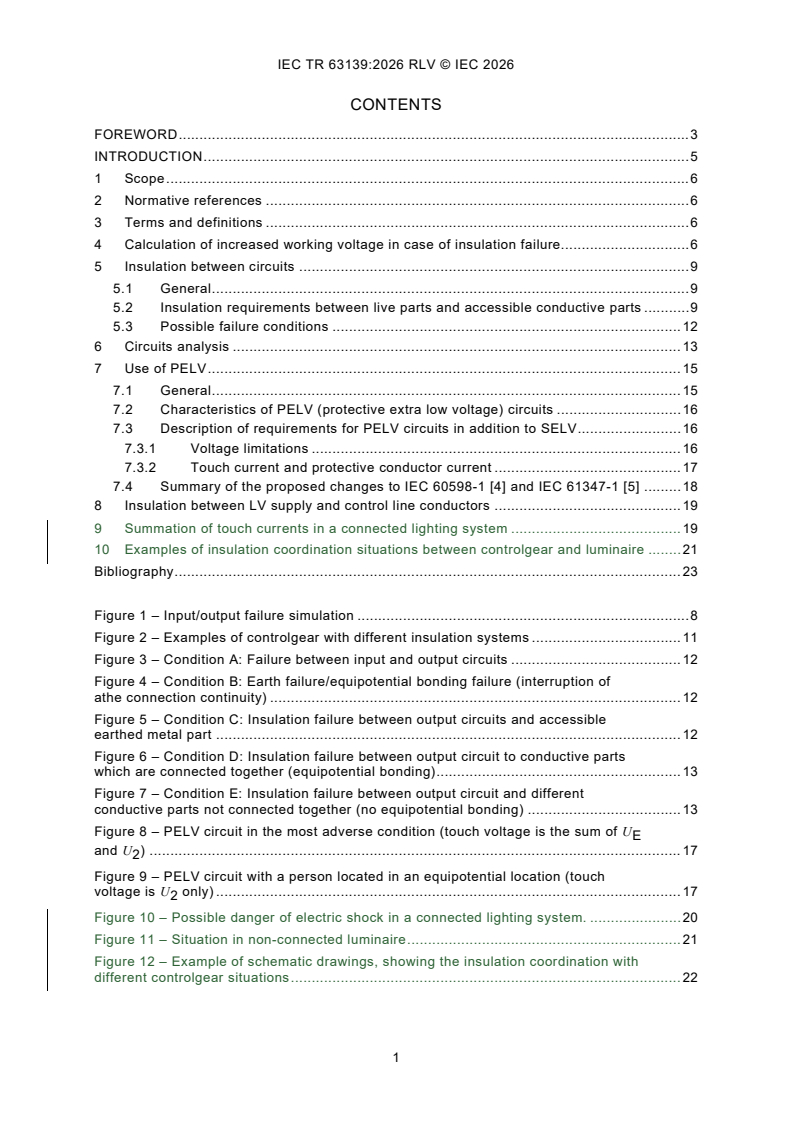
CONTENTS
FOREWORD . 3
INTRODUCTION . 5
1 Scope . 6
2 Normative references . 6
3 Terms and definitions . 6
4 Calculation of increased working voltage in case of insulation failure. 6
5 Insulation between circuits . 9
5.1 General . 9
5.2 Insulation requirements between live parts and accessible conductive parts . 9
5.3 Possible failure conditions . 12
6 Circuits analysis . 13
7 Use of PELV . 15
7.1 General . 15
7.2 Characteristics of PELV (protective extra low voltage) circuits . 16
7.3 Description of requirements for PELV circuits in addition to SELV . 16
7.3.1 Voltage limitations . 16
7.3.2 Touch current and protective conductor current . 17
7.4 Summary of the proposed changes to IEC 60598-1 [4] and IEC 61347-1 [5] . 18
8 Insulation between LV supply and control line conductors . 19
9 Summation of touch currents in a connected lighting system . 19
10 Examples of insulation coordination situations between controlgear and luminaire . 21
Bibliography . 23
Figure 1 – Input/output failure simulation . 8
Figure 2 – Examples of controlgear with different insulation systems . 11
Figure 3 – Condition A: Failure between input and output circuits . 12
Figure 4 – Condition B: Earth failure/equipotential bonding failure (interruption of
athe connection continuity) . 12
Figure 5 – Condition C: Insulation failure between output circuits and accessible
earthed metal part . 12
Figure 6 – Condition D: Insulation failure between output circuit to conductive parts
which are connected together (equipotential bonding) . 13
Figure 7 – Condition E: Insulation failure between output circuit and different
conductive parts not connected together (no equipotential bonding) . 13
Figure 8 – PELV circuit in the most adverse condition (touch voltage is the sum of U
E
and U ) . 17
Figure 9 – PELV circuit with a person located in an equipotential location (touch
voltage is U only) . 17
Figure 10 – Possible danger of electric shock in a connected lighting system. . 20
Figure 11 – Situation in non-connected luminaire . 21
Figure 12 – Example of schematic drawings, showing the insulation coordination with
different controlgear situations . 22
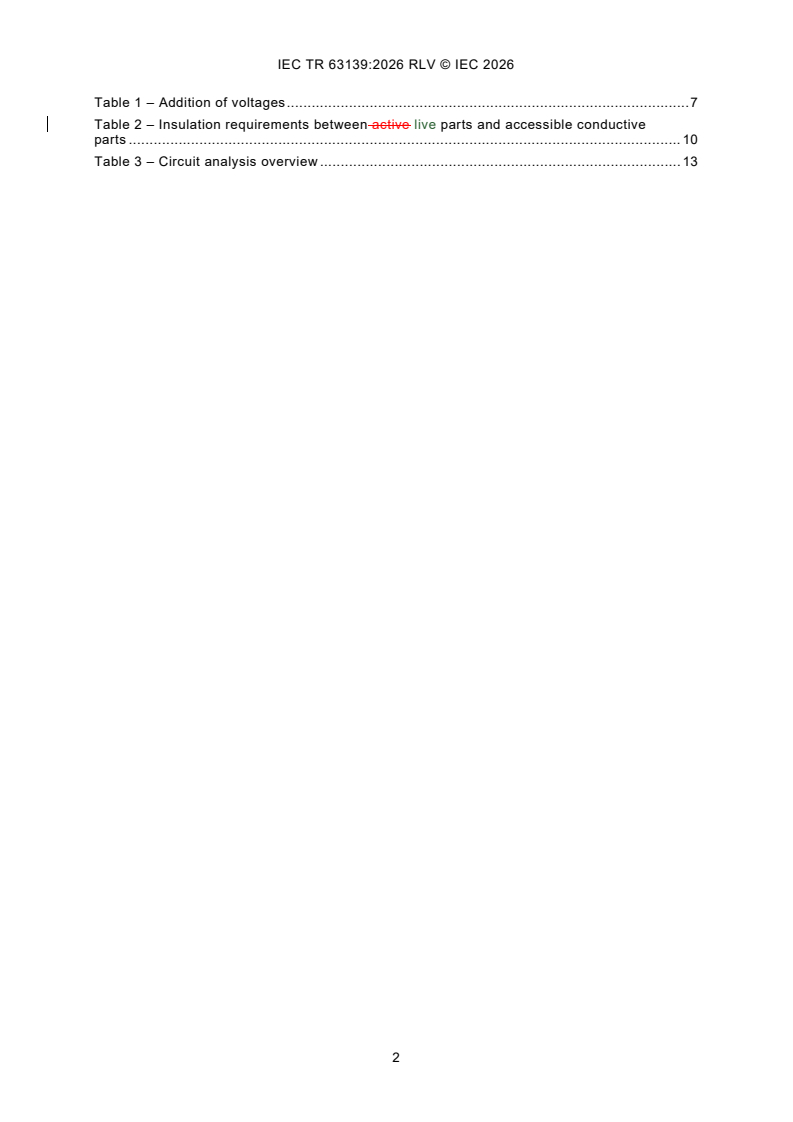
Table 1 – Addition of voltages . 7
Table 2 – Insulation requirements between active live parts and accessible conductive
parts . 10
Table 3 – Circuit analysis overview . 13
INTERNATIONAL ELECTROTECHNICAL COMMISSION
____________
Explanation of the mathematical addition of working voltages, insulation
between circuits and use of PELV and background information on
electrical safety requirements in TC 34 standards
FOREWORD
1) The International Electrotechnical Commission (IEC) is a worldwide organization for
standardization comprising all national electrotechnical committees (IEC National Committees).
The object of IEC is to promote international co-operation on all questions concerning
standardization in the electrical and electronic fields. To this end and in addition to other
activities, IEC publishes International Standards, Technical Specifications, Technical Reports,
Publicly Available Specifications (PAS) and Guides (hereafter referred to as "IEC
Publication(s)"). Their preparation is entrusted to technical committees; any IEC National
Committee interested in the subject dealt with may participate in this preparatory work.
International, governmental and non-governmental organizations liaising with the IEC also
participate in this preparation. IEC collaborates closely with the International Organization for
Standardization (ISO) in accordance with conditions determined by agreement between the two
organizations.
2) The formal decisions or agreements of IEC on technical matters express, as nearly as
possible, an international consensus of opinion on the relevant subjects since each technical
committee has representation from all interested IEC National Committees.
3) IEC Publications have the form of recommendations for international use and are accepted
by IEC National Committees in that sense. While all reasonable efforts are made to ensure that
the technical content of IEC Publications is accurate, IEC cannot be held responsible for the
way in which they are used or for any misinterpretation by any end user.
4) In order to promote international uniformity, IEC National Committees undertake to apply IEC
Publications transparently to the maximum extent possible in their national and regional
publications. Any divergence between any IEC Publication and the corresponding national or
regional publication shall be clearly indicated in the latter.
5) IEC itself does not provide any attestation of conformity. Independent certification bodies
provide conformity assessment services and, in some areas, access to IEC marks of conformity.
IEC is not responsible for any services carried out by independent certification bodies.
6) All users should ensure that they have the latest edition of this publication.
7) No liability shall attach to IEC or its directors, employees, servants or agents including
individual experts and members of its technical committees and IEC National Committees for
any personal injury, property damage or other damage of any nature whatsoever, whether direct
or indirect, or for costs (including legal fees) and expenses arising out of the publication, use
of, or reliance upon, this IEC Publication or any other IEC Publications.
8) Attention is drawn to the Normative references cited in this publication. Use of the referenced
publications is indispensable for the correct application of this publication.
9) IEC draws attention to the possibility that the implementation of this document may involve
the use of (a) patent(s). IEC takes no position concerning the evidence, validity or applicability
of any claimed patent rights in respect thereof. As of the date of publication of this document,
IEC had not received notice of (a) patent(s), which may be required to implement this document.
However, implementers are cautioned that this may not represent the latest information, which
may be obtained from the patent database available at https://patents.iec.ch. IEC shall not be
held responsible for identifying any or all such patent rights.
IEC TR 63139 has been prepared by IEC technical committee 34: Lighting. It is a Technical
Report.
This second edition cancels and replaces the first edition published in 2018. This edition
constitutes a technical revision.
This edition includes the following significant technical changes with respect to the previous
edition:
a) new title and scope to enable the adding of further new subjects to the content of this
document in the future;
b) new Clause 9 providing background information regarding the possible addition of currents
in a lighting installation where luminaires are interconnected via their control ports;
c) new Clause 10 transferring Annex S of IEC 61347-1:2015 [1] (Examples of controlgear
insulation coordination) from the controlgear safety standard into this document.
The text of this Technical Report is based on the following documents:
Draft Report on voting
34/1416/DTR 34/1435/RVDTR
Full information on the voting for its approval can be found in the report on voting indicated in
the above table.
The language used for the development of this Technical Report is English.
This document was drafted in accordance with ISO/IEC Directives, Part 2, and developed in
accordance with ISO/IEC Directives, Part 1 and ISO/IEC Directives, IEC Supplement, available
at www.iec.ch/members_experts/refdocs. The main document types developed by IEC are
described in greater detail at www.iec.ch/publications.
The committee has decided that the contents of this document will remain unchanged until the
stability date indicated on the IEC website under webstore.iec.ch in the data related to the
specific document. At this date, the document will be
– reconfirmed,
– withdrawn, or
– revised.
INTRODUCTION
This document provides background information to the following subjects being introduced into
IEC TC 34 standards to cover new technologies associated with the use of LED light sources
and controllable products.
This document consists of the following subdivisions:
Clause 4 - Mathematical addition of working voltages Calculation of increased working voltage
in case of insulation failure;
Clause 5 - Insulation between circuits following the circuits analysis in Clause 6;
Clause 7 - Use of protective extra low voltage (PELV);
Clause 8 - Insulation between LV supply and control line conductors;
Clause 9 - Summation of touch currents in a connected lighting system;
Clause 10 - Examples of insulation coordination situations between controlgear and luminaire.
1 Scope
This document is related to the insulation coordination in TC 34 standards and provides
explanations on mathematical addition of working voltages, insulation between circuits, use of
protective extra low voltage (PELV) and insulation between LV supply and control line
conductors in order to cover new technologies associated with the use of LED light sources and
controllable products.
It describes in which way the addition of supply voltages and working voltages can be arranged
for an assessment of the electrical insulation requirements (e.g. creepage distances and
clearances) in a system if a first failure occurs.
Furthermore the actual failure scenarios given in IEC 60598-1:2014 and IEC 60598-
1:2014/AMD1:2017, Annex X and IEC 61347-1:2015, Clause 15 are explained in greater detail
and the rationale behind the protective requirement for each situation is given (e.g. possible LV
primary to ELV secondary does not lead to an overburden of the insulation in the second circuit).
This document also describes the possibility to increase immunity and reliability of electronic
circuits, used in combination with LEDs, with the use of PELV and the associated safety
consequences for this system.
The insulation between LV supply and control line conductors is also important and this
document explains why this is an essential safety consideration for a complete installation
system.
This document provides explanations and background information on electrical safety
requirements in TC 34 standards.
2 Normative references
There are no normative references in this document.
3 Terms and definitions
No terms and definitions are listed in this document.
ISO and IEC maintain terminology databases for use in standardization at the following
addresses:
– IEC Electropedia: available at https://www.electropedia.org/
– ISO Online browsing platform: available at https://www.iso.org/obp
4 Mathematical addition of working voltages Calculation of increased working
voltage in case of insulation failure
Insulation requirements between live parts and accessible conductive parts as a function of the
controlgear input/output insulation classification and the insulation class of the luminaire are
given in IEC 60598-1:2014, Table X.1 and IEC 61347-1:2015, Table 6 IEC 60598-1:2024 [2],
Table T.1 and IEC 61347-1:2024 [3], Table M.1.
Insulation requirements in TC 34 standards are based on a hazard assessment with the
assumption that a certain failure will occur.
The required insulation is normally based on the working voltage U , but in some specific
OUT
failure cases when the basic insulation between supply and output of a controlgear fails, the
supply voltage should be is added to U . For controlgear with double or reinforced insulation
OUT
between primary (U ) and secondary (U ) this type of failure is not expected.
SUPPLY OUT
In case of failure of the basic insulation within the controlgear the following assumptions are
made:
– there is an increased output voltage,
– the luminaire remains working, and the increased voltage is present for a time long enough
to create a conduction track across the insulation (known as tracking).
For 50/60 Hz transformers inside the controlgear, this failure condition results in the addition of
the voltages that can be calculated by the simple summation of the two values. In electronic
controlgear this situation may can result in a more complex summation due to the complexity
of the oscillating circuit that may can influence the result.
The best method to check the output voltage in case of insulation failure is to measure the
output voltage directly on a sample of controlgear with the fault simulated. The failure of the
insulation and the output voltage should be is measured against earth (or zero potential). This
method has been found not to be practical due to the following reasons:
– differing supply conditions (voltage/frequency);
– difficulty in simulating exactly the failure condition;
– difficulty in making accurate and reproducible measurements.
For the above-mentioned reasons the mathematical calculation of the sum of the voltages has
been found to be more appropriate, reproducible and easy to calculate, even if the result may
can in some cases be lower than the real measurement. Designing and testing the insulation
properties of the output circuit with an increased voltage value is considered as a necessary
safety provision to cover this first failure condition which can occur inside basic insulated
controlgear.
The approximation given by the mathematical calculation is considered to provide sufficient
severity, compared to the possible practical failure voltage, to ensure the safety of the product
through its lifetime. With the selected appropriate formula in Table 1 most of the expected failure
cases are covered. Higher voltages occurring in very rare cases will not have any serious
impact.
The formulas used for combining the input and output voltages of the controlgear, with basic
insulation between supply and output, are given in Table 1.
Table 1 – Addition of voltages
U U Phase relationship Voltage calculation for insulation design
supply OUT
AC AC Same frequency and See Formula (1)
no phase shift
AC AC Same frequency and See Formula (2)
with phase shift
AC AC Different frequency See Formula (3)
AC DC No phase shift See Formula (4)
DC AC No phase shift See Formula (5)
DC DC No phase shift See Formula (6)
NOTE 1 Voltages in this Table 1 are RMS values.
NOTE 2 The AC and DC calculation is typical for LED applications.
𝑈𝑈 =𝑈𝑈 +𝑈𝑈 (1)
AC1 AC2
2 2
� (2)
𝑈𝑈 = 𝑈𝑈 +𝑈𝑈 +2𝑈𝑈 𝑈𝑈 cos𝜑𝜑
AC1 AC2 AC1 AC2
2 2
)
� (3
𝑈𝑈 = 𝑈𝑈 +𝑈𝑈
AC1 AC2
2 2
(4)
𝑈𝑈 =�𝑈𝑈 +𝑈𝑈
AC DC
2 2 2 2
(5)
𝑈𝑈 =�𝑈𝑈 +𝑈𝑈 𝑈𝑈 =�𝑈𝑈 +𝑈𝑈
AC DC DC AC
𝑈𝑈 =𝑈𝑈 +𝑈𝑈 (6)
DC1 DC2
Figure 1 shows the simulation of the possible fault between input and output terminals (red line)
with the mathematical calculation providing the expected output voltage that may can occur.
Figure 1 – Input/output failure simulation
For background information, Formula (4) and Formula (5) for the specific case of a combination
of an AC and DC voltage are derived from the following Formula (7) to Formula (11). It may can
be regarded as a showcase for any of the formulas from Table 1.
) of the voltage u(t).
Value U is the RMS value (U
RMS
𝑇𝑇
2 𝑢𝑢 (𝑡𝑡)𝑑𝑑𝑡𝑡
∫
0 (7)
�
U U ut()
RMS 𝑈𝑈 =
𝑇𝑇
In the particular case given, u(t) consists of an AC (sinusoidal) part with peak voltage U and
frequency ω and a DC part U . It can be derived that
DC
==
𝑇𝑇 𝑇𝑇
2 2
𝑢𝑢 (𝑡𝑡)𝑑𝑑𝑡𝑡 (𝑈𝑈 sin(𝜔𝜔𝑡𝑡)+𝑈𝑈 )𝑑𝑑𝑡𝑡
∫ ∫
1 DC
0 0
𝑈𝑈 = =
𝑇𝑇 𝑇𝑇
(8)
2 𝑇𝑇 𝑇𝑇 𝑇𝑇
𝑈𝑈 2𝑈𝑈𝑈𝑈 1
1 DC
1 2
= � sin (𝜔𝜔𝑡𝑡)𝑑𝑑𝑡𝑡+ � sin(𝜔𝜔𝑡𝑡)𝑑𝑑𝑡𝑡+ � 𝑈𝑈 𝑑𝑑𝑡𝑡
DC
𝑇𝑇 𝑇𝑇 𝑇𝑇
0 0 0
Evaluating this integral yields
1𝑈𝑈 1 2𝑈𝑈𝑈𝑈 1
1 1 DC
2 𝑡𝑡=𝑇𝑇 𝑡𝑡=𝑇𝑇 2
(9)
𝑈𝑈 = �𝑡𝑡− sin(𝜔𝜔𝑡𝑡)cos(𝜔𝜔𝑡𝑡)�│ − cos(𝜔𝜔𝑡𝑡)│ + 𝑈𝑈 𝑇𝑇
𝑡𝑡=0 𝑡𝑡=0
DC
2𝑇𝑇 𝜔𝜔 𝑇𝑇𝜔𝜔 𝑇𝑇
𝑈𝑈
(10)
= +𝑈𝑈
𝑈𝑈
DC
And thus,
𝑈𝑈
2 2 2
(11)
�
𝑈𝑈 = +𝑈𝑈 =�𝑈𝑈 +𝑈𝑈
DC AC DC
5 Insulation between circuits
5.1 General
New requirements have been added to those in IEC 60598-1 [4] and IEC 61347-1 [5] concerning
the requirements for insulation between different types of circuit and to conductive accessible
parts. For insulation requirements between active live parts and accessible conductive parts
and examples of controlgear with different insulation systems, see Table 2 and Figure 2.
In case of a failure in the basic insulation, with the assumptions made in Clause 4, between the
supply voltage and the output circuit, the insulation in the secondary circuit will have an increase
chance of failing; this can be regarded as a follow up failure, which is by definition still a single
fault. This means that the insulation in the secondary circuit should must be able to cope with
this higher voltage.
The explanations in the paragraph below provide information regarding the technical rationale
associated with these requirements.
The numbers in brackets (1) to (18) detailed in Table 2 refer to the content of IEC 60598-1:2014,
Table X.1 and IEC 61347-1:2015, Table 6 IEC 60598-1:2024 [2], Table T.1 and IEC 61347-
1:2024 [3], Table M.1. A comparison with possible failure conditions is shown in Figure 3 to
Figure 7. Each combination has been evaluated and the consequences are listed in 5.3 with
the requirements for the insulation which is needed for each numbered case.
5.2 Insulation requirements between active live parts and accessible
conductive parts
Explanations to the application of the insulation requirements are given in Table 2
and Figure 2.
Table 2 – Insulation requirements between active live parts and
accessible conductive parts
Controlgear Required insulation between active live parts and accessible conductive parts
Insulation Output Class II Class II
between voltage Class I
Insulation of Insulation of more than one accessible
LV mains
Insulation of one accessible conductive part without equipotential
supply
accessible conductive bonding
and
earthed part or more
secondary
conductive than one with
circuits
parts equipotential
bonding
None U > (1) (7) (13)
out
LV
supply
Basic Double or Double or reinforced insulation complying with
mains
insulation reinforced U
out
supply
complying with insulation
U complying with
out
U
out
U ≤
(2) (8) (14)
out
Lv
supply
Basic Double or Double or reinforced insulation complying with
mains
insulation reinforced LV mains supply
supply
supply
complying with insulation
LV mains complying with
supply
LV mains
supply supply
supply
Basic Voltages (3) (9) (15)
above
Basic Supplementary Insulation has to fulfil the higher requirement of
ELV
insulation insulation a) or b):
complying with complying with
a) Supplementary insulation complying with
U U + Lv
out out supply U + Lv added with mains supply
out supply
added with
b) Double or reinforced insulation complying
mains supply
with U
out
ELV (4) (10) (16)
(FELV)
Basic Supplementary Supplementary insulation complying with U +
out
insulation insulation
Lv added with mains supply
supply
complying with complying with
U U + Lv
out out supply
added with
mains supply
Double or Voltages (5) (11) (17)
reinforced above
Basic Basic insulation Double or reinforced insulation complying with
ELV
insulation complying with U
out
complying with U
out
U
out
ELV (6) (12) (18)
(SELV)
Basic Basic insulation Basic insulation complying with U
out
insulation complying with
complying with U See also requirements in IEC 60598-1:2014 and
out
U IEC 60598-1:2014/
out
See also AMD1:2017, Sections 8, 10 and 11 IEC 60598-
See also requirements in 1:2024 [2], Clause 10, Clause 12 and Clause 13
requirements IEC 60598-
in IEC 60598- 1:2014 and
1:2014 and IEC 60598-
IEC 60598- 1:2014/
1:2014/ AMD1:2017,
AMD1:2017, Sections 8, 10
Sections 8, 10 and 11 IEC
and 11 IEC 60598-1:2024
60598-1:2024 [2], Clause 10,
[2], Clause 10, Clause 12 and
Clause 12 and Clause 13
Clause 13
Controlgear Required insulation between active live parts and accessible conductive parts
Insulation Output Class II Class II
between voltage Class I
Insulation of Insulation of more than one accessible
LV mains
Insulation of one accessible conductive part without equipotential
supply
accessible conductive bonding
and
earthed part or more
secondary
conductive than one with
circuits
parts equipotential
bonding
NOTE 1 The content of this Table 2 is identical to that of IEC 60598-1:2014, Table X IEC 60598-1:2024 [2], Table
T.1. The corresponding Table 6 M.1 in IEC 61347-1:2015 IEC 61347-1:2024 [3] is technically equivalent.
NOTE 2 The numbers in brackets are used as references in Table 3.
NOTE 3 For addition of voltages, see Table 1.
a) Controlgear without insulation between U and U
supply out
b) Controlgear with basic insulation
c) Controlgear with double or reinforced insulation
NOTE One red line between the primary and secondary winding of the transformer stands for "basic insulation"
and two red lines for "double or reinforced insulation".
Figure 2 – Examples of controlgear with different insulation systems
5.3 Possible failure conditions
Figure 3 to Figure 7 show detailed various failure conditions encountered in circuits for LED
products.
Figure 3 – Condition A: Failure between input and output circuits
Figure 4 – Condition B: Earth failure/equipotential bonding failure (interruption of the
connection continuity)
Figure 5 – Condition C: Insulation failure between output circuits and accessible
earthed metal part
Figure 6 – Condition D: Insulation failure between output circuit to conductive parts
which are connected together (equipotential bonding)
Figure 7 – Condition E: Insulation failure between output circuit and different
conductive parts not connected together (no equipotential bonding)
6 Circuits analysis
Table 3 provides an overview of the possible hazard related to the failure conditions described
in 5.3. Each combination has been evaluated and the consequences are listed with the
requirements for the insulation introduced in IEC 60598 series which are needed for each
numbered case in Table 2.
Table 3 – Circuit analysis overview
Table 2 Failure Consequential circuit analysis
references conditions (see
5.3)
(1) and (2) A NA
B The second line of defence is the basic insulation.
C The second line of defence is the earth connection.
D NA
E NA
(3) and (4) A The second line of defence is the earth connection.
(Consequential failures due to high voltage also protected by earth
connection).
B The second line of defence is the basic insulation.
(Otherwise different conductive parts which become unbounded may can
have different potentials).
C The second line of defence is the earth connection.
D NA
E NA
Table 2 Failure Consequential circuit analysis
references conditions (see
5.3)
(5) A NA (There is double or reinforced insulation).
B The second line of defence is the basic insulation.
(Otherwise different conductive parts which become unbounded may can
have different potentials.)
C The second line of defence is the earth connection.
D NA
E NA
(6) A NA (There is double or reinforced insulation).
B Basic insulation required for SELV voltages above the limits defined by
IEC 60598-1:2014, Section 8 IEC 60598-1:2024 [2], Clause 10.
C Basic insulation required for SELV voltages above the limits defined by
IEC 60598-1:2014, Section 8 IEC 60598-1:2024 [2], Clause 10.
D NA
E NA
(7) and (8) A NA
B Double or reinforced insulation provides safety.
C NA
D Double or reinforced insulation provides safety.
E NA
(9) and (10) A The second line of defence is supplementary insulation.
B The second line of defence is supplementary insulation.
C NA
D The second line of defence is the basic insulation in the controlgear.
E NA
(11) A NA (There is double or reinforced insulation).
B The second line of defence is basic insulation.
C NA
D The second line of defence is equipotential bonding.
E NA
(12) A NA (There is double or reinforced insulation).
B Basic insulation. Required for SELV voltages above the limits defined by
IEC 60598-1:2014, Section 8 IEC 60598-1:2024 [2], Clause 10.
C NA
D Basic insulation required for SELV voltages above the limits defined by
IEC 60598-1:2014, Section 8 IEC 60598-1:2024 [2], Clause 10.
E NA
(13) and (14) A NA
B NA
C NA
D NA
E Double or reinforced insulation provides safety.
(15) A The second line of defence is supplementary insulation.
B NA
C NA
D NA
Table 2 Failure Consequential circuit analysis
references conditions (see
5.3)
E Double or reinforced insulation provides safety.
(After the first failure of insulation no change of operation may can be
noticed. In case of further failure, the two conductive parts could show
different potential).
(16) A The second line of defence is supplementary insulation.
B NA
C NA
D NA
E The second line of defence is the basic insulation in the controlgear.
(ELV voltage cannot create dangerous voltages between different
conductive parts).
(17) A NA (There is double or reinforced insulation.)
B NA
C NA
D NA
E Double or reinforced insulation provides safety.
(After the first failure of insulation no change of operation may can be
noticed. In case of further failure, the two conductive parts could show
different potential).
(18) A NA (There is double or reinforced insulation).
B NA
C NA
D NA
E Basic insulation required for SELV voltages above the limits defined by
IEC 60598-1:2014, Section 8 IEC 60598-1:2024 [2], Clause 10.
NOTE 1 The failure of functional insulation is not considered as single "fault condition" so functional insulation
cannot be considered as first or second line of defence.
NOTE 2 NA = Not applicable as the fault condition is not expected.
7 Use of PELV
7.1 General
With the use of electronic circuits in combination with LEDs, the immunity and reliability aspects
become more important.
LEDs are very sensitive to voltages that can damage the PN junction. Mains voltage transients
and electrostatic discharge may can produce voltages far above 1 kV.
One solution to limit the risk of damaging voltages is to establish a grid where all parts are
connected together (circuit and body of the luminaire). In this way the LEDs are more protected
and are not subjected to extra voltages. The connection of ELV parts to earth provides such a
situation.
In the wiring rules standard, IEC 60364-4-41:2005 [6], and in other standards (e.g. transformer
standard IEC 61558-1:2017 [7]), connecting an ELV circuit to earth is allowed. This is called
protective extra low voltage (PELV).
7.2 Characteristics of PELV (protective extra low voltage) circuits
In IEC 61140:2016 [8], 3.26.2, a PELV system is defined as "an electrical system in which the
voltage cannot exceed the value of ELV
– under normal conditions, and
– under single-fault conditions, except earth faults in other electric circuits."
Taking into consideration the requirements of IEC 61140:2016 [8] and IEC 60364-4-41:2005
[6], the following requirements are proposed:
– limitation of voltage in the PELV system to the upper limit of voltage Band I, 50 V AC or
120 V DC (see IEC 60449 [9] ), and
– protective separation (for example double or reinforced insulation) of the PELV system from
all circuits other than SELV and PELV circuits, and basic insulation between the SELV or
PELV system and other SELV or PELV systems.
In PELV circuits one pole is connected to earth for functional reasons. This requirement is the
difference between SELV and PELV. SELV circuits should is not be connected to earth while
PELV allows this connection. Additional requirements have to be are taken into account for the
safety of the products using PELV which are explained in 7.3.
To avoid any dangerous situations, the connection between the PELV circuit and the protective
earth (wire or PCB track) should must fulfil the requirements for functional earth.
Controlgear providing SELV can be used for PELV systems with appropriate management of
voltage and accessibility limits (see 7.3 ) by the luminaire manufacturer.
7.3 Description of requirements for PELV circuits in addition to SELV
7.3.1 Voltage limitations
As indicated in 7.1 and 7.2, PELV circuits have one pole connected to earth. This influences
the permitted accessibility of the circuits. For SELV circuits, under certain voltage limitation, it
is permitted to touch both poles of the SELV circuit; for PELV circuits the accessibility of the
pole not connected to earth may can create additional risks. In normal use the earth potential
may can be raised by the failure of other appliances connected to the same supply network.
Earthed circuits can reach voltage levels up to 50 V before any circuit protection operates and
this should be is taken into consideration. This means that, in practice, the pole connected to
earth may can always be accessible while the other pole may can have a potential which can
create a danger due to the sum of the voltages.
IEC product and installation standards specify different voltage limits for accessibility due to
the use of the voltage, its application, and risk. If an insulation failure occurs between live
conductors and earth, the voltage of the earthed parts of the building installation may can have
an increased potential.
___________
Withdrawn.
Figure 8 and Figure 9 illustrate the two possible situations.
Key
U primary voltage
U secondary voltage
U earth voltage
E
Figure 8 – PELV circuit in the most adverse condition
(touch voltage is the sum of U and U )
E 2
Key
U primary voltage
U secondary voltage
U
earth voltage
E
Figure 9 – PELV circuit with a person located in an equipotential location
(touch voltage is U only)
For luminaires and controlgear, the location where the product will be installed is normally not
known, so the voltage limits for the second pole accessibility have been selected from
IEC 60364-4-41:2005 [6], taking into account the most unfavourable conditions (see IEC 60364-
4-41:2005 [6], 414.4.5): 12 V AC or 30 V ripple free DC under both wet and dry conditions.
7.3.2 Touch current and protective conductor current
In the horizontal standards IEC 61140:2016 [8] and IEC 60364-4-41:2005 [6], the ELV
connection to earth is only allowed for functional purposes. This is because the PELV circuit
cannot guarantee the current carrying capability to handle the high fault currents that could
arise when an insulation failure in this circuit or other circuits occurs. This explains why double
or reinforced insulation from supply is also required according to IEC 61140:2016 [8] and
IEC 60364-4-41:2005 [6].
The connection to the earth circuit for functional reasons may can be made in two different
ways:
– connection to the protective earth circuit: this can be made in Class I equipment;
– connection to the functional earth: this can be made in fixed Class II equipment.
In the first case, the connection of the PELV circuit to the protective earth gives no safety
concerns. The protective earth, according to wiring rules, is an earth circuit with low impedance
as well as providing adequate current carrying capacity in the case of short circuit (a protective
earth interruption is considered to be a fault condition). Connection of the PELV circuit may can
increase the earth leakage current. The protective conductor current is measured according to
IEC 60598-1:2024 [2], 12.3 and IEC 60598-1:2024 [2], Annex G. In accordance with IEC 60598-
1:2024 [2], it is required that only a single point connection between the PELV circuit and the
protective earth be made in order to avoid damage of conductors not designed for high fault
currents. This is also applicable for lighting systems supplied from a single supply with more
than one satellite luminaire.
In the second case, as the functional earth is only provided for proper function and not related
to safety, the impedance to earth and the current capacity is not guaranteed. The functional
earth interruption is considered as normal use. This explains why double or reinforced insulation
between live parts and the functional earth is required according to IEC 60598-1:2024 [2] and
IEC 61347-1 [5]. In this case it is not guaranteed that the current coming from the appliance
could flow directly to earth. From a safety point of view, it is necessary to check the situation
must be checked where the connection to earth may can be interrupted by measuring the touch
current. For this reason a revision of IEC 60598-1:2024 [2], Annex G to simulate the above-
mentioned situation is needed.
7.4 Summary of the proposed changes to IEC 60598-1 [4] and IEC 61347-1 [5]
Implementation of PELV in the luminaire safety standard (IEC 60598-1 [4]) and in the
controlgear safety standard (IEC 61347-1 [5]) take into account the considerations in 7.2 and
7.3.
In principle, the requirements for SELV may can be extended also for PELV with the following
additions:
– PELV source: the requirements for a SELV source may can be extended to a PELV source
as well. In both cases the separation between SELV/PELV circuits and other circuits should
must be a protective separation (e. g. double or reinforced insulation).
– Voltage limits generated inside PELV circuits by the PELV source: here the limits for the
circuit are those given in the definition of ELV (50 V AC or 120 V ripple free DC).
– Voltage limits for accessibility to the circuit: as stated above, the pole connected to earth
may can always be accessible, while the other may pole can only be accessible in case of
a circuit voltage below 12 V AC or 30 V ripple free DC.
– Protective earth requirements: where a PELV circuit is connected to protective earth (even
if it is for functional reasons), the connection should must be done in a single point to avoid
extra current within the circuit. To avoid any dangerous situation, the connection between
the PELV circuit and the protective earth (wire or PCB track) should must fulfil the
requirements for functional earth.
– Functional earth requirements: as the impedance of the earth circuit is not guaranteed, in
addition to the SELV requirements, the touch current has to be is checked in case the
functional earth circuit is interrupted.
8 Insulation between LV supply and control line conductors
IEC 60598-1:2024 [2], 6.4.19 states that:
"For controllable luminaires having control terminals for the purpose of controlgear information
exchange or setting of controlgear functions, the classification of insulation that has been
maintained between LV mains supply and control conductors shall be provided (e.g. basic
insulation or reinforced insulation).
NOTE Maintenance of the declared insulation barrier for the luminaire can also be dependent on other external
components/ or products connected to the same control bus. This is the responsibility of the control system designer,
not the luminaire manufacturer."
The importance of this information is not only for the specific product (luminaire or controlgear)
but also for maintaining the safety of all products in a completely connected installation system.
For luminaires and gear controlgear connected via a common control bus in a building
installation system there could be some equipment designed with double/ or reinforced
insulation between the mains supply/ or live parts and controls conductors, some with basic
insulation for this situation, and others other equipment where safety relies on only SELV parts
being in close proximity to the control conductors at the product level. These constructions can
all be in conformity with their own standards and considered independently safe at product
level.
However, designers of lighting systems bringing equipment together with a common control bus
connection may need to must consider further the maintained safety of all connected equipment
in the complete system. This involves the appropriate selection of suitably compatible products.
For example, if there is a single insulation fault in equipment designed with just basic insulation
to the control conductors then this could bring the LV supply (or the equipment operating
voltage) also to other connected equipment via the common bus. The consequence of this
failure for the 'other' connected equipment would need technical consideration by the system
designer and may can involve the need for some deeper knowledge of the product design.
Ideally equipment connected to a common control bus should must be selected with the same
classification of electrical insulation to the control conductors. Where the connected equipment
has mixed classifications for this insulation then much more complex consideration will be
required.
9 Summation of touch currents in a connected lighting system
For SELV circuits in lighting equipment the peak touch current to accessible conductive parts
is limited by the corresponding product standard to 0,7 mA. However, in systems where circuits
of multiple products are interconnected, touch currents can add up and therefore exceed the
limit. Figure 10 below shows the unacceptable situation for connected lighting equipment.
Key
Red arrows identify "the paths of the currents".
Figure 10 – Possible dang
...