

IEC TS 63116:2021
(Main)Lighting systems - General requirements
General Information
- Abstract
IEC TS 63116:2021(E) specifies general requirements for design, installation and maintenance of a lighting system.
A lighting system comprises a set of products. Requirements of the products are specified in product standards. For the general requirements of lighting systems, this document prevails.
Construction of lighting systems can vary in applications. This document is not intended to provide detailed technical specifications for the construction of lighting systems but to specify requirements in general that are necessary for lighting systems.
- Status
- Published
- Publication Date
- 23-Jul-2023
- Technical Committee
- TC 34 - Lighting
- Drafting Committee
- PT 63116 - TC 34/PT 63116
- Current Stage
- PPUB - Publication issued
- Start Date
- 04-Oct-2021
- Completion Date
- 05-Nov-2021
Buy Documents
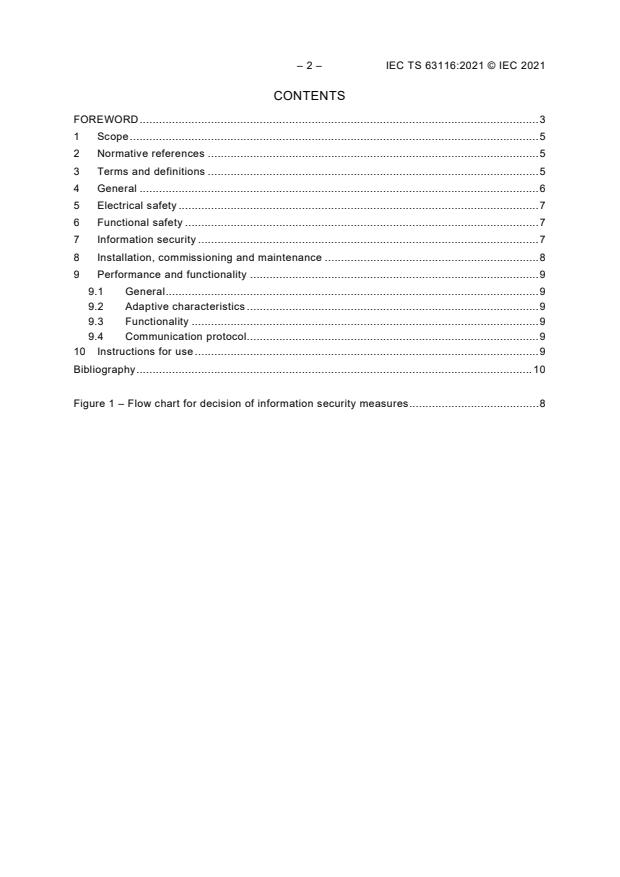
IEC TS 63116:2021 - Lighting systems - General requirements Released:10/4/2021

IEC TS 63116:2021+AMD1:2023 CSV - Lighting systems - General requirements Released:7/24/2023
Overview
IEC TS 63116:2021 - Lighting systems – General requirements - defines the high‑level requirements for the design, installation and maintenance of lighting systems. It addresses system‑level considerations that go beyond individual product standards (which remain the source for product safety and performance). IEC TS 63116 clarifies how sets of products (luminaires, sensors, controllers, networks, user interfaces and software) should be integrated to achieve safe, functional and secure lighting solutions across applications.
Key topics and requirements
- Scope and purpose: Establishes general, system‑level requirements rather than detailed construction specs; it prevails for lighting system requirements where products are combined.
- Product compliance: Systems must use products that meet applicable product standards and are suitable for expected environmental conditions (temperature, humidity, altitude, vibration).
- Electrical safety: System‑level electrical safety requirements are specified (see IEC TS 63117 for safety details).
- Functional safety: Addresses safe interaction of multiple components (sensors, controllers, interfaces) and mitigation of system failure modes.
- Information security: Requires protection of system information against unauthorized disclosure, modification or destruction - includes guidance for communication protocols and system interfaces.
- Installation, commissioning and maintenance: Sets expectations for lifecycle activities to ensure continued safety and performance.
- Performance & functionality: Covers adaptive characteristics (sensors, dimming, spectrum adjustment), diagnostics, communication protocols and user interfaces.
- Classification: Defines lighting system categories - standalone luminaires, autonomous systems, centrally controllable systems - and typical capacities/functionality per category.
- Reporting: Annex A (normative) standardizes how to report performance parameters, adaptive features, diagnostics, communication and security measures.
Applications and users
IEC TS 63116 is practical for:
- Lighting system designers and specifiers integrating multiple products
- System integrators and electrical contractors responsible for installation and commissioning
- Facility managers and building owners planning maintenance and lifecycle management
- Manufacturers and OEMs developing system‑level products, interfaces and documentation
- Test laboratories and certification bodies assessing system compliance
- Building automation and IoT teams addressing interoperability, control and cybersecurity
Practical uses include preparing system design briefs, defining acceptance tests, specifying communication and security requirements, and documenting system performance for procurement and commissioning.
Related standards
- IEC 62504 - LED products and related equipment - terms and definitions
- IEC TS 63105 - Lighting systems and related equipment - vocabulary
- IEC TS 63117 - General requirements for lighting systems - safety
Keywords: IEC TS 63116, lighting systems, general requirements, lighting design, lighting installation, electrical safety, functional safety, information security, lighting control, adaptive lighting, communication protocol.
Relations
- Effective Date
- 05-Sep-2023
Buy Documents
IEC TS 63116:2021 - Lighting systems - General requirements Released:10/4/2021
IEC TS 63116:2021+AMD1:2023 CSV - Lighting systems - General requirements Released:7/24/2023
Get Certified
Connect with accredited certification bodies for this standard

IMQ S.p.A. (Certification)
Italian electrical product certification.

SLG Prüf- und Zertifizierungs GmbH
German testing and certification body.

UL Solutions
Global safety science company with testing, inspection and certification.
Sponsored listings
Frequently Asked Questions
IEC TS 63116:2021 is a technical specification published by the International Electrotechnical Commission (IEC). Its full title is "Lighting systems - General requirements". This standard covers: IEC TS 63116:2021(E) specifies general requirements for design, installation and maintenance of a lighting system. A lighting system comprises a set of products. Requirements of the products are specified in product standards. For the general requirements of lighting systems, this document prevails. Construction of lighting systems can vary in applications. This document is not intended to provide detailed technical specifications for the construction of lighting systems but to specify requirements in general that are necessary for lighting systems.
IEC TS 63116:2021(E) specifies general requirements for design, installation and maintenance of a lighting system. A lighting system comprises a set of products. Requirements of the products are specified in product standards. For the general requirements of lighting systems, this document prevails. Construction of lighting systems can vary in applications. This document is not intended to provide detailed technical specifications for the construction of lighting systems but to specify requirements in general that are necessary for lighting systems.
IEC TS 63116:2021 is classified under the following ICS (International Classification for Standards) categories: 29.140.01 - Lamps in general; 29.140.50 - Lighting installation systems. The ICS classification helps identify the subject area and facilitates finding related standards.
IEC TS 63116:2021 has the following relationships with other standards: It is inter standard links to IEC TS 63116:2021/AMD1:2023. Understanding these relationships helps ensure you are using the most current and applicable version of the standard.
IEC TS 63116:2021 is available in PDF format for immediate download after purchase. The document can be added to your cart and obtained through the secure checkout process. Digital delivery ensures instant access to the complete standard document.
Standards Content (Sample)
IEC TS 63116 ®
Edition 1.0 2021-10
TECHNICAL
SPECIFICATION
Lighting systems – General requirements
All rights reserved. Unless otherwise specified, no part of this publication may be reproduced or utilized in any form
or by any means, electronic or mechanical, including photocopying and microfilm, without permission in writing from
either IEC or IEC's member National Committee in the country of the requester. If you have any questions about IEC
copyright or have an enquiry about obtaining additional rights to this publication, please contact the address below or
your local IEC member National Committee for further information.
IEC Central Office Tel.: +41 22 919 02 11
3, rue de Varembé info@iec.ch
CH-1211 Geneva 20 www.iec.ch
Switzerland
About the IEC
The International Electrotechnical Commission (IEC) is the leading global organization that prepares and publishes
International Standards for all electrical, electronic and related technologies.
About IEC publications
The technical content of IEC publications is kept under constant review by the IEC. Please make sure that you have the
latest edition, a corrigendum or an amendment might have been published.
IEC publications search - webstore.iec.ch/advsearchform IEC online collection - oc.iec.ch
The advanced search enables to find IEC publications by a Discover our powerful search engine and read freely all the
variety of criteria (reference number, text, technical publications previews. With a subscription you will always
committee, …). It also gives information on projects, replaced have access to up to date content tailored to your needs.
and withdrawn publications.
Electropedia - www.electropedia.org
IEC Just Published - webstore.iec.ch/justpublished
The world's leading online dictionary on electrotechnology,
Stay up to date on all new IEC publications. Just Published
containing more than 22 000 terminological entries in English
details all new publications released. Available online and
and French, with equivalent terms in 18 additional languages.
once a month by email.
Also known as the International Electrotechnical Vocabulary
(IEV) online.
IEC Customer Service Centre - webstore.iec.ch/csc
If you wish to give us your feedback on this publication or
need further assistance, please contact the Customer Service
Centre: sales@iec.ch.
IEC TS 63116 ®
Edition 1.0 2021-10
TECHNICAL
SPECIFICATION
Lighting systems – General requirements
INTERNATIONAL
ELECTROTECHNICAL
COMMISSION
ICS 29.140.01; 29.140.50 ISBN 978-2-8322-1034-9
– 2 – IEC TS 63116:2021 © IEC 2021
CONTENTS
FOREWORD . 3
1 Scope . 5
2 Normative references . 5
3 Terms and definitions . 5
4 General . 6
5 Electrical safety . 7
6 Functional safety . 7
7 Information security . 7
8 Installation, commissioning and maintenance . 8
9 Performance and functionality . 9
9.1 General . 9
9.2 Adaptive characteristics . 9
9.3 Functionality . 9
9.4 Communication protocol. 9
10 Instructions for use . 9
Bibliography . 10
Figure 1 – Flow chart for decision of information security measures . 8
INTERNATIONAL ELECTROTECHNICAL COMMISSION
____________
LIGHTING SYSTEMS – GENERAL REQUIREMENTS
FOREWORD
1) The International Electrotechnical Commission (IEC) is a worldwide organization for standardization comprising
all national electrotechnical committees (IEC National Committees). The object of IEC is to promote international
co-operation on all questions concerning standardization in the electrical and electronic fields. To this end and
in addition to other activities, IEC publishes International Standards, Technical Specifications, Technical Reports,
Publicly Available Specifications (PAS) and Guides (hereafter referred to as “IEC Publication(s)”). Their
preparation is entrusted to technical committees; any IEC National Committee interested in the subject dealt with
may participate in this preparatory work. International, governmental and non-governmental organizations liaising
with the IEC also participate in this preparation. IEC collaborates closely with the International Organization for
Standardization (ISO) in accordance with conditions determined by agreement between the two organizations.
2) The formal decisions or agreements of IEC on technical matters express, as nearly as possible, an international
consensus of opinion on the relevant subjects since each technical committee has representation from all
interested IEC National Committees.
3) IEC Publications have the form of recommendations for international use and are accepted by IEC National
Committees in that sense. While all reasonable efforts are made to ensure that the technical content of IEC
Publications is accurate, IEC cannot be held responsible for the way in which they are used or for any
misinterpretation by any end user.
4) In order to promote international uniformity, IEC National Committees undertake to apply IEC Publications
transparently to the maximum extent possible in their national and regional publications. Any divergence between
any IEC Publication and the corresponding national or regional publication shall be clearly indicated in the latter.
5) IEC itself does not provide any attestation of conformity. Independent certification bodies provide conformity
assessment services and, in some areas, access to IEC marks of conformity. IEC is not responsible for any
services carried out by independent certification bodies.
6) All users should ensure that they have the latest edition of this publication.
7) No liability shall attach to IEC or its directors, employees, servants or agents including individual experts and
members of its technical committees and IEC National Committees for any personal injury, property damage or
other damage of any nature whatsoever, whether direct or indirect, or for costs (including legal fees) and
expenses arising out of the publication, use of, or reliance upon, this IEC Publication or any other IEC
Publications.
8) Attention is drawn to the Normative references cited in this publication. Use of the referenced publications is
indispensable for the correct application of this publication.
9) Attention is drawn to the possibility that some of the elements of this IEC Publication may be the subject of patent
rights. IEC shall not be held responsible for identifying any or all such patent rights.
IEC TS 63116 has been prepared by IEC technical committee 34: Lighting. It is a Technical
Specification.
The text of this Technical Specification is based on the following documents:
Draft Report on voting
34/808/DTS 34/843/RVDTS
Full information on the voting for its approval can be found in the report on voting indicated in
the above table.
The language used for the development of this Technical Specification is English.
This document was drafted in accordance with ISO/IEC Directives, Part 2, and developed in
accordance with ISO/IEC Directives, Part 1 and ISO/IEC Directives, IEC Supplement, available
at www.iec.ch/members_experts/refdocs. The main document types developed by IEC are
described in greater detail at www.iec.ch/standardsdev/publications.
– 4 – IEC TS 63116:2021 © IEC 2021
The committee has decided that the contents of this document will remain unchanged until the
stability date indicated on the IEC website under webstore.iec.ch in the data related to the
specific document. At this date, the document will be
• reconfirmed,
• withdrawn,
• replaced by a revised edition, or
• amended.
LIGHTING SYSTEMS – GENERAL REQUIREMENTS
1 Scope
This document specifies general requirements for design, installation and maintenance of a
lighting system.
A lighting system comprises a set of products. Requirements of the products are specified in
product standards. For the general requirements of lighting systems, this document prevails.
Construction of lighting systems can vary in applications. This document is not intended to
provide detailed technical specifications for the construction of lighting systems but to specify
requirements in general that are necessary for lighting systems.
2 Normative references
The following documents are referred to in the text in such a way that some or all of their content
constitutes requirement
...
IEC TS 63116 ®
Edition 1.1 2023-07
CONSOLIDATED VERSION
TECHNICAL
SPECIFICATION
colour
inside
Lighting systems – General requirements
IEC 63116:2021+AMD1:2023-07 CSV(en)
All rights reserved. Unless otherwise specified, no part of this publication may be reproduced or utilized in any form
or by any means, electronic or mechanical, including photocopying and microfilm, without permission in writing from
either IEC or IEC's member National Committee in the country of the requester. If you have any questions about IEC
copyright or have an enquiry about obtaining additional rights to this publication, please contact the address below or
your local IEC member National Committee for further information.
IEC Secretariat Tel.: +41 22 919 02 11
3, rue de Varembé info@iec.ch
CH-1211 Geneva 20 www.iec.ch
Switzerland
About the IEC
The International Electrotechnical Commission (IEC) is the leading global organization that prepares and publishes
International Standards for all electrical, electronic and related technologies.
About IEC publications
The technical content of IEC publications is kept under constant review by the IEC. Please make sure that you have the
latest edition, a corrigendum or an amendment might have been published.
IEC publications search - webstore.iec.ch/advsearchform IEC Products & Services Portal - products.iec.ch
The advanced search enables to find IEC publications by a Discover our powerful search engine and read freely all the
variety of criteria (reference number, text, technical publications previews. With a subscription you will always have
committee, …). It also gives information on projects, replaced access to up to date content tailored to your needs.
and withdrawn publications.
Electropedia - www.electropedia.org
IEC Just Published - webstore.iec.ch/justpublished
The world's leading online dictionary on electrotechnology,
Stay up to date on all new IEC publications. Just Published
containing more than 22 300 terminological entries in English
details all new publications released. Available online and once
and French, with equivalent terms in 19 additional languages.
a month by email.
Also known as the International Electrotechnical Vocabulary
(IEV) online.
IEC Customer Service Centre - webstore.iec.ch/csc
If you wish to give us your feedback on this publication or need
further assistance, please contact the Customer Service
Centre: sales@iec.ch.
IEC TS 63116 ®
Edition 1.1 2023-07
CONSOLIDATED VERSION
TECHNICAL
SPECIFICATION
colour
inside
Lighting systems – General requirements
INTERNATIONAL
ELECTROTECHNICAL
COMMISSION
ICS 29.140.01; 29.140.50 ISBN 978-2-8322-7324-1
IEC TS 63116 ®
Edition 1.1 2023-07
CONSOLIDATED VERSION
REDLINE VERSION
colour
inside
Lighting systems – General requirements
IEC 63116:2021+AMD1:2023-07 CSV(en)
– 2 – IEC TS 63116:2021+AMD1:2023 CSV
© IEC 2023
CONTENTS
FOREWORD . 3
1 Scope . 5
2 Normative references . 5
3 Terms and definitions . 5
4 General . 6
5 Electrical safety . 7
6 Functional safety . 7
7 Information security . 7
8 Installation, commissioning and maintenance . 8
9 Performance and functionality . 9
9.1 General . 9
9.2 Adaptive characteristics . 9
9.3 Functionality . 9
9.4 Communication protocol. 9
10 Instructions for use . 9
11 Classification of lighting systems . 10
11.1 General . 10
11.2 Lighting system consisting of standalone luminaire(s) . 10
11.3 Autonomous lighting system. 10
11.4 Centrally controllable lighting system . 11
11.5 Typical capacities of lighting systems in different categories . 11
Annex A (normative) Lighting systems – Reporting of lighting system performance
parameters and functionalities . 13
A.1 General . 13
A.2 Adaptive characteristics . 13
A.2.1 Sensors . 13
A.2.2 Adjustment of light output level . 13
A.2.3 Adjustment of light spectrum . 13
A.2.4 Lighting control functionality . 13
A.3 Diagnostics . 14
A.4 Communication protocol. 14
A.5 User interface . 14
A.6 Information security measures . 14
Bibliography . 15
Figure 1 – Flow chart for decision of information security measures . 8
Figure 2 – Example of lighting system consisting of a standalone luminaire . 10
Figure 3 – Example of autonomous lighting system . 11
Figure 4 – Example of centrally controllable lighting system . 11
Table 1 – Examples of functionalities and characteristics for each category of lighting
system . 12
© IEC 2023
INTERNATIONAL ELECTROTECHNICAL COMMISSION
____________
LIGHTING SYSTEMS – GENERAL REQUIREMENTS
FOREWORD
1) The International Electrotechnical Commission (IEC) is a worldwide organization for standardization comprising
all national electrotechnical committees (IEC National Committees). The object of IEC is to promote international
co-operation on all questions concerning standardization in the electrical and electronic fields. To this end and
in addition to other activities, IEC publishes International Standards, Technical Specifications, Technical Reports,
Publicly Available Specifications (PAS) and Guides (hereafter referred to as “IEC Publication(s)”). Their
preparation is entrusted to technical committees; any IEC National Committee interested in the subject dealt with
may participate in this preparatory work. International, governmental and non-governmental organizations liaising
with the IEC also participate in this preparation. IEC collaborates closely with the International Organization for
Standardization (ISO) in accordance with conditions determined by agreement between the two organizations.
2) The formal decisions or agreements of IEC on technical matters express, as nearly as possible, an international
consensus of opinion on the relevant subjects since each technical committee has representation from all
interested IEC National Committees.
3) IEC Publications have the form of recommendations for international use and are accepted by IEC National
Committees in that sense. While all reasonable efforts are made to ensure that the technical content of IEC
Publications is accurate, IEC cannot be held responsible for the way in which they are used or for any
misinterpretation by any end user.
4) In order to promote international uniformity, IEC National Committees undertake to apply IEC Publications
transparently to the maximum extent possible in their national and regional publications. Any divergence between
any IEC Publication and the corresponding national or regional publication shall be clearly indicated in the latter.
5) IEC itself does not provide any attestation of conformity. Independent certification bodies provide conformity
assessment services and, in some areas, access to IEC marks of conformity. IEC is not responsible for any
services carried out by independent certification bodies.
6) All users should ensure that they have the latest edition of this publication.
7) No liability shall attach to IEC or its directors, employees, servants or agents including individual experts and
members of its technical committees and IEC National Committees for any personal injury, property damage or
other damage of any nature whatsoever, whether direct or indirect, or for costs (including legal fees) and
expenses arising out of the publication, use of, or reliance upon, this IEC Publication or any other IEC
Publications.
8) Attention is drawn to the Normative references cited in this publication. Use of the referenced publications is
indispensable for the correct application of this publication.
9) Attention is drawn to the possibility that some of the elements of this IEC Publication may be the subject of patent
rights. IEC shall not be held responsible for identifying any or all such patent rights.
This consolidated version of the official IEC Standard and its amendment has been
prepared for user convenience.
IEC TS 63116 edition 1.1 contains the first edition (2021-10) [documents 34/808/DTS and
34/843/RVDTS] and its amendment 1 (2023-07) [documents 34/1010/DTS and
34/1050/RVDTS].
In this Redline version, a vertical line in the margin shows where the technical content is
modified by amendment 1. Additions are in green text, deletions are in strikethrough red
text. A separate Final version with all changes accepted is available in this publication.
– 4 – IEC TS 63116:2021+AMD1:2023 CSV
© IEC 2023
IEC TS 63116 has been prepared by IEC technical committee 34: Lighting. It is a Technical
Specification.
The language used for the development of this Technical Specification is English.
This document was drafted in accordance with ISO/IEC Directives, Part 2, and developed in
accordance with ISO/IEC Directives, Part 1 and ISO/IEC Directives, IEC Supplement, available
at www.iec.ch/members_experts/refdocs. The main document types developed by IEC are
described in greater detail at www.iec.ch/standardsdev/publications.
The committee has decided that the contents of this document and its amendment will remain
unchanged until the stability date indicated on the IEC website under webstore.iec.ch in the
data related to the specific document. At this date, the document will be
• reconfirmed,
• withdrawn,
• replaced by a revised edition, or
• amended.
IMPORTANT – The 'colour inside' logo on the cover page of this publication indicates
that it contains colours which are considered to be useful for the correct understanding
of its contents. Users should therefore print this document using a colour printer.
© IEC 2023
LIGHTING SYSTEMS – GENERAL REQUIREMENTS
1 Scope
This document specifies general requirements for design, installation and maintenance of a
lighting system.
A lighting system comprises a set of products. Requirements of the products are specified in
product standards. For the general requirements of lighting systems, this document prevails.
Construction of lighting systems can vary in applications. This document is not intended to
provide detailed technical specifications for the construction of lighting systems but to specify
requirements in general that are necessary for lighting systems.
2 Normative references
The following documents are referred to in the text in such a way that some or all of their content
constitutes requirements of this document. For dated references, only the edition cited applies.
For undated references, the latest edition of the referenced document (including any
amendments) applies.
IEC 62504, General lighting – Light emitting diode (LED) products and related equipment –
Terms and definitions
IEC TS 63105, Lighting systems and related equipment – Vocabulary
IEC TS 63117, General requirements for lighting systems – Safety
3 Terms and definitions
For the purposes of this document, the terms and definitions given in IEC TS 63105 and
IEC 62504 and the following apply.
ISO and IEC maintain terminological databases for use in standardization at the following
addresses:
• IEC Electropedia: available at http://www.electropedia.org/
• ISO Online browsing platform: available at http://www.iso.org/obp
3.1
lighting system
system designed to provide lighting
Note 1 to entry: The lighting system can be dedicated to
a) the support of one or more specified visual tasks under specified conditions considering other requirements such
as human comfort, safety, the appearance of the surrounding environment and energy consumption;
b) the support of other than human tasks.
Note 2 to entry: The lighting system can include a set of light sources, other physical components, communication
protocols, user interfaces, software and networks to provide control and monitoring functions.
Note 3 to entry: The light source(s) and the related equipment can be integrated in a single item, e. g. an LED
module, a lamp or a luminaire.
– 6 – IEC TS 63116:2021+AMD1:2023 CSV
© IEC 2023
Note 4 to entry: A lighting system can be networked to provide central or remote control and monitoring functions.
Note 5 to entry: A lighting system can be connected to or integrated with other systems or devices.
[SOURCE: IEC 60050-845:2020, 845-27-010]
3.2
functional safety
part of the overall safety that depends on functional and physical units operating correctly in
response to their inputs
[SOURCE: IEC 60050-351:2013, 351-57-06, modified – The Note 1 to entry has been deleted.]
3.3
information security
protection of information against unauthorized disclosure, transfer, modification, or destruction,
whether accidental or intentional
Note 1 to entry: The term covers cyber-security.
[SOURCE: IEC 60050-721:1991, 721-08-57, modified – The Note 1 to entry has been added.]
3.4
communication protocol
set of rules for data transmission in a system interlinking several system components
Note 1 to entry: A communication protocol can define the conditions for establishing a connection to a transmission
medium, the rules governing access to the medium, the procedures for error protection, the functional and procedural
means of data exchange, the transport mechanisms, the communication control, the representation of data and the
exchange of application data.
Communication protocols define, for example:
• data units transferred between system components,
• the meaning of data units (semantics),
• the format of data units (syntax) and
• the logic time sequence of data exchange.
Note 2 to entry: The communication protocols used in a system can be organized in accordance with industry-wide
accepted reference models, e.g. the ISO-OSI seven-layer reference model.
[SOURCE: IEC 60050-351:2013, 351-56-14, modified – "protocol" has been replaced by
"communication protocol", "participants" has been replaced by "system components", and the
Note 2 to entry has been modified.]
3.5
adaptive characteristic
characteristic that responds to circumstances or predefined conditions
Note 1 to entry: The adaptive characteristic of a lighting system and its components is to provide adaptive lighting.
Note 2 to entry: See IEV 845-29-027 for the definition of "adaptive lighting".
4 General
The lighting systems shall be designed using products that:
• comply with product standards, such as, but not limited to safety requirements, performance
requirements and interface requirements;
• are suitable for the environmental conditions to which the system is likely to be subjected,
such as, but not limited to temperature range, humidity range, altitude and vibration;
© IEC 2023
• provide appropriate electrical insulation towards system integration for electrical safety
assurance;
• provide appropriate protection measures towards system integration for functional safety
and information security;
• provide appropriate interfaces, such as communication interfaces, towards system
integration for the expected system performance and functionality.
Compliance is checked by inspection of the documentation and by carrying out the tests of
Clause 5 to Clause 10 11.
5 Electrical safety
Lighting systems require additional safety requirements at the system level. These
requirements apply in addition to the product safety requirements that can be found in the
product specific standards.
The electrical safety requirements of lighting systems at the system level shall follow
IEC TS 63117.
6 Functional safety
Lighting systems often comprise many different products (luminaire, sensor, controllers, touch
panels and other human interfaces, etc.) which are connected through communication cabling
or wirelessly, where the light output can be varied based on the input from sensors or users.
Malfunction of the interaction of system components can create unsafe lighting conditions.
When operating, they should incur no unacceptable risks.
Functional safety requirements of lighting systems shall follow IEC TS 63117.
7 Information security
Lighting systems often utilize communication, data transfer and data storage functions. The
data and information can be sensitive and/or private. Lighting systems can also be applied
within an environment demanding (a) higher security level(s). These lighting systems shall be
applied with an appropriate level of information security.
Information security aspects shall be considered from the start of the design of a lighting system,
throughout its service life, and at end-of-life-stage. Whether measures to provide information
security are to be included should be checked against regulatory and application requirements,
see Figure 1.
– 8 – IEC TS 63116:2021+AMD1:2023 CSV
© IEC 2023
SOURCE: IEC Guide 120:2018
Figure 1 – Flow chart for decision of information security measures
A risk assessment process described in IEC 31010 can be used to perform this evaluation.
8 Installation, commissioning and maintenance
Lighting systems shall be installed in accordance with
• the instructions for use (see Clause 10), provided by the manufacturer or responsible vendor
of the lighting system and the design details provided by the lighting system designer, and
• the installation instructions specified in the appropriate standards.
NOTE Local installation regulations provide relevant information that can also be consulted when preparing
installation instructions.
© IEC 2023
Lighting systems should be commissioned to fulfil the designed system specifications. For a
system with less complexity, the commissioning can be done according to the instructions for
use. For lighting systems in highly complex buildings, the commissioning could follow
ISO/TS 21274.
Lighting systems and its components shall be maintained in accordance with the instructions
for use (see Clause 10), provided by the manufacturer or responsible vendor of the lighting
system and the design details provided by the lighting system designer.
9 Performance and functionality
9.1 General
The lighting system performance parameters and functionalities shall comply with all claimed
characteristics in the system documentation. Reporting of such characteristics shall comply with
the requirements of Annex A.
9.2 Adaptive characteristics
The lighting system shall fulfill all claimed adaptive characteristics in the system documentation,
which include but are not limited to the following:
• sensitivity to a specific stimulus (e.g. occupancy, natural light level, weather and traffic
conditions);
• relevant response (e.g. dimming (flux variation), changing colour and timing adjustment of
light output level (dimming and brightening), adjustment of light spectrum (colour or
correlated colour temperature (CCT) tuning or both) and timing).
9.3 Functionality
The lighting system shall fulfill all claimed functionalities with specified accuracy in the system
documentation, such as:
• fault detection,
• degradation compensation,
• remote monitoring,
• energy consumption monitoring.
NOTE 1 The type of functions of a lighting system depends on the application.
NOTE 2 A lighting system can also integrate functions other than lighting for enhanced performance, for example,
monitoring of environmental and traffic conditions by a street lighting system. Other standards can apply for functions
other than lighting.
9.4 Communication protocol
The communication protocol(s) employed within the lighting system shall be declared by the
manufacturer or responsible vendor in the system documentation.
If the manufacturer or responsible vendor of a lighting system claims the capability of interfacing
with other systems, they shall publish relevant substantiating information in the system
documentation.
10 Instructions for use
Instructions for use shall be available for installation, commissioning, maintenance, disposal
and all claimed performance characteristics and functionalities.
– 10 – IEC TS 63116:2021+AMD1:2023 CSV
© IEC 2023
All available types and methods of user interfaces to control the lighting systems shall be
provided in the instructions for use.
In case the system has been provided with measures to provide information security,
corresponding information shall be provided by the manufacturer or responsible vendor to
enable correct installation, use, data backup, software and firmware updates, maintenance and
end-of-life treatment.
11 Classification of lighting systems
11.1 General
According to the system structure, lighting systems can be classified into three categories, as
follows:
• lighting systems consisting of standalone luminaire(s);
• autonomous lighting systems;
• centrally controllable lighting systems.
See 11.2 to 11.4 for the description of the different categories.
See 11.5 for the typical capacities of lighting systems in different categories.
11.2 Lighting system consisting of standalone luminaire(s)
A lighting system consisting of a standalone luminaire is a luminaire that does not communicate
with other luminaires or a central controller for setting light properties (e.g. on/off, dimming) or
for the exchange of information. It can have the capability to communicate with other devices
for setting configuration parameters or setting light properties (e.g. on/off, dimming) or
exchange of information. An example of a lighting system consisting of one standalone
luminaire is shown in Figure 2.
Figure 2 – Example of lighting system consisting of a standalone luminaire
11.3 Autonomous lighting system
The autonomous lighting system consists of two or more luminaires that can communicate with
each other for the purpose of adjusting the light properties of the luminaires. This network of
luminaires is characterized by having no central control possibilities.
These luminaires have at least one communication network that is intended to exchange
information between luminaires to control the light properties. These luminaires can also have
the communication capabilities of a standalone luminaire. An example of autonomous lighting
system is shown in Figure 3.
© IEC 2023
Figure 3 – Example of autonomous lighting system
11.4 Centrally controllable lighting system
The centrally controllable lighting system consists of one or more luminaires that can
communicate with a central controller and in the case of multiple luminaires, can have the ability
to communicate between luminaires directly like in an autonomous lighting system and can
have the communication capabilities of a standalone luminaire. An example of centrally
controllable lighting system is shown in Figure 4.
Figure 4 – Example of centrally controllable lighting system
11.5 Typical capacities of lighting systems in different categories
The implementations of adaptive lighting controls and functionalities on lighting systems are
specified according to the purpose and environmental conditions of the application. Table 1
gives examples of such functionalities and characteristics for each category of lighting system.
– 12 – IEC TS 63116:2021+AMD1:2023 CSV
© IEC 2023
Table 1 – Examples of functionalities and characteristics
for each category of lighting system
Lighting system with Autonomous lighting Centrally controllable
standalone luminaire system lighting system
Timer-based light control X X X
Sensor-based light control X X X
Group-based light control X X
Centrally controllable light X
control
Systems configurable in X X X
field
Data exchange on local X X X
request
Automatic data exchange X
with central controller
Data exchange with X
external system
(optional)
© IEC 2023
Annex A
(normative)
Lighting systems – Reporting of lighting system
performance parameters and functionalities
A.1 General
The characteristics of products used in lighting systems related to functionality, connectivity
and capability shall be presented in the lighting system technical documentation.
A.2 Adaptive characteristics
A.2.1 Sensors
The supported types of sensors for lighting products in the lighting system shall be reported.
Such characteristics can include but are not limited to:
• purpose of the sensor(s);
• type of sensor(s);
• sensor technology(ies).
A.2.2 Adjustment of light output level
If applicable, the dimming methods and dimming range of lighting products in the lighting system
shall be reported. Such dimming characteristics can include but are not limited to:
• continuous dimming;
• stepped dimming;
• scene selection;
• dimming curve;
• dimming range.
A.2.3 Adjustment of light spectrum
If applicable, the full colour changing or white CCT tuning range of lighting products in the
lighting system shall be reported. Such characteristics can include but are not limited to:
• colour tuning;
• white CCT tuning;
• colour shift dimming (e.g. dim-to-warm);
• default setting;
• tuning range or setting;
• colour tuning protocol.
A.2.4 Lighting control functionality
If applicable, the lighting control of lighting products in the lighting system shall be reported.
Such characteristics can include but are not limited to:
• individual control (device addressability);
• group control (device addressability);
• daylight harvesting;
– 14 – IEC TS 63116:2021+AMD1:2023 CSV
© IEC 2023
• scene control;
• scheduling.
A.3 Diagnostics
If applicable, the functions related to diagnostics of lighting products shall be reported. Such
characteristics can include but are not limited to:
• fault detection;
• device status monitoring;
• light level detection;
• light degradation compensation;
• remote monitoring;
• occupancy monitoring;
• energy consumption monitoring and reporting.
A.4 Communication protocol
The supported types of communication protocol for lighting products in the lighting system shall
be reported. Such characteristics can include but are not limited to:
...