

IEC 62133-1:2026
(Main)Secondary cells and batteries containing alkaline or other non-acid electrolytes - Safety requirements for portable sealed secondary cells, and for batteries made from them, for use in portable applications - Part 1: Nickel systems
General Information
- Abstract
IEC 62133-1:2026 specifies requirements and tests for the safe operation of portable sealed secondary nickel cells and batteries containing alkaline electrolyte, under intended use and reasonably foreseeable misuse. This second edition cancels and replaces the first edition of IEC 62133-1 published in 2017. It constitutes a technical revision.
This edition includes the following significant technical changes with respect to IEC 62133 1:2017:
a) removal of the definition "secondary battery";
b) removal of the definition "portable battery";
c) "removal of the definition "portable cell";
d) replacement of the single term "room temperature" with 20 °C ± 5 °C in 7.2.3;
e) modification of Figure 1.
- Status
- Published
- Publication Date
- 05-Mar-2026
- Technical Committee
- SC 21A - Secondary cells and batteries containing alkaline or other non-acid electrolytes
- Drafting Committee
- WG 4 - TC 21/SC 21A/WG 4
- Current Stage
- PPUB - Publication issued
- Start Date
- 06-Mar-2026
- Completion Date
- 13-Mar-2026
Buy Documents
IEC 62133-1:2026 - Secondary cells and batteries containing alkaline or other non-acid electrolytes - Safety requirements for portable sealed secondary cells, and for batteries made from them, for use in portable applications - Part 1: Nickel systems
REDLINE IEC 62133-1:2026 CMV - Secondary cells and batteries containing alkaline or other non-acid electrolytes - Safety requirements for portable sealed secondary cells, and for batteries made from them, for use in portable applications - Part 1: Nickel systems
iec62133-1{ed2.0}fr - Accumulateurs alcalins et autres accumulateurs a électrolyte non acide - Exigences de sécurité pour les accumulateurs portables étanches, et pour les batteries qui en sont constituées, destinés a l’utilisation dans des applications portables - Partie 1: Systemes au nickel
Overview
IEC 62133-1:2026 is an international standard published by the International Electrotechnical Commission (IEC). It specifies safety requirements and testing procedures for portable sealed secondary nickel cells and batteries containing alkaline or other non-acid electrolytes. These batteries are intended for use in portable applications, with a focus on nickel-based systems. As the second edition, IEC 62133-1:2026 replaces the previous version from 2017 and constitutes a significant technical revision to improve battery safety for manufacturers, designers, and end-users.
The standard aims to ensure the safe design, assembly, usage, and disposal of nickel systems batteries, both under intended operation and foreseeable misuse. Strict compliance with IEC 62133-1 enhances product reliability and helps prevent dangerous failures such as fire, explosion, or electrolyte leakage.
Key Topics
IEC 62133-1:2026 covers a comprehensive range of topics related to the safety of nickel-based secondary batteries:
- General Safety Principles: Defines basic design and construction requirements to prevent hazards such as fire, explosion, and electrolyte leakage.
- Tolerances and Measurement: Establishes guidelines for accurate measurement of voltage, current, temperature, and other critical parameters during testing.
- Type Tests and Sample Sizes: Specifies requirements for type testing, including the number of cell and battery samples to ensure statistical validity.
- Use Scenarios:
- Intended Use: Assessment of batteries' safety under normal operation and long-term charging.
- Foreseeable Misuse: Evaluates the implications of accidental or improper use, such as incorrect installation, short-circuiting, overcharging, mechanical shock, crushing, extreme temperatures, and drops.
- Marking and Information: Outlines requirements for product marking, user instructions, and warnings to mitigate risks for various stakeholders.
- Packaging: Provides guidance on packaging to maintain product safety during transport and storage.
- Quality Planning: Recommends implementing robust quality control systems throughout the production and assembly chain.
This edition introduces several substantial changes:
- Removal of certain definitions (secondary battery, portable battery, portable cell)
- Updated environmental terms for testing (replacing "room temperature" with "20°C ± 5°C")
- Modification of figures used in testing protocols
Applications
IEC 62133-1:2026 is essential for manufacturers, design engineers, and quality managers involved in the development, production, and certification of portable nickel-based batteries. Typical applications covered by this standard include:
- Consumer Electronics: Safety qualification of rechargeable batteries for portable devices such as cameras, radios, or power tools.
- Medical Devices: Ensures reliability and safety of batteries used in portable medical equipment.
- Industrial and Professional Tools: Covers batteries used in field instrumentation, data loggers, and portable analyzers.
- Battery Pack Assemblers: Sets requirements for assembling cells into battery packs, supporting safe integration into end products.
By adopting IEC 62133-1:2026, organizations benefit from:
- Reduced risk of product recalls due to battery safety incidents
- Facilitated access to global markets by meeting regulatory and compliance expectations
- Enhanced consumer trust through reliable product performance
Related Standards
Relevant standards and references linked to IEC 62133-1:2026 include:
- IEC 60050-482: International Electrotechnical Vocabulary - Batteries and accumulators
- IEC 61951-1: Nickel-cadmium sealed rechargeable batteries for portable applications
- IEC 61951-2: Nickel-metal hydride sealed rechargeable batteries for portable applications
- ISO/IEC Guide 51: Safety aspects - Guidelines for inclusion in standards
Other parts of the IEC 62133 series focus on different chemistries, such as lithium systems (IEC 62133-2).
For complete safety and performance, it is recommended to use IEC 62133-1:2026 with relevant technical and regulatory documents during battery design, manufacturing, and quality assurance processes.
Relations
- Effective Date
- 05-Sep-2023
Buy Documents
IEC 62133-1:2026 - Secondary cells and batteries containing alkaline or other non-acid electrolytes - Safety requirements for portable sealed secondary cells, and for batteries made from them, for use in portable applications - Part 1: Nickel systems
REDLINE IEC 62133-1:2026 CMV - Secondary cells and batteries containing alkaline or other non-acid electrolytes - Safety requirements for portable sealed secondary cells, and for batteries made from them, for use in portable applications - Part 1: Nickel systems
iec62133-1{ed2.0}fr - Accumulateurs alcalins et autres accumulateurs a électrolyte non acide - Exigences de sécurité pour les accumulateurs portables étanches, et pour les batteries qui en sont constituées, destinés a l’utilisation dans des applications portables - Partie 1: Systemes au nickel
Get Certified
Connect with accredited certification bodies for this standard

IMQ S.p.A. (Certification)
Italian electrical product certification.

SLG Prüf- und Zertifizierungs GmbH
German testing and certification body.

UL Solutions
Global safety science company with testing, inspection and certification.
Sponsored listings
Frequently Asked Questions
IEC 62133-1:2026 is a standard published by the International Electrotechnical Commission (IEC). Its full title is "Secondary cells and batteries containing alkaline or other non-acid electrolytes - Safety requirements for portable sealed secondary cells, and for batteries made from them, for use in portable applications - Part 1: Nickel systems". This standard covers: IEC 62133-1:2026 specifies requirements and tests for the safe operation of portable sealed secondary nickel cells and batteries containing alkaline electrolyte, under intended use and reasonably foreseeable misuse. This second edition cancels and replaces the first edition of IEC 62133-1 published in 2017. It constitutes a technical revision. This edition includes the following significant technical changes with respect to IEC 62133 1:2017: a) removal of the definition "secondary battery"; b) removal of the definition "portable battery"; c) "removal of the definition "portable cell"; d) replacement of the single term "room temperature" with 20 °C ± 5 °C in 7.2.3; e) modification of Figure 1.
IEC 62133-1:2026 specifies requirements and tests for the safe operation of portable sealed secondary nickel cells and batteries containing alkaline electrolyte, under intended use and reasonably foreseeable misuse. This second edition cancels and replaces the first edition of IEC 62133-1 published in 2017. It constitutes a technical revision. This edition includes the following significant technical changes with respect to IEC 62133 1:2017: a) removal of the definition "secondary battery"; b) removal of the definition "portable battery"; c) "removal of the definition "portable cell"; d) replacement of the single term "room temperature" with 20 °C ± 5 °C in 7.2.3; e) modification of Figure 1.
IEC 62133-1:2026 is classified under the following ICS (International Classification for Standards) categories: 29.220.30 - Alkaline secondary cells and batteries. The ICS classification helps identify the subject area and facilitates finding related standards.
IEC 62133-1:2026 has the following relationships with other standards: It is inter standard links to IEC 62133-1:2017. Understanding these relationships helps ensure you are using the most current and applicable version of the standard.
IEC 62133-1:2026 is available in PDF format for immediate download after purchase. The document can be added to your cart and obtained through the secure checkout process. Digital delivery ensures instant access to the complete standard document.
Standards Content (Sample)
IEC 62133-1 ®
Edition 2.0 2026-03
INTERNATIONAL
STANDARD
Secondary cells and batteries containing alkaline or other non-acid electrolytes -
Safety requirements for portable sealed secondary cells, and for batteries made
from them, for use in portable applications -
Part 1: Nickel systems
ICS 29.220.30 ISBN 978-2-8327-1070-8
All rights reserved. Unless otherwise specified, no part of this publication may be reproduced or utilized in any form or
by any means, electronic or mechanical, including photocopying and microfilm, without permission in writing from either
IEC or IEC's member National Committee in the country of the requester. If you have any questions about IEC copyright
or have an enquiry about obtaining additional rights to this publication, please contact the address below or your local
IEC member National Committee for further information.
IEC Secretariat Tel.: +41 22 919 02 11
3, rue de Varembé info@iec.ch
CH-1211 Geneva 20 www.iec.ch
Switzerland
About the IEC
The International Electrotechnical Commission (IEC) is the leading global organization that prepares and publishes
International Standards for all electrical, electronic and related technologies.
About IEC publications
The technical content of IEC publications is kept under constant review by the IEC. Please make sure that you have the
latest edition, a corrigendum or an amendment might have been published.
IEC publications search - IEC Products & Services Portal - products.iec.ch
webstore.iec.ch/advsearchform Discover our powerful search engine and read freely all the
The advanced search enables to find IEC publications by a publications previews, graphical symbols and the glossary.
variety of criteria (reference number, text, technical With a subscription you will always have access to up to date
committee, …). It also gives information on projects, content tailored to your needs.
replaced and withdrawn publications.
Electropedia - www.electropedia.org
The world's leading online dictionary on electrotechnology,
IEC Just Published - webstore.iec.ch/justpublished
Stay up to date on all new IEC publications. Just Published containing more than 22 500 terminological entries in English
details all new publications released. Available online and and French, with equivalent terms in 25 additional languages.
once a month by email. Also known as the International Electrotechnical Vocabulary
(IEV) online.
IEC Customer Service Centre - webstore.iec.ch/csc
If you wish to give us your feedback on this publication or
need further assistance, please contact the Customer
Service Centre: sales@iec.ch.
CONTENTS
FOREWORD . 3
1 Scope . 5
2 Normative references . 5
3 Terms and definitions . 5
4 Parameter measurement tolerances . 7
5 General safety considerations . 7
5.1 General . 7
5.2 Insulation and wiring . 8
5.3 Venting . 8
5.4 Temperature, voltage and current management . 8
5.5 Terminal contacts . 8
5.6 Assembly of cells into batteries . 8
5.7 Quality plan . 9
6 Type test and sample size . 9
7 Specific requirements and tests . 10
7.1 Charging procedure for test purposes . 10
7.2 Intended use . 10
7.2.1 Continuous low-rate charging (cells) . 10
7.2.2 Vibration . 10
7.2.3 Case stress at high ambient temperature (batteries) . 11
7.2.4 Temperature cycling . 11
7.3 Reasonably foreseeable misuse. 12
7.3.1 Incorrect installation (cells) . 12
7.3.2 External short circuit . 12
7.3.3 Free fall . 12
7.3.4 Mechanical shock (crash hazard) . 12
7.3.5 Thermal abuse (cells) . 13
7.3.6 Crush (cells) . 13
7.3.7 Low pressure (cells) . 13
7.3.8 Overcharge . 14
7.3.9 Forced discharge (cells) . 14
8 Information for safety . 14
8.1 General . 14
8.2 Small cell and battery safety information . 14
9 Marking . 15
9.1 Cell marking. 15
9.2 Battery marking . 15
9.3 Caution for ingestion of small cells and batteries . 16
9.4 Other information . 16
10 Packaging . 16
Annex A (informative) Recommendations to equipment manufacturers and battery
assemblers . 17
Annex B (informative) Recommendations to the end-users . 18
Annex C (informative) Packaging . 19
Bibliography . 20
Figure 1 – Temperature profile for 7.2.4 – Temperature cycling test . 11
Figure 2 – Ingestion gauge . 15
Table 1 – Sample size for type tests . 9
Table 2 – Conditions for vibration test . 10
INTERNATIONAL ELECTROTECHNICAL COMMISSION
____________
Secondary cells and batteries containing alkaline or other non-acid
electrolytes - Safety requirements for portable sealed
secondary cells, and for batteries made from
them, for use in portable applications -
Part 1: Nickel systems
FOREWORD
1) The International Electrotechnical Commission (IEC) is a worldwide organization for standardization comprising
all national electrotechnical committees (IEC National Committees). The object of IEC is to promote international
co-operation on all questions concerning standardization in the electrical and electronic fields. To this end and
in addition to other activities, IEC publishes International Standards, Technical Specifications, Technical Reports,
Publicly Available Specifications (PAS) and Guides (hereafter referred to as “IEC Publication(s)”). Their
preparation is entrusted to technical committees; any IEC National Committee interested in the subject dealt with
may participate in this preparatory work. International, governmental and non-governmental organizations liaising
with the IEC also participate in this preparation. IEC collaborates closely with the International Organization for
Standardization (ISO) in accordance with conditions determined by agreement between the two organizations.
2) The formal decisions or agreements of IEC on technical matters express, as nearly as possible, an international
consensus of opinion on the relevant subjects since each technical committee has representation from all
interested IEC National Committees.
3) IEC Publications have the form of recommendations for international use and are accepted by IEC National
Committees in that sense. While all reasonable efforts are made to ensure that the technical content of IEC
Publications is accurate, IEC cannot be held responsible for the way in which they are used or for any
misinterpretation by any end user.
4) In order to promote international uniformity, IEC National Committees undertake to apply IEC Publications
transparently to the maximum extent possible in their national and regional publications. Any divergence between
any IEC Publication and the corresponding national or regional publication shall be clearly indicated in the latter.
5) IEC itself does not provide any attestation of conformity. Independent certification bodies provide conformity
assessment services and, in some areas, access to IEC marks of conformity. IEC is not responsible for any
services carried out by independent certification bodies.
6) All users should ensure that they have the latest edition of this publication.
7) No liability shall attach to IEC or its directors, employees, servants or agents including individual experts and
members of its technical committees and IEC National Committees for any personal injury, property damage or
other damage of any nature whatsoever, whether direct or indirect, or for costs (including legal fees) and
expenses arising out of the publication, use of, or reliance upon, this IEC Publication or any other IEC
Publications.
8) Attention is drawn to the Normative references cited in this publication. Use of the referenced publications is
indispensable for the correct application of this publication.
9) IEC draws attention to the possibility that the implementation of this document may involve the use of (a)
patent(s). IEC takes no position concerning the evidence, validity or applicability of any claimed patent rights in
respect thereof. As of the date of publication of this document, IEC [had/had not] received notice of (a) patent(s),
which may be required to implement this document. However, implementers are cautioned that this may not
represent the latest information, which may be obtained from the patent database available at
https://patents.iec.ch. IEC shall not be held responsible for identifying any or all such patent rights.
IEC 62133-1 has been prepared by subcommittee 21A: Secondary cells and batteries
containing alkaline or other non-acid electrolytes, of IEC technical committee 21: Secondary
cells and batteries. It is an International Standard.
This second edition cancels and replaces the first edition of IEC 62133-1 published in 2017. It
constitutes a technical revision.
This edition includes the following significant technical changes with respect to
IEC 62133-1:2017:
a) removal of the definition "secondary battery";
b) removal of the definition "portable battery";
c) "removal of the definition "portable cell";
d) replacement of the single term "room temperature" with 20 °C ± 5 °C in 7.2.3;
e) modification of Figure 1.
The text of this International Standard is based on the following documents:
Draft Report on voting
21A/946/FDIS 21A/969/RVD
Full information on the voting for its approval can be found in the report on voting indicated in
the above table.
The language used for the development of this International Standard is English.
This document was drafted in accordance with ISO/IEC Directives, Part 2, and developed in
accordance with ISO/IEC Directives, Part 1 and ISO/IEC Directives, IEC Supplement, available
at www.iec.ch/members_experts/refdocs. The main document types developed by IEC are
described in greater detail at www.iec.ch/publications.
A list of all parts of the IEC 62133 series, published under the general title Secondary cells and
batteries containing alkaline or other non-acid electrolytes – Safety requirements for portable
sealed secondary cells, and for batteries made from them, for use in portable applications, can
be found on the IEC website.
The committee has decided that the contents of this document will remain unchanged until the
stability date indicated on the IEC website under webstore.iec.ch in the data related to the
specific document. At this date, the document will be
– reconfirmed,
– withdrawn, or
– revised.
1 Scope
This part of IEC 62133 specifies requirements and tests for the safe operation of portable sealed
secondary nickel cells and batteries containing alkaline electrolyte, under intended use and
reasonably foreseeable misuse.
2 Normative references
The following documents are referred to in the text in such a way that some or all of their content
constitutes requirements of this document. For dated references, only the edition cited applies.
For undated references, the latest edition of the referenced document (including any
amendments) applies.
IEC 60050-482:2004, International Electrotechnical Vocabulary (IEV) - Part 482: Primary and
secondary cells and batteries
IEC 61951-1, Secondary cells and batteries containing alkaline or other non-acid electrolytes -
Secondary sealed cells and batteries for portable applications - Part 1: Nickel-Cadmium
IEC 61951-2, Secondary cells and batteries containing alkaline or other non acid electrolytes -
Secondary sealed cells and batteries for portable applications - Part 2: Nickel-metal hydride
ISO/IEC Guide 51, Safety aspects - Guidelines for their inclusion in standards
3 Terms and definitions
For the purposes of this document, the terms and definitions given in IEC 60050-482,
ISO/IEC Guide 51 and the following apply.
ISO and IEC maintain terminology databases for use in standardization at the following
addresses:
– IEC Electropedia: available at https://www.electropedia.org/
– ISO Online browsing platform: available at https://www.iso.org/obp
3.1
safety
freedom from unacceptable risk
3.2
risk
combination of the probability of occurrence of harm and the severity of that harm
3.3
harm
physical injury or damage to the health of people or damage to property or to the environment
3.4
hazard
potential source of harm
3.5
intended use
use of a product, process or service in accordance with specifications, instructions and
information provided by the supplier
3.6
reasonably foreseeable misuse
use of a product, process or service in a way which is not intended by the supplier, but which
may result from readily predictable human behaviour
3.7
secondary cell
basic manufactured unit providing a source of electrical energy by direct conversion of chemical
energy, that consists of electrodes, separators, electrolyte, container and terminals, and that is
designed to be charged electrically
3.8
leakage
unplanned, visible escape of liquid electrolyte
3.9
venting
release of excessive internal pressure from a cell or battery in a manner intended by design to
preclude rupture or explosion
3.10
rupture
mechanical failure of a cell container or battery case induced by an internal or external cause,
resulting in exposure or spillage but not ejection of materials
3.11
explosion
failure that occurs when a cell container or battery case opens violently and major components
are forcibly expelled
3.12
fire
emission of flames from a cell or battery
3.13
rated capacity
capacity value of a cell or battery determined under specified conditions and declared by the
manufacturer
Note 1 to entry: The rated capacity is the quantity of electricity C Ah (ampere-hours) declared by the manufacturer
which a single cell can deliver when discharged at the reference test current of 0,2 I A to a specified final voltage,
t
after charging, storing and discharging under specified conditions.
[SOURCE: IEC 60050-482:2004, 482-03-15, modified – In the definition, "battery" replaced with
"cell or battery", Note 1 to entry added]
3.14
reference test current
I
t
charge or discharge current, expressed as a multiple of I A, where I A = C Ah/1 h, as defined
t t 5
in IEC 61434, and based on the rated capacity (C Ah) of the cell or battery
3.15
button cell
coin cell
cell with a cylindrical shape in which the overall height is less than the diameter, e.g. in the
shape of a button or a coin
Note 1 to entry: In practice, the term coin is used exclusively for non-aqueous lithium cells.
[SOURCE: IEC 60050-482:2004, 482-02-40]
3.16
cylindrical cell
cell with a cylindrical shape in which the overall height is equal to or greater than the diameter
[SOURCE: IEC 60050-482:2004, 482-02-39]
3.17
prismatic cell
cell having the shape of a parallelepiped whose faces are rectangular
[SOURCE: IEC 60050-482:2004, 482-02-38, modified – Source term is "prismatic" (adj.). In the
definition, "qualifies a cell or a battery" replaced with "cell"]
4 Parameter measurement tolerances
The overall accuracy of controlled or measured values, relative to the specified or actual
parameters, shall be within these tolerances:
a) ± 1 % for voltage;
b) ± 1 % for current;
c) ± 2 °C for temperature;
d) ± 0,1 % for time;
e) ± 1 % for dimension;
f) ± 1 % for capacity.
These tolerances comprise the combined accuracy of the measuring instruments, the
measurement techniques used, and all other sources of error in the test procedure.
The details of the instrumentation used shall be provided in any report of results.
5 General safety considerations
5.1 General
The safety of secondary cells and batteries requires the consideration of two sets of applied
conditions:
a) intended use;
b) reasonably foreseeable misuse.
Cells and batteries shall be so designed and constructed that they are safe under conditions of
both intended use and reasonably foreseeable misuse. It is expected that cells or batteries
subjected to misuse may fail to function following such experience. They shall not however
present significant hazards. It may also be expected that cells and batteries subjected to
intended use shall not only be safe but shall continue to be functional in all respects.
Potential hazards which are the subject of this document are:
– fire;
– burst/explosion;
– leakage of cell electrolyte;
– venting with continuous emission of flammable and/or toxic gas, and/or smoke;
– burns from excessively high external temperatures;
– rupture of battery case with exposure of internal components.
Conformity with 5.2 to 5.7 for cells and batteries other than button cells is checked by
inspection, by the tests of Clauses 7, and in accordance with the appropriate standard (see
Clause 2 and Table 1).
5.2 Insulation and wiring
The insulation resistance between the positive terminal and externally exposed metal surfaces
of the battery excluding electrical contact surfaces shall be not less than 5 MΩ at 500 V DC
when measured 60 s after applying the voltage.
Internal wiring and insulation should be sufficient to withstand the maximum anticipated current,
voltage and temperature requirements. The orientation of wiring should be such that adequate
clearances and creepage distances are maintained between conductors. The mechanical
integrity of internal connections should be sufficient to accommodate conditions of reasonably
foreseeable misuse (i.e. solder alone is not considered a reliable means of connection).
5.3 Venting
Battery cases and cells shall incorporate a pressure relief mechanism or shall be so constructed
that they will relieve excessive internal pressure at a value and rate that will preclude rupture,
explosion and self-ignition. If encapsulation is used to support cells within an outer case, the
type of encapsulant and the method of encapsulation shall neither cause the battery to overheat
during normal operation nor inhibit pressure relief.
5.4 Temperature, voltage and current management
The design of batteries shall be such that abnormal temperature-rise conditions are prevented.
Batteries shall be designed to be within temperature, voltage and current limits specified by the
cell manufacturer. Batteries shall be provided with specifications and charging instructions for
equipment manufacturers so that associated chargers are designed to maintain charging within
the temperature, voltage and current limits specified.
Where necessary, applicable means can be provided to limit current to safe levels during charge
and discharge.
5.5 Terminal contacts
The size and shape of the terminal contacts shall ensure that they can carry the maximum
anticipated current. External terminal contact surfaces shall be formed from conductive
materials with good mechanical strength and corrosion resistance. Terminal contacts shall be
arranged so as to minimize the risk of short circuits.
5.6 Assembly of cells into batteries
If there is more than one battery housed in a single battery case, cells used in the assembly of
each battery shall have closely matched capacities, be of the same design, be of the same
chemistry and be from the same manufacturer. The battery shall have some type of safety
device or feature for charging (example: keyed connector).
Manufacturers of cells shall specify current, voltage and temperature limits so that the battery
manufacturer/designer may ensure proper design and assembly.
Batteries that are designed for the selective discharge of a portion of their series-
...
IEC 62133-1 ®
Edition 2.0 2026-03
INTERNATIONAL
STANDARD
COMMENTED VERSION
Secondary cells and batteries containing alkaline or other non-acid electrolytes -
Safety requirements for portable sealed secondary cells, and for batteries made
from them, for use in portable applications -
Part 1: Nickel systems
ICS 29.220.30 ISBN 978-2-8327-1136-1
All rights reserved. Unless otherwise specified, no part of this publication may be reproduced or utilized in any form or
by any means, electronic or mechanical, including photocopying and microfilm, without permission in writing from either
IEC or IEC's member National Committee in the country of the requester. If you have any questions about IEC copyright
or have an enquiry about obtaining additional rights to this publication, please contact the address below or your local
IEC member National Committee for further information.
IEC Secretariat Tel.: +41 22 919 02 11
3, rue de Varembé info@iec.ch
CH-1211 Geneva 20 www.iec.ch
Switzerland
About the IEC
The International Electrotechnical Commission (IEC) is the leading global organization that prepares and publishes
International Standards for all electrical, electronic and related technologies.
About IEC publications
The technical content of IEC publications is kept under constant review by the IEC. Please make sure that you have the
latest edition, a corrigendum or an amendment might have been published.
IEC publications search - IEC Products & Services Portal - products.iec.ch
webstore.iec.ch/advsearchform Discover our powerful search engine and read freely all the
The advanced search enables to find IEC publications by a publications previews, graphical symbols and the glossary.
variety of criteria (reference number, text, technical With a subscription you will always have access to up to date
committee, …). It also gives information on projects, content tailored to your needs.
replaced and withdrawn publications.
Electropedia - www.electropedia.org
The world's leading online dictionary on electrotechnology,
IEC Just Published - webstore.iec.ch/justpublished
Stay up to date on all new IEC publications. Just Published containing more than 22 500 terminological entries in English
details all new publications released. Available online and and French, with equivalent terms in 25 additional languages.
once a month by email. Also known as the International Electrotechnical Vocabulary
(IEV) online.
IEC Customer Service Centre - webstore.iec.ch/csc
If you wish to give us your feedback on this publication or
need further assistance, please contact the Customer
Service Centre: sales@iec.ch.
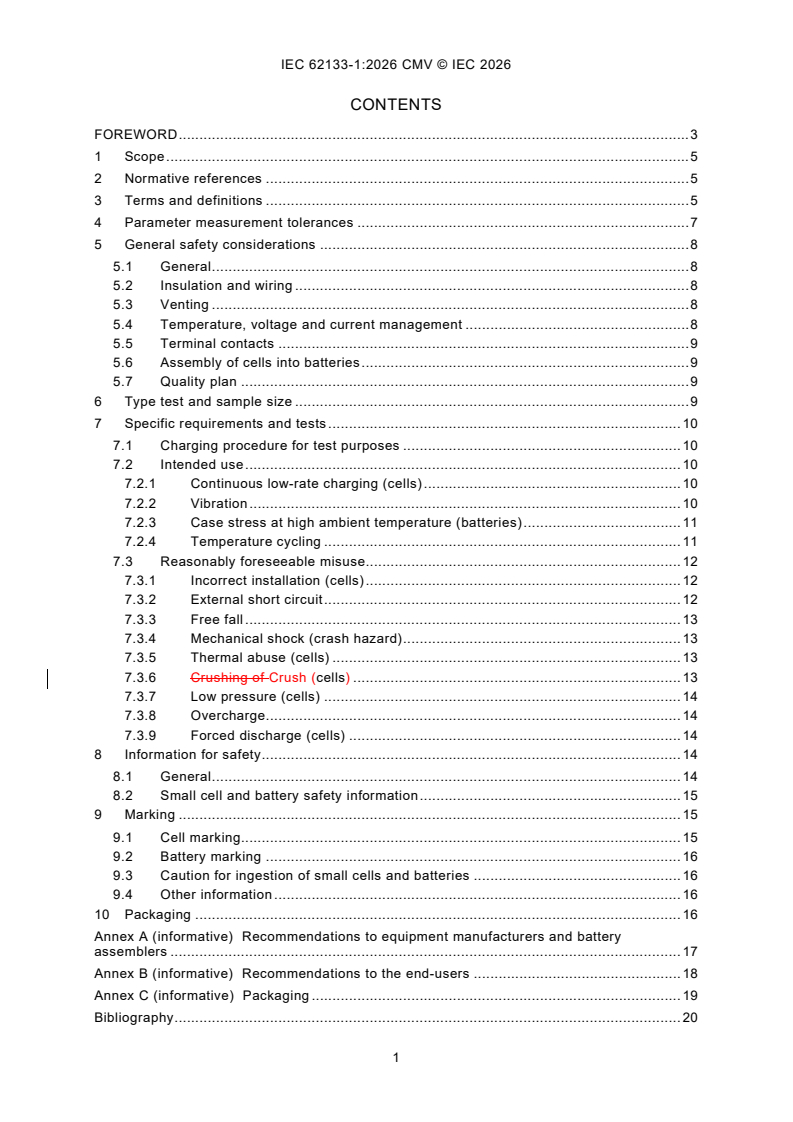
CONTENTS
FOREWORD . 3
1 Scope . 5
2 Normative references . 5
3 Terms and definitions . 5
4 Parameter measurement tolerances . 7
5 General safety considerations . 8
5.1 General . 8
5.2 Insulation and wiring . 8
5.3 Venting . 8
5.4 Temperature, voltage and current management . 8
5.5 Terminal contacts . 9
5.6 Assembly of cells into batteries . 9
5.7 Quality plan . 9
6 Type test and sample size . 9
7 Specific requirements and tests . 10
7.1 Charging procedure for test purposes . 10
7.2 Intended use . 10
7.2.1 Continuous low-rate charging (cells) . 10
7.2.2 Vibration . 10
7.2.3 Case stress at high ambient temperature (batteries) . 11
7.2.4 Temperature cycling . 11
7.3 Reasonably foreseeable misuse. 12
7.3.1 Incorrect installation (cells) . 12
7.3.2 External short circuit . 12
7.3.3 Free fall . 13
7.3.4 Mechanical shock (crash hazard) . 13
7.3.5 Thermal abuse (cells) . 13
7.3.6 Crushing of Crush (cells) . 13
7.3.7 Low pressure (cells) . 14
7.3.8 Overcharge . 14
7.3.9 Forced discharge (cells) . 14
8 Information for safety . 14
8.1 General . 14
8.2 Small cell and battery safety information . 15
9 Marking . 15
9.1 Cell marking. 15
9.2 Battery marking . 16
9.3 Caution for ingestion of small cells and batteries . 16
9.4 Other information . 16
10 Packaging . 16
Annex A (informative) Recommendations to equipment manufacturers and battery
assemblers . 17
Annex B (informative) Recommendations to the end-users . 18
Annex C (informative) Packaging . 19
Bibliography . 20
List of comments. 21
Figure 1 – Temperature profile for 7.2.4 – Temperature cycling test . 12
Figure 2 – Ingestion gauge . 15
Table 1 – Sample size for type tests . 10
Table 2 – Conditions for vibration test . 11
INTERNATIONAL ELECTROTECHNICAL COMMISSION
____________
Secondary cells and batteries containing alkaline or other non-acid
electrolytes - Safety requirements for portable sealed
secondary cells, and for batteries made from
them, for use in portable applications -
Part 1: Nickel systems
FOREWORD
1) The International Electrotechnical Commission (IEC) is a worldwide organization for standardization comprising
all national electrotechnical committees (IEC National Committees). The object of IEC is to promote international
co-operation on all questions concerning standardization in the electrical and electronic fields. To this end and
in addition to other activities, IEC publishes International Standards, Technical Specifications, Technical Reports,
Publicly Available Specifications (PAS) and Guides (hereafter referred to as “IEC Publication(s)”). Their
preparation is entrusted to technical committees; any IEC National Committee interested in the subject dealt with
may participate in this preparatory work. International, governmental and non-governmental organizations liaising
with the IEC also participate in this preparation. IEC collaborates closely with the International Organization for
Standardization (ISO) in accordance with conditions determined by agreement between the two organizations.
2) The formal decisions or agreements of IEC on technical matters express, as nearly as possible, an international
consensus of opinion on the relevant subjects since each technical committee has representation from all
interested IEC National Committees.
3) IEC Publications have the form of recommendations for international use and are accepted by IEC National
Committees in that sense. While all reasonable efforts are made to ensure that the technical content of IEC
Publications is accurate, IEC cannot be held responsible for the way in which they are used or for any
misinterpretation by any end user.
4) In order to promote international uniformity, IEC National Committees undertake to apply IEC Publications
transparently to the maximum extent possible in their national and regional publications. Any divergence between
any IEC Publication and the corresponding national or regional publication shall be clearly indicated in the latter.
5) IEC itself does not provide any attestation of conformity. Independent certification bodies provide conformity
assessment services and, in some areas, access to IEC marks of conformity. IEC is not responsible for any
services carried out by independent certification bodies.
6) All users should ensure that they have the latest edition of this publication.
7) No liability shall attach to IEC or its directors, employees, servants or agents including individual experts and
members of its technical committees and IEC National Committees for any personal injury, property damage or
other damage of any nature whatsoever, whether direct or indirect, or for costs (including legal fees) and
expenses arising out of the publication, use of, or reliance upon, this IEC Publication or any other IEC
Publications.
8) Attention is drawn to the Normative references cited in this publication. Use of the referenced publications is
indispensable for the correct application of this publication.
9) IEC draws attention to the possibility that the implementation of this document may involve the use of (a)
patent(s). IEC takes no position concerning the evidence, validity or applicability of any claimed patent rights in
respect thereof. As of the date of publication of this document, IEC [had/had not] received notice of (a) patent(s),
which may be required to implement this document. However, implementers are cautioned that this may not
represent the latest information, which may be obtained from the patent database available at
https://patents.iec.ch. IEC shall not be held responsible for identifying any or all such patent rights.
This commented version (CMV) of the official standard IEC 62133-1:2026 edition 2.0 allows the
user to identify the changes made to the previous IEC 62133-1:2017 edition 1.0. Furthermore,
comments from IEC SC 21A experts are provided to explain the reasons of the most relevant
changes, or to clarify any part of the content.
A vertical bar appears in the margin wherever a change has been made. Additions are in green
text, deletions are in strikethrough red text. Experts' comments are identified by a blue-
background number. Mouse over a number to display a pop-up note with the comment.
This publication contains the CMV and the official standard. The full list of comments is available
at the end of the CMV.
IEC 62133-1 has been prepared by subcommittee 21A: Secondary cells and batteries
containing alkaline or other non-acid electrolytes, of IEC technical committee 21: Secondary
cells and batteries. It is an International Standard.
This second edition cancels and replaces the first edition of IEC 62133-1 published in 2017. It
constitutes a technical revision.
This edition includes the following significant technical changes with respect to
IEC 62133-1:2017:
a) removal of the definition "secondary battery";
b) removal of the definition "portable battery";
c) "removal of the definition "portable cell";
d) replacement of the single term "room temperature" with 20 °C ± 5 °C in 7.2.3;
e) modification of Figure 1.
The text of this International Standard is based on the following documents:
Draft Report on voting
21A/946/FDIS 21A/969/RVD
Full information on the voting for its approval can be found in the report on voting indicated in
the above table.
The language used for the development of this International Standard is English.
This document was drafted in accordance with ISO/IEC Directives, Part 2, and developed in
accordance with ISO/IEC Directives, Part 1 and ISO/IEC Directives, IEC Supplement, available
at www.iec.ch/members_experts/refdocs. The main document types developed by IEC are
described in greater detail at www.iec.ch/publications.
A list of all parts of the IEC 62133 series, published under the general title Secondary cells and
batteries containing alkaline or other non-acid electrolytes – Safety requirements for portable
sealed secondary cells, and for batteries made from them, for use in portable applications, can
be found on the IEC website.
The committee has decided that the contents of this document will remain unchanged until the
stability date indicated on the IEC website under webstore.iec.ch in the data related to the
specific document. At this date, the document will be
– reconfirmed,
– withdrawn, or
– revised.
1 Scope
This part of IEC 62133 specifies requirements and tests for the safe operation of portable sealed
secondary nickel cells and batteries containing alkaline electrolyte, under intended use and
reasonably foreseeable misuse.
2 Normative references
The following documents are referred to in the text in such a way that some or all of their content
constitutes requirements of this document. For dated references, only the edition cited applies.
For undated references, the latest edition of the referenced document (including any
amendments) applies.
IEC 60050-482:2004, International Electrotechnical Vocabulary (IEV) - Part 482: Primary and
secondary cells and batteries
IEC 61951-1, Secondary cells and batteries containing alkaline or other non-acid electrolytes -
Portable sealed rechargeable single cells Secondary sealed cells and batteries for portable
applications 1 - Part 1: Nickel-Cadmium
IEC 61951-2, Secondary cells and batteries containing alkaline or other non -acid electrolytes
- Portable sealed rechargeable single cells Secondary sealed cells and batteries for portable
applications 1 - Part 2: Nickel-metal hydride
ISO/IEC Guide 51, Safety aspects - Guidelines for their inclusion in standards
3 Terms and definitions
For the purposes of this document, the terms and definitions given in IEC 60050-482,
ISO/IEC Guide 51 and the following apply.
ISO and IEC maintain terminology databases for use in standardization at the following
addresses:
– IEC Electropedia: available at https://www.electropedia.org/
– ISO Online browsing platform: available at https://www.iso.org/obp
3.1
safety
freedom from unacceptable risk
3.2
risk
combination of the probability of occurrence of harm and the severity of that harm
3.3
harm
physical injury or damage to the health of people or damage to property or to the environment
3.4
hazard
potential source of harm
3.5
intended use
use of a product, process or service in accordance with specifications, instructions and
information provided by the supplier
3.6
reasonably foreseeable misuse
use of a product, process or service in a way which is not intended by the supplier, but which
may result from readily predictable human behaviour
3.7
secondary cell
basic manufactured unit providing a source of electrical energy by direct conversion of chemical
energy, that consists of electrodes, separators, electrolyte, container and terminals, and that is
designed to be charged electrically
3.8
secondary battery 2
assembly of secondary cell(s) ready for use as a source of electrical energy characterized by
its voltage, size, terminal arrangement, capacity and rate capability
Note 1 to entry: Includes single cell batteries.
3.8
leakage
unplanned, visible escape of liquid electrolyte
3.9
venting
release of excessive internal pressure from a cell or battery in a manner intended by design to
preclude rupture or explosion
3.10
rupture
mechanical failure of a cell container or battery case induced by an internal or external cause,
resulting in exposure or spillage but not ejection of materials
3.11
explosion
failure that occurs when a cell container or battery case opens violently and major components
are forcibly expelled
3.12
fire
emission of flames from a cell or battery
3.14
portable battery 2
battery for use in a device or appliance which is conveniently hand-carried
3.15
portable cell 2
cell intended for assembly in a portable battery
3.13
rated capacity
capacity value of a cell or battery determined under specified conditions and declared by the
manufacturer
Note 1 to entry: The rated capacity is the quantity of electricity C Ah (ampere-hours) declared by the manufacturer
which a single cell can deliver when discharged at the reference test current of 0,2 I A to a specified final voltage,
t
after charging, storing and discharging under specified conditions.
[SOURCE: IEC 60050-482:2004, 482-03-15, modified – In the definition, "battery" replaced with
"cell or battery", Note 1 to entry added]
3.14
reference test current
I
t
charge or discharge current, expressed as a multiple of I A, where I A = C Ah/1 h, as defined
t t 5
in IEC 61434, and based on the rated capacity (C Ah) of the cell or battery
3.15
button cell
coin cell
cell with a cylindrical shape in which the overall height is less than the diameter, e.g. in the
shape of a button or a coin
Note 1 to entry: In practice, the term coin is used exclusively for non-aqueous lithium cells.
[SOURCE: IEC 60050-482:2004, 482-02-40]
3.16
cylindrical cell
cell with a cylindrical shape in which the overall height is equal to or greater than the diameter
[SOURCE: IEC 60050-482:2004, 482-02-39]
3.17
prismatic cell
cell having the shape of a parallelepiped whose faces are rectangular
[SOURCE: IEC 60050-482:2004, 482-02-38, modified – Source term is "prismatic" (adj.). In the
definition, "qualifies a cell or a battery" replaced with "cell"]
4 Parameter measurement tolerances
The overall accuracy of controlled or measured values, relative to the specified or actual
parameters, shall be within these tolerances:
a) ± 1 % for voltage;
b) ± 1 % for current;
c) ± 2 °C for temperature;
d) ± 0,1 % for time;
e) ± 1 % for dimension;
f) ± 1 % for capacity.
These tolerances comprise the combined accuracy of the measuring instruments, the
measurement techniques used, and all other sources of error in the test procedure.
The details of the instrumentation used shall be provided in any report of results.
5 General safety considerations
5.1 General
The safety of secondary cells and batteries requires the consideration of two sets of applied
conditions:
a) intended use;
b) reasonably foreseeable misuse.
Cells and batteries shall be so designed and constructed that they are safe under conditions of
both intended use and reasonably foreseeable misuse. It is expected that cells or batteries
subjected to misuse may fail to function following such experience. They shall not however
present significant hazards. It may also be expected that cells and batteries subjected to
intended use shall not only be safe but shall continue to be functional in all respects.
Potential hazards which are the subject of this document are:
– fire;
– burst/explosion;
– leakage of cell electrolyte;
– venting with continuous emission of flammable and/or toxic gas, and/or smoke; 3
– burns from excessively high external temperatures;
– rupture of battery case with exposure of internal components.
Conformity with 5.2 to 5.7 for cells and batteries other than button cells is checked by
inspection, by the tests of Clauses 7, and in accordance with the appropriate standard (see
Clause 2 and Table 1).
5.2 Insulation and wiring
The insulation resistance between the positive terminal and externally exposed metal surfaces
of the battery excluding electrical contact surfaces shall be not less than 5 MΩ at 500 V DC
when measured 60 s after applying the voltage.
Internal wiring and insulation should be sufficient to withstand the maximum anticipated current,
voltage and temperature requirements. The orientation of wiring should be such that adequate
clearances and creepage distances are maintained between conductors. The mechanical
integrity of internal connections should be sufficient to accommodate conditions of reasonably
foreseeable misuse (i.e. solder alone is not considered a reliable means of connection).
5.3 Venting
Battery cases and cells shall incorporate a pressure relief mechanism or shall be so constructed
that they will relieve excessive internal pressure at a value and rate that will preclude rupture,
explosion and self-ignition. If encapsulation is used to support cells within an outer case, the
type of encapsulant and the method of encapsulation shall neither cause the battery to overheat
during normal operation nor inhibit pressure relief.
5.4 Temperature, voltage and current management
The design of batteries shall be such that abnormal temperature-rise conditions are prevented.
Batteries shall be designed to be within temperature, voltage and current limits specified by the
cell manufacturer. Batteries shall be provided with specifications and charging instructions for
equipment manufacturers so that associated chargers are designed to maintain charging within
the temperature, voltage and current limits specified.
Where necessary, applicable means can be provided to limit current to safe levels during charge
and discharge.
5.5 Terminal contacts
The size and shape of the terminal contacts shall ensure that they can carry the maximum
anticipated current. External terminal contact surfaces shall be formed from conductive
materials with good mechanical strength and corrosion resistance. Terminal contacts shall be
arranged so as to minimize the risk of short circuits.
5.6 Assembly of cells into batteries
If there is more than one battery housed in a single battery case, cells used in the assembly of
each battery shall have closely matched capacities, be of the same design, be of the same
chemistry and be from the same manufacturer. The battery shall have some type of safety
device or feature for charging (example: keyed connector). 4
Manufacturers of cells shall specify current, voltage and temperature limits so that the battery
manufacturer/designer may ensure proper design and assembly.
Batteries that are designed for the selective discharge of a portion of their series-connected
cells shall incorporate circuitry to prevent operation of cells outside the limits specified by the
cell manufacturer.
Protective circuit components should be added as appropriate and consideration given to the
end-device application. When testing a battery, the manufacturer of the battery should provide
a test report confirming its compliance according to this document.
5.7 Quality plan
The manufacturer shall prepare and implement a quality plan that defines procedures for the
inspection of materials, components, cells and batteries and which covers the whole process of
producing each type of cell or battery. Manufacturers should understand their process
capabilities and should institute the necessary process controls as they relate to product safety.
6 Type test and sample size
Tests are made with the number of cells or batteries specified in Table 1 using cells or batteries
that are not more than six months old. Unless otherwise specified in the relevant subclause of
this document 5, tests are carried out in an ambient temperature of 20 °C ± 5 °C.
NOTE Test conditions are for type tests only and do not imply that intended use includes operation under these
conditions. Similarly, the limit of six months is introduced for consistency and does not imply that the cell or battery
safety is reduced after six months.
Table 1 – Sample size for type tests
a
Test Battery
Cell
7.2.1 Continuous low rate charging (cells) 5 –
7.2.2 Vibration 5 5
7.2.3 Case stress at high ambient temperature (batteries) – 3
7.2.4 Temperature cycling 5 5
7.3.1 Incorrect installation (cells) 5 sets of 4 –
7.3.2 External short circuit 5 per temperature 5 per temperature
7.3.3 Free fall 3 3
7.3.4 Mechanical shock (crash hazard) 5 5
7.3.5 Thermal abuse (cells) 5 –
7.3.6 Crush (cells) 5 (10 for prismatic) –
7.3.7 Low pressure (cells) 3 –
7.3.8 Overcharge 5 5
7.3.9 Forced discharge (cells) 5
−
a
– not applicable to button cells
7 Specific requirements and tests
7.1 Charging procedure for test purposes
Unless otherwise stated in this document, the charging procedure for test purposes is carried
out in an ambient temperature of 20 °C ± 5 °C, using the method declared by the manufacturer.
Prior to charging, the cell or battery shall have been discharged at 20 °C ± 5 °C at a constant
current of 0,2 I A down to a specified final voltage.
t
WARNING: These tests use procedures which may result in harm if adequate precautions are not taken. Tests
should only be performed by qualified and experienced technicians using adequate protection. To prevent
burns, caution should be taken for those cells or batteries whose casings may exceed 75 °c as a result of
testing.
7.2 Intended use
7.2.1 Continuous low-rate charging (cells)
a) Requirement
A continuous low-rate charge shall not cause fire or explosion.
b) Test
Fully charged cells are subjected for 28 days to a charge as specified by the manufacturer.
c) Acceptance criteria
No fire, no explosion.
7.2.2 Vibration
a) Requirements
Vibration encountered during transportation shall not cause leakage, fire or explosion.
b) Test
Fully charged cells or batteries are vibration-tested under the following test conditions and
the sequence in Table 2. A simple harmonic motion is applied to the cells or batteries with
an amplitude of 0,76 mm, and a total maximum excursion of 1,52 mm. The frequency is
varied at the rate of 1 Hz/min between the limits of 10 Hz and 55 Hz. The entire range of
frequencies (10 Hz to 55 Hz) and return (55 Hz to 10 Hz) is traversed in 90 min ± 5 min for
each mounting position (direction of vibration). The vibration is applied in each of three
mutually perpendicular directions, in the sequence specified below.
Table 2 – Conditions for vibration test
Step Axes of vibration Frequency Vibration time Rest time Visual examination
Hz min h
1 − − − − Pre-test
2 X 10 to 55 90 ± 5 –
−
3 Y 10 to 55 90 ± 5 − –
4 Z 10 to 55 90 ± 5 − –
5 1 Post-test
− − −
NOTE The sequence of Step 2 through Step 4 can be interchanged.
Step 1: Verify that the measured voltage is typical of the charged product being
tested.
Steps 2 to 4: Apply the vibration as specified in Table 2.
Step 5: Rest cell or battery for 1 h and then make a visual inspection.
c) Acceptance criteria
No fire, no explosion, no leakage.
7.2.3 Case stress at high ambient temperature (batteries)
a) Requirement
Internal components of batteries shall not be exposed during use at high temperature.
This requirement only applies to batteries with a moulded case.
b) Test
Fully charged batteries are exposed to a moderately high temperature to evaluate case
integrity. The battery is placed in an air circulating oven at a temperature of 70 °C ± 2 °C.
The batteries remain in the oven for 7 h, after which they are removed and allowed to return
to room temperature 20 °C ± 5 °C.
c) Acceptance criteria
No physical distortion of the battery case resulting in exposure of internal protective
components and cells.
7.2.4 Temperature cycling
a) Requirements
Repeated exposure to high and low temperatures shall not cause leakage, fire or explosion.
b) Test according to the following procedure and the profile shown in Figure 1:
Fully charged cells or batteries are subjected to temperature cycling (−20 °C, +75 °C),
in forced draught chambers, according to the following procedure.
Step 1: Place the cells or batteries in an ambient temperature of +75 °C ± 2 °C for 4 h.
Step 2: Change the ambient temperature to 20 °C ± 5 °C within 30 min and maintain
at this temperature for a minimum of 2 h.
Step 3: Change the ambient temperature to −20 °C ± 2 °C within 30 min and maintain at
this temperature for 4 h.
Step 4: Change the ambient temperature to 20 °C ± 5 °C within 30 min and maintain
at this temperature for a minimum of 2 h.
Step 5: Repeat steps 1 to 4 for a further four cycles. Transition from Step 4 to Step 1
within 30 min.
Step 6: After the fifth cycle, store the cells or batteries and conduct a visual check after
a rest period of at least 24 h.
NOTE This test can be performed in a single chamber whose temperature is changed or in three separate
chambers at three different test temperatures.
c) Acceptance criteria
No fire, no explosion, no leakage.
Figure 1 – Temperature profile for 7.2.4 – Temperature cycling test
7.3 Reasonably foreseeable misuse
7.3.1 Incorrect installation (cells)
a) Requirements
The incorrect installation of a single cell in a multi-cell application shall not cause fire or
explosion. In multi-cell applications where customers can replace cells, one single cell is
inserted in the application in reverse polarity. This shall not cause fire or explosion.
b) Test
Fully charged cells are evaluated under conditions in which one of the cells is incorrectly
installed. Four fully charged single cells of the same brand, type, size and age are connected
in series with one of the four cells reversed. The resultant assembly is connected across a
resistor of 1 Ω until the vent opens or until the temperature of the reversed cell returns to
ambient temperature. Alternatively, a stabilized DC power supply can be used to simulate
the conditions imposed on the reversed cell.
c) Acceptance criteria
No fire, no explosion.
7.3.2 External short circuit
a) Requirements
Short-circuiting of the positive and negative terminals shall not cause fire or explosion.
b) Test
Two sets of fully charged cells or batteries are stored in an ambient temperature of
20 °C ± 5 °C and 55 °C ± 5 °C, respectively, when the samples reach temperature balance
with the ambient temperature. The cell or battery is then short-circuited by connecting the
positive and negative terminals with a total external resistance of 80 mΩ ± 20 mΩ. The cells
or batteries remain on test for 24 h or until the case temperature declines by 20 % of the
maximum temperature rise, whichever is the sooner.
c) Acceptance criteria
No fire, no explosion.
7.3.3 Free fall
a) Requirements
Dropping a cell or battery (for example, from a bench top) shall not cause fire or explosion.
b) Test
Each fully charged cell or battery is dropped three times from a height of 1,00 m + 0.01 m
onto a concrete floor. The cells or batteries are dropped so as to obtain impacts in random
orientations. After the test, the sample shall be put on rest for a minimum of 1 h and then a
visual inspection shall be performed.
c) Acceptance criteria
No fire, no explosion.
7.3.4 Mechanical shock (crash hazard)
a) Requirements
Shocks encountered during handling or transportation shall not cause fire, explosion or
leakage.
b) Test
The fully charged cell or battery is secured to the testing machine by means of a rigid mount
which will support all mounting surfaces of the cell or battery. The cell or battery is subjected
to a total of three shocks of equal magnitude. The shocks are applied in each of three
mutually perpendicular directions. At least one of them shall be perpendicular to a flat face.
For each shock the cell or battery is accelerated in such a manner that during the initial
3 ms the minimum average acceleration is 735 m/s (75 g ). The peak acceleration shall be
n
2 2
between 1 226 m/s (125 g ) and 1 716 m/s (175 g ). Cells or batteries are tested in an
n n
ambient temperature of 20 °C ± 5 °C. After the test, the sample shall be put on rest for a
minimum of 1 h and then a visual inspection shall be performed.
c) Acceptance criteria
No fire, no explosion, no leakage.
7.3.5 Thermal abuse (cells)
a) Requirements
An extremely high temperature shall not cause fire or explosion.
b) Test
Each fully charged cell, stabilized in an ambient temperature of 20 °C ± 5 °C, is placed in a
gravity or circulating air-convection oven. The oven temperature is raised at a rate
of 5 °C/min ± 2 °C/min to a temperature of 130 °C ± 2 °C. The cell remains at this
temperature for 30 min before the test is terminated.
c) Acceptance criteria
No fire, no explosion.
7.3.6 Crushing of Crush (cells) 6
a) Requirements
Severe crushing of a cell (for example, during disposal in a waste compactor) shall not
cause fire or explosion.
b) Test
Each fully charged cell is crushed between two flat surfaces. The force for the crushing is
applied by a device exerting a force of 13 kN ± 0,78 kN. The crushing is performed in a
manner that will cause the most adverse result. Once the maximum force has been applied,
or an abrupt voltage drop of one-third of the original voltage has been obtained, the force is
released.
A cylindrical or prismatic cell is crushed with its longitudinal axis parallel to the flat surfaces
of the crushing apparatus. To test both wide and narrow sides of prismatic cells, a second
set of cells is tested, rotated 90° around their longitudinal axes compared to the first set.
c) Acceptance criteria
No fire, no explosion.
7.3.7 Low pressure (cells)
Low pressure testing of cells
a) Requirements
Low pressure (for example, during transportation in an aircraft cargo hold) shall not cause
fire or explosion.
b) Test
Each fully charged cell is placed in a vacuum chamber, in an ambient temperature
of 20 °C ± 5 °C. Once the chamber has been sealed, its internal pressure is gradually
reduced to a pressure equal to or less than 11,6 kPa (this simulates an altitude of 15 240 m)
and held at that value for 6 h.
c) Acceptance criteria
No fire, no explosion, no leakage.
7.3.8 Overcharge
a) Requirements
Charging for longer periods and at a higher rate than specified by the manufacturer shall
not cause fire or explosion.
b) Test
A discharged cell or battery is subjected to a high-rate charge of 2,5 times the recommended
charging current for a time that produces a 250 % charge input (250 % of rated capacity).
c) Acceptance criteria
No fire, no explosion.
7.3.9 Forced discharge (cells)
a) Requirements
A cell in a multi-cell application shall withstand polarity reversal without causing fire or
explosion.
b) Test
A discharged cell is subjected to a reverse charge at 1 I A for 90 min.
t
c) Acceptance criteria
No fire, no explosion.
8 Information for safety
8.1 General
The use, and particularly abuse, of portable sealed secondary cells and batteries containing
alkaline or other non-acid electrolyte may result in the creation of hazards and may cause harm.
Manufacturers of secondary cells shall ensure that information is provided about current,
voltage and temperature limits of their products. Manufacturers of batteries shall ensure that
equipment manufacturers and, in the case of direct sales, end-users are provided with
information to minimize and mitigate hazards.
It is the equipment manufacturer’s responsibility to inform end-users of the potential hazards
arising from the use of equipment containing secondary cells and batteries. Systems analyses
should be performed by device manufacturers to ensure that a particular battery design
prevents hazards from occurring during use of a product. As appropriate, any information
relating to hazard avoidance resulting from a system analysis should be provided to the end
user.
Guidance is provided in IEC TR 62188 on the design and manufacture of portable batteries,
and non-exhaustive lists of good advice are provided for information in Annex A and Annex B.
Conformity can be checked by examination of manufacturer's documentation.
8.2 Small cell and battery safety information
Small cells and batteries and equipment using small cells and batteries are to be provided with
information regarding ingestion hazards. Small cells and batteries that may pose an ingestion
hazard are those that can fit within the limits of the ingestion gauge shown in Figure 2.
The following warning language is to be provided with the information packaged with the small
cells and batteries or equipment using them:
– Keep small cells and batteries which are considered swallowable out of the reach of
children.
– Swallowing may lead to burns, perforation of soft tissue, and death. Severe burns can occur
within 2 h of ingestion.
– In case of ingestion of a cell or battery, seek medical assistance promptly.
Dimensions in millimetres
NOTE This gauge defines a swallowable component and is defined in ISO 8124-1.
Figure 2 – Ingestion gauge
9 Marking
9.1 Cell marking
Cells shall be marked as specified in the following applicable cell standards: IEC 61951-1 or
IEC 61951-2.
By agreement between the cell manufacturer and the battery and/or end product manufacturer,
component cells used in the manufacture of a battery need not be marked. However, the cell
marking can be indicated with the battery, the instructions and/or the specifications.
Conformity is checked by inspection.
9.2 Battery marking
Batteries shall be marked as specified in IEC 61951-1 or IEC 61951-2. Batteries shall also be
marked with an appropriate caution statement.
Terminals shall have clear polarity marking on the external surface of the battery.
Batteries with keyed external connectors designed for connection to specific end products need
not be marked with polarity markings if the design of the external connector prevents reverse
polarity connections.
Conformity is checked by inspection.
9.3 Caution for ingestion of small cells and batteries
Small cells and batteries determined to be small according to 8.2 shall include a caution
statement regarding the hazards of ingestion in accordance with 8.2.
When small cells and batteries are intended for direct sale in consumer-replaceable
applications, caution for ingestion shall be given on the immediate package.
Conformity is checked by inspection.
9.4 Other information
The following information shall be marked on or supplied with the battery:
– storage and disposal instructions;
– recommended charging instructions.
Conformity is checked by examination of markings and manufacturer's documentation.
10 Packaging
Packaging for button cells shall not be small enough to fit within the limits of the ingestion gauge
of Figure 2.
See Annex C for information regarding packaging.
Annex A
(informative)
Recommendations to equipment manufacturers
and battery assemblers
The following represents a typical, but non-exhaustive, list of good advice to be provided by the
manufacturer of secondary cells and batteries to equipment manufacturers and battery
assemblers:
a) Do not dismantle, open or shred cells. Batteries should be dismantled only by trained
personnel. Multi-cell battery cases should be designed so that they can be opened only with
the aid of a tool.
b) Compartments should be designed to prevent easy access to the batteries by young
children.
c) Do not short-circuit a cell or battery. Do not store cells or batteries haphazardly in a box or
drawer where they may short-circuit each other or be short-circuited by conductive
materials.
d) Do not remove a cell or battery from its original packaging until required for use.
e) Do not expose cells or batteries to heat or fire. Avoid storage in direct sunlight.
f) Do not subject cells or batteries to mechanical shock.
g) In the event of a cell leaking, do not allow the liquid to come into contact with the skin or
eyes. If contact has been made, wash the affected area with copious amounts of water and
seek medical advice.
h) Equipment should be designed to prohibit the incorrect insertion of cells or batteries and
should have clear polarity marks. Always observe the polarity marks on the cell, battery and
equipment and ensure correct use.
i) Do not mix cells of different manufacturer, capacity, size, age or type within a battery.
Manufacturer’s recommendation for acceptable age term should be obtained. 7
j) Seek medical advice immediately if a cell or battery has been swallowed.
k) Consult the cell or battery manufacturer on the maximum number of cells which may be
assembled in a battery and on the safest way in which cells may be con
...
IEC 62133-1 ®
Edition 2.0 2026-03
NORME
INTERNATIONALE
Accumulateurs alcalins et autres accumulateurs à électrolyte non acide -
Exigences de sécurité pour les accumulateurs portables étanches, et pour les
batteries qui en sont constituées, destinées à l'utilisation dans des applications
portables -
Partie 1: Systèmes au nickel
ICS 29.220.30 ISBN 978-2-8327-1070-8
Droits de reproduction réservés. Sauf indication contraire, aucune partie de cette publication ne peut être reproduite ni
utilisée sous quelque forme que ce soit et par aucun procédé, électronique ou mécanique, y compris la photocopie et
les microfilms, sans l'accord écrit de l'IEC ou du Comité national de l'IEC du pays du demandeur. Si vous avez des
questions sur le copyright de l'IEC ou si vous désirez obtenir des droits supplémentaires sur cette publication, utilisez
les coordonnées ci-après ou contactez le Comité national de l'IEC de votre pays de résidence.
IEC Secretariat Tel.: +41 22 919 02 11
3, rue de Varembé info@iec.ch
CH-1211 Geneva 20 www.iec.ch
Switzerland
A propos de l'IEC
La Commission Electrotechnique Internationale (IEC) est la première organisation mondiale qui élabore et publie des
Normes internationales pour tout ce qui a trait à l'électricité, à l'électronique et aux technologies apparentées.
A propos des publications IEC
Le contenu technique des publications IEC est constamment revu. Veuillez vous assurer que vous possédez l’édition la
plus récente, un corrigendum ou amendement peut avoir été publié.
Recherche de publications IEC - IEC Products & Services Portal - products.iec.ch
webstore.iec.ch/advsearchform Découvrez notre puissant moteur de recherche et consultez
La recherche avancée permet de trouver des publications gratuitement tous les aperçus des publications, symboles
IEC en utilisant différents critères (numéro de référence, graphiques et le glossaire. Avec un abonnement, vous aurez
texte, comité d’études, …). Elle donne aussi des toujours accès à un contenu à jour adapté à vos besoins.
informations sur les projets et les publications remplacées
ou retirées. Electropedia - www.electropedia.org
Le premier dictionnaire d'électrotechnologie en ligne au
IEC Just Published - webstore.iec.ch/justpublished monde, avec plus de 22 500 articles terminologiques en
Restez informé sur les nouvelles publications IEC. Just anglais et en français, ainsi que les termes équivalents
dans 25 langues additionnelles. Egalement appelé
Published détaille les nouvelles publications parues.
Disponible en ligne et une fois par mois par email. Vocabulaire Electrotechnique International (IEV) en ligne.
Service Clients - webstore.iec.ch/csc
Si vous désirez nous donner des commentaires sur cette
publication ou si vous avez des questions contactez-
nous: sales@iec.ch.
SOMMAIRE
AVANT-PROPOS . 3
1 Domaine d’application . 5
2 Références normatives . 5
3 Termes et définitions . 5
4 Tolérances de mesure relatives aux paramètres . 7
5 Considérations générales de sécurité . 7
5.1 Généralités . 7
5.2 Isolement et câblage . 8
5.3 Échappement de gaz . 8
5.4 Gestion de la température, de la tension et du courant . 8
5.5 Contacts des bornes . 9
5.6 Assemblage des éléments dans les batteries . 9
5.7 Plan qualité . 9
6 Essai de type et effectif d’échantillon . 9
7 Exigences spécifiques et essais . 10
7.1 Procédure de charge pour les besoins des essais . 10
7.2 Utilisation prévue . 10
7.2.1 Charge continue à faible régime (éléments) . 10
7.2.2 Vibrations . 11
7.2.3 Contrainte sur boîtier à température ambiante élevée (batteries) . 11
7.2.4 Cycles de température . 12
7.3 Utilisation abusive raisonnablement prévisible . 12
7.3.1 Installation incorrecte (éléments) . 12
7.3.2 Court-circuit externe . 13
7.3.3 Chute libre . 13
7.3.4 Choc mécanique (danger de collision) . 13
7.3.5 Température abusive (éléments) . 14
7.3.6 Écrasement (éléments) . 14
7.3.7 Basse pression (éléments) . 14
7.3.8 Surcharge . 15
7.3.9 Décharge forcée (éléments). 15
8 Informations pour la sécurité . 15
8.1 Généralités . 15
8.2 Informations relatives à la sécurité des éléments et batteries de petite taille . 16
9 Marquage . 16
9.1 Marquage des éléments . 16
9.2 Marquage des batteries . 16
9.3 Mise en garde contre l’ingestion des éléments et batteries de petite taille . 17
9.4 Autres informations . 17
10 Emballage . 17
Annexe A (informative) Recommandations à l’attention des fabricants d’équipements
et assembleurs de batteries . 18
Annexe B (informative) Recommandations à l’attention des utilisateurs finaux . 19
Annexe C (informative) Emballage . 21
Bibliographie . 22
Figure 1 – Profil de température pour 7.2.4 – Essai de cycles de température . 12
Figure 2 – Gabarit d’ingestion . 16
Tableau 1 – Taille des échantillons pour essais de type . 10
Tableau 2 – Conditions des essais de vibrations . 11
COMMISSION ÉLECTROTECHNIQUE INTERNATIONALE
____________
Accumulateurs alcalins et autres accumulateurs à électrolyte non acide -
Exigences de sécurité pour les accumulateurs portables étanches,
et pour les batteries qui en sont constituées, destinés à l’utilisation
dans des applications portables -
Partie 1: Systèmes au nickel
AVANT-PROPOS
1) La Commission Électrotechnique Internationale (IEC) est une organisation mondiale de normalisation composée
de l’ensemble des comités électrotechniques nationaux (Comités nationaux de l’IEC). L’IEC a pour objet de
favoriser la coopération internationale pour toutes les questions de normalisation dans les domaines de
l’électricité et de l’électronique. À cet effet, l’IEC – entre autres activités – publie des Normes internationales,
des Spécifications techniques, des Rapports techniques, des Spécifications accessibles au public (PAS) et des
Guides (ci-après dénommés "Publication(s) de l’IEC"). Leur élaboration est confiée à des comités d’études, aux
travaux desquels tout Comité national intéressé par le sujet traité peut participer. Les organisations
internationales, gouvernementales et non gouvernementales, en liaison avec l’IEC, participent également aux
travaux. L’IEC collabore étroitement avec l’Organisation Internationale de Normalisation (ISO), selon des
conditions fixées par accord entre les deux organisations.
2) Les décisions ou accords officiels de l’IEC concernant les questions techniques représentent, dans la mesure du
possible, un accord international sur les sujets étudiés, étant donné que les Comités nationaux de l’IEC intéressés
sont représentés dans chaque comité d’études.
3) Les Publications de l’IEC se présentent sous la forme de recommandations internationales et sont agréées
comme telles par les Comités nationaux de l’IEC. Tous les efforts raisonnables sont entrepris afin que l’IEC
s’assure de l’exactitude du contenu technique de ses publications; l’IEC ne peut pas être tenue responsable de
l’éventuelle mauvaise utilisation ou interprétation qui en est faite par un quelconque utilisateur final.
4) Dans le but d’encourager l’uniformité internationale, les Comités nationaux de l’IEC s’engagent, dans toute la
mesure possible, à appliquer de façon transparente les Publications de l’IEC dans leurs publications nationales
et régionales. Toutes divergences entre toutes Publications de l’IEC et toutes publications nationales ou
régionales correspondantes doivent être indiquées en termes clairs dans ces dernières.
5) L’IEC elle-même ne fournit aucune attestation de conformité. Des organismes de certification indépendants
fournissent des services d’évaluation de conformité et, dans certains secteurs, accèdent aux marques de
conformité de l’IEC. L’IEC n’est responsable d’aucun des services effectués par les organismes de certification
indépendants.
6) Tous les utilisateurs doivent s’assurer qu’ils sont en possession de la dernière édition de cette publication.
7) Aucune responsabilité ne doit être imputée à l’IEC, à ses administrateurs, employés, auxiliaires ou mandataires,
y compris ses experts particuliers et les membres de ses comités d’études et des Comités nationaux de l’IEC,
pour tout préjudice causé en cas de dommages corporels et matériels, ou de tout autre dommage de quelque
nature que ce soit, directe ou indirecte, ou pour supporter les coûts (y compris les frais de justice) et les dépenses
découlant de la publication ou de l’utilisation de cette Publication de l’IEC ou de toute autre Publication de l’IEC,
ou au crédit qui lui est accordé.
8) L’attention est attirée sur les références normatives citées dans cette publication. L’utilisation de publications
référencées est obligatoire pour une application correcte de la présente publication.
9) L’IEC attire l’attention sur le fait que la mise en application du présent document peut entraîner l’utilisation d’un
ou de plusieurs brevets. L’IEC ne prend pas position quant à la preuve, à la validité et à l’applicabilité de tout
droit de brevet revendiqué à cet égard. À la date de publication du présent document, l’IEC [avait/n’avait pas]
reçu notification qu’un ou plusieurs brevets pouvaient être nécessaires à sa mise en application. Toutefois, il y a
lieu d’avertir les responsables de la mise en application du présent document que des informations plus récentes
sont susceptibles de figurer dans la base de données de brevets, disponible à l’adresse https://patents.iec.ch.
L’IEC ne saurait être tenue pour responsable de ne pas avoir identifié de tels droits de propriété et averti de leur
existence.
L’IEC 62133-1 a été établie par le sous-comité 21A: Accumulateurs alcalins et autres
accumulateurs à électrolyte non acide, du comité d’études 21 de l’IEC: Accumulateurs. Il s’agit
d’une Norme internationale.
Cette deuxième édition annule et remplace la première édition de l’IEC 62133-1 parue en 2017.
Cette édition constitue une révision technique.
Cette édition inclut les modifications techniques majeures suivantes par rapport à
l’IEC 62133-1:2017:
a) suppression de la définition "batterie d’accumulateurs";
b) suppression de la définition "batterie portable";
c) suppression de la définition "élément portable";
d) remplacement du terme unique "température ambiante" par 20 °C ± 5 °C au 7.2.3;
e) modification de la Figure 1.
Le texte de cette Norme internationale est issu des documents suivants:
Projet Rapport de vote
21A/946/FDIS 21A/969/RVD
Le rapport de vote indiqué dans le tableau ci-dessus donne toute information sur le vote ayant
abouti à son approbation.
La langue employée pour l’élaboration de cette Norme internationale est l’anglais.
Ce document a été rédigé selon les Directives ISO/IEC, Partie 2, il a été développé selon les
Directives ISO/IEC, Partie 1 et les Directives ISO/IEC, Supplément IEC, disponibles sous
www.iec.ch/members_experts/refdocs. Les principaux types de documents développés par
l’IEC sont décrits plus en détail sous www.iec.ch/publications.
Une liste de toutes les parties de la série IEC 62133, publiées sous le titre général,
Accumulateurs alcalins et autres accumulateurs à électrolyte non acide – Exigences de sécurité
pour les accumulateurs portables étanches, et pour les batteries qui en sont constituées,
destinés à l’utilisation dans des applications portables, peut être consultée sur le site web de
l’IEC.
Le comité a décidé que le contenu de ce document ne sera pas modifié avant la date de stabilité
indiquée sur le site web de l’IEC sous webstore.iec.ch dans les données relatives au document
recherché. À cette date, le document sera
– reconduit,
– supprimé, ou
– révisé.
1 Domaine d’application
La présente partie de l’IEC 62133 spécifie les exigences et les essais pour le fonctionnement
en toute sécurité des accumulateurs portables étanches au nickel contenant un électrolyte
alcalin dans des conditions d’utilisations prévues et dans des conditions d’utilisation abusive
raisonnablement prévisible.
2 Références normatives
Les documents suivants sont cités dans le texte de sorte qu’ils constituent, pour tout ou partie
de leur contenu, des exigences du présent document. Pour les références datées, seule
l’édition citée s’applique. Pour les références non datées, la dernière édition du document de
référence s’applique (y compris les éventuels amendements).
IEC 60050-482:2004, Vocabulaire Électrotechnique International - Partie 482: Piles et
accumulateurs électriques
IEC 61951-1, Accumulateurs alcalins et autres accumulateurs à électrolyte non acide -
Accumulateurs étanches pour applications portables - Partie 1: Nickel-cadmium
IEC 61951-2, Accumulateurs alcalins et autres accumulateurs à électrolyte non acide -
Accumulateurs étanches pour applications portables - Partie 2: Nickel-métal hydrure
ISO/IEC Guide 51, Aspects liés à la sécurité - Principes directeurs pour les inclure dans les
normes
3 Termes et définitions
Pour les besoins du présent document, les termes et définitions de l’IEC 60050-482 et de
l’ISO/IEC Guide 51, ainsi que les suivants, s’appliquent.
L’ISO et l’IEC tiennent à jour des bases de données terminologiques destinées à être utilisées
en normalisation, consultables aux adresses suivantes:
– IEC Electropedia: disponible à l’adresse https://www.electropedia.org/
– ISO Online browsing platform: disponible à l’adresse https://www.iso.org/obp
3.1
sécurité
absence de tout risque inacceptable
3.2
risque
combinaison de la probabilité de survenue d’un dommage et de sa gravité
3.3
dommage
blessure physique ou atteinte à la santé des personnes, ou atteinte aux biens ou à
l’environnement
3.4
danger
source potentielle de dommage
3.5
utilisation prévue
utilisation d’un produit, procédé ou service conformément aux spécifications, aux instructions
et aux informations données par le fournisseur
3.6
utilisation abusive raisonnablement prévisible
utilisation d’un produit, procédé ou service dans des conditions ou à des fins non prévues par
le fournisseur, mais qui peut résulter d’un comportement humain envisageable
3.7
élément d’accumulateur
unité de base fabriquée fournissant une source d’énergie électrique par la transformation
directe d’énergie chimique, constituée d’électrodes, de séparateurs, d’électrolyte, d’un bac,
et de bornes de connexion, et qui est conçue pour être chargée électriquement
3.8
fuite
perte visible, imprévue, d’électrolyte liquide
3.9
échappement de gaz
libération de pression interne excessive, d’un élément d’accumulateur ou d’une batterie
d’accumulateurs, conçue pour prévenir la rupture ou l’explosion
3.10
rupture
défaillance mécanique d’un bac d’élément ou d’un boîtier de batterie induite par une cause
interne ou externe, qui conduit à une exposition des matériaux ou à l’échappement de liquide,
mais non à une éjection de matériaux
3.11
explosion
défaillance qui se produit lorsqu’un bac d’élément ou un boîtier de batterie s’ouvre violemment
et lorsque les composants principaux sont éjectés de manière violente
3.12
feu
émission de flammes d’un élément ou d’une batterie
3.13
capacité assignée
valeur de la capacité d’un élément ou d’une batterie déterminée dans des conditions spécifiées
et déclarée par le fabricant
Note 1 à l’article: La capacité assignée est la quantité d’électricité, C Ah (ampères-heures) déclarée par le
fabricant, qu’un élément individuel est capable de restituer en décharge au courant d’essai de référence de 0,2 I A
t
jusqu’à une tension finale spécifiée, après charge, repos et décharge, dans les conditions spécifiées.
[SOURCE: IEC 60050-482:2004, 482-03-15, modifié – Remplacement dans la définition "d’une
batterie" par "d’un élément ou d’une batterie » et ajout de la Note 1 à l’article.]
3.14
courant d’essai de référence
I
t
courant de charge ou de décharge, exprimé sous la forme d’un multiple de I A, où I A =
t t
C Ah/1 h, tel que défini dans l’IEC 61434, qui repose sur la capacité assignée (C Ah) de
5 5
l’élément ou de la batterie
3.15
élément bouton
élément de forme cylindrique dont la hauteur totale est inférieure au diamètre, par exemple en
forme de bouton ou de pièce de monnaie
Note 1 à l’article: En pratique, le terme élément bouton est utilisé exclusivement pour les piles au lithium non
aqueuses.
[SOURCE: IEC 60050-482:2004, 482-02-40]
3.16
élément cylindrique
élément de forme cylindrique dans laquelle la hauteur totale est supérieure ou égale au
diamètre
[SOURCE: IEC 60050-482:2004, 482-02-39]
3.17
élément parallélépipédique
élément ayant la forme d’un parallélépipède dont les faces sont rectangulaires
[SOURCE: IEC 60050-482:2004, 482-02-38, modifié – Remplacement du terme source
"parallélépipédique, adj." par "élément parallélépipédique". Remplacement dans la définition
de "qualifie un élément ou une batterie" par "élément"]
4 Tolérances de mesure relatives aux paramètres
L’exactitude globale des valeurs contrôlées ou mesurées, par rapport aux paramètres spécifiés
ou réels, doit respecter les tolérances suivantes:
a) ±1 % pour la tension;
b) ± 1 % pour le courant;
c) ±2 °C pour la température;
d) ±0,1 % pour le temps;
e) ±1 % pour les dimensions;
f) ±1 % pour la capacité.
Ces tolérances comprennent l’exactitude combinée des appareils de mesure, des techniques
de mesure utilisées et de toute autre source d’erreur dans la procédure d’essai.
Les détails relatifs aux appareils utilisés doivent être fournis dans chaque rapport de résultats.
5 Considérations générales de sécurité
5.1 Généralités
La sécurité des éléments et des batteries d’accumulateurs exige la prise en compte de deux
ensembles de conditions d’utilisation:
a) l’utilisation prévue;
b) l’utilisation abusive raisonnablement prévisible.
Les éléments et les batteries d’accumulateurs doivent être conçus et construits de manière telle
qu’ils soient sûrs dans les conditions d’utilisation prévues et dans les conditions d’utilisation
abusive raisonnablement prévisible. Il est admis que les accumulateurs soumis à une utilisation
abusive puissent être défaillants après une telle utilisation. Ils ne doivent cependant pas
présenter de dangers significatifs. Par ailleurs, les éléments et les batteries d’accumulateurs
utilisés dans les conditions normales doivent non seulement être sûrs mais doivent aussi
continuer à être fonctionnels en tous points.
Les dangers potentiels qui font l’objet du présent document sont:
– le feu;
– l’éclatement/l’explosion;
– la fuite de l’électrolyte d’un élément;
– l’échappement de gaz avec émission continue de gaz inflammable et/ou toxique, et/ou de
fumée;
– les brûlures résultant de températures externes excessivement élevées;
– la rupture du boîtier de batterie avec exposition des constituants internes.
La conformité à 5.2 à 5.7 pour les éléments et les batteries (hors éléments boutons) est vérifiée
par examen, par les essais de l’Article 7, et conformément à la norme appropriée (voir l’Article 2
et le Tableau 1).
5.2 Isolement et câblage
La résistance d’isolement entre la borne positive et les surfaces métalliques externes exposées
de la batterie, à l’exclusion des surfaces de contact électrique, ne doit pas être inférieure à
5 MΩ sous 500 V en courant continu, mesurée 60 s après application de la tension.
Il convient que le câblage interne et son isolement soient suffisants pour satisfaire aux
exigences maximales prévisibles de courant, de tension et de température. Il convient que
l’orientation du câblage soit de nature à maintenir les espaces de dégagement et les distances
d’isolement entre les conducteurs. Il convient que l’intégrité mécanique des connexions
internes soit suffisante pour s’adapter aux conditions d’utilisation abusive raisonnablement
prévisible (c’est-à-dire qu’une soudure seule n’est pas considérée comme étant un moyen fiable
de connexion).
5.3 Échappement de gaz
Les boîtiers des éléments et des batteries d’accumulateurs doivent être équipés d’un
mécanisme de libération de pression ou doivent être construits de telle sorte qu’ils libèrent la
pression interne en excès à une valeur et à un régime permettant de prévenir la rupture,
l’explosion et l’inflammation spontanée. Si le surmoulage est utilisé pour maintenir les éléments
dans un boîtier extérieur, le type de produit et la méthode de surmoulage ne doivent entraîner
ni une surchauffe de l’accumulateur au cours d’un fonctionnement normal, ni le blocage du
mécanisme de libération de pression.
5.4 Gestion de la température, de la tension et du courant
La conception des batteries doit être de nature à prévenir tout échauffement anormal.
Les batteries doivent être conçues pour être dans les limites de température, de tension et de
courant spécifiées par le fabricant des éléments. Les batteries doivent être accompagnées de
spécifications et d’instructions de charge pour les fabricants de matériel de façon à concevoir
les chargeurs associés en maintenant la charge dans les limites spécifiées de température,
de tension et de courant.
Si nécessaire, des moyens peuvent être mis en œuvre pour limiter le courant à des niveaux
sûrs au cours de la charge et de la décharge.
5.5 Contacts des bornes
La taille et la forme des contacts des bornes doivent permettre le transport du courant maximal
prévu. Les surfaces de contact des bornes externes doivent être constituées de matériaux
conducteurs, avec une bonne résistance mécanique et une bonne résistance à la corrosion.
Les contacts des bornes doivent être disposés de façon à réduire le plus possible le risque de
court-circuit.
5.6 Assemblage des éléments dans les batteries
Si plusieurs batteries sont logées dans un unique boîtier de batteries, les éléments utilisés dans
l’assemblage des batteries doivent avoir des capacités équilibrées, avoir la même conception,
appartenir au même système électrochimique et provenir du même fabricant. La batterie doit
être équipée d’un certain type de dispositif ou de fonction de sécurité pour la charge (par
exemple connecteur à détrompeur).
Les fabricants d’éléments doivent spécifier les limites de courant, de tension et de température,
pour permettre au fabricant/concepteur de la batterie d’assurer une conception et un
assemblage convenables.
Les batteries conçues pour la décharge sélective d’une partie de leurs éléments connectés en
série doivent être équipées de circuits permettant d’éviter le fonctionnement des éléments hors
des limites spécifiées par le fabricant de l’élément.
Il convient d’ajouter, si nécessaire, des composants aux circuits de protection et de tenir compte
de l’application du dispositif final. Lors de l’essai d’une batterie, il convient que le fabricant de
la batterie fournisse un rapport d’essai confirmant sa conformité au présent document.
5.7 Plan qualité
Le fabricant doit préparer et mettre en œuvre un plan qualité qui définit les procédures
d’examen des matériaux, des composants, des éléments et des batteries et qui couvre
l’ensemble du processus de production de chaque type d’accumulateur. Il convient que les
fabricants comprennent leurs capacités de traitement et il convient qu’ils mettent en place les
contrôles de processus nécessaires concernant la sécurité des produits.
6 Essai de type et effectif d’échantillon
Les essais sont effectués, avec le nombre d’éléments ou de b
...