

IEC 60364-8-1:2014
(Main)Low-voltage electrical installations - Part 8-1: Energy efficiency
General Information
- Abstract
IEC 60364-8-1:2014 provides additional requirements, measures and recommendations for the design, erection and verification of all types of low-voltage electrical installation including local production and storage of energy for optimizing the overall efficient use of electricity. It introduces requirements and recommendations for the design of an electrical installation within the framework of an energy efficiency management approach in order to get the best permanent functionally equivalent service for the lowest electrical energy consumption and the most acceptable energy availability and economic balance. These requirements and recommendations apply, within the scope of the IEC 60364 series, for new installations and modification of existing installations. This standard is applicable to the electrical installation of a building or system and does not apply to products. The energy efficiency of these products and their operational requirements are covered by the relevant product standards. This standard does not specifically address building automation systems.
- Status
- Published
- Publication Date
- 08-Oct-2014
- Technical Committee
- TC 64 - Electrical installations and protection against electric shock
- Current Stage
- DELPUB - Deleted Publication
- Start Date
- 06-Feb-2019
- Completion Date
- 28-Aug-2026
Overview
IEC 60364-8-1:2014 is an international standard from the International Electrotechnical Commission (IEC) focused on energy efficiency in low-voltage electrical installations. It sets forth additional requirements, measures, and recommendations designed to optimize the use of electrical energy in all types of low-voltage installations. This standard addresses the design, erection, and verification phases considering local energy production and storage to ensure the most efficient energy use. It aims to balance energy availability, economic considerations, and service quality while maintaining safety.
Distinct from product standards, IEC 60364-8-1 does not cover building automation systems or specific products, instead targeting the entire electrical installation within buildings or systems. It applies to both new installations and modifications of existing setups, emphasizing permanent functional equivalence with reduced energy consumption.
Key Topics
Fundamental Principles: Emphasizes safety, availability of electrical energy, and user decision-making in designing energy-efficient electrical installations.
Load Profiles and Zoning: Defining load profiles, electrical zones, usages, and meshes within electrical distribution systems to optimize design and operation.
Transformer and Switchboard Location: Use of the barycentre (center of gravity) method for optimal placement to reduce losses and improve efficiency.
Efficiency Considerations:
- Transformer efficiency and operating points
- Efficiency of local electricity production and energy storage solutions
- Minimization of wiring losses, addressing voltage drops and correct sizing of conductors
- Power factor correction and reduction of harmonic currents
Energy Management Systems:
- Integration of load management and energy monitoring systems
- Incorporation of inputs from loads, sensors, and forecasts for intelligent energy usage
- Multi-source energy supply management including grids, local generation, and storage
Performance and Maintenance:
- Life cycle methodologies for installation energy efficiency
- Continual verification, performance enhancement, and maintenance planning
- Assessment procedures for new and existing installations
Implementation Parameters and Actions:
- Equipment selection and optimization for current use and power distribution
- Installation and commissioning of monitoring systems to ensure ongoing efficiency
Applications
IEC 60364-8-1:2014 applies to a broad range of low-voltage electrical installations in various infrastructures, such as:
- Residential, commercial, and industrial buildings
- Buildings incorporating local electricity production (e.g., solar panels) and energy storage units (e.g., batteries)
- Facilities undergoing new installation, extension, or refurbishment of electrical systems
- Energy management initiatives aiming to lower electricity consumption without compromising service quality
- Design of electrical distribution systems to maximize energy efficiency, reduce losses, and improve power quality
This standard supports the creation of sustainable electrical installations by guiding designers, engineers, and facility managers to achieve efficient energy use, cost savings, and compliance with international best practices.
Related Standards
IEC 60364-8-1 forms part of the broader IEC 60364 series addressing low-voltage electrical installations. Related standards and normative references include:
- IEC 60364 series covering wiring systems, protection, and safety in electrical installations
- Product standards covering the energy efficiency and operational requirements of electrical equipment (e.g., transformers, switchboards, lighting, HVAC systems)
- Standards on power quality, harmonic mitigation, and power factor correction relevant to electrical energy efficiency
- International standards on local energy production and storage systems
- Building energy codes and standards that complement electrical installation efficiency by addressing broader building performance
By aligning with IEC 60364-8-1 along with associated standards, stakeholders can implement energy-efficient low-voltage electrical systems that meet technical, safety, and sustainability objectives.
Keywords: IEC 60364-8-1, low-voltage electrical installations, energy efficiency, electrical installation design, energy management, load profile, transformer efficiency, electrical wiring losses, local energy storage, power factor correction, electrical installation verification, IEC standards.
Relations
- Effective Date
- 25-Aug-2026
- Effective Date
- 05-Sep-2023
Get Certified
Connect with accredited certification bodies for this standard

DNV
DNV is an independent assurance and risk management provider.

BSI Group
BSI (British Standards Institution) is the business standards company that helps organizations make excellence a habit.

Bureau Veritas
Bureau Veritas is a world leader in laboratory testing, inspection and certification services.
Sponsored listings
Frequently Asked Questions
IEC 60364-8-1:2014 is a standard published by the International Electrotechnical Commission (IEC). Its full title is "Low-voltage electrical installations - Part 8-1: Energy efficiency". This standard covers: IEC 60364-8-1:2014 provides additional requirements, measures and recommendations for the design, erection and verification of all types of low-voltage electrical installation including local production and storage of energy for optimizing the overall efficient use of electricity. It introduces requirements and recommendations for the design of an electrical installation within the framework of an energy efficiency management approach in order to get the best permanent functionally equivalent service for the lowest electrical energy consumption and the most acceptable energy availability and economic balance. These requirements and recommendations apply, within the scope of the IEC 60364 series, for new installations and modification of existing installations. This standard is applicable to the electrical installation of a building or system and does not apply to products. The energy efficiency of these products and their operational requirements are covered by the relevant product standards. This standard does not specifically address building automation systems.
IEC 60364-8-1:2014 provides additional requirements, measures and recommendations for the design, erection and verification of all types of low-voltage electrical installation including local production and storage of energy for optimizing the overall efficient use of electricity. It introduces requirements and recommendations for the design of an electrical installation within the framework of an energy efficiency management approach in order to get the best permanent functionally equivalent service for the lowest electrical energy consumption and the most acceptable energy availability and economic balance. These requirements and recommendations apply, within the scope of the IEC 60364 series, for new installations and modification of existing installations. This standard is applicable to the electrical installation of a building or system and does not apply to products. The energy efficiency of these products and their operational requirements are covered by the relevant product standards. This standard does not specifically address building automation systems.
IEC 60364-8-1:2014 is classified under the following ICS (International Classification for Standards) categories: 13.020.01 - Environment and environmental protection in general; 27.015 - Energy efficiency. Energy conservation in general; 91.140.50 - Electricity supply systems. The ICS classification helps identify the subject area and facilitates finding related standards.
IEC 60364-8-1:2014 has the following relationships with other standards: It is inter standard links to EN 378-3:2016, IEC 60364-8-1:2019. Understanding these relationships helps ensure you are using the most current and applicable version of the standard.
IEC 60364-8-1:2014 is available in PDF format for immediate download after purchase. The document can be added to your cart and obtained through the secure checkout process. Digital delivery ensures instant access to the complete standard document.
Standards Content (Sample)
IEC 60364-8-1 ®
Edition 1.0 2014-10
INTERNATIONAL
STANDARD
NORME
INTERNATIONALE
colour
inside
Low-voltage electrical installations –
Part 8-1: Energy efficiency
Installations électriques basse tension –
Partie 8-1: Efficacité énergétique
All rights reserved. Unless otherwise specified, no part of this publication may be reproduced or utilized in any form
or by any means, electronic or mechanical, including photocopying and microfilm, without permission in writing from
either IEC or IEC's member National Committee in the country of the requester. If you have any questions about IEC
copyright or have an enquiry about obtaining additional rights to this publication, please contact the address below or
your local IEC member National Committee for further information.
Droits de reproduction réservés. Sauf indication contraire, aucune partie de cette publication ne peut être reproduite
ni utilisée sous quelque forme que ce soit et par aucun procédé, électronique ou mécanique, y compris la photocopie
et les microfilms, sans l'accord écrit de l'IEC ou du Comité national de l'IEC du pays du demandeur. Si vous avez des
questions sur le copyright de l'IEC ou si vous désirez obtenir des droits supplémentaires sur cette publication, utilisez
les coordonnées ci-après ou contactez le Comité national de l'IEC de votre pays de résidence.
IEC Central Office Tel.: +41 22 919 02 11
3, rue de Varembé Fax: +41 22 919 03 00
CH-1211 Geneva 20 info@iec.ch
Switzerland www.iec.ch
About the IEC
The International Electrotechnical Commission (IEC) is the leading global organization that prepares and publishes
International Standards for all electrical, electronic and related technologies.
About IEC publications
The technical content of IEC publications is kept under constant review by the IEC. Please make sure that you have the
latest edition, a corrigenda or an amendment might have been published.
IEC Catalogue - webstore.iec.ch/catalogue Electropedia - www.electropedia.org
The stand-alone application for consulting the entire The world's leading online dictionary of electronic and
bibliographical information on IEC International Standards, electrical terms containing more than 30 000 terms and
Technical Specifications, Technical Reports and other definitions in English and French, with equivalent terms in 14
documents. Available for PC, Mac OS, Android Tablets and additional languages. Also known as the International
iPad. Electrotechnical Vocabulary (IEV) online.
IEC publications search - www.iec.ch/searchpub IEC Glossary - std.iec.ch/glossary
The advanced search enables to find IEC publications by a More than 55 000 electrotechnical terminology entries in
variety of criteria (reference number, text, technical English and French extracted from the Terms and Definitions
committee,…). It also gives information on projects, replaced clause of IEC publications issued since 2002. Some entries
and withdrawn publications. have been collected from earlier publications of IEC TC 37,
77, 86 and CISPR.
IEC Just Published - webstore.iec.ch/justpublished
Stay up to date on all new IEC publications. Just Published IEC Customer Service Centre - webstore.iec.ch/csc
details all new publications released. Available online and If you wish to give us your feedback on this publication or
also once a month by email. need further assistance, please contact the Customer Service
Centre: csc@iec.ch.
A propos de l'IEC
La Commission Electrotechnique Internationale (IEC) est la première organisation mondiale qui élabore et publie des
Normes internationales pour tout ce qui a trait à l'électricité, à l'électronique et aux technologies apparentées.
A propos des publications IEC
Le contenu technique des publications IEC est constamment revu. Veuillez vous assurer que vous possédez l’édition la
plus récente, un corrigendum ou amendement peut avoir été publié.
Catalogue IEC - webstore.iec.ch/catalogue Electropedia - www.electropedia.org
Application autonome pour consulter tous les renseignements
Le premier dictionnaire en ligne de termes électroniques et
bibliographiques sur les Normes internationales,
électriques. Il contient plus de 30 000 termes et définitions en
Spécifications techniques, Rapports techniques et autres
anglais et en français, ainsi que les termes équivalents dans
documents de l'IEC. Disponible pour PC, Mac OS, tablettes
14 langues additionnelles. Egalement appelé Vocabulaire
Android et iPad.
Electrotechnique International (IEV) en ligne.
Recherche de publications IEC - www.iec.ch/searchpub
Glossaire IEC - std.iec.ch/glossary
Plus de 55 000 entrées terminologiques électrotechniques, en
La recherche avancée permet de trouver des publications IEC
en utilisant différents critères (numéro de référence, texte, anglais et en français, extraites des articles Termes et
comité d’études,…). Elle donne aussi des informations sur les Définitions des publications IEC parues depuis 2002. Plus
projets et les publications remplacées ou retirées. certaines entrées antérieures extraites des publications des
CE 37, 77, 86 et CISPR de l'IEC.
IEC Just Published - webstore.iec.ch/justpublished
Service Clients - webstore.iec.ch/csc
Restez informé sur les nouvelles publications IEC. Just
Published détaille les nouvelles publications parues. Si vous désirez nous donner des commentaires sur cette
Disponible en ligne et aussi une fois par mois par email. publication ou si vous avez des questions contactez-nous:
csc@iec.ch.
IEC 60364-8-1 ®
Edition 1.0 2014-10
INTERNATIONAL
STANDARD
NORME
INTERNATIONALE
colour
inside
Low-voltage electrical installations –
Part 8-1: Energy efficiency
Installations électriques basse tension –
Partie 8-1: Efficacité énergétique
INTERNATIONAL
ELECTROTECHNICAL
COMMISSION
COMMISSION
ELECTROTECHNIQUE
PRICE CODE
INTERNATIONALE
CODE PRIX XA
ICS 13.020.01; 91.140.50 ISBN 978-2-8322-1883-9
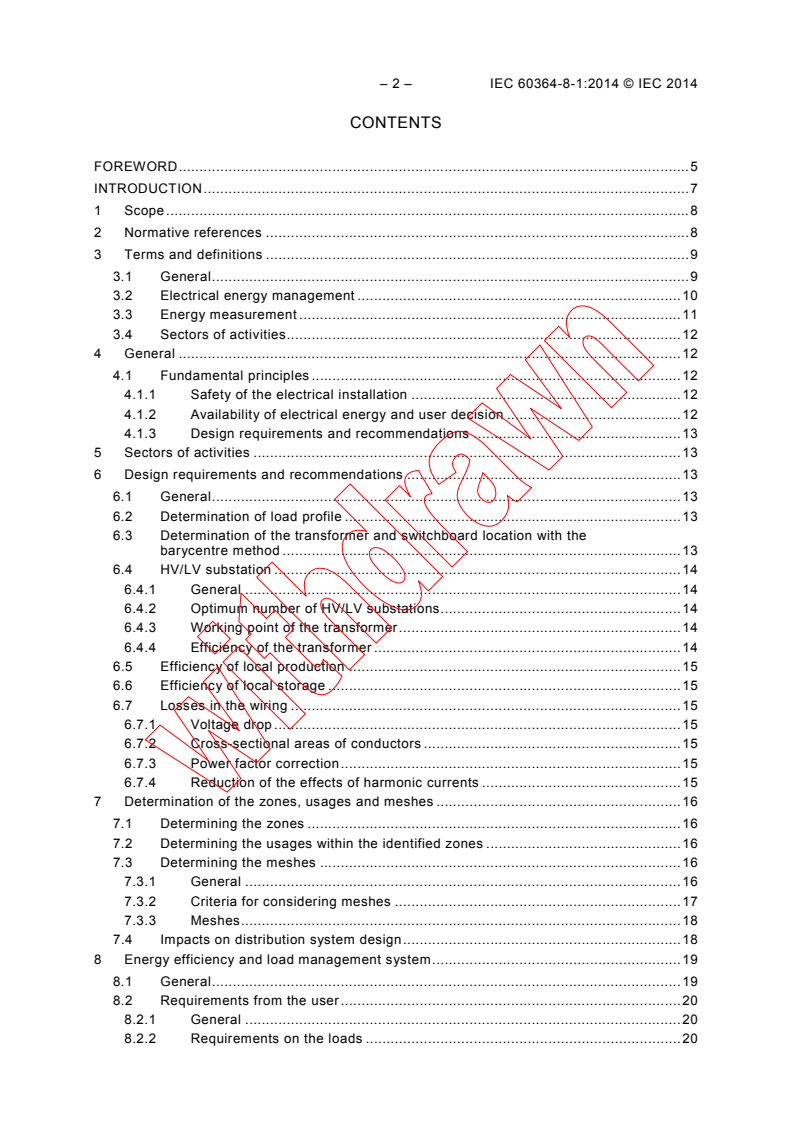
– 2 – IEC 60364-8-1:2014 © IEC 2014
CONTENTS
FOREWORD . 5
INTRODUCTION . 7
1 Scope . 8
2 Normative references . 8
3 Terms and definitions . 9
3.1 General . 9
3.2 Electrical energy management . 10
3.3 Energy measurement . 11
3.4 Sectors of activities . 12
4 General . 12
4.1 Fundamental principles . 12
4.1.1 Safety of the electrical installation . 12
4.1.2 Availability of electrical energy and user decision . 12
4.1.3 Design requirements and recommendations . 13
5 Sectors of activities . 13
6 Design requirements and recommendations . 13
6.1 General . 13
6.2 Determination of load profile . 13
6.3 Determination of the transformer and switchboard location with the
barycentre method . 13
6.4 HV/LV substation . 14
6.4.1 General . 14
6.4.2 Optimum number of HV/LV substations . 14
6.4.3 Working point of the transformer . 14
6.4.4 Efficiency of the transformer . 14
6.5 Efficiency of local production . 15
6.6 Efficiency of local storage . 15
6.7 Losses in the wiring . 15
6.7.1 Voltage drop . 15
6.7.2 Cross-sectional areas of conductors . 15
6.7.3 Power factor correction . 15
6.7.4 Reduction of the effects of harmonic currents . 15
7 Determination of the zones, usages and meshes . 16
7.1 Determining the zones . 16
7.2 Determining the usages within the identified zones . 16
7.3 Determining the meshes . 16
7.3.1 General . 16
7.3.2 Criteria for considering meshes . 17
7.3.3 Meshes . 18
7.4 Impacts on distribution system design . 18
8 Energy efficiency and load management system . 19
8.1 General . 19
8.2 Requirements from the user . 20
8.2.1 General . 20
8.2.2 Requirements on the loads . 20
8.2.3 Requirements on the supplies . 20
8.3 Inputs from loads, sensors and forecasts . 20
8.3.1 Measurement . 20
8.3.2 Loads . 22
8.3.3 Energy sensors . 23
8.3.4 Forecasts . 23
8.3.5 Data logging . 23
8.3.6 Communication . 23
8.4 Inputs from the supplies: energy availability and pricing, smart metering. 23
8.5 Information for the user: monitoring the electrical installation . 23
8.6 Management of loads through the meshes . 24
8.6.1 General . 24
8.6.2 Energy management system . 24
8.7 Multi-supply source management: grid, local electricity production and
storage . 24
9 Maintenance and enhancement of the performance of the installation . 25
9.1 Methodology . 25
9.2 Installation life cycle methodology . 26
9.3 Energy efficiency life cycle . 26
9.3.1 General . 26
9.3.2 Performance programme . 26
9.3.3 Verification . 27
9.3.4 Maintenance . 27
10 Parameters for implementation of efficiency measures . 27
10.1 General . 27
10.2 Efficiency measures . 27
10.2.1 Current-using/carrying equipment . 27
10.2.2 Distribution system . 28
10.2.3 Installation of monitoring systems . 29
11 Actions . 31
12 Assessment process for electrical installations . 32
12.1 New installations, modifications and extensions of existing installations . 32
12.2 Adaptation of existing installations . 32
Annex A (informative) Determination of transformer and switchboard location using the
barycentre method . 33
A.1 Barycentre method . 33
A.2 Total load barycentre . 36
A.2.1 General . 36
A.2.2 Subdistribution board locations . 37
A.2.3 Iterative process . 37
Annex B (informative) Example of a method to assess the energy efficiency of an
electrical installation . 38
B.1 Energy efficiency parameters . 38
B.2 Energy efficiency performance levels . 46
B.3 Installation profiles . 48
B.4 Electrical installation efficiency classes . 49
B.5 Example of installation profile (IP) and electrical installation efficiency class
(EIEC). 50
Bibliography . 52
– 4 – IEC 60364-8-1:2014 © IEC 2014
Figure 1 – Energy efficiency and load management system . 19
Figure 2 – Power distribution scheme . 21
Figure 3 – Iterative process for electrical energy efficiency management . 25
Figure A.1 – Example 1: Floor plan of production plant with the planned loads and
calculated barycentre . 35
Figure A.2 – Barycentre – Example 2: Calculated . 36
Figure A.3 – Example of location of the barycentre in an industrial building . 37
Table 1 – Overview of the needs . 21
Table 2 – Process for electrical energy efficiency management and responsibilities . 26
Table B.1 – Determination of load profile in kWh . 38
Table B.2 – Location of the main substation . 39
Table B.3 – Required optimization analysis for motors . 40
Table B.4 – Required optimization analysis for lighting . 40
Table B.5 – Required optimization analysis for HVAC . 41
Table B.6 – Required optimization analysis for transformers . 41
Table B.7 – Required optimization analysis for wiring system . 42
Table B.8 – Required optimization analysis for power factor correction . 42
Table B.9 – Requirement for power factor (PF) measurement . 43
Table B.10 – Requirement for electrical energy (kWh) and power (kW) measurement . 43
Table B.11 – Requirement for voltage (V) measurement . 44
Table B.12 – Requirement for harmonic and interharmonic measurement . 45
Table B.13 – Requirement for renewable energy . 46
Table B.14 – Minimum requirement for distribution of annual consumption . 47
Table B.15 – Minimum requirement for reducing the reactive power . 47
Table B.16 – Minimum requirement for transformer efficiency . 48
Table B.17 – Energy efficiency measures profile . 49
Table B.18 – Energy efficiency performance profile for an industrial installation . 49
Table B.19 – Electrical installation efficiency classes . 50
Table B.20 – Example of energy efficiency profile – Efficiency measures . 50
Table B.21 – Example of energy efficiency profile – Energy efficiency performance
levels . 51
INTERNATIONAL ELECTROTECHNICAL COMMISSION
____________
LOW-VOLTAGE ELECTRICAL INSTALLATIONS –
Part 8-1: Energy efficiency
FOREWORD
1) The International Electrotechnical Commission (IEC) is a worldwide organization for standardization comprising
all national electrotechnical committees (IEC National Committees). The object of IEC is to promote
international co-operation on all questions concerning standardization in the electrical and electronic fields. To
this end and in addition to other activities, IEC publishes International Standards, Technical Specifications,
Technical Reports, Publicly Available Specifications (PAS) and Guides (hereafter referred to as “IEC
Publication(s)”). Their preparation is entrusted to technical committees; any IEC National Committee interested
in the subject dealt with may participate in this preparatory work. International, governmental and non-
governmental organizations liaising with the IEC also participate in this preparation. IEC collaborates closely
with the International Organization for Standardization (ISO) in accordance with conditions determined by
agreement between the two organizations.
2) The formal decisions or agreements of IEC on technical matters express, as nearly as possible, an international
consensus of opinion on the relevant subjects since each technical committee has representation from all
interested IEC National Committees.
3) IEC Publications have the form of recommendations for international use and are accepted by IEC National
Committees in that sense. While all reasonable efforts are made to ensure that the technical content of IEC
Publications is accurate, IEC cannot be held responsible for the way in which they are used or for any
misinterpretation by any end user.
4) In order to promote international uniformity, IEC National Committees undertake to apply IEC Publications
transparently to the maximum extent possible in their national and regional publications. Any divergence
between any IEC Publication and the corresponding national or regional publication shall be clearly indicated in
the latter.
5) IEC itself does not provide any attestation of conformity. Independent certification bodies provide conformity
assessment services and, in some areas, access to IEC marks of conformity. IEC is not responsible for any
services carried out by independent certification bodies.
6) All users should ensure that they have the latest edition of this publication.
7) No liability shall attach to IEC or its directors, employees, servants or agents including individual experts and
members of its technical committees and IEC National Committees for any personal injury, property damage or
other damage of any nature whatsoever, whether direct or indirect, or for costs (including legal fees) and
expenses arising out of the publication, use of, or reliance upon, this IEC Publication or any other IEC
Publications.
8) Attention is drawn to the Normative references cited in this publication. Use of the referenced publications is
indispensable for the correct application of this publication.
9) Attention is drawn to the possibility that some of the elements of this IEC Publication may be the subject of
patent rights. IEC shall not be held responsible for identifying any or all such patent rights.
International Standard IEC 60364-8-1 has been prepared by IEC technical committee 64:
Electrical installations and protection against electric shock.
The text of this standard is based on the first edition and the following documents:
FDIS Report on voting
64/1969/FDIS 64/1977/RVD
Full information on the voting for the approval of this standard can be found in the report on
voting indicated in the above table.
This publication has been drafted in accordance with the ISO/IEC Directives, Part 2.
A list of all parts of the IEC 60364, under the general title Low-voltage electrical installations,
can be found on the IEC website.
– 6 – IEC 60364-8-1:2014 © IEC 2014
The committee has decided that the contents of this publication will remain unchanged until
the stability date indicated on the IEC web site under "http://webstore.iec.ch" in the data
related to the specific publication. At this date, the publication will be
• reconfirmed,
• withdrawn,
• replaced by a revised edition, or
• amended.
IMPORTANT – The 'colour inside' logo on the cover page of this publication indicates
that it contains colours which are considered to be useful for the correct
understanding of its contents. Users should therefore print this document using a
colour printer.
INTRODUCTION
The optimization of electrical energy usage can be facilitated by appropriate design and
installation considerations. An electrical installation can provide the required level of service
and safety for the lowest electrical consumption. This is considered by designers as a general
requirement of their design procedures in order to establish the best use of electrical energy.
In addition to the many parameters taken into account in the design of electrical installations,
more importance is nowadays focused on reducing losses within the system and its use. The
design of the whole installation therefore takes into account inputs from users, suppliers and
utilities.
The rate of replacement of existing properties is low, between 2 % and 5 % annually,
depending on the state of the local economy. It is therefore important that this standard
covers existing electrical installations in buildings, in addition to new installations. It is in the
refurbishment of existing buildings that significant overall improvements in energy efficiency
can be achieved.
The optimization of the use of electricity is based on energy efficiency management which is
based on the price of electricity, electrical consumption and real-time adaptation. Efficiency is
checked by measurement during the whole life of the electrical installation. This helps identify
opportunities for any improvements and corrections. Improvements and corrections may be
implemented through major investment or by an incremental method. The aim is to provide a
design for an efficient electrical installation which allows an energy management process to
suit the user’s needs, and in accordance with an acceptable investment.
This standard first introduces the different measures to ensure an energy efficient installation
based on kWh saving. It then provides guidance on giving priority to the measures depending
on the return of investment, i.e. the saving of electrical energy costs divided by the amount of
investment.
This standard is intended to provide requirements and recommendations for the electrical part
of the energy management system addressed by ISO 50001 [1] .
Account should be taken, if appropriate, of induced works (civil works, compartmentalization)
and the necessity to expect, or not, the modifiability of the installation.
This standard introduces requirements and recommendations to design the adequate
installation in order to give the ability to improve the management of performance of the
installation by the tenant/user or for example the energy manager.
All requirements and recommendations of this part of IEC 60364 enhance the requirements
contained in Parts 1 to 7 of the standard.
_______________
Numbers in square brackets refer to the Bibliography.
– 8 – IEC 60364-8-1:2014 © IEC 2014
LOW-VOLTAGE ELECTRICAL INSTALLATIONS –
Part 8-1: Energy efficiency
1 Scope
This part of IEC 60364 provides additional requirements, measures and recommendations for
the design, erection and verification of all types of low-voltage electrical installation including
local production and storage of energy for optimizing the overall efficient use of electricity.
It introduces requirements and recommendations for the design of an electrical installation
within the framework of an energy efficiency management approach in order to get the best
permanent functionally equivalent service for the lowest electrical energy consumption and
the most acceptable energy availability and economic balance.
These requirements and recommendations apply, within the scope of the IEC 60364 series,
for new installations and modification of existing installations.
This standard is applicable to the electrical installation of a building or system and does not
apply to products. The energy efficiency of these products and their operational requirements
are covered by the relevant product standards.
This standard does not specifically address building automation systems.
2 Normative references
The following documents, in whole or in part, are normatively referenced in this document and
are indispensable for its application. For dated references, only the edition cited applies. For
undated references, the latest edition of the referenced document (including any
amendments) applies.
IEC 60034-30, Rotating electrical machines – Part 30: Efficiency classes of single-speed,
three-phase, cage-induction motors (IE-code)
IEC 60287-3-2, Electric cables – Calculation of the current rating – Part 3-2: Sections on
operating conditions – Economic optimization of power cable size
IEC 60364 (all parts), Low-voltage electrical installations
IEC 60364-5-52:2009, Low-voltage electrical installations – Part 5-52: Selection and erection
of electrical equipment – Wiring systems
IEC 60364-5-55:2011, Low-voltage electrical installations – Part 5-55: Selection and erection
of electrical equipment – Other equipment
IEC 60364-7-712:2002, Electrical installations of buildings – Part 7-712: Requirements for
special installations or locations – Solar photovoltaic (PV) power supply systems
IEC 61557-12:2007, Electrical safety in low voltage distribution systems up to 1 000 V a.c.
and 1 500 V d.c. – Equipment for testing, measuring or monitoring of protective measures –
Part 12: performance measuring and monitoring devices (PMD)
IEC 62053-21, Electricity metering equipment (a.c.) – Particular requirements – Part 21: Static
meters for active energy (classes 1 and 2)
IEC 62053-22, Electricity metering equipment (a.c.) – Particular requirements – Part 22: Static
meters for active energy (classes 0,2 S and 0,5 S)
3 Terms and definitions
For the purposes of this document, the following terms and definitions apply.
3.1 General
3.1.1
zone
area (or a surface) defining part of an installation
2 2
Note 1 to entry: Examples of a zone can be a kitchen of 20 m or a storage area of 500 m .
3.1.2
current-using equipment
electrical equipment intended to convert electrical energy into another form of energy, for
example light, heat, mechanical energy
[SOURCE: IEC 60050-826:2004, 826-16-02] [2]
3.1.3
electrical distribution system
set of coordinated electrical equipment such as transformers, protection relays, circuit-
breakers, wires, busbars, etc. for the purpose of powering current-using equipment with
electrical energy
3.1.4
usage
type of application for which electricity is used such as lighting, heating, etc.
3.1.5
distribution system design
design of cabling and associated electrical equipment for the distribution of electrical energy
3.1.6
load energy profile
electrical energy consumed over a specified period of time for a mesh or a group of meshes
3.1.7
electrical energy efficiency
EEE
system approach to optimize the efficiency of electrical energy use
Note 1 to entry: Energy efficiency improvement measures take into account the following considerations:
– both the consumption (kWh) and the price of electricity technology;
– environmental impact.
Note 2 to entry: “Energy efficiency” is considered to represent “Electrical energy efficiency” in this standard.
– 10 – IEC 60364-8-1:2014 © IEC 2014
3.1.8
mesh
group of electrical equipment powered from one or more circuits of the electrical installation
for one or more zones including one or more services for the purpose of electrical energy
efficiency
3.1.9
active electrical energy efficiency measures
measures for the optimization of electrical energy produced, supplied, flowing and consumed
by an electrical installation for the best permanent functionally equivalent service
Note 1 to entry: In this context, the word “measure” is to be understood as “provision”.
3.1.10
passive electrical energy efficiency measures
measures for the choice of parameters of electrical equipment (type, location, etc.) in order to
improve overall electrical energy efficiency of the electrical installation while not affecting
initial construction parameters such as limiting air penetration, water penetration, and thermal
insulation, and other parts of the structure of the building
Note 1 to entry: In this context, the word “measure” is to be understood as “provision”.
3.1.11
electrical energy efficiency profile
set of criteria defining the electrical energy efficiency of an electrical installation
3.1.12
electrical installation efficiency class
EIEC
combination of efficiency measures (EM) and energy efficiency performance levels (EEPL)
3.1.13
efficiency measures
EM
level of implementation of measures to improve energy efficiency of an electrical installation
3.1.14
energy efficiency performance level
EEPL
level of energy efficiency improvement attained by measures implemented for improving the
energy efficiency of an electrical installation
3.1.15
energy efficiency parameter
influencing factor on the energy efficiency of the installation
3.2 Electrical energy management
3.2.1
installation monitoring and supervision system
set of coordinated devices for the purpose of controlling and supervising electrical parameters
in an electrical distribution system
Note 1 to entry: Examples of devices are
– current sensors,
– voltage sensors,
– metering and monitoring devices,
– power quality instruments,
– supervision software tools.
3.2.2
electrical energy management system
EEMS
system comprising different equipment and devices in the installation for the purpose of
energy efficiency management
3.2.3
rational use of energy
energy use by consumers in a manner best suited to the realization of economic objectives,
taking into account technical, social, political, financial and environmental constraints
3.2.4
electrical energy management and efficiency
system approach to optimize the efficiency of energy used to perform a given service, activity
or function and taking care of inputs from user needs, utilities needs and energy pricing,
availability of local storage or production of electrical energy
3.2.5
load shedding
approach where the electrical loads are switched off for variable periods of time to optimize
demand
3.3 Energy measurement
3.3.1
energy measurement
process of obtaining one or more values that can be attributed to a quantity of energy
3.3.2
metering
applying a device measuring energy or other consumption
3.3.3
estimation
process of judging one or more values that can be attributed to a quantity
Note 1 to entry: Estimation by a competent person can provide data of a reasonable accuracy.
3.3.4
monitoring
continuing procedure for the collection and assessment of pertinent information, including
measurements, for the purpose of determining the effectiveness of the plans and procedures
[SOURCE: IEC 60050-881:1983, 881-16-02 [3], modified – the words "for radiation protection"
have been omitted]
3.3.5
evaluation
comparison of monitored results against targets
3.3.6
forecast
an estimate of the expected value of a parameter at a given future date
3.3.7
total harmonic distortion of the voltage wave
THDu
ratio of the r.m.s. value of the harmonic content of an alternating quantity (voltage) to the
r.m.s. value of the fundamental component of the quantity (voltage)
– 12 – IEC 60364-8-1:2014 © IEC 2014
3.3.8
total harmonic distortion of the current wave
THDi
ratio of the r.m.s. value of the harmonic content of an alternating quantity (current) to the
r.m.s. value of the fundamental component of the quantity (current)
3.4 Sectors of activities
3.4.1
residential buildings (dwellings)
premises designed and constructed for private habitation
3.4.2
commercial buildings
premises designed and constructed for commercial operations
Note 1 to entry: Examples of commercial buildings are offices, retail, distribution, public buildings, banks, hotels.
3.4.3
industrial buildings
premises designed and constructed for manufacturing and processing operations
Note 1 to entry: Examples of industrial buildings are factories, workshops, distribution centres.
3.4.4
infrastructure
systems or premises designed and constructed for transport or utility operations
Note 1 to entry: Examples of infrastructures are airport terminals, port facilities, transport facilities.
4 General
4.1 Fundamental principles
4.1.1 Safety of the electrical installation
The requirements and recommendations of this part of IEC 60364 shall not impair
requirements included in other parts of the IEC 60364 series. The safety of persons, property
and livestock remains of prime importance.
Active electrical energy efficiency measures shall not impair the passive energy efficiency
measures of the building.
4.1.2 Availability of electrical energy and user decision
Energy efficiency management shall not reduce electrical availability and/or services or
operation below the level desired by the user.
The user of the electrical installation shall be able to take the final decision over whether they
accept or not to use a service at nominal value, or optimized value or not to use it for a
certain time.
At any time the user shall be able to make an exemption and to use the service in accordance
with his needs while being aware that this can be more costly than expected from the
electrical energy point of view.
NOTE Examples are if someone is ill, the user may decide to heat the room at a higher temperature, even during
peak consumption; if a company receives an urgent delivery order, the workshop may need to work at an
unexpected hour.
4.1.3 Design requirements and recommendations
The design principles of this standard take into account the following aspects:
– load energy profile (active and passive);
– availability of local generation (solar, wind, generator, etc.);
– reduction of energy losses in the electrical installation;
– the arrangement of the circuits with regard to energy efficiency (meshes);
– the use of energy according to customer demand;
– the tariff structure offered by the supplier of the electrical energy;
without losing the quality of service and the performance of the electrical installation.
5 Sectors of activities
For a general approach to electrical energy efficiency, four sectors may be identified, each
having particular characteristics requiring specific methodology of implementation of EEE:
– residential buildings (dwellings);
– commercial buildings;
– industrial buildings;
– infrastructure.
6 Design requirements and recommendations
6.1 General
This clause gives the design principles of the installation, taking into account:
– the load energy profile (active and passive);
– the minimization of energy losses in the electrical installation by means of
• optimal location of the HV/LV substation, local energy production source and
switchboard (barycentre),
• reduction of losses in wiring.
6.2 Determination of load profile
The main load demands within the installation shall be determined. The loads in kVA, together
with their durations of operation, and/or an estimate of the annual load consumption (in kWh)
should be identified and listed.
6.3 Determination of the transformer and switchboard location with the barycentre
method
Account shall be taken of the building’s use, construction and space availability for the best
position to be obtained, but this should be determined with the building's designers and
owners prior to construction. To keep losses to a minimum, transformers and main distribution
switchboards shall be located (where possible) in such a way as to keep distances to main
loads to a minimum. The methods used for determining the position can be used to determine
the optimal available site for the distribution equipment and transformers.
The barycentre method is one solution which identifies if the load distribution is uniform or of
localized type and determines the total load barycentre location. See examples of calculations
in Annex A.
– 14 – IEC 60364-8-1:2014 © IEC 2014
6.4 HV/LV substation
6.4.1 General
To find the optimal solution for the transformer, consideration of the following topics shall be
taken into account:
– the optimum number of HV/LV substations;
– the working point of the transformer;
– the efficiency of the transformer.
As an LV consumer, it is important to have an early discussion with the utility on the number
and location of the substations, transformers and switchboards.
As an HV consumer, it is important to consider the number and location of substations,
transformers and LV switchboards.
6.4.2 Optimum number of HV/LV substations
Depending on several criteria such as the required power, the building surface and the load
distribution, the number of HV/LV substations and the distribution layout will have an
influence on the lengths and cross-sectional areas of cables.
The barycentre method is one solution which identifies if the load distribution is uniform or of
localized type and determines the total load barycentre location. See examples of calculations
in Annex A.
If the barycentre is located in one building side, it is advised to choose one substation close
to this barycentre; on the other hand, if the barycentre is located in the middle of the building
layout, it may not be possible to locate the HV/LV substation near to the load centre. In such
cases, it is advised to divide the electrical distribution among several HV/LV substations
located to their respective barycentre. This enables the optimization of LV cable lengths and
...