

IEC 60947-5-5:2026
(Main)Low-voltage switchgear and controlgear - Part 5-5: Control circuit devices and switching elements - Electrical emergency stop device with mechanical latching function
General Information
- Abstract
IEC 60947-5-5:2026 This edition includes the following significant technical changes with respect to the previous edition:
a) re-shaping the document with the clause numbers and names to be in line with other documents of the 60947 series;
b) review of the test method to reasonably determine that the latch mechanism meets the requirements of the document;
c) new Annex B for special requirements for illuminated push-button type emergency stop devices, including the reference to a function to distinguish between "active and inactive" by changing the colour of the push-button depending on the illumination.
This part of IEC 60947-5 provides detailed specifications relating to the electrical and mechanical construction of emergency stop devices with mechanical latching function and to their testing.
This document is applicable to electrical control circuit devices and switching elements which are used to initiate an emergency stop signal. Such devices can be provided with their own enclosure and will be installed according to the product documentation.
This document does not apply to:
– emergency stop devices for non-electrical control applications, for example hydraulic or pneumatic;
– emergency stop devices without mechanical latching function.
An emergency stop device conforming to this document can also be used as part of an emergency switching off means in compliance with IEC 60364-5-53.
NOTE See also IEC 60204-1:2016 and IEC 60204-1:2016/AMD1:2021, 9.2.3.4.
This document does not address specific requirements on acoustic noise as the noise emission of electrical emergency stop devices with mechanical latching function is not considered to be a relevant hazard.
This second edition cancels and replaces the first edition published in 1997. This edition constitutes a technical revision.
- Status
- Published
- Publication Date
- 17-Feb-2026
- Technical Committee
- SC 121A - Low-voltage switchgear and controlgear
- Drafting Committee
- WG 3 - TC 121/SC 121A/WG 3
- Current Stage
- PPUB - Publication issued
- Start Date
- 18-Feb-2026
- Completion Date
- 05-Dec-2025
Buy Documents
IEC 60947-5-5:2026 - Low-voltage switchgear and controlgear - Part 5-5: Control circuit devices and switching elements - Electrical emergency stop device with mechanical latching function
IEC 60947-5-5:2026 - Appareillage à basse tension - Partie 5-5: Appareils et éléments de commutation pour circuits de commande - Appareils d'arrêt d'urgence électriques à accrochage mécanique
IEC 60947-5-5:2026 - Low-voltage switchgear and controlgear - Part 5-5: Control circuit devices and switching elements - Electrical emergency stop device with mechanical latching function
Overview
IEC 60947-5-5:2026 is an international standard published by the International Electrotechnical Commission (IEC) that specifies requirements for low-voltage switchgear and controlgear, focusing on electrical emergency stop devices equipped with mechanical latching functions. The standard outlines design principles, operational criteria, and test methods, ensuring safe and reliable performance of emergency stop devices used within electrical control circuits. This 2026 edition is a technical revision and aligns its content, structure, and requirements with other parts of the IEC 60947 series, supporting global harmonization in the safety and reliability of control circuit devices.
Key Topics
- Scope and Applicability
- Applies to electrical emergency stop devices with mechanical latching used in electrical control circuits.
- Excludes non-electrical (e.g., hydraulic, pneumatic) and non-latching emergency stop devices.
- Document Structure
- Clause organization revised for consistency with the IEC 60947 series.
- Test Methods
- Updated procedures to verify that latching mechanisms fulfill performance and durability requirements.
- Includes mechanical, electrical, shock, and vibration tests.
- Illuminated Push-Button Devices
- New Annex B introduces requirements for illuminated push-buttons that distinguish between active and inactive states by altering color via illumination.
- Marking and Installation
- Prescribes symbols and color requirements for actuators and marker flags to enhance safety and visibility.
- Reliability and Functional Safety
- Details requirements for reliability data and functional safety, referencing parameters like B10D for device lifespan and failure rates.
Applications
IEC 60947-5-5:2026 is crucial for manufacturers, system integrators, and safety engineers in various sectors such as manufacturing, automotive, machinery, and industrial automation. Its correct application helps ensure:
- Operator Safety: Emergency stop devices compliant with the standard provide a reliable means to halt machinery in hazardous situations, mitigating risks of injury or equipment damage.
- System Integration: Ensures emergency stop devices can safely interface with other electrical control components, supporting dependability in complex automation systems.
- Machine Compliance: Facilitates adherence to safety-related directives and regulations, supporting requirements found in standards like ISO 13850 and IEC 60204-1.
- Product Quality and Acceptance: Conformance to this standard demonstrates a commitment to international best practices, aiding in global market access and customer assurance.
Typical devices covered include push-button emergency stops and trip wire (rope pull) switches, used in control panels, on machines, or along conveyor systems where rapid shutdown capability is needed.
Related Standards
Adherence to IEC 60947-5-5:2026 is often in conjunction with several other international standards for comprehensive compliance:
- IEC 60947-1:2020 – General rules for low-voltage switchgear and controlgear
- IEC 60947-5-1:2024 – Electromechanical control circuit devices
- IEC 60204-1:2016 (+AMD1:2021) – Safety of machinery - Electrical equipment of machines
- ISO 13850:2015 – Safety of machinery - Emergency stop function - Principles for design
- IEC 60364-5-53 – Low-voltage electrical installations - Selection and erection of electrical equipment
Implementing IEC 60947-5-5:2026 alongside these related standards builds a robust foundation for electrical safety, machine performance, and regulatory alignment.
By following the requirements in IEC 60947-5-5:2026, organizations ensure greater safety, reliability, and clarity in the deployment of emergency stop devices with mechanical latching functions, supporting the operational integrity of electrical control systems worldwide.
Relations
- Effective Date
- 05-Sep-2023
- Effective Date
- 05-Sep-2023
- Effective Date
- 05-Sep-2023
- Effective Date
- 05-Sep-2023
Buy Documents
IEC 60947-5-5:2026 - Low-voltage switchgear and controlgear - Part 5-5: Control circuit devices and switching elements - Electrical emergency stop device with mechanical latching function
IEC 60947-5-5:2026 - Appareillage à basse tension - Partie 5-5: Appareils et éléments de commutation pour circuits de commande - Appareils d'arrêt d'urgence électriques à accrochage mécanique
IEC 60947-5-5:2026 - Low-voltage switchgear and controlgear - Part 5-5: Control circuit devices and switching elements - Electrical emergency stop device with mechanical latching function
Get Certified
Connect with accredited certification bodies for this standard

IMQ S.p.A. (Certification)
Italian electrical product certification.

SLG Prüf- und Zertifizierungs GmbH
German testing and certification body.

UL Solutions
Global safety science company with testing, inspection and certification.
Sponsored listings
Frequently Asked Questions
IEC 60947-5-5:2026 is a standard published by the International Electrotechnical Commission (IEC). Its full title is "Low-voltage switchgear and controlgear - Part 5-5: Control circuit devices and switching elements - Electrical emergency stop device with mechanical latching function". This standard covers: IEC 60947-5-5:2026 This edition includes the following significant technical changes with respect to the previous edition: a) re-shaping the document with the clause numbers and names to be in line with other documents of the 60947 series; b) review of the test method to reasonably determine that the latch mechanism meets the requirements of the document; c) new Annex B for special requirements for illuminated push-button type emergency stop devices, including the reference to a function to distinguish between "active and inactive" by changing the colour of the push-button depending on the illumination. This part of IEC 60947-5 provides detailed specifications relating to the electrical and mechanical construction of emergency stop devices with mechanical latching function and to their testing. This document is applicable to electrical control circuit devices and switching elements which are used to initiate an emergency stop signal. Such devices can be provided with their own enclosure and will be installed according to the product documentation. This document does not apply to: – emergency stop devices for non-electrical control applications, for example hydraulic or pneumatic; – emergency stop devices without mechanical latching function. An emergency stop device conforming to this document can also be used as part of an emergency switching off means in compliance with IEC 60364-5-53. NOTE See also IEC 60204-1:2016 and IEC 60204-1:2016/AMD1:2021, 9.2.3.4. This document does not address specific requirements on acoustic noise as the noise emission of electrical emergency stop devices with mechanical latching function is not considered to be a relevant hazard. This second edition cancels and replaces the first edition published in 1997. This edition constitutes a technical revision.
IEC 60947-5-5:2026 This edition includes the following significant technical changes with respect to the previous edition: a) re-shaping the document with the clause numbers and names to be in line with other documents of the 60947 series; b) review of the test method to reasonably determine that the latch mechanism meets the requirements of the document; c) new Annex B for special requirements for illuminated push-button type emergency stop devices, including the reference to a function to distinguish between "active and inactive" by changing the colour of the push-button depending on the illumination. This part of IEC 60947-5 provides detailed specifications relating to the electrical and mechanical construction of emergency stop devices with mechanical latching function and to their testing. This document is applicable to electrical control circuit devices and switching elements which are used to initiate an emergency stop signal. Such devices can be provided with their own enclosure and will be installed according to the product documentation. This document does not apply to: – emergency stop devices for non-electrical control applications, for example hydraulic or pneumatic; – emergency stop devices without mechanical latching function. An emergency stop device conforming to this document can also be used as part of an emergency switching off means in compliance with IEC 60364-5-53. NOTE See also IEC 60204-1:2016 and IEC 60204-1:2016/AMD1:2021, 9.2.3.4. This document does not address specific requirements on acoustic noise as the noise emission of electrical emergency stop devices with mechanical latching function is not considered to be a relevant hazard. This second edition cancels and replaces the first edition published in 1997. This edition constitutes a technical revision.
IEC 60947-5-5:2026 is classified under the following ICS (International Classification for Standards) categories: 29.120.99 - Other electrical accessories; 29.130.20 - Low voltage switchgear and controlgear. The ICS classification helps identify the subject area and facilitates finding related standards.
IEC 60947-5-5:2026 has the following relationships with other standards: It is inter standard links to IEC 60947-5-5:1997/AMD1:2005/COR1:2007, IEC 60947-5-5:1997/AMD1:2005, IEC 60947-5-5:1997, IEC 60947-5-5:1997/AMD2:2016. Understanding these relationships helps ensure you are using the most current and applicable version of the standard.
IEC 60947-5-5:2026 is available in PDF format for immediate download after purchase. The document can be added to your cart and obtained through the secure checkout process. Digital delivery ensures instant access to the complete standard document.
Standards Content (Sample)
IEC 60947-5-5 ®
Edition 2.0 2026-02
INTERNATIONAL
STANDARD
Low-voltage switchgear and controlgear -
Part 5-5: Control circuit devices and switching elements - Electrical emergency
stop device with mechanical latching function
ICS 29.130.20; 29.120.99 ISBN 978-2-8327-0874-3
All rights reserved. Unless otherwise specified, no part of this publication may be reproduced or utilized in any form or
by any means, electronic or mechanical, including photocopying and microfilm, without permission in writing from either
IEC or IEC's member National Committee in the country of the requester. If you have any questions about IEC copyright
or have an enquiry about obtaining additional rights to this publication, please contact the address below or your local
IEC member National Committee for further information.
IEC Secretariat Tel.: +41 22 919 02 11
3, rue de Varembé info@iec.ch
CH-1211 Geneva 20 www.iec.ch
Switzerland
About the IEC
The International Electrotechnical Commission (IEC) is the leading global organization that prepares and publishes
International Standards for all electrical, electronic and related technologies.
About IEC publications
The technical content of IEC publications is kept under constant review by the IEC. Please make sure that you have the
latest edition, a corrigendum or an amendment might have been published.
IEC publications search - IEC Products & Services Portal - products.iec.ch
webstore.iec.ch/advsearchform Discover our powerful search engine and read freely all the
The advanced search enables to find IEC publications by a
publications previews, graphical symbols and the glossary.
variety of criteria (reference number, text, technical With a subscription you will always have access to up to date
committee, …). It also gives information on projects, content tailored to your needs.
replaced and withdrawn publications.
Electropedia - www.electropedia.org
IEC Just Published - webstore.iec.ch/justpublished The world's leading online dictionary on electrotechnology,
Stay up to date on all new IEC publications. Just Published containing more than 22 500 terminological entries in English
details all new publications released. Available online and and French, with equivalent terms in 25 additional languages.
once a month by email. Also known as the International Electrotechnical Vocabulary
(IEV) online.
IEC Customer Service Centre - webstore.iec.ch/csc
If you wish to give us your feedback on this publication or
need further assistance, please contact the Customer
Service Centre: sales@iec.ch.
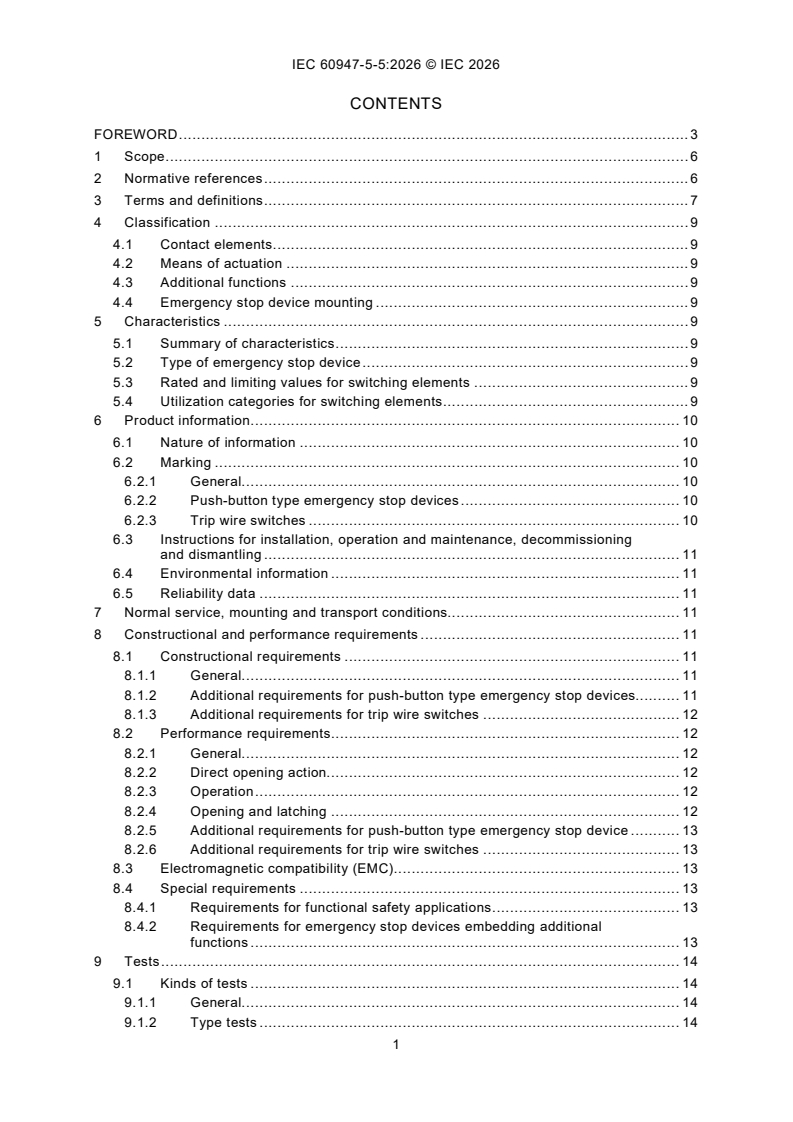
CONTENTS
FOREWORD . 3
1 Scope . 6
2 Normative references . 6
3 Terms and definitions . 7
4 Classification . 9
4.1 Contact elements . 9
4.2 Means of actuation . 9
4.3 Additional functions . 9
4.4 Emergency stop device mounting . 9
5 Characteristics . 9
5.1 Summary of characteristics . 9
5.2 Type of emergency stop device . 9
5.3 Rated and limiting values for switching elements . 9
5.4 Utilization categories for switching elements . 9
6 Product information . 10
6.1 Nature of information . 10
6.2 Marking . 10
6.2.1 General. 10
6.2.2 Push-button type emergency stop devices . 10
6.2.3 Trip wire switches . 10
6.3 Instructions for installation, operation and maintenance, decommissioning
and dismantling . 11
6.4 Environmental information . 11
6.5 Reliability data . 11
7 Normal service, mounting and transport conditions. 11
8 Constructional and performance requirements . 11
8.1 Constructional requirements . 11
8.1.1 General. 11
8.1.2 Additional requirements for push-button type emergency stop devices. 11
8.1.3 Additional requirements for trip wire switches . 12
8.2 Performance requirements . 12
8.2.1 General. 12
8.2.2 Direct opening action. 12
8.2.3 Operation . 12
8.2.4 Opening and latching . 12
8.2.5 Additional requirements for push-button type emergency stop device . 13
8.2.6 Additional requirements for trip wire switches . 13
8.3 Electromagnetic compatibility (EMC). 13
8.4 Special requirements . 13
8.4.1 Requirements for functional safety applications . 13
8.4.2 Requirements for emergency stop devices embedding additional
functions . 13
9 Tests . 14
9.1 Kinds of tests . 14
9.1.1 General. 14
9.1.2 Type tests . 14
9.1.3 Routine tests . 14
9.1.4 Sampling tests . 14
9.1.5 Special tests. 14
9.2 Compliance with constructional requirements . 15
9.3 Performance . 15
9.3.1 General. 15
9.3.2 Test sequences . 15
9.3.3 General test condition . 15
9.3.4 Robustness of a push-button actuator . 16
9.3.5 Robustness of a trip wire actuator . 16
9.3.6 Mechanical durability test . 17
9.3.7 Conditioning procedures . 17
9.3.8 Shock test . 17
9.3.9 Vibration tests . 18
9.3.10 Opening, latching, actuation, resetting and impact tests . 18
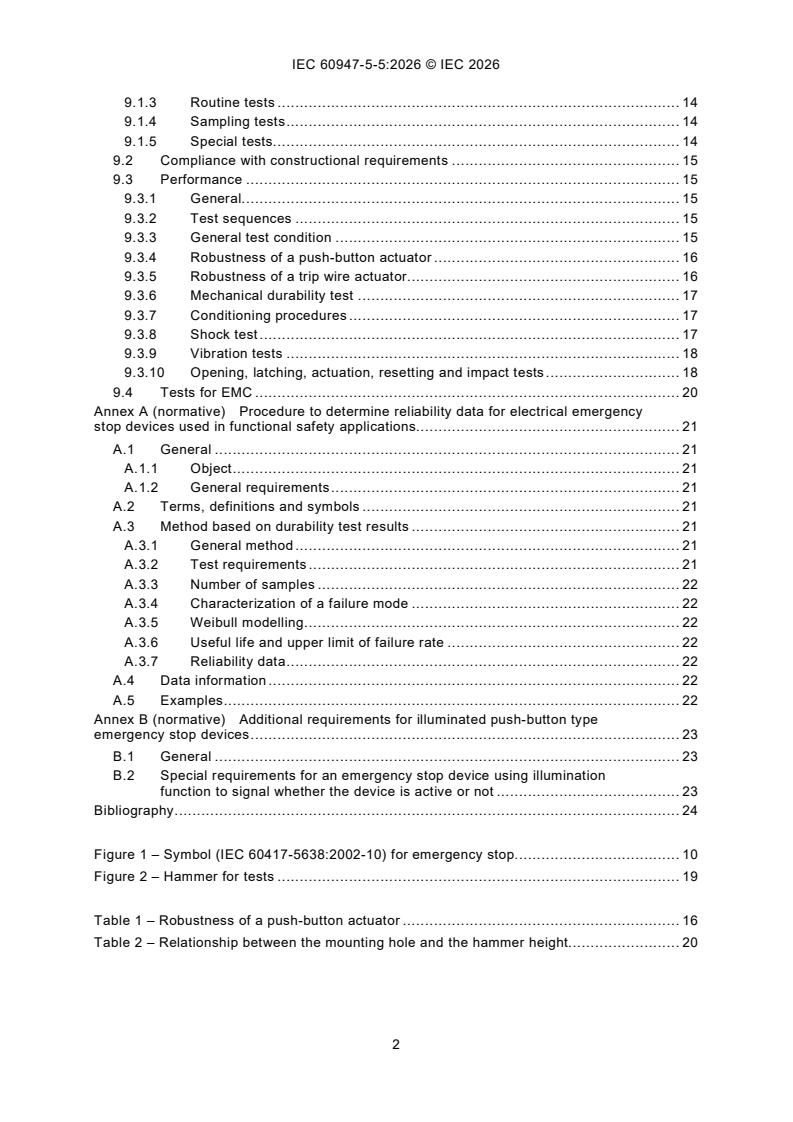
9.4 Tests for EMC . 20
Annex A (normative) Procedure to determine reliability data for electrical emergency
stop devices used in functional safety applications. 21
A.1 General . 21
A.1.1 Object . 21
A.1.2 General requirements . 21
A.2 Terms, definitions and symbols . 21
A.3 Method based on durability test results . 21
A.3.1 General method . 21
A.3.2 Test requirements . 21
A.3.3 Number of samples . 22
A.3.4 Characterization of a failure mode . 22
A.3.5 Weibull modelling . 22
A.3.6 Useful life and upper limit of failure rate . 22
A.3.7 Reliability data . 22
A.4 Data information . 22
A.5 Examples . 22
Annex B (normative) Additional requirements for illuminated push-button type
emergency stop devices . 23
B.1 General . 23
B.2 Special requirements for an emergency stop device using illumination
function to signal whether the device is active or not . 23
Bibliography . 24
Figure 1 – Symbol (IEC 60417-5638:2002-10) for emergency stop. 10
Figure 2 – Hammer for tests . 19
Table 1 – Robustness of a push-button actuator . 16
Table 2 – Relationship between the mounting hole and the hammer height. 20
INTERNATIONAL ELECTROTECHNICAL COMMISSION
____________
Low-voltage switchgear and controlgear -
Part 5-5: Control circuit devices and switching elements -
Electrical emergency stop device with mechanical latching function
FOREWORD
1) The International Electrotechnical Commission (IEC) is a worldwide organization for standardization comprising
all national electrotechnical committees (IEC National Committees). The object of IEC is to promote international
co-operation on all questions concerning standardization in the electrical and electronic fields. To this end and
in addition to other activities, IEC publishes International Standards, Technical Specifications, Technical Reports,
Publicly Available Specifications (PAS) and Guides (hereafter referred to as "IEC Publication(s)"). Their
preparation is entrusted to technical committees; any IEC National Committee interested in the subject dealt with
may participate in this preparatory work. International, governmental and non-governmental organizations liaising
with the IEC also participate in this preparation. IEC collaborates closely with the International Organization for
Standardization (ISO) in accordance with conditions determined by agreement between the two organizations.
2) The formal decisions or agreements of IEC on technical matters express, as nearly as possible, an international
consensus of opinion on the relevant subjects since each technical committee has representation from all
interested IEC National Committees.
3) IEC Publications have the form of recommendations for international use and are accepted by IEC National
Committees in that sense. While all reasonable efforts are made to ensure that the technical content of IEC
Publications is accurate, IEC cannot be held responsible for the way in which they are used or for any
misinterpretation by any end user.
4) In order to promote international uniformity, IEC National Committees undertake to apply IEC Publications
transparently to the maximum extent possible in their national and regional publications. Any divergence between
any IEC Publication and the corresponding national or regional publication shall be clearly indicated in the latter.
5) IEC itself does not provide any attestation of conformity. Independent certification bodies provide conformity
assessment services and, in some areas, access to IEC marks of conformity. IEC is not responsible for any
services carried out by independent certification bodies.
6) All users should ensure that they have the latest edition of this publication.
7) No liability shall attach to IEC or its directors, employees, servants or agents including individual experts and
members of its technical committees and IEC National Committees for any personal injury, property damage or
other damage of any nature whatsoever, whether direct or indirect, or for costs (including legal fees) and
expenses arising out of the publication, use of, or reliance upon, this IEC Publication or any other IEC
Publications.
8) Attention is drawn to the Normative references cited in this publication. Use of the referenced publications is
indispensable for the correct application of this publication.
9) IEC draws attention to the possibility that the implementation of this document may involve the use of (a)
patent(s). IEC takes no position concerning the evidence, validity or applicability of any claimed patent rights in
respect thereof. As of the date of publication of this document, IEC had not received notice of (a) patent(s), which
may be required to implement this document. However, implementers are cautioned that this may not represent
the latest information, which may be obtained from the patent database available at https://patents.iec.ch. IEC
shall not be held responsible for identifying any or all such patent rights.
IEC 60947-5-5 has been prepared by subcommittee 121A: Low-voltage switchgear and
controlgear, of IEC technical committee 121: Switchgear and controlgear and their assemblies
for low voltage. It is an International Standard.
This second edition cancels and replaces the first edition published in 1997. This edition
constitutes a technical revision.
This edition includes the following significant technical changes with respect to the previous
edition:
a) re-shaping the document with the clause numbers and names to be in line with other
documents of the 60947 series;
b) review of the test method to reasonably determine that the latch mechanism meets the
requirements of the document;
c) new Annex B for special requirements for illuminated push-button type emergency stop
devices, including the reference to a function to distinguish between "active and inactive"
by changing the colour of the push-button depending on the illumination.
The text of this International Standard is based on the following documents:
Draft Report on voting
121A/699/FDIS 121A/703/RVD
Full information on the voting for its approval can be found in the report on voting indicated in
the above table.
The language used for the development of this International Standard is English.
This document was drafted in accordance with ISO/IEC Directives, Part 2, and developed in
accordance with ISO/IEC Directives, Part 1 and ISO/IEC Directives, IEC Supplement, available
at www.iec.ch/members_experts/refdocs. The main document types developed by IEC are
described in greater detail at www.iec.ch/publications.
This International Standard is to be used in conjunction with IEC 60947-1:2020 and with
IEC 60947-5-1:2024.
The provisions of the general rules, IEC 60947-1, are applicable to this standard, where
specifically called for. General rules clauses and subclauses thus applicable, as well as tables,
figures and annexes are identified by a reference to IEC 60947-1, for example 1.2.3 or Annex A
of IEC 60947-1:2020.
A list of all parts in the IEC 60947 series, under the general title Low-voltage switchgear and
controlgear, can be found on the IEC website.
The committee has decided that the contents of this document will remain unchanged until the
stability date indicated on the IEC website under webstore.iec.ch in the data related to the
specific document. At this date, the document will be
– reconfirmed,
– withdrawn, or
– revised.
INTRODUCTION
This document deals specifically with electrical emergency stop devices with mechanical
latching function and gives additional electrical and mechanical requirements to those given in
the following International Standards:
– ISO 13850, giving requirements for the emergency stop function of a machine, whatever be
the energy used;
– IEC 60204-1, giving additional requirements for an emergency stop function realized by the
electrical equipment of a machine;
– IEC 60947-5-1, specifying electrical characteristics of electromechanical control circuit
devices.
1 Scope
This part of IEC 60947-5 provides detailed specifications relating to the electrical and
mechanical construction of emergency stop devices with mechanical latching function and to
their testing.
This document is applicable to electrical control circuit devices and switching elements which
are used to initiate an emergency stop signal. Such devices can be provided with their own
enclosure and will be installed according to the product documentation.
This document does not apply to:
– emergency stop devices for non-electrical control applications, for example hydraulic or
pneumatic;
– emergency stop devices without mechanical latching function.
An emergency stop device conforming to this document can also be used as part of an
emergency switching off means in compliance with IEC 60364-5-53.
NOTE See also IEC 60204-1:2016 and IEC 60204-1:2016/AMD1:2021, 9.2.3.4.
This document does not address specific requirements on acoustic noise as the noise emission
of electrical emergency stop devices with mechanical latching function is not considered to be
a relevant hazard.
2 Normative references
The following documents are referred to in the text in such a way that some or all of their content
constitutes requirements of this document. For dated references, only the edition cited applies.
For undated references, the latest edition of the referenced document (including any
amendments) applies.
IEC 60068-2-1, Environmental testing - Part 2-1: Tests - Test A: Cold
IEC 60068-2-2, Environmental testing - Part 2-2: Tests - Test B: Dry heat
IEC 60068-2-6, Environmental testing - Part 2-6: Tests - Test Fc: Vibration (sinusoidal)
IEC 60068-2-11, Environmental testing - Part 2-11: Tests - Test Ka: Salt mist
IEC 60068-2-27, Environmental testing - Part 2-27: Tests - Test Ea and guidance: Shock
IEC 60068-2-30, Environmental testing - Part 2-30: Tests - Test Db: Damp heat, cyclic
(12 h + 12 h cycle)
IEC 60068-2-75, Environmental testing - Part 2-75: Tests - Test Eh: Hammer tests
IEC 60417, Graphical symbols for use on equipment, available at https://www.graphical-
symbols.info/equipment
IEC 60947-1:2020, Low-voltage switchgear and controlgear - Part 1: General rules
IEC 60947-5-1:2024, Low-voltage switchgear and controlgear - Part 5-1: Control circuit devices
and switching elements - Electromechanical control circuit devices
ISO 13850:2015, Safety of machinery - Emergency stop function - Principles for design
3 Terms and definitions
For the purposes of this document, the terms and definitions given in IEC 60947-1,
IEC 60947-5-1 and the following apply.
ISO and IEC maintain terminology databases for use in standardization at the following
addresses:
– IEC Electropedia: available at https://www.electropedia.org/
– ISO Online browsing platform: available at https://www.iso.org/obp
3.1
emergency stop function
function which is intended to:
– avert or to reduce hazards to persons, damage to machinery or to work in progress;
– be initiated by a single human action.
[SOURCE: ISO 12100:2010, 3.40, modified – the first preferred term "emergency stop" has
been removed.]
3.2
emergency stop device
manually operated control circuit device used to initiate an emergency stop function
Note 1 to entry: An emergency stop device can also provide auxiliary functions, for example for redundancy or for
signalling through additional contact element(s), or both. Such additional contact(s) can be normally open or normally
closed, or both.
3.3
emergency stop signal
signal, which is generated by an emergency stop device contact, used to initiate an emergency
stop function
3.4
actuating system
mechanical parts which transmit the actuating force to the
contact elements
[SOURCE: IEC 60050-441:1984, 441-15-21, modified – restricted to electromechanical
emergency stop devices; the note is not relevant anymore.]
3.5
actuator
part of the actuating system which is operated by a part of the
human body
Note 1 to entry: Examples of an actuator include: a push-button, a wire, or a rope.
[SOURCE: IEC 60050-441:1984, 441-15-22, modified – actuation is intended to be achieved by
human only, the domain has been added and the note has been revised.]
3.6
rest position
position of an emergency stop device, or of a part of it, which has not been actuated
Note 1 to entry: In rest position, the normally closed contacts are closed and the machine (or equipment) can work.
3.7
actuated position
position of an emergency stop device, or of a part of it, after it has been operated
Note 1 to entry: In the actuated position of the emergency stop device, the normally closed contacts remain open.
3.8
latching
function or means which engage and maintain the actuating
system in the actuated position until reset by a separate manual action
3.9
resetting
disengaging
manual action to return the actuating system of the emergency
stop device from the actuated position to the rest position
Note 1 to entry: Examples of resetting include the rotation of a key or the actuator, pulling the actuator or pushing
or rotating a dedicated reset button.
3.10
direct opening action
DEPRECATED: positive opening action
achievement of contact separation as a direct result of a specified
movement of the switch actuator through non-resilient members (e.g. non dependent upon
springs)
[SOURCE: IEC 60947-5-1:2024, 3.1.15.2, modified – addition of a deprecated term.]
3.11
push-button type emergency stop device
emergency stop device with a button type as actuator
3.12
trigger mechanism
positive latching
safety lock mechanism
mechanical means ensuring that when operated, latching occurs at the point where the
emergency stop signal is generated
3.13
trip wire switch
rope pull switch
emergency stop device in which the actuator is a rope, a wire or similar means
4 Classification
4.1 Contact elements
Subclause 4.1 of IEC 60947-5-1:2024 applies.
4.2 Means of actuation
Emergency stop devices can be classified according to the means of actuation, for example
push-button, trip wire switch.
4.3 Additional functions
Emergency stop devices can be classified according to the additional function(s) of the device
(e.g. illumination, trigger mechanism, resetting means or locking mechanism to maintain the
emergency stop signal).
4.4 Emergency stop device mounting
Emergency stop devices can be classified according to the mounting of the device, for example
hole size D16, D22, D30 for a push-button type.
5 Characteristics
5.1 Summary of characteristics
Subclause 5.1 of IEC 60947-5-1:2024 applies.
NOTE For information exchange in electronic format, see ACC515 and ACC522 classes of IEC 62683-1 Common
Data Dictionary for trip wire switch, and emergency stop push-button respectively.
5.2 Type of emergency stop device
The kind of emergency stop device shall be stated:
– push-button;
– trip wire switch.
5.3 Rated and limiting values for switching elements
Subclause 5.3 of IEC 60947-5-1:2024 applies.
5.4 Utilization categories for switching elements
For emergency stop contact elements with direct opening action, the utilization categories shall
be one or more categories specified in IEC 60947-5-1:2024, K.5.4.
For additional contact elements for auxiliary functions, the utilization categories shall be one or
more categories selected from IEC 60947-5-1:2024, Table 1.
6 Product information
6.1 Nature of information
Subclause 6.1 and Clause K.6 of IEC 60947-5-1:2024 apply with the following addition.
For push-button switches, information provided in the product documentation shall include:
– resetting/unlatching method;
– trigger mechanism, if applicable;
– illumination function, if applicable.
For trip wire switches, information provided in the product documentation shall include:
– resetting/unlatching method;
– the maximum length of wire or rope;
– information to establish correct tension of wire or rope;
– the distances between supports;
– recommendation to use only straight runs of wire or rope;
– if applicable, guidance on maintenance for pulleys and eyelets, and the measures necessary
to ensure that the wire or rope remains in proper position.
6.2 Marking
6.2.1 General
Subclause 6.2 of IEC 60947-5-1:2024, with the exception of 6.2.4, applies with the following
additions.
6.2.2 Push-button type emergency stop devices
Where a symbol is necessary for clarification, the symbol IEC 60417-5638:2002-10 shall be
used (see Figure 1).
Figure 1 – Symbol (IEC 60417-5638:2002-10) for emergency stop
The direction of unlatching shall be identified when resetting is achieved by rotation of the
button. The identification of the direction of unlatching shall have the same or nearly the same
colour as the actuator in order to avoid misinterpretation.
NOTE 1 Compliance with this requirement fulfils ISO 13850:2015, 4.3.7.
NOTE 2 See also IEC 60073 and ISO 3864 series for general information concerning identification and safety
colours.
6.2.3 Trip wire switches
Marker flags may be attached
...
IEC 60947-5-5 ®
Edition 2.0 2026-02
NORME
INTERNATIONALE
Appareillage à basse tension -
Partie 5-5: Appareils et éléments de commutation pour circuits de commande -
Appareils d'arrêt d'urgence électriques à accrochage mécanique
ICS 29.130.20; 29.120.99 ISBN 978-2-8327-0874-3
Droits de reproduction réservés. Sauf indication contraire, aucune partie de cette publication ne peut être reproduite ni
utilisée sous quelque forme que ce soit et par aucun procédé, électronique ou mécanique, y compris la photocopie et
les microfilms, sans l'accord écrit de l'IEC ou du Comité national de l'IEC du pays du demandeur. Si vous avez des
questions sur le copyright de l'IEC ou si vous désirez obtenir des droits supplémentaires sur cette publication, utilisez
les coordonnées ci-après ou contactez le Comité national de l'IEC de votre pays de résidence.
IEC Secretariat Tel.: +41 22 919 02 11
3, rue de Varembé info@iec.ch
CH-1211 Geneva 20 www.iec.ch
Switzerland
A propos de l'IEC
La Commission Electrotechnique Internationale (IEC) est la première organisation mondiale qui élabore et publie des
Normes internationales pour tout ce qui a trait à l'électricité, à l'électronique et aux technologies apparentées.
A propos des publications IEC
Le contenu technique des publications IEC est constamment revu. Veuillez vous assurer que vous possédez l’édition la
plus récente, un corrigendum ou amendement peut avoir été publié.
Recherche de publications IEC - IEC Products & Services Portal - products.iec.ch
webstore.iec.ch/advsearchform Découvrez notre puissant moteur de recherche et consultez
La recherche avancée permet de trouver des publications gratuitement tous les aperçus des publications, symboles
IEC en utilisant différents critères (numéro de référence, graphiques et le glossaire. Avec un abonnement, vous aurez
texte, comité d’études, …). Elle donne aussi des toujours accès à un contenu à jour adapté à vos besoins.
informations sur les projets et les publications remplacées
ou retirées. Electropedia - www.electropedia.org
Le premier dictionnaire d'électrotechnologie en ligne au
IEC Just Published - webstore.iec.ch/justpublished monde, avec plus de 22 500 articles terminologiques en
Restez informé sur les nouvelles publications IEC. Just anglais et en français, ainsi que les termes équivalents
Published détaille les nouvelles publications parues. dans 25 langues additionnelles. Egalement appelé
Disponible en ligne et une fois par mois par email. Vocabulaire Electrotechnique International (IEV) en ligne.
Service Clients - webstore.iec.ch/csc
Si vous désirez nous donner des commentaires sur cette
publication ou si vous avez des questions contactez-
nous: sales@iec.ch.
SOMMAIRE
AVANT-PROPOS . 3
1 Domaine d'application . 6
2 Références normatives . 6
3 Termes et définitions. 7
4 Classification . 9
4.1 Éléments de contact . 9
4.2 Moyens de manœuvre . 9
4.3 Fonctions supplémentaires . 9
4.4 Montage des appareils d'arrêt d'urgence . 9
5 Caractéristiques . 9
5.1 Énumération des caractéristiques . 9
5.2 Type d'appareil d'arrêt d'urgence. 9
5.3 Valeurs assignées et valeurs limites pour les éléments de commutation . 9
5.4 Catégories d'emploi des éléments de commutation . 9
6 Informations sur le matériel . 10
6.1 Nature des informations . 10
6.2 Marquage . 10
6.2.1 Généralités . 10
6.2.2 Appareils d'arrêt d'urgence à bouton-poussoir . 10
6.2.3 Interrupteurs à commande par câble . 11
6.3 Instructions d'installation, de fonctionnement, de maintenance, de mise hors
service et de démontage . 11
6.4 Informations relatives à l'environnement . 11
6.5 Données de fiabilité . 11
7 Conditions normales de service, de montage et de transport . 11
8 Exigences relatives à la construction et au fonctionnement . 11
8.1 Exigences relatives à la construction . 11
8.1.1 Généralités . 11
8.1.2 Exigences supplémentaires pour les appareils d'arrêt d'urgence à
bouton-poussoir . 11
8.1.3 Exigences supplémentaires pour les interrupteurs à commande par
câble . 12
8.2 Exigences relatives au fonctionnement . 12
8.2.1 Généralités . 12
8.2.2 Manœuvre positive d'ouverture . 12
8.2.3 Manœuvre . 12
8.2.4 Ouverture et verrouillage . 12
8.2.5 Exigences supplémentaires pour les appareils d'arrêt d'urgence à
bouton-poussoir . 13
8.2.6 Exigences supplémentaires pour les interrupteurs à commande par
câble . 13
8.3 Compatibilité électromagnétique (CEM) . 13
8.4 Exigences spéciales . 13
8.4.1 Exigences pour les applications de sécurité fonctionnelle . 13
8.4.2 Exigences pour les appareils d'arrêt d'urgence intégrant des fonctions
supplémentaires . 13
9 Essais . 14
9.1 Nature des essais . 14
9.1.1 Généralités . 14
9.1.2 Essais de type . 14
9.1.3 Essais individuels de série . 14
9.1.4 Essais sur prélèvement . 14
9.1.5 Essais spéciaux . 14
9.2 Conformité aux exigences de construction. 15
9.3 Fonctionnement . 15
9.3.1 Généralités . 15
9.3.2 Séquences d'essais . 15
9.3.3 Conditions générales d'essai . 15
9.3.4 Robustesse d'un organe de commande à bouton-poussoir . 16
9.3.5 Robustesse d'un organe de commande à câble . 17
9.3.6 Essai de durabilité mécanique . 17
9.3.7 Procédures de conditionnement . 17
9.3.8 Essai de chocs . 18
9.3.9 Essais de vibrations . 18
9.3.10 Essais d'ouverture, de verrouillage, de manœuvre, de réarmement et de
chocs . 19
9.4 Essais pour la CEM . 21
Annexe A (normative) Procédure de détermination des données de fiabilité des
appareils d'arrêt d'urgence électriques utilisés dans des applications de sécurité
fonctionnelle . 22
A.1 Généralités . 22
A.1.1 Objet . 22
A.1.2 Exigences générales . 22
A.2 Termes, définitions et symboles . 22
A.3 Méthode fondée sur les résultats des essais de durabilité . 22
A.3.1 Méthode générale . 22
A.3.2 Exigences d'essai . 22
A.3.3 Nombre d'échantillons . 23
A.3.4 Caractérisation d'un mode de défaillance . 23
A.3.5 Modélisation de Weibull . 23
A.3.6 Durée de vie utile et limite supérieure du taux de défaillance . 23
A.3.7 Données de fiabilité . 23
A.4 Informations relatives aux données . 23
A.5 Exemples . 23
Annexe B (normative) Exigences supplémentaires pour les appareils d'arrêt
d'urgence à bouton-poussoir lumineux . 24
B.1 Généralités . 24
B.2 Exigences particulières pour un appareil d'arrêt d'urgence intégrant une
fonction d'illumination pour signaler si l'appareil est actif ou non. 24
Bibliographie . 25
Figure 1 – Symbole (IEC 60417-5638:2002-10) d'arrêt d'urgence . 10
Figure 2 – Marteau utilisé pour les essais . 20
Tableau 1 – Robustesse d'un organe de commande à bouton-poussoir . 16
Tableau 2 – Relation entre le trou de fixation et la hauteur du marteau . 20
COMMISSION ÉLECTROTECHNIQUE INTERNATIONALE
____________
Appareillage à basse tension -
Partie 5-5: Appareils et éléments de commutation
pour circuits de commande - Appareils d'arrêt d'urgence
électriques avec accrochage mécanique
AVANT-PROPOS
1) La Commission Électrotechnique Internationale (IEC) est une organisation mondiale de normalisation composée
de l'ensemble des comités électrotechniques nationaux (Comités nationaux de l'IEC). L'IEC a pour objet de
favoriser la coopération internationale pour toutes les questions de normalisation dans les domaines de
l'électricité et de l'électronique. À cet effet, l'IEC – entre autres activités – publie des Normes internationales,
des Spécifications techniques, des Rapports techniques, des Spécifications accessibles au public (PAS) et des
Guides (ci-après dénommés "Publication(s) de l'IEC"). Leur élaboration est confiée à des comités d'études, aux
travaux desquels tout Comité national intéressé par le sujet traité peut participer. Les organisations
internationales, gouvernementales et non gouvernementales, en liaison avec l'IEC, participent également aux
travaux. L'IEC collabore étroitement avec l'Organisation Internationale de Normalisation (ISO), selon des
conditions fixées par accord entre les deux organisations.
2) Les décisions ou accords officiels de l'IEC concernant les questions techniques représentent, dans la mesure du
possible, un accord international sur les sujets étudiés, étant donné que les Comités nationaux de l'IEC intéressés
sont représentés dans chaque comité d'études.
3) Les Publications de l'IEC se présentent sous la forme de recommandations internationales et sont agréées
comme telles par les Comités nationaux de l'IEC. Tous les efforts raisonnables sont entrepris afin que l'IEC
s'assure de l'exactitude du contenu technique de ses publications; l'IEC ne peut pas être tenue responsable de
l'éventuelle mauvaise utilisation ou interprétation qui en est faite par un quelconque utilisateur final.
4) Dans le but d'encourager l'uniformité internationale, les Comités nationaux de l'IEC s'engagent, dans toute la
mesure possible, à appliquer de façon transparente les Publications de l'IEC dans leurs publications nationales
et régionales. Toutes divergences entre toutes Publications de l'IEC et toutes publications nationales ou
régionales correspondantes doivent être indiquées en termes clairs dans ces dernières.
5) L'IEC elle-même ne fournit aucune attestation de conformité. Des organismes de certification indépendants
fournissent des services d'évaluation de conformité et, dans certains secteurs, accèdent aux marques de
conformité de l'IEC. L'IEC n'est responsable d'aucun des services effectués par les organismes de certification
indépendants.
6) Tous les utilisateurs doivent s'assurer qu'ils sont en possession de la dernière édition de cette publication.
7) Aucune responsabilité ne doit être imputée à l'IEC, à ses administrateurs, employés, auxiliaires ou mandataires,
y compris ses experts particuliers et les membres de ses comités d'études et des Comités nationaux de l'IEC,
pour tout préjudice causé en cas de dommages corporels et matériels, ou de tout autre dommage de quelque
nature que ce soit, directe ou indirecte, ou pour supporter les coûts (y compris les frais de justice) et les dépenses
découlant de la publication ou de l'utilisation de cette Publication de l'IEC ou de toute autre Publication de l'IEC,
ou au crédit qui lui est accordé.
8) L'attention est attirée sur les références normatives citées dans cette publication. L'utilisation de publications
référencées est obligatoire pour une application correcte de la présente publication.
9) L'IEC attire l'attention sur le fait que la mise en application du présent document peut entraîner l'utilisation d'un
ou de plusieurs brevets. L'IEC ne prend pas position quant à la preuve, à la validité et à l'applicabilité de tout
droit de brevet revendiqué à cet égard. À la date de publication du présent document, l'IEC n'avait pas reçu
notification qu'un ou plusieurs brevets pouvaient être nécessaires à sa mise en application. Toutefois, il y a lieu
d'avertir les responsables de la mise en application du présent document que des informations plus récentes
sont susceptibles de figurer dans la base de données de brevets, disponible à l'adresse https://patents.iec.ch.
L'IEC ne saurait être tenue pour responsable de ne pas avoir identifié de tels droits de brevets.
L'IEC 60947-5-5 a été établie par le sous-comité 121A: Appareillages à basse tension, du
comité d'études 121 de l'IEC: Appareillages et ensembles d'appareillages basse tension. Il
s'agit d'une Norme internationale.
Cette seconde édition annule et remplace la première édition parue en 1997. Cette édition
constitue une révision technique.
Cette édition inclut les modifications techniques majeures suivantes par rapport à l'édition
précédente:
a) le document a été restructuré en s'alignant sur les numéros et intitulés d'articles et de
paragraphes des autres documents de la série IEC 60947;
b) la méthode d'essai a été revue afin de déterminer de manière raisonnable que le mécanisme
de verrouillage respecte les exigences du document;
c) la nouvelle Annexe B définit les exigences particulières pour les appareils d'arrêt d'urgence
à bouton-poussoir lumineux en faisant notamment référence à la fonction qui permet de
distinguer les états "actif" et "inactif" en faisant varier la couleur d'illumination du bouton-
poussoir.
Le texte de cette Norme internationale est issu des documents suivants:
Projet Rapport de vote
121A/699/FDIS 121A/703/RVD
Le rapport de vote indiqué dans le tableau ci-dessus donne toute information sur le vote ayant
abouti à son approbation.
La langue employée pour l'élaboration de cette Norme internationale est l'anglais.
Ce document a été rédigé selon les Directives ISO/IEC, Partie 2, il a été développé selon les
Directives ISO/IEC, Partie 1 et les Directives ISO/IEC, Supplément IEC, disponibles sous
www.iec.ch/members_experts/refdocs. Les principaux types de documents développés par
l'IEC sont décrits plus en détail sous www.iec.ch/publications.
La présente Norme internationale doit être utilisée conjointement avec l'IEC 60947-1:2020 et
l'IEC 60947-5-1:2024.
Les dispositions des règles générales de l'IEC 60947-1 s'appliquent à la présente norme
lorsque celle-ci le précise. Les articles, paragraphes, tableaux, figures et annexes des règles
générales qui s'appliquent ainsi sont identifiés par référence à l'IEC 60947-1, par exemple 1.2.3
ou Annexe A de l'IEC 60947-1:2020.
Une liste de toutes les parties de la série IEC 60947, publiées sous le titre général Appareillage
à basse tension, se trouve sur le site web de l'IEC.
Le comité a décidé que le contenu de ce document ne sera pas modifié avant la date de stabilité
indiquée sur le site web de l'IEC sous webstore.iec.ch dans les données relatives au document
recherché. À cette date, le document sera
– reconduit,
– supprimé, ou
– révisé.
INTRODUCTION
Le présent document traite spécifiquement des appareils d'arrêt d'urgence électriques avec
accrochage mécanique et fournit des exigences électriques et mécaniques complémentaires à
celles données dans les Normes internationales suivantes:
– l'ISO 13850 fournit des exigences pour la fonction d'arrêt d'urgence d'une machine, quelle
que soit l'énergie utilisée;
– l'IEC 60204-1 fournit des exigences supplémentaires pour une fonction d'arrêt d'urgence
réalisée par l'équipement électrique d'une machine;
– l'IEC 60947-5-1 spécifie les caractéristiques électriques des appareils électromécaniques
pour circuits de commande.
1 Domaine d'application
La présente partie de l'IEC 60947-5 fournit des spécifications détaillées concernant la
construction électrique et mécanique des appareils d'arrêt d'urgence avec accrochage
mécanique et leurs essais.
Le présent document s'applique aux appareils et éléments de commutation pour circuits de
commande électriques, qui sont utilisés pour générer un signal d'arrêt d'urgence. Ces appareils
peuvent être équipés de leur propre enveloppe et sont installés conformément à la
documentation du produit.
Le présent document ne s'applique pas:
– appareils d'arrêt d'urgence pour applications de commande non électriques, par exemple
hydrauliques ou, pneumatiques;
– appareils d'arrêt d'urgence sans accrochage mécanique.
Un appareil d'arrêt d'urgence conforme au présent document peut également être utilisé dans
le cadre d'un moyen de coupure d'urgence conformément à l'IEC 60364-5-53.
NOTE Voir aussi le 9.2.3.4 de l'IEC 60204-1:2016 et de l'IEC 60204-1:2016/AMD1:2021.
Le présent document ne traite pas des exigences spécifiques relatives au bruit acoustique, car
l'émission de bruit des appareils d'arrêt d'urgence électriques avec accrochage mécanique n'est
pas considérée comme constituant un danger pertinent.
2 Références normatives
Les documents suivants sont cités dans le texte de sorte qu'ils constituent, pour tout ou partie
de leur contenu, des exigences du présent document. Pour les références datées, seule
l'édition citée s'applique. Pour les références non datées, la dernière édition du document de
référence s'applique (y compris les éventuels amendements).
IEC 60068-2-1, Essais d'environnement - Partie 2-1: Essais - Essai A: Froid
IEC 60068-2-2, Essais d'environnement - Partie 2-2: Essais - Essai B: Chaleur sèche
IEC 60068-2-6, Essais d'environnement - Partie 2-6: Essais - Essai Fc: Vibrations (sinusoïdales)
IEC 60068-2-11, Essais d'environnement - Partie 2-11: Essais - Essai Ka: Brouillard salin
IEC 60068-2-27, Essais d'environnement - Partie 2-27: Essais - Essai Ea et guide: Chocs
IEC 60068-2-30, Essais d'environnement - Partie 2-30: Essais - Essai Db: Essai cyclique de
chaleur humide (cycle de 12 h + 12 h)
IEC 60068-2-75, Essais d'environnement - Partie 2-75: Essais - Test Eh: Essais au marteau
IEC 60417, Symboles graphiques utilisables sur le matériel, disponible à l'adresse
https://www.graphical-symbols.info/equipment
IEC 60947-1:2020, Appareillage à basse tension - Partie 1: Règles générales
IEC 60947-5-1:2024, Appareillage à basse tension - Partie 5-1: Appareils et éléments de
commutation pour circuits de commande - Appareils électromécaniques pour circuits de
commande
ISO 13850:2015, Sécurité des machines - Fonction d'arrêt d'urgence - Principes de conception
3 Termes et définitions
Pour les besoins du présent document, les termes et définitions de l'IEC 60947-1, de
l'IEC 60947-5-1 ainsi que les suivants s'appliquent.
L'ISO et l'IEC tiennent à jour des bases de données terminologiques destinées à être utilisées
en normalisation, consultables aux adresses suivantes:
– IEC Electropedia: disponible à l'adresse https://www.electropedia.org/
– ISO Online browsing platform: disponible à l'adresse https://www.iso.org/obp
3.1
fonction d'arrêt d'urgence
fonction destinée:
– à parer à des phénomènes dangereux en train d'apparaître, ou à atténuer des dommages
existants, pouvant porter atteinte à des personnes, à la machine ou au travail en cours, et
– à être déclenchée par une action humaine unique
[SOURCE: ISO 12100:2010, 3.40, modifié – le premier terme privilégié "arrêt d'urgence" a été
supprimé.]
3.2
appareil d'arrêt d'urgence
appareil pour circuit de commande manœuvré manuellement et utilisé pour déclencher une
fonction d'arrêt d'urgence
Note 1 à l'article: Un appareil d'arrêt d'urgence peut également fournir des fonctions auxiliaires, par exemple pour
la redondance ou la signalisation par un ou plusieurs éléments de contact supplémentaires, ou les deux. Ce ou ces
contacts supplémentaires peuvent être normalement ouverts ou normalement fermés, ou les deux.
3.3
signal d'arrêt d'urgence
signal qui est émis par un contact d'un appareil d'arrêt d'urgence, utilisé pour déclencher une
fonction d'arrêt d'urgence
3.4
mécanisme transmetteur
pièces mécaniques qui transmettent l'effort de manœuvre aux
éléments de contact
[SOURCE: IEC 60050-441:1984, 441-15-21, modifié – La définition est restreinte aux appareils
d'arrêt d'urgence électromécaniques, et la note n'est plus pertinente.]
3.5
organe de commande
partie du mécanisme transmetteur qui est manœuvrée par
une partie du corps humain
Note 1 à l'article: Un bouton-poussoir, un câble ou une barre sont des exemples d'organes de commande.
[SOURCE: IEC 60050-441:1984, 441-15-22, modifié – La manœuvre est destinée à être
effectuée uniquement par un être humain, le domaine a été ajouté et la note a été révisée.]
3.6
position de repos
position d'un appareil d'arrêt d'urgence, ou d'une partie de celui-ci, qui n'a pas été manœuvré
Note 1 à l'article: Lorsque l'appareil d'arrêt d'urgence est en position de repos, les contacts normalement fermés
sont fermés et la machine (ou l'équipement) peut fonctionner.
3.7
position activée
position d'un appareil d'arrêt d'urgence, ou d'une partie de celui-ci, après avoir été manœuvré
Note 1 à l'article: Lorsque l'appareil d'arrêt d'urgence est en position activée, les contacts normalement fermés
restent ouverts.
3.8
verrouillage
fonction ou dispositif qui enclenche et maintient le mécanisme
transmetteur en position activée jusqu'au réarmement par une manœuvre manuelle séparée
3.9
réarmement
désengagement
manœuvre manuelle permettant au mécanisme transmetteur
de l'appareil d'arrêt d'urgence de basculer de la position activée à la position de repos
Note 1 à l'article: La rotation d'une clef ou de l'organe de commande, un mouvement de traction sur l'organe de
commande, l'enclenchement ou la rotation d'un bouton de réarmement dédié, sont des exemples de réarmement.
3.10
manœuvre positive d'ouverture
accomplissement de la séparation des contacts qui résulte
directement d'un mouvement spécifié de l'organe de commande et effectué au moyen de pièces
non élastiques (par exemple, sans l'intermédiaire de ressorts)
[SOURCE: IEC 60947-5-1:2024, 3.1.15.2, modifié – La modification concerne le texte anglais
seulement.]
3.11
appareil d'arrêt d'urgence à bouton-poussoir
appareil d'arrêt d'urgence équipé d'un organe de commande à bouton
3.12
mécanisme de déclenchement
verrouillage positif
mécanisme de verrouillage de sécurité
moyen mécanique qui permet de s'assurer que, lorsqu'il est activé, le verrouillage a lieu au
moment où le signal d'arrêt d'urgence est généré
3.13
interrupteur à commande par câble
appareil d'arrêt d'urgence dans lequel l'organe de commande est un câble ou un moyen
similaire
4 Classification
4.1 Éléments de contact
Le 4.1 de l'IEC 60947-5-1:2024 s'applique.
4.2 Moyens de manœuvre
Les appareils d'arrêt d'urgence peuvent être classés en fonction de leur moyen de manœuvre,
par exemple un bouton-poussoir, un interrupteur à commande par câble.
4.3 Fonctions supplémentaires
Les appareils d'arrêt d'urgence peuvent être classés en fonction de la ou des fonctions
supplémentaires fournies par l'appareil (par exemple, illumination, mécanisme de
déclenchement, moyen de réarmement ou mécanisme de verrouillage permettant de maintenir
le signal d'arrêt d'urgence).
4.4 Montage des appareils d'arrêt d'urgence
Les appareils d'arrêt d'urgence peuvent être classés en fonction de la méthode de montage de
l'appareil, par exemple des dimensions de trou de montage D16, D22 ou D30 dans le cas d'un
appareil d'arrêt d'urgence à bouton-poussoir.
5 Caractéristiques
5.1 Énumération des caractéristiques
Le 5.1 de l'IEC 60947-5-1:2024 s'applique.
NOTE Pour l'échange d'informations au format électronique, voir les classes ACC515 et ACC522 du dictionnaire
de données communes (CDD) de l'IEC 62683-1 pour les interrupteurs à commande par câble et les boutons-
poussoirs d'arrêt d'urgence, respectivement.
5.2 Type d'appareil d'arrêt d'urgence
La nature de l'appareil d'arrêt d'urgence doit être précisée:
– bouton-poussoir;
– interrupteur à commande par câble.
5.3 Valeurs assignées et valeurs limites pour les éléments de commutation
Le 5.3 de l'IEC 60947-5-1:2024 s'applique.
5.4 Catégories d'emploi des éléments de commutation
Pour les éléments de contact d'arrêt d'urgence à manœuvre positive d'ouverture, la ou les
catégories d'emploi doivent être choisies parmi celles spécifiées dans l'IEC 60947-5-1:2024,
K.5.4.
Pour les éléments de contact supplémentaires des fonctions auxiliaires, les catégories d'emploi
doivent être choisies parmi celles spécifiées dans l'IEC 60947-5-1:2024, Tableau 1.
6 Informations sur le matériel
6.1 Nature des informations
Le 6.1 et l'Article K.6 de l'IEC 60947-5-1:2024 s'appliquent, avec l'ajout suivant.
Pour les interrupteurs à commande par bouton-poussoir, les informations fournies dans la
documentation du produit doivent inclure:
– méthode de réarmement/déverrouillage;
– le mécanisme de déclenchement, s'il y a lieu;
– la fonction d'illumination, s'il y a lieu.
Pour les interrupteurs à commande par câble, les informations fournies dans la documentation
du produit doivent inclure:
– méthode de réarmement/déverrouillage;
– la longueur maximale du câble;
– les informations pour établir la tension correcte du câble;
– les distances entre supports;
– la recommandation d'utiliser exclusivement des parcours droits de câble;
– s'il y a lieu, des recommandations pour l'entretien des poulies et des œillets, ainsi que les
mesures nécessaires pour s'assurer que le câble reste en position correcte.
6.2 Marquage
6.2.1 Généralités
Le 6.2 de l'IEC 60947-5-1:2024 s'applique, à l’exception du 6.2.4, avec les ajouts suivants.
6.2.2 Appareils d'arrêt d'urgence à bouton-poussoir
Si un symbole est nécessaire pour plus de clarté, le symbole IEC 60417-5638:2002-10 doit être
utilisé (voir la Figure 1).
Figure 1 – Symbole (IEC 60417-5638:2002-10) d'arrêt d'urgence
Le sens de déverrouillage doit être clairement identifié lorsque le réarmement est assuré par
une rotation du bouton. L'identification du sens de déverrouillage doit avoir une couleur
identique ou presque identique à celle de l'organe de commande afin d'éviter toute erreur
d'interprétation.
NOTE 1 La conformité à cette exigence satisfait au 4.3.7 de l'ISO 13850:2015.
NOTE 2 Voir aussi l'IEC 60073 et et la série ISO 3864 pour des informations générales concernant les couleurs
d'identification et de sécurité.
6.2.3 Interrupteurs à commande par câble
Des drapeaux peuvent être fixés aux câbles de commande pour améliorer leur visibilité. Voir le
8.1.3. Si un symbole est nécessaire pour plus de clarté sur le drapeau, le symbole
IEC 60417-5638:2002-10 doit être utilisé (voir la Figure 1).
6.3 Instructions d'installation, de fonctionnement, de maintenance, de mise hors
service et de démontage
Le 6.3 de l'IEC 60947-5-1:2024 s'applique.
6.4 Informations relatives à l'environnement
Le 6.4 de l'IEC 60947-5-1:2024 s'applique.
6.5 Données de fiabilité
Conformément à l'Annexe C de l'IEC 62061:2021 et de l'IEC 62061:2021/AMD1:2024, et à
l'Annexe O de l'ISO 13849-1:2023, le paramètre de sécurité fonctionnelle principal
caractérisant un appareil d'arrêt d'urgence est
...
IEC 60947-5-5 ®
Edition 2.0 2026-02
INTERNATIONAL
STANDARD
NORME
INTERNATIONALE
Low-voltage switchgear and controlgear -
Part 5-5: Control circuit devices and switching elements - Electrical emergency
stop device with mechanical latching function
Appareillage à basse tension -
Partie 5-5: Appareils et éléments de commutation pour circuits de commande -
Appareils d'arrêt d'urgence électriques à accrochage mécanique
ICS 29.130.20, 29.120.99 ISBN 978-2-8327-0874-3
All rights reserved. Unless otherwise specified, no part of this publication may be reproduced or utilized in any form or
by any means, electronic or mechanical, including photocopying and microfilm, without permission in writing from either
IEC or IEC's member National Committee in the country of the requester. If you have any questions about IEC copyright
or have an enquiry about obtaining additional rights to this publication, please contact the address below or your local
IEC member National Committee for further information.
Droits de reproduction réservés. Sauf indication contraire, aucune partie de cette publication ne peut être reproduite ni
utilisée sous quelque forme que ce soit et par aucun procédé, électronique ou mécanique, y compris la photocopie et
les microfilms, sans l'accord écrit de l'IEC ou du Comité national de l'IEC du pays du demandeur. Si vous avez des
questions sur le copyright de l'IEC ou si vous désirez obtenir des droits supplémentaires sur cette publication, utilisez
les coordonnées ci-après ou contactez le Comité national de l'IEC de votre pays de résidence.
IEC Secretariat Tel.: +41 22 919 02 11
3, rue de Varembé info@iec.ch
CH-1211 Geneva 20 www.iec.ch
Switzerland
About the IEC
The International Electrotechnical Commission (IEC) is the leading global organization that prepares and publishes
International Standards for all electrical, electronic and related technologies.
About IEC publications
The technical content of IEC publications is kept under constant review by the IEC. Please make sure that you have the
latest edition, a corrigendum or an amendment might have been published.
IEC publications search - IEC Products & Services Portal - products.iec.ch
webstore.iec.ch/advsearchform Discover our powerful search engine and read freely all the
The advanced search enables to find IEC publications by a publications previews, graphical symbols and the glossary.
variety of criteria (reference number, text, technical With a subscription you will always have access to up to date
committee, …). It also gives information on projects, content tailored to your needs.
replaced and withdrawn publications.
Electropedia - www.electropedia.org
IEC Just Published - webstore.iec.ch/justpublished The world's leading online dictionary on electrotechnology,
Stay up to date on all new IEC publications. Just Published containing more than 22 500 terminological entries in English
details all new publications released. Available online and and French, with equivalent terms in 25 additional languages.
once a month by email. Also known as the International Electrotechnical Vocabulary
(IEV) online.
IEC Customer Service Centre - webstore.iec.ch/csc
If you wish to give us your feedback on this publication or
need further assistance, please contact the Customer
Service Centre: sales@iec.ch.
A propos de l'IEC
La Commission Electrotechnique Internationale (IEC) est la première organisation mondiale qui élabore et publie des
Normes internationales pour tout ce qui a trait à l'électricité, à l'électronique et aux technologies apparentées.
A propos des publications IEC
Le contenu technique des publications IEC est constamment revu. Veuillez vous assurer que vous possédez l’édition la
plus récente, un corrigendum ou amendement peut avoir été publié.
Recherche de publications IEC - IEC Products & Services Portal - products.iec.ch
webstore.iec.ch/advsearchform Découvrez notre puissant moteur de recherche et consultez
La recherche avancée permet de trouver des publications gratuitement tous les aperçus des publications, symboles
IEC en utilisant différents critères (numéro de référence, graphiques et le glossaire. Avec un abonnement, vous aurez
texte, comité d’études, …). Elle donne aussi des toujours accès à un contenu à jour adapté à vos besoins.
informations sur les projets et les publications remplacées
ou retirées. Electropedia - www.electropedia.org
Le premier dictionnaire d'électrotechnologie en ligne au
IEC Just Published - webstore.iec.ch/justpublished monde, avec plus de 22 500 articles terminologiques en
Restez informé sur les nouvelles publications IEC. Just anglais et en français, ainsi que les termes équivalents
Published détaille les nouvelles publications parues. dans 25 langues additionnelles. Egalement appelé
Disponible en ligne et une fois par mois par email. Vocabulaire Electrotechnique International (IEV) en ligne.
Service Clients - webstore.iec.ch/csc
Si vous désirez nous donner des commentaires sur cette
publication ou si vous avez des questions contactez-
nous: sales@iec.ch.
CONTENTS
FOREWORD . 3
1 Scope . 6
2 Normative references . 6
3 Terms and definitions . 7
4 Classification . 9
4.1 Contact elements . 9
4.2 Means of actuation . 9
4.3 Additional functions . 9
4.4 Emergency stop device mounting . 9
5 Characteristics . 9
5.1 Summary of characteristics . 9
5.2 Type of emergency stop device . 9
5.3 Rated and limiting values for switching elements . 9
5.4 Utilization categories for switching elements . 9
6 Product information . 10
6.1 Nature of information . 10
6.2 Marking . 10
6.2.1 General. 10
6.2.2 Push-button type emergency stop devices . 10
6.2.3 Trip wire switches . 10
6.3 Instructions for installation, operation and maintenance, decommissioning
and dismantling . 11
6.4 Environmental information . 11
6.5 Reliability data . 11
7 Normal service, mounting and transport conditions. 11
8 Constructional and performance requirements . 11
8.1 Constructional requirements . 11
8.1.1 General. 11
8.1.2 Additional requirements for push-button type emergency stop devices. 11
8.1.3 Additional requirements for trip wire switches . 12
8.2 Performance requirements . 12
8.2.1 General. 12
8.2.2 Direct opening action. 12
8.2.3 Operation . 12
8.2.4 Opening and latching . 12
8.2.5 Additional requirements for push-button type emergency stop device . 13
8.2.6 Additional requirements for trip wire switches . 13
8.3 Electromagnetic compatibility (EMC). 13
8.4 Special requirements . 13
8.4.1 Requirements for functional safety applications . 13
8.4.2 Requirements for emergency stop devices embedding additional
functions . 13
9 Tests . 14
9.1 Kinds of tests . 14
9.1.1 General. 14
9.1.2 Type tests . 14
9.1.3 Routine tests . 14
9.1.4 Sampling tests . 14
9.1.5 Special tests. 14
9.2 Compliance with constructional requirements . 15
9.3 Performance . 15
9.3.1 General. 15
9.3.2 Test sequences . 15
9.3.3 General test condition . 15
9.3.4 Robustness of a push-button actuator . 16
9.3.5 Robustness of a trip wire actuator . 16
9.3.6 Mechanical durability test . 17
9.3.7 Conditioning procedures . 17
9.3.8 Shock test . 17
9.3.9 Vibration tests . 18
9.3.10 Opening, latching, actuation, resetting and impact tests . 18
9.4 Tests for EMC . 20
Annex A (normative) Procedure to determine reliability data for electrical emergency
stop devices used in functional safety applications. 21
A.1 General . 21
A.1.1 Object . 21
A.1.2 General requirements . 21
A.2 Terms, definitions and symbols . 21
A.3 Method based on durability test results . 21
A.3.1 General method . 21
A.3.2 Test requirements . 21
A.3.3 Number of samples . 22
A.3.4 Characterization of a failure mode . 22
A.3.5 Weibull modelling . 22
A.3.6 Useful life and upper limit of failure rate . 22
A.3.7 Reliability data . 22
A.4 Data information . 22
A.5 Examples . 22
Annex B (normative) Additional requirements for illuminated push-button type
emergency stop devices . 23
B.1 General . 23
B.2 Special requirements for an emergency stop device using illumination
function to signal whether the device is active or not . 23
Bibliography . 24
Figure 1 – Symbol (IEC 60417-5638:2002-10) for emergency stop. 10
Figure 2 – Hammer for tests . 19
Table 1 – Robustness of a push-button actuator . 16
Table 2 – Relationship between the mounting hole and the hammer height. 20
INTERNATIONAL ELECTROTECHNICAL COMMISSION
____________
Low-voltage switchgear and controlgear -
Part 5-5: Control circuit devices and switching elements -
Electrical emergency stop device with mechanical latching function
FOREWORD
1) The International Electrotechnical Commission (IEC) is a worldwide organization for standardization comprising
all national electrotechnical committees (IEC National Committees). The object of IEC is to promote international
co-operation on all questions concerning standardization in the electrical and electronic fields. To this end and
in addition to other activities, IEC publishes International Standards, Technical Specifications, Technical Reports,
Publicly Available Specifications (PAS) and Guides (hereafter referred to as "IEC Publication(s)"). Their
preparation is entrusted to technical committees; any IEC National Committee interested in the subject dealt with
may participate in this preparatory work. International, governmental and non-governmental organizations liaising
with the IEC also participate in this preparation. IEC collaborates closely with the International Organization for
Standardization (ISO) in accordance with conditions determined by agreement between the two organizations.
2) The formal decisions or agreements of IEC on technical matters express, as nearly as possible, an international
consensus of opinion on the relevant subjects since each technical committee has representation from all
interested IEC National Committees.
3) IEC Publications have the form of recommendations for international use and are accepted by IEC National
Committees in that sense. While all reasonable efforts are made to ensure that the technical content of IEC
Publications is accurate, IEC cannot be held responsible for the way in which they are used or for any
misinterpretation by any end user.
4) In order to promote international uniformity, IEC National Committees undertake to apply IEC Publications
transparently to the maximum extent possible in their national and regional publications. Any divergence between
any IEC Publication and the corresponding national or regional publication shall be clearly indicated in the latter.
5) IEC itself does not provide any attestation of conformity. Independent certification bodies provide conformity
assessment services and, in some areas, access to IEC marks of conformity. IEC is not responsible for any
services carried out by independent certification bodies.
6) All users should ensure that they have the latest edition of this publication.
7) No liability shall attach to IEC or its directors, employees, servants or agents including individual experts and
members of its technical committees and IEC National Committees for any personal injury, property damage or
other damage of any nature whatsoever, whether direct or indirect, or for costs (including legal fees) and
expenses arising out of the publication, use of, or reliance upon, this IEC Publication or any other IEC
Publications.
8) Attention is drawn to the Normative references cited in this publication. Use of the referenced publications is
indispensable for the correct application of this publication.
9) IEC draws attention to the possibility that the implementation of this document may involve the use of (a)
patent(s). IEC takes no position concerning the evidence, validity or applicability of any claimed patent rights in
respect thereof. As of the date of publication of this document, IEC had not received notice of (a) patent(s), which
may be required to implement this document. However, implementers are cautioned that this may not represent
the latest information, which may be obtained from the patent database available at https://patents.iec.ch. IEC
shall not be held responsible for identifying any or all such patent rights.
IEC 60947-5-5 has been prepared by subcommittee 121A: Low-voltage switchgear and
controlgear, of IEC technical committee 121: Switchgear and controlgear and their assemblies
for low voltage. It is an International Standard.
This second edition cancels and replaces the first edition published in 1997. This edition
constitutes a technical revision.
This edition includes the following significant technical changes with respect to the previous
edition:
a) re-shaping the document with the clause numbers and names to be in line with other
documents of the 60947 series;
b) review of the test method to reasonably determine that the latch mechanism meets the
requirements of the document;
c) new Annex B for special requirements for illuminated push-button type emergency stop
devices, including the reference to a function to distinguish between "active and inactive"
by changing the colour of the push-button depending on the illumination.
The text of this International Standard is based on the following documents:
Draft Report on voting
121A/699/FDIS 121A/703/RVD
Full information on the voting for its approval can be found in the report on voting indicated in
the above table.
The language used for the development of this International Standard is English.
This document was drafted in accordance with ISO/IEC Directives, Part 2, and developed in
accordance with ISO/IEC Directives, Part 1 and ISO/IEC Directives, IEC Supplement, available
at www.iec.ch/members_experts/refdocs. The main document types developed by IEC are
described in greater detail at www.iec.ch/publications.
This International Standard is to be used in conjunction with IEC 60947-1:2020 and with
IEC 60947-5-1:2024.
The provisions of the general rules, IEC 60947-1, are applicable to this standard, where
specifically called for. General rules clauses and subclauses thus applicable, as well as tables,
figures and annexes are identified by a reference to IEC 60947-1, for example 1.2.3 or Annex A
of IEC 60947-1:2020.
A list of all parts in the IEC 60947 series, under the general title Low-voltage switchgear and
controlgear, can be found on the IEC website.
The committee has decided that the contents of this document will remain unchanged until the
stability date indicated on the IEC website under webstore.iec.ch in the data related to the
specific document. At this date, the document will be
– reconfirmed,
– withdrawn, or
– revised.
INTRODUCTION
This document deals specifically with electrical emergency stop devices with mechanical
latching function and gives additional electrical and mechanical requirements to those given in
the following International Standards:
– ISO 13850, giving requirements for the emergency stop function of a machine, whatever be
the energy used;
– IEC 60204-1, giving additional requirements for an emergency stop function realized by the
electrical equipment of a machine;
– IEC 60947-5-1, specifying electrical characteristics of electromechanical control circuit
devices.
1 Scope
This part of IEC 60947-5 provides detailed specifications relating to the electrical and
mechanical construction of emergency stop devices with mechanical latching function and to
their testing.
This document is applicable to electrical control circuit devices and switching elements which
are used to initiate an emergency stop signal. Such devices can be provided with their own
enclosure and will be installed according to the product documentation.
This document does not apply to:
– emergency stop devices for non-electrical control applications, for example hydraulic or
pneumatic;
– emergency stop devices without mechanical latching function.
An emergency stop device conforming to this document can also be used as part of an
emergency switching off means in compliance with IEC 60364-5-53.
NOTE See also IEC 60204-1:2016 and IEC 60204-1:2016/AMD1:2021, 9.2.3.4.
This document does not address specific requirements on acoustic noise as the noise emission
of electrical emergency stop devices with mechanical latching function is not considered to be
a relevant hazard.
2 Normative references
The following documents are referred to in the text in such a way that some or all of their content
constitutes requirements of this document. For dated references, only the edition cited applies.
For undated references, the latest edition of the referenced document (including any
amendments) applies.
IEC 60068-2-1, Environmental testing - Part 2-1: Tests - Test A: Cold
IEC 60068-2-2, Environmental testing - Part 2-2: Tests - Test B: Dry heat
IEC 60068-2-6, Environmental testing - Part 2-6: Tests - Test Fc: Vibration (sinusoidal)
IEC 60068-2-11, Environmental testing - Part 2-11: Tests - Test Ka: Salt mist
IEC 60068-2-27, Environmental testing - Part 2-27: Tests - Test Ea and guidance: Shock
IEC 60068-2-30, Environmental testing - Part 2-30: Tests - Test Db: Damp heat, cyclic
(12 h + 12 h cycle)
IEC 60068-2-75, Environmental testing - Part 2-75: Tests - Test Eh: Hammer tests
IEC 60417, Graphical symbols for use on equipment, available at https://www.graphical-
symbols.info/equipment
IEC 60947-1:2020, Low-voltage switchgear and controlgear - Part 1: General rules
IEC 60947-5-1:2024, Low-voltage switchgear and controlgear - Part 5-1: Control circuit devices
and switching elements - Electromechanical control circuit devices
ISO 13850:2015, Safety of machinery - Emergency stop function - Principles for design
3 Terms and definitions
For the purposes of this document, the terms and definitions given in IEC 60947-1,
IEC 60947-5-1 and the following apply.
ISO and IEC maintain terminology databases for use in standardization at the following
addresses:
– IEC Electropedia: available at https://www.electropedia.org/
– ISO Online browsing platform: available at https://www.iso.org/obp
3.1
emergency stop function
function which is intended to:
– avert or to reduce hazards to persons, damage to machinery or to work in progress;
– be initiated by a single human action.
[SOURCE: ISO 12100:2010, 3.40, modified – the first preferred term "emergency stop" has
been removed.]
3.2
emergency stop device
manually operated control circuit device used to initiate an emergency stop function
Note 1 to entry: An emergency stop device can also provide auxiliary functions, for example for redundancy or for
signalling through additional contact element(s), or both. Such additional contact(s) can be normally open or normally
closed, or both.
3.3
emergency stop signal
signal, which is generated by an emergency stop device contact, used to initiate an emergency
stop function
3.4
actuating system
mechanical parts which transmit the actuating force to the
contact elements
[SOURCE: IEC 60050-441:1984, 441-15-21, modified – restricted to electromechanical
emergency stop devices; the note is not relevant anymore.]
3.5
actuator
part of the actuating system which is operated by a part of the
human body
Note 1 to entry: Examples of an actuator include: a push-button, a wire, or a rope.
[SOURCE: IEC 60050-441:1984, 441-15-22, modified – actuation is intended to be achieved by
human only, the domain has been added and the note has been revised.]
3.6
rest position
position of an emergency stop device, or of a part of it, which has not been actuated
Note 1 to entry: In rest position, the normally closed contacts are closed and the machine (or equipment) can work.
3.7
actuated position
position of an emergency stop device, or of a part of it, after it has been operated
Note 1 to entry: In the actuated position of the emergency stop device, the normally closed contacts remain open.
3.8
latching
function or means which engage and maintain the actuating
system in the actuated position until reset by a separate manual action
3.9
resetting
disengaging
manual action to return the actuating system of the emergency
stop device from the actuated position to the rest position
Note 1 to entry: Examples of resetting include the rotation of a key or the actuator, pulling the actuator or pushing
or rotating a dedicated reset button.
3.10
direct opening action
DEPRECATED: positive opening action
achievement of contact separation as a direct result of a specified
movement of the switch actuator through non-resilient members (e.g. non dependent upon
springs)
[SOURCE: IEC 60947-5-1:2024, 3.1.15.2, modified – addition of a deprecated term.]
3.11
push-button type emergency stop device
emergency stop device with a button type as actuator
3.12
trigger mechanism
positive latching
safety lock mechanism
mechanical means ensuring that when operated, latching occurs at the point where the
emergency stop signal is generated
3.13
trip wire switch
rope pull switch
emergency stop device in which the actuator is a rope, a wire or similar means
4 Classification
4.1 Contact elements
Subclause 4.1 of IEC 60947-5-1:2024 applies.
4.2 Means of actuation
Emergency stop devices can be classified according to the means of actuation, for example
push-button, trip wire switch.
4.3 Additional functions
Emergency stop devices can be classified according to the additional function(s) of the device
(e.g. illumination, trigger mechanism, resetting means or locking mechanism to maintain the
emergency stop signal).
4.4 Emergency stop device mounting
Emergency stop devices can be classified according to the mounting of the device, for example
hole size D16, D22, D30 for a push-button type.
5 Characteristics
5.1 Summary of characteristics
Subclause 5.1 of IEC 60947-5-1:2024 applies.
NOTE For information exchange in electronic format, see ACC515 and ACC522 classes of IEC 62683-1 Common
Data Dictionary for trip wire switch, and emergency stop push-button respectively.
5.2 Type of emergency stop device
The kind of emergency stop device shall be stated:
– push-button;
– trip wire switch.
5.3 Rated and limiting values for switching elements
Subclause 5.3 of IEC 60947-5-1:2024 applies.
5.4 Utilization categories for switching elements
For emergency stop contact elements with direct opening action, the utilization categories shall
be one or more categories specified in IEC 60947-5-1:2024, K.5.4.
For additional contact elements for auxiliary functions, the utilization categories shall be one or
more categories selected from IEC 60947-5-1:2024, Table 1.
6 Product information
6.1 Nature of information
Subclause 6.1 and Clause K.6 of IEC 60947-5-1:2024 apply with the following addition.
For push-button switches, information provided in the product documentation shall include:
– resetting/unlatching method;
– trigger mechanism, if applicable;
– illumination function, if applicable.
For trip wire switches, information provided in the product documentation shall include:
– resetting/unlatching method;
– the maximum length of wire or rope;
– information to establish correct tension of wire or rope;
– the distances between supports;
– recommendation to use only straight runs of wire or rope;
– if applicable, guidance on maintenance for pulleys and eyelets, and the measures necessary
to ensure that the wire or rope remains in proper position.
6.2 Marking
6.2.1 General
Subclause 6.2 of IEC 60947-5-1:2024, with the exception of 6.2.4, applies with the following
additions.
6.2.2 Push-button type emergency stop devices
Where a symbol is necessary for clarification, the symbol IEC 60417-5638:2002-10 shall be
used (see Figure 1).
Figure 1 – Symbol (IEC 60417-5638:2002-10) for emergency stop
The direction of unlatching shall be identified when resetting is achieved by rotation of the
button. The identification of the direction of unlatching shall have the same or nearly the same
colour as the actuator in order to avoid misinterpretation.
NOTE 1 Compliance with this requirement fulfils ISO 13850:2015, 4.3.7.
NOTE 2 See also IEC 60073 and ISO 3864 series for general information concerning identification and safety
colours.
6.2.3 Trip wire switches
Marker flags may be attached to trip wires or ropes for improved visibility. See 8.1.3. Where a
symbol is necessary for clarification on the marker flag, the symbol IEC 60417-5638:2002-10
shall be used (see Figure 1).
6.3 Instructions for installation, operation and maintenance, decommissioning and
dismantling
Subclause 6.3 of IEC 60947-5-1:2024 applies.
6.4 Environmental information
Subclause 6.4 of IEC 60947-5-1:2024 applies.
6.5 Reliability data
According to IEC 62061:2021 and IEC 62061:2021/AMD1:2024, Annex C and
ISO 13849-1:2023, Annex O, the main functional safety parameter characterizing an emergency
stop device is B .
10D
B for an emergency stop device is the number of cycles by which 10 % of the device
10D
population will have failed dangerously, which means the normally closed contact failed to open.
for an emergency stop device shall be established in accordance with Annex A.
B
10D
For information exchange in electronic format, the ACC007 class and ACE056 property (defined
in the IEC 62683 domain of IEC CDD) should be used.
7 Normal service, mounting and transport conditions
Clause 7 of IEC 60947-5-1:2024 applies with the following addition.
Additional tests for shock and vibration are defined in 9.3.8 and 9.3.9.
8 Constructional and performance requirements
8.1 Constructional requirements
8.1.1 General
Subclause 8.1 of IEC 60947-5-1:2024 applies with the following additions.
Means shall be provided to enable the emergency stop device to be securely installed in its
intended mounting position.
Verification of the applicable constructional requirements in 8.1.2 or 8.1.3 shall be conducted
in accordance with 9.2.
8.1.2 Additional requirements for push-button type emergency stop devices
Push-buttons used as emergency stop device actuators shall be coloured red. When a
background exists behind the actuator, it shall be coloured yellow.
Additional requirements for illuminated push-button type emergency stop devices are defined
in Annex B.
8.1.3 Additional requirements for trip wire switches
Ropes or wires used for trip wire switches shall be coloured red. If marker flags are used to
improve the visibility of wires or ropes, they shall be coloured yellow or "red and yellow"
(alternating stripes or colours).
The integral resetting actuator shall be coloured blue.
When coloured indicators are provided to assist setting of a trip wire switch, green shall indicate
the correct setting of the rest position and yellow shall indicate the correct setting of the
actuated position.
8.2 Performance requirements
8.2.1 General
Subclause 8.2 of IEC 60947-5-1:2024 applies with the following additions.
8.2.2 Direct opening action
Emergency stop devices including all normally closed contact elements generating the
emergency stop signal shall have a direct opening action in accordance with
IEC 60947-5-1:2024, Annex K.
8.2.3 Operation
It shall be possible to operate and reset the emergency stop device under all normal service
conditions.
For the normally closed contacts generating the emergency stop signal, vibrations or shocks,
or both, shall not cause the opening of the contacts in the closed position or the closing of the
contacts in the open position, nor actuation or release of the latching mechanism.
The tests shall be conducted in accordance with 9.3.
8.2.4 Opening and latching
When the emergency stop signal has been generated during actuation of the emergency stop
device, the emergency stop signal shall be maintained by latching of the actuating system. The
emergency stop signal shall be maintained until the emergency stop device is reset
(disengaged). It shall not be possible for the emergency stop device to latch without generating
the emergency stop signal.
The latching shall operate correctly when the emergency stop device is tested following the
conditioning procedures specified in 9.3.7.
The opening test shall be conducted in accordance with 9.3.10.2.1. Additionally, the latching
test can be conducted in accordance with 9.3.10.2.2 in case the trigger mechanism is stated in
the product documentation.
8.2.5 Additional requirements for push-button type emergency stop device
A push-button type emergency stop device shall be designed such that:
– the emergency stop actuator can be operated in a direction perpendicular to its mounting
surface;
– removal of the actuator is preferably from the inside of the enclosure, or from the outside of
the enclosure by use of a tool intended for that purpose;
– it can be actuated by a one-handed continuous single motion; and
– the latching means can be reset by rotation in the designated direction or by a pulling
motion, or by turning a key.
The tests shall be conducted in accordance with 9.3.
8.2.6 Additional requirements for trip wire switches
Trip wire switches shall be designed such that:
– if not provided with the trip wire switch, specification of the wire or rope shall be provided;
– the setting of the wire or rope, and subsequent adjustment, can be carried out without
causing malfunction;
– the amount of force and deflection of the trip wire or rope required to initiate an emergency
stop signal (opening of the contacts) shall be less than 200 N of force and less than 400 mm
of deflection;
– the trip wire or rope can withstand a tension force not less than 10 times the designed
tension (see 6.1) without breaking;
– the loss of tension or reduction of tension below the recommended range, such as due to
breaking of the trip wire or rope or loosening of a fastening, shall result in actuation of the
emergency stop signal;
– the latching means can be reset by pressing or pulling an integral resetting button or rotating
the button in the designated direction.
The tests shall be conducted in accordance with 9.3.5, with consideration for changes in the
length of wire or rope based on external factors (for example temperature, age, etc.).
8.3 Electromagnetic compatibility (EMC)
Subclause 8.3 of IEC 60947-5-1:2024 applies.
8.4 Special requirements
8.4.1 Requirements for functional safety applications
If functional safety data is necessary, tests shall be made in accordance with 9.1.5.3.
8.4.2 Requirements for emergency stop devices embedding additional functions
Emergency stop devices may incorporate additional functions for signalling, diagnostic, contact
monitoring, remote control or other purpose.
In this case the additional function(s) shall not impede the emergency stop device from
complying with all applicable performance and constructional requirements stated in 8.1, 8.2
and 8.3, and the related tests described in Clause 9.
9 Tests
9.1 Kinds of tests
9.1.1 General
Subclause 9.1.1 of IEC 60947-5-1:2024 applies.
9.1.2 Type tests
Subclause 9.1.2 of IEC 60947-5-1:2024 applies with the following additional type tests to verify
operation and compliance of emergency stop devices with this document:
– robustness of a push-button actuator (9.3.4);
– robustness of a trip wire actuator (9.3.5);
– mechanical durability test (9.3.6);
– conditioning procedures (9.3.7);
– shock test (9.3.8);
– vibration test (9.3.9);
– opening test (9.3.10.2.1);
– latching test (9.3.10.2.2), as applicable;
– actuation test for push-button type emergency stop devices (9.3.10.3);
– resetting test (9.3.10.4);
– impact test for push-button type emergency stop devices (9.3.10.5);
– EMC tests (9.4), as applicable.
9.1.3 Routine tests
Subclause 9.1.3 of IEC 60947-5-1:2024 applies.
9.1.4 Sampling tests
Subclause 9.1.4 of IEC 60947-5-1:2024 applies.
9.1.5 Special tests
9.1.5.1 General
Subclause 9.1.5.1 of IEC 60947-5-1:2024 applies.
9.1.5.2 Durability tests
Subclause 9.1.5.2 of IEC 60947-5-1:2024 applies.
9.1.5.3 Reliability data tests
If the data for functional safety applications is declared in the product documentation, Annex A
applies.
9.1.5.4 Environmental tests
Subclause 9.1.5.4 of IEC 60947-5-1:2024 applies.
9.2 Compliance with constructional requirements
Subclause 9.2 of IEC 60947-5-1:2024 applies with the following additions.
The requirements of 8.1 shall be verified by inspection of the mechanical structure of the
emergency stop device.
Additional functions for emergency stop devices shall not interfere with the essential
requirements of the emergency stop actuator from being clearly identified, clearly visible and
readily accessible. It shall be checked by a visual inspection.
9.3 Performance
9.3.1 General
Subclause 9.3 of IEC 60947-5-1:2024 applies with the following additions.
9.3.2 Test sequences
The type and sequence of tests shall be performed on representative samples as follows.
– Test sequence I (sample no. 1)
• Test no. 1 – robustness of a push-button actuator (9.3.4) or robustness of a trip wire
actuator (9.3.5), as applicable
– Test sequence II (sample nos. 2, 3, 4)
• Test no. 1 – mechanical durability test (9.3.6)
• Test no. 2 – conditioning procedures (9.3.7)
• Test no. 3 – shock test (9.3.8)
• Test no. 4 – vibration test (9.3.9)
• Test no. 5 – opening test (9.3.10.2.1)
• Test no. 6 – latching test (9.3.10.2.2), as applicable
• Test no. 7 – actuation test for push-button type emergency stop devices (9.3.10.3)
• Test no. 8 – resetting test (9.3.10.4)
• Test no. 9 – impact test for push-button type emergency stop devices (9.3.10.5)
9.3.3 General test condition
The purpose of these tests is to verify the durability of the latching parts (springs, balls, pins,
trip wires etc.), operation of the main contacts and operation of the declared illumination
function (if provided) in normal use.
An emergency stop device can have combinations of both main and auxiliary contacts. The
tests given in 9.3.8 and 9.3.9 are to verify that all these contacts are not adversely affected by
mechanical shocks.
Some tests, for example based on visual inspection, or by checking the literature provided with
the emergency stop device, require only one sample.
For the tests described in 9.3.6, 9.3.7, 9.3.8, 9.3.9 and 9.3.10, three identical samples of the
emergency stop device shall be selected, and each sample shall be subjected successfully to
the sequence of tests, in the order given in test sequence II of 9.3.2.
In case an additional enclosure is necessary to conduct a specific test (e.g. salt mist), it shall
be used throughout the test sequence (9.3.4 to 9.3.10). For contact monitoring purposes
appropriate measures to modify the enclosure (e.g. cable bushing) are permissible.
If provided with an illumination function, the illumination shall be functional after completion of
each test.
Additional functions for emergency stop devices shall not interfere with their essential
requirements of operation. It shall be checked during the performance tests under 9.3.
9.3.4 Robustness of a push-button actuator
A push-button actuator shall withstand in each of the latched and unlatched positions:
– a force as specified in Table 1, applied in the three mutually perpendicular axes; and
– a torque as specified in Table 1, in both directions of rotation, where the resetting action
requires rotation of the push-button actuator or operation of a key.
Table 1 – Robustness of a push-button actuator
Mounting hole diameter Force Torque
mm N N m
+0,2
16,2 80 1,6
D16:
+0,4
D22: 22,3 110 2,2
+0,5
D30: 30,5 150 3,0
For mounting holes having dimensions other than in Table 1:
– the force (in newton) shall be five times the largest dimension of the mounting hole (i.e., for
a square or rectangular hole, the diagonal measurement) in mm;
– the torque (in newton meter) shall be equal to 0,1 times the largest dimension of the
mounting hole (i.e., for a square or rectangular hole, the diagonal measurement) in mm.
For a push-button type emergency stop device not mounted in a single hole, the following shall
apply:
– if the actuator diameter (or largest dimension) is less than 30 mm, use the values for
D22 mm;
– if the actuator diameter (or largest dimension) is equal to or g
...