

IEC 60947-7-3:2009
(Main)Low-voltage switchgear and controlgear - Part 7-3: Ancillary equipment - Safety requirements for fuse terminal blocks
General Information
- Abstract
IEC 60947-7-3:2009 applies to fuse terminal blocks with screw-type or screwless-type clamping units for the connection of rigid (solid or stranded) or flexible copper conductors for the reception of cartridge fuse-links in accordance with IEC 60127-2, intended primarily for industrial or similar use in circuits not exceeding 1 000 V a.c., up to 1 000 Hz or 1 500 V d.c., and having a maximum short-circuit breaking capacity of 1 500 A. They are intended for installation in electrical equipment with enclosures which surround the fuse terminal blocks to such an extent that they are accessible only with the aid of a tool. For certain applications, for example in control circuits, the fuse terminal blocks may be designed exclusively for short-circuit protection. The object of this standard is to specify safety requirements and test methods for the mechanical, electrical and thermal characteristics of fuse terminal blocks, to ensure the compatibility between terminal blocks and standardized fuse-links. This standard may be used as a guide for
- fuse terminal blocks requiring the fixing of special devices to the conductors, for example quick connect terminations or wrapped connections, etc.;
- fuse terminal blocks providing direct contact to the conductors by means of edges or points penetrating the insulation, for example insulation displacement connections, etc.
Where applicable in this standard, the term "clamping unit" has been used instead of the term "terminal". This is taken into account in case of reference to IEC 60947-1. The main technical modifications of this standard since this previous publication are listed below:
- requirements regarding clearances and creepage distances replaced by reference to Annex H of IEC 60947-1;
- requirements for the test of the mechanical strength of the clamping units improved in 8.3.3.1;
- requirements for tightening torques for the tests improved and referenced to Table 4 of IEC 60947-1;
- requirements for the resistance and the dimensions of dummy fuse-links specified in 8.5.2.5.
This publication shall be read in conjunction with IEC 60947-1:2007 and IEC 60947-7-1:2009.
- Status
- Published
- Publication Date
- 19-Apr-2009
- Technical Committee
- SC 121A - Low-voltage switchgear and controlgear
- Drafting Committee
- MT 8 - TC 121/SC 121A/MT 8
- Current Stage
- PPUB - Publication issued
- Start Date
- 20-Apr-2009
- Completion Date
- 15-May-2009
Overview
IEC 60947-7-3:2009 is an international standard developed by the International Electrotechnical Commission (IEC) that specifies safety requirements for fuse terminal blocks used in low-voltage switchgear and controlgear. This part 7-3 standard focuses on ancillary equipment, particularly fuse terminal blocks with various types of clamping units designed to connect rigid or flexible copper conductors and accommodate cartridge fuse-links compliant with IEC 60127-2.
The standard applies primarily to industrial or equivalent applications in circuits with voltages not exceeding 1,000 V AC (up to 1,000 Hz) or 1,500 V DC and short-circuit breaking capacities up to 1,500 A. Fuse terminal blocks covered by this standard are intended for installation in enclosures that restrict access to authorized personnel using tools, ensuring enhanced operational safety.
This document specifies essential safety, mechanical, electrical, and thermal requirements, as well as test methodologies to guarantee compatibility between fuse terminal blocks and standardized fuse-links. It also serves as a guide for fuse terminal blocks with special conductor fixing devices or insulation-penetrating direct contact designs.
Key Topics
- Scope and Application: Covers fuse terminal blocks with screw-type or screwless clamps for copper conductors in low-voltage circuits up to 1,000 V AC/1,500 V DC.
- Safety Requirements: Addresses mechanical strength, electrical performance, thermal characteristics, and electromagnetic compatibility (EMC).
- Constructional Requirements: Includes clamping units design, terminal identification, clearances, creepage distances (referenced from IEC 60947-1 Annex H), and mounting provisions.
- Rated Values: Specifies rated voltage, current, cross-section, connecting capacity, and power dissipation for overload and short-circuit protection.
- Testing Procedures: Defines mechanical tests for clamping units and connections, electrical tests including dielectric strength and contact resistance, thermal testing including power dissipation measurement, and durability testing.
- Marking and Documentation: Requirements for clear marking of fuse terminal blocks and packaging to provide essential product and safety information.
- Updates from Previous Editions: Enhancements to mechanical strength test requirements, tightening torque specifications, and dummy fuse-link resistance and dimensions.
Applications
IEC 60947-7-3:2009 is essential for manufacturers, designers, and engineers working with low-voltage electrical equipment that incorporates fuse terminal blocks, especially for:
- Industrial control panels and switchgear assemblies.
- Electrical distribution boards for machine tools and manufacturing processes.
- Safety-critical installations requiring reliable short-circuit protection.
- Electrical systems requiring compatibility with standardized fuse-links to ensure operational safety.
- Designing fuse terminal blocks with advanced termination technologies such as quick connect or insulation-displacement contacts.
Compliance with this standard ensures that fuse terminal blocks meet internationally recognized safety criteria, reducing the risk of electrical faults, improving equipment reliability, and facilitating global market acceptance.
Related Standards
- IEC 60947-1:2007 – General rules and common specifications for low-voltage switchgear and controlgear, including requirements for clearances, creepage distances, and torque values referenced within IEC 60947-7-3.
- IEC 60947-7-1:2009 – Safety requirements for auxiliary terminal blocks, providing complementary specifications applicable to ancillary connection devices.
- IEC 60127-2 – Specifications for miniature fuse-links utilized within fuse terminal blocks as referenced by IEC 60947-7-3.
By integrating IEC 60947-7-3 with these related standards, professionals ensure harmonized electrical safety and performance across various components of low-voltage electrical installations.
Keywords: IEC 60947-7-3, fuse terminal blocks, low-voltage switchgear, controlgear, safety requirements, electrical safety standard, fuse-links compatibility, industrial electrical equipment, electrical testing, thermal characteristics, mechanical strength, low-voltage ancillary equipment.
Relations
- Effective Date
- 05-Sep-2023
- Effective Date
- 05-Sep-2023
Get Certified
Connect with accredited certification bodies for this standard

IMQ S.p.A. (Certification)
Italian electrical product certification.

SLG Prüf- und Zertifizierungs GmbH
German testing and certification body.

UL Solutions
Global safety science company with testing, inspection and certification.
Sponsored listings
Frequently Asked Questions
IEC 60947-7-3:2009 is a standard published by the International Electrotechnical Commission (IEC). Its full title is "Low-voltage switchgear and controlgear - Part 7-3: Ancillary equipment - Safety requirements for fuse terminal blocks". This standard covers: IEC 60947-7-3:2009 applies to fuse terminal blocks with screw-type or screwless-type clamping units for the connection of rigid (solid or stranded) or flexible copper conductors for the reception of cartridge fuse-links in accordance with IEC 60127-2, intended primarily for industrial or similar use in circuits not exceeding 1 000 V a.c., up to 1 000 Hz or 1 500 V d.c., and having a maximum short-circuit breaking capacity of 1 500 A. They are intended for installation in electrical equipment with enclosures which surround the fuse terminal blocks to such an extent that they are accessible only with the aid of a tool. For certain applications, for example in control circuits, the fuse terminal blocks may be designed exclusively for short-circuit protection. The object of this standard is to specify safety requirements and test methods for the mechanical, electrical and thermal characteristics of fuse terminal blocks, to ensure the compatibility between terminal blocks and standardized fuse-links. This standard may be used as a guide for - fuse terminal blocks requiring the fixing of special devices to the conductors, for example quick connect terminations or wrapped connections, etc.; - fuse terminal blocks providing direct contact to the conductors by means of edges or points penetrating the insulation, for example insulation displacement connections, etc. Where applicable in this standard, the term "clamping unit" has been used instead of the term "terminal". This is taken into account in case of reference to IEC 60947-1. The main technical modifications of this standard since this previous publication are listed below: - requirements regarding clearances and creepage distances replaced by reference to Annex H of IEC 60947-1; - requirements for the test of the mechanical strength of the clamping units improved in 8.3.3.1; - requirements for tightening torques for the tests improved and referenced to Table 4 of IEC 60947-1; - requirements for the resistance and the dimensions of dummy fuse-links specified in 8.5.2.5. This publication shall be read in conjunction with IEC 60947-1:2007 and IEC 60947-7-1:2009.
IEC 60947-7-3:2009 applies to fuse terminal blocks with screw-type or screwless-type clamping units for the connection of rigid (solid or stranded) or flexible copper conductors for the reception of cartridge fuse-links in accordance with IEC 60127-2, intended primarily for industrial or similar use in circuits not exceeding 1 000 V a.c., up to 1 000 Hz or 1 500 V d.c., and having a maximum short-circuit breaking capacity of 1 500 A. They are intended for installation in electrical equipment with enclosures which surround the fuse terminal blocks to such an extent that they are accessible only with the aid of a tool. For certain applications, for example in control circuits, the fuse terminal blocks may be designed exclusively for short-circuit protection. The object of this standard is to specify safety requirements and test methods for the mechanical, electrical and thermal characteristics of fuse terminal blocks, to ensure the compatibility between terminal blocks and standardized fuse-links. This standard may be used as a guide for - fuse terminal blocks requiring the fixing of special devices to the conductors, for example quick connect terminations or wrapped connections, etc.; - fuse terminal blocks providing direct contact to the conductors by means of edges or points penetrating the insulation, for example insulation displacement connections, etc. Where applicable in this standard, the term "clamping unit" has been used instead of the term "terminal". This is taken into account in case of reference to IEC 60947-1. The main technical modifications of this standard since this previous publication are listed below: - requirements regarding clearances and creepage distances replaced by reference to Annex H of IEC 60947-1; - requirements for the test of the mechanical strength of the clamping units improved in 8.3.3.1; - requirements for tightening torques for the tests improved and referenced to Table 4 of IEC 60947-1; - requirements for the resistance and the dimensions of dummy fuse-links specified in 8.5.2.5. This publication shall be read in conjunction with IEC 60947-1:2007 and IEC 60947-7-1:2009.
IEC 60947-7-3:2009 is classified under the following ICS (International Classification for Standards) categories: 29.120.99 - Other electrical accessories; 29.130.20 - Low voltage switchgear and controlgear. The ICS classification helps identify the subject area and facilitates finding related standards.
IEC 60947-7-3:2009 has the following relationships with other standards: It is inter standard links to IEC 60947-7-3:2002/COR1:2003, IEC 60947-7-3:2002. Understanding these relationships helps ensure you are using the most current and applicable version of the standard.
IEC 60947-7-3:2009 is available in PDF format for immediate download after purchase. The document can be added to your cart and obtained through the secure checkout process. Digital delivery ensures instant access to the complete standard document.
Standards Content (Sample)
IEC 60947-7-3 ®
Edition 2.0 2009-04
INTERNATIONAL
STANDARD
NORME
INTERNATIONALE
Low-voltage switchgear and controlgear –
Part 7-3: Ancillary equipment – Safety requirements for fuse terminal blocks
Appareillage à basse tension –
Partie 7-3: Matériels accessoires – Exigences de sécurité pour les blocs de
jonction à fusible
All rights reserved. Unless otherwise specified, no part of this publication may be reproduced or utilized in any form or by
any means, electronic or mechanical, including photocopying and microfilm, without permission in writing from either IEC or
IEC's member National Committee in the country of the requester.
If you have any questions about IEC copyright or have an enquiry about obtaining additional rights to this publication,
please contact the address below or your local IEC member National Committee for further information.
Droits de reproduction réservés. Sauf indication contraire, aucune partie de cette publication ne peut être reproduite
ni utilisée sous quelque forme que ce soit et par aucun procédé, électronique ou mécanique, y compris la photocopie
et les microfilms, sans l'accord écrit de la CEI ou du Comité national de la CEI du pays du demandeur.
Si vous avez des questions sur le copyright de la CEI ou si vous désirez obtenir des droits supplémentaires sur cette
publication, utilisez les coordonnées ci-après ou contactez le Comité national de la CEI de votre pays de résidence.
IEC Central Office
3, rue de Varembé
CH-1211 Geneva 20
Switzerland
Email: inmail@iec.ch
Web: www.iec.ch
About the IEC
The International Electrotechnical Commission (IEC) is the leading global organization that prepares and publishes
International Standards for all electrical, electronic and related technologies.
About IEC publications
The technical content of IEC publications is kept under constant review by the IEC. Please make sure that you have the
latest edition, a corrigenda or an amendment might have been published.
ƒ Catalogue of IEC publications: www.iec.ch/searchpub
The IEC on-line Catalogue enables you to search by a variety of criteria (reference number, text, technical committee,…).
It also gives information on projects, withdrawn and replaced publications.
ƒ IEC Just Published: www.iec.ch/online_news/justpub
Stay up to date on all new IEC publications. Just Published details twice a month all new publications released. Available
on-line and also by email.
ƒ Electropedia: www.electropedia.org
The world's leading online dictionary of electronic and electrical terms containing more than 20 000 terms and definitions
in English and French, with equivalent terms in additional languages. Also known as the International Electrotechnical
Vocabulary online.
ƒ Customer Service Centre: www.iec.ch/webstore/custserv
If you wish to give us your feedback on this publication or need further assistance, please visit the Customer Service
Centre FAQ or contact us:
Email: csc@iec.ch
Tel.: +41 22 919 02 11
Fax: +41 22 919 03 00
A propos de la CEI
La Commission Electrotechnique Internationale (CEI) est la première organisation mondiale qui élabore et publie des
normes internationales pour tout ce qui a trait à l'électricité, à l'électronique et aux technologies apparentées.
A propos des publications CEI
Le contenu technique des publications de la CEI est constamment revu. Veuillez vous assurer que vous possédez
l’édition la plus récente, un corrigendum ou amendement peut avoir été publié.
ƒ Catalogue des publications de la CEI: www.iec.ch/searchpub/cur_fut-f.htm
Le Catalogue en-ligne de la CEI vous permet d’effectuer des recherches en utilisant différents critères (numéro de référence,
texte, comité d’études,…). Il donne aussi des informations sur les projets et les publications retirées ou remplacées.
ƒ Just Published CEI: www.iec.ch/online_news/justpub
Restez informé sur les nouvelles publications de la CEI. Just Published détaille deux fois par mois les nouvelles
publications parues. Disponible en-ligne et aussi par email.
ƒ Electropedia: www.electropedia.org
Le premier dictionnaire en ligne au monde de termes électroniques et électriques. Il contient plus de 20 000 termes et
définitions en anglais et en français, ainsi que les termes équivalents dans les langues additionnelles. Egalement appelé
Vocabulaire Electrotechnique International en ligne.
ƒ Service Clients: www.iec.ch/webstore/custserv/custserv_entry-f.htm
Si vous désirez nous donner des commentaires sur cette publication ou si vous avez des questions, visitez le FAQ du
Service clients ou contactez-nous:
Email: csc@iec.ch
Tél.: +41 22 919 02 11
Fax: +41 22 919 03 00
IEC 60947-7-3 ®
Edition 2.0 2009-04
INTERNATIONAL
STANDARD
NORME
INTERNATIONALE
Low-voltage switchgear and controlgear –
Part 7-3: Ancillary equipment – Safety requirements for fuse terminal blocks
Appareillage à basse tension –
Partie 7-3: Matériels accessoires – Exigences de sécurité pour les blocs de
jonction à fusible
INTERNATIONAL
ELECTROTECHNICAL
COMMISSION
COMMISSION
ELECTROTECHNIQUE
PRICE CODE
INTERNATIONALE
W
CODE PRIX
ICS 29.120.99; 29.130.20 ISBN 978-2-88910-343-0
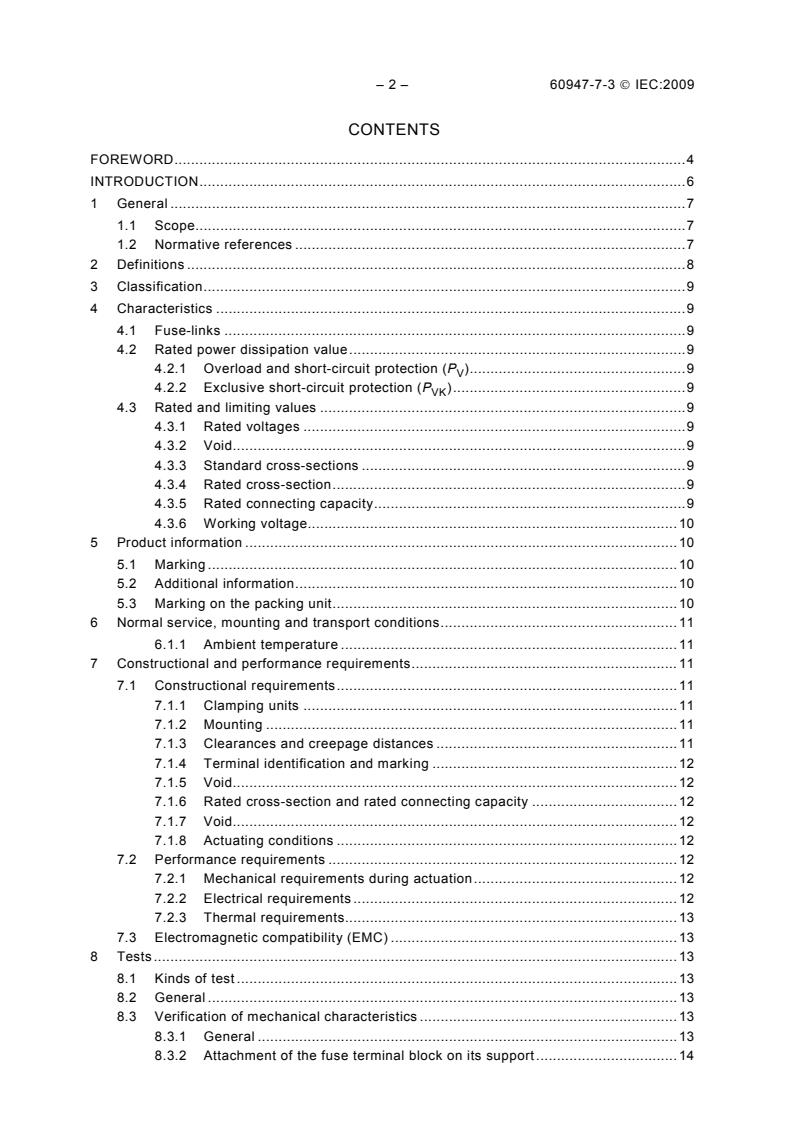
– 2 – 60947-7-3 © IEC:2009
CONTENTS
FOREWORD.4
INTRODUCTION.6
1 General .7
1.1 Scope.7
1.2 Normative references .7
2 Definitions .8
3 Classification.9
4 Characteristics .9
4.1 Fuse-links .9
4.2 Rated power dissipation value.9
4.2.1 Overload and short-circuit protection (P ).9
V
4.2.2 Exclusive short-circuit protection (P ).9
VK
4.3 Rated and limiting values .9
4.3.1 Rated voltages .9
4.3.2 Void.9
4.3.3 Standard cross-sections .9
4.3.4 Rated cross-section.9
4.3.5 Rated connecting capacity.9
4.3.6 Working voltage.10
5 Product information .10
5.1 Marking .10
5.2 Additional information.10
5.3 Marking on the packing unit.10
6 Normal service, mounting and transport conditions. 11
6.1.1 Ambient temperature .11
7 Constructional and performance requirements. 11
7.1 Constructional requirements.11
7.1.1 Clamping units .11
7.1.2 Mounting .11
7.1.3 Clearances and creepage distances .11
7.1.4 Terminal identification and marking . 12
7.1.5 Void.12
7.1.6 Rated cross-section and rated connecting capacity .12
7.1.7 Void.12
7.1.8 Actuating conditions .12
7.2 Performance requirements .12
7.2.1 Mechanical requirements during actuation.12
7.2.2 Electrical requirements .12
7.2.3 Thermal requirements.13
7.3 Electromagnetic compatibility (EMC) .13
8 Tests .13
8.1 Kinds of test .13
8.2 General .13
8.3 Verification of mechanical characteristics . 13
8.3.1 General .13
8.3.2 Attachment of the fuse terminal block on its support.14
60947-7-3 © IEC:2009 – 3 –
8.3.3 Mechanical properties of clamping units of a fuse terminal block . 14
8.3.4 Compatibility between fuse terminal blocks and the fuse-link. 14
8.3.5 Mechanical strength of the connection between the terminal block
base and the fuse-carrier.15
8.4 Verification of electrical characteristics. 15
8.4.1 General .15
8.4.2 Void.16
8.4.3 Dielectric tests.16
8.4.4 Contact resistance.17
8.4.5 Temperature rise of clamping units.18
8.4.6 Void.18
8.4.7 Ageing test (for screwless-type fuse terminal blocks only) . 18
8.5 Verification of thermal characteristics .19
8.5.1 General .19
8.5.2 Rated power dissipation .20
8.5.3 Durability.24
8.5.4 Needle flame test .24
8.6 Verification of EMC characteristics . 26
Annex A (normative) Gauges .27
Annex B (informative) Power dissipation values P and P .28
V VK
Annex C (normative) Order of tests and number of specimens. 36
Bibliography.37
Figure 1 − Test arrangement for the verification of the contact resistance. 17
Figure 2 − Test arrangement for separate arrangement . 20
Figure 3 − Test arrangement for compound arrangement . 21
Figure 4 − Test arrangement for compound arrangement of short-circuit protection . 22
Figure 5 − Test arrangement for the needle flame test .25
Figure 6 − Point of test flame contact (view from the layer placed below the fuse
terminal block) . 25
Figure A.1 – Outline of the gauges.27
Figure B.1 – Derating curve in the case of exclusive short-circuit protection for a
separate arrangement.30
Figure B.2 – Derating curve in the case of exclusive short-circuit protection for a
compound arrangement .31
Figure B.3 – Derating curve in the case of overload and short-circuit protection for a
separate arrangement.33
Figure B.4 – Derating curve in the case of overload and short-circuit protection for a
compound arrangement .34
Table 1 − Test forces .14
Table 2 − Dummy fuse-links.23
Table A.1 − Dimensions and materials for gauges for fuse-links according
to IEC 60127-2 .27
Table B.1 – Results of derating curves in the case of exclusive short-circuit protection. 32
Table B.2 – Results of derating curves in case of overload and short-circuit protection.35
Table C.1 – Order of tests and number of specimens. 36
– 4 – 60947-7-3 © IEC:2009
INTERNATIONAL ELECTROTECHNICAL COMMISSION
____________
LOW-VOLTAGE SWITCHGEAR AND CONTROLGEAR –
Part 7-3: Ancillary equipment –
Safety requirements for fuse terminal blocks
FOREWORD
1) The International Electrotechnical Commission (IEC) is a worldwide organization for standardization comprising
all national electrotechnical committees (IEC National Committees). The object of IEC is to promote
international co-operation on all questions concerning standardization in the electrical and electronic fields. To
this end and in addition to other activities, IEC publishes International Standards, Technical Specifications,
Technical Reports, Publicly Available Specifications (PAS) and Guides (hereafter referred to as “IEC
Publication(s)”). Their preparation is entrusted to technical committees; any IEC National Committee interested
in the subject dealt with may participate in this preparatory work. International, governmental and non-
governmental organizations liaising with the IEC also participate in this preparation. IEC collaborates closely
with the International Organization for Standardization (ISO) in accordance with conditions determined by
agreement between the two organizations.
2) The formal decisions or agreements of IEC on technical matters express, as nearly as possible, an international
consensus of opinion on the relevant subjects since each technical committee has representation from all
interested IEC National Committees.
3) IEC Publications have the form of recommendations for international use and are accepted by IEC National
Committees in that sense. While all reasonable efforts are made to ensure that the technical content of IEC
Publications is accurate, IEC cannot be held responsible for the way in which they are used or for any
misinterpretation by any end user.
4) In order to promote international uniformity, IEC National Committees undertake to apply IEC Publications
transparently to the maximum extent possible in their national and regional publications. Any divergence
between any IEC Publication and the corresponding national or regional publication shall be clearly indicated in
the latter.
5) IEC provides no marking procedure to indicate its approval and cannot be rendered responsible for any
equipment declared to be in conformity with an IEC Publication.
6) All users should ensure that they have the latest edition of this publication.
7) No liability shall attach to IEC or its directors, employees, servants or agents including individual experts and
members of its technical committees and IEC National Committees for any personal injury, property damage or
other damage of any nature whatsoever, whether direct or indirect, or for costs (including legal fees) and
expenses arising out of the publication, use of, or reliance upon, this IEC Publication or any other IEC
Publications.
8) Attention is drawn to the Normative references cited in this publication. Use of the referenced publications is
indispensable for the correct application of this publication.
9) Attention is drawn to the possibility that some of the elements of this IEC Publication may be the subject of
patent rights. IEC shall not be held responsible for identifying any or all such patent rights.
International Standard IEC 60947-7-3 has been prepared by subcommittee 17B: Low-voltage
switchgear and controlgear, of IEC technical committee 17: Switchgear and controlgear.
This second edition of IEC 60947-7-3 cancels and replaces the first edition, published in 2002,
and constitutes a technical revision.
The main technical modifications of this standard since this previous publication are listed
below:
– requirements regarding clearances and creepage distances replaced by reference to
Annex H of IEC 60947-1;
– requirements for the test of the mechanical strength of the clamping units improved in
8.3.3.1;
– requirements for tightening torques for the tests improved and referenced to Table 4 of
IEC 60947-1;
60947-7-3 © IEC:2009 – 5 –
– requirements for the resistance and the dimensions of dummy fuse-links specified in
8.5.2.5.
This standard shall be read in conjunction with IEC 60947-1 and IEC 60947-7-1. The
provisions of the general rules dealt with in IEC 60947-1 and the requirements for terminal
blocks of IEC 60947-7-1 are applicable to this standard, where specifically called for. Clauses
and subclauses, tables, figures and annexes thus applicable are identified by reference to
IEC 60947-1 or IEC 60947-7-1, e.g. 1.2 of IEC 60947-1, Table 4 of IEC 60947-7-1 or Annex A
of IEC 60947-1.
The text of this standard is based on the following documents:
FDIS Report on voting
17B/1657/FDIS 17B/1671/RVD
Full information on the voting for the approval of this standard can be found in the report on
voting indicated in the above table.
This publication has been drafted in accordance with the ISO/IEC Directives, Part 2.
A list of all the parts in the IEC 60947 series, under the general title Low-voltage switchgear
and controlgear, can be found on the IEC website.
The committee has decided that the contents of this publication will remain unchanged until
the maintenance result date indicated on the IEC web site under "http://webstore.iec.ch" in the
data related to the specific publication. At this date, the publication will be
• reconfirmed,
• withdrawn,
• replaced by a revised edition, or
• amended.
– 6 – 60947-7-3 © IEC:2009
INTRODUCTION
The standard for fuse terminal blocks covers not only the terminal block requirements but also
takes into account the specifications of the cartridge fuse-links according to IEC 60127-1 and
IEC 60127-2. A connection between these two standards is made by adding (adapting) the
fundamental specifications of cartridge fuse-links (rated current, rated voltage, maximum
voltage drop and maximum sustained power dissipation for cartridge fuse-links with the
dimension of 5 mm × 20 mm or 6,3 mm × 32 mm with their different response characteristics)
to the IEC 60947-7-1 requirements for terminal blocks. By this means, it is possible to judge
the quality of the product “fuse terminal blocks”.
An important fact when using such cartridge fuse-links with fuse terminal blocks is that fuses
heat up much less under rated load than they would do under overload conditions. The rated
load is the result of rated current and maximum voltage drop. But there is a considerably
increased power dissipation under overload conditions, equalling the maximum sustained
power dissipation loss according to IEC 60127-2.
In industrial applications, single fuse terminal blocks are used within an arrangement of
terminal blocks or many of them forming an arrangement on their own. This means that the
same current and fuse-link will result in different heat emissions. Furthermore, it should be
taken into account that apart from the general full range fuse (for overload and short-circuit
protection), some fuse terminal blocks are exclusively used for short-circuit protection
according to IEC 60364-4-43, e.g. in control circuits, where no overloads occur (i.e. safety
coils, indicator lights or similar equipment).
Consequently there are four different types of application that need to be described in the
catalogue or indicated on the fuse terminal block. For more information, see Annex B.
60947-7-3 © IEC:2009 – 7 –
LOW-VOLTAGE SWITCHGEAR AND CONTROLGEAR –
Part 7-3: Ancillary equipment –
Safety requirements for fuse terminal blocks
1 General
1.1 Scope
This part of IEC 60947 applies to fuse terminal blocks with screw-type or screwless-type
clamping units for the connection of rigid (solid or stranded) or flexible copper conductors for
the reception of cartridge fuse-links in accordance with IEC 60127-2, intended primarily for
industrial or similar use in circuits not exceeding 1 000 V a.c., up to 1 000 Hz or 1 500 V d.c.,
and having a maximum short-circuit breaking capacity of 1 500 A.
They are intended for installation in electrical equipment with enclosures which surround the
fuse terminal blocks to such an extent that they are accessible only with the aid of a tool.
For certain applications, for example in control circuits, the fuse terminal blocks may be
designed exclusively for short-circuit protection.
NOTE This standard may be used as a guide for fuse terminal blocks for the reception of special cartridge fuse-
links which do not meet the requirements of IEC 60127-2.
The object of this standard is to specify safety requirements and test methods for the
mechanical, electrical and thermal characteristics of fuse terminal blocks, to ensure the
compatibility between terminal blocks and standardized fuse-links.
This standard may be used as a guide for
− fuse terminal blocks requiring the fixing of special devices to the conductors, for example
quick connect terminations or wrapped connections, etc.;
− fuse terminal blocks providing direct contact to the conductors by means of edges or points
penetrating the insulation, for example insulation displacement connections, etc.
Where applicable in this standard, the term “clamping unit” has been used instead of the term
“terminal”. This is taken into account in case of reference to IEC 60947-1.
1.2 Normative references
The following referenced documents are indispensable for the application of this document.
For dated references, only the edition cited applies. For undated references, the latest edition
of the referenced document (including any amendments) applies.
IEC 60127-1:2006, Miniature fuses – Part 1: Definitions for miniature fuses and general
requirements for miniature fuse-links
IEC 60127-2:2003, Miniature fuses – Part 2: Cartridge fuse-links
Amendment 1 (2003)
IEC 60216-1:2001, Electrical insulating materials – Properties of thermal endurance – Part 1:
Ageing procedures and evaluation of test results
IEC 60695-11-5:2004, Fire hazard testing – Part 11-5: Test flames – Needle flame test method
– Apparatus, confirmatory test arrangement and guidance
– 8 – 60947-7-3 © IEC:2009
IEC 60947-1:2007, Low-voltage switchgear and controlgear – Part 1: General rules
IEC 60947-7-1, Low-voltage switchgear and controlgear – Part 7-1: Ancillary equipment –
Terminal blocks for copper conductors
ISO 3:1973, Preferred numbers – Series of preferred numbers
ISO 4046-4:2002, Paper, board, pulp and related terms – Vocabulary– Part 4: Paper and
board grades and coverted products
2 Definitions
For the purposes of this document, definitions given in IEC 60947-7-1, together with the
following definitions, apply.
2.1
fuse terminal block
terminal block base with a fuse-carrier
2.2
terminal block base
insulating part of a fuse terminal block carrying the clamping units and contacts, intended to
be fixed to a support
2.3
fuse-carrier
movable part of a fuse terminal block designed to carry the cartridge fuse-link and enable
its exchange
NOTE The fuse-carrier can be mechanically coupled with the terminal block base.
2.4
maximum power dissipation of the cartridge fuse-link
2.4.1 in the case of an overload of P , equal to the maximum sustained power dissipation as
V1
given in IEC 60127-2
2.4.2 in the case of a nominal load of P , equal to the power dissipation value calculated
V2
from the nominal values, i.e. the maximum voltage drop and the rated current in accordance
with IEC 60127-2
2.5
separate arrangement of a fuse terminal block
arrangement of a single fuse terminal block between adjacent terminal blocks (without
additional function) (see Figure 2)
NOTE Mounting of fuse terminal blocks side by side with a spacing that securely prevents any mutual thermal
influence is also considered as a separate arrangement.
2.6
compound arrangement of fuse terminal blocks
arrangement of two or several fuse terminal blocks side by side or the arrangement of a single
fuse terminal block between adjacent terminal blocks with additional function (see Figure 3)
NOTE Additional functions within the meaning of this standard include all components which may thermally
influence the function of the fuse terminal block due to their own power dissipation.
60947-7-3 © IEC:2009 – 9 –
2.7
rated power dissipation value of a fuse terminal block
maximum permissible value with which the fuse terminal block can be continuously loaded by
the cartridge fuse-link under specified conditions
3 Classification
Fuse terminal blocks are classified as follows:
a) fuse terminal block with separate fuse-carrier, e.g. screw type or plug-in type;
b) fuse terminal block with mechanically coupled fuse-carrier, e.g. hinged type.
4 Characteristics
4.1 Fuse-links
The fuse links shall be in accordance with IEC 60127-2.
4.2 Rated power dissipation value
4.2.1 Overload and short-circuit protection (P )
V
The rated value of power dissipation for overload and short-circuit protection (P ) is the
V
maximum permissible power dissipation value of a fuse terminal block under overload and
short-circuit conditions related to an ambient temperature of 23 °C.
4.2.2 Exclusive short-circuit protection (P )
VK
The rated value of power dissipation for exclusive short-circuit protection (P ) is the
VK
maximum permissible power dissipation value of a fuse terminal block, which can accept a
fuse-link with an equal or lower sustained power dissipation used under exclusive short-circuit
conditions and related to an ambient temperature of 23 °C (see Annex B).
NOTE “Maximum sustained power dissipation” of a fuse link is given in IEC 60127-1.
4.3 Rated and limiting values
4.3.1 Rated voltages
Subclause 4.3.1 of IEC 60947-7-1 applies.
4.3.2 Void
4.3.3 Standard cross-sections
Subclause 4.3.3 of IEC 60947-7-1 applies.
4.3.4 Rated cross-section
Subclause 4.3.4 of IEC 60947-7-1 applies.
4.3.5 Rated connecting capacity
Subclause 4.3.5 of IEC 60947-7-1 applies with the following addition.
The conductor cross-section specified for the temperature-rise test according to 8.4.5 shall be
included in the range of the rated connecting capacity.
– 10 – 60947-7-3 © IEC:2009
4.3.6 Working voltage
See 2.5.52 of IEC 60947-1.
5 Product information
5.1 Marking
A fuse terminal block shall be marked in a durable and legible manner with the following:
a) the name of the manufacturer or a trade mark, by which the manufacturer can be readily
identified;
b) a type reference permitting its identification in order to obtain relevant information from the
manufacturer or his catalogue;
c) energy flow direction, if required to ensure protection against electric shock, according
to 7.1.8, e.g. line-load marking or ➜.
5.2 Additional information
The following information shall be stated by the manufacturer, if applicable, e.g in the
manufacturer’s data sheet or catalogue or on the packing unit:
a) IEC 60947-7-3, if the manufacturer claims compliance with this standard;
b) the rated cross-section;
c) the rated connecting capacity, if different from Table 2 of IEC 60947-7-1, including the
number of conductors simultaneously connectable;
d) the rated insulation voltage (U) of the terminal block base and the fuse-carrier, if
i
applicable;
e) the working voltage or working voltage range, primarily determined by the fuse-link or
by additional components, e.g. illuminated indicators;
f) rated impulse withstand voltage (U );
imp
NOTE This value may be marked on the fuse terminal block only if the rated insulation voltage (U ) or the
i
working voltage is also marked on the fuse terminal block, e.g. 250 V/4 kV.
g) rated value of the power dissipation for overload and short-circuit protection (P ) and rated
V
current of the fuse-link as declared by the manufacturer
− in case of separate arrangement,
− in case of compound arrangement;
h) rated value of the power dissipation for exclusive short-circuit protection (P ) and rated
VK
current of the fuse-link as declared by the manufacturer
− in case of separate arrangement,
− in case of compound arrangement;
i) operating conditions, if different from Clause 6;
j) size of the fuse-link.
5.3 Marking on the packing unit
a) “No overload protection” in case of fuse terminal blocks which are designed exclusively for
short-circuit protection.
b) “No overload protection in compound arrangement” in case of fuse terminal blocks which
are designed for overload only in separate arrangement and short-circuit protection in
compound arrangement.
60947-7-3 © IEC:2009 – 11 –
The breaking capacity of the fuse-link(s) shall be selected according to expected short-circuit
level at the point of installation.
NOTE A warning may be written on the package and the literature to notify that the breaking capacity of the fuse-
link(s) according to IEC 60127-2 shall be selected according to expected short-circuit level at the point of
installation.
6 Normal service, mounting and transport conditions
Clause 6 of IEC 60947-1 applies with the following addition.
6.1.1 Ambient temperature
The rated value of the power dissipation refers to an ambient temperature of 23 °C.
In those cases where the ambient temperature differs from 23 °C, this fact shall be taken into
account with respect to the function. See derating curves in Annex B.
7 Constructional and performance requirements
7.1 Constructional requirements
7.1.1 Clamping units
Subclause 7.1.1 of IEC 60947-7-1 applies.
7.1.2 Mounting
Fuse terminal blocks shall be provided with means that allow them to be securely attached to
a rail or a mounting surface.
Tests shall be made in accordance with 8.3.2.
NOTE Information on mounting rails can be found in IEC 60715.
7.1.3 Clearances and creepage distances
Subclause 7.1.3 of IEC 60947-7-1 applies with the following additions.
Clearances and creepage distances shall be designed for overvoltage category III and
pollution degree 3.
Clearances and creepage distances shall be checked where the fuse terminal block is
assembled for normal use, e.g. fuse-carrier and gauge no. 3 or no. 6 is inserted in the terminal
block base in accordance with Table A.1.
The following aspects shall be considered:
a) functional insulation:
− insulation between live parts with different potential;
− insulation between live parts of adjacent fuse terminal blocks of same series and size;
b) basic insulation:
− insulation between live parts and the fixing support.
Compliance is checked by measurement. Subclause 8.3.3.4 of IEC 60947-1 applies.
– 12 – 60947-7-3 © IEC:2009
7.1.4 Terminal identification and marking
Subclause 7.1.4 of IEC 60947-7-1 applies.
7.1.5 Void
7.1.6 Rated cross-section and rated connecting capacity
Subclause 7.1.6 of IEC 60947-7-1 applies.
7.1.7 Void
7.1.8 Actuating conditions
The fuse terminal block shall be so designed that live parts are not accessible when it is
assembled, installed and operated under normal use.
The safety from finger touch of live parts of the fuse-carrier shall be ensured during
replacement of the fuse-link, unless otherwise specified by the manufacturer. The safety from
finger touch shall be maintained until the fuse-carrier and the fuse-link are de-energized.
7.2 Performance requirements
7.2.1 Mechanical requirements during actuation
Fuse terminal blocks shall have an adequate mechanical strength so as to withstand the
stresses which occur during operation.
Compliance shall be checked in accordance with 8.3.4 and 8.3.5.
7.2.2 Electrical requirements
7.2.2.1 Dielectric strength
The dielectric strength shall be adequate.
Verification shall be made by an impulse voltage test and a power-frequency withstand test on
the fuse terminal block assembled by means of gauges as in normal use, in accordance
with 8.4.3.
7.2.2.2 Contact resistance
The test shall be carried out in accordance with 8.4.4. If not otherwise specified, the mean
value of the contact resistance shall not exceed 10 mΩ. The value of an individual
measurement shall not exceed 15 mΩ.
7.2.2.3 Temperature rise of clamping units
The temperature rise of the clamping units shall not exceed 45 K.
Compliance shall be checked in accordance with 8.4.5.
7.2.2.4 Electrical performance after ageing (for screwless-type fuse terminal blocks
only)
Fuse terminal blocks shall be capable of withstanding the ageing test comprising 192
temperature cycles in accordance with 8.4.7.
60947-7-3 © IEC:2009 – 13 –
7.2.3 Thermal requirements
7.2.3.1 Rated value of power dissipation
A fuse terminal block shall be so designed that it can use a fuse-link with rated current and
maximum sustained power dissipation, according to IEC 60127-1, lower or equal to the rated
power dissipation value of the fuse terminal block and at an ambient temperature of 23 °C (see
Annex B).
In this way, the temperature of 85 °C on the surface of the actuating elements of the fuse-
carrier and the relative temperature index (RTI) of the insulating material as stated by the
manufacturer in accordance with IEC 60216-1 shall not be exceeded.
Compliance shall be checked in accordance with 8.5.2.
For fuse terminal blocks which are exclusively designed for short-circuit protection, the tests in
accordance with 8.5.2.2 do not apply.
Generally, the maximum permanent allowed temperature can be defined with a RTI value
according to IEC 60216-1, based on 20 000 h taking into account the electrical property.
7.2.3.2 Durability
Fuse terminal blocks shall be sufficiently resistant to thermal stresses which can occur under
normal use.
Compliance shall be checked in accordance with 8.5.3.
7.2.3.3 Resistance to abnormal heat and fire
The insulation materials of fuse terminal blocks shall not be adversely affected by abnormal
heat and fire.
Compliance shall be checked by the needle flame test, according to IEC 60695-11-5, as
specified in 8.5.4.
7.3 Electromagnetic compatibility (EMC)
Subclause 7.3 of IEC 60947-7-1 applies.
8 Tests
8.1 Kinds of test
Subclause 8.1 of IEC 60947-7-1 applies.
8.2 General
Subclause 8.2 of IEC 60947-7-1 applies with the following modification.
The tests shall be carried out in the order as given in Annex C.
8.3 Verification of mechanical characteristics
8.3.1 General
The verification of mechanical characteristics includes the following tests:
– 14 – 60947-7-3 © IEC:2009
− attachment of the fuse terminal block on its support (8.3.2);
− mechanical strength of the clamping units of a fuse terminal block (8.3.3);
− compatibility between fuse terminal blocks and fuse-link (8.3.4);
− mechanical strength of the connection between the terminal block base and the fuse-
carrier (8.3.5).
8.3.2 Attachment of the fuse terminal block on its support
Subclause 8.3.2 of IEC 60947-7-1 applies.
8.3.3 Mechanical properties of clamping units of a fuse terminal block
8.3.3.1 Testing of mechanical strength of the clamping units
Subclauses 8.2.4.1 and 8.2.4.2 of IEC 60947-1 apply with the following addition.
The test shall be made on two clamping units at the centre terminal blocks out of five fuse
terminal blocks mounted as in normal use on the appropriate support according to the
manufacturer's instructions.
Rigid conductors of the rated cross-section shall be connected and disconnected five times.
8.3.3.2 Testing for damage to and accidental loosening of conductors
of a fuse terminal block (flexion test)
Subclause 8.3.3.2 of IEC 60947-7-1 applies.
8.3.3.3 Pull-out test
Subclause 8.3.3.3 of IEC 60947-7-1 applies.
8.3.3.4 Verification of rated cross-section and rated connecting capacity
Subclause 8.3.3.4 of IEC 60947-7-1 applies.
8.3.4 Compatibility between fuse terminal blocks and the fuse-link
The maximum gauge no. 1 or no. 4, in accordance with Table A.1, shall be inserted and
withdrawn 10 times from the fuse-carrier.
Following each insertion of the gauge, the fuse-carrier shall be fitted to the terminal block base
as in normal operation. In the case of fuse terminal blocks with screw-type fuse-carrier, the
fuse-carriers shall be fitted with a torque of two-thirds of the value specified in Table 1.
Table 1 − Test forces
Diameter (d) of fuse carrier
Torque Axial pulling force
Nm N
Up to and including 16 mm 0,4 25
Over 16 mm, up to and including 25 mm 0,6 50
∅d
60947-7-3 © IEC:2009 – 15 –
No visible damage or loosening of parts shall be observed. The minimum gauge no. 2 or no. 5,
according to Table A.1, shall be prevented from falling out of the fuse-carrier in the most
unfavourable position.
The minimum gauge no. 2 or no. 5 shall then be inserted into the fuse terminal block and the
contact resistance be measured according to 8.4.4 (see Figure 1).
The mean value of the contact resistance shall not exceed 10 mΩ. The value of an individual
measurement shall not exceed 15 mΩ.
8.3.5 Mechanical strength of the connection between the terminal block base
and the fuse-carrier
8.3.5.1 Torque test on screw-type fuse-carriers
The fuse-carrier equipped with the maximum gauge no. 1 or no. 4, in accordance with
Table A.1, shall be screwed in five times into the terminal block base by applying the
respective torque specified in Table 1.
The fuse-carrier shall be securely kept in the terminal block base during and after the test, and
shall show no changes impairing its normal use.
8.3.5.2 Pull-out test on screw-type and bayonet-type fuse-carriers
The fuse-carrier equipped with the maximum gauge no. 1 or no. 4, according to Table A.1,
shall be inserted in the terminal block base.
Screw-type fuse-carriers shall be tightened with a torque of two-thirds of the value specified in
Table 1.
The fuse-carrier shall then be subjected to an axial pulling force as specified in Table 1 for
1 min.
The fuse-carrier shall be securely kept in the terminal block base during and after the test, and
shall show no changes impairing its normal use.
8.3.5.3 Actuating forces on plug-on type or hinged-type fuse-carriers
The fuse-carrier, together with the maximum gauge no. 1 or no. 4 according to Table A.1, shall
be inserted in and withdrawn from or slewed out of the terminal block base.
The actuating forces shall be measured with appropriate measuring means. This test shall be
conducted 10 times.
The value of each individual measurement shall be within the limit values as stated by the
manufacturer.
The fuse-carrier shall be securely kept in the terminal block base during and after the test, and
shall show no change impairing its normal use.
8.4 Verification of electrical characteristics
8.4.1 General
The verification of electrical characteristics includes the following:
− dielectric tests (8.4.3);
− contact resistance (8.4.4);
– 16 – 60947-7-3 © IEC:2009
− temperature-rise test of the clamping units (8.4.5);
− ageing test (for screwless-type fuse terminal blocks only) (8.4.7).
8.4.2 Void
8.4.3 Dielectric tests
8.4.3.1 General
a) If the manufacturer has declared a value for the rated impulse withstand voltage (U ), the
imp
impulse withstand voltage test shall be made in accordance with 8.3.3.4.1, item 2), of
IEC 60947-1, except item 2) c) which does not apply.
b) According to the rated insulation voltage (U ), the power-frequency withstand test shall be
i
made in accordance with 8.3.3.4.1, item 3), of IEC 60947-1.
The value of the test voltage shall be as stated in Table 12A of IEC 60947-1 (see 8.3.3.4.1,
item 3) b) i), of IEC 60947-1).
8.4.3.2 Test arrangement and application of the test voltage
8.4.3.2.1 General
Each test shall be carried out on five adjacent fuse terminal blocks wired with conductors of
the rated cross-section and installed on a metal support under the following conditions:
– the conductor ends shall be stripped to a length specified by the manufacturer;
– in case the manufacturer has stated the possibility of using different metal supports, the
most unfavourable support shall be used.
8.4.3.2.2 Test A
Gauge no. 3 or no. 6, accordi
...