

IEC 62676-6:2026
(Main)Video surveillance systems for use in security applications - Part 6: Performance testing and grading of real-time intelligent video content analysis devices and systems for use in video surveillance applications
General Information
- Abstract
IEC 62676-6:2026 specifies the functions, performance, interfaces, environmental adaptability, test methods, performance evaluation and grading rules of real-time intelligent video analysis in surveillance systems.
This document applies to live and forensic, real-time intelligent video analysis devices and systems in video surveillance.
The document is centred on testing performance and grading device functionality which enables:
• Core capability: Classification of objects, detection of specific "object activity", such as "stopping", "starting", "direction of movement", etc.
Examples are listed in Annex A.
• Complex capability: Detection of "scenarios" which are based on combinations of object activity, such as "loitering", "perimeter intrusion detection", "person down", "tailgating", "intrusion", "abandoned object detection", explosion, fire, flood, potential terrorist attack using a vehicle, owner of an abandoned bag, etc.
Examples of current scenarios are listed and described in Annex B.
• Degree of difficulty: The application of real operating environments to test the performance under known or required operating stress levels, examples of operating stress levels that are sterile or non-sterile, indoor or outdoor, target obscuration levels, extreme weather conditions, vibrating mechanical rugged environments causing image shake resulting in degradation of image quality requirement, see Table 1 and Annex C.
The purpose of this document is to provide end users, at different levels of the service process, from users and installers, integrators and maintenance companies, to certification providers, with methods to measure the performance of video analysis systems that must also comply with other parts of the standard.
- Status
- Published
- Publication Date
- 17-Feb-2026
- Technical Committee
- TC 79 - Alarm and electronic security systems
- Drafting Committee
- WG 12 - TC 79/WG 12
- Current Stage
- PPUB - Publication issued
- Start Date
- 18-Feb-2026
- Completion Date
- 27-Feb-2026
Buy Documents

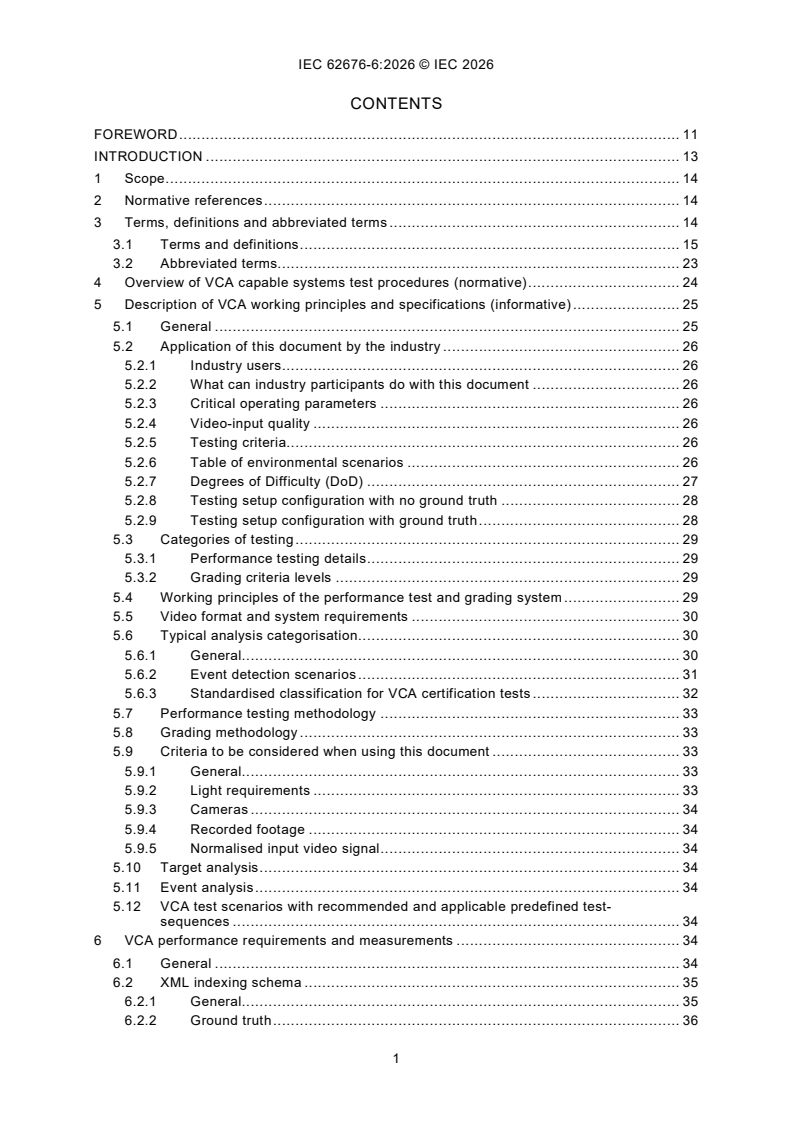
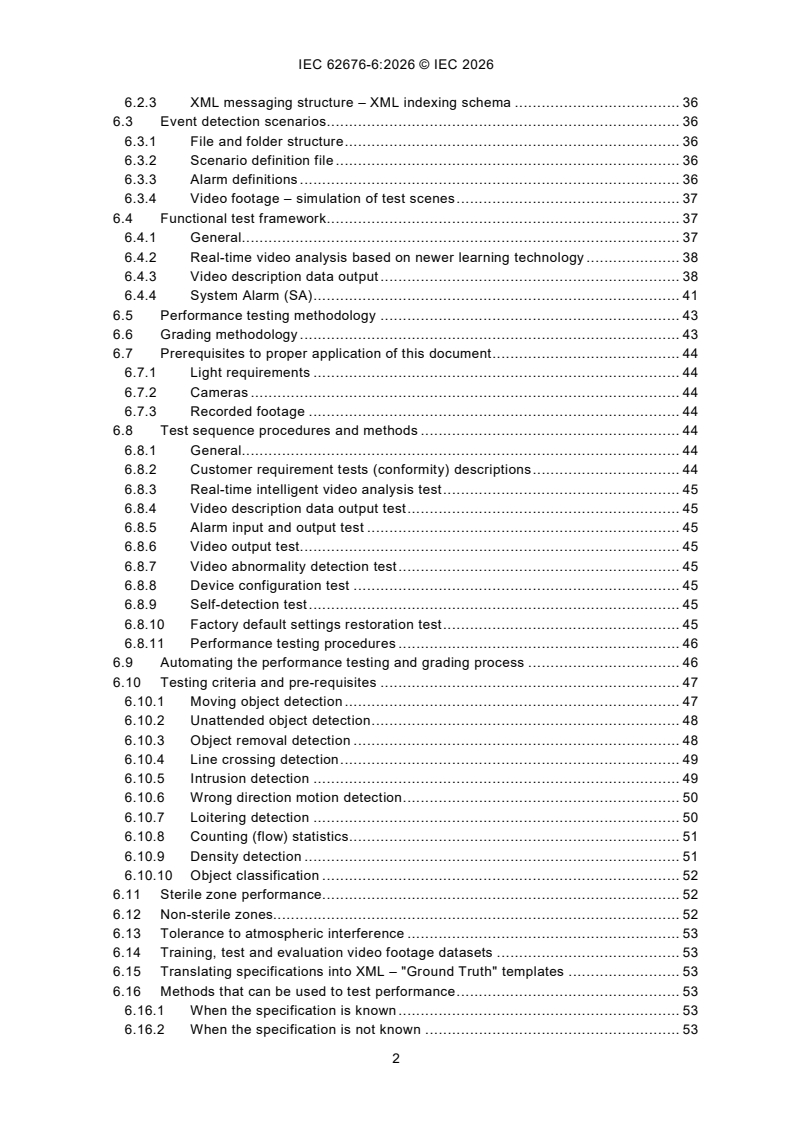
IEC 62676-6:2026 - Video surveillance systems for use in security applications - Part 6: Performance testing and grading of real-time intelligent video content analysis devices and systems for use in video surveillance applications
IEC 62676-6:2026 - Systèmes de vidéosurveillance destinés à être utilisés dans les applications de sécurité - Partie 6: Essai de performance et classification des dispositifs et systèmes d'analyse intelligente en temps réel de contenus vidéo destinés aux applications de vidéosurveillance
IEC 62676-6:2026 - Video surveillance systems for use in security applications - Part 6: Performance testing and grading of real-time intelligent video content analysis devices and systems for use in video surveillance applications
Overview
IEC 62676-6:2026 is an international standard developed by the International Electrotechnical Commission (IEC) for video surveillance systems used in security applications. This part of the IEC 62676 series specifically addresses the performance testing and grading of real-time intelligent video content analysis (IVCA) devices and systems used in video surveillance. The document specifies the functions, performance criteria, system interfaces, environmental adaptability, test methods, and grading rules to assess and benchmark intelligent video analysis capabilities. This standard aims to provide end users, system integrators, installers, maintenance companies, and certification providers with reliable and reproducible methods to evaluate the performance of intelligent video surveillance systems.
Key Topics
Core Capabilities: The standard defines methods for testing essential functions such as object classification, detection of object activities (stopping, starting, direction of movement), and other elementary surveillance requirements.
Complex Capabilities: It covers performance evaluation for advanced scenario detection like loitering, perimeter intrusion, person-down detection, tailgating, abandoned object detection, and responses to critical incidents such as explosions, fire, or floods.
Operating Environments: IEC 62676-6:2026 mandates testing under varying real-world conditions and stress levels, including sterile and non-sterile zones, indoor and outdoor settings, varying levels of target obscuration, extreme weather, and settings prone to mechanical vibrations.
Performance Testing and Grading: The document details comprehensive methodologies for performance assessment, including criteria for grading device and system capabilities, systematic test methods, configuration protocols, and the use of ground truth versus non-ground truth data for objective measurements.
Functional and Environmental Adaptability: The standard outlines how intelligent video analysis systems should perform consistently across a range of environments and conditions, ensuring reliable security monitoring.
Applications
Real-Time Surveillance and Security
- Public Safety: Used in transportation hubs, city centers, airports, and critical infrastructure for automated detection of security threats and behavioral anomalies.
- Private Sector: Applied in commercial buildings, retail environments, and industrial sites for proactive risk management, theft prevention, and incident investigation.
- Forensic Analysis: Provides guidelines for evaluating how systems perform under forensic review, enhancing the accuracy and reliability of post-incident investigations.
- Smart Cities: Enables deployment of intelligent surveillance for traffic monitoring, crowd management, and rapid incident response.
Performance Benchmarking and Certification
- System Procurement: Offers transparent benchmarks for end users and procurement professionals to compare video analysis systems based on independently validated performance data.
- Certification and Compliance: Supports certification bodies and regulators in verifying compliance of surveillance products with international standards.
- Product Development: Guides manufacturers in designing systems that meet globally recognized performance thresholds.
- Maintenance and Upgrades: Assists maintenance providers in evaluating existing solutions and planning upgrades to maintain compliance with evolving security requirements.
Related Standards
- IEC 62676-1: Video surveillance systems for use in security applications - System requirements.
- IEC 62676-2: Video surveillance systems for use in security applications - Video transmission protocols.
- IEC 62676-3: Video surveillance systems for use in security applications - Analog and digital interfaces.
- IEC 62676-4: Video surveillance systems for use in security applications - Video management system requirements.
- ISO/IEC 27001: Information security management (related for IT environments integrating video analysis).
Practical Value
By adopting IEC 62676-6:2026, organizations gain access to standardized frameworks for testing, grading, and certifying intelligent video content analysis systems. This supports consistent security outcomes, informed purchasing decisions, and interoperability across diverse surveillance environments. The standard’s focus on real-time and forensic applications ensures adaptability to a rapidly evolving security landscape, supporting both current needs and future innovations in intelligent video surveillance.
Buy Documents
IEC 62676-6:2026 - Video surveillance systems for use in security applications - Part 6: Performance testing and grading of real-time intelligent video content analysis devices and systems for use in video surveillance applications
IEC 62676-6:2026 - Systèmes de vidéosurveillance destinés à être utilisés dans les applications de sécurité - Partie 6: Essai de performance et classification des dispositifs et systèmes d'analyse intelligente en temps réel de contenus vidéo destinés aux applications de vidéosurveillance
IEC 62676-6:2026 - Video surveillance systems for use in security applications - Part 6: Performance testing and grading of real-time intelligent video content analysis devices and systems for use in video surveillance applications
Get Certified
Connect with accredited certification bodies for this standard

DNV
DNV is an independent assurance and risk management provider.

Lloyd's Register
Lloyd's Register is a global professional services organisation specialising in engineering and technology.
DNV Energy Systems
Energy and renewable energy certification.
Sponsored listings
Frequently Asked Questions
IEC 62676-6:2026 is a standard published by the International Electrotechnical Commission (IEC). Its full title is "Video surveillance systems for use in security applications - Part 6: Performance testing and grading of real-time intelligent video content analysis devices and systems for use in video surveillance applications". This standard covers: IEC 62676-6:2026 specifies the functions, performance, interfaces, environmental adaptability, test methods, performance evaluation and grading rules of real-time intelligent video analysis in surveillance systems. This document applies to live and forensic, real-time intelligent video analysis devices and systems in video surveillance. The document is centred on testing performance and grading device functionality which enables: • Core capability: Classification of objects, detection of specific "object activity", such as "stopping", "starting", "direction of movement", etc. Examples are listed in Annex A. • Complex capability: Detection of "scenarios" which are based on combinations of object activity, such as "loitering", "perimeter intrusion detection", "person down", "tailgating", "intrusion", "abandoned object detection", explosion, fire, flood, potential terrorist attack using a vehicle, owner of an abandoned bag, etc. Examples of current scenarios are listed and described in Annex B. • Degree of difficulty: The application of real operating environments to test the performance under known or required operating stress levels, examples of operating stress levels that are sterile or non-sterile, indoor or outdoor, target obscuration levels, extreme weather conditions, vibrating mechanical rugged environments causing image shake resulting in degradation of image quality requirement, see Table 1 and Annex C. The purpose of this document is to provide end users, at different levels of the service process, from users and installers, integrators and maintenance companies, to certification providers, with methods to measure the performance of video analysis systems that must also comply with other parts of the standard.
IEC 62676-6:2026 specifies the functions, performance, interfaces, environmental adaptability, test methods, performance evaluation and grading rules of real-time intelligent video analysis in surveillance systems. This document applies to live and forensic, real-time intelligent video analysis devices and systems in video surveillance. The document is centred on testing performance and grading device functionality which enables: • Core capability: Classification of objects, detection of specific "object activity", such as "stopping", "starting", "direction of movement", etc. Examples are listed in Annex A. • Complex capability: Detection of "scenarios" which are based on combinations of object activity, such as "loitering", "perimeter intrusion detection", "person down", "tailgating", "intrusion", "abandoned object detection", explosion, fire, flood, potential terrorist attack using a vehicle, owner of an abandoned bag, etc. Examples of current scenarios are listed and described in Annex B. • Degree of difficulty: The application of real operating environments to test the performance under known or required operating stress levels, examples of operating stress levels that are sterile or non-sterile, indoor or outdoor, target obscuration levels, extreme weather conditions, vibrating mechanical rugged environments causing image shake resulting in degradation of image quality requirement, see Table 1 and Annex C. The purpose of this document is to provide end users, at different levels of the service process, from users and installers, integrators and maintenance companies, to certification providers, with methods to measure the performance of video analysis systems that must also comply with other parts of the standard.
IEC 62676-6:2026 is classified under the following ICS (International Classification for Standards) categories: 27.120.20 - Nuclear power plants. Safety. The ICS classification helps identify the subject area and facilitates finding related standards.
IEC 62676-6:2026 is available in PDF format for immediate download after purchase. The document can be added to your cart and obtained through the secure checkout process. Digital delivery ensures instant access to the complete standard document.
Standards Content (Sample)
IEC 62676-6 ®
Edition 1.0 2026-02
INTERNATIONAL
STANDARD
Video surveillance systems for use in security applications -
Part 6: Performance testing and grading of real-time intelligent video content
analysis devices and systems for use in video surveillance applications
ICS 27.120.20 ISBN 978-2-8327-1055-5
All rights reserved. Unless otherwise specified, no part of this publication may be reproduced or utilized in any form or
by any means, electronic or mechanical, including photocopying and microfilm, without permission in writing from either
IEC or IEC's member National Committee in the country of the requester. If you have any questions about IEC copyright
or have an enquiry about obtaining additional rights to this publication, please contact the address below or your local
IEC member National Committee for further information.
IEC Secretariat Tel.: +41 22 919 02 11
3, rue de Varembé info@iec.ch
CH-1211 Geneva 20 www.iec.ch
Switzerland
About the IEC
The International Electrotechnical Commission (IEC) is the leading global organization that prepares and publishes
International Standards for all electrical, electronic and related technologies.
About IEC publications
The technical content of IEC publications is kept under constant review by the IEC. Please make sure that you have the
latest edition, a corrigendum or an amendment might have been published.
IEC publications search - IEC Products & Services Portal - products.iec.ch
webstore.iec.ch/advsearchform Discover our powerful search engine and read freely all the
The advanced search enables to find IEC publications by a
publications previews, graphical symbols and the glossary.
variety of criteria (reference number, text, technical With a subscription you will always have access to up to date
committee, …). It also gives information on projects, content tailored to your needs.
replaced and withdrawn publications.
Electropedia - www.electropedia.org
IEC Just Published - webstore.iec.ch/justpublished The world's leading online dictionary on electrotechnology,
Stay up to date on all new IEC publications. Just Published containing more than 22 500 terminological entries in English
details all new publications released. Available online and and French, with equivalent terms in 25 additional languages.
once a month by email. Also known as the International Electrotechnical Vocabulary
(IEV) online.
IEC Customer Service Centre - webstore.iec.ch/csc
If you wish to give us your feedback on this publication or
need further assistance, please contact the Customer
Service Centre: sales@iec.ch.
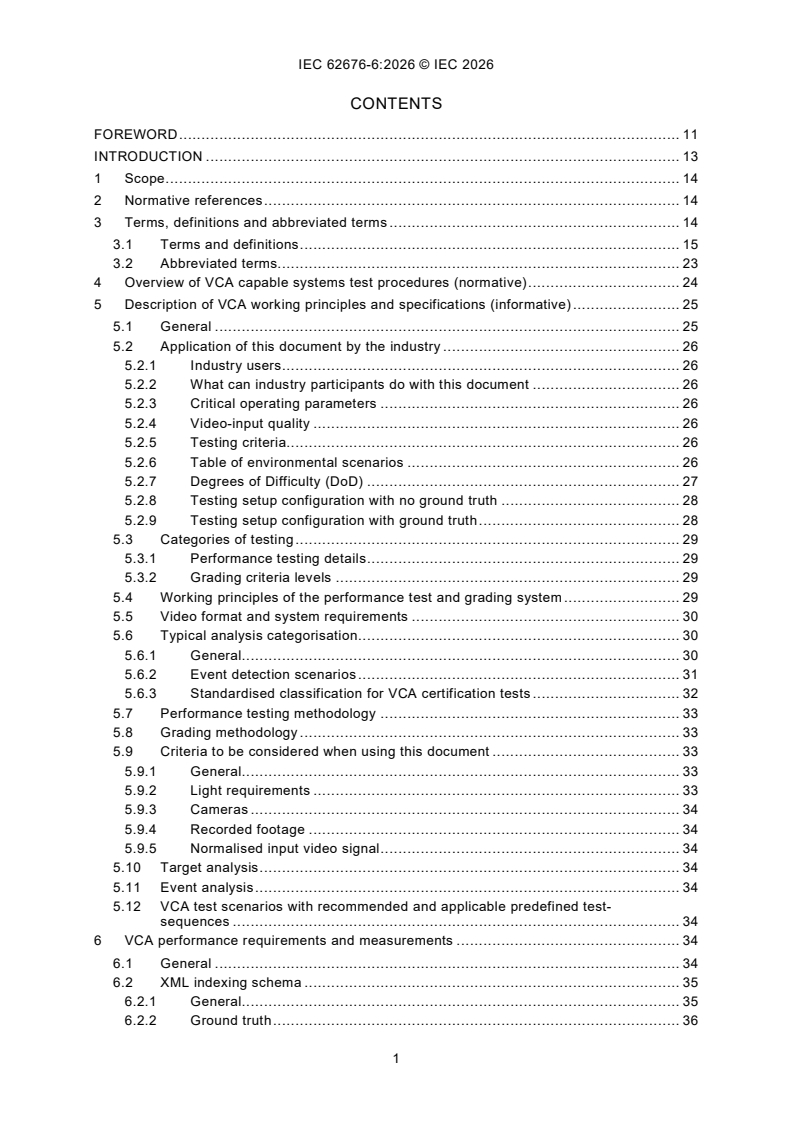
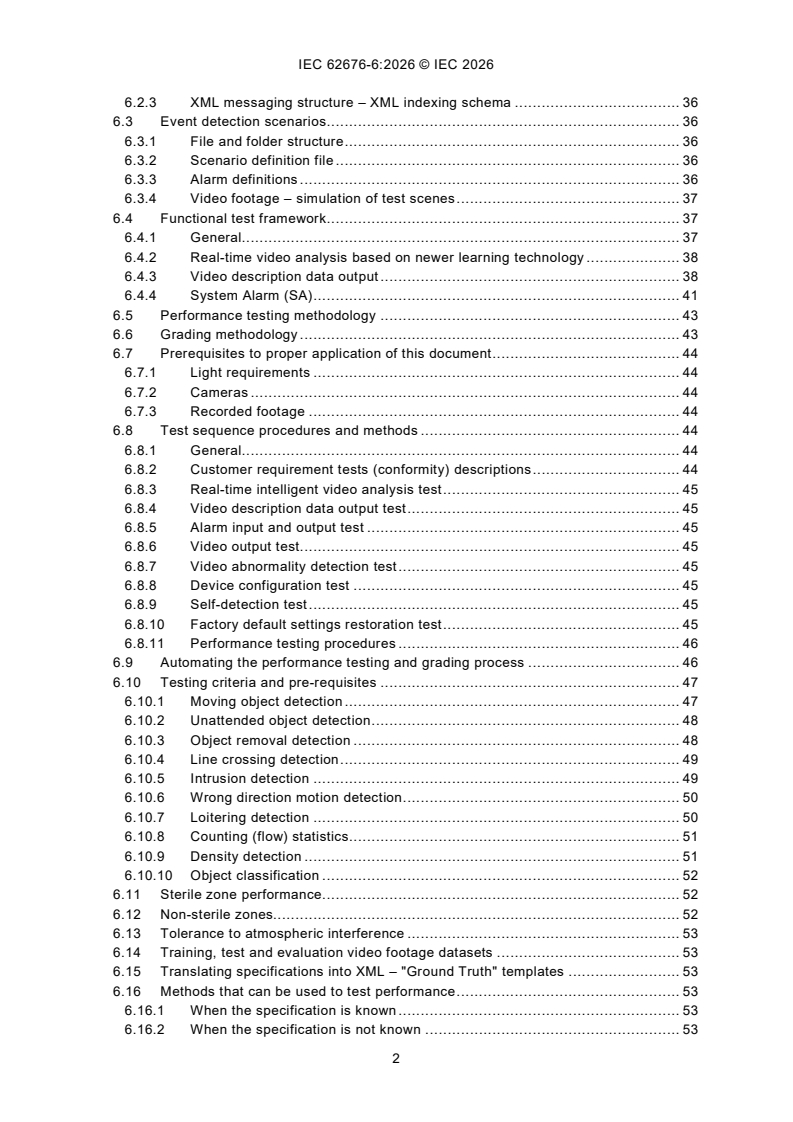
CONTENTS
FOREWORD . 11
INTRODUCTION . 13
1 Scope . 14
2 Normative references . 14
3 Terms, definitions and abbreviated terms . 14
3.1 Terms and definitions . 15
3.2 Abbreviated terms. 23
4 Overview of VCA capable systems test procedures (normative) . 24
5 Description of VCA working principles and specifications (informative) . 25
5.1 General . 25
5.2 Application of this document by the industry . 26
5.2.1 Industry users . 26
5.2.2 What can industry participants do with this document . 26
5.2.3 Critical operating parameters . 26
5.2.4 Video-input quality . 26
5.2.5 Testing criteria. 26
5.2.6 Table of environmental scenarios . 26
5.2.7 Degrees of Difficulty (DoD) . 27
5.2.8 Testing setup configuration with no ground truth . 28
5.2.9 Testing setup configuration with ground truth . 28
5.3 Categories of testing . 29
5.3.1 Performance testing details . 29
5.3.2 Grading criteria levels . 29
5.4 Working principles of the performance test and grading system . 29
5.5 Video format and system requirements . 30
5.6 Typical analysis categorisation . 30
5.6.1 General. 30
5.6.2 Event detection scenarios . 31
5.6.3 Standardised classification for VCA certification tests . 32
5.7 Performance testing methodology . 33
5.8 Grading methodology . 33
5.9 Criteria to be considered when using this document . 33
5.9.1 General. 33
5.9.2 Light requirements . 33
5.9.3 Cameras . 34
5.9.4 Recorded footage . 34
5.9.5 Normalised input video signal . 34
5.10 Target analysis . 34
5.11 Event analysis . 34
5.12 VCA test scenarios with recommended and applicable predefined test-
sequences . 34
6 VCA performance requirements and measurements . 34
6.1 General . 34
6.2 XML indexing schema . 35
6.2.1 General. 35
6.2.2 Ground truth . 36
6.2.3 XML messaging structure – XML indexing schema . 36
6.3 Event detection scenarios . 36
6.3.1 File and folder structure . 36
6.3.2 Scenario definition file . 36
6.3.3 Alarm definitions . 36
6.3.4 Video footage – simulation of test scenes . 37
6.4 Functional test framework . 37
6.4.1 General. 37
6.4.2 Real-time video analysis based on newer learning technology . 38
6.4.3 Video description data output . 38
6.4.4 System Alarm (SA) . 41
6.5 Performance testing methodology . 43
6.6 Grading methodology . 43
6.7 Prerequisites to proper application of this document . 44
6.7.1 Light requirements . 44
6.7.2 Cameras . 44
6.7.3 Recorded footage . 44
6.8 Test sequence procedures and methods . 44
6.8.1 General. 44
6.8.2 Customer requirement tests (conformity) descriptions . 44
6.8.3 Real-time intelligent video analysis test . 45
6.8.4 Video description data output test . 45
6.8.5 Alarm input and output test . 45
6.8.6 Video output test . 45
6.8.7 Video abnormality detection test . 45
6.8.8 Device configuration test . 45
6.8.9 Self-detection test . 45
6.8.10 Factory default settings restoration test . 45
6.8.11 Performance testing procedures . 46
6.9 Automating the performance testing and grading process . 46
6.10 Testing criteria and pre-requisites . 47
6.10.1 Moving object detection . 47
6.10.2 Unattended object detection . 48
6.10.3 Object removal detection . 48
6.10.4 Line crossing detection . 49
6.10.5 Intrusion detection . 49
6.10.6 Wrong direction motion detection . 50
6.10.7 Loitering detection . 50
6.10.8 Counting (flow) statistics . 51
6.10.9 Density detection . 51
6.10.10 Object classification . 52
6.11 Sterile zone performance . 52
6.12 Non-sterile zones. 52
6.13 Tolerance to atmospheric interference . 53
6.14 Training, test and evaluation video footage datasets . 53
6.15 Translating specifications into XML – "Ground Truth" templates . 53
6.16 Methods that can be used to test performance . 53
6.16.1 When the specification is known . 53
6.16.2 When the specification is not known . 53
7 Typical scenario performance criteria . 54
7.1 Sterile zone performance . 54
7.2 Non-sterile zones. 55
7.3 Tolerance to atmospheric interference . 55
8 Core and complex scenario detection messaging . 55
8.1 General . 55
8.2 XML indexing schema . 55
9 VCA object-scenario detection specification in textual format (with examples) . 56
9.1 General . 56
9.2 Translating specifications into XML – "Ground Truth" templates . 56
10 System grading methodology . 57
11 Automating the performance testing and grading process . 57
12 Scenario evaluation criteria . 57
12.1 General . 57
12.2 Training, test and evaluation datasets . 57
12.3 Typical analysis categorisation . 58
12.3.1 General. 58
12.3.2 Scenario creation and event etection . 58
12.3.3 Standardized classification for VCA certification tests . 59
13 Data and XML structure . 60
13.1 General . 60
13.2 Event detection scenarios . 60
13.2.1 File and folder structure on hard drives . 60
13.2.2 Scenario definition file . 60
13.2.3 Alarm definitions . 60
13.2.4 XML indexing schema . 60
13.2.5 Video folder . 60
13.2.6 Ground Truth (see Annex N) . 60
13.2.7 Video database . 61
13.2.8 Video footage library (see Annex N) . 61
13.3 Functional requirements . 61
13.3.1 Real-time intelligent video analysis . 61
13.3.2 Video description data output . 61
13.3.3 Alarm input and output . 61
13.4 Video output. 61
13.5 Video abnormality detection . 61
13.6 Parameter configuration . 61
13.7 Self-inspection . 62
13.8 Restoration of factory default settings . 62
13.9 Test sequence procedures and methods . 62
13.9.1 General. 62
13.9.2 Performance test . 63
13.9.3 Moving object detection . 64
13.9.4 Unattended object detection . 64
13.9.5 Object removal detection . 64
13.9.6 Line crossing detection . 64
13.9.7 Intrusion detection . 64
13.9.8 Wrong direction (motion detection) . 64
13.9.9 Loitering detection . 64
13.9.10 Count (statistics) . 65
13.9.11 Crowd detection . 65
13.9.12 Object classification . 65
14 System evaluation . 65
14.1 VCA tests and trials . 65
14.2 Business process workflow for credible accreditation process . 65
14.3 Sterile zone test process (workflow) diagram (see Figure 14) . 67
14.4 Non-sterile zone test process (workflow) diagram . 69
14.5 Demonstration of the performance test process (results). 71
14.6 Techniques used currently in country specific testing of VCA systems . 71
14.7 Evaluation score threshold examples . 72
15 Evaluation procedure . 73
15.1 General . 73
15.2 Event detection . 73
15.3 Object tracking . 73
16 Evaluation method and criteria (contribution by Korea) . 73
16.1 General . 73
16.2 Event detection functional description . 74
16.2.1 Loitering . 74
16.2.2 Intrusion . 74
16.2.3 Abandonment . 74
16.3 Evaluation criteria . 74
16.3.1 General. 74
16.3.2 Event detection performance scoring technique (method) . 75
17 Automation tools for grading . 75
17.1 Table to homogenise the different video signal types . 75
17.2 Test setup configuration . 76
17.2.1 General. 76
17.2.2 Source stream . 76
17.2.3 System under test accepts source stream . 76
17.2.4 Results in XML output . 76
17.2.5 Results – Evaluation options . 76
17.2.6 Important prior work . 77
17.2.7 Configuration considerations . 77
17.3 Automated spreadsheet table to tabulate results and deliver grading . 79
17.4 Method of automating the performance testing and grading process . 79
17.5 Grading table . 80
17.6 Grading calculation table . 80
Annex A (normative) List of core VCA capability . 83
Annex B (normative) List of Complex VCA Capability . 85
Annex C (normative) Degree of Difficulty criteria explanation . 86
C.1 Degree of Difficulty levels . 86
C.2 Explanation . 86
C.2.1 Internal . 86
C.2.2 External . 86
C.2.3 Night . 86
C.2.4 Cloudy (poor light and or high shadows) . 86
C.2.5 Shake (Vibration and Wind shake) . 86
C.2.6 Obscuration . 87
C.3 Generate Alarm . 87
C.4 Object Tracking . 87
Annex D (informative) Real-time Video Analysis function rules . 88
D.1 Description for real-time intelligent Video Analysis function rules . 88
D.2 Rule capability set data . 98
Annex E (informative) Definitions of data types and the coordinate system . 102
E.1 Description for data types . 102
E.2 Definitions of coordinates and the coordinate system . 102
Annex F (informative) Video description data type . 104
F.1 General . 104
F.2 XML packaging example of video description data . 104
Annex G (informative) Real-time intelligent analysis video footage repositories . 113
G.1 Video footage repositories . 113
G.2 Chinese industry repository . 113
Annex H (informative) Detection and object tracking evaluation . 159
H.1 General . 159
H.2 Confusion matrix (a working example with “epochs” (trials) and calculated
results) . 159
H.3 Example of testing . 159
H.4 Formulae . 160
H.5 Example results from tests using the confusion matrix (iLIDS) (Table H.1
and Table H.2) . 161
Annex I (informative) Frequently asked questions . 162
Annex J (informative) Typical scenario definitions . 163
J.1 Scenario definition . 163
J.2 Doorway surveillance scenario definition . 165
Annex K (informative) Performance evaluation by recording behaviour method . 167
K.1 Outline . 167
K.2 Korean composition and scope . 167
K.3 Ground Truth. 167
K.3.1 General. 167
K.3.2 System Alarm . 167
K.3.3 Video DATA BASE (dDatabase) . 167
K.4 Performance evaluation system. 167
K.5 Video transfer device . 168
K.6 Intelligent video analysis system . 168
K.7 Performance evaluation device . 168
K.8 Method of writing system alarms . 168
K.8.1 Outline . 168
K.8.2 XML schema . 168
K.8.3 Composition of system alarms . 169
K.8.4 Details of the header . 169
K.8.5 Details of the alarm . 170
K.8.6 Details of AlarmDescription: for crime prevention . 170
K.8.7 Example. 171
Annex L (informative) XML and JSON messaging . 172
L.1 XML messaging . 172
L.2 XML database structure . 172
L.3 Annotation guidelines . 173
Annex M (informative) Electromagnetic spectrum and sensor technology . 175
Annex N (informative) IEC video, communications standards applicability . 178
Annex O (informative) Video footage playlist list (Korea and public) . 179
O.1 Video footage library and playlist for use in testing . 179
O.2 For Abandoned Baggage . 181
O.3 For the new technologies dataset . 182
O.4 Video folder . 183
O.5 Public video databases . 184
Annex P (informative) Typical certification house customer interaction workflow
(Figure P.1) . 185
Annex Q (informative) Example XML message creation tools . 186
Q.1 VCA testing, Ground Truth, and XML messaging format creation tools . 186
Q.2 GitHUB resources . 186
Annex R (informative) Scenario definition examples with images and metadata
(iLIDS) . 187
R.1 Parked vehicle scenario definition in pictures and metadata generated . 187
R.2 XML indexing schema . 188
R.3 Sterile zone scenario definition . 188
R.4 XML indexing schema . 189
R.5 Multiple camera tracking scenario definition . 189
R.5.1 General requirements for tracking . 189
R.5.2 Target acquisition . 190
R.6 Viper compliant XML indexing schema for MCTS ground truth . 191
R.7 New technologies scenario definitions (see Figure R.4) . 193
R.8 XML indexing schema . 194
R.9 Illumination long wave (see Figure R.5) . 196
R.10 XML indexing schema . 197
R.11 Encapsulation of descriptions. 199
R.12 List file . 199
R.13 Ground Truth (GT) . 200
R.14 System Event (Event XML File) . 201
R.15 Encapsulation of video description data tables (see Table R.5 through
Table R.15) . 203
Annex S (informative) Depth of field considerations (camera-lens). 212
S.1 Depth of field considerations in VCA performance . 212
S.2 Formulae . 213
Annex T (informative) Using LED monitor as test target . 215
Annex U (informative) Aperture – Sensitivity – Depth of Field and Field of View . 217
Annex V (informative) Busan IEC meeting presentation . 220
V.1 Demonstration setup at Busan meeting (Figure V.1) . 220
V.2 Purpose of demonstration of framework . 220
V.3 Creating video footage for camera with embedded Video Content Analysis . 221
V.4 Referencing the test framework . 222
V.4.1 General. 222
V.4.2 The video source . 222
Bibliography . 223
Figure 1 – Workflow to establish certification criteria . 27
Figure 2 – Test configuration with no ground truth. 28
Figure 3 – Test configuration with ground truth . 28
Figure 4 – Working principle of the VCA device . 30
Figure 5 – Thermal imaging and IR illumination technologies . 31
Figure 6 – Typical outdoor scene using a multispectral camera . 32
Figure 7 – IEC62676-6 grading workflow . 38
Figure 8 – Example of a SA file . 42
Figure 9 – Performance test process . 46
Figure 10 – Performance process results table (spreadsheet) . 47
Figure 11 – Process of performance test . 63
Figure 12 – Test monitor screen segmentation when used as a target . 63
Figure 13 – Workflow for a certification house . 66
Figure 14 – Sterile zone test process (workflow) . 68
Figure 15 – Non-sterile zone test process (workflow) . 70
Figure 16 – Core capability – PARSED data entered in event count table . 71
Figure 17 – Country specific testing regime explanation . 72
Figure 18 – Country specific main test procedure example . 72
Figure 19 – Country specific example using alarm states for evaluation . 73
Figure 20 – Existing localised configurations . 78
Figure 21 – Open configurations which are inter-connected via an IP network . 78
Figure 22 – Grading table (spreadsheet) with embedded formula to produce
grading level . 79
Figure 23 – Grading spreadsheet table guide . 80
Figure 24 – Suggested formulae to express grading outcome from tabular count tally . 80
Figure 25 – The entire testing framework . 81
Figure E.1 – Definitions of coordinates and the coordinate system. 103
Figure H.1 – Confusion Matrix in a spreadsheet with formulae (on Github) . 160
Figure J.1 – Abandoned baggage scenario 1 . 163
Figure J.2 – Abandoned baggage scenario 2 . 163
Figure J.3 – Doorway surveillance 1 . 165
Figure J.4 – Doorway surveillance 2 . 165
Figure K.1 – Configuration of the performance evaluation system . 168
Figure M.1 – Principle of conversion of electromagnetic spectrum to light signals for
humans . 175
Figure M.2 – Video Content Analysis presented to us in the human visual domain . 176
Figure M.3 – Multispectral live video . 176
Figure M.4 – Example of multi-spectral analysis . 177
Figure P.1 – Example workflow interface to customers . 185
Figure R.1 – No parking zones . 187
Figure R.2 – Detection zones . 188
Figure R.3 – Examples of target acquisitions . 191
Figure R.4 – Rules setup . 193
Figure R.5 – Rules setup for long wave illumination . 196
Figure S.1 – Requirements . 212
Figure S.2 – Depth of field setting examples. 212
Figure T.1 – Setting up a good FOV for VCA . 215
Figure T.2 – Typical detection based on aspect ratio and size . 215
Figure T.3 – Classified object “mask” to confirm detection . 216
Figure T.4 – “Mimics” are used to simulate human targets to setup aspect correction . 216
Figure U.1 – How aperture works . 217
Figure U.2 – Video image and measurable levels . 218
Figure U.3 – Light spectrum or composition of light contributing significantly to the
quality of the image captured . 218
Figure U.4 – Waveform monitor. 219
Figure U.5 – Output on waveform monitor . 219
Figure U.6 – Electromagnetic light spectrum in daylight . 219
Figure V.1 – Demonstration setup at the Busan WG12 meeting . 220
Figure V.2 – LED screen as target setup . 221
Figure V.3 – Aspect calibration avatars or mimics . 221
Figure V.4 – Parsed metadata in table showing core capability – Presence detection
count . 222
Table 1 – Environmental test scenarios and grading levels . 27
Table 2 – Environmental test criteria framework. 37
Table 3 – Input source details and applicable standard . 76
Table D.1 – POINT Parameters for Point Data Type . 88
Table D.2 – LINE Parameters for Line Data Type . 89
Table D.3 – REGION Parameters for Region Data Type . 89
Table D.4 – RECT_PAIR Parameters for Rectangle Pair Data Type . 89
Table D.5 – TIME Parameters for Time Interval Data Type . 89
Table D.6 – FILTERS Parameters for Object Size Filter Group Type . 90
Table D.7 – FILTER Parameters for Object Size Filter Type . 90
Table D.8 – Parameter Information for Length/Area Filtering Method . 90
Table D.9 – Parameter Information for Length Filtering Method . 90
Table D.10 – Parameter Information for Area Filtering Method . 90
Table D.11 – Parameter Information for Aspect Ratio Filtering Method . 91
Table D.12 – Real-time intelligent Video Analysis function rule parameters . 91
Table D.13 – RULE_INFO parameters for rule information data type . 92
Table D.14 – Moving object detection function rule parameters . 92
Table D.15 – Unattended object detection/Object removal detection function rule
parameters . 93
Table D.16 – Line Crossing detection function rule parameters . 93
Table D.17 – Intrusion detection function rule parameters . 94
Table D.18 – ACTION parameters for intrusion action data type . 95
Table D.19 – Wrong direction of motion detection function rule parameters . 95
Table D.20 – Loitering detection function rule parameters .
...
IEC 62676-6 ®
Edition 1.0 2026-02
NORME
INTERNATIONALE
Systèmes de vidéosurveillance destinés à être utilisés dans les applications de
sécurité –
Partie 6: Essai de performance et classification des dispositifs et systèmes
d'analyse intelligente en temps réel de contenus vidéo destinés aux applications
de vidéosurveillance
ICS 27.120.20 ISBN 978-2-8327-1055-5
Droits de reproduction réservés. Sauf indication contraire, aucune partie de cette publication ne peut être reproduite ni
utilisée sous quelque forme que ce soit et par aucun procédé, électronique ou mécanique, y compris la photocopie et
les microfilms, sans l'accord écrit de l'IEC ou du Comité national de l'IEC du pays du demandeur. Si vous avez des
questions sur le copyright de l'IEC ou si vous désirez obtenir des droits supplémentaires sur cette publication, utilisez
les coordonnées ci-après ou contactez le Comité national de l'IEC de votre pays de résidence.
IEC Secretariat Tel.: +41 22 919 02 11
3, rue de Varembé info@iec.ch
CH-1211 Geneva 20 www.iec.ch
Switzerland
A propos de l'IEC
La Commission Electrotechnique Internationale (IEC) est la première organisation mondiale qui élabore et publie des
Normes internationales pour tout ce qui a trait à l'électricité, à l'électronique et aux technologies apparentées.
A propos des publications IEC
Le contenu technique des publications IEC est constamment revu. Veuillez vous assurer que vous possédez l’édition la
plus récente, un corrigendum ou amendement peut avoir été publié.
Recherche de publications IEC - IEC Products & Services Portal - products.iec.ch
webstore.iec.ch/advsearchform Découvrez notre puissant moteur de recherche et consultez
La recherche avancée permet de trouver des publications gratuitement tous les aperçus des publications, symboles
IEC en utilisant différents critères (numéro de référence, graphiques et le glossaire. Avec un abonnement, vous aurez
texte, comité d’études, …). Elle donne aussi des toujours accès à un contenu à jour adapté à vos besoins.
informations sur les projets et les publications remplacées
ou retirées. Electropedia - www.electropedia.org
Le premier dictionnaire d'électrotechnologie en ligne au
IEC Just Published - webstore.iec.ch/justpublished monde, avec plus de 22 500 articles terminologiques en
Restez informé sur les nouvelles publications IEC. Just anglais et en français, ainsi que les termes équivalents
Published détaille les nouvelles publications parues. dans 25 langues additionnelles. Egalement appelé
Disponible en ligne et une fois par mois par email. Vocabulaire Electrotechnique International (IEV) en ligne.
Service Clients - webstore.iec.ch/csc
Si vous désirez nous donner des commentaires sur cette
publication ou si vous avez des questions contactez-
nous: sales@iec.ch.
SOMMAIRE
AVANT-PROPOS . 12
INTRODUCTION . 14
1 Domaine d'application . 15
2 Références normatives . 15
3 Termes, définitions et abréviations . 16
3.1 Termes et définitions. 16
3.2 Abréviations . 25
4 Présentation des procédures d'essai des systèmes avec capacité VCA (normatif) . 26
5 Description des principes et des spécifications de fonctionnement de la VCA
(informatif) . 28
5.1 Généralités . 28
5.2 Application du présent document dans l'industrie . 28
5.2.1 Utilisateurs industriels . 28
5.2.2 Utilisation du présent document par les industriels . 28
5.2.3 Paramètres de fonctionnement essentiels . 29
5.2.4 Qualité d'entrée vidéo . 29
5.2.5 Critères d'essai . 29
5.2.6 Tableau des scénarios d'environnement . 29
5.2.7 Degrés de difficulté (DoD) . 29
5.2.8 Configuration du montage d'essai sans vérification sur site . 31
5.2.9 Configuration du montage d'essai avec vérification sur site . 31
5.3 Catégories d'essais. 32
5.3.1 Description détaillée des essais de performance . 32
5.3.2 Niveaux de critères de classification . 32
5.4 Principes de fonctionnement du système d'essai de performance et de
classification . 32
5.5 Format vidéo et exigences système . 33
5.6 Catégorisation d'analyses types . 33
5.6.1 Généralités . 33
5.6.2 Scénarios de détection d'événement . 34
5.6.3 Classification normalisée des essais de certification VCA . 35
5.7 Méthodologie des essais de performance . 36
5.8 Méthodologie de classification . 36
5.9 Critères à prendre en compte lors de l'utilisation du présent document . 37
5.9.1 Généralités . 37
5.9.2 Exigences de lumière . 37
5.9.3 Caméras . 37
5.9.4 Séquences vidéo enregistrées . 37
5.9.5 Signal vidéo d'entrée normalisé . 37
5.10 Analyse de cibles . 37
5.11 Analyse d'événements . 37
5.12 Scénarios d'essai VCA avec séquences d'essai prédéfinies recommandées
et applicables . 38
6 Exigences et mesures des performances VCA . 38
6.1 Généralités . 38
6.2 Schéma d'indexation XML . 39
6.2.1 Généralités . 39
6.2.2 Vérification sur site . 39
6.2.3 Structure de messagerie XML – Schéma d'indexation XML . 40
6.3 Scénarios de détection d'événement . 40
6.3.1 Structure de fichier et de dossier . 40
6.3.2 Fichier de définition de scénario . 40
6.3.3 Définition des alarmes . 40
6.3.4 Séquence vidéo – Simulation de scènes d'essai . 40
6.4 Cadre d'essai fonctionnel . 41
6.4.1 Généralités . 41
6.4.2 Analyse en temps réel de contenus vidéo fondée sur une nouvelle
technologie d'apprentissage . 42
6.4.3 Données de description vidéo en sortie . 43
6.4.4 Alarme système (SA, System Alarm) . 46
6.5 Méthodologie des essais de performance . 48
6.6 Méthodologie de classification . 48
6.7 Conditions préalables à la bonne application du présent document . 49
6.7.1 Exigences de lumière . 49
6.7.2 Caméras . 49
6.7.3 Séquences vidéo enregistrées . 49
6.8 Procédures et méthodes pour les séquences d'essai . 49
6.8.1 Généralités . 49
6.8.2 Description des essais de conformité aux exigences client . 50
6.8.3 Essai d'analyse intelligente en temps réel de contenus vidéo . 50
6.8.4 Essai des données de sortie de description vidéo . 50
6.8.5 Essai d'entrée et de sortie d'alarme . 50
6.8.6 Essai de sortie vidéo . 50
6.8.7 Essai de détection d'anomalie vidéo . 50
6.8.8 Essai de configuration du dispositif . 50
6.8.9 Essai de détection automatique . 50
6.8.10 Essai de restauration des réglages par défaut d'usine . 51
6.8.11 Procédures d'essais de performance. 51
6.9 Automatisation du processus d'essai de performance et de classification . 51
6.10 Critères d'essai et conditions préalables . 52
6.10.1 Détection d'objet mobile . 52
6.10.2 Détection d'objet sans surveillance . 53
6.10.3 Détection de retrait d'objet . 54
6.10.4 Détection de franchissement de ligne . 54
6.10.5 Détection d'intrusion . 55
6.10.6 Détection de déplacement dans une mauvaise direction. 55
6.10.7 Détection d'errance . 56
6.10.8 Statistiques de comptage (flux) . 57
6.10.9 Détection de densité . 57
6.10.10 Classification d'objet . 57
6.11 Performances en zone stérile . 58
6.12 Zones non stériles . 58
6.13 Tolérance aux perturbations atmosphériques . 58
6.14 Ensembles de données des séquences vidéo de formation, d'essai et
d'évaluation . 59
6.15 Traduction des spécifications en XML – Modèles de "vérification sur site" . 59
6.16 Méthodes qui peuvent être utilisées pour les essais de performance . 59
6.16.1 Lorsque la spécification est connue . 59
6.16.2 Lorsque la spécification n'est pas connue . 59
7 Critères de performance de scénarios types . 60
7.1 Performances en zone stérile . 60
7.2 Zones non stériles . 60
7.3 Tolérance aux perturbations atmosphériques . 61
8 Messagerie de détection de scénario de base/complexe . 61
8.1 Généralités . 61
8.2 Schéma d'indexation XML . 61
9 Spécification de la détection de scénario objet VCA au format texte (avec
exemples) . 62
9.1 Généralités . 62
9.2 Traduction des spécifications en XML – Modèles de "vérification sur site" . 63
10 Méthodologie de classification des systèmes . 63
11 Automatisation du processus d'essai de performance et de classification . 63
12 Critères d'évaluation de scénarios . 63
12.1 Généralités . 63
12.2 Ensembles de données de formation, d'essai et d'évaluation. 64
12.3 Catégorisation d'analyses types . 64
12.3.1 Généralités . 64
12.3.2 Création de scénario et détection d'événement . 65
12.3.3 Classification normalisée des essais de certification VCA . 65
13 Structure de données et structure XML . 66
13.1 Généralités . 66
13.2 Scénarios de détection d'événement . 66
13.2.1 Structure de fichier et de dossier sur disques durs . 66
13.2.2 Fichier de définition de scénario . 66
13.2.3 Définition des alarmes . 66
13.2.4 Schéma d'indexation XML . 67
13.2.5 Vidéo (dossier) . 67
13.2.6 Vérification sur site (voir Annexe N) . 67
13.2.7 Base de données vidéo . 67
13.2.8 Bibliothèque de séquences vidéo (voir Annexe N) . 67
13.3 Exigences fonctionnelles . 68
13.3.1 Analyse intelligente en temps réel de contenus vidéo . 68
13.3.2 Données de description vidéo en sortie . 68
13.3.3 Entrée et sortie d'alarme . 68
13.4 Sortie vidéo. 68
13.5 Détection d'anomalie vidéo . 68
13.6 Configuration des paramètres . 68
13.7 Autoévaluation . 69
13.8 Restauration des réglages par défaut d'usine . 69
13.9 Procédures et méthodes pour les séquences d'essai . 69
13.9.1 Généralités . 69
13.9.2 Essai de performance . 69
13.9.3 Détection d'objet mobile . 70
13.9.4 Détection d'objet sans surveillance . 71
13.9.5 Détection de retrait d'objet . 71
13.9.6 Détection de franchissement de ligne . 71
13.9.7 Détection d'intrusion . 71
13.9.8 Détection de déplacement dans une mauvaise direction. 71
13.9.9 Détection d'errance . 71
13.9.10 Comptage (statistiques) . 71
13.9.11 Détection de foule . 71
13.9.12 Classification d'objet . 72
14 Évaluation du système . 72
14.1 Essais VCA . 72
14.2 Flux de travaux de processus métier pour un processus d'accréditation
fiable . 72
14.3 Schéma du processus d'essai (flux de travaux) en zone stérile (voir
Figure 14) . 74
14.4 Schéma du processus d'essai (flux de travaux) en zone non stérile . 76
14.5 Démonstration du processus d'essai de performance (résultats) . 78
14.6 Techniques actuellement utilisées pour les essais des systèmes VCA
spécifiques au pays . 78
14.7 Exemples de seuils de notation d'évaluation . 79
15 Procédure d'évaluation . 80
15.1 Généralités . 80
15.2 Détection d'événement . 80
15.3 Suivi d'objet . 80
16 Méthode et critères d'évaluation (contribution de la Corée) . 80
16.1 Généralités . 80
16.2 Description fonctionnelle de la détection d'événement . 81
16.2.1 Errance . 81
16.2.2 Intrusion . 81
16.2.3 Abandon . 81
16.3 Critères d'évaluation . 81
16.3.1 Généralités . 81
16.3.2 Technique de notation des performances de détection d'événement
(méthode) . 82
17 Outils d'automatisation pour la classification . 82
17.1 Tableau pour l'homogénéisation des différents types de signaux vidéo. 82
17.2 Configuration du montage d'essai . 83
17.2.1 Généralités . 83
17.2.2 Flux source . 83
17.2.3 Acceptation du flux source par le système à l'essai . 83
17.2.4 Résultats de sortie XML . 84
17.2.5 Résultats – Options d'évaluation . 84
17.2.6 Travaux antérieurs importants . 84
17.2.7 Considérations de configuration . 84
17.3 Tableau de la feuille de calcul automatisée pour compiler les résultats et
fournir la classification . 86
17.4 Méthode d'automatisation du processus d'essai de performance et de
classification . 86
17.5 Tableau de classification . 87
17.6 Tableau de calcul de classification . 87
Annexe A (normative) Liste des capacités VCA de base . 90
Annexe B (normative) Liste des capacités VCA complexes . 92
Annexe C (normative) Explication des critères de degré de difficulté . 94
C.1 Niveaux de degré de difficulté . 94
C.2 Explication . 94
C.2.1 En intérieur . 94
C.2.2 En extérieur . 94
C.2.3 De nuit . 94
C.2.4 Par temps nuageux (faible luminosité et/ou ombre importante) . 94
C.2.5 Avec tremblement (vibration et vent) . 95
C.2.6 Avec obscurcissement . 95
C.3 Génération d'alarme. 95
C.4 Suivi d'objet . 95
Annexe D (informative) Règles fonctionnelles d'analyse en temps réel de contenus
vidéo . 96
D.1 Description des règles fonctionnelles d'analyse intelligente en temps réel de
contenus vidéo . 96
D.2 Données de l'ensemble de capacités des règles . 107
Annexe E (informative) Définitions des types de données et du système de
coordonnées . 112
E.1 Description des types de données . 112
E.2 Définitions des coordonnées et du système de coordonnées . 112
Annexe F (informative) Type de données de description vidéo . 114
F.1 Généralités . 114
F.2 Exemple de paquet XML de données de description vidéo . 114
Annexe G (informative) Référentiels de séquences vidéo pour analyse intelligente en
temps réel . 123
G.1 Référentiels de séquences vidéo . 123
G.2 Répertoire du secteur chinois. 123
Annexe H (informative) Évaluation de la détection et du suivi d'objet . 169
H.1 Généralités . 169
H.2 Matrice de confusion (exemple pratique avec "époques" (essais) et résultats
calculés) . 169
H.3 Exemple d'essai . 169
H.4 Formules . 170
H.5 Exemple de résultats d'essais utilisant la matrice de confusion (iLIDS)
(Tableau H.1 et Tableau H.2) . 171
Annexe I (informative) Foire aux questions. 172
Annexe J (informative) Définitions de scénarios types . 174
J.1 Définition de scénario . 174
J.2 Définition de scénario de surveillance de porte d'entrée. 176
Annexe K (informative) Évaluation des performances par la méthode
d'enregistrement du comportement . 178
K.1 Présentation générale . 178
K.2 Composition et domaine d'application pour la Corée . 178
K.3 Vérification sur site . 178
K.3.1 Généralités . 178
K.3.2 Alarme système . 178
K.3.3 BASE DE DONNÉES vidéo (dDatabase) . 178
K.4 Système d'évaluation des performances . 179
K.5 Dispositif de transfert vidéo . 179
K.6 Système d'analyse intelligente de contenus vidéo . 179
K.7 Dispositif d'évaluation des performances . 179
K.8 Méthode d'écriture des alarmes système . 179
K.8.1 Présentation générale . 179
K.8.2 Schéma XML . 179
K.8.3 Composition des alarmes système . 180
K.8.4 Détails de l'en-tête . 180
K.8.5 Détails de l'alarme . 181
K.8.6 Détails d'AlarmDescription pour la prévention du crime . 181
K.8.7 Exemple. 182
Annexe L (informative) Messagerie XML et JSON . 183
L.1 Messagerie XML . 183
L.2 Structure de base de données XML . 183
L.3 Lignes directrices d'annotation . 184
Annexe M (informative) Spectre électromagnétique et technologie de capteur . 186
Annexe N (informative) Applicabilité des normes IEC de contenus vidéo et de
communications . 189
Annexe O (informative) Liste de lecture de séquences vidéo (Corée et public) . 190
O.1 Bibliothèque de séquences vidéo et liste de lecture à utiliser pour les essais . 190
O.2 Pour un scénario Bagage abandonné . 192
O.3 Pour l'ensemble de données de nouvelles technologies . 193
O.4 Vidéo (dossier) . 194
O.5 Bases de données vidéo publiques . 195
Annexe P (informative) Flux de travaux d'interaction type entre client et centre de
certification (Figure P.1) . 196
Annexe Q (informative) Exemple d'outils de création de messages XML . 197
Q.1 Outils d'essai VCA, de vérification sur site et de création de format de
messagerie XML . 197
Q.2 Ressources GitHUB . 197
Annexe R (informative) Exemples de définitions de scénarios avec images et
métadonnées (iLIDS) . 198
R.1 Définition de scénario de véhicule stationné avec génération d'images et de
métadonnées . 198
R.2 Schéma d'indexation XML . 199
R.3 Définition de scénario de zone stérile . 199
R.4 Schéma d'indexation XML . 200
R.5 Définition de scénario de suivi multicaméra . 201
R.5.1 Exigences générales de suivi . 201
R.5.2 Acquisition de cibles. 201
R.6 Schéma d'indexation XML compatible Viper pour la vérification sur site
MCTS . 202
R.7 Définitions de scénarios de nouvelles technologies (voir Figure R.4). 204
R.8 Schéma d'indexation XML . 205
R.9 Éclairage à ondes longues (voir Figure R.5) . 207
R.10 Schéma d'indexation XML . 208
R.11 Encapsulation des descriptions . 210
R.12 Fichier de liste . 210
R.13 Vérification sur site (GT). 211
R.14 Événement système (fichier d'événement XML) . 212
R.15 Encapsulation des tableaux de données de description vidéo (voir
Tableau R.5 à Tableau R.15) . 215
Annexe S (informative) Considérations relatives à la profondeur de champ (caméra-
objectif) . 224
S.1 Considérations relatives à la profondeur de champ pour les
performances VCA . 224
S.2 Formules . 225
Annexe T (informative) Utilisation d'un moniteur LED comme cible d'essai . 227
Annexe U (informative) Ouverture – Sensibilité – Profondeur de champ et champ de
vision . 229
Annexe V (informative) Présentation lors de la réunion de l'IEC à Busan . 232
V.1 Configuration de la démonstration présentée lors de la réunion à Busan
(Figure V.1). 232
V.2 Objet de la démonstration du cadre . 232
V.3 Création d'une séquence vidéo pour une caméra avec analyse du contenu
vidéo intégrée . 233
V.4 Références du cadre d'essai . 234
V.4.1 Généralités . 234
V.4.2 Source vidéo . 234
Bibliographie . 235
Figure 1 – Flux de travaux pour établir des critères de certification . 30
Figure 2 – Configuration d'essai sans vérification sur site . 31
Figure 3 – Configuration d'essai avec vérification sur site . 31
Figure 4 – Principe de fonctionnement du dispositif VCA . 33
Figure 5 – Technologies d'imagerie thermique et d'éclairage IR . 35
Figure 6 – Scène d'extérieur type avec caméra multispectrale. 36
Figure 7 – Flux de travaux de classification IEC62676-6 . 42
Figure 8 – Exemple de fichier SA . 47
Figure 9 – Processus d'essai de performance. 51
Figure 10 – Tableau des résultats du processus d'essai de performance (feuille de
calcul) . 52
Figure 11 – Processus d'essai de performance . 70
Figure 12 – Segmentation de l'écran du moniteur d'essai utilisé comme cible . 70
Figure 13 – Flux de travaux pour un centre de certification . 73
Figure 14 – Processus d'essai (flux de travaux) en zone stérile . 75
Figure 15 – Processus d'essai (flux de travaux) en zone non stérile . 77
Figure 16 – Capacité de base – Données ANALYSÉES entrées dans le tableau de
comptage des événements . 78
Figure 17 – Explication du régime d'essai spécifique au pays . 79
Figure 18 – Exemple de procédure d'essai principal spécifique au pays . 79
Figure 19 – Exemple d'utilisation d'états d'alarme pour l'évaluation spécifique au pays . 80
Figure 20 – Configurations localisées existantes. 85
Figure 21 – Configurations ouvertes interconnectées par le biais d'un réseau IP . 85
Figure 22 – Tableau de classification (feuille de calcul) avec formule intégrée pour
générer le niveau de classification . 86
Figure 23 – Guide du tableau de classification avec feuille de calcul . 87
Figure 24 – Formules suggérées pour exprimer les résultats de classification des
décomptes tabulaires . 87
Figure 25 – Intégralité du cadre d'essai . 88
Figure E.1 – Définitions des coordonnées et du système de coordonnées . 113
Figure H.1 – Matrice de confusion dans une feuille de calcul avec formules (sur
Github) . 170
Figure J.1 – Scénario de bagage abandonné 1 . 174
Figure J.2 – Scénario de bagage abandonné 2 . 174
Figure J.3 – Surveillance de porte d'entrée 1 . 176
Figure J.4 – Surveillance de porte d'entrée 2 . 176
Figure K.1 – Configuration du système d'évaluation des performances . 179
Figure M.1 – Principe de conversion du spectre électromagnétique en signaux
lumineux destinés à l'œil humain . 186
Figure M.2 – Analyse du contenu vidéo présentée dans le domaine visuel humain . 187
Figure M.3 – Vidéos multispectrales en direct. 187
Figure M.4 – Exemple d'analyse multispectrale. 188
Figure P.1 – Exemple de flux de travaux d'interface avec les clients . 196
Figure R.1 – Zones de stationnement interdit . 198
Figure R.2 – Zones de détection . 199
Figure R.3 – Exemples d'acquisitions de cibles. 202
Figure R.4 – Configuration des règles . 204
Figure R.5 – Configuration des règles pour l'éclairage à ondes longues . 207
Figure S.1 – Exigences . 224
Figure S.2 – Exemples de réglages de la profondeur de champ. 224
Figure T.1 – Configuration d'un champ de vision satisfaisant pour le système VCA . 227
Figure T.2 – Détection type fondée sur le rapport d'aspect et la taille . 227
Figure T.3 – "Masque" de l'objet classé pour confirmer la détection . 228
Figure T.4 – Recours à des "simulations" de cibles humaines pour configurer la
correction d'aspect . 228
Figure U.1 – Fonctionnement de l'ouverture . 229
Figure U.2 – Image vidéo et niveaux mesurables . 230
Figure U.3 – Spectre de lumière ou composition de la lumière contribuant de manière
significative à la qualité de l'image capturée . 230
Figure U.4 – Moniteur de formes d'ondes . 231
Figure U.5 – Sortie sur le moniteur de formes d'ondes . 231
Figure U.6 – Spectre de lumière électromagnétique à la lumière du jour . 231
Figure V.1 – Configuration de la démonstration présentée lors de la réunion du WG12
à Busan . 232
Figure V.2 – Écran LED comme configuration cible . 233
Figure V.3 – Avatars ou simulations pour l'étalonnage d'aspect . 233
Figure V.4 – Métadonnées analysées dans un tableau indiquant une capacité de base
– Comptage des détections de présence . 234
Tableau 1 – Scénarios d'essai d'environnement et niveaux de classification . 29
Tableau 2 – Cadre des critères d'essai d'environnement . 41
Tableau 3 – Description de la source d'entrée et norme applicable .
...
IEC 62676-6 ®
Edition 1.0 2026-02
INTERNATIONAL
STANDARD
NORME
INTERNATIONALE
Video surveillance systems for use in security applications -
Part 6: Performance testing and grading of real-time intelligent video content
analysis devices and systems for use in video surveillance applications
Systèmes de vidéosurveillance destinés à être utilisés dans les applications de
sécurité -
Partie 6: Essai de performance et classification des dispositifs et systèmes
d'analyse intelligente en temps réel de contenus vidéo destinés aux applications
de vidéosurveillance
ICS 27.120.20 ISBN 978-2-8327-1055-5
All rights reserved. Unless otherwise specified, no part of this publication may be reproduced or utilized in any form or
by any means, electronic or mechanical, including photocopying and microfilm, without permission in writing from either
IEC or IEC's member National Committee in the country of the requester. If you have any questions about IEC copyright
or have an enquiry about obtaining additional rights to this publication, please contact the address below or your local
IEC member National Committee for further information.
Droits de reproduction réservés. Sauf indication contraire, aucune partie de cette publication ne peut être reproduite ni
utilisée sous quelque forme que ce soit et par aucun procédé, électronique ou mécanique, y compris la photocopie et
les microfilms, sans l'accord écrit de l'IEC ou du Comité national de l'IEC du pays du demandeur. Si vous avez des
questions sur le copyright de l'IEC ou si vous désirez obtenir des droits supplémentaires sur cette publication, utilisez
les coordonnées ci-après ou contactez le Comité national de l'IEC de votre pays de résidence.
IEC Secretariat Tel.: +41 22 919 02 11
3, rue de Varembé info@iec.ch
CH-1211 Geneva 20 www.iec.ch
Switzerland
About the IEC
The International Electrotechnical Commission (IEC) is the leading global organization that prepares and publishes
International Standards for all electrical, electronic and related technologies.
About IEC publications
The technical content of IEC publications is kept under constant review by the IEC. Please make sure that you have the
latest edition, a corrigendum or an amendment might have been published.
IEC publications search - IEC Products & Services Portal - products.iec.ch
webstore.iec.ch/advsearchform Discover our powerful search engine and read freely all the
The advanced search enables to find IEC publications by a publications previews, graphical symbols and the glossary.
variety of criteria (reference number, text, technical With a subscription you will always have access to up to date
committee, …). It also gives information on projects, content tailored to your needs.
replaced and withdrawn publications.
Electropedia - www.electropedia.org
IEC Just Published - webstore.iec.ch/justpublished The world's leading online dictionary on electrotechnology,
Stay up to date on all new IEC publications. Just Published containing more than 22 500 terminological entries in English
details all new publications released. Available online and and French, with equivalent terms in 25 additional languages.
once a month by email. Also known as the International Electrotechnical Vocabulary
(IEV) online.
IEC Customer Service Centre - webstore.iec.ch/csc
If you wish to give us your feedback on this publication or
need further assistance, please contact the Customer
Service Centre: sales@iec.ch.
A propos de l'IEC
La Commission Electrotechnique Internationale (IEC) est la première organisation mondiale qui élabore et publie des
Normes internationales pour tout ce qui a trait à l'électricité, à l'électronique et aux technologies apparentées.
A propos des publications IEC
Le contenu technique des publications IEC est constamment revu. Veuillez vous assurer que vous possédez l’édition la
plus récente, un corrigendum ou amendement peut avoir été publié.
Recherche de publications IEC - IEC Products & Services Portal - products.iec.ch
webstore.iec.ch/advsearchform Découvrez notre puissant moteur de recherche et consultez
La recherche avancée permet de trouver des publications gratuitement tous les aperçus des publications, symboles
IEC en utilisant différents critères (numéro de référence, graphiques et le glossaire. Avec un abonnement, vous aurez
texte, comité d’études, …). Elle donne aussi des toujours accès à un contenu à jour adapté à vos besoins.
informations sur les projets et les publications remplacées
ou retirées. Electropedia - www.electropedia.org
Le premier dictionnaire d'électrotechnologie en ligne au
IEC Just Published - webstore.iec.ch/justpublished monde, avec plus de 22 500 articles terminologiques en
Restez informé sur les nouvelles publications IEC. Just anglais et en français, ainsi que les termes équivalents
Published détaille les nouvelles publications parues. dans 25 langues additionnelles. Egalement appelé
Disponible en ligne et une fois par mois par email. Vocabulaire Electrotechnique International (IEV) en ligne.
Service Clients - webstore.iec.ch/csc
Si vous désirez nous donner des commentaires sur cette
publication ou si vous avez des questions contactez-
nous: sales@iec.ch.
CONTENTS
FOREWORD . 11
INTRODUCTION . 13
1 Scope . 14
2 Normative references . 14
3 Terms, definitions and abbreviated terms . 14
3.1 Terms and definitions . 15
3.2 Abbreviated terms. 23
4 Overview of VCA capable systems test procedures (normative) . 24
5 Description of VCA working principles and specifications (informative) . 25
5.1 General . 25
5.2 Application of this document by the industry . 26
5.2.1 Industry users . 26
5.2.2 What can industry participants do with this document . 26
5.2.3 Critical operating parameters . 26
5.2.4 Video-input quality . 26
5.2.5 Testing criteria. 26
5.2.6 Table of environmental scenarios . 26
5.2.7 Degrees of Difficulty (DoD) . 27
5.2.8 Testing setup configuration with no ground truth . 28
5.2.9 Testing setup configuration with ground truth . 28
5.3 Categories of testing . 29
5.3.1 Performance testing details . 29
5.3.2 Grading criteria levels . 29
5.4 Working principles of the performance test and grading system . 29
5.5 Video format and system requirements . 30
5.6 Typical analysis categorisation . 30
5.6.1 General. 30
5.6.2 Event detection scenarios . 31
5.6.3 Standardised classification for VCA certification tests . 32
5.7 Performance testing methodology . 33
5.8 Grading methodology . 33
5.9 Criteria to be considered when using this document . 33
5.9.1 General. 33
5.9.2 Light requirements . 33
5.9.3 Cameras . 34
5.9.4 Recorded footage . 34
5.9.5 Normalised input video signal . 34
5.10 Target analysis . 34
5.11 Event analysis . 34
5.12 VCA test scenarios with recommended and applicable predefined test-
sequences . 34
6 VCA performance requirements and measurements . 34
6.1 General . 34
6.2 XML indexing schema . 35
6.2.1 General. 35
6.2.2 Ground truth . 36
6.2.3 XML messaging structure – XML indexing schema . 36
6.3 Event detection scenarios . 36
6.3.1 File and folder structure . 36
6.3.2 Scenario definition file . 36
6.3.3 Alarm definitions . 36
6.3.4 Video footage – simulation of test scenes . 37
6.4 Functional test framework . 37
6.4.1 General. 37
6.4.2 Real-time video analysis based on newer learning technology . 38
6.4.3 Video description data output . 38
6.4.4 System Alarm (SA) . 41
6.5 Performance testing methodology . 43
6.6 Grading methodology . 43
6.7 Prerequisites to proper application of this document . 44
6.7.1 Light requirements . 44
6.7.2 Cameras . 44
6.7.3 Recorded footage . 44
6.8 Test sequence procedures and methods . 44
6.8.1 General. 44
6.8.2 Customer requirement tests (conformity) descriptions . 44
6.8.3 Real-time intelligent video analysis test . 45
6.8.4 Video description data output test . 45
6.8.5 Alarm input and output test . 45
6.8.6 Video output test . 45
6.8.7 Video abnormality detection test . 45
6.8.8 Device configuration test . 45
6.8.9 Self-detection test . 45
6.8.10 Factory default settings restoration test . 45
6.8.11 Performance testing procedures . 46
6.9 Automating the performance testing and grading process . 46
6.10 Testing criteria and pre-requisites . 47
6.10.1 Moving object detection . 47
6.10.2 Unattended object detection . 48
6.10.3 Object removal detection . 48
6.10.4 Line crossing detection . 49
6.10.5 Intrusion detection . 49
6.10.6 Wrong direction motion detection . 50
6.10.7 Loitering detection . 50
6.10.8 Counting (flow) statistics . 51
6.10.9 Density detection . 51
6.10.10 Object classification . 52
6.11 Sterile zone performance . 52
6.12 Non-sterile zones. 52
6.13 Tolerance to atmospheric interference . 53
6.14 Training, test and evaluation video footage datasets . 53
6.15 Translating specifications into XML – "Ground Truth" templates . 53
6.16 Methods that can be used to test performance . 53
6.16.1 When the specification is known . 53
6.16.2 When the specification is not known . 53
7 Typical scenario performance criteria . 54
7.1 Sterile zone performance . 54
7.2 Non-sterile zones. 55
7.3 Tolerance to atmospheric interference . 55
8 Core and complex scenario detection messaging . 55
8.1 General . 55
8.2 XML indexing schema . 55
9 VCA object-scenario detection specification in textual format (with examples) . 56
9.1 General . 56
9.2 Translating specifications into XML – "Ground Truth" templates . 56
10 System grading methodology . 57
11 Automating the performance testing and grading process . 57
12 Scenario evaluation criteria . 57
12.1 General . 57
12.2 Training, test and evaluation datasets . 57
12.3 Typical analysis categorisation . 58
12.3.1 General. 58
12.3.2 Scenario creation and event etection . 58
12.3.3 Standardized classification for VCA certification tests . 59
13 Data and XML structure . 60
13.1 General . 60
13.2 Event detection scenarios . 60
13.2.1 File and folder structure on hard drives . 60
13.2.2 Scenario definition file . 60
13.2.3 Alarm definitions . 60
13.2.4 XML indexing schema . 60
13.2.5 Video folder . 60
13.2.6 Ground Truth (see Annex N) . 60
13.2.7 Video database . 61
13.2.8 Video footage library (see Annex N) . 61
13.3 Functional requirements . 61
13.3.1 Real-time intelligent video analysis . 61
13.3.2 Video description data output . 61
13.3.3 Alarm input and output . 61
13.4 Video output. 61
13.5 Video abnormality detection . 61
13.6 Parameter configuration . 61
13.7 Self-inspection . 62
13.8 Restoration of factory default settings . 62
13.9 Test sequence procedures and methods . 62
13.9.1 General. 62
13.9.2 Performance test . 63
13.9.3 Moving object detection . 64
13.9.4 Unattended object detection . 64
13.9.5 Object removal detection . 64
13.9.6 Line crossing detection . 64
13.9.7 Intrusion detection . 64
13.9.8 Wrong direction (motion detection) . 64
13.9.9 Loitering detection . 64
13.9.10 Count (statistics) . 65
13.9.11 Crowd detection . 65
13.9.12 Object classification . 65
14 System evaluation . 65
14.1 VCA tests and trials . 65
14.2 Business process workflow for credible accreditation process . 65
14.3 Sterile zone test process (workflow) diagram (see Figure 14) . 67
14.4 Non-sterile zone test process (workflow) diagram . 69
14.5 Demonstration of the performance test process (results). 71
14.6 Techniques used currently in country specific testing of VCA systems . 71
14.7 Evaluation score threshold examples . 72
15 Evaluation procedure . 73
15.1 General . 73
15.2 Event detection . 73
15.3 Object tracking . 73
16 Evaluation method and criteria (contribution by Korea) . 73
16.1 General . 73
16.2 Event detection functional description . 74
16.2.1 Loitering . 74
16.2.2 Intrusion . 74
16.2.3 Abandonment . 74
16.3 Evaluation criteria . 74
16.3.1 General. 74
16.3.2 Event detection performance scoring technique (method) . 75
17 Automation tools for grading . 75
17.1 Table to homogenise the different video signal types . 75
17.2 Test setup configuration . 76
17.2.1 General. 76
17.2.2 Source stream . 76
17.2.3 System under test accepts source stream . 76
17.2.4 Results in XML output . 76
17.2.5 Results – Evaluation options . 76
17.2.6 Important prior work . 77
17.2.7 Configuration considerations . 77
17.3 Automated spreadsheet table to tabulate results and deliver grading . 79
17.4 Method of automating the performance testing and grading process . 79
17.5 Grading table . 80
17.6 Grading calculation table . 80
Annex A (normative) List of core VCA capability . 83
Annex B (normative) List of Complex VCA Capability . 85
Annex C (normative) Degree of Difficulty criteria explanation . 86
C.1 Degree of Difficulty levels . 86
C.2 Explanation . 86
C.2.1 Internal . 86
C.2.2 External . 86
C.2.3 Night . 86
C.2.4 Cloudy (poor light and or high shadows) . 86
C.2.5 Shake (Vibration and Wind shake) . 86
C.2.6 Obscuration . 87
C.3 Generate Alarm . 87
C.4 Object Tracking . 87
Annex D (informative) Real-time Video Analysis function rules . 88
D.1 Description for real-time intelligent Video Analysis function rules . 88
D.2 Rule capability set data . 98
Annex E (informative) Definitions of data types and the coordinate system . 102
E.1 Description for data types . 102
E.2 Definitions of coordinates and the coordinate system . 102
Annex F (informative) Video description data type . 104
F.1 General . 104
F.2 XML packaging example of video description data . 104
Annex G (informative) Real-time intelligent analysis video footage repositories . 113
G.1 Video footage repositories . 113
G.2 Chinese industry repository . 113
Annex H (informative) Detection and object tracking evaluation . 159
H.1 General . 159
H.2 Confusion matrix (a working example with “epochs” (trials) and calculated
results) . 159
H.3 Example of testing . 159
H.4 Formulae . 160
H.5 Example results from tests using the confusion matrix (iLIDS) (Table H.1
and Table H.2) . 161
Annex I (informative) Frequently asked questions . 162
Annex J (informative) Typical scenario definitions . 163
J.1 Scenario definition . 163
J.2 Doorway surveillance scenario definition . 165
Annex K (informative) Performance evaluation by recording behaviour method . 167
K.1 Outline . 167
K.2 Korean composition and scope . 167
K.3 Ground Truth. 167
K.3.1 General. 167
K.3.2 System Alarm . 167
K.3.3 Video DATA BASE (dDatabase) . 167
K.4 Performance evaluation system. 167
K.5 Video transfer device . 168
K.6 Intelligent video analysis system . 168
K.7 Performance evaluation device . 168
K.8 Method of writing system alarms . 168
K.8.1 Outline . 168
K.8.2 XML schema . 168
K.8.3 Composition of system alarms . 169
K.8.4 Details of the header . 169
K.8.5 Details of the alarm . 170
K.8.6 Details of AlarmDescription: for crime prevention . 170
K.8.7 Example. 171
Annex L (informative) XML and JSON messaging . 172
L.1 XML messaging . 172
L.2 XML database structure . 172
L.3 Annotation guidelines . 173
Annex M (informative) Electromagnetic spectrum and sensor technology . 175
Annex N (informative) IEC video, communications standards applicability . 178
Annex O (informative) Video footage playlist list (Korea and public) . 179
O.1 Video footage library and playlist for use in testing . 179
O.2 For Abandoned Baggage . 181
O.3 For the new technologies dataset . 182
O.4 Video folder . 183
O.5 Public video databases . 184
Annex P (informative) Typical certification house customer interaction workflow
(Figure P.1) . 185
Annex Q (informative) Example XML message creation tools . 186
Q.1 VCA testing, Ground Truth, and XML messaging format creation tools . 186
Q.2 GitHUB resources . 186
Annex R (informative) Scenario definition examples with images and metadata
(iLIDS) . 187
R.1 Parked vehicle scenario definition in pictures and metadata generated . 187
R.2 XML indexing schema . 188
R.3 Sterile zone scenario definition . 188
R.4 XML indexing schema . 189
R.5 Multiple camera tracking scenario definition . 189
R.5.1 General requirements for tracking . 189
R.5.2 Target acquisition . 190
R.6 Viper compliant XML indexing schema for MCTS ground truth . 191
R.7 New technologies scenario definitions (see Figure R.4) . 193
R.8 XML indexing schema . 194
R.9 Illumination long wave (see Figure R.5) . 196
R.10 XML indexing schema . 197
R.11 Encapsulation of descriptions. 199
R.12 List file . 199
R.13 Ground Truth (GT) . 200
R.14 System Event (Event XML File) . 201
R.15 Encapsulation of video description data tables (see Table R.5 through
Table R.15) . 203
Annex S (informative) Depth of field considerations (camera-lens). 212
S.1 Depth of field considerations in VCA performance . 212
S.2 Formulae . 213
Annex T (informative) Using LED monitor as test target . 215
Annex U (informative) Aperture – Sensitivity – Depth of Field and Field of View . 217
Annex V (informative) Busan IEC meeting presentation . 220
V.1 Demonstration setup at Busan meeting (Figure V.1) . 220
V.2 Purpose of demonstration of framework . 220
V.3 Creating video footage for camera with embedded Video Content Analysis . 221
V.4 Referencing the test framework . 222
V.4.1 General. 222
V.4.2 The video source . 222
Bibliography . 223
Figure 1 – Workflow to establish certification criteria . 27
Figure 2 – Test configuration with no ground truth. 28
Figure 3 – Test configuration with ground truth . 28
Figure 4 – Working principle of the VCA device . 30
Figure 5 – Thermal imaging and IR illumination technologies . 31
Figure 6 – Typical outdoor scene using a multispectral camera . 32
Figure 7 – IEC62676-6 grading workflow . 38
Figure 8 – Example of a SA file . 42
Figure 9 – Performance test process . 46
Figure 10 – Performance process results table (spreadsheet) . 47
Figure 11 – Process of performance test . 63
Figure 12 – Test monitor screen segmentation when used as a target . 63
Figure 13 – Workflow for a certification house . 66
Figure 14 – Sterile zone test process (workflow) . 68
Figure 15 – Non-sterile zone test process (workflow) . 70
Figure 16 – Core capability – PARSED data entered in event count table . 71
Figure 17 – Country specific testing regime explanation . 72
Figure 18 – Country specific main test procedure example . 72
Figure 19 – Country specific example using alarm states for evaluation . 73
Figure 20 – Existing localised configurations . 78
Figure 21 – Open configurations which are inter-connected via an IP network . 78
Figure 22 – Grading table (spreadsheet) with embedded formula to produce
grading level . 79
Figure 23 – Grading spreadsheet table guide . 80
Figure 24 – Suggested formulae to express grading outcome from tabular count tally . 80
Figure 25 – The entire testing framework . 81
Figure E.1 – Definitions of coordinates and the coordinate system. 103
Figure H.1 – Confusion Matrix in a spreadsheet with formulae (on Github) . 160
Figure J.1 – Abandoned baggage scenario 1 . 163
Figure J.2 – Abandoned baggage scenario 2 . 163
Figure J.3 – Doorway surveillance 1 . 165
Figure J.4 – Doorway surveillance 2 . 165
Figure K.1 – Configuration of the performance evaluation system . 168
Figure M.1 – Principle of conversion of electromagnetic spectrum to light signals for
humans . 175
Figure M.2 – Video Content Analysis presented to us in the human visual domain . 176
Figure M.3 – Multispectral live video . 176
Figure M.4 – Example of multi-spectral analysis . 177
Figure P.1 – Example workflow interface to customers . 185
Figure R.1 – No parking zones . 187
Figure R.2 – Detection zones . 188
Figure R.3 – Examples of target acquisitions . 191
Figure R.4 – Rules setup . 193
Figure R.5 – Rules setup for long wave illumination . 196
Figure S.1 – Requirements . 212
Figure S.2 – Depth of field setting examples. 212
Figure T.1 – Setting up a good FOV for VCA . 215
Figure T.2 – Typical detection based on aspect ratio and size . 215
Figure T.3 – Classified object “mask” to confirm detection . 216
Figure T.4 – “Mimics” are used to simulate human targets to setup aspect correction . 216
Figure U.1 – How aperture works . 217
Figure U.2 – Video image and measurable levels . 218
Figure U.3 – Light spectrum or composition of light contributing significantly to the
quality of the image captured . 218
Figure U.4 – Waveform monitor. 219
Figure U.5 – Output on waveform monitor . 219
Figure U.6 – Electromagnetic light spectrum in daylight . 219
Figure V.1 – Demonstration setup at the Busan WG12 meeting . 220
Figure V.2 – LED screen as target setup . 221
Figure V.3 – Aspect calibration avatars or mimics . 221
Figure V.4 – Parsed metadata in table showing core capability – Presence detection
count .
...