

IEC 61225:2025
(Main)Nuclear power plants - Instrumentation, control and electrical power systems - Requirements for static uninterruptible DC and AC power supply systems
- Abstract
IEC 61225:2025 specifies the performance and the functional characteristics of the low voltage static uninterruptible power supply (SUPS) systems in a nuclear power plant (NPP) and, when applicable, in nuclear facilities in general. An uninterruptible power supply (UPS) is an electrical equipment which draws electrical energy from a source, stores it, and maintains the supply in a specified form by means inside the equipment to output terminals. A SUPS has no rotating parts to perform its functions. The specific design requirements for the components of the power supply system are covered by IEC standards and other standards listed in the normative references. Otherwise, specific component-level design requirements are outside the scope of this document.
- Status
- Published
- Publication Date
- 07-Jul-2025
- Technical Committee
- SC 45A - Instrumentation, control and electrical power systems of nuclear facilities
- Drafting Committee
- WG 11 - TC 45/SC 45A/WG 11
- Current Stage
- PPUB - Publication issued
- Start Date
- 08-Jul-2025
- Completion Date
- 27-Jun-2025
Buy Documents
IEC 61225:2025 - Nuclear power plants - Instrumentation, control and electrical power systems - Requirements for static uninterruptible DC and AC power supply systems
IEC 61225:2025 RLV - Nuclear power plants - Instrumentation, control and electrical power systems - Requirements for static uninterruptible DC and AC power supply systems Released:7/8/2025
iec61225{ed4.0}en - IEC 61225:2025 - Nuclear power plants - Instrumentation, control and electrical power systems - Requirements for static uninterruptible DC and AC power supply systems
iec61225{ed4.0}fr - Centrales nucléaires de puissance - Systèmes d'instrumentation, de contrôle-commande et d'alimentation électrique - Exigences pour les systèmes d'alimentation en courant alternatif et en courant continu statiques sans interruption
Overview - What IEC 61225:2025 covers
IEC 61225:2025 (Edition 4.0) defines performance and functional characteristics for low‑voltage static uninterruptible power supply (SUPS) systems used in nuclear power plants (NPPs) and nuclear facilities. It covers both DC and AC static UPS solutions (systems without rotating parts) that draw, store and deliver electrical energy to maintain uninterrupted power to instrumentation, control and electrical power systems. Component‑level design (detailed battery or inverter internals) is excluded and handled by referenced IEC standards.
This edition expands and clarifies requirements to ease application to small modular reactors (SMRs) and passive designs.
Key topics and technical requirements
- System requirements and boundaries - definitions of SUPS scope, system divisions and interfaces with plant power systems.
- Functional requirements - requirements for SUPS supporting systems important to safety; specifications for batteries, battery chargers, inverters, bypass switches, converters (DC/DC, AC/DC) and associated performance.
- Distribution systems - load allocation, electrical characteristics, earthing/grounding, and architecture examples for redundant divisions.
- Supply quality and load effects - immunity to voltage/frequency variations, transients, open‑phase and asymmetrical conditions, electromagnetic interference (EMI) and load current impacts.
- Monitoring, protection and control - continuous monitoring, alarms, electrical protection requirements, and human factors considerations.
- Qualification, ageing, testing and maintenance - qualification criteria, aging mitigation, test procedures and maintenance practices to ensure long‑term reliability.
- Informative annexes - examples of voltage variations (Annex A), sample specifications (Annex B) and specific guidance for SMRs/passive plants (Annex C).
Practical applications and who uses this standard
IEC 61225:2025 is used to:
- Specify SUPS performance for safety‑related and non‑safety I&C equipment in NPPs.
- Inform procurement and vendor requirements for static UPS, batteries and converters.
- Guide system architects and electrical engineers on distribution design, redundancy and earthing for uninterrupted DC/AC supplies.
- Support safety assessors, licensing authorities and plant operators in demonstrating robustness against grid disturbances and ageing.
- Provide test, qualification and maintenance criteria for engineering, commissioning and long‑term plant operation.
Typical users: NPP electrical/I&C engineers, plant designers, equipment manufacturers, safety analysts, regulatory bodies and maintenance teams.
Related standards
IEC 61225:2025 is to be used with IEC 61513, IEC 60709, IEC 60880, IEC 62138, IEC 62855, IEC 63046 and other normative references covering component‑level design, software, and qualification of nuclear I&C and electrical systems.
Keywords: IEC 61225:2025, static uninterruptible power supply, SUPS, UPS, nuclear power plants, NPP, DC power, AC power, SMR, passive design, batteries, inverters, distribution, EMC, testing.
Relations
- Effective Date
- 05-Sep-2023
Buy Documents
IEC 61225:2025 - Nuclear power plants - Instrumentation, control and electrical power systems - Requirements for static uninterruptible DC and AC power supply systems
IEC 61225:2025 RLV - Nuclear power plants - Instrumentation, control and electrical power systems - Requirements for static uninterruptible DC and AC power supply systems Released:7/8/2025
iec61225{ed4.0}en - IEC 61225:2025 - Nuclear power plants - Instrumentation, control and electrical power systems - Requirements for static uninterruptible DC and AC power supply systems
iec61225{ed4.0}fr - Centrales nucléaires de puissance - Systèmes d'instrumentation, de contrôle-commande et d'alimentation électrique - Exigences pour les systèmes d'alimentation en courant alternatif et en courant continu statiques sans interruption
Get Certified
Connect with accredited certification bodies for this standard

DNV
DNV is an independent assurance and risk management provider.

Lloyd's Register
Lloyd's Register is a global professional services organisation specialising in engineering and technology.
DNV Energy Systems
Energy and renewable energy certification.
Sponsored listings
Frequently Asked Questions
IEC 61225:2025 is a standard published by the International Electrotechnical Commission (IEC). Its full title is "Nuclear power plants - Instrumentation, control and electrical power systems - Requirements for static uninterruptible DC and AC power supply systems". This standard covers: IEC 61225:2025 specifies the performance and the functional characteristics of the low voltage static uninterruptible power supply (SUPS) systems in a nuclear power plant (NPP) and, when applicable, in nuclear facilities in general. An uninterruptible power supply (UPS) is an electrical equipment which draws electrical energy from a source, stores it, and maintains the supply in a specified form by means inside the equipment to output terminals. A SUPS has no rotating parts to perform its functions. The specific design requirements for the components of the power supply system are covered by IEC standards and other standards listed in the normative references. Otherwise, specific component-level design requirements are outside the scope of this document.
IEC 61225:2025 specifies the performance and the functional characteristics of the low voltage static uninterruptible power supply (SUPS) systems in a nuclear power plant (NPP) and, when applicable, in nuclear facilities in general. An uninterruptible power supply (UPS) is an electrical equipment which draws electrical energy from a source, stores it, and maintains the supply in a specified form by means inside the equipment to output terminals. A SUPS has no rotating parts to perform its functions. The specific design requirements for the components of the power supply system are covered by IEC standards and other standards listed in the normative references. Otherwise, specific component-level design requirements are outside the scope of this document.
IEC 61225:2025 is classified under the following ICS (International Classification for Standards) categories: 27.120.20 - Nuclear power plants. Safety. The ICS classification helps identify the subject area and facilitates finding related standards.
IEC 61225:2025 has the following relationships with other standards: It is inter standard links to IEC 61225:2019. Understanding these relationships helps ensure you are using the most current and applicable version of the standard.
IEC 61225:2025 is available in PDF format for immediate download after purchase. The document can be added to your cart and obtained through the secure checkout process. Digital delivery ensures instant access to the complete standard document.
Standards Content (Sample)
IEC 61225 ®
Edition 4.0 2025-07
INTERNATIONAL
STANDARD
Nuclear power plants - Instrumentation, control and electrical power systems -
Requirements for static uninterruptible DC and AC power supply systems
ICS 27.120.20 ISBN 978-2-8327-0486-8
All rights reserved. Unless otherwise specified, no part of this publication may be reproduced or utilized in any form or
by any means, electronic or mechanical, including photocopying and microfilm, without permission in writing from either
IEC or IEC's member National Committee in the country of the requester. If you have any questions about IEC copyright
or have an enquiry about obtaining additional rights to this publication, please contact the address below or your local
IEC member National Committee for further information.
IEC Secretariat Tel.: +41 22 919 02 11
3, rue de Varembé info@iec.ch
CH-1211 Geneva 20 www.iec.ch
Switzerland
About the IEC
The International Electrotechnical Commission (IEC) is the leading global organization that prepares and publishes
International Standards for all electrical, electronic and related technologies.
About IEC publications
The technical content of IEC publications is kept under constant review by the IEC. Please make sure that you have the
latest edition, a corrigendum or an amendment might have been published.
IEC publications search - IEC Products & Services Portal - products.iec.ch
webstore.iec.ch/advsearchform Discover our powerful search engine and read freely all the
The advanced search enables to find IEC publications by a publications previews, graphical symbols and the glossary.
variety of criteria (reference number, text, technical With a subscription you will always have access to up to date
committee, …). It also gives information on projects, content tailored to your needs.
replaced and withdrawn publications.
Electropedia - www.electropedia.org
The world's leading online dictionary on electrotechnology,
IEC Just Published - webstore.iec.ch/justpublished
Stay up to date on all new IEC publications. Just Published containing more than 22 500 terminological entries in English
details all new publications released. Available online and and French, with equivalent terms in 25 additional languages.
once a month by email. Also known as the International Electrotechnical Vocabulary
(IEV) online.
IEC Customer Service Centre - webstore.iec.ch/csc
If you wish to give us your feedback on this publication or
need further assistance, please contact the Customer
Service Centre: sales@iec.ch.
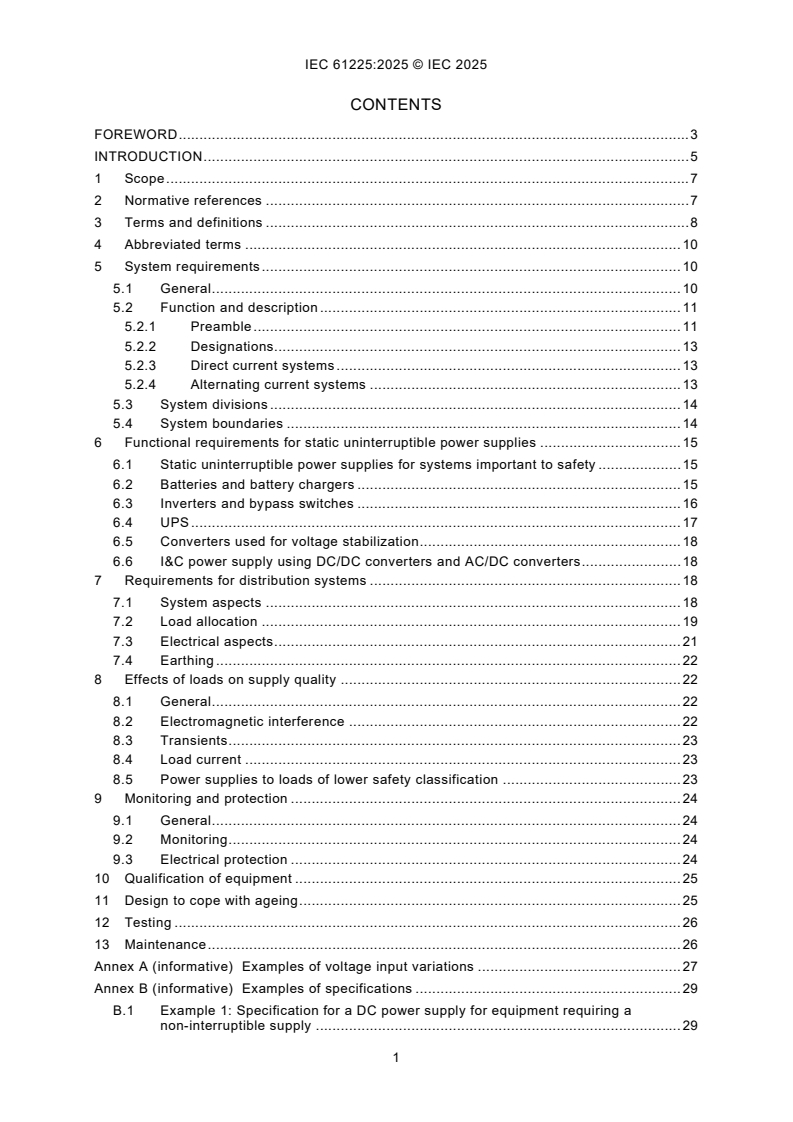
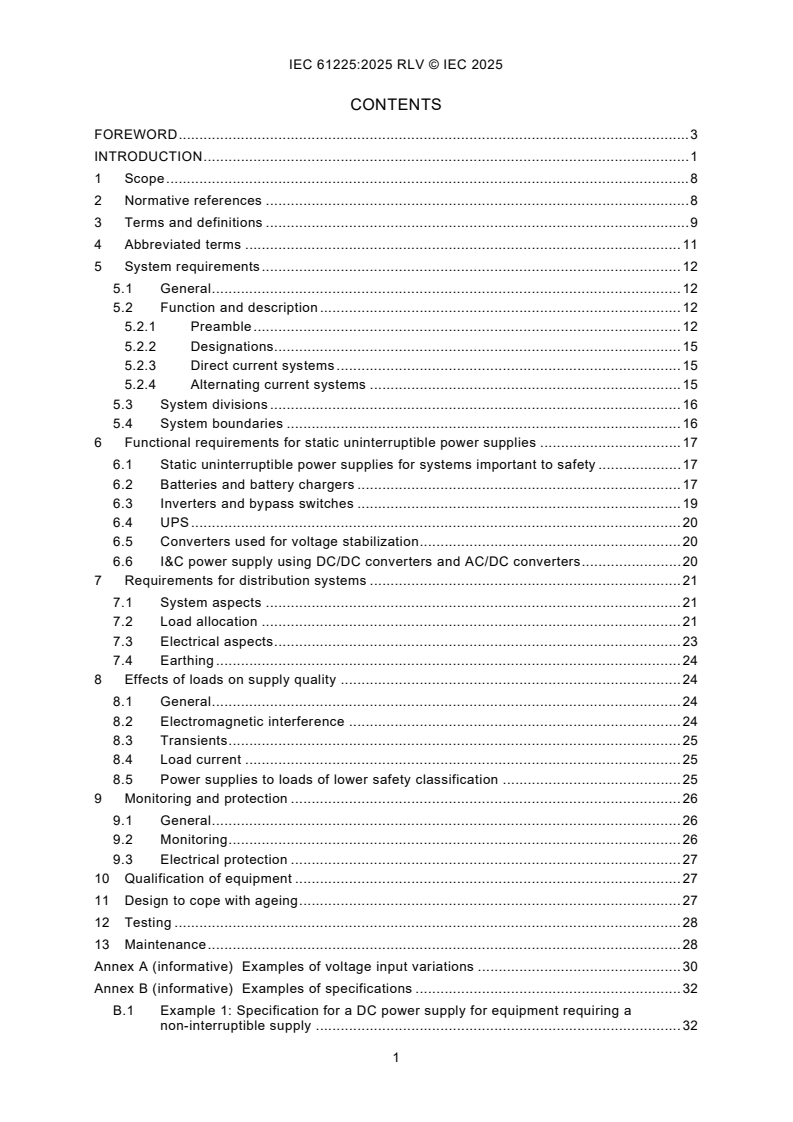
CONTENTS
FOREWORD . 3
INTRODUCTION . 5
1 Scope . 7
2 Normative references . 7
3 Terms and definitions . 8
4 Abbreviated terms . 10
5 System requirements . 10
5.1 General . 10
5.2 Function and description . 11
5.2.1 Preamble . 11
5.2.2 Designations. 13
5.2.3 Direct current systems . 13
5.2.4 Alternating current systems . 13
5.3 System divisions . 14
5.4 System boundaries . 14
6 Functional requirements for static uninterruptible power supplies . 15
6.1 Static uninterruptible power supplies for systems important to safety . 15
6.2 Batteries and battery chargers . 15
6.3 Inverters and bypass switches . 16
6.4 UPS . 17
6.5 Converters used for voltage stabilization . 18
6.6 I&C power supply using DC/DC converters and AC/DC converters . 18
7 Requirements for distribution systems . 18
7.1 System aspects . 18
7.2 Load allocation . 19
7.3 Electrical aspects . 21
7.4 Earthing . 22
8 Effects of loads on supply quality . 22
8.1 General . 22
8.2 Electromagnetic interference . 22
8.3 Transients . 23
8.4 Load current . 23
8.5 Power supplies to loads of lower safety classification . 23
9 Monitoring and protection . 24
9.1 General . 24
9.2 Monitoring . 24
9.3 Electrical protection . 24
10 Qualification of equipment . 25
11 Design to cope with ageing . 25
12 Testing . 26
13 Maintenance . 26
Annex A (informative) Examples of voltage input variations . 27
Annex B (informative) Examples of specifications . 29
B.1 Example 1: Specification for a DC power supply for equipment requiring a
non-interruptible supply . 29
B.2 Example 2: Specification for AC power supply for equipment requiring a non-
interruptible supply . 30
B.3 Example 3: Specification for DC power supply with DC/DC converter for
equipment . 31
B.4 Human factor engineering programme . 32
Annex C (normative) Uninterruptible power supplies and distribution systems for
power plants with passive design and SMRs . 33
C.1 General . 33
C.2 Recommendations and requirements . 34
C.3 Safety assessment . 34
Bibliography . 35
Figure 1 – Boundary of a SUPS . 12
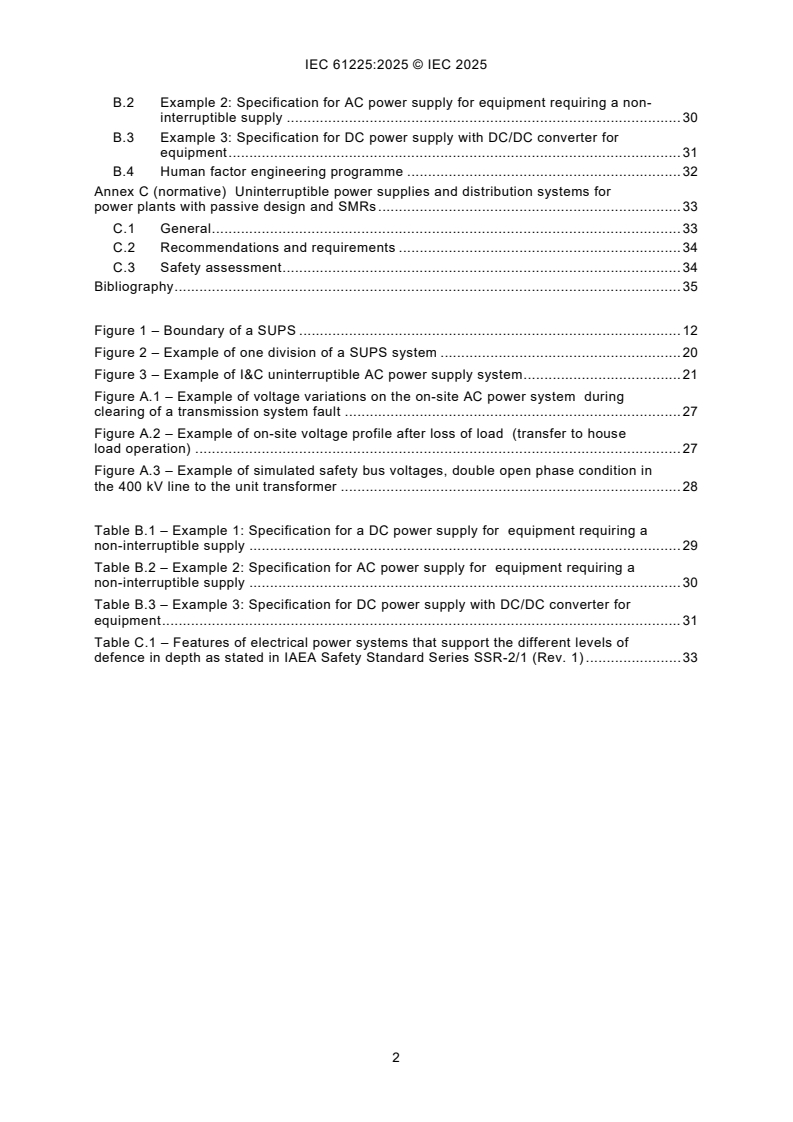
Figure 2 – Example of one division of a SUPS system . 20
Figure 3 – Example of I&C uninterruptible AC power supply system . 21
Figure A.1 – Example of voltage variations on the on-site AC power system during
clearing of a transmission system fault . 27
Figure A.2 – Example of on-site voltage profile after loss of load (transfer to house
load operation) . 27
Figure A.3 – Example of simulated safety bus voltages, double open phase condition in
the 400 kV line to the unit transformer . 28
Table B.1 – Example 1: Specification for a DC power supply for equipment requiring a
non-interruptible supply . 29
Table B.2 – Example 2: Specification for AC power supply for equipment requiring a
non-interruptible supply . 30
Table B.3 – Example 3: Specification for DC power supply with DC/DC converter for
equipment . 31
Table C.1 – Features of electrical power systems that support the different levels of
defence in depth as stated in IAEA Safety Standard Series SSR-2/1 (Rev. 1) . 33
INTERNATIONAL ELECTROTECHNICAL COMMISSION
____________
Nuclear power plants - Instrumentation, control and electrical power
systems - Requirements for static uninterruptible DC and AC
power supply systems
FOREWORD
1) The International Electrotechnical Commission (IEC) is a worldwide organization for standardization comprising
all national electrotechnical committees (IEC National Committees). The object of IEC is to promote international
co-operation on all questions concerning standardization in the electrical and electronic fields. To this end and
in addition to other activities, IEC publishes International Standards, Technical Specifications, Technical Reports,
Publicly Available Specifications (PAS) and Guides (hereafter referred to as "IEC Publication(s)"). Their
preparation is entrusted to technical committees; any IEC National Committee interested in the subject dealt with
may participate in this preparatory work. International, governmental and non-governmental organizations liaising
with the IEC also participate in this preparation. IEC collaborates closely with the International Organization for
Standardization (ISO) in accordance with conditions determined by agreement between the two organizations.
2) The formal decisions or agreements of IEC on technical matters express, as nearly as possible, an international
consensus of opinion on the relevant subjects since each technical committee has representation from all
interested IEC National Committees.
3) IEC Publications have the form of recommendations for international use and are accepted by IEC National
Committees in that sense. While all reasonable efforts are made to ensure that the technical content of IEC
Publications is accurate, IEC cannot be held responsible for the way in which they are used or for any
misinterpretation by any end user.
4) In order to promote international uniformity, IEC National Committees undertake to apply IEC Publications
transparently to the maximum extent possible in their national and regional publications. Any divergence between
any IEC Publication and the corresponding national or regional publication shall be clearly indicated in the latter.
5) IEC itself does not provide any attestation of conformity. Independent certification bodies provide conformity
assessment services and, in some areas, access to IEC marks of conformity. IEC is not responsible for any
services carried out by independent certification bodies.
6) All users should ensure that they have the latest edition of this publication.
7) No liability shall attach to IEC or its directors, employees, servants or agents including individual experts and
members of its technical committees and IEC National Committees for any personal injury, property damage or
other damage of any nature whatsoever, whether direct or indirect, or for costs (including legal fees) and
expenses arising out of the publication, use of, or reliance upon, this IEC Publication or any other IEC
Publications.
8) Attention is drawn to the Normative references cited in this publication. Use of the referenced publications is
indispensable for the correct application of this publication.
9) IEC draws attention to the possibility that the implementation of this document may involve the use of (a)
patent(s). IEC takes no position concerning the evidence, validity or applicability of any claimed patent rights in
respect thereof. As of the date of publication of this document, IEC had not received notice of (a) patent(s), which
may be required to implement this document. However, implementers are cautioned that this may not represent
the latest information, which may be obtained from the patent database available at https://patents.iec.ch. IEC
shall not be held responsible for identifying any or all such patent rights.
IEC 61225 has been prepared by subcommittee 45A: Instrumentation, control and electrical
power systems of nuclear facilities, of IEC technical committee 45: Nuclear instrumentation. It
is an International Standard.
This fourth edition cancels and replaces the third edition published in 2019. This edition
constitutes a technical revision.
This edition includes the following significant technical changes with respect to the previous
edition:
a) expansion and clarification of the requirements for static uninterruptible DC and AC power
supply systems to ease the application in SMRs and passive designs.
This International Standard is to be used in conjunction with IEC 61513:2011, IEC 60709:2018,
IEC 60880:2006, IEC 62138:2018, IEC 62855:2016 and IEC 63046:2020.
The text of this International Standard is based on the following documents:
Draft Report on voting
45A/1591/FDIS 45A/1610/RVD
Full information on the voting for its approval can be found in the report on voting indicated in
the above table.
The language used for the development of this International Standard is English.
This document was drafted in accordance with ISO/IEC Directives, Part 2, and developed in
accordance with ISO/IEC Directives, Part 1 and ISO/IEC Directives, IEC Supplement, available
at www.iec.ch/members_experts/refdocs. The main document types developed by IEC are
described in greater detail at www.iec.ch/publications.
The committee has decided that the contents of this document will remain unchanged until the
stability date indicated on the IEC website under webstore.iec.ch in the data related to the
specific document. At this date, the document will be
• reconfirmed,
• withdrawn, or
• revised.
INTRODUCTION
a) Technical background, main issues and organization of the standard
The 1993 issue of IEC 61225 was developed for specifying the requirements relevant to the
design of electrical supplies for I&C systems in nuclear power plants. Considering the
experience gathered worldwide on this subject, in 2003 working group A2 recommended a
revision to this document to allow a new revision, IEC 61225 Ed. 2 (2005), to be consistently
integrated into the SC 45A standard series. In 2015, working group A11 recommended a
revision to this document following the publication of the revision of IAEA SSG-34 and that the
scope of the standard should cover static uninterruptible power supplies for all types of
connected equipment. In 2022, working group A11 recommended a revision to this document
to ease the application to SMRs and passive designs.
International operating experience with electrical supply systems in nuclear power plants has
highlighted a number of supply voltage variations and malfunctions, such as:
• voltage perturbations due to disturbances on the internal AC distribution system (with origin
off-site or on-site).
• voltage overshoot on loss of grid.
• open phase conditions (one or two phases).
• asymmetrical faults.
These types of perturbations can degrade the performance of static uninterruptible power
supplies and ultimately result in failure of connected equipment.
One of the objectives of the uninterruptible power supplies is to protect connected equipment
from voltage variations on the on-site AC interruptible distribution system (the immunity
concept). The power supplies also guarantee an output voltage with specified magnitude and
waveform (in case of AC) to connected loads. The power supplies have the capacity to supply
the relevant loads during a specified time regardless of any voltage variations on the on-site
AC interruptible distribution system.
Examples of voltage and frequency variations in the incoming feeder to the supplies can be
found in informative Annex A. Examples of specifications for static uninterruptible power
supplies can be found in informative Annex B. Requirements for SMRs and passive designs are
given in Annex C.
This document is applicable to the design of static uninterruptible electrical power supplies in
new nuclear power plants (including SMRs and passive designs) when design work is initiated
after the publication of this document and in general for nuclear facilities. It also serves as a
reference for upgrading and modernizing existing nuclear power plants and facilities.
b) Situation of the current standard in the structure of the SC 45A standard series
IEC 61225 is a second level document specifically addressing the particular topic of
requirements for electrical supplies.
For more details on the structure of the SC 45A standard series, see item d) of this introduction.
c) Recommendations and limitations regarding the application of this document
It is important to note that this document establishes no additional functional requirements for
safety systems.
To ensure that the standard will continue to be relevant in future years, the emphasis has been
placed on issues of principle, rather than specific technologies.
d) Description of the structure of the IEC SC 45A standard series and relationships with
other IEC documents and other bodies documents (IAEA, ISO)
The top-level documents of the IEC SC 45A standard series are IEC 61513 and IEC 63046.
IEC 61513 provides general requirements for I&C systems and equipment that are used to
perform functions important to safety in NPPs. IEC 63046 provides general requirements for
electrical power systems of NPPs; it covers power supply systems including the supply systems
of the I&C systems. IEC 61513 and IEC 63046 are to be considered in conjunction and at the
same level. IEC 61513 and IEC 63046 structure the IEC SC 45A standard series and shape a
complete framework establishing general requirements for instrumentation, control and
electrical systems for nuclear power plants.
IEC 61513 and IEC 63046 refer directly to other IEC SC 45A standards for general topics
related to the categorization of functions and the classification of systems, qualification,
separation, defence against common cause failure, control room design, electromagnetic
compatibility, cybersecurity, software and hardware aspects for programmable digital systems,
coordination of safety and security requirements and management of ageing. The standards
referenced directly at this second level should be considered together with IEC 61513 and
IEC 63046 as a consistent document set.
At a third level, IEC SC 45A standards not directly referenced by IEC 61513 or by IEC 63046
are standards related to specific equipment, technical methods, or specific activities. Usually
these documents, which make reference to second-level documents for general topics, can be
used on their own.
A fourth level extending the IEC SC 45 standard series, corresponds to the Technical Reports
which are not normative.
The IEC SC 45A standards series consistently implements and details the safety and security
principles and basic aspects provided in the relevant IAEA safety standards and in the relevant
documents of the IAEA nuclear security series (NSS). In particular this includes the IAEA
requirements SSR-2/1, establishing safety requirements related to the design of nuclear power
plants (NPPs), the IAEA safety guide SSG-30 dealing with the safety classification of structures,
systems and components in NPPs, the IAEA safety guide SSG-39 dealing with the design of
instrumentation and control systems for NPPs, the IAEA safety guide SSG-34 dealing with the
design of electrical power systems for NPPs and the implementing guide NSS17 for computer
security at nuclear facilities. The safety and security terminology and definitions used by
SC 45A standards are consistent with those used by the IAEA.
IEC 61513 and IEC 63046 have adopted a presentation format similar to the basic safety
publication IEC 61508 with an overall life-cycle framework and a system life-cycle framework.
Regarding nuclear safety, IEC 61513 and IEC 63046 provide the interpretation of the general
requirements of IEC 61508-1, IEC 61508-2 and IEC 61508-4, for the nuclear application sector.
In this framework IEC 60880, IEC 62138 and IEC 62566 correspond to IEC 61508-3 for the
nuclear application sector. IEC 61513 and IEC 63046 refer to ISO as well as to IAEA GS-R
part 2 and IAEA GS-G-3.1 and IAEA GS-G-3.5 for topics related to quality assurance (QA). At
level 2, regarding nuclear security, IEC 62645 is the entry document for the IEC/SC 45A
security standards. It builds upon the valid high-level principles and main concepts of the
generic security standards, in particular ISO/IEC 27001 and ISO/IEC 27002; it adapts them and
completes them to fit the nuclear context and coordinates with the IEC 62443 series. At level 2,
IEC 60964 is the entry document for the IEC/SC 45A control rooms standards and IEC 62342
is the entry document for the ageing management standards.
NOTE It is assumed that for the design of I&C systems in NPPs that implement conventional safety functions (e.g.
to address worker safety, asset protection, chemical hazards, and process energy hazards) international or national
standards are applied.
1 Scope
This document specifies the performance and the functional characteristics of the low voltage
static uninterruptible power supply (SUPS) systems in a nuclear power plant (NPP) and, when
applicable, in nuclear facilities in general. An uninterruptible power supply (UPS) is an electrical
equipment which draws electrical energy from a source, stores it, and maintains the supply in
a specified form by means inside the equipment to output terminals. A SUPS has no rotating
parts to perform its functions.
The specific design requirements for the components of the power supply system are covered
by IEC standards and other standards listed in the normative references. Otherwise, specific
component-level design requirements are outside the scope of this document.
2 Normative references
The following documents are referred to in the text in such a way that some or all of their content
constitutes requirements of this document. For dated references, only the edition cited applies.
For undated references, the latest edition of the referenced document (including any
amendments) applies.
IEC 60038, IEC standard voltages
IEC 60146-1-1, Semiconductor converters – General requirements and line commutated
converters – Part 1-1: Specification of basic requirements
IEC 60146-2, Semiconductor converters – Part 2: Self-commutated semiconductor converters
including direct d.c. converters
IEC 60364-4-41, Low voltage electrical installations – Part 4-41: Protection for safety –
Protection against electric shock
IEC 60709, Nuclear power plants – Instrumentation, control and electrical power systems
important to safety – Separation
IEC 61000 (all parts), Electromagnetic compatibility (EMC)
IEC 61513, Nuclear power plants – Instrumentation and control important to safety – General
requirements for systems
IEC 62003, Nuclear power plants – Instrumentation, control and electrical power systems –
Requirements for electromagnetic compatibility testing
IEC 62040 (all parts), Uninterruptible power systems (UPS)
IEC/IEEE 60780-323, Nuclear facilities – Electrical equipment important to safety –
Qualification
IEC/IEEE 60980-344, Nuclear facilities – Equipment important to safety – Seismic qualification
3 Terms and definitions
For the purposes of this document, the following terms and definitions apply.
NOTE Other terms not defined below are defined in IAEA Safety Guides SSG-34 and SSG-39.
ISO and IEC maintain terminological databases for use in standardization at the following
addresses:
• IEC Electropedia: available at http://www.electropedia.org/
• ISO Online browsing platform: available at http://www.iso.org/obp
3.1
anticipated operational occurrence
AOO
deviation of an operational process from normal operation that is expected to occur at least
once during the operating lifetime of a facility but which, in view of appropriate design
provisions, does not cause any significant damage to items important to safety or lead to
accident conditions
[SOURCE: IAEA Nuclear Safety and Security Glossary, 2022 (Interim) Edition]
3.2
battery charger
electrical item used to convert AC into DC to charge batteries and to supply power to DC loads
during normal operation
Note 1 to entry: The battery charger provides transformer isolation of the DC output from the AC input and is
equipped with regulation and monitoring.
[SOURCE: IEEE 946, 2004]
3.3
common cause failure
CCF
failure of two or more structures, systems or components due to a single specific event or cause
[SOURCE: IAEA Nuclear Safety and Security Glossary, 2022 (Interim) Edition]
3.4
common mode failure
CMF
failure of two or more structures, systems or components in the same manner or mode due to
a single specific event or cause
[SOURCE: IAEA Nuclear Safety and Security Glossary, 2022 (Interim) Edition]
3.5
diversity
presence of two or more independent (redundant) systems or components to perform an
identified function, where the different systems or components have different attributes so as
to reduce the possibility of common cause failure, including common mode failure
[SOURCE: IAEA Nuclear Safety and Security Glossary, 2022 (Interim) Edition]
3.6
division
collection of items, including their interconnections, that form one redundancy of a redundant
system or safety group
Note 1 to entry: Divisions can include multiple channels.
Note 2 to entry: Designation that enables the establishment and maintenance of physical, electrical, and functional
independence from other redundant sets of items.
[SOURCE: IAEA SSG-39, 2016]
3.7
item important to safety
item that is part of a safety group and/or whose malfunction or failure could lead to radiation
exposure of the site personnel or members of the public
Note 1 to entry: Items important to safety include those structures, systems and components whose malfunction
or failure could lead to undue radiation exposure of site personnel or members of the public;
[SOURCE: IAEA Nuclear Safety and Security Glossary, 2022 (Interim) Edition]
3.8
plant states
Operational states Accident conditions
Normal Anticipated operational Design basis Design extension conditions
operation occurrences accidents
Without significant fuel degradation With core melting
[SOURCE: IAEA Nuclear Safety and Security Glossary, 2022 (Interim) Edition]
3.9
redundancy
provision of alternative (identical or diverse) structures, systems and components, so that any
single structure, system or component can perform the required function regardless of the state
of operation or failure of any other
[SOURCE: IAEA Nuclear Safety and Security Glossary, 2022 (Interim) Edition]
3.10
single failure
failure which results in the loss of capability of a single system or component to perform its
intended safety function(s), and any consequential failure(s) which result from it
[SOURCE: IAEA Nuclear Safety and Security Glossary, 2022 (Interim) Edition]
3.11
single failure criterion
criterion (or requirement) applied to a system such that it must be capable of performing its task
in the presence of any single failure
[SOURCE: IAEA Nuclear Safety and Security Glossary, 2022 (Interim) Edition]
4 Abbreviated terms
AC alternating current
CCF common cause failure
CMF common mode failure
DC direct current
EMC electromagnetic compatibility
EMP electromagnetic pulse
I&C instrumentation and control
IGBT insulated-gate bipolar transistor
NPP nuclear power plant
SMR small modular reactor
SUPS static uninterruptible power supply
UPS uninterruptible power supply
5 System requirements
5.1 General
This document defines requirements for reliable and robust SUPS systems in nuclear facilities
including NPPs. In general, more stringent criteria are applied to items important to safety, such
as power supplies, requiring additional verifications. However, the entire on-site and off-site
power systems contribute to the reliability and robustness of the nuclear facilities power system.
The same requirements should be applied to SUPS systems regardless of their importance to
safety with a graded approach to verification and validation.
For SMRs and power plants with passive designs, the term "(highly) reliable power supply" is
often used instead of "power supply important to safety". Provisions for power supplies
important to safety apply in general for a reliable power system. These supplies are required
for monitoring and actuation (if necessary) of systems important to safety.
Robust power supply systems shall have sufficient margins and built-in conservatism to ensure
that:
• equipment ratings, capabilities and capacities required to meet intended goals are not
exceeded during all postulated conditions considered in the safety case;
• equipment protection set points are selected to accommodate anticipated perturbations in
the nuclear facility's electrical distribution system during all modes of operation and plant
states;
• the equipment has the capacity and capability to support emergency operations.
The design of the power supplies shall include analysis of:
• transient, dynamic, and quasi-stationary variations in voltage and frequency (in case of AC
power source);
• power interruptions on the incoming feeder (see 5.2.2) (or voltage or frequency dips
exceeding the allowed dynamic variation range) lasting from milliseconds up to extended
loss of all AC interruptible power supplies;
• asymmetrical conditions;
• independence of redundant parts of the power supply system and resilience against
common cause failures (CCFs).
5.2 Function and description
5.2.1 Preamble
The SUPS system shall provide a continuous uninterruptible supply to each connected load
within the specified tolerances of voltage, and (for AC systems) waveform and frequency for all
input conditions. The system required to perform safety functions shall have sufficient
independence, redundancy and testability assuming a single failure in the system.
A SUPS generally consists of one or both of the following systems (see Figure 1):
• a DC power system with battery chargers and batteries, supplying DC loads.
• an AC power system with battery chargers, back-up batteries, static switches, and inverters,
supplying AC loads.
In certain designs the battery chargers and batteries can be common to both the DC and AC
power systems.
The functions and the classification of the power supplies should be designated according to
the safety classification scheme of the NPP. In general, the classification should be based on
the highest classification of the load supplied by the power supply as discussed in 7.2.
The constraints on connecting loads with different classifications are discussed in 8.5.
NOTE DC/DC converters, AC/DC converters, and converters for voltage stabilization and maintenance bypass of the AC power supply system are not shown. Uninterruptible
AC power supply can also be provided by an UPS. An UPS is normally an integrated assembly of battery charger, battery and inverter as shown on the right-hand side of the
figure.
a
The box represents:
– a direct connection;
– a transformer; or
– a regulated transformer.
Figure 1 – Boundary of a SUPS
5.2.2 Designations
Incoming feeder: the SUPS has an incoming feeder, generally from a low voltage AC power bus
which is normally part of the electrical safety buses .
Outgoing feeder: the SUPS utilizes a set of battery charger and battery or battery charger,
battery and inverter system with an outgoing feeder that is connected to the distribution system.
The SUPS supplies the loads from a distribution system (see Figure 1).
5.2.3 Direct current systems
Each division of an uninterruptible DC power supply system shall consist of at least:
• a battery;
• a battery charger;
• a distribution system.
In order to increase the availability and the robustness of the division, but also for increased
maintenance flexibility, the provision of internal redundancy in each division should be
considered. The provision of redundancy is discussed in 5.3.
The DC power supply system shall supply the DC loads during normal operation (including
outages), anticipated operational occurrences, accident conditions and all plant states
considered in the safety case.
The DC power supply system shall supply the DC loads for a specified minimum duration
defined by the safety case when power is lost on the incoming feeder with no perturbation of
the outgoing feeder voltage outside specified tolerances.
5.2.4 Alternating current systems
Each division of an uninterruptible AC power supply system shall consist of:
• a power supply from a DC power system to an inverter;
• alternatively, a power supply from an interruptible AC bus, a dedicated battery charger, a
battery and an inverter;
• a distribution system.
A back-up power supply to the distribution system from an interruptible AC bus shall be installed
together with a device for automatically switching between the power supply from the inverter
and the back-up supply. Additionally, a maintenance bypass should be implemented.
To increase the availability and the robustness of the division and for more flexibility for
maintenance, the provision of internal redundancy should be considered as discussed in 5.3.
The uninterruptible AC power supply system shall supply the AC loads during normal operation
(including outages), anticipated operational occurrences, accident conditions and all plant
states considered in the safety case.
The uninterruptible AC power supply system shall supply the AC loads for a specified minimum
duration, defined by the safety case, when power is lost on the incoming feeder with no
perturbation of the outgoing feeder voltage outside specified tolerances.
___________
See figures in IAEA SSG-34.
Due to the higher reliability of DC systems, supplying an I&C system of importance to safety
from the DC system should be considered. If determined by the safety case, a double infeed
combining DC and AC supply for each train should be used to minimize the risks of common
mode failure.
The design should consider the use of DC loads supplied by DC supply. Avoiding use of
uninterruptible AC power supply system eliminates a source of failure in the critical power
supply system.
5.3 System divisions
The DC power supply system and the AC power supply system shall be divided into redundant
and independent divisions. Loads important to safety shall be supplied from at least one
dedicated supply source for each division, to ensure physical and functional separation. The
required number of redundant sources depends on the design of the reactor protection system
and the redundancy in the NPP design.
The power supplies for loads important to safety covered by this document shall be in
accordance with the single failure criterion as described in IEC 61513 and the requirements on
separation and failure tolerance described in IEC 60709.
AC and DC systems that are important to safety should not be shared between units.
Any deviations from the divisional structure and proposals to share facilities for highly reliable
AC and DC systems in SMR modules or modules of passive designs should be supported by
safety assessment. This safety assessment shall demonstrate that single failure criteria is met,
that faults should not propagate between units or modules, maintenance activities can be
performed safely and that there is no risk of common cause failure. When AC or DC systems
are shared, operating constraints should be considered for impact on overall operation of units
or modules when maintenance or surveillance actions are necessary.
The functional diversity of AC and DC systems shall be considered for I&C power supplies to
improve the availability of the overall power supply. The principle of independence and diversity
shall be applied to protect against credible CCFs that can affect redundant parts which
originate:
• in the equipment itself;
• from switching surges;
• from either voltage or frequency excursions, or both.
Examples of such events are given in Annex A.
The possibility of CCF shall be taken into account, e.g. by analysis and provision of defence in
depth, in the design, maintenance, testing and operation of the system.
5.4 System boundaries
This document covers the power supply system from the outgoing terminals of the breaker to
the battery charger up to the incoming breakers to each individual load (see Figure 1).
Within the limits specified in Figure 1, each system includes equipment such as transformers,
converters, battery chargers, inverters, cables, isolation devices, distribution boards,
switchover devices, central and local batteries, as well as switching, monitoring and protection
equipment.
If necessary, a load with lower safety classification within the same division can be supplied
from a bus supplying higher safety-classified equipment subject to the provisions described
in 8.5.
6 Functional requirements for static uninterruptible power supplies
6.1 Static uninterruptible power supplies for systems important to safety
The SUPS can be subjected to electrical perturbations on the incoming feeder due to external
effects such as lightning or switching surges in the electrical system. These transients should
be identified and mitigated by external protection to protect the SUPS against these
perturbations. The SUPS can also be subjected to internal electrical perturbations such as
voltage dip or swell. The design of the SUPS shall prevent perturbations outside acceptable
limits from affecting the outgoing feeder and distribution system voltage (or frequency when
applicable).
The output voltage to the loads (whether AC or DC) shall be maintained within specified limits
following a loss and restoration of power on the incoming feeder. The loads should be assessed
for their tolerance to short interruptions of power during change-over operations. The
assessments should ensure that momentary loss of power does not have an adverse impact on
plant safety or result in a perturbation in plant operation.
Electromagnetic compatibility (EMC) requirements shall be taken into account, e.g. by analysis,
and adequate immunity shall be demonstrated. Components being used in the power supply for
SUPS systems shall comply with the disturbance immunity requirements specified in
IEC 62003.
NOTE The fundamental EMC standard for UPS (see 6.4) is IEC 62040 in conjunction with IEC 61000-6-2 and
IEC 61000-6-4. For power plants IEC 61000-6-5 applies, but the design bases for the NPP can be more severe than
the standard.
The risk of software failure or CCF in digital equipment used in the control and monitoring of
UPS supplies should be reduced to an acceptable level consistent with its safety case by
appropriate software design, categorisation, verification, and validation. Diverse design of
hardware and software should be considered.
Guidelines on software design, validation, and verification are contained in IEC 60880 (for
systems performing category A functions), IEC 62138 (for systems performing category B or C
functions), IEC 62566 and IEC 62566-2.
6.2 Batteries and battery chargers
To maintain an uninterruptible DC electrical supply the battery and battery charger shall both
be permanently connected to their associated bus. The battery and battery charger capability
shall be adequate to supply the connected loads (including transient and intermittent loads) and
maintain the supply for the specified minimum time.
The battery charger shall have sufficient capacity to simultaneously:
• restore the battery from a discharged condition to a float-charged state within an acceptable
time whilst maintaining the acceptable voltage range of consumers,
• supply the maximum postulated demands of all the connected loads after an initiating loss
of normal power.
If rapid charging of the battery is considered, the consequences of the higher voltage should
be investigated to verify that there are no adverse effects on the connected consumers.
Each battery
...
IEC 61225 ®
Edition 4.0 2025-07
INTERNATIONAL
STANDARD
REDLINE VERSION
Nuclear power plants - Instrumentation, control and electrical power systems -
Requirements for static uninterruptible DC and AC power supply systems
ICS 27.120.20 ISBN 978-2-8327-0575-9
All rights reserved. Unless otherwise specified, no part of this publication may be reproduced or utilized in any form or
by any means, electronic or mechanical, including photocopying and microfilm, without permission in writing from either
IEC or IEC's member National Committee in the country of the requester. If you have any questions about IEC copyright
or have an enquiry about obtaining additional rights to this publication, please contact the address below or your local
IEC member National Committee for further information.
IEC Secretariat Tel.: +41 22 919 02 11
3, rue de Varembé info@iec.ch
CH-1211 Geneva 20 www.iec.ch
Switzerland
About the IEC
The International Electrotechnical Commission (IEC) is the leading global organization that prepares and publishes
International Standards for all electrical, electronic and related technologies.
About IEC publications
The technical content of IEC publications is kept under constant review by the IEC. Please make sure that you have the
latest edition, a corrigendum or an amendment might have been published.
IEC publications search - IEC Products & Services Portal - products.iec.ch
webstore.iec.ch/advsearchform Discover our powerful search engine and read freely all the
The advanced search enables to find IEC publications by a publications previews, graphical symbols and the glossary.
variety of criteria (reference number, text, technical With a subscription you will always have access to up to date
committee, …). It also gives information on projects, content tailored to your needs.
replaced and withdrawn publications.
Electropedia - www.electropedia.org
The world's leading online dictionary on electrotechnology,
IEC Just Published - webstore.iec.ch/justpublished
Stay up to date on all new IEC publications. Just Published containing more than 22 500 terminological entries in English
details all new publications released. Available online and and French, with equivalent terms in 25 additional languages.
once a month by email. Also known as the International Electrotechnical Vocabulary
(IEV) online.
IEC Customer Service Centre - webstore.iec.ch/csc
If you wish to give us your feedback on this publication or
need further assistance, please contact the Customer
Service Centre: sales@iec.ch.
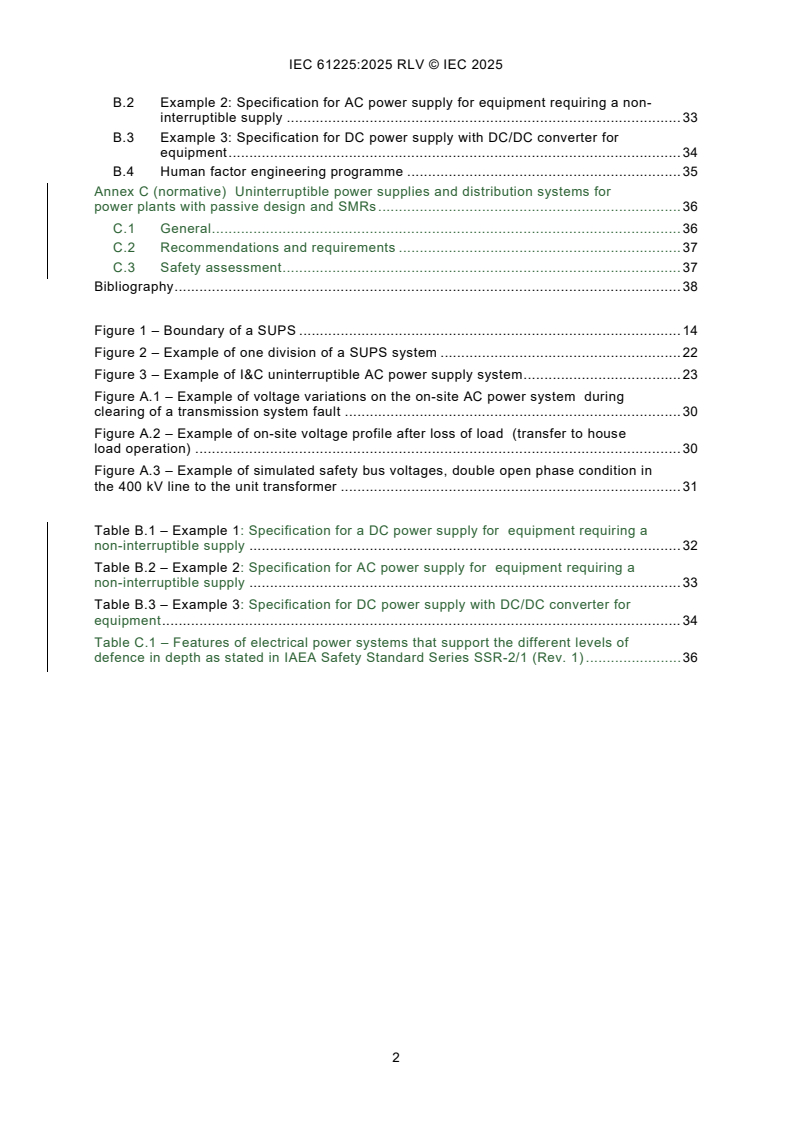
CONTENTS
FOREWORD . 3
INTRODUCTION . 1
1 Scope . 8
2 Normative references . 8
3 Terms and definitions . 9
4 Abbreviated terms . 11
5 System requirements . 12
5.1 General . 12
5.2 Function and description . 12
5.2.1 Preamble . 12
5.2.2 Designations. 15
5.2.3 Direct current systems . 15
5.2.4 Alternating current systems . 15
5.3 System divisions . 16
5.4 System boundaries . 16
6 Functional requirements for static uninterruptible power supplies . 17
6.1 Static uninterruptible power supplies for systems important to safety . 17
6.2 Batteries and battery chargers . 17
6.3 Inverters and bypass switches . 19
6.4 UPS . 20
6.5 Converters used for voltage stabilization . 20
6.6 I&C power supply using DC/DC converters and AC/DC converters . 20
7 Requirements for distribution systems . 21
7.1 System aspects . 21
7.2 Load allocation . 21
7.3 Electrical aspects . 23
7.4 Earthing . 24
8 Effects of loads on supply quality . 24
8.1 General . 24
8.2 Electromagnetic interference . 24
8.3 Transients . 25
8.4 Load current . 25
8.5 Power supplies to loads of lower safety classification . 25
9 Monitoring and protection . 26
9.1 General . 26
9.2 Monitoring . 26
9.3 Electrical protection . 27
10 Qualification of equipment . 27
11 Design to cope with ageing . 27
12 Testing . 28
13 Maintenance . 28
Annex A (informative) Examples of voltage input variations . 30
Annex B (informative) Examples of specifications . 32
B.1 Example 1: Specification for a DC power supply for equipment requiring a
non-interruptible supply . 32
B.2 Example 2: Specification for AC power supply for equipment requiring a non-
interruptible supply . 33
B.3 Example 3: Specification for DC power supply with DC/DC converter for
equipment . 34
B.4 Human factor engineering programme . 35
Annex C (normative) Uninterruptible power supplies and distribution systems for
power plants with passive design and SMRs . 36
C.1 General . 36
C.2 Recommendations and requirements . 37
C.3 Safety assessment . 37
Bibliography . 38
Figure 1 – Boundary of a SUPS . 14
Figure 2 – Example of one division of a SUPS system . 22
Figure 3 – Example of I&C uninterruptible AC power supply system . 23
Figure A.1 – Example of voltage variations on the on-site AC power system during
clearing of a transmission system fault . 30
Figure A.2 – Example of on-site voltage profile after loss of load (transfer to house
load operation) . 30
Figure A.3 – Example of simulated safety bus voltages, double open phase condition in
the 400 kV line to the unit transformer . 31
Table B.1 – Example 1: Specification for a DC power supply for equipment requiring a
non-interruptible supply . 32
Table B.2 – Example 2: Specification for AC power supply for equipment requiring a
non-interruptible supply . 33
Table B.3 – Example 3: Specification for DC power supply with DC/DC converter for
equipment . 34
Table C.1 – Features of electrical power systems that support the different levels of
defence in depth as stated in IAEA Safety Standard Series SSR-2/1 (Rev. 1) . 36
INTERNATIONAL ELECTROTECHNICAL COMMISSION
____________
Nuclear power plants - instrumentation, control and electrical power
systems - requirements for static uninterruptible dc and ac
power supply systems
FOREWORD
1) The International Electrotechnical Commission (IEC) is a worldwide organization for standardization comprising
all national electrotechnical committees (IEC National Committees). The object of IEC is to promote international
co-operation on all questions concerning standardization in the electrical and electronic fields. To this end and
in addition to other activities, IEC publishes International Standards, Technical Specifications, Technical Reports,
Publicly Available Specifications (PAS) and Guides (hereafter referred to as "IEC Publication(s)"). Their
preparation is entrusted to technical committees; any IEC National Committee interested in the subject dealt with
may participate in this preparatory work. International, governmental and non-governmental organizations liaising
with the IEC also participate in this preparation. IEC collaborates closely with the International Organization for
Standardization (ISO) in accordance with conditions determined by agreement between the two organizations.
2) The formal decisions or agreements of IEC on technical matters express, as nearly as possible, an international
consensus of opinion on the relevant subjects since each technical committee has representation from all
interested IEC National Committees.
3) IEC Publications have the form of recommendations for international use and are accepted by IEC National
Committees in that sense. While all reasonable efforts are made to ensure that the technical content of IEC
Publications is accurate, IEC cannot be held responsible for the way in which they are used or for any
misinterpretation by any end user.
4) In order to promote international uniformity, IEC National Committees undertake to apply IEC Publications
transparently to the maximum extent possible in their national and regional publications. Any divergence between
any IEC Publication and the corresponding national or regional publication shall be clearly indicated in the latter.
5) IEC itself does not provide any attestation of conformity. Independent certification bodies provide conformity
assessment services and, in some areas, access to IEC marks of conformity. IEC is not responsible for any
services carried out by independent certification bodies.
6) All users should ensure that they have the latest edition of this publication.
7) No liability shall attach to IEC or its directors, employees, servants or agents including individual experts and
members of its technical committees and IEC National Committees for any personal injury, property damage or
other damage of any nature whatsoever, whether direct or indirect, or for costs (including legal fees) and
expenses arising out of the publication, use of, or reliance upon, this IEC Publication or any other IEC
Publications.
8) Attention is drawn to the Normative references cited in this publication. Use of the referenced publications is
indispensable for the correct application of this publication.
9) IEC draws attention to the possibility that the implementation of this document may involve the use of (a)
patent(s). IEC takes no position concerning the evidence, validity or applicability of any claimed patent rights in
respect thereof. As of the date of publication of this document, IEC had not received notice of (a) patent(s), which
may be required to implement this document. However, implementers are cautioned that this may not represent
the latest information, which may be obtained from the patent database available at https://patents.iec.ch. IEC
shall not be held responsible for identifying any or all such patent rights.
This redline version of the official IEC Standard allows the user to identify the changes made
to the previous edition IEC 61225:2019. A vertical bar appears in the margin wherever a change
has been made. Additions are in green text, deletions are in strikethrough red text.
IEC 61225 has been prepared by subcommittee 45A: Instrumentation, control and electrical
power systems of nuclear facilities, of IEC technical committee 45: Nuclear instrumentation. It
is an International Standard.
This fourth edition cancels and replaces the third edition published in 2019. This edition
constitutes a technical revision.
This edition includes the following significant technical changes with respect to the previous
edition:
a) expansion and clarification of the requirements for static uninterruptible DC and AC power
supply systems to ease the application in SMRs and passive designs.
This International Standard is to be used in conjunction with IEC 61513:2011, IEC 60709:2018,
IEC 60880:2006, IEC 62138:2018, IEC 62855:2016 and IEC 63046:2020.
The text of this International Standard is based on the following documents:
Draft Report on voting
45A/1591/FDIS 45A/1610/RVD
Full information on the voting for its approval can be found in the report on voting indicated in
the above table.
The language used for the development of this International Standard is English.
This document was drafted in accordance with ISO/IEC Directives, Part 2, and developed in
accordance with ISO/IEC Directives, Part 1 and ISO/IEC Directives, IEC Supplement, available
at www.iec.ch/members_experts/refdocs. The main document types developed by IEC are
described in greater detail at www.iec.ch/publications.
The committee has decided that the contents of this document will remain unchanged until the
stability date indicated on the IEC website under webstore.iec.ch in the data related to the
specific document. At this date, the document will be
• reconfirmed,
• withdrawn, or
• revised.
INTRODUCTION
a) Technical background, main issues and organization of the standard
The 1993 issue of IEC 61225 was developed for specifying the requirements relevant to the
design of electrical supplies for I&C systems in nuclear power plants. Considering the
experience gathered worldwide on this subject, in 2003 working group A2 recommended a
revision to this document so that to allow a new revision, IEC 61225 Ed. 2 (2005), could to be
consistently integrated into the SC 45A standard series. In 2015, working group A11
recommended a revision to this document following the publication of the revision of IAEA SSG-
34 and that the scope of the standard should cover static uninterruptible power supplies for all
types of connected equipment. In 2022, working group A11 recommended a revision to this
document to ease the application to SMRs and passive designs.
International operating experience with electrical supply systems in nuclear power plants has
highlighted a number of supply voltage variations and malfunctions, such as:
• voltage perturbations due to disturbances on the internal AC distribution system (with origin
off-site or on-site).
• voltage overshoot on loss of grid.
• open phase conditions (one or two phases).
• asymmetrical faults.
These types of perturbations can degrade the performance of static uninterruptible power
supplies and ultimately result in failure of connected equipment.
One of the objectives of the uninterruptible power supplies is to protect connected equipment
from voltage variations on the on-site AC interruptible distribution system (the immunity
concept). The power supplies shall also guarantee an output voltage with specified magnitude
and waveform (in case of AC) to connected loads. The power supplies shall have the capacity
to supply the relevant loads during a specified time regardless of any voltage variations on the
on-site AC interruptible distribution system.
Examples of voltage and frequency variations in the incoming feeder to the supplies can be
found in informative Annex A. Examples of specifications for static uninterruptible power
supplies can be found in informative Annex B. Requirements for SMRs and passive designs are
given in Annex C.
This document is applicable to the design of static uninterruptible electrical power supplies in
new nuclear power plants (including SMRs and passive designs) when design work is initiated
after the publication of this document and in general for nuclear facilities. It also serves as a
reference for upgrading and modernizing existing nuclear power plants and facilities.
b) Situation of the current standard in the structure of the SC 45A standard series
IEC 61225 is a second level document specifically addressing the particular topic of
requirements for electrical supplies.
For more details on the structure of the SC 45A standard series, see item d) of this introduction.
c) Recommendations and limitations regarding the application of this document
It is important to note that this document establishes no additional functional requirements for
safety systems.
To ensure that the standard will continue to be relevant in future years, the emphasis has been
placed on issues of principle, rather than specific technologies.
This standard is to be applied in conjunction with IEC 61513, IEC 60709, IEC 60880,
IEC 62138, IEC 62855 and IEC 63046 (to be published).
d) Description of the structure of the IEC SC 45A standard series and relationships with
other IEC documents and other bodies documents (IAEA, ISO)
The top-level documents of the IEC SC 45A standard series are IEC 61513 and IEC 63046.
IEC 61513 provides general requirements for I&C systems and equipment that are used to
perform functions important to safety in NPPs. IEC 63046 provides general requirements for
electrical power systems of NPPs; it covers power supply systems including the supply systems
of the I&C systems. IEC 61513 and IEC 63046 are to be considered in conjunction and at the
same level. IEC 61513 and IEC 63046 structure the IEC SC 45A standard series and shape a
complete framework establishing general requirements for instrumentation, control and
electrical systems for nuclear power plants.
IEC 61513 and IEC 63046 refer directly to other IEC SC 45A standards for general topics
related to the categorization of functions and the classification of systems, qualification,
separation, defence against common cause failure, control room design, electromagnetic
compatibility, cybersecurity, software and hardware aspects for programmable digital systems,
coordination of safety and security requirements and management of ageing. The standards
referenced directly at this second level should be considered together with IEC 61513 and
IEC 63046 as a consistent document set.
At a third level, IEC SC 45A standards not directly referenced by IEC 61513 or by IEC 63046
are standards related to specific equipment, technical methods, or specific activities. Usually
these documents, which make reference to second-level documents for general topics, can be
used on their own.
A fourth level extending the IEC SC 45 standard series, corresponds to the Technical Reports
which are not normative.
The IEC SC 45A standards series consistently implements and details the safety and security
principles and basic aspects provided in the relevant IAEA safety standards and in the relevant
documents of the IAEA nuclear security series (NSS). In particular this includes the IAEA
requirements SSR-2/1, establishing safety requirements related to the design of nuclear power
plants (NPPs), the IAEA safety guide SSG-30 dealing with the safety classification of structures,
systems and components in NPPs, the IAEA safety guide SSG-39 dealing with the design of
instrumentation and control systems for NPPs, the IAEA safety guide SSG-34 dealing with the
design of electrical power systems for NPPs and the implementing guide NSS17 for computer
security at nuclear facilities. The safety and security terminology and definitions used by
SC 45A standards are consistent with those used by the IAEA.
IEC 61513 and IEC 63046 have adopted a presentation format similar to the basic safety
publication IEC 61508 with an overall life-cycle framework and a system life-cycle framework.
Regarding nuclear safety, IEC 61513 and IEC 63046 provide the interpretation of the general
requirements of IEC 61508-1, IEC 61508-2 and IEC 61508-4, for the nuclear application sector.
In this framework IEC 60880, IEC 62138 and IEC 62566 correspond to IEC 61508-3 for the
nuclear application sector. IEC 61513 and IEC 63046 refer to ISO as well as to IAEA GS-R
part 2 and IAEA GS-G-3.1 and IAEA GS-G-3.5 for topics related to quality assurance (QA). At
level 2, regarding nuclear security, IEC 62645 is the entry document for the IEC/SC 45A
security standards. It builds upon the valid high-level principles and main concepts of the
generic security standards, in particular ISO/IEC 27001 and ISO/IEC 27002; it adapts them and
completes them to fit the nuclear context and coordinates with the IEC 62443 series. At level 2,
IEC 60964 is the entry document for the IEC/SC 45A control rooms standards and IEC 62342
is the entry document for the ageing management standards.
NOTE 1 It is assumed that for the design of I&C systems in NPPs that implement conventional safety functions (e.g.
to address worker safety, asset protection, chemical hazards, and process energy hazards) international or national
standards would be are applied.
NOTE 2 IEC/SC 45A domain was extended in 2013 to cover electrical systems. In 2014 and 2015 discussions were
held in IEC/SC 45A to decide how and where general requirements for the design of electrical systems were to be
considered. IEC/SC 45A experts recommended that an independent standard be developed at the same level as
IEC 61513 to establish general requirements for electrical systems. Project IEC 63046 is now launched to cover this
objective. When IEC 63046 is published, this NOTE 2 of the introduction of IEC/SC 45A standards will be suppressed.
1 Scope
This document specifies the performance and the functional characteristics of the low voltage
static uninterruptible power supply (SUPS) systems in a nuclear power plant (NPP) and, when
applicable, in nuclear facilities in general. An uninterruptible power supply (UPS) is an electrical
equipment which draws electrical energy from a source, stores it, and maintains the supply in
a specified form by means inside the equipment to output terminals. A SUPS has no rotating
parts to perform its functions.
The specific design requirements for the components of the power supply system are covered
by IEC standards and other standards listed in the normative references and. Otherwise,
specific component-level design requirements are otherwise outside the scope of this
document.
2 Normative references
The following documents are referred to in the text in such a way that some or all of their content
constitutes requirements of this document. For dated references, only the edition cited applies.
For undated references, the latest edition of the referenced document (including any
amendments) applies.
IEC 60038, IEC standard voltages
IEC 60146-1-1, Semiconductor converters – General requirements and line commutated
converters – Part 1-1: Specification of basic requirements
IEC 60146-2, Semiconductor converters – Part 2: Self-commutated semiconductor converters
including direct d.c. converters
IEC 60364-4-41, Low voltage electrical installations – Part 4-41: Protection for safety –
Protection against electric shock
IEC 60709, Nuclear power plants – Instrumentation, control and electrical power systems
important to safety – Separation
IEC/IEEE 60780-323, Nuclear power plants – Electrical equipment important to safety –
Qualification
IEC 60880, Nuclear power plants – Instrumentation and control systems important to safety –
Software aspects for computer-based systems performing category A functions
IEC 60980, Recommended practices for seismic qualification of electrical equipment of the
safety system for nuclear generating stations
IEC 61000 (all parts), Electromagnetic compatibility (EMC)
IEC 61508 (all parts), Functional safety of electrical/electronic/programmable electronic safety-
related systems
IEC 61513, Nuclear power plants – Instrumentation and control important to safety – General
requirements for systems
IEC 62003, Nuclear power plants – Instrumentation, control important to safety and electrical
power systems – Requirements for electromagnetic compatibility testing
IEC 62040 (all parts), Uninterruptible power systems (UPS)
IEC 62138, Nuclear power plants – Instrumentation and control systems important to safety –
Software aspects for computer-based systems performing category B or C functions
IEC 62566, Nuclear power plants – Instrumentation and control important to safety –
Development of HDL-programmed integrated circuits for systems performing category A
functions
IEC 62566-2, Nuclear power plants – Instrumentation and control important to safety –
Development of HDL-programmed integrated circuits – Part 2: HDL-programmed integrated
circuits for systems performing category B or C functions (to be published)
IEC/IEEE 60780-323, Nuclear facilities – Electrical equipment important to safety –
Qualification
IEC/IEEE 60980-344, Nuclear facilities – Equipment important to safety – Seismic qualification
3 Terms and definitions
For the purposes of this document, the following terms and definitions apply.
NOTE Other terms not defined below are defined in IAEA Safety Guides SSG-34 and SSG-39.
ISO and IEC maintain terminological databases for use in standardization at the following
addresses:
• IEC Electropedia: available at http://www.electropedia.org/
• ISO Online browsing platform: available at http://www.iso.org/obp
3.1
anticipated operational occurrence
AOO
deviation of an operational process from normal operation that is expected to occur at least
once during the operating lifetime of a facility but which, in view of appropriate design
provisions, does not cause any significant damage to items important to safety or lead to
accident conditions
[SOURCE: IAEA Nuclear Safety and Security Glossary, 20162022 (Interim) Edition]
3.2
battery charger
electrical item used to convert AC into DC to charge batteries and to supply power to DC loads
during normal operation
Note 1 to entry: The battery charger provides transformer isolation of the DC output from the AC input and is
equipped with regulation and monitoring.
[SOURCE: IEEE 946, 2004]
3.3
common cause failure
CCF
failure of two or more structures, systems and or components due to a single specific event or
cause
[SOURCE: IAEA Nuclear Safety and Security Glossary, 20162022 (Interim) Edition]
3.4
common mode failure
CMF
failure of two or more structures, systems or components in the same manner or mode due to
a single specific event or cause
[SOURCE: IAEA Nuclear Safety and Security Glossary, 2022 (Interim) Edition]
3.5
diversity
presence of two or more independent (redundant) systems or components to perform an
identified function, where the different systems or components have different attributes so as
to reduce the possibility of common cause failure, including common mode failure
[SOURCE: IAEA Nuclear Safety and Security Glossary, 20162022 (Interim) Edition]
3.6
division
collection of items, including their interconnections, that form one redundancy of a redundant
system or safety group
Note 1 to entry: Divisions may can include multiple channels.
Note 2 to entry: Designation that enables the establishment and maintenance of physical, electrical, and functional
independence from other redundant sets of items.
[SOURCE: IAEA SSG-39, 2016]
3.7
item important to safety
item that is part of a safety group and/or whose malfunction or failure could lead to radiation
exposure of the site personnel or members of the public
Note 1 to entry: Items important to safety include those structures, systems and components whose malfunction
or failure could lead to undue radiation exposure of site personnel or members of the public;
[SOURCE: IAEA Nuclear Safety and Security Glossary, 2022 (Interim) Edition]
3.8
plant states
Operational states Accident conditions
Normal Anticipated operational Design basis Design extension conditions
operation occurrences accidents
Without significant fuel degradation With core melting
[SOURCE: IAEA Nuclear Safety and Security Glossary, 20162022 (Interim) Edition]
3.9
redundancy
provision of alternative (identical or diverse) structures, systems and components, so that any
one single structure, system or component can perform the required function regardless of the
state of operation or failure of any other
[SOURCE: IAEA Nuclear Safety and Security Glossary, 20162022 (Interim) Edition]
3.8
safety related system
system important to safety that is not part of a safety system
[SOURCE: IAEA Safety Glossary, 2016 edition]
3.9
safety system
system important to safety, provided to ensure the safe shutdown of the reactor or residual heat
removal from the core, or to limit the consequences of anticipated operational occurrences and
design basis accidents
[SOURCE: IAEA Safety Glossary, 2016 Edition]
3.10
single failure
failure which results in the loss of capability of a single system or component to perform its
intended safety function(s), and any consequential failure(s) which result from it
[SOURCE: IAEA Nuclear Safety and Security Glossary, 20162022 (Interim) Edition]
3.11
single failure criterion
criterion (or requirement) applied to a system such that it must be capable of performing its task
in the presence of any single failure
[SOURCE: IAEA Nuclear Safety and Security Glossary, 20162022 (Interim) Edition]
3.12
station blackout
SBO
plant condition with complete loss of all AC power from off-site sources, from the main generator
and from standby AC power sources
Note 1 to entry: Uninterruptible DC and AC power supplies may be available as long as batteries can supply the
loads.é
Note 2 to entry: Alternate AC supplies according to IAEA SSG-34 are available.
[SOURCE: IAEA SSG-34, 2016]
4 Abbreviated terms
AC alternating current
AOO Anticipated operational occurrence
CCF common cause failure
CMF common mode failure
DC direct current
EMC electromagnetic compatibility
EMP electromagnetic pulse
I&C instrumentation and control
IGBT insulated-gate bipolar transistor
NPP nuclear power plant
SBO Station blackout
SSC Structures, systems and components
SMR small modular reactor
SUPS static uninterruptible power supply
UPS uninterruptible power supply
5 System requirements
5.1 General
This document defines requirements for reliable and robust SUPS systems in nuclear power
plants (NPPs). Even though more stringent criteria are applied to safety power supplies and
more verification is necessary, the entire onsite and off-site power systems contribute to the
reliability and robustness of the NPP power systems. It is recommended that The same
requirements are applied to SUPS systems regardless of safety classification with a graded
approach to verification and validation.
This document defines requirements for reliable and robust SUPS systems in nuclear facilities
including NPPs. In general, more stringent criteria are applied to items important to safety, such
as power supplies, requiring additional verifications. However, the entire on-site and off-site
power systems contribute to the reliability and robustness of the nuclear facilities power system.
The same requirements should be applied to SUPS systems regardless of their importance to
safety with a graded approach to verification and validation.
For SMRs and power plants with passive designs, the term "(highly) reliable power supply" is
often used instead of "power supply important to safety". Provisions for power supplies
important to safety apply in general for a reliable power system. These supplies are required
for monitoring and actuation (if necessary) of systems important to safety.
Robust power supply systems shall have sufficient margins and built-in conservatism to ensure
that:
• equipment ratings, capabilities and capacities required to meet intended goals are not
exceeded during all postulated conditions considered in the safety case;
• equipment protection set points are selected to accommodate anticipated perturbations in
the NPP nuclear facility's electrical distribution system during all modes of operation and
plant states;
• the equipment has the capacity and capability to support emergency operations.
The design of the power supplies shall include analysis of:
• transient, dynamic, and quasi-stationary variations in voltage and frequency (in case of AC
power source);
• power interruptions on the incoming feeder (see 5.2.2) (or voltage /or frequency dips
exceeding the allowed dynamic variation range) lasting from milliseconds up to SBO
conditions extended loss of all AC interruptible power supplies;
• asymmetrical conditions;
• independence of redundant parts of the power supply system and resilience against
common cause failures (CCFs).
5.2 Function and description
5.2.1 Preamble
The SUPS system shall provide a continuous uninterruptible supply to each connected load
within the specified tolerances of voltage, and (for AC systems) waveform and frequency for all
input conditions. The system required to perform safety functions shall have sufficient
independence, redundancy and testability assuming a single failure in the system.
A SUPS generally consists of one or both of the following systems (see Figure 1):
• a DC power system with battery chargers and batteries, supplying DC loads.
• an AC power system with battery chargers, back-up batteries, static switches, and inverters,
supplying AC loads.
In certain designs the battery chargers and batteries could can be common to both the DC and
AC power systems.
The functions and the classification of the power supplies should be designated according to
the safety classification scheme of the NPP. In general, the classification should be based on
the highest classification of the load supplied by the power supply as discussed in 7.2.
The constraints on connecting loads with different classifications are discussed in 8.5.
NOTE DC/DC converters, AC/DC converters, and converters for voltage stabilization and maintenance bypass of the AC power supply system are not shown. Uninterruptible
AC power supply can also be provided by an UPS. An UPS is normally an integrated assembly of battery charger, battery and inverter as shown on the right-hand side of the
figure.
a
The box represents:
– a direct connection;
– a transformer; or
– a regulated transformer.
Figure 1 – Boundary of a SUPS
5.2.2 Designations
Incoming feeder: the SUPS has an incoming feeder, generally from a low voltage AC power bus
which is normally part of the electrical safety buses .
Outgoing feeder: the SUPS utilizes a set of battery charger/ and battery or battery charger/,
battery/ and inverter system with an outgoing feeder that is connected to the distribution system.
The SUPS supplies the loads from a distribution system (see Figure 1).
5.2.3 Direct current systems
Each division of an uninterruptible DC power supply system shall consist of at least:
• a battery;
• a battery charger;
• a distribution system.
In order to increase the availability and the robustness of the division, but also for increased
maintenance flexibility, the provision of internal redundancy in each division should be
considered. The provision of redundancy is discussed in 5.3.
The DC power supply system shall supply the DC loads during normal operation (including
outages), anticipated operational occurrences, accident conditions and all plant states
considered in the safety case.
The DC power supply system shall supply the DC loads for a specified minimum duration
defined by the safety case when power is lost on the incoming feeder with no perturbation of
the outgoing feeder voltage outside specified tolerances.
5.2.4 Alternating current systems
Each division of an uninterruptible AC power supply system shall consist of:
• a power supply from a DC power system to an inverter;
• alternatively, a power supply from an interruptible AC bus, a dedicated battery charger, a
battery and an inverter;
• a distribution system.
A back-up power supply to the distribution system from an interruptible AC bus shall be installed
together with a device for automatically switching between the power supply from the inverter
and the back-up supply. Additionally, a maintenance bypass should be implemented.
To increase the availability and the robustness of the division and for more flexibility for
maintenance, the provision of internal redundancy should be considered as discussed in 5.3.
The uninterruptible AC power supply system shall supply the AC loads during normal operation
(including outages), anticipated operational occurrences, accident conditions and all plant
states considered in the safety case.
The uninterruptible AC power supply system shall supply the AC loads for a specified minimum
duration, defined by the safety case, when power is lost on the incoming feeder with no
perturbation of the outgoing feeder voltage outside specified tolerances.
___________
See figures in IAEA SSG-34.
Due to the higher reliability of DC systems, supplying a safety I&C system from the DC system
should be considered. If possible, a combination of DC and AC supply should be used to
minimize the risks of common mode failure. If only DC loads are supplied, the use of DC supply
should be the preferred solution. Such an approach eliminates a source of failure.
Due to the higher reliability of DC systems, supplying an I&C system of importance to safety
from the DC system should be considered. If determined by the safety case, a double infeed
combining DC and AC supply for each train should be used to minimize the risks of common
mode failure.
The design should consider the use of DC loads supplied by DC supply. Avoiding use of
uninterruptible AC power supply system eliminates a source of failure in the critical power
supply system.
5.3 System divisions
The DC power supply system and the AC power supply system shall be divided into redundant
and independent divisions. The safety loads Loads important to safety shall be supplied from
at least one dedicated supply source for each division, to ensure physical and functional
separation. The required number of redundant sources depends on the design of the reactor
protection system and the redundancy in the NPP design.
The power supplies for loads important to safety loads covered by this document shall be in
accordance with the single failure criterion as described in IEC 61513 and the requirements on
separation and failure tolerance described in IEC 60709.
AC and DC systems that are important to safety should not be shared between units.
Any deviations from the divisional structure and proposals to share facilities for highly reliable
AC and DC systems in SMR modules or modules of passive designs should be supported by
safety assessment. This safety assessment shall demonstrate that single failure criteria is met,
that faults should not propagate between units or modules, maintenance activities can be
performed safely and that there is no risk of common cause failure. When AC or DC systems
are shared, operating constraints should be considered for impact on overall operation of units
or modules when maintenance or surveillance actions are necessary.
The functional diversity of AC and DC systems shall be considered for I&C power supplies to
improve the availability of the overall power supply. The principle of independence and diversity
shall be applied to protect agains
...
IEC 61225 ®
Edition 4.0 2025-07
INTERNATIONAL
STANDARD
Nuclear power plants - Instrumentation, control and electrical power systems -
Requirements for static uninterruptible DC and AC power supply systems
ICS 27.120.20 ISBN 978-2-8327-0486-8
All rights reserved. Unless otherwise specified, no part of this publication may be reproduced or utilized in any form or
by any means, electronic or mechanical, including photocopying and microfilm, without permission in writing from either
IEC or IEC's member National Committee in the country of the requester. If you have any questions about IEC copyright
or have an enquiry about obtaining additional rights to this publication, please contact the address below or your local
IEC member National Committee for further information.
IEC Secretariat Tel.: +41 22 919 02 11
3, rue de Varembé info@iec.ch
CH-1211 Geneva 20 www.iec.ch
Switzerland
About the IEC
The International Electrotechnical Commission (IEC) is the leading global organization that prepares and publishes
International Standards for all electrical, electronic and related technologies.
About IEC publications
The technical content of IEC publications is kept under constant review by the IEC. Please make sure that you have the
latest edition, a corrigendum or an amendment might have been published.
IEC publications search - IEC Products & Services Portal - products.iec.ch
webstore.iec.ch/advsearchform Discover our powerful search engine and read freely all the
The advanced search enables to find IEC publications by a publications previews, graphical symbols and the glossary.
variety of criteria (reference number, text, technical With a subscription you will always have access to up to date
committee, …). It also gives information on projects, content tailored to your needs.
replaced and withdrawn publications.
Electropedia - www.electropedia.org
The world's leading online dictionary on electrotechnology,
IEC Just Published - webstore.iec.ch/justpublished
Stay up to date on all new IEC publications. Just Published containing more than 22 500 terminological entries in English
details all new publications released. Available online and and French, with equivalent terms in 25 additional languages.
once a month by email. Also known as the International Electrotechnical Vocabulary
(IEV) online.
IEC Customer Service Centre - webstore.iec.ch/csc
If you wish to give us your feedback on this publication or
need further assistance, please contact the Customer
Service Centre: sales@iec.ch.
CONTENTS
FOREWORD . 3
INTRODUCTION . 5
1 Scope . 7
2 Normative references . 7
3 Terms and definitions . 8
4 Abbreviated terms . 10
5 System requirements . 10
5.1 General . 10
5.2 Function and description . 11
5.2.1 Preamble . 11
5.2.2 Designations. 13
5.2.3 Direct current systems . 13
5.2.4 Alternating current systems . 13
5.3 System divisions . 14
5.4 System boundaries . 14
6 Functional requirements for static uninterruptible power supplies . 15
6.1 Static uninterruptible power supplies for systems important to safety . 15
6.2 Batteries and battery chargers . 15
6.3 Inverters and bypass switches . 16
6.4 UPS . 17
6.5 Converters used for voltage stabilization . 18
6.6 I&C power supply using DC/DC converters and AC/DC converters . 18
7 Requirements for distribution systems . 18
7.1 System aspects . 18
7.2 Load allocation . 19
7.3 Electrical aspects . 21
7.4 Earthing . 22
8 Effects of loads on supply quality . 22
8.1 General . 22
8.2 Electromagnetic interference . 22
8.3 Transients . 23
8.4 Load current . 23
8.5 Power supplies to loads of lower safety classification . 23
9 Monitoring and protection . 24
9.1 General . 24
9.2 Monitoring . 24
9.3 Electrical protection . 24
10 Qualification of equipment . 25
11 Design to cope with ageing . 25
12 Testing . 26
13 Maintenance . 26
Annex A (informative) Examples of voltage input variations . 27
Annex B (informative) Examples of specifications . 29
B.1 Example 1: Specification for a DC power supply for equipment requiring a
non-interruptible supply . 29
B.2 Example 2: Specification for AC power supply for equipment requiring a non-
interruptible supply . 30
B.3 Example 3: Specification for DC power supply with DC/DC converter for
equipment . 31
B.4 Human factor engineering programme . 32
Annex C (normative) Uninterruptible power supplies and distribution systems for
power plants with passive design and SMRs . 33
C.1 General . 33
C.2 Recommendations and requirements . 34
C.3 Safety assessment . 34
Bibliography . 35
Figure 1 – Boundary of a SUPS . 12
Figure 2 – Example of one division of a SUPS system . 20
Figure 3 – Example of I&C uninterruptible AC power supply system . 21
Figure A.1 – Example of voltage variations on the on-site AC power system during
clearing of a transmission system fault . 27
Figure A.2 – Example of on-site voltage profile after loss of load (transfer to house
load operation) . 27
Figure A.3 – Example of simulated safety bus voltages, double open phase condition in
the 400 kV line to the unit transformer . 28
Table B.1 – Example 1: Specification for a DC power supply for equipment requiring a
non-interruptible supply . 29
Table B.2 – Example 2: Specification for AC power supply for equipment requiring a
non-interruptible supply . 30
Table B.3 – Example 3: Specification for DC power supply with DC/DC converter for
equipment . 31
Table C.1 – Features of electrical power systems that support the different levels of
defence in depth as stated in IAEA Safety Standard Series SSR-2/1 (Rev. 1) . 33
INTERNATIONAL ELECTROTECHNICAL COMMISSION
____________
Nuclear power plants - Instrumentation, control and electrical power
systems - Requirements for static uninterruptible DC and AC
power supply systems
FOREWORD
1) The International Electrotechnical Commission (IEC) is a worldwide organization for standardization comprising
all national electrotechnical committees (IEC National Committees). The object of IEC is to promote international
co-operation on all questions concerning standardization in the electrical and electronic fields. To this end and
in addition to other activities, IEC publishes International Standards, Technical Specifications, Technical Reports,
Publicly Available Specifications (PAS) and Guides (hereafter referred to as "IEC Publication(s)"). Their
preparation is entrusted to technical committees; any IEC National Committee interested in the subject dealt with
may participate in this preparatory work. International, governmental and non-governmental organizations liaising
with the IEC also participate in this preparation. IEC collaborates closely with the International Organization for
Standardization (ISO) in accordance with conditions determined by agreement between the two organizations.
2) The formal decisions or agreements of IEC on technical matters express, as nearly as possible, an international
consensus of opinion on the relevant subjects since each technical committee has representation from all
interested IEC National Committees.
3) IEC Publications have the form of recommendations for international use and are accepted by IEC National
Committees in that sense. While all reasonable efforts are made to ensure that the technical content of IEC
Publications is accurate, IEC cannot be held responsible for the way in which they are used or for any
misinterpretation by any end user.
4) In order to promote international uniformity, IEC National Committees undertake to apply IEC Publications
transparently to the maximum extent possible in their national and regional publications. Any divergence between
any IEC Publication and the corresponding national or regional publication shall be clearly indicated in the latter.
5) IEC itself does not provide any attestation of conformity. Independent certification bodies provide conformity
assessment services and, in some areas, access to IEC marks of conformity. IEC is not responsible for any
services carried out by independent certification bodies.
6) All users should ensure that they have the latest edition of this publication.
7) No liability shall attach to IEC or its directors, employees, servants or agents including individual experts and
members of its technical committees and IEC National Committees for any personal injury, property damage or
other damage of any nature whatsoever, whether direct or indirect, or for costs (including legal fees) and
expenses arising out of the publication, use of, or reliance upon, this IEC Publication or any other IEC
Publications.
8) Attention is drawn to the Normative references cited in this publication. Use of the referenced publications is
indispensable for the correct application of this publication.
9) IEC draws attention to the possibility that the implementation of this document may involve the use of (a)
patent(s). IEC takes no position concerning the evidence, validity or applicability of any claimed patent rights in
respect thereof. As of the date of publication of this document, IEC had not received notice of (a) patent(s), which
may be required to implement this document. However, implementers are cautioned that this may not represent
the latest information, which may be obtained from the patent database available at https://patents.iec.ch. IEC
shall not be held responsible for identifying any or all such patent rights.
IEC 61225 has been prepared by subcommittee 45A: Instrumentation, control and electrical
power systems of nuclear facilities, of IEC technical committee 45: Nuclear instrumentation. It
is an International Standard.
This fourth edition cancels and replaces the third edition published in 2019. This edition
constitutes a technical revision.
This edition includes the following significant technical changes with respect to the previous
edition:
a) expansion and clarification of the requirements for static uninterruptible DC and AC power
supply systems to ease the application in SMRs and passive designs.
This International Standard is to be used in conjunction with IEC 61513:2011, IEC 60709:2018,
IEC 60880:2006, IEC 62138:2018, IEC 62855:2016 and IEC 63046:2020.
The text of this International Standard is based on the following documents:
Draft Report on voting
45A/1591/FDIS 45A/1610/RVD
Full information on the voting for its approval can be found in the report on voting indicated in
the above table.
The language used for the development of this International Standard is English.
This document was drafted in accordance with ISO/IEC Directives, Part 2, and developed in
accordance with ISO/IEC Directives, Part 1 and ISO/IEC Directives, IEC Supplement, available
at www.iec.ch/members_experts/refdocs. The main document types developed by IEC are
described in greater detail at www.iec.ch/publications.
The committee has decided that the contents of this document will remain unchanged until the
stability date indicated on the IEC website under webstore.iec.ch in the data related to the
specific document. At this date, the document will be
• reconfirmed,
• withdrawn, or
• revised.
INTRODUCTION
a) Technical background, main issues and organization of the standard
The 1993 issue of IEC 61225 was developed for specifying the requirements relevant to the
design of electrical supplies for I&C systems in nuclear power plants. Considering the
experience gathered worldwide on this subject, in 2003 working group A2 recommended a
revision to this document to allow a new revision, IEC 61225 Ed. 2 (2005), to be consistently
integrated into the SC 45A standard series. In 2015, working group A11 recommended a
revision to this document following the publication of the revision of IAEA SSG-34 and that the
scope of the standard should cover static uninterruptible power supplies for all types of
connected equipment. In 2022, working group A11 recommended a revision to this document
to ease the application to SMRs and passive designs.
International operating experience with electrical supply systems in nuclear power plants has
highlighted a number of supply voltage variations and malfunctions, such as:
• voltage perturbations due to disturbances on the internal AC distribution system (with origin
off-site or on-site).
• voltage overshoot on loss of grid.
• open phase conditions (one or two phases).
• asymmetrical faults.
These types of perturbations can degrade the performance of static uninterruptible power
supplies and ultimately result in failure of connected equipment.
One of the objectives of the uninterruptible power supplies is to protect connected equipment
from voltage variations on the on-site AC interruptible distribution system (the immunity
concept). The power supplies also guarantee an output voltage with specified magnitude and
waveform (in case of AC) to connected loads. The power supplies have the capacity to supply
the relevant loads during a specified time regardless of any voltage variations on the on-site
AC interruptible distribution system.
Examples of voltage and frequency variations in the incoming feeder to the supplies can be
found in informative Annex A. Examples of specifications for static uninterruptible power
supplies can be found in informative Annex B. Requirements for SMRs and passive designs are
given in Annex C.
This document is applicable to the design of static uninterruptible electrical power supplies in
new nuclear power plants (including SMRs and passive designs) when design work is initiated
after the publication of this document and in general for nuclear facilities. It also serves as a
reference for upgrading and modernizing existing nuclear power plants and facilities.
b) Situation of the current standard in the structure of the SC 45A standard series
IEC 61225 is a second level document specifically addressing the particular topic of
requirements for electrical supplies.
For more details on the structure of the SC 45A standard series, see item d) of this introduction.
c) Recommendations and limitations regarding the application of this document
It is important to note that this document establishes no additional functional requirements for
safety systems.
To ensure that the standard will continue to be relevant in future years, the emphasis has been
placed on issues of principle, rather than specific technologies.
d) Description of the structure of the IEC SC 45A standard series and relationships with
other IEC documents and other bodies documents (IAEA, ISO)
The top-level documents of the IEC SC 45A standard series are IEC 61513 and IEC 63046.
IEC 61513 provides general requirements for I&C systems and equipment that are used to
perform functions important to safety in NPPs. IEC 63046 provides general requirements for
electrical power systems of NPPs; it covers power supply systems including the supply systems
of the I&C systems. IEC 61513 and IEC 63046 are to be considered in conjunction and at the
same level. IEC 61513 and IEC 63046 structure the IEC SC 45A standard series and shape a
complete framework establishing general requirements for instrumentation, control and
electrical systems for nuclear power plants.
IEC 61513 and IEC 63046 refer directly to other IEC SC 45A standards for general topics
related to the categorization of functions and the classification of systems, qualification,
separation, defence against common cause failure, control room design, electromagnetic
compatibility, cybersecurity, software and hardware aspects for programmable digital systems,
coordination of safety and security requirements and management of ageing. The standards
referenced directly at this second level should be considered together with IEC 61513 and
IEC 63046 as a consistent document set.
At a third level, IEC SC 45A standards not directly referenced by IEC 61513 or by IEC 63046
are standards related to specific equipment, technical methods, or specific activities. Usually
these documents, which make reference to second-level documents for general topics, can be
used on their own.
A fourth level extending the IEC SC 45 standard series, corresponds to the Technical Reports
which are not normative.
The IEC SC 45A standards series consistently implements and details the safety and security
principles and basic aspects provided in the relevant IAEA safety standards and in the relevant
documents of the IAEA nuclear security series (NSS). In particular this includes the IAEA
requirements SSR-2/1, establishing safety requirements related to the design of nuclear power
plants (NPPs), the IAEA safety guide SSG-30 dealing with the safety classification of structures,
systems and components in NPPs, the IAEA safety guide SSG-39 dealing with the design of
instrumentation and control systems for NPPs, the IAEA safety guide SSG-34 dealing with the
design of electrical power systems for NPPs and the implementing guide NSS17 for computer
security at nuclear facilities. The safety and security terminology and definitions used by
SC 45A standards are consistent with those used by the IAEA.
IEC 61513 and IEC 63046 have adopted a presentation format similar to the basic safety
publication IEC 61508 with an overall life-cycle framework and a system life-cycle framework.
Regarding nuclear safety, IEC 61513 and IEC 63046 provide the interpretation of the general
requirements of IEC 61508-1, IEC 61508-2 and IEC 61508-4, for the nuclear application sector.
In this framework IEC 60880, IEC 62138 and IEC 62566 correspond to IEC 61508-3 for the
nuclear application sector. IEC 61513 and IEC 63046 refer to ISO as well as to IAEA GS-R
part 2 and IAEA GS-G-3.1 and IAEA GS-G-3.5 for topics related to quality assurance (QA). At
level 2, regarding nuclear security, IEC 62645 is the entry document for the IEC/SC 45A
security standards. It builds upon the valid high-level principles and main concepts of the
generic security standards, in particular ISO/IEC 27001 and ISO/IEC 27002; it adapts them and
completes them to fit the nuclear context and coordinates with the IEC 62443 series. At level 2,
IEC 60964 is the entry document for the IEC/SC 45A control rooms standards and IEC 62342
is the entry document for the ageing management standards.
NOTE It is assumed that for the design of I&C systems in NPPs that implement conventional safety functions (e.g.
to address worker safety, asset protection, chemical hazards, and process energy hazards) international or national
standards are applied.
1 Scope
This document specifies the performance and the functional characteristics of the low voltage
static uninterruptible power supply (SUPS) systems in a nuclear power plant (NPP) and, when
applicable, in nuclear facilities in general. An uninterruptible power supply (UPS) is an electrical
equipment which draws electrical energy from a source, stores it, and maintains the supply in
a specified form by means inside the equipment to output terminals. A SUPS has no rotating
parts to perform its functions.
The specific design requirements for the components of the power supply system are covered
by IEC standards and other standards listed in the normative references. Otherwise, specific
component-level design requirements are outside the scope of this document.
2 Normative references
The following documents are referred to in the text in such a way that some or all of their content
constitutes requirements of this document. For dated references, only the edition cited applies.
For undated references, the latest edition of the referenced document (including any
amendments) applies.
IEC 60038, IEC standard voltages
IEC 60146-1-1, Semiconductor converters – General requirements and line commutated
converters – Part 1-1: Specification of basic requirements
IEC 60146-2, Semiconductor converters – Part 2: Self-commutated semiconductor converters
including direct d.c. converters
IEC 60364-4-41, Low voltage electrical installations – Part 4-41: Protection for safety –
Protection against electric shock
IEC 60709, Nuclear power plants – Instrumentation, control and electrical power systems
important to safety – Separation
IEC 61000 (all parts), Electromagnetic compatibility (EMC)
IEC 61513, Nuclear power plants – Instrumentation and control important to safety – General
requirements for systems
IEC 62003, Nuclear power plants – Instrumentation, control and electrical power systems –
Requirements for electromagnetic compatibility testing
IEC 62040 (all parts), Uninterruptible power systems (UPS)
IEC/IEEE 60780-323, Nuclear facilities – Electrical equipment important to safety –
Qualification
IEC/IEEE 60980-344, Nuclear facilities – Equipment important to safety – Seismic qualification
3 Terms and definitions
For the purposes of this document, the following terms and definitions apply.
NOTE Other terms not defined below are defined in IAEA Safety Guides SSG-34 and SSG-39.
ISO and IEC maintain terminological databases for use in standardization at the following
addresses:
• IEC Electropedia: available at http://www.electropedia.org/
• ISO Online browsing platform: available at http://www.iso.org/obp
3.1
anticipated operational occurrence
AOO
deviation of an operational process from normal operation that is expected to occur at least
once during the operating lifetime of a facility but which, in view of appropriate design
provisions, does not cause any significant damage to items important to safety or lead to
accident conditions
[SOURCE: IAEA Nuclear Safety and Security Glossary, 2022 (Interim) Edition]
3.2
battery charger
electrical item used to convert AC into DC to charge batteries and to supply power to DC loads
during normal operation
Note 1 to entry: The battery charger provides transformer isolation of the DC output from the AC input and is
equipped with regulation and monitoring.
[SOURCE: IEEE 946, 2004]
3.3
common cause failure
CCF
failure of two or more structures, systems or components due to a single specific event or cause
[SOURCE: IAEA Nuclear Safety and Security Glossary, 2022 (Interim) Edition]
3.4
common mode failure
CMF
failure of two or more structures, systems or components in the same manner or mode due to
a single specific event or cause
[SOURCE: IAEA Nuclear Safety and Security Glossary, 2022 (Interim) Edition]
3.5
diversity
presence of two or more independent (redundant) systems or components to perform an
identified function, where the different systems or components have different attributes so as
to reduce the possibility of common cause failure, including common mode failure
[SOURCE: IAEA Nuclear Safety and Security Glossary, 2022 (Interim) Edition]
3.6
division
collection of items, including their interconnections, that form one redundancy of a redundant
system or safety group
Note 1 to entry: Divisions can include multiple channels.
Note 2 to entry: Designation that enables the establishment and maintenance of physical, electrical, and functional
independence from other redundant sets of items.
[SOURCE: IAEA SSG-39, 2016]
3.7
item important to safety
item that is part of a safety group and/or whose malfunction or failure could lead to radiation
exposure of the site personnel or members of the public
Note 1 to entry: Items important to safety include those structures, systems and components whose malfunction
or failure could lead to undue radiation exposure of site personnel or members of the public;
[SOURCE: IAEA Nuclear Safety and Security Glossary, 2022 (Interim) Edition]
3.8
plant states
Operational states Accident conditions
Normal Anticipated operational Design basis Design extension conditions
operation occurrences accidents
Without significant fuel degradation With core melting
[SOURCE: IAEA Nuclear Safety and Security Glossary, 2022 (Interim) Edition]
3.9
redundancy
provision of alternative (identical or diverse) structures, systems and components, so that any
single structure, system or component can perform the required function regardless of the state
of operation or failure of any other
[SOURCE: IAEA Nuclear Safety and Security Glossary, 2022 (Interim) Edition]
3.10
single failure
failure which results in the loss of capability of a single system or component to perform its
intended safety function(s), and any consequential failure(s) which result from it
[SOURCE: IAEA Nuclear Safety and Security Glossary, 2022 (Interim) Edition]
3.11
single failure criterion
criterion (or requirement) applied to a system such that it must be capable of performing its task
in the presence of any single failure
[SOURCE: IAEA Nuclear Safety and Security Glossary, 2022 (Interim) Edition]
4 Abbreviated terms
AC alternating current
CCF common cause failure
CMF common mode failure
DC direct current
EMC electromagnetic compatibility
EMP electromagnetic pulse
I&C instrumentation and control
IGBT insulated-gate bipolar transistor
NPP nuclear power plant
SMR small modular reactor
SUPS static uninterruptible power supply
UPS uninterruptible power supply
5 System requirements
5.1 General
This document defines requirements for reliable and robust SUPS systems in nuclear facilities
including NPPs. In general, more stringent criteria are applied to items important to safety, such
as power supplies, requiring additional verifications. However, the entire on-site and off-site
power systems contribute to the reliability and robustness of the nuclear facilities power system.
The same requirements should be applied to SUPS systems regardless of their importance to
safety with a graded approach to verification and validation.
For SMRs and power plants with passive designs, the term "(highly) reliable power supply" is
often used instead of "power supply important to safety". Provisions for power supplies
important to safety apply in general for a reliable power system. These supplies are required
for monitoring and actuation (if necessary) of systems important to safety.
Robust power supply systems shall have sufficient margins and built-in conservatism to ensure
that:
• equipment ratings, capabilities and capacities required to meet intended goals are not
exceeded during all postulated conditions considered in the safety case;
• equipment protection set points are selected to accommodate anticipated perturbations in
the nuclear facility's electrical distribution system during all modes of operation and plant
states;
• the equipment has the capacity and capability to support emergency operations.
The design of the power supplies shall include analysis of:
• transient, dynamic, and quasi-stationary variations in voltage and frequency (in case of AC
power source);
• power interruptions on the incoming feeder (see 5.2.2) (or voltage or frequency dips
exceeding the allowed dynamic variation range) lasting from milliseconds up to extended
loss of all AC interruptible power supplies;
• asymmetrical conditions;
• independence of redundant parts of the power supply system and resilience against
common cause failures (CCFs).
5.2 Function and description
5.2.1 Preamble
The SUPS system shall provide a continuous uninterruptible supply to each connected load
within the specified tolerances of voltage, and (for AC systems) waveform and frequency for all
input conditions. The system required to perform safety functions shall have sufficient
independence, redundancy and testability assuming a single failure in the system.
A SUPS generally consists of one or both of the following systems (see Figure 1):
• a DC power system with battery chargers and batteries, supplying DC loads.
• an AC power system with battery chargers, back-up batteries, static switches, and inverters,
supplying AC loads.
In certain designs the battery chargers and batteries can be common to both the DC and AC
power systems.
The functions and the classification of the power supplies should be designated according to
the safety classification scheme of the NPP. In general, the classification should be based on
the highest classification of the load supplied by the power supply as discussed in 7.2.
The constraints on connecting loads with different classifications are discussed in 8.5.
NOTE DC/DC converters, AC/DC converters, and converters for voltage stabilization and maintenance bypass of the AC power supply system are not shown. Uninterruptible
AC power supply can also be provided by an UPS. An UPS is normally an integrated assembly of battery charger, battery and inverter as shown on the right-hand side of the
figure.
a
The box represents:
– a direct connection;
– a transformer; or
– a regulated transformer.
Figure 1 – Boundary of a SUPS
5.2.2 Designations
Incoming feeder: the SUPS has an incoming feeder, generally from a low voltage AC power bus
which is normally part of the electrical safety buses .
Outgoing feeder: the SUPS utilizes a set of battery charger and battery or battery charger,
battery and inverter system with an outgoing feeder that is connected to the distribution system.
The SUPS supplies the loads from a distribution system (see Figure 1).
5.2.3 Direct current systems
Each division of an uninterruptible DC power supply system shall consist of at least:
• a battery;
• a battery charger;
• a distribution system.
In order to increase the availability and the robustness of the division, but also for increased
maintenance flexibility, the provision of internal redundancy in each division should be
considered. The provision of redundancy is discussed in 5.3.
The DC power supply system shall supply the DC loads during normal operation (including
outages), anticipated operational occurrences, accident conditions and all plant states
considered in the safety case.
The DC power supply system shall supply the DC loads for a specified minimum duration
defined by the safety case when power is lost on the incoming feeder with no perturbation of
the outgoing feeder voltage outside specified tolerances.
5.2.4 Alternating current systems
Each division of an uninterruptible AC power supply system shall consist of:
• a power supply from a DC power system to an inverter;
• alternatively, a power supply from an interruptible AC bus, a dedicated battery charger, a
battery and an inverter;
• a distribution system.
A back-up power supply to the distribution system from an interruptible AC bus shall be installed
together with a device for automatically switching between the power supply from the inverter
and the back-up supply. Additionally, a maintenance bypass should be implemented.
To increase the availability and the robustness of the division and for more flexibility for
maintenance, the provision of internal redundancy should be considered as discussed in 5.3.
The uninterruptible AC power supply system shall supply the AC loads during normal operation
(including outages), anticipated operational occurrences, accident conditions and all plant
states considered in the safety case.
The uninterruptible AC power supply system shall supply the AC loads for a specified minimum
duration, defined by the safety case, when power is lost on the incoming feeder with no
perturbation of the outgoing feeder voltage outside specified tolerances.
___________
See figures in IAEA SSG-34.
Due to the higher reliability of DC systems, supplying an I&C system of importance to safety
from the DC system should be considered. If determined by the safety case, a double infeed
combining DC and AC supply for each train should be used to minimize the risks of common
mode failure.
The design should consider the use of DC loads supplied by DC supply. Avoiding use of
uninterruptible AC power supply system eliminates a source of failure in the critical power
supply system.
5.3 System divisions
The DC power supply system and the AC power supply system shall be divided into redundant
and independent divisions. Loads important to safety shall be supplied from at least one
dedicated supply source for each division, to ensure physical and functional separation. The
required number of redundant sources depends on the design of the reactor protection system
and the redundancy in the NPP design.
The power supplies for loads important to safety covered by this document shall be in
accordance with the single failure criterion as described in IEC 61513 and the requirements on
separation and failure tolerance described in IEC 60709.
AC and DC systems that are important to safety should not be shared between units.
Any deviations from the divisional structure and proposals to share facilities for highly reliable
AC and DC systems in SMR modules or modules of passive designs should be supported by
safety assessment. This safety assessment shall demonstrate that single failure criteria is met,
that faults should not propagate between units or modules, maintenance activities can be
performed safely and that there is no risk of common cause failure. When AC or DC systems
are shared, operating constraints should be considered for impact on overall operation of units
or modules when maintenance or surveillance actions are necessary.
The functional diversity of AC and DC systems shall be considered for I&C power supplies to
improve the availability of the overall power supply. The principle of independence and diversity
shall be applied to protect against credible CCFs that can affect redundant parts which
originate:
• in the equipment itself;
• from switching surges;
• from either voltage or frequency excursions, or both.
Examples of such events are given in Annex A.
The possibility of CCF shall be taken into account, e.g. by analysis and provision of defence in
depth, in the design, maintenance, testing and operation of the system.
5.4 System boundaries
This document covers the power supply system from the outgoing terminals of the breaker to
the battery charger up to the incoming breakers to each individual load (see Figure 1).
Within the limits specified in Figure 1, each system includes equipment such as transformers,
converters, battery chargers, inverters, cables, isolation devices, distribution boards,
switchover devices, central and local batteries, as well as switching, monitoring and protection
equipment.
If necessary, a load with lower safety classification within the same division can be supplied
from a bus supplying higher safety-classified equipment subject to the provisions described
in 8.5.
6 Functional requirements for static uninterruptible power supplies
6.1 Static uninterruptible power supplies for systems important to safety
The SUPS can be subjected to electrical perturbations on the incoming feeder due to external
effects such as lightning or switching surges in the electrical system. These transients should
be identified and mitigated by external protection to protect the SUPS against these
perturbations. The SUPS can also be subjected to internal electrical perturbations such as
voltage dip or swell. The design of the SUPS shall prevent perturbations outside acceptable
limits from affecting the outgoing feeder and distribution system voltage (or frequency when
applicable).
The output voltage to the loads (whether AC or DC) shall be maintained within specified limits
following a loss and restoration of power on the incoming feeder. The loads should be assessed
for their tolerance to short interruptions of power during change-over operations. The
assessments should ensure that momentary loss of power does not have an adverse impact on
plant safety or result in a perturbation in plant operation.
Electromagnetic compatibility (EMC) requirements shall be taken into account, e.g. by analysis,
and adequate immunity shall be demonstrated. Components being used in the power supply for
SUPS systems shall comply with the disturbance immunity requirements specified in
IEC 62003.
NOTE The fundamental EMC standard for UPS (see 6.4) is IEC 62040 in conjunction with IEC 61000-6-2 and
IEC 61000-6-4. For power plants IEC 61000-6-5 applies, but the design bases for the NPP can be more severe than
the standard.
The risk of software failure or CCF in digital equipment used in the control and monitoring of
UPS supplies should be reduced to an acceptable level consistent with its safety case by
appropriate software design, categorisation, verification, and validation. Diverse design of
hardware and software should be considered.
Guidelines on software design, validation, and verification are contained in IEC 60880 (for
systems performing category A functions), IEC 62138 (for systems performing category B or C
functions), IEC 62566 and IEC 62566-2.
6.2 Batteries and battery chargers
To maintain an uninterruptible DC electrical supply the battery and battery charger shall both
be permanently connected to their associated bus. The battery and battery charger capability
shall be adequate to supply the connected loads (including transient and intermittent loads) and
maintain the supply for the specified minimum time.
The battery charger shall have sufficient capacity to simultaneously:
• restore the battery from a discharged condition to a float-charged state within an acceptable
time whilst maintaining the acceptable voltage range of consumers,
• supply the maximum postulated demands of all the connected loads after an initiating loss
of normal power.
If rapid charging of the battery is considered, the consequences of the higher voltage should
be investigated to verify that there are no adverse effects on the connected consumers.
Each battery
...
IEC 61225 ®
Edition 4.0 2025-07
NORME
INTERNATIONALE
Centrales nucléaires de puissance - Systèmes d'instrumentation, de contrôle-
commande et d'alimentation électrique - Exigences pour les systèmes
d'alimentation en courant alternatif et en courant continu statiques sans
interruption
ICS 27.120.20 ISBN 978-2-8327-1537-6
Droits de reproduction réservés. Sauf indication contraire, aucune partie de cette publication ne peut être reproduite ni
utilisée sous quelque forme que ce soit et par aucun procédé, électronique ou mécanique, y compris la photocopie et
les microfilms, sans l'accord écrit de l'IEC ou du Comité national de l'IEC du pays du demandeur. Si vous avez des
questions sur le copyright de l'IEC ou si vous désirez obtenir des droits supplémentaires sur cette publication, utilisez
les coordonnées ci-après ou contactez le Comité national de l'IEC de votre pays de résidence.
IEC Secretariat Tel.: +41 22 919 02 11
3, rue de Varembé info@iec.ch
CH-1211 Geneva 20 www.iec.ch
Switzerland
A propos de l'IEC
La Commission Electrotechnique Internationale (IEC) est la première organisation mondiale qui élabore et publie des
Normes internationales pour tout ce qui a trait à l'électricité, à l'électronique et aux technologies apparentées.
A propos des publications IEC
Le contenu technique des publications IEC est constamment revu. Veuillez vous assurer que vous possédez l’édition la
plus récente, un corrigendum ou amendement peut avoir été publié.
Recherche de publications IEC - IEC Products & Services Portal - products.iec.ch
webstore.iec.ch/advsearchform Découvrez notre puissant moteur de recherche et consultez
La recherche avancée permet de trouver des publications gratuitement tous les aperçus des publications, symboles
IEC en utilisant différents critères (numéro de référence, graphiques et le glossaire. Avec un abonnement, vous aurez
texte, comité d’études, …). Elle donne aussi des toujours accès à un contenu à jour adapté à vos besoins.
informations sur les projets et les publications remplacées
ou retirées. Electropedia - www.electropedia.org
Le premier dictionnaire d'électrotechnologie en ligne au
IEC Just Published - webstore.iec.ch/justpublished monde, avec plus de 22 500 articles terminologiques en
Restez informé sur les nouvelles publications IEC. Just anglais et en français, ainsi que les termes équivalents
dans 25 langues additionnelles. Egalement appelé
Published détaille les nouvelles publications parues.
Disponible en ligne et une fois par mois par email. Vocabulaire Electrotechnique International (IEV) en ligne.
Service Clients - webstore.iec.ch/csc
Si vous désirez nous donner des commentaires sur cette
publication ou si vous avez des questions contactez-
nous: sales@iec.ch.
SOMMAIRE
AVANT-PROPOS . 3
INTRODUCTION . 5
1 Domaine d'application . 8
2 Références normatives . 8
3 Termes et définitions . 9
4 Abréviations . 11
5 Exigences du système . 11
5.1 Généralités . 11
5.2 Fonction et description . 12
5.2.1 Préambule . 12
5.2.2 Désignations. 15
5.2.3 Systèmes en courant continu . 15
5.2.4 Systèmes en courant alternatif . 15
5.3 Divisions du système . 16
5.4 Limites du système . 17
6 Exigences fonctionnelles pour les alimentations statiques sans interruption . 17
6.1 Alimentations statiques sans interruption importantes pour la sûreté . 17
6.2 Batteries et chargeurs de batteries . 18
6.3 Onduleurs et interrupteurs de bypass. 19
6.4 ASI . 20
6.5 Convertisseurs utilisés pour stabiliser la tension . 20
6.6 Alimentation d'I&C utilisant des convertisseurs continu/continu et des
convertisseurs alternatif/continu . 20
7 Exigences pour les systèmes de distribution . 21
7.1 Aspects du système . 21
7.2 Répartition des charges . 22
7.3 Aspects électriques . 24
7.4 Mise à la terre . 25
8 Effets des charges sur la qualité d'alimentation . 25
8.1 Généralités . 25
8.2 Perturbations électromagnétiques . 25
8.3 Transitoires . 26
8.4 Courant de charge . 26
8.5 Alimentation des charges de classe de sûreté inférieure . 27
9 Surveillance et protection . 27
9.1 Généralités . 27
9.2 Surveillance . 27
9.3 Protection électrique . 28
10 Qualification des matériels . 29
11 Conception à l'épreuve du vieillissement . 29
12 Essais . 29
13 Maintenance . 30
Annexe A (informative) Exemples de variations de la tension d'entrée . 31
Annexe B (informative) Exemples de spécifications . 33
B.1 Exemple 1: Spécification d'une alimentation en courant continu pour les
matériels exigeant une alimentation sans interruption . 33
B.2 Exemple 2: Spécification d'une alimentation en courant alternatif pour les
matériels exigeant une alimentation sans interruption . 34
B.3 Exemple 3: Spécifications d'une alimentation en courant continu avec
convertisseur continu/continu pour les matériels . 35
B.4 Programme d'ingénierie des facteurs humains . 36
Annexe C (normative) Alimentations électriques sans interruption et systèmes de
distribution pour les centrales électriques à conception passive et les PRM . 37
C.1 Généralités . 37
C.2 Recommandations et exigences . 38
C.3 Évaluation de sûreté . 39
Bibliographie . 40
Figure 1 – Périmètre d'une ASSI . 14
Figure 2 – Exemple de division d'un système ASSI . 23
Figure 3 – Exemple de système d'alimentation électrique d'I&C sans interruption en
courant alternatif . 24
Figure A.1 – Exemple de variations de la tension sur l'alimentation interne en courant
alternatif pendant l'élimination d'un défaut du système de transmission . 31
Figure A.2 – Exemple de profil de tension interne à la suite d'une perte de charge
(passage en îlotage) . 31
Figure A.3 – Exemple de tensions simulées d'un jeu de barres de sûreté, condition de
coupure de deux phases d'une ligne de 400 kV reliée au transformateur . 32
Tableau B.1 – Exemple 1: Spécification d'une alimentation en courant continu pour les
matériels exigeant une alimentation sans interruption . 33
Tableau B.2 – Exemple 2: Spécification d'une alimentation en courant alternatif pour
les matériels exigeant une alimentation sans interruption . 34
Tableau B.3 – Exemple 3: Spécifications d'une alimentation en courant continu avec
convertisseur continu/continu pour les matériels . 35
Tableau C.1 – Caractéristiques des systèmes d'alimentation électrique qui soutiennent
les différents niveaux de défense en profondeur, conformément à la série de normes
de sûreté de l'AIEA SSR-2/1 (Rév.1) . 37
COMMISSION ÉLECTROTECHNIQUE INTERNATIONALE
____________
Centrales nucléaires de puissance - Systèmes d'instrumentation, de
contrôle-commande et d'alimentation électrique - Exigences pour les
systèmes d'alimentation en courant alternatif et en courant continu
statiques sans interruption
AVANT-PROPOS
1) La Commission Électrotechnique Internationale (IEC) est une organisation mondiale de normalisation composée
de l'ensemble des comités électrotechniques nationaux (Comités nationaux de l'IEC). L'IEC a pour objet de
favoriser la coopération internationale pour toutes les questions de normalisation dans les domaines de
l'électricité et de l'électronique. À cet effet, l'IEC – entre autres activités – publie des Normes internationales,
des Spécifications techniques, des Rapports techniques, des Spécifications accessibles au public (PAS) et des
Guides (ci-après dénommés "Publication(s) de l'IEC"). Leur élaboration est confiée à des comités d'études, aux
travaux desquels tout Comité national intéressé par le sujet traité peut participer. Les organisations
internationales, gouvernementales et non gouvernementales, en liaison avec l'IEC, participent également aux
travaux. L'IEC collabore étroitement avec l'Organisation Internationale de Normalisation (ISO), selon des
conditions fixées par accord entre les deux organisations.
2) Les décisions ou accords officiels de l'IEC concernant les questions techniques représentent, dans la mesure du
possible, un accord international sur les sujets étudiés, étant donné que les Comités nationaux de l'IEC intéressés
sont représentés dans chaque comité d'études.
3) Les Publications de l'IEC se présentent sous la forme de recommandations internationales et sont agréées
comme telles par les Comités nationaux de l'IEC. Tous les efforts raisonnables sont entrepris afin que l'IEC
s'assure de l'exactitude du contenu technique de ses publications; l'IEC ne peut pas être tenue responsable de
l'éventuelle mauvaise utilisation ou interprétation qui en est faite par un quelconque utilisateur final.
4) Dans le but d'encourager l'uniformité internationale, les Comités nationaux de l'IEC s'engagent, dans toute la
mesure possible, à appliquer de façon transparente les Publications de l'IEC dans leurs publications nationales
et régionales. Toutes divergences entre toutes Publications de l'IEC et toutes publications nationales ou
régionales correspondantes doivent être indiquées en termes clairs dans ces dernières.
5) L'IEC elle-même ne fournit aucune attestation de conformité. Des organismes de certification indépendants
fournissent des services d'évaluation de conformité et, dans certains secteurs, accèdent aux marques de
conformité de l'IEC. L'IEC n'est responsable d'aucun des services effectués par les organismes de certification
indépendants.
6) Tous les utilisateurs doivent s'assurer qu'ils sont en possession de la dernière édition de cette publication.
7) Aucune responsabilité ne doit être imputée à l'IEC, à ses administrateurs, employés, auxiliaires ou mandataires,
y compris ses experts particuliers et les membres de ses comités d'études et des Comités nationaux de l'IEC,
pour tout préjudice causé en cas de dommages corporels et matériels, ou de tout autre dommage de quelque
nature que ce soit, directe ou indirecte, ou pour supporter les coûts (y compris les frais de justice) et les dépenses
découlant de la publication ou de l'utilisation de cette Publication de l'IEC ou de toute autre Publication de l'IEC,
ou au crédit qui lui est accordé.
8) L'attention est attirée sur les références normatives citées dans cette publication. L'utilisation de publications
référencées est obligatoire pour une application correcte de la présente publication.
9) L'IEC attire l'attention sur le fait que la mise en application du présent document peut entraîner l'utilisation d'un
ou de plusieurs brevets. L'IEC ne prend pas position quant à la preuve, à la validité et à l'applicabilité de tout
droit de brevet revendiqué à cet égard. À la date de publication du présent document, l'IEC n'avait pas reçu
notification qu'un ou plusieurs brevets pouvaient être nécessaires à sa mise en application. Toutefois, il y a lieu
d'avertir les responsables de la mise en application du présent document que des informations plus récentes
sont susceptibles de figurer dans la base de données de brevets, disponible à l'adresse https://patents.iec.ch.
L'IEC ne saurait être tenue pour responsable de ne pas avoir identifié de tels droits de brevets.
L'IEC 61225 a été établie par le sous-comité 45A: Systèmes d'instrumentation, de contrôle-
commande et d'alimentation électrique des installations nucléaires, du comité d'études 45 de
l'IEC: Instrumentation nucléaire. Il s'agit d'une Norme internationale.
Cette quatrième édition annule et remplace la troisième édition parue en 2019. Cette édition
constitue une révision technique.
Cette édition inclut les modifications techniques majeures suivantes par rapport à l'édition
précédente:
a) l'expansion et la clarification des exigences relatives aux systèmes d'alimentation statiques
non interruptibles en courant continu et en courant alternatif pour faciliter l'application dans
les PRM et les conceptions passives.
La présente Norme internationale doit être utilisée conjointement avec les normes
IEC 61513:2011, IEC 60709:2018, IEC 60880:2006, IEC 62138:2018, IEC 62855:2016 et
IEC 63046:2020.
La présente version bilingue (2026-10) correspond à la version anglaise monolingue publiée en
2025-07.
La version française de cette norme n'a pas été soumise au vote.
La langue employée pour l'élaboration de cette Norme internationale est l'anglais.
Ce document a été rédigé selon les Directives ISO/IEC, Partie 2, il a été développé selon les
Directives ISO/IEC, Partie 1 et les Directives ISO/IEC, Supplément IEC, disponibles sous
www.iec.ch/members_experts/refdocs. Les principaux types de documents développés par
l'IEC sont décrits plus en détail sous www.iec.ch/publications.
Le comité a décidé que le contenu de ce document ne sera pas modifié avant la date de stabilité
indiquée sur le site web de l'IEC sous webstore.iec.ch dans les données relatives au document
recherché. À cette date, le document sera
• reconduit,
• supprimé, ou
• révisé.
INTRODUCTION
a) Contexte technique, questions importantes et structure de la norme
La première édition de la norme IEC 61225 parue en 1993 a été établie dans le but de fournir
les exigences relatives à la conception des alimentations électriques pour les systèmes d'I&C
dans les centrales nucléaires de puissance. En 2003, le Groupe de travail A2 a pris en compte
le retour d'expérience collecté mondialement sur le sujet et a recommandé une révision du
présent document afin qu'une nouvelle révision, l'IEC 61225, Éd. 2 (2005), soit intégrée de
façon plus cohérente dans la série de normes du SC 45A. En 2015, le Groupe de travail A11 a
recommandé la révision du présent document à la suite de la révision du document SSG-34 de
l'AIEA, précisant qu'il convenait que le domaine d'application de la norme couvre les
alimentations statiques sans interruption pour tous les types de matériels connectés. En 2022,
le groupe de travail A11 a recommandé une révision du présent document en vue de faciliter
l'application aux PRM et aux conceptions passives.
L'expérience internationale acquise avec l'exploitation de systèmes d'alimentation électrique
dans les centrales nucléaires de puissance a mis en évidence un certain nombre de variations
de la tension d'alimentation ainsi que des dysfonctionnements, tels que:
• des perturbations de tension dues à des perturbations au niveau du système de distribution
interne en courant alternatif (d'origine interne ou externe);
• un dépassement de la tension en cas de perte de la grille;
• des conditions de coupure de phase (une ou deux phases);
• des défauts asymétriques.
Ces types de perturbations peuvent dégrader les performances des alimentations statiques
sans interruption et engendrer une défaillance du matériel connecté.
L'un des objectifs des alimentations sans interruption est de protéger le matériel connecté
contre les variations de tension sur le système de distribution interne en courant alternatif
interruptible (concept d'immunité). Les alimentations garantissent également une tension de
sortie présentant l'amplitude et la forme d'onde (en cas de courant alternatif) spécifiées pour
les charges connectées. Les alimentations sont capables d'alimenter les charges pertinentes
pendant le temps spécifié quelles que soient les variations de tension sur le système de
distribution interne en courant alternatif interruptible.
L'Annexe A informative fournit des exemples de variations de tension et de fréquence au niveau
de la cellule d'arrivée. L'Annexe B informative fournit des exemples de spécifications pour les
alimentations statiques sans interruption. L'Annexe C spécifie les exigences applicables aux
PRM et aux conceptions passives.
Le présent document est applicable à la conception des alimentations électriques statiques
sans interruption dans les nouvelles centrales nucléaires de puissance (y compris les PRM et
les conceptions passives), dont la construction a débuté après la publication du présent
document, ainsi que dans les installations nucléaires en général. Il sert également de référence
pour la modernisation et la mise à niveau des centrales et installations nucléaires de puissance.
b) Positionnement de la présente norme dans la structure de la collection de normes du
SC 45A de l'IEC
La norme IEC 61225 est un document de deuxième niveau traitant spécifiquement du sujet
particulier des exigences relatives aux alimentations électriques.
Pour plus d'informations sur la structure de la collection de normes du SC 45A de l'IEC, voir le
point d) de la présente introduction.
c) Recommandations et limites relatives à l'application du présent document
Il est important de noter que le présent document n'établit pas d'exigences fonctionnelles
supplémentaires pour les systèmes de sûreté.
Afin d'assurer la pertinence de la norme pour les années à venir, l'accent est mis sur les
questions de principe plutôt que sur des technologies particulières.
d) Description de la structure de la collection des normes du SC 45A de l'IEC et des
relations avec d'autres documents de l'IEC, et avec les documents d'autres
organisations (AIEA, ISO)
Les documents de niveau supérieur dans la collection des normes établies par le SC 45A de
l'IEC sont les normes IEC 61513 et IEC 63046. L'IEC 61513 traite des exigences générales
relatives aux systèmes et équipements d'instrumentation et de contrôle-commande (systèmes
d'I&C) utilisés pour accomplir les fonctions importantes pour la sûreté des centrales nucléaires.
L'IEC 63046 traite des exigences générales relatives aux systèmes d'alimentation électrique
des centrales nucléaires; elle couvre les systèmes d'alimentation électrique y compris les
alimentations des systèmes d'I&C. Les normes IEC 61513 et IEC 63046 doivent être prises en
compte ensemble et au même niveau. Les normes IEC 61513 et IEC 63046 structurent la
collection de normes du SC 45A de l'IEC et forment un cadre complet qui établit les exigences
générales relatives aux systèmes d'I&C et électriques des centrales nucléaires de puissance.
Les normes IEC 61513 et IEC 63046 font directement référence à d'autres normes du SC 45A
de l'IEC qui traitent de sujets généraux, tels que la catégorisation des fonctions et le classement
des systèmes, la qualification, la séparation des systèmes, la défense contre les défaillances
de cause commune, la conception des salles de commande, la compatibilité électromagnétique,
la cybersécurité, les aspects logiciels et matériels relatifs aux systèmes numériques
programmables, la coordination des exigences de sûreté et de sécurité et la gestion du
vieillissement. Il convient de considérer que ces normes, auxquelles il est fait référence à ce
deuxième niveau, forment, avec les normes IEC 61513 et IEC 63046, un ensemble
documentaire cohérent.
Au troisième niveau, les normes du SC 45A de l'IEC, qui ne sont généralement pas citées en
référence directement par les normes IEC 61513 ou IEC 63046, traitent de matériels
particuliers, de méthodes techniques ou d'activités spécifiques. Généralement, ces documents,
qui font référence aux documents de deuxième niveau pour les sujets généraux, peuvent être
utilisés de façon isolée.
Un quatrième niveau qui est une extension de la collection de normes du SC 45 de l'IEC
correspond aux rapports techniques qui ne sont pas des documents normatifs.
Les normes de la collection du SC 45A de l'IEC mettent en œuvre de manière systématique et
décrivent les principes de sûreté et de sécurité et les aspects fondamentaux donnés dans les
normes de sûreté de l'AIEA pertinentes pour les centrales nucléaires, ainsi que dans les
documents pertinents de la collection de l'AIEA pour la sécurité nucléaire (NSS), en particulier
avec le document SSR-2/1 qui établit les exigences de sûreté relatives à la conception des
centrales nucléaires, avec le guide de sûreté SSG-30 qui traite du classement de sûreté des
structures, systèmes et composants des centrales nucléaires, avec le guide de sûreté SSG-39
qui traite de la conception de l'instrumentation et du contrôle commande des centrales
nucléaires, avec le guide de sûreté SSG-34 qui traite de la conception des systèmes
d'alimentation électrique des centrales nucléaires, et avec le guide de mise en œuvre NSS17
qui traite de la sécurité informatique pour les installations nucléaires. La terminologie et les
définitions utilisées pour la sûreté et la sécurité dans les normes établies par le SC 45A sont
conformes à celles utilisées par l'AIEA.
Les normes IEC 61513 et IEC 63046 ont adopté une présentation similaire à celle de la
publication fondamentale de sécurité IEC 61508, avec un cycle de vie d'ensemble et un cycle
de vie des systèmes. En ce qui concerne la sûreté nucléaire, les normes IEC 61513 et
IEC 63046 donnent l'interprétation des exigences générales de l'IEC 61508-1, de l'IEC 61508-2
et de l'IEC 61508-4 pour le secteur nucléaire. Dans ce cadre, l'IEC 60880, l'IEC 62138 et
l'IEC 62566 correspondent à la partie 3 de l'IEC 61508 pour le secteur nucléaire. Les normes
IEC 61513 et IEC 63046 font référence aux normes ISO ainsi qu'aux documents AIEA GS-R
partie 2 et AIEA GS-G-3.1 et AIEA GS-G-3.5 pour ce qui concerne l'assurance qualité. Au
deuxième niveau, en ce qui concerne la sûreté nucléaire, la norme IEC 62645 est le document
chapeau des normes du SC 45A de l'IEC portant sur la cybersécurité. Elle se fonde sur les
principes pertinents de haut niveau et sur les concepts principaux des normes génériques de
sûreté, en particulier l'ISO/IEC 27001 et l'ISO/IEC 27002; elle les adapte et les complète pour
qu'ils deviennent pertinents pour le secteur nucléaire; elle est coordonnée étroitement avec la
série de normes IEC 62443. Au deuxième niveau, la norme IEC 60964 est le document chapeau
des normes du SC 45A de l'IEC applicables aux salles de commande et la norme IEC 62342
est le document chapeau des normes du SC 45A de l'IEC applicables à la gestion du
vieillissement.
NOTE Pour la conception des systèmes d'I&C qui mettent en œuvre des fonctions de sûreté conventionnelle dans
les NPP (par exemple, pour assurer la sécurité des travailleurs, la protection des biens, la prévention des risques
chimiques et la prévention des risques liés au procédé énergétique), il est admis par hypothèse que des Normes
nationales ou internationales sont appliquées.
1 Domaine d'application
Le présent document spécifie les performances et les caractéristiques fonctionnelles des
systèmes d'alimentation statiques sans interruption (ASSI) en basse tension dans les centrales
nucléaires de puissance (CNP) et, le cas échéant, dans les installations nucléaires en général.
Une alimentation sans interruption (ASI) est un équipement électrique qui tire l'énergie
électrique d'une source, la stocke et maintien une alimentation aux bornes de sortie sous une
forme spécifiée en utilisant des moyens internes à l'équipement. Une ASSI ne comprend pas
de partie tournante pour réaliser sa fonction.
Les exigences de conception particulières relatives aux composants du système d'alimentation
électrique sont traitées par les normes IEC et les autres normes citées dans les références
normatives. Les exigences de conception se rapportant spécifiquement à des composants ne
relèvent pas du domaine d'application du présent document.
2 Références normatives
Les documents suivants sont cités dans le texte de sorte qu'ils constituent, pour tout ou partie
de leur contenu, des exigences du présent document. Pour les références datées, seule
l'édition citée s'applique. Pour les références non datées, la dernière édition du document de
référence s'applique (y compris les éventuels amendements).
IEC 60038, Tensions normales de l'IEC
IEC 60146-1-1, Convertisseurs à semiconducteurs – Exigences générales et convertisseurs
commutés par le réseau – Partie 1-1: Spécification des exigences de base
IEC 60146-2, Convertisseurs à semiconducteurs – Partie 2: Convertisseurs autocommutés à
semiconducteurs y compris les convertisseurs à courant continu directs
IEC 60364-4-41, Installations électriques à basse tension – Partie 4-41: Protection pour assurer
la sécurité – Protection contre les chocs électriques
IEC 60709, Centrales nucléaires de puissance – Systèmes d'instrumentation, de contrôle-
commande et d'alimentation électrique importants pour la sûreté – Séparation
IEC 61000 (toutes les parties), Compatibilité électromagnétique (CEM)
IEC 61513, Centrales nucléaires de puissance – Instrumentation et contrôle-commande
importants pour la sûreté – Exigences générales pour les systèmes
IEC 62003, Centrales nucléaires de puissance – Systèmes d'instrumentation, de contrôle-
commande et d'alimentation électrique – Exigences relatives aux essais de compatibilité
électromagnétique
IEC 62040 (toutes les parties), Alimentations sans interruption (ASI)
IEC/IEEE 60780-323, Installations nucléaires – Équipements électriques importants pour la
sûreté – Qualification
IEC/IEEE 60980-344, Installations nucléaires – Équipements importants pour la sûreté –
Qualification sismique
3 Termes et définitions
Pour les besoins du présent document, les termes et définitions suivants s'appliquent.
NOTE Pour les termes non définis ci-dessous, se référer aux Guides de sûreté SSG-34 et SSG-39 de l'AIEA.
L'ISO et l'IEC tiennent à jour des bases de données terminologiques destinées à être utilisées
en normalisation, consultables aux adresses suivantes:
• IEC Electropedia: disponible à l'adresse http://www.electropedia.org/
• ISO Online browsing platform: disponible à l'adresse http://www.iso.org/obp
3.1
incident de fonctionnement prévu
IFP
écart de fonctionnement par rapport au fonctionnement normal que l'on s'attend à voir survenir
au moins une fois pendant la durée de vie utile de l'installation mais qui, grâce aux dispositions
appropriées prises lors de la conception, ne cause pas de dommage significatif à des
constituants importants pour la sûreté ou ne dégénère pas en conditions accidentelles
[SOURCE: Glossaire de la sûreté et de la sécurité nucléaires de l'AIEA, édition (provisoire) de
2022, modifié – Le terme "durée de vie certifiée" a été remplacé par "durée de vie qualifiée".]
3.2
chargeur de batterie
appareil électrique utilisé pour convertir du courant alternatif en courant continu afin de charger
des batteries et d'alimenter des charges de courant continu durant le fonctionnement normal
Note 1 à l'article: Le chargeur de batterie assure l'isolement du transformateur entre la sortie en courant continu et
l'entrée en courant alternatif; il est en outre équipé de dispositifs de régulation et de surveillance.
[SOURCE: IEEE 946, 2004]
3.3
défaillance de cause commune
DCC
défaillance de plusieurs structures, systèmes ou composants due à un événement ou à une
cause spécifique unique
[SOURCE: Glossaire de la sûreté et de la sécurité nucléaires de l'AIEA, édition (provisoire) de
2022, modifié – Le terme "durée de vie certifiée" a été remplacé par "durée de vie qualifiée".]
3.4
défaillance de mode commun
DMC
défaillance de plusieurs structures, systèmes ou composants, suivant le même schéma ou le
même mode, due à un événement ou à une cause spécifique unique
[SOURCE: Glossaire de la sûreté et de la sécurité nucléaires de l'AIEA, édition (provisoire) de
2022, modifié – Le terme "durée de vie certifiée" a été remplacé par "durée de vie qualifiée".]
3.5
diversité
présence de plusieurs systèmes ou composants indépendants (redondants) pour
l'accomplissement d'une fonction déterminée, lorsque ces différents systèmes ou composants
possèdent des attributs différents afin de réduire le risque de défaillance de cause commune,
y compris de défaillance de mode commun
[SOURCE: Glossaire de la sûreté et de la sécurité nucléaires de l'AIEA, édition (provisoire) de
2022, modifié – Le terme "durée de vie certifiée" a été remplacé par "durée de vie qualifiée".]
3.6
division
collection d'articles formant, avec leurs interconnexions, une redondance d'un système
redondant ou d'un groupe de sûreté
Note 1 à l'article: Les divisions peuvent comporter de multiples circuits.
Note 2 à l'article: Désignation qui permet l'établissement et le maintien d'une indépendance physique, électrique et
fonctionnelle par rapport à d'autres ensembles d'éléments redondants.
[SOURCE: Guide de sûreté SSG-39 de l'AIEA, 2016]
3.7
constituant important pour la sûreté
constituant faisant partie d'un groupe de sûreté et/ou dont le mauvais fonctionnement ou la
défaillance pourrait entraîner une exposition à des rayonnements du personnel du site ou de
personnes du public
Note 1 à l'article: Les constituants importants pour la sûreté comprennent les structures, systèmes et composants
dont le mauvais fonctionnement ou la défaillance pourraient entraîner une exposition indue à des rayonnements du
personnel du site ou de personnes du public.
[SOURCE: Glossaire de la sûreté et de la sécurité nucléaires de l'AIEA, édition (provisoire) de
2022, modifié – Le terme "durée de vie certifiée" a été remplacé par "durée de vie qualifiée".]
3.8
états de la centrale
Conditions de fonctionnement Conditions accidentelles
Fonctionnement Incidents de Accidents de Conditions additionnelles de dimensionnement
normal fonctionnement dimensionnement
Sans dégradation importante du Avec fusion du cœur
prévus
combustible
[SOURCE: Glossaire de la sûreté et de la sécurité nucléaires de l'AIEA, édition (provisoire) de
2022, modifié – Le terme "durée de vie certifiée" a été remplacé par "durée de vie qualifiée".]
3.9
redondance
mise en place de structures, systèmes ou composants (identiques ou différents)
supplémentaires, afin qu'une structure, un système ou un composant quelconque puisse remplir
la fonction requise indépendamment de l'état de fonctionnement ou de défaillance d'un autre
élément.
[SOURCE: Glossaire de la sûreté et de la sécurité nucléaires de l'AIEA, édition (provisoire) de
2022, modifié – Le terme "durée de vie certifiée" a été remplacé par "durée de vie qualifiée".]
3.10
défaillance unique
défaillance qui rend un système unique ou un composant impropre à remplir sa (ses) fonction(s)
de sûreté prévue(s) et toute autre défaillance qui peut en résulter
[SOURCE: Glossaire de la sûreté et de la sécurité nucléaires de l'AIEA, édition (provisoire) de
2022, modifié – Le terme "durée de vie certifiée" a été remplacé par "durée de vie qualifiée".]
3.11
critère de défaillance unique
critère (ou contrainte) appliqué à un système en vertu duquel ce dernier doit être capable de
remplir sa fonction en cas de défaillance unique
Note 1 à l'article: L'abréviation "SFC" est dérivée du terme anglais développé correspondant "single failure
criterion".
[SOURCE: Glossaire de la sûreté et de la sécurité nucléaires de l'AIEA, édition (provisoire) de
2022, modifié – Le terme "durée de vie certifiée" a été remplacé par "durée de vie qualifiée".]
4 Abréviations
CA courant alternatif
DCC défaillance de cause commune
DMC défaillance de mode commune
CC courant continu
CEM compatibilité électromagnétique
IEM impulsion électromagnétique
I&C instrumentation et contrôle-commande
TBGI transistor bipolaire à grille isolée
CNP centrale nucléaire de puissance
PRM petit réacteur modulaire
ASSI alimentation statique sans interruption
ASI alimentation sans interruption
5 Exigences du système
5.1 Généralités
Le présent document établit les exigences pour réaliser des systèmes ASSI fiables et robustes
dans les installations nucléaires, notamment les CNP. En général, des critères plus stricts sont
appliqués aux constituants importants pour la sûreté, tels que les alimentations, qui nécessitent
des vérifications supplémentaires. Cependant, l'ensemble des systèmes d'alimentation internes
et externes contribuent à la fiabilité et à la robustesse du système d'alimentation des
installations nucléaires. Il convient donc d'appliquer les mêmes exigences aux systèmes AASI,
indépendamment de leur importance pour la sûreté, en adoptant une approche progressive de
vérification et de validation.
Pour les PRM et les centrales nucléaires de puissance à conception passive, l'expression
"alimentation (hautement) fiable" est souvent utilisée au lieu de l'expression "alimentation
importante pour la sûreté". Les dispositions relatives aux alimentations électriques importantes
pour la sûreté s'appliquent en général à un système d'alimentation fiable. Ces alimentations
sont nécessaires à la surveillance et à l'actionnement (si nécessaire) des systèmes importants
pour la sûreté.
Les systèmes d'alimentation électrique robustes doivent avoir suffisamment de marges et
appliquer une démarche conservatrice pour assurer que:
• les caractéristiques assignées et les capacités du matériel exigées pour atteindre les
objectifs prévus ne sont pas dépassées pendant l'ensemble des conditions hypothétiques
considérées dans l'argumentaire de sûreté;
• des valeurs de consigne pour la protection du matériel sont choisies afin de prendre en
compte les perturbations prévues dans le système de distribution électrique de l'installation
nucléaire pour l'ensemble des modes de fonctionnement et pour tous les états de la
centrale;
• le matériel est apte et capable de supporter des opérations d'urgence.
La conception des alimentations doit comprendre une analyse:
• des variations transitoires, dynamiques et quasi stationnaires de tension et de fréquence
(dans le cas d'une source d'alimentation en courant alternatif);
• des coupures d'alimentation au niveau de la cellule d'arrivée (voir 5.2.2) ou des creux de
tension ou de fréquence dépassant la plage de variation dynamique admise) d'une durée
comprise entre quelques millisecondes et la perte prolongée de toutes les alimentations
électriques interruptibles en courant alternatif;
• des conditions asymétriques;
• de l'indépendance des parties redondantes du système d'alimentation électrique et de leur
résilience face aux défaillances de cause commune (DCM).
5.2 Fonction et description
5.2.1 Préambule
Le système ASSI doit assurer une alimentation en continu sans interruption de chaque charge
connectée, dans la limite des tolérances spécifiées pour la tension, et (pour les systèmes en
courant alternatif) pour la forme d'onde et la fréquence, pour toutes les conditions d'entrée. Le
système nécessaire à l'exécution des fonctions de sûreté doit avoir une indépendance, une
redondance et une vérifiabilité suffisantes en présumant une défaillance unique au niveau du
système.
Une ASSI se compose généralement de l'un ou des deux systèmes suivants (voir la Figure 1):
• un système d'alimentation en courant continu avec chargeurs de batteries et batteries,
alimentant des charges de courant continu;
• un système d'alimentation en courant alternatif avec chargeurs de batteries, batteries de
secours, commutateurs statiques et onduleurs, alimentant des charges de courant alternatif.
Dans certaines conceptions, les chargeurs de batteries et les batteries peuvent être communs
aux deux systèmes en courant continu et en courant alternatif.
Il convient de désigner les fonctions et le classement des alimentations conformément au
schéma de classement de sûreté de la CNP. En règle générale, il convient d'établir le
classement en fonction du classement le plus élevé de la charge alimentée par l'alimentation,
comme cela est indiqué au 7.2.
Le 8.5 traite des contraintes relatives à la connexion des charges avec différents classements.
Anglais Français
AC low-voltage bus (part of safety bus) Jeu de barres basse tension en courant alternatif
(composant du jeu de barres de sûreté)
DC power source Source d'alimentation en courant continu
Incoming feeder Cellule d'arrivée
Battery charger Chargeur de batterie
Battery supply Alimentation sur batterie
Anglais Français
AC back-up source Source de secours en courant alternatif
DC-AC inverter Onduleur en courant continu-courant alternatif
Scope of this standard Domaine d'application de la présente norme
Uninterruptible DC bus Jeu de barres sans interruption en courant continu
Uninterruptible AC bus Jeu de barres sans interruption en courant alternatif
Outgoing feeder Cellule de départ
Distribution system Système de distribution
Change-over (bypass) switch Interrupteur de basculement (bypass)
NOTE Les convertisseurs continu/continu, les convertisseurs alternatif/continu et les convertisseurs employés pour la stabilisation de la tension et pour le bypass de
maintenance du système d'alimentation en courant alternatif ne sont pas représentés. L'alimentation sans interruption en courant alternatif peut également être assurée par
une ASI. Une ASI est généralement un ensemble intégré constitué d'un chargeur de batterie, d'une batterie et d'un onduleur, comme cela est représenté à droite de la figure.
a
La zone représente:
– une connexion directe;
– un transformateur; ou
– un transformateur régulé.
Figure 1 – Périmètre d'une ASSI
5.2.2 Désignations
Cellule d'arrivée: l'ASSI possède une cellule d'arrivée, généralement reliée à un jeu de barres
basse tension en courant alternatif qui fait normalement partie des jeux de barres de sûreté
.
électrique
Cellule de départ: l'ASSI utilise un ensemble chargeur de batterie/batterie ou chargeur de
batterie/batterie/onduleur avec une cellule de départ reliée au système de distribution.
L'ASSI alimente les charges à partir d'un système de distribution (voir la Figure 1).
5.2.3 Systèmes en courant continu
Chaque division d'un système d'alimentation électrique en courant continu sans interruption
doit se composer d'au moins:
• une batterie;
• un chargeur de batterie;
• un système de distribution.
Pour améliorer la disponibilité et la robustesse de la division, mais également la flexibilité de
maintenance, il convient d'envisager la mise en place d'une redondance interne dans chaque
division. Les mesures relatives à la redondance sont traitées en 5.3.
Le système d'alimentation électrique en courant continu doit alimenter les charges de courant
continu durant le fonctionnement normal (coupures incluses), les incidents de fonctionnement
prévus, les conditions accidentelles et tous les états de la centrale considérés dans
l'argumentaire de sûreté.
Le système d'alimentation électrique en courant continu doit alimenter les charges de courant
continu pendant le temps minimal défini par l'argumentaire de sécurité en c
...