

IEC 61094-3:2016
(Main)Electroacoustics - Measurement microphones - Part 3: Primary method for free-field calibration of laboratory standard microphones by the reciprocity technique
General Information
- Abstract
IEC 61094-3:2016 specifies a primary method of determining the complex free-field sensitivity of laboratory standard microphones so as to establish a reproducible and accurate basis for the measurement of sound pressure under free-field conditions. It is applicable to laboratory standard microphones meeting the requirements of IEC 61094-1. It is intended for use by laboratories with highly experienced staff and specialized equipment. This second edition cancels and replaces the first edition published in 1995. This edition constitutes a technical revision.
The contents of the corrigendum of December 2016 have been included in this copy.
- Status
- Published
- Publication Date
- 13-Jun-2016
- Technical Committee
- TC 29 - Electroacoustics
- Drafting Committee
- WG 5 - TC 29/WG 5
- Current Stage
- PPUB - Publication issued
- Start Date
- 14-Jun-2016
- Completion Date
- 31-Aug-2016
Buy Documents
IEC 61094-3:2016 - Electroacoustics - Measurement microphones - Part 3: Primary method for free-field calibration of laboratory standard microphones by the reciprocity technique Released:6/14/2016
Overview
IEC 61094-3:2016 is an international standard developed by the International Electrotechnical Commission (IEC) that defines a primary method for the free-field calibration of laboratory standard microphones using the reciprocity technique. This standard is essential for ensuring a reproducible and highly accurate basis for measuring sound pressure under free-field conditions. Specifically designed for laboratory standard microphones compliant with IEC 61094-1, IEC 61094-3:2016 targets highly specialized laboratories equipped with advanced tools and experienced technical staff.
This second edition, published in 2016, replaces the initial 1995 version and includes significant technical updates, such as new provisions for minimizing acoustic reflections and calibration in driven shield configurations. The document serves as a critical resource for electroacoustic measurement professionals and labs aiming to maintain international calibration consistency.
Key Topics
- Primary Calibration Method: Specification of free-field sensitivity determination for laboratory microphones by applying the reciprocity technique, which enables traceable and reliable sound pressure measurements.
- Reciprocity Technique Principles: Detailed procedures for calibration involving three microphones or two microphones with an auxiliary sound source, including underlying electrical and acoustical principles.
- Measurement Conditions: Guidelines on maintaining reference environmental conditions such as static pressure, temperature, and humidity to ensure calibration precision.
- Influencing Factors: Analysis of variables affecting microphone sensitivity such as polarizing voltage, shield configuration, acoustic center positioning, and deviations from ideal free-field environments.
- Uncertainty Analysis: Comprehensive breakdown of calibration uncertainty components covering electrical transfer impedance, sound attenuation in air, and theoretical model limitations.
- Technical Enhancements: Introduction of time-selective techniques for reducing acoustic interference and reflections during calibration to improve measurement accuracy.
- Normative and Informative Annexes: Supplementary information including values for air attenuation coefficients, environmental sensitivity influences, and practical calibration guidance.
Applications
IEC 61094-3:2016 is suited for:
- Acoustic Laboratories: Ensuring highly accurate calibration of laboratory standard microphones used in sound level measurements and acoustic research.
- Sound Measurement Equipment Manufacturers: Providing the basis for microphone calibration procedures to guarantee product traceability and performance validation.
- Industrial Noise Monitoring: Supporting the standardization and quality assurance of measurement microphones deployed in environmental noise and occupational health monitoring.
- Calibration Service Providers: Offering a recognized primary method that maintains adherence to international standards in calibration services.
- Electroacoustic Research and Development: Enabling precise microphone characterization essential for the development of audio devices and acoustic sensors.
Related Standards
- IEC 61094-1: Specifies physical and electrical characteristics requirements for laboratory standard microphones intended for use with IEC 61094-3 calibration methods.
- IEC 61094-2: Defines the secondary methods for microphone calibration, often used in conjunction with primary methods.
- ISO 17289: International standard addressing acoustical calibration of measurement microphones, linking to IEC standards for comprehensive calibration protocols.
- IEC 61672 Series: Related to sound level meters and performance standards that rely on properly calibrated microphones as primary sensing elements.
Using IEC 61094-3:2016 ensures that laboratory microphones are calibrated according to internationally accepted primary methods, fostering consistency, reliability, and traceability in acoustic measurements worldwide. This standard is indispensable for professionals engaged in high-precision microphone calibration tasks under free-field conditions.
Relations
- Effective Date
- 05-Sep-2023
Buy Documents
IEC 61094-3:2016 - Electroacoustics - Measurement microphones - Part 3: Primary method for free-field calibration of laboratory standard microphones by the reciprocity technique Released:6/14/2016
Get Certified
Connect with accredited certification bodies for this standard

ANCE
Mexican certification and testing association.

BSMI (Bureau of Standards, Metrology and Inspection)
Taiwan's standards and inspection authority.

Intertek Slovenia
Intertek testing, inspection, and certification services in Slovenia.
Sponsored listings
Frequently Asked Questions
IEC 61094-3:2016 is a standard published by the International Electrotechnical Commission (IEC). Its full title is "Electroacoustics - Measurement microphones - Part 3: Primary method for free-field calibration of laboratory standard microphones by the reciprocity technique". This standard covers: IEC 61094-3:2016 specifies a primary method of determining the complex free-field sensitivity of laboratory standard microphones so as to establish a reproducible and accurate basis for the measurement of sound pressure under free-field conditions. It is applicable to laboratory standard microphones meeting the requirements of IEC 61094-1. It is intended for use by laboratories with highly experienced staff and specialized equipment. This second edition cancels and replaces the first edition published in 1995. This edition constitutes a technical revision. The contents of the corrigendum of December 2016 have been included in this copy.
IEC 61094-3:2016 specifies a primary method of determining the complex free-field sensitivity of laboratory standard microphones so as to establish a reproducible and accurate basis for the measurement of sound pressure under free-field conditions. It is applicable to laboratory standard microphones meeting the requirements of IEC 61094-1. It is intended for use by laboratories with highly experienced staff and specialized equipment. This second edition cancels and replaces the first edition published in 1995. This edition constitutes a technical revision. The contents of the corrigendum of December 2016 have been included in this copy.
IEC 61094-3:2016 is classified under the following ICS (International Classification for Standards) categories: 01 - GENERALITIES. TERMINOLOGY. STANDARDIZATION. DOCUMENTATION; 17.140.50 - Electroacoustics; 33.160.50 - Accessories. The ICS classification helps identify the subject area and facilitates finding related standards.
IEC 61094-3:2016 has the following relationships with other standards: It is inter standard links to IEC 61094-3:2016/COR1:2016. Understanding these relationships helps ensure you are using the most current and applicable version of the standard.
IEC 61094-3:2016 is available in PDF format for immediate download after purchase. The document can be added to your cart and obtained through the secure checkout process. Digital delivery ensures instant access to the complete standard document.
Standards Content (Sample)
IEC 61094-3 ®
Edition 2.0 2016-06
INTERNATIONAL
STANDARD
NORME
INTERNATIONALE
colour
inside
Electroacoustics – Measurement microphones –
Part 3: Primary method for free-field calibration of laboratory standard
microphones by the reciprocity technique
Électroacoustique – Microphones de mesure –
Partie 3: Méthode primaire pour l’étalonnage en champ libre des microphones
étalons de laboratoire par la méthode de réciprocité
All rights reserved. Unless otherwise specified, no part of this publication may be reproduced or utilized in any form
or by any means, electronic or mechanical, including photocopying and microfilm, without permission in writing from
either IEC or IEC's member National Committee in the country of the requester. If you have any questions about IEC
copyright or have an enquiry about obtaining additional rights to this publication, please contact the address below or
your local IEC member National Committee for further information.
Droits de reproduction réservés. Sauf indication contraire, aucune partie de cette publication ne peut être reproduite
ni utilisée sous quelque forme que ce soit et par aucun procédé, électronique ou mécanique, y compris la photocopie
et les microfilms, sans l'accord écrit de l'IEC ou du Comité national de l'IEC du pays du demandeur. Si vous avez des
questions sur le copyright de l'IEC ou si vous désirez obtenir des droits supplémentaires sur cette publication, utilisez
les coordonnées ci-après ou contactez le Comité national de l'IEC de votre pays de résidence.
IEC Central Office Tel.: +41 22 919 02 11
3, rue de Varembé Fax: +41 22 919 03 00
CH-1211 Geneva 20 info@iec.ch
Switzerland www.iec.ch
About the IEC
The International Electrotechnical Commission (IEC) is the leading global organization that prepares and publishes
International Standards for all electrical, electronic and related technologies.
About IEC publications
The technical content of IEC publications is kept under constant review by the IEC. Please make sure that you have the
latest edition, a corrigenda or an amendment might have been published.
IEC Catalogue - webstore.iec.ch/catalogue Electropedia - www.electropedia.org
The stand-alone application for consulting the entire The world's leading online dictionary of electronic and
bibliographical information on IEC International Standards, electrical terms containing 20 000 terms and definitions in
Technical Specifications, Technical Reports and other English and French, with equivalent terms in 15 additional
documents. Available for PC, Mac OS, Android Tablets and languages. Also known as the International Electrotechnical
iPad. Vocabulary (IEV) online.
IEC publications search - www.iec.ch/searchpub IEC Glossary - std.iec.ch/glossary
The advanced search enables to find IEC publications by a 65 000 electrotechnical terminology entries in English and
variety of criteria (reference number, text, technical French extracted from the Terms and Definitions clause of
committee,…). It also gives information on projects, replaced IEC publications issued since 2002. Some entries have been
and withdrawn publications. collected from earlier publications of IEC TC 37, 77, 86 and
CISPR.
IEC Just Published - webstore.iec.ch/justpublished
Stay up to date on all new IEC publications. Just Published IEC Customer Service Centre - webstore.iec.ch/csc
details all new publications released. Available online and If you wish to give us your feedback on this publication or
also once a month by email. need further assistance, please contact the Customer Service
Centre: csc@iec.ch.
A propos de l'IEC
La Commission Electrotechnique Internationale (IEC) est la première organisation mondiale qui élabore et publie des
Normes internationales pour tout ce qui a trait à l'électricité, à l'électronique et aux technologies apparentées.
A propos des publications IEC
Le contenu technique des publications IEC est constamment revu. Veuillez vous assurer que vous possédez l’édition la
plus récente, un corrigendum ou amendement peut avoir été publié.
Catalogue IEC - webstore.iec.ch/catalogue Electropedia - www.electropedia.org
Application autonome pour consulter tous les renseignements
Le premier dictionnaire en ligne de termes électroniques et
bibliographiques sur les Normes internationales,
électriques. Il contient 20 000 termes et définitions en anglais
Spécifications techniques, Rapports techniques et autres
et en français, ainsi que les termes équivalents dans 15
documents de l'IEC. Disponible pour PC, Mac OS, tablettes
langues additionnelles. Egalement appelé Vocabulaire
Android et iPad.
Electrotechnique International (IEV) en ligne.
Recherche de publications IEC - www.iec.ch/searchpub
Glossaire IEC - std.iec.ch/glossary
La recherche avancée permet de trouver des publications IEC 65 000 entrées terminologiques électrotechniques, en anglais
en utilisant différents critères (numéro de référence, texte, et en français, extraites des articles Termes et Définitions des
comité d’études,…). Elle donne aussi des informations sur les publications IEC parues depuis 2002. Plus certaines entrées
projets et les publications remplacées ou retirées. antérieures extraites des publications des CE 37, 77, 86 et
CISPR de l'IEC.
IEC Just Published - webstore.iec.ch/justpublished
Service Clients - webstore.iec.ch/csc
Restez informé sur les nouvelles publications IEC. Just
Published détaille les nouvelles publications parues. Si vous désirez nous donner des commentaires sur cette
Disponible en ligne et aussi une fois par mois par email. publication ou si vous avez des questions contactez-nous:
csc@iec.ch.
IEC 61094-3 ®
Edition 2.0 2016-06
INTERNATIONAL
STANDARD
NORME
INTERNATIONALE
colour
inside
Electroacoustics – Measurement microphones –
Part 3: Primary method for free-field calibration of laboratory standard
microphones by the reciprocity technique
Électroacoustique – Microphones de mesure –
Partie 3: Méthode primaire pour l’étalonnage en champ libre des microphones
étalons de laboratoire par la méthode de réciprocité
INTERNATIONAL
ELECTROTECHNICAL
COMMISSION
COMMISSION
ELECTROTECHNIQUE
INTERNATIONALE
ICS 17.140.50; 33.160.50 ISBN 978-2-8322-3478-5
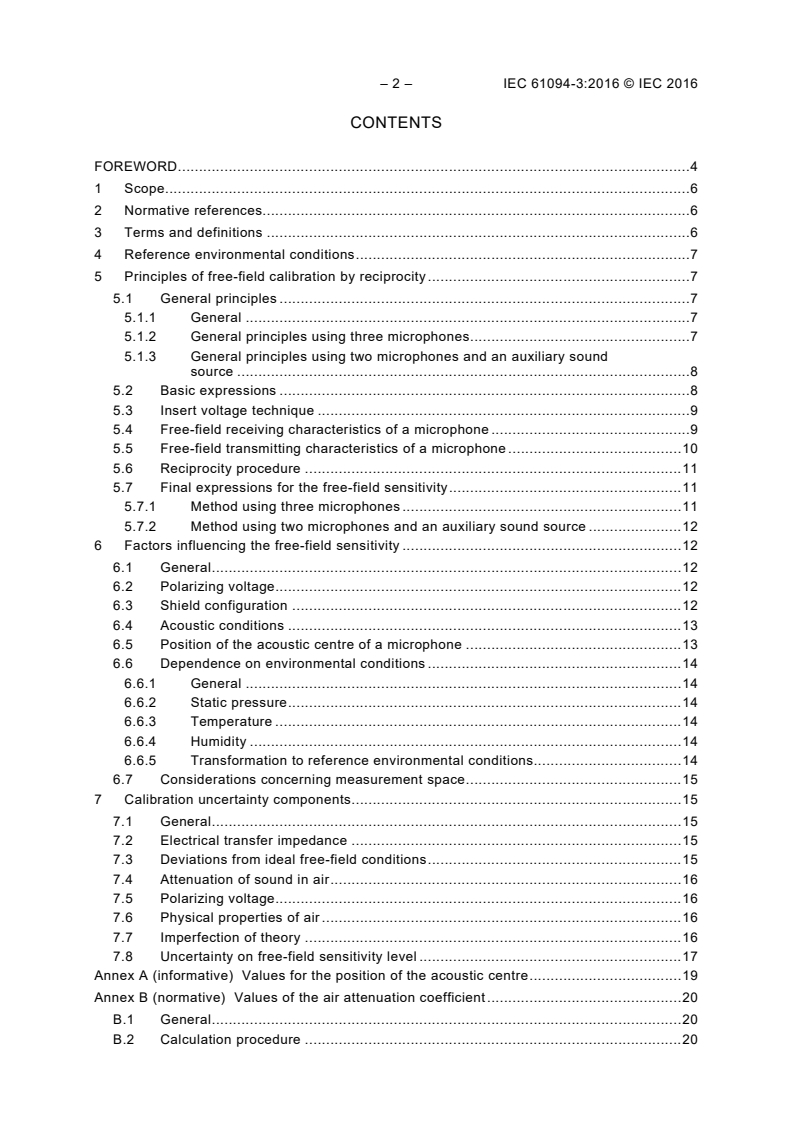
– 2 – IEC 61094-3:2016 © IEC 2016
CONTENTS
FOREWORD . 4
1 Scope . 6
2 Normative references. 6
3 Terms and definitions . 6
4 Reference environmental conditions . 7
5 Principles of free-field calibration by reciprocity . 7
5.1 General principles . 7
5.1.1 General . 7
5.1.2 General principles using three microphones . 7
5.1.3 General principles using two microphones and an auxiliary sound
source . 8
5.2 Basic expressions . 8
5.3 Insert voltage technique . 9
5.4 Free-field receiving characteristics of a microphone . 9
5.5 Free-field transmitting characteristics of a microphone . 10
5.6 Reciprocity procedure . 11
5.7 Final expressions for the free-field sensitivity . 11
5.7.1 Method using three microphones . 11
5.7.2 Method using two microphones and an auxiliary sound source . 12
6 Factors influencing the free-field sensitivity . 12
6.1 General . 12
6.2 Polarizing voltage . 12
6.3 Shield configuration . 12
6.4 Acoustic conditions . 13
6.5 Position of the acoustic centre of a microphone . 13
6.6 Dependence on environmental conditions . 14
6.6.1 General . 14
6.6.2 Static pressure . 14
6.6.3 Temperature . 14
6.6.4 Humidity . 14
6.6.5 Transformation to reference environmental conditions. 14
6.7 Considerations concerning measurement space . 15
7 Calibration uncertainty components . 15
7.1 General . 15
7.2 Electrical transfer impedance . 15
7.3 Deviations from ideal free-field conditions . 15
7.4 Attenuation of sound in air . 16
7.5 Polarizing voltage . 16
7.6 Physical properties of air . 16
7.7 Imperfection of theory . 16
7.8 Uncertainty on free-field sensitivity level . 17
Annex A (informative) Values for the position of the acoustic centre . 19
Annex B (normative) Values of the air attenuation coefficient . 20
B.1 General . 20
B.2 Calculation procedure . 20
Annex C (informative) Environmental influence on the sensitivity of microphones . 23
C.1 General . 23
C.2 Dependence on static pressure . 23
C.3 Dependence on temperature . 23
Annex D (informative) Application of time selective techniques for removal of
unwanted reflections and acoustic interference between microphones . 25
D.1 General . 25
D.2 Practical considerations . 25
D.2.1 Signal-to-noise ratio . 25
D.2.2 Reflections from walls and measurement rig . 25
D.3 Frequency limitations . 26
D.3.1 General . 26
D.3.2 Measurements based on frequency sweeps . 26
D.3.3 Measurements based on pure tones . 26
D.4 Generating missing portions of the frequency response previous to
transforming to the time-domain. . 27
D.4.1 General . 27
D.4.2 Missing frequencies below the minimum measurement frequency . 27
D.4.3 Missing frequencies above the maximum measured frequency . 27
D.4.4 Filtering the extended frequency response . 28
Bibliography . 29
Figure 1 – Equivalent circuit for a receiving microphone under free-field conditions . 9
Figure 2 – Equivalent circuit for a transmitting microphone under free-field conditions . 10
Figure A.1 – Example of the estimated values of the acoustic centres of LS1P and
LS2aP microphones given in the bibliographical references for Annex A . 19
Table 1 – Uncertainty components . 17
Table B.1 – Values for attenuation of sound pressure in air (in dB/m) . 22
– 4 – IEC 61094-3:2016 © IEC 2016
INTERNATIONAL ELECTROTECHNICAL COMMISSION
____________
ELECTROACOUSTICS – MEASUREMENT MICROPHONES –
Part 3: Primary method for free-field calibration of laboratory
standard microphones by the reciprocity technique
FOREWORD
1) The International Electrotechnical Commission (IEC) is a worldwide organization for standardization comprising
all national electrotechnical committees (IEC National Committees). The object of IEC is to promote
international co-operation on all questions concerning standardization in the electrical and electronic fields. To
this end and in addition to other activities, IEC publishes International Standards, Technical Specifications,
Technical Reports, Publicly Available Specifications (PAS) and Guides (hereafter referred to as “IEC
Publication(s)”). Their preparation is entrusted to technical committees; any IEC National Committee interested
in the subject dealt with may participate in this preparatory work. International, governmental and non-
governmental organizations liaising with the IEC also participate in this preparation. IEC collaborates closely
with the International Organization for Standardization (ISO) in accordance with conditions determined by
agreement between the two organizations.
2) The formal decisions or agreements of IEC on technical matters express, as nearly as possible, an international
consensus of opinion on the relevant subjects since each technical committee has representation from all
interested IEC National Committees.
3) IEC Publications have the form of recommendations for international use and are accepted by IEC National
Committees in that sense. While all reasonable efforts are made to ensure that the technical content of IEC
Publications is accurate, IEC cannot be held responsible for the way in which they are used or for any
misinterpretation by any end user.
4) In order to promote international uniformity, IEC National Committees undertake to apply IEC Publications
transparently to the maximum extent possible in their national and regional publications. Any divergence
between any IEC Publication and the corresponding national or regional publication shall be clearly indicated in
the latter.
5) IEC itself does not provide any attestation of conformity. Independent certification bodies provide conformity
assessment services and, in some areas, access to IEC marks of conformity. IEC is not responsible for any
services carried out by independent certification bodies.
6) All users should ensure that they have the latest edition of this publication.
7) No liability shall attach to IEC or its directors, employees, servants or agents including individual experts and
members of its technical committees and IEC National Committees for any personal injury, property damage or
other damage of any nature whatsoever, whether direct or indirect, or for costs (including legal fees) and
expenses arising out of the publication, use of, or reliance upon, this IEC Publication or any other IEC
Publications.
8) Attention is drawn to the Normative references cited in this publication. Use of the referenced publications is
indispensable for the correct application of this publication.
9) Attention is drawn to the possibility that some of the elements of this IEC Publication may be the subject of
patent rights. IEC shall not be held responsible for identifying any or all such patent rights.
International Standard IEC 61094-3 has been prepared by IEC technical committee 29:
Electroacoustics.
This second edition cancels and replaces the first edition published in 1995. This edition
constitutes a technical revision.
This edition includes the following significant technical changes with respect to the previous
edition:
a) a new informative annex describing the use of time-selective techniques to minimize the
influence of acoustic reflections from the measurement setup;
b) provision for the calibration of microphones in driven shield configuration.
The text of this standard is based on the following documents:
CDV Report on voting
29/873/CDV 29/892A/RVC
Full information on the voting for the approval of this standard can be found in the report on
voting indicated in the above table.
This publication has been drafted in accordance with the ISO/IEC Directives, Part 2.
A list of all parts in the IEC 61094 series, published under the general title Electroacoustics –
Measurement microphones, can be found on the IEC website.
The committee has decided that the contents of this publication will remain unchanged until
the stability date indicated on the IEC website under "http://webstore.iec.ch" in the data
related to the specific publication. At this date, the publication will be
• reconfirmed,
• withdrawn,
• replaced by a revised edition, or
• amended.
The contents of the Corrigendum 1 of December 2016 have been included in this copy.
IMPORTANT – The 'colour inside' logo on the cover page of this publication indicates
that it contains colours which are considered to be useful for the correct
understanding of its contents. Users should therefore print this document using a
colour printer.
– 6 – IEC 61094-3:2016 © IEC 2016
ELECTROACOUSTICS – MEASUREMENT MICROPHONES –
Part 3: Primary method for free-field calibration of laboratory
standard microphones by the reciprocity technique
1 Scope
This part of IEC 61094
• specifies a primary method of determining the complex free-field sensitivity of laboratory
standard microphones so as to establish a reproducible and accurate basis for the
measurement of sound pressure under free-field conditions,
• is applicable to laboratory standard microphones meeting the requirements of
IEC 61094-1,
• is intended for use by laboratories with highly experienced staff and specialized
equipment.
NOTE The calibration principle described in this part of IEC 61094 is also applicable to working standard
microphones, preferably used without their protection grid.
2 Normative references
The following documents, in whole or in part, are normatively referenced in this document and
are indispensable for its application. For dated references, only the edition cited applies. For
undated references, the latest edition of the referenced document (including any
amendments) applies.
IEC 61094-1:2000, Measurement microphones – Part 1: Specifications for laboratory standard
microphones
IEC 61094-2:2009, Electroacoustics – Measurement microphones – Part 2: Primary method
for pressure calibration of laboratory standard microphones by the reciprocity technique
IEC TS 61094-7:2006, Measurement microphones – Part 7: Values for the difference between
free-field and pressure sensitivity levels of laboratory standard microphones
ISO 9613-1, Acoustics – Attenuation of sound during propagation outdoors – Part 1:
Calculation of the absorption of sound by the atmosphere
ISO/IEC Guide 98-3, Uncertainty of measurement – Part 3: Guide to the expression of
uncertainty in measurement (GUM:1995)
3 Terms and definitions
For the purposes of this document, the terms and definitions given in IEC 61094-1,
IEC 61094-2, ISO/IEC Guide 98-3 and the following apply.
3.1
phase
phase angle between the open-circuit voltage and the
sound pressure that would exist at the position of the acoustic centre of the microphone in the
absence of the microphone, for a sinusoidal plane progressive wave of given frequency and
direction of sound incidence, and for given environmental conditions
Note 1 to entry: Phase is expressed in degrees (°) or radians (rad).
3.2
acoustic centre
point from which approximately spherical wavefronts from a sound-emitting
transducer producing a sinusoidal signal at a given frequency appear to diverge with respect
to a small region around an observation point at a specified direction and distance from the
sound source
Note 1 to entry: The acoustic centre of a reciprocal transducer when used as a receiver is coincident with the
acoustic centre when used as a transmitter.
Note 2 to entry: This definition only applies to regions of the sound field where spherical or approximately
spherical wavefronts are observed.
3.3
equivalent point-transducer
notional transducer occupying a single point that, when located at the position of its acoustic
centre, simulates the transmitting or receiving characteristics of a microphone, for a
sinusoidal signal of given frequency, and for a given observation direction and distance
3.4
principal axis
line through the centre of and perpendicular to the diaphragm of the
microphone
3.5
free-field conditions
airborne sound-field environment where sound waves can propagate freely without
disturbances of any kind
4 Reference environmental conditions
The reference environmental conditions are:
• temperature 23,0 °C
• static pressure 101,325 kPa
• relative humidity 50 %
5 Principles of free-field calibration by reciprocity
5.1 General principles
5.1.1 General
A reciprocity calibration of microphones may be carried out by means of three microphones,
two of which shall be reciprocal, or by means of an auxiliary sound source and two
microphones, one of which shall be reciprocal.
NOTE 1 If one of the microphones is not reciprocal it can only be used as a sound receiver.
NOTE 2 Laboratory standard microphones are reciprocal when used within their linear operating range.
5.1.2 General principles using three microphones
Let two of the microphones be coupled acoustically under free-field conditions. Using one of
them as a sound source and the other as a sound receiver, the electrical transfer impedance
is measured. When the acoustic transfer impedance of the system is known, the product of
the free-field sensitivities of the two coupled microphones can be determined. Using pair-wise
combinations of three microphones, three such mutually independent sensitivity products are
– 8 – IEC 61094-3:2016 © IEC 2016
available, from which an expression for the free-field sensitivity of each of the three
microphones can be derived.
5.1.3 General principles using two microphones and an auxiliary sound source
First, let the two microphones be coupled acoustically under free-field conditions, and the
product of the free-field sensitivities of the two microphones be determined as described in
5.1.2. Next, let the two microphones be sequentially presented to the same sound pressure,
set up by the auxiliary sound source under identical free-field conditions. The ratio of the two
output voltages will then equal the ratio of the free-field sensitivities of the two microphones.
Thus, from the product and the ratio of the free-field sensitivities of the two microphones, an
expression for the free-field sensitivity of each of the two microphones can be derived.
NOTE In order to obtain the ratio of free-field sensitivities, a direct comparison method can be used, and the
auxiliary sound source can be another type of transducer or a third microphone having mechanical or acoustical
characteristics which differ from those of the microphones being calibrated.
5.2 Basic expressions
Laboratory standard microphones are considered reciprocal and thus the two-port formulae of
the microphones can be written as:
zi+=z q U
11 12
(1)
zi+ z q=p
21 22
where
p is the sound pressure, at the acoustical terminals of the microphone, in
pascals (Pa);
U is the signal voltage at the electrical terminals of the microphone, in volts
(V);
q is the volume velocity through the acoustical terminals (diaphragm) of the
microphone, in cubic metres per second (m /s);
i is the current through the electrical terminals of the microphone, in
amperes (A);
z = Z is the electrical impedance of the microphone when the diaphragm is
11 e
blocked, in ohms (Ω);
z = Z is the acoustic impedance of the microphone when the electrical
22 a
−3
terminals are unloaded, in pascal-seconds per cubic metre (Pa⋅s⋅m ),
z = z = M Z is equal to the reverse and forward transfer impedances in volt-seconds
12 21 p a
−3
per cubic metre (V⋅s⋅m ), M being the pressure sensitivity of the
p
−1
microphone in volts per pascal (V⋅Pa ).
NOTE Underlined symbols represent complex quantities.
Formula (1) may then be rewritten as:
Zi+=M Z q U
e pa
(2)
M Zi+ Z q=p
pa a
which constitute the formulae of reciprocity for the microphone.
When the sound pressure p is not uniform over the surface of the diaphragm, as will be the
case at high frequencies when the microphone is located in a plane progressive wave, the
location of the acoustic terminals is given through the equivalent point-transducer simulating
the microphone. In this case, Formula (1) will also be valid for the real microphone through a
special interpretation of , see 5.4 and 5.5.
5.3 Insert voltage technique
The insert voltage technique is used to determine the open-circuit voltage of a microphone
when it is electrically loaded.
Let a microphone having a certain open-circuit voltage and internal electrical impedance be
connected to an external electrical load impedance. To measure the open-circuit voltage, an
impedance, small compared to the load impedance, is connected in series with the
microphone and a calibrating voltage applied across it.
Let a sound pressure and a calibrating voltage of the same frequency be applied alternately.
When the calibrating voltage is adjusted until it gives the same voltage drop across the load
impedance as results from the sound pressure on the microphone, the open-circuit voltage
will be equal in magnitude to the calibrating voltage.
5.4 Free-field receiving characteristics of a microphone
Let a microphone be placed in a progressive plane wave of sound pressure p . The equivalent
circuit of the microphone is given in Figure 1, where is the sound pressure when the
diaphragm is blocked and the actual sound pressure at the acoustic terminals of the
microphone. Z is the acoustic radiation impedance of the microphone.
a,r
IEC
Key
1 microphone
Figure 1 – Equivalent circuit for a receiving
microphone under free-field conditions
Let be related to through:
where S(f,θ) is the scattering factor and depends on the geometrical configuration of the
microphone. It is a function of frequency f and angle of incidence θ of the sound wave
impinging on the diaphragm of the microphone.
As , the two-port Formulae (2) can be written as:
– 10 – IEC 61094-3:2016 © IEC 2016
(3)
and thus, from the basic definition, the free-field sensitivity is given by:
(4)
Formula (4) shows that the difference between the pressure sensitivity and the free-field
sensitivity is determined not only by the geometry of the microphone through the scattering
factor S(f,θ) but also by the relation between the acoustic impedance of the microphone and
the radiation impedance.
NOTE The effect of the microphone venting mechanism is not accounted for in the model presented and will also
influence the difference between the pressure sensitivity and free-field sensitivity at low frequencies (see 6.1).
5.5 Free-field transmitting characteristics of a microphone
Let a microphone be used as a transmitter under free-field conditions. The equivalent circuit
of the microphone is given in Figure 2.
IEC
Key
1 microphone
Figure 2 – Equivalent circuit for a transmitting
microphone under free-field conditions
As , the two-port formulae of transmitting microphone can be written as:
(5)
so that:
From the general principle of reciprocity, it can be deduced that at a remote point, the
equivalent point-transducer will act as a simple source of strength S(f,θ) = M i and the
f
sound pressure at the distance d between this point and the equivalent point-transducer
will then be:
ρρ f f
-γ d
jωt j(ωαt−kd ) - d
p j Mi e e j Mi e e (6)
f f
2 d 2 d
where
γ = α + jk is the complex propagation coefficient, α is the air attenuation coefficient, k is the
wave number and ρ is the density of the gas.
NOTE Derivation of Formula (6) given above is based on a lumped parameter representation of the microphone
(see Formula (1)). A more rigorous derivation can be obtained by using an integral form of representation of the
formulae of the microphone.
5.6 Reciprocity procedure
Let two microphones denoted as microphone 1 and microphone 2 with free-field sensitivities
M and M , respectively, be situated in a free field facing each other and with coincident
f,1 f,2
principal axes. A current i through the electrical terminals of microphone 1 will produce a
sound pressure p given by Formula (6) at a distance d from its acoustic centre, under free-
field conditions. When introducing microphone 2 into the sound field, neglecting losses in the
medium and assuming no interaction takes place between the two microphones, the open-
circuit voltage of microphone 2 will be:
ρ f
j(ωt−kd )
p 12
Ui = = j
M M M e
21f,2 f,1 f,2
2d
d being the distance between the acoustic centres of microphone 1 and microphone 2.
At high frequencies the molecular relaxation effects and viscous losses in air cannot be
neglected and thus, the product of the free-field sensitivities is given by:
U
2d
12 2 αd
jkd
m12
= - j e , (7)
M M
e
f,1 f,2
ρ f i
where d is the physical distance between the diaphragms of microphone 1 and
m12
microphone 2, being the actual distance the sound wave has propagated.
5.7 Final expressions for the free-field sensitivity
5.7.1 Method using three microphones
Implementing the principles in 5.1.2, let the electrical transfer impedance U /i be denoted by
2 1
Z with similar expressions for microphone pairs involving the third microphone,
e,12
microphone 3. The final expression for the complex free-field sensitivity of microphone 1 is
then:
1/2
ZZ
dd e,12 e,31
12 31 α() + -
j(k + - ) d dd
d d d m12 m31 m23
12 31 23
= e
M (8)
e
f,1
ρ f
Z
d
e,23
Similar expressions apply for microphone 2 and microphone 3.
The modulus and phase of the free-field sensitivity can be derived from Formula (8),
whereupon the phase should be referred to the full four-quadrant phase range, i.e. 0 to 2π rad
or 0 to 360°.
==
– 12 – IEC 61094-3:2016 © IEC 2016
5.7.2 Method using two microphones and an auxiliary sound source
If only two microphones and an auxiliary sound source are used, then implementing the
principles in 5.1.3, the final expression for the complex free-field sensitivity is:
1/2
2d
12 αd
jkd
m12 (9)
= r e
MZ
e
12
f,1 e,12
ρ f
, is measured by
where the ratio of the free-field sensitivities of the two microphones, r
comparison against the auxiliary source, see 5.1.3.
6 Factors influencing the free-field sensitivity
6.1 General
The free-field sensitivity of a laboratory standard microphone depends on polarizing voltage,
as it has an electrostatic transductions mechanism, and the environmental conditions.
The basic mode of operation of a polarized electrostatic microphone assumes that the
electrical charge on the microphone is kept constant at all frequencies. This condition cannot
be maintained at very low frequencies and the product of the microphone capacitance and the
polarizing resistance determines the time constant for the flow of charge to and from the
microphone. While the open-circuit sensitivity of the microphone, as obtained using the insert
voltage technique, will be determined correctly, the absolute output from an associated
preamplifier to the microphone will decrease at low frequencies in accordance with this time
constant.
The construction principles of laboratory standard microphones imply that the static pressure
behind and in front of the diaphragm shall remain the same. To comply with this a pressure
equalizing tube is used to connect the back cavity of the microphone to the external medium.
The effect of this tube is that the free-field sensitivity will approach zero at very low
frequencies (below a few hertz). The technique described in this standard is not suitable for
determining the free-field sensitivity in this frequency range.
Furthermore, the definition of the free-field sensitivity implies that certain requirements be
fulfilled by the measurements. It is essential during a calibration that these conditions are
controlled sufficiently well so that the resulting uncertainty components are small.
6.2 Polarizing voltage
The sensitivity of a laboratory standard microphone is approximately proportional to the
polarizing voltage and thus the polarizing voltage actually used during the calibration shall be
reported.
To comply with IEC 61094-1, a polarizing voltage of 200,0 V is recommended.
6.3 Shield configuration
The open-circuit voltage, and therefore the free-field sensitivity, depends on the shield
configuration. Consequently, IEC 61094-1 specifies a reference mechanical configuration for
the shield for use in determining the open-circuit voltage. While the reference mechanical
configuration is essential, the shield can either be grounded (grounded-shield configuration),
or the output voltage from the microphone can be applied to the shield (driven-shield
configuration). It shall be stated whether the driven-shield or grounded-shield configuration
was used in the measurements.
The same shield configuration shall apply to both transmitter and receiver microphones during
the calibration.
If any non-standard configuration is used, the results of a calibration shall be referred to the
reference mechanical configuration.
If the manufacturer specifies a maximum mechanical force to be applied to the central
electrical contact of the microphone, this limit shall not be exceeded.
NOTE 1 When the shield is driven, the loading impedance as seen from the microphone is maximized, and it can
be described more accurately than in the case of using the grounded shield configuration. In the ideal case, in
which the microphone is a perfectly linear and passive device and the shield is either grounded, or driven from a
zero source impedance, there is no difference between the open-circuit sensitivity with grounded or driven shield.
NOTE 2 In the driven-shield configuration, applying the output voltage from the microphone to the shield means
that any difference between the signal applied on the shield and on the centre-pin of the microphone is negligible.
NOTE 3 If a microphone is connected to a preamplifier by means of an adapter there is the possibility that the
open-circuit voltage of the microphone is not determined properly by the insert voltage technique at high
frequencies. The deviations depend on the load impedance as seen from the microphone.
6.4 Acoustic conditions
The free-field sensitivity of a microphone depends on the geometrical configuration of the
housing containing the preamplifier. For this reason, the microphone and the shield
configuration shall be attached to a cylinder whose diameter is equal to the nominal diameter
of the microphone, see Table 1 and Table 2 in IEC 61094-1:2000. The length of the cylinder
shall be long compared to the diameter of the microphone. A minimum length of twenty times
the diameter of the microphone with a gradually tapered transition to the supporting structure
is recommended. This arrangement shall also apply to the transmitter microphone.
The definition of the free-field sensitivity of a microphone refers to the sound pressure in an
undisturbed plane progressive wave. In the far field of a sound source located under free-field
conditions, spherical waves are encountered which, at a sufficient distance from the source,
are approximately plane waves in a limited region. Thus, the distance between the receiver
microphone and the transmitter microphone shall be great enough to ensure approximately
plane waves in a suitable region around the receiver microphone (see 7.3). Conversely, the
influence of reflections from the interior surfaces of an anechoic chamber usually increases as
the distance between the two microphones is increased. Also the scattering factor S(f,θ)
depends on the character of the sound field and can only be unambiguously defined for a true
plane progressive wave. Therefore, the metrological conditions should be carefully chosen
and it may be preferable to carry out calibrations at more than one distance to assess the
calibration uncertainty attributable to dependence on these conditions.
6.5 Position of the acoustic centre of a microphone
The position of the acoustic centre of a microphone can be determined from measurements of
the sound pressure produced by the microphone when used as a sound source in a free field,
as a function of distance r from an arbitrarily chosen reference point of the microphone. In a
limited region of the far field, the sound pressure, corrected for the effect of sound
attenuation, will follow the 1/r-law, r being referred now to the acoustic centre of the
microphone. Thus, when plotting the inverse value of the measured sound pressure as a
function of the distance from an arbitrarily chosen reference point of the microphone (most
conveniently the centre of the diaphragm), a straight line can be fitted (e.g. by the methods of
least squares) through the plotted values. The intersection of this straight line and the
abscissa axis determines the position of the acoustic centre relative to the reference point.
The acoustic centres used to determine d (see 5.7) shall relate to the orientation and
separation used during the free-field calibrations.
Annex A contains information on typical values for the position of the acoustic centre for
laboratory standard microphones.
– 14 – IEC 61094-3:2016 © IEC 2016
NOTE Specific applications may require defining the acoustic centre of the microphone at a fixed position, for
instance, at the centre of the microphone diaphragm. Whereas this would result in the modulus of the sensitivity
having a dependence on the distance between microphone and source, it may provide a useful reference for the
phase response. While using this fixed acoustic centre in the calculations is possible, an alternative is to determine
the sensitivity using the acoustic centre based on the inverse-distance law and later apply a correction to the
phase response to the preferred position of the acoustic centre.
6.6 Dependence on environmental conditions
6.6.1 General
The general dependence of the pressure sensitivity on environmental conditions is given in
6.5 of IEC 61094-2:2009. In addition to this, the free-field sensitivity further depends on
environmental conditions through the relation given in Formula (4). In this formula, the
radiation impedance is a function of the air density and speed of sound. Similarly the
scattering factor S(f,θ) depends on the wavelength and thus on the speed of sound in air.
6.6.2 Static pressure
In addition to the dependence described in IEC 61094-2:2009 (6.5 and Annex D), a further
dependence is caused by the relationship between the acoustic impedance of the microphone
and its radiation impedance due to the change in the density of air with static pressure. The
major influence of the mass term of the radiation impedance is to lower the resonance
frequency of the microphone slightly.
6.6.3 Temperature
In addition to the dependence described in IEC 61094-2:2009 (6.5 and Annex D), a further
dependence is caused by the relationship between the acoustic impedance of the microphone
and its radiation impedance due to the change in the density and the speed of sound in air
with temperature. In addition, a dependence is caused by the scattering factor S(f,θ) according
to Formula (4) due to the change in the speed of sound in air with temperature.
IEC TS 61094-7:2006, Clause 6 describes the temperature dependence of the difference
between the free-field sensitivity and the pressure sensitivity that shall be considered in
addition to the temperature dependence of the pressure sensitivity itself.
NOTE If a microphone is exposed to excessive temperature variations, a permanent change in sensitivity can
result.
6.6.4 Humidity
According to Formula (4) a slight effect may be found on the free-field sensitivity in addition to
influence on the pressure sensitivity, caused by the influence of humidity on the density and
speed of sound in air.
NOTE Certain conditions can influence the stability of polarizing voltage and backplate charge and therefore
influence the sensitivity. For example the surface resistance of the insulation material between the backplate and
the housi
...