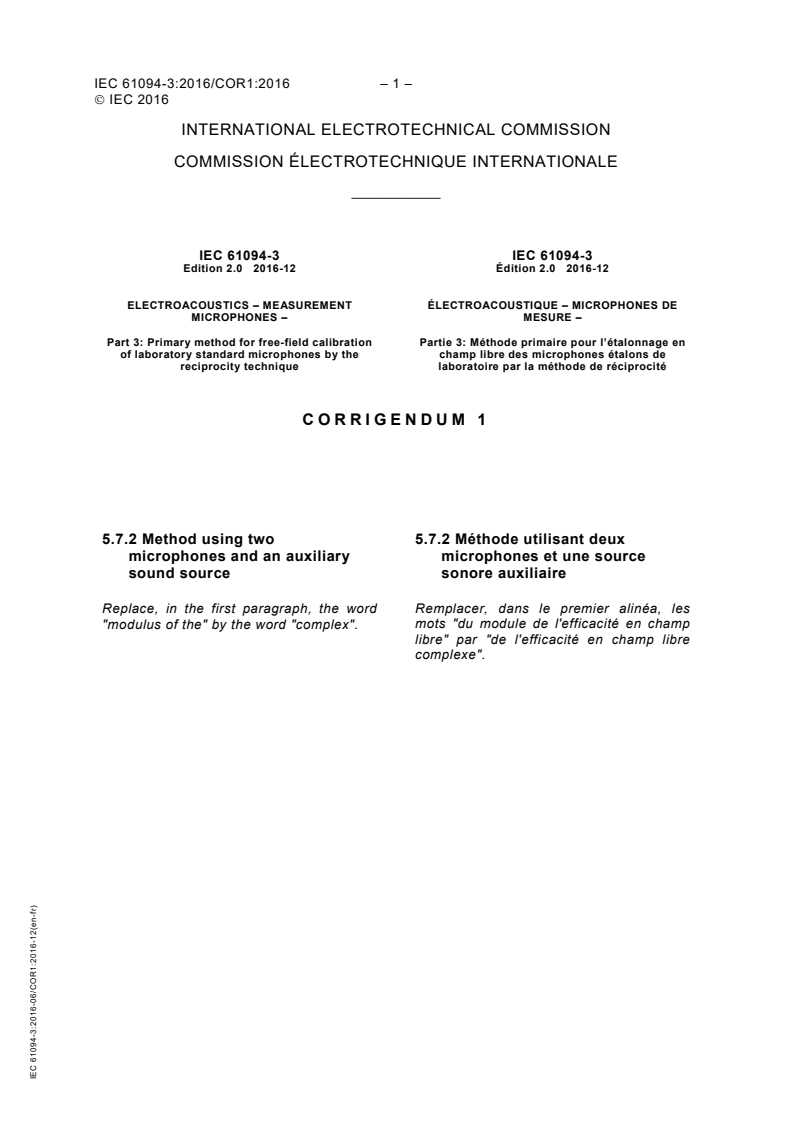
IEC 61094-3:2016/COR1:2016
(Corrigendum)Corrigendum 1 - Electroacoustics - Measurement microphones - Part 3: Primary method for free-field calibration of laboratory standard microphones by the reciprocity technique
Corrigendum 1 - Electroacoustics - Measurement microphones - Part 3: Primary method for free-field calibration of laboratory standard microphones by the reciprocity technique
Corrigendum 1 - Electroacoustique - Microphones de mesure - Partie 3: Méthode primaire pour l'étalonnage en champ libre des microphones étalons de laboratoire par la méthode de réciprocité
General Information
Relations
Standards Content (Sample)
IEC 2016
INTERNATIONAL ELECTROTECHNICAL COMMISSION
COMMISSION ÉLECTROTECHNIQUE INTERNATIONALE
____________
IEC 61094-3 IEC 61094-3
Edition 2.0 2016-12 Édition 2.0 2016-12
ELECTROACOUSTICS – MEASUREMENT ÉLECTROACOUSTIQUE – MICROPHONES DE
MICROPHONES – MESURE –
Part 3: Primary method for free-field calibration Partie 3: Méthode primaire pour l’étalonnage en
of laboratory standard microphones by the champ libre des microphones étalons de
reciprocity technique laboratoire
...
This May Also Interest You
IEC 61094-3:2016 specifies a primary method of determining the complex free-field sensitivity of laboratory standard microphones so as to establish a reproducible and accurate basis for the measurement of sound pressure under free-field conditions. It is applicable to laboratory standard microphones meeting the requirements of IEC 61094-1. It is intended for use by laboratories with highly experienced staff and specialized equipment. This second edition cancels and replaces the first edition published in 1995. This edition constitutes a technical revision.
The contents of the corrigendum of December 2016 have been included in this copy.
- Standard57 pagesEnglish and French languagesale 15% off
Specifies mechanical dimensions and certain electroacoustic characteristics for condenser microphones used as laboratory standards for the realization of the unit of sound pressure. The specifications are intended to ensure that primary calibration by the reciprocity method can be readily carried out. Establishes a system for classifying laboratory standard condenser mocrophones.
- Standard1 pageEnglish and French languagesale 15% off
IEC 60317-47:2013 specifies the requirements of enamelled rectangular copper winding wire of class 240 with a sole coating of aromatic polyimide resin. The range of nominal conductor dimensions covered by this standard is:
- width: min. 2,0 mm max. 16,0 mm;
- thickness: min. 0,80 mm max. 5,60 mm. Wires of grade 1 and grade 2 are included in this specification and apply to the complete range of conductors. The specified combinations of width and thickness, as well as the specified width/thickness ratio, are given in IEC 60317-0-2. This second edition cancels and replaces the first edition published in 1997. This edition constitutes a technical revision. This edition includes the following significant technical changes with respect to the previous edition:
- deletion of the "in some countries" statement in the scope;
- new subclause containing general notes on winding wire, formerly a part of the scope;
- new subclause containing requirements for appearance;
- revision to the notes in Clause 19, Dielectric dissipation factor;
- new Clause 23, Pin hole test. Keywords: requirements of enamelled rectangular copper winding wire, class 240, sole coating of aromatic polyimide resin.
This publication is to be read in conjunction with IEC 60317-0-2:2013.
- Standard19 pagesEnglish languagesale 15% off
- Standard17 pagesEnglish and French languagesale 15% off
IEC 60317-53:2014 specifies requirements for tape wrapped rectangular copper winding wire of temperature index 220. The insulation consists of one or more wrappings of aromatic polyamide (aramid) tape of various thicknesses. The range of nominal conductor dimensions covered by this standard is: width: min. 2,00 mm max. 16,00 mm; thickness: min.0,80 mm max. 5,60 mm. This second edition cancels and replaces the first edition published in 1999. This edition constitutes a technical revision. This edition includes the following significant technical changes with respect to the previous edition:
- new 3.2.2 containing general notes on winding wire, formerly a part of the scope;
- new 3.3, containing requirements for appearance;
- modification to Clause 15 to delete the note on revisions to IEC 60172;
- new Clause 23, Pin hole test. Keywords: tape wrapped rectangular copper winding wire of temperature index 220, aromatic polyamide (aramid) tape
- Standard33 pagesEnglish and French languagesale 15% off
Applies to the microphone part and earphone part of handsets, headsets or earsets for speech communications, and also to the microphone units and earphone units of built-in handsets, headsets or earsets. Establishes definitions relating to these electroacoustic transducers, standardizes the characteristics to be specified and the relevant methods of measurement.
- Standard28 pagesEnglish languagesale 15% off
IEC TR 61169-1-8:2025 provides a test method for voltage standing wave ratio (VSWR, hereinafter) of single RF connector by double-connector method. This document is applicable to single RF cable connectors and single microstrip RF connectors as well as single adapters if an estimation of the VSWR of a single completely installed RF-connector is used and a time domain feature is not available on the vector network analyzer.
- Technical report18 pagesEnglish languagesale 15% off
IEC 62541-100:2025 defines the information model associated with Devices. This document describes three models which build upon each other as follows:
• The (base) Device Model is intended to provide a unified view of devices and their hardware and software parts irrespective of the underlying device protocols.
• The Device Communication Model adds Network and Connection information elements so that communication topologies can be created.
• The Device Integration Host Model finally adds additional elements and rules required for host systems to manage integration for a complete system. It enables reflecting the topology of the automation system with the devices as well as the connecting communication networks.
This document also defines AddIns that can be used for the models in this document but also for models in other information models. They are:
• Locking model – a generic AddIn to control concurrent access,
• Software update model – an AddIn to manage software in a Device.
This second edition cancels and replaces the first edition published in 2015. This edition constitutes a technical revision.
This edition includes the following significant technical changes with respect to the previous edition:
a a ComponentType that can be used to model any HW or SW element of a device has been defined and a SoftwareType has been added as subtype of ComponentType;
b the new OPC UA interface concept and defined interfaces for Nameplate, DeviceHealth, and SupportInfo has been added.
c) a new model for Software Update (Firmware Update) has been added;
d) a new entry point for documents where each document is represented by a FileType instance has been specified;
e) a model that provides information about the lifetime, related limits and semantic of the lifetime of things like tools, material or machines has been added.
- Standard152 pagesEnglish languagesale 15% off
- Standard158 pagesFrench languagesale 15% off
- Standard310 pagesEnglish and French languagesale 15% off
IEC TS 63414:2025 is applicable for the determination of the AC and DC pollution flashover and withstand voltage characteristics of insulators with polymeric housing, to be used outdoors in HV applications and exposed to polluted environments. This is also applicable for insulators with hydrophobic coatings. This document refers to AC systems with a rated voltage greater than 1 000 V and DC systems with a rated voltage greater than 1 500 V.
The object of this technical specification is to prescribe standardized test methods, requirements and procedures for artificial pollution tests applicable to polymeric insulators for overhead lines including traction lines, station post and hollow insulators of equipment. Available test experience with polymeric station post and hollow insulators, especially for DC applications, is limited.
The proposed tests are not applicable to ceramic and glass insulators without polymeric housing, to greased insulators or to special types of insulators (e.g., insulators with semiconducting glaze).
Differently to ceramic and glass insulators without polymeric housing:
- The pollution performance of insulators with polymeric housing varies with the hydrophobicity condition of the surface. The specific conditions simulated by standardized tests might not represent the actual dynamic field conditions.
- The determination of the flashover and/or withstand voltage under pollution conditions is not enough for dimensioning. Additional constraints related to possible ageing are also to be considered.
- If the Hydrophobicity Transfer Material (HTM) test according to IEC TR 62039 confirms that an insulator is non-HTM, it can be tested according to IEC 60507 or IEC TS 61245.
- Technical specification39 pagesEnglish languagesale 15% off
IEC 63522-4:2025 is used for testing along with the appropriate severities and conditions for measurements and tests designed to assess the ability of DUTs to perform under expected conditions of transportation, storage and all aspects of operational use.
The object of this test is to define a standard test method for the dielectric strength test.
- Standard10 pagesEnglish languagesale 15% off
- Standard10 pagesFrench languagesale 15% off
- Standard20 pagesEnglish and French languagesale 15% off
IEC 62541-10:2025 is available as IEC 62541-10:2025 RLV which contains the International Standard and its Redline version, showing all changes of the technical content compared to the previous edition.IEC 62541-10:2025 defines the Information Model associated with Programs in OPC Unified Architecture (OPC UA). This includes the description of the NodeClasses, standard Properties, Methods and Events and associated behaviour and information for Programs. The complete AddressSpace model including all NodeClasses and Attributes is specified in IEC 62541-3. The Services such as those used to invoke the Methods used to manage Programs are specified in IEC 62541-4. An example for a DomainDownload Program is defined in Annex A. This fourth edition cancels and replaces the third edition published in 2020. This edition constitutes a technical revision.
This edition includes the following significant technical changes with respect to the previous edition:
- StateMachine table format has been aligned.
- Standard42 pagesEnglish languagesale 15% off
- Standard45 pagesFrench languagesale 15% off
- Standard87 pagesEnglish and French languagesale 15% off


Questions, Comments and Discussion
Ask us and Technical Secretary will try to provide an answer. You can facilitate discussion about the standard in here.
Loading comments...