

IEC 61842:2002
(Main)Microphones and earphones for speech communications
General Information
- Abstract
Applies to the microphone part and earphone part of handsets, headsets or earsets for speech communications, and also to the microphone units and earphone units of built-in handsets, headsets or earsets. Establishes definitions relating to these electroacoustic transducers, standardizes the characteristics to be specified and the relevant methods of measurement.
- Status
- Published
- Publication Date
- 07-Mar-2002
- Technical Committee
- TC 100 - Audio, video and multimedia systems and equipment
- Current Stage
- PPUB - Publication issued
- Start Date
- 08-Mar-2002
- Completion Date
- 30-Apr-2002
Overview
IEC 61842:2002 - Microphones and earphones for speech communications defines terminology, measurable characteristics and standardized methods for testing the microphone and earphone parts of handsets, headsets and earsets (including built-in units). The standard focuses on electroacoustic transducers used for speech, ensuring reproducible measurement procedures and clear product specifications for manufacturers, test labs and procurement.
Key topics and requirements
- Definitions and classification: clear terms for handset, headset, earset, microphone unit, earphone unit, case for unit measurement.
- Measurement devices & fixtures: use of an artificial mouth (sound source) and artificial ear (acoustic load), plus accessories like lip rings, mouthpiece holes and earcap holes for consistent test positioning.
- Fundamental characteristics to specify and measure:
- Microphone sensitivity (V/Pa) and sensitivity level (dB)
- Earphone sensitivity to voltage (Pa/V), sensitivity to power (Pa2/W) and corresponding dB levels
- Electrical impedance (Ω) and capacitance (nF) where applicable
- Magnetic field measurements (plane parallel to earcap reference plane at 10 mm)
- Measurement procedures & conditions:
- Rated conditions and climatic/test conditions referencing IEC 60268-1
- Use of specified calibration and test setups (artificial mouth calibration, case arrangements for unit measurements)
- Connectors & interfaces: standardized connector designs such as the miniature 4‑position connector and sub-miniature 2.5 mm concentric connector are described for interoperability.
- Endurance and insulation: requirements for insulation endurance and other reliability-related measurements.
- Documentation: characteristics that manufacturers should state on datasheets for reproducibility and procurement.
Applications and who uses it
- Product manufacturers of telephony handsets, headsets, earsets and built-in transducer units use IEC 61842:2002 to design and specify microphone/earphone performance for speech communications.
- R&D and acoustic engineers apply the measurement methods (artificial mouth/ear) during development and verification.
- Test laboratories and certification bodies adopt the standard for compliance testing and repeatable evaluation.
- Procurement and quality teams rely on standardized characteristics (sensitivity, impedance, connector types) to compare components and ensure interoperability in telecom and VoIP equipment.
Related standards
Normative references incorporated by IEC 61842:2002 include:
- IEC 60268-1, -4, -7 (sound system equipment general, microphones, headphones/earphones)
- IEC 60318-1, IEC 60711 (ear simulators)
- IEC 61094 (measurement microphones)
- IEC 60603-11 (connector dimensions)
- ITU‑T P.51, P.370 (artificial mouth; coupling hearing aids to telephone sets)
IEC 61842:2002 is essential for consistent, reproducible measurement and specification of speech‑grade microphones and earphones used in telecommunication devices.
Get Certified
Connect with accredited certification bodies for this standard

ANCE
Mexican certification and testing association.

BSMI (Bureau of Standards, Metrology and Inspection)
Taiwan's standards and inspection authority.

Intertek Slovenia
Intertek testing, inspection, and certification services in Slovenia.
Sponsored listings
Frequently Asked Questions
IEC 61842:2002 is a standard published by the International Electrotechnical Commission (IEC). Its full title is "Microphones and earphones for speech communications". This standard covers: Applies to the microphone part and earphone part of handsets, headsets or earsets for speech communications, and also to the microphone units and earphone units of built-in handsets, headsets or earsets. Establishes definitions relating to these electroacoustic transducers, standardizes the characteristics to be specified and the relevant methods of measurement.
Applies to the microphone part and earphone part of handsets, headsets or earsets for speech communications, and also to the microphone units and earphone units of built-in handsets, headsets or earsets. Establishes definitions relating to these electroacoustic transducers, standardizes the characteristics to be specified and the relevant methods of measurement.
IEC 61842:2002 is classified under the following ICS (International Classification for Standards) categories: 17.140.50 - Electroacoustics; 33.160.50 - Accessories. The ICS classification helps identify the subject area and facilitates finding related standards.
IEC 61842:2002 is available in PDF format for immediate download after purchase. The document can be added to your cart and obtained through the secure checkout process. Digital delivery ensures instant access to the complete standard document.
Standards Content (Sample)
INTERNATIONAL IEC
STANDARD
First edition
2002-03
Microphones and earphones
for speech communications
Reference number
Publication numbering
As from 1 January 1997 all IEC publications are issued with a designation in the
60000 series. For example, IEC 34-1 is now referred to as IEC 60034-1.
Consolidated editions
The IEC is now publishing consolidated versions of its publications. For example,
edition numbers 1.0, 1.1 and 1.2 refer, respectively, to the base publication, the
base publication incorporating amendment 1 and the base publication incorporating
amendments 1 and 2.
Further information on IEC publications
The technical content of IEC publications is kept under constant review by the IEC,
thus ensuring that the content reflects current technology. Information relating to
this publication, including its validity, is available in the IEC Catalogue of
publications (see below) in addition to new editions, amendments and corrigenda.
Information on the subjects under consideration and work in progress undertaken
by the technical committee which has prepared this publication, as well as the list
of publications issued, is also available from the following:
• IEC Web Site (www.iec.ch)
• Catalogue of IEC publications
The on-line catalogue on the IEC web site (www.iec.ch/catlg-e.htm) enables
you to search by a variety of criteria including text searches, technical
committees and date of publication. On-line information is also available on
recently issued publications, withdrawn and replaced publications, as well as
corrigenda.
• IEC Just Published
This summary of recently issued publications (www.iec.ch/JP.htm) is also
available by email. Please contact the Customer Service Centre (see below) for
further information.
• Customer Service Centre
If you have any questions regarding this publication or need further assistance,
please contact the Customer Service Centre:
Email: custserv@iec.ch
Tel: +41 22 919 02 11
Fax: +41 22 919 03 00
INTERNATIONAL IEC
STANDARD
First edition
2002-03
Microphones and earphones
for speech communications
IEC 2002 Copyright - all rights reserved
No part of this publication may be reproduced or utilized in any form or by any means, electronic or
mechanical, including photocopying and microfilm, without permission in writing from the publisher.
International Electrotechnical Commission, 3, rue de Varembé, PO Box 131, CH-1211 Geneva 20, Switzerland
Telephone: +41 22 919 02 11 Telefax: +41 22 919 03 00 E-mail: inmail@iec.ch Web: www.iec.ch
PRICE CODE
Commission Electrotechnique Internationale
U
International Electrotechnical Commission
Международная Электротехническая Комиссия
For price, see current catalogue
– 2 – 61842 IEC:2002(E)
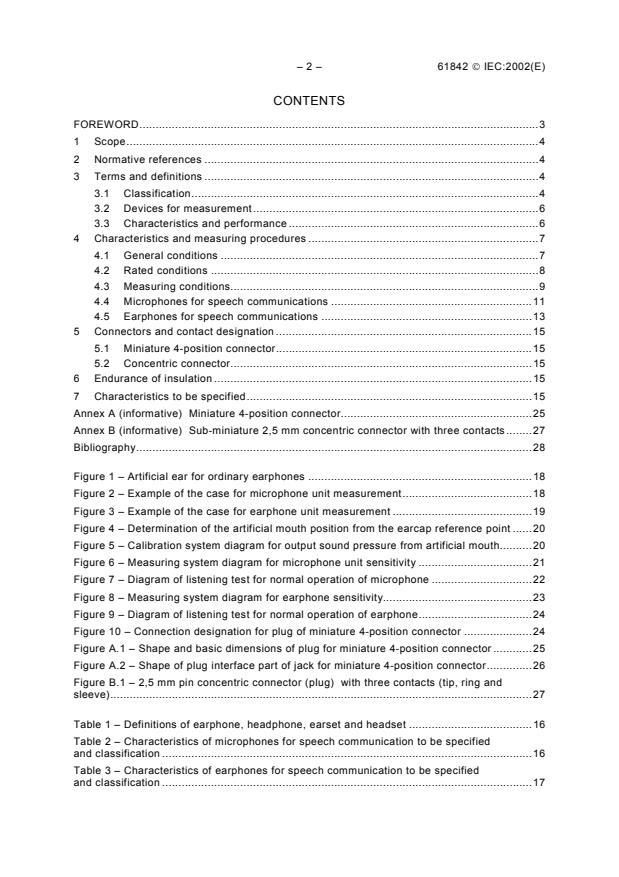
CONTENTS
FOREWORD.3
1 Scope.4
2 Normative references .4
3 Terms and definitions .4
3.1 Classification.4
3.2 Devices for measurement.6
3.3 Characteristics and performance .6
4 Characteristics and measuring procedures .7
4.1 General conditions .7
4.2 Rated conditions .8
4.3 Measuring conditions.9
4.4 Microphones for speech communications .11
4.5 Earphones for speech communications .13
5 Connectors and contact designation .15
5.1 Miniature 4-position connector.15
5.2 Concentric connector.15
6 Endurance of insulation .15
7 Characteristics to be specified.15
Annex A (informative) Miniature 4-position connector.25
Annex B (informative) Sub-miniature 2,5 mm concentric connector with three contacts.27
Bibliography.28
Figure 1 – Artificial ear for ordinary earphones .18
Figure 2 – Example of the case for microphone unit measurement.18
Figure 3 – Example of the case for earphone unit measurement .19
Figure 4 – Determination of the artificial mouth position from the earcap reference point .20
Figure 5 – Calibration system diagram for output sound pressure from artificial mouth.20
Figure 6 – Measuring system diagram for microphone unit sensitivity .21
Figure 7 – Diagram of listening test for normal operation of microphone .22
Figure 8 – Measuring system diagram for earphone sensitivity.23
Figure 9 – Diagram of listening test for normal operation of earphone.24
Figure 10 – Connection designation for plug of miniature 4-position connector .24
Figure A.1 – Shape and basic dimensions of plug for miniature 4-position connector .25
Figure A.2 – Shape of plug interface part of jack for miniature 4-position connector.26
Figure B.1 – 2,5 mm pin concentric connector (plug) with three contacts (tip, ring and
sleeve).27
Table 1 – Definitions of earphone, headphone, earset and headset .16
Table 2 – Characteristics of microphones for speech communication to be specified
and classification .16
Table 3 – Characteristics of earphones for speech communication to be specified
and classification .17
61842 IEC:2002(E) – 3 –
INTERNATIONAL ELECTROTECHNICAL COMMISSION
____________
MICROPHONES AND EARPHONES FOR SPEECH COMMUNICATIONS
FOREWORD
1) The IEC (International Electrotechnical Commission) is a worldwide organization for standardization comprising
all national electrotechnical committees (IEC National Committees). The object of the IEC is to promote
international co-operation on all questions concerning standardization in the electrical and electronic fields. To
this end and in addition to other activities, the IEC publishes International Standards. Their preparation is
entrusted to technical committees; any IEC National Committee interested in the subject dealt with may
participate in this preparatory work. International, governmental and non-governmental organizations liaising
with the IEC also participate in this preparation. The IEC collaborates closely with the International
Organization for Standardization (ISO) in accordance with conditions determined by agreement between the
two organizations.
2) The formal decisions or agreements of the IEC on technical matters express, as nearly as possible, an
international consensus of opinion on the relevant subjects since each technical committee has representation
from all interested National Committees.
3) The documents produced have the form of recommendations for international use and are published in the form
of standards, technical specifications, technical reports or guides and they are accepted by the National
Committees in that sense.
4) In order to promote international unification, IEC National Committees undertake to apply IEC International
Standards transparently to the maximum extent possible in their national and regional standards. Any
divergence between the IEC Standard and the corresponding national or regional standard shall be clearly
indicated in the latter.
5) The IEC provides no marking procedure to indicate its approval and cannot be rendered responsible for any
equipment declared to be in conformity with one of its standards.
6) Attention is drawn to the possibility that some of the elements of this International Standard may be the subject
of patent rights. The IEC shall not be held responsible for identifying any or all such patent rights.
International Standard IEC 61842 has been prepared by IEC technical committee 100: Audio,
video and multimedia systems and equipment.
The text of this standard is based on the following documents:
FDIS Report on voting
100/450/FDIS 100/479/RVD
Full information on the voting for the approval of this standard can be found in the report on
voting indicated in the above table.
This publication has been drafted in accordance with the ISO/IEC Directives, Part 2.
The committee has decided that the contents of this publication will remain unchanged until 2005.
At this date, the publication will be
• reconfirmed;
• withdrawn;
• replaced by a revised edition, or
• amended.
– 4 – 61842 IEC:2002(E)
MICROPHONES AND EARPHONES FOR SPEECH COMMUNICATIONS
1 Scope
This standard applies to the microphone part and earphone part of handsets, headsets or
earsets for speech communications, and also to the microphone units and earphone units of
built-in handsets, headsets or earsets. The object of this standard is to establish definitions
relating to these electroacoustic transducers, and to standardize the characteristics to be
specified and the relevant methods of measurement. This does not exclude the use of other
methods of measurement which can be shown to give the same or more reliable results.
2 Normative references
The following reference documents are indispensable for the application of this document. For
dated references, only the edition cited applies. For undated references, the latest edition of
the referenced document (including any amendments) applies.
IEC 60268-1:1985, Sound system equipment – Part 1: General
IEC 60268-4, Sound system equipment – Part 4: Microphones
IEC 60268-7, Sound system equipment – Part 7: Headphones and earphones
IEC 60318-1, Electroacoustics – Simulators of human head and ear – Part 1: Ear simulator for
the calibration of supra-aural earphones
IEC 60603-11:1992, Connectors for frequencies below 3 MHz for use with printed boards –
Part 11: Detail specification for concentric connectors (dimensions for free connectors and
fixed connectors)
IEC 60711, Occluded-ear simulator for the measurement of earphones coupled to the ear
by ear inserts
IEC 61094-1, Measurement microphones – Part 1: Specifications for laboratory standard
microphones
IEC 61094-4, Measurement microphones – Part 4: Specifications for working standard
microphones
ITU-T P.51, Artificial mouth
ITU-T P.370, Coupling hearing aids to telephone sets
3 Terms and definitions
For the purposes of this International Standard, the following terms and definitions apply.
3.1 Classification
3.1.1
handset
assembly for speech communications, which is a handle including a microphone part and an
earphone part suitable to be held by the talker's hand
61842 IEC:2002(E) – 5 –
3.1.2
headset
assembly for speech communications, which consists of a holder to put on the talker's head,
one or two earphone parts and a microphone part, so as to keep the talker’s hands free
3.1.3
earset
assembly for speech communications, which consists of an earphone part and a microphone
part, so as to keep the talker’s hands free, without a holder to put on the talker's head
NOTE The distinction between an earset and a headset is as complicated as it is between an earphone and
a headphone. Table 1 explains the definitions of earphone, headphone, earset and headset used in this standard.
3.1.4
microphone for speech communications:
a) part of a handset, an earset or a headset, which functions as a microphone (an acousto-
electrical transducer)
b) assembly of a microphone unit for speech communications and a case for measurement
purposes, including acoustical circuit elements so as to obtain practical frequency
characteristics
NOTE 1 A microphone for speech communications is understood to include devices, if any, such as amplifiers or
impedance matching transformers up to the output terminals.
NOTE 2 A microphone for speech communications is called merely "microphone", or “microphone part” of a
handset, of an earset or of a headset, in Clause 4 of this standard and beyond.
3.1.5
earphone for speech communications
a) part of a handset, an earset or a headset, which functions as an earphone (an electro-
acoustic transducer)
b) assembly of an earphone unit for speech communications and a case for measurement
purposes, including acoustical circuit elements so as to obtain practical frequency
characteristics
NOTE 1 Any component which is intended by the manufacturer as an integral part of the earphone is included
during measurements.
NOTE 2 An earphone for speech communications is called merely "earphone", or “earphone part” of a handset, of
an earset or of a headset, in Clause 4 of this standard and beyond.
3.1.6
microphone unit for speech communications
acousto-electrical transducer installed in a handset, in an earset or in a headset to pick up the
talker's speech in the vicinity of his/her mouth
NOTE The microphone unit for speech communications is called merely a "microphone unit" in Clause 4 of this
standard and beyond.
3.1.7
earphone unit for speech communications
electroacoustic transducer installed in a handset, in an earset or in a headset to radiate sound
signal in the vicinity of the listener's ear
NOTE The earphone unit for speech communications is called merely an "earphone unit" in Clause 4 of this
standard and beyond.
3.1.8
case for unit measurement
case in which a microphone unit or an earphone unit for speech communications is installed
for measurement. It includes additional acoustic circuit elements so as to obtain practical
frequency characteristics, if necessary
– 6 – 61842 IEC:2002(E)
3.2 Devices for measurement
3.2.1
mouthpiece holes
holes bored into the front of the enclosure of a microphone unit for speech communications,
to receive the input sound
3.2.2
earcap holes
holes bored into the front of the enclosure of an earphone for speech communications, to
radiate the output sound
3.2.3
artificial mouth
sound source for microphone measurement, which can produce the sound field similar to that
around an ordinary human mouth
3.2.4
artificial ear
acoustic load for earphone measurement, whose acoustic impedance is similar to that of an
ordinary human ear. It includes a microphone for measurement
3.2.5
lip ring
circular ring placed in front of the sound outlet of an artificial mouth for localizing the
equivalent lip position
3.2.6
lip plane
outer plane of the lip ring, giving the reference point for finding the measuring position
3.2.7
external d.c. power supply
d.c. power supply for a microphone for speech communications including an amplifier or an
electrical impedance converter circuit
3.2.8
additional resistance
electrical resistance for the earphone for speech communications which requires an external
resistance for necessary adjustment of characteristics of the device
3.2.9
probe coil
coil for measurement of the external magnetic field of an earphone for speech communications
3.3 Characteristics and performance
3.3.1
sensitivity (V/Pa)
absolute value of the ratio between the open-circuit output voltage from a microphone for
speech communications placed at a specified point in the sound field produced by the artificial
mouth and the sound pressure in the undisturbed free field at a specified calibration point, the
signal frequency being the reference frequency
NOTE Though the specified point for the microphone and the sound pressure calibration point should be identical
in general, these points may be different according to this Standard.
61842 IEC:2002(E) – 7 –
3.3.2
sensitivity level (dB)
twenty times the logarithm to base ten of the sensitivity divided by the reference sensitivity
(1 V/Pa)
3.3.3
sensitivity to voltage (Pa/V)
absolute value of the ratio between the sound pressure produced by an earphone for speech
communications in the artificial ear and the voltage supplied to the earphone, the signal
frequency being the reference frequency
3.3.4
sensitivity level to voltage (dB)
twenty times the logarithm with a base of ten of the sensitivity divided by the reference
sensitivity (20 μPa/V)
3.3.5
sensitivity to power (Pa /W)
absolute value of the ratio between mean square of the sound pressure produced by an
earphone for speech communications in the artificial ear and the electrical power supplied to
the earphone, the signal frequency being the reference frequency
3.3.6
sensitivity level to power (dB)
ten times the logarithm with a base of ten of the sensitivity to power divided by the reference
−10 2
sensitivity (4 × 10 Pa /W)
3.3.7
electrical impedance (Ω)
absolute value of the internal impedance measured at the output terminals of a microphone
for speech communications or the input terminals of an earphone for speech communications
NOTE The word “electrical” is added in this Standard to distinguish the electrical impedance from the acoustical
or the mechanical impedance.
3.3.8
capacitance (nF)
capacitance measured at the input terminal of the earphone for speech communications
NOTE The capacitance is relevant only to earphones including a piezoelectric transducer because an ordinary
piezoelectric microphone includes an amplifier.
3.3.9
plane of magnetic field strength measurement
a plane parallel to the earcap reference plane at a distance of 10 mm (see 4.2.7)
4 Characteristics and measuring procedures
4.1 General conditions
IEC 60268-1 applies for the following items:
1) Units and system for measurement: IEC 60268-1, Clause 2.
2) Climatic conditions: IEC 60268-1, Clause 8.
3) Graphical presentation of data: IEC 60268-1, Clause 10.
– 8 – 61842 IEC:2002(E)
4.2 Rated conditions
In order to perform measurements correctly and reproducibly, certain basic data, to be
specified by manufacturer, are essential, and these are termed 'rated conditions'. For a full
explanation of rated conditions, see IEC 60268-2.
4.2.1 Rated d.c. power supply voltage (V)
The d.c. power supply voltage for the microphone for speech communications.
4.2.2 Rated sinusoidal voltage (V)
The sinusoidal input voltage over the specified frequency range, under which the earphone for
speech communications can operate in a linear mode continuously without any thermal or
mechanical damage for a long time.
4.2.3 Rated sinusoidal power (W)
Electric power given by,
(U ) /Z
s r
where
U is the rated sinusoidal voltage;
s
Z is the rated impedance.
r
4.2.4 Rated noise voltage (V)
The pink noise input voltage over the specified frequency range, under which the earphone
for speech communications can operate in a linear mode continuously without permanent
damage for a long time.
4.2.5 Rated noise power (W)
Electric power given by,
(U ) /Z
n r
where
U is the rated noise voltage;
n
Z is the rated impedance.
r
4.2.6 Rated frequency range
Frequency range of a continuous input signal for a normal operation of a microphone or an
earphone for speech communications.
4.2.7 Earcap reference plane
Plane formed by the contacting points of a flat surface against the earcap of a handset, an
earset or a headset, or by the front plane of the case for earphone unit measurement.
NOTE Partly similar to the definition in ITU-T P.10 (see Bibliography).
4.2.8 Earcap reference point
Point in the earcap reference plane, used as a reference parameter.
NOTE See the note to 4.2.7.
61842 IEC:2002(E) – 9 –
4.2.9 Rated impedance (Ω)
Absolute value of the electrical impedance of a microphone or earphone for speech
communications.
For an earphone with an electrodynamic transducer, it is recommended that the value is
chosen so that the lowest value of the modulus of the actual impedance within the rated
frequency range is not less than 80 % of the chosen value. Alternatively, it may be given as
the value at the reference frequency or the value at the frequency specified by the
manufacturer.
4.2.10 Rated capacitance (nF)
The capacitance of an earphone for speech communications at the frequency specified by the
manufacturer, or at 120 Hz, if not specified.
4.3 Measuring conditions
4.3.1 Environmental interference
The level of disturbances due to environmental noise, reverberation, wind noise, electro-
magnetically induced noise, vibration noise and other interference shall be at least 10 dB
below the measured quantity.
4.3.2 Reference sound pressure
The reference sound pressure for a microphone shall be 1 Pa and that for an earphone shall
be 20 μPa.
4.3.3 Signal for measurement
A sinusoidal signal shall be used for measurement unless otherwise specified.
Results may also be gained from measurements using noise signals, quasi-random sequence
signals or impulsive signals. If signals other than sinusoidal signals are used, it is the
responsibility of the test house to show that the results are equivalent or have fewer artefacts
than those obtained with sinusoidal signals.
4.3.4 Reference frequency and frequency range
The reference frequency shall be 1 kHz. The frequency range shall be from 150 Hz to 5 kHz
unless otherwise specified. The frequency values for measurement at discrete frequency
points shall be specified by the manufacturer.
4.3.5 Apparatus for acoustic measurement
The following apparatus shall be used.
a) Microphone for measurement
A condenser microphone conforming to IEC 61094-1 or IEC 61094-4 shall be used. Type
LS2P or equivalent, or smaller than LS2P, is recommended. A pressure microphone
whose sensitivity was calibrated by using the standard condenser microphone is
acceptable.
b) Artificial mouth
The artificial mouth defined by ITU-T Recommendation P.51 shall be used.
c) Artificial ear
The artificial ear defined in IEC 60318-1 or IEC 60711 shall be used. Additional components
shall be used, if necessary.
– 10 – 61842 IEC:2002(E)
The type of artificial ear to be used, and conditions relating to shape, dimension or other
characteristics of the additional components shall be specified by the manufacturer. In
particular, the following items shall be specified clearly.
1) Position of the earcap reference plane,
2) Position of the earcap reference point, and,
3) Direction of axis of the microphone part.
The artificial ear specified in IEC 60318-1, or an artificial ear with a construction as shown in
Figure 1, is recommended for measurement of the supra-aural earphone, defined in the
Clause 1 of IEC 60268-7: with minimized leakage, mainly for measurements at les
...