

IEC 60227-6:1985/AMD1:1997
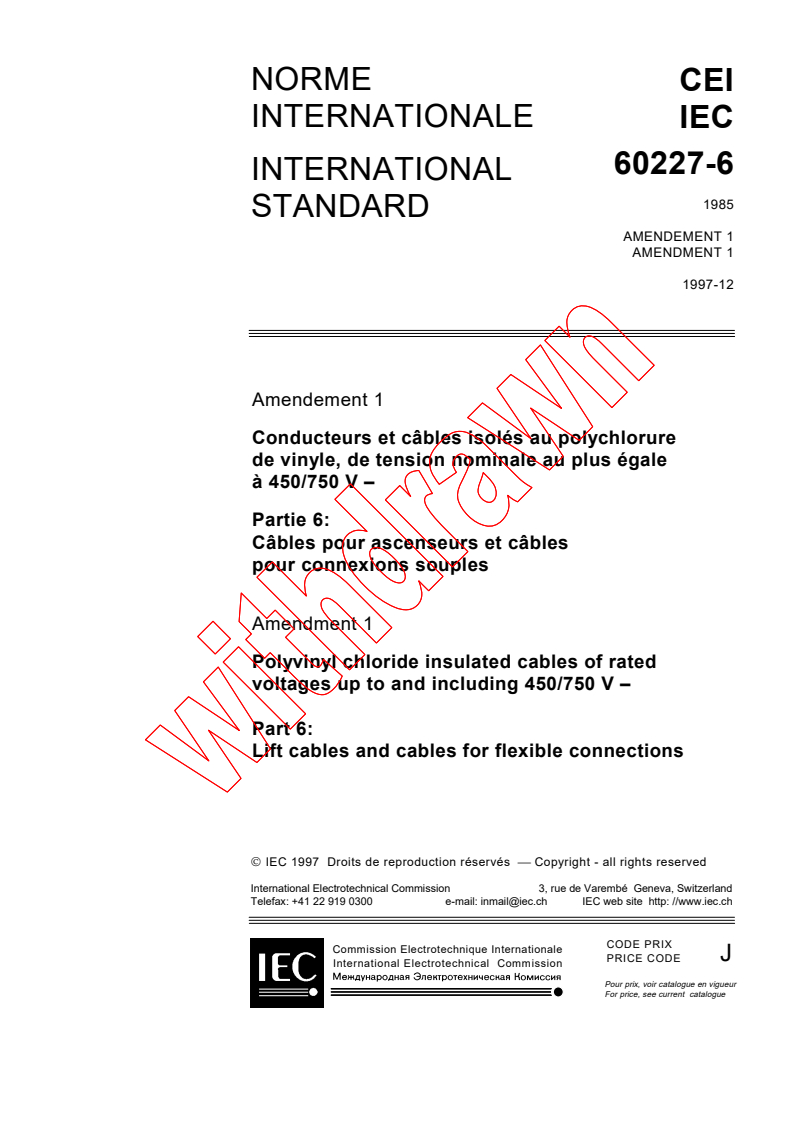
(Amendment)Amendment 1 - Polyvinyl chloride insulated cables of rated voltages up to and including 450/750 V. Part 6: Lift cables and cables for flexible connections
General Information
- Abstract
- Status
- Published
- Publication Date
- 10-Dec-1997
- Technical Committee
- TC 20 - Electric cables
- Current Stage
- DELPUB - Deleted Publication
- Start Date
- 13-Jun-2001
- Completion Date
- 28-Aug-2026
Buy Documents
IEC 60227-6:1985/AMD1:1997 - Amendment 1 - Polyvinyl chloride insulated cables of rated voltages up to and including 450/750 V. Part 6: Lift cables and cables for flexible connections Released:12/11/1997
Overview
IEC 60227-6:1985/AMD1:1997 is an important amendment to the international standard that specifies polyvinyl chloride (PVC) insulated cables of rated voltages up to and including 450/750 V. This amendment focuses specifically on lift cables and cables designed for flexible connections, providing detailed requirements to ensure safety, reliability, and durability in demanding elevator and flexible cable applications.
Produced by the International Electrotechnical Commission (IEC), this amendment complements the original IEC 60227-6 standard, detailing construction methods, testing procedures, and performance criteria essential for cables used in vertical transportation systems and flexible cable applications.
Key Topics
Cable Types and Designation
The amendment introduces circular and flat lift cables as well as flexible connection cables. It defines the code designation system, such as "60227 IEC 71 c," for clear identification of cable types.Rated Voltages
Rated voltage classifications include 300/500 V for cables with conductors ≤1 mm² and 450/750 V for conductors >1 mm², making these cables suitable for various low-voltage lift and flexible connection applications.Construction Details
- Conductors: Class 5 flexible copper conductors either plain or tinned with specific cross-sectional areas and preferred conductor counts.
- Insulation: Type PVC/D polyvinyl chloride applied around each conductor for electrical insulation, with specified insulation thickness and minimum insulation resistance values.
- Core Assembly: Conductors, telecommunication units (including optical fibers, coaxial cables, and screened pairs), and fillers are assembled around a central core (hemp, jute, strain member, or combinations), providing mechanical strength and integrity.
- Screening: Optional copper wire braid screen for electromagnetic interference protection with a minimum 85% copper coverage.
- Sheath: Outer sheath of type PVC/ST5 compound with specified thickness depending on cable diameter, designed for mechanical protection and ease of removal without damage.
Testing Requirements
- Flexing tests are prescribed, especially for flexible cables, to ensure durability under repeated bending.
- Static flexibility tests verify cable performance under tensile strain conditions.
- Strain member tensile testing ensures the mechanical integrity of the central strength member.
- Additional tests include insulation resistance, dimensional verification, and thermal aging where applicable.
Application Guidance
The standard includes a guide to use, helping manufacturers and users select and implement cables according to operational and safety requirements, optimizing performance in lifts and flexible connection contexts.Additional Annex
A fictitious calculation method for determining sheath dimensions is provided, enabling precise design and assurance of cable integrity.
Applications
This amendment applies specifically to:
Elevator (Lift) Cables
Designed for vertical movement and high mechanical stress, these cables are central to elevator safety and functionality. Their construction ensures flexibility, strain resistance, and reliable electrical performance in lift control and power circuits.Flexible Connection Cables
Used in environments requiring frequent bending or movement, such as machinery connections, robotics, and mobile equipment, these cables offer flexibility without sacrificing electrical safety.Telecommunication Integration
The ability to incorporate optical fibers, coaxial cables, and screened pairs within the cable assembly makes this standard relevant for lift communication systems and control networks embedded in the cable structure.
Related Standards
IEC 60227-6 Amendment 1 references and complements several international standards that cover broader or related cable characteristics and testing methods:
- IEC 60227-1: General requirements for PVC insulated cables.
- IEC 60228: Conductors of insulated cables - classification and requirements for conductor materials.
- IEC 60096-0-1: Radio-frequency cables - guide to specification design, relevant for cable screening requirements.
- IEC 60502-1: Power cables with extruded insulation for rated voltages from 1 kV to 30 kV.
- IEC 60811 series: Common test methods for insulation and sheathing materials, including thermal aging, mechanical properties, and low temperature tests.
- Additional IEC testing methods specific to PVC compounds ensuring the mechanical and electrical integrity of the cables.
Summary
The IEC 60227-6:1985/AMD1:1997 amendment is an essential reference standard for manufacturers and users of PVC insulated lift cables and flexible connection cables rated up to 450/750 V. It delivers comprehensive technical specifications, focusing on conductor construction, insulation quality, assembly methods, mechanical strength, and environmental resistance. By aligning with this amendment, suppliers and engineers can ensure cables meet international quality benchmarks, promoting safety, durability, and optimal performance in elevator systems and flexible cable applications.
Keywords: IEC 60227-6 amendment, PVC insulated cables, lift cables, flexible connection cables, rated voltage 450/750 V, cable construction, cable testing, cable standards, electric cables, lift system cables, flexible cables.
Relations
- Effective Date
- 05-Sep-2023
Buy Documents
IEC 60227-6:1985/AMD1:1997 - Amendment 1 - Polyvinyl chloride insulated cables of rated voltages up to and including 450/750 V. Part 6: Lift cables and cables for flexible connections Released:12/11/1997
Get Certified
Connect with accredited certification bodies for this standard

DIBt (Deutsches Institut für Bautechnik)
German Institute for Building Technology.
DIN CERTCO
DIN Group product certification.

IMQ S.p.A. (Certification)
Italian electrical product certification.
Sponsored listings
Frequently Asked Questions
IEC 60227-6:1985/AMD1:1997 is a standard published by the International Electrotechnical Commission (IEC). Its full title is "Amendment 1 - Polyvinyl chloride insulated cables of rated voltages up to and including 450/750 V. Part 6: Lift cables and cables for flexible connections". This standard covers: Amendment 1 - Polyvinyl chloride insulated cables of rated voltages up to and including 450/750 V. Part 6: Lift cables and cables for flexible connections
Amendment 1 - Polyvinyl chloride insulated cables of rated voltages up to and including 450/750 V. Part 6: Lift cables and cables for flexible connections
IEC 60227-6:1985/AMD1:1997 is classified under the following ICS (International Classification for Standards) categories: 29.060.20 - Cables; 91.140.90 - Lifts. Escalators. The ICS classification helps identify the subject area and facilitates finding related standards.
IEC 60227-6:1985/AMD1:1997 has the following relationships with other standards: It is inter standard links to IEC 60227-6:2001. Understanding these relationships helps ensure you are using the most current and applicable version of the standard.
IEC 60227-6:1985/AMD1:1997 is available in PDF format for immediate download after purchase. The document can be added to your cart and obtained through the secure checkout process. Digital delivery ensures instant access to the complete standard document.
Standards Content (Sample)
NORME
CEI
INTERNATIONALE
IEC
60227-6
INTERNATIONAL
STANDARD
AMENDEMENT 1
AMENDMENT 1
1997-12
Amendement 1
Conducteurs et câbles isolés au polychlorure
de vinyle, de tension nominale au plus égale
à 450/750 V –
Partie 6:
Câbles pour ascenseurs et câbles
pour connexions souples
Amendment 1
Polyvinyl chloride insulated cables of rated
voltages up to and including 450/750 V –
Part 6:
Lift cables and cables for flexible connections
IEC 1997 Droits de reproduction réservés Copyright - all rights reserved
International Electrotechnical Commission 3, rue de Varembé Geneva, Switzerland
Telefax: +41 22 919 0300 e-mail: inmail@iec.ch IEC web site http: //www.iec.ch
CODE PRIX
Commission Electrotechnique Internationale
PRICE CODE J
International Electrotechnical Commission
Pour prix, voir catalogue en vigueur
For price, see current catalogue
– 2 – 60227-6 amend. 1 © CEI:1997
AVANT-PROPOS
Le présent amendement a été établi par le sous-comité 20B: Câbles de basse tension, du
comité d'études 20 de la CEI: Câbles électriques.
Le texte de cet amendement est issu des documents suivants:
FDIS Rapport de vote
20B/252//FDIS 20B/260/RVD
Le rapport de vote indiqué dans le tableau ci-dessus donne toute information sur le vote ayant
abouti à l'approbation de cet amendement.
__________
Page 2
SOMMAIRE
Ajouter, à la fin de la liste des articles, les nouveaux titres suivants:
3 Câbles circulaires sous gaine de polychlorure de vinyle pour ascenseurs et câbles
pour connexions souples
3.1 Désignation
3.2 Tension nominale
3.3 Constitution
3.4 Essais
3.5 Guide d’emploi
Annexe A – Méthode de calcul fictif pour la détermination de la dimension de la gaine
Page 4
PRÉFACE
Insérer, dans le dernier paragraphe de la préface, les nouvelles références suivantes:
CEI 60096-0-1:1990, Câbles pour fréquences radioélectriques – Partie 0-1: Guide pour la
conception des spécifications particulières – Câbles coaxiaux
CEI 60502-1:1997, Câbles d'énergie à isolant extrudé et leurs accessoires pour des tensions
assignées de 1 kV (U = 1,2 kV) à 30 kV (U = 36 kV) – Partie 1: Câbles de tensions
m m
assignées de 1 kV (U = 1,2 kV) et 3 kV (U = 3,6 kV)
m m
60227-6 Amend. 1 © IEC:1997 – 3 –
FOREWORD
This amendment has been prepared by subcommittee 20B: Low-voltage cables, of IEC
technical committee 20: Electric cables.
The text of this amendment is based on the following documents:
FDIS Report on voting
20B/252/FDIS 20B/260/RVD
Full information on the voting for the approval of this amendment can be found in the report on
voting indicated in the above table.
__________
Page 3
CONTENTS
Add, at the end of the list of contents, the following new titles:
3 Circular polyvinyl chloride sheathed lift cable and cable for flexible connections
3.1 Code designation
3.2 Rated voltage
3.3 Construction
3.4 Tests
3.5 Guide to use
Annex A – Fictitious calculation method for determination of the sheath dimension
Page 5
PREFACE
Add, in the last paragraph of the preface, the following new references:
IEC 60096-0-1:1990, Radio-frequency cables – Part 0-1: Guide to the design of detailed
specifications – Coaxial cables
IEC 60502-1:1997, Power cables with extruded insulation and their accessories for rated
voltages from 1 kV (U = 1,2 kV) up to 30 kV (U = 36 kV) – Part 1: Cables for rated voltages
m m
of 1 kV (U = 1,2 kV) and 3 kV (U = 3,6 kV)
m m
– 4 – 60227-6 amend. 1 © CEI:1997
CEI 60811-1-1:1993, Méthodes d'essais communes pour les matériaux d’isolation et de
gainage des câbles électriques – Partie 1: Méthodes d’application générale – Section 1: Mesure
des épaisseurs et des dimensions extérieures – Détermination des propriétés mécaniques
CEI 60811-1-2:1985, Méthodes d’essais communes pour les matériaux d’isolation et de
gainage des câbles électriques – Première partie: Méthodes d’application générale – Section
deux: Méthodes de vieillissement thermique
CEI 60811-1-4:1985, Méthodes d’essais communes pour les matériaux d’isolation et de
gainage des câbles électriques – Première partie: Méthodes d’application générale – Section
quatre: Essais à basse température
CEI 60811-3-1:1985: Méthodes d’essais communes pour les matériaux d’isolation et de
gainage des câbles électriques – Troisième partie: Méthodes spécifiques pour les mélanges
PVC – Section un: Essai de pression à température élevée – Essais de résistance à la
fissuration
CEI 60811-3-2:1985, Méthodes d’essais communes pour les matériaux d’isolation et de
gainage des câbles électriques – Troisième partie: Méthodes spécifiques pour les mélanges
PVC – Section deux: Essai de perte de masse – Essai de stabilité thermique
Page 6
1 Domaine d'application
Remplacer le texte de cet article par le nouveau texte suivant:
La présente partie de la CEI 60227 précise les spécifications particulières aux câbles pour
ascenseurs de type circulaire et méplat, et aux câbles pour connexions souples, de tension
nominale au plus égale à 450/750 V.
Chaque câble satisfait aux prescriptions appropriées données dans la CEI 60227-1, et aux
prescriptions particulières de la présente partie de la CEI 60227.
Page 20
Ajouter, après le tableau III, le nouvel article 3 et la nouvelle annexe A.
3 Câbles circulaires sous gaine de polychlorure de vinyle pour ascenseurs
et câbles pour connexions souples
3.1 Désignation
60227 IEC 71 c
3.2 Tension nominale
– 300/500 V pour les câbles dont la section nominale des âmes conductrices est au plus
égale à 1 mm .
– 450/750 V pour les âmes de section supérieure à 1 mm .
60227-6 Amend. 1 © IEC:1997 – 5 –
IEC 60811-1-1:1993, Common test methods for insulating and sheathing materials of electric
cables – Part 1: Methods for general application – Section 1: Measurement of thickness and
overall dimensions – Tests for determining the mechanical properties
IEC 60811-1-2:1985, Common test methods for insulating and sheathing materials of electric
cables – Part 1: Methods for general application – Section Two: Thermal ageing methods
IEC 60811-1-4:1985, Common test methods for insulating and sheathing materials of electric
cables – Part 1: Methods for general application – Section Four: Test at low temperature
IEC 60811-3-1:1985, Common test methods for insulating and sheathing materials of electric
cables – Part 3: Methods specific to PVC compounds – Section One: Pressure test at high
temperature – Tests for resistance to cracking
IEC 60811-3-2:1985, Common test methods for insulating and sheathing materials of
electric cables – Part 3: Methods specific to PVC compounds – Section Two: Loss of mass
test – Thermal stability test
Page 7
1 Scope
Replace the text of this clause by the following new text:
This part of IEC 60227 details the particular specifications for circular and flat lift cables and
cables for flexible connections of rated voltages up to and including 450/750 V.
Each cable complies with the appropriate requirements given in IEC 60227-1, and the
particular requirements of this part of IEC 60227.
Page 21
Add, at the end of table III, the following new clause 3 and the new annex A.
3 Circular polyvinyl chloride sheathed lift cable and cable for flexible connections
3.1 Code designation
60227 IEC 71 c
3.2 Rated voltage
– 300/500 V for cables with conductors having nominal cross-sectional areas not exceeding
1 mm .
– 450/750 V for conductors larger than 1 mm .
– 6 – 60227-6 amend. 1 © CEI:1997
3.3 Constitution
3.3.1 Ame
Les combinaisons des sections nominales et du nombre préférentiel d’âmes ayant ces sections
sont données dans le tableau 4.
Tableau 4 – Combinaison des sections nominales et du nombre d’âmes
1)
Section nominale de l'âme Nombre préférentiel des âmes
mm
0,75, 1, 1,5 et 2,5 6, 9, 12, 18, 24 ou 30
4, 6, 10, 16 et 25 4 ou 5
1)
Les nombres préférentiels mentionnés n'excluent pas la constitution de câbles
ayant un nombre de conducteurs autre ou plus élevé.
Les âmes doivent satisfaire aux prescriptions de classe 5 de la CEI 60228, à l'exception de la
valeur maximale de la résistance des âmes n'excédant pas 2,5 mm , qui doit être accrue de 5 %.
Les brins peuvent être nus ou étamés.
Les unités de télécommunication suivantes peuvent être introduites dans n'importe quelle
couche du câble:
– câbles à fibres optiques,
– câbles coaxiaux,
– paires avec écran et monoconducteurs avec écran dont la section nominale de l'âme est
d'au moins 0,5 mm .
Les âmes des paires et des monoconducteurs doivent satisfaire aux prescriptions de la classe 5
de la CEI 60228.
Toutes les unités de télécommunication doivent avoir une gaine non métallique extrudée ou un
ruban séparateur.
3.3.2 Enveloppe isolante des conducteurs de contrôle et de puissance
L'enveloppe isolante doit être un mélange de polychlorure de vinyle du type PVC/D appliqué
autour de l'âme.
L'épaisseur de l'enveloppe isolante doit satisfaire à la valeur spécifiée donnée dans le tableau 5,
colonne 2.
La résistance d’isolement ne doit pas être inférieure à la valeur donnée dans le tableau 5,
colonne 3.
60227-6 Amend. 1 © IEC:1997 – 7 –
3.3 Construction
3.3.1 Conductor
The combination of the cross-sectional areas and the preferred number of conductors
belonging to them is given in table 4.
Table 4 – Combination of cross-sectional areas and the number of conductors
Nominal cross-sectional area Preferred number
1)
of conductors of conductors
mm
0,75, 1, 1,5 and 2,5 6, 9, 12, 18, 24 or 30
4, 6, 10, 16 and 25 4 or 5
1)
The preferred numbers mentioned for the conductors do not preclude the con-
struction of cables having another number of cores or more cores.
The conductors shall comply with the requirements given in IEC 60228 for class 5 conductors,
except that the values of the maximum resistance of the conductors up to and including
2,5 mm shall be increased by 5 %. The wires may be plain or tinned.
The following telecommunication units may be included in any layer of the cable:
– optical fibre cables,
– coaxial cables,
– screened communication pairs and screened single cores with conductors having a nominal
cross-sectional area of at least 0,5 mm .
The conductors of the communication pairs and single cores shall comply with the
requirements of IEC 60228 for class 5 conductors.
Any telecommunication unit shall be provided with a suitable extruded non-metallic covering, or
binder tape.
3.3.2 Insulation for the control and power cores
The insulation shall be polyvinyl chloride compound of type PVC/D applied around each
conductor.
The insulation thickness shall comply with the specified value given in table 5, column 2.
The insulation resistance shall be not less than the value given in table 5, column 3.
– 8 – 60227-6 amend. 1 © CEI:1997
Tableau 5 – Données générales pour les câbles du type 60227 IEC 71 c
12 3
Section nominale des âmes Epaisseur nominale de l'enveloppe isolante Résistance d'isolement
Valeur spécifiée minimale à 70 °C
MΩ·km
mm mm
0,75 0,6 0,011
1 0,6 0,010
1,5 0,7 0,010
2,5 0,8 0,009
4 0,8 0,007
6 0,8 0,006
10 1,0 0,0056
16 1,0 0,0046
25 1,2 0,0044
3.3.3 Disposition des conducteurs, des âmes centrales, des unités de
télécommunication et des bourrages éventuels
Pour les câbles d'ascenseurs, les conducteurs ainsi que les unités de télécommunication ou
les bourrages éventuels doivent être assemblés autour d'une âme centrale.
L'âme centrale doit être composée de
a) chanvre, jute ou d’un matériau similaire, ou
b) d’une âme porteuse, ou
c) d’une combinaison de a) et b) ci-dessus.
L'âme porteuse doit être composée soit d'un matériau non métallique, soit de métal revêtu d'un
revêtement non conducteur, résistant à l'abrasion.
NOTE – L'objet du revêtement est d'éviter des dommages sur les conducteurs lors de la rupture des brins de l'âme
porteuse.
Les bourrages éventuels doivent être composés de coton sec ou d’un autre matériau fibreux
convenable.
Pour les câbles destinés à d'autres applications que les ascenseurs, l'âme centrale et/ou l'âme
porteuse est optionnelle.
Les conducteurs doivent être assemblés en une seule couche pour les câbles à 6, 9 et
12 conducteurs, et en une ou deux couches pour les câbles ayant plus de 12 conducteurs et
jusqu’à 30 conducteurs. Comme il est possible de fabriquer des câbles à plus de 30 conducteurs
(voir note du tableau 4), dans ce cas le nombre de couches peut être augmenté en conséquence.
L'assemblage des conducteurs doit avoir une section pratiquement circulaire.
Le pas d'assemblage des conducteurs ne doit pas dépasser 11 fois le diamètre du cercle
passant à travers le centre des conducteurs assemblés.
3.3.4 Revêtement d’assemblage
Un revêtement composé d'une tresse ou d'un ruban peut être appliqué sur l'assemblage.
La tresse doit être composée de matériau naturel (par exemple coton ou coton traité) ou
synthétique (par exemple rayonne). La tresse doit être uniforme, sans noeud ni jour.
Le ruban doit être composé de matériau naturel ou synthétique compatible avec les matériaux de
l'enveloppe isolante et de la gaine. Il doit être appliqué en hélice avec un chevauchement convenable.
60227-6 Amend. 1 © IEC:1997 – 9 –
Table 5 – General data for type 60227 IEC 7I c
12 3
Nominal cross-sectional Insulation thickness Minimum insulation resistance
area of conductors Specified value 70 °C
MΩ·km
mm mm
0,75 0,6 0,011
1 0,6 0,010
1,5 0,7 0,010
2,5 0,8 0,009
4 0,8 0,007
6 0,8 0,006
10 1,0 0,0056
16 1,0 0,0046
25 1,2 0,0044
3.3.3 Assembly of cores, central heart and telecommunication units and fillers, if any
For lift cables, the cores with optional fillers or telecommunication units shall be twisted round
a central heart.
The central heart shall consist of either
a) hemp, jute or similar material, or
b) a strain-bearing member, or
c) a combination of a) and b) above.
The strain-bearing member shall consist of either a non-metallic material or of a metal covered
with a non-conducting, abrasion resistant material.
NOTE – The purpose of this covering is to prevent damage of the cores by broken strands of the strain-bearing
member.
The fillers, if any, shall consist of dry cotton or other suitable fibrous material.
For cables for other applications than lift cables, a central heart and/or a strain-bearing
member is optional.
The cores shall be so assembled as to form one layer for 6, 9 and 12 core cables and one or
two layers for cables having more than 12 cores up to 30 cores. As it is possible to
manufacture cables with more than 30 cores (see note of table 4), in this case the numbers of
layers may be increased accordingly. The assembly of the cores shall have a practically
circular cross-section.
The pitch of the laid-up cores shall not exceed 11 times the diameter of the circle passing
through the centres of the laid-up cores themselves.
3.3.4 Covering of the core assembly
A covering, consisting of a braid or a tape, may be applied over the completed core assembly.
The braid shall be based on natural material (e.g. cotton, treated cotton) or synthetic material
(e.g. rayon). The braid shall be uniform without knots or gaps.
The tape shall be based on natural or synthetic material, compatible with the insulation and
sheathing materials. It shall be applied helically with suitable overlap.
– 10 – 60227-6 amend. 1 © CEI:1997
3.3.5 Ecran
Un écran peut être appliqué sur le revêtement d'assemblage.
L'écran doit être une tresse de fils de cuivre recuit, nus ou étamés, d'un diamètre maximal
de 0,21 mm, appliquée symétriquement.
La tresse doit être composée de mèches de fils de cuivre ou de mèches de fils de cuivre
alternant avec des mèches de fils textiles convenables (par exemple en polyester).
Le pourcentage de recouvrement de la partie en cuivre, calculé selon une méthode adaptée
(par exemple selon la CEI 60096-0-1) doit être au moins de 85 %.
3.3.6 Gaine
La gaine doit être un mélange de polychlorure de vinyle du type PVC/ST5 appliqué autour du
revêtement d'assemblage ou de l'écran éventuel.
Il doit être possible d'enlever la gaine sans dommage pour la couche sous-jacente, autre que la
tresse spécifiée en 3.3.4 et 3.3.5.
L'épaisseur de la gaine doit satisfaire à la valeur spécifiée au tableau 6.
Tableau 6 – Epaisseur de la gaine
Diamètre fictif sur le revêtement Epaisseur de la gaine
1)
d'assemblage Valeur spécifiée
mm mm
– 9,0 1,0
9,1 – 14,0 1,3
14,1 – 18,0 1,6
18,1 – 22,0 2,0
22,0 et supérieur 2,4
1)
Y compris l'écran éventuel.
3.4 Essais
La conformité aux prescriptions données en 3.3 est vérifiée par examen et par les essais
donnés dans le tableau 8.
3.4.1 Essais de flexions alternées
Pour les câbles d'ascenseurs: à l'étude.
60227-6 Amend. 1 © IEC:1997 – 11 –
3.3.5 Screen
A screen may be applied over the covering of the core assembly.
The screen shall be a symmetrically applied wire braid of plain or tinned, annealed copper
wires with a maximum diameter of 0,21 mm.
The braid shall consist of a wire braid or a wire screen cross-meshed with a suitable textile
yarn (e.g. polyester).
The percentage of the braid coverage, related to the copper part, shall be at least 85 %
calculated according to a suitable method (e.g. IEC 60096-0-1).
3.3.6 Sheath
The sheath shall be polyvinyl chloride compound of type PVC/ST5 applied over the covering of
the core assembly or the screen, if any.
It shall be possible to remove the sheath without damaging the underlying layer, other than the
braid specified in 3.3.4 and 3.3.5.
The sheath thickness shall comply with the specified value given in table 6.
Table 6 – Sheath thickness
Fictitious diameter over covering of Sheath thickness
1)
core assembly Specified value
mm mm
– 9,0 1,0
9,1 – 14,0 1,3
14,1 – 18,0 1,6
18,1 – 22,0 2,0
22,0 and larger 2,4
1)
Including the screen, if any.
3.4 Tests
Compliance with the requirements of 3.3 shall be checked by inspection and by the tests given
in table 8.
3.4.1 Flexing test
For lift cables: under consideration.
– 12 – 60227-6 amend. 1 © CEI:1997
Pour les autres câbles, l'essai de flexions alternées doit être réalisé conformément à 3.1 de la
CEI 60227-2 avec les modifications indiquées dans la tableau 7.
Tableau 7 – Essais de flexions alternées
Masse Diamètre des poulies
Type du câble souple
kg mm
Câble circulaire sous gaine de polychlorure de
vinyle pour connexions souples:
2 1,0 80
– de section nominale ne dépassant pas 1 mm
2 2
1,5 120
– de section nominale 1,5 mm et 2,5 mm
– de section nominale 4 mm 2,0 200
3.4.2 Essai statique de souplesse
L'essai doit être effectué conformément à 3.5 de la CEI 60227-2.
La distance l' à vérifier ne doit pas être supérieure à 30 fois le diamètre extérieur mesuré du
câble à l’essai.
3.4.3 Essai de traction de l'âme porteuse
Sauf accord différent entre le fabricant et l'utilisateur, la résistance à la traction de l'âme
centrale constituée d'une âme porteuse doit être essayée conformément aux exigences de 3.6
de la CEI 60227-2.
Ni le bourrage central ni l’âme porteuse ne doivent se rompre pendant l’essai.
3.4.4 Autres essais
D'autres essais et d'autres exigences peuvent être ajoutés selon un accord mutuel entre le
fabricant et l'utilisateur.
3.5 Guide d’emploi
Dans le cas des ascenseurs et des appareils de levage, ce type de câble est prévu pour être
utilisé lorsque la longueur libre suspendue ne dépasse pas 45 m et que la vitesse de
déplacement n'est pas supérieure à 4,0 m/s.
Pour les recommandations au-delà de ces limites, il convient de consulter les codes nationaux,
régionaux ou locaux pour la longueur maximale admissible suspendue et les autres exigences
pour tous les câbles.
La présente spécification ne s'applique pas aux câbles destinés à être utilisés à une
température inférieure à 0 °C.
Température maximale de l'âme en service normal: 70 °C.
60227-6 Amend. 1 © IEC:1997 – 13 –
For other cables the flexing test shall be carried out in accordance with 3.1 of IEC 60227-2 with
the modification as shown in table 7.
Table 7 – Flexing test
Mass of weight Diameter of pulleys
Type of flexible cable
kg mm
Circular polyvinyl chloride sheathed cable for flexible
connections:
2 1,0 80
– of nominal cross-sectional area not exceeding 1 mm
2 2
1,5 120
– of nominal cross-sectional area 1,5 mm and 2,5 mm
– of nominal cross-sectional area 4 mm 2,0 200
3.4.2 Static flexibility test
This test shall be carried out in accordance with 3.5 of IEC 60227-2.
The distance l' to be complied with shall be not more than 30 times the measured overall
diameter of the cable under test.
3.4.3 Tensile strength of strain-bearing member
Unless otherwise agreed between manufacturer and user, the tensile strength of the central
heart comprising a strain-bearing member shall be tested in accordance with the requirements
of 3.6 of IEC 60227-2.
The central heart or strain-bearing centre shall not rupture during the test.
3.4.4 Other tests
Other tests and requirements may be added upon mutual agreement between manufacturer
and user.
3.5 Guide to use
For lifts and hoists this type of cable is intended for installations where the freely suspended
length does not exceed 45 m and the speed of travel does not exceed 4,0 m/s.
For guidance on the use of cables beyond these limits, local, regional, national and other codes
should be consulted for the maximum allowable length for suspension and other requirements
for all cables.
This particular specification does not apply to cables to be used at temperatures below 0 °C.
Maximum conductor temperature in normal use 70 °C.
– 14 – 60227-6 amend. 1 © CEI:1997
Tableau 8 – Essais concernant les câbles souples circulaires du type 60227 IEC 71 c
12 3 4
N° de Essai Catégorie
Méthode d'essai décrite dans:
référence de l'essai
1 Essais électriques CEI 60227-2
1.1 Résistance des âmes T,S 2.1 de la CEI 60227-2
1.2 Essai de tension sur conducteurs selon la
tension nominale:
1.2.1 à 1 500 V pour U /U 300/500 V T 2.3 de la CEI 60227-2
o
1.2.2 à 2 500 V pour U /U 450/750 V T 2.3 de la CEI 60227-2
o
1.3 Essai de tension sur câble complet selon la T,S 2.2 de la CEI 60227-2
tension nominale:
1.3.1 à 2 000 V pour U /U 300/500 V
o
1.3.2 à 2 500 V pour U /U 450/750 V
o
1.4 Résistance d'isolement à 70 °C T 2.4 de la CEI 60227-2
2 Prescriptions relatives aux dispositions cons- CEI 60227-1 et CEI 60227-2
tructives et aux caractéristiques dimensionnelles
2.1 Vérification de la conformité aux dispositions T,S CEI 60227-1
constructives Examen et essais à la main
2.2 Mesure de l'épaisseur de l'enveloppe isolante T,S 1.9 de la CEI 60227-2
2.3 Mesure de l'épaisseur de la gaine T,S 1.10 de la CEI 60227-2
3 Propriétés mécaniques de l'enveloppe isolante
3.1 Essai de traction avant vieillissement T 9.1 de la CEI 60811-1-1
3.2 Essai de traction après vieillissement T 8.1.3 de la CEI 60811-1-2
3.3 Essai de perte de masse T 8.1 de la CEI 60811-3-2
4 Propriétés mécaniques de la gaine
4.1 Essai de traction avant vieillissement T 9.2 de la CEI 60811-1-1
4.2 Essai de traction après vieillissement T 8.1.3 de la CEI 60811-1-2
4.3 Essai de perte de masse T 8.2 de la CEI 60811-3-2
5 Essai de pression à température élevée CEI 60811-3-1
5.1 Enveloppe isolante T 8.1 de la CEI 60811-3-1
5.2 Gaine T 8.2 de la CEI 60811-3-1
6 Elasticité et résistance au choc à basse température CEI 60811-1-4
6.1 Essai de pliage de l'enveloppe isolante T 8.1 de la CEI 60811-1-4
à basse température
6.2 Essai de pliage de la gaine à basse température T 8.2 de la CEI 60811-1-4
6.3 Essai d'allongement de la gaine à basse T 8.4 de la CEI 60811-1-4
température
6.4 Essai de choc à basse température sur T 8.5 de la CEI 60811-1-4
câble complet
7 Essai de choc thermique CEI 60811-3-1
7.1 Enveloppe isolante T 9.1 de la CEI 60811-3-1
7.2 Gaine T 9.2 de la CEI 60811-3-1
8 Résistance mécanique du câble complet CEI 60227-2
8.1 Résistance à la traction de l'âme centrale T 3.6 de la CEI 60227-2
composé d'une âme porteuse Voir aussi 3.4.3 de la présente norme
8.2 Essai de flexions alternées T A l'étude pour les câbles d'ascenseurs
Voir aussi 3.4.1 de la présente norme
8.3 Essai statique de souplesse T 3.5 de la CEI 60227-2
Voir aussi 3.4.2 de la présente norme
9 Essai de non-propagation de la flamme T CEI 60332-1
60227-6 Amend. 1 © IEC:1997 – 15 –
Table 8 – Tests for circular flexible cable type 60227 IEC 71 c
12 3 4
Reference Test Category
Test method described in:
No. of test
1 Electrical IEC 60227-2
1.1 Resistance of conductors T,S 2.1 of IEC 60227-2
1.2 Voltage test on cores according to voltage
rating:
1.2.1 at 1 500 V for U /U 300/500 V T 2.3 of IEC 60227-2
o
1.2.2 at 2 500 V for U /U 450/750 V T 2.3 of IEC 60227-2
o
1.3 Voltage test on completed cable according to T,S 2.2 of IEC 60227-2
voltage rating:
1.3.1 at 2 000 V for U /U 300/500 V
o
1.3.2 at 2 500 V for U /U 450/750 V
o
1.4 Insulation resistance at 70 °C T 2.4 of IEC 60227-2
2 Provisions covering constructional and IEC 60227-1 and IEC 60227-2
dimensional characteristics
2.1 Checking of compliance with constructional T,S IEC 60227-1
provi
...