

IEC 60156:2025
(Main)Insulating liquids - Determination of the breakdown voltage at power frequency - Test method
General Information
- Abstract
IEC 60156:2025 specifies the method for determining the dielectric breakdown voltage of insulating liquids at power frequency. The test procedure is performed in a specified apparatus, where the oil sample is subjected to an increasing AC electrical field until breakdown occurs. The method applies to all types of insulating liquids of nominal viscosity up to 350 mm2/s at 40 °C. It is appropriate both for acceptance testing on unused liquids at the time of their delivery and for establishing the condition of samples taken in monitoring and maintenance of equipment.
- Status
- Published
- Publication Date
- 30-Jan-2025
- Technical Committee
- TC 10 - Fluids for electrotechnical applications
- Drafting Committee
- MT 30 - TC 10/MT 30
- Current Stage
- PPUB - Publication issued
- Start Date
- 31-Jan-2025
- Completion Date
- 24-Jan-2025
Buy Documents
IEC 60156:2025 RLV - Insulating liquids - Determination of the breakdown voltage at power frequency - Test method Released:31. 01. 2025
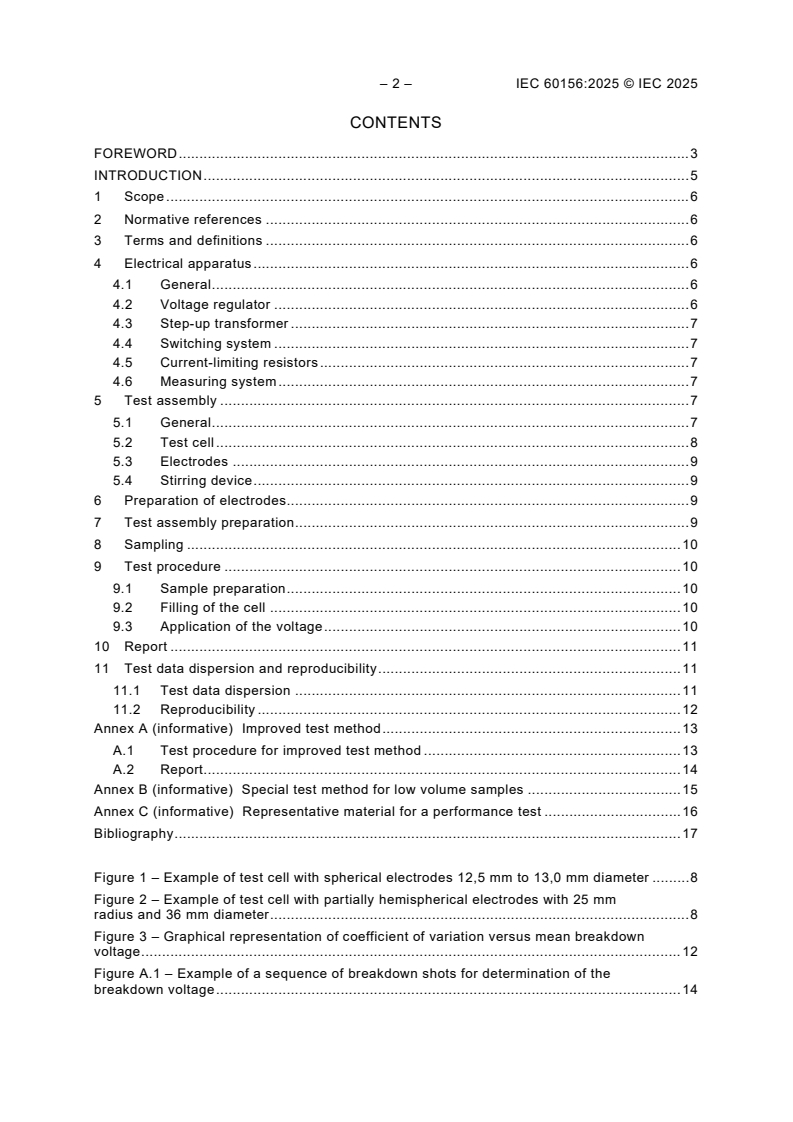
IEC 60156:2025 - Insulating liquids - Determination of the breakdown voltage at power frequency - Test method/31/2025
Overview
IEC 60156:2025 - Insulating liquids - Determination of the breakdown voltage at power frequency - Test method - specifies a standardized AC test method to determine the dielectric breakdown voltage (power-frequency) of insulating liquids. The procedure defines required apparatus, sample handling, test-cell geometry and electrodes, and test control so results are comparable worldwide. It applies to insulating liquids with nominal viscosity up to 350 mm2/s at 40 °C and is suitable for both acceptance testing of new liquids and condition assessment during equipment monitoring and maintenance.
Key topics and technical requirements
- Scope: Method for measuring breakdown voltage at power frequency (48 Hz to 62 Hz sinusoidal supply).
- Apparatus components: Voltage regulator, step-up (or resonant) transformer, switching system, current‑limiting resistors and measuring system.
- Voltage control: Automatic, uniform rate of rise; voltage increments shall be smooth and without overshoot. Incremental steps should not exceed 2% of the expected breakdown voltage.
- Electrical integrity: Transformer secondary centre-point earthed; AC source free from significant harmonics (< 3%).
- Protection & switching: Automatic circuit opening on sustained arc; voltage collapse detection typically around 500 V. Fast cut‑off times (previous edition referenced <100 µs) are noted for multiple breakdown testing of some liquids such as silicones.
- Test assembly: Defined test cells, electrode shapes and sizes, stirring devices and electrode preparation procedures are specified to ensure repeatability.
- Sampling & sample preparation: References IEC 60475 for sampling; strict sample handling and temperature control are required for certified results.
- Data & reporting: Requirements for reporting test conditions, dispersion and reproducibility (including informative annexes on improved methods, low-volume samples and reference materials).
Practical applications and users
- Utilities and power transmission companies for transformer oil testing and dielectric maintenance programs.
- Manufacturers of transformers, switchgear and insulating liquid formulations for acceptance testing and quality control.
- Independent testing laboratories and certification bodies performing standardized dielectric strength assessments.
- Maintenance engineers and asset managers using breakdown voltage as an indicator of contamination (water, particulates) and to guide drying/filtration actions.
Related guidance and annexes
- Normative reference: IEC 60475 (sampling insulating liquids).
- Informative annexes in IEC 60156:2025 describe an improved test method (Annex A), low-volume test cells (Annex B) and a reference material for performance checks (Annex C).
Keywords: IEC 60156:2025, breakdown voltage, insulating liquids test method, power frequency dielectric strength, transformer oil testing, acceptance testing, oil condition monitoring.
Relations
- Effective Date
- 05-Sep-2023
Buy Documents
IEC 60156:2025 RLV - Insulating liquids - Determination of the breakdown voltage at power frequency - Test method Released:31. 01. 2025
IEC 60156:2025 - Insulating liquids - Determination of the breakdown voltage at power frequency - Test method/31/2025
Get Certified
Connect with accredited certification bodies for this standard

IMQ S.p.A. (Certification)
Italian electrical product certification.

SLG Prüf- und Zertifizierungs GmbH
German testing and certification body.

UL Solutions
Global safety science company with testing, inspection and certification.
Sponsored listings
Frequently Asked Questions
IEC 60156:2025 is a standard published by the International Electrotechnical Commission (IEC). Its full title is "Insulating liquids - Determination of the breakdown voltage at power frequency - Test method". This standard covers: IEC 60156:2025 specifies the method for determining the dielectric breakdown voltage of insulating liquids at power frequency. The test procedure is performed in a specified apparatus, where the oil sample is subjected to an increasing AC electrical field until breakdown occurs. The method applies to all types of insulating liquids of nominal viscosity up to 350 mm2/s at 40 °C. It is appropriate both for acceptance testing on unused liquids at the time of their delivery and for establishing the condition of samples taken in monitoring and maintenance of equipment.
IEC 60156:2025 specifies the method for determining the dielectric breakdown voltage of insulating liquids at power frequency. The test procedure is performed in a specified apparatus, where the oil sample is subjected to an increasing AC electrical field until breakdown occurs. The method applies to all types of insulating liquids of nominal viscosity up to 350 mm2/s at 40 °C. It is appropriate both for acceptance testing on unused liquids at the time of their delivery and for establishing the condition of samples taken in monitoring and maintenance of equipment.
IEC 60156:2025 is classified under the following ICS (International Classification for Standards) categories: 29.040 - Insulating fluids. The ICS classification helps identify the subject area and facilitates finding related standards.
IEC 60156:2025 has the following relationships with other standards: It is inter standard links to IEC 60156:2018. Understanding these relationships helps ensure you are using the most current and applicable version of the standard.
IEC 60156:2025 is available in PDF format for immediate download after purchase. The document can be added to your cart and obtained through the secure checkout process. Digital delivery ensures instant access to the complete standard document.
Standards Content (Sample)
IEC 60156 ®
Edition 4.0 2025-01
REDLINE VERSION
INTERNATIONAL
STANDARD
Insulating liquids – Determination of the breakdown voltage at power
frequency – Test method
All rights reserved. Unless otherwise specified, no part of this publication may be reproduced or utilized in any form
or by any means, electronic or mechanical, including photocopying and microfilm, without permission in writing from
either IEC or IEC's member National Committee in the country of the requester. If you have any questions about IEC
copyright or have an enquiry about obtaining additional rights to this publication, please contact the address below or
your local IEC member National Committee for further information.
IEC Secretariat Tel.: +41 22 919 02 11
3, rue de Varembé info@iec.ch
CH-1211 Geneva 20 www.iec.ch
Switzerland
About the IEC
The International Electrotechnical Commission (IEC) is the leading global organization that prepares and publishes
International Standards for all electrical, electronic and related technologies.
About IEC publications
The technical content of IEC publications is kept under constant review by the IEC. Please make sure that you have the
latest edition, a corrigendum or an amendment might have been published.
IEC publications search - webstore.iec.ch/advsearchform IEC Products & Services Portal - products.iec.ch
The advanced search enables to find IEC publications by a Discover our powerful search engine and read freely all the
variety of criteria (reference number, text, technical publications previews, graphical symbols and the glossary.
committee, …). It also gives information on projects, replaced With a subscription you will always have access to up to date
and withdrawn publications. content tailored to your needs.
IEC Just Published - webstore.iec.ch/justpublished
Electropedia - www.electropedia.org
Stay up to date on all new IEC publications. Just Published
The world's leading online dictionary on electrotechnology,
details all new publications released. Available online and once
containing more than 22 500 terminological entries in English
a month by email.
and French, with equivalent terms in 25 additional languages.
Also known as the International Electrotechnical Vocabulary
IEC Customer Service Centre - webstore.iec.ch/csc
(IEV) online.
If you wish to give us your feedback on this publication or need
further assistance, please contact the Customer Service
Centre: sales@iec.ch.
IEC 60156 ®
Edition 4.0 2025-01
REDLINE VERSION
INTERNATIONAL
STANDARD
Insulating liquids – Determination of the breakdown voltage at power
frequency – Test method
INTERNATIONAL
ELECTROTECHNICAL
COMMISSION
ICS 29.040 ISBN 978-2-8327-0194-2
– 2 – IEC 60156:2025 RLV © IEC 2025
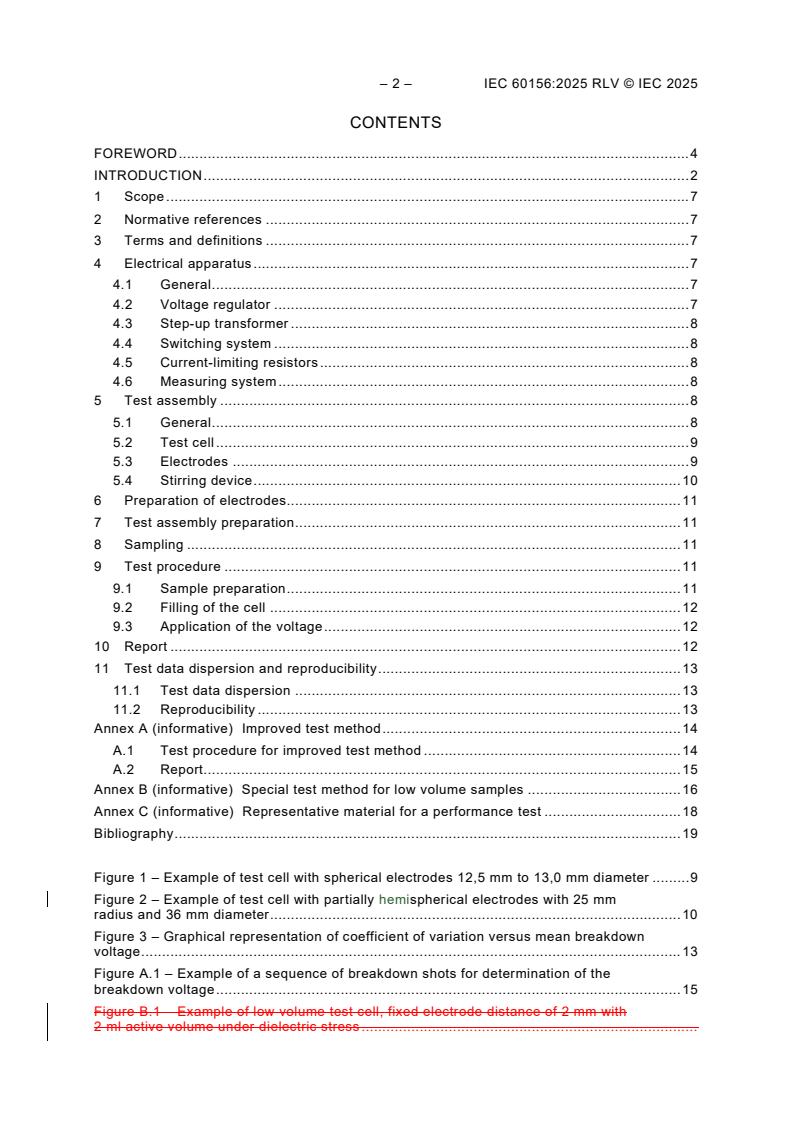
CONTENTS
FOREWORD . 4
INTRODUCTION . 2
1 Scope . 7
2 Normative references . 7
3 Terms and definitions . 7
4 Electrical apparatus . 7
4.1 General . 7
4.2 Voltage regulator . 7
4.3 Step-up transformer . 8
4.4 Switching system . 8
4.5 Current-limiting resistors . 8
4.6 Measuring system . 8
5 Test assembly . 8
5.1 General . 8
5.2 Test cell . 9
5.3 Electrodes . 9
5.4 Stirring device . 10
6 Preparation of electrodes. 11
7 Test assembly preparation . 11
8 Sampling . 11
9 Test procedure . 11
9.1 Sample preparation . 11
9.2 Filling of the cell . 12
9.3 Application of the voltage . 12
10 Report . 12
11 Test data dispersion and reproducibility . 13
11.1 Test data dispersion . 13
11.2 Reproducibility . 13
Annex A (informative) Improved test method . 14
A.1 Test procedure for improved test method . 14
A.2 Report. 15
Annex B (informative) Special test method for low volume samples . 16
Annex C (informative) Representative material for a performance test . 18
Bibliography . 19
Figure 1 – Example of test cell with spherical electrodes 12,5 mm to 13,0 mm diameter . 9
Figure 2 – Example of test cell with partially hemispherical electrodes with 25 mm
radius and 36 mm diameter . 10
Figure 3 – Graphical representation of coefficient of variation versus mean breakdown
voltage . 13
Figure A.1 – Example of a sequence of breakdown shots for determination of the
breakdown voltage . 15
Figure B.1 – Example of low volume test cell, fixed electrode distance of 2 mm with
2 ml active volume under dielectric stress .
Figure B.2 – Example of low volume test cell, fixed electrode distance of 2,5 mm
(150 ml to 200 ml) .
– 4 – IEC 60156:2025 RLV © IEC 2025
INTERNATIONAL ELECTROTECHNICAL COMMISSION
____________
INSULATING LIQUIDS – DETERMINATION OF THE BREAKDOWN
VOLTAGE AT POWER FREQUENCY – TEST METHOD
FOREWORD
1) The International Electrotechnical Commission (IEC) is a worldwide organization for standardization comprising
all national electrotechnical committees (IEC National Committees). The object of IEC is to promote international
co-operation on all questions concerning standardization in the electrical and electronic fields. To this end and
in addition to other activities, IEC publishes International Standards, Technical Specifications, Technical Reports,
Publicly Available Specifications (PAS) and Guides (hereafter referred to as “IEC Publication(s)”). Their
preparation is entrusted to technical committees; any IEC National Committee interested in the subject dealt with
may participate in this preparatory work. International, governmental and non-governmental organizations liaising
with the IEC also participate in this preparation. IEC collaborates closely with the International Organization for
Standardization (ISO) in accordance with conditions determined by agreement between the two organizations.
2) The formal decisions or agreements of IEC on technical matters express, as nearly as possible, an international
consensus of opinion on the relevant subjects since each technical committee has representation from all
interested IEC National Committees.
3) IEC Publications have the form of recommendations for international use and are accepted by IEC National
Committees in that sense. While all reasonable efforts are made to ensure that the technical content of IEC
Publications is accurate, IEC cannot be held responsible for the way in which they are used or for any
misinterpretation by any end user.
4) In order to promote international uniformity, IEC National Committees undertake to apply IEC Publications
transparently to the maximum extent possible in their national and regional publications. Any divergence between
any IEC Publication and the corresponding national or regional publication shall be clearly indicated in the latter.
5) IEC itself does not provide any attestation of conformity. Independent certification bodies provide conformity
assessment services and, in some areas, access to IEC marks of conformity. IEC is not responsible for any
services carried out by independent certification bodies.
6) All users should ensure that they have the latest edition of this publication.
7) No liability shall attach to IEC or its directors, employees, servants or agents including individual experts and
members of its technical committees and IEC National Committees for any personal injury, property damage or
other damage of any nature whatsoever, whether direct or indirect, or for costs (including legal fees) and
expenses arising out of the publication, use of, or reliance upon, this IEC Publication or any other IEC
Publications.
8) Attention is drawn to the Normative references cited in this publication. Use of the referenced publications is
indispensable for the correct application of this publication.
9) IEC draws attention to the possibility that the implementation of this document may involve the use of (a)
patent(s). IEC takes no position concerning the evidence, validity or applicability of any claimed patent rights in
respect thereof. As of the date of publication of this document, IEC had not received notice of (a) patent(s), which
may be required to implement this document. However, implementers are cautioned that this may not represent
the latest information, which may be obtained from the patent database available at https://patents.iec.ch. IEC
shall not be held responsible for identifying any or all such patent rights.
This redline version of the official IEC Standard allows the user to identify the changes
made to the previous edition IEC 60156:2018. A vertical bar appears in the margin
wherever a change has been made. Additions are in green text, deletions are in
strikethrough red text.
IEC 60156 has been prepared by IEC technical committee 10: Fluids for electrotechnical
applications. It is an International Standard.
This fourth edition cancels and replaces the third edition published in 2018. This edition
constitutes a technical revision.
This edition constitutes a technical revision and, mainly, confirms the content of the previous
edition even if some advances are included. The test method has not been changed for practical
reasons, due to the very large number of instrumentations disseminated around the world.
The text of this International Standard is based on the following documents:
Draft Report on voting
10/1241/FDIS 10/1256/RVD
Full information on the voting for its approval can be found in the report on voting indicated in
the above table.
The language used for the development of this International Standard is English.
This document was drafted in accordance with ISO/IEC Directives, Part 2, and developed in
accordance with ISO/IEC Directives, Part 1 and ISO/IEC Directives, IEC Supplement, available
at www.iec.ch/members_experts/refdocs. The main document types developed by IEC are
described in greater detail at www.iec.ch/publications.
The committee has decided that the contents of this document will remain unchanged until the
stability date indicated on the IEC website under webstore.iec.ch in the data related to the
specific document. At this date, the document will be
• reconfirmed,
• withdrawn, or
• revised.
– 6 – IEC 60156:2025 RLV © IEC 2025
INTRODUCTION
As normally applied, breakdown voltage of insulating liquids is not a basic material property but
an empirical test procedure intended to indicate the presence of contaminants such as water
and solid suspended matter and the advisability of carrying out drying and filtration treatment.
The AC breakdown voltage value of insulating liquids strongly depends on the particular set of
conditions used in its measurement. Therefore, standardized testing procedures and equipment
are essential for the unambiguous interpretation of test results.
The method described in this document applies to either acceptance tests on new deliveries of
insulating liquids or testing of treated liquids prior to or during filling into electrical equipment,
or to the monitoring and maintenance of oil-filled insulating liquid-filled apparatus in service. It
specifies rigorous sample-handling procedures and temperature control that should be adhered
to when certified results are required. For routine tests, especially in the field, less stringent
procedures may be practicable, and it is the responsibility of the user to determine their effect
on the results.
Annex A describes, for comparison, an alternative test method which could be introduced in the
future. Annex B describes special test methods, using cells which may include low volume
samples. Annex C describes a reference material for a performance test and check according
to IEC 60060-3 [1] .
___________
Numbers in square brackets refer to the Bibliography.
INSULATING LIQUIDS – DETERMINATION OF THE BREAKDOWN
VOLTAGE AT POWER FREQUENCY – TEST METHOD
1 Scope
This document specifies the method for determining the dielectric breakdown voltage of
insulating liquids at power frequency. The test procedure is performed in a specified apparatus,
where the oil sample is subjected to an increasing AC electrical field until breakdown occurs.
The method applies to all types of insulating liquids of nominal viscosity up to 350 mm /s at
40 °C. It is appropriate both for acceptance testing on unused liquids at the time of their delivery
and for establishing the condition of samples taken in monitoring and maintenance of
equipment.
2 Normative references
The following documents are referred to in the text in such a way that some or all of their content
constitutes requirements of this document. For dated references, only the edition cited applies.
For undated references, the latest edition of the referenced document (including any
amendments) applies.
IEC 60475, Method of sampling insulating liquids
3 Terms and definitions
No terms and definitions are listed in this document.
ISO and IEC maintain terminology databases for use in standardization at the following
addresses:
• IEC Electropedia: available at https://www.electropedia.org/
• ISO Online browsing platform: available at https://www.iso.org/obp
4 Electrical apparatus
4.1 General
The electrical apparatus consists of the following units:
1) voltage regulator,
2) step-up transformer,
3) switching system,
4) current-limiting resistors,
5) measuring device.
Two or more of these units may be integrated in any equipment system.
4.2 Voltage regulator
The test voltage shall be increased with an automatic control of the required uniform voltage
rate of rise. The device should not introduce harmonics disturbances (< 3 %) and the AC source
should be free from harmonics.
– 8 – IEC 60156:2025 RLV © IEC 2025
4.3 Step-up transformer
The test voltage is obtained by using a step-up or resonant transformer supplied from an AC
source using 48 Hz to 62 Hz (sinusoidal waveform). The voltage source value is constantly
increased. The controls of the variable low-voltage source shall be capable of varying the test
voltage smoothly, uniformly and without overshoots or transients. Incremental increases
(produced, for example, by a variable auto-transformer or an amplifier) shall not exceed 2 % of
the expected breakdown voltage.
The centre-point of the secondary winding of the transformer should be connected to earth.
4.4 Switching system
The circuit shall be opened automatically if a sustained arc between the electrodes occurs and
the voltage between the electrodes collapses to a voltage less than 500 V.
NOTE Typically, voltage collapse is detected in the range of 500 V.
The primary circuit of the step-up transformer shall be fitted with a circuit-breaker operated by
the current sensing device, resulting from the breakdown of the sample and shall break the
voltage within 10 ms.
The sensitivity of the current or voltage sensing element depends on the energy-limiting device
employed and only approximate guidance can be given.
A cut-off time of < 100 µs, as given in the previous edition of this document, is needed
necessary to perform multiple breakdowns on silicone liquids.
4.5 Current-limiting resistors
To protect the equipment and to avoid excessive decomposition at the instant of breakdown of
liquids, such as silicone or ester liquids, a resistance limiting the breakdown current shall be
inserted in series with the test cell.
The short-circuit current of the transformer and associated circuits shall be within the range of
10 mA to 25 mA for all voltages higher than 15 kV. This may be achieved by a combination of
resistors in either or both the primary and secondary circuits of the high-voltage transformer.
4.6 Measuring system
For the purpose of this document, the magnitude of the test voltage is defined as its peak value
divided by 2 .
The output voltage of the step-up transformer may be measured by means of a measuring
system consisting of a voltage divider or a measuring winding of the step-up transformer
coupled with a peak-voltmeter. The measuring system shall be calibrated up to the upper scale
voltage to be measured. A method of calibration which has been found satisfactory is the use
of a transfer standard. This is an auxiliary measuring device which is connected in place of the
test cell between the high-voltage terminals to which it presents an impedance similar to the
one of the sample liquids. The auxiliary device is separately calibrated against a primary
standard [2], [3].
5 Test assembly
5.1 General
The breakdown voltage test is performed following the method described herewith as a routine
test.
5.2 Test cell
The volume of the cell shall be between 350 ml and 600 ml.
The cell shall be made from electrically insulating materials that are not hygroscopic. The cell
shall be transparent and chemically inert, resistant to the insulating liquid and to the cleaning
agent that shall be used. A glass cell is the preferred option. Whilst glass is a commonly used
material, other suitable materials such as plastics or polymers are appropriate, provided they
have high chemical resistance to the insulating liquids (including mineral oils, ester liquids,
etc.).
The cell shall be provided with a cover and shall be designed to permit easy removal of the
electrodes for cleaning and maintenance. To improve homogenization of the test liquid, a
rounded bottom shape of the cell is recommended. Containers and covers shall be cleaned by
washing with a suitable solvent or clean insulating liquid to remove residues of an earlier
sample. After cleaning, containers shall be immediately capped and kept closed until used
again. Electrodes shall be stored in clean insulating liquids.
NOTE 1 It is preferable, in the case of esters to use a similar liquid to store the electrodes.
Different shapes of electrodes give different results. The partially hemispherical electrode shall
be used, unless otherwise stated.
NOTE 2 If the difference in the shape of electrodes is minimal, the results difference is also minimal.
Examples of suitable cell designs are given in Figure 1 and Figure 2.
Dimensions in millimetres
2,5
IEC
NOTE The stirring device can be mounted on the top (right side figure) or on the bottom (left side figure). The
stirring device position and Vernier shifter are reported only as reference.
NOTE The stirring device can be mounted on the top or on the bottom.
Figure 1 – Example of test cell with spherical electrodes
12,5 mm to 13,0 mm diameter
– 10 – IEC 60156:2025 RLV © IEC 2025
Dimensions in millimetres
R25
2,5
IEC
NOTE The stirring device can be mounted on the top (right side figure) or on the bottom (left side figure). The
stirring device position and Vernier shifter are reported only as reference.
NOTE The stirring device can be mounted on the top or on the bottom.
Figure 2 – Example of test cell with partially hemispherical electrodes
with 25 mm radius and 36 mm diameter
5.3 Electrodes
The electrodes shall be made either of brass, bronze or austenitic stainless steel. They shall
be polished and, in shape, either spherical (12,5 mm to 13,0 mm diameter) as shown in Figure 1
or in partially hemispherical shape (25 mm ± 0,25 mm radius) as shown in Figure 2. The axis
of the electrode system shall be horizontal and shall be at least 40 mm below the surface of the
test liquid. No part of the cell or stirrer shall influence the electric field between the electrodes.
The gap between the electrodes shall be 2,50 mm ± 0,05 mm.
The electrodes shall be examined frequently for pitting or other damage and shall be maintained
or replaced as soon as such damage is observed.
NOTE The electrodes can be replaced or refurbished typically after 5 000 single breakdowns. The surface of the
electrodes can be polished with a maximum grain diameter of 10 µm. The limit of the arithmetical mean deviation of
the roughness profile of the electrodes can be Ra ≤ = < 0,5 µm, according to ISO 4287 ISO 21290-2 [4].
5.4 Stirring device
The use of an automatic stirring device is recommended, to be used at all times during the test.
The stirrer shall be mounted in the test cell in order to maximize the homogenization of the
liquid. It shall be designed so that it is easily cleaned. Stirring shall be achieved by means of a
two-bladed or appropriate stirrer of effective diameter 25 mm to 35 mm, axial depth 5 mm to
10 mm, rotating at a speed of 200 r/min to 300 r/min. The stirrer shall not produce air bubbles.
It shall be fully immersed in the liquid sample. Examples of stirring systems mounted in test
cells are reported in Figures 1 and 2.
NOTE 1 To avoid bubbles between the electrodes, the stirrer can rotate preferably in such a direction that bubbles
can be removed [5].
NOTE 2 The stirring device can be mounted on the top or on the bottom. In Figures 1 and 2, the stirring device
position is reported only as reference.
ø36
NOTE 3 A magnetic stirring device can be also used. Stirring by means of a magnetic bar (20 mm to 25 mm in
length and 5 mm to 10 mm in diameter) is an acceptable solution, taking into consideration the collecting of magnetic
particles from the fluid on the magnetic bar.
6 Preparation of electrodes
New electrodes shall be cleaned and fulfil the requirements of 5.3. Preparation of the electrodes
shall follow the following procedure:
– clean all surfaces with a suitable volatile solvent and allow the solvent to evaporate;
– polish with fine abrasive powder (for example, jeweller’s rouge) or abrasive paper or cloth,
for example crocus cloth (see 5.3);
– after polishing, clean with petroleum spirit (reagent quality: boiling range of about 40 °C to
80 °C) followed by acetone (reagent quality);
– assemble the electrodes in the cell, fill with a clean, unused insulating liquid of the type to
be tested;
– before the first breakdown test, raise the voltage until breakdown 24 times.
This procedure shall be repeated after each cleaning or change of electrodes.
7 Test assembly preparation
It is recommended that a separate test cell assembly be reserved for different insulating liquid
types.
Test assemblies shall be stored in a dry place, covered and filled with dry insulating liquid of
the type in regular use in the cell.
On change of the type of liquid under test, remove all residues of the previous liquid with an
appropriate solvent, rinse the assembly with a clean, dry liquid of the same type as the one to
be tested, drain and refill.
8 Sampling
Sampling shall be carried out in accordance with IEC 60475.
NOTE Breakdown voltage is extremely sensitive to the slightest contamination of the sample by water and
particulate matter. Special precautions can be implemented to avoid contamination of the sample and the need for
trained personnel and experienced supervision. The sample is taken where the liquid is likely to be most
contaminated, usually at the lowest point of the container holding it, unless otherwise specified.
The test is carried out on the sample as received without drying or degassing, unless otherwise
specified.
9 Test procedure
9.1 Sample preparation
Immediately before filling the test cell, the sample container is gently agitated and turned over
several times in such a way as to ensure, as far as possible, a homogeneous distribution of the
impurities contained in the liquid without causing the formation of air bubbles.
A possible method is an automatic rotation of the sample container horizontally for 1 min with
a recommended speed of 30 r/min.
– 12 – IEC 60156:2025 RLV © IEC 2025
Equilibrate the sample to room temperature. Unnecessary exposure to the ambient air of the
sample shall be avoided. The sample liquid is exposed to ambient air only during pouring from
the sampling vessel to the test cell.
9.2 Filling of the cell
Immediately before commencing the test, drain the test cell and rinse the walls, electrodes and
other component parts, with the test liquid. Drain and slowly fill with the test liquid avoiding the
formation of air bubbles.
Measure and record the temperature of the liquid.
Close the test cell directly after filling.
9.3 Application of the voltage
At the time of test, the temperatures shall be maintained at room temperature (2022 °C ± 5 °C).
Adjust the electrode gap distance to 2,5 mm ± 0,05 mm with a vernier or other system and start
the stirrer. The stirrer, if used, shall run continuously throughout the test.
Metallic gauges can damage the surface of the electrodes; hence, they have to be avoided.
Adjust the electrode gap distance to 2,5 mm ± 0,05 mm using an adjustment device and start
the stirrer. If the gauge is used to verify the gap distance, it must be ensured that no damage
to the electrodes surface is introduced.
The first application of voltage is started approximately 5 min after completion of filling and
checking that no air bubbles are visible in the electrode gap.
The stirrer, if used, shall run continuously throughout the test.
Apply voltage to the electrodes and uniformly increase voltage from zero at the rate of 2,0 kV/s
± 0,2 kV/s until breakdown occurs.
The breakdown voltage is the maximum voltage reached at the time the circuit is opened either
automatically (established arc) or manually (visible or audible discharge detected).
Record the value in kV (kilovolts).
Carry out six breakdowns on the same cell filling, allowing a pause of at least 2 min after each
breakdown before re-application of voltage. Check that no gas bubbles are present within the
electrode gap.
Calculate the mean value of the six breakdowns, standard deviation and related coefficient of
variation (ratio between standard deviation and mean breakdown voltage).
For insulating liquids having a nominal kinematic viscosity higher than 15 mm /s (40 °C), the
resting time before application of the voltage shall be increased in the range of 15 min to 30
60 min. In addition, the resting time between two consecutive shots shall also be increased
accordingly to 6 min.
10 Report
The report shall include:
– sample identification, possibly including the type of insulating liquids;
– value of each individual breakdown in kV (kilovolts).
– mean breakdown value;
– typeshape of electrodes used;
– temperature of the liquid (in the test cell);
– coefficient of variation (%).
Other optional information includes:
– frequency of the test voltage (optional);
– stirring arrangement (optional).
In the case where the individual breakdown voltage is above the maximum equipment voltage
capability, the result shall be reported as greater than the maximum voltage capability
(example: > 80 kV).
11 Test data dispersion and reproducibility
11.1 Test data dispersion
The graphical representation of Figure 3 indicates the values of the coefficient of variation and
its mean value which have been found in a large body of test data in several laboratories using
transformer liquids. The solid line in the graph shows the distribution of the coefficient of
variation as a function of the mean breakdown value. The dotted lines indicate the expected
2,5 % (0,025) to 97,5 % (0,975) range of values of coefficient of variation (i.e. relative standard
deviation (SD) divided by mean, expressed in percentage) as a function of the value of the
mean.
Typical coefficients of variation reported in Figure 3 are for information only and do not
represent an acceptance criterion of the obtained results.
Figure 3 – Graphical representation of coefficient of variation versus
mean breakdown voltage
11.2 Reproducibility
Experience has shown that the reproducibility of individual dielectric breakdown values is in the
range of ±30 %.
– 14 – IEC 60156:2025 RLV © IEC 2025
Annex A
(informative)
Improved test method
A.1 Test procedure for improved test method
Annex A describes an improved test method, believed to be able to reduce the scatter of the
results of breakdown voltage, which may be used [5], [6], [7]. The results obtained using both
methods around the world in the years to come will assist in a future choice when this document
is revised.
Use the same instrument and prepare the test according to Clause 4 to Clause 8. Instead of
the procedure described in Clause 9, follow the procedure described hereafter (Figure A.1):
NOTE The software of the device can be aligned with the procedure described in this Annex A.
1) The first application of voltage is started at least 5 min after completion of filling and after
checking that the liquid under test is free from air bubbles.
2) Apply voltage to the electrodes uniformly and increase the voltage from zero at the rate of
2 kV/s ± 0,2 kV/s until 10 kV is reached.
3) Maintain the 10 kV level for 10 s, then continue with a rate of voltage rise of 2 kV/s ± 0,2 kV/s
until a breakdown occurs.
4) The breakdown voltage shall should be recorded at the maximum voltage reached.
5) Carry out 10 breakdowns on the same filling, allowing a pause of at least 1 min after each
breakdown before re-application of the test voltage. Record each single breakdown.
Calculate the test results as the average and coefficient of variation (ratio between standard
deviation and mean breakdown voltage) of the remaining six results after disregarding the
two highest and two lowest results.
6) When the coefficient of variation of the test result (mean breakdown voltage) exceeds the
upper limit (Figure 3), the test procedure should proceed for another 10 breakdowns,
repeating the procedure from 2) to 6) with the same sample liquid. Record also the results
of these additional breakdowns. Calculate the test results as the average and coefficient of
variation of the remaining 12 results after disregarding the four highest and four lowest
results [7].
For insulating liquids having a nominal kinematic viscosity higher than 15 mm /s (40 °C), the
resting time before application of the voltage shall be increased in the range of 15 min to 30
60 min. In addition, the resting time between two consecutive shots shall also be increased
accordingly.
In the average calculation, the results of four outliers (two highest and two lowest values) have to shall be discarded
(in this example, shots 1 and 8 are the highest and shots 7 and 9 are the lowest).
Figure A.1 – Example of a sequence of breakdown shots
for determination of the breakdown voltage
A.2 Report
See Clause 10.
– 16 – IEC 60156:2025 RLV © IEC 2025
Annex B
(informative)
Special test method for low volume samples
B.1 Low volume sample test
The special test method reported in this annex is suggested for use with low sample volumes.
A limited body of data has shown that The results obtained are comparable to the results
obtained from the method described in the main body of this document. Examples of the
reduced volume test cell are shown in Figures B.1 and B.2.
A fast test on-site may require small portable testers, able to measure the breakdown voltage
of insulating liquids (in either direct current or alternating current). An example of such
instruments is a Cockcroft-Walton generator, which utilizes a small electrode gap cell and
measuring instrumentation. The cell in such an instrument also requires very small quantities
of test liquid.
NOTE The results obtained with such portable instruments cannot be used for diagnostic purposes. Results can
differ significantly unless comparability has been established.
IEC
Key
1 partially spherical electrodes, rounded disk electrode, 50 mm diameter, 2 mm gap
2 oil filled cup, test cell HV insulation
3 cover
4 electrode distance control
5 sample inlet
6 sample outlet
Figure B.1 – Example of low volume test cell, fixed electrode distance of 2 mm with
2 ml active volume under dielectric stress
ø50
Dimensions in millimetres
R15
2,5 Section A-A
IEC
Figure B.2 – Example of low volume test cell, fixed electrode distance of 2,5 mm
(150 ml to 200 ml)
A special test method is suggested for use with low volume samples.
The results obtained with these low volume testers cannot be compared with the results
obtained with the test procedure described in the main body of this document.
A fast test on-site can require small portable testers, able to measure the breakdown voltage
of insulating liquids (in either direct current or alternating current). An example of such
instruments is a Cockcroft-Walton generator, which utilizes a small electrode gap cell and
measuring instrumentation. These testers should require very small quantities of test liquid.
NOTE The results obtained with such portable instruments cannot be used for diagnostic purposes. Results can
differ significantly unless comparability has been established.
ø36
– 18 – IEC 60156:2025 RLV © IEC 2025
Annex C
(informative)
Representative material for a performance test
The reference analysis may be used as performance check to prove that the test system is fit
for use according to IEC 60060-3.
The representative material shall be an unused, filtered and degassed mineral oil, silicone or
ester liquid. The minimum quality requirement of the liquid shall be according to IEC relevant
standards.
If the test result does not reach the required > 70 kV value, check the functionality of the
equipment, or prepare a fresh representative material sample and carry out a new performance
check.
Bibliography
[1] IEC 60060-3, High-voltage test techniques – Part 3: Definitions and requirements for on-
site testing
[2] IEC 60052:2002, Voltage measurement by means of standard air gaps
[3] IEC 60060-2:2010, High-voltage test techniques – Part 2: Measuring systems
[4] ISO 4287, Geometrical product specifications (GPS) – Surface texture: Profile method
–Terms, definitions and surface texture parameters
[4] ISO 21920-2:2021, Geometrical product specifications (GPS) – Surface texture: Profile
– Part 2: Terms, definitions and surface texture parameters
[5] Elektrische Festigkeit von Isolieröl, Dissertation von G. J. Pukel TU Graz, 2004,
ISBN 978-3-85133-060-1
[6] M. BAUR, M. POMPILI, R. BARTNIKAS, "A comment on the test methods for the
breakdown voltage of dielectric liquids", IEEE Trans. Dielectric Electric Insulation, Vol.
19, pp. 1482-1484, 2012
[7] M. BAUR, L. CALCARA, M. POMPILI, "Scatter Reduction of the 50-60 Hz Breakdown
Voltage Test for Insulating Liquids", IEEE Trans. Dielectric Electric Insulation, Vol. 22,
Issue 5, pp. 2401-2407, October 2015
[8] M. Baur, J. Knauel, L. Calcara, M. Pompili, “Insulating Liquids Breakdown Voltage
Determination: Test Method Efficiency”, ICDL 2017, paper 1239, Manchester
[8] T.J. LEWIS, "Mechanism of electrical breakdown in saturated hydrocarbon liquids",
Journal of Applied Physics, Vol. 27, pp. 645-650, 1956
[9] E. O. FORSTER, "Critical Assessment of the Electrical Breakdown Process in Dielectric
Fluids", IEEE Transactions on Electrical Insulation, Vol. 20, pp. 891-896, 1985
[10] E.O. FORSTER, C. MAZZETTI and M. POMPILI "Electrical breakdown in dielectric
fluids: a review of old a new concept", L’Energia Elettrica, Vol. LXVII, pp. 1-19, 1990 (in
English)
[11] IEC 60296, Fluids for electrotechnical applications – Unused Mineral insulating oils for
transformers and switchgear electrical equipment
[12] IEC 60422, Mineral insulating oils in electrical equipment – Supervision and
maintenance guidance
___________
IEC 60156 ®
Edition 4.0 2025-01
INTERNATIONAL
STANDARD
NORME
INTERNATIONALE
Insulating liquids – Determination of the breakdown voltage at power
frequency – Test method
Isolants liquides – Détermination de la tension de claquage à fréquence
industrielle – Méthode d’essai
– 2 – IEC 60156:2025 © IEC 2025
CONTENTS
FOREWORD . 3
INTRODUCTION . 5
1 Scope . 6
2 Normative references . 6
3 Terms and definitions . 6
4 Electrical apparatus . 6
4.1 General . 6
4.2 Voltage regulator . 6
4.3 Step-up transformer . 7
4.4 Switching system . 7
4.5 Current-limiting resistors . 7
4.6 Measuring system . 7
5 Test assembly . 7
5.1 General . 7
5.2 Test cell . 8
5.3 Electrodes . 9
5.4 Stirring device . 9
6 Preparation of electrodes. 9
7 Test assembly preparation . 9
8 Sampling . 10
9 Test procedure . 10
9.1 Sample preparation . 10
9.2 Filling of the cell . 10
9.3 Application of the voltage . 10
10 Report . 11
11 Test data dispersion and reproducibility . 11
11.1 Test data dispersion . 11
11.2 R
...
IEC 60156 ®
Edition 4.0 2025-01
INTERNATIONAL
STANDARD
NORME
INTERNATIONALE
Insulating liquids – Determination of the breakdown voltage at power
frequency – Test method
Isolants liquides – Détermination de la tension de claquage à fréquence
industrielle – Méthode d’essai
All rights reserved. Unless otherwise specified, no part of this publication may be reproduced or utilized in any form
or by any means, electronic or mechanical, including photocopying and microfilm, without permission in writing from
either IEC or IEC's member National Committee in the country of the requester. If you have any questions about IEC
copyright or have an enquiry about obtaining additional rights to this publication, please contact the address below or
your local IEC member National Committee for further information.
Droits de reproduction réservés. Sauf indication contraire, aucune partie de cette publication ne peut être reproduite ni
utilisée sous quelque forme que ce soit et par aucun procédé, électronique ou mécanique, y compris la photocopie et
les microfilms, sans l'accord écrit de l'IEC ou du Comité national de l'IEC du pays du demandeur. Si vous avez des
questions sur le copyright de l'IEC ou si vous désirez obtenir des droits supplémentaires sur cette publication, utilisez
les coordonnées ci-après ou contactez le Comité national de l'IEC de votre pays de résidence.
IEC Secretariat Tel.: +41 22 919 02 11
3, rue de Varembé info@iec.ch
CH-1211 Geneva 20 www.iec.ch
Switzerland
About the IEC
The International Electrotechnical Commission (IEC) is the leading global organization that prepares and publishes
International Standards for all electrical, electronic and related technologies.
About IEC publications
The technical content of IEC publications is kept under constant review by the IEC. Please make sure that you have the
latest edition, a corrigendum or an amendment might have been published.
IEC publications search - webstore.iec.ch/advsearchform IEC Products & Services Portal - products.iec.ch
The advanced search enables to find IEC publications by a Discover our powerful search engine and read freely all the
variety of criteria (reference number, text, technical publications previews, graphical symbols and the glossary.
committee, …). It also gives information on projects, replaced With a subscription you will always have access to up to date
and withdrawn publications. content tailored to your needs.
IEC Just Published - webstore.iec.ch/justpublished
Electropedia - www.electropedia.org
Stay up to date on all new IEC publications. Just Published
The world's leading online dictionary on electrotechnology,
details all new publications released. Available online and once
containing more than 22 500 terminological entries in English
a month by email.
and French, with equivalent terms in 25 additional languages.
Also known as the International Electrotechnical Vocabulary
IEC Customer Service Centre - webstore.iec.ch/csc
(IEV) online.
If you wish to give us your feedback on this publication or need
further assistance, please contact the Customer Service
Centre: sales@iec.ch.
A propos de l'IEC
La Commission Electrotechnique Internationale (IEC) est la première organisation mondiale qui élabore et publie des
Normes internationales pour tout ce qui a trait à l'électricité, à l'électronique et aux technologies apparentées.
A propos des publications IEC
Le contenu technique des publications IEC est constamment revu. Veuillez vous assurer que vous possédez l’édition la
plus récente, un corrigendum ou amendement peut avoir été publié.
Recherche de publications IEC - IEC Products & Services Portal - products.iec.ch
webstore.iec.ch/advsearchform Découvrez notre puissant moteur de recherche et consultez
La recherche avancée permet de trouver des publications IEC gratuitement tous les aperçus des publications, symboles
en utilisant différents critères (numéro de référence, texte, graphiques et le glossaire. Avec un abonnement, vous aurez
comité d’études, …). Elle donne aussi des informations sur les toujours accès à un contenu à jour adapté à vos besoins.
projets et les publications remplacées ou retirées.
Electropedia - www.electropedia.org
IEC Just Published - webstore.iec.ch/justpublished
Le premier dictionnaire d'électrotechnologie en ligne au monde,
Restez informé sur les nouvelles publications IEC. Just
avec plus de 22 500 articles terminologiques en anglais et en
Published détaille les nouvelles publications parues.
français, ainsi que les termes équivalents dans 25 langues
Disponible en ligne et une fois par mois par email.
additionnelles. Egalement appelé Vocabulaire
Electrotechnique International (IEV) en ligne.
Service Clients - webstore.iec.ch/csc
Si vous désirez nous donner des commentaires sur cette
publication ou si vous avez des questions contactez-nous:
sales@iec.ch.
IEC 60156 ®
Edition 4.0 2025-01
INTERNATIONAL
STANDARD
NORME
INTERNATIONALE
Insulating liquids – Determination of the breakdown voltage at power
frequency – Test method
Isolants liquides – Détermination de la tension de claquage à fréquence
industrielle – Méthode d’essai
INTERNATIONAL
ELECTROTECHNICAL
COMMISSION
COMMISSION
ELECTROTECHNIQUE
INTERNATIONALE
ICS 29.040 ISBN 978-2-8327-0140-9
– 2 – IEC 60156:2025 © IEC 2025
CONTENTS
FOREWORD . 3
INTRODUCTION . 5
1 Scope . 6
2 Normative references . 6
3 Terms and definitions . 6
4 Electrical apparatus . 6
4.1 General . 6
4.2 Voltage regulator . 6
4.3 Step-up transformer . 7
4.4 Switching system . 7
4.5 Current-limiting resistors . 7
4.6 Measuring system . 7
5 Test assembly . 7
5.1 General . 7
5.2 Test cell . 8
5.3 Electrodes . 9
5.4 Stirring device . 9
6 Preparation of electrodes. 9
7 Test assembly preparation . 9
8 Sampling . 10
9 Test procedure . 10
9.1 Sample preparation . 10
9.2 Filling of the cell . 10
9.3 Application of the voltage . 10
10 Report . 11
11 Test data dispersion and reproducibility . 11
11.1 Test data dispersion . 11
11.2 Reproducibility . 12
Annex A (informative) Improved test method . 13
A.1 Test procedure for improved test method . 13
A.2 Report. 14
Annex B (informative) Special test method for low volume samples . 15
Annex C (informative) Representative material for a performance test . 16
Bibliography . 17
Figure 1 – Example of test cell with spherical electrodes 12,5 mm to 13,0 mm diameter . 8
Figure 2 – Example of test cell with partially hemispherical electrodes with 25 mm
radius and 36 mm diameter . 8
Figure 3 – Graphical representation of coefficient of variation versus mean breakdown
voltage . 12
Figure A.1 – Example of a sequence of breakdown shots for determination of the
breakdown voltage . 14
INTERNATIONAL ELECTROTECHNICAL COMMISSION
____________
INSULATING LIQUIDS – DETERMINATION OF THE BREAKDOWN
VOLTAGE AT POWER FREQUENCY – TEST METHOD
FOREWORD
1) The International Electrotechnical Commission (IEC) is a worldwide organization for standardization comprising
all national electrotechnical committees (IEC National Committees). The object of IEC is to promote international
co-operation on all questions concerning standardization in the electrical and electronic fields. To this end and
in addition to other activities, IEC publishes International Standards, Technical Specifications, Technical Reports,
Publicly Available Specifications (PAS) and Guides (hereafter referred to as “IEC Publication(s)”). Their
preparation is entrusted to technical committees; any IEC National Committee interested in the subject dealt with
may participate in this preparatory work. International, governmental and non-governmental organizations liaising
with the IEC also participate in this preparation. IEC collaborates closely with the International Organization for
Standardization (ISO) in accordance with conditions determined by agreement between the two organizations.
2) The formal decisions or agreements of IEC on technical matters express, as nearly as possible, an international
consensus of opinion on the relevant subjects since each technical committee has representation from all
interested IEC National Committees.
3) IEC Publications have the form of recommendations for international use and are accepted by IEC National
Committees in that sense. While all reasonable efforts are made to ensure that the technical content of IEC
Publications is accurate, IEC cannot be held responsible for the way in which they are used or for any
misinterpretation by any end user.
4) In order to promote international uniformity, IEC National Committees undertake to apply IEC Publications
transparently to the maximum extent possible in their national and regional publications. Any divergence between
any IEC Publication and the corresponding national or regional publication shall be clearly indicated in the latter.
5) IEC itself does not provide any attestation of conformity. Independent certification bodies provide conformity
assessment services and, in some areas, access to IEC marks of conformity. IEC is not responsible for any
services carried out by independent certification bodies.
6) All users should ensure that they have the latest edition of this publication.
7) No liability shall attach to IEC or its directors, employees, servants or agents including individual experts and
members of its technical committees and IEC National Committees for any personal injury, property damage or
other damage of any nature whatsoever, whether direct or indirect, or for costs (including legal fees) and
expenses arising out of the publication, use of, or reliance upon, this IEC Publication or any other IEC
Publications.
8) Attention is drawn to the Normative references cited in this publication. Use of the referenced publications is
indispensable for the correct application of this publication.
9) IEC draws attention to the possibility that the implementation of this document may involve the use of (a)
patent(s). IEC takes no position concerning the evidence, validity or applicability of any claimed patent rights in
respect thereof. As of the date of publication of this document, IEC had not received notice of (a) patent(s), which
may be required to implement this document. However, implementers are cautioned that this may not represent
the latest information, which may be obtained from the patent database available at https://patents.iec.ch. IEC
shall not be held responsible for identifying any or all such patent rights.
IEC 60156 has been prepared by IEC technical committee 10: Fluids for electrotechnical
applications. It is an International Standard.
This fourth edition cancels and replaces the third edition published in 2018. This edition
constitutes a technical revision.
This edition constitutes a technical revision and, mainly, confirms the content of the previous
edition even if some advances are included. The test method has not been changed for practical
reasons, due to the very large number of instrumentations disseminated around the world.
– 4 – IEC 60156:2025 © IEC 2025
The text of this International Standard is based on the following documents:
Draft Report on voting
10/1241/FDIS 10/1256/RVD
Full information on the voting for its approval can be found in the report on voting indicated in
the above table.
The language used for the development of this International Standard is English.
This document was drafted in accordance with ISO/IEC Directives, Part 2, and developed in
accordance with ISO/IEC Directives, Part 1 and ISO/IEC Directives, IEC Supplement, available
at www.iec.ch/members_experts/refdocs. The main document types developed by IEC are
described in greater detail at www.iec.ch/publications.
The committee has decided that the contents of this document will remain unchanged until the
stability date indicated on the IEC website under webstore.iec.ch in the data related to the
specific document. At this date, the document will be
• reconfirmed,
• withdrawn, or
• revised.
INTRODUCTION
As normally applied, breakdown voltage of insulating liquids is not a basic material property but
an empirical test procedure intended to indicate the presence of contaminants such as water
and solid suspended matter and the advisability of carrying out drying and filtration treatment.
The AC breakdown voltage value of insulating liquids strongly depends on the particular set of
conditions used in its measurement. Therefore, standardized testing procedures and equipment
are essential for the unambiguous interpretation of test results.
The method described in this document applies to either acceptance tests on new deliveries of
insulating liquids or testing of treated liquids prior to or during filling into electrical equipment,
or to the monitoring and maintenance of insulating liquid-filled apparatus in service. It specifies
rigorous sample-handling procedures and temperature control that should be adhered to when
certified results are required. For routine tests, especially in the field, less stringent procedures
may be practicable, and it is the responsibility of the user to determine their effect on the results.
Annex A describes, for comparison, an alternative test method which could be introduced in the
future. Annex B describes special test methods, using cells which may include low volume
samples. Annex C describes a reference material for a performance test and check according
.
to IEC 60060-3 [1]
___________
Numbers in square brackets refer to the Bibliography.
– 6 – IEC 60156:2025 © IEC 2025
INSULATING LIQUIDS – DETERMINATION OF THE BREAKDOWN
VOLTAGE AT POWER FREQUENCY – TEST METHOD
1 Scope
This document specifies the method for determining the dielectric breakdown voltage of
insulating liquids at power frequency. The test procedure is performed in a specified apparatus,
where the oil sample is subjected to an increasing AC electrical field until breakdown occurs.
The method applies to all types of insulating liquids of nominal viscosity up to 350 mm /s at
40 °C. It is appropriate both for acceptance testing on unused liquids at the time of their delivery
and for establishing the condition of samples taken in monitoring and maintenance of
equipment.
2 Normative references
The following documents are referred to in the text in such a way that some or all of their content
constitutes requirements of this document. For dated references, only the edition cited applies.
For undated references, the latest edition of the referenced document (including any
amendments) applies.
IEC 60475, Method of sampling insulating liquids
3 Terms and definitions
No terms and definitions are listed in this document.
ISO and IEC maintain terminology databases for use in standardization at the following
addresses:
• IEC Electropedia: available at https://www.electropedia.org/
• ISO Online browsing platform: available at https://www.iso.org/obp
4 Electrical apparatus
4.1 General
The electrical apparatus consists of the following units:
1) voltage regulator,
2) step-up transformer,
3) switching system,
4) current-limiting resistors,
5) measuring device.
Two or more of these units may be integrated in any equipment system.
4.2 Voltage regulator
The test voltage shall be increased with an automatic control of the required uniform voltage
rate of rise. The device should not introduce harmonics disturbances (< 3 %) and the AC source
should be free from harmonics.
4.3 Step-up transformer
The test voltage is obtained by using a step-up or resonant transformer supplied from an AC
source using 48 Hz to 62 Hz (sinusoidal waveform). The voltage source value is constantly
increased. The controls of the variable low-voltage source shall be capable of varying the test
voltage smoothly, uniformly and without overshoots or transients. Incremental increases
(produced, for example, by a variable auto-transformer or an amplifier) shall not exceed 2 % of
the expected breakdown voltage.
The centre-point of the secondary winding of the transformer should be connected to earth.
4.4 Switching system
The circuit shall be opened automatically if a sustained arc between the electrodes occurs and
the voltage between the electrodes collapses.
NOTE Typically, voltage collapse is detected in the range of 500 V.
The primary circuit of the step-up transformer shall be fitted with a circuit-breaker operated by
the current sensing device, resulting from the breakdown of the sample and shall break the
voltage within 10 ms.
The sensitivity of the current or voltage sensing element depends on the energy-limiting device
employed and only approximate guidance can be given.
A cut-off time of < 100 µs, as given in the previous edition of this document, is necessary to
perform multiple breakdowns on silicone liquids.
4.5 Current-limiting resistors
To protect the equipment and to avoid excessive decomposition at the instant of breakdown of
liquids, such as silicone or ester liquids, a resistance limiting the breakdown current shall be
inserted in series with the test cell.
The short-circuit current of the transformer and associated circuits shall be within the range of
10 mA to 25 mA for all voltages higher than 15 kV. This may be achieved by a combination of
resistors in either or both the primary and secondary circuits of the high-voltage transformer.
4.6 Measuring system
For the purpose of this document, the magnitude of the test voltage is defined as its peak value
divided by 2 .
The output voltage of the step-up transformer may be measured by means of a measuring
system consisting of a voltage divider or a measuring winding of the step-up transformer
coupled with a peak-voltmeter. The measuring system shall be calibrated up to the upper scale
voltage to be measured. A method of calibration which has been found satisfactory is the use
of a transfer standard. This is an auxiliary measuring device which is connected in place of the
test cell between the high-voltage terminals to which it presents an impedance similar to the
one of the sample liquids. The auxiliary device is separately calibrated against a primary
standard [2], [3].
5 Test assembly
5.1 General
The breakdown voltage test is performed following the method described herewith as a routine
test.
– 8 – IEC 60156:2025 © IEC 2025
5.2 Test cell
The volume of the cell shall be between 350 ml and 600 ml.
The cell shall be made from electrically insulating materials that are not hygroscopic. The cell
shall be transparent and chemically inert, resistant to the insulating liquid and to the cleaning
agent that shall be used. Whilst glass is a commonly used material, other suitable materials
such as plastics or polymers are appropriate, provided they have high chemical resistance to
the insulating liquids (including mineral oils, ester liquids, etc.).
The cell shall be provided with a cover and shall be designed to permit easy removal of the
electrodes for cleaning and maintenance. To improve homogenization of the test liquid, a
rounded bottom shape of the cell is recommended. Containers and covers shall be cleaned by
washing with a suitable solvent or clean insulating liquid to remove residues of an earlier
sample. After cleaning, containers shall be immediately capped and kept closed until used
again. Electrodes shall be stored in clean insulating liquids.
NOTE 1 It is preferable, in the case of esters to use a similar liquid to store the electrodes.
Different shapes of electrodes give different results. The partially hemispherical electrode shall
be used, unless otherwise stated.
NOTE 2 If the difference in the shape of electrodes is minimal, the results difference is also minimal.
Examples of suitable cell designs are given in Figure 1 and Figure 2.
Dimensions in millimetres
NOTE The stirring device can be mounted on the top or on the bottom.
Figure 1 – Example of test cell with spherical electrodes
12,5 mm to 13,0 mm diameter
Dimensions in millimetres
NOTE The stirring device can be mounted on the top or on the bottom.
Figure 2 – Example of test cell with partially hemispherical electrodes
with 25 mm radius and 36 mm diameter
5.3 Electrodes
The electrodes shall be made either of brass, bronze or austenitic stainless steel. They shall
be polished and, in shape, either spherical (12,5 mm to 13,0 mm diameter) as shown in Figure 1
or in partially hemispherical shape (25 mm ± 0,25 mm radius) as shown in Figure 2. The axis
of the electrode system shall be horizontal and shall be at least 40 mm below the surface of the
test liquid. No part of the cell or stirrer shall influence the electric field between the electrodes.
The gap between the electrodes shall be 2,50 mm ± 0,05 mm.
The electrodes shall be examined frequently for pitting or other damage and shall be maintained
or replaced as soon as such damage is observed.
NOTE The electrodes can be replaced or refurbished typically after 5 000 single breakdowns. The surface of the
electrodes can be polished with a maximum grain diameter of 10 µm. The limit of the arithmetical mean deviation of
the roughness profile of the electrodes can be Ra = < 0,5 µm, according to ISO 21290-2 [4].
5.4 Stirring device
The use of an automatic stirring device is recommended, to be used at all times during the test.
The stirrer shall be mounted in the test cell. It shall be designed so that it is easily cleaned.
Stirring shall be achieved by means of a two-bladed or appropriate stirrer of effective diameter
25 mm to 35 mm, axial depth 5 mm to 10 mm, rotating at a speed of 200 r/min to 300 r/min. The
stirrer shall not produce air bubbles. It shall be fully immersed in the liquid sample.
NOTE 1 To avoid bubbles between the electrodes, the stirrer can rotate preferably in such a direction that bubbles
can be removed [5].
NOTE 2 The stirring device can be mounted on the top or on the bottom.
NOTE 3 Stirring by means of a magnetic bar (20 mm to 25 mm in length and 5 mm to 10 mm in diameter) is an
acceptable solution, taking into consideration the collecting of magnetic particles from the fluid on the magnetic bar.
6 Preparation of electrodes
New electrodes shall be cleaned and fulfil the requirements of 5.3. Preparation of the electrodes
shall follow the following procedure:
– clean all surfaces with a suitable volatile solvent and allow the solvent to evaporate;
– polish with fine abrasive powder (for example, jeweller’s rouge) or abrasive paper or cloth,
for example crocus cloth (see 5.3);
– after polishing, clean with petroleum spirit (reagent quality: boiling range of about 40 °C to
80 °C) followed by acetone (reagent quality);
– assemble the electrodes in the cell, fill with a clean, unused insulating liquid of the type to
be tested;
– before the first breakdown test, raise the voltage until breakdown 24 times.
This procedure shall be repeated after each cleaning or change of electrodes.
7 Test assembly preparation
It is recommended that a separate test cell assembly be reserved for different insulating liquid
types.
Test assemblies shall be stored in a dry place, covered and filled with dry insulating liquid of
the type in regular use in the cell.
– 10 – IEC 60156:2025 © IEC 2025
On change of the type of liquid under test, remove all residues of the previous liquid with an
appropriate solvent, rinse the assembly with a clean, dry liquid of the same type as the one to
be tested, drain and refill.
8 Sampling
Sampling shall be carried out in accordance with IEC 60475.
NOTE Breakdown voltage is extremely sensitive to the slightest contamination of the sample by water and
particulate matter. Special precautions can be implemented to avoid contamination of the sample and the need for
trained personnel and experienced supervision. The sample is taken where the liquid is likely to be most
contaminated, usually at the lowest point of the container holding it, unless otherwise specified.
The test is carried out on the sample as received without drying or degassing, unless otherwise
specified.
9 Test procedure
9.1 Sample preparation
Immediately before filling the test cell, the sample container is gently agitated and turned over
several times in such a way as to ensure, as far as possible, a homogeneous distribution of the
impurities contained in the liquid without causing the formation of air bubbles.
A possible method is an automatic rotation of the sample container horizontally for 1 min with
a recommended speed of 30 r/min.
Equilibrate the sample to room temperature. Unnecessary exposure to the ambient air of the
sample shall be avoided. The sample liquid is exposed to ambient air only during pouring from
the sampling vessel to the test cell.
9.2 Filling of the cell
Immediately before commencing the test, drain the test cell and rinse the walls, electrodes and
other component parts, with the test liquid. Drain and slowly fill with the test liquid avoiding the
formation of air bubbles.
Measure and record the temperature of the liquid.
Close the test cell directly after filling.
9.3 Application of the voltage
At the time of test, the temperatures shall be maintained at room temperature (22 °C ± 5 °C).
Adjust the electrode gap distance to 2,5 mm ± 0,05 mm using an adjustment device and start
the stirrer. If the gauge is used to verify the gap distance, it must be ensured that no damage
to the electrodes surface is introduced.
The first application of voltage is started approximately 5 min after completion of filling and
checking that no air bubbles are visible in the electrode gap.
The stirrer, if used, shall run continuously throughout the test.
Apply voltage to the electrodes and uniformly increase voltage from zero at the rate of 2,0 kV/s
± 0,2 kV/s until breakdown occurs.
The breakdown voltage is the maximum voltage reached at the time the circuit is opened either
automatically (established arc) or manually (visible or audible discharge detected).
Record the value in kV (kilovolts).
Carry out six breakdowns on the same cell filling, allowing a pause of at least 2 min after each
breakdown before re-application of voltage. Check that no gas bubbles are present within the
electrode gap.
Calculate the mean value of the six breakdowns, standard deviation and related coefficient of
variation (ratio between standard deviation and mean breakdown voltage).
For insulating liquids having a nominal kinematic viscosity higher than 15 mm /s (40 °C), the
resting time before application of the voltage shall be increased in the range of 15 min to 60 min.
In addition, the resting time between two consecutive shots shall be increased to 6 min.
10 Report
The report shall include:
– sample identification, possibly including the type of insulating liquids;
– value of each individual breakdown in kV (kilovolts).
– mean breakdown value;
– shape of electrodes used;
– temperature of the liquid (in the test cell);
– coefficient of variation (%).
Other optional information includes:
– frequency of the test voltage (optional);
– stirring arrangement (optional).
In the case where the individual breakdown voltage is above the maximum equipment voltage
capability, the result shall be reported as greater than the maximum voltage capability
(example: > 80 kV).
11 Test data dispersion and reproducibility
11.1 Test data dispersion
The graphical representation of Figure 3 indicates the values of the coefficient of variation and
its mean value which have been found in a large body of test data in several laboratories using
transformer liquids. The solid line in the graph shows the distribution of the coefficient of
variation as a function of the mean breakdown value. The dotted lines indicate the expected
2,5 % (0,025) to 97,5 % (0,975) range of values of coefficient of variation (i.e. relative standard
deviation (SD) divided by mean, expressed in percentage) as a function of the value of the
mean.
Typical coefficients of variation reported in Figure 3 are for information only and do not
represent an acceptance criterion of the obtained results.
– 12 – IEC 60156:2025 © IEC 2025
Figure 3 – Graphical representation of coefficient of variation versus
mean breakdown voltage
11.2 Reproducibility
Experience has shown that the reproducibility of individual dielectric breakdown values is in the
range of ±30 %.
Annex A
(informative)
Improved test method
A.1 Test procedure for improved test method
Annex A describes an improved test method, believed to be able to reduce the scatter of the
results of breakdown voltage, which may be used [5], [6], [7]. The results obtained using both
methods around the world in the years to come will assist in a future choice when this document
is revised.
Use the same instrument and prepare the test according to Clause 4 to Clause 8. Instead of
the procedure described in Clause 9, follow the procedure described hereafter (Figure A.1):
NOTE The software of the device can be aligned with the procedure described in this Annex A.
1) The first application of voltage is started at least 5 min after completion of filling and after
checking that the liquid under test is free from air bubbles.
2) Apply voltage to the electrodes uniformly and increase the voltage from zero at the rate of
2 kV/s ± 0,2 kV/s until 10 kV is reached.
3) Maintain the 10 kV level for 10 s, then continue with a rate of voltage rise of 2 kV/s ± 0,2 kV/s
until a breakdown occurs.
4) The breakdown voltage should be recorded at the maximum voltage reached.
5) Carry out 10 breakdowns on the same filling, allowing a pause of at least 1 min after each
breakdown before re-application of the test voltage. Record each single breakdown.
Calculate the test results as the average and coefficient of variation (ratio between standard
deviation and mean breakdown voltage) of the remaining six results after disregarding the
two highest and two lowest results.
6) When the coefficient of variation of the test result (mean breakdown voltage) exceeds the
upper limit (Figure 3), the test procedure should proceed for another 10 breakdowns,
repeating the procedure from 2) to 6) with the same sample liquid. Record also the results
of these additional breakdowns. Calculate the test results as the average and coefficient of
variation of the remaining 12 results after disregarding the four highest and four lowest
results [7].
For insulating liquids having a nominal kinematic viscosity higher than 15 mm /s (40 °C), the
resting time before application of the voltage shall be increased in the range of 15 min to 60 min.
In addition, the resting time between two consecutive shots shall also be increased accordingly.
– 14 – IEC 60156:2025 © IEC 2025
In the average calculation, the results of four outliers (two highest and two lowest values) shall be discarded (in this
example, shots 1 and 8 are the highest and shots 7 and 9 are the lowest).
Figure A.1 – Example of a sequence of breakdown shots
for determination of the breakdown voltage
A.2 Report
See Clause 10.
Annex B
(informative)
Special test method for low volume samples
A special test method is suggested for use with low volume samples.
The results obtained with these low volume testers cannot be compared with the results
obtained with the test procedure described in the main body of this document.
A fast test on-site can require small portable testers, able to measure the breakdown voltage
of insulating liquids (in either direct current or alternating current). An example of such
instruments is a Cockcroft-Walton generator, which utilizes a small electrode gap cell and
measuring instrumentation. These testers should require very small quantities of test liquid.
NOTE The results obtained with such portable instruments cannot be used for diagnostic purposes. Results can
differ significantly unless comparability has been established.
– 16 – IEC 60156:2025 © IEC 2025
Annex C
(informative)
Representative material for a performance test
The reference analysis may be used as performance check to prove that the test system is fit
for use according to IEC 60060-3.
The representative material shall be an unused, filtered and degassed mineral oil, silicone or
ester liquid. The minimum quality requirement of the liquid shall be according to IEC relevant
standards.
Bibliography
[1] IEC 60060-3, High-voltage test techniques – Part 3: Definitions and requirements for on-
site testing
[2] IEC 60052:2002, Voltage measurement by means of standard air gaps
[3] IEC 60060-2:2010, High-voltage test techniques – Part 2: Measuring systems
[4] ISO 21920-2:2021, Geometrical product specifications (GPS) – Surface texture: Profile
– Part 2: Terms, definitions and surface texture parameters
[5] Elektrische Festigkeit von Isolieröl, Dissertation von G. J. Pukel TU Graz, 2004,
ISBN 978-3-85133-060-1
[6] M. BAUR, M. POMPILI, R. BARTNIKAS, "A comment on the test methods for the
breakdown voltage of dielectric liquids", IEEE Trans. Dielectric Electric Insulation, Vol.
19, pp. 1482-1484, 2012
[7] M. BAUR, L. CALCARA, M. POMPILI, "Scatter Reduction of the 50-60 Hz Breakdown
Voltage Test for Insulating Liquids", IEEE Trans. Dielectric Electric Insulation, Vol. 22,
Issue 5, pp. 2401-2407, October 2015
[8] T. J. LEWIS, "Mechanism of electrical breakdown in saturated hydrocarbon liquids",
Journal of Applied Physics, Vol. 27, pp. 645-650, 1956
[9] E. O. FORSTER, "Critical Assessment of the Electrical Breakdown Process in Dielectric
Fluids", IEEE Transactions on Electrical Insulation, Vol. 20, pp. 891-896, 1985
[10] E.O. FORSTER, C. MAZZETTI and M. POMPILI "Electrical breakdown in dielectric
fluids: a review of old a new concept", L’Energia Elettrica, Vol. LXVII, pp. 1-19, 1990 (in
English)
[11] IEC 60296, Fluids for electrotechnical applications – Mineral insulating oils for electrical
equipment
[12] IEC 60422, Mineral insulating oils in electrical equipment – Supervision and
maintenance guidance
___________
– 18 – IEC 60156:2025 © IEC 2025
SOMMAIRE
AVANT-PROPOS . 19
INTRODUCTION . 21
1 Domaine d’application . 22
2 Références normatives . 22
3 Termes et définitions . 22
4 Appareillage électrique . 22
4.1 Généralités . 22
4.2 Régulateur de tension . 22
4.3 Transformateur élévateur . 23
4.4 Système de commutation . 23
4.5 Résistances de limitation de courant . 23
4.6 Système de mesure . 23
5 Dispositif d’essai . 24
5.1 Généralités . 24
5.2 Cellule d’essai . 24
5.3 Électrodes . 25
5.4 Agitateur . 25
6 Préparation des électrodes . 26
7 Préparation du dispositif d’essai . 26
8 Échantillonnage . 26
9 Procédure d’essai . 26
9.1 Préparation de l’échantillon . 26
9.2 Remplissage de la cellule . 27
9.3 Application de la tension . 27
10 Rapport . 27
11 Dispersion des résultats d’essais et reproductibilité . 28
11.1 Dispersion des résultats d’essais . 28
11.2 Reproductibilité . 28
Annexe A (informative) Méthode d’essai améliorée . 29
A.1 Procédure d’essai pour une méthode d’essai améliorée . 29
A.2 Rapport . 30
Annexe B (informative) Méthode d’essai spéciales pour échantillons de faible volume . 31
Annexe C (informative) Matériau représentatif pour un essai de détermination des
caractéristiques . 32
Bibliographie . 33
Figure 1 – Exemple de cellule d’essai avec des électrodes sphériques de diamètre
compris entre 12,5 mm et 13,0 mm . 24
Figure 2 – Exemple de cellule d’essai avec des électrodes partiellement
hémisphériques d’un rayon de 25 mm et d’un diamètre de 36 mm . 25
Figure 3 – Représentation graphique du coefficient de variation en fonction de la
tension de claquage moyenne . 28
Figure A.1 – Exemple d’une séquence de claquages pour la déter
...