


IEC PAS 62326-20:2011
(Main)Printed boards - Part 20: Electronic circuit board for high-brightness LEDs
General Information
- Abstract
IEC/PAS 62326-20:2011(E) specifies the properties of the electronic circuit board for high-brightness LEDs (hereafter described as "ECB").
- Status
- Replaced
- Publication Date
- 25-Jan-2011
- Technical Committee
- TC 91 - Electronics assembly technology
- Drafting Committee
- WG 4 - TC 91/WG 4
- Current Stage
- DELPUB - Deleted Publication
- Start Date
- 03-Feb-2016
- Completion Date
- 28-Aug-2026
Relations
- Replaced By
IEC 62326-20:2016 - Printed boards - Part 20: Printed circuit boards for high-brightness LEDs - Effective Date
- 05-Sep-2023
Get Certified
Connect with accredited certification bodies for this standard

ANCE
Mexican certification and testing association.

Intertek Slovenia
Intertek testing, inspection, and certification services in Slovenia.

LNE (Laboratoire National de Métrologie et d'Essais)
French national laboratory for metrology and testing.
Sponsored listings
Frequently Asked Questions
IEC PAS 62326-20:2011 is a technical specification published by the International Electrotechnical Commission (IEC). Its full title is "Printed boards - Part 20: Electronic circuit board for high-brightness LEDs". This standard covers: IEC/PAS 62326-20:2011(E) specifies the properties of the electronic circuit board for high-brightness LEDs (hereafter described as "ECB").
IEC/PAS 62326-20:2011(E) specifies the properties of the electronic circuit board for high-brightness LEDs (hereafter described as "ECB").
IEC PAS 62326-20:2011 is classified under the following ICS (International Classification for Standards) categories: 31.180 - Printed circuits and boards; 33.160.30 - Audio systems. The ICS classification helps identify the subject area and facilitates finding related standards.
IEC PAS 62326-20:2011 has the following relationships with other standards: It is inter standard links to IEC 62326-20:2016. Understanding these relationships helps ensure you are using the most current and applicable version of the standard.
IEC PAS 62326-20:2011 is available in PDF format for immediate download after purchase. The document can be added to your cart and obtained through the secure checkout process. Digital delivery ensures instant access to the complete standard document.
Standards Content (Sample)
IEC/PAS 62326-20 ®
Edition 1.0 2011-01
PUBLICLY AVAILABLE
SPECIFICATION
PRE-STANDARD
colour
inside
Printed boards –
Part 20: Electronic circuit board for high-brightness LEDs
IEC/PAS 62326-20:2011(E)
All rights reserved. Unless otherwise specified, no part of this publication may be reproduced or utilized in any form
or by any means, electronic or mechanical, including photocopying and microfilm, without permission in writing from
either IEC or IEC's member National Committee in the country of the requester.
If you have any questions about IEC copyright or have an enquiry about obtaining additional rights to this publication,
please contact the address below or your local IEC member National Committee for further information.
IEC Central Office
3, rue de Varembé
CH-1211 Geneva 20
Switzerland
Email: inmail@iec.ch
Web: www.iec.ch
About the IEC
The International Electrotechnical Commission (IEC) is the leading global organization that prepares and publishes
International Standards for all electrical, electronic and related technologies.
About IEC publications
The technical content of IEC publications is kept under constant review by the IEC. Please make sure that you have the
latest edition, a corrigenda or an amendment might have been published.
Catalogue of IEC publications: www.iec.ch/searchpub
The IEC on-line Catalogue enables you to search by a variety of criteria (reference number, text, technical committee,…).
It also gives information on projects, withdrawn and replaced publications.
IEC Just Published: www.iec.ch/online_news/justpub
Stay up to date on all new IEC publications. Just Published details twice a month all new publications released. Available
on-line and also by email.
Electropedia: www.electropedia.org
The world's leading online dictionary of electronic and electrical terms containing more than 20 000 terms and definitions
in English and French, with equivalent terms in additional languages. Also known as the International Electrotechnical
Vocabulary online.
Customer Service Centre: www.iec.ch/webstore/custserv
If you wish to give us your feedback on this publication or need further assistance, please visit the Customer Service
Centre FAQ or contact us:
Email: csc@iec.ch
Tel.: +41 22 919 02 11
Fax: +41 22 919 03 00
IEC/PAS 62326-20 ®
Edition 1.0 2011-01
PUBLICLY AVAILABLE
SPECIFICATION
PRE-STANDARD
colour
inside
Printed boards –
Part 20: Electronic circuit board for high-brightness LEDs
INTERNATIONAL
ELECTROTECHNICAL
COMMISSION
PRICE CODE
X
ICS 31.180 ISBN 978-2-88912-345-2
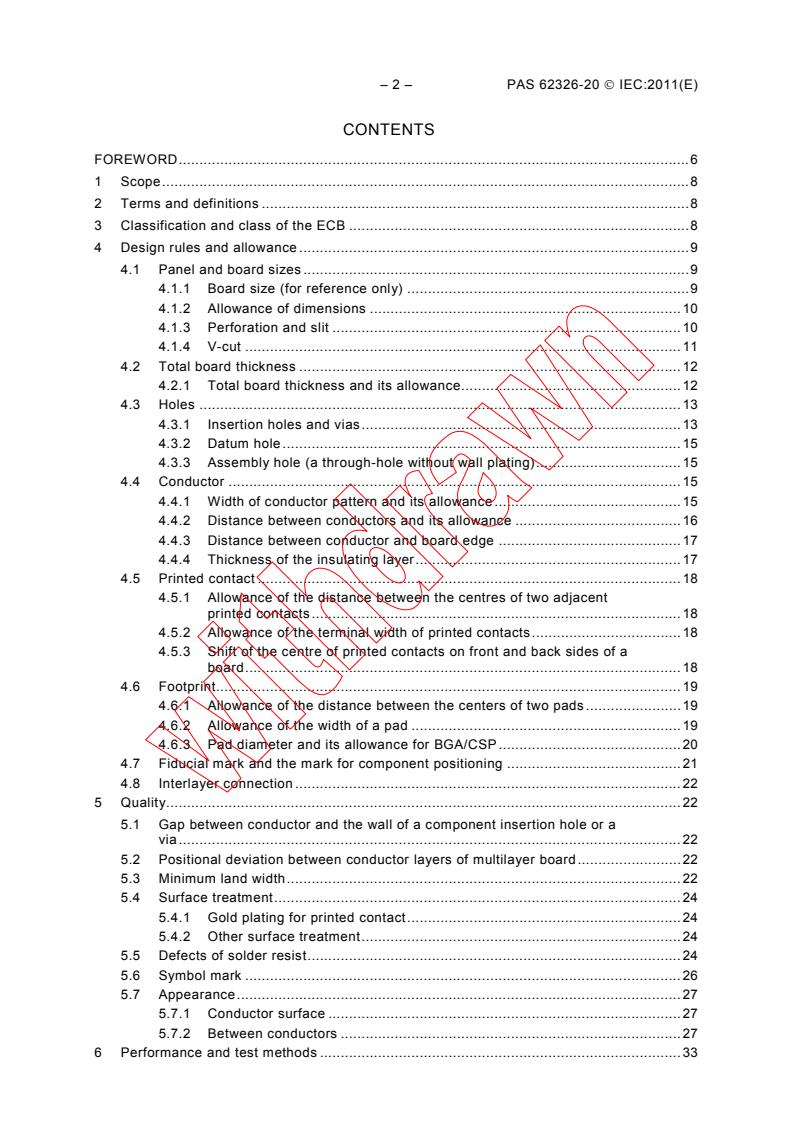
– 2 – PAS 62326-20 IEC:2011(E)
CONTENTS
FOREWORD . 6
1 Scope . 8
2 Terms and definitions . 8
3 Classification and class of the ECB . 8
4 Design rules and allowance . 9
4.1 Panel and board sizes . 9
4.1.1 Board size (for reference only) . 9
4.1.2 Allowance of dimensions . 10
4.1.3 Perforation and slit . 10
4.1.4 V-cut . 11
4.2 Total board thickness . 12
4.2.1 Total board thickness and its allowance . 12
4.3 Holes . 13
4.3.1 Insertion holes and vias . 13
4.3.2 Datum hole . 15
4.3.3 Assembly hole (a through-hole without wall plating) . 15
4.4 Conductor . 15
4.4.1 Width of conductor pattern and its allowance . 15
4.4.2 Distance between conductors and its allowance . 16
4.4.3 Distance between conductor and board edge . 17
4.4.4 Thickness of the insulating layer . 17
4.5 Printed contact . 18
4.5.1 Allowance of the distance between the centres of two adjacent
printed contacts . 18
4.5.2 Allowance of the terminal width of printed contacts . 18
4.5.3 Shift of the centre of printed contacts on front and back sides of a
board . 18
4.6 Footprint. 19
4.6.1 Allowance of the distance between the centers of two pads . 19
4.6.2 Allowance of the width of a pad . 19
4.6.3 Pad diameter and its allowance for BGA/CSP . 20
4.7 Fiducial mark and the mark for component positioning . 21
4.8 Interlayer connection . 22
5 Quality . 22
5.1 Gap between conductor and the wall of a component insertion hole or a
via . 22
5.2 Positional deviation between conductor layers of multilayer board . 22
5.3 Minimum land width . 22
5.4 Surface treatment . 24
5.4.1 Gold plating for printed contact . 24
5.4.2 Other surface treatment . 24
5.5 Defects of solder resist . 24
5.6 Symbol mark . 26
5.7 Appearance . 27
5.7.1 Conductor surface . 27
5.7.2 Between conductors . 27
6 Performance and test methods . 33
PAS 62326-20 IEC:2011(E) – 3 –
6.1 Observation of component mounting for and vias . 33
6.1.1 Observation with standard conditions . 33
6.1.2 Observation after thermal shock test . 34
7 Marking, packaging and storage . 47
7.1 Marking on a product . 47
7.2 Marking on the package . 47
7.3 Packaging and storage . 47
7.3.1 Packaging . 47
7.3.2 Storage . 47
8 Normative references . 47
Annex A (informative) Additional information to IEC/PAS 62326-20. 48
Figure 1 – Example of classification and their application by base materials,
electronic circuit boards and final products . 9
Figure 2 – Board arrangement in a panel . 9
Figure 3 – Distances from the datum point to perforation and slit . 10
Figure 4 – Distance from the datum point to V-cut . 11
Figure 5 – Allowance of position off-set of V-cuts on front and back surfaces . 11
Figure 6 – PWB board with symbol mark, solder resist, copper foil and plating . 12
Figure 7 – Positions of component insertion holes . 13
Figure 8 – Distance between the wall of a hole to the board edge . 14
Figure 9 – Hole wall and the minimum designed spacing to the inner conductor . 15
Figure 10 – Width of finished conductor . 16
Figure 11 – Distance between finished conductors . 17
Figure 12 – Thickness of the insulating layer . 17
Figure 13 – Distance between centres of terminals of printed contacts . 18
Figure 14 – Terminal width of a printed contact . 18
Figure 15 – Shift of the centre of printed contacts on front and back sides of a board . 19
Figure 16 – Foot print . 19
Figure 17– Pad width of a footprint . 20
Figure 18 – Allowance of pad diameter of BGA/CSP formed of conductor only . 20
Figure 19 – Pad diameter (d) of BGA/CSP formed at the opening of solder resist . 21
Figure 20 – Examples of fiducial mark and component positioning mark . 21
Figure 21-1 – Minimum land width on the outer layer . 23
Figure 21-2 – Minimum land width on the inner layer with a plated through-hole . 23
Figure 21-3 – Allowable area of land break . 24
Figure 22 – Exposure of conductor . 25
Figure 23 – Minimum land width caused by the shift of solder resist . 25
Figure 24 – The overlap, smear and shift of solder resist . 26
Figure 25 – Examples . 26
Figure 26 – Example of measling . 27
Figure 27 – Examples of crazing . 28
Figure 28 – Missing of conductor . 28
Figure 29 – Conductor residue . 28
– 4 – PAS 62326-20 IEC:2011(E)
Figure 30 – Land. 29
Figure 31 – Defects in a pad of a footprint . 29
Figure 32 – Defects in BGA/CSP mounting pads . 30
Figure 33 – The areas to be checked for defects of a printed contact . 31
Figure 34 – Defects in a printed contact . 31
Figure 35 – Defect on a plating of a component mounting hole . 33
Figure 36-1 – Resin smear . 34
Figure 36-2 – Corner crack . 35
Figure 36-3 – Barrel crack . 35
Figure 36-4 – Foil crack . 35
Figure 37 – The relations between resistance and width, thickness and temperature
of conductor . 36
Figure 38 – Temperature rise as functions of width and thickness of conductor and
current . 37
Table 1 – Application and classification . 8
Table 2 – Panel dimensions (informative purpose) . 10
Table 3– Allowance of dimensions . 10
Table 4 – Allowance of the distances from the datum point to perforation and slit . 11
Table 5 – Allowance for the distance from the datum point to the center of the V-cut . 12
Table 6 – Total thickness and its allowance . 12
Table 7 – Allowance of holes for component insertion . 13
Table 8 – Position allowance of component insertion holes . 13
Table 9 – Distance between a hole wall and board edge . 14
Table 10 – Minimum clearance between the hole wall and the inner layer conductor . 14
Table 11 – Allowance of conductor width . 16
Table 12 – Allowance of the distance between conductors . 16
Table 13 – Distance between conductor and board edge . 17
Table 14 – Allowance of the terminal width of a printed contact . 18
Table 15 – Allowance of the distance between the centres of two pads . 19
Table 16 – Allowance of the width of a pad of a footprint . 20
Table 17 – Pad diameter and its allowance for BGA/CSP . 20
Table 18 – Allowance of the pad diameter (d) of BGA/CSP formed at the opening of
solder resist . 21
Table 19 – Shapes and sizes of typical fiducial marks and component positioning
marks . 22
Table 20 – Minimum thickness of copper plating . 22
Table 21 – Minimum land width . 23
Table 22 – Minimum land width . 25
Table 23 – The overlap, smear and shift of solder resist over a fool print . 26
Table 24 – Allowance of the area of a defect, remaining width and protrusion of a
land . 29
Table 25 – Defect of a pad of a footprint . 30
Table 26 – Defects in BGA/CSP mounting pads . 30
Table 27 – Defects in a printed contact . 32
PAS 62326-20 IEC:2011(E) – 5 –
Table 28 – Allowance in horizontal sectioning . 34
Table 29 – Specification and test methods . 38
Table A.1 – The relation between thermal conductive parameter (W/(mK)) and heat
transfer coefficient parameter . 49
Table A.2 – The relation between thermal conductive parameter (W/(mK)) and heat
transfer coefficient parameter . 49
– 6 – PAS 62326-20 IEC:2011(E)
INTERNATIONAL ELECTROTECHNICAL COMMISSION
____________
PRINTED BOARDS –
Part 20: Electronic circuit board for high-brightness LEDs
FOREWORD
1) The International Electrotechnical Commission (IEC) is a worldwide organization for standardization
comprising all national electrotechnical committees (IEC National Committees). The object of IEC is to
promote international co-operation on all questions concerning standardization in the electrical and
electronic fields. To this end and in addition to other activities, IEC publishes International Standards,
Technical Specifications, Technical Reports, Publicly Available Specifications (PAS) and Guides (hereafter
referred to as “IEC Publication(s)”). Their preparation is entrusted to technical committees; any IEC National
Committee interested in the subject dealt with may participate in this preparatory work. International,
governmental and non-governmental organizations liaising with the IEC also participate in this preparation.
IEC collaborates closely with the International Organization for Standardization (ISO) in accordance with
conditions determined by agreement between the two organizations.
2) The formal decisions or agreements of IEC on technical matters express, as nearly as possible, an
international consensus of opinion on the relevant subjects since each technical committee has
representation from all interested IEC National Committees.
3) IEC Publications have the form of recommendations for international use and are accepted by IEC National
Committees in that sense. While all reasonable efforts are made to ensure that the technical content of IEC
Publications is accurate, IEC cannot be held responsible for the way in which they are used or for any
misinterpretation by any end user.
4) In order to promote international uniformity, IEC National Committees undertake to apply IEC Publications
transparently to the maximum extent possible in their national and regional publications. Any divergence
between any IEC Publication and the corresponding national or regional publication shall be clearly indicated
in the latter.
5) IEC itself does not provide any attestation of conformity. Independent certification bodies provide conformity
assessment services and, in some areas, access to IEC marks of conformity. IEC is not responsible for any
services carried out by independent certification bodies.
6) All users should ensure that they have the latest edition of this publication.
7) No liability shall attach to IEC or its directors, employees, servants or agents including individual experts and
members of its technical committees and IEC National Committees for any personal injury, property damage
or other damage of any nature whatsoever, whether direct or indirect, or for costs (including legal fees) and
expenses arising out of the publication, use of, or reliance upon, this IEC Publication or any other IEC
Publications.
8) Attention is drawn to the Normative references cited in this publication. Use of the referenced publications is
indispensable for the correct application of this publication.
9) Attention is drawn to the possibility that some of the elements of this IEC Publication may be the subject of
patent rights. IEC shall not be held responsible for identifying any or all such patent rights.
A PAS is a technical specification not fulfilling the requirements for a standard, but made
available to the public.
IEC-PAS 62326-20 was submitted by the JPCA (Japan Electronics Packaging and Circuits
Association) and has been processed by IEC technical committee 91: Electronics assembly
technology.
PAS 62326-20 IEC:2011(E) – 7 –
It is based on JPCA-TMC-LED01S-2010. It is published as a double-logo PAS and JPCA.
The text of this PAS is based on the This PAS was approved for
following document: publication by the P-members of the
committee concerned as indicated in
the following document
Draft PAS Report on voting
91/926/PAS 91/942A/RVD
Following publication of this PAS, which is a pre-standard publication, the technical
committee or subcommittee concerned may transform it into an International Standard.
This PAS shall remain valid for an initial maximum period of 3 years starting from the
publication date. The validity may be extended for a single period up to a maximum of
3 years, at the end of which it shall be published as another type of normative document, or
shall be withdrawn.
A list of all the parts in the IEC 62326 series, under the general title Printed boards, can be
found on the IEC website.
IMPORTANT – The 'colour inside' logo on the cover page of this publication indicates
that it contains colours which are considered to be useful for the correct
understanding of its contents. Users should therefore print this document using a
colour printer.
– 8 – PAS 62326-20 IEC:2011(E)
PRINTED BOARDS –
Part 20: Electronic circuit board for high-brightness LEDs
1 Scope
This PAS specifies the properties of the electronic circuit board for high-brightness LEDs
(hereafter described as “ECB”).
NOTE Standards relevant to the present standards are given below.
JPCA-TD01 Terms and definitions for printed circuits
JIS C 5603 Terms and definitions for printed circuits
2 Terms and definitions
For the purpose of this document, the terms used in this PAS shall be in accordance with
JPCA-TD01 and JIS C 5603, unless otherwise specified.
3 Classification and class of the ECB
The ECB specified in this PAS shall satisfy the specification of (A) to (C) in Table 1 in the
following way. The materials used in the materials of PWB are not specified; however, they
shall be agreed upon between user and supplier depending on the application area of the
boards in question.
Table 1 – Application and classification
Small Thermal Heat
Classification
classification conductivity transfer
Definition
Definition
(thermal parameter parameter
(insulation
conductivity)
property) W/(mK) W/(m K)
I No specification
<1 <10
A Standard boards Ⅱ Electric strength <1,000 V
Ⅲ Electric strength 1,000 V≤
No specification
Ⅰ
Thermal
Electric strength <1,000 V
B conductive Ⅱ
boards
1≤ <10
Electric strength 1,000 V≤
Ⅲ
No specification
Ⅰ
High thermal
C conductive Ⅱ Electric strength <1,000 V
boards
1≤ 10≤
Electric strength 1,000 V≤
Ⅲ
PAS 62326-20 IEC:2011(E) – 9 –
Heat Radiation A B C
Resin type substrate (CEM-3, FR-4, FR-5 ) Resin type substrate (with thermal via)
Flexible type substrate High thermal conductive resin substrate
Metal core substrate
Classsification by base materials
Metal base substrate
Ceramic type substrate
Conventional substrate for discreat type electronic parts mounted boards
Classification by electronic circuit boards Substrate for semiconductor package
Substrate for Chip on Board
Assistant lighting lamp
Lamp substitute for halogen lamp
Lamp substitute for fluorescent lamp substitution
Classification by final products
Lamp substitute for filament lamp
Street lamp
Lamp substitute for HID
Insulation class Ⅰ Ⅱ Ⅲ Ⅰ Ⅱ Ⅲ Ⅰ Ⅱ Ⅲ
Figure 1 – Example of classification and their application by base materials,
electronic circuit boards and final products
4 Design rules and allowance
4.1 Panel and board sizes
4.1.1 Board size (for reference only)
The size of the board of the product (axb) illustrated in Figure 2 shall be selected so that
the boards can be arranged efficiently within a panel with a size specified in Table 2. Or, a
proper panel with a size given in the table shall be selected so as to satisfy the required
efficient arrangement of the boards.
Table 1. PWB
Board size of the product: a x b
Space between board and
panel edges: c ,c ,c ,c
1 2 3 4
Space between boards: e ,e
1 2
Figure 2 – Board arrangement in a panel
– 10 – PAS 62326-20 IEC:2011(E)
Table 2 – Panel dimensions (informative purpose)
mm
Division
Size of CCL (copper
clad laminate) panel
4 6 8 9
1 000 × 1 000 500 × 500 333 × 500 250 × 500 333 × 333
333 × 600
1 000 × 1 200 500 × 600 300 × 500 333 × 400
400 × 500
4.1.2 Allowance of dimensions
The allowance of dimensions of a board or a panel is given in Table 3.
Table 3– Allowance of dimensions
mm
Longitudinal size Allowance
≤ 100 ±0,2
Add 0,1 for each 50 exceeding a length of 100.
100<
4.1.3 Perforation and slit
The perforation and slit are shown in Figure 3. The allowance of the distances from the
datum point to the center of the cut of the perforation and slit is given in Table 4.
Figure 3 – Distances from the datum point to perforation and slit
PAS 62326-20 IEC:2011(E) – 11 –
Table 4 – Allowance of the distances from the datum point to perforation and slit
mm
Distances from the datum
Allowance
point to perforation and slit
≤ 100 ±0,2
100 < Add 0,1 for each 50 beyond a length of 100.
4.1.4 V-cut
The V-cut is shown in Figure 4. The allowance of the distance from the reference datum to
the center of cut of the V (g to g ) is given in Table 5. The allowance of the deviation of the
1 4
position of the V-cut on the front and back planes is 0,2 mm, and the allowance of the uncut
thickness of the board is the sum of the allowance of the board thickness ±0,1 mm.
Board Peripheral
V-cut
Datum point
Figure 4 – Distance from the datum point to V-cut
mm
Insulating board
Figure 5 – Allowance of position off-set of V-cuts on front and back surfaces
– 12 – PAS 62326-20 IEC:2011(E)
Table 5 – Allowance for the distance from the datum point to the center of the V-cut
Distance from the datum
point to the center of the Allowance
V-cut
≤100 ±0,2
>100 Add 0,1 for each 50 mm exceeding a length over 100 mm
4.2 Total board thickness
4.2.1 Total board thickness and its allowance
The allowance of the total board thickness (t) of a board with solder resist and symbol
marks as shown in Figure 6 is given in Table 6.
Solder resist
Symbol mark
Plating
Copper foil
Figure 6 – PWB board with symbol mark, solder resist, copper foil and plating
Table 6 – Total thickness and its allowance
mm
Total thickness
(center value of the final board) Allowance
mm
+ 0,10
≤ 0,3 to < 0,5
- 0,05
≤ 0,5 to < 0,8 ±0,10
≤ 0,8 to < 1,10 ±0,15
≤ 1,10 to < 1,40 ±0,17
≤ 1,40 to < 2,00 ±0,19
≤ 2,00 ±10 %
PAS 62326-20 IEC:2011(E) – 13 –
4.3 Holes
4.3.1 Insertion holes and vias
(1) Allowance of component insertion holes
Allowance of component insertion holes is given in Table 7. The allowance given in this
table is not applicable to vias (through-hole vias, buried vias and blind vias). The allowance
of through-holes with a diameter less than 0,6 mm for insertion of a component and holes
for press-fit of a component is to be agreed between user and supplier.
Table 7 – Allowance of holes for component insertion
mm
Item Allowance
0,6 ≤ <2,0 ±0,10
Plated
through-hole
2,0 ≤ ±0,15
Non-plated through-hole
±0,10
(2) Position of a hole for component insertion
The center of a hole for component insertion should be at the cross point of the grid for
pattern design including the complementary grid lines used. The allowance of a component
→
insertion hole position, (| , j|), the deviation from the designed position in respect to
the datum point as shown in Figure 7 is given in Table 8.
Finished hole
Datum hole
Designed hole positin (X, Y)
Datum hole (0,0)
Outer line of multilayer PWB Datum line
Figure 7 – Positions of component insertion holes
Table 8 – Position allowance of component insertion holes
mm
Longer dimension of
Allowance
rectangular board
≤ 400 0,10
400< For board exceeding 400, add 0,05 for each additional 100
– 14 – PAS 62326-20 IEC:2011(E)
(3) Distance from the board edge to the wall of a hole
Distance from the board edge to the wall of a hole (d) is shown in Figure 8. The distance (d)
between the walls of a through-hole before plating and of a hole for component insertion
shall be larger than either 1,0 mm. The distance in the case of press hole formation shall be
in accordance with Table 9.
Figure 8 – Distance between the wall of a hole to the board edge
Table 9 – Distance between a hole wall and board edge
mm
Distance (j) between a component hole before plating and
Item
the via wall
HDI PWB ≤ 1,0 mm and also longer than the board thickness (t)
Standard PWB ≤ 1,5 mm and also longer than the board thickness (t)
(4) Minimum clearance between hole wall and the inner conductor
The minimum clearance between the hole wall and the inner conductor (k) as illustrated in
Figure 9 shall be 0,325 mm. If the distance 0,325 mm is guaranteed in the design of the
pattern, the minimum separation is guaranteed.
Table 10 – Minimum clearance between the hole wall and the inner layer conductor
Minimum clearance between hole wall and the inner layer
conductor
Item
Standard value Minimum value
Component
0,5
hole
HDI PWB 0,25
Via 0,30
Component
0,5
hole
Standard PWB 0,30
Via 0,35
PAS 62326-20 IEC:2011(E) – 15 –
Insulating
Copper foil
board
Through hole
plating
Figure 9 – Hole wall and the minimum designed spacing to the inner conductor
4.3.2 Datum hole
(1) Allowance of a datum hole
+0,10
The allowance of a datum hole shall be ±0,05 mm, or mm. A through hole without wall
−0,00
plating shall be used as a datum hole.
4.3.3 Assembly hole (a through-hole without wall plating)
(1) Allowance of an assembly hole
The allowance of an assembly hole shall be ±0,10 mm.
(2) Allowance of the position of an assembly hole
The allowance of the position of an assembly hole shall be in accordance with the Table 8
of 4.3.1 (2).
(3) Distance between an assembly hole and the board edge
The distance between an assembly hole and the board edge shall be larger than 2,0 mm. In
case the distance is less than 2,0 mm, the distance shall be agreed between user and
supplier.
(4) The distance between an assembly hole and the inner conductor
The distance between the wall of an assembly hole and the inner conductor shall be larger
than 1,0 mm.
4.4 Conductor
4.4.1 Width of conductor pattern and its allowance
The allowance of the formed conductor width as illustrated in Figure 10 shall be in
accordance with Table 11. The allowance of the finishied conductor pattern specifically
designed for impedance control shall be agreed between the user and supplier.
– 16 – PAS 62326-20 IEC:2011(E)
Table 11 – Allowance of conductor width
Conductor Allowance Conductor with
a
thickness (mm) for reference
50 <75 ± 25 15 to 20
± 30 20 to 40
7500 <100
100 <300 ± 50 30 to 50
300 ± 100 40 to 70
± 150 70
Thick copper foil
± 200 105
circuits
± 300 140
a
The conductor thickness is the copper foil thickness plus the thickness of plated copper.
Conductor
Insulating
substrate
Figure 10 – Width of finished conductor
4.4.2 Distance between conductors and its allowance
The allowance of the distance between conductors (m) shall be as given in Table 12. The
allowance of the finishied conductor pattern specifically designed for impedance control
shall be agreed between the user and supplier.
Table 12 – Allowance of the distance between conductors
Allowance Conductor with
Conductor
a
thickness (mm) for reference
50 <75 ± 25 15 to 20
± 30 20 to 40
7500 <100
± 50 30 to 50
100 <300
300 ± 100 40 to 70
a
The conductor thickness is the copper foil thickness plus the thickness of plated copper.
PAS 62326-20 IEC:2011(E) – 17 –
Conductor
Insulating
substrate
Figure 11 – Distance between finished conductors
4.4.3 Distance between conductor and board edge
The distance between conductor and board edge shall be larger than 0,5 mm. The distance
for the case of pressing shall be as given in Table 13 excluding the board printed contact
portions.
Table 13 – Distance between conductor and board edge
Distance between conductor and
Board thickness
board edge
< 0,8 0,5≤
0,8≤ ≤2,0 More than the board thickness
4.4.4 Thickness of the insulating layer
The thickness of an insulating layer is illustrated in Figure 12.
Conductor
Insulating
substrate
(1) (2) (3)
NOTE In case the surface of copper foil is roughened, the thickness of t he insulating substrate is the minimum
distance applicable to the substrate.
Figure 12 – Thickness of the insulating layer
– 18 – PAS 62326-20 IEC:2011(E)
4.5 Printed contact
4.5.1 Allowance of the distance between the centres of two adjacent printed
contacts
The allowance of the distance between the centres of two adjacent printed contacts (p,p )
n
as illustrated in Figure 13 shall be ±0,10 mm. Add 0,01 mm for each additional 20 mm in
case the distance between the centres of terminals exceeds 100 mm.
Figure 13 – Distance between centres of terminals of printed contacts
4.5.2 Allowance of the terminal width of printed contacts
The allowance of the terminal width of printed contacts (w) as illustrated in Figure 14 is
specified in Table 14.
Figure 14 – Terminal width of a printed contact
Table 14 – Allowance of the terminal width of a printed contact
mm
Terminal width Allowance
≤ 1,0 ±0,05
1,0< ±0,10
4.5.3 Shift of the centre of printed contacts on front and back sides of a board
The allowance of the shift of the centre of printed contacts on front and back sides of a
board (q) as illustrated in Figure 15 shall be ±0,20 mm.
PAS 62326-20 IEC:2011(E) – 19 –
Printed contact
Insulating
substrate
Figure 15 – Shift of the centre of printed contacts on front and back sides of a board
4.6 Footprint
4.6.1 Allowance of the distance between the centers of two pads
The allowance of the distance between the centres of two adjacent pads (S ) and of two
adjascent parallel pads (S) as illustrated in Figure 16 is specified in Table 15.
Figure 15. Footprint
Figure 16 – Foot print
Table 15 – Allowance of the distance between the centres of two pads
mm
Distance between
Allowance
centres
S ±0,03
S ±0,05
4.6.2 Allowance of the width of a pad
The allowance of the width of a pad of a footprint (w) as illustrated in Figure 17 is specified
in Table 16. The allowance for a pad narrower than 0,15 mm shall be agreed between the
user and supplier.
– 20 – PAS 62326-20 IEC:2011(E)
Insulating
substrate
Figure 17– Pad width of a footprint
Table 16 – Allowance of the width of a pad of a footprint
mm
Pad width Allowance
0,15 < ≤0,35 ±0,04
0,35< ±0,06
4.6.3 Pad diameter and its allowance for BGA/CSP
The allowance of pad diameter for BGA/CSP is specified in 4.6.3 (1) and 4.6.3 (2) specified
below.
(1) The pattern is shown in Figure 18. The allowance of the pad diameter (d) of BGA/CSP
made of conductor only is given in Table 17.
Pad Pad
Figure 18 Pad diameter of BGA/CSP formed of conductor only
Conductor
Insulating
Insulating Conductor
substrate
substrate
Figure 18 – Allowance of pad diameter of BGA/CSP formed of conductor only
Table 17 – Pad diameter and its allowance for BGA/CSP
Allowance of pad Conductor thickness
Item
diameter (mm)
(µm, for reference)
HDI PWB + 0,02 – 0,03 20 to 30
Standard PWB + 0,03 – 0,05 30 to 50
PAS 62326-20 IEC:2011(E) – 21 –
(2) The pattern is shown in Figure 19. The allowance of the pad diameter (d) of BGA/CSP
formed at the opening of solder resist is given in Table 18.
Table 18 – Allowance of the pad diameter (d) of BGA/CSP formed
at the opening of solder resist
mm
Item Allowance
HDI PWB ± 0,03
Standard PWB ± 0,05
Solder resist
Pad
Solder resist
Conductor
Insulating board
Figure 19 – Pad diameter (d) of BGA/CSP formed at the opening of solder resist
4.7 Fiducial mark and the mark for component positioning
4.7.1 The typical form and the size of the fiducial mark and the mark for component
positioning as illustrated in Figure 20 are specified in Table 19.
Conponent positioning
k
Footprint
Fiducial
Multilayer PWB
Figure 20 – Examples of fiducial mark and component positioning mark
– 22 – PAS 62326-20 IEC:2011(E)
Table 19 – Shapes and sizes of typical fiducial marks
and component positioning marks
mm
Item Shape Diameter
Fiducial and component
Circle 1,0
positioning marks
4.7.2 Dimensional allowance of fiducial mark and component positioning mark
The dimensional allowance of fiducial mark and component positioning mark as illustrated
in Figure 21 is ±0,1 mm.
4.7.3 Position allowance of the component positioning mark and the farthest footprint from
the mark (u ,u ) as illustrated in Figure 21 shall be ±0,05 mm.
1 2
4.8 Interlayer connection
(1) Copper plating
The minimum thickness of copper plating on the wall of via and component insertion holes
is given in Table 20.
Table 20 – Minimum thickness of copper plating
a
Board thickness, or layer Minimum thickness of copper plating
thickness (mm) (µm)
2,4< Thickness shall be agreed between the
user and supplier.
1,0 < ≤2,4 15
0,5 < ≤1,0 12
0,5≤ 10
a
The measurement shall be made by optical observation of a microsectioned vertical cross section. Local
surface deviation is not accounted.
5 Quality
5.1 Gap between conductor and the wall of a component insertion hole or a via
The gap between conductor and the wall of a component insertion hole or a via, or the gap
between the inner conductor and the wall of a hole shall be larger than 0,13 mm.
5.2 Positional deviation between conductor layers of multilayer board
The deviation of conductor layers of multilayer board shall satisfy the conditions specified in
4.5.3, 5.1, and 5.3.
5.3 Minimum land width
The minimum land width on the most outer layer (w ) caused by the shift of land and the
) are specified in Table 21 (also see
hole, and the minimum land width on an inner layer (w
Figures 21-1 to 21-3).
PAS 62326-20 IEC:2011(E) – 23 –
Table 21 – Minimum land width
mm
a
Item Minimum land width
At the joint of land and
Minimum land width w ≧0,03
conductor
on outer layer
b
w
Other area θ≦90°
Case of non-conductive
w ≧0,05
component insertion hole
At the joint of land and
w ≧0,03
conductor
Minimum land width
on inner layer
c
w
2 Others (except laser
θ≦90°
d
drilled hole)
a
Regardless of the shape of a land.
b
Includes the thickness of through-hole plating.
c
Does not include the thickness of through-hole plating.
d
No break of inner land is allowed for a laser drilled hole.
Figure 21-1 – Minimum land width on the outer layer
Plated through hole
Figure 21-2 – Minimum land width on the inner layer with a plated through-hole
– 24 – PAS 62326-20 IEC:2011(E)
Figure 21-3 – Allowable area of land break
5.4 Surface treatment
5.4.1 Gold plating for printed contact
The gold plating for printed contact is generally plated of hard gold on the nickel plating.
1) Nickel plating: the thickness of nickel plating on a printed contact shall be more than
2,0 µm.
2) Gold plating: the hard gold shall be used for plating on a printed contact with a plating
thickness of more than 0,1 µm.
5.4.2 Other surface treatment
The details of other surface treatment including gold flush plating and solder coating
depends on the methods for interconnection (such as soldering or wire bonding). These
details shall be agreed by the user and supplier.
5.5 Defects of solder resist
1) The defects in a pad for BGA/CSP shall be in accordance with 4.6.3 (diameter and
allowance of pads for BGA/CCP).
2) Solder resist shall not have scratch, peeling, pin-hole, or foreign material. Solder resist
shall not have any bubble extending to two conductors.
3) Exposure of conductor after application of solder resist shall be in conformance to the
illustrations in Figure 22.
PAS 62326-20 IEC:2011(E) – 25 –
(Not acceptable)
(Acceptable)
Conductor Conductor
Solder resist
Solder resist
Insulating
Insulating
Conductor
Conductor
Solder Land Solder resist
Land
Insulating
In
...