


IEC 62287-1:2017
(Main)Maritime navigation and radiocommunication equipment and systems - Class B shipborne equiment of the automatic identification system (AIS) - Part 1: Carrier-sense time division multiple access (CSTDMA) techniques
Maritime navigation and radiocommunication equipment and systems - Class B shipborne equiment of the automatic identification system (AIS) - Part 1: Carrier-sense time division multiple access (CSTDMA) techniques
IEC 62287-1:2017 specifies the minimum operational and performance requirements, methods of testing and required test results for Class B shipborne automatic identification system (AIS) equipment using carrier-sense time division multiple access (CSTDMA) techniques. This document takes into account other associated IEC International Standards and existing national standards, as applicable. It is applicable for AIS equipment used on craft that are not covered by the mandatory carriage requirement of AIS under SOLAS Chapter V. An AIS station intended to operate in receive-only mode is not considered a Class B shipborne mobile AIS station. This edition includes the following significant technical change with respect to the previous edition: in the synchronisation method, addition of a direct method for synchronisation from an internal UTC source.
Matériels et systèmes de navigation et de radiocommunication maritimes - Transpondeur embarqué du système d’identification automatique (AIS) de classe B - Partie 1: Techniques d’accès multiple par répartition dans le temps avec écoute de porteuse (CSTDMA)
L’IEC 62287-1:2017 spécifie les exigences minimales opérationnelles et de performance, les méthodes d’essai et les résultats d’essai exigés pour le transpondeur embarqué du système d’identification automatique (AIS) de classe B utilisant les techniques d’accès multiple par répartition dans le temps avec détection de la porteuse (AMRTDP). Le présent document prend en compte d’autres Normes internationales IEC associées et des normes nationales existantes, selon le cas. Il s’applique aux matériels AIS utilisés sur le navire, qui ne sont pas visés par l’exigence relative aux AIS de bord obligatoires selon le Chapitre V de la convention SOLAS. Une station AIS conçue pour fonctionner en mode réception uniquement n’est pas considérée comme une station AIS mobile embarquée de Classe B.
General Information
- Status
- Published
- Publication Date
- 04-Apr-2017
- Technical Committee
- TC 80 - Maritime navigation and radiocommunication equipment and systems
- Drafting Committee
- WG 15 - TC 80/WG 15
- Current Stage
- PPUB - Publication issued
- Start Date
- 05-Apr-2017
- Completion Date
- 21-Apr-2017
Relations
- Effective Date
- 05-Sep-2023
- Effective Date
- 05-Sep-2023
- Effective Date
- 05-Sep-2023
Overview - IEC 62287-1:2017 (Class B AIS, CSTDMA)
IEC 62287-1:2017 defines the minimum operational and performance requirements, test methods and required test results for Class B shipborne Automatic Identification System (AIS) equipment that use Carrier‑Sense Time Division Multiple Access (CSTDMA) techniques. The standard applies to AIS transceivers intended for craft not subject to mandatory SOLAS AIS carriage (for example recreational craft, fishing vessels and other non‑SOLAS workboats). Note: an AIS station intended only for receive‑only operation is not considered a Class B mobile AIS station under this standard. The 2017 edition adds a direct synchronisation method using an internal UTC source.
Key topics and technical requirements
- CSTDMA air interface and MAC behaviour - requirements for carrier sense/time slot access and link‑layer management to ensure fair channel sharing and interoperability.
- Performance requirements and composition - minimum capabilities expected of Class B "CS" AIS equipment.
- GNSS requirements and synchronisation - GNSS position reporting expectations and the added option for direct synchronisation from an internal UTC source.
- Transmitter and receiver tests - physical layer tests (frequency error, power, modulation, sensitivity, selectivity, intermodulation, spurious responses).
- Link, network and transport layers - packetisation, sequencing, channel management, congestion resolution and dual‑channel operation.
- Operational tests and environmental/EMC testing - normal and extreme test conditions, vibration/shock, undervoltage (brown‑out) and EMC requirements.
- User interface, alarms and fall‑back - static data input, indicators, integrity monitoring, transceiver shutdown and sensor fallback conditions.
- Quality assurance and marking - documentation, manuals, product identification and safety of operation.
Practical applications and who uses it
- Equipment manufacturers - design and validate Class B CSTDMA AIS transceivers to meet international test methods and performance limits.
- Test laboratories and certification bodies - perform standardized tests for conformity, EMC and environmental performance.
- Shipyards and system integrators - select compliant AIS units for non‑SOLAS craft and ensure correct installation and interface to GNSS and bridge systems.
- Maritime authorities and fleet operators - specify procurement requirements and verify equipment interoperability and safety.
- Surveyors and insurers - assess device compliance and operational reliability.
Related standards
- Other IEC maritime navigation and radiocommunication standards (referenced within IEC 62287‑1) and national AIS regulations. For implementation, consult the latest IEC catalogue and any applicable national guidance for AIS carriage and radio licensing.
Keywords: IEC 62287-1, Class B AIS, CSTDMA, maritime navigation, AIS equipment testing, GNSS synchronisation, AIS performance requirements.



IEC 62287-1:2017+AMD1:2022 CSV - Maritime navigation and radiocommunication equipment and systems - Class B shipborne equipment of the automatic identification system (AIS) - Part 1: Carrier-sense time division multiple access (CSTDMA) techniques Released:11/23/2022

IEC 62287-1:2017 - Maritime navigation and radiocommunication equipment and systems - Class B shipborne equiment of the automatic identification system (AIS) - Part 1: Carrier-sense time division multiple access (CSTDMA) techniques
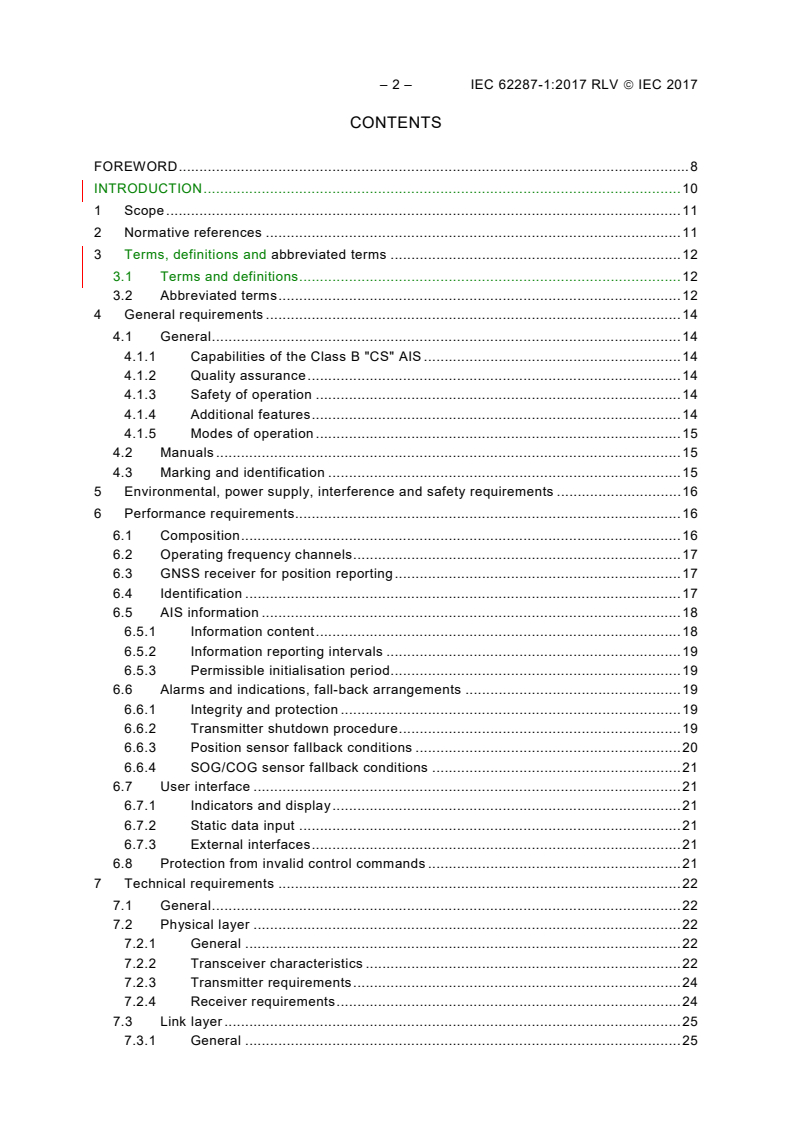
REDLINE IEC 62287-1:2017 - Maritime navigation and radiocommunication equipment and systems - Class B shipborne equiment of the automatic identification system (AIS) - Part 1: Carrier-sense time division multiple access (CSTDMA) techniques Released:4/5/2017 Isbn:9782832242179


IEC 62287-1:2017 - Maritime navigation and radiocommunication equipment and systems - Class B shipborne equiment of the automatic identification system (AIS) - Part 1: Carrier-sense time division multiple access (CSTDMA) techniques
Get Certified
Connect with accredited certification bodies for this standard

BSI Group
BSI (British Standards Institution) is the business standards company that helps organizations make excellence a habit.

DNV
DNV is an independent assurance and risk management provider.

TÜV Rheinland
TÜV Rheinland is a leading international provider of technical services.
Sponsored listings
Frequently Asked Questions
IEC 62287-1:2017 is a standard published by the International Electrotechnical Commission (IEC). Its full title is "Maritime navigation and radiocommunication equipment and systems - Class B shipborne equiment of the automatic identification system (AIS) - Part 1: Carrier-sense time division multiple access (CSTDMA) techniques". This standard covers: IEC 62287-1:2017 specifies the minimum operational and performance requirements, methods of testing and required test results for Class B shipborne automatic identification system (AIS) equipment using carrier-sense time division multiple access (CSTDMA) techniques. This document takes into account other associated IEC International Standards and existing national standards, as applicable. It is applicable for AIS equipment used on craft that are not covered by the mandatory carriage requirement of AIS under SOLAS Chapter V. An AIS station intended to operate in receive-only mode is not considered a Class B shipborne mobile AIS station. This edition includes the following significant technical change with respect to the previous edition: in the synchronisation method, addition of a direct method for synchronisation from an internal UTC source.
IEC 62287-1:2017 specifies the minimum operational and performance requirements, methods of testing and required test results for Class B shipborne automatic identification system (AIS) equipment using carrier-sense time division multiple access (CSTDMA) techniques. This document takes into account other associated IEC International Standards and existing national standards, as applicable. It is applicable for AIS equipment used on craft that are not covered by the mandatory carriage requirement of AIS under SOLAS Chapter V. An AIS station intended to operate in receive-only mode is not considered a Class B shipborne mobile AIS station. This edition includes the following significant technical change with respect to the previous edition: in the synchronisation method, addition of a direct method for synchronisation from an internal UTC source.
IEC 62287-1:2017 is classified under the following ICS (International Classification for Standards) categories: 11.040.50 - Radiographic equipment; 47.020.70 - Navigation and control equipment. The ICS classification helps identify the subject area and facilitates finding related standards.
IEC 62287-1:2017 has the following relationships with other standards: It is inter standard links to IEC 62287-1:2017/AMD1:2022, IEC 62287-1:2010, IEC 62287-1:2010/AMD1:2013. Understanding these relationships helps ensure you are using the most current and applicable version of the standard.
IEC 62287-1:2017 is available in PDF format for immediate download after purchase. The document can be added to your cart and obtained through the secure checkout process. Digital delivery ensures instant access to the complete standard document.
Standards Content (Sample)
IEC 62287-1 ®
Edition 3.1 2022-11
CONSOLIDATED VERSION
INTERNATIONAL
STANDARD
colour
inside
Maritime navigation and radiocommunication equipment and systems –
Class B shipborne equipment of the automatic identification system (AIS) –
Part 1: Carrier-sense time division multiple access (CSTDMA) techniques
All rights reserved. Unless otherwise specified, no part of this publication may be reproduced or utilized in any form
or by any means, electronic or mechanical, including photocopying and microfilm, without permission in writing from
either IEC or IEC's member National Committee in the country of the requester. If you have any questions about IEC
copyright or have an enquiry about obtaining additional rights to this publication, please contact the address below or
your local IEC member National Committee for further information.
IEC Secretariat Tel.: +41 22 919 02 11
3, rue de Varembé info@iec.ch
CH-1211 Geneva 20 www.iec.ch
Switzerland
About the IEC
The International Electrotechnical Commission (IEC) is the leading global organization that prepares and publishes
International Standards for all electrical, electronic and related technologies.
About IEC publications
The technical content of IEC publications is kept under constant review by the IEC. Please make sure that you have the
latest edition, a corrigendum or an amendment might have been published.
IEC publications search - webstore.iec.ch/advsearchform IEC Products & Services Portal - products.iec.ch
The advanced search enables to find IEC publications by a Discover our powerful search engine and read freely all the
variety of criteria (reference number, text, technical publications previews. With a subscription you will always
committee, …). It also gives information on projects, replaced have access to up to date content tailored to your needs.
and withdrawn publications.
Electropedia - www.electropedia.org
IEC Just Published - webstore.iec.ch/justpublished
The world's leading online dictionary on electrotechnology,
Stay up to date on all new IEC publications. Just Published
containing more than 22 300 terminological entries in English
details all new publications released. Available online and
and French, with equivalent terms in 19 additional languages.
once a month by email.
Also known as the International Electrotechnical Vocabulary
(IEV) online.
IEC Customer Service Centre - webstore.iec.ch/csc
If you wish to give us your feedback on this publication or
need further assistance, please contact the Customer Service
Centre: sales@iec.ch.
IEC 62287-1 ®
Edition 3.1 2022-11
CONSOLIDATED VERSION
INTERNATIONAL
STANDARD
colour
inside
Maritime navigation and radiocommunication equipment and systems –
Class B shipborne equipment of the automatic identification system (AIS) –
Part 1: Carrier-sense time division multiple access (CSTDMA) techniques
INTERNATIONAL
ELECTROTECHNICAL
COMMISSION
ICS 47.020.70 ISBN 978-2-8322-6128-6
IEC 62287-1 ®
Edition 3.1 2022-11
CONSOLIDATED VERSION
REDLINE VERSION
colour
inside
Maritime navigation and radiocommunication equipment and systems –
Class B shipborne equipment of the automatic identification system (AIS) –
Part 1: Carrier-sense time division multiple access (CSTDMA) techniques
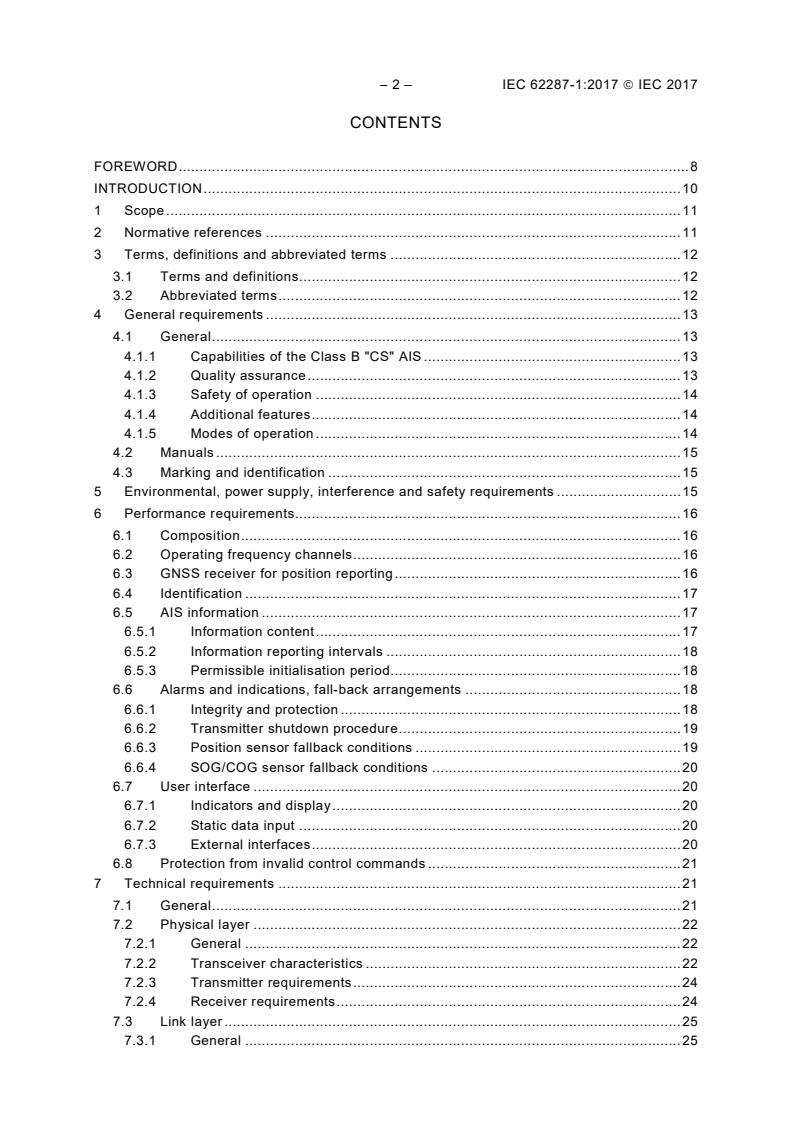
– 2 – IEC 62287-1:2017+AMD1:2022 CSV
IEC 2022
CONTENTS
FOREWORD . 8
INTRODUCTION . 10
1 Scope . 11
2 Normative references . 11
3 Terms, definitions and abbreviated terms . 12
3.1 Terms and definitions . 12
3.2 Abbreviated terms . 12
4 General requirements . 13
4.1 General . 13
4.1.1 Capabilities of the Class B "CS" AIS . 13
4.1.2 Quality assurance . 13
4.1.3 Safety of operation . 14
4.1.4 Additional features . 14
4.1.5 Modes of operation . 14
4.2 Manuals . 15
4.3 Marking and identification . 15
5 Environmental, power supply, interference and safety requirements . 15
6 Performance requirements. 16
6.1 Composition . 16
6.2 Operating frequency channels . 16
6.3 GNSS receiver for position reporting . 16
6.4 Identification . 17
6.5 AIS information . 17
6.5.1 Information content . 17
6.5.2 Information reporting intervals . 18
6.5.3 Permissible initialisation period . 18
6.6 Alarms and indications, fall-back arrangements . 18
6.6.1 Integrity and protection . 18
6.6.2 Transmitter shutdown procedure . 19
6.6.3 Position sensor fallback conditions . 19
6.6.4 SOG/COG sensor fallback conditions . 20
6.7 User interface . 20
6.7.1 Indicators and display . 20
6.7.2 Static data input . 20
6.7.3 External interfaces . 20
6.8 Protection from invalid control commands . 21
7 Technical requirements . 21
7.1 General . 21
7.2 Physical layer . 22
7.2.1 General . 22
7.2.2 Transceiver characteristics . 22
7.2.3 Transmitter requirements . 24
7.2.4 Receiver requirements . 24
7.3 Link layer . 25
7.3.1 General . 25
IEC 2022
7.3.2 Link sublayer 1: Medium access control (MAC) . 25
7.3.3 Link sublayer 2: Data Link Service (DLS) . 28
7.3.4 Link sublayer 3: Link management entity (LME) . 33
7.4 Network layer . 41
7.4.1 General . 41
7.4.2 Dual channel operation . 41
7.4.3 Channel management . 42
7.4.4 Distribution of transmission packets . 42
7.4.5 Data link congestion resolution . 42
7.5 Transport layer . 42
7.5.1 General . 42
7.5.2 Transmission packets . 43
7.5.3 Sequencing of data packets . 43
7.6 Digital selective calling (DSC) . 43
8 Test conditions . 43
8.1 General . 43
8.2 Normal and extreme test conditions . 43
8.2.1 Normal test conditions . 43
8.2.2 Extreme test conditions . 43
8.3 Test signals . 43
8.3.1 Standard test signal number 1 . 44
8.3.2 Standard test signal number 2 . 44
8.3.3 Standard test signal number 3 . 44
8.3.4 Standard test signal number 4 . 44
8.3.5 Standard test signal number 5 . 44
8.4 Test arrangements . 45
8.4.1 Standard test environment . 45
8.4.2 Modes of operation of the transmitter. 46
8.4.3 Common test conditions for protection from invalid controls . 46
8.4.4 Measurement uncertainties . 46
9 Power supply, environmental and EMC tests . 47
9.1 Test summary . 47
9.2 Vibration/shock . 49
9.2.1 Vibration . 49
9.2.2 Shock . 49
9.3 Performance tests/checks . 49
9.4 Undervoltage test (brown out) . 50
9.4.1 Purpose . 50
9.4.2 Method of test. 50
9.4.3 Required result . 50
10 Operational tests . 50
10.1 General . 50
10.1.1 Quality assurance . 50
10.1.2 Safety of operation . 50
10.1.3 Additional features . 50
10.2 Modes of operation . 51
10.2.1 Autonomous mode . 51
10.2.2 Assigned mode . 52
10.2.3 Polled mode/interrogation response . 53
– 4 – IEC 62287-1:2017+AMD1:2022 CSV
IEC 2022
10.3 Messages extending one time period . 54
10.3.1 Method of measurement . 54
10.3.2 Required results . 54
10.4 Channel selection . 54
10.4.1 Valid channels . 54
10.4.2 Invalid channels . 54
10.5 Internal GNSS receiver . 54
10.6 AIS information . 55
10.6.1 Information content . 55
10.6.2 Information update rates . 56
10.7 Initialisation period . 57
10.7.1 Method of measurement . 57
10.7.2 Required results . 57
10.8 Alarms and indications, fall-back arrangements . 57
10.8.1 Built-in integrity test . 57
10.8.2 Transceiver protection . 58
10.8.3 Transmitter shutdown procedure . 58
10.8.4 Position sensor fallback conditions . 58
10.8.5 Speed sensors . 59
10.9 User interface . 59
10.9.1 Display . 59
10.9.2 Message display . 59
10.9.3 Static data input . 60
10.9.4 External interfaces . 60
11 Physical tests . 60
11.1 TDMA transmitter . 60
11.1.1 Frequency error . 60
11.1.2 Carrier power . 61
11.1.3 Transmission spectrum . 61
11.1.4 Modulation accuracy . 62
11.1.5 Transmitter output power versus time function . 63
11.2 TDMA receivers . 64
11.2.1 Sensitivity . 64
11.2.2 Error behaviour at high input levels. 65
11.2.3 Co-channel rejection . 66
11.2.4 Adjacent channel selectivity . 67
11.2.5 Spurious response rejection . 67
11.2.6 Intermodulation response rejection . 70
11.2.7 Blocking or desensitisation . 71
11.3 Conducted spurious emissions . 72
11.3.1 Spurious emissions from the receiver . 72
11.3.2 Spurious emissions from the transmitter . 72
12 Specific tests of link layer . 73
12.1 TDMA synchronisation . 73
12.1.1 Synchronisation test sync mode 1 . 73
12.1.2 Synchronisation test sync mode 2 . 74
12.1.3 Synchronisation test with UTC . 74
12.2 Carrier-sense tests . 74
12.2.1 Threshold level . 74
IEC 2022
12.2.2 Carrier-sense timing . 76
12.3 VDL state/reservations . 76
12.3.1 Method of measurement . 76
12.3.2 Required results . 77
12.4 Data encoding (bit stuffing) . 77
12.4.1 Method of measurement . 77
12.4.2 Required results . 77
12.5 Frame check sequence . 77
12.5.1 Method of measurement . 77
12.5.2 Required results . 77
12.6 Slot allocation (channel access protocol) . 77
12.6.1 Autonomous mode allocation . 77
12.6.2 DSC listening periods . 78
12.7 Assigned operation . 78
12.7.1 Assignment priority . 78
12.7.2 Entering rate assignment . 78
12.7.3 Reverting from rate assignment . 78
12.7.4 Reverting from quiet mode . 79
12.7.5 Retry of interrogation response . 79
12.8 Message formats . 79
12.8.1 Received messages . 79
12.8.2 Transmitted messages . 80
13 Specific tests of network layer . 80
13.1 Regional area designation by VDL message . 80
13.1.1 Method of measurement . 80
13.1.2 Required results . 80
13.2 Regional area designation by serial message or manually . 81
13.2.1 Method of measurement . 81
13.2.2 Required result . 81
13.3 Management of received regional operating settings . 81
13.3.1 Replacement or erasure of dated or remote regional operating settings . 81
13.3.2 Channel management by addressed Message 22 . 82
13.3.3 Invalid regional operating areas . 82
13.3.4 Continuation of autonomous mode reporting rate . 83
13.3.5 Other conditions . 83
Annex A (informative) Results of computer simulations and testing of CSTDMA
technology . 84
A.1 Computer simulations . 84
A.2 Carrier-sense tests . 85
A.3 Range tests . 86
A.4 Conclusion . 86
Annex B (informative) Description of the system . 87
Annex C (normative) DSC channel management . 88
C.1 DSC functionality . 88
C.2 DSC time sharing . 88
C.3 DSC functionality tests . 89
C.3.1 General . 89
C.3.2 Regional area designation . 89
C.3.3 Scheduling . 89
– 6 – IEC 62287-1:2017+AMD1:2022 CSV
IEC 2022
C.3.4 DSC flag in Message 18 . 89
C.3.5 DSC monitoring time plan . 89
C.3.6 Replacement or erasure of dated or remote regional operating settings . 90
C.3.7 Test of addressed telecommand . 90
C.3.8 Invalid regional operating areas . 91
C.4 DSC receiver tests . 91
C.4.1 General . 91
C.4.2 Maximum sensitivity. 91
C.4.3 Error behaviour at high input levels. 92
C.4.4 Co-channel rejection . 92
C.4.5 Adjacent channel selectivity . 92
C.4.6 Spurious response rejection . 93
C.4.7 Intermodulation response rejection . 93
C.4.8 Blocking or desensitisation . 94
Annex D (informative) Channel management regions . 95
Bibliography . 96
Figure 1 – OSI layer model . 22
Figure 2 – Carrier-sense timing . 27
Figure 3 – Power versus time mask . 28
Figure 4 – Transmission packet . 29
Figure 5 – Training sequence . 30
Figure 6 – Transmission timing . 32
Figure 7 – Example for CSTDMA access. 33
Figure 8 – Format for repeating four-packet cluster . 44
Figure 9 – Measurement arrangement for carrier power . 61
Figure 10 – Emission mask . 62
Figure 11 – Measurement arrangement for modulation accuracy . 63
Figure 12 – Measurement arrangement . 65
Figure 13 – Measurement arrangement with two generators . 66
Figure 14 – SINAD or PER/BER measuring equipment . 68
Figure 15 – Measurement arrangement for intermodulation . 70
Figure 16 – Configuration for carrier-sense threshold test . 75
Figure 17 – Regional area scenario . 80
Figure A.1 – Effect on Class A AIS messages of Class B messages . 84
Figure A.2 – Reception of messages by Class A AIS . 85
Figure A.3 – Reception of messages by Class B AIS . 85
Figure A.4 – Range achieved by a Class A AIS from Class B AIS . 86
Figure D.1 – Channel management regions used for test given in 13.3.1 . 95
Table 1 – Position sensor fallback conditions . 19
Table 2 – Use of accuracy (PA) flag . 20
Table 3 – Transceiver characteristics . 23
Table 4 – Transmitter parameters . 24
Table 5 – Receiver parameters . 25
IEC 2022
Table 6 – Definition of timings for Figure 3 . 28
Table 7 – Start-buffer . 30
Table 8 – Summary of the transmission packet . 31
Table 9 – Transmission timing . 32
Table 10 – Access parameters . 33
Table 11 – Use of VDL messages by a Class B "CS" AIS . 36
Table 12 – Number of data bits for use with Message 14 . 37
Table 13 – Contents of Message 18 . 38
Table 14 – Message 24 Part A . 39
Table 15 – Message 24 Part B . 39
Table 16 – Contents of Message 23 . 40
Table 17 – Reporting interval settings for use with Message 23 . 41
Table 18 – Channel management. 42
Table 19 – Content of first two packets . 45
Table 20 – Fixed PRS data derived from ITU-T O.153. 45
Table 21 – Test summary. 48
Table 22 – Peak frequency deviation versus time. 63
Table 23 – Frequencies for inter-modulation test . 71
Table 24 – Required threshold test results . 76
Table 25 – Required carrier-sense timing results . 76
Table 26 – Required channels in use . 81
Table C.1 – DSC monitoring times . 89
– 8 – IEC 62287-1:2017+AMD1:2022 CSV
IEC 2022
INTERNATIONAL ELECTROTECHNICAL COMMISSION
____________
MARITIME NAVIGATION AND RADIOCOMMUNICATION
EQUIPMENT AND SYSTEMS – CLASS B SHIPBORNE EQUIPMENT
OF THE AUTOMATIC IDENTIFICATION SYSTEM (AIS) –
Part 1: Carrier-sense time division multiple access
(CSTDMA) techniques
FOREWORD
1) The International Electrotechnical Commission (IEC) is a worldwide organization for standardization comprising
all national electrotechnical committees (IEC National Committees). The object of IEC is to promote
international co-operation on all questions concerning standardization in the electrical and electronic fields. To
this end and in addition to other activities, IEC publishes International Standards, Technical Specifications,
Technical Reports, Publicly Available Specifications (PAS) and Guides (hereafter referred to as “IEC
Publication(s)”). Their preparation is entrusted to technical committees; any IEC National Committee interested
in the subject dealt with may participate in this preparatory work. International, governmental and non-
governmental organizations liaising with the IEC also participate in this preparation. IEC collaborates closely
with the International Organization for Standardization (ISO) in accordance with conditions determined by
agreement between the two organizations.
2) The formal decisions or agreements of IEC on technical matters express, as nearly as possible, an international
consensus of opinion on the relevant subjects since each technical committee has representation from all
interested IEC National Committees.
3) IEC Publications have the form of recommendations for international use and are accepted by IEC National
Committees in that sense. While all reasonable efforts are made to ensure that the technical content of IEC
Publications is accurate, IEC cannot be held responsible for the way in which they are used or for any
misinterpretation by any end user.
4) In order to promote international uniformity, IEC National Committees undertake to apply IEC Publications
transparently to the maximum extent possible in their national and regional publications. Any divergence
between any IEC Publication and the corresponding national or regional publication shall be clearly indicated in
the latter.
5) IEC itself does not provide any attestation of conformity. Independent certification bodies provide conformity
assessment services and, in some areas, access to IEC marks of conformity. IEC is not responsible for any
services carried out by independent certification bodies.
6) All users should ensure that they have the latest edition of this publication.
7) No liability shall attach to IEC or its directors, employees, servants or agents including individual experts and
members of its technical committees and IEC National Committees for any personal injury, property damage or
other damage of any nature whatsoever, whether direct or indirect, or for costs (including legal fees) and
expenses arising out of the publication, use of, or reliance upon, this IEC Publication or any other IEC
Publications.
8) Attention is drawn to the Normative references cited in this publication. Use of the referenced publications is
indispensable for the correct application of this publication.
9) Attention is drawn to the possibility that some of the elements of this IEC Publication may be the subject of
patent rights. IEC shall not be held responsible for identifying any or all such patent rights.
This consolidated version of the official IEC Standard and its amendment has been
prepared for user convenience.
IEC 62287-1 edition 3.1 contains the third edition (2017-04) [documents 80/837/FDIS and
80/842/RVD] and its amendment 1 (2022-11) [documents 80/1042/CDV and 80/1052/RVC].
In this Redline version, a vertical line in the margin shows where the technical content
is modified by amendment 1. Additions are in green text, deletions are in strikethrough
red text. A separate Final version with all changes accepted is available in this
publication.
IEC 2022
International Standard IEC 62287-1 has been prepared by IEC technical
committee 80: Maritime navigation and radiocommunication equipment and systems.
This third edition constitutes a technical revision.
This edition includes the following significant technical change with respect to the previous
edition: in the synchronisation method, addition of a direct method for synchronisation from an
internal UTC source.
This document has been drafted in accordance with the ISO/IEC Directives, Part 2.
A list of all parts of the IEC 62287 series published under the general title Maritime navigation
and radiocommunication equipment and systems – Class B shipborne equipment of the
automatic identification system (AIS), can be found on the IEC website.
The committee has decided that the contents of the base publication and its amendment will
remain unchanged until the stability date indicated on the IEC web site under webstore.iec.ch
in the data related to the specific publication. At this date, the publication will be
• reconfirmed,
• withdrawn,
• replaced by a revised edition, or
• amended.
IMPORTANT – The 'colour inside' logo on the cover page of this publication indicates
that it contains colours which are considered to be useful for the correct
understanding of its contents. Users should therefore print this document using a
colour printer.
– 10 – IEC 62287-1:2017+AMD1:2022 CSV
IEC 2022
INTRODUCTION
The International Electrotechnical Commission (IEC) draws attention to the fact that it is
claimed that compliance with this document may involve the use of a patent concerning the
communication method and system given in 7.3.2.
IEC takes no position concerning the evidence, validity and scope of this patent right.
The holder of this patent right has assured the IEC that he/she is willing to negotiate licences
under reasonable and non-discriminatory terms and conditions with applicants throughout the
world. In this respect, the statement of the holder of this patent right is registered with IEC.
Information may be obtained from:
SRT Marine systems plc
Neil Peniket
Chief Operating Officer
SRT Marine Systems plc, Wireless House, First Avenue, Westfield Industrial Estate,
Midsomer Norton, Bath, UK. BA3 4BS
Attention is drawn to the possibility that some of the elements of this document may be the
subject of patent rights other than those identified above. IEC shall not be held responsible for
identifying any or all such patent rights.
ISO (www.iso.org/patents) and IEC (http://patents.iec.ch) maintain on-line data bases of
patents relevant to their standards. Users are encouraged to consult the data bases for the
most up to date information concerning patents.
IEC 2022
MARITIME NAVIGATION AND RADIOCOMMUNICATION
EQUIPMENT AND SYSTEMS – CLASS B SHIPBORNE EQUIPMENT
OF THE AUTOMATIC IDENTIFICATION SYSTEM (AIS) –
Part 1: Carrier-sense time division multiple access
(CSTDMA) techniques
1 Scope
This part of IEC 62287 specifies the minimum operational and performance requirements,
methods of testing and required test results for Class B shipborne automatic identification
system (AIS) equipment using carrier-sense time division multiple access (CSTDMA)
techniques. This document takes into account other associated IEC International Standards
and existing national standards, as applicable.
It is applicable for AIS equipment used on craft that are not covered by the mandatory
carriage requirement of AIS under SOLAS Chapter V.
An AIS station intended to operate in receive-only mode is not considered a Class B
shipborne mobile AIS station.
2 Normative references
The following documents are referred to in the text in such a way that some or all of their
content constitutes requirements of this document. For dated references, only the edition
cited applies. For undated references, the latest edition of the referenced document (including
any amendments) applies.
IEC 60945:2002, Maritime navigation and radiocommunication equipment and systems –
General requirements – Methods of testing and required test results
IEC 61108 (all parts), Maritime navigation and radiocommunication equipment and systems –
Global navigation satellite systems (GNSS)
IEC 61162-1, Maritime navigation and radiocommunication equipment and systems – Digital
interfaces – Part 1: Single talker and multiple listeners
IEC 61993-2, Maritime navigation and radiocommunication equipment and systems –
Automatic identification systems (AIS) – Part 2: Class A shipborne equipment of the automatic
identification system (AIS) – Operational and performance requirements, methods of test and
required test results
IEC 62320-1, Maritime navigation and radiocommunication equipment and systems –
Automatic identification systems (AIS) – Part 1: AIS Base Stations – Minimum operational and
performance requirements, methods of testing and required test results
ITU-R Recommendation M.493, Digital selective-calling system for use in the maritime mobile
service
ITU-R Recommendation M.825-3:1998, Characteristics of a transponder system using digital
selective calling techniques for use with vessel traffic services and ship-to-ship identification
– 12 – IEC 62287-1:2017+AMD1:2022 CSV
IEC 2022
ITU-R Recommendation M.1084-5:2012, Interim solutions for improved efficiency in the use of
the band 156-174 MHz by stations in t
...
IEC 62287-1 ®
Edition 3.0 2017-04
INTERNATIONAL
STANDARD
colour
inside
Maritime navigation and radiocommunication equipment and systems – Class B
shipborne equipment of the automatic identification system (AIS) –
Part 1: Carrier-sense time division multiple access (CSTDMA) techniques
All rights reserved. Unless otherwise specified, no part of this publication may be reproduced or utilized in any form
or by any means, electronic or mechanical, including photocopying and microfilm, without permission in writing from
either IEC or IEC's member National Committee in the country of the requester. If you have any questions about IEC
copyright or have an enquiry about obtaining additional rights to this publication, please contact the address below or
your local IEC member National Committee for further information.
IEC Central Office Tel.: +41 22 919 02 11
3, rue de Varembé Fax: +41 22 919 03 00
CH-1211 Geneva 20 info@iec.ch
Switzerland www.iec.ch
About the IEC
The International Electrotechnical Commission (IEC) is the leading global organization that prepares and publishes
International Standards for all electrical, electronic and related technologies.
About IEC publications
The technical content of IEC publications is kept under constant review by the IEC. Please make sure that you have the
latest edition, a corrigenda or an amendment might have been published.
IEC Catalogue - webstore.iec.ch/catalogue Electropedia - www.electropedia.org
The stand-alone application for consulting the entire The world's leading online dictionary of electronic and
bibliographical information on IEC International Standards, electrical terms containing 20 000 terms and definitions in
Technical Specifications, Technical Reports and other English and French, with equivalent terms in 16 additional
documents. Available for PC, Mac OS, Android Tablets and languages. Also known as the International Electrotechnical
iPad. Vocabulary (IEV) online.
IEC publications search - www.iec.ch/searchpub IEC Glossary - std.iec.ch/glossary
The advanced search enables to find IEC publications by a 65 000 electrotechnical terminology entries in English and
variety of criteria (reference number, text, technical French extracted from the Terms and Definitions clause of
committee,…). It also gives information on projects, replaced IEC publications issued since 2002. Some entries have been
and withdrawn publications. collected from earlier publications of IEC TC 37, 77, 86 and
CISPR.
IEC Just Published - webstore.iec.ch/justpublished
Stay up to date on all new IEC publications. Just Published IEC Customer Service Centre - webstore.iec.ch/csc
details all new publications released. Available online and If you wish to give us your feedback on this publication or
also once a month by email. need further assistance, please contact the Customer Service
Centre: csc@iec.ch.
IEC 62287-1 ®
Edition 3.0 2017-04
INTERNATIONAL
STANDARD
colour
inside
Maritime navigation and radiocommunication equipment and systems – Class B
shipborne equipment of the automatic identification system (AIS) –
Part 1: Carrier-sense time division multiple access (CSTDMA) techniques
INTERNATIONAL
ELECTROTECHNICAL
COMMISSION
ICS 47.020.70 ISBN 978-2-8322-4152-3
– 2 – IEC 62287-1:2017 IEC 2017
CONTENTS
FOREWORD . 8
INTRODUCTION . 10
1 Scope . 11
2 Normative references . 11
3 Terms, definitions and abbreviated terms . 12
3.1 Terms and definitions . 12
3.2 Abbreviated terms . 12
4 General requirements . 13
4.1 General . 13
4.1.1 Capabilities of the Class B "CS" AIS . 13
4.1.2 Quality assurance . 13
4.1.3 Safety of operation . 14
4.1.4 Additional features . 14
4.1.5 Modes of operation . 14
4.2 Manuals . 15
4.3 Marking and identification . 15
5 Environmental, power supply, interference and safety requirements . 15
6 Performance requirements. 16
6.1 Composition . 16
6.2 Operating frequency channels . 16
6.3 GNSS receiver for position reporting . 16
6.4 Identification . 17
6.5 AIS information . 17
6.5.1 Information content . 17
6.5.2 Information reporting intervals . 18
6.5.3 Permissible initialisation period . 18
6.6 Alarms and indications, fall-back arrangements . 18
6.6.1 Integrity and protection . 18
6.6.2 Transmitter shutdown procedure . 19
6.6.3 Position sensor fallback conditions . 19
6.6.4 SOG/COG sensor fallback conditions . 20
6.7 User interface . 20
6.7.1 Indicators and display . 20
6.7.2 Static data input . 20
6.7.3 External interfaces . 20
6.8 Protection from invalid control commands . 21
7 Technical requirements . 21
7.1 General . 21
7.2 Physical layer . 22
7.2.1 General . 22
7.2.2 Transceiver characteristics . 22
7.2.3 Transmitter requirements . 24
7.2.4 Receiver requirements . 24
7.3 Link layer . 25
7.3.1 General . 25
7.3.2 Link sublayer 1: Medium access control (MAC) . 25
7.3.3 Link sublayer 2: Data Link Service (DLS) . 28
7.3.4 Link sublayer 3: Link management entity (LME) . 33
7.4 Network layer . 41
7.4.1 General . 41
7.4.2 Dual channel operation . 41
7.4.3 Channel management . 42
7.4.4 Distribution of transmission packets . 42
7.4.5 Data link congestion resolution . 42
7.5 Transport layer . 42
7.5.1 General . 42
7.5.2 Transmission packets . 43
7.5.3 Sequencing of data packets . 43
7.6 Digital selective calling (DSC) . 43
8 Test conditions . 43
8.1 General . 43
8.2 Normal and extreme test conditions . 43
8.2.1 Normal test conditions . 43
8.2.2 Extreme test conditions . 43
8.3 Test signals . 43
8.3.1 Standard test signal number 1 . 44
8.3.2 Standard test signal number 2 . 44
8.3.3 Standard test signal number 3 . 44
8.3.4 Standard test signal number 4 . 44
8.3.5 Standard test signal number 5 . 44
8.4 Test arrangements . 45
8.4.1 Standard test environment . 45
8.4.2 Modes of operation of the transmitter. 46
8.4.3 Common test conditions for protection from invalid controls . 46
8.4.4 Measurement uncertainties . 46
9 Power supply, environmental and EMC tests . 47
9.1 Test summary . 47
9.2 Vibration/shock . 49
9.2.1 Vibration . 49
9.2.2 Shock . 49
9.3 Performance tests/checks . 49
9.4 Undervoltage test (brown out) . 50
9.4.1 Purpose . 50
9.4.2 Method of test. 50
9.4.3 Required result . 50
10 Operational tests . 50
10.1 General . 50
10.1.1 Quality assurance . 50
10.1.2 Safety of operation . 50
10.1.3 Additional features . 50
10.2 Modes of operation . 51
10.2.1 Autonomous mode . 51
10.2.2 Assigned mode . 52
10.2.3 Polled mode/interrogation response . 53
– 4 – IEC 62287-1:2017 IEC 2017
10.3 Messages extending one time period . 54
10.3.1 Method of measurement . 54
10.3.2 Required results . 54
10.4 Channel selection . 54
10.4.1 Valid channels . 54
10.4.2 Invalid channels . 54
10.5 Internal GNSS receiver . 54
10.6 AIS information . 55
10.6.1 Information content . 55
10.6.2 Information update rates . 56
10.7 Initialisation period . 57
10.7.1 Method of measurement . 57
10.7.2 Required results . 57
10.8 Alarms and indications, fall-back arrangements . 57
10.8.1 Built-in integrity test . 57
10.8.2 Transceiver protection . 58
10.8.3 Transmitter shutdown procedure . 58
10.8.4 Position sensor fallback conditions . 58
10.8.5 Speed sensors . 59
10.9 User interface . 59
10.9.1 Display . 59
10.9.2 Message display . 59
10.9.3 Static data input . 60
10.9.4 External interfaces . 60
11 Physical tests . 60
11.1 TDMA transmitter . 60
11.1.1 Frequency error . 60
11.1.2 Carrier power . 61
11.1.3 Transmission spectrum . 61
11.1.4 Modulation accuracy . 62
11.1.5 Transmitter output power versus time function . 63
11.2 TDMA receivers . 64
11.2.1 Sensitivity . 64
11.2.2 Error behaviour at high input levels. 65
11.2.3 Co-channel rejection . 65
11.2.4 Adjacent channel selectivity . 66
11.2.5 Spurious response rejection . 67
11.2.6 Intermodulation response rejection . 69
11.2.7 Blocking or desensitisation . 70
11.3 Conducted spurious emissions . 71
11.3.1 Spurious emissions from the receiver . 71
11.3.2 Spurious emissions from the transmitter . 72
12 Specific tests of link layer . 72
12.1 TDMA synchronisation . 72
12.1.1 Synchronisation test sync mode 1 . 72
12.1.2 Synchronisation test sync mode 2 . 73
12.1.3 Synchronisation test with UTC . 74
12.2 Carrier-sense tests . 74
12.2.1 Threshold level . 74
12.2.2 Carrier-sense timing . 75
12.3 VDL state/reservations . 76
12.3.1 Method of measurement . 76
12.3.2 Required results . 76
12.4 Data encoding (bit stuffing) . 76
12.4.1 Method of measurement . 76
12.4.2 Required results . 76
12.5 Frame check sequence . 76
12.5.1 Method of measurement . 76
12.5.2 Required results . 76
12.6 Slot allocation (channel access protocol) . 77
12.6.1 Autonomous mode allocation . 77
12.6.2 DSC listening periods . 77
12.7 Assigned operation . 77
12.7.1 Assignment priority . 77
12.7.2 Entering rate assignment . 78
12.7.3 Reverting from rate assignment . 78
12.7.4 Reverting from quiet mode . 78
12.7.5 Retry of interrogation response . 78
12.8 Message formats . 79
12.8.1 Received messages . 79
12.8.2 Transmitted messages . 79
13 Specific tests of network layer . 79
13.1 Regional area designation by VDL message . 79
13.1.1 Method of measurement . 79
13.1.2 Required results . 80
13.2 Regional area designation by serial message or manually . 80
13.2.1 Method of measurement . 80
13.2.2 Required result . 80
13.3 Management of received regional operating settings . 80
13.3.1 Replacement or erasure of dated or remote regional operating settings . 80
13.3.2 Channel management by addressed Message 22 . 81
13.3.3 Invalid regional operating areas . 82
13.3.4 Continuation of autonomous mode reporting rate . 82
13.3.5 Other conditions . 82
Annex A (informative) Results of computer simulations and testing of CSTDMA
technology . 83
A.1 Computer simulations . 83
A.2 Carrier-sense tests . 84
A.3 Range tests . 85
A.4 Conclusion . 85
Annex B (informative) Description of the system . 86
Annex C (normative) DSC channel management . 87
C.1 DSC functionality . 87
C.2 DSC time sharing . 87
C.3 DSC functionality tests . 88
C.3.1 General . 88
C.3.2 Regional area designation . 88
C.3.3 Scheduling . 88
– 6 – IEC 62287-1:2017 IEC 2017
C.3.4 DSC flag in Message 18 . 88
C.3.5 DSC monitoring time plan . 88
C.3.6 Replacement or erasure of dated or remote regional operating settings . 89
C.3.7 Test of addressed telecommand . 89
C.3.8 Invalid regional operating areas . 90
C.4 DSC receiver tests . 90
C.4.1 General . 90
C.4.2 Maximum sensitivity. 90
C.4.3 Error behaviour at high input levels. 91
C.4.4 Co-channel rejection . 91
C.4.5 Adjacent channel selectivity . 91
C.4.6 Spurious response rejection . 92
C.4.7 Intermodulation response rejection . 92
C.4.8 Blocking or desensitisation . 93
Annex D (informative) Channel management regions . 94
Bibliography . 95
Figure 1 – OSI layer model . 22
Figure 2 – Carrier-sense timing . 27
Figure 3 – Power versus time mask . 28
Figure 4 – Transmission packet . 29
Figure 5 – Training sequence . 30
Figure 6 – Transmission timing . 32
Figure 7 – Example for CSTDMA access. 33
Figure 8 – Format for repeating four-packet cluster . 44
Figure 9 – Measurement arrangement for carrier power . 61
Figure 10 – Emission mask . 62
Figure 11 – Measurement arrangement for modulation accuracy . 63
Figure 12 – Measurement arrangement . 64
Figure 13 – Measurement arrangement with two generators . 66
Figure 14 – SINAD or PER/BER measuring equipment . 68
Figure 15 – Measurement arrangement for intermodulation . 70
Figure 16 – Configuration for carrier-sense threshold test . 75
Figure 17 – Regional area scenario . 80
Figure A.1 – Effect on Class A AIS messages of Class B messages . 83
Figure A.2 – Reception of messages by Class A AIS . 84
Figure A.3 – Reception of messages by Class B AIS . 84
Figure A.4 – Range achieved by a Class A AIS from Class B AIS . 85
Figure D.1 – Channel management regions used for test given in 13.3.1 . 94
Table 1 – Position sensor fallback conditions . 19
Table 2 – Use of accuracy (PA) flag . 20
Table 3 – Transceiver characteristics . 23
Table 4 – Transmitter parameters . 24
Table 5 – Receiver parameters . 25
Table 6 – Definition of timings for Figure 3 . 28
Table 7 – Start-buffer . 30
Table 8 – Summary of the transmission packet . 31
Table 9 – Transmission timing . 32
Table 10 – Access parameters . 33
Table 11 – Use of VDL messages by a Class B "CS" AIS . 36
Table 12 – Number of data bits for use with Message 14 . 37
Table 13 – Contents of Message 18 . 38
Table 14 – Message 24 Part A . 39
Table 15 – Message 24 Part B . 39
Table 16 – Contents of Message 23 . 40
Table 17 – Reporting interval settings for use with Message 23 . 41
Table 18 – Channel management. 42
Table 19 – Content of first two packets . 45
Table 20 – Fixed PRS data derived from ITU-T O.153. 45
Table 21 – Test summary. 48
Table 22 – Peak frequency deviation versus time. 63
Table 23 – Frequencies for inter-modulation test . 70
Table 24 – Required threshold test results . 75
Table 25 – Required carrier-sense timing results . 76
Table 26 – Required channels in use . 80
Table C.1 – DSC monitoring times . 88
– 8 – IEC 62287-1:2017 IEC 2017
INTERNATIONAL ELECTROTECHNICAL COMMISSION
____________
MARITIME NAVIGATION AND RADIOCOMMUNICATION
EQUIPMENT AND SYSTEMS – CLASS B SHIPBORNE EQUIPMENT
OF THE AUTOMATIC IDENTIFICATION SYSTEM (AIS) –
Part 1: Carrier-sense time division multiple access
(CSTDMA) techniques
FOREWORD
1) The International Electrotechnical Commission (IEC) is a worldwide organization for standardization comprising
all national electrotechnical committees (IEC National Committees). The object of IEC is to promote
international co-operation on all questions concerning standardization in the electrical and electronic fields. To
this end and in addition to other activities, IEC publishes International Standards, Technical Specifications,
Technical Reports, Publicly Available Specifications (PAS) and Guides (hereafter referred to as “IEC
Publication(s)”). Their preparation is entrusted to technical committees; any IEC National Committee interested
in the subject dealt with may participate in this preparatory work. International, governmental and non-
governmental organizations liaising with the IEC also participate in this preparation. IEC collaborates closely
with the International Organization for Standardization (ISO) in accordance with conditions determined by
agreement between the two organizations.
2) The formal decisions or agreements of IEC on technical matters express, as nearly as possible, an international
consensus of opinion on the relevant subjects since each technical committee has representation from all
interested IEC National Committees.
3) IEC Publications have the form of recommendations for international use and are accepted by IEC National
Committees in that sense. While all reasonable efforts are made to ensure that the technical content of IEC
Publications is accurate, IEC cannot be held responsible for the way in which they are used or for any
misinterpretation by any end user.
4) In order to promote international uniformity, IEC National Committees undertake to apply IEC Publications
transparently to the maximum extent possible in their national and regional publications. Any divergence
between any IEC Publication and the corresponding national or regional publication shall be clearly indicated in
the latter.
5) IEC itself does not provide any attestation of conformity. Independent certification bodies provide conformity
assessment services and, in some areas, access to IEC marks of conformity. IEC is not responsible for any
services carried out by independent certification bodies.
6) All users should ensure that they have the latest edition of this publication.
7) No liability shall attach to IEC or its directors, employees, servants or agents including individual experts and
members of its technical committees and IEC National Committees for any personal injury, property damage or
other damage of any nature whatsoever, whether direct or indirect, or for costs (including legal fees) and
expenses arising out of the publication, use of, or reliance upon, this IEC Publication or any other IEC
Publications.
8) Attention is drawn to the Normative references cited in this publication. Use of the referenced publications is
indispensable for the correct application of this publication.
9) Attention is drawn to the possibility that some of the elements of this IEC Publication may be the subject of
patent rights. IEC shall not be held responsible for identifying any or all such patent rights.
International Standard IEC 62287-1 has been prepared by IEC technical
committee 80: Maritime navigation and radiocommunication equipment and systems.
This third edition cancels and replaces the second edition published in 2010 and
Amendment 1:2013. This edition constitutes a technical revision.
This edition includes the following significant technical change with respect to the previous
edition: in the synchronisation method, addition of a direct method for synchronisation from an
internal UTC source.
The text of this document is based on the following documents:
FDIS Report on voting
80/837/FDIS 80/842/RVD
Full information on the voting for the approval of this International Standard can be found in
the report on voting indicated in the above table.
This document has been drafted in accordance with the ISO/IEC Directives, Part 2.
A list of all parts of the IEC 62287 series published under the general title Maritime navigation
and radiocommunication equipment and systems – Class B shipborne equipment of the
automatic identification system (AIS), can be found on the IEC website.
The committee has decided that the contents of this document will remain unchanged until the
stability date indicated on the IEC website under "http://webstore.iec.ch" in the data related to
the specific document. At this date, the document will be
• reconfirmed,
• withdrawn,
• replaced by a revised edition, or
• amended.
A bilingual version of this publication may be issued at a later date.
IMPORTANT – The 'colour inside' logo on the cover page of this publication indicates
that it contains colours which are considered to be useful for the correct
understanding of its contents. Users should therefore print this document using a
colour printer.
– 10 – IEC 62287-1:2017 IEC 2017
INTRODUCTION
The International Electrotechnical Commission (IEC) draws attention to the fact that it is
claimed that compliance with this document may involve the use of a patent concerning the
communication method and system given in 7.3.2.
IEC takes no position concerning the evidence, validity and scope of this patent right.
The holder of this patent right has assured the IEC that he/she is willing to negotiate licences
under reasonable and non-discriminatory terms and conditions with applicants throughout the
world. In this respect, the statement of the holder of this patent right is registered with IEC.
Information may be obtained from:
SRT Marine systems plc
Neil Peniket
Chief Operating Officer
SRT Marine Systems plc, Wireless House, First Avenue, Westfield Industrial Estate,
Midsomer Norton, Bath, UK. BA3 4BS
Attention is drawn to the possibility that some of the elements of this document may be the
subject of patent rights other than those identified above. IEC shall not be held responsible for
identifying any or all such patent rights.
ISO (www.iso.org/patents) and IEC (http://patents.iec.ch) maintain on-line data bases of
patents relevant to their standards. Users are encouraged to consult the data bases for the
most up to date information concerning patents.
MARITIME NAVIGATION AND RADIOCOMMUNICATION
EQUIPMENT AND SYSTEMS – CLASS B SHIPBORNE EQUIPMENT
OF THE AUTOMATIC IDENTIFICATION SYSTEM (AIS) –
Part 1: Carrier-sense time division multiple access
(CSTDMA) techniques
1 Scope
This part of IEC 62287 specifies the minimum operational and performance requirements,
methods of testing and required test results for Class B shipborne automatic identification
system (AIS) equipment using carrier-sense time division multiple access (CSTDMA)
techniques. This document takes into account other associated IEC International Standards
and existing national standards, as applicable.
It is applicable for AIS equipment used on craft that are not covered by the mandatory
carriage requirement of AIS under SOLAS Chapter V.
An AIS station intended to operate in receive-only mode is not considered a Class B
shipborne mobile AIS station.
2 Normative references
The following documents are referred to in the text in such a way that some or all of their
content constitutes requirements of this document. For dated references, only the edition
cited applies. For undated references, the latest edition of the referenced document (including
any amendments) applies.
IEC 60945:2002, Maritime navigation and radiocommunication equipment and systems –
General requirements – Methods of testing and required test results
IEC 61108 (all parts), Maritime navigation and radiocommunication equipment and systems –
Global navigation satellite systems (GNSS)
IEC 61162-1, Maritime navigation and radiocommunication equipment and systems – Digital
interfaces – Part 1: Single talker and multiple listeners
IEC 61993-2, Maritime navigation and radiocommunication equipment and systems –
Automatic identification systems (AIS) – Part 2: Class A shipborne equipment of the automatic
identification system (AIS) – Operational and performance requirements, methods of test and
required test results
IEC 62320-1, Maritime navigation and radiocommunication equipment and systems –
Automatic identification systems (AIS) – Part 1: AIS Base Stations – Minimum operational and
performance requirements, methods of testing and required test results
ITU-R Recommendation M.493, Digital selective-calling system for use in the maritime mobile
service
ITU-R Recommendation M.825-3:1998, Characteristics of a transponder system using digital
selective calling techniques for use with vessel traffic services and ship-to-ship identification
– 12 – IEC 62287-1:2017 IEC 2017
ITU-R Recommendation M.1084-5:2012, Interim solutions for improved efficiency in the use of
the band 156-174 MHz by stations in the maritime mobile service
ITU-R Recommendation M.1371-5:2014, Technical characteristics for an automatic
identification system using time-division multiple access in the VHF maritime mobile band
ITU, Radio Regulations:2012 (available at http://www.itu.int/publ/R-REG-RR/en)
3 Terms, definitions and abbreviated terms
3.1 Term
...
IEC 62287-1 ®
Edition 3.0 2017-04
REDLINE VERSION
INTERNATIONAL
STANDARD
colour
inside
Maritime navigation and radiocommunication equipment and systems – Class B
shipborne equipment of the automatic identification system (AIS) –
Part 1: Carrier-sense time division multiple access (CSTDMA) techniques
All rights reserved. Unless otherwise specified, no part of this publication may be reproduced or utilized in any form
or by any means, electronic or mechanical, including photocopying and microfilm, without permission in writing from
either IEC or IEC's member National Committee in the country of the requester. If you have any questions about IEC
copyright or have an enquiry about obtaining additional rights to this publication, please contact the address below or
your local IEC member National Committee for further information.
IEC Central Office Tel.: +41 22 919 02 11
3, rue de Varembé Fax: +41 22 919 03 00
CH-1211 Geneva 20 info@iec.ch
Switzerland www.iec.ch
About the IEC
The International Electrotechnical Commission (IEC) is the leading global organization that prepares and publishes
International Standards for all electrical, electronic and related technologies.
About IEC publications
The technical content of IEC publications is kept under constant review by the IEC. Please make sure that you have the
latest edition, a corrigenda or an amendment might have been published.
IEC Catalogue - webstore.iec.ch/catalogue Electropedia - www.electropedia.org
The stand-alone application for consulting the entire The world's leading online dictionary of electronic and
bibliographical information on IEC International Standards, electrical terms containing 20 000 terms and definitions in
Technical Specifications, Technical Reports and other English and French, with equivalent terms in 16 additional
documents. Available for PC, Mac OS, Android Tablets and languages. Also known as the International Electrotechnical
iPad. Vocabulary (IEV) online.
IEC publications search - www.iec.ch/searchpub IEC Glossary - std.iec.ch/glossary
The advanced search enables to find IEC publications by a 65 000 electrotechnical terminology entries in English and
variety of criteria (reference number, text, technical French extracted from the Terms and Definitions clause of
committee,…). It also gives information on projects, replaced IEC publications issued since 2002. Some entries have been
and withdrawn publications. collected from earlier publications of IEC TC 37, 77, 86 and
CISPR.
IEC Just Published - webstore.iec.ch/justpublished
Stay up to date on all new IEC publications. Just Published IEC Customer Service Centre - webstore.iec.ch/csc
details all new publications released. Available online and If you wish to give us your feedback on this publication or
also once a month by email. need further assistance, please contact the Customer Service
Centre: csc@iec.ch.
IEC 62287-1 ®
Edition 3.0 2017-04
REDLINE VERSION
INTERNATIONAL
STANDARD
colour
inside
Maritime navigation and radiocommunication equipment and systems – Class B
shipborne equipment of the automatic identification system (AIS) –
Part 1: Carrier-sense time division multiple access (CSTDMA) techniques
INTERNATIONAL
ELECTROTECHNICAL
COMMISSION
ICS 47.020.70 ISBN 978-2-8322-4217-9
– 2 – IEC 62287-1:2017 RLV IEC 2017
CONTENTS
FOREWORD . 8
INTRODUCTION . 10
1 Scope . 11
2 Normative references . 11
3 Terms, definitions and abbreviated terms . 12
3.1 Terms and definitions . 12
3.2 Abbreviated terms . 12
4 General requirements . 14
4.1 General . 14
4.1.1 Capabilities of the Class B "CS" AIS . 14
4.1.2 Quality assurance . 14
4.1.3 Safety of operation . 14
4.1.4 Additional features . 14
4.1.5 Modes of operation . 15
4.2 Manuals . 15
4.3 Marking and identification . 15
5 Environmental, power supply, interference and safety requirements . 16
6 Performance requirements. 16
6.1 Composition . 16
6.2 Operating frequency channels . 17
6.3 GNSS receiver for position reporting . 17
6.4 Identification . 17
6.5 AIS information . 18
6.5.1 Information content . 18
6.5.2 Information reporting intervals . 19
6.5.3 Permissible initialisation period . 19
6.6 Alarms and indications, fall-back arrangements . 19
6.6.1 Integrity and protection . 19
6.6.2 Transmitter shutdown procedure . 19
6.6.3 Position sensor fallback conditions . 20
6.6.4 SOG/COG sensor fallback conditions . 21
6.7 User interface . 21
6.7.1 Indicators and display . 21
6.7.2 Static data input . 21
6.7.3 External interfaces . 21
6.8 Protection from invalid control commands . 21
7 Technical requirements . 22
7.1 General . 22
7.2 Physical layer . 22
7.2.1 General . 22
7.2.2 Transceiver characteristics . 22
7.2.3 Transmitter requirements . 24
7.2.4 Receiver requirements . 24
7.3 Link layer . 25
7.3.1 General . 25
7.3.2 Link sublayer 1: Medium access control (MAC) . 25
7.3.3 Link sublayer 2: Data Link Service (DLS) . 28
7.3.4 Link sublayer 3: Link management entity (LME) . 33
7.4 Network layer . 41
7.4.1 General . 41
7.4.2 Dual channel operation . 41
7.4.3 Channel management . 42
7.4.4 Distribution of transmission packets . 42
7.4.5 Data link congestion resolution . 42
7.5 Transport layer . 42
7.5.1 General . 42
7.5.2 Transmission packets . 43
7.5.3 Sequencing of data packets . 43
7.6 Digital selective calling (DSC) . 43
8 Test conditions . 43
8.1 General . 43
8.2 Normal and extreme test conditions . 43
8.2.1 Normal test conditions . 43
8.2.2 Extreme test conditions . 43
8.3 Test signals . 44
8.3.1 Standard test signal number 1 . 44
8.3.2 Standard test signal number 2 . 44
8.3.3 Standard test signal number 3 . 44
8.3.4 Standard test signal number 4 . 44
8.3.5 Standard test signal number 5 . 44
8.4 Test arrangements . 45
8.4.1 Standard test environment . 45
8.4.2 Modes of operation of the transmitter. 46
8.4.3 Common test conditions for protection from invalid controls . 46
8.4.4 Measurement uncertainties . 46
9 Power supply, environmental and EMC tests . 47
9.1 Test summary . 47
9.2 Vibration/shock . 49
9.2.1 Vibration . 49
9.2.2 Shock . 49
9.3 Performance tests/checks . 49
9.4 Undervoltage test (brown out) . 50
9.4.1 Purpose . 50
9.4.2 Method of test. 50
9.4.3 Required result . 50
10 Operational tests . 50
10.1 General . 50
10.1.1 Quality assurance . 50
10.1.2 Safety of operation . 50
10.1.3 Additional features . 50
10.2 Modes of operation . 51
10.2.1 Autonomous mode . 51
10.2.2 Assigned mode . 52
10.2.3 Polled mode/interrogation response . 53
– 4 – IEC 62287-1:2017 RLV IEC 2017
10.3 Messages extending one time period . 54
10.3.1 Method of measurement . 54
10.3.2 Required results . 54
10.4 Channel selection . 54
10.4.1 Valid channels . 54
10.4.2 Invalid channels . 54
10.5 Internal GNSS receiver . 54
10.6 AIS information . 55
10.6.1 Information content . 55
10.6.2 Information update rates . 56
10.7 Initialisation period . 57
10.7.1 Method of measurement . 57
10.7.2 Required results . 57
10.8 Alarms and indications, fall-back arrangements . 57
10.8.1 Built-in integrity test . 58
10.8.2 Transceiver protection . 58
10.8.3 Transmitter shutdown procedure . 58
10.8.4 Position sensor fallback conditions . 58
10.8.5 Speed sensors . 59
10.9 User interface . 59
10.9.1 Display . 59
10.9.2 Message display . 59
10.9.3 Static data input . 60
10.9.4 External interfaces . 60
11 Physical tests . 60
11.1 TDMA transmitter . 60
11.1.1 Frequency error . 60
11.1.2 Carrier power . 61
11.1.3 Transmission spectrum . 61
11.1.4 Modulation accuracy . 62
11.1.5 Transmitter output power versus time function . 64
11.2 TDMA receivers . 64
11.2.1 Sensitivity . 64
11.2.2 Error behaviour at high input levels. 65
11.2.3 Co-channel rejection . 66
11.2.4 Adjacent channel selectivity . 67
11.2.5 Spurious response rejection . 67
11.2.6 Intermodulation response rejection . 70
11.2.7 Blocking or desensitisation . 71
11.3 Conducted spurious emissions . 72
11.3.1 Spurious emissions from the receiver . 72
11.3.2 Spurious emissions from the transmitter . 72
12 Specific tests of link layer . 73
12.1 TDMA synchronisation . 73
12.1.1 Synchronisation test sync mode 1 . 73
12.1.2 Synchronisation test sync mode 2 . 74
12.1.3 Synchronisation test with UTC . 74
12.2 Carrier-sense tests . 74
12.2.1 Threshold level . 74
12.2.2 Carrier-sense timing . 76
12.3 VDL state/reservations . 76
12.3.1 Method of measurement . 76
12.3.2 Required results . 77
12.4 Data encoding (bit stuffing) . 77
12.4.1 Method of measurement . 77
12.4.2 Required results . 77
12.5 Frame check sequence . 77
12.5.1 Method of measurement . 77
12.5.2 Required results . 77
12.6 Slot allocation (channel access protocol) . 77
12.6.1 Autonomous mode allocation . 77
12.6.2 DSC listening periods . 78
12.7 Assigned operation . 78
12.7.1 Assignment priority . 78
12.7.2 Entering rate assignment . 78
12.7.3 Reverting from rate assignment . 79
12.7.4 Reverting from quiet mode . 79
12.7.5 Retry of interrogation response . 79
12.8 Message formats . 79
12.8.1 Received messages . 79
12.8.2 Transmitted messages . 80
13 Specific tests of network layer . 80
13.1 Regional area designation by VDL message . 80
13.1.1 Method of measurement . 80
13.1.2 Required results . 80
13.2 Regional area designation by serial message or manually . 81
13.2.1 Method of measurement . 81
13.2.2 Required result . 81
13.3 Management of received regional operating settings . 81
13.3.1 Replacement or erasure of dated or remote regional operating settings . 81
13.3.2 Channel management by addressed Message 22 . 82
13.3.3 Invalid regional operating areas . 82
13.3.4 Continuation of autonomous mode reporting rate . 83
13.3.5 Other conditions . 83
Annex A (informative) Results of computer simulations and testing of CSTDMA
technology . 84
A.1 Computer simulations . 84
A.2 Carrier-sense tests . 85
A.3 Range tests . 86
A.4 Conclusion . 86
Annex B (informative) Description of the system . 87
Annex C (normative) DSC channel management . 88
C.1 DSC functionality . 88
C.2 DSC time sharing . 88
C.3 DSC functionality tests . 89
C.3.1 General . 89
C.3.2 Regional area designation . 89
C.3.3 Scheduling . 89
– 6 – IEC 62287-1:2017 RLV IEC 2017
C.3.4 DSC flag in Message 18 . 89
C.3.5 DSC monitoring time plan . 89
C.3.6 Replacement or erasure of dated or remote regional operating settings . 90
C.3.7 Test of addressed telecommand . 90
C.3.8 Invalid regional operating areas . 91
C.4 DSC receiver tests . 91
C.4.1 General . 91
C.4.2 Maximum sensitivity. 91
C.4.3 Error behaviour at high input levels. 92
C.4.4 Co-channel rejection . 92
C.4.5 Adjacent channel selectivity . 92
C.4.6 Spurious response rejection . 93
C.4.7 Intermodulation response rejection . 93
C.4.8 Blocking or desensitisation . 94
Annex D (informative) Channel management regions . 95
Bibliography . 96
Figure 1 – OSI layer model . 22
Figure 2 – Carrier-sense timing . 27
Figure 3 – Power versus time mask . 28
Figure 4 – Transmission packet . 29
Figure 5 – Training sequence . 30
Figure 6 – Transmission timing . 32
Figure 7 – Example for CSTDMA access. 33
Figure 8 – Format for repeating four-packet cluster . 44
Figure 9 – Measurement arrangement for carrier power . 61
Figure 10 – Emission mask . 62
Figure 11 – Measurement arrangement for modulation accuracy . 63
Figure 12 – Measurement arrangement . 65
Figure 13 – Measurement arrangement with two generators . 66
Figure 14 – SINAD or PER/BER measuring equipment . 68
Figure 15 – Measurement arrangement for intermodulation . 70
Figure 16 – Configuration for carrier-sense threshold test . 75
Figure 17 – Regional area scenario . 80
Figure A.1 – Effect on Class A AIS messages of Class B messages . 84
Figure A.2 – Reception of messages by Class A AIS . 85
Figure A.3 – Reception of messages by Class B AIS . 85
Figure A.4 – Range achieved by a Class A AIS from Class B AIS . 86
Figure D.1 – Channel management regions used for test given in 13.3.1 . 95
Table 1 – Position sensor fallback conditions . 20
Table 2 – Use of accuracy (PA) flag . 20
Table 3 – Transceiver characteristics . 23
Table 4 – Transmitter parameters . 24
Table 5 – Receiver parameters . 25
Table 6 – Definition of timings for Figure 3 . 28
Table 7 – Start-buffer . 30
Table 8 – Summary of the transmission packet . 31
Table 9 – Transmission timing . 32
Table 10 – Access parameters . 33
Table 11 – Use of VDL messages by a Class B "CS" AIS . 36
Table 12 – Number of data bits for use with Message 14 . 37
Table 13 – Contents of Message 18 . 38
Table 14 – Message 24 Part A . 39
Table 15 – Message 24 Part B . 39
Table 16 – Contents of Message 23 . 40
Table 17 – Reporting interval settings for use with Message 23 . 41
Table 18 – Channel management. 42
Table 19 – Content of first two packets . 45
Table 20 – Fixed PRS data derived from ITU-T O.153. 45
Table 21 – Test summary. 48
Table 22 – Peak frequency deviation versus time. 63
Table 23 – Frequencies for inter-modulation test . 71
Table 24 – Required threshold test results . 76
Table 25 – Required carrier-sense timing results . 76
Table 26 – Required channels in use . 81
Table C.1 – DSC monitoring times . 89
– 8 – IEC 62287-1:2017 RLV IEC 2017
INTERNATIONAL ELECTROTECHNICAL COMMISSION
____________
MARITIME NAVIGATION AND RADIOCOMMUNICATION
EQUIPMENT AND SYSTEMS – CLASS B SHIPBORNE EQUIPMENT
OF THE AUTOMATIC IDENTIFICATION SYSTEM (AIS) –
Part 1: Carrier-sense time division multiple access
(CSTDMA) techniques
FOREWORD
1) The International Electrotechnical Commission (IEC) is a worldwide organization for standardization comprising
all national electrotechnical committees (IEC National Committees). The object of IEC is to promote
international co-operation on all questions concerning standardization in the electrical and electronic fields. To
this end and in addition to other activities, IEC publishes International Standards, Technical Specifications,
Technical Reports, Publicly Available Specifications (PAS) and Guides (hereafter referred to as “IEC
Publication(s)”). Their preparation is entrusted to technical committees; any IEC National Committee interested
in the subject dealt with may participate in this preparatory work. International, governmental and non-
governmental organizations liaising with the IEC also participate in this preparation. IEC collaborates closely
with the International Organization for Standardization (ISO) in accordance with conditions determined by
agreement between the two organizations.
2) The formal decisions or agreements of IEC on technical matters express, as nearly as possible, an international
consensus of opinion on the relevant subjects since each technical committee has representation from all
interested IEC National Committees.
3) IEC Publications have the form of recommendations for international use and are accepted by IEC National
Committees in that sense. While all reasonable efforts are made to ensure that the technical content of IEC
Publications is accurate, IEC cannot be held responsible for the way in which they are used or for any
misinterpretation by any end user.
4) In order to promote international uniformity, IEC National Committees undertake to apply IEC Publications
transparently to the maximum extent possible in their national and regional publications. Any divergence
between any IEC Publication and the corresponding national or regional publication shall be clearly indicated in
the latter.
5) IEC itself does not provide any attestation of conformity. Independent certification bodies provide conformity
assessment services and, in some areas, access to IEC marks of conformity. IEC is not responsible for any
services carried out by independent certification bodies.
6) All users should ensure that they have the latest edition of this publication.
7) No liability shall attach to IEC or its directors, employees, servants or agents including individual experts and
members of its technical committees and IEC National Committees for any personal injury, property damage or
other damage of any nature whatsoever, whether direct or indirect, or for costs (including legal fees) and
expenses arising out of the publication, use of, or reliance upon, this IEC Publication or any other IEC
Publications.
8) Attention is drawn to the Normative references cited in this publication. Use of the referenced publications is
indispensable for the correct application of this publication.
9) Attention is drawn to the possibility that some of the elements of this IEC Publication may be the subject of
patent rights. IEC shall not be held responsible for identifying any or all such patent rights.
This redline version of the official IEC Standard allows the user to identify the changes
made to the previous edition. A vertical bar appears in the margin wherever a change
has been made. Additions are in green text, deletions are in strikethrough red text.
International Standard IEC 62287-1 has been prepared by IEC technical
committee 80: Maritime navigation and radiocommunication equipment and systems.
This third edition cancels and replaces the second edition published in 2010 and
Amendment 1:2013. This edition constitutes a technical revision.
This edition includes the following significant technical change with respect to the previous
edition: in the synchronisation method, addition of a direct method for synchronisation from an
internal UTC source.
The text of this document is based on the following documents:
FDIS Report on voting
80/837/FDIS 80/842/RVD
Full information on the voting for the approval of this International Standard can be found in
the report on voting indicated in the above table.
This document has been drafted in accordance with the ISO/IEC Directives, Part 2.
A list of all parts of the IEC 62287 series published under the general title Maritime navigation
and radiocommunication equipment and systems – Class B shipborne equipment of the
automatic identification system (AIS), can be found on the IEC website.
The committee has decided that the contents of this document will remain unchanged until the
stability date indicated on the IEC website under "http://webstore.iec.ch" in the data related to
the specific document. At this date, the document will be
• reconfirmed,
• withdrawn,
• replaced by a revised edition, or
• amended.
A bilingual version of this publication may be issued at a later date.
IMPORTANT – The 'colour inside' logo on the cover page of this publication indicates
that it contains colours which are considered to be useful for the correct
understanding of its contents. Users should therefore print this document using a
colour printer.
– 10 – IEC 62287-1:2017 RLV IEC 2017
INTRODUCTION
The International Electrotechnical Commission (IEC) draws attention to the fact that it is
claimed that compliance with this document may involve the use of a patent concerning the
communication method and system given in 7.3.2.
IEC takes no position concerning the evidence, validity and scope of this patent right.
The holder of this patent right has assured the IEC that he/she is willing to negotiate licences
under reasonable and non-discriminatory terms and conditions with applicants throughout the
world. In this respect, the statement of the holder of this patent right is registered with IEC.
Information may be obtained from:
SRT Marine systems plc
Neil Peniket
Chief Operating Officer
SRT Marine Systems plc, Wireless House, First Avenue, Westfield Industrial Estate,
Midsomer Norton, Bath, UK. BA3 4BS
Attention is drawn to the possibility that some of the elements of this document may be the
subject of patent rights other than those identified above. IEC shall not be held responsible for
identifying any or all such patent rights.
ISO (www.iso.org/patents) and IEC (http://patents.iec.ch) maintain on-line data bases of
patents relevant to their standards. Users are encouraged to consult the data bases for the
most up to date information concerning patents.
MARITIME NAVIGATION AND RADIOCOMMUNICATION
EQUIPMENT AND SYSTEMS – CLASS B SHIPBORNE EQUIPMENT
OF THE AUTOMATIC IDENTIFICATION SYSTEM (AIS) –
Part 1: Carrier-sense time division multiple access
(CSTDMA) techniques
1 Scope
This part of IEC 62287 specifies the minimum operational and performance requirements,
methods of testing and required test results for Class B shipborne automatic identification
system (AIS) equipment using carrier-sense time division multiple access (CSTDMA)
techniques. This document takes into account other associated IEC International Standards
and existing national standards, as applicable.
It is applicable for AIS equipment used on craft that are not covered by the mandatory
carriage requirement of AIS under SOLAS Chapter V.
An AIS station intended to operate in receive-only mode is not considered a Class B
shipborne mobile AIS station.
2 Normative references
The following documents are referred to in the text in such a way that some or all of their
content constitutes requirements of this document. For dated references, only the edition
cited applies. For undated references, the latest edition of the referenced document (including
any amendments) applies.
IEC 60945:2002, Maritime navigation and radiocommunication equipment and systems –
General requirements – Methods of testing and required test results
IEC 61108 (all parts), Maritime navigation and radiocommunication equipment and systems –
Global navigation satellite systems (GNSS)
IEC 61162 (all parts), Maritime navigation and radiocommunication equipment and systems –
Digital interfaces
IEC 61162-1, Maritime navigation and radiocommunication equipment and systems – Digital
interfaces – Part 1: Single talker and multiple listeners
IEC 61993-2, Maritime navigation and radiocommunication equipment and systems –
Automatic identification systems (AIS) – Part 2: Class A shipborne equipment of the universal
automatic identification system (AIS) – Operational and performance requirements, methods
of test and required test results
IEC 62320-1, Maritime navigation and radiocommunication equipment and systems –
Automatic identification systems (AIS) – Part 1: AIS Base Stations – Minimum operational and
performance requirements, methods of testing and required test results
IMO MSC.140(76), Recommendation for the protection of the AIS VHF data link
– 12 – IEC 62287-1:2017 RLV IEC 2017
ITU-R Recommendation M.493-13, Digital selective-calling system for use in the maritime
mobile service
ITU-R Recommendation M.825-3:1998, Characteristics of a transponder system using digital
selective cal
...
IEC 62287-1 ®
Edition 3.0 2017-04
INTERNATIONAL
STANDARD
NORME
INTERNATIONALE
colour
inside
Maritime navigation and radiocommunication equipment and systems – Class B
shipborne equipment of the automatic identification system (AIS) –
Part 1: Carrier-sense time division multiple access (CSTDMA) techniques
Matériels et systèmes de navigation et de radiocommunication maritimes –
Transpondeur embarqué du système d’identification automatique (AIS) de
classe B –
Partie 1: Techniques d’accès multiple par répartition dans le temps avec écoute
de porteuse (CSTDMA)
All rights reserved. Unless otherwise specified, no part of this publication may be reproduced or utilized in any form
or by any means, electronic or mechanical, including photocopying and microfilm, without permission in writing from
either IEC or IEC's member National Committee in the country of the requester. If you have any questions about IEC
copyright or have an enquiry about obtaining additional rights to this publication, please contact the address below or
your local IEC member National Committee for further information.
Droits de reproduction réservés. Sauf indication contraire, aucune partie de cette publication ne peut être reproduite ni
utilisée sous quelque forme que ce soit et par aucun procédé, électronique ou mécanique, y compris la photocopie et
les microfilms, sans l'accord écrit de l'IEC ou du Comité national de l'IEC du pays du demandeur. Si vous avez des
questions sur le copyright de l'IEC ou si vous désirez obtenir des droits supplémentaires sur cette publication, utilisez
les coordonnées ci-après ou contactez le Comité national de l'IEC de votre pays de résidence.
IEC Central Office Tel.: +41 22 919 02 11
3, rue de Varembé info@iec.ch
CH-1211 Geneva 20 www.iec.ch
Switzerland
About the IEC
The International Electrotechnical Commission (IEC) is the leading global organization that prepares and publishes
International Standards for all electrical, electronic and related technologies.
About IEC publications
The technical content of IEC publications is kept under constant review by the IEC. Please make sure that you have the
latest edition, a corrigendum or an amendment might have been published.
IEC publications search - webstore.iec.ch/advsearchform IEC online collection - oc.iec.ch
The advanced search enables to find IEC publications by a Discover our powerful search engine and read freely all the
variety of criteria (reference number, text, technical publications previews. With a subscription you will always have
committee, …). It also gives information on projects, replaced access to up to date content tailored to your needs.
and withdrawn publications.
Electropedia - www.electropedia.org
IEC Just Published - webstore.iec.ch/justpublished
The world's leading online dictionary on electrotechnology,
Stay up to date on all new IEC publications. Just Published
containing more than 22 000 terminological entries in English
details all new publications released. Available online and once
and French, with equivalent terms in 18 additional languages.
a month by email.
Also known as the International Electrotechnical Vocabulary
(IEV) online.
IEC Customer Service Centre - webstore.iec.ch/csc
If you wish to give us your feedback on this publication or need
further assistance, please contact the Customer Service
Centre: sales@iec.ch.
A propos de l'IEC
La Commission Electrotechnique Internationale (IEC) est la première organisation mondiale qui élabore et publie des
Normes internationales pour tout ce qui a trait à l'électricité, à l'électronique et aux technologies apparentées.
A propos des publications IEC
Le contenu technique des publications IEC est constamment revu. Veuillez vous assurer que vous possédez l’édition la
plus récente, un corrigendum ou amendement peut avoir été publié.
Recherche de publications IEC - Découvrez notre puissant moteur de recherche et consultez
webstore.iec.ch/advsearchform gratuitement tous les aperçus des publications. Avec un
La recherche avancée permet de trouver des publications IEC abonnement, vous aurez toujours accès à un contenu à jour
en utilisant différents critères (numéro de référence, texte, adapté à vos besoins.
comité d’études, …). Elle donne aussi des informations sur les
projets et les publications remplacées ou retirées. Electropedia - www.electropedia.org
Le premier dictionnaire d'électrotechnologie en ligne au monde,
IEC Just Published - webstore.iec.ch/justpublished
avec plus de 22 000 articles terminologiques en anglais et en
Restez informé sur les nouvelles publications IEC. Just
français, ainsi que les termes équivalents dans 16 langues
Published détaille les nouvelles publications parues.
additionnelles. Egalement appelé Vocabulaire
Disponible en ligne et une fois par mois par email.
Electrotechnique International (IEV) en ligne.
Service Clients - webstore.iec.ch/csc
Si vous désirez nous donner des commentaires sur cette
publication ou si vous avez des questions contactez-nous:
sales@iec.ch.
IEC online collection - oc.iec.ch
IEC 62287-1 ®
Edition 3.0 2017-04
INTERNATIONAL
STANDARD
NORME
INTERNATIONALE
colour
inside
Maritime navigation and radiocommunication equipment and systems – Class B
shipborne equipment of the automatic identification system (AIS) –
Part 1: Carrier-sense time division multiple access (CSTDMA) techniques
Matériels et systèmes de navigation et de radiocommunication maritimes –
Transpondeur embarqué du système d’identification automatique (AIS) de
classe B –
Partie 1: Techniques d’accès multiple par répartition dans le temps avec écoute
de porteuse (CSTDMA)
INTERNATIONAL
ELECTROTECHNICAL
COMMISSION
COMMISSION
ELECTROTECHNIQUE
INTERNATIONALE
ICS 47.020.70 ISBN 978-2-8322-1039-9
– 2 – IEC 62287-1:2017 IEC 2017
CONTENTS
FOREWORD . 8
INTRODUCTION . 10
1 Scope . 11
2 Normative references . 11
3 Terms, definitions and abbreviated terms . 12
3.1 Terms and definitions . 12
3.2 Abbreviated terms . 12
4 General requirements . 13
4.1 General . 13
4.1.1 Capabilities of the Class B "CS" AIS . 13
4.1.2 Quality assurance . 13
4.1.3 Safety of operation . 14
4.1.4 Additional features . 14
4.1.5 Modes of operation . 14
4.2 Manuals . 15
4.3 Marking and identification . 15
5 Environmental, power supply, interference and safety requirements . 15
6 Performance requirements. 16
6.1 Composition . 16
6.2 Operating frequency channels . 16
6.3 GNSS receiver for position reporting . 16
6.4 Identification . 17
6.5 AIS information . 17
6.5.1 Information content . 17
6.5.2 Information reporting intervals . 18
6.5.3 Permissible initialisation period . 18
6.6 Alarms and indications, fall-back arrangements . 18
6.6.1 Integrity and protection . 18
6.6.2 Transmitter shutdown procedure . 19
6.6.3 Position sensor fallback conditions . 19
6.6.4 SOG/COG sensor fallback conditions . 20
6.7 User interface . 20
6.7.1 Indicators and display . 20
6.7.2 Static data input . 20
6.7.3 External interfaces . 20
6.8 Protection from invalid control commands . 21
7 Technical requirements . 21
7.1 General . 21
7.2 Physical layer . 22
7.2.1 General . 22
7.2.2 Transceiver characteristics . 22
7.2.3 Transmitter requirements . 24
7.2.4 Receiver requirements . 24
7.3 Link layer . 25
7.3.1 General . 25
7.3.2 Link sublayer 1: Medium access control (MAC) . 25
7.3.3 Link sublayer 2: Data Link Service (DLS) . 28
7.3.4 Link sublayer 3: Link management entity (LME) . 33
7.4 Network layer . 41
7.4.1 General . 41
7.4.2 Dual channel operation . 41
7.4.3 Channel management . 42
7.4.4 Distribution of transmission packets . 42
7.4.5 Data link congestion resolution . 42
7.5 Transport layer . 42
7.5.1 General . 42
7.5.2 Transmission packets . 43
7.5.3 Sequencing of data packets . 43
7.6 Digital selective calling (DSC) . 43
8 Test conditions . 43
8.1 General . 43
8.2 Normal and extreme test conditions . 43
8.2.1 Normal test conditions . 43
8.2.2 Extreme test conditions . 43
8.3 Test signals . 43
8.3.1 Standard test signal number 1 . 44
8.3.2 Standard test signal number 2 . 44
8.3.3 Standard test signal number 3 . 44
8.3.4 Standard test signal number 4 . 44
8.3.5 Standard test signal number 5 . 44
8.4 Test arrangements . 45
8.4.1 Standard test environment . 45
8.4.2 Modes of operation of the transmitter. 46
8.4.3 Common test conditions for protection from invalid controls . 46
8.4.4 Measurement uncertainties . 46
9 Power supply, environmental and EMC tests . 47
9.1 Test summary . 47
9.2 Vibration/shock . 49
9.2.1 Vibration . 49
9.2.2 Shock . 49
9.3 Performance tests/checks . 49
9.4 Undervoltage test (brown out) . 50
9.4.1 Purpose . 50
9.4.2 Method of test. 50
9.4.3 Required result . 50
10 Operational tests . 50
10.1 General . 50
10.1.1 Quality assurance . 50
10.1.2 Safety of operation . 50
10.1.3 Additional features . 50
10.2 Modes of operation . 51
10.2.1 Autonomous mode . 51
10.2.2 Assigned mode . 52
10.2.3 Polled mode/interrogation response . 53
10.3 Messages extending one time period . 54
– 4 – IEC 62287-1:2017 IEC 2017
10.3.1 Method of measurement . 54
10.3.2 Required results . 54
10.4 Channel selection . 54
10.4.1 Valid channels . 54
10.4.2 Invalid channels . 54
10.5 Internal GNSS receiver . 54
10.6 AIS information . 55
10.6.1 Information content . 55
10.6.2 Information update rates . 56
10.7 Initialisation period . 57
10.7.1 Method of measurement . 57
10.7.2 Required results . 57
10.8 Alarms and indications, fall-back arrangements . 57
10.8.1 Built-in integrity test . 57
10.8.2 Transceiver protection . 58
10.8.3 Transmitter shutdown procedure . 58
10.8.4 Position sensor fallback conditions . 58
10.8.5 Speed sensors . 59
10.9 User interface . 59
10.9.1 Display . 59
10.9.2 Message display . 59
10.9.3 Static data input . 60
10.9.4 External interfaces . 60
11 Physical tests . 60
11.1 TDMA transmitter . 60
11.1.1 Frequency error . 60
11.1.2 Carrier power . 61
11.1.3 Transmission spectrum . 61
11.1.4 Modulation accuracy . 62
11.1.5 Transmitter output power versus time function . 63
11.2 TDMA receivers . 64
11.2.1 Sensitivity . 64
11.2.2 Error behaviour at high input levels. 65
11.2.3 Co-channel rejection . 65
11.2.4 Adjacent channel selectivity . 66
11.2.5 Spurious response rejection . 67
11.2.6 Intermodulation response rejection . 69
11.2.7 Blocking or desensitisation . 70
11.3 Conducted spurious emissions . 71
11.3.1 Spurious emissions from the receiver . 71
11.3.2 Spurious emissions from the transmitter . 72
12 Specific tests of link layer . 72
12.1 TDMA synchronisation . 72
12.1.1 Synchronisation test sync mode 1 . 72
12.1.2 Synchronisation test sync mode 2 . 73
12.1.3 Synchronisation test with UTC . 74
12.2 Carrier-sense tests . 74
12.2.1 Threshold level . 74
12.2.2 Carrier-sense timing . 75
12.3 VDL state/reservations . 76
12.3.1 Method of measurement . 76
12.3.2 Required results . 76
12.4 Data encoding (bit stuffing) . 76
12.4.1 Method of measurement . 76
12.4.2 Required results . 76
12.5 Frame check sequence . 76
12.5.1 Method of measurement . 76
12.5.2 Required results . 76
12.6 Slot allocation (channel access protocol) . 77
12.6.1 Autonomous mode allocation . 77
12.6.2 DSC listening periods . 77
12.7 Assigned operation . 77
12.7.1 Assignment priority . 77
12.7.2 Entering rate assignment . 78
12.7.3 Reverting from rate assignment . 78
12.7.4 Reverting from quiet mode . 78
12.7.5 Retry of interrogation response . 78
12.8 Message formats . 79
12.8.1 Received messages . 79
12.8.2 Transmitted messages . 79
13 Specific tests of network layer . 79
13.1 Regional area designation by VDL message . 79
13.1.1 Method of measurement . 79
13.1.2 Required results . 80
13.2 Regional area designation by serial message or manually . 80
13.2.1 Method of measurement . 80
13.2.2 Required result . 80
13.3 Management of received regional operating settings . 80
13.3.1 Replacement or erasure of dated or remote regional operating settings . 80
13.3.2 Channel management by addressed Message 22 . 81
13.3.3 Invalid regional operating areas . 82
13.3.4 Continuation of autonomous mode reporting rate . 82
13.3.5 Other conditions . 82
Annex A (informative) Results of computer simulations and testing of CSTDMA
technology . 83
A.1 Computer simulations . 83
A.2 Carrier-sense tests . 84
A.3 Range tests . 85
A.4 Conclusion . 85
Annex B (informative) Description of the system . 86
Annex C (normative) DSC channel management . 87
C.1 DSC functionality . 87
C.2 DSC time sharing . 87
C.3 DSC functionality tests . 88
C.3.1 General . 88
C.3.2 Regional area designation . 88
C.3.3 Scheduling . 88
C.3.4 DSC flag in Message 18 . 88
– 6 – IEC 62287-1:2017 IEC 2017
C.3.5 DSC monitoring time plan . 88
C.3.6 Replacement or erasure of dated or remote regional operating settings . 89
C.3.7 Test of addressed telecommand . 89
C.3.8 Invalid regional operating areas . 90
C.4 DSC receiver tests . 90
C.4.1 General . 90
C.4.2 Maximum sensitivity. 90
C.4.3 Error behaviour at high input levels. 91
C.4.4 Co-channel rejection . 91
C.4.5 Adjacent channel selectivity . 91
C.4.6 Spurious response rejection . 92
C.4.7 Intermodulation response rejection . 92
C.4.8 Blocking or desensitisation . 93
Annex D (informative) Channel management regions . 94
Bibliography . 95
Figure 1 – OSI layer model . 22
Figure 2 – Carrier-sense timing . 27
Figure 3 – Power versus time mask . 28
Figure 4 – Transmission packet . 29
Figure 5 – Training sequence . 30
Figure 6 – Transmission timing . 32
Figure 7 – Example for CSTDMA access. 33
Figure 8 – Format for repeating four-packet cluster . 44
Figure 9 – Measurement arrangement for carrier power . 61
Figure 10 – Emission mask . 62
Figure 11 – Measurement arrangement for modulation accuracy . 63
Figure 12 – Measurement arrangement . 64
Figure 13 – Measurement arrangement with two generators . 66
Figure 14 – SINAD or PER/BER measuring equipment . 68
Figure 15 – Measurement arrangement for intermodulation . 70
Figure 16 – Configuration for carrier-sense threshold test . 75
Figure 17 – Regional area scenario . 80
Figure A.1 – Effect on Class A AIS messages of Class B messages . 83
Figure A.2 – Reception of messages by Class A AIS . 84
Figure A.3 – Reception of messages by Class B AIS . 84
Figure A.4 – Range achieved by a Class A AIS from Class B AIS . 85
Figure D.1 – Channel management regions used for test given in 13.3.1 . 94
Table 1 – Position sensor fallback conditions . 19
Table 2 – Use of accuracy (PA) flag . 20
Table 3 – Transceiver characteristics . 23
Table 4 – Transmitter parameters . 24
Table 5 – Receiver parameters . 25
Table 6 – Definition of timings for Figure 3 . 28
Table 7 – Start-buffer . 30
Table 8 – Summary of the transmission packet . 31
Table 9 – Transmission timing . 32
Table 10 – Access parameters . 33
Table 11 – Use of VDL messages by a Class B "CS" AIS . 36
Table 12 – Number of data bits for use with Message 14 . 37
Table 13 – Contents of Message 18 . 38
Table 14 – Message 24 Part A . 39
Table 15 – Message 24 Part B . 39
Table 16 – Contents of Message 23 . 40
Table 17 – Reporting interval settings for use with Message 23 . 41
Table 18 – Channel management. 42
Table 19 – Content of first two packets . 45
Table 20 – Fixed PRS data derived from ITU-T O.153. 45
Table 21 – Test summary. 48
Table 22 – Peak frequency deviation versus time. 63
Table 23 – Frequencies for inter-modulation test . 70
Table 24 – Required threshold test results . 75
Table 25 – Required carrier-sense timing results . 76
Table 26 – Required channels in use . 80
Table C.1 – DSC monitoring times . 88
– 8 – IEC 62287-1:2017 IEC 2017
INTERNATIONAL ELECTROTECHNICAL COMMISSION
____________
MARITIME NAVIGATION AND RADIOCOMMUNICATION
EQUIPMENT AND SYSTEMS – CLASS B SHIPBORNE EQUIPMENT
OF THE AUTOMATIC IDENTIFICATION SYSTEM (AIS) –
Part 1: Carrier-sense time division multiple access
(CSTDMA) techniques
FOREWORD
1) The International Electrotechnical Commission (IEC) is a worldwide organization for standardization comprising
all national electrotechnical committees (IEC National Committees). The object of IEC is to promote
international co-operation on all questions concerning standardization in the electrical and electronic fields. To
this end and in addition to other activities, IEC publishes International Standards, Technical Specifications,
Technical Reports, Publicly Available Specifications (PAS) and Guides (hereafter referred to as “IEC
Publication(s)”). Their preparation is entrusted to technical committees; any IEC National Committee interested
in the subject dealt with may participate in this preparatory work. International, governmental and non-
governmental organizations liaising with the IEC also participate in this preparation. IEC collaborates closely
with the International Organization for Standardization (ISO) in accordance with conditions determined by
agreement between the two organizations.
2) The formal decisions or agreements of IEC on technical matters express, as nearly as possible, an international
consensus of opinion on the relevant subjects since each technical committee has representation from all
interested IEC National Committees.
3) IEC Publications have the form of recommendations for international use and are accepted by IEC National
Committees in that sense. While all reasonable efforts are made to ensure that the technical content of IEC
Publications is accurate, IEC cannot be held responsible for the way in which they are used or for any
misinterpretation by any end user.
4) In order to promote international uniformity, IEC National Committees undertake to apply IEC Publications
transparently to the maximum extent possible in their national and regional publications. Any divergence
between any IEC Publication and the corresponding national or regional publication shall be clearly indicated in
the latter.
5) IEC itself does not provide any attestation of conformity. Independent certification bodies provide conformity
assessment services and, in some areas, access to IEC marks of conformity. IEC is not responsible for any
services carried out by independent certification bodies.
6) All users should ensure that they have the latest edition of this publication.
7) No liability shall attach to IEC or its directors, employees, servants or agents including individual experts and
members of its technical committees and IEC National Committees for any personal injury, property damage or
other damage of any nature whatsoever, whether direct or indirect, or for costs (including legal fees) and
expenses arising out of the publication, use of, or reliance upon, this IEC Publication or any other IEC
Publications.
8) Attention is drawn to the Normative references cited in this publication. Use of the referenced publications is
indispensable for the correct application of this publication.
9) Attention is drawn to the possibility that some of the elements of this IEC Publication may be the subject of
patent rights. IEC shall not be held responsible for identifying any or all such patent rights.
International Standard IEC 62287-1 has been prepared by IEC technical
committee 80: Maritime navigation and radiocommunication equipment and systems.
This third edition cancels and replaces the second edition published in 2010 and
Amendment 1:2013. This edition constitutes a technical revision.
This edition includes the following significant technical change with respect to the previous
edition: in the synchronisation method, addition of a direct method for synchronisation from an
internal UTC source.
The text of this document is based on the following documents:
FDIS Report on voting
80/837/FDIS 80/842/RVD
Full information on the voting for the approval of this International Standard can be found in
the report on voting indicated in the above table.
This document has been drafted in accordance with the ISO/IEC Directives, Part 2.
A list of all parts of the IEC 62287 series published under the general title Maritime navigation
and radiocommunication equipment and systems – Class B shipborne equipment of the
automatic identification system (AIS), can be found on the IEC website.
The committee has decided that the contents of this document will remain unchanged until the
stability date indicated on the IEC website under "http://webstore.iec.ch" in the data related to
the specific document. At this date, the document will be
• reconfirmed,
• withdrawn,
• replaced by a revised edition, or
• amended.
IMPORTANT – The 'colour inside' logo on the cover page of this publication indicates
that it contains colours which are considered to be useful for the correct
understanding of its contents. Users should therefore print this document using a
colour printer.
– 10 – IEC 62287-1:2017 IEC 2017
INTRODUCTION
The International Electrotechnical Commission (IEC) draws attention to the fact that it is
claimed that compliance with this document may involve the use of a patent concerning the
communication method and system given in 7.3.2.
IEC takes no position concerning the evidence, validity and scope of this patent right.
The holder of this patent right has assured the IEC that he/she is willing to negotiate licences
under reasonable and non-discriminatory terms and conditions with applicants throughout the
world. In this respect, the statement of the holder of this patent right is registered with IEC.
Information may be obtained from:
SRT Marine systems plc
Neil Peniket
Chief Operating Officer
SRT Marine Systems plc, Wireless House, First Avenue, Westfield Industrial Estate,
Midsomer Norton, Bath, UK. BA3 4BS
Attention is drawn to the possibility that some of the elements of this document may be the
subject of patent rights other than those identified above. IEC shall not be held responsible for
identifying any or all such patent rights.
ISO (www.iso.org/patents) and IEC (http://patents.iec.ch) maintain on-line data bases of
patents relevant to their standards. Users are encouraged to consult the data bases for the
most up to date information concerning patents.
MARITIME NAVIGATION AND RADIOCOMMUNICATION
EQUIPMENT AND SYSTEMS – CLASS B SHIPBORNE EQUIPMENT
OF THE AUTOMATIC IDENTIFICATION SYSTEM (AIS) –
Part 1: Carrier-sense time division multiple access
(CSTDMA) techniques
1 Scope
This part of IEC 62287 specifies the minimum operational and performance requirements,
methods of testing and required test results for Class B shipborne automatic
...
Questions, Comments and Discussion
Ask us and Technical Secretary will try to provide an answer. You can facilitate discussion about the standard in here.
Loading comments...