


IEC TR 60601-4-2:2016
(Main)Medical electrical equipment - Part 4-2: Guidance and interpretation - Electromagnetic immunity: performance of medical electrical equipment and medical electrical systems
General Information
- Abstract
IEC TR 60601-4-2:2016(E) applies to the performance of medical electrical equipment or a medical electrical system in the presence of electromagnetic disturbances.
- Status
- Replaced
- Publication Date
- 12-May-2016
- Technical Committee
- SC 62A - Common aspects of medical equipment, software, and systems
- Current Stage
- DELPUB - Deleted Publication
- Start Date
- 20-Mar-2024
- Completion Date
- 28-Aug-2026
Buy Documents
IEC TR 60601-4-2:2016 - Medical electrical equipment - Part 4-2: Guidance and interpretation - Electromagnetic immunity: performance of medical electrical equipment and medical electrical systems
IEC TR 60601-4-2:2016 - Medical electrical equipment - Part 4-2: Guidance and interpretation - Electromagnetic immunity: performance of medical electrical equipment and medical electrical systems Released:5/13/2016
Relations
- Effective Date
- 27-Oct-2023
Buy Documents
IEC TR 60601-4-2:2016 - Medical electrical equipment - Part 4-2: Guidance and interpretation - Electromagnetic immunity: performance of medical electrical equipment and medical electrical systems
IEC TR 60601-4-2:2016 - Medical electrical equipment - Part 4-2: Guidance and interpretation - Electromagnetic immunity: performance of medical electrical equipment and medical electrical systems Released:5/13/2016
Get Certified
Connect with accredited certification bodies for this standard

BSI Group
BSI (British Standards Institution) is the business standards company that helps organizations make excellence a habit.

TÜV Rheinland
TÜV Rheinland is a leading international provider of technical services.

TÜV SÜD
TÜV SÜD is a trusted partner of choice for safety, security and sustainability solutions.
Sponsored listings
Frequently Asked Questions
IEC TR 60601-4-2:2016 is a technical report published by the International Electrotechnical Commission (IEC). Its full title is "Medical electrical equipment - Part 4-2: Guidance and interpretation - Electromagnetic immunity: performance of medical electrical equipment and medical electrical systems". This standard covers: IEC TR 60601-4-2:2016(E) applies to the performance of medical electrical equipment or a medical electrical system in the presence of electromagnetic disturbances.
IEC TR 60601-4-2:2016(E) applies to the performance of medical electrical equipment or a medical electrical system in the presence of electromagnetic disturbances.
IEC TR 60601-4-2:2016 is classified under the following ICS (International Classification for Standards) categories: 11.040.01 - Medical equipment in general; 29.060.10 - Wires; 33.100.20 - Immunity. The ICS classification helps identify the subject area and facilitates finding related standards.
IEC TR 60601-4-2:2016 has the following relationships with other standards: It is inter standard links to IEC TS 60601-4-2:2024. Understanding these relationships helps ensure you are using the most current and applicable version of the standard.
IEC TR 60601-4-2:2016 is available in PDF format for immediate download after purchase. The document can be added to your cart and obtained through the secure checkout process. Digital delivery ensures instant access to the complete standard document.
Standards Content (Sample)
IEC TR 60601-4-2 ®
Edition 1.0 2016-05
TECHNICAL
REPORT
colour
inside
Medical electrical equipment –
Part 4-2: Guidance and interpretation – Electromagnetic immunity: performance
of medical electrical equipment and medical electrical systems
All rights reserved. Unless otherwise specified, no part of this publication may be reproduced or utilized in any form
or by any means, electronic or mechanical, including photocopying and microfilm, without permission in writing from
either IEC or IEC's member National Committee in the country of the requester. If you have any questions about IEC
copyright or have an enquiry about obtaining additional rights to this publication, please contact the address below or
your local IEC member National Committee for further information.
IEC Central Office Tel.: +41 22 919 02 11
3, rue de Varembé Fax: +41 22 919 03 00
CH-1211 Geneva 20 info@iec.ch
Switzerland www.iec.ch
About the IEC
The International Electrotechnical Commission (IEC) is the leading global organization that prepares and publishes
International Standards for all electrical, electronic and related technologies.
About IEC publications
The technical content of IEC publications is kept under constant review by the IEC. Please make sure that you have the
latest edition, a corrigenda or an amendment might have been published.
IEC Catalogue - webstore.iec.ch/catalogue Electropedia - www.electropedia.org
The stand-alone application for consulting the entire The world's leading online dictionary of electronic and
bibliographical information on IEC International Standards, electrical terms containing 20 000 terms and definitions in
Technical Specifications, Technical Reports and other English and French, with equivalent terms in 15 additional
documents. Available for PC, Mac OS, Android Tablets and languages. Also known as the International Electrotechnical
iPad. Vocabulary (IEV) online.
IEC publications search - www.iec.ch/searchpub IEC Glossary - std.iec.ch/glossary
The advanced search enables to find IEC publications by a 65 000 electrotechnical terminology entries in English and
variety of criteria (reference number, text, technical French extracted from the Terms and Definitions clause of
committee,…). It also gives information on projects, replaced IEC publications issued since 2002. Some entries have been
and withdrawn publications. collected from earlier publications of IEC TC 37, 77, 86 and
CISPR.
IEC Just Published - webstore.iec.ch/justpublished
Stay up to date on all new IEC publications. Just Published IEC Customer Service Centre - webstore.iec.ch/csc
details all new publications released. Available online and If you wish to give us your feedback on this publication or
also once a month by email. need further assistance, please contact the Customer Service
Centre: csc@iec.ch.
IEC TR 60601-4-2 ®
Edition 1.0 2016-05
TECHNICAL
REPORT
colour
inside
Medical electrical equipment –
Part 4-2: Guidance and interpretation – Electromagnetic immunity: performance
of medical electrical equipment and medical electrical systems
INTERNATIONAL
ELECTROTECHNICAL
COMMISSION
ICS 11.040.01; 33.100.20 ISBN 978-2-8322-3414-3
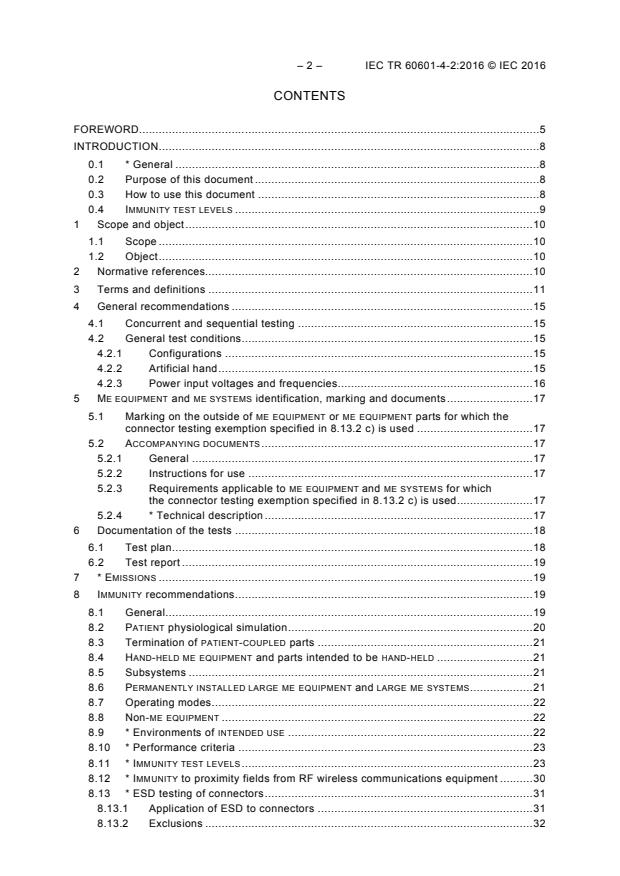
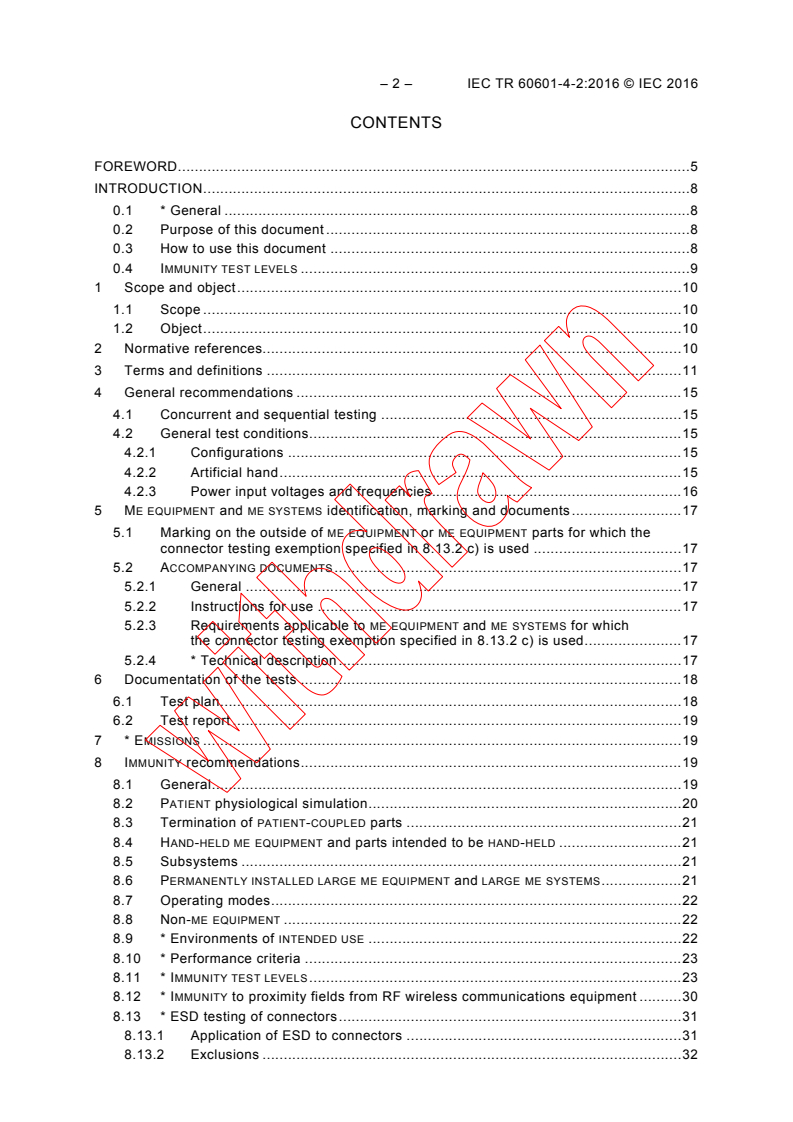
– 2 – IEC TR 60601-4-2:2016 © IEC 2016
CONTENTS
FOREWORD . 5
INTRODUCTION . 8
0.1 * General . 8
0.2 Purpose of this document . 8
0.3 How to use this document . 8
0.4 IMMUNITY TEST LEVELS . 9
1 Scope and object . 10
1.1 Scope . 10
1.2 Object . 10
2 Normative references. 10
3 Terms and definitions . 11
4 General recommendations . 15
4.1 Concurrent and sequential testing . 15
4.2 General test conditions . 15
4.2.1 Configurations . 15
4.2.2 Artificial hand . 15
4.2.3 Power input voltages and frequencies . 16
5 ME EQUIPMENT and ME SYSTEMS identification, marking and documents . 17
5.1 Marking on the outside of ME EQUIPMENT or ME EQUIPMENT parts for which the
connector testing exemption specified in 8.13.2 c) is used . 17
5.2 ACCOMPANYING DOCUMENTS . 17
5.2.1 General . 17
5.2.2 Instructions for use . 17
5.2.3 Requirements applicable to ME EQUIPMENT and ME SYSTEMS for which
the connector testing exemption specified in 8.13.2 c) is used . 17
5.2.4 * Technical description . 17
6 Documentation of the tests . 18
6.1 Test plan . 18
6.2 Test report . 19
7 * EMISSIONS . 19
8 IMMUNITY recommendations . 19
8.1 General . 19
8.2 PATIENT physiological simulation . 20
8.3 Termination of PATIENT-COUPLED parts . 21
8.4 HAND-HELD ME EQUIPMENT and parts intended to be HAND-HELD . 21
8.5 Subsystems . 21
8.6 PERMANENTLY INSTALLED LARGE ME EQUIPMENT and LARGE ME SYSTEMS . 21
8.7 Operating modes . 22
8.8 Non-ME EQUIPMENT . 22
8.9 * Environments of INTENDED USE . 22
8.10 * Performance criteria . 23
8.11 * IMMUNITY TEST LEVELS . 23
8.12 * IMMUNITY to proximity fields from RF wireless communications equipment . 30
8.13 * ESD testing of connectors . 31
8.13.1 Application of ESD to connectors . 31
8.13.2 Exclusions . 32
9 Test report. 33
Annex A (informative) General guidance and rationale . 35
Annex B (informative) Guide to labelling recommendations . 40
B.1 ACCOMPANYING DOCUMENTS, instructions for use . 40
B.2 ACCOMPANYING DOCUMENTS, technical description . 40
Annex C (informative) Determination of IMMUNITY TEST LEVELS for SPECIAL
ENVIRONMENTS . 41
C.1 General . 41
C.2 EM DISTURBANCE level determination . 42
C.3 Assessment of EM DISTURBANCE sources . 42
C.4 Test methods . 42
C.5 Test plan . 42
C.6 Examples of mitigations and special conditions . 43
Annex D (informative) Identification of specific IMMUNITY performance criteria . 44
D.1 General . 44
D.2 IMMUNITY performance criteria principles . 44
D.2.1 General . 44
D.2.2 IMMUNITY performance criteria for non-ME EQUIPMENT used in an
ME SYSTEM . 44
D.2.3 IMMUNITY performance criteria determination . 44
D.3 IMMUNITY performance criteria examples . 44
D.3.1 General examples . 44
D.3.2 Example of immunity performance criteria for a radiological table
system . 46
D.3.3 Example of immunity performance criteria for ultrasonic diagnostic
equipment . 46
Annex E (informative) Performance criteria specified by IEC 61000-6-x generic EMC
standards . 48
Annex F (informative) Mapping between this document and the elements of
IEC 60601-1-2:2014 . 49
Bibliography . 54
Index of defined terms used in this technical report . 56
Figure 1 – RC element of the artificial hand . 16
Figure 2 – * PORTS of ME EQUIPMENT and ME SYSTEMS . 20
Figure 3 – Examples of environments (locations) of INTENDED USE . 25
Table 1 – Recommended minimum test plan (1 of 2) . 18
Table 2 – * ENCLOSURE PORT . 26
Table 3 – * Input AC power PORT (1 of 2) . 26
Table 4 – Input DC power PORT . 28
Table 5 – * PATIENT COUPLING PORT . 29
Table 6 – SIGNAL INPUT/OUTPUT PARTS PORT . 30
Table 7 – Test specifications for ENCLOSURE PORT IMMUNITY to RF wireless
communications equipment . 31
Table 8 – Parts of connectors to be tested for ESD, based on the connector shell and
cover material . 32
Table 9 – * Testing of connectors and pins while connected and disconnected . 32
– 4 – IEC TR 60601-4-2:2016 © IEC 2016
Table 10 – Test report minimum contents (1 of 2) . 33
Table A.1 – Assumptions used in determining IMMUNITY TEST LEVELS specified in
Table 7 (1 of 2) . 38
Table B.1 – ACCOMPANYING DOCUMENTS, instructions for use . 40
Table B.2 – ACCOMPANYING DOCUMENTS, technical description . 40
Table C.1 – Examples of adjusted IMMUNITY TEST LEVELS due to mitigations or special
conditions . 43
Table D.1 – Example of IMMUNITY performance criteria for a radiological table and
gantry system . 46
Table D.2 – Example of IMMUNITY performance criteria for ULTRASONIC DIAGNOSTIC
EQUIPMENT . 47
Table F.1 – Mapping between the elements of IEC TR 60601-4-2 and IEC 60601-1-
2:2014 (1 of 5) . 49
INTERNATIONAL ELECTROTECHNICAL COMMISSION
____________
MEDICAL ELECTRICAL EQUIPMENT –
Part 4-2: Guidance and interpretation – Electromagnetic immunity:
performance of medical electrical equipment
and medical electrical systems
FOREWORD
1) The International Electrotechnical Commission (IEC) is a worldwide organization for standardization comprising
all national electrotechnical committees (IEC National Committees). The object of IEC is to promote
international co-operation on all questions concerning standardization in the electrical and electronic fields. To
this end and in addition to other activities, IEC publishes International Standards, Technical Specifications,
Technical Reports, Publicly Available Specifications (PAS) and Guides (hereafter referred to as “IEC
Publication(s)”). Their preparation is entrusted to technical committees; any IEC National Committee interested
in the subject dealt with may participate in this preparatory work. International, governmental and non-
governmental organizations liaising with the IEC also participate in this preparation. IEC collaborates closely
with the International Organization for Standardization (ISO) in accordance with conditions determined by
agreement between the two organizations.
2) The formal decisions or agreements of IEC on technical matters express, as nearly as possible, an international
consensus of opinion on the relevant subjects since each technical committee has representation from all
interested IEC National Committees.
3) IEC Publications have the form of recommendations for international use and are accepted by IEC National
Committees in that sense. While all reasonable efforts are made to ensure that the technical content of IEC
Publications is accurate, IEC cannot be held responsible for the way in which they are used or for any
misinterpretation by any end user.
4) In order to promote international uniformity, IEC National Committees undertake to apply IEC Publications
transparently to the maximum extent possible in their national and regional publications. Any divergence
between any IEC Publication and the corresponding national or regional publication shall be clearly indicated in
the latter.
5) IEC itself does not provide any attestation of conformity. Independent certification bodies provide conformity
assessment services and, in some areas, access to IEC marks of conformity. IEC is not responsible for any
services carried out by independent certification bodies.
6) All users should ensure that they have the latest edition of this publication.
7) No liability shall attach to IEC or its directors, employees, servants or agents including individual experts and
members of its technical committees and IEC National Committees for any personal injury, property damage or
other damage of any nature whatsoever, whether direct or indirect, or for costs (including legal fees) and
expenses arising out of the publication, use of, or reliance upon, this IEC Publication or any other IEC
Publications.
8) Attention is drawn to the Normative references cited in this publication. Use of the referenced publications is
indispensable for the correct application of this publication.
9) Attention is drawn to the possibility that some of the elements of this IEC Publication may be the subject of
patent rights. IEC shall not be held responsible for identifying any or all such patent rights.
The main task of IEC technical committees is to prepare International Standards. However, a
technical committee may propose the publication of a technical report when it has collected
data of a different kind from that which is normally published as an International Standard, for
example "state of the art".
IEC 60601-4-2, which is a technical report, has been prepared by IEC subcommittee 62A:
Common aspects of electrical equipment used in medical practice, of IEC technical committee
62: Electrical equipment in medical practice.
– 6 – IEC TR 60601-4-2:2016 © IEC 2016
The text of this technical report is based on the following documents:
Enquiry draft Report on voting
62A/1068/DTR 62A/1073A/RVC
Full information on the voting for the approval of this technical report can be found in the
report on voting indicated in the above table.
This publication has been drafted in accordance with the ISO/IEC Directives, Part 2.
In this technical report, the following print types are used:
– Recommendations and definitions: roman type.
– Test instructions: italic type.
– Informative material appearing outside of tables, such as notes, examples and references: in smaller type.
Normative text of tables is also in a smaller type.
– TERMS DEFINED IN CLAUSE 3 OF THIS TECHNICAL REPORT OR AS NOTED: SMALL CAPITALS.
In referring to the structure of this technical report, the term
– “clause” means one of the numbered divisions within the table of contents, inclusive of all
subdivisions (e.g. Clause 1 includes 1.1, 1.2, etc.);
– “subclause” means a numbered subdivision of a clause (e.g. 1.1, 1.2 and 1.3.1 are all
subclauses of Clause 1).
References to clauses within this technical report are preceded by the term “Clause” followed
by the clause number. References to subclauses within this technical report are by number
only.
In this technical report, the conjunctive “or” is used as an “inclusive or” so a statement is true
if any combination of the conditions is true.
The verbal forms used in this technical report conform to usage described in Annex H of the
ISO/IEC Directives, Part 2. For the purposes of this technical report, the auxiliary verb:
– “shall” means that compliance with a requirement or a test is mandatory for compliance
with this technical report; however, we chose to use it in this technical report only as
described in 0.3;
– “should” means that compliance with a requirement or a test is recommended but is not
mandatory for compliance with this technical report;
– “may” is used to describe a permissible way to achieve compliance with a requirement or
test.
An asterisk (*) as the first character of a title or at the beginning of a paragraph or table title
indicates that there is guidance or rationale related to that item in Annex A.
A list of all parts of the IEC 60601 series, published under the general title Medical electrical
equipment, can be found on the IEC website.
The committee has decided that the contents of this publication will remain unchanged until
the stability date indicated on the IEC website under "http://webstore.iec.ch" in the data
related to the specific publication. At this date, the publication will be
• reconfirmed,
• withdrawn,
• replaced by a revised edition, or
• amended.
A bilingual version of this publication may be issued at a later date.
IMPORTANT – The 'colour inside' logo on the cover page of this publication indicates
that it contains colours which are considered to be useful for the correct
understanding of its contents. Users should therefore print this document using a
colour printer.
– 8 – IEC TR 60601-4-2:2016 © IEC 2016
INTRODUCTION
0.1 * General
MEDICAL ELECTRICAL EQUIPMENT and MEDICAL ELECTRICAL SYSTEMS are used in the practice of
medicine because they provide needed functions that are associated with the INTENDED USE. If
MEDICAL ELECTRICAL EQUIPMENT or a MEDICAL ELECTRICAL SYSTEM does not provide these
needed functions because of a lack of IMMUNITY to ELECTROMAGNETIC DISTURBANCES that are
expected to occur in the environment(s) of INTENDED USE, this can interfere with the practice of
medicine.
This document provides guidance on assessing IMMUNITY, with regard to the INTENDED USE.
Based on the INTENDED USE, MEDICAL ELECTRICAL EQUIPMENT and MEDICAL ELECTRICAL SYSTEMS
should have adequate IMMUNITY to provide the performance specified by the MANUFACTURER in
the presence of ELECTROMAGNETIC DISTURBANCES. See Annex A for more information regarding
performance.
Guidance for IMMUNITY with regard to INTENDED USE can be useful for MEDICAL ELECTRICAL
EQUIPMENT and MEDICAL ELECTRICAL SYSTEMS for which the BASIC SAFETY AND ESSENTIAL
PERFORMANCE do not include the purpose(s) for which the ME EQUIPMENT or ME SYSTEM was
purchased. It is important to the OPERATOR or RESPONSIBLE ORGANIZATION and to the delivery
of healthcare that these functions operate as intended in the EM ENVIRONMENTS of INTENDED
USE.
Examples of performance that might not be BASIC SAFETY or ESSENTIAL PERFORMANCE but that
might be INTENDED USE include the following:
– the ability to print an ultrasound image remotely;
– the ability of a scale to accurately measure PATIENT weight;
– accuracy of X-RAY TUBE VOLTAGE in X-ray equipment for radiography and radioscopy, e.g.
the error is less than 5 %.
In general in IEC 60601-1-2:2014, the IMMUNITY TEST LEVELS for BASIC SAFETY and ESSENTIAL
PERFORMANCE are based on reasonably foreseeable maximum levels of EM DISTURBANCES. In
this document, IMMUNITY TEST LEVELS for performance are based on typical levels of
EM DISTURBANCES. Rationales concerning test methodology can be found in Annex A of this
document and in Annex A of IEC 60601-1-2:2014.
NOTE In general, typical IMMUNITY TEST LEVELS are equal to or lower than reasonably foreseeable maximum
levels.
0.2 Purpose of this document
The purpose of this document is to provide a consistent method for evaluating the ability of
MEDICAL ELECTRICAL EQUIPMENT or a MEDICAL ELECTRICAL SYSTEM to perform without
degradation of performance in the presence of ELECTROMAGNETIC DISTURBANCES.
0.3 How to use this document
This document can be used in conjunction with IEC 60601-1-2 and testing for conformity to
both documents can be done at the same time. This allows IMMUNITY testing of BASIC SAFETY,
ESSENTIAL PERFORMANCE and performance of the MEDICAL ELECTRICAL EQUIPMENT or MEDICAL
ELECTRICAL SYSTEM during one test, concurrently or sequentially. The main difference is the
use of performance criteria instead of pass/fail criteria, and differences can also include
modes and configurations. For BASIC SAFETY and ESSENTIAL PERFORMANCE, the pass/fail criteria
are determined as specified by IEC 60601-1-2. For performance, the criteria are determined
by the specifications, instructions and information provided by the MANUFACTURER.
This document uses “recommend” and “should” in place of “shall” in most cases. “Shall” is
used where an action is required by other standards or something needs to be done in a
prescribed way in order to be effective. Also, this document has “normative” references. They
are “normative” because if you choose to follow the recommendations of this document, they
are indispensable for that use. An example of this would be testing for radiated RF IMMUNITY.
The test methods of IEC 61000-4-3 would be indispensable for this testing.
0.4 IMMUNITY TEST LEVELS
The IMMUNITY TEST LEVELS specified in this document are typical for the locations of INTENDED
USE of MEDICAL ELECTRICAL EQUIPMENT and MEDICAL ELECTRICAL SYSTEMS. However, Annex C
provides a method for modifying the specified typical IMMUNITY TEST LEVELS for performance if
necessary or for particular environments (e.g. SPECIAL ENVIRONMENTS) for which this document
does not specify IMMUNITY TEST LEVELS.
– 10 – IEC TR 60601-4-2:2016 © IEC 2016
MEDICAL ELECTRICAL EQUIPMENT –
Part 4-2: Guidance and interpretation – Electromagnetic immunity:
performance of medical electrical equipment
and medical electrical systems
1 Scope and object
1.1 Scope
This part of IEC 60601 applies to the performance of MEDICAL ELECTRICAL EQUIPMENT or a
MEDICAL ELECTRICAL SYSTEM in the presence of ELECTROMAGNETIC DISTURBANCES. Hereafter,
MEDICAL ELECTRICAL EQUIPMENT or a MEDICAL ELECTRICAL SYSTEM are referred to as
ME EQUIPMENT or an ME SYSTEM.
1.2 Object
The object of this document is to provide guidance on the assessment of the performance of
ME EQUIPMENT or an ME SYSTEM in the presence of ELECTROMAGNETIC DISTURBANCES.
2 Normative references
The following documents are referred to in the text in such a way that some or all of their
content constitutes requirements of this document. For dated references, only the edition
cited applies. For undated references, the latest edition of the referenced document (including
any amendments) applies.
NOTE The way in which these referenced documents are cited in normative requirements determines the extent
(in whole or in part) to which they apply.
IEC 60417:2002, Graphical symbols for use on equipment (available from:
http://www.graphical-symbols.info/equipment)
IEC 60601-1:2005, Medical electrical equipment – Part 1: General requirements for basic
safety and essential performance
)
IEC 60601-1:2005/AMD1:2012
IEC 60601-1-2:2014, Medical electrical equipment – Part 1-2: General requirements for basic
safety and essential performance – Collateral standard: Electromagnetic disturbances –
Requirements and tests
IEC 60601-1-8:2006, Medical electrical equipment – Part 1-8: General requirements for basic
safety and essential performance – Collateral Standard: General requirements tests and
guidance for alarm systems in medical electrical equipment and medical electrical systems
IEC 60601-1-8:2006/AMD1:2012
IEC 60601-1-11:2015, Medical electrical equipment – Part 1-11: General requirements for
basic safety and essential performance – Collateral Standard: Requirements for medical
electrical equipment and medical electrical systems used in the home healthcare environment
___________
)
There exists a consolidated edition 3.1, including IEC 60601-1:2005 and its Amendment 1:2012.
IEC 60601-1-12:2014, Medical electrical equipment – Part 1-12: General requirements for
basic safety and essential performance – Collateral Standard: Requirements for medical
electrical equipment and medical electrical systems intended for use in the emergency
medical services environment
IEC 61000-4-2:2008, Electromagnetic compatibility (EMC) – Part 4-2: Testing and
measurement techniques – Electrostatic discharge immunity test
IEC 61000-4-3:2006, Electromagnetic compatibility (EMC) – Part 4-3: Testing and
measurement techniques – Radiated, radio-frequency, electromagnetic field immunity test
IEC 61000-4-3:2006/AMD1:2007
)
IEC 61000-4-3:2006/AMD2:2010
IEC 61000-4-4:2012, Electromagnetic compatibility (EMC) – Part 4-4: Testing and
measurement techniques – Electrical fast transient/burst immunity test
IEC 61000-4-5:2014, Electromagnetic compatibility (EMC) – Part 4-5: Testing and
measurement techniques – Surge immunity test
IEC 61000-4-6:2013, Electromagnetic compatibility (EMC) – Part 4-6: Testing and
measurement techniques – Immunity to conducted disturbances, induced by radio-frequency
fields
IEC 61000-4-8:2009, Electromagnetic compatibility (EMC) – Part 4-8: Testing and
measurement techniques – Power frequency magnetic field immunity test
IEC 61000-4-11:2004, Electromagnetic compatibility (EMC) – Part 4-11: Testing and
measurement techniques –Voltage dips, short interruptions and voltage variations immunity
tests
CISPR 16-1-2:2014, Specification for radio disturbance and immunity measuring apparatus
and methods – Part 1-2: Radio disturbance and immunity measuring apparatus – Coupling
devices for conducted disturbance measurements
ISO 7637-2:2011, Road vehicles – Electrical disturbances from conduction and coupling –
Part 2: Electrical transient conduction along supply lines only
3 Terms and definitions
For the purposes of this document, the terms and definitions given in IEC 60601-1:2005 and
IEC 60601-1:2005/AMD1:2012, IEC 60601-1-8:2006 and IEC 60601-1-8:2006/AMD1:2012,
IEC 60601-1-11:2015, IEC 60601-1-12:2014 and the following apply.
ISO and IEC maintain terminological databases for use in standardization at the following
addresses:
• IEC Electropedia: available at http://www.electropedia.org/
• ISO Online browsing platform: available at http://www.iso.org/obp
NOTE 1 Where the terms “voltage” and “current” are used in this document, they mean the RMS values of an
alternating, direct or composite voltage or current unless stated otherwise.
___________
)
There exists a consolidated edition 3.2, including IEC 61000-4-3:2006 and its Amendment 1:2007 and
Amendment 2:2010.
– 12 – IEC TR 60601-4-2:2016 © IEC 2016
NOTE 2 The term “electrical equipment” is used to mean ME EQUIPMENT or other electrical equipment. This
document also uses the term “equipment” to mean ME EQUIPMENT or other electrical or non-electrical equipment in
the context of an ME SYSTEM.
NOTE 3 *The dictionary definition of “performance” applies.
NOTE 4 An index of defined terms is found beginning on page 56.
3.1
ACCESSIBLE PART
part of electrical equipment other than an APPLIED PART that can be touched by means of the
standard test finger
Note 1 to entry: See also 5.9.2.1 of IEC 60601-1:2005.
[SOURCE: IEC 60601-1:2005, 3,2, modified — the original NOTE has been modified to add a
reference to IEC 60601-1:2005.]
3.2
APPLIED PART
part of ME EQUIPMENT that in NORMAL USE necessarily comes into physical contact with the
PATIENT for ME EQUIPMENT or an ME SYSTEM to perform its function
Note 1 to entry: See Figure 3, Figure 4 and Figure A.1 to Figure A.7 (inclusive) of IEC 60601-1:2005.
[SOURCE: IEC 60601-1:2005, 3.8, modified — Note 1 has been modified to add a reference
to IEC 60601-1:2005 and Note 2 and Note 3 have been deleted.]
3.3
ELECTROMAGNETIC DISTURBANCE
EM DISTURBANCE
any electromagnetic phenomenon that could degrade the performance of a device, equipment
or system
Note 1 to entry: An ELECTROMAGNETIC DISTURBANCE can be ELECTROMAGNETIC NOISE, an unwanted signal or a
change in the propagation medium itself.
[SOURCE: IEC 60601-1-2:2014, 3.3]
3.4
(ELECTROMAGNETIC) EMISSION
the phenomenon by which electromagnetic energy emanates from a source
[SOURCE: IEC 60601-1-2:2014, 3.4]
3.5
ELECTROMAGNETIC ENVIRONMENT
EM ENVIRONMENT
the totality of electromagnetic phenomena existing at a given location
Note 1 to entry: In general, the EM ENVIRONMENT is time dependent and its description might need a statistical
approach.
[SOURCE: IEC 60601-1-2:2014, 3.5]
3.6
ELECTROSTATIC DISCHARGE
ESD
a transfer of electric charge between bodies of different electrostatic potential in proximity or
through direct contact
[SOURCE: IEC 60601-1-2:2014, 3.6]
3.7
ENCLOSURE PORT
physical boundary of the ME EQUIPMENT or ME SYSTEM that electromagnetic fields can radiate
through or impinge on
[SOURCE: IEC 60601-1-2:2014, 3.7, modified – Note 1 to entry has been deleted.]
3.8
IMMUNITY (TO A DISTURBANCE)
the ability of ME EQUIPMENT or an ME SYSTEM to perform without degradation in the presence of
an ELECTROMAGNETIC DISTURBANCE
[SOURCE: IEC 60601-1-2:2014, 3.8]
3.9
IMMUNITY TEST LEVEL
the level of a test signal used to simulate an ELECTROMAGNETIC DISTURBANCE when performing
an IMMUNITY test
[SOURCE: IEC 60601-1-2:2014, 3.9]
3.10
INTENDED USE
INTENDED PURPOSE
use for which a product, PROCESS or service is intended according to the specifications,
instructions and information provided by the MANUFACTURER
Note 1 to entry: INTENDED USE should not be confused with NORMAL USE. While both include the concept of use as
intended by the MANUFACTURER, INTENDED USE focuses on the medical purpose while NORMAL USE incorporates not
only the medical purpose, but maintenance, service, transport, etc. as well.
[SOURCE: IEC 60601-1:2005 + IEC 60601-1:2005/AMD1:2012, 3.44]
3.11
LARGE ME EQUIPMENT
ME EQUIPMENT that cannot fit within a 2 m × 2 m × 2,5 m volume, excluding cables
[SOURCE: IEC 60601-1-2:2014, 3.12]
3.12
LARGE ME SYSTEM
ME SYSTEM that cannot fit within a 2 m × 2 m × 2,5 m volume, excluding cables; this includes
distributed ME SYSTEMS
[SOURCE: IEC 60601-1-2:2014, 3.13]
3.13
LOW VOLTAGE
line-to-line or line-to-neutral voltage that is less than or equal to 1 000 V AC or 1 500 V DC
[SOURCE: IEC 60601-1-2:2014, 3.14]
3.14
PATIENT-COUPLED
term referring to the presence of a path for the transfer of electromagnetic energy to or from
the PATIENT, whether intended or unintended
– 14 – IEC TR 60601-4-2:2016 © IEC 2016
Note 1 to entry: Examples of types of coupling include conductive, capacitive, inductive and optical.
[SOURCE: IEC 60601-1-2:2014, 3.15]
3.15
PATIENT COUPLING POINT
a sensing or treatment point of ME EQUIPMENT that is necessary to achieve the INTENDED USE of
the ME EQUIPMENT or an ME SYSTEM and that provides a path for transfer of electromagnetic
energy to or from the PATIENT, whether intended or unintended
Note 1 to entry: Examples of types of coupling include conductive, capacitive, inductive and optical.
[SOURCE: IEC 60601-1-2:2014, 3.16]
3.16
PORT
access to a device or network where electromagnetic energy or signals can be supplied or
received or where the device or network variables can be observed or measured
Note 1 to entry: Examples of PORTS include terminal pairs, PATIENT cables (PATIENT CONNECTIONS), SIGNAL
INPUT/OUTPUT PARTS such as data ports and USB connections, battery charger connections, and the ENCLOSURE
itself (i.e. ENCLOSURE PORT).
[SOURCE: IEC 60601-1-2:2014, 3.17]
3.17
PUBLIC MAINS NETWORK
LOW VOLTAGE electricity power lines to which all categories of consumers have access
[SOURCE: IEC 60601-1-2:2014, 3.18]
3.18
RADIO FREQUENCY
RF
a frequency in the portion of the electromagnetic spectrum that is between the audio-
frequency portion and the infrared portion; frequency useful for radio transmission
[SOURCE: IEC 60601-1-2:2014, 3.19]
3.19
SIGNAL INPUT/OUTPUT PART
SIP/SOP
part of ME EQUIPMENT, not being an APPLIED PART, intended to deliver or receive signals to or
from other electrical equipment, for example, for display, recording or data processing
[SOURCE: IEC 60601-1:2005, 3.115]
3.20
SPECIAL ENVIRONMENT
ELECTROMAGNETIC ENVIRONMENT with electromagnetic characteristics different from those
specified in this document in Table 2 through Table 6 or that requires IMMUNITY TEST LEVELS or
test methods that are different from those specified for the professional healthcare facility
environment and the HOME HEALTHCARE ENVIRONMENT
Note 1 to entry: The definition also implies the locations where SPECIAL ENVIRONMENTS are found.
Note 2 to entry: For ME EQUIPMENT and ME SYSTEMS intended for use in SPECIAL ENVIRONMENTS, special IMMUNITY
TEST LEVELS might be applicable.
[SOURCE: IEC 60601-1-2:2014, 3.20, modified — references to the source document have
been changed to refer to this document, and Notes 1 and 2 to entry have been added.]
3.21
TRANSIENT (adjective and noun)
pertaining to or designating a phenomenon or a quantity that varies between two consecutive
steady states during a time interval short compared with the time-scale of interest
[SOURCE: IEC 60050-161:1990, 161-02-01, modified – “which” has been changed to “that”
and parentheses have been added around “adjective and noun”.]
4 General recommendations
4.1 Concurrent and sequential testing
IMMUNITY testing according to this document can be performed concurrently or sequentially
with the IMMUNITY testing specified in IEC 60601-1-2.
If the IMMUNITY performance criteria determined according to this document are met at the
IMMUNITY TEST LEVELS specified in IEC 60601-1-2:2014, Clause 8, no further testing is needed
to demonstrate conformity to the recommendations of this document.
4.2 General test conditions
4.2.1 Configurations
ME EQUIPMENT and ME SYSTEMS should be tested in representative configurations and modes
consistent with INTENDED USE.
These configurations should include:
– attachment of cables to all PORTS as necessary to achieve the INTENDED USE (including
SIP/SOPs and, if applicable, the POTENTIAL EQUALIZATION CONDUCTOR);
– attachment of all tubing and filling of all fluid containers;
– termination of the cables with the intended equipment, subsystem simulators as specified
in 8.5, PATIENT physiological simulators as specified in 8.2 or artificial hands as specified
in 4.2.2;
– earthing on the ENCLOSURE PORT, if applicable, including connections to the terminal for
the connection of a POTENTIAL EQUALIZATION CONDUCTOR;
– use of cables and connectors that meet the specifications of the ME EQUIPMENT or
ME SYSTEM MANUFACTURER.
Special hardware or software might need to be used with the ME EQUIPMENT or ME SYSTEM to
perform the tests specified in Clause 8. If so, this should be documented in the test plan and
in the test report.
NOTE If the configurations used in IEC 60601-1-2 testing meet the recommendations of this subclause, this
could facilitate concurrent or sequential testing.
4.2.2 Artificial hand
Where an artificial hand is required by this document, it shall be connected as follows:
– For PATIENT COUPLING POINTS that do not have a conductive contact, the PATIENT COUPLING
POINT is terminated with the artificial hand and (series) RC element shown in Clause 8 of
CISPR 16-1-2:2014 (see Figure 1). The metal foil of the artificial hand is sized and placed
to simulate the approximate area and location of PATIENT coupling when the ME EQUIPMENT
or ME SYSTEM is providing its INTENDED USE. The metal foil of the artificial hand is
– 16 – IEC TR 60601-4-2:2016 © IEC 2016
connected to terminal M of the RC element and the other terminal of the RC element is
connected to the ground reference plane.
– For PATIENT COUPLING POINTS that have conductive contact to the PATIENT (PATIENT
CONNECTION), terminal M of the RC element is connected directly to the PATIENT COUPLING
POINT, and the other terminal of the RC element is connected to the ground reference
plane. If normal operation of the ME EQUIPMENT or ME SYSTEM cannot be verified with
terminal M connected to the PATIENT COUPLING POINT, an insulating material with a
maximum thickness of 5 mm may be applied between the metal foil of the artificial hand
and the PATIENT COUPLING POINT. In this case, the metal foil of the artificial hand is to be
sized and placed to simulate the approximate area and location of PATIENT coupling when
the ME EQUIPMENT or ME SYSTEM is providing its INTENDED USE, and terminal M of the RC
element is to be connected to the metal foil but not to the PATIENT COUPLING POINT. The
other terminal of the RC element is connected to the ground reference plane in all cases.
– For ME EQUIPMENT and ME SYSTEMS that have multiple PATIENT COUPLING POINTS intended to
be connected to a single PATIENT, each PATIENT COUPLING POINT and each PATIENT-COUPLED
part is to have an artificial hand applied as specified above. The artificial hands are
connected to a single common connection and this common connection is connected to
terminal M of the RC element, as specified in Clause 8 of CISPR 16-1-2:2014. For
ME EQUIPMENT and ME SYSTEMS intended to be connected to multiple PATIENTS, artificial
hands are to be applied as specified above and a separate common connection and RC
element is to be used for each PATIENT for which the capacitive coupling effect and RF
impedance is to be simulated. The other terminal of each RC element is connected to the
ground reference plane in all cases.
M
220 pF ±20 %
510 Ω ±10 %
IEC
Figure 1 – RC element of the artificial hand
4.2.3 Power input voltages and frequencies
For all tests except for the IEC 61000-4-11 test, the test may be performed at any one power
input voltage within the ME EQUIPMENT or ME SYSTEM RATED voltage and any one RATED power
frequency. Unless otherwise specified in this document, if the ME EQUIPMENT or ME SYSTEM is
tested at one power input voltage and one power input frequency, it is not necessary to re-test
at additional voltages or frequencies.
The IEC 61000-4-11 tests should be performed at the minimum RATED power input voltage
and any one RATED power input frequency. ME EQUIPMENT and ME SYSTEMS with power input
voltage
...
IEC TR 60601-4-2 ®
Edition 1.0 2016-05
TECHNICAL
REPORT
colour
inside
Medical electrical equipment –
Part 4-2: Guidance and interpretation – Electromagnetic immunity: performance
of medical electrical equipment and medical electrical systems
All rights reserved. Unless otherwise specified, no part of this publication may be reproduced or utilized in any form
or by any means, electronic or mechanical, including photocopying and microfilm, without permission in writing from
either IEC or IEC's member National Committee in the country of the requester. If you have any questions about IEC
copyright or have an enquiry about obtaining additional rights to this publication, please contact the address below or
your local IEC member National Committee for further information.
IEC Central Office Tel.: +41 22 919 02 11
3, rue de Varembé Fax: +41 22 919 03 00
CH-1211 Geneva 20 info@iec.ch
Switzerland www.iec.ch
About the IEC
The International Electrotechnical Commission (IEC) is the leading global organization that prepares and publishes
International Standards for all electrical, electronic and related technologies.
About IEC publications
The technical content of IEC publications is kept under constant review by the IEC. Please make sure that you have the
latest edition, a corrigenda or an amendment might have been published.
IEC Catalogue - webstore.iec.ch/catalogue Electropedia - www.electropedia.org
The stand-alone application for consulting the entire The world's leading online dictionary of electronic and
bibliographical information on IEC International Standards, electrical terms containing 20 000 terms and definitions in
Technical Specifications, Technical Reports and other English and French, with equivalent terms in 15 additional
documents. Available for PC, Mac OS, Android Tablets and languages. Also known as the International Electrotechnical
iPad. Vocabulary (IEV) online.
IEC publications search - www.iec.ch/searchpub IEC Glossary - std.iec.ch/glossary
The advanced search enables to find IEC publications by a 65 000 electrotechnical terminology entries in English and
variety of criteria (reference number, text, technical French extracted from the Terms and Definitions clause of
committee,…). It also gives information on projects, replaced IEC publications issued since 2002. Some entries have been
and withdrawn publications. collected from earlier publications of IEC TC 37, 77, 86 and
CISPR.
IEC Just Published - webstore.iec.ch/justpublished
Stay up to date on all new IEC publications. Just Published IEC Customer Service Centre - webstore.iec.ch/csc
details all new publications released. Available online and If you wish to give us your feedback on this publication or
also once a month by email. need further assistance, please contact the Customer Service
Centre: csc@iec.ch.
IEC TR 60601-4-2 ®
Edition 1.0 2016-05
TECHNICAL
REPORT
colour
inside
Medical electrical equipment –
Part 4-2: Guidance and interpretation – Electromagnetic immunity: performance
of medical electrical equipment and medical electrical systems
INTERNATIONAL
ELECTROTECHNICAL
COMMISSION
ICS 11.040.01; 33.100.20 ISBN 978-2-8322-3414-3
– 2 – IEC TR 60601-4-2:2016 © IEC 2016
CONTENTS
FOREWORD . 5
INTRODUCTION . 8
0.1 * General . 8
0.2 Purpose of this document . 8
0.3 How to use this document . 8
0.4 IMMUNITY TEST LEVELS . 9
1 Scope and object . 10
1.1 Scope . 10
1.2 Object . 10
2 Normative references. 10
3 Terms and definitions . 11
4 General recommendations . 15
4.1 Concurrent and sequential testing . 15
4.2 General test conditions . 15
4.2.1 Configurations . 15
4.2.2 Artificial hand . 15
4.2.3 Power input voltages and frequencies . 16
5 ME EQUIPMENT and ME SYSTEMS identification, marking and documents . 17
5.1 Marking on the outside of ME EQUIPMENT or ME EQUIPMENT parts for which the
connector testing exemption specified in 8.13.2 c) is used . 17
5.2 ACCOMPANYING DOCUMENTS . 17
5.2.1 General . 17
5.2.2 Instructions for use . 17
5.2.3 Requirements applicable to ME EQUIPMENT and ME SYSTEMS for which
the connector testing exemption specified in 8.13.2 c) is used . 17
5.2.4 * Technical description . 17
6 Documentation of the tests . 18
6.1 Test plan . 18
6.2 Test report . 19
7 * EMISSIONS . 19
8 IMMUNITY recommendations . 19
8.1 General . 19
8.2 PATIENT physiological simulation . 20
8.3 Termination of PATIENT-COUPLED parts . 21
8.4 HAND-HELD ME EQUIPMENT and parts intended to be HAND-HELD . 21
8.5 Subsystems . 21
8.6 PERMANENTLY INSTALLED LARGE ME EQUIPMENT and LARGE ME SYSTEMS . 21
8.7 Operating modes . 22
8.8 Non-ME EQUIPMENT . 22
8.9 * Environments of INTENDED USE . 22
8.10 * Performance criteria . 23
8.11 * IMMUNITY TEST LEVELS . 23
8.12 * IMMUNITY to proximity fields from RF wireless communications equipment . 30
8.13 * ESD testing of connectors . 31
8.13.1 Application of ESD to connectors . 31
8.13.2 Exclusions . 32
9 Test report. 33
Annex A (informative) General guidance and rationale . 35
Annex B (informative) Guide to labelling recommendations . 40
B.1 ACCOMPANYING DOCUMENTS, instructions for use . 40
B.2 ACCOMPANYING DOCUMENTS, technical description . 40
Annex C (informative) Determination of IMMUNITY TEST LEVELS for SPECIAL
ENVIRONMENTS . 41
C.1 General . 41
C.2 EM DISTURBANCE level determination . 42
C.3 Assessment of EM DISTURBANCE sources . 42
C.4 Test methods . 42
C.5 Test plan . 42
C.6 Examples of mitigations and special conditions . 43
Annex D (informative) Identification of specific IMMUNITY performance criteria . 44
D.1 General . 44
D.2 IMMUNITY performance criteria principles . 44
D.2.1 General . 44
D.2.2 IMMUNITY performance criteria for non-ME EQUIPMENT used in an
ME SYSTEM . 44
D.2.3 IMMUNITY performance criteria determination . 44
D.3 IMMUNITY performance criteria examples . 44
D.3.1 General examples . 44
D.3.2 Example of immunity performance criteria for a radiological table
system . 46
D.3.3 Example of immunity performance criteria for ultrasonic diagnostic
equipment . 46
Annex E (informative) Performance criteria specified by IEC 61000-6-x generic EMC
standards . 48
Annex F (informative) Mapping between this document and the elements of
IEC 60601-1-2:2014 . 49
Bibliography . 54
Index of defined terms used in this technical report . 56
Figure 1 – RC element of the artificial hand . 16
Figure 2 – * PORTS of ME EQUIPMENT and ME SYSTEMS . 20
Figure 3 – Examples of environments (locations) of INTENDED USE . 25
Table 1 – Recommended minimum test plan (1 of 2) . 18
Table 2 – * ENCLOSURE PORT . 26
Table 3 – * Input AC power PORT (1 of 2) . 26
Table 4 – Input DC power PORT . 28
Table 5 – * PATIENT COUPLING PORT . 29
Table 6 – SIGNAL INPUT/OUTPUT PARTS PORT . 30
Table 7 – Test specifications for ENCLOSURE PORT IMMUNITY to RF wireless
communications equipment . 31
Table 8 – Parts of connectors to be tested for ESD, based on the connector shell and
cover material . 32
Table 9 – * Testing of connectors and pins while connected and disconnected . 32
– 4 – IEC TR 60601-4-2:2016 © IEC 2016
Table 10 – Test report minimum contents (1 of 2) . 33
Table A.1 – Assumptions used in determining IMMUNITY TEST LEVELS specified in
Table 7 (1 of 2) . 38
Table B.1 – ACCOMPANYING DOCUMENTS, instructions for use . 40
Table B.2 – ACCOMPANYING DOCUMENTS, technical description . 40
Table C.1 – Examples of adjusted IMMUNITY TEST LEVELS due to mitigations or special
conditions . 43
Table D.1 – Example of IMMUNITY performance criteria for a radiological table and
gantry system . 46
Table D.2 – Example of IMMUNITY performance criteria for ULTRASONIC DIAGNOSTIC
EQUIPMENT . 47
Table F.1 – Mapping between the elements of IEC TR 60601-4-2 and IEC 60601-1-
2:2014 (1 of 5) . 49
INTERNATIONAL ELECTROTECHNICAL COMMISSION
____________
MEDICAL ELECTRICAL EQUIPMENT –
Part 4-2: Guidance and interpretation – Electromagnetic immunity:
performance of medical electrical equipment
and medical electrical systems
FOREWORD
1) The International Electrotechnical Commission (IEC) is a worldwide organization for standardization comprising
all national electrotechnical committees (IEC National Committees). The object of IEC is to promote
international co-operation on all questions concerning standardization in the electrical and electronic fields. To
this end and in addition to other activities, IEC publishes International Standards, Technical Specifications,
Technical Reports, Publicly Available Specifications (PAS) and Guides (hereafter referred to as “IEC
Publication(s)”). Their preparation is entrusted to technical committees; any IEC National Committee interested
in the subject dealt with may participate in this preparatory work. International, governmental and non-
governmental organizations liaising with the IEC also participate in this preparation. IEC collaborates closely
with the International Organization for Standardization (ISO) in accordance with conditions determined by
agreement between the two organizations.
2) The formal decisions or agreements of IEC on technical matters express, as nearly as possible, an international
consensus of opinion on the relevant subjects since each technical committee has representation from all
interested IEC National Committees.
3) IEC Publications have the form of recommendations for international use and are accepted by IEC National
Committees in that sense. While all reasonable efforts are made to ensure that the technical content of IEC
Publications is accurate, IEC cannot be held responsible for the way in which they are used or for any
misinterpretation by any end user.
4) In order to promote international uniformity, IEC National Committees undertake to apply IEC Publications
transparently to the maximum extent possible in their national and regional publications. Any divergence
between any IEC Publication and the corresponding national or regional publication shall be clearly indicated in
the latter.
5) IEC itself does not provide any attestation of conformity. Independent certification bodies provide conformity
assessment services and, in some areas, access to IEC marks of conformity. IEC is not responsible for any
services carried out by independent certification bodies.
6) All users should ensure that they have the latest edition of this publication.
7) No liability shall attach to IEC or its directors, employees, servants or agents including individual experts and
members of its technical committees and IEC National Committees for any personal injury, property damage or
other damage of any nature whatsoever, whether direct or indirect, or for costs (including legal fees) and
expenses arising out of the publication, use of, or reliance upon, this IEC Publication or any other IEC
Publications.
8) Attention is drawn to the Normative references cited in this publication. Use of the referenced publications is
indispensable for the correct application of this publication.
9) Attention is drawn to the possibility that some of the elements of this IEC Publication may be the subject of
patent rights. IEC shall not be held responsible for identifying any or all such patent rights.
The main task of IEC technical committees is to prepare International Standards. However, a
technical committee may propose the publication of a technical report when it has collected
data of a different kind from that which is normally published as an International Standard, for
example "state of the art".
IEC 60601-4-2, which is a technical report, has been prepared by IEC subcommittee 62A:
Common aspects of electrical equipment used in medical practice, of IEC technical committee
62: Electrical equipment in medical practice.
– 6 – IEC TR 60601-4-2:2016 © IEC 2016
The text of this technical report is based on the following documents:
Enquiry draft Report on voting
62A/1068/DTR 62A/1073A/RVC
Full information on the voting for the approval of this technical report can be found in the
report on voting indicated in the above table.
This publication has been drafted in accordance with the ISO/IEC Directives, Part 2.
In this technical report, the following print types are used:
– Recommendations and definitions: roman type.
– Test instructions: italic type.
– Informative material appearing outside of tables, such as notes, examples and references: in smaller type.
Normative text of tables is also in a smaller type.
– TERMS DEFINED IN CLAUSE 3 OF THIS TECHNICAL REPORT OR AS NOTED: SMALL CAPITALS.
In referring to the structure of this technical report, the term
– “clause” means one of the numbered divisions within the table of contents, inclusive of all
subdivisions (e.g. Clause 1 includes 1.1, 1.2, etc.);
– “subclause” means a numbered subdivision of a clause (e.g. 1.1, 1.2 and 1.3.1 are all
subclauses of Clause 1).
References to clauses within this technical report are preceded by the term “Clause” followed
by the clause number. References to subclauses within this technical report are by number
only.
In this technical report, the conjunctive “or” is used as an “inclusive or” so a statement is true
if any combination of the conditions is true.
The verbal forms used in this technical report conform to usage described in Annex H of the
ISO/IEC Directives, Part 2. For the purposes of this technical report, the auxiliary verb:
– “shall” means that compliance with a requirement or a test is mandatory for compliance
with this technical report; however, we chose to use it in this technical report only as
described in 0.3;
– “should” means that compliance with a requirement or a test is recommended but is not
mandatory for compliance with this technical report;
– “may” is used to describe a permissible way to achieve compliance with a requirement or
test.
An asterisk (*) as the first character of a title or at the beginning of a paragraph or table title
indicates that there is guidance or rationale related to that item in Annex A.
A list of all parts of the IEC 60601 series, published under the general title Medical electrical
equipment, can be found on the IEC website.
The committee has decided that the contents of this publication will remain unchanged until
the stability date indicated on the IEC website under "http://webstore.iec.ch" in the data
related to the specific publication. At this date, the publication will be
• reconfirmed,
• withdrawn,
• replaced by a revised edition, or
• amended.
A bilingual version of this publication may be issued at a later date.
IMPORTANT – The 'colour inside' logo on the cover page of this publication indicates
that it contains colours which are considered to be useful for the correct
understanding of its contents. Users should therefore print this document using a
colour printer.
– 8 – IEC TR 60601-4-2:2016 © IEC 2016
INTRODUCTION
0.1 * General
MEDICAL ELECTRICAL EQUIPMENT and MEDICAL ELECTRICAL SYSTEMS are used in the practice of
medicine because they provide needed functions that are associated with the INTENDED USE. If
MEDICAL ELECTRICAL EQUIPMENT or a MEDICAL ELECTRICAL SYSTEM does not provide these
needed functions because of a lack of IMMUNITY to ELECTROMAGNETIC DISTURBANCES that are
expected to occur in the environment(s) of INTENDED USE, this can interfere with the practice of
medicine.
This document provides guidance on assessing IMMUNITY, with regard to the INTENDED USE.
Based on the INTENDED USE, MEDICAL ELECTRICAL EQUIPMENT and MEDICAL ELECTRICAL SYSTEMS
should have adequate IMMUNITY to provide the performance specified by the MANUFACTURER in
the presence of ELECTROMAGNETIC DISTURBANCES. See Annex A for more information regarding
performance.
Guidance for IMMUNITY with regard to INTENDED USE can be useful for MEDICAL ELECTRICAL
EQUIPMENT and MEDICAL ELECTRICAL SYSTEMS for which the BASIC SAFETY AND ESSENTIAL
PERFORMANCE do not include the purpose(s) for which the ME EQUIPMENT or ME SYSTEM was
purchased. It is important to the OPERATOR or RESPONSIBLE ORGANIZATION and to the delivery
of healthcare that these functions operate as intended in the EM ENVIRONMENTS of INTENDED
USE.
Examples of performance that might not be BASIC SAFETY or ESSENTIAL PERFORMANCE but that
might be INTENDED USE include the following:
– the ability to print an ultrasound image remotely;
– the ability of a scale to accurately measure PATIENT weight;
– accuracy of X-RAY TUBE VOLTAGE in X-ray equipment for radiography and radioscopy, e.g.
the error is less than 5 %.
In general in IEC 60601-1-2:2014, the IMMUNITY TEST LEVELS for BASIC SAFETY and ESSENTIAL
PERFORMANCE are based on reasonably foreseeable maximum levels of EM DISTURBANCES. In
this document, IMMUNITY TEST LEVELS for performance are based on typical levels of
EM DISTURBANCES. Rationales concerning test methodology can be found in Annex A of this
document and in Annex A of IEC 60601-1-2:2014.
NOTE In general, typical IMMUNITY TEST LEVELS are equal to or lower than reasonably foreseeable maximum
levels.
0.2 Purpose of this document
The purpose of this document is to provide a consistent method for evaluating the ability of
MEDICAL ELECTRICAL EQUIPMENT or a MEDICAL ELECTRICAL SYSTEM to perform without
degradation of performance in the presence of ELECTROMAGNETIC DISTURBANCES.
0.3 How to use this document
This document can be used in conjunction with IEC 60601-1-2 and testing for conformity to
both documents can be done at the same time. This allows IMMUNITY testing of BASIC SAFETY,
ESSENTIAL PERFORMANCE and performance of the MEDICAL ELECTRICAL EQUIPMENT or MEDICAL
ELECTRICAL SYSTEM during one test, concurrently or sequentially. The main difference is the
use of performance criteria instead of pass/fail criteria, and differences can also include
modes and configurations. For BASIC SAFETY and ESSENTIAL PERFORMANCE, the pass/fail criteria
are determined as specified by IEC 60601-1-2. For performance, the criteria are determined
by the specifications, instructions and information provided by the MANUFACTURER.
This document uses “recommend” and “should” in place of “shall” in most cases. “Shall” is
used where an action is required by other standards or something needs to be done in a
prescribed way in order to be effective. Also, this document has “normative” references. They
are “normative” because if you choose to follow the recommendations of this document, they
are indispensable for that use. An example of this would be testing for radiated RF IMMUNITY.
The test methods of IEC 61000-4-3 would be indispensable for this testing.
0.4 IMMUNITY TEST LEVELS
The IMMUNITY TEST LEVELS specified in this document are typical for the locations of INTENDED
USE of MEDICAL ELECTRICAL EQUIPMENT and MEDICAL ELECTRICAL SYSTEMS. However, Annex C
provides a method for modifying the specified typical IMMUNITY TEST LEVELS for performance if
necessary or for particular environments (e.g. SPECIAL ENVIRONMENTS) for which this document
does not specify IMMUNITY TEST LEVELS.
– 10 – IEC TR 60601-4-2:2016 © IEC 2016
MEDICAL ELECTRICAL EQUIPMENT –
Part 4-2: Guidance and interpretation – Electromagnetic immunity:
performance of medical electrical equipment
and medical electrical systems
1 Scope and object
1.1 Scope
This part of IEC 60601 applies to the performance of MEDICAL ELECTRICAL EQUIPMENT or a
MEDICAL ELECTRICAL SYSTEM in the presence of ELECTROMAGNETIC DISTURBANCES. Hereafter,
MEDICAL ELECTRICAL EQUIPMENT or a MEDICAL ELECTRICAL SYSTEM are referred to as
ME EQUIPMENT or an ME SYSTEM.
1.2 Object
The object of this document is to provide guidance on the assessment of the performance of
ME EQUIPMENT or an ME SYSTEM in the presence of ELECTROMAGNETIC DISTURBANCES.
2 Normative references
The following documents are referred to in the text in such a way that some or all of their
content constitutes requirements of this document. For dated references, only the edition
cited applies. For undated references, the latest edition of the referenced document (including
any amendments) applies.
NOTE The way in which these referenced documents are cited in normative requirements determines the extent
(in whole or in part) to which they apply.
IEC 60417:2002, Graphical symbols for use on equipment (available from:
http://www.graphical-symbols.info/equipment)
IEC 60601-1:2005, Medical electrical equipment – Part 1: General requirements for basic
safety and essential performance
)
IEC 60601-1:2005/AMD1:2012
IEC 60601-1-2:2014, Medical electrical equipment – Part 1-2: General requirements for basic
safety and essential performance – Collateral standard: Electromagnetic disturbances –
Requirements and tests
IEC 60601-1-8:2006, Medical electrical equipment – Part 1-8: General requirements for basic
safety and essential performance – Collateral Standard: General requirements tests and
guidance for alarm systems in medical electrical equipment and medical electrical systems
IEC 60601-1-8:2006/AMD1:2012
IEC 60601-1-11:2015, Medical electrical equipment – Part 1-11: General requirements for
basic safety and essential performance – Collateral Standard: Requirements for medical
electrical equipment and medical electrical systems used in the home healthcare environment
___________
)
There exists a consolidated edition 3.1, including IEC 60601-1:2005 and its Amendment 1:2012.
IEC 60601-1-12:2014, Medical electrical equipment – Part 1-12: General requirements for
basic safety and essential performance – Collateral Standard: Requirements for medical
electrical equipment and medical electrical systems intended for use in the emergency
medical services environment
IEC 61000-4-2:2008, Electromagnetic compatibility (EMC) – Part 4-2: Testing and
measurement techniques – Electrostatic discharge immunity test
IEC 61000-4-3:2006, Electromagnetic compatibility (EMC) – Part 4-3: Testing and
measurement techniques – Radiated, radio-frequency, electromagnetic field immunity test
IEC 61000-4-3:2006/AMD1:2007
)
IEC 61000-4-3:2006/AMD2:2010
IEC 61000-4-4:2012, Electromagnetic compatibility (EMC) – Part 4-4: Testing and
measurement techniques – Electrical fast transient/burst immunity test
IEC 61000-4-5:2014, Electromagnetic compatibility (EMC) – Part 4-5: Testing and
measurement techniques – Surge immunity test
IEC 61000-4-6:2013, Electromagnetic compatibility (EMC) – Part 4-6: Testing and
measurement techniques – Immunity to conducted disturbances, induced by radio-frequency
fields
IEC 61000-4-8:2009, Electromagnetic compatibility (EMC) – Part 4-8: Testing and
measurement techniques – Power frequency magnetic field immunity test
IEC 61000-4-11:2004, Electromagnetic compatibility (EMC) – Part 4-11: Testing and
measurement techniques –Voltage dips, short interruptions and voltage variations immunity
tests
CISPR 16-1-2:2014, Specification for radio disturbance and immunity measuring apparatus
and methods – Part 1-2: Radio disturbance and immunity measuring apparatus – Coupling
devices for conducted disturbance measurements
ISO 7637-2:2011, Road vehicles – Electrical disturbances from conduction and coupling –
Part 2: Electrical transient conduction along supply lines only
3 Terms and definitions
For the purposes of this document, the terms and definitions given in IEC 60601-1:2005 and
IEC 60601-1:2005/AMD1:2012, IEC 60601-1-8:2006 and IEC 60601-1-8:2006/AMD1:2012,
IEC 60601-1-11:2015, IEC 60601-1-12:2014 and the following apply.
ISO and IEC maintain terminological databases for use in standardization at the following
addresses:
• IEC Electropedia: available at http://www.electropedia.org/
• ISO Online browsing platform: available at http://www.iso.org/obp
NOTE 1 Where the terms “voltage” and “current” are used in this document, they mean the RMS values of an
alternating, direct or composite voltage or current unless stated otherwise.
___________
)
There exists a consolidated edition 3.2, including IEC 61000-4-3:2006 and its Amendment 1:2007 and
Amendment 2:2010.
– 12 – IEC TR 60601-4-2:2016 © IEC 2016
NOTE 2 The term “electrical equipment” is used to mean ME EQUIPMENT or other electrical equipment. This
document also uses the term “equipment” to mean ME EQUIPMENT or other electrical or non-electrical equipment in
the context of an ME SYSTEM.
NOTE 3 *The dictionary definition of “performance” applies.
NOTE 4 An index of defined terms is found beginning on page 56.
3.1
ACCESSIBLE PART
part of electrical equipment other than an APPLIED PART that can be touched by means of the
standard test finger
Note 1 to entry: See also 5.9.2.1 of IEC 60601-1:2005.
[SOURCE: IEC 60601-1:2005, 3,2, modified — the original NOTE has been modified to add a
reference to IEC 60601-1:2005.]
3.2
APPLIED PART
part of ME EQUIPMENT that in NORMAL USE necessarily comes into physical contact with the
PATIENT for ME EQUIPMENT or an ME SYSTEM to perform its function
Note 1 to entry: See Figure 3, Figure 4 and Figure A.1 to Figure A.7 (inclusive) of IEC 60601-1:2005.
[SOURCE: IEC 60601-1:2005, 3.8, modified — Note 1 has been modified to add a reference
to IEC 60601-1:2005 and Note 2 and Note 3 have been deleted.]
3.3
ELECTROMAGNETIC DISTURBANCE
EM DISTURBANCE
any electromagnetic phenomenon that could degrade the performance of a device, equipment
or system
Note 1 to entry: An ELECTROMAGNETIC DISTURBANCE can be ELECTROMAGNETIC NOISE, an unwanted signal or a
change in the propagation medium itself.
[SOURCE: IEC 60601-1-2:2014, 3.3]
3.4
(ELECTROMAGNETIC) EMISSION
the phenomenon by which electromagnetic energy emanates from a source
[SOURCE: IEC 60601-1-2:2014, 3.4]
3.5
ELECTROMAGNETIC ENVIRONMENT
EM ENVIRONMENT
the totality of electromagnetic phenomena existing at a given location
Note 1 to entry: In general, the EM ENVIRONMENT is time dependent and its description might need a statistical
approach.
[SOURCE: IEC 60601-1-2:2014, 3.5]
3.6
ELECTROSTATIC DISCHARGE
ESD
a transfer of electric charge between bodies of different electrostatic potential in proximity or
through direct contact
[SOURCE: IEC 60601-1-2:2014, 3.6]
3.7
ENCLOSURE PORT
physical boundary of the ME EQUIPMENT or ME SYSTEM that electromagnetic fields can radiate
through or impinge on
[SOURCE: IEC 60601-1-2:2014, 3.7, modified – Note 1 to entry has been deleted.]
3.8
IMMUNITY (TO A DISTURBANCE)
the ability of ME EQUIPMENT or an ME SYSTEM to perform without degradation in the presence of
an ELECTROMAGNETIC DISTURBANCE
[SOURCE: IEC 60601-1-2:2014, 3.8]
3.9
IMMUNITY TEST LEVEL
the level of a test signal used to simulate an ELECTROMAGNETIC DISTURBANCE when performing
an IMMUNITY test
[SOURCE: IEC 60601-1-2:2014, 3.9]
3.10
INTENDED USE
INTENDED PURPOSE
use for which a product, PROCESS or service is intended according to the specifications,
instructions and information provided by the MANUFACTURER
Note 1 to entry: INTENDED USE should not be confused with NORMAL USE. While both include the concept of use as
intended by the MANUFACTURER, INTENDED USE focuses on the medical purpose while NORMAL USE incorporates not
only the medical purpose, but maintenance, service, transport, etc. as well.
[SOURCE: IEC 60601-1:2005 + IEC 60601-1:2005/AMD1:2012, 3.44]
3.11
LARGE ME EQUIPMENT
ME EQUIPMENT that cannot fit within a 2 m × 2 m × 2,5 m volume, excluding cables
[SOURCE: IEC 60601-1-2:2014, 3.12]
3.12
LARGE ME SYSTEM
ME SYSTEM that cannot fit within a 2 m × 2 m × 2,5 m volume, excluding cables; this includes
distributed ME SYSTEMS
[SOURCE: IEC 60601-1-2:2014, 3.13]
3.13
LOW VOLTAGE
line-to-line or line-to-neutral voltage that is less than or equal to 1 000 V AC or 1 500 V DC
[SOURCE: IEC 60601-1-2:2014, 3.14]
3.14
PATIENT-COUPLED
term referring to the presence of a path for the transfer of electromagnetic energy to or from
the PATIENT, whether intended or unintended
– 14 – IEC TR 60601-4-2:2016 © IEC 2016
Note 1 to entry: Examples of types of coupling include conductive, capacitive, inductive and optical.
[SOURCE: IEC 60601-1-2:2014, 3.15]
3.15
PATIENT COUPLING POINT
a sensing or treatment point of ME EQUIPMENT that is necessary to achieve the INTENDED USE of
the ME EQUIPMENT or an ME SYSTEM and that provides a path for transfer of electromagnetic
energy to or from the PATIENT, whether intended or unintended
Note 1 to entry: Examples of types of coupling include conductive, capacitive, inductive and optical.
[SOURCE: IEC 60601-1-2:2014, 3.16]
3.16
PORT
access to a device or network where electromagnetic energy or signals can be supplied or
received or where the device or network variables can be observed or measured
Note 1 to entry: Examples of PORTS include terminal pairs, PATIENT cables (PATIENT CONNECTIONS), SIGNAL
INPUT/OUTPUT PARTS such as data ports and USB connections, battery charger connections, and the ENCLOSURE
itself (i.e. ENCLOSURE PORT).
[SOURCE: IEC 60601-1-2:2014, 3.17]
3.17
PUBLIC MAINS NETWORK
LOW VOLTAGE electricity power lines to which all categories of consumers have access
[SOURCE: IEC 60601-1-2:2014, 3.18]
3.18
RADIO FREQUENCY
RF
a frequency in the portion of the electromagnetic spectrum that is between the audio-
frequency portion and the infrared portion; frequency useful for radio transmission
[SOURCE: IEC 60601-1-2:2014, 3.19]
3.19
SIGNAL INPUT/OUTPUT PART
SIP/SOP
part of ME EQUIPMENT, not being an APPLIED PART, intended to deliver or receive signals to or
from other electrical equipment, for example, for display, recording or data processing
[SOURCE: IEC 60601-1:2005, 3.115]
3.20
SPECIAL ENVIRONMENT
ELECTROMAGNETIC ENVIRONMENT with electromagnetic characteristics different from those
specified in this document in Table 2 through Table 6 or that requires IMMUNITY TEST LEVELS or
test methods that are different from those specified for the professional healthcare facility
environment and the HOME HEALTHCARE ENVIRONMENT
Note 1 to entry: The definition also implies the locations where SPECIAL ENVIRONMENTS are found.
Note 2 to entry: For ME EQUIPMENT and ME SYSTEMS intended for use in SPECIAL ENVIRONMENTS, special IMMUNITY
TEST LEVELS might be applicable.
[SOURCE: IEC 60601-1-2:2014, 3.20, modified — references to the source document have
been changed to refer to this document, and Notes 1 and 2 to entry have been added.]
3.21
TRANSIENT (adjective and noun)
pertaining to or designating a phenomenon or a quantity that varies between two consecutive
steady states during a time interval short compared with the time-scale of interest
[SOURCE: IEC 60050-161:1990, 161-02-01, modified – “which” has been changed to “that”
and parentheses have been added around “adjective and noun”.]
4 General recommendations
4.1 Concurrent and sequential testing
IMMUNITY testing according to this document can be performed concurrently or sequentially
with the IMMUNITY testing specified in IEC 60601-1-2.
If the IMMUNITY performance criteria determined according to this document are met at the
IMMUNITY TEST LEVELS specified in IEC 60601-1-2:2014, Clause 8, no further testing is needed
to demonstrate conformity to the recommendations of this document.
4.2 General test conditions
4.2.1 Configurations
ME EQUIPMENT and ME SYSTEMS should be tested in representative configurations and modes
consistent with INTENDED USE.
These configurations should include:
– attachment of cables to all PORTS as necessary to achieve the INTENDED USE (including
SIP/SOPs and, if applicable, the POTENTIAL EQUALIZATION CONDUCTOR);
– attachment of all tubing and filling of all fluid containers;
– termination of the cables with the intended equipment, subsystem simulators as specified
in 8.5, PATIENT physiological simulators as specified in 8.2 or artificial hands as specified
in 4.2.2;
– earthing on the ENCLOSURE PORT, if applicable, including connections to the terminal for
the connection of a POTENTIAL EQUALIZATION CONDUCTOR;
– use of cables and connectors that meet the specifications of the ME EQUIPMENT or
ME SYSTEM MANUFACTURER.
Special hardware or software might need to be used with the ME EQUIPMENT or ME SYSTEM to
perform the tests specified in Clause 8. If so, this should be documented in the test plan and
in the test report.
NOTE If the configurations used in IEC 60601-1-2 testing meet the recommendations of this subclause, this
could facilitate concurrent or sequential testing.
4.2.2 Artificial hand
Where an artificial hand is required by this document, it shall be connected as follows:
– For PATIENT COUPLING POINTS that do not have a conductive contact, the PATIENT COUPLING
POINT is terminated with the artificial hand and (series) RC element shown in Clause 8 of
CISPR 16-1-2:2014 (see Figure 1). The metal foil of the artificial hand is sized and placed
to simulate the approximate area and location of PATIENT coupling when the ME EQUIPMENT
or ME SYSTEM is providing its INTENDED USE. The metal foil of the artificial hand is
– 16 – IEC TR 60601-4-2:2016 © IEC 2016
connected to terminal M of the RC element and the other terminal of the RC element is
connected to the ground reference plane.
– For PATIENT COUPLING POINTS that have conductive contact to the PATIENT (PATIENT
CONNECTION), terminal M of the RC element is connected directly to the PATIENT COUPLING
POINT, and the other terminal of the RC element is connected to the ground reference
plane. If normal operation of the ME EQUIPMENT or ME SYSTEM cannot be verified with
terminal M connected to the PATIENT COUPLING POINT, an insulating material with a
maximum thickness of 5 mm may be applied between the metal foil of the artificial hand
and the PATIENT COUPLING POINT. In this case, the metal foil of the artificial hand is to be
sized and placed to simulate the approximate area and location of PATIENT coupling when
the ME EQUIPMENT or ME SYSTEM is providing its INTENDED USE, and terminal M of the RC
element is to be connected to the metal foil but not to the PATIENT COUPLING POINT. The
other terminal of the RC element is connected to the ground reference plane in all cases.
– For ME EQUIPMENT and ME SYSTEMS that have multiple PATIENT COUPLING POINTS intended to
be connected to a single PATIENT, each PATIENT COUPLING POINT and each PATIENT-COUPLED
part is to have an artificial hand applied as specified above. The artificial hands are
connected to a single common connection and this common connection is connected to
terminal M of the RC element, as specified in Clause 8 of CISPR 16-1-2:2014. For
ME EQUIPMENT and ME SYSTEMS intended to be connected to multiple PATIENTS, artificial
hands are to be applied as specified above and a separate common connection and RC
element is to be used for each PATIENT for which the capacitive coupling effect and RF
impedance is to be simulated. The other terminal of each RC element is connected to the
ground reference plane in all cases.
M
220 pF ±20 %
510 Ω ±10 %
IEC
Figure 1 – RC element of the artificial hand
4.2.3 Power input voltages and frequencies
For all tests except for the IEC 61000-4-11 test, the test may be performed at any one power
input voltage within the ME EQUIPMENT or ME
...