


IEC 60749-4:2017
(Main)Semiconductor devices - Mechanical and climatic test methods - Part 4: Damp heat, steady state, highly accelerated stress test (HAST)
General Information
- Abstract
IEC 60749-4:2017 provides a highly accelerated temperature and humidity stress test (HAST) for the purpose of evaluating the reliability of non-hermetic packaged semiconductor devices in humid environments. This edition includes the following significant technical changes with respect to the previous edition:
a) clarification of requirements for temperature, relative humidity and duration detailed in Table 1;
b) recommendations that current limiting resistor(s) be placed in the test set-up to prevent test board or DUT damage;
c) allowance of additional time-to-test delay or return-to-stress delay.
- Status
- Published
- Publication Date
- 02-Mar-2017
- Technical Committee
- TC 47 - Semiconductor devices
- Drafting Committee
- WG 2 - TC 47/WG 2
- Current Stage
- PPUB - Publication issued
- Start Date
- 03-Mar-2017
- Completion Date
- 24-Mar-2017
Buy Documents
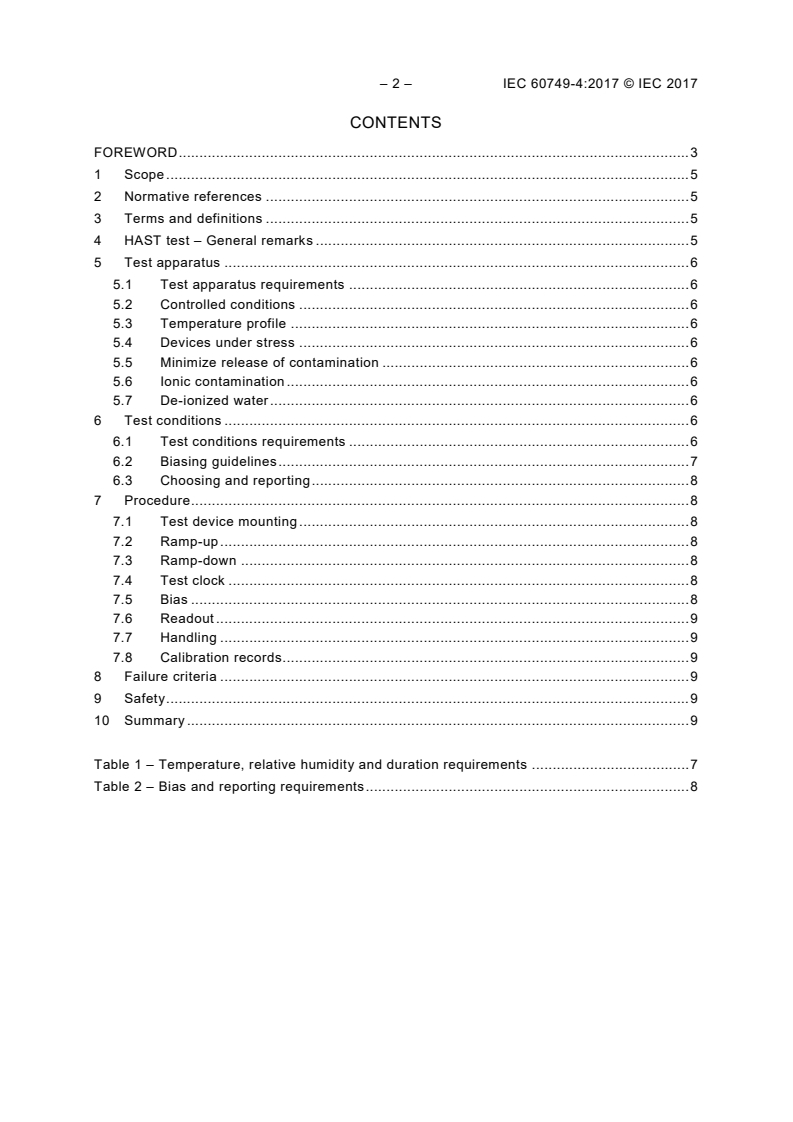
IEC 60749-4:2017 - Semiconductor devices - Mechanical and climatic test methods - Part 4: Damp heat, steady state, highly accelerated stress test (HAST) Released:3/3/2017
IEC 60749-4:2017 - Semiconductor devices - Mechanical and climatic test methods - Part 4: Damp heat, steady state, highly accelerated stress test (HAST) Released:9/20/2019
Overview
IEC 60749-4:2017 defines the Highly Accelerated Stress Test (HAST) - a damp-heat, steady-state test method used to evaluate the reliability of non-hermetic packaged semiconductor devices in humid environments. The method accelerates moisture ingress by combining elevated temperature, high humidity and electrical bias within a controlled pressure chamber. The test is considered destructive and is typically used for qualification, failure analysis and reliability benchmarking.
This 2017 edition clarifies and updates procedural guidance, notably: the Table 1 requirements for temperature, relative humidity and duration; a recommendation to add current-limiting resistor(s) in the test setup to protect test boards and DUTs; and allowance for additional time-to-test or return-to-stress delays.
Key Topics
- Test purpose: Accelerate moisture penetration through encapsulant or along interfaces to reveal humidity-induced failure mechanisms.
- Test apparatus: A pressure-capable chamber that maintains controlled temperature, relative humidity and electrical connections; continuous monitoring and a permanent temperature profile record are recommended.
- Controlled conditions: The chamber must support specified ramp-up and ramp-down profiles and maintain uniform conditions across the usable test volume.
- Device mounting: Minimize temperature gradients, avoid direct radiant heat and keep DUTs at least 3 cm from internal chamber surfaces; orient boards to preserve vapor circulation.
- Biasing guidelines: Apply bias per device needs while following rules to minimize power dissipation, alternate pin bias, distribute potential across metallization, and maximize allowable voltage. Continuous or cycled bias may be used depending on device heating characteristics.
- Contamination control: Select board, socket and wiring materials to minimize ionic contamination and corrosion. Use de-ionized water for humidity generation as specified by the standard.
- Data and safety: Record calibration, test clocks and readouts. The method includes failure criteria and safety provisions to protect personnel and equipment.
Applications
- Qualification testing of plastic-encapsulated and other non-hermetic semiconductor devices for humid environments.
- Screening for moisture-sensitive failure modes during product development and incoming inspection.
- Accelerated reliability comparisons and failure analysis to inform design, packaging and mitigation strategies (e.g., conformal coatings, seal improvements).
Note: HAST is often considered alongside the steady-state 85 °C/85 % RH temperature-humidity-bias test (IEC 60749-5); where both are used, results from IEC 60749-5 take priority.
Related Standards
- IEC 60749-5 - Steady-state temperature humidity bias life test (85/85)
- Other parts of the IEC 60749 series covering mechanical and climatic test methods for semiconductor devices
For implementation, consult the full IEC 60749-4:2017 text and supporting normative references to ensure compliance with specified conditions, reporting and safety requirements.
Relations
- Effective Date
- 05-Sep-2023
- Effective Date
- 05-Sep-2023
Buy Documents
IEC 60749-4:2017 - Semiconductor devices - Mechanical and climatic test methods - Part 4: Damp heat, steady state, highly accelerated stress test (HAST) Released:3/3/2017
IEC 60749-4:2017 - Semiconductor devices - Mechanical and climatic test methods - Part 4: Damp heat, steady state, highly accelerated stress test (HAST) Released:9/20/2019
Frequently Asked Questions
IEC 60749-4:2017 is a standard published by the International Electrotechnical Commission (IEC). Its full title is "Semiconductor devices - Mechanical and climatic test methods - Part 4: Damp heat, steady state, highly accelerated stress test (HAST)". This standard covers: IEC 60749-4:2017 provides a highly accelerated temperature and humidity stress test (HAST) for the purpose of evaluating the reliability of non-hermetic packaged semiconductor devices in humid environments. This edition includes the following significant technical changes with respect to the previous edition: a) clarification of requirements for temperature, relative humidity and duration detailed in Table 1; b) recommendations that current limiting resistor(s) be placed in the test set-up to prevent test board or DUT damage; c) allowance of additional time-to-test delay or return-to-stress delay.
IEC 60749-4:2017 provides a highly accelerated temperature and humidity stress test (HAST) for the purpose of evaluating the reliability of non-hermetic packaged semiconductor devices in humid environments. This edition includes the following significant technical changes with respect to the previous edition: a) clarification of requirements for temperature, relative humidity and duration detailed in Table 1; b) recommendations that current limiting resistor(s) be placed in the test set-up to prevent test board or DUT damage; c) allowance of additional time-to-test delay or return-to-stress delay.
IEC 60749-4:2017 is classified under the following ICS (International Classification for Standards) categories: 01 - GENERALITIES. TERMINOLOGY. STANDARDIZATION. DOCUMENTATION; 31.080.01 - Semiconductor devices in general. The ICS classification helps identify the subject area and facilitates finding related standards.
IEC 60749-4:2017 has the following relationships with other standards: It is inter standard links to IEC 60749-4:2002/COR1:2003, IEC 60749-4:2002. Understanding these relationships helps ensure you are using the most current and applicable version of the standard.
IEC 60749-4:2017 is available in PDF format for immediate download after purchase. The document can be added to your cart and obtained through the secure checkout process. Digital delivery ensures instant access to the complete standard document.
Standards Content (Sample)
IEC 60749-4 ®
Edition 2.0 2017-03
INTERNATIONAL
STANDARD
Semiconductor devices – Mechanical and climatic test methods –
Part 4: Damp heat, steady state, highly accelerated stress test (HAST)
All rights reserved. Unless otherwise specified, no part of this publication may be reproduced or utilized in any form
or by any means, electronic or mechanical, including photocopying and microfilm, without permission in writing from
either IEC or IEC's member National Committee in the country of the requester. If you have any questions about IEC
copyright or have an enquiry about obtaining additional rights to this publication, please contact the address below or
your local IEC member National Committee for further information.
IEC Central Office Tel.: +41 22 919 02 11
3, rue de Varembé Fax: +41 22 919 03 00
CH-1211 Geneva 20 info@iec.ch
Switzerland www.iec.ch
About the IEC
The International Electrotechnical Commission (IEC) is the leading global organization that prepares and publishes
International Standards for all electrical, electronic and related technologies.
About IEC publications
The technical content of IEC publications is kept under constant review by the IEC. Please make sure that you have the
latest edition, a corrigenda or an amendment might have been published.
IEC Catalogue - webstore.iec.ch/catalogue Electropedia - www.electropedia.org
The stand-alone application for consulting the entire The world's leading online dictionary of electronic and
bibliographical information on IEC International Standards, electrical terms containing 20 000 terms and definitions in
Technical Specifications, Technical Reports and other English and French, with equivalent terms in 16 additional
documents. Available for PC, Mac OS, Android Tablets and languages. Also known as the International Electrotechnical
iPad. Vocabulary (IEV) online.
IEC publications search - www.iec.ch/searchpub IEC Glossary - std.iec.ch/glossary
The advanced search enables to find IEC publications by a 65 000 electrotechnical terminology entries in English and
variety of criteria (reference number, text, technical French extracted from the Terms and Definitions clause of
committee,…). It also gives information on projects, replaced IEC publications issued since 2002. Some entries have been
and withdrawn publications. collected from earlier publications of IEC TC 37, 77, 86 and
CISPR.
IEC Just Published - webstore.iec.ch/justpublished
Stay up to date on all new IEC publications. Just Published IEC Customer Service Centre - webstore.iec.ch/csc
details all new publications released. Available online and If you wish to give us your feedback on this publication or
also once a month by email. need further assistance, please contact the Customer Service
Centre: csc@iec.ch.
IEC 60749-4 ®
Edition 2.0 2017-03
INTERNATIONAL
STANDARD
Semiconductor devices – Mechanical and climatic test methods –
Part 4: Damp heat, steady state, highly accelerated stress test (HAST)
INTERNATIONAL
ELECTROTECHNICAL
COMMISSION
ICS 31.080.01 ISBN 978-2-8322-4002-1
– 2 – IEC 60749-4:2017 © IEC 2017
CONTENTS
FOREWORD . 3
1 Scope . 5
2 Normative references . 5
3 Terms and definitions . 5
4 HAST test – General remarks . 5
5 Test apparatus . 6
5.1 Test apparatus requirements . 6
5.2 Controlled conditions . 6
5.3 Temperature profile . 6
5.4 Devices under stress . 6
5.5 Minimize release of contamination . 6
5.6 Ionic contamination . 6
5.7 De-ionized water . 6
6 Test conditions . 6
6.1 Test conditions requirements . 6
6.2 Biasing guidelines . 7
6.3 Choosing and reporting . 8
7 Procedure . 8
7.1 Test device mounting . 8
7.2 Ramp-up . 8
7.3 Ramp-down . 8
7.4 Test clock . 8
7.5 Bias . 8
7.6 Readout . 9
7.7 Handling . 9
7.8 Calibration records . 9
8 Failure criteria . 9
9 Safety . 9
10 Summary . 9
Table 1 – Temperature, relative humidity and duration requirements . 7
Table 2 – Bias and reporting requirements . 8
INTERNATIONAL ELECTROTECHNICAL COMMISSION
____________
SEMICONDUCTOR DEVICES –
MECHANICAL AND CLIMATIC TEST METHODS –
Part 4: Damp heat, steady state,
highly accelerated stress test (HAST)
FOREWORD
1) The International Electrotechnical Commission (IEC) is a worldwide organization for standardization comprising
all national electrotechnical committees (IEC National Committees). The object of IEC is to promote
international co-operation on all questions concerning standardization in the electrical and electronic fields. To
this end and in addition to other activities, IEC publishes International Standards, Technical Specifications,
Technical Reports, Publicly Available Specifications (PAS) and Guides (hereafter referred to as “IEC
Publication(s)”). Their preparation is entrusted to technical committees; any IEC National Committee interested
in the subject dealt with may participate in this preparatory work. International, governmental and non-
governmental organizations liaising with the IEC also participate in this preparation. IEC collaborates closely
with the International Organization for Standardization (ISO) in accordance with conditions determined by
agreement between the two organizations.
2) The formal decisions or agreements of IEC on technical matters express, as nearly as possible, an international
consensus of opinion on the relevant subjects since each technical committee has representation from all
interested IEC National Committees.
3) IEC Publications have the form of recommendations for international use and are accepted by IEC National
Committees in that sense. While all reasonable efforts are made to ensure that the technical content of IEC
Publications is accurate, IEC cannot be held responsible for the way in which they are used or for any
misinterpretation by any end user.
4) In order to promote international uniformity, IEC National Committees undertake to apply IEC Publications
transparently to the maximum extent possible in their national and regional publications. Any divergence
between any IEC Publication and the corresponding national or regional publication shall be clearly indicated in
the latter.
5) IEC itself does not provide any attestation of conformity. Independent certification bodies provide conformity
assessment services and, in some areas, access to IEC marks of conformity. IEC is not responsible for any
services carried out by independent certification bodies.
6) All users should ensure that they have the latest edition of this publication.
7) No liability shall attach to IEC or its directors, employees, servants or agents including individual experts and
members of its technical committees and IEC National Committees for any personal injury, property damage or
other damage of any nature whatsoever, whether direct or indirect, or for costs (including legal fees) and
expenses arising out of the publication, use of, or reliance upon, this IEC Publication or any other IEC
Publications.
8) Attention is drawn to the Normative references cited in this publication. Use of the referenced publications is
indispensable for the correct application of this publication.
9) Attention is drawn to the possibility that some of the elements of this IEC Publication may be the subject of
patent rights. IEC shall not be held responsible for identifying any or all such patent rights.
International Standard IEC 60749-4 has been prepared by IEC technical committee 47:
Semiconductor devices.
This second edition cancels and replaces the first edition published in 2002. This edition
constitutes a technical revision.
This edition includes the following significant technical changes with respect to the previous
edition:
a) clarification of requirements for temperature, relative humidity and duration detailed in
Table 1;
b) recommendations that current limiting resistor(s) be placed in the test set-up to prevent
test board or DUT damage;
c) allowance of additional time-to-test delay or return-to-stress delay.
– 4 – IEC 60749-4:2017 © IEC 2017
The text of this standard is based on the following documents:
FDIS Report on voting
47/2346/FDIS 47/2371/RVD
Full information on the voting for the approval of this International Standard can be found in
the report on voting indicated in the above table.
This document has been drafted in accordance with the ISO/IEC Directives, Part 2.
A list of all parts in the IEC 60749 series, published under the general title Semiconductor
devices – Mechanical and climatic test methods, can be found on the IEC website.
The committee has decided that the contents of this document will remain unchanged until the
stability date indicated on the IEC website under "http://webstore.iec.ch" in the data related to
the specific document. At this date, the document will be
• reconfirmed,
• withdrawn,
• replaced by a revised edition, or
• amended.
A bilingual version of this publication may be issued at a later date.
-----------
...
IEC 60749-4 ®
Edition 2.0 2017-03
INTERNATIONAL
STANDARD
NORME
INTERNATIONALE
Semiconductor devices – Mechanical and climatic test methods –
Part 4: Damp heat, steady state, highly accelerated stress test (HAST)
Dispositifs à semiconducteurs – Méthodes d’essais mécaniques
et climatiques –
Partie 4: Essai continu fortement accéléré de contrainte de chaleur humide
(HAST)
All rights reserved. Unless otherwise specified, no part of this publication may be reproduced or utilized in any form
or by any means, electronic or mechanical, including photocopying and microfilm, without permission in writing from
either IEC or IEC's member National Committee in the country of the requester. If you have any questions about IEC
copyright or have an enquiry about obtaining additional rights to this publication, please contact the address below or
your local IEC member National Committee for further information.
Droits de reproduction réservés. Sauf indication contraire, aucune partie de cette publication ne peut être reproduite
ni utilisée sous quelque forme que ce soit et par aucun procédé, électronique ou mécanique, y compris la photocopie
et les microfilms, sans l'accord écrit de l'IEC ou du Comité national de l'IEC du pays du demandeur. Si vous avez des
questions sur le copyright de l'IEC ou si vous désirez obtenir des droits supplémentaires sur cette publication, utilisez
les coordonnées ci-après ou contactez le Comité national de l'IEC de votre pays de résidence.
IEC Central Office Tel.: +41 22 919 02 11
3, rue de Varembé info@iec.ch
CH-1211 Geneva 20 www.iec.ch
Switzerland
About the IEC
The International Electrotechnical Commission (IEC) is the leading global organization that prepares and publishes
International Standards for all electrical, electronic and related technologies.
About IEC publications
The technical content of IEC publications is kept under constant review by the IEC. Please make sure that you have the
latest edition, a corrigendum or an amendment might have been published.
IEC publications search - webstore.iec.ch/advsearchform Electropedia - www.electropedia.org
The advanced search enables to find IEC publications by a The world's leading online dictionary on electrotechnology,
variety of criteria (reference number, text, technical containing more than 22 000 terminological entries in English
committee,…). It also gives information on projects, replaced and French, with equivalent terms in 16 additional languages.
and withdrawn publications. Also known as the International Electrotechnical Vocabulary
(IEV) online.
IEC Just Published - webstore.iec.ch/justpublished
Stay up to date on all new IEC publications. Just Published IEC Glossary - std.iec.ch/glossary
details all new publications released. Available online and 67 000 electrotechnical terminology entries in English and
once a month by email. French extracted from the Terms and Definitions clause of
IEC publications issued since 2002. Some entries have been
IEC Customer Service Centre - webstore.iec.ch/csc collected from earlier publications of IEC TC 37, 77, 86 and
If you wish to give us your feedback on this publication or CISPR.
need further assistance, please contact the Customer Service
Centre: sales@iec.ch.
A propos de l'IEC
La Commission Electrotechnique Internationale (IEC) est la première organisation mondiale qui élabore et publie des
Normes internationales pour tout ce qui a trait à l'électricité, à l'électronique et aux technologies apparentées.
A propos des publications IEC
Le contenu technique des publications IEC est constamment revu. Veuillez vous assurer que vous possédez l’édition la
plus récente, un corrigendum ou amendement peut avoir été publié.
Recherche de publications IEC - Electropedia - www.electropedia.org
webstore.iec.ch/advsearchform Le premier dictionnaire d'électrotechnologie en ligne au
La recherche avancée permet de trouver des publications IEC monde, avec plus de 22 000 articles terminologiques en
en utilisant différents critères (numéro de référence, texte, anglais et en français, ainsi que les termes équivalents dans
comité d’études,…). Elle donne aussi des informations sur les 16 langues additionnelles. Egalement appelé Vocabulaire
projets et les publications remplacées ou retirées. Electrotechnique International (IEV) en ligne.
IEC Just Published - webstore.iec.ch/justpublished Glossaire IEC - std.iec.ch/glossary
Restez informé sur les nouvelles publications IEC. Just 67 000 entrées terminologiques électrotechniques, en anglais
Published détaille les nouvelles publications parues. et en français, extraites des articles Termes et Définitions des
Disponible en ligne et une fois par mois par email. publications IEC parues depuis 2002. Plus certaines entrées
antérieures extraites des publications des CE 37, 77, 86 et
Service Clients - webstore.iec.ch/csc CISPR de l'IEC.
Si vous désirez nous donner des commentaires sur cette
publication ou si vous avez des questions contactez-nous:
sales@iec.ch.
IEC 60749-4 ®
Edition 2.0 2017-03
INTERNATIONAL
STANDARD
NORME
INTERNATIONALE
Semiconductor devices – Mechanical and climatic test methods –
Part 4: Damp heat, steady state, highly accelerated stress test (HAST)
Dispositifs à semiconducteurs – Méthodes d’essais mécaniques
et climatiques –
Partie 4: Essai continu fortement accéléré de contrainte de chaleur humide
(HAST)
INTERNATIONAL
ELECTROTECHNICAL
COMMISSION
COMMISSION
ELECTROTECHNIQUE
INTERNATIONALE
ICS 31.080.01 ISBN 978-2-8322-7378-4
– 2 – IEC 60749-4:2017 © IEC 2017
CONTENTS
FOREWORD . 3
1 Scope . 5
2 Normative references . 5
3 Terms and definitions . 5
4 HAST test – General remarks . 5
5 Test apparatus . 6
5.1 Test apparatus requirements . 6
5.2 Controlled conditions . 6
5.3 Temperature profile . 6
5.4 Devices under stress . 6
5.5 Minimize release of contamination . 6
5.6 Ionic contamination . 6
5.7 De-ionized water . 6
6 Test conditions . 6
6.1 Test conditions requirements . 6
6.2 Biasing guidelines . 7
6.3 Choosing and reporting . 8
7 Procedure . 8
7.1 Test device mounting . 8
7.2 Ramp-up . 8
7.3 Ramp-down . 8
7.4 Test clock . 9
7.5 Bias . 9
7.6 Readout . 9
7.7 Handling . 9
7.8 Calibration records . 9
8 Failure criteria . 9
9 Safety . 9
10 Summary . 10
Table 1 – Temperature, relative humidity and duration requirements . 7
Table 2 – Bias and reporting requirements . 8
INTERNATIONAL ELECTROTECHNICAL COMMISSION
____________
SEMICONDUCTOR DEVICES –
MECHANICAL AND CLIMATIC TEST METHODS –
Part 4: Damp heat, steady state,
highly accelerated stress test (HAST)
FOREWORD
1) The International Electrotechnical Commission (IEC) is a worldwide organization for standardization comprising
all national electrotechnical committees (IEC National Committees). The object of IEC is to promote
international co-operation on all questions concerning standardization in the electrical and electronic fields. To
this end and in addition to other activities, IEC publishes International Standards, Technical Specifications,
Technical Reports, Publicly Available Specifications (PAS) and Guides (hereafter referred to as “IEC
Publication(s)”). Their preparation is entrusted to technical committees; any IEC National Committee interested
in the subject dealt with may participate in this preparatory work. International, governmental and non-
governmental organizations liaising with the IEC also participate in this preparation. IEC collaborates closely
with the International Organization for Standardization (ISO) in accordance with conditions determined by
agreement between the two organizations.
2) The formal decisions or agreements of IEC on technical matters express, as nearly as possible, an international
consensus of opinion on the relevant subjects since each technical committee has representation from all
interested IEC National Committees.
3) IEC Publications have the form of recommendations for international use and are accepted by IEC National
Committees in that sense. While all reasonable efforts are made to ensure that the technical content of IEC
Publications is accurate, IEC cannot be held responsible for the way in which they are used or for any
misinterpretation by any end user.
4) In order to promote international uniformity, IEC National Committees undertake to apply IEC Publications
transparently to the maximum extent possible in their national and regional publications. Any divergence
between any IEC Publication and the corresponding national or regional publication shall be clearly indicated in
the latter.
5) IEC itself does not provide any attestation of conformity. Independent certification bodies provide conformity
assessment services and, in some areas, access to IEC marks of conformity. IEC is not responsible for any
services carried out by independent certification bodies.
6) All users should ensure that they have the latest edition of this publication.
7) No liability shall attach to IEC or its directors, employees, servants or agents including individual experts and
members of its technical committees and IEC National Committees for any personal injury, property damage or
other damage of any nature whatsoever, whether direct or indirect, or for costs (including legal fees) and
expenses arising out of the publication, use of, or reliance upon, this IEC Publication or any other IEC
Publications.
8) Attention is drawn to the Normative references cited in this publication. Use of the referenced publications is
indispensable for the correct application of this publication.
9) Attention is drawn to the possibility that some of the elements of this IEC Publication may be the subject of
patent rights. IEC shall not be held responsible for identifying any or all such patent rights.
International Standard IEC 60749-4 has been prepared by IEC technical committee 47:
Semiconductor devices.
This second edition cancels and replaces the first edition published in 2002. This edition
constitutes a technical revision.
This edition includes the following significant technical changes with respect to the previous
edition:
a) clarification of requirements for temperature, relative humidity and duration detailed in
Table 1;
b) recommendations that current limiting resistor(s) be placed in the test set-up to prevent
test board or DUT damage;
c) allowance of additional time-to-test delay or return-to-stress delay.
– 4 – IEC 60749-4:2017 © IEC 2017
This bilingual version (2019-09) corresponds to the monolingual English version, published in
2017-03.
The text of this standard is based on the following documents:
FDIS Report on voting
47/2346/FDIS 47/2371/RVD
Full information on the voting for the approval of this International Standard can be found in
the report on voting indicated in the above table.
The French version of this standard has not been voted upon.
This document has been drafted in accordance with the ISO/IEC Directives, Part 2.
A list of all parts in the IEC 60749 series, published under the general title Semiconductor
devices – Mechanical and climatic test methods, can be found on the IEC website.
The committee has decided that the contents of this document will remain unchanged until the
stability date indicated on the IEC website under "http://webstore.iec.ch" in the data related to
the specific document. At this date, the document will be
• reconfirmed,
• withdrawn,
• replaced by a revised edition, or
• amended.
SEMICONDUCTOR DEVICES –
MECHANICAL AND CLIMATIC TEST METHODS –
Part 4: Damp heat, steady state,
highly accelerated stress test (HAST)
1 Scope
This part of IEC 60749 provides a highly accelerated temperature and humidity stress test
(HAST) for the purpose of evaluating the reliability of non-hermetic packaged semiconductor
devices in humid environments.
2 Normative references
The following documents are referred to in the text in such a way that some or all of their
content constitutes requirements of this document. For dated references, only the edition
cited applies. For undated references, the latest edition of the referenced document (including
any amendments) applies.
IEC 60749-5, Semiconductor devices – Mechanical and climatic test methods – Part 5: Steady
state temperature humidity bias life test
3 Terms and definitions
No terms and definitions are listed in this document.
ISO and IEC maintain terminological databases for use in standardization at the following
addresses:
• IEC Electropedia: available at http://www.electropedia.org/
• ISO Online browsing platform: available at http://www.iso.org/obp
4 HAST test – General remarks
The HAST test employs severe conditions of temperature, humidity and bias which accelerate
the penetration of moisture through the external protective material (encapsulant or seal) or
along the interface between the external protective material and the metallic conductors which
pass through it. The stress usually activates the same failure mechanisms as the “85/85”
steady-state temperature humidity bias life test, IEC 60749-5. As such the test method may
be selected from IEC 60749-5 or from this test method. When both test methods are
performed, test results of the 85 °C/85 % RH steady-state temperature humidity bias life test,
IEC 60749-5, take priority over HAST.
This test method shall be considered destructive.
– 6 – IEC 60749-4:2017 © IEC 2017
5 Test apparatus
5.1 Test apparatus requirements
The test requires a pressure chamber capable of maintaining a specified temperature and
relative humidity continuously, while providing electrical connections to the devices under test
in a specified biasing configuration.
5.2 Controlled conditions
The chamber shall be capable of providing controlled conditions of pressure, temperature and
relative humidity during ramp-up to and ramp-down from the specified test conditions.
5.3 Temperature profile
A permanent record of the temperature profile for each test cycle is recommended so that the
validity of the stress can be verified.
5.4 Devices under stress
Devices under stress shall be mounted in such a way that temperature gradients are
minimized. Devices under stress shall be no closer than 3 cm from internal chamber surfaces,
and shall not be subjected to direct radiant heat from heaters. Boards on which devices are
mounted should be oriented to minimize interference with vapour circulation.
5.5 Minimize release of contamination
Care shall be exercised in the choice of board and socket materials, to minimize release of
contamination and to minimize degradation due to corrosion and other mechanisms.
5.6 Ionic contamination
Ionic contamination of the test apparatus (card cage, test boards, sockets, wiring storage
containers, etc.) shall be controlled to avoid test artefacts.
5.7 De-ionized water
De-ionized water with a minimum resistivity of 1 × 10 Ωm at room temperature shall be used.
6 Test conditions
6.1 Test conditions requirements
Test conditions consist of a temperature, relative humidity, and duration in conjunction with an
electrical bias configuration specific to the device. Unless otherwise required by the detailed
specification the test conditions shall be selected from Table 1.
Table 1 – Temperature, relative humidity and duration requirements
a b b c
Temperature Relative Temperature Vapour pressure Duration
a
(dry bulb) humidity (wet bulb)
°C % °C kPa h
130 ± 2 85 ± 5 124,7 230
+2
96 ( )
110 ± 2 85 ± 5 105,2 122
+2
264 ( )
For parts that reach absorption equilibrium in 24 h or less, the HAST test is equivalent to at least 1 000 h at
85 °C/85 % RH. For parts that require more than 24 h to reach equilibrium at the specified HAST condition, the
time should be extended to allow parts to reach equilibrium.
Caution: For plastic-encapsulated micro-circuits, it is known that moisture reduces the effective glass transition
temperature of the moulding compound. Stress temperatures above the effective glass transition temperature
can lead to failure mechanisms unrelated to standard 85 °C/85 % RH stress.
a
Tolerances apply to the entire useable test area.
b
For information only.
c
The test conditions are to be applied continuously except during any interim readouts when devices should
be returned to stress within the time specified in 7.6. The 96 h and 264 h test durations were selected to be
at least equivalent 1 000 h of 85 °C/85 % RH stress using a worst case activation energy of E = 0,65 eV.
a
6.2 Biasing guidelines
Apply bias according to the following guidelines:
a) Minimize power dissipation.
b) Alternate pin bias as much as possible.
c) Distribute potential differences across chip metallization as much as possible.
d) Maximize voltage within operating range.
NOTE The priority of the above guidelines depends on mechanism and specific device characteristics.
e) Either of two kinds of bias can be used to satisfy these guidelines, whichever is more
severe:
1) Continuous bias
The DC bias shall be applied continuously. Continuous bias is more severe than cycled
bias when the die temperature is ≤10 °C higher than the chamber ambient temperature
or, if the die temperature is not known when the heat dissipation of the DUT is less
than 200 mW. If the heat dissipation of the DUT exceeds 200 mW, then the die
temperature should be calculated. If the die temperature exceeds the chamber ambient
temperature by more than 5 °C, then the die temperature rise above the chamber
ambient should be included in reports of test results since acceleration of failure
mechanisms will be affected.
– 8 – IEC 60749-4:2017 © IEC 2017
2) Cycled bias
The DC voltage applied to the devices under test shall be periodically interrupted with
an appropriate frequency and duty cycle. If the biasing configuration results in a
temperature rise above the chamber ambient, ∆T , exceeding 10 °C, then cycled bias,
ja
when optimized for a specific device type, will be more severe than continuous bias.
Heating as a result of power dissipation tends to drive moisture away from the die and
thereby hinders moisture related failure mechanisms. Cycled bias permits moisture
collection on the die during the off periods when device power dissipation does not
occur. Cycling the DUT bias with a 50 % duty cycle is optimal for most plastic
encapsulated microcircuits. The period of the cycled stress should be ≤ 2 h for
packages ≥ 2 mm in thickness and ≤ 30 min for packages < 2 mm in thickness. The die
temperature, as calculated on the basis of the known thermal impedance and
dissipation should be quoted with the results whenever it exceeds the chamber
ambient by 5 °C or more.
6.3 Choosing and reporting
Criteria for choosing continuous or cyclical bias, and whether or not to report the amount by
which the die temperature exceeds the chamber ambient temperature, are summarized in
Table 2.
Table 2 – Bias and reporting requirements
Cyclical bias
∆T Report ∆T
ja ja
∆T < 5 °C, or power per DUT <200 mW No No
ja
(∆T ≥ 5 °C or power per DUT ≥200 mW), and ∆T < 10 °C No Yes
ja ja
Yes Yes
∆T ≥ 10 °C
ja
7 Procedure
7.1 Test device mounting
The test devices shall be mounted in a manner that exposes them to a specified condition of
temperature and humidity with a specified electrical biasing condition. Exposure of devices to
excessively hot, dry ambient or conditions that result in condensation on devices and
electrical fixtures shall be avoided, particularly during ramp-up and ramp-down.
7.2 Ramp-up
The time to reach stable temperature and relative humidity conditions shall be less than 3 h.
Condensation shall be avoided by ensuring that the test chamber (dry bulb) temperature
exceeds the wet-bulb temperature at all times, and that the rate of ramp up shall not be faster
than a rate which ensures that the temperature of any DUT does not lag below the wet bulb
temperature. The dry- and wet-bulb temperature set points shall be maintained so that the
relative humidity is not less than 50 % after significant heating begins. In a dry laboratory, the
chamber ambient may initially be drier than this.
7.3 Ramp-down
The first part of ramp-down to a slightly positive gauge pressure (a wet bulb temperature of
about 104 °C) shall be long enough to avoid test artefacts due to rapid depressurization but
shall not exceed 3 h. The second part of ramp-down from a wet bulb temperature of 104 °C to
room temperature shall occur with the chamber vented. There is no time restriction and forced
cooling of the vessel is permitted. Condensation on devices shall be avoided in both parts of
the ramp down by ensuring that the test chamber (dry bulb) temperature exceeds the wet-bulb
temperature at all times. Ramp-down should maintain the moisture content of the moulding
compound encapsulating the die. Therefore, the relative humidity shall not be less than 50 %
during the first part of the ramp down (see 7.2).
7.4 Test clock
The test clock starts when the temperature and relative humidity reach the set points and
stops at the beginning of ramp-down.
7.5 Bias
Bias application during ramp-up and ramp-down is optional. Bias should be verified after
devices are loaded, prior to the start of the test clock. Bias should also be verified after the
test clock stops, but before devices are removed from the chamber.
It is recommended that current limiting resistor(s) be placed in the test set-up to prevent test
board or DUT damage in case a short circuit develops during the test.
7.6 Readout
An electrical test shall be performed not later than 48 h after the end of ramp-down.
For intermediate readouts, devices should be returned to stress within 96 h of the end of ramp
down. The rate of moisture loss from devices after removal from the chamber can be reduced
by placing the devices in sealed moisture barrier bags (without desiccant). When devices are
placed in sealed bags, the “test window clock” runs at one-third of the rate of devices exposed
to the laboratory ambient. Thus the test window can be extended to as much as 144 h and the
time to return to stress to as much as 288 h by enclosing the devices in moisture-proof bags.
The electrical test parameters should be chosen to preserve any defect (i.e. by limiting the
applied test current).
Additional time-to-test delay or return-to-stress delay may be allowed if justified by technical
data.
7.7 Handling
Suitable hand-covering shall be used to handle devices, boards and fixtures. Contamination
control shall be exercised in any highly-accelerated moisture stress test.
7.8 Calibration records
Calibration records shall verify that, for steady state conditions and maximum thermal mass
loading, test conditions are maintained withi
...