


IEC 60749-38:2008
(Main)Semiconductor devices - Mechanical and climatic test methods - Part 38: Soft error test method for semiconductor devices with memory
General Information
- Abstract
This part of IEC 60749 establishes a procedure for measuring the soft error susceptibility of semiconductor devices with memory when subjected to energetic particles such as alpha radiation. Two tests are described; an accelerated test using an alpha radiation source and an (unaccelerated) real-time system test where any errors are generated under conditions of naturally occurring radiation which can be alpha or other radiation such as neutron. To completely characterize the soft error capability of an integrated circuit with memory, the device must be tested for broad high energy spectrum and thermal neutrons using additional test methods. This test method may be applied to any type of integrated circuit with memory device.
- Status
- Published
- Publication Date
- 11-Feb-2008
- Technical Committee
- TC 47 - Semiconductor devices
- Drafting Committee
- WG 2 - TC 47/WG 2
- Current Stage
- PPUB - Publication issued
- Start Date
- 12-Feb-2008
- Completion Date
- 15-Feb-2008
Overview
IEC 60749-38:2008 is an international standard developed by the International Electrotechnical Commission (IEC) that details test methods for evaluating the susceptibility of semiconductor memory devices to soft errors caused by energetic particles, such as alpha radiation and neutrons. As part of the IEC 60749 series on mechanical and climatic test methods for semiconductor devices, Part 38 provides procedures and requirements to measure how vulnerable memory-based integrated circuits are to transient data corruption from naturally occurring and artificially induced radiation sources. This standard supports semiconductor manufacturers, system integrators, and testers in assessing product quality and reliability in environments exposed to radiation.
Key Topics
- Soft Error Susceptibility Testing: The standard outlines procedures for measuring soft errors-temporary faults in semiconductor memory cells due to particle strikes-which can be corrected without replacing hardware.
- Types of Testing:
- Accelerated Alpha Source Tests: Using controlled sources of alpha radiation to rapidly induce soft errors and measure device sensitivity.
- Real-Time System Tests: Observing soft errors that arise from naturally occurring radiations (alpha particles, cosmic rays, neutrons) in typical operating environments.
- Test Equipment and Setup: Guidance is given on measurement instrumentation, selection and calibration of radiation sources, sample preparation, and environmental considerations to ensure accurate and repeatable results.
- Result Evaluation and Reporting: Standardized methods for calculating the soft error rate (SER) and failures in time (FIT), along with comprehensive documentation requirements for test conditions and outcomes.
- Definitions: Precise terminology around soft errors, single-event effects, alpha sources, flux, and error correction methods to foster clear communication and consistent interpretation of results.
Applications
IEC 60749-38:2008 has important applications across the electronics industry, particularly where data integrity and system reliability are critical:
- Semiconductor Manufacturing: Assists manufacturers in evaluating and improving product robustness against radiation-induced soft errors, which is vital for memory chips used in various sectors.
- Quality and Reliability Testing: Used by test labs and quality assurance teams to quantify soft error rates and compare different device designs or manufacturing processes.
- Aerospace and High-Altitude Electronics: Essential for memory devices deployed in aerospace, avionics, and other high-altitude environments where exposure to cosmic rays or atmospheric neutrons is significant.
- Data Centers and Servers: Data integrity is crucial for enterprise computing and storage environments, making soft error susceptibility testing a key part of system qualification.
- Consumer and Automotive Electronics: As electronics proliferate into safety-critical applications, understanding and mitigating soft error risks helps meet dependability standards.
Related Standards
For comprehensive testing and best practices, IEC 60749-38:2008 should be considered alongside other industry standards, including:
- IEC 60749 Series: Broader suite of mechanical and climatic test methods for semiconductor devices.
- JEITA EDR4705 and JESD89 Series (JEDEC): Guidelines and test methods for soft error rate measurement and reporting, providing further methodologies for system-level and accelerated testing.
- IEC publications on radiation measurement: Guidance for instrumentation and facility requirements relevant to soft error testing, particularly where neutron exposure is considered.
By following IEC 60749-38:2008, organizations can ensure systematic, repeatable, and internationally recognized approaches to assess-and ultimately minimize-the risk of soft errors in semiconductor memory devices, supporting product quality and reliability in diverse applications.
Frequently Asked Questions
IEC 60749-38:2008 is a standard published by the International Electrotechnical Commission (IEC). Its full title is "Semiconductor devices - Mechanical and climatic test methods - Part 38: Soft error test method for semiconductor devices with memory". This standard covers: This part of IEC 60749 establishes a procedure for measuring the soft error susceptibility of semiconductor devices with memory when subjected to energetic particles such as alpha radiation. Two tests are described; an accelerated test using an alpha radiation source and an (unaccelerated) real-time system test where any errors are generated under conditions of naturally occurring radiation which can be alpha or other radiation such as neutron. To completely characterize the soft error capability of an integrated circuit with memory, the device must be tested for broad high energy spectrum and thermal neutrons using additional test methods. This test method may be applied to any type of integrated circuit with memory device.
This part of IEC 60749 establishes a procedure for measuring the soft error susceptibility of semiconductor devices with memory when subjected to energetic particles such as alpha radiation. Two tests are described; an accelerated test using an alpha radiation source and an (unaccelerated) real-time system test where any errors are generated under conditions of naturally occurring radiation which can be alpha or other radiation such as neutron. To completely characterize the soft error capability of an integrated circuit with memory, the device must be tested for broad high energy spectrum and thermal neutrons using additional test methods. This test method may be applied to any type of integrated circuit with memory device.
IEC 60749-38:2008 is classified under the following ICS (International Classification for Standards) categories: 01 - GENERALITIES. TERMINOLOGY. STANDARDIZATION. DOCUMENTATION; 31.080.01 - Semiconductor devices in general. The ICS classification helps identify the subject area and facilitates finding related standards.
IEC 60749-38:2008 is available in PDF format for immediate download after purchase. The document can be added to your cart and obtained through the secure checkout process. Digital delivery ensures instant access to the complete standard document.
Standards Content (Sample)
IEC 60749-38
Edition 1.0 2008-02
INTERNATIONAL
STANDARD
NORME
INTERNATIONALE
Semiconductor devices – Mechanical and climatic test methods –
Part 38: Soft error test method for semiconductor devices with memory
Dispositifs à semiconducteurs – Méthodes d’essais mécaniques et climatiques –
Partie 38: Méthode d’essai des erreurs logicielles pour les dispositifs à
semiconducteurs avec mémoire
All rights reserved. Unless otherwise specified, no part of this publication may be reproduced or utilized in any form or by
any means, electronic or mechanical, including photocopying and microfilm, without permission in writing from either IEC or
IEC's member National Committee in the country of the requester.
If you have any questions about IEC copyright or have an enquiry about obtaining additional rights to this publication,
please contact the address below or your local IEC member National Committee for further information.
Droits de reproduction réservés. Sauf indication contraire, aucune partie de cette publication ne peut être reproduite
ni utilisée sous quelque forme que ce soit et par aucun procédé, électronique ou mécanique, y compris la photocopie
et les microfilms, sans l'accord écrit de la CEI ou du Comité national de la CEI du pays du demandeur.
Si vous avez des questions sur le copyright de la CEI ou si vous désirez obtenir des droits supplémentaires sur cette
publication, utilisez les coordonnées ci-après ou contactez le Comité national de la CEI de votre pays de résidence.
IEC Central Office
3, rue de Varembé
CH-1211 Geneva 20
Switzerland
Email: inmail@iec.ch
Web: www.iec.ch
About the IEC
The International Electrotechnical Commission (IEC) is the leading global organization that prepares and publishes
International Standards for all electrical, electronic and related technologies.
About IEC publications
The technical content of IEC publications is kept under constant review by the IEC. Please make sure that you have the
latest edition, a corrigenda or an amendment might have been published.
ƒ Catalogue of IEC publications: www.iec.ch/searchpub
The IEC on-line Catalogue enables you to search by a variety of criteria (reference number, text, technical committee,…).
It also gives information on projects, withdrawn and replaced publications.
ƒ IEC Just Published: www.iec.ch/online_news/justpub
Stay up to date on all new IEC publications. Just Published details twice a month all new publications released. Available
on-line and also by email.
ƒ Electropedia: www.electropedia.org
The world's leading online dictionary of electronic and electrical terms containing more than 20 000 terms and definitions
in English and French, with equivalent terms in additional languages. Also known as the International Electrotechnical
Vocabulary online.
ƒ Customer Service Centre: www.iec.ch/webstore/custserv
If you wish to give us your feedback on this publication or need further assistance, please visit the Customer Service
Centre FAQ or contact us:
Email: csc@iec.ch
Tel.: +41 22 919 02 11
Fax: +41 22 919 03 00
A propos de la CEI
La Commission Electrotechnique Internationale (CEI) est la première organisation mondiale qui élabore et publie des
normes internationales pour tout ce qui a trait à l'électricité, à l'électronique et aux technologies apparentées.
A propos des publications CEI
Le contenu technique des publications de la CEI est constamment revu. Veuillez vous assurer que vous possédez
l’édition la plus récente, un corrigendum ou amendement peut avoir été publié.
ƒ Catalogue des publications de la CEI: www.iec.ch/searchpub/cur_fut-f.htm
Le Catalogue en-ligne de la CEI vous permet d’effectuer des recherches en utilisant différents critères (numéro de référence,
texte, comité d’études,…). Il donne aussi des informations sur les projets et les publications retirées ou remplacées.
ƒ Just Published CEI: www.iec.ch/online_news/justpub
Restez informé sur les nouvelles publications de la CEI. Just Published détaille deux fois par mois les nouvelles
publications parues. Disponible en-ligne et aussi par email.
ƒ Electropedia: www.electropedia.org
Le premier dictionnaire en ligne au monde de termes électroniques et électriques. Il contient plus de 20 000 termes et
définitions en anglais et en français, ainsi que les termes équivalents dans les langues additionnelles. Egalement appelé
Vocabulaire Electrotechnique International en ligne.
ƒ Service Clients: www.iec.ch/webstore/custserv/custserv_entry-f.htm
Si vous désirez nous donner des commentaires sur cette publication ou si vous avez des questions, visitez le FAQ du
Service clients ou contactez-nous:
Email: csc@iec.ch
Tél.: +41 22 919 02 11
Fax: +41 22 919 03 00
IEC 60749-38
Edition 1.0 2008-02
INTERNATIONAL
STANDARD
NORME
INTERNATIONALE
Semiconductor devices – Mechanical and climatic test methods –
Part 38: Soft error test method for semiconductor devices with memory
Dispositifs à semiconducteurs – Méthodes d’essais mécaniques et climatiques –
Partie 38: Méthode d’essai des erreurs logicielles pour les dispositifs à
semiconducteurs avec mémoire
INTERNATIONAL
ELECTROTECHNICAL
COMMISSION
COMMISSION
ELECTROTECHNIQUE
PRICE CODE
INTERNATIONALE
M
CODE PRIX
ICS 31.080.01 ISBN 2-8318-9615-0
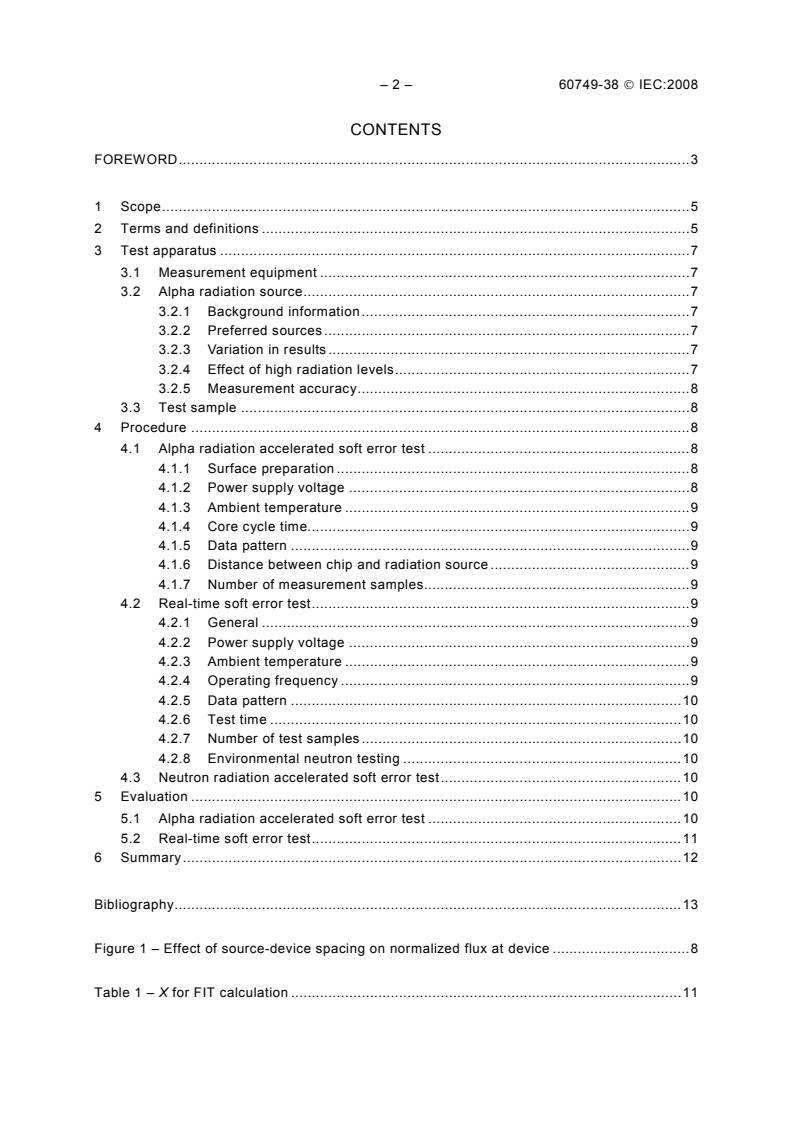
– 2 – 60749-38 © IEC:2008
CONTENTS
FOREWORD.3
1 Scope.5
2 Terms and definitions .5
3 Test apparatus .7
3.1 Measurement equipment .7
3.2 Alpha radiation source.7
3.2.1 Background information.7
3.2.2 Preferred sources .7
3.2.3 Variation in results.7
3.2.4 Effect of high radiation levels.7
3.2.5 Measurement accuracy.8
3.3 Test sample .8
4 Procedure .8
4.1 Alpha radiation accelerated soft error test .8
4.1.1 Surface preparation .8
4.1.2 Power supply voltage .8
4.1.3 Ambient temperature .9
4.1.4 Core cycle time.9
4.1.5 Data pattern .9
4.1.6 Distance between chip and radiation source .9
4.1.7 Number of measurement samples.9
4.2 Real-time soft error test.9
4.2.1 General .9
4.2.2 Power supply voltage .9
4.2.3 Ambient temperature .9
4.2.4 Operating frequency .9
4.2.5 Data pattern .10
4.2.6 Test time .10
4.2.7 Number of test samples .10
4.2.8 Environmental neutron testing .10
4.3 Neutron radiation accelerated soft error test.10
5 Evaluation .10
5.1 Alpha radiation accelerated soft error test .10
5.2 Real-time soft error test.11
6 Summary.12
Bibliography.13
Figure 1 – Effect of source-device spacing on normalized flux at device .8
Table 1 – X for FIT calculation .11
60749-38 © IEC:2008 – 3 –
INTERNATIONAL ELECTROTECHNICAL COMMISSION
____________
SEMICONDUCTOR DEVICES –
MECHANICAL AND CLIMATIC TEST METHODS –
Part 38: Soft error test method for semiconductor
devices with memory
FOREWORD
1) The International Electrotechnical Commission (IEC) is a worldwide organization for standardization comprising
all national electrotechnical committees (IEC National Committees). The object of IEC is to promote
international co-operation on all questions concerning standardization in the electrical and electronic fields. To
this end and in addition to other activities, IEC publishes International Standards, Technical Specifications,
Technical Reports, Publicly Available Specifications (PAS) and Guides (hereafter referred to as “IEC
Publication(s)”). Their preparation is entrusted to technical committees; any IEC National Committee interested
in the subject dealt with may participate in this preparatory work. International, governmental and non-
governmental organizations liaising with the IEC also participate in this preparation. IEC collaborates closely
with the International Organization for Standardization (ISO) in accordance with conditions determined by
agreement between the two organizations.
2) The formal decisions or agreements of IEC on technical matters express, as nearly as possible, an international
consensus of opinion on the relevant subjects since each technical committee has representation from all
interested IEC National Committees.
3) IEC Publications have the form of recommendations for international use and are accepted by IEC National
Committees in that sense. While all reasonable efforts are made to ensure that the technical content of IEC
Publications is accurate, IEC cannot be held responsible for the way in which they are used or for any
misinterpretation by any end user.
4) In order to promote international uniformity, IEC National Committees undertake to apply IEC Publications
transparently to the maximum extent possible in their national and regional publications. Any divergence
between any IEC Publication and the corresponding national or regional publication shall be clearly indicated in
the latter.
5) IEC provides no marking procedure to indicate its approval and cannot be rendered responsible for any
equipment declared to be in conformity with an IEC Publication.
6) All users should ensure that they have the latest edition of this publication.
7) No liability shall attach to IEC or its directors, employees, servants or agents including individual experts and
members of its technical committees and IEC National Committees for any personal injury, property damage or
other damage of any nature whatsoever, whether direct or indirect, or for costs (including legal fees) and
expenses arising out of the publication, use of, or reliance upon, this IEC Publication or any other IEC
Publications.
8) Attention is drawn to the Normative references cited in this publication. Use of the referenced publications is
indispensable for the correct application of this publication.
9) Attention is drawn to the possibility that some of the elements of this IEC Publication may be the subject of
patent rights. IEC shall not be held responsible for identifying any or all such patent rights.
International Standard IEC 60749-38 has been prepared by IEC technical committee 47:
Semiconductor devices.
The text of this standard is based on the following documents:
FDIS Report on voting
47/1943/FDIS 47/1951/RVD
Full information on the voting for the approval of this standard can be found in the report on
voting indicated in the above table.
This publication has been drafted in accordance with the ISO/IEC Directives, Part 2.
– 4 – 60749-38 © IEC:2008
A list of all the parts in the IEC 60749 series, under the general title Semiconductor devices –
Mechanical and climatic test methods, can be found on the IEC website.
The committee has decided that the contents of this publication will remain unchanged until
the maintenance result date indicated on the IEC web site under "http://webstore.iec.ch" in
the data related to the specific publication. At this date, the publication will be
• reconfirmed;
• withdrawn;
• replaced by a revised edition, or
• amended.
60749-38 © IEC:2008 – 5 –
SEMICONDUCTOR DEVICES –
MECHANICAL AND CLIMATIC TEST METHODS –
Part 38: Soft error test method for semiconductor
devices with memory
1 Scope
This part of IEC 60749 establishes a procedure for measuring the soft error susceptibility of
semiconductor devices with memory when subjected to energetic particles such as alpha
radiation. Two tests are described; an accelerated test using an alpha radiation source and an
(unaccelerated) real-time system test where any errors are generated under conditions of
naturally occurring radiation which can be alpha or other radiation such as neutron. To
completely characterize the soft error capability of an integrated circuit with memory, the
device must be tested for broad high energy spectrum and thermal neutrons using additional
test methods. This test method may be applied to any type of integrated circuit with memory
device.
2 Terms and definitions
For the purposes of this document, the following terms and definitions apply.
2.1
single-event upset
SEU
soft error caused by the transient signal induced by a single energetic-particle strike
2.2
soft error
erroneous output signal from a latch or memory cell that can be corrected by performing one
or more normal functions of the device containing the latch or memory cell
NOTE As commonly used, the term refers to an error caused by radiation or electromagnetic pulses and not to an
error associated with a physical defect introduced during the manufacturing process.
2.3
single-event hard error
SHE
irreversible change in operation resulting from a single radiation event and typically
associated with permanent damage to one or more of the device elements (e.g. gate oxide
rupture)
2.4
static soft error
soft error that is not corrected by repeated reading but can be corrected by rewriting without
the removal of power
2.5
transient soft error
soft error that can be corrected by repeated reading without rewriting and without the removal
of power
– 6 – 60749-38 © IEC:2008
2.6
soft error, power cycle
PCSE
soft error that is not corrected by repeated reading or writing but can be corrected by the
removal of power
2.7
single event functional interrupt
SEFI
soft error that causes the component to reset, lock-up, or otherwise malfunction in a
detectable way, but does not require power cycling of the device (off and back on) to restore
operability, unlike single-event latch-up (SEL), or result in permanent damage as in single-
event burnout (SEB)
2.8
multiple bit upset
MBU
multiple-cell upset in which two or more error bits occur in the same word
2.9
single event latch up
SEL
abnormal high-current state in a device caused by the passage of a single energetic particle
through sensitive regions of the device structure and resulting in the loss of device
functionality
NOTE 1 SEL may cause permanent damage to the device. If the device is not permanently damaged, power
cycling of the device (off and back on) is necessary to restore normal operation.
NOTE 2 An example of SEL in a CMOS device is when the passage of a single particle induces the creation of
parasitic bipolar (p-n-p-n) shorting of power to ground.
2.10
flux (of particle radiation)
time rate of flow of particles emitted from or incident on a surface, divided by the area of that
surface
NOTE The flux is usually expressed in particles per square centimeter second (N/cm s) or particles per square
centimeter hour (N/cm h).
2.11
alpha source activity
number of alpha particle decays in the alpha source per unit time
NOTE The preferred SI unit is the Becquerel (Bq); to convert from the Curie, multiply by 3,7 × 10 (exactly).
2.12
soft error rate
SER
rate at which soft errors occur
2.13
failures in time
FIT
the number of failures in 10 device-hours
2.14
multiple-cell upset
MCU
single event that induces several bits in an IC to have a soft error at one time
60749-38 © IEC:2008 – 7 –
NOTE The bits are usually, but not always, adjacent.
3 Test apparatus
3.1 Measurement equipment
The equipment shall be capable of measuring the functions of the integrated circuit devices,
and capable of measuring the time taken for the change of stored data by the exposure to
energetic particles, such as alpha radiation to take place (i.e. the generation of a soft error).
Alternatively, the test equipment (memory tester etc.) shall have the capability of counting the
number of soft errors in unit time.
3.2 Alpha radiation source
3.2.1 Background information
Uranium and thorium impurities found in trace amounts in the various production and
packaging materials emit alpha particles. Alpha particles are strongly ionizing, so those that
impinge on the active device create bursts of free electron-hole pairs in the silicon. Different
types of alpha sources can be used to simulate the alpha emission from uranium and thorium
impurities. Sources that emit alpha particles with energy spectra similar to uranium and
thorium impurities simulate the radiation environment of wirebonded components
encapsulated in moulding compound. Sources that emit alpha particles with similar energy
spectra to Po are used for simulating components in a flip-chip arrangement with solder
bumps. The source should provide an alpha particle spectrum similar to that encountered in
the actual component.
3.2.2 Preferred sources
238 232 241
U or Th are the preferred sources for inducing SER in mould-resin compounds. Am
and Po sources can be used as substitutes.
3.2.3 Variation in results
Results will differ depending on the source used due to spectral variations. Alpha particle
sources available on the market are usually only classified by their activities in μCi (rather
than in the preferred unit, Bq, see 2.11) and the emission rates of alpha particle are seldom
indicated.
The emission rate cannot be determined simply from the activities because of the effects of
absorption of alpha particle in the source itself and its situation. For example, the activity of
1μCi is 3,7 × 10 decays/s. However, the alpha emission rate from the source would be less
than 3,7 × 10 alpha/s.
Therefore, a measurement of the alpha emission rate of the source which is used in the SER
test is recommended.
As a consequence, the energy spectrum of the alpha radiation source shall be confirmed
because different test values can result from differing energy spectra even if the alpha
radiation sources have the same level of radioactivity.
241 210
NOTE If Am or Po are used, this should be documented in a report along with the statement that results can
differ if other sources have been used, due to energy spectra variations.
3.2.4 Effect of high radiation levels
In cases where the dose concentration delivered to the test sample is high, consideration
shall be given to the effect of multiple hits.
– 8 – 60749-38 © IEC:2008
3.2.5 Measurement accuracy
If the emission area of the alpha radiation is significantly smaller than the chip area,
absorption of the alpha radiation through the atmosphere and the chip protection film and
incident angle effects will contribute to give erroneous values. Therefore, to perform the test
accurately, the emission area of the alpha radiation shall not be significantly smaller than the
chip area and, preferably, shall be larger. In Figure 1, the curves apply for devices of about
10 mm diameter. Dimension "d" should be scaled up or down in proportion for devices with a
different diameter (for more information, see Bibliography).
1,0
Large source
0,9
0,8
d
0,7
0,6
0,5
0,4
Medium source
0,3
Point source
0,2
d
0,1
0,0
0 1 23 456 7 8 9 10
Source-device spacing (mm)
IEC 202/08
Figure 1 – Effect of source-device spacing on normalized flux at device
3.3 Test sample
Any type of integrated circuits with memory may be tested. The device parameters
(capacitance of the memory cell in the DRAM etc.) which can affect the soft error rate shall be
well understood.
4 Procedure
4.1 Alpha radiation accelerated soft error test
4.1.1 Surface preparation
The surface of the sample shall be suitably prepared before irradiation. For accelerated alpha
particle testing, the surface of the sample shall be exposed using a method which does not
affect the electrical characteristics. When, however, the purpose of the test is to evaluate the
effect of chip coating, the chip coating shall not be removed.
NOTE As an example, the upper side of the package can be cut with a small knife or the moulding resin on the
upper surface of the chip can be dissolved chemically etc. Unless otherwise specified, chip coatings should be
removed because alpha radiation from an Am source (peak energy 5 MeV approximately) is absorbed by the
chip coating. Alpha radiation of higher energy can occur in the package materials or as natural radio-activity.
4.1.2 Power supply voltage
This shall be set at the minimum voltage of the recommended operating condition (when
required, the supply voltage dependence on failure rate shall be measured). For latch up
testing, the voltage shall be set at the minimum and maximum voltage of the recommended
operating condition.
Normalized flux at device
60749-38 © IEC:2008 – 9 –
4.1.3 Ambient temperature
The ambient temperature shall be room temperature and, for latch up, at the manufacturer’s
maximum recommended operating temperature.
4.1.4 Core cycle time
The core cycle time is dependent on the samples under test and shall be set to the
manufacturer’s recommended value (when required, the core cycle time dependence shall be
measured).
4.1.5 Data pattern
This is dependent on the samples under test. Data pattern shall be reported (a checker board,
all ‘0/1’-read/write pattern, etc.).
4.1.6 Distance between chip and radiation source
The actual value used shall be documented in the report.
NOTE The distance between the chip and radiation source should be 1 mm or less. Excessive distance between
the source and the chip will cause attenuation of the alpha flux, unless the test is performed in a vacuum.
Operators should be careful to avoid touching the chip or wirebonds with the radiation source.
4.1.7 Number of measurement samples
Multiple samples shall be measured to take into account measurement variation.
4.2 Real-time soft error test
4.2.1 General
In this method, the samples are mounted on memory boards of a system machine which has a
similar function to that of the test equipment. The soft errors are generated under similar
conditions to those of the actual use environment, without the use of an external alpha source
to provide error rate acceleration. The radiation is that which occurs naturally, consisting of
alpha, neutron and other energetic particles.
4.2.2 Power supply voltage
Power supply voltage shall be set at nominal voltage so that the reported SER will be related
to in-use conditions, unless otherwise specified.
4.2.3 Ambient temperature
The ambient temperature shall be from room temperature to the maximum temperature of
recommended operating condition. The ambient temperature shall be reported.
4.2.4 Operating frequency
The operating frequency is dependent upon the samples used but the evaluation is
recommended to be performed at the intended operating core frequency and it shall be
reported. No frequency or voltage accelerations are permitted.
– 10 – 60749-38 © IEC:2008
4.2.5 Data pattern
This is dependent on the samples under test. Data pattern shall be reported. Dependent upon
the detail specification, all or some of the following data patterns shall be used with equal
duration: all 1, checkerboard pattern, the complementary checkerboard pattern and all zeros.
In cases where dynamic patterns are used to consider mechanisms that can not be identified
with static patterns, the duty cycle shall be reported. As a special case, in the data retention
test for SRAM etc., a data pattern of all ‘1’ is written in the test samples initially. The test
samples are left in the battery back-up mode and the evaluation by reading out is performed
at predetermined intervals.
4.2.6 Test time
Test time shall be related to system SER requirements and shall be detailed in the relevant
specification.
NOTE A test time of 1 000 h may be used.
4.2.7 Number of test samples
Sample size shall be related to system SER requirements.
NOTE A sample size of 1 000 test pieces may be used.
4.2.8 Environmental neutron testing
Neutron flux depends on the location. Therefore, the evaluation shall take into account the
environment as follows:
Altitude
Region/Latitude
Room/Outdoor
The altitude and location of the test shall be reported.
Where the evaluation takes place in a building, the structure, floor, thickness and material of
building shall be reported.
4.3 Neutron radiation accelerated soft error test
Where this test is required, three methods of neutron accelerated soft error test are available.
These are the thermal neutron-induced soft error test, the (quasi)-mono energy test and the
white neutron test, all as nuclear spallation reactions. The neutrons are generated by a
nuclear reactor or accelerator. One or more methods shall be selected to satisfy the
requirement. For neutron radiation accelerated soft error testing, the facilities where the test
can be performed are restricted. Refer to the bibliography for the detail of the methods and
facility information.
NOTE White neutron test is a radiation test using a neutron simulator that has a flux-versus energy spectrum
similar to that of the naturally occurring atmospheric neutron radiation from sea level to 60 000 feet (18 290 m)
altitude.
5 Evaluation
5.1 Alpha radiation accelerated soft error test
The soft error rate (SER) is calculated by the following equation.
60749-38 © IEC:2008 – 11 –
SER
acc
(1)
SER = × F
P
F
acc
where
SER is the soft error rate (FIT);
SER is the soft error rate in the accelerated soft error test (FIT);
acc
F is the alpha radiation flux in the accelerated soft error test;
acc
F is the alpha radiation flux from the package.
P
NOTE 1 In addition, the unit ‘FIT/Mbit’ is recommended for a normalized expression for relative comparisons.
NOTE 2 In this method, the conversion is performed with 1Bq = 1α/s. But the conversion should be treated with
caution because the error rates depend on the energy spectrum. Therefore, this test method should be used for
relative comparisons between devices and it can be used for estimates.
5.2 Real-time soft error test
This test is usually terminated when sufficient data have been accumulated to demonstrate
conformance to the required standard (for example, 1 000 FIT or less) or better. This is
because it is not an accelerated test and requires a large number of samples and a prolonged
period of test time to evaluate the soft error rate.
X
SER = 10 [FIT] (2)
N t
s T
where
X is given in Table 1;
N is the sample number;
s
t is the test time.
T
Table 1 – X for FIT calculation
Confidence level
Number of failures 60 % 90 %
X X
0 0,916 2,303
1 2,022 3,890
2 3,105 5,322
3 4,175 6,681
4 5,236 7,993
5 6,292 9,274
6 7,342 10,53
7 8,390 11,77
8 9,434 12,99
9 10,47 14,20
10 11,51 15,40
– 12 – 60749-38 © IEC:2008
NOTE More generally the failure rate in FIT is given, using chi-squared (χ2) statistics, as:
9 2
10 χ ( 2 2)
ν = n +
SER = (3)
2 N t
s T
where ν is the number of degrees of freedom defining the χ2 confidence limit.
6 Summary
The following information shall be specified in the applicable procurement document.
a) Test circumstance (shielding material, board angular orientation, and location of board)
b) Test condition (supply voltage, core voltage, I/O voltage, cycle time, temperature)
c) Operation mode (dynamic mode, battery back up mode, stand by mode)
d) Data pattern (all 0, all1, checkerboard, etc.)
e) Test sequence (write-read-write-(repeat)…, write-read-read-(repeat)
f) Redundancy status (ECC (error correction code), without ECC, refresh mode). All errors
shall be reported even though they can be handled through error correction (ECC)
g) Error information (SEU, MCU, MBU, SEFI, fail address, I/O, fail date and time, board
location, cumulative duration, etc.)
h) Any event that is not clearly understood but shows as a disturbance (such events may
include single event latch up SEL which will require de-powering to recover or the device
may be permanently damaged.)
i) Any result that does not match expectations
j) Description of test site
k) Results shall be normalized to sea level taking into account geomagnetic factors
(normalization of results to sea level)
l) Environmental conditions such as temperature, etc.
m) Spacing used, etc.
60749-38 © IEC:2008 – 13 –
Bibliography
[1] Thermal Neutron Spectra – DIRK J. D., NELSON M. E., ZIEGLER J. F., THOMPSON A.
and ZABEL T.H., ‘Terrestrial Thermal Neutrons’, /IEEE Trans. Nucl. Sci/., vol. 50, no. 6,
pp. 2060-2064, Dec. 2003.
[2] High Energy Neutron Spectra – ZIEGLER J. F., ‘Terrestrial cosmic ray intensities’, IBM
J. Res. Develop, vol. 42, no.1, pp. 117-139, Jan. 1998.
[3] Broad energy range (thermal up to high energy) – GORDON M. S., GOLDHAGEN P.,
RODBELL K. P., ZABEL T. H., TANG H. H. K., CLEM J. M., and BAILEY P.,
‘Measurement of the Flux and Energy Spectrum of Cosmic-Ray Induced Neutrons on
the Ground’, IEEE Trans. Nucl. Sci., vol. 51, no. 6, pp. 3427-3434, Dec. 2004.
...