

IEC 60364-7-714
Electrical installations of buildings - Part 7: Requirements for special installations or locations - Section 714: External lighting installations
General Information
- Abstract
Deals with fixed external lighting installations. The requirements apply particularly to lighting installations e.g. for roads, parks, gardens, public places, sporting areas, illumination of monuments and flood lighting, and other equipment incorporating lighting such as telephone kiosks, bus shelters, advertising panels, town maps, road signs. Note: External lighting comprises luminaires, wiring system and accessories located outside buildings. [
]This English-language version is derived from the original bilingual publication by leaving out all French-language pages. Missing page numbers correspond to the French-language pages.
- Status
- Not Published
- Technical Committee
- TC 64 - Electrical installations and protection against electric shock
- Current Stage
- PPUB - Publication issued
- Start Date
- 04-Apr-1996



Overview
IEC 60364-7-714 specifies requirements for fixed external lighting installations located outside buildings. The section applies to luminaires, wiring systems and accessories used for roads, parks, gardens, public places, sporting areas, illumination of monuments, floodlighting and equipment incorporating lighting (e.g., telephone kiosks, bus shelters, advertising panels, town maps and road signs). It supplements the general IEC 60364 rules and clarifies installation, protection and selection measures specific to external lighting.
Key Topics
- Scope and exclusions: The standard covers fixed external lighting but excludes temporary festoon lighting, road traffic signal systems and certain public lighting provided directly and operated by a public supply authority.
- Definitions: A luminaire is defined as the apparatus that distributes or transforms light and includes parts necessary for support and protection (excluding the lamp itself).
- Assessment of external influences: Recommended classes include ambient temperature (AA2, M4: approx. −40 °C to +40 °C) and climatic conditions (AB2, AB4; relative humidity 5 %–100 %). Minimum classes for water and foreign-body ingress are specified (e.g., AD3 for sprays, AE2 for small objects).
- Protection for safety: Requirements for protection against direct and indirect contact are defined. Live parts must be insulated or enclosed; access doors and cabinets near ground level should be secured and provide at least IP2X/IPXXB protection when open.
- Protection methods: Automatic disconnection of supply, residual current devices and use of Class II equipment or equivalent insulation are discussed; RCDs of 30 mA or less are recommended for certain equipment types to provide supplementary protection.
- Selection and erection: Minimum degrees of protection for equipment are given (e.g., IP33 by construction/installation; IP23 for luminaires where pollution is negligible and mounting height exceeds specified limits). Consideration must be given to mechanical impact, corrosion, solar radiation and local conditions.
Applications
This section is practical for designers, electricians and asset managers responsible for:
- Road and street lighting schemes
- Park, garden and public square illumination
- Monument and architectural floodlighting
- Lighting integrated into street furniture (kiosks, shelters, signs)
Practical benefits include improved safety for the public and maintenance staff, standardized requirements for durable equipment selection, and clearer guidance on earthing and protection strategies.
Related Standards
- IEC 60364 (general electrical installations of buildings)
- IEC 60364-3 (assessment of general characteristics)
- IEC 598 (luminaires)
Keywords: IEC 60364-7-714, external lighting installations, luminaires, IP ratings, earthing, protection against electric shock, floodlighting.
Get Certified
Connect with accredited certification bodies for this standard

DIBt (Deutsches Institut für Bautechnik)
German Institute for Building Technology.
DIN CERTCO
DIN Group product certification.

Aboma Certification B.V.
Specialized in construction, metal, and transport sectors.
Sponsored listings
Frequently Asked Questions
IEC 60364-7-714 is a standard published by the International Electrotechnical Commission (IEC). Its full title is "Electrical installations of buildings - Part 7: Requirements for special installations or locations - Section 714: External lighting installations". This standard covers: Deals with fixed external lighting installations. The requirements apply particularly to lighting installations e.g. for roads, parks, gardens, public places, sporting areas, illumination of monuments and flood lighting, and other equipment incorporating lighting such as telephone kiosks, bus shelters, advertising panels, town maps, road signs. Note: External lighting comprises luminaires, wiring system and accessories located outside buildings. [<BR>]This English-language version is derived from the original bilingual publication by leaving out all French-language pages. Missing page numbers correspond to the French-language pages.
Deals with fixed external lighting installations. The requirements apply particularly to lighting installations e.g. for roads, parks, gardens, public places, sporting areas, illumination of monuments and flood lighting, and other equipment incorporating lighting such as telephone kiosks, bus shelters, advertising panels, town maps, road signs. Note: External lighting comprises luminaires, wiring system and accessories located outside buildings. [<BR>]This English-language version is derived from the original bilingual publication by leaving out all French-language pages. Missing page numbers correspond to the French-language pages.
IEC 60364-7-714 is classified under the following ICS (International Classification for Standards) categories: 91.140.50 - Electricity supply systems; 91.160.20 - Exterior building lighting. The ICS classification helps identify the subject area and facilitates finding related standards.
IEC 60364-7-714 is available in PDF format for immediate download after purchase. The document can be added to your cart and obtained through the secure checkout process. Digital delivery ensures instant access to the complete standard document.
Standards Content (Sample)
SLOVENSKI STANDARD
01-februar-2000
Electrical installations of buildings - Part 7: Requirements for special installations
and locations - Section 714: External lighting installations
Electrical installations of buildings - Part 7: Requirements for special installations or
locations - Section 714: External lighting installations
Ta slovenski standard je istoveten z: IEC 60364-7-714
ICS:
91.140.50 Sistemi za oskrbo z elektriko Electricity supply systems
91.160.20 Zunanja razsvetljava stavb Exterior building lighting
2003-01.Slovenski inštitut za standardizacijo. Razmnoževanje celote ali delov tega standarda ni dovoljeno.
INTERNATIONAL IEC
STANDARD 60364-7-714
First edition
1996-04
Electrical installations of buildings –
Part 7-714:
Requirements for special installations or
locations –
External lighting installations
IEC 1996 Copyright - all rights reserved
No part of this publication may be reproduced or utilized in any form or by any means, electronic or mechanical,
including photocopying and microfilm, without permission in writing from the publisher.
International Electrotechnical Commission, 3, rue de Varembé, PO Box 131, CH-1211 Geneva 20, Switzerland
Telephone: +41 22 919 02 11 Telefax: +41 22 919 03 00 E-mail: inmail@iec.ch Web: www.iec.ch
PRICE CODE
H
Commission Electrotechnique Internationale
International Electrotechnical Commission
МеждународнаяЭлектротехническаяКомиссия
For price, see current catalogue
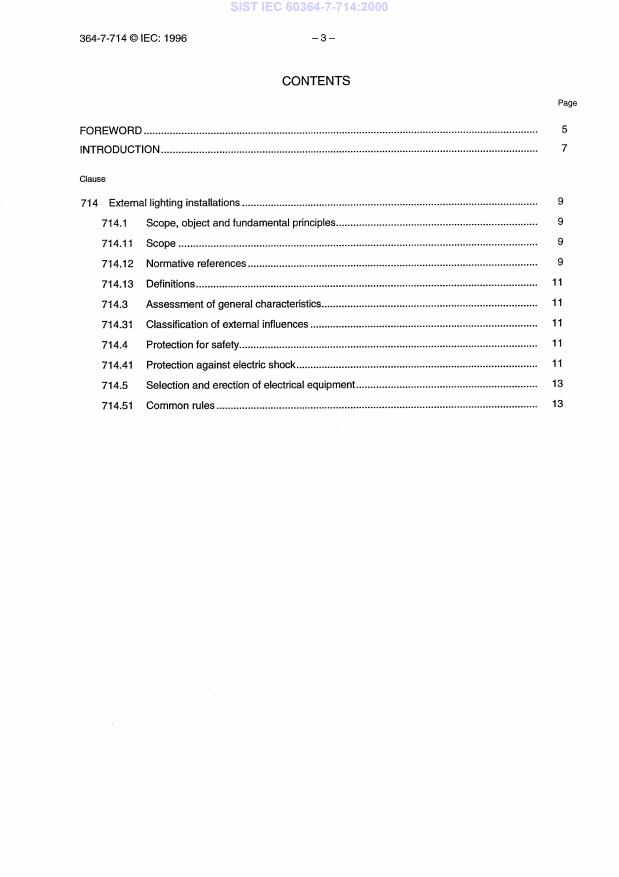
364-7-714 © IEC: 1996 – 3 –
CONTENTS
Page
FOREWORD 5
INTRODUCTION
Clause
External lighting installations 9
714.1 Scope, object and fundamental principles
714.11 Scope 9
714.12 Normative references 9
714.13 Definitions
11 714.3 Assessment of general characteristics
Classification of external influences 11
714.31
714.4 Protection for safety 11
714.41 Protection against electric shock
Selection and erection of electrical equipment 714.5
714.51 Common rules
364-7-714 © IEC: 1996 – 5 –
INTERNATIONAL ELECTROTECHNICAL COMMISSION
ELECTRICAL INSTALLATIONS OF BUILDINGS —
Partie 7: Requirements for special installations or locations —
Section 714: External lighting installations
FOREWORD
1) The IEC (International Electrotechnical Commission) is a worldwide organization for standardization comprising all national
electrotechnical committees (IEC National Committees). The object of the IEC is to promote intemational co-operation on
all questions concerning standardization in the electrical and electronic fields. To this end and in addition to other activities,
the IEC publishes International Standards. Their preparation is entrusted to technical committees; any IEC National
Committee interested in the subject dealt with may participate in this preparatory work. International, governmental and
non-govemmental organizations liaising with the IEC also participate in this preparation. The IEC collaborates closely with
ons determined by agreement between
the International Organization for Standardization (ISO) in accordance with condi ti
the two organizations.
The formal decisions or agreements of the IEC on technical matters, express as nearly as possible, an inte rnational
2)
consensus of opinion on the relevant subjects since each technical committee has representation from all interested
National Committees.
rna onal use and are published in the form of
3) The documents produced have the form of recommendations for inte ti
standards, technical reports or guides and they are accepted by the Na tional Committees in that sense.
In order to promote inte rnational unification, IEC National Committees undertake to apply IEC International Standards
4)
transparently to the maximum extent possible in their national and regional standards. Any divergence between the IEC
corresponding national or regional standard shall be clearly indicated in the latter.
Standard and the
The IEC provides no marking procedure to indicate its approval and cannot be rendered responsible for any
5)
equipment declared to be in conformity with one of its standards.
Attention is drawn to the possibility that some of the elements of this International Standard may be the subject
6)
of patent rights. IEC shall not be held responsible for identifying any or all such patent rights.
International Standard IEC 364-7-714 has been prepared by IEC technical committee 64: Electrical
installations of buildings.
The text of this standard is based on the following documents:
on voting
FDIS Report
64/839/RVD
64/794/FDIS
Full information on the voting for the approval of this standard can be found in the report on voting
indicated in the above table.
364-7-714 © IEC: 1996 – 7 –
INTRODUCTION
The requirements of pa rt 7 supplement, modify or replace certain of the general requirements of the
IEC 364. The numbers following the particular number of section 714 are those of the corresponding
parts, chapters, sections or clauses of IEC Publication 364. The absence of reference to a chapter, a
section or a clause means that the general requirements of IEC 364 are applicable.
364-7-714 © I EC: 1996 – 9 –
ELECTRICAL INSTALLATIONS OF BUILDINGS —
Requirements for special installations or locations —
Partie 7:
Section 714: External lighting installations
714 External lighting installations
714.1 Scope, object and fundamental principles
714.11 Scope
This section of IEC 364-7 deals with fixed external lighting installations.
ses luminaires, wiring system and accessories located outside buildings.
NOTE - External lighting comp ri
The requirements apply particularly to:
lighting installations e.g. for roads, parks, gardens, public places, sporting areas, illumination of
–
monuments and floodlighting;
– other equipment incorporating lighting such as telephone kiosks, bus shelters, advertising
panels, town plans, roads signs.
These rules do not apply to:
rt of public power grid and operated by a public supply
– public lighting installations which are pa
authority who is responsible for and has taken all necessary measures regarding saf
...