

IEC 62951-6:2019
(Main)Semiconductor devices - Flexible and stretchable semiconductor devices - Part 6: Test method for sheet resistance of flexible conducting films
General Information
- Abstract
IEC 62951-6:2019 specifies terms, as well as the test method and report of sheet resistance of the flexible conducting film under bending and folding tests. The measurement methods include the 2-point probe, 4-point probe and Montgomery method, which can be applied to in-situ and ex-situ measurement and the measurements of anisotropic sheet resistance.
- Status
- Published
- Publication Date
- 05-May-2019
- Technical Committee
- TC 47 - Semiconductor devices
- Drafting Committee
- WG 6 - TC 47/WG 6
- Current Stage
- PPUB - Publication issued
- Start Date
- 06-May-2019
- Completion Date
- 24-May-2019
Overview
IEC 62951-6:2019 is an international standard published by the International Electrotechnical Commission (IEC) that specifies test methods for measuring the sheet resistance of flexible conducting films used in semiconductor devices. This part of the IEC 62951 series focuses on flexible and stretchable semiconductor devices and provides standardized procedures for evaluating sheet resistance under bending and folding conditions. The standard covers different measurement techniques, including the 2-point probe, 4-point probe, and Montgomery methods, applicable for both in-situ and ex-situ testing. It further addresses measurements of anisotropic sheet resistance, ensuring comprehensive characterization of flexible conducting films.
Key Topics
Scope and Purpose: Standardizes terminology, testing procedures, and result reporting related to sheet resistance of flexible conducting films subjected to mechanical stresses such as bending and folding.
Measurement Methods:
- 2-Point Probe Method: Suitable for in-situ testing; involves applying current and measuring voltage across two probes to calculate sheet resistance.
- 4-Point Probe Method: Provides uniformity measurements with minimized contact resistance influences by using separate pairs of current and voltage probes.
- Montgomery Method: Ideal for evaluating anisotropic sheet resistance, accounting for directional electrical properties in the film.
Test Conditions: Includes conditioning and evaluation under standardized atmospheric conditions and mechanical deformation to simulate real operational stresses.
Data Analysis and Reporting: Specifies how to measure, analyze, and document results ensuring consistent and reproducible testing outcomes.
Correction Factors: The standard details necessary corrections for finite sample sizes, probe tip dimensions, and measurement positions, enhancing accuracy in practical applications.
Applications
IEC 62951-6:2019 is vital for industries developing or utilizing flexible and stretchable semiconductor devices, including:
Flexible Electronics: Validation of conductive films used in bendable displays, wearable devices, and flexible circuits to guarantee performance under mechanical strain.
Medical Devices: Testing of bio-compatible flexible sensors and conductive films for wearable health monitoring systems.
Automotive and Aerospace: Reliable characterization of conductive films in flexible electronics integrated into vehicle interiors and aircraft for enhanced durability.
Research and Development: Providing standardized evaluation methods that support innovation in flexible semiconductor materials and devices.
This standard enables manufacturers, testing laboratories, and researchers to deliver improved product reliability and quality assurance for next-generation flexible semiconductor technologies.
Related Standards
IEC 62951 Series: This part 6 complements other parts of the IEC 62951 series, which cover broader aspects of flexible and stretchable semiconductor devices.
ISO 291:2008: Specifies standard atmospheres for conditioning and testing plastics, referenced for conditioning flexible films before resistance testing.
IEC 60050 Series: Provides definitions and terms related to resistivity and resistance, supporting the terminology used in IEC 62951-6:2019.
Professionals working with flexible conducting films should consult these standards in conjunction with IEC 62951-6:2019 for comprehensive compliance and testing strategies.
Keywords: IEC 62951-6:2019, flexible conducting films, sheet resistance test, 2-point probe method, 4-point probe method, Montgomery method, flexible semiconductor devices, bending tests, anisotropic sheet resistance, flexible electronics standards, semiconductor device testing.
Get Certified
Connect with accredited certification bodies for this standard

IMQ S.p.A. (Certification)
Italian electrical product certification.

SLG Prüf- und Zertifizierungs GmbH
German testing and certification body.

UL Solutions
Global safety science company with testing, inspection and certification.
Sponsored listings
Frequently Asked Questions
IEC 62951-6:2019 is a standard published by the International Electrotechnical Commission (IEC). Its full title is "Semiconductor devices - Flexible and stretchable semiconductor devices - Part 6: Test method for sheet resistance of flexible conducting films". This standard covers: IEC 62951-6:2019 specifies terms, as well as the test method and report of sheet resistance of the flexible conducting film under bending and folding tests. The measurement methods include the 2-point probe, 4-point probe and Montgomery method, which can be applied to in-situ and ex-situ measurement and the measurements of anisotropic sheet resistance.
IEC 62951-6:2019 specifies terms, as well as the test method and report of sheet resistance of the flexible conducting film under bending and folding tests. The measurement methods include the 2-point probe, 4-point probe and Montgomery method, which can be applied to in-situ and ex-situ measurement and the measurements of anisotropic sheet resistance.
IEC 62951-6:2019 is classified under the following ICS (International Classification for Standards) categories: 29.060.20 - Cables; 31.080.99 - Other semiconductor devices. The ICS classification helps identify the subject area and facilitates finding related standards.
IEC 62951-6:2019 is available in PDF format for immediate download after purchase. The document can be added to your cart and obtained through the secure checkout process. Digital delivery ensures instant access to the complete standard document.
Standards Content (Sample)
IEC 62951-6 ®
Edition 1.0 2019-05
INTERNATIONAL
STANDARD
NORME
INTERNATIONALE
colour
inside
Semiconductor devices – Flexible and stretchable semiconductor devices –
Part 6: Test method for sheet resistance of flexible conducting films
Dispositifs à semiconducteurs – Dispositifs à semiconducteurs souples
et extensibles –
Partie 6: Méthode d’essai pour la résistance de couche des couches
conductrices souples
All rights reserved. Unless otherwise specified, no part of this publication may be reproduced or utilized in any form
or by any means, electronic or mechanical, including photocopying and microfilm, without permission in writing from
either IEC or IEC's member National Committee in the country of the requester. If you have any questions about IEC
copyright or have an enquiry about obtaining additional rights to this publication, please contact the address below or
your local IEC member National Committee for further information.
Droits de reproduction réservés. Sauf indication contraire, aucune partie de cette publication ne peut être reproduite
ni utilisée sous quelque forme que ce soit et par aucun procédé, électronique ou mécanique, y compris la photocopie
et les microfilms, sans l'accord écrit de l'IEC ou du Comité national de l'IEC du pays du demandeur. Si vous avez des
questions sur le copyright de l'IEC ou si vous désirez obtenir des droits supplémentaires sur cette publication, utilisez
les coordonnées ci-après ou contactez le Comité national de l'IEC de votre pays de résidence.
IEC Central Office Tel.: +41 22 919 02 11
3, rue de Varembé info@iec.ch
CH-1211 Geneva 20 www.iec.ch
Switzerland
About the IEC
The International Electrotechnical Commission (IEC) is the leading global organization that prepares and publishes
International Standards for all electrical, electronic and related technologies.
About IEC publications
The technical content of IEC publications is kept under constant review by the IEC. Please make sure that you have the
latest edition, a corrigendum or an amendment might have been published.
IEC publications search - webstore.iec.ch/advsearchform Electropedia - www.electropedia.org
The advanced search enables to find IEC publications by a The world's leading online dictionary on electrotechnology,
variety of criteria (reference number, text, technical containing more than 22 000 terminological entries in English
committee,…). It also gives information on projects, replaced and French, with equivalent terms in 16 additional languages.
and withdrawn publications. Also known as the International Electrotechnical Vocabulary
(IEV) online.
IEC Just Published - webstore.iec.ch/justpublished
Stay up to date on all new IEC publications. Just Published IEC Glossary - std.iec.ch/glossary
details all new publications released. Available online and 67 000 electrotechnical terminology entries in English and
once a month by email. French extracted from the Terms and Definitions clause of
IEC publications issued since 2002. Some entries have been
IEC Customer Service Centre - webstore.iec.ch/csc collected from earlier publications of IEC TC 37, 77, 86 and
If you wish to give us your feedback on this publication or CISPR.
need further assistance, please contact the Customer Service
Centre: sales@iec.ch.
A propos de l'IEC
La Commission Electrotechnique Internationale (IEC) est la première organisation mondiale qui élabore et publie des
Normes internationales pour tout ce qui a trait à l'électricité, à l'électronique et aux technologies apparentées.
A propos des publications IEC
Le contenu technique des publications IEC est constamment revu. Veuillez vous assurer que vous possédez l’édition la
plus récente, un corrigendum ou amendement peut avoir été publié.
Recherche de publications IEC - Electropedia - www.electropedia.org
webstore.iec.ch/advsearchform Le premier dictionnaire d'électrotechnologie en ligne au
La recherche avancée permet de trouver des publications IEC monde, avec plus de 22 000 articles terminologiques en
en utilisant différents critères (numéro de référence, texte, anglais et en français, ainsi que les termes équivalents dans
comité d’études,…). Elle donne aussi des informations sur les 16 langues additionnelles. Egalement appelé Vocabulaire
projets et les publications remplacées ou retirées. Electrotechnique International (IEV) en ligne.
IEC Just Published - webstore.iec.ch/justpublished Glossaire IEC - std.iec.ch/glossary
Restez informé sur les nouvelles publications IEC. Just 67 000 entrées terminologiques électrotechniques, en anglais
Published détaille les nouvelles publications parues. et en français, extraites des articles Termes et Définitions des
Disponible en ligne et une fois par mois par email. publications IEC parues depuis 2002. Plus certaines entrées
antérieures extraites des publications des CE 37, 77, 86 et
Service Clients - webstore.iec.ch/csc CISPR de l'IEC.
Si vous désirez nous donner des commentaires sur cette
publication ou si vous avez des questions contactez-nous:
sales@iec.ch.
IEC 62951-6 ®
Edition 1.0 2019-05
INTERNATIONAL
STANDARD
NORME
INTERNATIONALE
colour
inside
Semiconductor devices – Flexible and stretchable semiconductor devices –
Part 6: Test method for sheet resistance of flexible conducting films
Dispositifs à semiconducteurs – Dispositifs à semiconducteurs souples
et extensibles –
Partie 6: Méthode d’essai pour la résistance de couche des couches
conductrices souples
INTERNATIONAL
ELECTROTECHNICAL
COMMISSION
COMMISSION
ELECTROTECHNIQUE
INTERNATIONALE
ICS 31.080.99 ISBN 978-2-8322-6871-1
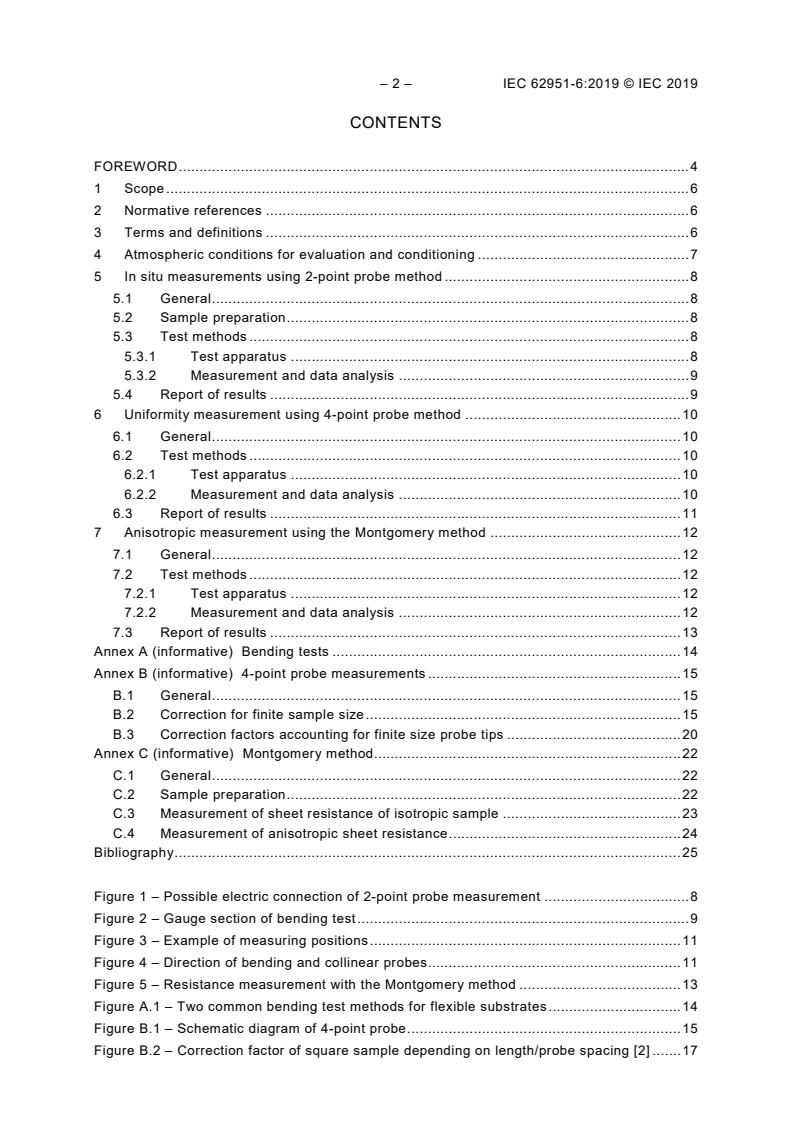
– 2 – IEC 62951-6:2019 © IEC 2019
CONTENTS
FOREWORD . 4
1 Scope . 6
2 Normative references . 6
3 Terms and definitions . 6
4 Atmospheric conditions for evaluation and conditioning . 7
5 In situ measurements using 2-point probe method . 8
5.1 General . 8
5.2 Sample preparation . 8
5.3 Test methods . 8
5.3.1 Test apparatus . 8
5.3.2 Measurement and data analysis . 9
5.4 Report of results . 9
6 Uniformity measurement using 4-point probe method . 10
6.1 General . 10
6.2 Test methods . 10
6.2.1 Test apparatus . 10
6.2.2 Measurement and data analysis . 10
6.3 Report of results . 11
7 Anisotropic measurement using the Montgomery method . 12
7.1 General . 12
7.2 Test methods . 12
7.2.1 Test apparatus . 12
7.2.2 Measurement and data analysis . 12
7.3 Report of results . 13
Annex A (informative) Bending tests . 14
Annex B (informative) 4-point probe measurements . 15
B.1 General . 15
B.2 Correction for finite sample size . 15
B.3 Correction factors accounting for finite size probe tips . 20
Annex C (informative) Montgomery method. 22
C.1 General . 22
C.2 Sample preparation . 22
C.3 Measurement of sheet resistance of isotropic sample . 23
C.4 Measurement of anisotropic sheet resistance . 24
Bibliography . 25
Figure 1 – Possible electric connection of 2-point probe measurement . 8
Figure 2 – Gauge section of bending test . 9
Figure 3 – Example of measuring positions . 11
Figure 4 – Direction of bending and collinear probes . 11
Figure 5 – Resistance measurement with the Montgomery method . 13
Figure A.1 – Two common bending test methods for flexible substrates . 14
Figure B.1 – Schematic diagram of 4-point probe . 15
Figure B.2 – Correction factor of square sample depending on length/probe spacing [2] . 17
Figure B.3 – Correction factor depending on measuring position when collinear probes
are directed vertically . 18
Figure B.4 – Correction factor depending on measuring position when collinear probes
are directed horizontally . 18
Figure B.5 – Correction factor, f depending on measuring positions and direction of
collinear probes . 19
Figure B.6 – Example of probe with a finite contact diameter (e.g. 2mm) comparable to
inter-distance between probes (e.g. 5 mm) . 20
Figure B.7 – Dimensional sketch of probe with a finite contact diameter . 21
Figure C.1 – Possible contact placements of square or rectangular sample . 22
Figure C.2 – Correction factors for finite contact size on resistivity measurement [4] . 23
Figure C.3 – Resistance measurement of Montgomery method . 24
– 4 – IEC 62951-6:2019 © IEC 2019
INTERNATIONAL ELECTROTECHNICAL COMMISSION
____________
SEMICONDUCTOR DEVICES –
FLEXIBLE AND STRETCHABLE SEMICONDUCTOR DEVICES –
Part 6: Test method for sheet resistance of flexible conducting films
FOREWORD
1) The International Electrotechnical Commission (IEC) is a worldwide organization for standardization comprising
all national electrotechnical committees (IEC National Committees). The object of IEC is to promote
international co-operation on all questions concerning standardization in the electrical and electronic fields. To
this end and in addition to other activities, IEC publishes International Standards, Technical Specifications,
Technical Reports, Publicly Available Specifications (PAS) and Guides (hereafter referred to as “IEC
Publication(s)”). Their preparation is entrusted to technical committees; any IEC National Committee interested
in the subject dealt with may participate in this preparatory work. International, governmental and non-
governmental organizations liaising with the IEC also participate in this preparation. IEC collaborates closely
with the International Organization for Standardization (ISO) in accordance with conditions determined by
agreement between the two organizations.
2) The formal decisions or agreements of IEC on technical matters express, as nearly as possible, an international
consensus of opinion on the relevant subjects since each technical committee has representation from all
interested IEC National Committees.
3) IEC Publications have the form of recommendations for international use and are accepted by IEC National
Committees in that sense. While all reasonable efforts are made to ensure that the technical content of IEC
Publications is accurate, IEC cannot be held responsible for the way in which they are used or for any
misinterpretation by any end user.
4) In order to promote international uniformity, IEC National Committees undertake to apply IEC Publications
transparently to the maximum extent possible in their national and regional publications. Any divergence
between any IEC Publication and the corresponding national or regional publication shall be clearly indicated in
the latter.
5) IEC itself does not provide any attestation of conformity. Independent certification bodies provide conformity
assessment services and, in some areas, access to IEC marks of conformity. IEC is not responsible for any
services carried out by independent certification bodies.
6) All users should ensure that they have the latest edition of this publication.
7) No liability shall attach to IEC or its directors, employees, servants or agents including individual experts and
members of its technical committees and IEC National Committees for any personal injury, property damage or
other damage of any nature whatsoever, whether direct or indirect, or for costs (including legal fees) and
expenses arising out of the publication, use of, or reliance upon, this IEC Publication or any other IEC
Publications.
8) Attention is drawn to the Normative references cited in this publication. Use of the referenced publications is
indispensable for the correct application of this publication.
9) Attention is drawn to the possibility that some of the elements of this IEC Publication may be the subject of
patent rights. IEC shall not be held responsible for identifying any or all such patent rights.
International Standard IEC 62951-6 has been prepared by IEC technical committee 47:
Semiconductor devices.
The text of this International Standard is based on the following documents:
FDIS Report on voting
47/2547/FDIS 47/2566/RVD
Full information on the voting for the approval of this International Standard can be found in
the report on voting indicated in the above table.
This document has been drafted in accordance with the ISO/IEC Directives, Part 2.
A list of all parts in the IEC 62951 series, published under the general title Semiconductor
devices – Flexible and stretchable semiconductor devices, can be found on the IEC website.
The committee has decided that the contents of this document will remain unchanged until the
stability date indicated on the IEC website under "http://webstore.iec.ch" in the data related to
the specific document. At this date, the document will be
• reconfirmed,
• withdrawn,
• replaced by a revised edition, or
• amended.
IMPORTANT – The 'colour inside' logo on the cover page of this publication indicates
that it contains colours which are considered to be useful for the correct
understanding of its contents. Users should therefore print this document using a
colour printer.
– 6 – IEC 62951-6:2019 © IEC 2019
SEMICONDUCTOR DEVICES –
FLEXIBLE AND STRETCHABLE SEMICONDUCTOR DEVICES –
Part 6: Test method for sheet resistance of flexible conducting films
1 Scope
This part of IEC 62951 specifies terms, as well as the test method and report of sheet
resistance of the flexible conducting film under bending and folding tests. The measurement
methods include the 2-point probe, 4-point probe and Montgomery method, which can be
applied to in-situ and ex-situ measurement and the measurements of anisotropic sheet
resistance.
2 Normative references
The following documents are referred to in the text in such a way that some or all of their
content constitutes requirements of this document. For dated references, only the edition
cited applies. For undated references, the latest edition of the referenced document (including
any amendments) applies.
ISO 291:2008, Plastics – Standard atmospheres for conditioning and testing
3 Terms and definitions
For the purpose of this document, the following terms and definitions apply.
ISO and IEC maintain terminological databases for use in standardization at the following
addresses:
• IEC Electropedia: available at http://www.electropedia.org/
• ISO Online browsing platform: available at http://www.iso.org/obp
3.1
resistivity
inverse of the conductivity when this inverse exists
[SOURCE: IEC 60050-121:1998, 121-12-04]
3.2
R
s
sheet resistance
resistance of thin films that are nominally uniform in thickness, which is the resistivity divided
by the thickness of conducting film
3.3
resistance
for a resistive two-terminal element or two-terminal circuit with terminals A and B, quotient of
the voltage (IEC 60050-131:2008, 131-11-56) u between the terminals by the electric
AB
current i in the element or circuit
𝑢𝑢
𝐴𝐴𝐴𝐴
𝑅𝑅=
𝑖𝑖
where the electric current is taken positive if its direction is from A to B and negative if its
direction is from B to A
Note 1 to entry: A resistance cannot be negative.
Note 2 to entry: The term "resistance" is also a short term for “resistance to alternating current”
(IEC 60050-131:2013, 131-12-45).
Note 3 to entry: In French, the term "résistance" also denotes a device, in English "resistor" (see
IEC 60050-151:2001, 151-13-19).
Note 4 to entry: The coherent SI unit of resistance is ohm, Ω.
[SOURCE: IEC 60050-131:2013, 131-12-04]
3.4
contact resistance
resistance between the surface of a material and the electric contact made to the surface
3.5
radius
distance from the centre of a circle to the circumference
Note 1 to entry: The radius of a sphere is the radius of a great circle.
[SOURCE: IEC 60050-113:2011, 113-01-25]
3.6
radius of curvature
at a point of a curve, radius of the osculating circle
Note 1 to entry: The osculating circle is the circle tangent to a curve at a point that approaches at best the curve
in the vicinity of the point.
[SOURCE: IEC 60050-113:2011, 113-01-30]
3.7
2-point probe method
method for measuring the resistivity of a material, using two electric contacts to the material
Note 1 to entry: The measured value is dependent on the probe resistance.
3.8
4-point probe method
method for measuring the resistivity of a material, using four electric contacts to the material
Note 1 to entry: This avoids many contact resistance problems.
3.9
Montgomery method
technique used to measure the resistivity of two-dimensional sample by placing the electrodes
on its perimeter
4 Atmospheric conditions for evaluation and conditioning
The standard atmosphere for evaluation (test and measurement) and storage of the specimen
shall be a temperature of 23°C ± 2°C and relative humidity of (50 ± 10) %, conforming to
standard atmosphere class 2 specified in ISO 291:2008. If a polymer substrate is used for a
test piece coated with a conductive layer, the standard atmosphere for evaluation shall be a
temperature of 23°C ± 1°C and relative humidity of (50 ± 5) %, conforming to standard
atmosphere class 1 specified in ISO 291:2008.
– 8 – IEC 62951-6:2019 © IEC 2019
If conditioning is necessary, the same standard atmosphere as specified above shall apply.
5 In situ measurements using 2-point probe method
5.1 General
The 2-point probe method for measuring the sheet resistance of a conductive film uses two
electric contacts. It is well known that the measured value includes the error caused by the
probe resistance and the contact resistance. However, other methods (i.e. 4-point probe and
Montgomery method) are not convenient or impossible to use for in-situ measurement during
the bending or folding test. Consequently, the 2-point probe method is often necessary for in-
situ measurements.
5.2 Sample preparation
To minimize the error caused by the probe resistance and the contact resistance, the
following should be satisfied.
• The sample resistance should be 20 times larger than the probe resistance to guarantee
the error within 5 % (e.g. if the sheet resistance is about 50 ohms/square and the probe
resistance is about 5 Ω, the ratio of length to width, L/W can be larger than 2).
• The probe electric contact should be made securely using highly conductive adhesive,
such as silver paste.
• When the width W is comparable or larger than the length L, of the sample, the conducting
bar (using highly conductive adhesive, such as silver paste) should be securely attached
to the sample to minimize the spreading resistance in the width direction. (see Figure 1)
L
L
W W
B
W ≥ L W << L
IEC
Key
W width of the sample
L length of the sample
B conductive bar
Figure 1 – Possible electric connection of 2-point probe measurement
5.3 Test methods
5.3.1 Test apparatus
The appropriate evaluation for flexible electronics is bending the sample to a given radius. For
this, either the collapsing radius test (see IEC 62951-1) or the X–Y–θ test can be used
(refer to Annex A). It is noted that the gauge section (where the bending radius r is observed)
should be measured in the collapsing radius test.
It is noted that the folding test is also similar to the bending test. The difference is the fact
that the permanent deformation occurs in folding due to the relatively small radius of
curvature.
5.3.2 Measurement and data analysis
Acquisition of temporal resistance data requires digital multimeter, whose reading rate should
be 10 times faster than the bending frequency to measure the resistance change during one
cyclic bending. It is noted that the applied current can cause heating of the material, which
can change its resistivity. To avoid this problem, make sure the measured resistance is
constant with time (the average resistance should not drift more than 10 % in a few minutes).
For the 2-point probe method, the sheet resistance, R can be calculated from the measured
s
resistance, R, as shown by Formula (1):
W
RR= (1)
s
L
In addition, the bending radius should be measured by fitting circles to optical images of
curvature (especially when collapsing radius test is used). When the whole area of sample
does not experience the same bending radius (Figure 2), the sheet resistance at the gauge
section can be obtained from the initial resistance, R as shown by Formula (2):
i
LL− W
bend
R R− R
(2)
si
LL
bend
After the bending test, it is recommended to measure the sheet resistance of the sample
using a 4-point probe. The comparison of measurements between the 2-point and 4-point
probe can ascertain the secure electrical connection of the 2-point probe after the bending
test and can further reduce the measurement error by the 2-point probe. For the same reason,
it is also recommended to measure the sheet resistance using a 4-point probe before the
bending test.
L
bend
L
bend
r
r
L
L
IEC
Figure 2 – Gauge section of bending test
5.4 Report of results
The report shall include the following items:
a) specimen identification;
b) date of test;
=
– 10 – IEC 62951-6:2019 © IEC 2019
c) atmospheric conditions of test;
d) bending radius;
e) sample dimension and the actual bending area (gauge section);
f) frequency of bending;
g) temporal sheet resistance curve (or equivalent sheet resistance over bending area);
h) optical observation permanent deformation;
i) (optional) 4-point probe measurement before and after the bending test.
6 Uniformity measurement using 4-point probe method
6.1 General
The 4-point probe method is an electrical measuring technique that uses separate pairs of
current-carrying and voltage-sensing electrodes to make more accurate measurements than
the simpler 2-point probe sensing. Separation of current and voltage electrodes eliminates the
lead and contact resistance from the measurement. 4-point probes can accurately measure a
resistance below 100 Ω, and therefore it is a suitable technique to evaluate the sheet
resistance uniformity of thin films.
6.2 Test methods
6.2.1 Test apparatus
The sheet resistances are measured by pressing collinear 4-point probes against the surface
of the film. A current is applied between the outer two points, while the voltage is measured
across the inner two points.
For the soft conducting film on flexible substrate, the use of the special collinear probe with a
finite contact area equipped with internal springs is recommended. An example of this probe
pin is shown in Figure B.6.
6.2.2 Measurement and data analysis
From the induced current, I and the measured voltage, V, the sheet resistance is calculated
as:
πV V
R f,4 5324 f
(3)
s
ln2 II
Here, f is the correction factor considering the finite size of the sample and the finite size of
the probe contact area and is detailed in Annex B. See Figure B.1 and Figure B.7.
To evaluate the uniformity of the sheet resistance of the conductive film, many measurement
points are required. There is not a preferred map for measuring positions, but it is
recommended that the positions are located 10 % inside from the edge. An example of
measuring positions is shown in Figure 3.
In the case of a long roll of flexible conductive film, it is recommended to acquire the samples
from both ends, but not the extremities of the roll and to evaluate the uniformity.
==
0,2W 0,15W 0,15W 0,15W 0,15W 0,2W
W
IEC
Figure 3 – Example of measuring positions
In the case of a sample after the bending test, anisotropic resistivity may appear. Therefore, it
is recommended that the sheet resistance is measured with the collinear probe placed in both
directions, parallel and perpendicular to the bending direction, as depicted in Figure 4.
IEC
Key
1 direction of collinear probes
2 bending direction
Figure 4 – Direction of bending and collinear probes
6.3 Report of results
The report shall include the following items:
a) specimen identification;
L
0,2W 0,15W 0,15W 0,15W 0,15W 0,2W
– 12 – IEC 62951-6:2019 © IEC 2019
b) date of test;
c) atmospheric conditions of test;
d) sample history;
e) sample dimension and measuring positons;
f) direction of collinear probes;
g) sheet resistance data and its statistical uniformity information;
h) (optional) data of correction factor.
7 Anisotropic measurement using the Montgomery method
7.1 General
The Montgomery method is a technique used to measure the sheet resistance of a sample. Its
advantage lies in its ability to accurately measure the sheet resistance of a sample and to
measure an anisotropic resistivity as well. However, for this method, electrodes should be
placed on the perimeter of the sample, so that it only provides the average value. See
Annex C.
7.2 Test methods
7.2.1 Test apparatus
An electric equipment similar to that used for the 4-point probe method can be used. Since
the current source and voltmeter shall be switched to all terminals of the sample, equipment
with switching matrix to automate measurements is recommended. The electric contacts
should be made on the four corners of the rectangular sample and the size of contact should
be 10 times smaller than the sample dimension to guarantee an error within 1 %.
7.2.2 Measurement and data analysis
To make a measurement, a current should flow along one edge of the sample (for instance,
I and I ) and the voltage across the opposite edge (in this case, V and V , respectively)
12 23 34 41
is measured (refer to Figure 5). From these values, a resistance (for this example, R and
12,34
R ) can be found using Ohm's law:
23,41
V
R =
(4)
12,34
I
V
R =
23,41
I
(5)
These measurements are repeated to improve the accuracy of the resistance values and the
vertical and horizontal resistance can be obtained as follows:
RR+ + RR+
12,34 21,43 34,12 43,21
(6)
R =
vertical
R + R + R + R
23,41 32,14 41,23 14,32
R =
horizontal
(7)
If any of the reversed polarity measurements do not agree, to a sufficient degree of accuracy
(usually within 3 %), with the corresponding standard polarity measurement, then there is
probably a source of error somewhere in the setup, which should be investigated before
continuing. The same principle applies to the reciprocal measurements.
In the case of an anisotropic sample, both the respective sheet resistances for both vertical
and horizontal directions can be calculated as follows:
π L
R = RFsinh πF
( ) (8)
s,vertical horizontal
8 L
sinh πF
L ( )
π
RR= (9)
s,horizontal horizontal
8 LF
where
2
11 RR1
vertical vertical
F≈+ln ln + 4
(10)
2 π R π R
horizontal horizontal
L and L are vertical and horizontal lengths of the sample, respectively.
12 23
V
V 14
A
V
V
I
1 4
1 4
A
I
2 2
IEC IEC
R = V /I R = V /I
12,34 43 12 23,41 41 23
Figure 5 – Resistance measurement with the Montgomery method
7.3 Report of results
The report shall include the following items:
a) specimen identification;
b) date of test;
c) atmospheric conditions of test;
d) sample dimension;
e) directional sheet resistance data;
f) (optional) data of correction factor;
g) (optional) sample history (direction of bending).
– 14 – IEC 62951-6:2019 © IEC 2019
Annex A
(informative)
Bending tests
The appropriate evaluation for flexible electronics is bending the sample to a given radius. For
this, the most common technique is the collapsing radius test detailed in IEC 62951-1
(Figure A.1 (left)). In the collapsing radius test, the sample is subjected to a bending radius r
(shown in Figure A.1 (left)) in the gauge section only, while other areas are subjected to a
bending radius other than r. In the X-Y-θ test (Figure A.1 (right), also mentioned in
IEC 62951-1), the end of the sample is positioned on the coordinates of the circumference, so
that the whole area of the sample is subjected to the same bending radius r. Therefore, the X-
Y-θ test can provide a larger area for the electrical measurement given the same sample size
and it also allows to measure sheet resistance variation depending on the radius of curvature
during the bending test.
(x , y , 0°) (x , y , 0°)
1 1 2 1
2r
(x , y ,θ)
i i
(x , y ,180°)
1 2
Fixed Moving
IEC
Figure A.1 – Two common bending test methods for flexible substrates
Annex B
(informative)
4-point probe measurements
B.1 General
With the probes centered on a very wide (lateral dimension >> s) and very thin
(thickness << s) sample, with s the probe spacing, the sheet resistance is given by:
πV V
R,4 5324
(B.1)
s
ln2 II
where
I is the current between probe A and D;
V is the potential difference measured between probe B and C.
D
C
B
A
–b/2 b/2
y
s
x
A
s
a
y
A
x IEC
Figure B.1 – Schematic diagram of 4-point probe
B.2 Correction for finite sample size
For a sample of finite width, this should be multiplied by a finite size correction factor f:
πV V
R f,4 5324 f (B.2)
s
ln2 II
where
f is the finite width correction factor.
The correction factor f can be expressed by the following formula:
==
==
– 16 – IEC 62951-6:2019 © IEC 2019
∞
y − y
2 bb b
−1 C
B
F(+ cos ξx )cosh ξ y+− cos( ξx )cosh ξ y+ ×cos( ξx )cosh ξ y−
∑ BB C C A A
aaξsinh( bξ ) 2 2 2
m=1
b bb
− cos( ξx )cosh ξ y − − cos( ξx )cosh ξ y −×cos( ξx )cosh ξ y +
BB C C DD
2 22
∞
2 bb b
+ × cosh ηy + − cosh ηy + ×cosh ηy −
BC A
∑
aηsinh( bη ) 2 2 2
n=1
(B.3)
bb b
− cosh ηy −− cosh ηy − ×cosh ηy +
BC D
22 2
∞∞
4 b bb
+ × cos(ξx )cosh ζ y + − cos(ξx )cosh ζ y +×cos(ξx )cosh ζ y −
∑∑ BB CC A A
aζ sinh( bζ ) 2 22
mn11
b b b
− cos ξx cosh ζ y −− cos ξx cosh ζ y − ×cos ξx cosh ζ y +
( ) ( ) ( )
B B C C DD
22 2
where
π
F f,4 532 4 f
(B.4)
ln2
( x ,y ) are the x, y coordinates of probe A (cm);
AA
( x ,y ) are the x, y coordinates of probe B (cm);
BB
( x ,y ) are the x, y coordinates of probe C (cm);
CC
( x ,y ) are the x, y coordinates of probe D (cm);
DD
a, b are the length of the conductive layer;
ξ= mπ / a (m represents an integral number);
η= nπ / t (n represents an integral number, t represents the thickness of the conductive
layer);
12/
ζ ξη+
.
( )
If t << s and collinear probes are oriented parallel to the y axis (i.e. ),
x xx x
A B CD
Formula (B.3) simplifies to:
∞ 2
s 2cos ( ξx ) b b b
− A
F =+ cosh ξ y+ − cosh ξ y+ ×cosh ξ y−
∑ BC A
aaξsinh( bξ ) 2 2 2
m=1
bb b
(B.5)
− cosh ξ y −− cosh ξ y − ×+cosh ξ y
BC D
22 2
∞ ∞∞
2 4cos ξx
−−sη 22sη A −sζ − sζ
+ (e −+e ) (e − e )
∑ ∑∑
aη aζ
n 1 mn11
Representative correction factors are shown hereafter. When a 4-point probe is placed at the
centre of a square sample, the correction factor, f is calculated using Formula (B.6) resulting
in Figure B.2.
Figure B.3 and Figure B.4 show the variation of the correction factor for long samples
depending on measuring positions as well as the orientation of collinear probes.
Figure B.5 shows the variation of correction for rectangular samples.
= = =
===
=
==
= =
=
It is noted that the correction factor is closer to 1 when the collinear probes are oriented
parallel to the short side. However, in this case, it decreases earlier when the measuring
position approaches the edge of samples.
0,95
0,9
0,85
0,8
0,75
0,7
0,65
0,6
0,55
0,5
0 5 10 15 20 25 30 35 40
a/s (length of square sample/probe spacing)
IEC
Figure B.2 – Correction factor of square sample depending on length/probe spacing [2]
f (correction factor)
– 18 – IEC 62951-6:2019 © IEC 2019
a/s = 12
0,95
0,9
a/s = 6
0,85
0,8
a/s = 4
0,75
0,7
0,65
b/s = 60
0,6
–30 –25 –20 –15 –10 –5 0 5 10 15 20 25 30
x/s
IEC
Figure B.3 – Correction factor depending on measuring position when
collinear probes are directed vertically
0,95
a/s = 12
0,9
0,85
a/s = 6
0,8
s
0,75
0,7
a/s = 4
0,65
b/s = 60
0,6
–30 –25 –20 –15 –10 –5 0 5 10 15 20 25 30
x/s
IEC
Figure B.4 – Correction factor depending on measuring position when
collinear probes are directed horizontally
f (correction factor)
f (correction factor)
s
a/s
a/s
Measurement position
Direction of
collinear probes
s
Measurement position
Direction of collinear probes
W/s = 40
W/s = 40
W/s = 20 W/s = 20
0,2W 0,15W 0,15W
0,2W 0,15W 0,15W
W/s = 10
W/s = 10
IEC
Figure B.5 – Correction factor, f depending on measuring positions and
direction of collinear probes
L/s = 30 L/s = 60
L/s = 15
0,2L 0,15L 0,15L
0,2L 0,15L 0,15L 0,2L 0,15L 0,15L
s
L/s = 60
L/s = 30
L/s = 15
– 20 – IEC 62951-6:2019 © IEC 2019
B.3 Correction factors accounting for finite size probe tips
The sharp probe tip often scratches the soft conducting film (e.g. nanoparticle conducting film,
nanowire coated film), which may result in inconsistent measurements of sheet resistance. To
prevent this, a probe with a finite contact area equipped with internal springs is used. An
example of this probe pin for the soft conducting film is shown in Figure B.6. In this case, the
contact diameter is comparable to the inter-distance between probes and the additional
correction factor for sheet resistance is required.
The finite diameter of the probe tips results in under-estimation of the measured sheet
resistance for small electrode pitch, since it leads to an injection of the current over the whole
contact area instead of a point-like injection.
The additional correction factor including the effect of finite contact diameter can be
expressed as follows [2] :
πV V
R ff× 4,532 4 ff×
(B.6)
s probe probe
ln2 II
where
d
11+−d / a
( )
s
f =
;
probe
d
1− A
s
0,77+<0,074log( a / d ) for a / d 1000
A≈
(when s/ d> 2 ).
1 for a / d≥ 1000
2
IEC
Figure B.6 – Example of probe with a finite contact diameter (e.g. 2mm) comparable
to inter-distance between probes (e.g. 5 mm)
___________
Numbers in square brackets refer to the bibliography.
= =
b
a
d
IEC
s
Figure B.7 – Dimensional sketch of probe with a finite contact diameter
– 22 – IEC 62951-6:2019 © IEC 2019
Annex C
(informative)
Montgomery method
C.1 General
The Montgomery method is a technique used to measure the sheet resistance of a sample [3]
Its power lies in its ability to accurately measure the properties of a sample of any arbitrary to
dimensional shape. The electrodes are placed on its perimeter and an anisotropic resistivity
can be measured as well.
C.2 Sample preparation
In order to reduce errors in the calculations, it is preferable that the sample is symmetrical.
The measurements require that four small ohmic contacts be placed on the boundary of the
sample (or as close to it as possible). See Figure C.1.
Here, any errors given by their non-zero size will be of the order D/L, where D is the average
size of the contact and L is the distance between the contacts. As shown in Figure C.2, if D/L
is less than 0,15, the sheet resistance can be measured within the error of 1 %.
Contacts at Contacts at the edges
the corners or inside the perimeter
L
IEC IEC
Acceptable Not recommended
Figure C.1 – Possible contact placements of square or rectangular sample
1,1
Square contact
Theory
Experiment
Triangular contact
1,08
Theory
Experiment
l
1,06
δ
1,04
1,02
0 0,05 0,1 0,15 0,2 0,25
δ/l
IEC
Figure C.2 – Correction factors for finite contact size on resistivity measurement [4]
C.3 Measurement of sheet resistance of isotropic sample
To make a measurement, a current is caused to flow along one edge of the sample (for
instance, I ) and the voltage across the opposite edge (in this case, V ) is measured (refer
12 34
to Figure C.3). From these two values, a resistance (for this example, R ) can be found
12,34
using Ohm's law:
V
RR (C.1)
12,34 vertical
I
V
R R (C.2)
23,41 horizontal
I
The van der Pauw formula showed that the sheet resistance of samples with arbitrary shapes
can be determined from two of these resistances: one measured along a vertical edge, such
as R and a corresponding one measured along a horizontal edge, such as R . The
12,34 23,41
actual sheet resistance, R , is related to these resistances by the van der Pauw formula:
s
exp −πR / R +−exp πR / R =1
( ) ( ) (C.3)
vertical s horizontal s
A further improvement in the accuracy of the resistance values can be obtained by both
reciprocal measurements and switching polarities.
Resistivity correction factor
==
==
– 24 – IEC 62951-6:2019 © IEC 2019
RR+ + RR+
12,34 21,43 34,12 43,21
R =
(C.4)
vertical
R + R + R + R
23,41 32,14 41,23 14,32
R =
(C.5)
horizontal
The sheet resistance, R can be obtained from the above van der Pauw formula, again.
s
V
V 14
A
V
34 V
I
1 4
1 4
A
I
2 2
IEC IEC
R = V /I R = V /I
12,34 43 12 23,41 41 23
Figure C.3 – Resistance measurement of Montgomery method
If any of the reversed polarity measurements do not agree to a sufficient degree of accuracy
(usually within 3 %) with the corresponding standard polarity measurement, then there is
probably a source of error within the setup, which should be investigated before continuing.
The same principle applies to the reciprocal measurements.
C.4 Measurement of anisotropic sheet resistance
In the case of an anisotropic sample, both the respective sheet resistances for both vertical
and horizontal directions can be approximated as follows [5]:
π L
R = RFsinh πF (C.6)
( )
s,vertical horizontal
8 L
sinh πF
π L ( )
RR=
(C.7)
s,horizontal horizontal
8 LF
where
2
11 RR1
vertical vertical
F≈+ln ln + 4
2 π R π R
horizontal horizontal
L and L are the vertical and horizontal lengths of the sample, respectively.
12 23
Bibliography
[1] IEC 62951-1:2017, Semiconductor devices – Fle
...