

IEC TS 62607-8-1:2020
(Main)Nanomanufacturing - Key control characteristics - Part 8-1: Nano-enabled metal-oxide interfacial devices - Test method for defect states by thermally stimulated current
General Information
- Abstract
IEC TS 62607-8-1:2020 There are two types of thermally stimulated current (TSC) measurement methods, classified by the origin of the current. One is generated by the detrapping of charges. The other one is generated by depolarization. IEC TS 62607-8-1:2020 focuses on the former method, and specifies the measurement method to be developed for determining defect states of nano-enabled metal-oxide interfacial devices.
IEC TS 62607-8-1:2020 includes:
– outlines of the experimental procedures used to measure TSC,
– methods of interpretation of results and discussion of data analysis, and
– case studies.
- Status
- Published
- Publication Date
- 08-Apr-2020
- Technical Committee
- TC 113 - Nanotechnology for electrotechnical products and systems
- Drafting Committee
- WG 3 - TC 113/WG 3
- Current Stage
- PPUB - Publication issued
- Start Date
- 09-Apr-2020
- Completion Date
- 06-Mar-2020
Buy Documents
IEC TS 62607-8-1:2020 - Nanomanufacturing - Key control characteristics - Part 8-1: Nano-enabled metal-oxide interfacial devices - Test method for defect states by thermally stimulated current Released:4/9/2020
Overview
IEC TS 62607-8-1:2020 - "Nanomanufacturing - Key control characteristics - Part 8-1: Nano-enabled metal-oxide interfacial devices - Test method for defect states by thermally stimulated current" is a Technical Specification from the IEC that defines a standardized measurement method for detecting and characterizing defect states in nano-enabled metal‑oxide interfacial devices using thermally stimulated current (TSC). The document (Edition 1.0, 2020-04) focuses specifically on TSC arising from detrapping of charges (not depolarization) and provides experimental procedures, data analysis approaches, reporting guidance and case studies.
Key topics and technical requirements
- Scope and focus: Measurement of defect-derived TSC in metal‑oxide interfacial devices; suitable where device resistance varies widely.
- Measurement fundamentals: Description of typical TSC test set-up (electrodes, DUT, heating system) and presentation of results as TSC (A) versus temperature.
- Sample preparation: Notes on sensitivity of TSC signals to physical and chemical surface conditions and the need for representative device samples (DUT).
- Experimental procedures: Stepwise measurement sequences and parameters (charging/injection, controlled heating, current measurement) to obtain reproducible spectra.
- Data analysis methods: Standard interpretation techniques including the peak method, T–T method, and initial rise method to extract trap parameters such as activation energies and trap distributions.
- Reporting requirements: Guidance on how to report measurement conditions, sequence steps, data processing and uncertainties for comparability.
- Case studies: Practical examples demonstrating TSC on reference and real nano-enabled metal‑oxide devices to illustrate methodology and interpretation.
Practical applications and users
This Technical Specification is useful for:
- Materials scientists and device researchers evaluating trap states and charge transport mechanisms in metal‑oxide and nano-enabled electronic materials.
- Reliability and failure‑analysis engineers assessing how defect states affect device performance, lifetime and variability.
- Quality assurance and process-control teams in nanomanufacturing who need standardized test methods to validate production changes.
- Metrology and test laboratories that perform electrical characterization for product development and conformity testing.
Typical applications include defect characterization for FETs, memristors, capacitors, organic/inorganic hybrid devices, and other nano-enabled interfacial electronic components where trap-related behavior impacts device operation.
Related standards
- IEC TS 62607 series - broader nanomanufacturing key control characteristics.
- ISO/TS 80004-1 - vocabulary for nanotechnologies (normative reference cited in the TS).
- Prepared under IEC TC 113 (Nanotechnology).
Keywords: IEC TS 62607-8-1:2020, thermally stimulated current, TSC, nano-enabled metal-oxide interfacial devices, defect states, nanomanufacturing, trap activation energy, peak method, T–T method, initial rise method.
Buy Documents
IEC TS 62607-8-1:2020 - Nanomanufacturing - Key control characteristics - Part 8-1: Nano-enabled metal-oxide interfacial devices - Test method for defect states by thermally stimulated current Released:4/9/2020
Get Certified
Connect with accredited certification bodies for this standard

IMQ S.p.A. (Certification)
Italian electrical product certification.

SLG Prüf- und Zertifizierungs GmbH
German testing and certification body.

UL Solutions
Global safety science company with testing, inspection and certification.
Sponsored listings
Frequently Asked Questions
IEC TS 62607-8-1:2020 is a technical specification published by the International Electrotechnical Commission (IEC). Its full title is "Nanomanufacturing - Key control characteristics - Part 8-1: Nano-enabled metal-oxide interfacial devices - Test method for defect states by thermally stimulated current". This standard covers: IEC TS 62607-8-1:2020 There are two types of thermally stimulated current (TSC) measurement methods, classified by the origin of the current. One is generated by the detrapping of charges. The other one is generated by depolarization. IEC TS 62607-8-1:2020 focuses on the former method, and specifies the measurement method to be developed for determining defect states of nano-enabled metal-oxide interfacial devices. IEC TS 62607-8-1:2020 includes: – outlines of the experimental procedures used to measure TSC, – methods of interpretation of results and discussion of data analysis, and – case studies.
IEC TS 62607-8-1:2020 There are two types of thermally stimulated current (TSC) measurement methods, classified by the origin of the current. One is generated by the detrapping of charges. The other one is generated by depolarization. IEC TS 62607-8-1:2020 focuses on the former method, and specifies the measurement method to be developed for determining defect states of nano-enabled metal-oxide interfacial devices. IEC TS 62607-8-1:2020 includes: – outlines of the experimental procedures used to measure TSC, – methods of interpretation of results and discussion of data analysis, and – case studies.
IEC TS 62607-8-1:2020 is classified under the following ICS (International Classification for Standards) categories: 07.030 - Physics. Chemistry; 07.120 - Nanotechnologies; 29.060.10 - Wires. The ICS classification helps identify the subject area and facilitates finding related standards.
IEC TS 62607-8-1:2020 is available in PDF format for immediate download after purchase. The document can be added to your cart and obtained through the secure checkout process. Digital delivery ensures instant access to the complete standard document.
Standards Content (Sample)
IEC TS 62607-8-1 ®
Edition 1.0 2020-04
TECHNICAL
SPECIFICATION
colour
inside
Nanomanufacturing – Key control characteristics –
Part 8-1: Nano-enabled metal-oxide interfacial devices – Test method for defect
states by thermally stimulated current
All rights reserved. Unless otherwise specified, no part of this publication may be reproduced or utilized in any form
or by any means, electronic or mechanical, including photocopying and microfilm, without permission in writing from
either IEC or IEC's member National Committee in the country of the requester. If you have any questions about IEC
copyright or have an enquiry about obtaining additional rights to this publication, please contact the address below or
your local IEC member National Committee for further information.
IEC Central Office Tel.: +41 22 919 02 11
3, rue de Varembé info@iec.ch
CH-1211 Geneva 20 www.iec.ch
Switzerland
About the IEC
The International Electrotechnical Commission (IEC) is the leading global organization that prepares and publishes
International Standards for all electrical, electronic and related technologies.
About IEC publications
The technical content of IEC publications is kept under constant review by the IEC. Please make sure that you have the
latest edition, a corrigendum or an amendment might have been published.
IEC publications search - webstore.iec.ch/advsearchform Electropedia - www.electropedia.org
The advanced search enables to find IEC publications by a The world's leading online dictionary on electrotechnology,
variety of criteria (reference number, text, technical containing more than 22 000 terminological entries in English
committee,…). It also gives information on projects, replaced and French, with equivalent terms in 16 additional languages.
and withdrawn publications. Also known as the International Electrotechnical Vocabulary
(IEV) online.
IEC Just Published - webstore.iec.ch/justpublished
Stay up to date on all new IEC publications. Just Published IEC Glossary - std.iec.ch/glossary
details all new publications released. Available online and once 67 000 electrotechnical terminology entries in English and
a month by email. French extracted from the Terms and Definitions clause of IEC
publications issued since 2002. Some entries have been
IEC Customer Service Centre - webstore.iec.ch/csc collected from earlier publications of IEC TC 37, 77, 86 and
If you wish to give us your feedback on this publication or need CISPR.
further assistance, please contact the Customer Service
Centre: sales@iec.ch.
IEC TS 62607-8-1 ®
Edition 1.0 2020-04
TECHNICAL
SPECIFICATION
colour
inside
Nanomanufacturing – Key control characteristics –
Part 8-1: Nano-enabled metal-oxide interfacial devices – Test method for defect
states by thermally stimulated current
INTERNATIONAL
ELECTROTECHNICAL
COMMISSION
ICS 07.120; 07.030 ISBN 978-2-8322-7978-6
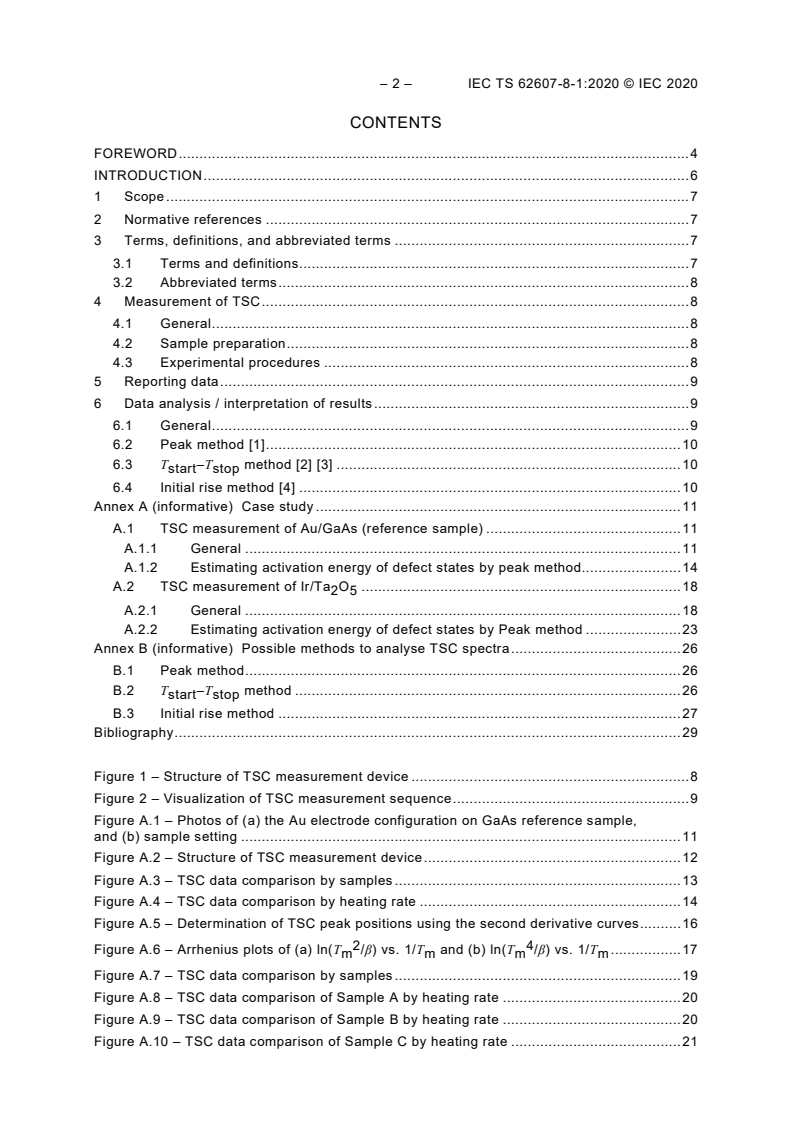
– 2 – IEC TS 62607-8-1:2020 © IEC 2020
CONTENTS
FOREWORD . 4
INTRODUCTION . 6
1 Scope . 7
2 Normative references . 7
3 Terms, definitions, and abbreviated terms . 7
3.1 Terms and definitions . 7
3.2 Abbreviated terms . 8
4 Measurement of TSC . 8
4.1 General . 8
4.2 Sample preparation . 8
4.3 Experimental procedures . 8
5 Reporting data . 9
6 Data analysis / interpretation of results . 9
6.1 General . 9
6.2 Peak method [1] . 10
6.3 T –T method [2] [3] . 10
start stop
6.4 Initial rise method [4] . 10
Annex A (informative) Case study . 11
A.1 TSC measurement of Au/GaAs (reference sample) . 11
A.1.1 General . 11
A.1.2 Estimating activation energy of defect states by peak method. 14
A.2 TSC measurement of Ir/Ta O . 18
2 5
A.2.1 General . 18
A.2.2 Estimating activation energy of defect states by Peak method . 23
Annex B (informative) Possible methods to analyse TSC spectra . 26
B.1 Peak method . 26
B.2 T –T method . 26
start stop
B.3 Initial rise method . 27
Bibliography . 29
Figure 1 – Structure of TSC measurement device . 8
Figure 2 – Visualization of TSC measurement sequence . 9
Figure A.1 – Photos of (a) the Au electrode configuration on GaAs reference sample,
and (b) sample setting . 11
Figure A.2 – Structure of TSC measurement device . 12
Figure A.3 – TSC data comparison by samples . 13
Figure A.4 – TSC data comparison by heating rate . 14
Figure A.5 – Determination of TSC peak positions using the second derivative curves . 16
2 4
Figure A.6 – Arrhenius plots of (a) ln(T /β) vs. 1/T and (b) ln(T /β) vs. 1/T . 17
m m m m
Figure A.7 – TSC data comparison by samples . 19
Figure A.8 – TSC data comparison of Sample A by heating rate . 20
Figure A.9 – TSC data comparison of Sample B by heating rate . 20
Figure A.10 – TSC data comparison of Sample C by heating rate . 21
Figure A.11 – TSC data comparison by carrier injection method (Samples A, B and C) . 22
Figure A.12 – Samples A, B and C: Determination of TSC peak positions using the
second derivative curves . 23
Figure A.13 – Arrhenius plots for TA1, Sample A . 24
Figure B.1 – Peak method . 26
Figure B.2 – T –T method . 27
start stop
Figure B.3 – Determination of trap level energy through initial rise method . 28
Table 1 – TSC measurement sequence steps and parameters . 9
Table A.1 – TSC measurement sequence steps and parameters / case study . 13
Table A.2 – Activation energies of T1 to T6 for y = ln (T /β) . 17
m
Table A.3 – Activation energies of T1 to T6 for y = ln (T /β) . 17
m
Table A.4 – TSC measurement sequence steps and parameters / case study (2) . 18
Table A.5 – Conditions of Ta O sputtering deposition . 19
2 5
Table A.6 – Activation energies of Samples A, B and C . 24
– 4 – IEC TS 62607-8-1:2020 © IEC 2020
INTERNATIONAL ELECTROTECHNICAL COMMISSION
____________
NANOMANUFACTURING –
KEY CONTROL CHARACTERISTICS –
Part 8-1: Nano-enabled metal-oxide interfacial devices –
Test method for defect states by thermally stimulated current
FOREWORD
1) The International Electrotechnical Commission (IEC) is a worldwide organization for standardization comprising
all national electrotechnical committees (IEC National Committees). The object of IEC is to promote international
co-operation on all questions concerning standardization in the electrical and electronic fields. To this end and
in addition to other activities, IEC publishes International Standards, Technical Specifications, Technical Reports,
Publicly Available Specifications (PAS) and Guides (hereafter referred to as “IEC Publication(s)”). Their
preparation is entrusted to technical committees; any IEC National Committee interested in the subject dealt with
may participate in this preparatory work. International, governmental and non-governmental organizations liaising
with the IEC also participate in this preparation. IEC collaborates closely with the International Organization for
Standardization (ISO) in accordance with conditions determined by agreement between the two organizations.
2) The formal decisions or agreements of IEC on technical matters express, as nearly as possible, an international
consensus of opinion on the relevant subjects since each technical committee has representation from all
interested IEC National Committees.
3) IEC Publications have the form of recommendations for international use and are accepted by IEC National
Committees in that sense. While all reasonable efforts are made to ensure that the technical content of IEC
Publications is accurate, IEC cannot be held responsible for the way in which they are used or for any
misinterpretation by any end user.
4) In order to promote international uniformity, IEC National Committees undertake to apply IEC Publications
transparently to the maximum extent possible in their national and regional publications. Any divergence between
any IEC Publication and the corresponding national or regional publication shall be clearly indicated in the latter.
5) IEC itself does not provide any attestation of conformity. Independent certification bodies provide conformity
assessment services and, in some areas, access to IEC marks of conformity. IEC is not responsible for any
services carried out by independent certification bodies.
6) All users should ensure that they have the latest edition of this publication.
7) No liability shall attach to IEC or its directors, employees, servants or agents including individual experts and
members of its technical committees and IEC National Committees for any personal injury, property damage or
other damage of any nature whatsoever, whether direct or indirect, or for costs (including legal fees) and
expenses arising out of the publication, use of, or reliance upon, this IEC Publication or any other IEC Publications.
8) Attention is drawn to the Normative references cited in this publication. Use of the referenced publications is
indispensable for the correct application of this publication.
9) Attention is drawn to the possibility that some of the elements of this IEC Publication may be the subject of patent
rights. IEC shall not be held responsible for identifying any or all such patent rights.
The main task of IEC technical committees is to prepare International Standards. In exceptional
circumstances, a technical committee may propose the publication of a Technical Specification
when
• the required support cannot be obtained for the publication of an International Standard,
despite repeated efforts, or
• the subject is still under technical development or where, for any other reason, there is the
future but no immediate possibility of an agreement on an International Standard.
Technical Specifications are subject to review within three years of publication to decide
whether they can be transformed into International Standards.
IEC TS 62607-8-1, which is a Technical Specification, has been prepared by IEC technical
committee 113: Nanotechnology for electrotechnical products and systems.
The text of this Technical Specification is based on the following documents:
DTS Report on voting
113/493/DTS 113/510/RVDTS
Full information on the voting for the approval of this Technical Specification can be found in
the report on voting indicated in the above table.
This publication has been drafted in accordance with the ISO/IEC Directives, Part 2.
A list of all parts in the IEC 62607 series, published under the general title Nanomanufacturing –
Key control characteristics, can be found on the IEC website.
The committee has decided that the contents of this publication will remain unchanged until the
stability date indicated on the IEC website under "http://webstore.iec.ch" in the data related to
the specific publication. At this date, the publication will be
• reconfirmed,
• withdrawn,
• replaced by a revised edition, or
• amended.
IMPORTANT – The 'colour inside' logo on the cover page of this publication indicates
that it contains colours which are considered to be useful for the correct understanding
of its contents. Users should therefore print this document using a colour printer.
– 6 – IEC TS 62607-8-1:2020 © IEC 2020
INTRODUCTION
Thermally stimulated current (TSC) measurement has been a simple and widely used method
to get information about charge trapping and electric polarization phenomena of various
materials such as dielectrics, ferroelectrics, semiconductors, ceramics, plastics, and other
organic materials for the past several decades. Recently, TSC measurement has been
recognized as a versatile tool to evaluate defect states and structures in advanced electronic
materials including nano-enabled materials and devices. The defect states in devices such as
metal-oxide interfacial devices, C-60 FETs, organic LEDs and emerging photovoltaic cells act
as charge carrier traps influencing their performance and reliability. As such, a standardized
protocol for TSC measurement will be useful to add validity of the experimental data for the
purposes of productization of nano-enabled materials and devices. The reference sample for
the reproducible TSC measurement is also required.
This document offers a measurement method to be developed for determining defect states of
nano-enabled metal-oxide interfacial devices, which is suitable for evaluating the electronic
state even though the resistance of the device changes widely.
NANOMANUFACTURING –
KEY CONTROL CHARACTERISTICS –
Part 8-1: Nano-enabled metal-oxide interfacial devices –
Test method for defect states by thermally stimulated current
1 Scope
There are two types of thermally stimulated current (TSC) measurement methods, classified by
the origin of the current. One is generated by the detrapping of charges. The other one is
generated by depolarization. This part of IEC 62607 focuses on the former method, and
specifies the measurement method to be developed for determining defect states of nano-
enabled metal-oxide interfacial devices.
This document includes:
– outlines of the experimental procedures used to measure TSC,
– methods of interpretation of results and discussion of data analysis, and
– case studies.
2 Normative references
The following documents are referred to in the text in such a way that some or all of their content
constitutes requirements of this document. For dated references, only the edition cited applies.
For undated references, the latest edition of the referenced document (including any
amendments) applies.
ISO/TS 80004-1, Nanotechnologies – Vocabulary – Part 1: Core terms
3 Terms, definitions, and abbreviated terms
3.1 Terms and definitions
For the purposes of this document, the terms and definitions given in ISO/TS 80004-1 and the
following apply.
ISO and IEC maintain terminological databases for use in standardization at the following
addresses:
• IEC Electropedia: available at http://www.electropedia.org/
• ISO Online browsing platform: available at http://www.iso.org/obp
3.1.1
device under test
DUT
representative sample device used in testing
[SOURCE: IEC 62876-2-1:2018, 3.1.2, modified – In the definition, the word "sample" has been
added.]
– 8 – IEC TS 62607-8-1:2020 © IEC 2020
3.1.2
thermally stimulated current
TSC
current flowing through an external circuit connecting to DUT, originated from the electricity
trapped at low temperature and released due to raising temperature
3.2 Abbreviated terms
DUT device under test
sccm standard cubic centimetres per minute
TSC thermally stimulated current
GaAs gallium arsenide
Ta O ditantalum pentaoxide, tantalum oxide
2 5
4 Measurement of TSC
4.1 General
The typical test set-up for measuring TSC is shown in Figure 1.
Figure 1 – Structure of TSC measurement device
Temperature dependence of TSC value shall be expressed by plotting TSC (A) on the ordinate
against temperature on the abscissa.
4.2 Sample preparation
TSC signal is very sensitive to physical and chemical conditions at the sample/electrode
interface. The surface preparation before the electrode formation process should be mentioned
in the standardization protocol, as shown in Figure 1 and Table 1.
4.3 Experimental procedures
• Step 1: Conditioning (Pre-treatment conditions) – Restore the sample to a state where all
trapped charges are released.
• Step 2: Cooling – Cool the sample to the trapping temperature.
• Step 3: Holding time – Keep the sample at the trapping temperature to stabilize the sample
condition.
• Step 4: Trapping – Done by optical injection or voltage injection, or a combination of both.
• Step 5: Measurement – Measure TSC while heating up to the targeted end temperature.
• Step 6: Ending (Post-measurement treatment) – Set back to the room temperature before
taking the sample out from the sample chamber.
Figure 2 – Visualization of TSC measurement sequence
Table 1 – TSC measurement sequence steps and parameters
Step Parameter 1 Parameter 2 Parameter 3 Parameter 4
Conditioning (Pre- Conditioning Holding time Releasing
measurement treatment) temperature voltage
Cooling Trapping Cooling rate
temperature
3 Hold Holding time
Trapping (photoexcitation) Wavelength Light irradiation Holding time Discharge time
(bandpass filter) time
Trapping (Voltage/Current Applied voltage Current Holding time Discharge time
injection)
Measurement End Heating rate Collecting
temperature voltage
Ending (Post-measurement Target Heating rate Holding time
treatment) temper
...