


IEC 61918:2007/COR1:2009
(Corrigendum)Corrigendum 1 - Industrial communication networks - Installation of communication networks in industrial premises
General Information
- Abstract
Applies to insulating poles (insulating sticks), and tool attachments (fittings) and is divided into three chapters. Chapter I: Specifies the required characteristics for insulating poles with permanently attached fittings and the tests (electrical and mechanical) which should be satisfied by these tools. Chapter II: Specifies the required characteristics for parts which may be attached to and detached from the ends of poles described in Chapter I, and the tests which should be satisfied by these tools. Chapter III: Specifies the special clauses, applicable to insulating poles and universal tool attachments.[
]The contents of the corrigendum of May 2000 have been included in this copy.
- Status
- Published
- Publication Date
- 10-Feb-2009
- Technical Committee
- SC 65C - Industrial networks
- Current Stage
- DELPUB - Deleted Publication
- Start Date
- 22-Jul-2010
- Completion Date
- 28-Aug-2026

Relations
- Effective Date
- 05-Sep-2023
- Effective Date
- 05-Sep-2023
Get Certified
Connect with accredited certification bodies for this standard

BSI Group
BSI (British Standards Institution) is the business standards company that helps organizations make excellence a habit.

DVS-ZERT GmbH
German welding certification society.

IMQ S.p.A. (Certification)
Italian electrical product certification.
Sponsored listings
Frequently Asked Questions
IEC 61918:2007/COR1:2009 is a standard published by the International Electrotechnical Commission (IEC). Its full title is "Corrigendum 1 - Industrial communication networks - Installation of communication networks in industrial premises". This standard covers: Applies to insulating poles (insulating sticks), and tool attachments (fittings) and is divided into three chapters. Chapter I: Specifies the required characteristics for insulating poles with permanently attached fittings and the tests (electrical and mechanical) which should be satisfied by these tools. Chapter II: Specifies the required characteristics for parts which may be attached to and detached from the ends of poles described in Chapter I, and the tests which should be satisfied by these tools. Chapter III: Specifies the special clauses, applicable to insulating poles and universal tool attachments.[<BR>]The contents of the corrigendum of May 2000 have been included in this copy.
Applies to insulating poles (insulating sticks), and tool attachments (fittings) and is divided into three chapters. Chapter I: Specifies the required characteristics for insulating poles with permanently attached fittings and the tests (electrical and mechanical) which should be satisfied by these tools. Chapter II: Specifies the required characteristics for parts which may be attached to and detached from the ends of poles described in Chapter I, and the tests which should be satisfied by these tools. Chapter III: Specifies the special clauses, applicable to insulating poles and universal tool attachments.[<BR>]The contents of the corrigendum of May 2000 have been included in this copy.
IEC 61918:2007/COR1:2009 is classified under the following ICS (International Classification for Standards) categories: 13.260 - Protection against electric shock. Live working; 25.040.40 - Industrial process measurement and control; 29.240.20 - Power transmission and distribution lines; 29.260.99 - Other electrical equipment for working in special conditions; 33.180.01 - Fibre optic systems in general; 35.110 - Networking. The ICS classification helps identify the subject area and facilitates finding related standards.
IEC 61918:2007/COR1:2009 has the following relationships with other standards: It is inter standard links to IEC 61918:2007, IEC 61918:2010. Understanding these relationships helps ensure you are using the most current and applicable version of the standard.
IEC 61918:2007/COR1:2009 is available in PDF format for immediate download after purchase. The document can be added to your cart and obtained through the secure checkout process. Digital delivery ensures instant access to the complete standard document.
Standards Content (Sample)
IEC 61918
(First edition – 2007)
INDUSTRIAL COMMUNICATION NETWORKS –
Installation of communication networks in industrial premises
CORRIGENDUM 1
4.4.3.4.1 Common description
In the list after the equation, instead of:
“I is the number of connections in the channel;”
Read:
“i is the number of connections in the channel;”
In the list after the equation, instead of:
“J is the number of splices in the channel;”
Read:
“j is the number of splices in the channel;”
4.4.8.2 Specific requirements for CPs
Instead of:
“Additional information regarding earthing and shielding requirements….”
Read:
“Additional information regarding storage and transportation requirements….”
5.2.1.2 Protecting communication cables against potential mechanical damage
Table 17 – Parameters for balanced cables
In the fifth row below the table heading “Characteristic” of Table 17, instead of:
“Maximum lateral forces (N)”
Read:
“Maximum lateral forces (N/cm)”
February 2009
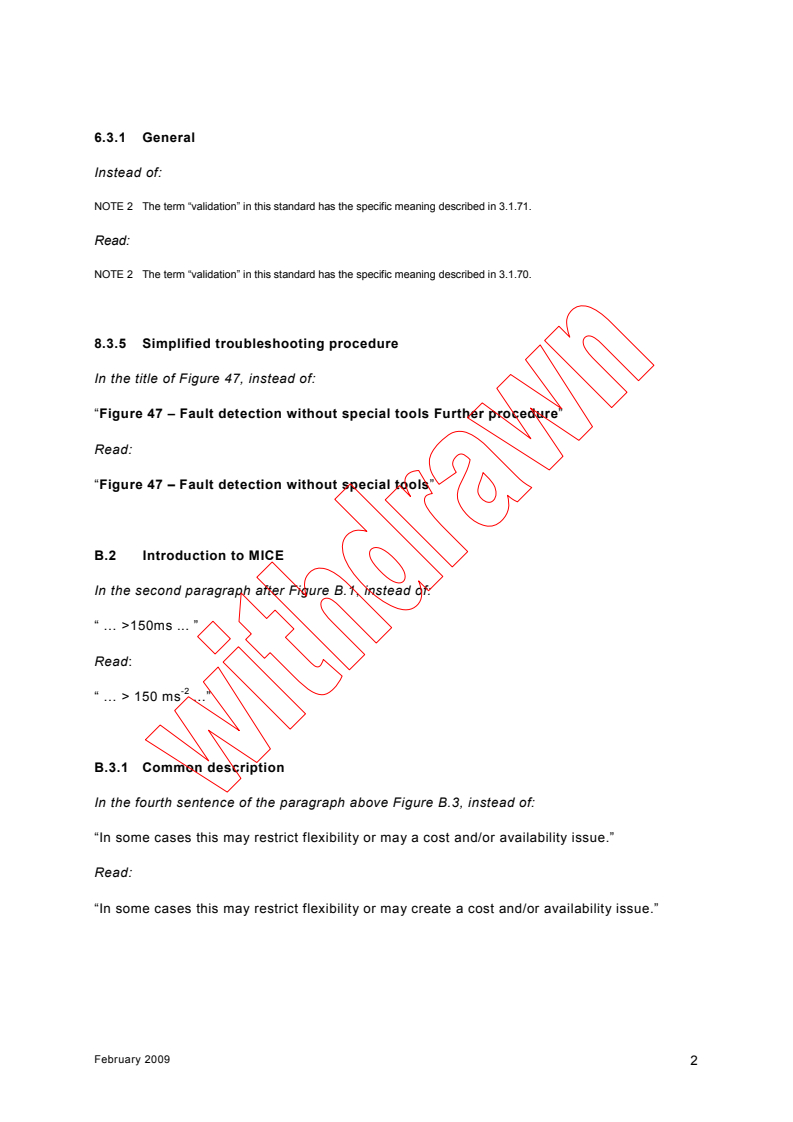
6.3.1 General
Instead of:
NOTE 2 The term “validation” in this standard has the specific meaning described in 3.1.71.
Read:
NOTE 2 The term “validation” in this standard has the specific meaning described in 3.1.70.
8.3.5 Simplified troubleshooting procedure
In the title of Figure 47, instead of:
“Figure 47 – Fault detection without special tools Further procedure”
Read:
“Figure 47 – Fault detection without special tools”
B.2 Introduction to MICE
In the second paragraph after Figure B.1, instead of:
“ … >150ms . ”
Read:
-2
“ … > 150 ms …”
B.3.1 Common description
In the fourth sentence of the paragraph above Figure B.3, instead of:
“In some cases this may restrict flexibility or may a cost and/or availability issue.”
Read:
“In some cases this may restrict flexibility or may create a cost and/or availability issue.”
February 2009
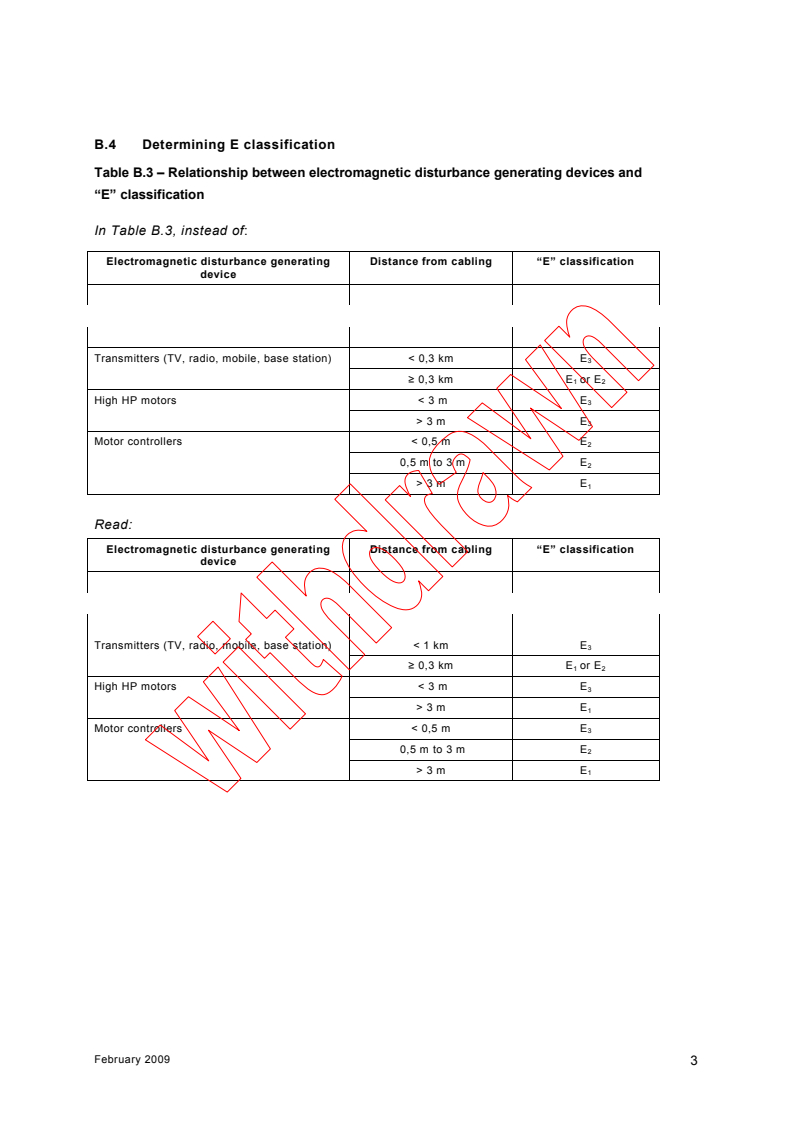
B.4 Determining E classification
Table B.3 – Relationship between electromagnetic disturbance generating devices and
“E” classification
In Table B.3, instead of:
Electromagnetic disturbance generating Distance from cabling “E” classification
device
Transmitters (TV, radio, mobile, base station) < 0,3 km E
≥ 0,3 km E or E
1 2
High HP motors < 3 m E
> 3 m E
Motor controllers < 0,5 m E
0,5 m to 3 m E2
> 3 m E
Read:
Electromagnetic disturbance generating Distance from cabling “E” classification
device
Transmitters (TV, radio, mobile, base station) < 1 km E
≥ 0,3 km E or E
1 2
High HP motors < 3 m E3
> 3 m E
Motor controllers < 0,5 m E
0,5 m to 3 m E
> 3 m E
February 2009
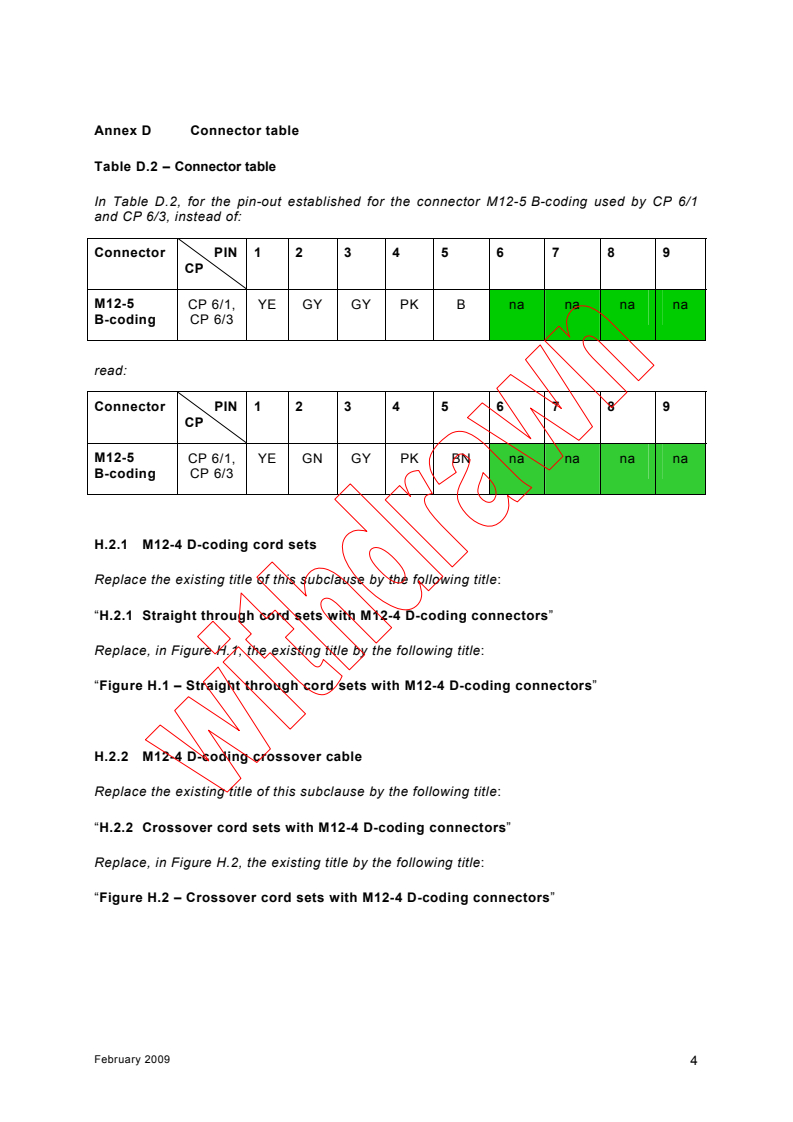
Annex D Connector table
Table D.2 – Connector table
In Table D.2, for the pin
...