

IEC SRD 63301-2:2025
(Main)Smart city use case collection and analysis - Water systems in smart cities - Part 2 : Use case analysis
General Information
- Abstract
IEC SRD 63301-2:2025 This part develops use cases based on user stories, which are to be arranged in database for analysis, so as to scope out standard requirements, specifically electro-technical standards for IEC and other Standard Development Organizations (SDOs) regarding water management.
- Status
- Published
- Publication Date
- 16-Sep-2025
- Technical Committee
- SyC Smart Cities - Electrotechnical aspects of Smart Cities
- Drafting Committee
- WG 2 - SyC Smart Cities/WG 2
- Current Stage
- PPUB - Publication issued
- Start Date
- 17-Sep-2025
- Completion Date
- 03-Oct-2025
Overview
IEC SRD 63301-2:2025 - "Smart city use case collection and analysis - Water systems in smart cities - Part 2: Use case analysis" is a Systems Reference Deliverable from the IEC Smart Cities committee. This part develops structured use cases derived from user stories, organized into a database for analysis to scope out standard requirements - in particular electro-technical standards for IEC and other Standard Development Organizations (SDOs) related to urban water management. The document supports harmonized, standards-based approaches to water security, supply resilience, drainage, flood prevention and integrated urban water-cycle operations in smart cities.
Key topics
The standard focuses on practical, analytical elements rather than prescriptive technical specifications. Major topics covered include:
- Use case stratification: business cases, high-level use cases (HLUCs) and specialized use cases.
- Use case analysis approach: methods to transform user stories into analysable use cases and database entries.
- Use case derivation across water domains:
- Water resource protection and preservation
- Robust water supply
- Water drainage systems
- Resilience-based urban flood prevention and control
- Flood management, control and relief
- Integrated urban water cycle management
- Intelligent manhole cover monitoring systems
- User stories and coding: standardized formats and coding for consistent capture.
- Application of the analysis: translating use case outputs into a standards hierarchy and standard recommendations (business, technology, management, service standards).
- Alignment with higher-level goals such as the UN Sustainable Development Goal 6 (water and sanitation).
Applications
IEC SRD 63301-2:2025 is intended to be a practical tool for:
- Scoping and prioritizing electro-technical standard requirements for water systems in smart cities.
- Building use-case databases to inform requirements engineering, interoperability and conformity assessment.
- Supporting the development of technical specifications and guidance for sensing, control, communications and management systems used in urban water infrastructures.
- Informing resilience planning for water supply, drainage and flood mitigation across municipal and regional programs.
Who should use this standard
- National and international standard developers and SDOs seeking harmonized requirements.
- City planners, municipal water utilities and infrastructure operators designing smart water programs.
- Systems integrators, solution architects and vendors of ICT/electrotechnical products for water management.
- Policy makers, researchers and consultants working on urban resilience, sustainability and SDG6 implementation.
Related standards
- Part of the IEC 63301 series: consult the series index for complementary parts.
- Intended to inform other IEC electrotechnical standards and cross-sector SDO workstreams on smart city water management.
Keywords: IEC SRD 63301-2:2025, smart city, water systems, use case analysis, water management, electro-technical standards, user stories, standard requirements.
Get Certified
Connect with accredited certification bodies for this standard

BSI Group
BSI (British Standards Institution) is the business standards company that helps organizations make excellence a habit.

Bureau Veritas
Bureau Veritas is a world leader in laboratory testing, inspection and certification services.

DNV
DNV is an independent assurance and risk management provider.
Sponsored listings
Frequently Asked Questions
IEC SRD 63301-2:2025 is a standardization document published by the International Electrotechnical Commission (IEC). Its full title is "Smart city use case collection and analysis - Water systems in smart cities - Part 2 : Use case analysis". This standard covers: IEC SRD 63301-2:2025 This part develops use cases based on user stories, which are to be arranged in database for analysis, so as to scope out standard requirements, specifically electro-technical standards for IEC and other Standard Development Organizations (SDOs) regarding water management.
IEC SRD 63301-2:2025 This part develops use cases based on user stories, which are to be arranged in database for analysis, so as to scope out standard requirements, specifically electro-technical standards for IEC and other Standard Development Organizations (SDOs) regarding water management.
IEC SRD 63301-2:2025 is classified under the following ICS (International Classification for Standards) categories: 03.100.70 - Management systems; 13.020.20 - Environmental economics. Sustainability; 91.140.60 - Water supply systems. The ICS classification helps identify the subject area and facilitates finding related standards.
IEC SRD 63301-2:2025 is available in PDF format for immediate download after purchase. The document can be added to your cart and obtained through the secure checkout process. Digital delivery ensures instant access to the complete standard document.
Standards Content (Sample)
IEC SRD 63301-2 ®
Edition 1.0 2025-09
SYSTEMS REFERENCE
DELIVERABLE
Smart city use case collection and analysis - Water systems in smart cities -
Part 2 : Use case analysis
ICS 13.020.20; 91.140.60; 03.100.70 ISBN 978-2-8327-0709-8
All rights reserved. Unless otherwise specified, no part of this publication may be reproduced or utilized in any form or
by any means, electronic or mechanical, including photocopying and microfilm, without permission in writing from either
IEC or IEC's member National Committee in the country of the requester. If you have any questions about IEC copyright
or have an enquiry about obtaining additional rights to this publication, please contact the address below or your local
IEC member National Committee for further information.
IEC Secretariat Tel.: +41 22 919 02 11
3, rue de Varembé info@iec.ch
CH-1211 Geneva 20 www.iec.ch
Switzerland
About the IEC
The International Electrotechnical Commission (IEC) is the leading global organization that prepares and publishes
International Standards for all electrical, electronic and related technologies.
About IEC publications
The technical content of IEC publications is kept under constant review by the IEC. Please make sure that you have the
latest edition, a corrigendum or an amendment might have been published.
IEC publications search - IEC Products & Services Portal - products.iec.ch
webstore.iec.ch/advsearchform Discover our powerful search engine and read freely all the
The advanced search enables to find IEC publications by a
publications previews, graphical symbols and the glossary.
variety of criteria (reference number, text, technical With a subscription you will always have access to up to date
committee, …). It also gives information on projects, content tailored to your needs.
replaced and withdrawn publications.
Electropedia - www.electropedia.org
IEC Just Published - webstore.iec.ch/justpublished The world's leading online dictionary on electrotechnology,
Stay up to date on all new IEC publications. Just Published containing more than 22 500 terminological entries in English
details all new publications released. Available online and and French, with equivalent terms in 25 additional languages.
once a month by email. Also known as the International Electrotechnical Vocabulary
(IEV) online.
IEC Customer Service Centre - webstore.iec.ch/csc
If you wish to give us your feedback on this publication or
need further assistance, please contact the Customer
Service Centre: sales@iec.ch.
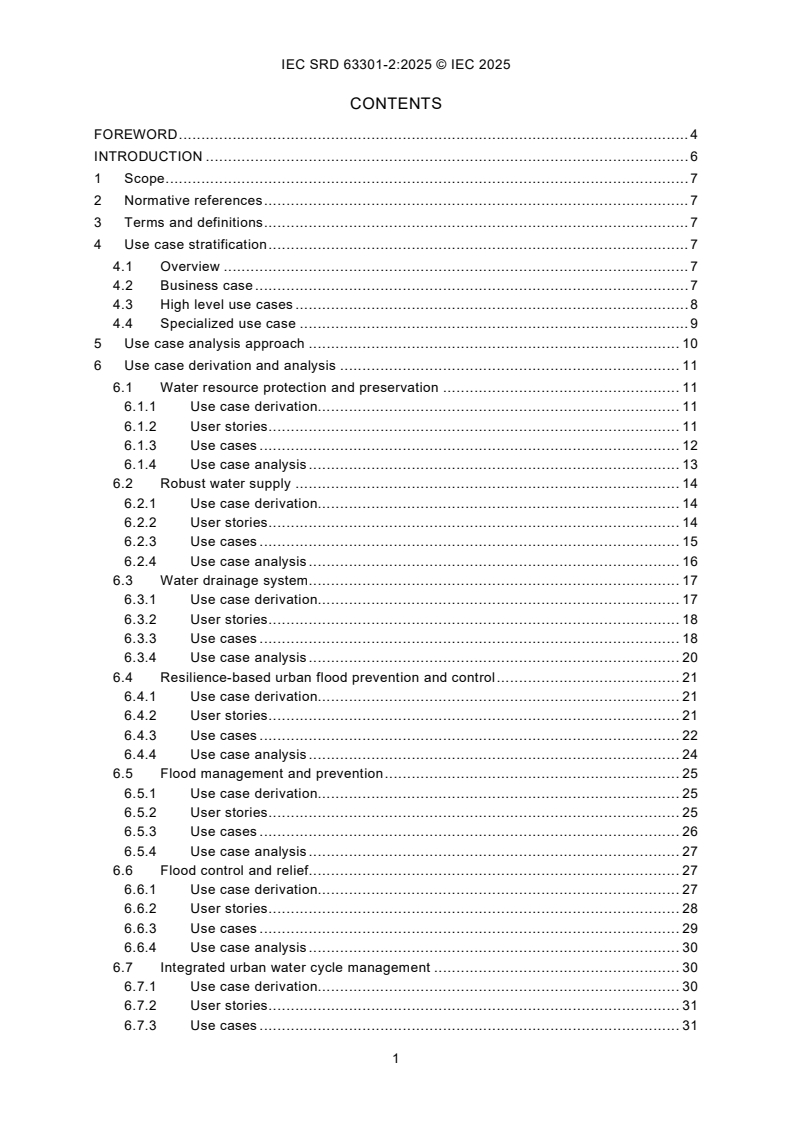
CONTENTS
FOREWORD . 4
INTRODUCTION . 6
1 Scope . 7
2 Normative references . 7
3 Terms and definitions . 7
4 Use case stratification . 7
4.1 Overview . 7
4.2 Business case . 7
4.3 High level use cases . 8
4.4 Specialized use case . 9
5 Use case analysis approach . 10
6 Use case derivation and analysis . 11
6.1 Water resource protection and preservation . 11
6.1.1 Use case derivation. 11
6.1.2 User stories . 11
6.1.3 Use cases . 12
6.1.4 Use case analysis . 13
6.2 Robust water supply . 14
6.2.1 Use case derivation. 14
6.2.2 User stories . 14
6.2.3 Use cases . 15
6.2.4 Use case analysis . 16
6.3 Water drainage system . 17
6.3.1 Use case derivation. 17
6.3.2 User stories . 18
6.3.3 Use cases . 18
6.3.4 Use case analysis . 20
6.4 Resilience-based urban flood prevention and control . 21
6.4.1 Use case derivation. 21
6.4.2 User stories . 21
6.4.3 Use cases . 22
6.4.4 Use case analysis . 24
6.5 Flood management and prevention . 25
6.5.1 Use case derivation. 25
6.5.2 User stories . 25
6.5.3 Use cases . 26
6.5.4 Use case analysis . 27
6.6 Flood control and relief. 27
6.6.1 Use case derivation. 27
6.6.2 User stories . 28
6.6.3 Use cases . 29
6.6.4 Use case analysis . 30
6.7 Integrated urban water cycle management . 30
6.7.1 Use case derivation. 30
6.7.2 User stories . 31
6.7.3 Use cases . 31
6.7.4 Use case analysis . 32
6.8 Intelligent manhole cover monitoring system. 33
6.8.1 Use case derivation. 33
6.8.2 User stories . 33
6.8.3 Use cases . 34
6.8.4 Use case analysis . 35
7 Application of the analysis . 36
7.1 General . 36
7.2 Standard hierarchy . 36
7.3 Standard recommendations . 36
7.3.1 Business standards . 36
7.3.2 Technology standards . 37
7.3.3 Management standards . 37
7.3.4 Service standards . 38
Annex A (informative) United Nations Sustainable Development Goal 6: Ensure
availability and sustainable management of water and sanitation for all. 39
Bibliography . 40
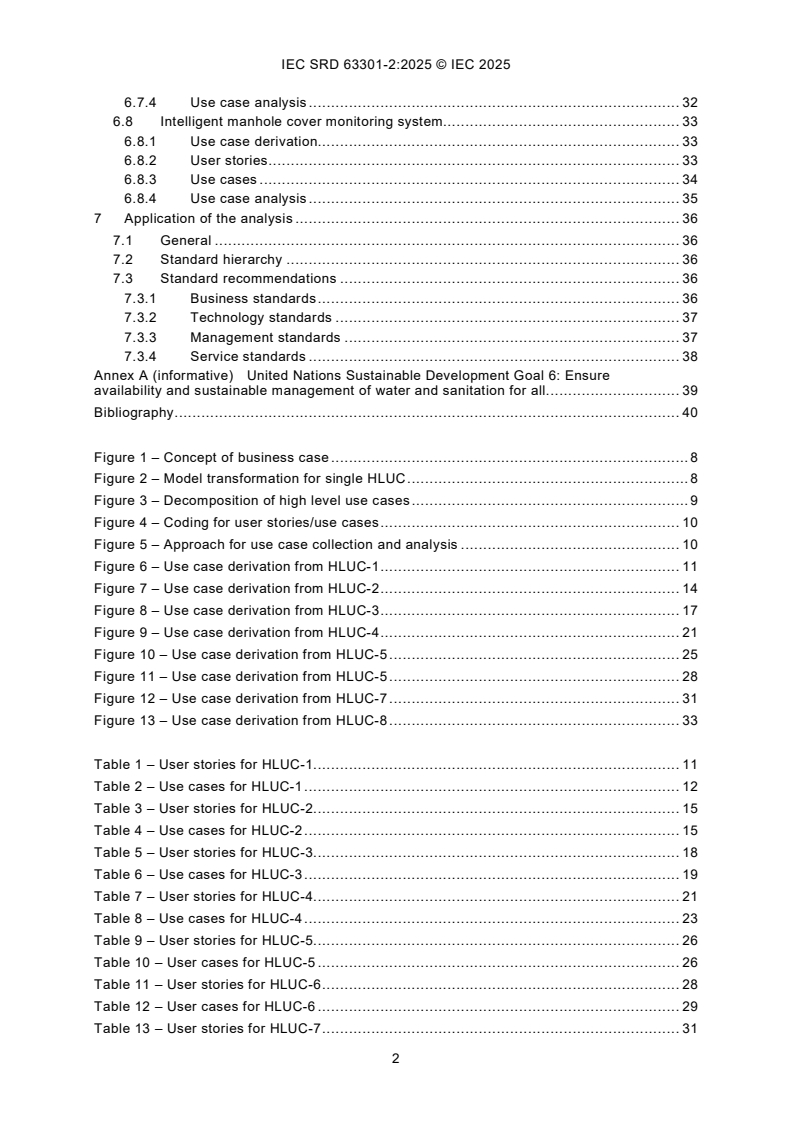
Figure 1 – Concept of business case . 8
Figure 2 – Model transformation for single HLUC . 8
Figure 3 – Decomposition of high level use cases . 9
Figure 4 – Coding for user stories/use cases . 10
Figure 5 – Approach for use case collection and analysis . 10
Figure 6 – Use case derivation from HLUC-1 . 11
Figure 7 – Use case derivation from HLUC-2 . 14
Figure 8 – Use case derivation from HLUC-3 . 17
Figure 9 – Use case derivation from HLUC-4 . 21
Figure 10 – Use case derivation from HLUC-5 . 25
Figure 11 – Use case derivation from HLUC-5 . 28
Figure 12 – Use case derivation from HLUC-7 . 31
Figure 13 – Use case derivation from HLUC-8 . 33
Table 1 – User stories for HLUC-1. 11
Table 2 – Use cases for HLUC-1 . 12
Table 3 – User stories for HLUC-2. 15
Table 4 – Use cases for HLUC-2 . 15
Table 5 – User stories for HLUC-3. 18
Table 6 – Use cases for HLUC-3 . 19
Table 7 – User stories for HLUC-4. 21
Table 8 – Use cases for HLUC-4 . 23
Table 9 – User stories for HLUC-5. 26
Table 10 – User cases for HLUC-5 . 26
Table 11 – User stories for HLUC-6 . 28
Table 12 – User cases for HLUC-6 . 29
Table 13 – User stories for HLUC-7 . 31
Table 14 – User cases for HLUC-7 . 32
Table 15 – User stories for HLUC-8 . 34
Table 16 – User cases for HLUC8 . 34
Table A.1 – Targets and indicators for UN SDG 6 . 39
INTERNATIONAL ELECTROTECHNICAL COMMISSION
____________
Smart city use case collection and analysis -
Water systems in smart cities -
Part 2: Use case analysis
FOREWORD
1) The International Electrotechnical Commission (IEC) is a worldwide organization for standardization comprising
all national electrotechnical committees (IEC National Committees). The object of IEC is to promote international
co-operation on all questions concerning standardization in the electrical and electronic fields. To this end and
in addition to other activities, IEC publishes International Standards, Technical Specifications, Technical Reports,
Publicly Available Specifications (PAS) and Guides (hereafter referred to as “IEC Publication(s)”). Their
preparation is entrusted to technical committees; any IEC National Committee interested in the subject dealt with
may participate in this preparatory work. International, governmental and non-governmental organizations liaising
with the IEC also participate in this preparation. IEC collaborates closely with the International Organization for
Standardization (ISO) in accordance with conditions determined by agreement between the two organizations.
2) The formal decisions or agreements of IEC on technical matters express, as nearly as possible, an international
consensus of opinion on the relevant subjects since each technical committee has representation from all
interested IEC National Committees.
3) IEC Publications have the form of recommendations for international use and are accepted by IEC National
Committees in that sense. While all reasonable efforts are made to ensure that the technical content of IEC
Publications is accurate, IEC cannot be held responsible for the way in which they are used or for any
misinterpretation by any end user.
4) In order to promote international uniformity, IEC National Committees undertake to apply IEC Publications
transparently to the maximum extent possible in their national and regional publications. Any divergence between
any IEC Publication and the corresponding national or regional publication shall be clearly indicated in the latter.
5) IEC itself does not provide any attestation of conformity. Independent certification bodies provide conformity
assessment services and, in some areas, access to IEC marks of conformity. IEC is not responsible for any
services carried out by independent certification bodies.
6) All users should ensure that they have the latest edition of this publication.
7) No liability shall attach to IEC or its directors, employees, servants or agents including individual experts and
members of its technical committees and IEC National Committees for any personal injury, property damage or
other damage of any nature whatsoever, whether direct or indirect, or for costs (including legal fees) and
expenses arising out of the publication, use of, or reliance upon, this IEC Publication or any other IEC
Publications.
8) Attention is drawn to the Normative references cited in this publication. Use of the referenced publications is
indispensable for the correct application of this publication.
9) IEC draws attention to the possibility that the implementation of this document may involve the use of (a)
patent(s). IEC takes no position concerning the evidence, validity or applicability of any claimed patent rights in
respect thereof. As of the date of publication of this document, IEC had not received notice of (a) patent(s), which
may be required to implement this document. However, implementers are cautioned that this may not represent
the latest information, which may be obtained from the patent database available at https://patents.iec.ch. IEC
shall not be held responsible for identifying any or all such patent rights.
IEC SRD 63301-2 has been prepared by IEC systems committee Smart Cities: Electrotechnical
aspects of Smart Cities. It is a Systems Reference Deliverable.
The text of this Systems Reference Deliverable is based on the following documents:
Draft Report on voting
SyCSmartCities/382/DTS SyCSmartCities/392/RVDTS
Full information on the voting for its approval can be found in the report on voting indicated in
the above table.
The language used for the development of this Systems Reference Deliverable is English.
A list of all parts in the IEC 63301 series, published under the general title Smart city use case
collection and analysis – Water systems in smart cities, can be found on the IEC website.
This document was drafted in accordance with ISO/IEC Directives, Part 2, and developed in
accordance with ISO/IEC Directives, Part 1 and ISO/IEC Directives, IEC Supplement, available
at www.iec.ch/members_experts/refdocs. The main document types developed by IEC are
described in greater detail at www.iec.ch/publications.
The committee has decided that the contents of this document will remain unchanged until the
stability date indicated on the IEC website under webstore.iec.ch in the data related to the
specific document. At this date, the document will be
– reconfirmed,
– withdrawn, or
– revised.
INTRODUCTION
The construction of a smart city can create benefits for a society and its stakeholders. Water is
a critical resource to support urban development and its sustainable use is recognised as a
United Nations Sustainability Goal. Water infrastructure development, water management
efficiency, water supply resilience, and the safe operation and use of water are important focal
areas for IEC systems committee Smart Cities.
This document focuses on water systems management, specifically water security whether
directly from a natural source or via man-made infrastructure. Information communication
technologies (ICT) and electrotechnologies can provide greater visibility and control, however
its application does depend on the characteristics of individual water markets. Technology is
not a panacea for resolving all issues and problems.
A gap exists in effective coordination and clear orientation and how industry and stakeholders
are engaged within it.
Major stakeholders of water management and use include citizens, the water authority
(government), and organisations (associations, business groups, utility companies). Each
stakeholder has different and competing interests, market relationships and touch points to
water system infrastructure, processes, operations, management and use.
Modelling these complex interactions into a systems architecture is a valuable exercise in
understanding the issues, gaps and opportunities for sustainable water management.
This document focuses on use case collection and analysis to elicit requirements to support
technical committees such as ISO/TC 224 and ISO/TC 147 in preparing sustainable water
management standards for our cities and communities.
This document also seeks to inform IEC technical committees to enable them to provide the
technical standards needed.
The IEC SRD 63301 series contains two parts:
– IEC SRD 63301-1: Smart city use case collection and analysis – Water systems in smart
cities – Part 1: High-level analysis;
– IEC SRD 63301-2: Smart city use case collection and analysis – Water systems in smart
cities – Part 2: Use case analysis.
This document is IEC SRD 63301-2, i.e. the use case analysis. This document aims to develop
the list of user stories and the database of use cases, conduct integrative analyses of the use
cases, scope out the requirements of water system standards and provide recommendations
for IEC and other Standard Development Organizations (SDOs).
1 Scope
This part of IEC SRD 63301 develops the list of user stories and the database of use cases,
conducts integrative analyses of the use cases, defines the requirements of water system
standards and provides recommendations for IEC and other Standard Development
Organizations (SDOs).
2 Normative references
The following documents are referred to in the text in such a way that some or all of their content
constitutes requirements of this document. For dated references, only the edition cited applies.
For undated references, the latest edition of the referenced document (including any
amendments) applies.
IEC SRD 63301-1, Smart city use case collection and analysis - Water systems in smart cities -
Part 1: High-level analysis
3 Terms and definitions
For the purposes of this document, the terms and definitions given in IEC SRD 63301-1 and the
following apply.
ISO and IEC maintain terminology databases for use in standardization at the following
addresses:
– IEC Electropedia: available at https://www.electropedia.org/
– ISO Online browsing platform: available at https://www.iso.org/obp
3.1
domain
area of knowledge or activity characterized by a set of concepts and terminology understood
by practitioners in that area
EXAMPLE Taken from Smart Grid/energy system area: generation, transmission, distribution, customer.
Note 1 to entry: Major areas of similar technologies and organizational backgrounds for some of the energy system
domains are suggested in this document as examples throughout this document.
[SOURCE: ISO/IEC 19501:2005, Glossary, modified – Example and Note added.]
4 Use case stratification
4.1 Overview
Use cases are collected and arranged according to different abstraction levels, including
business cases, high level use cases, and specialized use cases. IEC SRD 63301-1 established
business cases and high level cases, based on which this document focuses on use case
analysis building on specialized use cases supported by user stories.
4.2 Business case
A business case comes into being when something unites different actors (stakeholders) with
respective business goals. Actors involved in business cases can be further broken down to
logical actors that are engaged in HLUCs (high level use cases), see Figure 1.
Figure 1 – Concept of business case
This IEC SRD 63301 series identifies three major business cases around the lifecycle of water
systems, including natural water preservation, water supply security, and water recycle
promotion.
Business cases are converted into need statements for HLUC.
4.3 High level use cases
A high level use case (HLUC) describes a general requirement, idea or concept independently
from a specific technical realization, such as an architectural solution. High level use cases can
be derived from business cases through model transformation, in which business actors
involved in business cases are transformed into logical actors that are interpreted as logical
entities involved in a particular HLUC. See Figure 2 for an example.
Figure 2 – Model transformation for single HLUC
HLUC covers functionality necessary to fulfil the originating business case.
IEC SRD 63301-1 elaborates on eight major HLUCs, and gives a high level analysis.
4.4 Specialized use case
HLUC usually describes an innovative, abstract function but the actual technical implementation
is not dealt with. On this basis, specialized use cases can be developed and explain a tangible
elaboration of the technical aspects.
Based on the model transformation, the HLUC can be broken down into specialized use cases.
See Figure 3 for an example.
Figure 3 – Decomposition of high level use cases
The specialized use case can be derived from user stories which perform as the prototypes.
The user stories centre on a statement explaining what the stakeholders are supposed to do,
and what they need, under certain circumstances. For example, the structure is as follows:
“As a municipal government officer, when I am monitoring the water supply and water intake in
the city, I need to collect monitoring data on the quantity and quality of water in the water
storage reservoir and water inlet. I can thereby have a comprehensive and intuitive grasp of the
city's water resources.” (In details) to be more specific.
The key word is “As a” (Title), “when I am” (Situation), “I need to” (Motivation), “so that”
(Outcome).
Building on user stories, each use case follows the IEC short use case template
(IEC TR 62559-1:2019, IEC 62559-2:2015 and IEC 62559-3:2017), which includes the name of
the use case, scope/objective, narrative, and list of actors. The actors include human and
non-human actors. The main stakeholder is the first actor in each use case.
Use stories and use cases are coded in such a manner as shown in Figure 4.
Figure 4 – Coding for user stories/use cases
5 Use case analysis approach
A top-down approach is adopted in the process of use case collection and analysis concerned
in this document, following the general methodology set forth by IEC 62559. See Figure 5.
At the beginning of use case collection and analysis, a thorough study of water system is
needed, the purposes of the work of system study include identifying sub-systems, identifying
basic stakeholder needs, and forming materials for sub-system analysis as use case prototypes.
Use case building starts from breaking down stakeholder needs, and developing use cases
using the templates.
Use cases can be arranged in a database, relying on which, a set of common requirements can
be identified for water systems so as to scope out a family of standards.
Figure 5 – Approach for use case collection and analysis
IEC SRD 63301-1 completes the first two steps, and this document focuses on the third step.
6 Use case derivation and analysis
6.1 Water resource protection and preservation
6.1.1 Use case derivation
This HLUC addresses water quality concerns arising from water resource protection and
preservation, by actively monitoring the water quality conditions and enabling corresponding
actions relying on the comprehensive application of ICT technologies, responding to the water
preservation demands, making a contribution to sustainable urban development.
This HLUC can be decomposed into seven specialized use cases, see Figure 6.
Figure 6 – Use case derivation from HLUC-1
6.1.2 User stories
The user stories are arranged as in Table 1.
Table 1 – User stories for HLUC-1
No. Actors User story
As water quality monitoring officer, when I am monitoring
water quality, I need real time information on water quality,
water volume, water surface cleanliness and any
Water quality monitoring
SMW-US-WRP-001
officer unauthorized water activities of the rivers and lakes under
my supervision so that I can maintain the required quality of
the ecological environment.
As sewage outflow quality monitoring officer, I need to know
the sewage discharge volume and discharge index of the
Sewage outflow
SMW-US-WRP-002
sewage outlet through real-time monitoring equipment or
monitoring officer
regular on-site inspections so that I can deal with problems
in a timely manner
As comprehensive management officer, when I am handling
management of the water quality on a daily and
comprehensive basis, I need to manage and present the
Comprehensive
comprehensive status of rivers and lakes, carry out daily
SMW-US-WRP-003
management officer
inspections and cleaning, so that I can faithfully achieve the
goal of promoting management and protection of rivers and
lakes.
No. Actors User story
As officer for emergency handling, when I am handling
water-related emergency incidents, I need to promptly notify
Officer for emergency and coordinate the relevant departments to deal with the
SMW-US-WRP-004
handling reported emergency incidents, and give feedback on the
results of the disposal, so that I can manage to minimize
the damage caused by the emergency.
As company manager for external affairs, when I am
managing sewage discharge of my company, I need a
Company manager for simple way to report sewage discharge information in a
SMW-US-WRP-005
external affairs timely manner to the government supervision department so
that I can assure sewage discharge conforms to relevant
regulations.
As company manager for internal affairs, when I’m
managing sewage discharge of my company, I need real
Company managers for
SMW-US-WRP-006 time information about sewage discharge. So that I can
internal affairs
adjust the internal sewage management strategy as needed
to achieve the necessary level of controls.
As a citizen, I am leading my life in cities, I need to have a
channel to find out about the water quality of rivers and
SMW-US-WRP-007 Citizen lakes, and to report emergency incidents to the managing
department, so that I can make sure the water environment
is good enough for life.
6.1.3 Use cases
Based on user stories, the use cases can be established, see Table 2.
Table 2 – Use cases for HLUC-1
Actors (human and
ID of UC Name of UC Scope/ objective Narrative
non-human)
This use case describes
how the water quality
monitoring officer utilizes
To monitor water real time information to Water quality
SMW-UC-WRP- Water quality quality effectively maintain the required monitoring officer.
001 monitoring and quality of the ecological Water quality
comprehensively environment, guided by monitoring system
relevant standards, such
as ISO 5663 and
ISO 5664.
This use case describes
how the sewage outflow
Sewage To deal with quality monitoring officer Sewage outflow
SMW-UC-WRP-
outflow sewage outflow deals with sewage monitoring officer,
monitoring properly problems through real-time monitoring system
monitoring equipment or
regular on-site inspections
This use case describes
how the comprehensive
management officer
To maintain Comprehensive
handles management of
SMW-UC-WRP- Comprehensive comprehensive management officer,
the water quality on a daily
003 management management of dynamic management
and comprehensive basis,
water environment platform
supported by
comprehensive status of
rivers and lakes
Actors (human and
ID of UC Name of UC Scope/ objective Narrative
non-human)
This use case describes
how the emergency
handling officer is enabled
To deal with water to promptly notify and
Officer for emergency
SMW-UC-WRP- Emergency emergency coordinate the relevant
handling, emergency
004 handling promptly and departments to deal with
linkage
properly water emergency
incidents, and get
feedback on the results of
the disposal
This use case describes
Company manager for
Sewage how the companies
SMW-UC-WRP- Company manager external affairs, water
discharge manage and report
005 for external affairs quality monitoring
(external) sewage discharge in line
system
with relevant regulations
This use case describes
how companies align
To facilitate internal sewage
Sewage
SMW-UC-WRP- Internal sewage management strategy to Company managers
discharge
006 management achieve necessary level of for internal affairs
(internal)
alignment control, relying on real-
time information about
sewage discharge
This use case describes
how citizens can get
To make sure access to water quality of
Citizen
SMW-UC-WRP- citizens are water environment (rivers,
participation Citizen
007 engaged in the lakes) while also being
(daily life)
water management enabled to report
emergency incidents to the
managing department
6.1.4 Use case analysis
Water resource protection and preservation involves multiple stakeholders in addressing
various issues confronting cities and society, as demonstrated by user stories and use cases
collected in the process, in order to safeguard and conserve water resources, protecting them
from pollution, depletion, and other forms of degradation, contributing to the sustainable
development goal as given in Annex A.
These efforts involve a range of strategies and measures, including legal frameworks,
administrative policies, economic incentives, technological advancements, and educational
campaigns.
By analysing use cases collected in the process, several major points can be identified:
a) Automatic or manual routine tracking (SMW-UC-WRP-001, SMW-UC-WRP-002)
1) Pollution sources, water quality and other data collection, online monitoring
2) Real-time video monitoring of rivers, lakes and reservoirs
3) Daily inspection, joint meeting, assessment supervision
b) Environmental monitoring and data sharing (SMW-UC-WRP-005, SMW-UC-WRP-006)
1) providing sufficient environmental monitoring network and technical means
2) to grasp the situation of environmental pollution in a timely manner
3) promoting cooperation and coordination between various departments to jointly deal with
pollution problems
4) to assist detecting and reporting of epidemics and pandemics through water quality virus
detecting
c) Dynamic management supported by:(SMW-UC-WRP-003)
1) Data correlation, data and business correlation
2) Quantitative management of river water environmental quality and pollutant discharge
control
d) Emergency linkage (SMW-UC-WRP-004, SMW-UC-WRP-007)
1) Water system, river, river intuitive display
2) Emergency materials, plans, emergency teams and other coordinated command
3) Event reporting, acceptance, processing and feedback closed loop
In conclusion, water resource protection and preservation are essential for ensuring the
availability and sustainability of this vital resource for urban development. It requires a
collaborative effort from governments, communities, and individuals, and a multilateral
approach that addresses the issue comprehensively.
6.2 Robust water supply
6.2.1 Use case derivation
This HLUC aims to build the water resource scheduling model regarding water supply, enabling
the city to provide stable and robust water supply, with higher water resources utilization and
lower energy cost, based on real-time monitoring data and video provided by ICT infrastructures.
This HLUC can be broken down into seven specialized use cases, see Figure 7.
Figure 7 – Use case derivation from HLUC-2
6.2.2 User stories
The user stories are arranged as in Table 3.
Table 3 – User stories for HLUC-2
Type of user/
No. User story
stakeholders
As water supply dispatch officer, I draw up the city's water supply
dispatching plan, and need to obtain real-time information about
Water supply
SMW-US-RWS-001 water resources, water demand forecast and trend to accurately
dispatch
simulate and calculate the water supply, so that I can ensure the
reasonability of the dispatch plan.
As water dispatch officer, I conduct the city water supply
Water supply dispatch, and need to coordinate and cooperate with each part of
SMW-US-RWS-002
dispatch the water supply system, so that I can ensure smooth operation
of water supply systems and supply security.
As a water service company manager, when I am responsible for
water production and processing, I need to take water from the
Water service reservoir, monitor the flow and quality, and produce drinking
SMW-US-RWS-003
company water that meets the standards through purification, disinfection
and other processes, thereby providing safe and stable drinking
water for the city.
As a water service company manager, when I am supplying water
for society, I need to supply drinking water to the tap through the
Water service
SMW-US-RWS-004 pipe network and pump station and ensure smooth operation of
companies
each section, so that I can provide convenient and clean drinking
water for the society.
As a smart technology company manager, when I am providing
smart technology consulting for my customers, I want to know the
Smart technology
SMW-US-RWS-005 customer's smart technology demand for water supply
companies
management, so that I can make best use of technologies to help
the whole-process refinements for my customers.
As a citizen, when I am living in the city, I want to check water
quality figures released by the government and the water
SMW-US-RWS-006 Citizens
company to know if the drinking water in my home meets the
relevant standards.
As a financial institution manager (investor), when I am
investigating the financial situation of water companies and
Financing
technology companies in relation to investment loan demand, I
SMW-US-RWS-007 institutions and
want to know whether the company's operating model and profit
investors
margins are reasonable and whether it is worth the investment
loan; I can provide financial instruments for water management.
6.2.3 Use cases
Based on user stories, the use cases can be established, see Table 4.
Table 4 – Use cases for HLUC-2
Actors (human and
ID of UC Name of UC Scope / objective Narrative
non-human)
This use case describes the
To have a
process of water supply
reasonable and
planning based on real-time Water supply
SMW-UC-RWS- Water supply scientific water
information about water dispatch, water
001 planning supply plan in
resources, water demand service companies
response to water
forecast and trend over
supply demand
future periods
This use case describes
water dispatch conduction
To conduct water
in which various parts of Water supply
SMW-UC-RWS- Water supply supply smoothly
the water supply systems dispatch, water
002 conduction all through the
coordinate to ensure service companies
processes
smooth operation of water
supply
Actors (human and
ID of UC Name of UC Scope / objective Narrative
non-human)
This use case describes the
process of water supply
production that delivers
To identify and safe drinking water in
describe major compliance with relevant
SMW-UC-RWS- Water supply Water service
procedures of standards, such as the
003 production company
water processing WHO Guidelines for
& producing Drinking water Quality
(GDWQ), ISO 24512:2024,
ISO 5667 Series, or
IS 10500:2012.
This use case describes
how the water service
company supplies drinking
To describe the
water to the faucet through
process of water
pipe network and pump
SMW-UC-RWS- Water supply supply delivery Water service
station, providing
004 delivery through pipeworks companies
convenient and clean
to faucets in
drinking water for society in
homes
accordance with relevant
standards, such as
ISO 24516-1:2016
This use case describes
how technology companies
To identify
can better grasp the
technology Smart technology
SMW-UC-RWS- Technological customer's smart
demand for water companies, water
005 support technology demand for
supply service companies
water supply management,
management
to optimize technology
provision and application.
This use case describes
how average citizens can
Water service
be assured of water quality
SMW-UC-RWS- To assure water companies, smart
Daily service of daily life, supported by
006 quality for citizens technology
quality figures released by
companies, citizens
government and the water
company
This use case describes
how financial organs align
To facilitate
investment strategies by
financial strategy
assessing financial
Financing institutions
SMW-UC-RWS- Financial alignment for
situations of water and investors, water
007 support water companies
companies and technology service companies
and technology
companies, including profit
companies
margins, loan demand and
paying abilities.
6.2.4 Use case analysis
Development of smart city calls for a new water supply model that uses modern scientific and
technological means including cloud computing, Internet of Things, radio frequency
identification, etc., to achieve intelligent management and control of the whole process of water
supply.
The fundamental capability is to collect and transmit the operating data of the water supply
system including key parameters such as water quantity, water quality, pressure, and flow,
through sensors and monitoring equipment in real time, based on which, a variety functions and
services can be provided for the stakeholders
By analysing use cases collected in the process, several major points that concern stakeholders
can be identified as follows:
– Water supply planning: to formulate a feasible and sustainable water supply plan, based on
comprehensive assessment of the local water situation, including the amount, quality and
potential of water sources. (SMW-UC-RWS-001)
– Water quality monitoring and treatment: realizing timely monitoring of water quality to
validate water treatment, and assist with the detection of potential viruses in waste water to
monitor the spread of diseases. (SMW-UC-RWS-002)
– Adaptive control: Automatically adjusting water flow, pressure and water supply time
according to real-time demand and environmental conditions to improve water supply
efficiency and energy saving. (SMW-UC-RWS-003, SMW-UC-RWS-004)
– Optimized decision-making and collaborative control: developing water supply planning and
management strategies in more scientific and rational ways, based on the results of
intelligent analysis. (SMW-UC-RWS-005)
– Leakage analysis and control: to effectively localize the serious leakage areas of the pipe
network and achieve accurate leakage control through the analysis of the minimum flow at
nighttime, water balance, production and sales difference and other information.
(SMW-UC-RWS-005)
– Service and interface: to build a smart water supply service platform enabling real-time
interaction and information sharing, supported by which, users can inquire about water
information, pay water charges, report faults and so on through mobile apps, websites and
other channels to enjoy the convenience and satisfaction of water supply services.
(SMW-UC-RWS-006, SMW-UC-RWS-007)
6.3 Water drainage system
6.3.1 Use case derivation
This HLUC aims to realize comprehensive online management and control of the water drainage
system, improve the controllability of the operation and maintenance process, and reduce
manual oper
...