

IEC 61189-4/FRAG5
(Main)Test method of ultrasonic cleaning
General Information
- Abstract
Provides the future purchaser with information allowing him to prepare the required documents, from the call for tenders up to acceptance tests and operation of electromechanical equipment. Applies to installations having outputs of less than 5 MW and turbines with diameters less than 3 m.
- Status
- Published
- Publication Date
- 30-Dec-1995
- Technical Committee
- TC 91 - Electronics assembly technology
- Drafting Committee
- WG 3 - TC 91/WG 3
- Current Stage
- DEL - Deleted items
- Start Date
- 31-Dec-1995
- Completion Date
- 28-Aug-2026



Overview
IEC 61189-4/FRAG5 is an international standard published by the International Electrotechnical Commission (IEC). This standard provides a comprehensive test method for ultrasonic cleaning, focusing on its application within small hydroelectric installations equipped with electromechanical equipment. The guidance offered by IEC 61189-4/FRAG5 is especially valuable for installations with outputs less than 5 MW and turbines with runner diameters below 3 meters. The scope of the document is to support the future purchaser in preparing the necessary documents from the initial tender phase through to acceptance tests and operational use.
Through clear guidelines and best practices, IEC 61189-4/FRAG5 helps ensure the selection, commissioning, and ongoing maintenance of effective ultrasonic cleaning methods, enhancing operational reliability and equipment longevity for small hydroelectric power plants.
Key Topics
- Preparation for Procurement: Guidance on documentation required for calling tenders, specifying technical requirements, and evaluating proposals for electromechanical equipment.
- Ultrasonic Cleaning Test Methods: Standardized procedures for testing the effectiveness and compatibility of ultrasonic cleaning techniques on the equipment in question.
- Operational Considerations: Recommendations on the integration of ultrasonic cleaning processes, ensuring compatibility with the downstream operational environment.
- Design and Safety Requirements: Information on defining operational conditions and technical boundaries for safe and efficient equipment cleaning.
- Quality Control and Acceptance: Steps for verifying supplier compliance with ultrasonic cleaning methods, including shop-testing and site acceptance protocols.
- Maintenance Practices: Directions for establishing proper cleaning and maintenance routines following installation, supporting long-term efficiency and safety.
Applications
IEC 61189-4/FRAG5 is specifically applied in the context of small hydroelectric installations. The target users include:
- Equipment Purchasers & Consulting Engineers: Assisting in drafting specifications and technical requirements for ultrasonic cleaning during equipment procurement.
- Suppliers & Manufacturers: Establishing clear boundaries and expectations for ultrasonic cleaning test methods before supply and during shop-testing.
- Plant Operators & Maintenance Personnel: Implementing and verifying ultrasonic cleaning methods during commissioning and regular maintenance cycles.
- Quality Assurance Teams: Using standardized test methods to ensure consistency, safety, and regulatory compliance.
Thanks to its structured approach, the standard streamlines every step from purchasing to operation, minimizing misunderstandings and unnecessary costs. By implementing IEC 61189-4/FRAG5 compliant ultrasonic cleaning, stakeholders can extend equipment lifespan, improve operational efficiency, and ensure safe plant operation.
Related Standards
IEC 61189-4/FRAG5 references several relevant international standards, particularly those governing the equipment and operational environment of small hydroelectric plants. Key related standards include:
- IEC 34 Series: Rotating electrical machines, covering rating, performance, losses, and efficiency.
- IEC 41: Field acceptance tests for hydraulic turbines, pumps, and pump-turbines.
- IEC 56: High-voltage alternating-current circuit breakers.
- IEC 76-1: Power transformers - General requirements.
- IEC 545: Commissioning, operation, and maintenance of hydraulic turbines.
- IEC 609: Cavitation pitting evaluation in hydraulic turbines.
- IEC 50(602): International Electrotechnical Vocabulary - Generation, transmission, and distribution.
Purchasing and operating small hydroelectric installations benefit from referencing these standards to achieve comprehensive compliance across electromechanical equipment, test methods (including ultrasonic cleaning), and overall operational safety.
For more information on standardized test methods, procurement process optimization, and operational best practices for small hydroelectric installations, consult the full text of IEC 61189-4/FRAG5 and its referenced standards. Adhering to these guidelines is key to effective cleaning method integration and superior plant performance.
Get Certified
Connect with accredited certification bodies for this standard

DNV
DNV is an independent assurance and risk management provider.

Lloyd's Register
Lloyd's Register is a global professional services organisation specialising in engineering and technology.
DNV Energy Systems
Energy and renewable energy certification.
Sponsored listings
Frequently Asked Questions
IEC 61189-4/FRAG5 is a standard published by the International Electrotechnical Commission (IEC). Its full title is "Test method of ultrasonic cleaning". This standard covers: Provides the future purchaser with information allowing him to prepare the required documents, from the call for tenders up to acceptance tests and operation of electromechanical equipment. Applies to installations having outputs of less than 5 MW and turbines with diameters less than 3 m.
Provides the future purchaser with information allowing him to prepare the required documents, from the call for tenders up to acceptance tests and operation of electromechanical equipment. Applies to installations having outputs of less than 5 MW and turbines with diameters less than 3 m.
IEC 61189-4/FRAG5 is classified under the following ICS (International Classification for Standards) categories: 27.140 - Hydraulic energy engineering; 29.160.20 - Generators. The ICS classification helps identify the subject area and facilitates finding related standards.
IEC 61189-4/FRAG5 is available in PDF format for immediate download after purchase. The document can be added to your cart and obtained through the secure checkout process. Digital delivery ensures instant access to the complete standard document.
Standards Content (Sample)
SLOVENSKI STANDARD
01-april-1999
Electromechanical equipment guide for small hydroelectric installations
Electromechanical equipment guide for small hydroelectric installations
Guide pour l'équipement électromécanique des petits aménagements hydro-électriques
Ta slovenski standard je istoveten z: IEC 61116
ICS:
27.140 Vodna energija Hydraulic energy engineering
2003-01.Slovenski inštitut za standardizacijo. Razmnoževanje celote ali delov tega standarda ni dovoljeno.
NORME CEI
IEC
INTERNATIONALE
INTERNATIONAL
Première édition
STANDARD
First edition
1992-10
l'équipement électromécanique
Guide pour
électriques
des petits aménagements hydro-
Electromechanical equipment guide
for small hydroelectric installations
réservés — Copyright — all rights reserved
© CEI 1992 Droits de reproduction
Aucune partie de cette publication ne peut être reproduite ni No part of this publication may be reproduced or utilized
utilisée sous quelque forme que ce soit et par aucun procédé, in any form or by any means, electronic or mechanical,
électronique ou mécanique, y compris la photocopie et les including photocopying and microfilm, without permission
microfilms, sans l'accord écrit de l'éditeur. in writing from the publisher
Bureau central de la Commission Electrotechnique Inte rn Genève Suisse
ationale 3, rue de Varembé
Commission Electrotechnique Internationale CODE PRIX
XA
International Electrotechnical Commission PRICE CODE
IEC
MemayHapomiaa 3neKrporexHHVecKan HOMHCCHA
Pour prix, voir catalogue en vigueur
• •
For price, see current catalogue
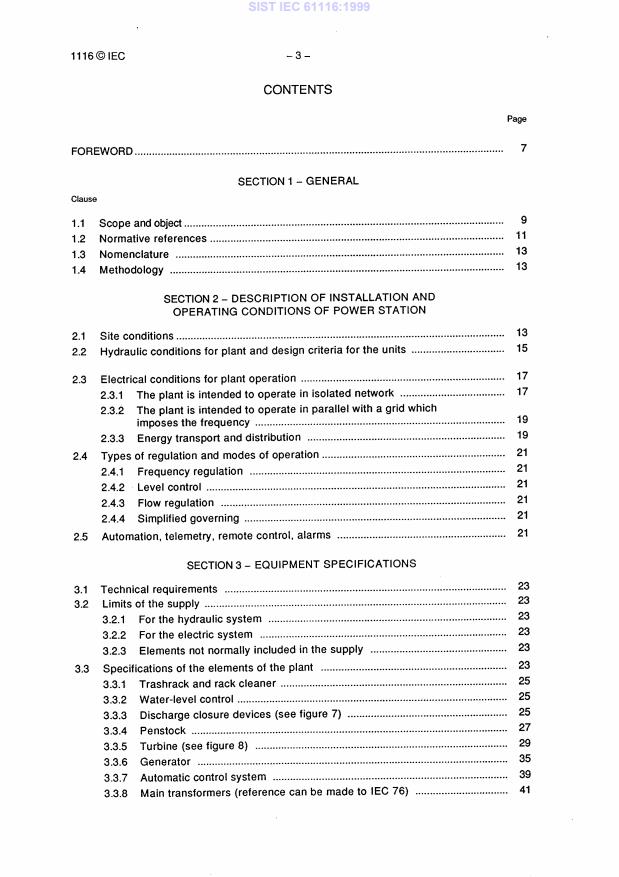
-3-
1116©IEC
CONTENTS
Page
FOREWORD 7
SECTION 1 - GENERAL
Clause
1.1 Scope and object 9
1.2 Normative references
1.3 Nomenclature
1.4 Methodology
SECTION 2 - DESCRIPTION OF INSTALLATION AND
OPERATING CONDITIONS OF POWER STATION
2.1 Site conditions
2.2 Hydraulic conditions for plant and design criteria for the units
17 2.3 Electrical conditions for plant operation
17 2.3.1 The plant is intended to operate in isolated network
2.3.2 The plant is intended to operate in parallel with a grid which
imposes the frequency
19 2.3.3 Energy transport and distribution
21 2.4 Types of regulation and modes of operation
2.4.1 Frequency regulation
2.4.2 Level control
21 2.4.3 Flow regulation
2.4.4 Simplified governing
21 2.5 Automation, telemetry, remote control, alarms
SECTION 3 - EQUIPMENT SPECIFICATIONS
3.1 Technical requirements
3.2 Limits of the supply
3.2.1 For the hydraulic system
3.2.2 For the electric system
23 3.2.3 Elements not normally included in the supply
23 3.3 Specifications of the elements of the plant
3.3.1 Trashrack and rack cleaner 25
3.3.2 Water-level control
3.3.3 Discharge closure devices (see figure 7)
3.3.4 Penstock
3.3.5 Turbine (see figure 8) 29
3.3.6 Generator
3.3.7 Automatic control system
41 3.3.8 Main transformers (reference can be made to IEC 76)
—5
1116©IEC
Page
Clause
41 3.3.9 Auxiliary equipment
45 3.3.10 Spare parts and special tools
45 3.3.11 Mechanical handling
3.3.12 Corrosion protection
3.4 Guarantees
3.4.1 General
3.4.2 Discharge closure devices 49
3.4.3 Turbine 49
3.4.4 Generator 49
49 3.4.5 Governor
51 3.4.6 Speed increaser
51 3.4.7 Comments concerning the complete generating set
51 3.4.8 Main transformer
3.5 General conditions for tender enquiries and comparison of tenders
3.5.1 Instructions to tenderers
53 3.5.2 General conditions of contract
53 3.5.3 Technical comparison of tenders
SECTION 4 – INSPECTION, DELIVERY, OPERATION
AND MAINTENANCE
4.1 Approval of the design and inspection of the work
4.1.1 Approval of design documents
4.1.2 Inspection of materials and sub-assemblies
55 4.1.3 Inspection at manufacturer's works
57 4.1.4 Delivery
4.1.5 Assembly at site
4.2 Commissioning
59 4.2.1 Preliminary checks before watering-up
4.2.2 Watering-up
61 4.2.3 Unit rotation
63 4.2.4 Preliminary checks and electrical load tests
63 4.3 Operation
63 4.3.1 Probationary period
65 4.3.2 Guarantee period
4.3.3 Normal operation 69
4.4 Training of personnel
4.5 Checking and maintenance 69
74 Annex A (informative) – Definitions and nomenclature
Tables
Figures 89
-7-
1116©IEC
INTERNATIONAL ELECTROTECHNICAL COMMISSION
ELECTROMECHANICAL EQUIPMENT GUIDE
FOR SMALL HYDROELECTRIC INSTALLATIONS
FOREWORD
The formal decisions or agreements of the IEC on technical matters, prepared by Technical Committees on
1)
which all the National Committees having a special interest therein are represented, express, as nearly as
possible, an international consensus of opinion on the subjects dealt with.
They have the form of recommendations for international use and they are accepted by the National
2)
Committees in that sense.
In order to promote international unification, the IEC expresses the wish that all National Committees
3)
should adopt the text of the IEC recommendation for their national rules in so far as national conditions will
permit. Any divergence between the IEC recommendation and the corresponding national rules should, as
far as possible, be clearly indicated in the latter.
This International Standard has been prepared by IEC Technical Committee No. 4:
Hydraulic turbines.
The text of this standard is based on the following documents:
Six Months' Rule Repo rt on Voting
4(CO)51
4(CO)46
Full information on the voting for the approval of this standard can be found in the Voting
rt indicated in the above table.
Repo
Annex A is for information only.
1116©IEC - 9 -
ELECTROMECHANICAL EQUIPMENT GUIDE
FOR SMALL HYDROELECTRIC INSTALLATIONS
SECTION 1 - GENERAL
1.1 Scope and object
This International Standard is used as a guide that applies to hydroelectric installations
with units having power outputs less than 5 MW and turbines with nominal runner
diameters less than 3 m. These figures do not represent absolute limits.
This guide deals only with the direct relations between the purchaser or the consulting
engineer and the supplier. It does not deal with civil works, administrative conditions or
commercial conditions.
This guide is intended to be used by all concerned in the installation of electromechanical
equipment for small hydroelectric plants.
This guide, based essentially on practical information, aims specifically at supplying the
purchaser of the equipment with information which will assist him with the following:
-
preparation of the call for tenders;
- evaluation of the tenders;
- contact with the supplier during the design and manufacture of equipment;
- quality control during the manufacture and shop-testing;
- follow-up of site erection;
- commissioning;
- acceptance tests;
- operation and maintenance.
The guide comprises the following:
a) general requirements for the electromechanical equipment of small hydroelectric
installations;
b) technical specifications for the electromechanical equipment, excluding its dimen-
sioning and standardization;
c) requirements for acceptance, operation and maintenance.
Bearing in mind the type of installation considered, the documents shall be as simple as
possible but must satisfactorily define the particular operation conditions. Over-speci-
fication is harmful to the economy of the project.
1116©IEC -11 -
1.2 Normative references
The following standards contain provisions which, through reference in this text, constitute
provisions of this International Standard. At the time of publication of this standard,
rties to
the editions indicated were valid. All standards are subject to revision, and pa
agreements based on this International Standard are encouraged to investigate the
possibility of applying the most recent editions of the standards indicated below. Members
of IEC and ISO maintain registers of currently valid International Standards.
rt 1: Rating and performance.
IEC 34-1: 1983, Rotating electrical machines - Pa
rt 2: Methods for determining losses and
IEC 34-2: 1972, Rotating electrical machines - Pa
efficiency of rotating electrical machinery from tests (excluding machines for traction
vehicles).
First supplement: Measurement of losses by the calorimetric method.
IEC 34-2A: 1974,
rt 5: Classification of degrees of
Rotating electrical machines - Pa
IEC 34-5: 1991,
protection provided by enclosures of rotating electrical machines (IP Code).
Field acceptance tests to determine the hydraulic performance of hydraulic
IEC 41: 1991,
turbines, storage pumps and pump-turbines.
International Electrotechnical Vocabulary (lEV), Chapter 602:
IEC 50(602): 1983,
Generation, transmission and distribution of electricity - Generation.
High-voltage alternating-current circuit-breakers.
IEC 56: 1987,
Power capacitors.
IEC 70: 1967,
rt 1: General.
IEC 76-1: 1976, Power transformers - Pa
Alternating current disconnectors (isolators) and earthing switches.
IEC 129: 1984,
Current transformers.
IEC 185: 1987,
Voltage transformers.
IEC 186: 1987,
International code for model acceptance tests of hydraulic turbines.
IEC 193: 1965,
Amendment No. 1 (1977).
First supplement to IEC 193 (1965).
IEC 193A: 1972,
International code for testing of speed governing systems for hydraulic
IEC 308: 1970,
turbines.
Guide for commissioning, operation and maintenance of hydraulic turbines.
IEC 545: 1976,
Cavitation pitting evaluation in hydraulic turbines, storage pumps and
IEC 609: 1978,
pump-turbines.
Considering the scope of this guide, it does not cover the initial stage of investigations,
that is to say the preliminary study and feasibility study. Neither does it deal with the
economic study concerning the supply and demand of energy.
- 13 -
1116©IEC
To conclude, the guide does not replace the necessary engineering studies for the selec-
tion, design, manufacture, installation and testing of the equipment. It is intended only to
make the purchaser aware of the important points and data to be furnished, specified and
kept in due consideration in the construction of small hydroelectric plants.
NOTES
1 The IEC standards applicable for the preparation of technical documents are given in clause 1.2. In the
case of small hydro developments, the necessary simplification relevant to the type of installation shall
be made.
2 Where IEC standards do not cover all areas of the equipment, ISO Standards concerning specific
items can be consulted, although where there is conflict between the IEC codes and the ISO Standards
those of the IEC will prevail.
1.3 Nomenclature
See annex A.
1.4 Methodology
In the interests of clarity, the sequence of the necessary steps for the construction of a
small hydroelectric power plant is represented diagrammatically in figure 1.
It principally covers the preparation of technical specifications, the examination of tenders,
the manufacture, and finally the commercial operation and maintenance of equipment.
This sequence also shows the relationship between the different phases and areas of
responsibility of all the parties concerned (consulting engineer, chief resident engineer,
and users).
ices of a
rv
If the purchaser does not have in-house engineering capabilities or the se
consulting engineer he may call for, to facilitate relations with contractors, a "turn-key"
of the
rt
supply, or have at least a leading contractor responsible for the supply of all or pa
electromechanical equipment (e.g. the turbine/generator package, or a "water-to-wire"
package).
SECTION 2 - DESCRIPTION OF INSTALLATION AND
OPERATING CONDITIONS OF POWER STATION
The following data is generally required by the equipment supplier and should appear in
the enquiry. In some cases, all these data are not always readily available. Nevertheless,
it must be emphasized that the more information that is given the better will the project be
understood and therefore the better the technical solution which will result.
2.1 Site conditions
2.1.1 Supply a topographic survey (plan and profile) giving the altitude of the points in-
dicated and the position desired for the main works (see figure 4), water intake, reservoir,
channel, surge tank or head pond, penstock, power plant, headwater, tailwater and their
main characteristics (sections, lengths, materials of the channels and penstocks, etc.).
Indicate the foundation conditions (sand, rock, soft ground, etc.).
2.1.2 Attach numbered pictures with cross-references to the topographic survey
described in 2.1.1, showing the setting and location of the main works.
1116©IEC - 15 -
2.1.3 Supply the chemical analysis of the water with extremes of temperature and, if
necessary, the amount and size of sediments carried by the water in the area around the
water intake or downstream of the sand trap, if any.
Indicate the presence of any living organisms or floating debris, etc.
2.1.4 Specify the local conditions; extremes of air temperature, humidity, occurrence of
strong winds, earthquakes, etc.
2.1.5 Indicate any transport or access limitations.
2.1.6 Certain information mentioned in 4.1.5.1 and 4.1.5.3 (erection) may also be shown
in the tender enquiry if this reflects a particular feature of the purchaser's own country.
2.1.7 State if it is run-of-river (see figure 3) or a scheme with a reservoir.
Indicate if there exist any particular operational constraints: e.g. multi-purpose scheme,
environmental, fisheries, etc.
State and describe (with drawings) those elements of the plant which are part of an exist-
ing installation which it is foreseen will eventually be put back into use.
2.1.8 State if the plant will be manned or unmanned.
2.2 Hydraulic conditions for plant and design criteria for the units
2.2.1 Specify the maximum allowable up or down surges in the channels.
2.2.2 Provide a flow duration curve (see figure 2) with an indication of the limiting flows
(guaranteed water supply, irrigation, drinking-water).
in cubic metres per second, and the availability
Qa ,
2.2.3 Specify the chosen design flow,
in days per year.
2.2.4 Specify the extreme water-levels at the intake and at the tail-race in metres (m)
above sea-level, as follows.
a) upstream max . m
min. m
b) downstream max . m
min. m
c) operational range allowed: . m
and give the curves for:
level versus discharge (upstream and downstream)
d)
level versus volume of the upstream reservoir or head pond (essential for a
e)
reservoir scheme).
2.2.5 Specify the desired outputs and the duration of the corresponding operations.
The net heads are defined as in IEC 41. The crossflow turbines with diffusers being
considered as reaction turbines.
1116©IEC – 17 –
2.2.6 State the number of units suggested.
2.2.7 Define the evaluation criteria for efficiency over the full range of operation as well
as overload conditions (weighting the efficiency according to the amount of energy
produced at different heads and flows). The weight to be given to a particular efficiency or
overload depends on the time of utilization at the point of operation considered and the
energy thus recovered from the installation. For general instructions to tenderers see
clause 3.5.
NOTES
For low head plants with short intakes, care must be taken in the design of the intake in order to obvi-
ate hydraulic problems such as vortices and air admission.
2 The proper design of the waterways is essential in order to minimize the head losses (difference
between gross and net head).
2.3 Electrical conditions for plant operation
The plant electrical conditions and requirements listed under either 2.3.1 or 2.3.2.
The plant is intended to operate in isolated network
2.3.1
a) Without any other energy supply on the network
For isolated load networks, black-start capability is essential.
V
i) Required network voltage
- .%
+ . % Tolerance (under steady-state conditions)
Hz
ii) Network frequency
+ . % – . Tolerance (under steady-state conditions)
kW
Minimum output required all year round by the network
iii)
iv) Load acceptance rate of the network (to determine
kW/s
whether or not a flywheel is required)
Value of the maximum step-change in load which the
v)
+ . kW – . kW
network can accept
vi) Power factor (cos 0)
With permanent connection to another electrical energy supply defined as follows:
b)
type i) Hydroelectric unit:
min output . kW
type ii) Thermoelectric unit:
iii) Generator characteristics (synchronous or asynchronous):
• rated voltage V
Hz
• rated frequency
kVA
• rated output
kg - m2
2 of rotating pa rts • inertia GD
power factor (cos 4)
iv) Turbine governor characteristics
The network conditions are to be defined as in 2.3.1 a), items i) to iv).
Voltage regulator characteristics (distribution of reactive power).
v)
1116©IEC - 19 -
Energy utilization: daily and seasonal load variations
c)
average maximum
minimum Output (kW)
Passive loads
(lighting, heating, drying, .)
Active loads
(electric motors)
Total
In order to decide the method of regulation and the design of the governor, it is necessary
to give an indication of the load variations (load curve):
daily;
a)
b) weekly;
seasonal.
c)
Indicate the priority and non-priority loads (load shedding) as this is useful for designing
the governor.
The plant is intended to operate in parallel with a grid which imposes the frequency
2.3.2
a) Characteristics of the grid
V
i) Voltage
+ % -.%
Tolerance
Hz
ii) Frequency
+ % - . %
Tolerance
iii) Short-circuit power (at the point where the
kVA
new scheme is linked to the grid)
iv) Power factor (cos 4)
Apparent output of the largest generator working
b)
kVA
on the network
2.3.3 Energy transport and distribution
Provide the following drawings:
a general layout drawing of the entire proposed network, in the case of isolated load
-
operation;
a drawing showing the link to the grid, in the case of operation in parallel with a
-
large grid.
The layout should also show the main centres of energy consumption and supply.
Also provide information on any possible developments of the grid.
1116©IEC –21 –
2.4 Types of regulation and modes of operation
2.4.1 Frequency regulation
ant part of the
rt
If the unit or the plant operates in an isolated network, or is an impo
network, a governor is required to maintain the network frequency during load changes.
For units with low output and where hydraulic energy is abundant, simplified governors
could also be used by producing a constant output at full load and dumping the unused
power.
2.4.2 Level control
Specify if it is necessary to maintain the upstream or downstream level constant, or within
a working range using the generating sets or some other discharge device. If this is so,
the turbine opening must then be governed with level feedback. This is generally the case
with run-of-river plants (in the river itself or in a bypass channel) or when linked to an
irrigation canal.
NOTE - On isolated load, level or frequency may be controlled but not both.
2.4.3 Flow regulation
Specify if the units are to provide a constant flow or a variable programmed flow.
NOTE - On isolated load, flow or frequency may be controlled but not both.
2.4.4 Simplified governing
If the plant is to operate on a large network which imposes the frequency, its units can
be fitted with simplified governors (positioners) having level feedback or load feedback.
rt of a large grid becomes accidentally
Stability may be affected in the case where pa
detached and simplified governors are used.
2.5 Automation, telemetry, remote control, alarms
a) Indicate if staff are available for the starting and shut-down sequences or if it is
required to minimize the use of operators.
b) If the plant is unattended, specify where the alarms are to be located.
c) Specify whether the starting sequence, synchronization, loading and shut-down
operations shall be:
i) manual;
ii) and/or automatic;
and/or telecontrolled (in this case, indicate the location of the control centre, the
iii)
carrier and the type and method of transmission of the signals).
d) Where a scheme has a reservoir, and there are several units, specify if manual or
automatic control of the reservoir water is required (operation according to a
programme).
e) Specify if the plant is to be the control centre for other energy supply sources in the
network.
1116©IEC –23
SECTION 3 – EQUIPMENT SPECIFICATIONS
The information given below is useful in establishing technical specifications and compar-
ing the technical offers for the most important items in a small hydroelectric development.
3.1 Technical requirements
In addition to supplying the equipment, the supplier should provide the following:
a) Suitability of the proposed technical solutions with regard to the hydraulic charac-
teristics and the operational requirements.
The supplier should inform the purchaser of the necessary civil work data at an
b)
early stage so that the civil work can be designed in accordance with the requirements
of the equipment. Verification of the compatibility between the civil work and the electro-
mechanical equipment (overall dimensions, floor loads, supply and verification of the
preliminary civil work layout drawings, etc.).
c) Information required for erecting, starting-up, operating and maintaining the
equipment.
3.2 Limits of the supply
These limits should be clearly and physically defined for each item. It should be checked
that no equipment has been excluded.
3.2.1 For the hydraulic system
On the upstream side the limit could be trashrack and the rack cleaning machine, if
installed, or the first hydraulic closure device (stop-logs, gate or valve), or any other
suitable section.
On the downstream side the limit could be defined as the end of the draft tube or of the
stop-logs or gate, or any other suitable section.
3.2.2 For the electric system
This may include all the electrical equipment, up to the first point of connection with the
grid to be defined by the purchaser.
Elements not normally included in the supply
3.2.3
Generally the following are not included:
a) civil works,
b) telemetry and remote control.
3.3 Specifications of the elements of the plant
Without overlooking the criterion of simplicity which this type of installation requires, the
selection of good quality materials, suitable technology and good machine characteristics
has the advantage of affording reliability and prolonged life of the plant.
1116©IEC – 25 –
3.3.1 Trashrack and rack cleaner
The opening between the bars of the grating should be as large as possible, but less than
the minimum dimension of the hydraulic circuit downstream (e.g. in Francis turbines, the
minimum opening between the blades of the runner). Specify that the racks should be able
to suppo rt the loads which can be produced when they are completely obstructed.
The rack cleaning machine, if it is required, could be manual or automatic, but in any
event, the clearing away, transporting and dumping of the debris should be taken into
account.
3.3.2 Water-level control
According to the operation of the plant, the control of level could be for information, and
also for protection and auxiliary regulation.
The elements of level control are generally placed upstream of the unit (intake, dam, etc.)
although in some cases it might be necessary to control the downstream level (flow
requirements, downstream plant, etc.).
If the level measuring equipment is very remote from the power station, it shall be
protected, together with the connecting line, against electrical surge. This is particularly
impo rtant when electronic devices are used.
Moreover, the level control equipment (and other associated equipment) should be
protected against damage from environmental causes or caused by a third party.
For low head stations, in most instances, the level control can be tapped at turbine inlet
inside the power station.
3.3.3 Discharge closure devices (see figure 7)
The unit should be protected by at least one closure device, which in an emergency would
close due to lack of electrical signal (this could be the admission of air in a siphon-type
turbine) or activation by electrical signal. This device may be the guide vanes.
The opening of the gates and valves is generally performed by means of an actuator and
with balanced upstream and downstream pressures. The actuator shall have sufficient
power to enable it to open the device under unbalanced pressures.
The closure should be guaranteed under any circumstances for reasons of safety:
a) for gates, closure should be affected by their own weight;
b) while for valves and guide vanes acting as safety closing devices and not having a
closing tendency, closure should be effected by a counterweight or any other device
having an equivalent effect.
For the correct and lasting operation of the stop-logs and gates, it is necessary to maintain
the parallelism of the fixed guides.
The valves and the gates should be designed to withstand a test pressure of 1,5 times the
maximum total pressure, including surge, and to be capable of stopping the maximum
discharge, including broken penstock flow conditions.
1116©IEC – 27 –
It is important to study the sealing systems and to specify the guaranteed limit of leakage
to be permitted (e.g. in litres/minute). It is recommended that the seals be replaceable.
3.3.3.1 Stop-logs or maintenance gates
In certain cases, these could act as a secondary closure device, independent of the
turbine.
3.3.3.2
Intake and head gates and valves
If these devices are necessary, it is essential to study their closing rates and conse-
quences on closing to avoid unfavourable disturbances in the waterway and hydraulic
units. Suitable venting of the penstock downstream of the closure device is necessary to
prevent the collapse of the penstock or serious damage to the water conveying structure.
3.3.3.3 Inlet valves for unit protection
If the penstock is short and there is an intake gate, inlet valves are not always necessary.
If several units are fed by the same penstock, it is recommended that separate valves for
each unit be installed.
In the case of Bulb or Kaplan turbines, the use of a value on the tail-race side can in some
cases, be more conductive.
The effective rate of closure should be studied with care, establishing the optimum relation
between the overspeed of the unit and the overpressure in the penstock in accordance
with the relevant equipment.
It is especially impo ant that the closure of the inlet valve be slow, with the aim of
rt
reducing the overpressure caused by the "water hammer" effect (and thus influencing the
design of the hydraulic pipeline), but it may result in an increased overspeed.
3.3.4 Penstock
It is advisable to use standard diameter and thickness pipes for the penstock. It should be
verified that penstocks can withstand 1,5 times the maximum total pressure including
surge to which it is subjected, taking into account the "water hammer" effect produced by
a hydraulic shut-off device or sometimes when the unit goes to runaway. The presence of
a surge chamber at an appropriate position in the hydraulic pipeline will help to reduce
pressure rises and pressure drops.
In some cases, it may be necessary to bury the penstock to protect it against rock fall,
avalanches or ice. It should be studied whether an anti-vacuum device is required.
Once the turbine is defined, the calculations for the "water hammer" effect may be
confirmed by the supplier. It is very important to bear in mind that overpressures affect the
design of the penstock, and vice versa. Depending on the penstock length and unit power
output, pressure rises may be decreased at the cost of increasing the overspeed of the
unit.
1116©IEC – 29 –
For the case of long penstocks and low discharge, the use of pressure relief valves
(discharge valve) is to be taken into consideration. Since this is a safety device, it calls for
careful checking and maintenance.
The use of materials other than steel for manufacturing the penstock may be considered.
3.3.5 Turbine (see figure 8)
Without wishing to exclude any particular type of construction, it should be noted that the
majority of turbines are of the impulse or reaction type.
Figure 5 gives some indication of the range covered by the largest family of turbines
(Pelton, Francis, Kaplan, propeller, and cross-flow) as a function of head and discharge.
The limits of operation of these turbines vary according to the supplier.
In all cases it is necessary that the turbines have good resistance to fatigue, cavitation,
erosion and corrosion according to the conditions imposed by the quality of the water.
The material of the unit, especially the runner and other parts subject to wear, should be
easily repairable. Each case should be studied individually bearing in mind the operating
conditions (operational time and down time).
In general, all points of articulation and axes should be constructed in corrosion-resistant
materials and the corresponding bushings should be of the self-lubricating type.
The horizontal, vertical or inclined arrangement of the unit has an important influence on
the amount of civil work and the ease of access and maintenance.
Impulse turbine (Felton, .)
3.3.5.1
It is generally recommended that its closing devices should have a natural tendency to
close during load rejections. The needles should act slowly to reduce the pressure rise
and if there is a deflector it should act quickly.
The nozzle and the needle of the injector should be very resistant to erosion and readily
replaceable.
The buckets are also parts which are subject to severe erosion (they should be easily
repairable) and subject to severe fatigue due to repeated impact from the water jets
(careful choice of materials, good mechanical design, and generally low stress levels are
required).
Reaction turbine (Francis, Kaplan, propeller, .)
3.3.5.2
In general, a higher setting of the machine above tailwater level will lead to larger turbine
dimensions and slower running speeds in order to avoid cavitation and conversely a lower
setting results in smaller turbine dimensions, faster running speeds but generally more
expensive civil works.
1116©IEC –31 -
It is recommended that the articulating parts of a guide vane apparatus be made of
self-lubricating material. A suitable device (breaking or equivalent) to avoid obstructions
between guide vanes being extended to the circle of the guide vanes is necessary.
The materials used for the fixed and the movable parts (especially the runner labyrinths)
should be resistant to erosion. Depending on the size of the turbine and the operating
conditions, it is advantageous for the labyrinths, runner and joints to be easily dismantled.
The shaft seal of the turbine is an item which should be studied with care and designed for
ease of maintenance and replacement.
3.3.5.3 Guide and thrust bearings
The shaft system should be designed to minimize the number of bearings. It is essential to
study the turbine and generator bearings as a system. In the choice between journal, ball
or roller bearings, attention should be given to their ability to withstand vibrations, eddy
currents and runaway conditions.
If the unit size allows it and for reasons of simplicity, the use of self-lubricating bearings is
to be considered.
3.3.5.4 Shaft coupling, direct or with speed increaser
The shaft coupling, if any, between the turbine and the generator can be direct or through
a speed increaser which allows the use of standardized or higher speed generators with
smaller dimensions. The most widely used speed increasers are of the gear or belt type. If
gears are used, then efficiency, runaway conditions, levels of noise and vibration, and life
expectancy should be taken into account.
In order to minimize alignment problems, flexible couplings can be considered, especially
in the case of long-shafted horizontal units. In this case the critical speed has to be
checked.
3.3.5.5 Monitoring and protection
In principle, two levels of protection can be specified: alarm and tripping.
Elements to be considered are:
a) speed of rotation;
b) oil level in the bearings;
circulation of lubricant;
c)
d) oil level of the governor system;
e) oil level of the speed increasers;
f) bearing temperature;
g) oil temperature of the governor system;
h) oil temperature of speed increasers;
i) oil pressure of the governor system;
j) circulation of cooling water.
Immediate tripping is required for items a), c), i) and j). Items b), d), e), f), g) and h) may
have an alarm annunciated first if the station is manned allowing corrective action to be
taken, but in any case, in the absence of corrective action, tripping will eventually follow.
In some cases, braking is used to reduce the time to standstill.
1116©IEC – 33 –
It is recommended that two independent overspeed shut-down devices be used on larger
units which might not be designed for continuous runaway.
The pressure tappings needed (for tests and operation) should be provided upstream and
downstream as required.
Governing systems
3.3.5.6
It is necessary to specify if operation will be in parallel with a grid or on an isolated load
system. A plant connected to the grid at a single point by a long transmission line will be
an intermediary case.
A) Operating in parallel with a large grid
The governor (or gate positioner) operates on the turbine opening device with, as a
minimum requirement, proportional control with opening feedback.
The controlled parameter could be:
a) discharge;
water level (run-of-river without constraints);
b)
c) power.
B) Operating on an isolated load system
The speed governor operates on the turbine opening device with, as a minimum require-
ment, proportional and integral control with opening and speed feedback.
ant to establish the compromise between the quality of the regulation
It is very impo rt
and its cost (inertia and speed of the unit, variations in pressure and speed) when
analyzing the entire hydraulic system.
It is necessary to define explicitly the quality of the frequency regulation of the network
to be supplied (fluctuation limits and speed of response) and its influence on the
hydraulic system (pressure variations). The information required by the supplier is to be
shown in the tender enquiry, as described in clause 2.4.
For the two modes of operation, it is necessary to study the behaviour upon sudden
load changes (pressure rises, pressure drops, overspeed, etc.). The effects are im-
portant for the hydraulic system (pipeline material thickness, type of materials) and for
the mechanical system (bearings, flywheels, seal clearances, speed increasers, etc.).
The regulating system should have a sufficient reserve of energy to guarantee an
emergency shut-down.
The governor is generally actuated by an oil pressure system. This same oil pressure
system can also be used for operating the inlet valve or gate.
For units with low power, and in the interest of simplicity, the governor actuation can be
from an electric-mechanical system rather than an oil pressure system.
rtant to study the laws of load
If there are several units in the plant (see 2.2.6) it is impo
distribution (which can be instructions to the operators, or the permanent speed droop
setting on each machine).
1116©IEC – 35 –
3.3.5.7 Auxiliary equipment for the turbine
A) Cooling
Whenever possible, and in the interests of simplicity, self-cooling bearings shall be
specified.
It will be necessary to check that the assumptions made in the calculations are in
accordance with the actual ambient conditions (water-air).
B) Lubrication
Locally obtained oils should be suitable for the lubrication requirements. It is necessary
to know and respect minimum and maximum allowable working temperature of the oil.
C) Water settling and filtering system for auxiliaries
Clean water is to be used whenever possible. Where the water contains suspended
solids, a suitable settling and filtering system will protect the auxiliaries. A closed loop
cooling system with a heat exchanger can also be used.
D) Dewatering and drainage system
Suitable equipment is required for dewatering and draining leakage water.
E) Auxiliary piping
In order to avoid corrosion in metal pipes by galvanic action, it is recommended that
metal piping should be made of the same material throughout its entire length. Valves
manufactured in brittle materials, such as grey cast iron, should be used with caution
and only for low pressures.
3.3.6 Generator
There are basically two types of alternating current generators: synchronous and asyn-
chronous (or induction) generators. The choice of the type to be used depends on
the characteristics of the grid to which the generator will be connected and also on the
generator's operational requirements.
Synchronous generators are used in the case of isolated load networks or wherever the
unit has a significant influence on the network. In some particular cases, asynchronous
generators may also be used.
In the case of large networks, both types of generator can be used.
Before making a decision on the type of generator to be used, it is important to take the
following points into consideration:
– A synchronous generator can regulate the grid voltage and supply reactive power to
the network. It can therefore be connected to any type of network.
– An asynchronous generator has a simpler operation, requiring only the use of a
tachometer to couple it to the grid. As the machine is coupled to the grid there is
a transient voltage drop, and once coupled to the grid the generator absorbs reactive
power from it. Where the power factor needs to be improved, a capacitor bank will be
necessary. The efficiency of an asynchronous generator is generally lower than that of
a synchronous one.
1116©IEC - 37 -
Standardized or upgraded mass-produced machines should be used where possible. Most
"off-the-shelf" or mass-produced machines are designed for lower overspeed values
(typically 1,25 to 1,50 times rated speed) than are experienced with hydraulic turbines.
Therefore, such generator designs should be checked for turbine runaway conditions.
Climatic conditions (ambient temperatures, altitude, humidity) can affect the choice of the
class of insulation level and temperature rises.
The cooling system of the generator shall be evaluated. In the case where heat from the
generator is expelled into the powerhouse sufficient powerhouse ventilation shall be provided.
If necessary, a braking system (either air or oil operated) should be considered.
3.3.6.1 Synchronous generators
Synchronous generators are generally used when operating on an isolated load network,
except for the case of special climatic conditions, their main features being:
a) Stator: See 3.3.6.2.
b) Rotor: The insulation levels should normally be Class F and temperature rises
Class B
c) Excitation equipment:
It is recommended that a system requiring the least maintenance be chosen (e.g. static
brushless excitation).
d) Voltage regulating equipment:
The aim should be simplicity with a view to maintenance. This equipment could be
included in the control system.
e) Synchronizing equipment:
May be manual and/or automatic. The synchronization should cover the voltage,
frequency and phase. Normally this equipment is included in the automatic control
system.
f) Power factor:
Between 0,8 and 1,0, depending on the reactive power requirements.
In the interest of safety, units with synchronous generators should be designed to
withstand continuous runaway conditions. If for any reason, the unit is unable to withstand
continuous runaway conditions, the period which they are able to withstand such condi-
tions shall be stated.
3.3.6.2 Asynchronous (induction) generator
Asynchronous generators are generally used when connected to a large grid, except in the
case of special climatic conditions.
Stator: Class F insulation level and Class B temperature rises are recommended.
a)
Rotor: Squirrel cage construction, Class F insulation and Class B temperature rises
b)
are recommended.
These units should be designed to withstand continuous runaway conditions.
Voltage and speed: The selection of voltage and speed affects the possibility of
c)
using a standard machine.
1116©IEC –39–
3.3.6.3 Guide and thrust bearings
As with turbines, see 3.3.5.3.
3.3.6.4 Monitoring and protection
As with turbines, two levels of protection can be specified: alarm and tripping.
The following are normally monitored:
a) stator temperature;
b) overcurrent (stator and rotor);
c) earth fault with current limits (stator and rotor);
d) maximum and minimum voltage;
e) power reversal;
f) over/under frequency;
g) oil level in the bearing sump;
bearing temperature;
h)
i) cooling air temperature.
Immediate tripping is required for items b), c), d), e) and f). Items a), g), h) and i) may
have an alarm annunciated if the station is manned allowing corrective action to be taken,
but in any case, in the absence of corrective action, tripping will eventually follow.
Depending on the individual case, heating equipment to prevent condensation may be
required.
It is advisable to consider differential protection when the size of the generator and/or its
environment justifies it.
The instruments and devices generally recommended for monitoring and protection are as
follows: voltmeter, ammeter, wattmeter, energy meter, power factor meter, tachometer,
hours of operation counter, synchronizer, water-level and/or pressure indicator, turbine
opening indicator, emergency stop device, short-circuit current protection, overcurrent
protection, reverse power relay, frequency monitor, voltage monitor, bearing monitor.
3.3.7 Automatic control system
The characteristics and extent of the automation depend upon the type of operation of the
plant (manned, unmanned, telecontrolled), the qualifications of the staff, etc.
A simple manual control panel or an automatic sequencer with all the command and
control functions may be used.
It is necessary to study the solution which best suits the individual case, bearing in mind
the operational requirements and the cost. In this respect, it is very important to consider
the consequences of a breakdown (plant shut-down, stock of spare parts, possibility of
manual operation, black start, etc.).
1116©IEC -41 -
Depending on the site, two types of control can be considered:
a) local (near to the item to be monitored or protected);
remote (distant from the item to be monitored, situated inside or outside the plant).
b)
In each case, the best solution from the point of simplicity and effectiveness should be
chosen:
the automation should be as simple as possible to avoid breakdowns and to reduce
a)
the duration of outages. It shall be designed for easy replacement of wearing parts. The
use of the modular elements (hot standby equipment) will generally result in reduced
down time;
it should be possible to perform a manual start without auxiliary energy (black start)
b)
at least locally (isolated load).
Two examples (asynchronous and synchronous) of electrical single-line diagrams are
shown in figure 6.
Main transformers (reference can be made to IEC 76)
3.3.8
ant characteristics to be considered are the following:
The most impo rt
...