

IEC 62388:2013
(Main)Maritime navigation and radiocommunication equipment and systems - Shipborne radar - Performance requirements, methods of testing and required test results
General Information
- Abstract
IEC 62388:2013 specifies the minimum operational and performance requirements, methods of testing and required test results conforming to performance standards not inferior to those adopted by the IMO in Resolution MSC.192(79).
(MSC.192/2) The radar installation, in addition to meeting the general requirements as set out in resolution A.694(17) and the related standard IEC 60945, should comply with the performance standards of MSC.192(79). When a requirement of this standard is different from IEC 60945, the requirement in this standard takes precedence. This second edition cancels and replaces the first edition published in 2007. This edition constitutes a technical revision. The contents of the corrigendum of February 2014 have been included in this copy.
- Status
- Published
- Publication Date
- 25-Jun-2013
- Technical Committee
- TC 80 - Maritime navigation and radiocommunication equipment and systems
- Drafting Committee
- MT 1 - TC 80/MT 1
- Current Stage
- PPUB - Publication issued
- Start Date
- 26-Jun-2013
- Completion Date
- 31-Jul-2013
Buy Documents


IEC 62388:2013 - Maritime navigation and radiocommunication equipment and systems - Shipborne radar - Performance requirements, methods of testing and required test results Released:6/26/2013


IEC 62388:2013 - Maritime navigation and radiocommunication equipment and systems - Shipborne radar - Performance requirements, methods of testing and required test results Released:6/26/2013
Overview
IEC 62388:2013 - Maritime navigation and radiocommunication equipment and systems - Shipborne radar: Performance requirements, methods of testing and required test results - is an IEC international standard that specifies minimum operational and performance requirements and defined test methods for shipborne radar. The standard is aligned with IMO Resolution MSC.192(79) and supplements general installation requirements (IMO A.694(17) and IEC 60945) by defining performance standards, test procedures and required test results for radar equipment used in maritime navigation. This second edition (2013, incl. corrigendum Feb 2014) supersedes the 2007 edition.
Key Topics and Technical Requirements
The standard covers practical, testable requirements across shipborne radar performance and presentation:
- Performance testing and methods: environmental, RF and over-sea performance tests, test sites and target simulation, and required test result formats.
- Transmission and interference: frequency requirements and interference mitigation.
- Performance optimisation: gain control, automatic/manual sea and rain anti-clutter, and continuous monitoring.
- Signal processing: target enhancement, correlation, latency, second-time-around echoes and image processing descriptions.
- Detection and discrimination: minimum range, range and bearing discrimination, and target detection performance assessments in cluttered and minimal conditions.
- Antenna characteristics: vertical/horizontal radiation patterns, pitch/roll behaviour and sidelobe control.
- Availability and reliability: standby/transmit availability tests and required outcomes.
- Display presentation and navigation tools: linearity, color use, CCRP and own-ship presentation, VRM/EBL/ERBL, cursors, range rings, parallel index, and map/route functions.
- Orientation, motion and stabilisation: azimuth alignment, heading reference, sea/ground stabilisation and motion modes.
Applications - Who Uses IEC 62388:2013
This standard is essential for:
- Radar manufacturers and system integrators for design, factory acceptance and type-approval testing.
- Shipbuilders and naval architects for equipment selection and installation compliance.
- Test laboratories and classification societies conducting performance verification and certification.
- Flag state authorities, procurement teams and maritime equipment specifiers ensuring conformity with IMO performance standards.
- Ship operators and technical managers validating radar performance during sea trials and in-service checks.
Related Standards
- IMO Resolution MSC.192(79) (radar performance standards)
- IEC 60945 (general maritime navigation equipment environmental and performance requirements)
- IMO Resolution A.694(17) (radar installation guidance)
IEC 62388:2013 is the authoritative reference for maritime radar performance testing and compliance - critical for safe navigation, collision avoidance and regulatory certification.
Relations
- Effective Date
- 05-Sep-2023
- Effective Date
- 05-Sep-2023
Buy Documents
IEC 62388:2013 - Maritime navigation and radiocommunication equipment and systems - Shipborne radar - Performance requirements, methods of testing and required test results Released:6/26/2013
IEC 62388:2013 - Maritime navigation and radiocommunication equipment and systems - Shipborne radar - Performance requirements, methods of testing and required test results Released:6/26/2013
Get Certified
Connect with accredited certification bodies for this standard

DNV
DNV is an independent assurance and risk management provider.

Lloyd's Register
Lloyd's Register is a global professional services organisation specialising in engineering and technology.

FSC International
Forest Stewardship Council certification.
Sponsored listings
Frequently Asked Questions
IEC 62388:2013 is a standard published by the International Electrotechnical Commission (IEC). Its full title is "Maritime navigation and radiocommunication equipment and systems - Shipborne radar - Performance requirements, methods of testing and required test results". This standard covers: IEC 62388:2013 specifies the minimum operational and performance requirements, methods of testing and required test results conforming to performance standards not inferior to those adopted by the IMO in Resolution MSC.192(79). (MSC.192/2) The radar installation, in addition to meeting the general requirements as set out in resolution A.694(17) and the related standard IEC 60945, should comply with the performance standards of MSC.192(79). When a requirement of this standard is different from IEC 60945, the requirement in this standard takes precedence. This second edition cancels and replaces the first edition published in 2007. This edition constitutes a technical revision. The contents of the corrigendum of February 2014 have been included in this copy.
IEC 62388:2013 specifies the minimum operational and performance requirements, methods of testing and required test results conforming to performance standards not inferior to those adopted by the IMO in Resolution MSC.192(79). (MSC.192/2) The radar installation, in addition to meeting the general requirements as set out in resolution A.694(17) and the related standard IEC 60945, should comply with the performance standards of MSC.192(79). When a requirement of this standard is different from IEC 60945, the requirement in this standard takes precedence. This second edition cancels and replaces the first edition published in 2007. This edition constitutes a technical revision. The contents of the corrigendum of February 2014 have been included in this copy.
IEC 62388:2013 is classified under the following ICS (International Classification for Standards) categories: 33.060 - Radiocommunications; 47.020.70 - Navigation and control equipment. The ICS classification helps identify the subject area and facilitates finding related standards.
IEC 62388:2013 has the following relationships with other standards: It is inter standard links to IEC 62388:2013/COR1:2014, IEC 62388:2007. Understanding these relationships helps ensure you are using the most current and applicable version of the standard.
IEC 62388:2013 is available in PDF format for immediate download after purchase. The document can be added to your cart and obtained through the secure checkout process. Digital delivery ensures instant access to the complete standard document.
Standards Content (Sample)
IEC 62388 ®
Edition 2.0 2013-06
INTERNATIONAL
STANDARD
colour
inside
Maritime navigation and radiocommunication equipment and systems –
Shipborne radar – Performance requirements, methods of testing and required
test results
All rights reserved. Unless otherwise specified, no part of this publication may be reproduced or utilized in any form
or by any means, electronic or mechanical, including photocopying and microfilm, without permission in writing from
either IEC or IEC's member National Committee in the country of the requester.
If you have any questions about IEC copyright or have an enquiry about obtaining additional rights to this publication,
please contact the address below or your local IEC member National Committee for further information.
IEC Central Office Tel.: +41 22 919 02 11
3, rue de Varembé Fax: +41 22 919 03 00
CH-1211 Geneva 20 info@iec.ch
Switzerland www.iec.ch
About the IEC
The International Electrotechnical Commission (IEC) is the leading global organization that prepares and publishes
International Standards for all electrical, electronic and related technologies.
About IEC publications
The technical content of IEC publications is kept under constant review by the IEC. Please make sure that you have the
latest edition, a corrigenda or an amendment might have been published.
Useful links:
IEC publications search - www.iec.ch/searchpub Electropedia - www.electropedia.org
The advanced search enables you to find IEC publications The world's leading online dictionary of electronic and
by a variety of criteria (reference number, text, technical electrical terms containing more than 30 000 terms and
committee,…). definitions in English and French, with equivalent terms in
It also gives information on projects, replaced and additional languages. Also known as the International
withdrawn publications. Electrotechnical Vocabulary (IEV) on-line.
IEC Just Published - webstore.iec.ch/justpublished Customer Service Centre - webstore.iec.ch/csc
Stay up to date on all new IEC publications. Just Published If you wish to give us your feedback on this publication
details all new publications released. Available on-line and or need further assistance, please contact the
also once a month by email. Customer Service Centre: csc@iec.ch.
IEC 62388 ®
Edition 2.0 2013-06
INTERNATIONAL
STANDARD
colour
inside
Maritime navigation and radiocommunication equipment and systems –
Shipborne radar – Performance requirements, methods of testing and required
test results
INTERNATIONAL
ELECTROTECHNICAL
COMMISSION
PRICE CODE
XH
ICS 33.060; 47.020.70 ISBN 978-2-8322-0890-8
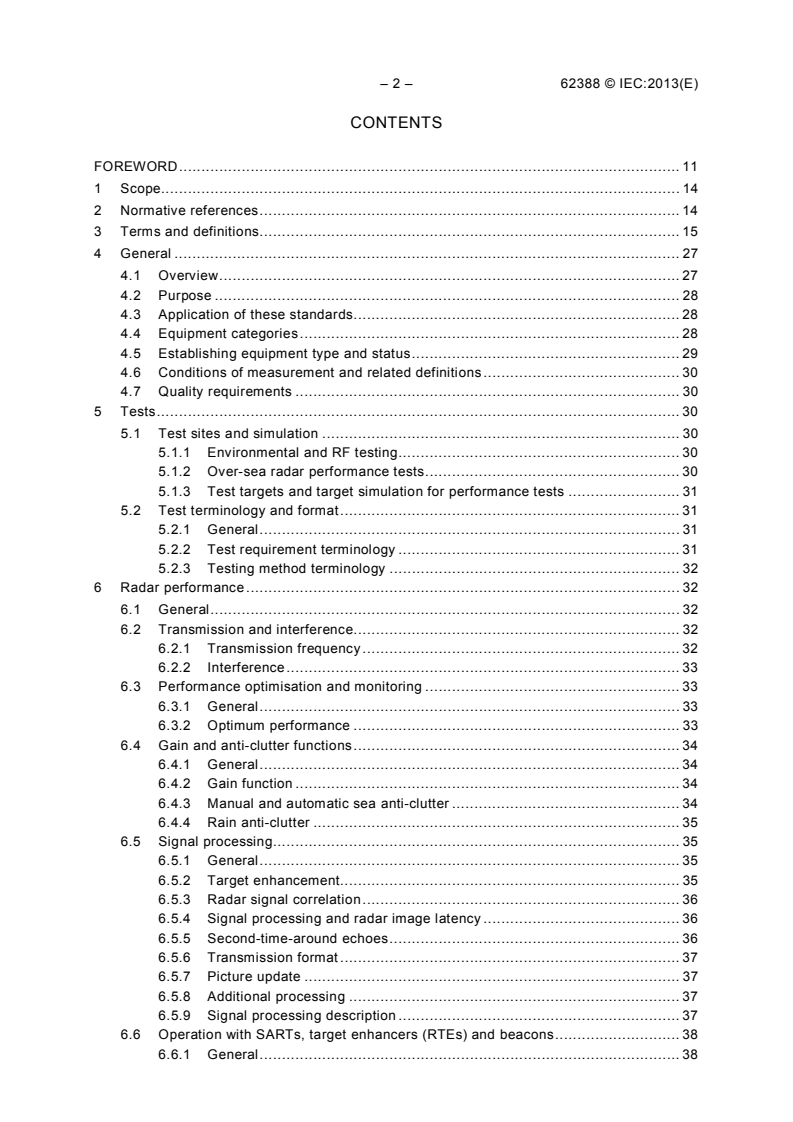
– 2 – 62388 © IEC:2013(E)
CONTENTS
FOREW ORD . 11
1 Scope . 14
2 Normative references . 14
3 Terms and definitions . 15
4 General . 27
4.1 Ov erv iew . 27
4.2 Purpose . 28
4.3 Application of these standards . 28
4.4 Equipment categories . 28
4.5 Establishing equipment type and status . 29
4.6 Conditions of measurement and related definitions . 30
4.7 Quality requirements . 30
5 Tests . 30
5.1 Test sites and simulation . 30
5.1.1 Environmental and RF testing . 30
5.1.2 Over-sea radar performance tests . 30
5.1.3 Test targets and target simulation for performance tests . 31
5.2 Test terminology and format . 31
5.2.1 General . 31
5.2.2 Test requirement terminology . 31
5.2.3 Testing method terminology . 32
6 Radar performance . 32
6.1 General . 32
6.2 Transmission and interference . 32
6.2.1 Transmission frequency . 32
6.2.2 Interference . 33
6.3 Performance optimisation and monitoring . 33
6.3.1 General . 33
6.3.2 Optimum performance . 33
6.4 Gain and anti-clutter functions . 34
6.4.1 General . 34
6.4.2 Gain function . 34
6.4.3 Manual and automatic sea anti-clutter . 34
6.4.4 Rain anti-clutter . 35
6.5 Signal processing . 35
6.5.1 General . 35
6.5.2 Target enhancement . 35
6.5.3 Radar signal correlation . 36
6.5.4 Signal processing and radar image latency . 36
6.5.5 Second-time-around echoes . 36
6.5.6 Transmission format . 37
6.5.7 Picture update . 37
6.5.8 Additional processing . 37
6.5.9 Signal processing description . 37
6.6 Operation with SARTs, target enhancers (RTEs) and beacons . 38
6.6.1 General . 38
62388 © IEC:2013(E) – 3 –
6.6.2 Radar beacons, SARTs and enhancers . 38
6.7 Minimum range and range compensation . 38
6.7.1 General . 38
6.7.2 Range compensation . 39
6.7.3 Minimum range . 39
6.8 Range and bearing discrimination . 40
6.8.1 General . 40
6.8.2 Measurement conditions . 40
6.8.3 Range discrimination . 40
6.8.4 Bearing discrimination . 40
6.8.5 Fundamental radar accuracy . 41
6.9 Target detection performance assessment . 41
6.9.1 General . 41
6.9.2 Range of first detection in minimal clutter . 42
6.9.3 Assessment of target detection with clutter . 44
6.9.4 Radar performance documentation. 49
6.10 Radar antenna (including pitch and roll) . 50
6.10.1 General . 50
6.10.2 Vertical radiation pattern/pitch and roll . 50
6.10.3 Antenna horizontal pattern . 51
6.10.4 Antenna side lobes . 51
6.11 Radar availability – Standby and transmit . 52
6.11.1 Requirements . 52
6.11.2 Methods of test and required results . 52
7 Display presentation . 53
7.1 General . 53
7.1.1 Requirements . 53
7.1.2 Methods of test and required results . 53
7.2 Linearity and index delay . 53
7.2.1 Requirements . 53
7.2.2 Methods of test and required results . 53
7.3 Use and discrimination of colour . 53
7.3.1 Requirements . 53
7.3.2 Methods of test and required results . 53
8 CCRP and own ship . 54
8.1 Consistent common reference point (CCRP) . 54
8.1.1 CCRP . 54
8.1.2 CCRP position . 54
8.1.3 Measurements . 54
8.1.4 Antenna offset . 55
8.2 Own ship . 55
8.2.1 General . 55
8.2.2 Own ship’s outline and minimised symbol . 55
8.2.3 Heading line . 55
8.2.4 Stern line . 56
9 Navigation tools. 56
9.1 General . 56
9.2 Units of measurement . 56
9.2.1 Requirements . 56
– 4 – 62388 © IEC:2013(E)
9.2.2 Methods of test and required results . 57
9.3 Presentation . 57
9.3.1 Requirements . 57
9.3.2 Methods of test and required results . 57
9.4 Display range scales . 57
9.4.1 Mandatory range scales . 57
9.5 Variable range marker (VRM) . 58
9.5.1 General . 58
9.5.2 VRM measurements . 58
9.6 Electronic bearing line (EBL) . 59
9.6.1 General . 59
9.6.2 EBL measurements . 59
9.6.3 EBL origin position . 60
9.7 Cursor . 60
9.7.1 General . 60
9.7.2 Cursor measurement . 60
9.7.3 Selection by cursor . 61
9.8 Offset measurement of range and bearing . 61
9.8.1 General . 61
9.8.2 Electronic range and bearing line (ERBL) . 61
9.9 Parallel index lines (PI) . 62
9.9.1 General . 62
9.9.2 PI lines and positioning . 62
9.10 Bearing scale. 63
9.10.1 General . 63
9.10.2 Bearing scale presentation . 63
9.11 Range rings . 64
9.11.1 General . 64
9.11.2 Range ring presentation and measurement . 64
9.12 Radar maps . 65
9.12.1 General . 65
9.12.2 Map functions and display simple user-defined maps . 65
9.12.3 Map memory and transfer . 65
9.12.4 Map presentation properties . 66
9.13 Navigation routes . 66
9.13.1 General . 66
9.13.2 Route display and monitoring . 67
10 Orientation, motion and stabilisation . 67
10.1 General . 67
10. 2 Azimuth orientation . 67
10.2.1 Accuracy of alignment . 67
10.2.2 Heading readout and reference. 68
10.2.3 Azimuth stabilisation update . 69
10.3 Motion and orientation modes. 69
10.3.1 General . 69
10.3.2 True and relative motion . 69
10.4 Off-centring . 70
10.4.1 General . 70
10.4.2 Manual and automatic off-centring . 70
62388 © IEC:2013(E) – 5 –
10.4.3 Automatic reset . 70
10.4.4 Display orientation . 71
10.5 Ground and sea stabilisation . 72
10.5.1 Mode and source . 72
10.5.2 Ground stabilisation . 72
10.5.3 Sea stabilisation . 73
11 Aids for collision avoidance . 73
11.1 General . 73
11. 2 Target trails and past positions . 73
11.2.1 General . 73
11.2.2 Time and plot requirements . 74
11.2.3 Trails/past position availability . 74
11.3 Target tracking (TT) . 75
11.3.1 General . 75
11.3.2 Presentation of targets . 75
11.3.3 Tracking calculations . 76
11.3.4 Target tracking availability . 76
11.3.5 Classification and tracked target capacity . 77
11.3.6 Manual acquisition . 78
11.3.7 Automatic acquisition . 78
11.3.8 Motion trend . 78
11.3.9 Visibility of 50 % . 79
11.3.10 Tracking algorithm . 79
11.3.11 Target swap . 79
11.3.12 Cease tracking. 79
11.3.13 Target tracking scenarios . 79
11.3.14 Target motion and tracking accuracy . 80
11.3.15 Tracker range and bearing accuracy . 88
11.3.16 Reference target . 89
11.4 Tracking limitations . 89
11.4.1 Tracking warnings . 89
11.4.2 Documentation . 90
11.4.3 Requirements . 90
11.4.4 Methods of test and required results . 90
11.5 Automatic identification system. 90
11.5.1 General . 90
11.5.2 AIS targets and data report capacity . 90
11.5.3 AIS target filtering . 92
11.5.4 Activation and deactivation of AIS targets . 92
11.5.5 AIS functionality and presentation . 93
11.6 Radar and AIS target data. 95
11.6.1 Requirements . 95
11.6.2 Methods of test and required results . 95
11.6.3 Bow crossing range and time (BCR/BCT). 96
11.7 Operational target alerts . 96
11.7.1 CPA and TCPA . 96
11.7.2 New target warning . 97
11.7.3 Lost tracked radar target . 97
11.7.4 Lost AIS target criteria . 98
– 6 – 62388 © IEC:2013(E)
11.8 Target association . 99
11.8.1 General . 99
11.8.2 Association and priority. 99
11.9 Trial manoeuvre . 103
11.9.1 General . 103
11.9.2 Trial functions . 103
12 Chart radar (optional classification) . 104
12.1 General requirements . 104
12.1.1 General . 104
12.1.2 Chart operation and source . 104
12.1.3 Chart elements and availability . 105
12.1.4 Chart reference . 106
12.1.5 Primary chart information set. 106
12.1.6 Chart stabilisation and chart redraw . 107
12.1.7 Chart position and latency. 108
12.1.8 Matching and adjustment . 108
12.1.9 Chart symbols, colours, and size . 109
12.1.10 Chart display size . 110
12.1.11 Chart alerts and indications . 110
12.1.12 Chart malfunction . 111
12.1.13 Chart radar malfunction . 111
12.2 Additional requirements for standalone radar with chart facilities. 111
12.2.1 General . 111
12.2.2 Provision and updating of chart information . 111
12.2.3 Content and structure of chart data . 112
12.3 Additional requirements for ECDIS back-up (optional) . 112
12.3.1 General . 112
12.3.2 Requirements . 112
12.3.3 Test Methods and required results . 112
13 Ergonomic criteria (control functions and display) . 112
13.1 General . 112
13.2 Operational controls . 112
13.2.1 Requirements . 112
13.2.2 Methods of test and required results . 113
13.3 Primary controls . 113
13.3.1 Requirements . 113
13.3.2 Methods of test and required results . 113
13.4 Control properties . 114
13.4.1 Requirements . 114
13.4.2 Methods of test and required results . 114
13.5 Default control setting and saved user control settings . 114
13.5.1 Requirements . 114
13.5.2 Test methods and required results . 115
14 Interfacing . 116
14.1 General . 116
14.2 Input interfacing . 116
14.2.1 Input data . 116
14.2.2 Input quality, integrity and latency . 117
14.3 Output interfacing . 117
62388 © IEC:2013(E) – 7 –
14.3.1 Output format . 117
14.3.2 Output target data . 117
14.3.3 VDR interface . 118
15 Design, servicing and installation . 119
15.1 General . 119
15.2 Fault diagnosis and servicing . 119
15.2.1 Requirements . 119
15.2.2 Methods of test and required results . 120
15.3 Display design . 120
15.3.1 Requirements . 120
15.3.2 Methods of test and required results . 120
15.4 Transceiver design . 120
15.4.1 General . 120
15.4.2 Sector blanking . 121
15.5 Antenna design . 121
15.5.1 Requirements . 121
15.5.2 Methods of test and required results . 121
15.6 Inter-switched and multiple radars . 122
15.6.1 General . 122
15.6.2 System safeguards . 122
15.6.3 Combining radar . 122
15.6.4 Multiple radar system status . 123
15.7 Multiple operational displays . 123
15.7.1 Additional information and conformity . 123
15.7.2 Requirements . 123
15.7.3 Methods of test and required results . 124
15.8 Safety – antenna and radiation . 124
15.8.1 General . 124
15.8.2 Antenna radiation and rotation . 124
15.8.3 Microwave radiation levels . 124
16 Alerts and failures. 125
16.1 General . 125
16.1.1 Priority of alerts . 125
16.1.2 Alerts and indications . 125
16.1.3 Alarm contact outputs . 125
16.1.4 Alert management interface. 125
16.1.5 Unacknowledged warnings . 126
16.1.6 Unacknowledged alarms . 127
16.1.7 Remote acknowledgement and silencing of alerts . 127
16.1.8 Picture freeze . 128
16.1.9 Sensor failure alert . 128
16.2 Backup and fallback arrangements . 128
16.2.1 Requirements . 128
16.2.2 Failure of heading information (azimuth stabilisation) . 128
16.2.3 Failure of speed through the water information . 129
16.2.4 Failure of course and speed over ground information . 129
16.2.5 Failure of position input information . 129
16.2.6 Failure of radar video input information . 130
16.2.7 Failure of AIS input information. 130
– 8 – 62388 © IEC:2013(E)
16.2.8 Failure of an integrated or networked system . 130
17 Environmental testing . 130
17.1 General . 130
17.2 Testing to IEC 60945 . 131
17.2.1 Requirements . 131
17.2.2 Methods of test and required results . 131
17.3 Additional environmental tests . 131
17.3.1 General . 131
17.3.2 Antenna shock test . 132
18 Equipment familiarisation and documentation . 132
18.1 Familiarisation simulator . 132
18.1.1 General . 132
18.1.2 Requirements . 132
18.1.3 Methods of test and required results . 132
18.2 Instructions and documentation . 133
18.2.1 General . 133
18.2.2 Documentation . 133
18.2.3 Operating instructions . 133
18.3 Radar system installation . 134
18.3.1 Requirements . 134
18.3.2 Methods of test and required results . 134
18.4 Maintenance information for equipment update . 135
18.4.1 Requirements . 135
18.4.2 Methods of test and required results . 135
Annex A (informative) Guidelines for radar functionality on navigation displays . 136
Annex B (normative) Unwanted emissions of radar systems . 137
Annex C (informative) Radar target size (RCS) and detection range calculations . 142
Annex D (informative) Factors that influence target detection . 146
Annex E (normative) Sensor errors . 155
Annex F (informative) Target scenario simulator/reported target simulator . 157
Annex G (informative) Tracked and reported target states . 158
Annex H (normative) IEC 61162 sentence formats . 159
Annex I (normative) Radar control function/indication grouping . 168
Annex J (informative) Interference to shipborne radar from emissions in adjacent
frequency bands . 172
Bibliography . 175
Figure 1 – Reduction of range to first detection due to rain at S-band . 45
Figure 2 – Reduction of range to first detection due to rain at X-band . 45
Figure 3 – TT scenario 1 . 82
Figure 4 – TT scenario 2 . 83
Figure 5 – TT scenario 3 . 84
Figure 6 – TT scenario 4 . 85
Figure 7 – TT scenario 5 . 86
Figure B.1 – B falls within the allocated band . 140
–40
Figure B.2 – B falls outside the allocated band . 141
–40
62388 © IEC:2013(E) – 9 –
Figure C.1 – Enhancement by reflection (dB) over free-space (9,41 GHz) . 145
Figure C.2 – Enhancement by reflection (dB) over free-space (3,05 GHz) . 145
Figure D.1 – Effect of sea spikes on target detection . 148
Figure D.2 – Multi-path plots for S-band . 150
Figure D.3 – Multi-path plot for X-band . 150
Figure G.1 – Tracked target states . 158
Figure G.2 – AIS target state . 158
Table 1 – Performance requirements for categories of ship/craft for SOLAS V . 29
Table 2 – Range of first detection in clutter-free conditions . 42
Table 3 – X-band pass/fail assessment criteria . 48
Table 4 – S-band pass/fail assessment criteria . 48
Table 5 – Pass/fail assessment . 49
Table 6 – Douglas sea state parameters . 49
Table 7 – Main horizontal beam pattern . 51
Table 8 – Effective side-lobes . 52
Table 9 – Features and colours to be used for radar maps . 66
Table 10 – Tracked target capacity (subset of Table 1) . 77
Table 11 – Typical tracked target accuracy (95 % probability figures) . 80
Table 12 – TT scenario 1, with sensor errors applied . 81
Table 13 – TT scenario 1, times of measurement task . 81
Table 14 – TT scenario 1, accuracies after 1 min and 3 min (all ± values) . 82
Table 15 – TT scenario 2, own ship turning through ± 180° . 83
Table 16 – TT scenario 3, initial target data. 84
Table 17 – TT scenario 4, initial target data for fast targets (standard speed ships) . 84
Table 18 – TT scenario 4, initial target data for fast targets (HSC) . 85
Table 19 – TT scenario 5: initial target data for standard craft . 86
Table 20 – TT scenario 5: initial target data for collision scenario for HSC . 86
Table 21 – Measurement points and results at 3 min and 6 min for HSC . 87
Table 22 – Measurement points and results at 11 min and 14 min for HSC . 87
Table 23 – Measurement points and results at 3 min and 6 min for standard craft . 87
Table 24 – Measurement points and results at 11 min and 14 min for standard craft . 88
Table 25 – Measurement of tracked target accuracy. 88
Table 26 – AIS display capacity (subset of Table 1) . 91
Table 27 – AIS reporting rates . 98
Table 28 – Association scenario 1, initial TT and AIS target position and data . 100
Table 29 – Association scenario 1, AIS target data for diverging and converging tracks . 101
Table 30 – Association scenario 2, initial TT and AIS target position and data . 101
Table 31 – Association scenario 2, AIS target data for changing speed . 102
Table 32 – Association scenario 3, TT and AIS target start position and data. 102
Table 33 – Association scenario 4, initial TT and AIS target position and data . 103
Table 34 – Association scenario 4, TT and AIS target with the same course and speed . 103
Table 35 – Control settings configured in response to ‘Default’ selection .
...
IEC 62388 ®
Edition 2.0 2013-06
INTERNATIONAL
STANDARD
NORME
INTERNATIONALE
colour
inside
Maritime navigation and radiocommunication equipment and systems –
Shipborne radar – Performance requirements, methods of testing and required
test results
Matériels et systèmes de navigation et de radiocommunication maritimes –
Radar de bord – Exigences de performance, méthodes d'essai et résultats
exigés
All rights reserved. Unless otherwise specified, no part of this publication may be reproduced or utilized in any form
or by any means, electronic or mechanical, including photocopying and microfilm, without permission in writing from
either IEC or IEC's member National Committee in the country of the requester. If you have any questions about IEC
copyright or have an enquiry about obtaining additional rights to this publication, please contact the address below or
your local IEC member National Committee for further information.
Droits de reproduction réservés. Sauf indication contraire, aucune partie de cette publication ne peut être reproduite
ni utilisée sous quelque forme que ce soit et par aucun procédé, électronique ou mécanique, y compris la photocopie
et les microfilms, sans l'accord écrit de l'IEC ou du Comité national de l'IEC du pays du demandeur. Si vous avez des
questions sur le copyright de l'IEC ou si vous désirez obtenir des droits supplémentaires sur cette publication, utilisez
les coordonnées ci-après ou contactez le Comité national de l'IEC de votre pays de résidence.
IEC Central Office Tel.: +41 22 919 02 11
3, rue de Varembé Fax: +41 22 919 03 00
CH-1211 Geneva 20 info@iec.ch
Switzerland www.iec.ch
About the IEC
The International Electrotechnical Commission (IEC) is the leading global organization that prepares and publishes
International Standards for all electrical, electronic and related technologies.
About IEC publications
The technical content of IEC publications is kept under constant review by the IEC. Please make sure that you have the
latest edition, a corrigenda or an amendment might have been published.
IEC Catalogue - webstore.iec.ch/catalogue Electropedia - www.electropedia.org
The stand-alone application for consulting the entire The world's leading online dictionary of electronic and
bibliographical information on IEC International Standards, electrical terms containing 20 000 terms and definitions in
Technical Specifications, Technical Reports and other English and French, with equivalent terms in 16 additional
documents. Available for PC, Mac OS, Android Tablets and languages. Also known as the International Electrotechnical
iPad. Vocabulary (IEV) online.
IEC publications search - www.iec.ch/searchpub IEC Glossary - std.iec.ch/glossary
The advanced search enables to find IEC publications by a 65 000 electrotechnical terminology entries in English and
variety of criteria (reference number, text, technical French extracted from the Terms and Definitions clause of
committee,…). It also gives information on projects, replaced IEC publications issued since 2002. Some entries have been
and withdrawn publications. collected from earlier publications of IEC TC 37, 77, 86 and
CISPR.
IEC Just Published - webstore.iec.ch/justpublished
Stay up to date on all new IEC publications. Just Published IEC Customer Service Centre - webstore.iec.ch/csc
details all new publications released. Available online and If you wish to give us your feedback on this publication or
also once a month by email. need further assistance, please contact the Customer Service
Centre: csc@iec.ch.
A propos de l'IEC
La Commission Electrotechnique Internationale (IEC) est la première organisation mondiale qui élabore et publie des
Normes internationales pour tout ce qui a trait à l'électricité, à l'électronique et aux technologies apparentées.
A propos des publications IEC
Le contenu technique des publications IEC est constamment revu. Veuillez vous assurer que vous possédez l’édition la
plus récente, un corrigendum ou amendement peut avoir été publié.
Catalogue IEC - webstore.iec.ch/catalogue Electropedia - www.electropedia.org
Application autonome pour consulter tous les renseignements
Le premier dictionnaire en ligne de termes électroniques et
bibliographiques sur les Normes internationales,
électriques. Il contient 20 000 termes et définitions en anglais
Spécifications techniques, Rapports techniques et autres
et en français, ainsi que les termes équivalents dans 16
documents de l'IEC. Disponible pour PC, Mac OS, tablettes
langues additionnelles. Egalement appelé Vocabulaire
Android et iPad.
Electrotechnique International (IEV) en ligne.
Recherche de publications IEC - www.iec.ch/searchpub
Glossaire IEC - std.iec.ch/glossary
65 000 entrées terminologiques électrotechniques, en anglais
La recherche avancée permet de trouver des publications IEC
en utilisant différents critères (numéro de référence, texte, et en français, extraites des articles Termes et Définitions des
comité d’études,…). Elle donne aussi des informations sur les publications IEC parues depuis 2002. Plus certaines entrées
projets et les publications remplacées ou retirées. antérieures extraites des publications des CE 37, 77, 86 et
CISPR de l'IEC.
IEC Just Published - webstore.iec.ch/justpublished
Service Clients - webstore.iec.ch/csc
Restez informé sur les nouvelles publications IEC. Just
Published détaille les nouvelles publications parues. Si vous désirez nous donner des commentaires sur cette
Disponible en ligne et aussi une fois par mois par email. publication ou si vous avez des questions contactez-nous:
csc@iec.ch.
IEC 62388 ®
Edition 2.0 2013-06
INTERNATIONAL
STANDARD
NORME
INTERNATIONALE
colour
inside
Maritime navigation and radiocommunication equipment and systems –
Shipborne radar – Performance requirements, methods of testing and required
test results
Matériels et systèmes de navigation et de radiocommunication maritimes –
Radar de bord – Exigences de performance, méthodes d'essai et résultats
exigés
INTERNATIONAL
ELECTROTECHNICAL
COMMISSION
COMMISSION
ELECTROTECHNIQUE
INTERNATIONALE
ICS 33.060; 47.020.70 ISBN 978-2-8322-4515-6
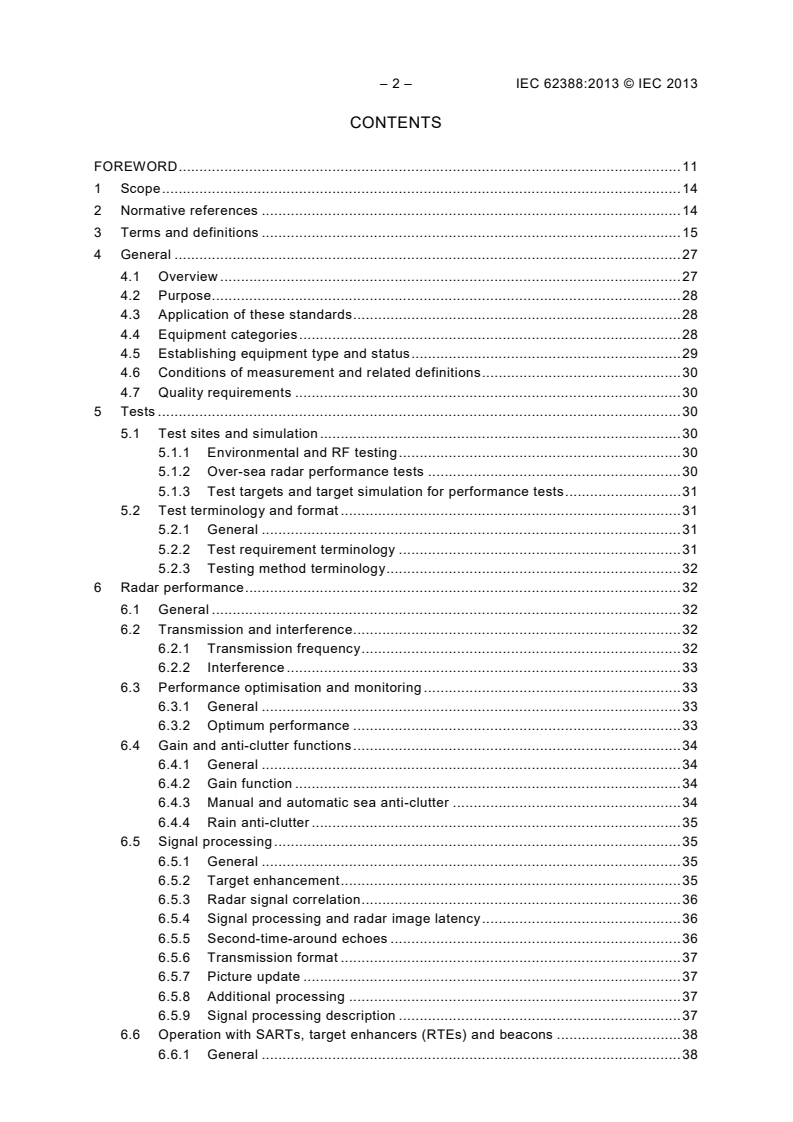
– 2 – IEC 62388:2013 © IEC 2013
CONTENTS
FOREWORD . 11
1 Scope . 14
2 Normative references . 14
3 Terms and definitions . 15
4 General . 27
4.1 Overview . 27
4.2 Purpose. 28
4.3 Application of these standards . 28
4.4 Equipment categories . 28
4.5 Establishing equipment type and status . 29
4.6 Conditions of measurement and related definitions . 30
4.7 Quality requirements . 30
5 Tests . 30
5.1 Test sites and simulation . 30
5.1.1 Environmental and RF testing . 30
5.1.2 Over-sea radar performance tests . 30
5.1.3 Test targets and target simulation for performance tests . 31
5.2 Test terminology and format . 31
5.2.1 General . 31
5.2.2 Test requirement terminology . 31
5.2.3 Testing method terminology . 32
6 Radar performance . 32
6.1 General . 32
6.2 Transmission and interference . 32
6.2.1 Transmission frequency . 32
6.2.2 Interference . 33
6.3 Performance optimisation and monitoring . 33
6.3.1 General . 33
6.3.2 Optimum performance . 33
6.4 Gain and anti-clutter functions . 34
6.4.1 General . 34
6.4.2 Gain function . 34
6.4.3 Manual and automatic sea anti-clutter . 34
6.4.4 Rain anti-clutter . 35
6.5 Signal processing . 35
6.5.1 General . 35
6.5.2 Target enhancement . 35
6.5.3 Radar signal correlation . 36
6.5.4 Signal processing and radar image latency . 36
6.5.5 Second-time-around echoes . 36
6.5.6 Transmission format . 37
6.5.7 Picture update . 37
6.5.8 Additional processing . 37
6.5.9 Signal processing description . 37
6.6 Operation with SARTs, target enhancers (RTEs) and beacons . 38
6.6.1 General . 38
6.6.2 Radar beacons, SARTs and enhancers . 38
6.7 Minimum range and range compensation . 38
6.7.1 General . 38
6.7.2 Range compensation . 39
6.7.3 Minimum range . 39
6.8 Range and bearing discrimination . 40
6.8.1 General . 40
6.8.2 Measurement conditions . 40
6.8.3 Range discrimination . 40
6.8.4 Bearing discrimination . 40
6.8.5 Fundamental radar accuracy . 41
6.9 Target detection performance assessment . 41
6.9.1 General . 41
6.9.2 Range of first detection in minimal clutter . 42
6.9.3 Assessment of target detection with clutter . 44
6.9.4 Radar performance documentation . 49
6.10 Radar antenna (including pitch and roll) . 50
6.10.1 General . 50
6.10.2 Vertical radiation pattern/pitch and roll. 50
6.10.3 Antenna horizontal pattern . 51
6.10.4 Antenna side lobes . 51
6.11 Radar availability – Standby and transmit . 52
6.11.1 Requirements . 52
6.11.2 Methods of test and required results . 52
7 Display presentation . 53
7.1 General . 53
7.1.1 Requirements . 53
7.1.2 Methods of test and required results . 53
7.2 Linearity and index delay . 53
7.2.1 Requirements . 53
7.2.2 Methods of test and required results . 53
7.3 Use and discrimination of colour . 53
7.3.1 Requirements . 53
7.3.2 Methods of test and required results . 53
8 CCRP and own ship . 54
8.1 Consistent common reference point (CCRP). 54
8.1.1 CCRP . 54
8.1.2 CCRP position . 54
8.1.3 Measurements . 54
8.1.4 Antenna offset . 55
8.2 Own ship . 55
8.2.1 General . 55
8.2.2 Own ship’s outline and minimised symbol . 55
8.2.3 Heading line . 55
8.2.4 Stern line . 56
9 Navigation tools . 56
9.1 General . 56
9.2 Units of measurement . 56
9.2.1 Requirements . 56
– 4 – IEC 62388:2013 © IEC 2013
9.2.2 Methods of test and required results . 57
9.3 Presentation . 57
9.3.1 Requirements . 57
9.3.2 Methods of test and required results . 57
9.4 Display range scales . 57
9.4.1 Mandatory range scales. 57
9.5 Variable range marker (VRM) . 58
9.5.1 General . 58
9.5.2 VRM measurements . 58
9.6 Electronic bearing line (EBL) . 59
9.6.1 General . 59
9.6.2 EBL measurements . 59
9.6.3 EBL origin position . 60
9.7 Cursor . 60
9.7.1 General . 60
9.7.2 Cursor measurement . 60
9.7.3 Selection by cursor . 61
9.8 Offset measurement of range and bearing . 61
9.8.1 General . 61
9.8.2 Electronic range and bearing line (ERBL) . 61
9.9 Parallel index lines (PI) . 62
9.9.1 General . 62
9.9.2 PI lines and positioning. 62
9.10 Bearing scale . 63
9.10.1 General . 63
9.10.2 Bearing scale presentation . 63
9.11 Range rings . 64
9.11.1 General . 64
9.11.2 Range ring presentation and measurement . 64
9.12 Radar maps . 65
9.12.1 General . 65
9.12.2 Map functions and display simple user-defined maps . 65
9.12.3 Map memory and transfer . 65
9.12.4 Map presentation properties . 66
9.13 Navigation routes . 66
9.13.1 General . 66
9.13.2 Route display and monitoring . 67
10 Orientation, motion and stabilisation . 67
10.1 General . 67
10.2 Azimuth orientation . 67
10.2.1 Accuracy of alignment . 67
10.2.2 Heading readout and reference . 68
10.2.3 Azimuth stabilisation update . 69
10.3 Motion and orientation modes . 69
10.3.1 General . 69
10.3.2 True and relative motion . 69
10.4 Off-centring . 70
10.4.1 General . 70
10.4.2 Manual and automatic off-centring . 70
10.4.3 Automatic reset . 70
10.4.4 Display orientation . 71
10.5 Ground and sea stabilisation . 72
10.5.1 Mode and source . 72
10.5.2 Ground stabilisation . 72
10.5.3 Sea stabilisation . 73
11 Aids for collision avoidance . 73
11.1 General . 73
11.2 Target trails and past positions . 73
11.2.1 General . 73
11.2.2 Time and plot requirements . 74
11.2.3 Trails/past position availability . 74
11.3 Target tracking (TT) . 75
11.3.1 General . 75
11.3.2 Presentation of targets . 75
11.3.3 Tracking calculations . 76
11.3.4 Target tracking availability . 76
11.3.5 Classification and tracked target capacity . 77
11.3.6 Manual acquisition . 78
11.3.7 Automatic acquisition . 78
11.3.8 Motion trend . 78
11.3.9 Visibility of 50 % . 79
11.3.10 Tracking algorithm . 79
11.3.11 Target swap . 79
11.3.12 Cease tracking . 79
11.3.13 Target tracking scenarios . 79
11.3.14 Target motion and tracking accuracy . 80
11.3.15 Tracker range and bearing accuracy . 88
11.3.16 Reference target . 89
11.4 Tracking limitations . 89
11.4.1 Tracking warnings . 89
11.4.2 Documentation . 90
11.4.3 Requirements . 90
11.4.4 Methods of test and required results . 90
11.5 Automatic identification system . 90
11.5.1 General . 90
11.5.2 AIS targets and data report capacity . 90
11.5.3 AIS target filtering. 92
11.5.4 Activation and deactivation of AIS targets . 92
11.5.5 AIS functionality and presentation . 93
11.6 Radar and AIS target data . 95
11.6.1 Requirements . 95
11.6.2 Methods of test and required results . 95
11.6.3 Bow crossing range and time (BCR/BCT) . 96
11.7 Operational target alerts . 96
11.7.1 CPA and TCPA . 96
11.7.2 New target warning . 97
11.7.3 Lost tracked radar target . 97
11.7.4 Lost AIS target criteria . 98
– 6 – IEC 62388:2013 © IEC 2013
11.8 Target association . 99
11.8.1 General . 99
11.8.2 Association and priority . 99
11.9 Trial manoeuvre . 103
11.9.1 General . 103
11.9.2 Trial functions . 103
12 Chart radar (optional classification) . 104
12.1 General requirements . 104
12.1.1 General . 104
12.1.2 Chart operation and source . 104
12.1.3 Chart elements and availability . 105
12.1.4 Chart reference . 106
12.1.5 Primary chart information set . 106
12.1.6 Chart stabilisation and chart redraw . 107
12.1.7 Chart position and latency . 108
12.1.8 Matching and adjustment. 108
12.1.9 Chart symbols, colours, and size . 109
12.1.10 Chart display size . 110
12.1.11 Chart alerts and indications . 110
12.1.12 Chart malfunction . 111
12.1.13 Chart radar malfunction . 111
12.2 Additional requirements for standalone radar with chart facilities . 111
12.2.1 General . 111
12.2.2 Provision and updating of chart information . 111
12.2.3 Content and structure of chart data. 112
12.3 Additional requirements for ECDIS back-up (optional) . 112
12.3.1 General . 112
12.3.2 Requirements . 112
12.3.3 Test Methods and required results . 112
13 Ergonomic criteria (control functions and display) . 112
13.1 General . 112
13.2 Operational controls . 112
13.2.1 Requirements . 112
13.2.2 Methods of test and required results . 113
13.3 Primary controls . 113
13.3.1 Requirements . 113
13.3.2 Methods of test and required results . 113
13.4 Control properties . 114
13.4.1 Requirements . 114
13.4.2 Methods of test and required results . 114
13.5 Default control setting and saved user control settings . 114
13.5.1 Requirements . 114
13.5.2 Test methods and required results . 115
14 Interfacing . 116
14.1 General . 116
14.2 Input interfacing . 116
14.2.1 Input data . 116
14.2.2 Input quality, integrity and latency . 117
14.3 Output interfacing . 117
14.3.1 Output format . 117
14.3.2 Output target data . 117
14.3.3 VDR interface . 118
15 Design, servicing and installation . 119
15.1 General . 119
15.2 Fault diagnosis and servicing . 119
15.2.1 Requirements . 119
15.2.2 Methods of test and required results . 120
15.3 Display design . 120
15.3.1 Requirements . 120
15.3.2 Methods of test and required results . 120
15.4 Transceiver design . 120
15.4.1 General . 120
15.4.2 Sector blanking . 121
15.5 Antenna design . 121
15.5.1 Requirements . 121
15.5.2 Methods of test and required results . 121
15.6 Inter-switched and multiple radars . 122
15.6.1 General . 122
15.6.2 System safeguards . 122
15.6.3 Combining radar . 122
15.6.4 Multiple radar system status . 123
15.7 Multiple operational displays . 123
15.7.1 Additional information and conformity . 123
15.7.2 Requirements . 123
15.7.3 Methods of test and required results . 124
15.8 Safety – antenna and radiation . 124
15.8.1 General . 124
15.8.2 Antenna radiation and rotation . 124
15.8.3 Microwave radiation levels . 124
16 Alerts and failures . 125
16.1 General . 125
16.1.1 Priority of alerts . 125
16.1.2 Alerts and indications . 125
16.1.3 Alarm contact outputs . 125
16.1.4 Alert management interface . 125
16.1.5 Unacknowledged warnings . 126
16.1.6 Unacknowledged alarms . 127
16.1.7 Remote acknowledgement and silencing of alerts . 127
16.1.8 Picture freeze . 128
16.1.9 Sensor failure alert . 128
16.2 Backup and fallback arrangements . 128
16.2.1 Requirements . 128
16.2.2 Failure of heading information (azimuth stabilisation) . 128
16.2.3 Failure of speed through the water information . 129
16.2.4 Failure of course and speed over ground information . 129
16.2.5 Failure of position input information . 129
16.2.6 Failure of radar video input information. 130
16.2.7 Failure of AIS input information . 130
– 8 – IEC 62388:2013 © IEC 2013
16.2.8 Failure of an integrated or networked system. 130
17 Environmental testing . 130
17.1 General . 130
17.2 Testing to IEC 60945 . 131
17.2.1 Requirements . 131
17.2.2 Methods of test and required results . 131
17.3 Additional environmental tests . 131
17.3.1 General . 131
17.3.2 Antenna shock test . 132
18 Equipment familiarisation and documentation . 132
18.1 Familiarisation simulator . 132
18.1.1 General . 132
18.1.2 Requirements . 132
18.1.3 Methods of test and required results . 132
18.2 Instructions and documentation . 133
18.2.1 General . 133
18.2.2 Documentation . 133
18.2.3 Operating instructions . 133
18.3 Radar system installation . 134
18.3.1 Requirements . 134
18.3.2 Methods of test and required results . 134
18.4 Maintenance information for equipment update . 135
18.4.1 Requirements . 135
18.4.2 Methods of test and required results . 135
Annex A (informative) Guidelines for radar functionality on navigation displays . 136
Annex B (normative) Unwanted emissions of radar systems. 137
Annex C (informative) Radar target size (RCS) and detection range calculations . 142
Annex D (informative) Factors that influence target detection . 146
Annex E (normative) Sensor errors . 155
Annex F (informative) Target scenario simulator/reported target simulator . 157
Annex G (informative) Tracked and reported target states . 158
Annex H (normative) IEC 61162 sentence formats . 159
Annex I (normative) Radar control function/indication grouping .
...