

IEC 60728-3:2017
(Main)Cable networks for television signals, sound signals and interactive services - Part 3: Active wideband equipment for cable networks
General Information
- Abstract
IEC 60728-3:2017 specifies the measuring methods, performance requirements and data publication requirements for active wideband equipment of cable networks for television signals, sound signals and interactive services. This fifth edition cancels and replaces the fourth edition published in 2010. This edition constitutes a technical revision. This edition includes the following significant technical changes with respect to the previous edition:
a) extension of upper frequency range limit for cable network equipment in the forward path from 1000 MHz to 1218 MHz (optional up to 1794 MHz);
b) extension of upper frequency range limit for cable network equipment in the return path from 85 MHz to 204 MHz;
c) integration and update of IEC 60728-3-1 content;
d) integration and update of the Technical Specification CLC/TS 50083-3-3 content;
e) deletion of specifications and test methods for obsolete analogue parameters;
f) additional normative references;
g) additional terms and definitions and abbreviations.
- Status
- Published
- Publication Date
- 26-Nov-2017
- Technical Committee
- TA 5 - Cable networks for television signals, sound signals and interactive services
- Drafting Committee
- WG 3 - TC 100/TA 5/WG 3
- Current Stage
- PPUB - Publication issued
- Start Date
- 27-Nov-2017
- Completion Date
- 17-Nov-2017
Buy Documents
IEC 60728-3:2017 - Cable networks for television signals, sound signals and interactive services - Part 3: Active wideband equipment for cable networks Released:11/27/2017
IEC 60728-3:2017 RLV - Cable networks for television signals, sound signals and interactive services - Part 3: Active wideband equipment for cable networks Released:11/27/2017
IEC 60728-3:2017 - Cable networks for television signals, sound signals and interactive services - Part 3: Active wideband equipment for cable networks Released:11/27/2017
Overview
IEC 60728-3:2017 - Cable networks for television signals, sound signals and interactive services - Part 3: Active wideband equipment for cable networks specifies measuring methods, performance requirements and data‑publication requirements for active wideband equipment used in cable networks. The fifth edition (2017) cancels and replaces the 2010 edition and is a technical revision that updates frequency ranges, integrates related technical content and removes obsolete analogue specifications.
Key updates in this edition include:
- Forward path upper frequency extended from 1000 MHz to 1218 MHz (optionally up to 1794 MHz)
- Return path upper frequency extended from 85 MHz to 204 MHz
- Integration/updates of IEC 60728-3-1 and CLC/TS 50083-3-3
- Removal of obsolete analogue test methods and additional normative references, terms and abbreviations
Key topics and requirements
The standard covers practical, testable requirements and measurement methods for active equipment used in modern cable networks. Major technical topics include:
- Methods of measurement for linear and non‑linear behavior
- Linear distortion: return loss, group delay variation
- Non‑linear distortion: intermodulation, Composite Triple Beat (CTB), Composite Second Order (CSO), cross‑modulation
- Noise performance: noise figure, CINR / NPR measurement methods for digitally modulated signals
- Hum modulation and carrier/hum ratio measurements
- Automatic gain and slope control (AGC) step response
- Crosstalk attenuation and isolation for loop‑through and output ports (including multi‑switch requirements)
- Equipment requirements: frequency range, impedance/return loss, gain, flatness, test points, power supply, EMC and safety, environmental/MTBF and marking
- Immunity to surge voltages and test levels
- Annexes with test frequency plans, test carriers, measurement examples and equipment checks
Applications and who uses it
IEC 60728-3:2017 is used by:
- Cable equipment manufacturers for design verification and product specifications
- Test laboratories for device characterization and certification
- Network operators and system integrators for acceptance testing, network upgrades and interoperability checks
- Regulatory bodies and procurement teams to define compliance and performance requirements for active wideband devices
- Maintenance teams to diagnose performance issues and validate repairs
Practical uses include equipment design validation, pre‑deployment testing, supplier qualification, and ensuring signal integrity for television, audio and interactive services across extended frequency ranges.
Related standards
- Other parts of the IEC 60728 series (system and passive components)
- Integrated content from IEC 60728-3-1 and CLC/TS 50083-3-3
- Applicable regional/national EMC, safety, and telecommunications testing standards
Keywords: IEC 60728-3, active wideband equipment, cable networks, CTB, CSO, CINR, noise figure, return loss, intermodulation, forward path, return path, measurement methods.
Relations
- Effective Date
- 05-Sep-2023
- Effective Date
- 05-Sep-2023
Buy Documents
IEC 60728-3:2017 - Cable networks for television signals, sound signals and interactive services - Part 3: Active wideband equipment for cable networks Released:11/27/2017
IEC 60728-3:2017 RLV - Cable networks for television signals, sound signals and interactive services - Part 3: Active wideband equipment for cable networks Released:11/27/2017
IEC 60728-3:2017 - Cable networks for television signals, sound signals and interactive services - Part 3: Active wideband equipment for cable networks Released:11/27/2017
Get Certified
Connect with accredited certification bodies for this standard

ANCE
Mexican certification and testing association.

Intertek Slovenia
Intertek testing, inspection, and certification services in Slovenia.

LNE (Laboratoire National de Métrologie et d'Essais)
French national laboratory for metrology and testing.
Sponsored listings
Frequently Asked Questions
IEC 60728-3:2017 is a standard published by the International Electrotechnical Commission (IEC). Its full title is "Cable networks for television signals, sound signals and interactive services - Part 3: Active wideband equipment for cable networks". This standard covers: IEC 60728-3:2017 specifies the measuring methods, performance requirements and data publication requirements for active wideband equipment of cable networks for television signals, sound signals and interactive services. This fifth edition cancels and replaces the fourth edition published in 2010. This edition constitutes a technical revision. This edition includes the following significant technical changes with respect to the previous edition: a) extension of upper frequency range limit for cable network equipment in the forward path from 1000 MHz to 1218 MHz (optional up to 1794 MHz); b) extension of upper frequency range limit for cable network equipment in the return path from 85 MHz to 204 MHz; c) integration and update of IEC 60728-3-1 content; d) integration and update of the Technical Specification CLC/TS 50083-3-3 content; e) deletion of specifications and test methods for obsolete analogue parameters; f) additional normative references; g) additional terms and definitions and abbreviations.
IEC 60728-3:2017 specifies the measuring methods, performance requirements and data publication requirements for active wideband equipment of cable networks for television signals, sound signals and interactive services. This fifth edition cancels and replaces the fourth edition published in 2010. This edition constitutes a technical revision. This edition includes the following significant technical changes with respect to the previous edition: a) extension of upper frequency range limit for cable network equipment in the forward path from 1000 MHz to 1218 MHz (optional up to 1794 MHz); b) extension of upper frequency range limit for cable network equipment in the return path from 85 MHz to 204 MHz; c) integration and update of IEC 60728-3-1 content; d) integration and update of the Technical Specification CLC/TS 50083-3-3 content; e) deletion of specifications and test methods for obsolete analogue parameters; f) additional normative references; g) additional terms and definitions and abbreviations.
IEC 60728-3:2017 is classified under the following ICS (International Classification for Standards) categories: 01 - GENERALITIES. TERMINOLOGY. STANDARDIZATION. DOCUMENTATION; 33.060.40 - Cabled distribution systems; 33.170 - Television and radio broadcasting. The ICS classification helps identify the subject area and facilitates finding related standards.
IEC 60728-3:2017 has the following relationships with other standards: It is inter standard links to IEC 60728-3-1:2012, IEC 60728-3:2010. Understanding these relationships helps ensure you are using the most current and applicable version of the standard.
IEC 60728-3:2017 is available in PDF format for immediate download after purchase. The document can be added to your cart and obtained through the secure checkout process. Digital delivery ensures instant access to the complete standard document.
Standards Content (Sample)
IEC 60728-3 ®
Edition 5.0 2017-11
INTERNATIONAL
STANDARD
colour
inside
Cable networks for television signals, sound signals and interactive services
Part 3: Active wideband equipment for cable networks
All rights reserved. Unless otherwise specified, no part of this publication may be reproduced or utilized in any form
or by any means, electronic or mechanical, including photocopying and microfilm, without permission in writing from
either IEC or IEC's member National Committee in the country of the requester. If you have any questions about IEC
copyright or have an enquiry about obtaining additional rights to this publication, please contact the address below or
your local IEC member National Committee for further information.
IEC Central Office Tel.: +41 22 919 02 11
3, rue de Varembé Fax: +41 22 919 03 00
CH-1211 Geneva 20 info@iec.ch
Switzerland www.iec.ch
About the IEC
The International Electrotechnical Commission (IEC) is the leading global organization that prepares and publishes
International Standards for all electrical, electronic and related technologies.
About IEC publications
The technical content of IEC publications is kept under constant review by the IEC. Please make sure that you have the
latest edition, a corrigenda or an amendment might have been published.
IEC Catalogue - webstore.iec.ch/catalogue Electropedia - www.electropedia.org
The stand-alone application for consulting the entire The world's leading online dictionary of electronic and
bibliographical information on IEC International Standards, electrical terms containing 20 000 terms and definitions in
Technical Specifications, Technical Reports and other English and French, with equivalent terms in 16 additional
documents. Available for PC, Mac OS, Android Tablets and languages. Also known as the International Electrotechnical
iPad. Vocabulary (IEV) online.
IEC publications search - www.iec.ch/searchpub IEC Glossary - std.iec.ch/glossary
The advanced search enables to find IEC publications by a 65 000 electrotechnical terminology entries in English and
variety of criteria (reference number, text, technical French extracted from the Terms and Definitions clause of
committee,…). It also gives information on projects, replaced IEC publications issued since 2002. Some entries have been
and withdrawn publications. collected from earlier publications of IEC TC 37, 77, 86 and
CISPR.
IEC Just Published - webstore.iec.ch/justpublished
Stay up to date on all new IEC publications. Just Published IEC Customer Service Centre - webstore.iec.ch/csc
details all new publications released. Available online and If you wish to give us your feedback on this publication or
also once a month by email. need further assistance, please contact the Customer Service
Centre: csc@iec.ch.
IEC 60728-3 ®
Edition 5.0 2017-11
INTERNATIONAL
STANDARD
colour
inside
Cable networks for television signals, sound signals and interactive services
Part 3: Active wideband equipment for cable networks
INTERNATIONAL
ELECTROTECHNICAL
COMMISSION
ICS 33.060.40; 33.170 ISBN 978-2-8322-4934-5
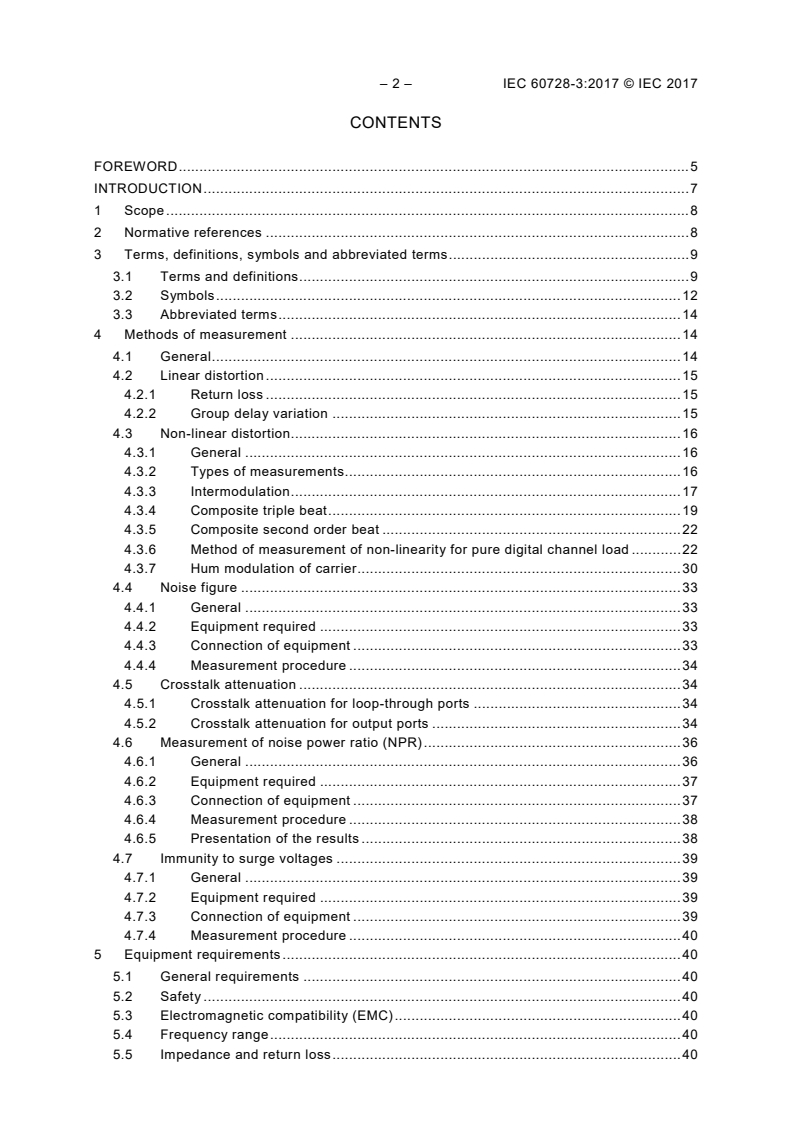
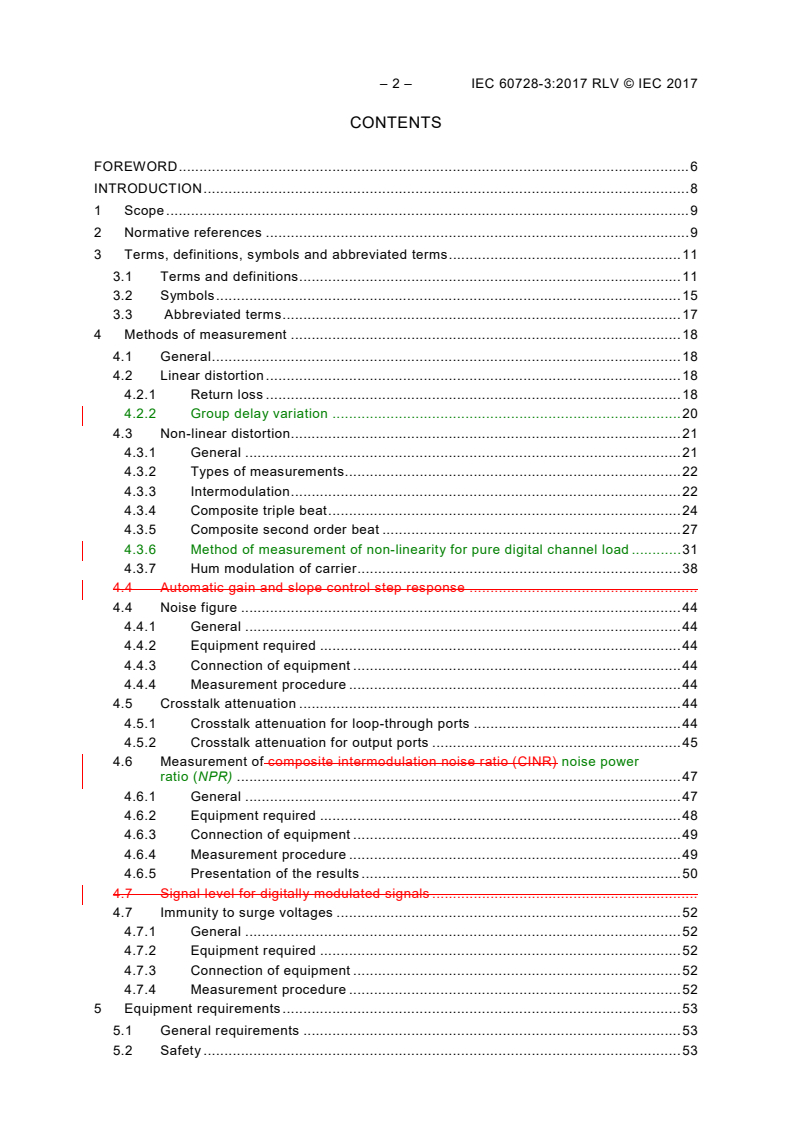
– 2 – IEC 60728-3:2017 © IEC 2017
CONTENTS
FOREWORD . 5
INTRODUCTION . 7
1 Scope . 8
2 Normative references . 8
3 Terms, definitions, symbols and abbreviated terms . 9
3.1 Terms and definitions . 9
3.2 Symbols . 12
3.3 Abbreviated terms . 14
4 Methods of measurement . 14
4.1 General . 14
4.2 Linear distortion . 15
4.2.1 Return loss . 15
4.2.2 Group delay variation . 15
4.3 Non-linear distortion. 16
4.3.1 General . 16
4.3.2 Types of measurements . 16
4.3.3 Intermodulation . 17
4.3.4 Composite triple beat . 19
4.3.5 Composite second order beat . 22
4.3.6 Method of measurement of non-linearity for pure digital channel load . 22
4.3.7 Hum modulation of carrier . 30
4.4 Noise figure . 33
4.4.1 General . 33
4.4.2 Equipment required . 33
4.4.3 Connection of equipment . 33
4.4.4 Measurement procedure . 34
4.5 Crosstalk attenuation . 34
4.5.1 Crosstalk attenuation for loop-through ports . 34
4.5.2 Crosstalk attenuation for output ports . 34
4.6 Measurement of noise power ratio (NPR) . 36
4.6.1 General . 36
4.6.2 Equipment required . 37
4.6.3 Connection of equipment . 37
4.6.4 Measurement procedure . 38
4.6.5 Presentation of the results . 38
4.7 Immunity to surge voltages . 39
4.7.1 General . 39
4.7.2 Equipment required . 39
4.7.3 Connection of equipment . 39
4.7.4 Measurement procedure . 40
5 Equipment requirements . 40
5.1 General requirements . 40
5.2 Safety . 40
5.3 Electromagnetic compatibility (EMC) . 40
5.4 Frequency range . 40
5.5 Impedance and return loss . 40
– 3 – IEC 60728-3:2017 © IEC 2017
5.6 Gain . 41
5.6.1 Minimum and maximum gain . 41
5.6.2 Gain control . 41
5.6.3 Slope and slope control . 41
5.7 Flatness . 41
5.8 Test points . 41
5.9 Noise figure . 41
5.10 Non-linear distortion. 42
5.10.1 General . 42
5.10.2 Second-order distortion . 42
5.10.3 Third order distortion . 42
5.10.4 Composite triple beat . 42
5.10.5 Composite second order . 42
5.10.6 Maximum operating level for pure digital channel load . 42
5.11 Hum modulation . 43
5.12 Power supply . 43
5.13 Environmental . 43
5.13.1 General . 43
5.13.2 Transportation . 43
5.13.3 Installation or maintenance . 43
5.13.4 Operation . 43
5.13.5 Energy efficiency of equipment . 44
5.14 Marking . 44
5.14.1 Marking of equipment . 44
5.14.2 Marking of ports . 44
5.15 Requirements for multi-switches . 44
5.15.1 Control signals for multi-switches . 44
5.15.2 Amplitude frequency response flatness . 44
5.15.3 Return loss . 44
5.15.4 Through loss . 44
5.15.5 Isolation . 44
5.15.6 Crosstalk attenuation . 44
5.15.7 Satellite IF to terrestrial signal isolation . 45
5.16 Immunity to surge voltages . 45
5.16.1 Degrees of testing levels . 45
5.16.2 Recommendation of testing level degree . 45
Annex A (normative) Test carriers, levels and intermodulation products . 46
A.1 Two signal tests for second- and third-order products . 46
A.1.1 Intermodulation products with test signals at frequencies ƒ and ƒ ,
a b
see Table A.1 . 46
A.1.2 Signal levels . 46
A.2 Three signal tests for third order products – Intermodulation products with
test signals at frequencies ƒ , ƒ and ƒ , see Table A.2 and Figure A.3 . 47
a b c
Annex B (informative) Test frequency plan for composite triple beat (CTB), composite
second order (CSO) . 48
Annex C (informative) Measurement errors that occur due to mismatched equipment . 50
Annex D (informative) Examples of measurement channels . 51
D.1 Operating frequency range 110 MHz to 1 006 MHz . 51
D.2 Operating frequency range 110 MHz to 862 MHz . 51
– 4 – IEC 60728-3:2017 © IEC 2017
D.3 Operating frequency range 258 MHz to 1 218 MHz . 51
Bibliography . 52
Figure 1 – Basic arrangement of test equipment for evaluation of the ratio of signal to
intermodulation product . 18
Figure 2 – Connection of test equipment for the measurement of non-linear distortion
by composite beat . 21
Figure 3 – BER measurement test configuration . 24
Figure 4 – CINR measurement test setup . 28
Figure 5 – Plot of CINR in dB curve (forward path) versus EUT channel output signal
level in dBµV . 29
Figure 6 – Carrier/hum ratio . 30
Figure 7 – Test set-up for local-powered objects . 31
Figure 8 – Test set-up for remote-powered objects . 31
Figure 9 – Oscilloscope display . 32
Figure 10 – Measurement of noise figure . 33
Figure 11 – Measurement of crosstalk attenuation for loop through ports of multi-
switches. 36
Figure 12 – Characteristic of the noise filter . 37
Figure 13 – Test setup for the non-linearity measurement . 37
Figure 14 – Presentation of the result of NPR . 39
Figure 15 – Measurement set-up for surge immunity test . 40
Figure A.1 – An example showing products formed when 2ƒ >ƒ . 46
a b
Figure A.2 – An example showing products formed when 2ƒ < ƒ . 47
a b
Figure A.3 – Products of the form ƒ ± ƒ ± ƒ . 47
a b c
Figure C.1 – Error concerning return loss measurement . 50
Figure C.2 – Maximum ripple . 50
Table 1 – Measurement parameters for full channel load . 26
Table 2 – Notch filter frequencies . 37
Table 3 – Example of return loss requirements . 41
Table 4 – Parameters of surge voltages for different degrees of testing levels . 45
Table 5 – Recommendations for degree of testing levels . 45
Table A.1 – Intermodulation products with two signals . 46
Table A.2 – Intermodulation products with three signals . 47
Table B.1 – Frequency allocation plan . 48
– 5 – IEC 60728-3:2017 © IEC 2017
INTERNATIONAL ELECTROTECHNICAL COMMISSION
____________
CABLE NETWORKS FOR TELEVISION SIGNALS,
SOUND SIGNALS AND INTERACTIVE SERVICES –
Part 3: Active wideband equipment for cable networks
FOREWORD
1) The International Electrotechnical Commission (IEC) is a worldwide organization for standardization comprising
all national electrotechnical committees (IEC National Committees). The object of IEC is to promote
international co-operation on all questions concerning standardization in the electrical and electronic fields. To
this end and in addition to other activities, IEC publishes International Standards, Technical Specifications,
Technical Reports, Publicly Available Specifications (PAS) and Guides (hereafter referred to as “IEC
Publication(s)”). Their preparation is entrusted to technical committees; any IEC National Committee interested
in the subject dealt with may participate in this preparatory work. International, governmental and non-
governmental organizations liaising with the IEC also participate in this preparation. IEC collaborates closely
with the International Organization for Standardization (ISO) in accordance with conditions determined by
agreement between the two organizations.
2) The formal decisions or agreements of IEC on technical matters express, as nearly as possible, an international
consensus of opinion on the relevant subjects since each technical committee has representation from all
interested IEC National Committees.
3) IEC Publications have the form of recommendations for international use and are accepted by IEC National
Committees in that sense. While all reasonable efforts are made to ensure that the technical content of IEC
Publications is accurate, IEC cannot be held responsible for the way in which they are used or for any
misinterpretation by any end user.
4) In order to promote international uniformity, IEC National Committees undertake to apply IEC Publications
transparently to the maximum extent possible in their national and regional publications. Any divergence
between any IEC Publication and the corresponding national or regional publication shall be clearly indicated in
the latter.
5) IEC itself does not provide any attestation of conformity. Independent certification bodies provide conformity
assessment services and, in some areas, access to IEC marks of conformity. IEC is not responsible for any
services carried out by independent certification bodies.
6) All users should ensure that they have the latest edition of this publication.
7) No liability shall attach to IEC or its directors, employees, servants or agents including individual experts and
members of its technical committees and IEC National Committees for any personal injury, property damage or
other damage of any nature whatsoever, whether direct or indirect, or for costs (including legal fees) and
expenses arising out of the publication, use of, or reliance upon, this IEC Publication or any other IEC
Publications.
8) Attention is drawn to the Normative references cited in this publication. Use of the referenced publications is
indispensable for the correct application of this publication.
9) Attention is drawn to the possibility that some of the elements of this IEC Publication may be the subject of
patent rights. IEC shall not be held responsible for identifying any or all such patent rights.
International Standard IEC 60728-3 has been prepared by technical area 5: Cable networks
for television signals, sound signals and interactive services of IEC technical committee 100:
Audio, video and multimedia systems and equipment.
This fifth edition cancels and replaces the fourth edition published in 2010. This edition
constitutes a technical revision.
This edition includes the following significant technical changes with respect to the previous
edition:
a) extension of upper frequency range limit for cable network equipment in the forward path
from 1 000 MHz to 1 218 MHz (optional up to 1 794 MHz);
b) extension of upper frequency range limit for cable network equipment in the return path
from 85 MHz to 204 MHz;
c) integration and update of IEC 60728-3-1 content;
– 6 – IEC 60728-3:2017 © IEC 2017
d) integration and update of the Technical Specification CLC/TS 50083-3-3 content;
e) deletion of specifications and test methods for obsolete analogue parameters;
f) additional normative references;
g) additional terms and definitions and abbreviations.
The text of this International Standard is based on the following documents:
FDIS Report on voting
100/2975/FDIS 100/2990/RVD
Full information on the voting for the approval of this International Standard can be found in
the report on voting indicated in the above table.
This document has been drafted in accordance with the ISO/IEC Directives, Part 2.
The list of all the parts of the IEC 60728 series, under the general title Cable networks for
television signals, sound signals and interactive services, can be found on the IEC website.
The committee has decided that the contents of this document will remain unchanged until the
stability date indicated on the IEC website under "http://webstore.iec.ch" in the data related to
the specific document. At this date, the document will be
• reconfirmed,
• withdrawn,
• replaced by a revised edition, or
• amended.
A bilingual version of this publication may be issued at a later date.
– 7 – IEC 60728-3:2017 © IEC 2017
INTRODUCTION
Standards and other deliverables of the IEC 60728 series deal with cable networks, including
equipment and associated methods of measurement for headend reception, processing and
distribution of television and sound signals and for processing, interfacing and transmitting all
kinds of data signals for interactive services using all applicable transmission media. These
signals are typically transmitted in networks by frequency-multiplexing techniques.
This includes for instance:
• regional and local broadband cable networks,
• extended satellite and terrestrial television distribution systems,
• individual satellite and terrestrial television receiving systems,
and all kinds of equipment, systems and installations used in such cable networks, distribution
and receiving systems.
The extent of this standardization work is from the antennas and/or special signal source
inputs to the headend or other interface points to the network up to the terminal input of the
customer premises equipment.
The standardization work will consider coexistence with users of the RF spectrum in wired
and wireless transmission systems.
The standardization of any user terminals (i.e. tuners, receivers, decoders, multimedia
terminals, etc.) as well as of any coaxial, balanced and optical cables and accessories thereof
is excluded.
– 8 – IEC 60728-3:2017 © IEC 2017
CABLE NETWORKS FOR TELEVISION SIGNALS,
SOUND SIGNALS AND INTERACTIVE SERVICES –
Part 3: Active wideband equipment for cable networks
1 Scope
This part of IEC 60728 specifies the measuring methods, performance requirements and data
publication requirements for active wideband equipment of cable networks for television
signals, sound signals and interactive services.
This document
• applies to all amplifiers used in cable networks;
• covers the frequency range 5 MHz to 3 000 MHz;
NOTE The upper limit of 3 000 MHz is an example, but not a strict value.
• applies to one-way and two-way equipment;
• specifies the basic methods of measurement of the operational characteristics of the
active equipment in order to assess the performance of this equipment;
• identifies the performance specifications to be published by the manufacturers;
• states the minimum performance requirements of certain parameters.
2 Normative references
The following documents are referred to in the text in such a way that some or all of their
content constitutes requirements of this document. For dated references, only the edition
cited applies. For undated references, the latest edition of the referenced document (including
any amendments) applies.
IEC 60068-1, Environmental testing – Part 1: General and guidance
IEC 60068-2-1, Environmental testing – Part 2-1: Tests – Tests A: Cold
IEC 60068-2-2, Environmental testing – Part 2-2: Tests – Tests B: Dry heat
IEC 60068-2-6, Environmental testing – Part 2-6: Tests – Test Fc: Vibration (sinusoidal)
IEC 60068-2-14, Environmental testing – Part 2-14: Tests – Test N: Change of temperature
IEC 60068-2-27, Environmental testing – Part 2-27: Tests – Test Ea and guidance: Shock
IEC 60068-2-30, Environmental testing – Part 2-30: Tests – Test dB: Damp heat, cyclic
(12 h + 12 h cycle)
IEC 60068-2-31, Environmental testing – Part 2-31: Tests – Test Ec: Rough handling shocks,
primarily for equipment-type specimens
IEC 60068-2-40, Basic environmental testing procedures – Part 2-40: Tests – Test Z/AM:
Combined cold/low air pressure tests
– 9 – IEC 60728-3:2017 © IEC 2017
IEC 60529, Degrees of protection provided by enclosures (IP Code)
IEC 60728-2, Cable networks for television signals, sound signals and interactive services –
Part 2: Electromagnetic compatibility for equipment
IEC 60728-4, Cable networks for television signals, sound signals and interactive services –
Part 4: Passive wideband equipment for coaxial cable networks
IEC 60728-5, Cable networks for television signals, sound signals and interactive services –
Part 5: Headend equipment
IEC 60728-11, Cable networks for television signals, sound signals and interactive services –
Part 11: Safety
IEC 61000-4-5, Electromagnetic compatibility (EMC) – Part 4-5: Testing and measurement
techniques – Surge immunity test
IEC 61319-1, Interconnections of satellite receiving equipment – Part 1: Europe
IEC 61319-2, Interconnections of satellite receiving equipment – Part 2: Japan
IEC 62368-1, Audio/video, information and communication technology equipment – Part 1:
Safety requirements
3 Terms, definitions, symbols and abbreviated terms
For the purposes of this document, the following terms, definitions, symbols and abbreviated
terms apply.
ISO and IEC maintain terminological databases for use in standardization at the following
addresses:
• IEC Electropedia: available at http://www.electropedia.org/
• ISO Online browsing platform: available at http://www.iso.org/obp
3.1 Terms and definitions
3.1.1
amplitude frequency response
gain or loss of an equipment or system plotted against frequency
3.1.2
attenuation
ratio of the input power to the output power of an equipment or system, usually expressed in
decibels
3.1.3
carrier-to-noise ratio
difference in decibels between the vision or sound carrier level at a given point in an
equipment or system and the noise level at that point (measured within a bandwidth
appropriate to the television or radio system in use)
3.1.4
composite intermodulation noise
CIN
sum of noise and intermodulation products from digital modulated signals
– 10 – IEC 60728-3:2017 © IEC 2017
3.1.5
CINR
composite intermodulation noise ratio
ratio of the signal level and the CIN level
3.1.6
crosstalk attenuation
ratio of the wanted signal power to the unwanted signal power, which is caused by
electromagnetic coupling between two leads, while equal signal powers are applied to the
leads
Note 1 to entry: Crosstalk attenuation is usually expressed in decibels.
3.1.7
decibel ratio
ten times the logarithm of the ratio of two quantities of power P and P , i.e.
1 2
P
10lg
P
in dB
3.1.8
equaliser
device designed to compensate over a certain frequency range for the amplitude/frequency
distortion or phase/frequency distortion introduced by feeders or equipment
Note 1 to entry: This device is for the compensation of linear distortions only.
3.1.9
feeder
transmission path forming part of a cable network
Note 1 to entry: Such a path may consist of a metallic cable, optical fibre, waveguide or any combination of them.
By extension, the term is also applied to paths containing one or more radio links.
3.1.10
gain
ratio of the output power to the input power, usually expressed in decibels
3.1.11
ideal thermal noise
noise generated in a resistive component due to the thermal agitation of electrons
Note 1 to entry: The thermal power generated is given by
P= 4⋅ B⋅ k⋅ T
where
P is the noise power, in watts;
B is the bandwidth, in hertz;
−23
k is the Boltzmann's constant = 1,38 × 10 J/K;
T is the absolute temperature, in kelvins.
It follows that
U
= 4⋅ B⋅ k⋅ T
R
– 11 – IEC 60728-3:2017 © IEC 2017
and
U= 4⋅ R⋅ B⋅ k⋅ T
where
U is the noise voltage (e.m.f.);
R is the resistance, in ohms.
In practice, it is normal for the source to be terminated with a load equal to the internal
resistance value, the noise voltage at the input is then U/2.
3.1.12
level
decibel ratio of any power P to the standard reference power P , i.e.
1 0
P
10 lg
P
decibel ratio of any voltage U to the standard reference voltage U , i.e.
1 0
U
20 lg
U
Note 1 to entry: The power level may be expressed in decibels relative to P = (U /R) = (1/75) pW, i.e. in dB(P ),
0 0 0
taking into account that the level of P corresponds to 0 dB(P ) or, as more usually, in dB(pW), taking into account
0 0
that the level of P corresponds to −18,75 dB(pW). The voltage level is expressed in decibels relative to 1 µV
(across 75 Ω), i.e. in dB(µV).
3.1.13
modulation error ratio
MER
sum of the squares of the magnitudes of the ideal symbol vectors is divided by the sum of the
squares of the magnitudes of the symbol error vectors of a sequence of symbols, the result
being expressed as a power ratio in dB
N
2 2
(I + Q )
j j
∑
j=1
MER= 10 lg in dB
N
2 2
(δI + δQ )
j j
∑
j=1
3.1.14
multi-switch
equipment used in distribution systems for signals that are received from satellites and
converted to a suitable IF
Note 1 to entry: The IF signals that are received from different polarisations, frequency bands and orbital
positions are input signals to the multi-switch. Subscriber feeders are connected to the multi-switch output ports.
Each output port is switched to one of the input ports, depending on control signals that are transmitted from the
subscriber equipment to the multi-switch. Besides a splitter for each input port and a switch for each output port, a
multi-switch can contain amplifiers to compensate for distribution or cable losses.
3.1.15
multi-switch loop through port
one or more ports to loop through the input signals through a multi-switch
– 12 – IEC 60728-3:2017 © IEC 2017
Note 1 to entry: This enables larger networks with multiple multi-switches, each one installed close to a group of
subscribers. The multi-switches are connected in a loop through manner. The IF signals that are received by an
outdoor unit from different polarisations, frequency bands and orbital positions are input signals to a first
multi-switch. Cables connect the loop through ports of this multi-switch to the input ports of a second multi-switch
and so on.
3.1.16
noise factor
noise figure
figure of merit describing the internally generated noise of an active device
Note 1 to entry: The noise factor, F, is the ratio of the carrier-to-noise ratio at the input, to the carrier-to-noise
ratio at the output of an active device.
C /N
1 1
F=
C /N
2 2
where
C is the signal power at the input;
C is the signal power at the output;
N is the noise power at the input (ideal thermal noise);
N is the noise power at the output.
In other words, the noise factor is the ratio of noise power at the output of an active device to the noise power at
the same point if the device had been ideal and added no noise.
N
2actual
F=
N
2ideal
The noise factor is dimensionless and is often expressed as noise figure, NF, in dB
NF = 10 lg F in dB
3.1.17
slope
difference in gain or attenuation at two specified frequencies between any two points in an
equipment or system
Note 1 to entry: The slope sign is considered
a) negative when the attenuation increases with frequency (cables) or the gain (amplifiers) decreases with
frequency,
b) positive when the gain (amplifiers) increases with frequency (compensating slope).
3.1.18
surge voltage
surge which is produced by a direct or indirect lightning stroke
3.2 Symbols
The following graphical symbols are used in the figures of this standard. These symbols are
either listed in IEC 60617 or based on symbols defined in IEC 60617.
– 13 – IEC 60728-3:2017 © IEC 2017
Symbols Terms Symbols Terms
Ammeter Voltmeter
based on based on
[IEC 60617-S00910 [IEC 60617-S00910
(2001-07)] (2001-07)]
Power meter
based on
Selective voltmeter
[IEC 60617-S00910
(2001-07)]
Signal generator
Equipment under test
based on
based on
[IEC 60617-S00899,
[IEC 60617-S00059
IEC 60617-S01403
(2001-07)]
(2001-07)]
Variable signal generator
based on
Noise generator
[IEC 60617-S00081,
G
[IEC 60617-S01230
IEC 60617-S00899, IEC 60617-
kT (2001-07)]
S01403
(2001-09)]
Surge generator High-pass filter
[IEC 60617-S01228 [IEC 60617-S01247
(2001-07)] (2001-07)]
Low-pass filter Band-stop filter
[IEC 60617-S01248 [IEC 60617-S01250
(2001-07)] (2001-07)]
Oscilloscope
Band-pass filter based on
[IEC 60617-S01249 [IEC 60617-S00059, and
(2001-07)] IEC 60617-S00922
(2001-07)]
Spectrum analyser (electrical) Attenuator
based on based on
[IEC 60617-S00910 [IEC 60617-S01244
(2001-07)] (2001-07)]
Amplifier
Variable attenuator
[IEC 60617-S01245
[IEC 60617-S01239
(2001-07)]
(2001-07)]
RF modulator RF demodulator
based on based on
[IEC 60617-S01278 [IEC 60617-S01278
(2001-07)] (2001-07)]
Combiner
based on
Detector with LF-amplifier
[IEC 60617-S00059
(2001-07)]
Functional equipotential bonding
[IEC 60617-S01410 Adjustable AC voltage source
(2001-11)]
Resistor
Variable resistor
[IEC 60617-S00557
[IEC 60617-S00555
(2001-07)]
(2001-07)]
Capacitor RF choke
[IEC 60617-S00567 [IEC 60617-S00583
(2001-07)] (2001-07)]
– 14 – IEC 60728-3:2017 © IEC 2017
3.3 Abbreviated terms
AC alternating current
AM amplitude modulation
BER bit error ratio
CATV community antenna television (system)
CIN composite intermodulation noise
CINR composite intermodulation noise ratio
CSO composite second order
CTB composite triple beat
CW continuous wave
DC direct current
DUT device under test
DVB-C Digital Video Broadcasting – cable
EMC electromagnetic compatibility
EUT equipment under test
HP high pass
IF intermediate frequency
LF low frequency
LP low pass
MER modulation error ratio
PRBS pseudo-random bit sequence
QAM quadrature amplitude modulation
RF radio frequency
RMS root mean square
TV television
4 Methods of measurement
4.1 General
This clause defines basic methods of measurement. Ensure that all test equipment is
calibrated and all connectors, leads, and terminations have an adequate quality in order to not
affect the test results.
Unless stated otherwise, all measurements shall be carried out with 0 dB plug-in attenuators
and equalisers. The position of variable controls used during the measurements shall be
published.
A network can be used to distribute terrestrial signals in addition to the signals received from
satellites. The terrestrial antennas are connected to an optional terrestrial input port of a
multi-switch. On each output port, the terrestrial signals are available in addition to the
satellite IF signals. Since the normal frequency ranges for terrestrial signals and satellite IF
signals do not overlap, both can be carried on the same cable.
For large networks with loop through connected multi-switches, two possibilities exist to carry
the terrestrial signals from one multi-switch to another multi-switch:
• to use a specialised cable for the terrestrial signal, in addition to the cables used for the
satellite IF signals and then, on each output port the terrestrial signal is combined with the
selected satellite IF signal;
– 15 – IEC 60728-3:2017 © IEC 2017
• to combine the terrestrial signal with each satellite IF signal before the first multi-switch in
order to minimise the number of cables between multi-switches.
NOTE The signal coming from an outdoor unit for satellite reception can contain unwanted signal-components
with frequencies below the foreseen satellite IF frequency range. These signal-components overlap with the
frequency range of terrestrial signals. For example, an outdoor unit that converts the frequency band 11,7 GHz to
12,75 GHz to the satellite IF frequency range can convert signals in the 10,7 GHz to 11,7 GHz band to frequencies
below the satellite IF frequency range. These frequencies have to be sufficiently filtered out to avoid interference
with terrestrial signals on the same cable.
For measurements on multi-switches, it is necessary that control signals be fed to the output
ports that are involved in the measurement. Therefore, a bias-tee has to be connected
between the multi-switch output port and the measurement set. The DC port of the bias-tee is
connected to a standard receiver that generates the required control signals. Care has to be
taken that the influence of the bias-tee on the measurement result is insignificant. This can be
achieved by including it into the calibration or using a network analyser with a built in bias-tee.
4.2 Linear distortion
4.2.1 Return loss
4.2.1.1 General
The method described is applicable to the measurement of the return loss of equipment
operating in the frequency range 5 MHz to 3 000 MHz.
All input and output ports of the unit shall meet the specification under all conditions of
automatic and manual gain controls and with any combination of plug-in equalisers and
attenuators fitted.
4.2.1.2 Equipment required
A network analyser covering the frequency range of the equipment to be tested is required.
4.2.1.3 Measurement procedure
All coaxial input and output ports, other than those under test, shall be terminated in 75 Ω.
Ensure that there is no supply voltage on the port being measured as this could damage the
network analyser. If it is necessary to use a voltage blocking device, use one with a good
return loss (10 dB above the expected test result). Return loss shall be measured at all RF
signal ports of the EUT. Take into account the impact of test equipment mismatch as detailed
in Annex C and adjust the results accordingly.
4.2.2 Group delay variation
4.2.2.1 General
The group delay (GD) is a parameter affected by the physical length and propagation velocity
in the passive and active circuits involved, where frequency-selective components, such as
L-C filters, e.g. diplexers, and amplifiers, are present.
GD is defined as the negative derivative of phase with respect to frequency, and is expressed
mathematically as
GD = −(dφ/dω)
The GD value is measured in time units and usually expressed in nanoseconds.
– 16 – IEC 60728-3:2017 © IEC 2017
The group delay variation (GDV), also called group delay distortion, is the absolute value of
the difference between the maximum and minimum group delay within a specified frequency
interval, i.e. between one frequency and another in a circuit, device, or system.
GDV = │- (dφ /dω ) │- │- (dφ /dω ) │
1 1 2 2
The frequency interval is defined by the given specifications for the equipment under test or
can be derived from the specification of the transmission system. In cascaded systems, group
delay variation of each (cascaded) device accumulates and simple summation is assumed.
NOTE 1 Example for GDV derivation of cascaded systems:
If the system allows a GDV of 120 ns, a maximum number of 6 devices, with a GDV of 20 ns for each device, can
be cascaded.
NOTE 2 The term ‘group delay’ is wrongly used in some documents instead of group delay variation.
4.2.2.2 Equipment required
The following equipment is required: a vector network analyzer covering the frequency range
of the equipment to be tested and with features to measure transmission group delay (GD)
and frequency response at the specified frequencies.
4.2.2.3 Measurement procedure
The measurement procedure is as follows:
a) Calibrate and align the vector network analyzer in the same manner as for linear distortion
measurements.
b) Set frequency markers in frequency steps according to the specified frequency interval.
NOTE Examples of typical frequency intervals (bandwidths) can be found in IEC 60728-101:2016, Annex C.
c) The frequency interval over which the GD measurement is made shall be recorded.
d) Set the smoothing function in the network analyzer according to the recommendations of
the manual of the test equipment manufacturer to get the optimum reading of the values.
e) Plot the GD curve versus the specified frequency interval and record it.
f) Read the GD values for frequency 1 (ω ) and frequency 2
...
IEC 60728-3 ®
Edition 5.0 2017-11
REDLINE VERSION
INTERNATIONAL
STANDARD
colour
inside
Cable networks for television signals, sound signals and interactive services
Part 3: Active wideband equipment for cable networks
All rights reserved. Unless otherwise specified, no part of this publication may be reproduced or utilized in any form
or by any means, electronic or mechanical, including photocopying and microfilm, without permission in writing from
either IEC or IEC's member National Committee in the country of the requester. If you have any questions about IEC
copyright or have an enquiry about obtaining additional rights to this publication, please contact the address below or
your local IEC member National Committee for further information.
IEC Central Office Tel.: +41 22 919 02 11
3, rue de Varembé Fax: +41 22 919 03 00
CH-1211 Geneva 20 info@iec.ch
Switzerland www.iec.ch
About the IEC
The International Electrotechnical Commission (IEC) is the leading global organization that prepares and publishes
International Standards for all electrical, electronic and related technologies.
About IEC publications
The technical content of IEC publications is kept under constant review by the IEC. Please make sure that you have the
latest edition, a corrigenda or an amendment might have been published.
IEC Catalogue - webstore.iec.ch/catalogue Electropedia - www.electropedia.org
The stand-alone application for consulting the entire The world's leading online dictionary of electronic and
bibliographical information on IEC International Standards, electrical terms containing 20 000 terms and definitions in
Technical Specifications, Technical Reports and other English and French, with equivalent terms in 16 additional
documents. Available for PC, Mac OS, Android Tablets and languages. Also known as the International Electrotechnical
iPad. Vocabulary (IEV) online.
IEC publications search - www.iec.ch/searchpub IEC Glossary - std.iec.ch/glossary
The advanced search enables to find IEC publications by a 65 000 electrotechnical terminology entries in English and
variety of criteria (reference number, text, technical French extracted from the Terms and Definitions clause of
committee,…). It also gives information on projects, replaced IEC publications issued since 2002. Some entries have been
and withdrawn publications. collected from earlier publications of IEC TC 37, 77, 86 and
CISPR.
IEC Just Published - webstore.iec.ch/justpublished
Stay up to date on all new IEC publications. Just Published IEC Customer Service Centre - webstore.iec.ch/csc
details all new publications released. Available online and If you wish to give us your feedback on this publication or
also once a month by email. need further assistance, please contact the Customer Service
Centre: csc@iec.ch.
IEC 60728-3 ®
Edition 5.0 2017-11
REDLINE VERSION
INTERNATIONAL
STANDARD
colour
inside
Cable networks for television signals, sound signals and interactive services
Part 3: Active wideband equipment for cable networks
INTERNATIONAL
ELECTROTECHNICAL
COMMISSION
ICS 33.060.40; 33.170 ISBN 978-2-8322-5101-0
– 2 – IEC 60728-3:2017 RLV © IEC 2017
CONTENTS
FOREWORD . 6
INTRODUCTION . 8
1 Scope . 9
2 Normative references . 9
3 Terms, definitions, symbols and abbreviated terms . 11
3.1 Terms and definitions . 11
3.2 Symbols . 15
3.3 Abbreviated terms . 17
4 Methods of measurement . 18
4.1 General . 18
4.2 Linear distortion . 18
4.2.1 Return loss . 18
4.2.2 Group delay variation . 20
4.3 Non-linear distortion. 21
4.3.1 General . 21
4.3.2 Types of measurements . 22
4.3.3 Intermodulation . 22
4.3.4 Composite triple beat . 24
4.3.5 Composite second order beat . 27
4.3.6 Method of measurement of non-linearity for pure digital channel load . 31
4.3.7 Hum modulation of carrier . 38
4.4 Automatic gain and slope control step response .
4.4 Noise figure . 44
4.4.1 General . 44
4.4.2 Equipment required . 44
4.4.3 Connection of equipment . 44
4.4.4 Measurement procedure . 44
4.5 Crosstalk attenuation . 44
4.5.1 Crosstalk attenuation for loop-through ports . 44
4.5.2 Crosstalk attenuation for output ports . 45
4.6 Measurement of composite intermodulation noise ratio (CINR) noise power
ratio (NPR) . 47
4.6.1 General . 47
4.6.2 Equipment required . 48
4.6.3 Connection of equipment . 49
4.6.4 Measurement procedure . 49
4.6.5 Presentation of the results . 50
4.7 Signal level for digitally modulated signals .
4.7 Immunity to surge voltages . 52
4.7.1 General . 52
4.7.2 Equipment required . 52
4.7.3 Connection of equipment . 52
4.7.4 Measurement procedure . 52
5 Equipment requirements . 53
5.1 General requirements . 53
5.2 Safety . 53
– 3 – IEC 60728-3:2017 RLV © IEC 2017
5.3 Electromagnetic compatibility (EMC) . 53
5.4 Frequency range . 53
5.5 Impedance and return loss . 53
5.6 Gain . 54
5.6.1 Minimum and maximum gain . 54
5.6.2 Gain control . 54
5.6.3 Slope and slope control . 54
5.7 Flatness . 55
5.8 Test points . 55
5.9 Group delay .
5.9 Noise figure . 55
5.10 Non-linear distortion. 55
5.10.1 General . 55
5.10.2 Second-order distortion . 55
5.10.3 Third order distortion . 56
5.10.4 Composite triple beat . 56
5.10.5 Composite second order . 56
5.10.6 Maximum operating level for pure digital channel load . 56
5.11 Hum modulation . 57
5.12 Automatic gain and slope control .
5.12 Power supply . 57
5.13 Environmental . 57
5.13.1 General . 57
5.13.2 Transportation . 57
5.13.3 Installation or maintenance . 57
5.13.4 Operation . 57
5.13.5 Energy efficiency of equipment . 58
5.14 Marking . 58
5.14.1 Marking of equipment . 58
5.14.2 Marking of ports . 58
5.15 Requirements for multi-switches . 58
5.15.1 Control signals for multi-switches . 58
5.15.2 Amplitude frequency response flatness . 58
5.15.3 Return loss . 58
5.15.4 Through loss . 58
5.15.5 Isolation . 58
5.15.6 Crosstalk attenuation . 59
5.15.7 Satellite IF to terrestrial signal isolation . 59
5.16 Immunity to surge voltages . 59
5.16.1 Degrees of testing levels . 59
5.16.2 Recommendation of testing level degree . 59
5.17 Mean operating time between failure (MTBF) .
Annex A (informative) Derivation of non-linear distortion .
Annex A (normative) Test carriers, levels and intermodulation products . 63
A.1 Two signal tests for second- and third-order products . 63
A.1.1 Intermodulation products with test signals at frequencies ƒ and ƒ
a b
see Table A.1 . 63
A.2 Three signal tests for third order products – Intermodulation products with
test signals at frequencies ƒ , ƒ and ƒ , see Table A.2 and Figure A.3 . 64
a b c
– 4 – IEC 60728-3:2017 RLV © IEC 2017
Annex B (informative) Test frequency plan for composite triple beat (CTB), composite
second order (CSO) and crossmodulation (XM) measurement . 66
Annex C (normative) Checks on test equipment .
Annex C (informative) Measurement errors that occur due to mismatched equipment . 68
Annex D (informative) Examples of measurement channels . 69
D.1 Operating frequency range 110 MHz to 1 006 MHz . 69
D.2 Operating frequency range 110 MHz to 862 MHz . 69
D.3 Operating frequency range 258 MHz to 1 218 MHz . 69
Annex F (informative) Examples of signals, methods of measurement and network
design for return paths .
Bibliography . 77
Figure 1 – Maximum error a for measurement of return loss using VSWR-bridge with
directivity D = 46 dB and 26 dB test port return loss .
Figure 2 – Measurement of return loss .
Figure 1 – Basic arrangement of test equipment for evaluation of the ratio of signal to
intermodulation product . 23
Figure 2 – Connection of test equipment for the measurement of non-linear distortion
by composite beat . 26
Figure 3 – BER measurement test configuration . 32
Figure 4 – CINR measurement test setup . 37
Figure 5 – Connection of test equipment for the measurement of composite
crossmodulation .
Figure 5 – Plot of CINR in dB curve (forward path) versus EUT channel output signal
level in dBµV . 38
Figure 6 – Carrier/hum ratio . 39
Figure 7 – Test set-up for local-powered objects . 40
Figure 8 – Test set-up for remote-powered objects . 40
Figure 9 – Oscilloscope display . 41
Figure 10 – Time constant T .
c
Figure 10 – Measurement of noise figure . 44
Figure 11 – Measurement of AGC step response .
Figure 11 – Measurement of crosstalk attenuation for loop through ports of multi-
switches. 47
Figure 12 – Characteristic of the noise filter . 49
Figure 13 – Test setup for the non-linearity measurement . 49
Figure 14 – Presentation of the result of CINR NPR . 51
Figure 15 – Measurement set-up for surge immunity test . 52
Figure A.1 – An example showing products formed when 2ƒ > ƒ . 63
a b
Figure A.2 – An example showing products formed when 2ƒ < ƒ . 64
a b
Figure A.3 – Products of the form ƒ ± ƒ ± ƒ . 64
a b c
Figure C.1 – Error concerning return loss measurement . 68
Figure C.2 – Maximum ripple . 68
Figure F.1 – Spectrum of a QPSK-modulated signal .
Figure F.2 – Measurement of non-linearity using wideband noise .
Figure F.3 – Network used in the design example .
– 5 – IEC 60728-3:2017 RLV © IEC 2017
Figure F.4 – A test result measured from a real 20 dB return amplifier .
Figure F.5 – The CINR curve of one amplifier is modified to represent the CINR of the
whole coaxial section of the network .
Figure F.6 – The CINR of an optical link as a function of OMI, example .
Table 1 – Correction factors where the modulation used is other than 100 % .
Table 1 – Measurement parameters for full channel load . 34
Table 2 – Notch filter frequencies . 49
Table 3 – Example of return loss requirements for all equipment . 54
Table 4 – Parameters of surge voltages for different degrees of testing levels . 59
Table 5 – Recommendations for degree of testing levels . 60
Table A.1 – Intermodulation products with two signals . 63
Table A.2 – Intermodulation products with three signals . 64
Table B.1 – Frequency allocation plan . 66
Table F.1 – Application of methods of measurement in IEC 60728-3 for return path
equipment .
Table F.2 – Application of methods of measurement in IEC 60728-6 for return path
equipment .
– 6 – IEC 60728-3:2017 RLV © IEC 2017
INTERNATIONAL ELECTROTECHNICAL COMMISSION
____________
CABLE NETWORKS FOR TELEVISION SIGNALS,
SOUND SIGNALS AND INTERACTIVE SERVICES –
Part 3: Active wideband equipment for cable networks
FOREWORD
1) The International Electrotechnical Commission (IEC) is a worldwide organization for standardization comprising
all national electrotechnical committees (IEC National Committees). The object of IEC is to promote
international co-operation on all questions concerning standardization in the electrical and electronic fields. To
this end and in addition to other activities, IEC publishes International Standards, Technical Specifications,
Technical Reports, Publicly Available Specifications (PAS) and Guides (hereafter referred to as “IEC
Publication(s)”). Their preparation is entrusted to technical committees; any IEC National Committee interested
in the subject dealt with may participate in this preparatory work. International, governmental and non-
governmental organizations liaising with the IEC also participate in this preparation. IEC collaborates closely
with the International Organization for Standardization (ISO) in accordance with conditions determined by
agreement between the two organizations.
2) The formal decisions or agreements of IEC on technical matters express, as nearly as possible, an international
consensus of opinion on the relevant subjects since each technical committee has representation from all
interested IEC National Committees.
3) IEC Publications have the form of recommendations for international use and are accepted by IEC National
Committees in that sense. While all reasonable efforts are made to ensure that the technical content of IEC
Publications is accurate, IEC cannot be held responsible for the way in which they are used or for any
misinterpretation by any end user.
4) In order to promote international uniformity, IEC National Committees undertake to apply IEC Publications
transparently to the maximum extent possible in their national and regional publications. Any divergence
between any IEC Publication and the corresponding national or regional publication shall be clearly indicated in
the latter.
5) IEC itself does not provide any attestation of conformity. Independent certification bodies provide conformity
assessment services and, in some areas, access to IEC marks of conformity. IEC is not responsible for any
services carried out by independent certification bodies.
6) All users should ensure that they have the latest edition of this publication.
7) No liability shall attach to IEC or its directors, employees, servants or agents including individual experts and
members of its technical committees and IEC National Committees for any personal injury, property damage or
other damage of any nature whatsoever, whether direct or indirect, or for costs (including legal fees) and
expenses arising out of the publication, use of, or reliance upon, this IEC Publication or any other IEC
Publications.
8) Attention is drawn to the Normative references cited in this publication. Use of the referenced publications is
indispensable for the correct application of this publication.
9) Attention is drawn to the possibility that some of the elements of this IEC Publication may be the subject of
patent rights. IEC shall not be held responsible for identifying any or all such patent rights.
This redline version of the official IEC Standard allows the user to identify the changes
made to the previous edition. A vertical bar appears in the margin wherever a change
has been made. Additions are in green text, deletions are in strikethrough red text.
– 7 – IEC 60728-3:2017 RLV © IEC 2017
International Standard IEC 60728-3 has been prepared by technical area 5: Cable networks
for television signals, sound signals and interactive services of IEC technical committee 100:
Audio, video and multimedia systems and equipment.
This fifth edition cancels and replaces the fourth edition published in 2010. This edition
constitutes a technical revision.
This edition includes the following significant technical changes with respect to the previous
edition:
a) extension of upper frequency range limit for cable network equipment in the forward path
from 1 000 MHz to 1 218 MHz (optional up to 1 794 MHz);
b) extension of upper frequency range limit for cable network equipment in the return path
from 85 MHz to 204 MHz;
c) integration and update of IEC 60728-3-1 content;
d) integration and update of the Technical Specification CLC/TS 50083-3-3 content;
e) deletion of specifications and test methods for obsolete analogue parameters;
f) additional normative references;
g) additional terms and definitions and abbreviations.
The text of this International Standard is based on the following documents:
FDIS Report on voting
100/2975/FDIS 100/2990/RVD
Full information on the voting for the approval of this International Standard can be found in
the report on voting indicated in the above table.
This document has been drafted in accordance with the ISO/IEC Directives, Part 2.
The list of all the parts of the IEC 60728 series, under the general title Cable networks for
television signals, sound signals and interactive services, can be found on the IEC website.
The committee has decided that the contents of this document will remain unchanged until the
stability date indicated on the IEC website under "http://webstore.iec.ch" in the data related to
the specific document. At this date, the document will be
• reconfirmed,
• withdrawn,
• replaced by a revised edition, or
• amended.
A bilingual version of this publication may be issued at a later date.
IMPORTANT – The “colour inside” logo on the cover page of this publication indicates
that it contains colours which are considered to be useful for the correct understanding
of its contents. Users should therefore print this publication using a colour printer.
– 8 – IEC 60728-3:2017 RLV © IEC 2017
INTRODUCTION
Standards and other deliverables of the IEC 60728 series deal with cable networks, including
equipment and associated methods of measurement for headend reception, processing and
distribution of television signals and sound signals and their associated data signals and for
processing, interfacing and transmitting all kinds of data signals for interactive services using
all applicable transmission media. These signals are typically transmitted in networks by
frequency-multiplexing techniques.
This includes for instance:
• CATV -networks;
• MATV-networks and SMATV-networks;
• individual receiving networks;
• regional and local broadband cable networks,
• extended satellite and terrestrial television distribution systems,
• individual satellite and terrestrial television receiving systems,
and all kinds of equipment, systems and installations installed used in such cable networks,
distribution and receiving systems.
For active equipment with balanced RF signal ports this standard applies to those ports which
carry RF broadband signals for services as described in the scope of this standard.
The extent of this standardization work is from the antennas and/or special signal source
inputs to the headend or other interface points to the network up to the terminal input of the
customer premises equipment.
The standardization work will consider coexistence with users of the RF spectrum in wired
and wireless transmission systems.
The standardization of any user terminals (i.e. tuners, receivers, decoders, multimedia
terminals, etc.) as well as of any coaxial, balanced and optical cables and accessories thereof
is excluded.
This word encompasses the HFC (Hybrid Fibre Cable) networks used nowadays to provide telecommunications
services, voice, data, audio and video both broadcast and narrowcast.
– 9 – IEC 60728-3:2017 RLV © IEC 2017
CABLE NETWORKS FOR TELEVISION SIGNALS,
SOUND SIGNALS AND INTERACTIVE SERVICES –
Part 3: Active wideband equipment for cable networks
1 Scope
This part of IEC 60728 lays down specifies the measuring methods, performance
requirements and data publication requirements for active wideband equipment of cable
networks for television signals, sound signals and interactive services.
This document
• applies to all broadband amplifiers used in cable networks;
• covers the frequency range 5 MHz to 3 000 MHz;
NOTE The upper limit of 3 000 MHz is an example, but not a strict value. The frequency range, or ranges, over
which the equipment is specified, should be published.
• applies to one-way and two-way equipment;
• lays down specifies the basic methods of measurement of the operational characteristics
of the active equipment in order to assess the performance of this equipment;
• identifies the performance specifications to be published by the manufacturers;
• states the minimum performance requirements of certain parameters.
Amplifiers are divided into the following two quality levels:
Grade 1: amplifiers typically intended to be cascaded;
Grade 2: amplifiers for use typically within an apartment block, or within a single residence,
to feed a few outlets.
Practical experience has shown that these types meet most of the technical requirements
necessary for supplying a minimum signal quality to the subscribers. This classification is not
a requirement but is provided to users and manufacturers for information about minimum
quality criteria of the material required to install networks of different sizes. The system
operator has to select appropriate material to meet the minimum signal quality at the
subscriber’s outlet, and to optimise cost/performance, taking into account the size of the
network and local circumstances.
All requirements and published data are understood as guaranteed values within the specified
frequency range and in well-matched conditions.
2 Normative references
The following documents are referred to in the text in such a way that some or all of their
content constitutes requirements of this document. For dated references, only the edition
cited applies. For undated references, the latest edition of the referenced document (including
any amendments) applies.
IEC 60065, Audio, video and similar electronic apparatus – Safety requirements
IEC 60068-1:1998, Environmental testing – Part 1: General and guidance
– 10 – IEC 60728-3:2017 RLV © IEC 2017
IEC 60068-2-1, Environmental testing – Part 2-1: Tests – Tests A: Cold
IEC 60068-2-2, Environmental testing – Part 2-2: Tests – Tests B: Dry heat
IEC 60068-2-6, Environmental testing – Part 2-6: Tests – Test Fc: Vibration (sinusoidal)
IEC 60068-2-14, Environmental testing – Part 2-14: Tests – Test N: Change of temperature
IEC 60068-2-27, Environmental testing – Part 2-27: Tests – Test Ea and guidance: Shock
IEC 60068-2-29, Basic environmental testing procedures – Part 2-29: Tests – Test Eb and
guidance: Bump
IEC 60068-2-30, Environmental testing – Part 2-30: Tests – Test dB: Damp heat, cyclic
(12 h + 12 h cycle)
IEC 60068-2-31, Environmental testing – Part 2-31: Tests – Test Ec: Rough handling shocks,
primarily for equipment-type specimens
IEC 60068-2-32, Basic environmental testing procedures – Part 2-32: Tests – Test Ed: Free
fall
IEC 60068-2-40, Basic environmental testing procedures – Part 2-40: Tests – Test Z/AM:
Combined cold/low air pressure tests
IEC 60068-2-48, Basic environmental testing procedures – Part 2-48: Tests – Guidance on
the application of the tests of IEC publication 60068 to simulate the effects of storage
IEC 60529, Degrees of protection provided by enclosures (IP Code)
IEC 60728-1, Cable networks for television signals, sound signals and interactive services –
Part 1: System performance of forward paths
IEC 60728-2, Cable networks for television signals, sound signals and interactive services –
Part 2: Electromagnetic compatibility for equipment
IEC 60728-4, Cable networks for television signals, sound signals and interactive services –
Part 4: Passive wideband equipment for coaxial cable networks
IEC 60728-5, Cable networks for television signals, sound signals and interactive services –
Part 5: Headend equipment
IEC 60728-11, Cable networks for television signals, sound signals and interactive services –
Part 11: Safety
IEC 60950-1, Information technology equipment – Safety – Part 1: General requirements
IEC 61000-4-5, Electromagnetic compatibility (EMC) – Part 4-5: Testing and measurement
techniques – Surge immunity test
IEC 61319-1, Interconnections of satellite receiving equipment – Part 1: Europe
IEC 61319-2, Interconnections of satellite receiving equipment – Part 2: Japan
– 11 – IEC 60728-3:2017 RLV © IEC 2017
IEC 62368-1, Audio/video, information and communication technology equipment – Part 1:
Safety requirements
ITU-T Recommendation G.117, Transmission systems and media – Digital systems and
networks – International telephone connections and circuits – General recommendations on
the transmission quality for an entire international telephone connection – Transmission
aspects of unbalance about earth
ITU-T Recommendation O.9, Specifications of measuring equipment – General – Measuring
arrangements to assess the degree of unbalance about earth
3 Terms, definitions, symbols and abbreviated terms
For the purposes of this document, the following terms, definitions, symbols and abbreviated
terms apply.
ISO and IEC maintain terminological databases for use in standardization at the following
addresses:
• IEC Electropedia: available at http://www.electropedia.org/
• ISO Online browsing platform: available at http://www.iso.org/obp
3.1 Terms and definitions
3.1.1
amplitude frequency response
gain or loss of an equipment or system plotted against frequency
3.1.2
attenuation
ratio of the input power to the output power of an equipment or system, usually expressed in
decibels
3.1.3
balun
device to match symmetrical impedance 100 Ω (balanced) to un-symmetrical impedance 75 Ω
(unbalanced) and vice-versa
3.1.3
carrier-to-noise ratio
difference in decibels between the vision or sound carrier level at a given point in an
equipment or system and the noise level at that point (measured within a bandwidth
appropriate to the television or radio system in use)
3.1.5
chrominance-luminance delay inequality
difference in transmission delay of chrominance and luminance signals, which results in the
spilling of colour to left or right of the area of corresponding luminance
[IEC 60050-723:1997, 723-06-61]
3.1.4
composite intermodulation noise
CIN
sum of noise and intermodulation products from digital modulated signals
– 12 – IEC 60728-3:2017 RLV © IEC 2017
3.1.5
CINR
composite intermodulation noise ratio
ratio of the signal level and the CIN level
3.1.8
crossmodulation
undesired modulation of the carrier of a desired signal by the modulation of another signal as
a result of equipment or system non-linearities
3.1.6
crosstalk attenuation
unwanted signals beside the wanted signal on a lead caused by electromagnetic coupling
between leads; ratio of the wanted signal power to the unwanted signal power, which is
caused by electromagnetic coupling between two leads, while equal signal powers are applied
to the leads
Note 1 to entry: Crosstalk attenuation is usually expressed in decibels.
3.1.7
decibel ratio
ten times the logarithm of the ratio of two quantities of power P and P , i.e.
1 2
P
10lg
P
in dB
3.1.8
equaliser
device designed to compensate over a certain frequency range for the amplitude/frequency
distortion or phase/frequency distortion introduced by feeders or equipment
Note 1 to entry: This device is for the compensation of linear distortions only.
3.1.9
feeder
transmission path forming part of a cable network
Note 1 to entry: Such a path may consist of a metallic cable, optical fibre, waveguide or any combination of them.
By extension, the term is also applied to paths containing one or more radio links.
3.1.10
gain
ratio of the output power to the input power, usually expressed in decibels
3.1.11
ideal thermal noise
noise generated in a resistive component due to the thermal agitation of electrons
Note 1 to entry: The thermal power generated is given by
P = 4 ⋅ B ⋅ k ⋅ T
where
P is the noise power, in watts;
B is the bandwidth, in hertz;
−23
k is the Boltzmann's constant = 1,38 × 10 J/K;
T is the absolute temperature, in kelvins.
– 13 – IEC 60728-3:2017 RLV © IEC 2017
It follows that
U
= 4 ⋅ B ⋅ k ⋅ T
R
and
U = 4 ⋅ R ⋅ B ⋅ k ⋅ T
where
U is the noise voltage (e.m.f.);
R is the resistance, in ohms.
In practice, it is normal for the source to be terminated with a load equal to the internal
resistance value, the noise voltage at the input is then U/2.
3.1.12
level
decibel ratio of any power P to the standard reference power P , i.e.
1 0
P
10 lg
P
decibel ratio of any voltage U to the standard reference voltage U , i.e.
1 0
U
20 lg
U
Note 1 to entry: The power level may be expressed in decibels relative to P = (U /R) = (1/75) pW, i.e. in dB(P ),
0 0 0
taking into account that the level of P corresponds to 0 dB(P ) or, as more usually, in dB(pW), taking into account
0 0
that the level of P corresponds to −18,75 dB(pW). The voltage level is expressed in decibels relative to 1 µV
(across 75 Ω), i.e. in dB(µV).
3.1.13
modulation error ratio
MER
sum of the squares of the magnitudes of the ideal symbol vectors is divided by the sum of the
squares of the magnitudes of the symbol error vectors of a sequence of symbols, the result
being expressed as a power ratio in dB
N
2 2
(I + Q )
∑ j j
j =1
MER = 10 lg in dB
N
2 2
(δI + δQ )
∑ j j
j =1
3.1.14
multi-switch
equipment used in distribution systems for signals that are received from satellites and
converted to a suitable IF
Note 1 to entry: The IF signals that are received from different polarisations, frequency bands and orbital
positions are input signals to the multi-switch. Subscriber feeders are connected to the multi-switch output ports.
– 14 – IEC 60728-3:2017 RLV © IEC 2017
Each output port is switched to one of the input ports, depending on control signals that are transmitted from the
subscriber equipment to the multi-switch. Besides a splitter for each input port and a switch for each output port, a
multi-switch can contain amplifiers to compensate for distribution or cable losses.
3.1.15
multi-switch loop through port
one or more ports to loop through the input signals through a multi-switch
Note 1 to entry: This enables larger networks with multiple multi-switches, each one installed close to a group of
subscribers. The multi-switches are connected in a loop through manner. The IF signals that are received by an
outdoor unit from different polarisations, frequency bands and orbital positions are input signals to a first
multi-switch. Cables connect the loop through ports of this multi-switch to the input ports of a second multi-switch
and so on.
3.1.19
multi-switch port for terrestrial signals
port in a multi-switch used to distribute terrestrial signals in addition to the signals received
from satellites
3.1.16
noise factor
noise figure
used as figures of merit describing the internally generated noise of an active device
Note 1 to entry: The noise factor, F, is the ratio of the carrier-to-noise ratio at the input, to the carrier-to-noise
ratio at the output of an active device.
C /N
1 1
F=
C /N
2 2
where
C is the signal power at the input;
C is the signal power at the output;
N is the noise power at the input (ideal thermal noise);
N is the noise power at the output.
In other words, the noise factor is the ratio of noise power at the output of an active device to the noise power at
the same point if the device had been ideal and added no noise.
N
2actual
F =
N
2ideal
The noise factor is dimensionless and is often expressed as noise figure, NF, in dB
NF = 10 lg F in dB
3.1.17
slope
difference in gain or attenuation at two specified frequencies between any two points in an
equipment or system
Note 1 to entry: The slope sign is considered
a) negative when the attenuation increases with frequency (cables) or the gain (amplifiers) decreases with
frequency,
b) positive when the gain (amplifiers) increases with frequency (compensating slope).
3.1.22
standard reference power and voltage
in cable networks, the standard reference power, P , is (1/75) pW
– 15 – IEC 60728-3:2017 RLV © IEC 2017
NOTE 1 This is the power dissipated in a 75 Ω resistor with an RMS voltage drop of 1 µV across it.
NOTE 2 The standard reference voltage, U , is 1 µV.
3.1.18
surge voltage
surge which is produced by a direct or indirect lightning stroke
3.1.24
well-matched
matching condition when the return loss of the equipment complies with the requirements of
Table 3
NOTE Through mismatching of measurement instruments and the measurement object, measurement errors are
possible. Comments to the estimation of such errors are given in Annex E.
3.2 Symbols
The following graphical symbols are used in the figures of this standard. These symbols are
either listed in IEC 60617 or based on symbols defined in IEC 60617.
Symbols Terms Symbols Terms
Ammeter Voltmeter
based on based on
V
A
[IEC 60617-S00910 [IEC 60617-S00910
(2001-07)] (2001-07)]
Power meter
based on
Selective voltmeter
W
V [IEC 60617-S00910
(2001-07)]
Signal generator
Equipment under test
based on
based on
G
EUT [IEC 60617-S00899,
[IEC 60617-S00059
IEC 60617-S01403
(2001-07)]
(2001-07)]
Variable signal generator
based on
Noise generator
[IEC 60617-S00081,
G
[IEC
...
IEC 60728-3 ®
Edition 5.0 2017-11
INTERNATIONAL
STANDARD
NORME
INTERNATIONALE
Cable networks for television signals, sound signals and interactive services –
Part 3: Active wideband equipment for cable networks
Réseaux de distribution par câbles pour signaux de télévision, signaux de
radiodiffusion sonore et services interactifs –
Partie 3: Matériel actif à large bande pour réseaux de distribution par câbles
All rights reserved. Unless otherwise specified, no part of this publication may be reproduced or utilized in any form
or by any means, electronic or mechanical, including photocopying and microfilm, without permission in writing from
either IEC or IEC's member National Committee in the country of the requester. If you have any questions about IEC
copyright or have an enquiry about obtaining additional rights to this publication, please contact the address below or
your local IEC member National Committee for further information.
Droits de reproduction réservés. Sauf indication contraire, aucune partie de cette publication ne peut être reproduite
ni utilisée sous quelque forme que ce soit et par aucun procédé, électronique ou mécanique, y compris la photocopie
et les microfilms, sans l'accord écrit de l'IEC ou du Comité national de l'IEC du pays du demandeur. Si vous avez des
questions sur le copyright de l'IEC ou si vous désirez obtenir des droits supplémentaires sur cette publication, utilisez
les coordonnées ci-après ou contactez le Comité national de l'IEC de votre pays de résidence.
IEC Central Office Tel.: +41 22 919 02 11
3, rue de Varembé info@iec.ch
CH-1211 Geneva 20 www.iec.ch
Switzerland
About the IEC
The International Electrotechnical Commission (IEC) is the leading global organization that prepares and publishes
International Standards for all electrical, electronic and related technologies.
About IEC publications
The technical content of IEC publications is kept under constant review by the IEC. Please make sure that you have the
latest edition, a corrigendum or an amendment might have been published.
IEC publications search - webstore.iec.ch/advsearchform IEC online collection - oc.iec.ch
The advanced search enables to find IEC publications by a Discover our powerful search engine and read freely all the
variety of criteria (reference number, text, technical publications previews. With a subscription you will always
committee, …). It also gives information on projects, replaced have access to up to date content tailored to your needs.
and withdrawn publications.
Electropedia - www.electropedia.org
IEC Just Published - webstore.iec.ch/justpublished
The world's leading online dictionary on electrotechnology,
Stay up to date on all new IEC publications. Just Published
containing more than 22 000 terminological entries in English
details all new publications released. Available online and
and French, with equivalent terms in 18 additional languages.
once a month by email.
Also known as the International Electrotechnical Vocabulary
(IEV) online.
IEC Customer Service Centre - webstore.iec.ch/csc
If you wish to give us your feedback on this publication or
need further assistance, please contact the Customer Service
Centre: sales@iec.ch.
A propos de l'IEC
La Commission Electrotechnique Internationale (IEC) est la première organisation mondiale qui élabore et publie des
Normes internationales pour tout ce qui a trait à l'électricité, à l'électronique et aux technologies apparentées.
A propos des publications IEC
Le contenu technique des publications IEC est constamment revu. Veuillez vous assurer que vous possédez l’édition la
plus récente, un corrigendum ou amendement peut avoir été publié.
Recherche de publications IEC - IEC online collection - oc.iec.ch
webstore.iec.ch/advsearchform Découvrez notre puissant moteur de recherche et consultez
La recherche avancée permet de trouver des publications IEC gratuitement tous les aperçus des publications. Avec un
en utilisant différents critères (numéro de référence, texte, abonnement, vous aurez toujours accès à un contenu à jour
comité d’études, …). Elle donne aussi des informations sur adapté à vos besoins.
les projets et les publications remplacées ou retirées.
Electropedia - www.electropedia.org
IEC Just Published - webstore.iec.ch/justpublished
Le premier dictionnaire d'électrotechnologie en ligne au
Restez informé sur les nouvelles publications IEC. Just
monde, avec plus de 22 000 articles terminologiques en
Published détaille les nouvelles publications parues.
anglais et en français, ainsi que les termes équivalents dans
Disponible en ligne et une fois par mois par email.
16 langues additionnelles. Egalement appelé Vocabulaire
Electrotechnique International (IEV) en ligne.
Service Clients - webstore.iec.ch/csc
Si vous désirez nous donner des commentaires sur cette
publication ou si vous avez des questions contactez-nous:
sales@iec.ch.
IEC 60728-3 ®
Edition 5.0 2017-11
INTERNATIONAL
STANDARD
NORME
INTERNATIONALE
Cable networks for television signals, sound signals and interactive services –
Part 3: Active wideband equipment for cable networks
Réseaux de distribution par câbles pour signaux de télévision, signaux de
radiodiffusion sonore et services interactifs –
Partie 3: Matériel actif à large bande pour réseaux de distribution par câbles
INTERNATIONAL
ELECTROTECHNICAL
COMMISSION
COMMISSION
ELECTROTECHNIQUE
INTERNATIONALE
ICS 33.060.40; 33.170 ISBN 978-2-8322-9260-0
– 2 – IEC 60728-3:2017 © IEC 2017
CONTENTS
FOREWORD . 5
INTRODUCTION . 7
1 Scope . 8
2 Normative references . 8
3 Terms, definitions, symbols and abbreviated terms . 9
3.1 Terms and definitions . 9
3.2 Symbols . 12
3.3 Abbreviated terms . 14
4 Methods of measurement . 14
4.1 General . 14
4.2 Linear distortion . 15
4.2.1 Return loss . 15
4.2.2 Group delay variation . 15
4.3 Non-linear distortion. 16
4.3.1 General . 16
4.3.2 Types of measurements . 16
4.3.3 Intermodulation . 17
4.3.4 Composite triple beat . 19
4.3.5 Composite second order beat . 22
4.3.6 Method of measurement of non-linearity for pure digital channel load . 22
4.3.7 Hum modulation of carrier . 30
4.4 Noise figure . 33
4.4.1 General . 33
4.4.2 Equipment required . 33
4.4.3 Connection of equipment . 33
4.4.4 Measurement procedure . 34
4.5 Crosstalk attenuation . 34
4.5.1 Crosstalk attenuation for loop-through ports . 34
4.5.2 Crosstalk attenuation for output ports . 34
4.6 Measurement of noise power ratio (NPR) . 36
4.6.1 General . 36
4.6.2 Equipment required . 37
4.6.3 Connection of equipment . 37
4.6.4 Measurement procedure . 38
4.6.5 Presentation of the results . 38
4.7 Immunity to surge voltages . 39
4.7.1 General . 39
4.7.2 Equipment required . 39
4.7.3 Connection of equipment . 39
4.7.4 Measurement procedure . 40
5 Equipment requirements . 40
5.1 General requirements . 40
5.2 Safety . 40
5.3 Electromagnetic compatibility (EMC) . 40
5.4 Frequency range . 40
5.5 Impedance and return loss . 40
5.6 Gain . 41
5.6.1 Minimum and maximum gain . 41
5.6.2 Gain control . 41
5.6.3 Slope and slope control . 41
5.7 Flatness . 41
5.8 Test points . 41
5.9 Noise figure . 41
5.10 Non-linear distortion. 42
5.10.1 General . 42
5.10.2 Second-order distortion . 42
5.10.3 Third order distortion . 42
5.10.4 Composite triple beat . 42
5.10.5 Composite second order . 42
5.10.6 Maximum operating level for pure digital channel load . 42
5.11 Hum modulation . 43
5.12 Power supply . 43
5.13 Environmental . 43
5.13.1 General . 43
5.13.2 Transportation . 43
5.13.3 Installation or maintenance . 43
5.13.4 Operation . 43
5.13.5 Energy efficiency of equipment . 44
5.14 Marking . 44
5.14.1 Marking of equipment . 44
5.14.2 Marking of ports . 44
5.15 Requirements for multi-switches . 44
5.15.1 Control signals for multi-switches . 44
5.15.2 Amplitude frequency response flatness . 44
5.15.3 Return loss . 44
5.15.4 Through loss . 44
5.15.5 Isolation . 44
5.15.6 Crosstalk attenuation . 44
5.15.7 Satellite IF to terrestrial signal isolation . 45
5.16 Immunity to surge voltages . 45
5.16.1 Degrees of testing levels . 45
5.16.2 Recommendation of testing level degree . 45
Annex A (normative) Test carriers, levels and intermodulation products . 46
A.1 Two signal tests for second- and third-order products . 46
A.1.1 Intermodulation products with test signals at frequencies ƒ and ƒ ,
a b
see Table A.1 . 46
A.1.2 Signal levels . 46
A.2 Three signal tests for third order products – Intermodulation products with
test signals at frequencies ƒ , ƒ and ƒ , see Table A.2 and Figure A.3 . 47
a b c
Annex B (informative) Test frequency plan for composite triple beat (CTB), composite
second order (CSO) . 48
Annex C (informative) Measurement errors that occur due to mismatched equipment . 50
Annex D (informative) Examples of measurement channels . 51
D.1 Operating frequency range 110 MHz to 1 006 MHz . 51
D.2 Operating frequency range 110 MHz to 862 MHz . 51
– 4 – IEC 60728-3:2017 © IEC 2017
D.3 Operating frequency range 258 MHz to 1 218 MHz . 51
Bibliography . 52
Figure 1 – Basic arrangement of test equipment for evaluation of the ratio of signal to
intermodulation product . 18
Figure 2 – Connection of test equipment for the measurement of non-linear distortion
by composite beat . 21
Figure 3 – BER measurement test configuration . 24
Figure 4 – CINR measurement test setup . 28
Figure 5 – Plot of CINR in dB curve (forward path) versus EUT channel output signal
level in dBµV . 29
Figure 6 – Carrier/hum ratio . 30
Figure 7 – Test set-up for local-powered objects . 31
Figure 8 – Test set-up for remote-powered objects . 31
Figure 9 – Oscilloscope display . 32
Figure 10 – Measurement of noise figure . 33
Figure 11 – Measurement of crosstalk attenuation for loop through ports of multi-
switches. 36
Figure 12 – Characteristic of the noise filter . 37
Figure 13 – Test setup for the non-linearity measurement . 37
Figure 14 – Presentation of the result of NPR . 39
Figure 15 – Measurement set-up for surge immunity test . 40
Figure A.1 – An example showing products formed when 2ƒ >ƒ . 46
a b
Figure A.2 – An example showing products formed when 2ƒ < ƒ . 47
a b
Figure A.3 – Products of the form ƒ ± ƒ ± ƒ . 47
a b c
Figure C.1 – Error concerning return loss measurement . 50
Figure C.2 – Maximum ripple . 50
Table 1 – Measurement parameters for full channel load . 26
Table 2 – Notch filter frequencies . 37
Table 3 – Example of return loss requirements . 41
Table 4 – Parameters of surge voltages for different degrees of testing levels . 45
Table 5 – Recommendations for degree of testing levels . 45
Table A.1 – Intermodulation products with two signals . 46
Table A.2 – Intermodulation products with three signals . 47
Table B.1 – Frequency allocation plan . 48
INTERNATIONAL ELECTROTECHNICAL COMMISSION
____________
CABLE NETWORKS FOR TELEVISION SIGNALS,
SOUND SIGNALS AND INTERACTIVE SERVICES –
Part 3: Active wideband equipment for cable networks
FOREWORD
1) The International Electrotechnical Commission (IEC) is a worldwide organization for standardization comprising
all national electrotechnical committees (IEC National Committees). The object of IEC is to promote international
co-operation on all questions concerning standardization in the electrical and electronic fields. To this end and
in addition to other activities, IEC publishes International Standards, Technical Specifications, Technical Reports,
Publicly Available Specifications (PAS) and Guides (hereafter referred to as “IEC Publication(s)”). Their
preparation is entrusted to technical committees; any IEC National Committee interested in the subject dealt with
may participate in this preparatory work. International, governmental and non-governmental organizations liaising
with the IEC also participate in this preparation. IEC collaborates closely with the International Organization for
Standardization (ISO) in accordance with conditions determined by agreement between the two organizations.
2) The formal decisions or agreements of IEC on technical matters express, as nearly as possible, an international
consensus of opinion on the relevant subjects since each technical committee has representation from all
interested IEC National Committees.
3) IEC Publications have the form of recommendations for international use and are accepted by IEC National
Committees in that sense. While all reasonable efforts are made to ensure that the technical content of IEC
Publications is accurate, IEC cannot be held responsible for the way in which they are used or for any
misinterpretation by any end user.
4) In order to promote international uniformity, IEC National Committees undertake to apply IEC Publications
transparently to the maximum extent possible in their national and regional publications. Any divergence between
any IEC Publication and the corresponding national or regional publication shall be clearly indicated in the latter.
5) IEC itself does not provide any attestation of conformity. Independent certification bodies provide conformity
assessment services and, in some areas, access to IEC marks of conformity. IEC is not responsible for any
services carried out by independent certification bodies.
6) All users should ensure that they have the latest edition of this publication.
7) No liability shall attach to IEC or its directors, employees, servants or agents including individual experts and
members of its technical committees and IEC National Committees for any personal injury, property damage or
other damage of any nature whatsoever, whether direct or indirect, or for costs (including legal fees) and
expenses arising out of the publication, use of, or reliance upon, this IEC Publication or any other IEC Publications.
8) Attention is drawn to the Normative references cited in this publication. Use of the referenced publications is
indispensable for the correct application of this publication.
9) Attention is drawn to the possibility that some of the elements of this IEC Publication may be the subject of patent
rights. IEC shall not be held responsible for identifying any or all such patent rights.
International Standard IEC 60728-3 has been prepared by technical area 5: Cable networks for
television signals, sound signals and interactive services of IEC technical committee 100: Audio,
video and multimedia systems and equipment.
This fifth edition cancels and replaces the fourth edition published in 2010. This edition
constitutes a technical revision.
This edition includes the following significant technical changes with respect to the previous
edition:
a) extension of upper frequency range limit for cable network equipment in the forward path
from 1 000 MHz to 1 218 MHz (optional up to 1 794 MHz);
b) extension of upper frequency range limit for cable network equipment in the return path from
85 MHz to 204 MHz;
c) integration and update of IEC 60728-3-1 content;
d) integration and update of the Technical Specification CLC/TS 50083-3-3 content;
e) deletion of specifications and test methods for obsolete analogue parameters;
– 6 – IEC 60728-3:2017 © IEC 2017
f) additional normative references;
g) additional terms and definitions and abbreviations.
The text of this International Standard is based on the following documents:
FDIS Report on voting
100/2975/FDIS 100/2990/RVD
Full information on the voting for the approval of this International Standard can be found in the
report on voting indicated in the above table.
This document has been drafted in accordance with the ISO/IEC Directives, Part 2.
The list of all the parts of the IEC 60728 series, under the general title Cable networks for
television signals, sound signals and interactive services, can be found on the IEC website.
The committee has decided that the contents of this document will remain unchanged until the
stability date indicated on the IEC website under "http://webstore.iec.ch" in the data related to
the specific document. At this date, the document will be
• reconfirmed,
• withdrawn,
• replaced by a revised edition, or
• amended.
INTRODUCTION
Standards and other deliverables of the IEC 60728 series deal with cable networks, including
equipment and associated methods of measurement for headend reception, processing and
distribution of television and sound signals and for processing, interfacing and transmitting all
kinds of data signals for interactive services using all applicable transmission media. These
signals are typically transmitted in networks by frequency-multiplexing techniques.
This includes for instance:
• regional and local broadband cable networks,
• extended satellite and terrestrial television distribution systems,
• individual satellite and terrestrial television receiving systems,
and all kinds of equipment, systems and installations used in such cable networks, distribution
and receiving systems.
The extent of this standardization work is from the antennas and/or special signal source inputs
to the headend or other interface points to the network up to the terminal input of the customer
premises equipment.
The standardization work will consider coexistence with users of the RF spectrum in wired and
wireless transmission systems.
The standardization of any user terminals (i.e. tuners, receivers, decoders, multimedia terminals,
etc.) as well as of any coaxial, balanced and optical cables and accessories thereof is excluded.
– 8 – IEC 60728-3:2017 © IEC 2017
CABLE NETWORKS FOR TELEVISION SIGNALS,
SOUND SIGNALS AND INTERACTIVE SERVICES –
Part 3: Active wideband equipment for cable networks
1 Scope
This part of IEC 60728 specifies the measuring methods, performance requirements and data
publication requirements for active wideband equipment of cable networks for television signals,
sound signals and interactive services.
This document
• applies to all amplifiers used in cable networks;
• covers the frequency range 5 MHz to 3 000 MHz;
NOTE The upper limit of 3 000 MHz is an example, but not a strict value.
• applies to one-way and two-way equipment;
• specifies the basic methods of measurement of the operational characteristics of the active
equipment in order to assess the performance of this equipment;
• identifies the performance specifications to be published by the manufacturers;
• states the minimum performance requirements of certain parameters.
2 Normative references
The following documents are referred to in the text in such a way that some or all of their content
constitutes requirements of this document. For dated references, only the edition cited applies.
For undated references, the latest edition of the referenced document (including any
amendments) applies.
IEC 60068-1, Environmental testing – Part 1: General and guidance
IEC 60068-2-1, Environmental testing – Part 2-1: Tests – Tests A: Cold
IEC 60068-2-2, Environmental testing – Part 2-2: Tests – Tests B: Dry heat
IEC 60068-2-6, Environmental testing – Part 2-6: Tests – Test Fc: Vibration (sinusoidal)
IEC 60068-2-14, Environmental testing – Part 2-14: Tests – Test N: Change of temperature
IEC 60068-2-27, Environmental testing – Part 2-27: Tests – Test Ea and guidance: Shock
IEC 60068-2-30, Environmental testing – Part 2-30: Tests – Test dB: Damp heat, cyclic (12 h +
12 h cycle)
IEC 60068-2-31, Environmental testing – Part 2-31: Tests – Test Ec: Rough handling shocks,
primarily for equipment-type specimens
IEC 60068-2-40, Basic environmental testing procedures – Part 2-40: Tests – Test Z/AM:
Combined cold/low air pressure tests
IEC 60529, Degrees of protection provided by enclosures (IP Code)
IEC 60728-2, Cable networks for television signals, sound signals and interactive services –
Part 2: Electromagnetic compatibility for equipment
IEC 60728-4, Cable networks for television signals, sound signals and interactive services –
Part 4: Passive wideband equipment for coaxial cable networks
IEC 60728-5, Cable networks for television signals, sound signals and interactive services –
Part 5: Headend equipment
IEC 60728-11, Cable networks for television signals, sound signals and interactive services –
Part 11: Safety
IEC 61000-4-5, Electromagnetic compatibility (EMC) – Part 4-5: Testing and measurement
techniques – Surge immunity test
IEC 61319-1, Interconnections of satellite receiving equipment – Part 1: Europe
IEC 61319-2, Interconnections of satellite receiving equipment – Part 2: Japan
IEC 62368-1, Audio/video, information and communication technology equipment – Part 1:
Safety requirements
3 Terms, definitions, symbols and abbreviated terms
For the purposes of this document, the following terms, definitions, symbols and abbreviated
terms apply.
ISO and IEC maintain terminological databases for use in standardization at the following
addresses:
• IEC Electropedia: available at http://www.electropedia.org/
• ISO Online browsing platform: available at http://www.iso.org/obp
3.1 Terms and definitions
3.1.1
amplitude frequency response
gain or loss of an equipment or system plotted against frequency
3.1.2
attenuation
ratio of the input power to the output power of an equipment or system, usually expressed in
decibels
3.1.3
carrier-to-noise ratio
difference in decibels between the vision or sound carrier level at a given point in an equipment
or system and the noise level at that point (measured within a bandwidth appropriate to the
television or radio system in use)
3.1.4
composite intermodulation noise
CIN
sum of noise and intermodulation products from digital modulated signals
– 10 – IEC 60728-3:2017 © IEC 2017
3.1.5
CINR
composite intermodulation noise ratio
ratio of the signal level and the CIN level
3.1.6
crosstalk attenuation
ratio of the wanted signal power to the unwanted signal power, which is caused by
electromagnetic coupling between two leads, while equal signal powers are applied to the leads
Note 1 to entry: Crosstalk attenuation is usually expressed in decibels.
3.1.7
decibel ratio
ten times the logarithm of the ratio of two quantities of power P and P , i.e.
1 2
P
10lg
in dB
P
3.1.8
equaliser
device designed to compensate over a certain frequency range for the amplitude/frequency
distortion or phase/frequency distortion introduced by feeders or equipment
Note 1 to entry: This device is for the compensation of linear distortions only.
3.1.9
feeder
transmission path forming part of a cable network
Note 1 to entry: Such a path may consist of a metallic cable, optical fibre, waveguide or any combination of them.
By extension, the term is also applied to paths containing one or more radio links.
3.1.10
gain
ratio of the output power to the input power, usually expressed in decibels
3.1.11
ideal thermal noise
noise generated in a resistive component due to the thermal agitation of electrons
Note 1 to entry: The thermal power generated is given by
P= 4⋅ B⋅ k⋅ T
where
P is the noise power, in watts;
B is the bandwidth, in hertz;
−23
k is the Boltzmann's constant = 1,38 × 10 J/K;
T is the absolute temperature, in kelvins.
It follows that
U
= 4⋅ B⋅ k⋅ T
R
and
U= 4⋅ R⋅ B⋅ k⋅ T
where
U is the noise voltage (e.m.f.);
R is the resistance, in ohms.
In practice, it is normal for the source to be terminated with a load equal to the internal
resistance value, the noise voltage at the input is then U/2.
3.1.12
level
decibel ratio of any power P to the standard reference power P , i.e.
1 0
P
10 lg
P
decibel ratio of any voltage U to the standard reference voltage U , i.e.
1 0
U
20 lg
U
Note 1 to entry: The power level may be expressed in decibels relative to P = (U /R) = (1/75) pW, i.e. in dB(P ),
0 0 0
taking into account that the level of P corresponds to 0 dB(P ) or, as more usually, in dB(pW), taking into account
0 0
that the level of P corresponds to −18,75 dB(pW). The voltage level is expressed in decibels relative to 1 µV (across
75 Ω), i.e. in dB(µV).
3.1.13
modulation error ratio
MER
sum of the squares of the magnitudes of the ideal symbol vectors is divided by the sum of the
squares of the magnitudes of the symbol error vectors of a sequence of symbols, the result
being expressed as a power ratio in dB
N
2 2
(I + Q )
j j
∑
j=1
MER= 10 lg in dB
N
2 2
(δI + δQ )
∑ j j
j=1
3.1.14
multi-switch
equipment used in distribution systems for signals that are received from satellites and
converted to a suitable IF
Note 1 to entry: The IF signals that are received from different polarisations, frequency bands and orbital positions
are input signals to the multi-switch. Subscriber feeders are connected to the multi-switch output ports. Each output
port is switched to one of the input ports, depending on control signals that are transmitted from the subscriber
equipment to the multi-switch. Besides a splitter for each input port and a switch for each output port, a multi-switch
can contain amplifiers to compensate for distribution or cable losses.
– 12 – IEC 60728-3:2017 © IEC 2017
3.1.15
multi-switch loop through port
one or more ports to loop through the input signals through a multi-switch
Note 1 to entry: This enables larger networks with multiple multi-switches, each one installed close to a group of
subscribers. The multi-switches are connected in a loop through manner. The IF signals that are received by an
outdoor unit from different polarisations, frequency bands and orbital positions are input signals to a first multi-switch.
Cables connect the loop through ports of this multi-switch to the input ports of a second multi-switch and so on.
3.1.16
noise factor
noise figure
figure of merit describing the internally generated noise of an active device
Note 1 to entry: The noise factor, F, is the ratio of the carrier-to-noise ratio at the input, to the carrier-to-noise ratio
at the output of an active device.
C /N
1 1
F=
C /N
2 2
where
C is the signal power at the input;
C is the signal power at the output;
N is the noise power at the input (ideal thermal noise);
N is the noise power at the output.
In other words, the noise factor is the ratio of noise power at the output of an active device to the noise power at the
same point if the device had been ideal and added no noise.
N
2actual
F=
N
2ideal
The noise factor is dimensionless and is often expressed as noise figure, NF, in dB
NF = 10 lg F in dB
3.1.17
slope
difference in gain or attenuation at two specified frequencies between any two points in an
equipment or system
Note 1 to entry: The slope sign is considered
a) negative when the attenuation increases with frequency (cables) or the gain (amplifiers) decreases with
frequency,
b) positive when the gain (amplifiers) increases with frequency (compensating slope).
3.1.18
surge voltage
surge which is produced by a direct or indirect lightning stroke
3.2 Symbols
The following graphical symbols are used in the figures of this standard. These symbols are
either listed in IEC 60617 or based on symbols defined in IEC 60617.
Symbols Terms Symbols Terms
Ammeter Voltmeter
based on based on
V
A
[IEC 60617-S00910 [IEC 60617-S00910
(2001-07)] (2001-07)]
Power meter
based on
Selective voltmeter
W
V [IEC 60617-S00910
(2001-07)]
Signal generator
Equipment under test
based on
based on
G
EUT [IEC 60617-S00899,
[IEC 60617-S00059
IEC 60617-S01403
(2001-07)]
(2001-07)]
Variable signal generator
based on
Noise generator
[IEC 60617-S00081,
G
[IEC 60617-S01230
G
IEC 60617-S00899, IEC 60617-
kT
(2001-07)]
S01403
(2001-09)]
Surge generator High-pass filter
G
[IEC 60617-S01228 [IEC 60617-S01247
(2001-07)] (2001-07)]
Low-pass filter Band-stop filter
[IEC 60617-S01248 [IEC 60617-S01250
(2001-07)] (2001-07)]
Oscilloscope
Band-pass filter based on
[IEC 60617-S01249 [IEC 60617-S00059, and
(2001-07)] IEC 60617-S00922
(2001-07)]
Spectrum analyser (electrical) Attenuator
based on A based on
P(f)
[IEC 60617-S00910 [IEC 60617-S01244
x dB
(2001-07)] (2001-07)]
Amplifier
Variable attenuator
[IEC 60617-S01245
[IEC 60617-S01239
A
(2001-07)]
(2001-07)]
RF modulator RF demodulator
based on based on
[IEC 60617-S01278 [IEC 60617-S01278
(2001-07)] (2001-07)]
Combiner
based on
Σ Detector with LF-amplifier
[IEC 60617-S00059
(2001-07)]
Functional equipotential bonding
[IEC 60617-S01410 Adjustable AC voltage source
(2001-11)]
Resistor
Variable resistor
[IEC 60617-S00557
[IEC 60617-S00555
(2001-07)]
(2001-07)]
Capacitor RF choke
[IEC 60617-S00567 [IEC 60617-S00583
(2001-07)] (2001-07)]
– 14 – IEC 60728-3:2017 © IEC 2017
3.3 Abbreviated terms
AC alternating current
AM amplitude modulation
BER bit error ratio
CATV community antenna television (system)
CIN composite intermodulation noise
CINR composite intermodulation noise ratio
CSO composite second order
CTB composite triple beat
CW continuous wave
DC direct current
DUT device under test
DVB-C Digital Video Broadcasting – cable
EMC electromagnetic compatibility
EUT equipment under test
HP high pass
IF intermediate frequency
LF low frequency
LP low pass
MER modulation error ratio
PRBS pseudo-random bit sequence
QAM quadrature amplitude modulation
RF radio frequency
RMS root mean square
TV television
4 Methods of measurement
4.1 General
This clause defines basic methods of measurement. Ensure that all test equipment is calibrated
and all connectors, leads, and terminations have an adequate quality in order to not affect the
test results.
Unless stated otherwise, all measurements shall be carried out with 0 dB plug-in attenuators
and equalisers. The position of variable controls used during the measurements shall be
published.
A network can be used to distribute terrestrial signals in addition to the signals received from
satellites. The terrestrial antennas are connected to an optional terrestrial input port of a multi-
switch. On each output port, the terrestrial signals are available in addition to the satellite IF
signals. Since the normal frequency ranges for terrestrial signals and satellite IF signals do not
overlap, both can be carried on the same cable.
For large networks with loop through connected multi-switches, two possibilities exist to carry
the terrestrial signals from one multi-switch to another multi-switch:
• to use a specialised cable for the terrestrial signal, in addition to the cables used for the
satellite IF signals and then, on each output port the terrestrial signal is combined with the
selected satellite IF signal;
• to combine the terrestrial signal with each satellite IF signal before the first multi-switch in
order to minimise the number of cables between multi-switches.
NOTE The signal coming from an outdoor unit for satellite reception can contain unwanted signal-components with
frequencies below the foreseen satellite IF frequency range. These signal-components overlap with the frequency
range of terrestrial signals. For example, an outdoor unit that converts the frequency band 11,7 GHz to 12,75 GHz
to the satellite IF frequency range can convert signals in the 10,7 GHz to 11,7 GHz band to frequencies below the
satellite IF frequency range. These frequencies have to be sufficiently filtered out to avoid interference with terrestrial
signals on the same cable.
For measurements on multi-switches, it is necessary that control signals be fed to the output
ports that are involved in the measurement. Therefore, a bias-tee has to be connected between
the multi-switch output port and the measurement set. The DC port of the bias-tee is connected
to a standard receiver that generates the required control signals. Care has to be taken that the
influence of the bias-tee on the measurement result is insignificant. This can be achieved by
including it into the calibration or using a network analyser with a built in bias-tee.
4.2 Linear distortion
4.2.1 Return loss
4.2.1.1 General
The method described is applicable to the measurement of the return loss of equipment
operating in the frequency range 5 MHz to 3 000 MHz.
All input and output ports of the unit shall meet the specification under all conditions of
automatic and manual gain controls and with any combination of plug-in equalisers and
attenuators fitted.
4.2.1.2 Equipment required
A network analyser covering the frequency range of the equipment to be tested is required.
4.2.1.3 Measurement procedure
All coaxial input and output ports, other than those under test, shall be terminated in 75 Ω.
Ensure that there is no supply voltage on the port being measured as this could damage the
network analyser. If it is necessary to use a voltage blocking device, use one with a good return
loss (10 dB above the expected test result). Return loss shall be measured at all RF signal ports
of the EUT. Take into account the impact of test equipment mismatch as deta
...