


IEC 60728-3-1:2012
(Main)Cable networks for television signals, sound signals and interactive services - Part 3-1: Active wideband equipment for cable networks - Methods of measurement of non-linearity for full digital channel load with DVB-C signals
General Information
- Abstract
IEC 60728-3-1:2012 is applicable to the methods of non-linearity measurement for cable networks which carry only digitally modulated television signals, sound signals and signals for interactive services. These methods take into account the specific signal form and behaviour of digitally modulated signals which differ from the analogue broadcast signals represented mainly by the existence of discrete carrier signals.
- Status
- Replaced
- Publication Date
- 05-Jul-2012
- Technical Committee
- TC 100 - Audio, video and multimedia systems and equipment
- Current Stage
- WPUB - Publication withdrawn
- Start Date
- 10-May-2019
- Completion Date
- 10-May-2019
Buy Documents

IEC 60728-3-1:2012 - Cable networks for television signals, sound signals and interactive services - Part 3-1: Active wideband equipment for cable networks - Methods of measurement of non-linearity for full digital channel load with DVB-C signals Released:7/6/2012
Relations
- Effective Date
- 05-Sep-2023
Buy Documents
IEC 60728-3-1:2012 - Cable networks for television signals, sound signals and interactive services - Part 3-1: Active wideband equipment for cable networks - Methods of measurement of non-linearity for full digital channel load with DVB-C signals Released:7/6/2012
Get Certified
Connect with accredited certification bodies for this standard

ANCE
Mexican certification and testing association.

Intertek Slovenia
Intertek testing, inspection, and certification services in Slovenia.

LNE (Laboratoire National de Métrologie et d'Essais)
French national laboratory for metrology and testing.
Sponsored listings
Frequently Asked Questions
IEC 60728-3-1:2012 is a standard published by the International Electrotechnical Commission (IEC). Its full title is "Cable networks for television signals, sound signals and interactive services - Part 3-1: Active wideband equipment for cable networks - Methods of measurement of non-linearity for full digital channel load with DVB-C signals". This standard covers: IEC 60728-3-1:2012 is applicable to the methods of non-linearity measurement for cable networks which carry only digitally modulated television signals, sound signals and signals for interactive services. These methods take into account the specific signal form and behaviour of digitally modulated signals which differ from the analogue broadcast signals represented mainly by the existence of discrete carrier signals.
IEC 60728-3-1:2012 is applicable to the methods of non-linearity measurement for cable networks which carry only digitally modulated television signals, sound signals and signals for interactive services. These methods take into account the specific signal form and behaviour of digitally modulated signals which differ from the analogue broadcast signals represented mainly by the existence of discrete carrier signals.
IEC 60728-3-1:2012 is classified under the following ICS (International Classification for Standards) categories: 33.060.40 - Cabled distribution systems; 33.170 - Television and radio broadcasting. The ICS classification helps identify the subject area and facilitates finding related standards.
IEC 60728-3-1:2012 has the following relationships with other standards: It is inter standard links to IEC 60728-3:2017. Understanding these relationships helps ensure you are using the most current and applicable version of the standard.
IEC 60728-3-1:2012 is available in PDF format for immediate download after purchase. The document can be added to your cart and obtained through the secure checkout process. Digital delivery ensures instant access to the complete standard document.
Standards Content (Sample)
IEC 60728-3-1 ®
Edition 1.0 2012-07
INTERNATIONAL
STANDARD
NORME
INTERNATIONALE
Cable networks for television signals, sound signals and interactive services –
Part 3-1: Active wideband equipment for cable networks – Methods of
measurement of non-linearity for full digital channel load with DVB-C signals
Réseaux de distribution par câbles pour signaux de télévision, signaux de
radiodiffusion sonore et services interactifs –
Partie 3-1: Matériel actif à large bande pour réseaux de distribution par câbles –
Méthodes de mesure de la non-linéarité pour une charge tout numérique de
signaux DVB-C
All rights reserved. Unless otherwise specified, no part of this publication may be reproduced or utilized in any form
or by any means, electronic or mechanical, including photocopying and microfilm, without permission in writing from
either IEC or IEC's member National Committee in the country of the requester.
If you have any questions about IEC copyright or have an enquiry about obtaining additional rights to this publication,
please contact the address below or your local IEC member National Committee for further information.
Droits de reproduction réservés. Sauf indication contraire, aucune partie de cette publication ne peut être reproduite ni
utilisée sous quelque forme que ce soit et par aucun procédé, électronique ou mécanique, y compris la photocopie et les
microfilms, sans l'accord écrit de la CEI ou du Comité national de la CEI du pays du demandeur.
Si vous avez des questions sur le copyright de la CEI ou si vous désirez obtenir des droits supplémentaires sur cette
publication, utilisez les coordonnées ci-après ou contactez le Comité national de la CEI de votre pays de résidence.
IEC Central Office Tel.: +41 22 919 02 11
3, rue de Varembé Fax: +41 22 919 03 00
CH-1211 Geneva 20 info@iec.ch
Switzerland www.iec.ch
About the IEC
The International Electrotechnical Commission (IEC) is the leading global organization that prepares and publishes
International Standards for all electrical, electronic and related technologies.
About IEC publications
The technical content of IEC publications is kept under constant review by the IEC. Please make sure that you have the
latest edition, a corrigenda or an amendment might have been published.
Useful links:
IEC publications search - www.iec.ch/searchpub Electropedia - www.electropedia.org
The advanced search enables you to find IEC publications The world's leading online dictionary of electronic and
by a variety of criteria (reference number, text, technical electrical terms containing more than 30 000 terms and
committee,…). definitions in English and French, with equivalent terms in
It also gives information on projects, replaced and additional languages. Also known as the International
withdrawn publications. Electrotechnical Vocabulary (IEV) on-line.
IEC Just Published - webstore.iec.ch/justpublished Customer Service Centre - webstore.iec.ch/csc
Stay up to date on all new IEC publications. Just Published If you wish to give us your feedback on this publication
details all new publications released. Available on-line and or need further assistance, please contact the
also once a month by email. Customer Service Centre: csc@iec.ch.
A propos de la CEI
La Commission Electrotechnique Internationale (CEI) est la première organisation mondiale qui élabore et publie des
Normes internationales pour tout ce qui a trait à l'électricité, à l'électronique et aux technologies apparentées.
A propos des publications CEI
Le contenu technique des publications de la CEI est constamment revu. Veuillez vous assurer que vous possédez
l’édition la plus récente, un corrigendum ou amendement peut avoir été publié.
Liens utiles:
Recherche de publications CEI - www.iec.ch/searchpub Electropedia - www.electropedia.org
La recherche avancée vous permet de trouver des Le premier dictionnaire en ligne au monde de termes
publications CEI en utilisant différents critères (numéro de électroniques et électriques. Il contient plus de 30 000
référence, texte, comité d’études,…). termes et définitions en anglais et en français, ainsi que
Elle donne aussi des informations sur les projets et les les termes équivalents dans les langues additionnelles.
publications remplacées ou retirées. Egalement appelé Vocabulaire Electrotechnique
International (VEI) en ligne.
Just Published CEI - webstore.iec.ch/justpublished
Service Clients - webstore.iec.ch/csc
Restez informé sur les nouvelles publications de la CEI.
Just Published détaille les nouvelles publications parues. Si vous désirez nous donner des commentaires sur
Disponible en ligne et aussi une fois par mois par email. cette publication ou si vous avez des questions
contactez-nous: csc@iec.ch.
IEC 60728-3-1 ®
Edition 1.0 2012-07
INTERNATIONAL
STANDARD
NORME
INTERNATIONALE
Cable networks for television signals, sound signals and interactive services –
Part 3-1: Active wideband equipment for cable networks – Methods of
measurement of non-linearity for full digital channel load with DVB-C signals
Réseaux de distribution par câbles pour signaux de télévision, signaux de
radiodiffusion sonore et services interactifs –
Partie 3-1: Matériel actif à large bande pour réseaux de distribution par câbles –
Méthodes de mesure de la non-linéarité pour une charge tout numérique de
signaux DVB-C
INTERNATIONAL
ELECTROTECHNICAL
COMMISSION
COMMISSION
ELECTROTECHNIQUE
PRICE CODE
INTERNATIONALE
CODE PRIX Q
ICS 33.060; 33.170 ISBN 978-2-83220-211-1
– 2 – 60728-3-1 IEC:2012
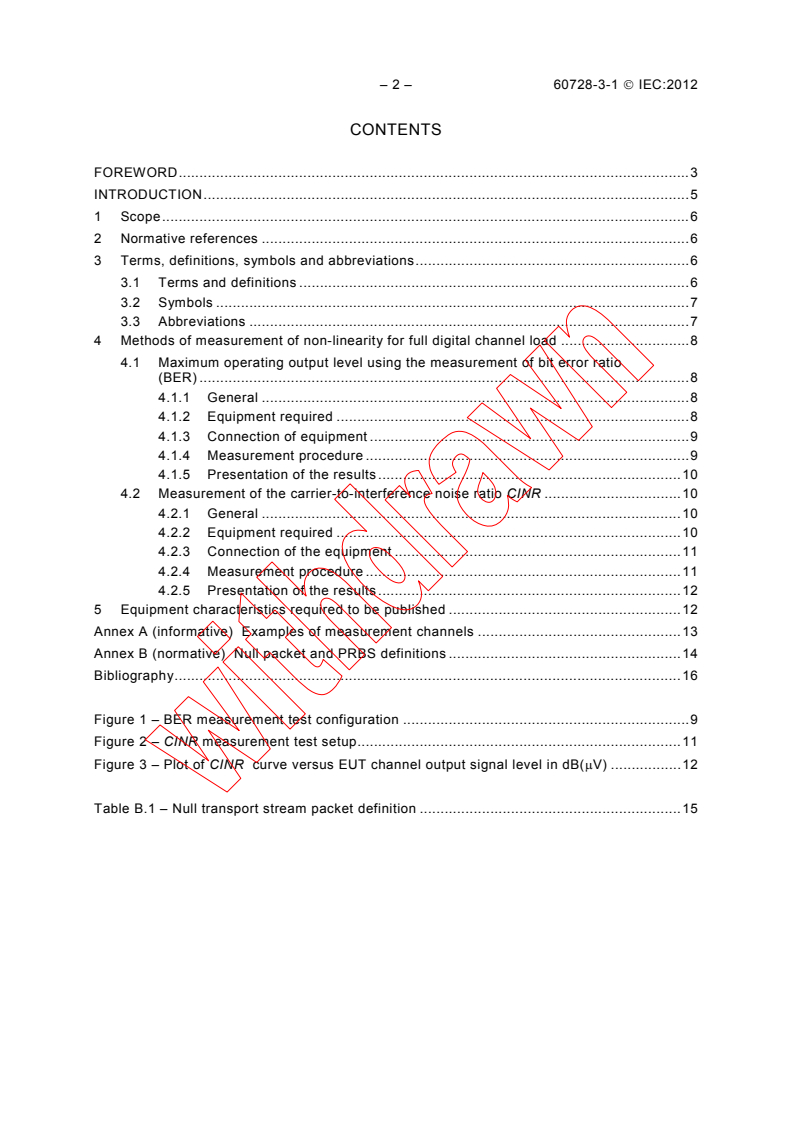
CONTENTS
FOREWORD . 3
INTRODUCTION . 5
1 Scope . 6
2 Normative references . 6
3 Terms, definitions, symbols and abbreviations . 6
3.1 Terms and definitions . 6
3.2 Symbols . 7
3.3 Abbreviations . 7
4 Methods of measurement of non-linearity for full digital channel load . 8
4.1 Maximum operating output level using the measurement of bit error ratio
(BER) . 8
4.1.1 General . 8
4.1.2 Equipment required . 8
4.1.3 Connection of equipment . 9
4.1.4 Measurement procedure . 9
4.1.5 Presentation of the results . 10
4.2 Measurement of the carrier-to-interference noise ratio CINR . 10
4.2.1 General . 10
4.2.2 Equipment required . 10
4.2.3 Connection of the equipment . 11
4.2.4 Measurement procedure . 11
4.2.5 Presentation of the results . 12
Equipment characteristics required to be published . 12
Annex A (informative) Examples of measurement channels . 13
Annex B (normative) Null packet and PRBS definitions . 14
Bibliography . 16
Figure 1 – BER measurement test configuration . 9
Figure 2 – CINR measurement test setup . 11
Figure 3 – Plot of CINR curve versus EUT channel output signal level in dB(µV) . 12
Table B.1 – Null transport stream packet definition . 15
60728-3-1 IEC:2012 – 3 –
INTERNATIONAL ELECTROTECHNICAL COMMISSION
____________
CABLE NETWORKS FOR TELEVISION SIGNALS,
SOUND SIGNALS AND INTERACTIVE SERVICES –
Part 3-1: Active wideband equipment for cable networks –
Methods of measurement of non-linearity for
full digital channel load with DVB-C signals
FOREWORD
1) The International Electrotechnical Commission (IEC) is a worldwide organization for standardization comprising
all national electrotechnical committees (IEC National Committees). The object of IEC is to promote
international co-operation on all questions concerning standardization in the electrical and electronic fields. To
this end and in addition to other activities, IEC publishes International Standards, Technical Specifications,
Technical Reports, Publicly Available Specifications (PAS) and Guides (hereafter referred to as “IEC
Publication(s)”). Their preparation is entrusted to technical committees; any IEC National Committee interested
in the subject dealt with may participate in this preparatory work. International, governmental and non-
governmental organizations liaising with the IEC also participate in this preparation. IEC collaborates closely
with the International Organization for Standardization (ISO) in accordance with conditions determined by
agreement between the two organizations.
2) The formal decisions or agreements of IEC on technical matters express, as nearly as possible, an international
consensus of opinion on the relevant subjects since each technical committee has representation from all
interested IEC National Committees.
3) IEC Publications have the form of recommendations for international use and are accepted by IEC National
Committees in that sense. While all reasonable efforts are made to ensure that the technical content of IEC
Publications is accurate, IEC cannot be held responsible for the way in which they are used or for any
misinterpretation by any end user.
4) In order to promote international uniformity, IEC National Committees undertake to apply IEC Publications
transparently to the maximum extent possible in their national and regional publications. Any divergence
between any IEC Publication and the corresponding national or regional publication shall be clearly indicated in
the latter.
5) IEC itself does not provide any attestation of conformity. Independent certification bodies provide conformity
assessment services and, in some areas, access to IEC marks of conformity. IEC is not responsible for any
services carried out by independent certification bodies.
6) All users should ensure that they have the latest edition of this publication.
7) No liability shall attach to IEC or its directors, employees, servants or agents including individual experts and
members of its technical committees and IEC National Committees for any personal injury, property damage or
other damage of any nature whatsoever, whether direct or indirect, or for costs (including legal fees) and
expenses arising out of the publication, use of, or reliance upon, this IEC Publication or any other IEC
Publications.
8) Attention is drawn to the Normative references cited in this publication. Use of the referenced publications is
indispensable for the correct application of this publication.
9) Attention is drawn to the possibility that some of the elements of this IEC Publication may be the subject of
patent rights. IEC shall not be held responsible for identifying any or all such patent rights.
International Standard IEC 60728-3-1 has been prepared by technical area 5: Cable networks
for television signals, sound signals and interactive services, of IEC technical committee 100:
Audio, video and multimedia systems and equipment.
The text of this standard is based on the following documents:
FDIS Report on voting
100/1969/FDIS 100/2006/RVD
Full information on the voting for the approval of this standard can be found in the report on
voting indicated in the above table.
This publication has been drafted in accordance with the ISO/IEC Directives, Part 2.
– 4 – 60728-3-1 IEC:2012
The list of all parts of the IEC 60728 series, under the general title, Cable networks for
television signals, sound signals and interactive services, can be found on the IEC website.
The committee has decided that the contents of this publication will remain unchanged until
the stability date indicated on the IEC web site under "http://webstore.iec.ch" in the data
related to the specific publication. At this date, the publication will be
• reconfirmed,
• withdrawn,
• replaced by a revised edition, or
• amended.
60728-3-1 IEC:2012 – 5 –
INTRODUCTION
Standards of the IEC 60728 series deal with cable networks including equipment and
associated methods of measurement for headend reception, processing and distribution of
television signals, sound signals and their associated data signals and for processing,
interfacing and transmitting all kinds of signals for interactive services using all applicable
transmission media.
This includes
• CATV -networks,
• MATV-networks and SMATV-networks,
• individual receiving networks,
and all kinds of equipment, systems and installations installed in such networks.
For active equipment with balanced RF signal ports this standard applies only to those ports
which carry RF broadband signals for services as described in the scope of this standard.
The extent of this standardization work is from the antennas and/or special signal source
inputs to the headend or other interface points to the network up to the terminal input.
The standardization of any user terminals (i.e., tuners, receivers, decoders, multimedia
terminals, etc.) as well as of any coaxial, balanced and optical cables and accessories thereof
is excluded.
___________
This word encompasses the HFC networks used nowadays to provide telecommunications services, voice,
data, audio and video both broadcast and narrowcast.
– 6 – 60728-3-1 IEC:2012
CABLE NETWORKS FOR TELEVISION SIGNALS,
SOUND SIGNALS AND INTERACTIVE SERVICES –
Part 3-1: Active wideband equipment for cable networks –
Methods of measurement of non-linearity for
full digital channel load with DVB-C signals
1 Scope
This part of IEC 60728 is applicable to the methods of non-linearity measurement for cable
networks which carry only digitally modulated television signals, sound signals and signals for
interactive services. These methods take into account the specific signal form and behaviour
of digitally modulated signals which differ from the analogue broadcast signals represented
mainly by the existence of discrete carrier signals.
2 Normative references
The following documents, in whole or in part, are normatively referenced in this document and
are indispensable for its application. For dated references, only the edition cited applies. For
undated references, the latest edition of the referenced document (including any
amendments) applies.
IEC 60728-3, Cable networks for television signals, sound signals and interactive services –
Part 3: Active wideband equipment for cable networks
ISO/IEC 13818-1:2007, Information technology – Generic coding of moving pictures and
associated audio information: Systems
3 Terms, definitions, symbols and abbreviations
For the purposes of this document, the following terms, definitions, symbols and abbreviations
apply.
3.1 Terms and definitions
Subclause 3.1 of IEC 60728-3 is applicable except as follows.
Addition:
3.1.25
maximum operating output level
average channel power level of a digitally modulated signal in the 256 QAM format with a
symbol rate of 6,9 MSymb/s with 15 % cosine roll-off, measured with full digital channel load
Note 1 to entry: This maximum operating output level has no direct correlation to that derived from CTB/CSO
measurements of analogue or mixed analogue-digital channel loads.
60728-3-1 IEC:2012 – 7 –
3.2 Symbols
The following graphical symbols are used in the figures of this standard. These symbols are
either listed in IEC 60617 or based on symbols defined in IEC 60617.
Symbols Terms Symbols Terms
Equipment Under
Test Band-pass filter
EUT
based on [IEC 60617-S01249
[IEC 60617-S00059 (2001-07)]
(2001-07)]
Spectrum analyzer
Variable attenuator (electrical)
P(f)
A
[IEC 60617-S01245 based on
(2001-07)] [IEC 60617-S00910
(2001-07)]
Combiner
Amplifier
based on
Σ
[IEC 60617-S01239
[IEC 60617-S00059
(2001-07]
(2001-07)]
Modulator Demodulator
based on based on
[IEC 60617-S01278 [IEC 60617-S01278
(2001-07)] (2001-07]
3.3 Abbreviations
BER bit error ratio
CATV community antenna television (system)
CINR carrier to intermodulation noise ratio
CSO composite second order
CTB composite triple beat
DVB digital video broadcasting
EUT equipment under test
HFC hybrid fibre coax
MATV master antenna television (system)
MEAS measured
PRBS pseudo-random bit sequence
QAM quadrature amplitude modulation
RF radio frequency
SMATV satellite master antenna television (system)
SYS system
UHF ultra-high frequency
VHF very-high frequency
U maximum operating output level with channel load of 112 carriers in
max (N)
the 256 QAM format
– 8 – 60728-3-1 IEC:2012
4 Methods of measurement of non-linearity for full digital channel load
4.1 Maximum operating output level using the measurement of bit error ratio (BER)
4.1.1 General
The method of measurement describes the measurement of the bit error ratio (BER) (before
Reed Solomon decoder of the measurement receiver) of the output signal of the equipment
under test (EUT) (e.g. an amplifier) when handling a full load of digitally modulated TV
signals.
This test is able to define the performance (maximum output level) of the EUT when loaded
with a number (N = 112) of digitally modulated signals in the 256 QAM format covering a
frequency range from 110 MHz to 1 006 MHz with a raster of 8 MHz.
NOTE 1 Due to different channel spacing plans in use, the lower frequency limit may not be exactly 110 MHz, but
may differ by some megahertz, e.g. 109 MHz. In the same way, the upper frequency limit may not be exactly
1 006 MHz, but may differ by some megahertz. The notation 110 MHz to 1 006 MHz in this standard is intended to
include such small deviations.
The number N can be reduced according to the used frequency range of the EUT, e.g. to
N = 94 for 862 MHz upper frequency limit. In all cases the EUT shall be fully loaded.
The measurement shall be performed for the following three channels:
a) the lowest RF channel according to the specified operating frequency range of the EUT;
b) the highest RF channel according to the specified operating frequency range of the EUT;
c) an RF channel at the arithmetic mean between the lowest and the highest RF channels
according to a) and b).
NOTE 2 Examples of these measurement channels are given in informative Annex B.
The worst case value of U of the EUT out of the three measured values according to a)
max (N)
to c) shall be presented together with the worst case channel.
4.1.2 Equipment required
The equipment required is the following:
a) a number N of 256 QAM modulators (with channel coders) having a suitable linearity (BER
–10
better than 1 × 10 ) and an occupied bandwidth of 8 MHz. The channels generated by
the modulators shall be placed in the frequency range from 110 MHz to 1 006 MHz or in a
subset of this frequency range with a raster of 8 MHz;
b) a number N of null packet or of pseudo-random bit sequence (PRBS) generators (see
Annex B);
c) a combiner for the output signals of the 256 QAM modulators with negligible distortion;
d) a wide band amplifier with suitable linearity and gain over the full bandwidth of the EUT;
e) precision attenuators (1 dB steps) to be placed before and after EUT;
f) a test receiver able to measure the BER of the received 256 QAM signals; its distortion
–10
should be sufficiently lower than that to be measured (e.g. a BER better than 1 × 10 ).
All applied QAM channels (channel load and measurement channels) shall have the same
output level within a deviation of maximum ±0,5 dB.
–10
The total BER introduced by source and measurement equipment shall not exceed 1 × 10 .
60728-3-1 IEC:2012 – 9 –
4.1.3 Connection of equipment
Connect the measuring equipment as indicated in Figure 1. The input signal is applied to the
equipment under test (EUT) input and its output signal level is measured by means of a
suitable measuring receiver, connected to a BER measuring set if not included in the
measuring receiver.
G Channel
coder
G
Channel
coder
BER
measuring
EUT A
A
Σ
set
Variable
Variable Measuring
attenuator B
attenuator A receiver with
RF demodulator
G
Channel
coder
Null packet
IEC 1278/12
or PRBS RF-modulator
generator
Figure 1 – BER measurement test configuration
4.1.4 Measurement procedure
The measurement shall be performed according to the steps described hereafter.
a) Tune the measuring receiver to an operating channel.
b) Measure the performance of the test configuration by connecting directly the output of the
variable attenuator A to the input of the variable attenuator B, reducing the attenuation of
the variable attenuator A to 0 dB and setting the variable attenuator B to a value that
–10
allows the best performance of the measuring receiver in terms of BER (<1 × 10
measured over an observation time >10 min). Note the level of the signal applied to the
measuring receiver and the BER value obtained.
c) Connect the EUT between the variable attenuator A and the variable attenuator B.
d) The equipment under test shall be operated at nominal gain and with nominal slope.
e) Using the variable attenuator A, set the channel output signal level of the EUT to a value
at least 10 dB lower than the maximum value (according to the methods of measurement
described in IEC 60728-3, using the CENELEC 42 channel test frequency plan); set the
variable attenuator B so as to obtain the previously determined optimum signal level at the
input of the measuring receiver.
–9
f) Read the BER on the measuring set which shall be <1 × 10 (measured over an
observation time >60 s).
g) Using the attenuator A, increase the output level of all applied channels by 1 dB and set
the variable attenuator B so as to obtain the previously determined optimum signal level at
the input of the measuring receiver.
–9
h) Repeat procedure g) until the BER measuring set shows a value >1 × 10 .
i) Then reduce the output level of all applied channels by 1 dB and set the variable
attenuator B so as to obtain the previously determined optimum signal level at the input of
the measuring receiver.
–9
j) Read the BER on the measuring set which once more shall be <1 × 10 (measured over
an observation time of >60 s). If not, repeat step i).
– 10 – 60728-3-1 IEC:2012
k) Note the output level of the EUT which represents the maximum operating output level of
the EUT.
This procedure shall be repeated for each channel as defined in 4.1.1 and the worst case
(lowest value of the maximum operating output level) shall be determined.
4.1.5 Presentation of the results
The worst case value of the maximum operating output level U of the EUT, with N
max (N)
channels applied and expressed in dB(µV), as defined in 4.1.1, shall be published. The worst-
case-channel condition shall be determined.
If the three test channels are applied to an amplifier with frequency slope, the same method of
measurement shall be applied as for amplifiers without frequency slope. But in this case the
maximum operating output level of the EUT shall always be stated for the highest
measurement channel, taking into account the relative slope value (slope value difference)
between the worst case channel and the highest measurement channel.
The frequency response (slope) of the EUT used for the measurements shall be published.
4.2 Measurement of the carrier-to-interference noise ratio CINR
4.2.1 General
In addition to the measurement of the maximum operating output level U of broadband
max (N)
–9
equipment at the borderline of the bit error ratio (1 × 10 ) according to 4.1 the carrier-to-
interference noise ratio shall be determined.
4.2.2 Equipment required
Figure 2 shows the measurement test setup.
The equipment required is the following:
a) a number N of 256 QAM modulators (with channel coders) having a suitable linearity
(shoulder attenuation) and an occupied bandwidth of 8 MHz; the channels generated by
the modulators shall be placed in the frequency range from 110 MHz to 1 006 MHz or in a
subset of this frequency range with a raster of 8 MHz;
b) a number N of null packet or of pseudo-random bit sequence (PRBS) generators (see
Annex B);
c) a combiner for the output signals of the 256 QAM modulators with negligible distortion;
d) a wide band amplifier with suitable linearity and gain over the full bandwidth of the EUT;
e) precision attenuators (1 dB steps) with sufficient attenuation range to be placed before
and after EUT;
f) a spectrum analyzer able to measure the CINR in a non-occupied measurement channel.
All applied QAM channels (channel load and measurement channels) shall have the same
output level within a deviation of maximum ±0,5 dB.
The complete measurement setup as described above should have a CINR >60 dB.
If the shoulder attenuation of the modulators is not sufficient or in the case of residual general
spurious signals transmitted by the modulators a notch filter (dashed box in Figure 2) should
be inserted in front of the EUT to achieve for the test equipment the required CINR value
>60 dB.
60728-3-1 IEC:2012 – 11 –
Furthermore, the CINR value of the test equipment may be improved by inserting a bandpass
filter at the input of the spectrum analyzer (dashed box in Figure 2). In this case, the minimum
attenuation of the variable attenuator B shall not go below a limit of 5 dB to assure sufficient
broadband impedance matching and appropriate return loss for correct measurement results.
G
Channel
coder
G
Channel
coder
P(f)
EUT A
A
Σ
Variable Notch Variable
attenuator A filter attenuator B
G
Channel
coder
IEC 1279/12
Figure 2 – CINR measurement test setup
4.2.3 Connection of the equipment
Connect the measuring equipment as indicated in Figure 2. The input signal is applied to the
equipment under test (EUT) input and its output signal level is measured by means of a
suitable spectrum analyzer. See also the remarks in 4.2.2 concerning additional means for
CINR value improvement of the test equipment.
4.2.4 Measurement procedure
The measurement shall be performed according to the steps described hereafter.
a) Tune the spectrum analyser to the channel to be measured in the used frequency band
and measure the system level as reference. The system level is defined as the level of
one of the occupied QAM channels. Switch the channel modulator temporarily off for the
CINR-measurement.
b) Measure the performance of the test setup connecting directly the output of the variable
attenuator A to the input of the variable attenuator B, reducing the attenuation of the
variable attenuator A to 0 dB and setting the variable attenuator B to a value that allows
the best performance of the spectrum analyzer in terms of CINR. Note the value of CINR
obtained by subtracting the measured noise signal level from the system level. This is the
value CINR (in dB) of the measuring system that shall be subtracted from the
SYS
measured values, to obtain performance of the EUT.
c) Connect the EUT between the variable attenuator A and the variable attenuator B.
d) The equipment under test shall be operated at nominal gain and with nominal slope.
e) Using the variable attenuator A, set the channel output signal level of the EUT at a value
at least 20 dB lower than the maximum value U according to 4.1.5 for which it has
max
been designed; set the variable attenuator B so as to obtain the previously determined
optimum signal level at the input of the spectrum analyser.
f) Read the value CINR on the spectrum analyser.
MEAS
g) Calculate the value CINR (in dB) of the EUT by subtracting the system performance
EUT
CINR from the measured value CINR , using the following formula:
SYS MEAS
-CINR - CINR
MEAS SYS
10 10
CINR =−10lg 10 −10
EUT
– 12 – 60728-3-1 IEC:2012
h) Using the attenuator A, increase the output level of all applied channels at the EUT in
steps of 1 dB and set the variable attenuator B so as to obtain the previously determined
optimum signal level at the input of the spectrum analyser; measure again the CINR
MEAS
on the measuring set and the channel output signal level of the EUT.
i) When the channel output level of the EUT approaches its upper limit, non linear distortion
appears and CINR decreases sharply.
j) Plot a graph of the CINR referred to the channel output signal level of the EUT in
EUT
dB(µV). An example of the plot of CINR versus channel output level of EUT is shown in
EUT
Figure 3.
NOTE The EUT channel output signal level is obtained from the level measured with the spectrum analyser
adding the attenuation due to the attenuator B and the band pass filter (if used).
85 90 95 100 105 110 115
EUT channel output signal level/dB(µV) →
IEC 1280/12
Figure 3 – Plot of CINR curve versus EUT channel output signal level in dB(µV)
This procedure shall be repeated for each of the three channels, as defined in 4.1.1.
4.2.5 Presentation of the results
The worst case CINR curve out of the three measured CINR curves according to 4.1.1 a) to c)
shall be presented.
NOTE Examples of these measurement channels are given in Annex A.
5 Equipment characteristics required to be published
The maximum operating output level U achieved by applying the method of
max(N)
measurement described in 4.1 shall be published.
The worst case value curve for CINR achieved by applying the method of measurement
EUT
described in 4.2 shall be published.
In addition, the nominal gain and nominal slope of the EUT, applied during the measurements,
shall be published.
/ dB →
CINR
EUT
60728-3-1 IEC:2012 – 13 –
Annex A
(informative)
Examples of measurement channels
A.1 Operating frequency range 110 MHz to 1 006 MHz
In the frequency range 110 MHz to 1 006 MHz the following measurement channels should be
used:
• Lowest RF channel frequency range: 110 MHz to 118 MHz
• Highest RF channel frequency range: 998 MHz to 1 006 MHz
• RF channel at arithmetic mean frequency range: 550 MHz to 558 MHz
NOTE For the RF channel at the arithmetic mean the next standard TV channel in the 8 MHz raster is chosen
here.
A.2 Operating frequency range 110 MHz to 862 MHz
In the frequency range 110 MHz to 862 MHz the following measurement channels should be
used:
• Lowest RF channel frequency range: 110 MHz to 118 MHz
• Highest RF channel frequency range: 854 MHz to 862 MHz
• RF channel at arithmetic mean frequency range: 478 MHz to 486 MHz
NOTE For the RF channel at the arithmetic mean the next standard TV channel in the 8 MHz raster is chosen
here.
A.3 Operating frequency range 109 MHz to 1 006 MHz
In the frequency range 109 MHz to 1 006 MHz the following measurement channels should be
used:
• Lowest RF channel frequency range: 109 MHz to 117 MHz
• Highest RF channel frequency range: 998 MHz to 1 006 MHz
• RF channel at arithmetic mean frequency range: 550 MHz to 558 MHz
NOTE For the RF channel at the arithmetic mean the next standard TV channel in the 8 MHz raster is chosen
here.
– 14 – 60728-3-1 IEC:2012
Annex B
(normative)
Null packet and PRBS definitions
B.1 Null packet definition
The null packet definition from ISO/IEC 13818-1 is extended for the purpose of the
recommended test mode.
ISO/IEC 13818-1 defines a null transport stream packet for the purpose of date rate stuffing.
Table B.1 shows the structure of a null transport stream packet using the method of
describing bit stream syntax as defined in 2.4 of ISO/IEC 13818-1:2007.
This description is derived from Table 2-2 of ISO/IEC 13818-1:2007. The abbreviation "bslbf"
means "bit string, left bit first", and "uimsbf" means "unsigned integer, most significant bit
first".
The column titled "Value", gives the bit sequence for the recommended null packet.
A null packet is defined by ISO/IEC 13818-1 as having
• payload_unit_start_indicator = '0',
• PID = 0x1FFF,
• transport_scrambling_control = '00',
• adaptation_field_control value = '01'. This corresponds to the case "no adaptation field,
payload only".
The remaining fields in the null packet that shall be defined for testing purposes are:
• transport_error_indicator is '0' unless the packet is corrupted: for testing purposes this
bit is defined as '0' when the packet is generated;
• transport_priority is not defined for a null packet by ISO/IEC 13818-1. For testing
purposes this bit is defined as '0';
• continuity_counter indicated in ISO/IEC 13818-1, is not defined for a null packet. For
testing purposes this bit field is defined as '0000';
• data_byte may have any value in a null packet according to ISO/IEC 13818-1. For testing
purposes this bit field is defined as '00000000'.
60728-3-1 IEC:2012 – 15 –
Table B.1 – Null transport stream packet definition
Syntax No. of bits Identifier Value
null_transport_packet(){
sync_byte 8 bslbf '0960111'
1 bslbf '0'
transport_error_indicator
1 bslbf
payload_unit_start_indicator '0'
transport_priority 1 bslbf '0'
PID 13 uimsbf '1111111111111'
2 bslbf '00'
transport_scrambling_control
2 bslbf '01'
adaptation_field_control
4 uimsbf
continuity_counter '0000'
8 bslbf '00000000'
for (i=0;i
}
B.2 PRBS definition
A PRBS (pseudo random bit sequence) generator can be used instead of a null packet
generator. A PRBS of 10 – 1 inverted is recommended.
– 16 – 60728-3-1 IEC:2012
Bibliography
IEC 60617 Graphical symbols for diagrams
_____________
– 18 – 60728-3-1 © CEI:2012
SOMMAIRE
AVANT-PROPOS . 19
INTRODUCTION . 21
1 Domaine d'application . 22
2 Références normatives . 22
3 Termes, définitions, symboles et abréviations . 22
3.1 Termes et définitions . 22
3.2 Symboles . 23
3.3 Abréviations . 23
4 Méthodes de mesure de la non-linéarité pour une charge de canaux tous
numériques . 24
4.1 Niveau maximal de sortie en fonctionnement normal par mesure du taux
d'erreur sur les bits (BER) . 24
4.1.1 Généralités . 24
4.1.2 Matériel nécessaire . 24
4.1.3 Raccordement du matériel . 25
4.1.4 Mode opératoire de la mesure . 25
4.1.5 Présentation des résultats . 26
4.2 Mesure du rapport CINR porteuse à bruit d'intermodulation composite (ou
porteuse à bruit brouilleur) . 26
4.2.1 Généralités . 26
4.2.2 Matériel nécessaire . 26
4.2.3 Raccordement du matériel . 27
4.2.4 Mode opératoire de la mesure . 27
4.2.5 Présentation des résultats . 29
5 Caractéristiques du matériel à publier . 29
Annexe A (informative) Exemples de canaux de mesure . 30
Annexe B (normative) Définition du paquet vide (null packet) et de la PRBS . 31
Bibliographie . 33
Figure 1 – Configuration de l'essai de mesure du BER . 25
Figure 2 – Configuration de l'essai de mesure du CINR . 27
Figure 3 – Tracé de la courbe du CINR par rapport au niveau du signal de sortie du
canal de l'EUT en dB(µV) . 28
Tableau B.1 – Définition du paquet vide du flux de transport . 32
60728-3-1 © CEI:2012 – 19 –
COMMISSION ÉLECTROTECHNIQUE INTERNATIONALE
____________
RÉSEAUX DE DISTRIBUTION PAR CÂBLES POUR
SIGNAUX DE TÉLÉVISION, SIGNAUX DE RADIODIFFUSION
SONORE ET SERVICES INTERACTIFS –
Partie 3-1: Matériel actif à large bande
pour réseaux de distribution par câbles –
Méthodes de mesure de la non-linéarité pour
une charge tout numérique de signaux DVB-C
AVANT-PROPOS
1) La Commission Electrotechnique Internationale (CEI) est une organisation mondiale de normalisation
composée de l'ensemble des comités électrotechniques nationaux (Comités nationaux de la CEI). La CEI a
pour objet de favoriser la coopération internationale pour toutes les questions de normalisation dans les
domaines de l'électricité et de l'électronique. A cet effet, la CEI – entre autres activités – publie des Normes
internationales, des Spécifications techniques, des Rapports techniques, des Spécifications accessibles au
public (PAS) et des Guides (ci-après dénommés "Publication(s) de la CEI"). Leur élaboration est confiée à des
comités d'études, aux travaux desquels tout Comité national intéressé par le sujet traité peut participer. Les
organisations internationales, gouvernementales et non gouvernementales, en liaison avec la CEI, participent
également aux travaux. La CEI collabore étroitement avec l'Organisation Internationale de Normalisation (ISO),
selon des conditions fixées par accord entre les deux organisations.
2) Les décisions ou accords officiels de la CEI concernant les questions techniques représentent, dans la mesure
du possible, un accord international sur les sujets étudiés, étant donné que les Comités nationaux de la CEI
intéressés sont représentés dans chaque comité d’études.
3) Les Publications de la CEI se présentent sous la forme de recommandations internationales et sont agréées
comme telles par les Comités nationaux de la CEI. Tous les efforts raisonnables sont entrepris afin que la CEI
s'assure de l'exactitude du contenu technique de ses publications; la CEI ne peut pas être tenue responsable
de l'éventuelle mauvaise utilisation ou interprétation qui en est faite par un quelconque utilisateur final.
4) Dans le but d'encourager l'uniformité internationale, les Comités nationaux de la CEI s'engagent, dans toute la
mesure possible, à appliquer de façon transparente les Publications de la CEI dans leurs publications
nationales et régionales. Toutes divergences entre toutes Publications de la CEI et toutes publications
nationales ou régionales correspondantes doivent être indiquées en termes clairs dans ces dernières.
5) La CEI elle-même ne fournit aucune attestation de conformité. Des organismes de certification indépendants
fournissent des services d'évaluation de conformité et, dans certains secteurs, accèdent aux marques de
conformité de la CEI. La CEI n'est responsable d'aucun des services effectués par les organismes de
certification indépendants.
6) Tous les utilisateurs doivent s'assurer qu'ils sont en possession de la dernière édition de cette publication.
7) Aucune responsabilité ne doit être imputée à la CEI, à ses administrateurs, employés, auxiliaires ou
mandataires, y compris ses experts particuliers et les membres de ses comités d'études et des Comités
nationaux de la CEI, pour tout préjudice causé en cas de dommages corporels et matériels, ou de tout autre
dommage de quelque nature que ce soit, directe ou indirecte, ou pour supporter les coûts (y compris les frais
de justice) et les dépenses découlant de la publication ou de l'utilisation de cette Publication de la CEI
...