

IEC 60728-3:2005
(Main)Cable networks for television signals, sound signals and interactive services - Part 3: Active wideband equipment for coaxial cable networks
General Information
- Abstract
lays down the measuring methods, performance requirements and data publication requirements for active coaxial wideband distribution equipment of cable networks for television and sound signals. applies to all broadband amplifiers used in cable networks and covers the frequency range 5 MHz to 3 000 MHz. It also applies to one-way and two-way equipment
- Status
- Published
- Publication Date
- 26-Jun-2005
- Technical Committee
- TC 100 - Audio, video and multimedia systems and equipment
- Current Stage
- DELPUB - Deleted Publication
- Start Date
- 09-Dec-2010
- Completion Date
- 28-Aug-2026

Overview
IEC 60728-3:2005 - "Cable networks for television signals, sound signals and interactive services - Part 3" specifies measurement methods, performance requirements and data publication rules for active wideband equipment for coaxial cable networks. It applies to all broadband amplifiers (one-way and two-way) used in cable TV and sound distribution, covering the frequency band 5 MHz to 3000 MHz. The standard is aimed at ensuring predictable RF performance, interoperability and reliable two‑way communication (return path) in coaxial distribution systems.
Key topics and requirements
- Scope & applicability
- Active coaxial wideband distribution equipment (including amplifiers and multi‑switches).
- One‑way and two‑way (return path) equipment across 5–3000 MHz.
- Measurement methods
- Linear distortion measurements (gain, flatness, group delay, return loss).
- Non‑linear distortion tests (CTB, CSO, crossmodulation and intermodulation products).
- New methods added in this edition: crosstalk attenuation, signal level for digitally modulated signals, and CINR (composite intermodulation noise ratio) for return‑path equipment carrying digital signals.
- Noise figure and S/N measurement procedures.
- AGC (automatic gain control) and slope control step response.
- Performance and equipment requirements
- Impedance and return loss criteria, gain/flatness specifications, noise figure limits, non‑linearity limits and EMC/safety expectations.
- Test points, marking, environmental and MTBF guidance.
- Specific requirements for multi‑switches and loop/through port crosstalk.
- Data publication
- Standardized ways to publish test data so manufacturers and operators can compare products reliably.
- Annexes
- Normative test carriers, test equipment checks, and informative examples (including return path design and measurement examples in Annex E).
Applications and who uses it
IEC 60728-3 is essential for:
- Cable system designers and network engineers - to specify and verify active coax components in HFC and CATV networks.
- Equipment manufacturers - to develop broadband amplifiers, amplifying nodes and multi‑switches compliant with industry measurement methods.
- Test laboratories and certification bodies - to perform standardized measurements and publish comparable datasheets.
- Operators and installers - to select equipment, troubleshoot signal quality and validate return path behavior for interactive services.
- Regulatory and procurement teams - to set technical acceptance criteria for deployed coaxial infrastructure.
Related standards
- Other parts of IEC 60728 (Part 1: system measurement; Part 2: EMC; Part 6: optical equipment; Part 10: return path system performance) - together these define a complete measurement and performance framework for cable networks.
Keywords: IEC 60728-3, coaxial cable networks, broadband amplifiers, active wideband equipment, 5 MHz–3000 MHz, measurement methods, CINR, crosstalk attenuation, noise figure, AGC, cable TV.
Relations
- Effective Date
- 10-Feb-2026
- Effective Date
- 10-Feb-2026
- Effective Date
- 10-Feb-2026
- Effective Date
- 10-Feb-2026
- Effective Date
- 05-Sep-2023
- Effective Date
- 05-Sep-2023
Get Certified
Connect with accredited certification bodies for this standard

ANCE
Mexican certification and testing association.

Intertek Slovenia
Intertek testing, inspection, and certification services in Slovenia.

LNE (Laboratoire National de Métrologie et d'Essais)
French national laboratory for metrology and testing.
Sponsored listings
Frequently Asked Questions
IEC 60728-3:2005 is a standard published by the International Electrotechnical Commission (IEC). Its full title is "Cable networks for television signals, sound signals and interactive services - Part 3: Active wideband equipment for coaxial cable networks". This standard covers: lays down the measuring methods, performance requirements and data publication requirements for active coaxial wideband distribution equipment of cable networks for television and sound signals. applies to all broadband amplifiers used in cable networks and covers the frequency range 5 MHz to 3 000 MHz. It also applies to one-way and two-way equipment
lays down the measuring methods, performance requirements and data publication requirements for active coaxial wideband distribution equipment of cable networks for television and sound signals. applies to all broadband amplifiers used in cable networks and covers the frequency range 5 MHz to 3 000 MHz. It also applies to one-way and two-way equipment
IEC 60728-3:2005 is classified under the following ICS (International Classification for Standards) categories: 33.060.40 - Cabled distribution systems; 33.170 - Television and radio broadcasting. The ICS classification helps identify the subject area and facilitates finding related standards.
IEC 60728-3:2005 has the following relationships with other standards: It is inter standard links to EN 60728-1-2:2009, EN 60728-5:2008, EN 60728-1:2008, EN 60728-1-1:2010, IEC 60728-3:2000, IEC 60728-3:2010. Understanding these relationships helps ensure you are using the most current and applicable version of the standard.
IEC 60728-3:2005 is available in PDF format for immediate download after purchase. The document can be added to your cart and obtained through the secure checkout process. Digital delivery ensures instant access to the complete standard document.
Standards Content (Sample)
INTERNATIONAL IEC
STANDARD 60728-3
Third edition
2005-06
Cable networks for television signals,
sound signals and interactive services –
Part 3:
Active wideband equipment for coaxial cable
networks
Reference number
Publication numbering
As from 1 January 1997 all IEC publications are issued with a designation in the
60000 series. For example, IEC 34-1 is now referred to as IEC 60034-1.
Consolidated editions
The IEC is now publishing consolidated versions of its publications. For example,
edition numbers 1.0, 1.1 and 1.2 refer, respectively, to the base publication, the
base publication incorporating amendment 1 and the base publication incorporating
amendments 1 and 2.
Further information on IEC publications
The technical content of IEC publications is kept under constant review by the IEC,
thus ensuring that the content reflects current technology. Information relating to
this publication, including its validity, is available in the IEC Catalogue of
publications (see below) in addition to new editions, amendments and corrigenda.
Information on the subjects under consideration and work in progress undertaken
by the technical committee which has prepared this publication, as well as the list
of publications issued, is also available from the following:
• IEC Web Site (www.iec.ch)
• Catalogue of IEC publications
The on-line catalogue on the IEC web site (www.iec.ch/searchpub) enables you to
search by a variety of criteria including text searches, technical committees
and date of publication. On-line information is also available on recently issued
publications, withdrawn and replaced publications, as well as corrigenda.
• IEC Just Published
This summary of recently issued publications (www.iec.ch/online_news/ justpub)
is also available by email. Please contact the Customer Service Centre (see
below) for further information.
• Customer Service Centre
If you have any questions regarding this publication or need further assistance,
please contact the Customer Service Centre:
Email: custserv@iec.ch
Tel: +41 22 919 02 11
Fax: +41 22 919 03 00
INTERNATIONAL IEC
STANDARD 60728-3
Third edition
2005-06
Cable networks for television signals,
sound signals and interactive services –
Part 3:
Active wideband equipment for coaxial cable
networks
IEC 2005 Copyright - all rights reserved
No part of this publication may be reproduced or utilized in any form or by any means, electronic or
mechanical, including photocopying and microfilm, without permission in writing from the publisher.
International Electrotechnical Commission, 3, rue de Varembé, PO Box 131, CH-1211 Geneva 20, Switzerland
Telephone: +41 22 919 02 11 Telefax: +41 22 919 03 00 E-mail: inmail@iec.ch Web: www.iec.ch
PRICE CODE
Commission Electrotechnique Internationale
XA
International Electrotechnical Commission
Международная Электротехническая Комиссия
For price, see current catalogue
– 2 – 60728-3 IEC:2005(E)
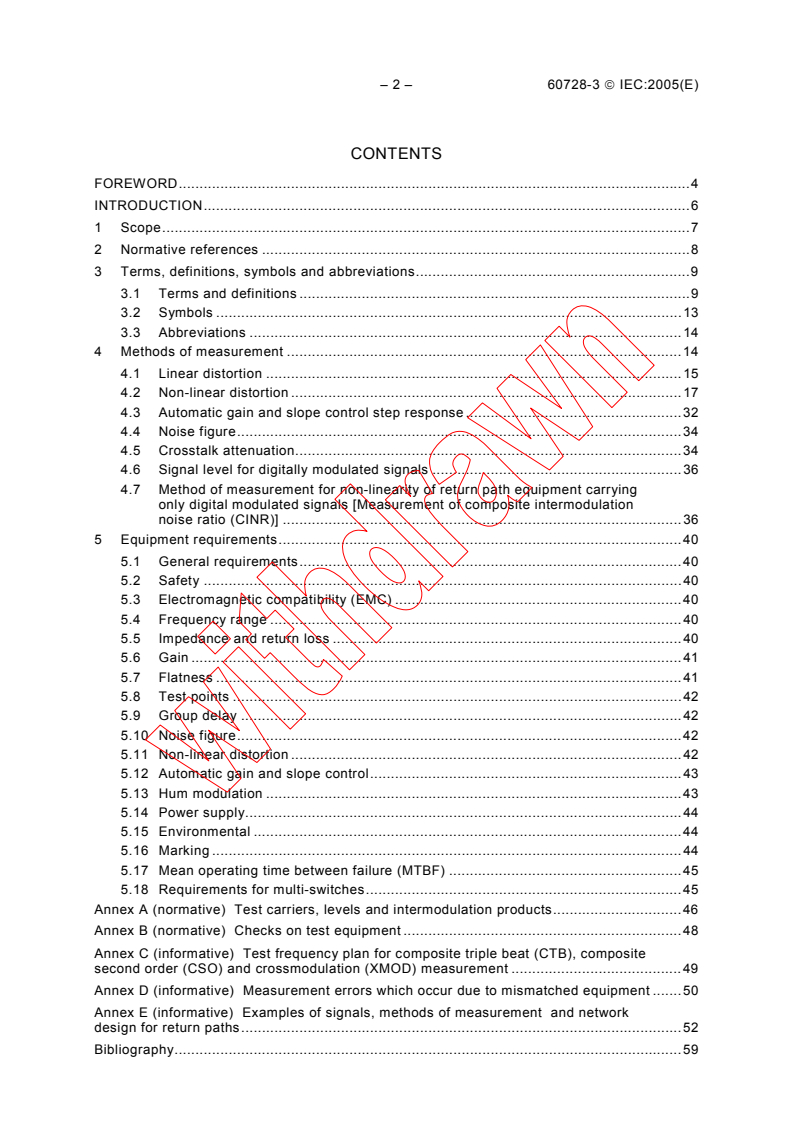
CONTENTS
FOREWORD.4
INTRODUCTION.6
1 Scope.7
2 Normative references .8
3 Terms, definitions, symbols and abbreviations.9
3.1 Terms and definitions .9
3.2 Symbols .13
3.3 Abbreviations .14
4 Methods of measurement .14
4.1 Linear distortion .15
4.2 Non-linear distortion .17
4.3 Automatic gain and slope control step response .32
4.4 Noise figure.34
4.5 Crosstalk attenuation.34
4.6 Signal level for digitally modulated signals .36
4.7 Method of measurement for non-linearity of return path equipment carrying
only digital modulated signals [Measurement of composite intermodulation
noise ratio (CINR)] .36
5 Equipment requirements.40
5.1 General requirements.40
5.2 Safety .40
5.3 Electromagnetic compatibility (EMC) .40
5.4 Frequency range .40
5.5 Impedance and return loss .40
5.6 Gain .41
5.7 Flatness .41
5.8 Test points .42
5.9 Group delay .42
5.10 Noise figure.42
5.11 Non-linear distortion .42
5.12 Automatic gain and slope control.43
5.13 Hum modulation .43
5.14 Power supply.44
5.15 Environmental .44
5.16 Marking .44
5.17 Mean operating time between failure (MTBF) .45
5.18 Requirements for multi-switches.45
Annex A (normative) Test carriers, levels and intermodulation products.46
Annex B (normative) Checks on test equipment .48
Annex C (informative) Test frequency plan for composite triple beat (CTB), composite
second order (CSO) and crossmodulation (XMOD) measurement .49
Annex D (informative) Measurement errors which occur due to mismatched equipment .50
Annex E (informative) Examples of signals, methods of measurement and network
design for return paths.52
Bibliography.59
60728-3 IEC:2005(E) – 3 –
Figure 1 – Maximum error a for measurement of return loss using VSWR-bridge with
directivity D = 46 dB and 26 dB test port return loss.16
Figure 2 – Measurement of return loss.16
Figure 3 – Basic arrangement of test equipment for evaluation of the ratio of signal to
intermodulation product .20
Figure 4 – Connection of test equipment for the measurement of non-linear distortion
by composite beat.23
Figure 5 – Connection of test equipment for the measurement of composite
crossmodulation.27
Figure 6 – Carrier/hum ratio.29
Figure 7 – Test set-up for local-powered objects.30
Figure 8 – Test set-up for remote-powered objects .30
Figure 9 – Oscilloscope display .31
Figure 10 – Time constant T .32
c
Figure 11 – Measurement of AGC step response .33
Figure 12 – Measurement of noise figure .34
Figure 13 – Measurement of crosstalk attenuation for loop trough ports of multi-switches.35
Figure 14 – Characteristic of the noise filter.38
Figure 15 – Test setup for the non-linearity measurement.38
Figure 16 – Presentation of the result of CINR .39
Figure A.1 – An example showing products formed when 2ƒ > ƒ .46
a b
Figure A.2 – An example showing products formed when 2ƒ < ƒ .47
a b
Figure A.3 – Products of the form ƒ ± ƒ ± ƒ .47
a b c
Figure D.1 – Error concerning return loss measurement .50
Figure D.2 – Maximum ripple .50
Figure E.1 – Spectrum of a QPSK-modulated signal .52
Figure E.2a – Loading with digital channels can be simulated with wideband noise.54
Figure E.2b – Non-linearity decreases the S/N at high levels .54
Figure E.3 – Network used in the design example.55
Figure E.4 – A test result measured from a real 20 dB return amplifier.56
Figure E.5 – The CINR curve of one amplifier is modified to represent the CINR of the
whole coaxial section of the network .57
Figure E.6 – The CINR of an optical link as a function of OMI, example.58
Table 1 – Correction factors where the modulation used is other than 100 %.25
Table 2 – Notch filter frequencies .37
Table 3 – Return loss requirements for all equipment .41
Table C.1 – Frequency allocation plan .49
Table E.1 – Application of methods of measurement in IEC 60728-3 for return path
equipment.53
Table E.2 – Application of methods of measurement in IEC 60728-6 for return path
equipment.53
– 4 – 60728-3 IEC:2005(E)
INTERNATIONAL ELECTROTECHNICAL COMMISSION
____________
CABLE NETWORKS FOR TELEVISION SIGNALS,
SOUND SIGNALS AND INTERACTIVE SERVICES –
Part 3: Active wideband equipment for coaxial cable networks
FOREWORD
1) The International Electrotechnical Commission (IEC) is a worldwide organization for standardization comprising
all national electrotechnical committees (IEC National Committees). The object of IEC is to promote
international co-operation on all questions concerning standardization in the electrical and electronic fields. To
this end and in addition to other activities, IEC publishes International Standards, Technical Specifications,
Technical Reports, Publicly Available Specifications (PAS) and Guides (hereafter referred to as “IEC
Publication(s)”). Their preparation is entrusted to technical committees; any IEC National Committee interested
in the subject dealt with may participate in this preparatory work. International, governmental and non-
governmental organizations liaising with the IEC also participate in this preparation. IEC collaborates closely
with the International Organization for Standardization (ISO) in accordance with conditions determined by
agreement between the two organizations.
2) The formal decisions or agreements of IEC on technical matters express, as nearly as possible, an international
consensus of opinion on the relevant subjects since each technical committee has representation from all
interested IEC National Committees.
3) IEC Publications have the form of recommendations for international use and are accepted by IEC National
Committees in that sense. While all reasonable efforts are made to ensure that the technical content of IEC
Publications is accurate, IEC cannot be held responsible for the way in which they are used or for any
misinterpretation by any end user.
4) In order to promote international uniformity, IEC National Committees undertake to apply IEC Publications
transparently to the maximum extent possible in their national and regional publications. Any divergence
between any IEC Publication and the corresponding national or regional publication shall be clearly indicated in
the latter.
5) IEC provides no marking procedure to indicate its approval and cannot be rendered responsible for any
equipment declared to be in conformity with an IEC Publication.
6) All users should ensure that they have the latest edition of this publication.
7) No liability shall attach to IEC or its directors, employees, servants or agents including individual experts and
members of its technical committees and IEC National Committees for any personal injury, property damage or
other damage of any nature whatsoever, whether direct or indirect, or for costs (including legal fees) and
expenses arising out of the publication, use of, or reliance upon, this IEC Publication or any other IEC
Publications.
8) Attention is drawn to the Normative references cited in this publication. Use of the referenced publications is
indispensable for the correct application of this publication.
9) Attention is drawn to the possibility that some of the elements of this IEC Publication may be the subject of
patent rights. IEC shall not be held responsible for identifying any or all such patent rights.
International Standard IEC 60728-3 has been prepared by technical area 5: Cable networks
for television signals, sound signals and interactive services, of IEC technical committee 100:
Audio, video and multimedia systems and equipment.
This third edition cancels and replaces the second edition published in 2000 of which it
constitutes a technical revision.
This edition includes the following significant technical changes with respect to the previous
edition:
– New methods of measurement:
• crosstalk attenuation, 4.5,
• signal level for digitally modulated signals, 4.6,
60728-3 IEC:2005(E) – 5 –
• method of measurement for non-linearity of return path equipment carrying only digital
modulated signals [Measurement of composite intermodulation noise ratio (CINR)],
4.7;
– New requirements for multi-switches, 5.18;
– New informative Annex E: Examples of signals, methods of measurement and network
design for return paths
The text of this standard is based on the following documents:
FDIS Report on voting
100/946/FDIS 100/976/RVD
Full information on the voting for the approval of this standard can be found in the report on
voting indicated in the above table.
This publication has been drafted in accordance with the ISO/IEC Directives, Part 2.
IEC 60728 consists of the following parts, under the general title Cable networks for television
signals, sound signals and interactive services:
Part 1: Methods of measurement and system performance Part 2: Electromagnetic
compatibility for equipment
Part 3: Active wideband equipment for coaxial cable networks
Part 4: Passive coaxial wideband distribution equipment (under consideration)
Part 5: Headend equipment
Part 6: Optical equipment
Part 7-1: Hybrid fibre coax outside plant status monitoring – Physical (PHY) layer
specification
Part 7-2: Hybrid fibre coax outside plant status monitoring – Media access control (MAC)
layer specification
Part 7-3: Hybrid fibre coax outside plant status monitoring – Power supply to transponder
interface bus (PSTIB) specification
Part 9: Interfaces for CATV/SMATV headends and similar professional equipment for
DVB/MPEG-2 transport streams
Part 10: System performance of return path
Part 11: Safety
Part 12: Electromagnetic compatibility of systems
The committee has decided that the contents of this publication will remain unchanged until
the maintenance result date indicated on the IEC web site under "http://webstore.iec.ch" in
the data related to the specific publication. At this date, the publication will be
• reconfirmed,
• withdrawn,
• replaced by a revised edition, or
• amended.
A bilingual version of this publication may be issued at a later date.
– 6 – 60728-3 IEC:2005(E)
INTRODUCTION
Standards of the IEC 60728 series deal with cable networks including equipment and
associated methods of measurement for headend reception, processing and distribution of
television signals, sound signals, interactive multimedia signals, interfaces and their
associated data signals, using all applicable transmission media.
This includes:
− CATV networks;
− MATV networks and SMATV networks;
− individual receiving networks,
and all kinds of equipment, systems and installations installed in such networks.
The extent of this standardization work is from the antennas, special signal source inputs to
the headend or other interface points to the network up to the terminal.
The standardization of any user terminals (i.e. tuners, receivers, decoders, terminals, etc.) as
well as of any coaxial and optical cables and accessories thereof is excluded.
60728-3 IEC:2005(E) – 7 –
CABLE NETWORKS FOR TELEVISION SIGNALS,
SOUND SIGNALS AND INTERACTIVE SERVICES –
Part 3: Active wideband equipment for coaxial cable networks
1 Scope
This part of IEC 60728 lays down the measuring methods, performance requirements and
data publication requirements for active coaxial wideband distribution equipment of cable
networks for television and sound signals.
This standard applies to all broadband amplifiers used in cable networks and covers the
frequency range 5 MHz to 3 000 MHz. It also applies to one-way and two-way equipment.
NOTE The upper limit of 3 000 MHz is an example, but not a strict value. The frequency range, or ranges, over
which the equipment is specified, should be published.
All requirements and published data are understood as guaranteed values within the specified
frequency range and in well-matched conditions.
This standard
• applies to all broadband amplifiers used in cable networks;
• covers the frequency range 5 MHz to 3 000 MHz;
• applies to one-way and two-way equipment;
• lays down the basic methods of measurement of the operational characteristics of the
active equipment in order to assess the performance of this equipment;
• identifies the performance specifications that shall be published by the manufacturers;
• states the minimum performance requirements of certain parameters.
Amplifiers are divided into the following two quality levels:
Grade 1: amplifiers typically intended to be cascaded.
Grade 2: amplifiers for use typically within an apartment block, or within a single residence,
to feed a few outlets.
Practical experience has shown these types meet most of the technical requirements
necessary for supplying a minimum signal quality to the subscribers. This classification shall
not be considered as a requirement but as the information for users and manufacturers on the
minimum quality criteria of the material required to install networks of different sizes. The
system operator has to select appropriate material to meet the minimum signal quality at the
subscriber’s outlet, and to optimise cost/performance, taking into account the size of the
network and local circumstances.
All requirements and published data are understood as guaranteed values within the specified
frequency range and in well-matched conditions.
– 8 – 60728-3 IEC:2005(E)
2 Normative references
The following referenced documents are indispensable for the application of this document.
For dated references, only the edition cited applies. For undated references, the latest edition
of the referenced document (including any amendments) applies.
IEC 60068-1:1988, Environmental testing – Part 1: General and guidance
Amendment 1 (1992)
IEC 60068-2-1:1990), Environmental testing – Part 2: Tests. Tests A: Cold
Amendment 1 (1993)
Amendment 2 (1994)
IEC 60068-2-2:1974, Environmental testing – Part 2: Tests. Tests B: Dry heat
Amendment 1 (1993)
Amendment 2 (1994)
IEC 60068-2-6:1995, Environmental testing – Part 2: Tests – Test Fc: Vibration (sinusoidal)
IEC 60068-2-14:1984, Environmental testing – Part 2: Tests. Test N: Change of temperature
Amendment 1 (1986)
IEC 60068-2-27:1987, Environmental testing – Part 2: Tests. Test Ea and guidance: Shock
IEC 60068-2-29:1987, Environmental testing – Part 2: Tests. Test Eb and guidance: Bump
IEC 60068-2-30:1980, Environmental testing – Part 2: Tests. Test Db and guidance: Damp
heat, cyclic (12 + 12-hour cycle)
Amendment 1 (1985)
IEC 60068-2-31:1969, Environmental testing –. Part 2: Tests. Test Ec: Drop and topple,
primarily for equipment-type specimens
Amendment 1 (1982)
IEC 60068-2-32:1975, Environmental testing – Part 2: Tests. Test Ed: Free fall (Procedure 1)
Amendment 2 (1990)
IEC 60068-2-40:1976, Environmental testing – Part 2: Tests. Test Z/AM: Combined cold/low
air pressure tests
Amendment 1 (1983)
IEC 60068-2-48:1982, Environmental testing – Part 2: Tests. Guidance on the application of
the tests of IEC 68 to simulate the effects of storage
IEC 60169-2:1965, Radio-frequency connectors. Part 2: Coaxial unmatched connector
Amendment 1 (1982)
IEC 60169-24:1991, Radio frequency connectors – Part 24: Radio frequency coaxial connectors
with screw coupling, typically for use in 75 ohm cable distribution systems (Type F)
IEC 60417-DB:2002 Graphical symbols for use on equipment
IEC 60529:1989, Degrees of protection provided by enclosures (IP Code)
Amendment 1 (1999)
___________
“DB” refers to the IEC on-line database.
60728-3 IEC:2005(E) – 9 –
IEC 60617-DB, 2001 Graphical symbols for diagrams – database comprising parts 2 to 13 of
IEC 60617
IEC 60728-1:2001, Cable networks for television signals, sound signals and interactive
services – Part 1: Methods of measurement and system performance
IEC 60728-2:2002, Cable networks for television signals, sound signals and interactive
services – Part 2: Electromagnetic compatibility for equipment
IEC 60728-4:2000, Cable networks for television signals, sound signals and interactive
services – Part 4: Passive coaxial wideband distribution equipment
IEC 60728-5:2001, Cable networks for television signals, sound signals and interactive
services – Part 5: Headend equipment
IEC 60728-6:2003, Cable networks for television signals, sound signals and interactive
services – Part 6: Optical equipment
IEC 60728-10:2001, Cable networks for television signals, sound signals and interactive
services – Part 10: System performance of return path
IEC 60728-11:2005, Cable networks for television signals, sound signals and interactive
services – Part 11: Safety
IEC 61319-1:1995, Interconnections of satellite receiving equipment – Part 1: Europe
IEC 61319-2:1997 Interconnections of satellite receiving equipment – Part 2: Japan
IEC 80416 (series), Basic principles for graphical symbols for use on equipment
ES 200 800 V1.3.12001, Digital Video Broadcasting (DVB); DVB interaction channel for Cable
TV distribution systems (CATV)
3 Terms, definitions, symbols and abbreviations
For the purposes of this document, the following terms, definitions, symbols and abbreviations
apply.
3.1 Terms and definitions
3.1.1
equaliser
device designed to compensate over a certain frequency range for the amplitude/frequency
distortion or phase/frequency distortion introduced by feeders or equipment
NOTE This device is for the compensation of linear distortions only.
3.1.2
feeder
transmission path forming part of a cable network. Such a path may consist of a metallic
cable, optical fibre, waveguide or any combination of them. By extension, the term is also
applied to paths containing one or more radio links
___________
“DB” refers to the IEC on-line database.
– 10 – 60728-3 IEC:2005(E)
3.1.3
decibel ratio
ten times the logarithm of the ratio of two quantities of power P and P , i.e.
1 2
P
10lg (dB)
P
3.1.4
standard reference power and voltage
in cable networks, the standard reference power, P , is (1/75) pW
NOTE This is the power dissipated in a 75 Ω resistor with an r.m.s. voltage drop of 1 µV across it.
the standard reference voltage, U , is 1 µV
3.1.5
level
of any power P it is the decibel ratio of that power to the standard reference power P , i.e.
1 0
P
10 lg
P
of any voltage U it is the decibel ratio of that voltage to the standard reference voltage U ,
1 0
i.e.
U
20 lg
U
The power level may be expressed in decibels relative to P = (U /R) = (1/75) pW, i.d.
0 0
in dB(P ), taking into account that the level of P corresponds to 0 dB(P ) or, as more usually,
0 0 0
in dB(pW), taking into account that the level of P corresponds to –18,75 dB(pW). The voltage
level is expressed in decibels relative to 1 µV (across 75 Ω), i.d. in dB(µV).
3.1.6
attenuation
ratio of the input power to the output power of an equipment or system, usually expressed in
decibels
3.1.7
gain
ratio of the output power to the input power, usually expressed in decibels
3.1.8
amplitude frequency response
gain or loss of an equipment or system plotted against frequency
3.1.9
slope
difference in gain or attenuation at two specified frequencies between any two points in an
equipment or system
3.1.10
crossmodulation
undesired modulation of the carrier of a desired signal by the modulation of another signal as
a result of equipment or system non-linearities
60728-3 IEC:2005(E) – 11 –
3.1.11
carrier-to-noise ratio
difference in decibels between the vision or sound carrier level at a given point in an
equipment or system and the noise level at that point (measured within a bandwidth
appropriate to the television or radio system in use)
3.1.12
noise factor/noise figure
used as figures of merit describing the internally generated noise of an active device
The noise factor, F, is the ratio of the carrier-to-noise ratio at the input, to the carrier-to-noise
ratio at the output of an active device.
C /N
1 1
F=
C /N
2 2
where
C is the signal power at the input;
C is the signal power at the output;
N is the noise power at the input (ideal thermal noise);
N is the noise power at the output.
In other words, the noise factor is the ratio of noise power at the output of an active device to
the noise power at the same point if the device had been ideal and added no noise.
N
2actual
F =
N
2ideal
The noise factor is dimensionless and is often expressed as noise figure, NF, in dB
NF = 10 lg F (dB)
3.1.13
ideal thermal noise
noise generated in a resistive component due to the thermal agitation of electrons
The thermal power generated is given by
P =4 ⋅ B ⋅ k⋅ T
where
P is the noise power in watts;
B is the bandwidth in hertz;
–23
k is the Boltzmann's constant = 1,38·10 J/K;
T is the absolute temperature in kelvins.
It follows that
U
= 4 ⋅ B ⋅k⋅T
R
and
U =4 ⋅ R ⋅ B ⋅ k⋅ T
– 12 – 60728-3 IEC:2005(E)
where
U is the noise voltage (e.m.f.);
R is the resistance in ohms.
In practice, it is normal for the source to be terminated with a load equal to the internal
resistance value, the noise voltage at the input is then U/2.
3.1.14
chrominance-luminance delay inequality
difference in transmission delay of chrominance and luminance signals, which results in the
spilling of colour to left or right of the area of corresponding luminance
[IEV 723-06-61]
3.1.15
well-matched
matching condition when the return loss of the equipment complies with the requirements of
Table 3
NOTE Through mismatching of measurement instruments and the measurement object, measurement errors are
possible. Comments to the estimation of such errors are given in Annex D.
3.1.16
multi-switch
equipment used in distribution systems for signals that are received from satellites and
converted to a suitable IF
NOTE The IF signals that are received from different polarisations, frequency bands and orbital positions are
input signals to the multi-switch. Subscriber feeders are connected to the multi-switch output ports. Each output
port is switched to one of the input ports, depending on control signals that are transmitted from the subscriber
equipment to the multi-switch. Besides a splitter for each input port and a switch for each output port, a multi-
switch can contain amplifiers to compensate for distribution or cable losses.
3.1.17
multi-switch loop through port
one or more ports to loop through the input signals through a multi-switch.
NOTE This enables larger networks with multiple multi-switches, each one installed close to a group of
subscribers. The multi-switches are connected in a loop through manner. The IF signals that are received by an
outdoor unit from different polarisations, frequency bands and orbital positions are input signals to a first multi-
switch. Cables connect the loop through ports of this multi-switch to the input ports of a second multi-switch and so
on.
3.1.18
multi-switch port for terrestrial signals
port in a multi-switch used to distribute terrestrial signals in addition to the signals received
from satellites
3.1.19
crosstalk attenuation
unwanted signals beside the wanted signal on a lead caused by electromagnetic coupling
between leads. It is the ratio of the wanted signal power to the unwanted signal power, while
equal signal powers are applied to the leads and is usually expressed in decibels
3.1.20
composite intermodulation noise (CIN)
sum of noise and intermodulation products from digital modulated signals
3.1.21
composite intermodulation noise ratio (CINR)
ratio of the signal level and the CIN level
60728-3 IEC:2005(E) – 13 –
3.2 Symbols
The following graphical symbols are used in the figures of this standard. These symbols are
either listed in IEC 60617 or based on symbols defined in IEC 60617.
Symbols Terms Symbols Terms
Ammeter Voltmeter
A V
[S00910] [S00910]
Power meter
Selective voltmeter W
V
[S00910]
Signal generator Oscilloscope
G
[S00899, S01403] [S00059, S00922]
Variable signal
Noise generator generator
G
G
[S01230] [S00081, S00899,
S01403]
Low-pass filter
VSWR-bridge
[S01248]
High-pass filter Band-pass filter
[S01247] [S01249]
Device Under
Band-stop filter
DUT
Test
[S01250]
[S00059]
A Attenuator Variable attenuator
A
[S01244] [S01245]
x dB
Combiner
Σ
Tap-off-box
[S00059]
O
Optical receiver
Double tap-off-box
E
[S00213]
Amplifier with return path Spectrum analyzer
P(f)
amplifier (electrical)
[S00433] [S00910]
Adjustable AC voltage
Detector with LF-amplifier source
(Functional equipotential
Capacitor
bonding)
[S00567]
[S01410]
RF choke Variable resistor
[S00583] [S00557]
– 14 – 60728-3 IEC:2005(E)
3.3 Abbreviations
AC alternating current
AF audio frequency
AGC automatic gain control
AM amplitude modulation
BER bit error rate
CATV community antenna television (system)
CIN composite intermodulation noise
CINR composite intermodulation noise ratio
CSO composite second order
CTB composite triple beat
CW continuous wave
DC direct current
DUT device under test
EMC electromagnetic compatibility
HP high pass
IF intermediate frequency
IP international protection
LF low frequency
LP low pass
MATV master antenna television (system)
MTBF meantime between failure
OMI optimum modulation index
PAL phase alternating line
RF radio frequency
RMS root mean square
RS rotary switch
SECAM sequential colour with memory (séquentiel couleur à mémoire)
SG signal generator
SMATV satellite master antenna television (system)
TV television
VSWR voltage standing wave ratio
XM crossmodulation
4 Methods of measurement
This clause defines basic methods of measurement. Any equivalent method that ensures the
same accuracy may be used for assessing performance.
Unless stated otherwise, all measurements shall be carried out with 0 dB plug-in attenuators
and equalisers. The position of variable controls used during the measurements shall be
published.
60728-3 IEC:2005(E) – 15 –
The test set-up shall be well-matched over the specified frequency band.
A network can be used to distribute terrestrial signals in addition to the signals received from
satellites. The terrestrial antennas are connected to an optional terrestrial input port of a
multi-switch. On each output port the terrestrial signals are available in addition to the satellite
IF signals. Since the usual frequency ranges for terrestrial signals and satellite IF signals do
not overlap, both can be carried on the same cable.
For large networks with loop through connected multi-switches, two possibilities exist to carry
the terrestrial signals from one multi-switch to another multi-switch:
• to use a specialised cable for the terrestrial signal, in addition with the cables used for the
satellite IF signals and then, on each output port the terrestrial signal is combined with the
selected satellite IF signa;.
• to combine the terrestrial signal with each satellite IF signal before the first multi-switch in
order to minimise the number of cables between multi-switches.
NOTE The signal coming from an outdoor unit for satellite reception may contain unwanted signal-components
with frequencies below the foreseen satellite IF frequency range. These signal-components overlap with the
frequency range of terrestrial signals. For example, an outdoor unit that converts the frequency band 11,7 GHz to
12,75 GHz to the satellite IF frequency range may convert signals in the 10,7 GHz to 11,7 GHz band to frequencies
below the satellite IF frequency range. These frequencies have to be filtered out sufficiently to avoid interference
with terrestrial signals on the same cable.
For measurements on multi-switches, it is necessary that control signals be fed to the output
ports that are involved in the measurement. Therefore, a bias-tee has to be connected
between the multi-switch output port and the measurement set. The DC port of the bias-tee is
connected to a standard receiver that generates the required control signals. Care has to be
taken that the influence of the bias-tee on the measurement result is insignificant. This can be
achieved by including it into the calibration or using a network analyzer with a built in bias-tee.
4.1 Linear distortion
4.1.1 Return loss
The method described is applicable to the measurement of the return loss of equipment
operating in the frequency range 5 MHz to 3 000 MHz.
All input and output ports of the unit shall meet the specification under all conditions of
automatic and manual gain controls and with any combination of plug-in equalisers and
attenuators fitted.
4.1.1.1 Equipment required
a) A signal generator or sweep generator, adjustable over the frequency range of the
equipment to be tested.
Care must be taken to ensure that the signal generator or sweep generator output does
not have a high harmonic content as this can cause serious inaccuracy.
b) A voltage standing wave ratio bridge with built-in or separate RF detector.
The accuracy of measurement is dependent on the quality of the bridge; in particular on
the directivity and on the return loss of the test port of the bridge. For example Figure 1
shows the maximum accuracy achieved by a bridge with 46 dB directivity and 26 dB return
loss.
– 16 – 60728-3 IEC:2005(E)
3 dB
2 dB
D = 46 dB
1 dB
–1 dB
D = 46 dB
–2 dB
–3 dB
0 dB 10 dB 20 dB 30 dB 40 dB
Measured return loss
IEC 872/05
Figure 1 – Maximum error a for measurement of return loss using VSWR-bridge
with directivity D = 46 dB and 26 dB test port return loss
c) An oscilloscope.
d) Calibrated mismatches.
4.1.1.2 Connection of equipment
The equipment shall be connected as in Figure 2.
VSWR-bridge
G
DUT
Variable signal Device under test
generator
Oscilloscope
IEC 873/05
Figure 2 – Measurement of return loss
4.1.1.3 Measurement procedure
All coaxial input and output ports, other than those under test, shall be terminated in 75 Ω.
Ensure that there is no supply voltage on the port being measured as this could damage the
bridge. If it is necessary to use a voltage blocking device, use one with a good return loss
(10 dB above requirement).
Only good quality calibrated connectors, adaptors and cables shall be used.
Maximum error a
60728-3 IEC:2005(E) – 17 –
The measurement procedure comprises the following steps:
a) connect the equipment as shown in Figure 2;
b) set the signal generator output level so that the device under test is not overloaded;
c) use calibrated mismatches to calibrate the display on the oscilloscope;
d) connect the device under test as shown in Figure 2 and check the return loss over the
specified frequency range.
4.1.2 Flatness
Methods of measurement are well-known and a full description of the procedure is not
necessary.
Measurement is commonly made with a 75 Ω scalar or vector network analyzer. Care must be
taken that all equipment used (connectors, adaptors, cable, etc.) are well-matched.
4.1.3 Chrominance/luminance delay inequality for PAL/SECAM only
The well-known 20T pulse method of measurement is used as described in IEC 60728-5.
4.2 Non-linear distortion
General
In a non-linear device, the expression for the output signal will, in general, have an infinity of
terms, each generated from one or more of the (assumed sinusoidal) terms in the input, and
particularly by the interaction of two or more terms. The transfer function of the device can be
expressed as£:
2 3 n
V = a + a V + a V + a V + .a V + ., etc.
out 0 1 in 2 in 3 in n in
has m sinusoidal terms, then this can be expressed as:
If the input signal V
in
V = V sin(ω t + Φ ) + V sin(ω t + Φ ) + .V sin(ω t + Φ )
in 1 1 1 2 2 2 m m m
The output signal is then a series of terms each of which can be expressed in the general
form:
CV a sin(ω t + Φ )
i n i i
where ω is the sum or difference of integral positive multiples of one or more of the input
i
frequencies, for example:
4ω , 2ω – ω , 4ω + ω , 2ω + ω + ω .
2 1 3 1 2 1 2 3
This may be written in a general form as:
ω = p ω ± p ω ± p ω ± .p ω
i 1 1 2 2 3 3 m m
where
is the angular velocity 2πf ;
ω
i
i
p , p ,.p are positive integers (including 0);
1 2 m
is the relative phase of the output signals;
Φ
i
– 18 – 60728-3 IEC:2005(E)
a is a coefficient of the transfer function;
n
V is a term dependent on the product of powers of the amplitudes of the input
i
signals (V , V , etc.) where the sum of the powers equals n;
1 2
C is a numerical multiplier.
It should be noted that terms at the same frequency may arise from several different terms in
the transfer function, i.e. for several different values of n.
Each component of the output signal represented by such an expression with n > 1 is a non-
linear distortion product, where ω is an integral multiple of a single term in the input signal,
i
for example 4ω , the product is regarded as a harmonic distortion product. If it is formed from
two or more terms, for example 2ω – ω , it is known as an intermodulation distortion product.
1 3
Since the values of a , a , a , etc., usually decrease relatively rapidly with increasing values
1 2 3
of n, it is found that the predominant non-linear output signals arise from the terms in the
transfer function in such a way that the sum p +p +.p = n, and n is defined as the order of
1 2 m
the non-linear distortion product, for example 3ω – 2ω is a fifth order product arising from
1 3
the term a V .
in
The m input signals represented in the expression are not necessarily distinct signals. Any
periodic signal may be represented by a series of sinusoidal terms as in the expression for
V . For the predominant non-linear output signals it is found that:
in
p p p p
1 2 3 m
V =V ⋅V ⋅V ⋅.V
i m
1 2 3
so that if the amplitudes of all the input signals are multiplied by a common factor K, the
th n
amplitude of the n order distortion products will be multiplied by K (since p + p +p +.p
1 2 3 m
th
= n). When the levels of all input signals are raised by 1 dB, the level of any signal n order
distortion product will increase by n dB, and the resultant sign
...