


IEC PAS 63178:2018
(Main)Smart manufacturing service platform - Service-oriented integration requirements of the manufacturing resource/capability
Smart manufacturing service platform - Service-oriented integration requirements of the manufacturing resource/capability
IEC PAS 63178:2018(E) provides the requirements of all relevant manufacturing resources integrated to the cloud manufacturing service platform, including integration of hard manufacturing resources, soft manufacturing resources and manufacturing capabilities.
This document is used for the integration of the relevant resources to the smart manufacturing service platform.
General Information
- Status
- Published
- Publication Date
- 16-Jul-2018
- Technical Committee
- SC 65E - Devices and integration in enterprise systems
- Current Stage
- WPUB - Publication withdrawn
- Start Date
- 20-Sep-2024
- Completion Date
- 20-Sep-2024
Overview
IEC PAS 63178:2018 - Smart manufacturing service platform - defines service-oriented integration requirements for manufacturing resources and capabilities when connecting to a cloud manufacturing service platform. The PAS covers integration of hard manufacturing resources (equipment, tools, materials), soft manufacturing resources (software, models, knowledge), and higher-level manufacturing capabilities (human, management, technology combined). It is intended to guide transformation of physical resources into virtual, service-oriented resources for smart/cloud manufacturing.
Key topics & requirements
This PAS focuses on practical integration and service packaging. Major technical topics and requirements include:
- Resource categories: clear distinction between hard resources, soft resources, and manufacturing capabilities.
- Data extraction and connectivity: status data from resources and capabilities must be extracted and transmitted to the cloud via wired or wireless networks.
- Virtualization and unified description: physical resources/capabilities are transformed into logical (virtual) resources using a unified description to form virtual resource/capability description documents.
- Service packaging: virtual resources are integrated to the platform as cloud services through standardized service descriptions and packaging methods.
- Hard resource integration modes:
- Complete equipment sets (e.g., simulation test systems, digital production lines) - options include local servers, DNC, MES/ERP integration or labelled digital manufacturing center databases.
- Production equipment - retrofit with sensors/I/O capture for non-networked machines or integration via industrial gateways, DNC, MES and ERP for networked equipment.
- Soft resource integration: on‑demand service access for ERP/PLM/CAD/CAE/CAM, app integration platforms, and knowledge bases.
- Application behaviors post-integration: monitoring, utilization analysis, equipment management, online renting/calling, collaborative planning, task/time/status/capability information exposure.
Applications
IEC PAS 63178 is directly applicable to:
- Building cloud manufacturing service platforms and industry/factory/workshop clouds
- Converting equipment and software into consumable cloud services (e.g., equipment-as-a-service)
- Enabling remote monitoring, scheduling, resource sharing, and collaborative manufacturing
- Facilitating digital production lines, simulation systems, and virtualized toolchains
Keywords: smart manufacturing, cloud manufacturing service platform, manufacturing resource integration, service‑oriented integration, IEC PAS 63178
Who should use this standard
- Manufacturing system architects and cloud platform vendors
- Industrial automation and IoT integrators
- MES/ERP/PLM implementers and digital transformation teams
- Equipment OEMs offering equipment-as-a-service
- Standards committees and procurement/spec authors
Related standards
IEC PAS 63178 is positioned within IEC TC 65 work (industrial-process measurement, control and automation). Users should consult IEC/ISO terminology resources (IEC Electropedia, ISO OBP) and applicable IEC/ISO standards for enterprise systems, MES/ERP interoperability, and industrial communication when implementing integrations.

Get Certified
Connect with accredited certification bodies for this standard

BSI Group
BSI (British Standards Institution) is the business standards company that helps organizations make excellence a habit.

National Aerospace and Defense Contractors Accreditation Program (NADCAP)
Global cooperative program for special process quality in aerospace.
CARES (UK Certification Authority for Reinforcing Steels)
UK certification for reinforcing steels and construction.
Sponsored listings
Frequently Asked Questions
IEC PAS 63178:2018 is a technical specification published by the International Electrotechnical Commission (IEC). Its full title is "Smart manufacturing service platform - Service-oriented integration requirements of the manufacturing resource/capability". This standard covers: IEC PAS 63178:2018(E) provides the requirements of all relevant manufacturing resources integrated to the cloud manufacturing service platform, including integration of hard manufacturing resources, soft manufacturing resources and manufacturing capabilities. This document is used for the integration of the relevant resources to the smart manufacturing service platform.
IEC PAS 63178:2018(E) provides the requirements of all relevant manufacturing resources integrated to the cloud manufacturing service platform, including integration of hard manufacturing resources, soft manufacturing resources and manufacturing capabilities. This document is used for the integration of the relevant resources to the smart manufacturing service platform.
IEC PAS 63178:2018 is classified under the following ICS (International Classification for Standards) categories: 25.040.40 - Industrial process measurement and control; 35.210 - Cloud computing; 35.240.50 - IT applications in industry. The ICS classification helps identify the subject area and facilitates finding related standards.
IEC PAS 63178:2018 is available in PDF format for immediate download after purchase. The document can be added to your cart and obtained through the secure checkout process. Digital delivery ensures instant access to the complete standard document.
Standards Content (Sample)
IEC PAS 63178 ®
Edition 1.0 2018-07
PUBLICLY AVAILABLE
SPECIFICATION
PRE-STANDARD
colour
inside
Smart manufacturing service platform – Service-oriented integration
requirements of the manufacturing resource/capability
All rights reserved. Unless otherwise specified, no part of this publication may be reproduced or utilized in any form
or by any means, electronic or mechanical, including photocopying and microfilm, without permission in writing from
either IEC or IEC's member National Committee in the country of the requester. If you have any questions about IEC
copyright or have an enquiry about obtaining additional rights to this publication, please contact the address below or
your local IEC member National Committee for further information.
IEC Central Office Tel.: +41 22 919 02 11
3, rue de Varembé info@iec.ch
CH-1211 Geneva 20 www.iec.ch
Switzerland
About the IEC
The International Electrotechnical Commission (IEC) is the leading global organization that prepares and publishes
International Standards for all electrical, electronic and related technologies.
About IEC publications
The technical content of IEC publications is kept under constant review by the IEC. Please make sure that you have the
latest edition, a corrigenda or an amendment might have been published.
IEC Catalogue - webstore.iec.ch/catalogue Electropedia - www.electropedia.org
The stand-alone application for consulting the entire The world's leading online dictionary of electronic and
bibliographical information on IEC International Standards, electrical terms containing 21 000 terms and definitions in
Technical Specifications, Technical Reports and other English and French, with equivalent terms in 16 additional
documents. Available for PC, Mac OS, Android Tablets and languages. Also known as the International Electrotechnical
iPad. Vocabulary (IEV) online.
IEC publications search - webstore.iec.ch/advsearchform IEC Glossary - std.iec.ch/glossary
The advanced search enables to find IEC publications by a 67 000 electrotechnical terminology entries in English and
variety of criteria (reference number, text, technical French extracted from the Terms and Definitions clause of
committee,…). It also gives information on projects, replaced IEC publications issued since 2002. Some entries have been
and withdrawn publications. collected from earlier publications of IEC TC 37, 77, 86 and
CISPR.
IEC Just Published - webstore.iec.ch/justpublished
Stay up to date on all new IEC publications. Just Published IEC Customer Service Centre - webstore.iec.ch/csc
details all new publications released. Available online and If you wish to give us your feedback on this publication or
also once a month by email. need further assistance, please contact the Customer Service
Centre: sales@iec.ch.
IEC PAS 63178 ®
Edition 1.0 2018-07
PUBLICLY AVAILABLE
SPECIFICATION
PRE-STANDARD
colour
inside
Smart manufacturing service platform – Service-oriented integration
requirements of the manufacturing resource/capability
INTERNATIONAL
ELECTROTECHNICAL
COMMISSION
ICS 25.040.40; 35.210; 35.240.50 ISBN 978-2-8322-5879-8
– 2 – IEC PAS 63178:2018 IEC 2018
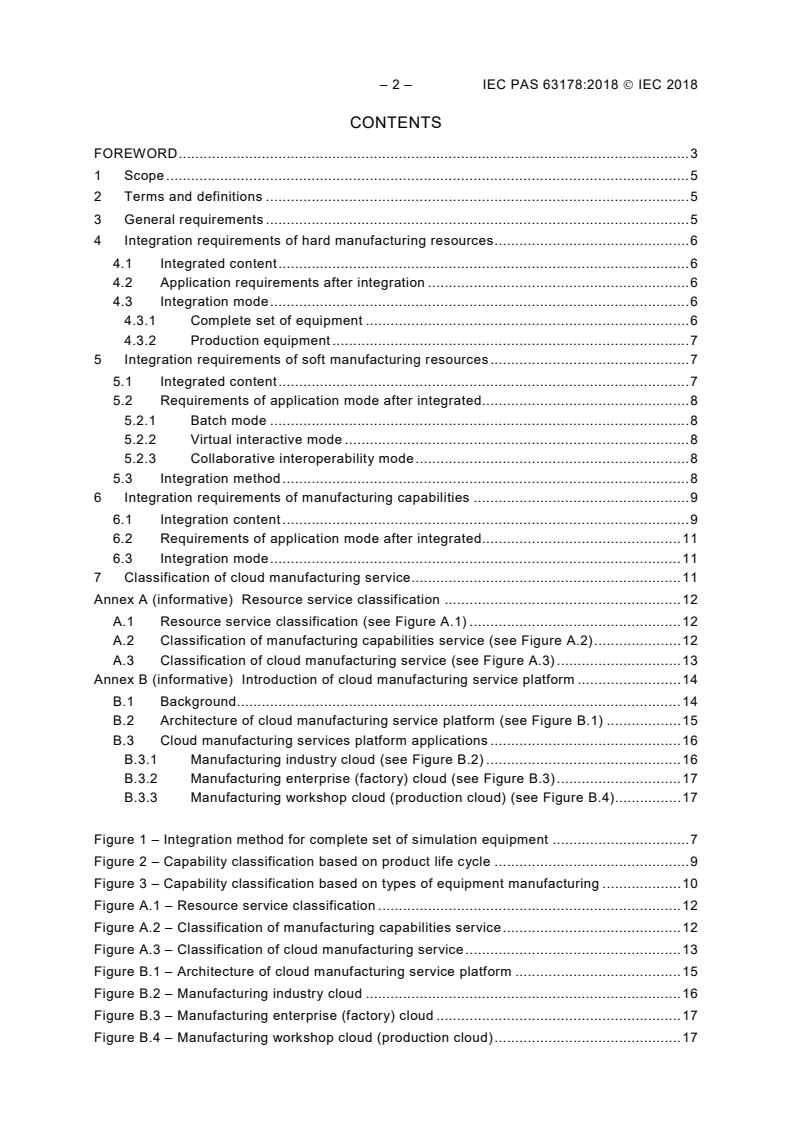
CONTENTS
FOREWORD . 3
1 Scope . 5
2 Terms and definitions . 5
3 General requirements . 5
4 Integration requirements of hard manufacturing resources . 6
4.1 Integrated content . 6
4.2 Application requirements after integration . 6
4.3 Integration mode . 6
4.3.1 Complete set of equipment . 6
4.3.2 Production equipment . 7
5 Integration requirements of soft manufacturing resources . 7
5.1 Integrated content . 7
5.2 Requirements of application mode after integrated. 8
5.2.1 Batch mode . 8
5.2.2 Virtual interactive mode . 8
5.2.3 Collaborative interoperability mode . 8
5.3 Integration method . 8
6 Integration requirements of manufacturing capabilities . 9
6.1 Integration content . 9
6.2 Requirements of application mode after integrated. 11
6.3 Integration mode . 11
7 Classification of cloud manufacturing service . 11
Annex A (informative) Resource service classification . 12
A.1 Resource service classification (see Figure A.1) . 12
A.2 Classification of manufacturing capabilities service (see Figure A.2) . 12
A.3 Classification of cloud manufacturing service (see Figure A.3) . 13
Annex B (informative) Introduction of cloud manufacturing service platform . 14
B.1 Background. 14
B.2 Architecture of cloud manufacturing service platform (see Figure B.1) . 15
B.3 Cloud manufacturing services platform applications . 16
B.3.1 Manufacturing industry cloud (see Figure B.2) . 16
B.3.2 Manufacturing enterprise (factory) cloud (see Figure B.3) . 17
B.3.3 Manufacturing workshop cloud (production cloud) (see Figure B.4). 17
Figure 1 – Integration method for complete set of simulation equipment . 7
Figure 2 – Capability classification based on product life cycle . 9
Figure 3 – Capability classification based on types of equipment manufacturing . 10
Figure A.1 – Resource service classification . 12
Figure A.2 – Classification of manufacturing capabilities service . 12
Figure A.3 – Classification of cloud manufacturing service . 13
Figure B.1 – Architecture of cloud manufacturing service platform . 15
Figure B.2 – Manufacturing industry cloud . 16
Figure B.3 – Manufacturing enterprise (factory) cloud . 17
Figure B.4 – Manufacturing workshop cloud (production cloud) . 17
INTERNATIONAL ELECTROTECHNICAL COMMISSION
____________
SMART MANUFACTURING SERVICE PLATFORM –
SERVICE-ORIENTED INTEGRATION REQUIREMENTS
OF THE MANUFACTURING RESOURCE/CAPABILITY
FOREWORD
1) The International Electrotechnical Commission (IEC) is a worldwide organization for standardization comprising
all national electrotechnical committees (IEC National Committees). The object of IEC is to promote
international co-operation on all questions concerning standardization in the electrical and electronic fields. To
this end and in addition to other activities, IEC publishes International Standards, Technical Specifications,
Technical Reports, Publicly Available Specifications (PAS) and Guides (hereafter referred to as “IEC
Publication(s)”). Their preparation is entrusted to technical committees; any IEC National Committee interested
in the subject dealt with may participate in this preparatory work. International, governmental and non-
governmental organizations liaising with the IEC also participate in this preparation. IEC collaborates closely
with the International Organization for Standardization (ISO) in accordance with conditions determined by
agreement between the two organizations.
2) The formal decisions or agreements of IEC on technical matters express, as nearly as possible, an international
consensus of opinion on the relevant subjects since each technical committee has representation from all
interested IEC National Committees.
3) IEC Publications have the form of recommendations for international use and are accepted by IEC National
Committees in that sense. While all reasonable efforts are made to ensure that the technical content of IEC
Publications is accurate, IEC cannot be held responsible for the way in which they are used or for any
misinterpretation by any end user.
4) In order to promote international uniformity, IEC National Committees undertake to apply IEC Publications
transparently to the maximum extent possible in their national and regional publications. Any divergence
between any IEC Publication and the corresponding national or regional publication shall be clearly indicated in
the latter.
5) IEC itself does not provide any attestation of conformity. Independent certification bodies provide conformity
assessment services and, in some areas, access to IEC marks of conformity. IEC is not responsible for any
services carried out by independent certification bodies.
6) All users should ensure that they have the latest edition of this publication.
7) No liability shall attach to IEC or its directors, employees, servants or agents including individual experts and
members of its technical committees and IEC National Committees for any personal injury, property damage or
other damage of any nature whatsoever, whether direct or indirect, or for costs (including legal fees) and
expenses arising out of the publication, use of, or reliance upon, this IEC Publication or any other IEC
Publications.
8) Attention is drawn to the Normative references cited in this publication. Use of the referenced publications is
indispensable for the correct application of this publication.
9) Attention is drawn to the possibility that some of the elements of this IEC Publication may be the subject of
patent rights. IEC shall not be held responsible for identifying any or all such patent rights.
A PAS is a technical specification not fulfilling the requirements for a standard, but made
available to the public.
IEC PAS 63178 has been processed by subcommittee 65E: Devices and integration in
enterprise systems, of IEC technical committee 65: Industrial-process measurement, control
and automation.
The text of this PAS is based on the This PAS was approved for
following document: publication by the P-members of the
committee concerned as indicated in
the following document
Draft PAS Report on voting
65E/578/DPAS 65E/585/RVDPAS
Following publication of this PAS, which is a pre-standard publication, the technical committee
or subcommittee concerned may transform it into an International Standard.
– 4 – IEC PAS 63178:2018 IEC 2018
This PAS shall remain valid for an initial maximum period of 2 years starting from the
publication date. The validity may be extended for a single period up to a maximum of 2 years,
at the end of which it shall be published as another type of normative document, or shall be
withdrawn.
A bilingual version of this publication may be issued at a later date.
IMPORTANT – The 'colour inside' logo on the cover page of this publication indicates
that it contains colours which are considered to be useful for the correct
understanding of its contents. Users should therefore print this document using a
colour printer.
SMART MANUFACTURING SERVICE PLATFORM –
SERVICE-ORIENTED INTEGRATION REQUIREMENTS
OF THE MANUFACTURING RESOURCE/CAPABILITY
1 Scope
This PAS provides the requirements of all relevant manufacturing resources integrated to the
cloud manufacturing service platform, including integration of hard manufacturing resources,
soft manufacturing resources and manufacturing capabilities.
This document is used for the integration of the relevant resources to the smart manufacturing
service platform.
2 Terms and definitions
For the purposes of this document, the following terms and definitions apply.
ISO and IEC maintain terminological databases for use in standardization at the following
addresses:
• IEC Electropedia: available at http://www.electropedia.org/
• ISO Online browsing platform: available at http://www.iso.org/obp
2.1
soft manufacturing resource
manufacturing resources that are based on software, data, models, knowledge
2.2
hard manufacturing resource
manufacturing equipment, computing equipment, materials, etc. used in a product life cycle
2.3
manufacturing capability
ability to complete various activities during the product life cycle, featured by the organic
combination of three main elements, human labour, management and technology
3 General requirements
The following requirements should be met:
a) Resource/capability integration to the smart manufacturing platform is generally divided
into hard manufacturing resource integration, soft manufacturing resource integration and
manufacturing capability integration.
b) Status data of soft/hard manufacturing resource and capability should be extracted, and
integrated to smart manufacturing platform through a wired or wireless network.
c) Physical manufacturing resource/capability should be transformed to logical ones. Logical
manufacturing resource/capability should be defined by unified description, which forms
description document of virtual manufacturing resource/capability.
d) Virtual manufacturing resource/capability should be integrated to the smart manufacturing
platform as a cloud service through a unified description of services and packaging
method.
– 6 – IEC PAS 63178:2018 IEC 2018
4 Integration requirements of hard manufacturing resources
4.1 Integrated content
According to the business requirements in a manufacturing life-cycle, integrated hard
manufacturing resources typically include the following:
a) complete set of equipment, such as large-scale simulation test system and digital
production line, etc.;
b) production equipment, including mechanical equipment, electrical equipment,
environmental test equipment, etc.
4.2 Application requirements after integration
Integrated equipment/device should be applied in the following ways:
a) equipment/device status monitoring and resource utilization analysing;
b) equipment/device management;
c) equipment/device online renting and calling;
d) resource collaborative planning.
Integrated equipment/device should provide following information:
1) equipment/device general information;
2) equipment/device capability information;
3) equipment/device time information;
4) equipment/device status information;
5) equipment/device task information.
4.3 Integration mode
4.3.1 Complete set of equipment
4.3.1.1 Complete set of simulation test equipment
For the set of simulation test equipment which is well digitalized and has a complete set of
control systems, a local server with dual DNC can be added to connect and convert real time
network (reflective memory network) to research network, so that device is integrated and
instrumentation is realized, as shown in Figure 1.
Figure 1 – Integration method for complete set of simulation equipment
4.3.1.2 Digital production line
For digital product line, there are generally two ways of integration:
• integrating distributed numerical control (DNC) centers, manufacturing execution systems
(MES) and enterprise resource planning (ERP) systems to realize high-end integration and
control of digital production line;
• integrating digital production line through digital manufacturing center database, which is
generated by fully or semi-automatically collecting data of working status for equipment,
which is realized by adding bar code labels to tools and materials and giving unified digital
labels to all kinds of production resources.
4.3.2 Production equipment
Production equipment integration has the following two situations based on whether it has
networking capabilities or not:
a) Install smart capture terminals and sensors or I/O signal capture devices on the
production device which does not have the networking capacity, and then equipment
should be integrated.
b) There are generally two types of integration for production equipment that has a
networking capacity:
1) integrated through deploying industrial data getaways which has a platform integration
functionality;
2) integrated through digital numerical control centers (DNC), manufacturing execution
systems (MES) and enterprise resource planning systems (ERP).
5 Integration requirements of soft manufacturing resources
5.1 I
...
Questions, Comments and Discussion
Ask us and Technical Secretary will try to provide an answer. You can facilitate discussion about the standard in here.
Loading comments...