

IEC TR 60601-4-3:2015
(Main)Medical electrical equipment - Part 4-3: Guidance and interpretation - Considerations of unaddressed safety aspects in the third edition of IEC 60601-1 and proposals for new requirements
General Information
- Abstract
IEC TR 60601-4-3:2015(E) is intended to convey the results of WG 14's work to interested parties such as manufacturers and test laboratories while retaining the informative nature of the material. This first edition contains 93 recommendations, numbered 101 to 193. All these recommendations are based upon IEC 60601-1:2005 and IEC 60601-1:2005/AMD1:2012.
- Status
- Published
- Publication Date
- 12-Apr-2015
- Technical Committee
- SC 62A - Common aspects of medical equipment, software, and systems
- Drafting Committee
- WG 14 - TC 62/SC 62A/WG 14
- Current Stage
- DELPUB - Deleted Publication
- Start Date
- 13-Dec-2018
- Completion Date
- 28-Aug-2026
Buy Documents
IEC TR 60601-4-3:2015 - Medical electrical equipment - Part 4-3: Guidance and interpretation - Considerations of unaddressed safety aspects in the third edition of IEC 60601-1 and proposals for new requirements Released:4/13/2015
Overview
IEC TR 60601-4-3:2015 is an IEC Technical Report that provides guidance and interpretation on unaddressed safety aspects of the third edition of IEC 60601-1. Published as an informative document, it records the work of WG 14 and presents 93 recommendations (numbered 101–193) that clarify, interpret and propose new requirements based on IEC 60601-1:2005 and IEC 60601-1:2005/AMD1:2012. The report is targeted at stakeholders who design, test or certify medical electrical equipment, helping bridge gaps between the main standard and real-world safety concerns.
Key Topics
This TR covers practical safety considerations and interpretation for medical electrical equipment, including but not limited to:
- Patient leakage current and test methods for ME systems and multiple applied parts
- MOPP (Means of Patient Protection) and MOOP (Means of Operator Protection) distinctions, pollution degree and related requirements
- Defibrillation-proof applied parts and defibrillation energy protection considerations
- Dielectric strength, creepage distances and air clearances for various components and enclosures
- Protective earth requirements, impedance and fault behaviour for ME systems
- Guidance on transient and overvoltage categories, mains transients and related test considerations
- Practical interpretation for transformers, optocouplers, fuses, batteries, portable/mobile equipment and enclosure materials
- Tests and instrumentation: recurrent test applicability (IEC 62353 referenced), leakage current test setups and environmental conditioning (humidity, altitude)
- Labeling, marking, applied-part connectivity, and examples of single-fault conditions and ME system arrangements
Applications
Who uses IEC TR 60601-4-3:2015 and why:
- Medical device manufacturers - to interpret IEC 60601-1 requirements, evaluate safety margins and plan design changes or mitigation for unaddressed risks.
- Test laboratories and certification bodies - to harmonize test methods, interpret borderline cases (e.g., leakage current measurement, defibrillation tests) and support conformity assessments.
- Regulatory and quality teams - to prepare technical files and risk assessments that reference WG 14 recommendations.
- Design engineers and safety specialists - for practical guidance on selecting components, spacing, insulation strategies and protecting patient and operator safety.
Related Standards
- IEC 60601-1 (3rd edition) - primary general standard for medical electrical equipment safety
- IEC 60601-1:2005/AMD1:2012 - amendment referenced by the TR
- IEC 62353 - recurrent and routine test methods (referenced for test equipment use)
- IEC 62304 - software lifecycle considerations (cross-reference appears in the TR)
This Technical Report is a practical companion for interpreting IEC 60601-1 safety requirements, improving compliance strategies and reducing ambiguity in testing and design of medical electrical equipment.
Relations
- Effective Date
- 05-Sep-2023
Buy Documents
IEC TR 60601-4-3:2015 - Medical electrical equipment - Part 4-3: Guidance and interpretation - Considerations of unaddressed safety aspects in the third edition of IEC 60601-1 and proposals for new requirements Released:4/13/2015
Get Certified
Connect with accredited certification bodies for this standard

BSI Group
BSI (British Standards Institution) is the business standards company that helps organizations make excellence a habit.

DNV
DNV is an independent assurance and risk management provider.

TÜV Rheinland
TÜV Rheinland is a leading international provider of technical services.
Sponsored listings
Frequently Asked Questions
IEC TR 60601-4-3:2015 is a technical report published by the International Electrotechnical Commission (IEC). Its full title is "Medical electrical equipment - Part 4-3: Guidance and interpretation - Considerations of unaddressed safety aspects in the third edition of IEC 60601-1 and proposals for new requirements". This standard covers: IEC TR 60601-4-3:2015(E) is intended to convey the results of WG 14's work to interested parties such as manufacturers and test laboratories while retaining the informative nature of the material. This first edition contains 93 recommendations, numbered 101 to 193. All these recommendations are based upon IEC 60601-1:2005 and IEC 60601-1:2005/AMD1:2012.
IEC TR 60601-4-3:2015(E) is intended to convey the results of WG 14's work to interested parties such as manufacturers and test laboratories while retaining the informative nature of the material. This first edition contains 93 recommendations, numbered 101 to 193. All these recommendations are based upon IEC 60601-1:2005 and IEC 60601-1:2005/AMD1:2012.
IEC TR 60601-4-3:2015 is classified under the following ICS (International Classification for Standards) categories: 11.040.01 - Medical equipment in general; 27.160 - Solar energy engineering. The ICS classification helps identify the subject area and facilitates finding related standards.
IEC TR 60601-4-3:2015 has the following relationships with other standards: It is inter standard links to IEC TR 60601-4-3:2018. Understanding these relationships helps ensure you are using the most current and applicable version of the standard.
IEC TR 60601-4-3:2015 is available in PDF format for immediate download after purchase. The document can be added to your cart and obtained through the secure checkout process. Digital delivery ensures instant access to the complete standard document.
Standards Content (Sample)
IEC TR 60601-4-3 ®
Edition 1.0 2015-04
TECHNICAL
REPORT
Medical electrical equipment –
Part 4-3: Guidance and interpretation – Considerations of unaddressed safety
aspects in the third edition of IEC 60601-1 and proposals for new requirements
All rights reserved. Unless otherwise specified, no part of this publication may be reproduced or utilized in any form
or by any means, electronic or mechanical, including photocopying and microfilm, without permission in writing from
either IEC or IEC's member National Committee in the country of the requester. If you have any questions about IEC
copyright or have an enquiry about obtaining additional rights to this publication, please contact the address below or
your local IEC member National Committee for further information.
IEC Central Office Tel.: +41 22 919 02 11
3, rue de Varembé Fax: +41 22 919 03 00
CH-1211 Geneva 20 info@iec.ch
Switzerland www.iec.ch
About the IEC
The International Electrotechnical Commission (IEC) is the leading global organization that prepares and publishes
International Standards for all electrical, electronic and related technologies.
About IEC publications
The technical content of IEC publications is kept under constant review by the IEC. Please make sure that you have the
latest edition, a corrigenda or an amendment might have been published.
IEC Catalogue - webstore.iec.ch/catalogue Electropedia - www.electropedia.org
The stand-alone application for consulting the entire The world's leading online dictionary of electronic and
bibliographical information on IEC International Standards, electrical terms containing more than 30 000 terms and
Technical Specifications, Technical Reports and other definitions in English and French, with equivalent terms in 15
documents. Available for PC, Mac OS, Android Tablets and additional languages. Also known as the International
iPad. Electrotechnical Vocabulary (IEV) online.
IEC publications search - www.iec.ch/searchpub IEC Glossary - std.iec.ch/glossary
The advanced search enables to find IEC publications by a More than 60 000 electrotechnical terminology entries in
variety of criteria (reference number, text, technical English and French extracted from the Terms and Definitions
committee,…). It also gives information on projects, replaced clause of IEC publications issued since 2002. Some entries
and withdrawn publications. have been collected from earlier publications of IEC TC 37,
77, 86 and CISPR.
IEC Just Published - webstore.iec.ch/justpublished
Stay up to date on all new IEC publications. Just Published IEC Customer Service Centre - webstore.iec.ch/csc
details all new publications released. Available online and If you wish to give us your feedback on this publication or
also once a month by email. need further assistance, please contact the Customer Service
Centre: csc@iec.ch.
IEC TR 60601-4-3 ®
Edition 1.0 2015-04
TECHNICAL
REPORT
Medical electrical equipment –
Part 4-3: Guidance and interpretation – Considerations of unaddressed safety
aspects in the third edition of IEC 60601-1 and proposals for new requirements
INTERNATIONAL
ELECTROTECHNICAL
COMMISSION
ICS 11.040 ISBN 978-2-8322-2613-1
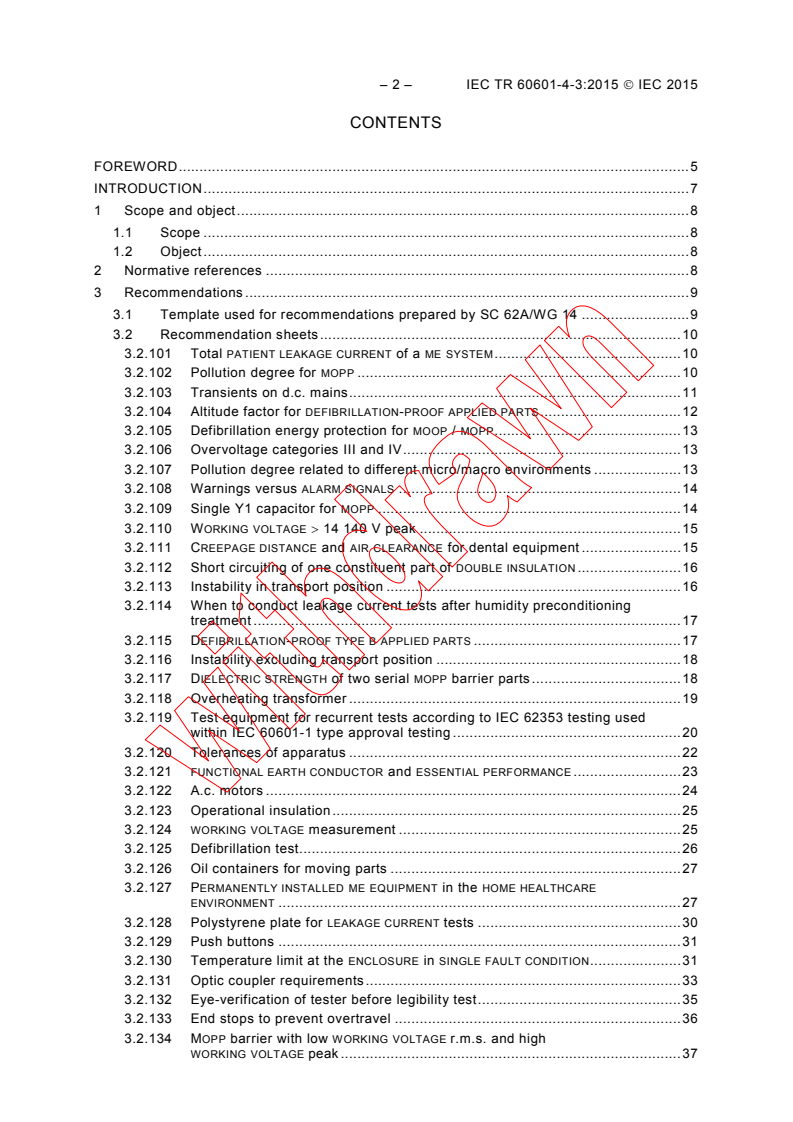
– 2 – IEC TR 60601-4-3:2015 IEC 2015
CONTENTS
FOREWORD . 5
INTRODUCTION . 7
1 Scope and object . 8
1.1 Scope . 8
1.2 Object . 8
2 Normative references . 8
3 Recommendations . 9
3.1 Template used for recommendations prepared by SC 62A/WG 14 . 9
3.2 Recommendation sheets . 10
3.2.101 Total PATIENT LEAKAGE CURRENT of a ME SYSTEM . 10
3.2.102 Pollution degree for MOPP . 10
3.2.103 Transients on d.c. mains . 11
3.2.104 Altitude factor for DEFIBRILLATION-PROOF APPLIED PARTS . 12
3.2.105 Defibrillation energy protection for MOOP / MOPP . 13
3.2.106 Overvoltage categories III and IV . 13
3.2.107 Pollution degree related to different micro/macro environments . 13
3.2.108 Warnings versus ALARM SIGNALS . 14
3.2.109 Single Y1 capacitor for MOPP . 14
3.2.110 WORKING VOLTAGE > 14 140 V peak . 15
3.2.111 CREEPAGE DISTANCE and AIR CLEARANCE for dental equipment . 15
3.2.112 Short circuiting of one constituent part of DOUBLE INSULATION . 16
3.2.113 Instability in transport position . 16
3.2.114 When to conduct leakage current tests after humidity preconditioning
treatment . 17
3.2.115 DEFIBRILLATION-PROOF TYPE B APPLIED PARTS . 17
3.2.116 Instability excluding transport position . 18
3.2.117 DIELECTRIC STRENGTH of two serial MOPP barrier parts . 18
3.2.118 Overheating transformer . 19
3.2.119 Test equipment for recurrent tests according to IEC 62353 testing used
within IEC 60601-1 type approval testing . 20
3.2.120 Tolerances of apparatus . 22
3.2.121 FUNCTIONAL EARTH CONDUCTOR and ESSENTIAL PERFORMANCE . 23
3.2.122 A.c. motors . 24
3.2.123 Operational insulation . 25
3.2.124 WORKING VOLTAGE measurement . 25
3.2.125 Defibrillation test. 26
3.2.126 Oil containers for moving parts . 27
3.2.127 PERMANENTLY INSTALLED ME EQUIPMENT in the HOME HEALTHCARE
ENVIRONMENT . 27
3.2.128 Polystyrene plate for LEAKAGE CURRENT tests . 30
3.2.129 Push buttons . 31
3.2.130 Temperature limit at the ENCLOSURE in SINGLE FAULT CONDITION . 31
3.2.131 Optic coupler requirements . 33
3.2.132 Eye-verification of tester before legibility test . 35
3.2.133 End stops to prevent overtravel . 36
3.2.134 MOPP barrier with low WORKING VOLTAGE r.m.s. and high
WORKING VOLTAGE peak . 37
3.2.135 Labeling: spare parts vs. detachable parts vs. ACCESSORIES . 38
3.2.136 Protective earth impedance of ME SYSTEM >200 mΩ . 41
3.2.137 Ball pressure test . 42
3.2.138 Magnesium alloy ENCLOSURE. 43
3.2.139 Instability with initial movement . 44
3.2.140 Ball pressure test . 45
3.2.141 DIELECTRIC STRENGTH test values . 47
3.2.142 SECONDARY CIRCUITS . 48
3.2.143 LEAKAGE CURRENTS in SINGLE FAULT CONDITION and during component
faults . 48
3.2.144 Impedance of a PROTECTIVE EARTH CONDUCTOR within a DETACHABLE
POWER SUPPLY CORD . 49
3.2.145 Time delay of the 100 VA limit . 50
3.2.146 Test voltage multiplied by factor 1,6 . 51
3.2.147 Overflow, spillage, … . 51
3.2.148 DIELECTRIC STRENGTH test of transformers without accessible frame . 52
3.2.149 Expected voltage on SIP/SOPs . 52
3.2.150 Flammability rating for transformer bobbin . 53
3.2.151 COMPONENT WITH HIGH-INTEGRITY CHARACTERISTICS . 54
3.2.152 Peak and r.m.s. WORKING VOLTAGES . 55
3.2.153 Critical components . 56
3.2.154 LEAKAGE CURRENT test for ME EQUIPMENT with multiple APPLIED PARTS . 56
3.2.155 DIELECTRIC STRENGTH test value for extruded and spirally wrapped multi-
layer wires . 57
3.2.156 DIELECTRIC STRENGTH test after thermal cycling test . 57
3.2.157 Required MOOP values higher than MOPP values . 58
3.2.158 Optocouplers . 58
3.2.159 Impact test . 59
3.2.160 Spillage test in NORMAL CONDITION and in SINGLE FAULT CONDITION . 60
3.2.161 TYPE B APPLIED PART connected to ACCESSIBLE PARTS . 61
3.2.162 Current/power labeling . 62
3.2.163 Separate power supply part of ME EQUIPMENT or ME SYSTEM . 62
3.2.164 Specification of the allowed power supply . 63
3.2.165 Mains transients for opposite polarity on the secondary side or battery
pole to pole barrier . 64
3.2.166 Keep dry and umbrella symbol . 65
3.2.167 MOBILE and STATIONARY ME EQUIPMENT with wheels . 66
3.2.168 Varistors installed in the MAINS PART . 67
3.2.169 Using Y2 capacitors for MOPP . 67
3.2.170 Overtravel end stops – specification of the speed . 68
3.2.171 CREEPAGE DISTANCE and AIR CLEARANCE between input and output of
fuse contacts . 69
3.2.172 Examples of SINGLE FAULT CONDITION . 69
3.2.173 Examples of ME SYSTEMS . 70
3.2.174 Cross sectional area of POWER SUPPLY CORD for rated input current
> 63 A . 70
3.2.175 Biocompatibility for quasi APPLIED PARTS . 71
3.2.176 Floating reference earth. 71
3.2.177 SINGLE FAULT CONDITION in OXYGEN RICH ENVIRONMENT . 72
3.2.178 Laser requirements . 74
– 4 – IEC TR 60601-4-3:2015 IEC 2015
3.2.179 Flammability rating of insulated wires . 74
3.2.180 Infrared lamps . 75
3.2.181 Identification of internal fuses . 76
3.2.182 Chargers for ME EQUIPMENT used at home . 77
3.2.183 CLASS II ME EQUIPMENT with FUNCTIONAL EARTH CONDUCTOR . 78
3.2.184 Symbol D2-2 on MSO . 78
3.2.185 PATIENT leads connectors . 79
3.2.186 Rationale for IP2X . 80
3.2.187 Battery – limited power . 80
3.2.188 TYPE B APPLIED PART separated from ACCESSIBLE PARTS . 81
3.2.189 Protective earth test >25A . 81
3.2.190 Reference to IEC 62304:2006 . 82
3.2.191 The SIP/SOP pin to earth TOUCH CURRENT . 82
3.2.192 Overbalancing . 84
3.2.193 MAINS VOLTAGE on APPLIED PART . 85
Annex A (informative) Overview of the recommendations developed by IEC/SC
62A/WG 14 . 86
Bibliography . 91
Table A.1 – Cross-reference of recommendations by subclause of IEC 60601-1:2005
and IEC 60601-1:2005/AMD1:2012 (1 of 5) . 86
INTERNATIONAL ELECTROTECHNICAL COMMISSION
____________
MEDICAL ELECTRICAL EQUIPMENT –
Part 4-3: Guidance and interpretation – Considerations
of unaddressed safety aspects in the third edition of IEC 60601-1
and proposals for new requirements
FOREWORD
1) The International Electrotechnical Commission (IEC) is a worldwide organization for standardization comprising
all national electrotechnical committees (IEC National Committees). The object of IEC is to promote
international co-operation on all questions concerning standardization in the electrical and electronic fields. To
this end and in addition to other activities, IEC publishes International Standards, Technical Specifications,
Technical Reports, Publicly Available Specifications (PAS) and Guides (hereafter referred to as “IEC
Publication(s)”). Their preparation is entrusted to technical committees; any IEC National Committee interested
in the subject dealt with may participate in this preparatory work. International, governmental and non-
governmental organizations liaising with the IEC also participate in this preparation. IEC collaborates closely
with the International Organization for Standardization (ISO) in accordance with conditions determined by
agreement between the two organizations.
2) The formal decisions or agreements of IEC on technical matters express, as nearly as possible, an international
consensus of opinion on the relevant subjects since each technical committee has representation from all
interested IEC National Committees.
3) IEC Publications have the form of recommendations for international use and are accepted by IEC National
Committees in that sense. While all reasonable efforts are made to ensure that the technical content of IEC
Publications is accurate, IEC cannot be held responsible for the way in which they are used or for any
misinterpretation by any end user.
4) In order to promote international uniformity, IEC National Committees undertake to apply IEC Publications
transparently to the maximum extent possible in their national and regional publications. Any divergence
between any IEC Publication and the corresponding national or regional publication shall be clearly indicated in
the latter.
5) IEC itself does not provide any attestation of conformity. Independent certification bodies provide conformity
assessment services and, in some areas, access to IEC marks of conformity. IEC is not responsible for any
services carried out by independent certification bodies.
6) All users should ensure that they have the latest edition of this publication.
7) No liability shall attach to IEC or its directors, employees, servants or agents including individual experts and
members of its technical committees and IEC National Committees for any personal injury, property damage or
other damage of any nature whatsoever, whether direct or indirect, or for costs (including legal fees) and
expenses arising out of the publication, use of, or reliance upon, this IEC Publication or any other IEC
Publications.
8) Attention is drawn to the Normative references cited in this publication. Use of the referenced publications is
indispensable for the correct application of this publication.
9) Attention is drawn to the possibility that some of the elements of this IEC Publication may be the subject of
patent rights. IEC shall not be held responsible for identifying any or all such patent rights.
The main task of IEC technical committees is to prepare International Standards. However, a
technical committee may propose the publication of a technical report when it has collected
data of a different kind from that which is normally published as an International Standard, for
example "state of the art".
IEC TR 60601-4-3, which is a technical report, has been prepared by subcommittee 62A:
Common aspects of electrical equipment used in medical practice, of IEC technical committee
62: Electrical equipment in medical practice.
– 6 – IEC TR 60601-4-3:2015 IEC 2015
The text of this technical report is based on the following documents:
Enquiry draft Report on voting
62A/951/DTR 62A/973A/RVC
Full information on the voting for the approval of this technical report can be found in the
report on voting indicated in the above table.
This publication has been drafted in accordance with the ISO/IEC Directives, Part 2.
Terms used throughout this technical report that have been defined in Clause 3 of
IEC 60601-1:2005 and IEC 60601-1:2005/AMD 1:2012 are printed in SMALL CAPITALS.
The committee has decided that the contents of this publication will remain unchanged until
the stability date indicated on the IEC website under "http://webstore.iec.ch" in the data
related to the specific publication. At this date, the publication will be
• reconfirmed,
• withdrawn,
• replaced by a revised edition, or
• amended.
A bilingual version of this technical report may be issued at a later date.
INTRODUCTION
At the Sydney meeting in August 1994, IEC subcommittee (SC) 62A established a procedure
under which working group (WG) 14 would develop recommendations regarding problems of
interpretation or application of IEC 60601-1. WG 14 is made up of experts with particular
expertise in testing according to the requirements of IEC 60601-1. Many of the experts on
WG 14 are employed by test laboratories with a long history of applying IEC 60601-1 to
MEDICAL ELECTRICAL EQUIPMENT. While the National Committee members of SC 62A nominate
these experts, their recommendations were not to be formally adopted through any official
voting procedure. To reinforce this process, the Subcommittee specifically directed that the
following note appear on every page of the resulting informational circular:
IMPORTANT NOTE: Per the 62A decision at Sydney (see RM3755/SC62A, August 1994), the
62A Secretary is circulating this recommendation, prepared by 62A/WG 14, regarding
problems of interpretation or application of IEC 60601-1 to all P-Member NCs.
This recommendation/interpretation is the result of considerations by a group of nominated
experts and has not been formally adopted through any National Committee voting procedure.
Distribution is only for information.
At the November 2000 meeting of SC 62A in Tokyo, the subcommittee discussed ways and
means for achieving a wider distribution of the WG 14 recommendations. At the conclusion of
this discussion, the subcommittee instructed the Secretariat to develop a technical report (TR)
based on the published recommendations of WG 14. This technical report is intended to
convey the results of WG 14's work to interested parties such as MANUFACTURERS and test
laboratories while retaining the informative nature of the material.
This first edition of IEC TR 60601-4-3 contains 93 recommendations, numbered 101 to 193.
All these recommendations are based upon IEC 60601-1:2005 and
IEC 60601-1:2005/AMD1:2012.
The numbering starts with 101 instead of just 1 to ensure that these WG 14 recommendations
(101 to 193) will not accidentally be confused with previous issued WG 14 recommendations 1
to 63, which are based on the second edition of IEC 60601-1 and published in IEC TR 62296.
This technical report may be amended from time to time as WG 14 prepares additional
recommendations.
– 8 – IEC TR 60601-4-3:2015 IEC 2015
MEDICAL ELECTRICAL EQUIPMENT
Part 4-3: Guidance and interpretation – Considerations
of unaddressed safety aspects in the third edition of IEC 60601-1
and proposals for new requirements
1 Scope and object
1.1 Scope
This technical report contains a series of recommendations developed by an expert working
group of IEC subcommittee 62A in response to questions of interpretation of the third edition
of IEC 60601-1.
This technical report is primarily intended to be used by:
– MANUFACTURERS of MEDICAL ELECTRICAL EQUIPMENT;
– test laboratories and others responsible for assessment of compliance with
IEC 60601-1:2005 and IEC 60601-1:2005/AMD1:2012, and
– those developing subsequent editions of IEC 60601-1.
The recommendations in the first edition of IEC/TR 62296 were considered in preparing the
third edition of IEC 60601-1. Similarly it is expected that these recommendations within
IEC 60601-4-3 will be considered when preparing a future revision of IEC 60601-1.
1.2 Object
The object of this technical report is to make the recommendations/interpretations developed
by the experts in IEC/SC 62A/WG 14 available to those interested in the application of the
third edition of IEC 60601-1.
The reader is reminded that, although a majority of the National Committee members of IEC/SC 62A have
approved publication of this technical report, the contents remain the opinion of the expert members of WG 14.
These recommendations/interpretations are the result of considerations by this group of nominated experts and
have not been formally adopted through any National Committee voting procedure. Distribution is only for
information.
2 Normative references
The following documents, in whole or in part, are normatively referenced in this document and
are indispensable for its application. For dated references, only the edition cited applies. For
undated references, the latest edition of the referenced document (including any
amendments) applies.
IEC 60601-1:2005, Medical electrical equipment – Part 1: General requirements for basic
safety and essential performance
IEC 60601-1:2005/AMD1:2012
IEC 60601-1-8:2006, Medical electrical equipment – Part 1-8: General requirements for basic
safety and essential performance – Collateral standard: General requirements, tests and
guidance for alarm systems in medical electrical equipment and medical electrical systems
IEC 60601-1-8:2006/AMD1:2012
IEC 60601-1-11:2010, Medical electrical equipment – Part 1-11: General requirements for
basic safety and essential performance – Collateral standard: Requirements for medical
electrical equipment and medical electrical systems used in the home healthcare environment
3 Recommendations
3.1 Template used for recommendations prepared by SC 62A/WG 14
The recommendations in this Technical Report are presented in tabular form using the
following table structure.
a)
WG 14 recommendation number
NNN
b)
Requirement, clause/ subclause number(s)
c)
Source/problem
d)
Discussion/comment
e)
Submitter proposed recommendation
f)
WG 14 recommendation
a)
The numbering of the recommendations in the Technical Report starts with 101 instead of just 1 to ensure
that these WG 14 recommendations will not accidentally be confused with previously issued WG 14
recommendations 1 to 63, which are based on the second edition of IEC 60601-1.
b)
The clause, subclause or requirement to which the question is related. If no standard is listed, the reference
is to IEC 60601-1:2005 and IEC 60601-1:2005/AMD1:2012.
c)
A description of the problem as submitted to WG 14.
d)
Additional discussion or commentary provided by the submitter.
e)
The submitter's proposed resolution to the problem, if one exists.
f)
The final recommendation developed by WG 14.
– 10 – IEC TR 60601-4-3:2015 IEC 2015
3.2 Recommendation sheets
3.2.101 Total PATIENT LEAKAGE CURRENT of a ME SYSTEM
WG 14 recommendation number 101
Requirement, clause/ subclause 16.6.3
number(s)
Source/problem There is no measuring circuit or measurement method given in
IEC 60601-1 for measurement of the total PATIENT LEAKAGE CURRENT
of ME SYSTEMS.
Input: PATIENT can be simultaneously monitored for a physiological
parameter by the ME EQUIPMENT “1” and for other physiological
parameter by the ME EQUIPMENT “2”. The ME EQUIPMENT “1” and “2”
belong to the same ME SYSTEM. The total PATIENT LEAKAGE CURRENT
of the ME SYSTEM in question should be measured, but how should
the measurement be performed?
Discussion/comment –
Submitter proposed recommendation –
WG 14 recommendation Q1:
Shall the total PATIENT LEAKAGE CURRENT of the ME SYSTEM be
measured “from” and “to” all PATIENT CONNECTIONS of all APPLIED
PARTS (in the ME SYSTEM) of the same type connected together?
NOTE Those APPLIED PARTS belong to several individual
ME EQUIPMENTS of the ME SYSTEM.
WG 14 answer to Q1:
No, measure only “from” (i.e. to earth) not “to” all PATIENT
CONNECTIONS of the same type of APPLIED PARTS of the ME SYSTEM
connected together. Reason: SINGLE FAULT CONDITION tests with
SUPPLY MAINS on APPLIED PART or with SUPPLY MAINS on SIP/SOP
(represent “to” measurement) are N/A for a ME SYSTEM, see
subclauses 16.1 and 16.6.3.
Q2:
Is it adequate that the total PATIENT LEAKAGE CURRENT of the
ME SYSTEM in question is measured according to subclause 8.7.4.7 h)
separately for each individual ME EQUIPMENT belonging to the
ME SYSTEM?
WG 14 answer to Q2:
No, this is not adequate. Individual tests of each item of
ME EQUIPMENT or non-ME EQUIPMENT is anyway required and those
individual measurements do not replace the ME SYSTEM tests of the
total PATIENT LEAKAGE CURRENT.
In addition:
It is not explicitly written in IEC 60601-1, but WG 14 recommends
measuring the total PATIENT LEAKAGE CURRENT in an ME SYSTEM by
combining all APPLIED PARTS of the same type of the whole
ME SYSTEM together and measuring against earth. See also Annex A,
subclause 16.6.3.
3.2.102 Pollution degree for MOPP
WG 14 recommendation number 102
Requirement, clause/ subclause 8.9,
number(s) 8.9.1.1
Source/problem IEC 60601-1 does not include requirements for MOPP in regards to
pollution degrees 1 and 3.
Discussion/comment There are no clear requirements in regards to pollution degree
relative to MOPP.
Submitter proposed recommendation
Use Table 12 for MOPP as provided for pollution degrees 1, 2 and 3.
NOTE Pollution degree 4 is not allowed as a MOP.
WG 14 recommendation
It is recommended to use Table 12 for MOPP for pollution degrees 1,
2 and 3.
NOTE Pollution degree 4 is not allowed.
3.2.103 Transients on d.c. mains
WG 14 recommendation number 103
Requirement, clause/ subclause 8.9,
number(s) 8.9.1.1
Source/problem
Transients on d.c. mains (e.g. ambulance power source).
Discussion/comment The tables are based on a.c. mains transients. What about ME
that operates from a d.c. mains such as an ambulance?
EQUIPMENT
Submitter proposed recommendation Apply Tables 12 through 16 as provided for ME EQUIPMENT connected
to the d.c. mains.
WG 14 recommendation It is recommended to apply Tables 12 through 16 for ME EQUIPMENT
connected to the d.c. mains.
Examples:
a) Pure external battery power: no MAINS TRANSIENT VOLTAGE
exists.
b) If the external d.c. power is derived out of an a.c. MAINS VOLTAGE
(e.g. 230 V a.c.): use the concept already described in
IEC 60601-1.
c) If the external d.c. power is locally generated by a local
generator (i.e. not derived out of MAINS VOLTAGE 230 V a.c.), e.g.
by a generator of the ambulance, then use transient level
Table 10, line 50 V r.m.s. for primary d.c. circuit.
– 12 – IEC TR 60601-4-3:2015 IEC 2015
3.2.104 Altitude factor for DEFIBRILLATION-PROOF APPLIED PARTS
WG 14 recommendation number 104
Requirement, clause/ subclause 8.9,
number(s) 8.9.1.1
Source/problem
Use of AIR CLEARANCE altitude multiplication factor for
DEFIBRILLATION-PROOF APPLIED PARTS
Discussion/comment AIR CLEARANCE multiplication factor based on altitude
Should the
(reference Table 8) be used for subclause 8.9.1.15?
It was mentioned that IEC 60601-2-4 could be referenced, but many
APPLIED PARTS marked DEFIBRILLATION-PROOF are not in themselves
defibrillators. The group felt that since the AIR CLEARANCE
multiplication factor pertains to transients, it should apply.
DEFIBRILLATION-PROOF TYPE CF APPLIED PARTS testing is conducted in
IEC 60601-1 for three primary reasons, which include:
1) to ensure that the defibrillator energy at APPLIED PARTS does not
transfer excessive energy to parts of ME EQUIPMENT that
OPERATORS or other persons could touch during cardiac
defibrillation;
2) to ensure that the ME EQUIPMENT does not lose more than 10 %
of the total defibrillation energy across a 100 Ω resistor (see
Figure 11);
3) to ensure that the ME EQUIPMENT remains functional (cardiac
defibrillation recovery) within a specified period of time;
As item 1 above directly relates to the CREEPAGE DISTANCE and
AIR CLEARANCE requirement for subclause 8.9.1.15 and is relative to
the protection of OPERATORS rather than PATIENTS, the
AIR CLEARANCE multiplication factors for altitude would be taken from
Table 8 column heading “Multiplication factor for MOOP”. However,
these multiplication factors cause a large increase in the AIR
CLEARANCE and it is doubtful that this is really necessary.
Submitter proposed recommendation Apply the AIR CLEARANCE multiplication factor based on altitude to
subclause 8.9.1.15. Also, bump the CREEPAGE DISTANCE requirements
to equal those of the AIR CLEARANCE as is done throughout this
edition of IEC 60601-1.
WG 14 recommendation
1) For DEFIBRILLATION-PROOF APPLIED PARTS, a minimum of 4,0 mm
CREEPAGE DISTANCE and 4,0 mm AIR CLEARANCE are required.
2) For use in higher altitudes, the AIR CLEARANCE needs be
corrected by a multiplication factor. According to Figure A.12 the
MANUFACTURER has the choice to use MOPP instead of MOOP. The
MOPP multiplication factor is less than the MOOP multiplication
factor. The MOPP multiplication factor is sufficient.
3) Figure A.12 should be normative. This should be implemented in
a future amendment of IEC 60601-1.
4) CREEPAGE DISTANCE requirements should be at least equal to
those of the AIR CLEARANCE.
3.2.105 Defibrillation energy protection for MOOP / MOPP
WG 14 recommendation number 105
Requirement, clause/ subclause 8.9,
number(s) 8.9.1.1
Source/problem
APPLIED PART separation MOP type.
Discussion/comment Is APPLIED PART separation, for example in subclause 8.9.1.15 for
DEFIBRILLATION-PROOF APPLIED PARTS, considered a MOPP or MOOP?
What about MAXIMUM MAINS VOLTAGE on APPLIED PARTS?
Where the separation provides MOPP, such as during MAXIMUM MAINS
VOLTAGE on APPLIED PARTS or DEFIBRILLATION-PROOF APPLIED PARTS
and when measuring energy from other APPLIED PARTS, then that is a
MOPP, whereas when the separation provides MOOP, such as
DEFIBRILLATION-PROOF APPLIED PARTS and when verifying the energy
at the ENCLOSURE or at SIP/SOP, then that is a MOOP.
Submitter proposed recommendation
Consider how the separation is being used. If for MOOP then use the
requirements for MOOP, if for the MOPP then use the MOPP.
WG 14 recommendation Consider how the separation is being used. If for MOOP then use the
requirements for MOOP, if for MOPP then use the requirements for
MOPP. However Figure A.12 should be regarded as normative,
consequently MOPP requirements are considered as satisfying both
MOOP and MOPP requirements.
3.2.106 Overvoltage categories III and IV
WG 14 recommendation number 106
Requirement, clause/ subclause 8.9,
number(s) 8.9.1.1
Source/problem ME EQUIPMENT connected to overvoltage categories other than II.
Discussion/comment IEC 60601-1 tables are based on overvoltage category II except
MOOP secondary is overvoltage category I under certain conditions
as defined in subclause 8.9.1.12. What about overvoltage categories
I, III, IV? ME EQUIPMENT meant for connection to another overvoltage
category will need to meet requirements outside of the tables
provided in IEC 60601-1.
Submitter proposed recommendation Use IEC 60664 or IEC 61010 for requirements of CREEPAGE
DISTANCE, AIR CLEARANCE and DIELECTRIC STRENGTH for
ME EQUIPMENT connected to SUPPLY MAINS of overvoltage category III
or IV.
WG 14 recommendation Subclause 8.9.1.11 deals with this issue, therefore, there is no need
for a WG 14 recommendation.
3.2.107 Pollution degree related to different micro/macro environments
WG 14 recommendation number
Requirement, clause/ subclause 8.9
number(s) 8.9.1.1
Source/problem Application of pollution degree classifications.
Discussion/comment Pollution degree initially is a micro environment exactly at the barrier
concerned. However there is a relation between the micro and macro
environments under certain conditions.
Normally one environment is applied. Based on the design of the
ME EQUIPMENT or ME SYSTEM, more than one pollution degree can be
applicable to different parts.
Submitter proposed recommendation –
WG 14 recommendation The answer can be found in IEC 60601-1:2005/AMD1:2012,
Annex M.
– 14 – IEC TR 60601-4-3:2015 IEC 2015
3.2.108 Warnings versus ALARM SIGNALS
WG 14 recommendation number 108
Requirement, clause/ subclause 7.8.1, Table 2
number(s)
Source/problem
A red indicator light signifies a ‘warning’ but if it is not flashing in
accordance with IEC 60601-1-8 requirements, it means that it is not
an alarm. What is the difference between a warning and an alarm?
Warnings are not alarms and generally do not require response by
the OPERATOR. Potential conflicts include:
– a constant yellow light could be a ‘caution’ or a ‘low priority
alarm’;
– if a response from the OPERATOR is required – surely it is an
alarm not a warning or caution.
Discussion/comment A warning is normally something that alerts the OPERATOR but no
immediate action is required but further action can be hazardous –
e.g. a red light on a door to indicate that entering the room can be
hazardous (lasers, X-ray, etc.). It might then be appropriate to
initiate an alarm if the door is opened when the red light is on.
Submitter proposed recommendation The meaning in Table 2 should not state “immediate response” or
“prompt response” but just state “warning” for red and “caution” for
yellow. The note in 7.8.1 should be made normative and state that
flashing lights are only allowed for alarms.
WG 14 recommendation
It is recommended to use IEC 60601-1:2005, subclause 7.8.1
Table 2 for warnings or cautions that are similar to a safety sign. A
typical example would be an indicator accompanied by natural
language describing the HAZARD or HAZARDOUS SITUATION.
Where the ME EQUIPMENT needs to notify the OPERATOR of a situation
that requires attention (e.g. immediate or prompt OPERATOR action is
needed or when OPERATOR awareness is needed—see
IEC 60601-1-8:2006 and IEC 60601-1-8:2006/AMD1:2012, Table 1)
to control RISK, an ALARM SYSTEM and ALARM SIGNALS are
recommended (see IEC 60601-1-8:2006, Clause 4).
NOTE Colour definitions of warnings, cautions, proper operation
and alarms are according to IEC 60073 and IEC 60601-1:2005
subclause 7.8.1. If the red light is flashing, it is an alarm signal.
The response of the OPERATOR as currently addressed in
IEC 60601-1:2005, subclause 7.8.1, Table 2 related to the meaning
of warnings and cautions seems to be in conflict with definition 3.141
in IEC 60601-1:2005 and IEC 60601-1:2005/AMD1:2012 for ALARMS
CONDITION. This should be clarified in a future revision of
IEC 60601-1.
3.2.109 Single Y1 capacitor for MOPP
WG 14 recommendation number 109
Requirement, clause/ subclause 8.5.1
number(s)
Source/problem Is a single Y-Capacitor between a secondary circuit and an APPLIED
PART acceptable?
Discussion/comment
This issue is addressed in Amendment 1.
Submitter proposed recommendation –
WG 14 recommendation The issue is already addressed in IEC 60601-1:2005/AMD1:2012.
3.2.110 WORKING VOLTAGE > 14 140 V peak
WG 14 recommendation number 110
Requirement, clause/ subclause 8.8.3, Table 6; 8.9
number(s)
Source/problem Solid insulation is only tested and separation distances are only
measured if the WORKING VOLTAGE is less than 14 140 V peak or is
specified in a particular standard. What tests should be done if there
is no particular standard?
Discussion/comment
WG 14 is aware only of ME EQUIPMENT operating at voltages greater
than 14 140 V having particular standards that describe what to do.
Submitter proposed recommendation
–
WG 14 recommendation Usually particular standards address the issue. For example, see
IEC 60601-2-2, -22, -28, -36, -44, -54.
If no particular standard exists for the EUT, then the particular
standards that deal with high voltage insulation in the most similar
way should be used as guidance.
3.2.111 CREEPAGE DISTANCE and AIR CLEARANCE for dental equipment
WG 14 recommendation number 111
Requirement, clause/ subclause
IEC 80601-2-60
number(s)
Source/problem
This particular standard attempts to address the issue: “it is not
possible to meet the requirements of IEC 60601-1 due to the small
size of the dental electric motor” by allowing the minimum possible
CREEPAGE DISTANCES and AIR CLEARANCEs obtained from IEC 60664,
which is a horizontal safety standard that does not consider
‘PATIENTS’. The allowable AIR CLEARANCEs are in fact less than those
of IEC 60601-1 for MOOP. This would seem not to be acceptable
following the rationale of IEC 60601.
Firstly, apart from implications concerning the safety of dental
equipment, the concern is that some MANUFACTURERS of
ME EQUIPMENT having no particular standards will refer to particular
standards that are for devices similar to their device and so can use
IEC 80601-2-60 to demonstrate safety.
Note that subclause 8.9 of IEC 60601-1:2005 is one of the many
subclauses that do not allow consideration of RISK ASSESSMENT for
making decisions of this nature; so this is major change in the
rationale of IEC 60601.
Also, the impulse test method for determining the overvoltage
category of secondary circuits and subsequent rationale for
determining compliance limits for AIR CLEARANCEs proposed is a
subject to be addressed in IEC 60601-1 and so this proposal should
be addressed in a future revision of IEC 60601-1.
The definition of PERMANENTLY INSTALLED should surely additionally
state ‘and is not normally moved’ or a similar phrase. Making
ME EQUIPMENT PERMANENTLY INSTALLED does not necessarily
decrease the RISK of PROTECTIVE EARTH CONDUCTOR damage.
The alternative is to include mains cord restraint mechanical strength
tests. The new dialysis machine standard attempts to get around the
problem introduced by the home healthcare equipment standard, not
allowing CLASS I equipment unless permanently installed, by a
method that introduces additional problems in that dialysis equipment
can be easily moved around the treatment room whilst ‘permanently
installed’, with the significant increase in RISK of mains cord earth
conductor damage.
Discussion/comment –
Submitter proposed recommendation –
WG 14 recommendation WG 14 refers to the particular standard and to the fact that the
particular standard overrules
...