

IEC TS 63070:2019
(Main)Ultrasonics - Field characterization - Infrared imaging techniques for determining temperature elevation in tissue-mimicking material and at the radiation surface of a transducer in still air
General Information
- Abstract
IEC TS 63070:2019 is applicable to ultrasonic equipment designed for the medical field of application. It covers both diagnostic and therapeutic (physiotherapy and HITU) equipment.
This document describes transducer evaluation by the infrared imaging technique using a split TMM-phantom for qualitative and quantitative estimation of temperature distributions in tissue-mimicking material, resulting from absorption of ultrasound and from heating of the transducer itself.
This document also describes a method to measure transducer-surface temperature, while the transducer is driven under the still-air condition.
- Status
- Published
- Publication Date
- 14-Feb-2019
- Technical Committee
- TC 87 - Ultrasonics
- Drafting Committee
- WG 14 - TC 87/WG 14
- Current Stage
- PPUB - Publication issued
- Start Date
- 15-Feb-2019
- Completion Date
- 25-Jan-2019
Buy Documents
IEC TS 63070:2019 - Ultrasonics - Field characterization - Infrared imaging techniques for determining temperature elevation in tissue-mimicking material and at the radiation surface of a transducer in still air Released:2/15/2019
Overview
IEC TS 63070:2019 is a technical specification published by the International Electrotechnical Commission (IEC), focusing on ultrasonics and field characterization using infrared imaging techniques. This specification provides methods for evaluating temperature elevation in tissue-mimicking materials (TMM) and at the radiating surface of ultrasonic transducers in still-air conditions. Its main purpose is to guide accurate temperature measurements for both diagnostic and therapeutic ultrasonic medical equipment, including physiotherapy and high intensity therapeutic ultrasound (HITU) devices.
Infrared imaging, when applied according to this standard, enables both qualitative and quantitative assessment of thermal effects caused by ultrasound absorption in tissue-equivalent phantoms and by self-heating of the transducer. The results are crucial for validating device safety, supporting regulatory compliance, and improving the effectiveness of ultrasonic medical devices.
Key Topics
- Infrared Imaging Techniques: The document details the use of infrared (IR) cameras for temperature measurement. Requirements include specific temperature ranges, spatial resolution, nominal temperature resolution, and regular calibration against primary standards.
- Tissue-Mimicking Material (TMM) Phantom: A split phantom design allows for precise temperature mapping immediately after insonation. The specification covers construction, material properties (emissivity, thermal conductivity, attenuation), and periodic validation.
- Transducer Surface Temperature Measurement: Methods are provided for assessing the surface temperature of the ultrasound transducer in still air, aligning with regulatory safety requirements.
- Measurement Procedures: Outlined step-by-step approaches for both split TMM and still-air setups, with emphasis on environmental control, emissivity settings, and minimizing external thermal interference.
- Uncertainty Determination: Guidance is given for estimating and reducing measurement uncertainty using customary analysis methods, supporting confidence in results.
- Calibration and Validation: The importance of annual calibration of IR cameras and regular phantom validation to guarantee ongoing measurement accuracy.
Applications
IEC TS 63070:2019 is valuable in multiple practical contexts:
- Medical Device Testing: Supports manufacturers and testing laboratories in characterizing thermal effects during pre-market evaluation of ultrasonic diagnostic and therapeutic equipment.
- Quality Assurance: Facilitates routine checks and quality control processes for hospitals and clinical engineering departments to ensure ongoing device safety.
- Research and Development: Assists researchers developing new ultrasound modalities or refining instrumentation by providing reproducible procedures for thermal mapping and transducer assessment.
- Regulatory Compliance: Fosters conformity with international safety requirements cited in IEC 60601-2-37, IEC 60601-2-5, and IEC 60601-2-62 standards, often referenced in global medical device regulations.
Related Standards
Stakeholders using IEC TS 63070:2019 should also consider the following related standards for comprehensive compliance and best practices:
- IEC 60601-2-37: Medical electrical equipment - Safety and performance for ultrasonic medical diagnostic and monitoring equipment.
- IEC 60601-2-5: Safety and performance for ultrasonic physiotherapy equipment.
- IEC 60601-2-62: Safety and performance for high intensity therapeutic ultrasound (HITU) equipment.
- IEC 61161: Ultrasonics - Power measurement using radiation force balances.
- IEC 62127-1: Measurement and characterization of medical ultrasonic fields (hydrophones).
- ISO 18434-1: Condition monitoring and diagnostics of machines - Thermography procedures.
Conclusion
IEC TS 63070:2019 presents a comprehensive framework for infrared imaging-based temperature measurement in tissue-mimicking material and at ultrasonic transducer surfaces. By adhering to this specification, users in the medical ultrasonics field can achieve high-quality, traceable thermal characterization, supporting both device innovation and patient safety. Integration of the outlined methodologies helps ensure devices meet global standards and regulatory expectations, further promoting best practices in medical ultrasonics.
Buy Documents
IEC TS 63070:2019 - Ultrasonics - Field characterization - Infrared imaging techniques for determining temperature elevation in tissue-mimicking material and at the radiation surface of a transducer in still air Released:2/15/2019
Get Certified
Connect with accredited certification bodies for this standard

BSMI (Bureau of Standards, Metrology and Inspection)
Taiwan's standards and inspection authority.
Sponsored listings
Frequently Asked Questions
IEC TS 63070:2019 is a technical specification published by the International Electrotechnical Commission (IEC). Its full title is "Ultrasonics - Field characterization - Infrared imaging techniques for determining temperature elevation in tissue-mimicking material and at the radiation surface of a transducer in still air". This standard covers: IEC TS 63070:2019 is applicable to ultrasonic equipment designed for the medical field of application. It covers both diagnostic and therapeutic (physiotherapy and HITU) equipment. This document describes transducer evaluation by the infrared imaging technique using a split TMM-phantom for qualitative and quantitative estimation of temperature distributions in tissue-mimicking material, resulting from absorption of ultrasound and from heating of the transducer itself. This document also describes a method to measure transducer-surface temperature, while the transducer is driven under the still-air condition.
IEC TS 63070:2019 is applicable to ultrasonic equipment designed for the medical field of application. It covers both diagnostic and therapeutic (physiotherapy and HITU) equipment. This document describes transducer evaluation by the infrared imaging technique using a split TMM-phantom for qualitative and quantitative estimation of temperature distributions in tissue-mimicking material, resulting from absorption of ultrasound and from heating of the transducer itself. This document also describes a method to measure transducer-surface temperature, while the transducer is driven under the still-air condition.
IEC TS 63070:2019 is classified under the following ICS (International Classification for Standards) categories: 17.140.50 - Electroacoustics; 97.100.10 - Electric heaters. The ICS classification helps identify the subject area and facilitates finding related standards.
IEC TS 63070:2019 is available in PDF format for immediate download after purchase. The document can be added to your cart and obtained through the secure checkout process. Digital delivery ensures instant access to the complete standard document.
Standards Content (Sample)
IEC TS 63070 ®
Edition 1.0 2019-02
TECHNICAL
SPECIFICATION
colour
inside
Ultrasonics – Field characterization – Infrared imaging techniques for
determining temperature elevation in tissue-mimicking material and at the
radiation surface of a transducer in still air
All rights reserved. Unless otherwise specified, no part of this publication may be reproduced or utilized in any form
or by any means, electronic or mechanical, including photocopying and microfilm, without permission in writing from
either IEC or IEC's member National Committee in the country of the requester. If you have any questions about IEC
copyright or have an enquiry about obtaining additional rights to this publication, please contact the address below or
your local IEC member National Committee for further information.
IEC Central Office Tel.: +41 22 919 02 11
3, rue de Varembé info@iec.ch
CH-1211 Geneva 20 www.iec.ch
Switzerland
About the IEC
The International Electrotechnical Commission (IEC) is the leading global organization that prepares and publishes
International Standards for all electrical, electronic and related technologies.
About IEC publications
The technical content of IEC publications is kept under constant review by the IEC. Please make sure that you have the
latest edition, a corrigendum or an amendment might have been published.
IEC publications search - webstore.iec.ch/advsearchform Electropedia - www.electropedia.org
The advanced search enables to find IEC publications by a The world's leading online dictionary on electrotechnology,
variety of criteria (reference number, text, technical containing more than 22 000 terminological entries in English
committee,…). It also gives information on projects, replaced and French, with equivalent terms in 16 additional languages.
and withdrawn publications. Also known as the International Electrotechnical Vocabulary
(IEV) online.
IEC Just Published - webstore.iec.ch/justpublished
Stay up to date on all new IEC publications. Just Published IEC Glossary - std.iec.ch/glossary
details all new publications released. Available online and 67 000 electrotechnical terminology entries in English and
once a month by email. French extracted from the Terms and Definitions clause of
IEC publications issued since 2002. Some entries have been
IEC Customer Service Centre - webstore.iec.ch/csc collected from earlier publications of IEC TC 37, 77, 86 and
If you wish to give us your feedback on this publication or CISPR.
need further assistance, please contact the Customer Service
Centre: sales@iec.ch.
IEC TS 63070 ®
Edition 1.0 2019-02
TECHNICAL
SPECIFICATION
colour
inside
Ultrasonics – Field characterization – Infrared imaging techniques for
determining temperature elevation in tissue-mimicking material and at the
radiation surface of a transducer in still air
INTERNATIONAL
ELECTROTECHNICAL
COMMISSION
ICS 17.140.50 ISBN 978-2-8322-6417-1
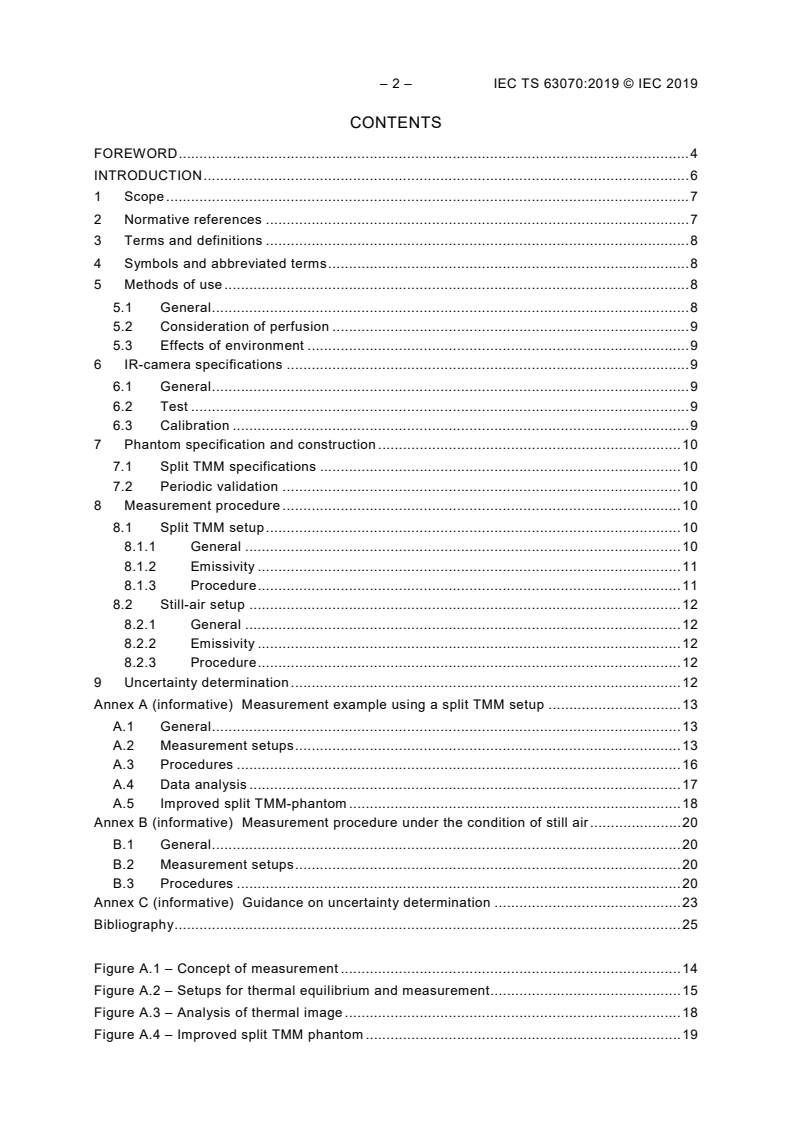
– 2 – IEC TS 63070:2019 © IEC 2019
CONTENTS
FOREWORD . 4
INTRODUCTION . 6
1 Scope . 7
2 Normative references . 7
3 Terms and definitions . 8
4 Symbols and abbreviated terms . 8
5 Methods of use . 8
5.1 General . 8
5.2 Consideration of perfusion . 9
5.3 Effects of environment . 9
6 IR-camera specifications . 9
6.1 General . 9
6.2 Test . 9
6.3 Calibration . 9
7 Phantom specification and construction . 10
7.1 Split TMM specifications . 10
7.2 Periodic validation . 10
8 Measurement procedure . 10
8.1 Split TMM setup . 10
8.1.1 General . 10
8.1.2 Emissivity . 11
8.1.3 Procedure . 11
8.2 Still-air setup . 12
8.2.1 General . 12
8.2.2 Emissivity . 12
8.2.3 Procedure . 12
9 Uncertainty determination . 12
Annex A (informative) Measurement example using a split TMM setup . 13
A.1 General . 13
A.2 Measurement setups . 13
A.3 Procedures . 16
A.4 Data analysis . 17
A.5 Improved split TMM-phantom . 18
Annex B (informative) Measurement procedure under the condition of still air . 20
B.1 General . 20
B.2 Measurement setups . 20
B.3 Procedures . 20
Annex C (informative) Guidance on uncertainty determination . 23
Bibliography . 25
Figure A.1 – Concept of measurement . 14
Figure A.2 – Setups for thermal equilibrium and measurement . 15
Figure A.3 – Analysis of thermal image . 18
Figure A.4 – Improved split TMM phantom . 19
Figure B.1 – Example of a measurement setup for the transducer surface-temperature
test in still air using an infrared camera . 21
Figure B.2 – Flow chart of the transducer surface-temperature test in still air using an
infrared camera . 22
Table A.1 – Results of measurement . 18
– 4 – IEC TS 63070:2019 © IEC 2019
INTERNATIONAL ELECTROTECHNICAL COMMISSION
____________
ULTRASONICS – FIELD CHARACTERIZATION –
INFRARED IMAGING TECHNIQUES FOR DETERMINING
TEMPERATURE ELEVATION IN TISSUE-MIMICKING MATERIAL AND
AT THE RADIATION SURFACE OF A TRANSDUCER IN STILL AIR
FOREWORD
1) The International Electrotechnical Commission (IEC) is a worldwide organization for standardization comprising
all national electrotechnical committees (IEC National Committees). The object of IEC is to promote
international co-operation on all questions concerning standardization in the electrical and electronic fields. To
this end and in addition to other activities, IEC publishes International Standards, Technical Specifications,
Technical Reports, Publicly Available Specifications (PAS) and Guides (hereafter referred to as “IEC
Publication(s)”). Their preparation is entrusted to technical committees; any IEC National Committee interested
in the subject dealt with may participate in this preparatory work. International, governmental and non-
governmental organizations liaising with the IEC also participate in this preparation. IEC collaborates closely
with the International Organization for Standardization (ISO) in accordance with conditions determined by
agreement between the two organizations.
2) The formal decisions or agreements of IEC on technical matters express, as nearly as possible, an international
consensus of opinion on the relevant subjects since each technical committee has representation from all
interested IEC National Committees.
3) IEC Publications have the form of recommendations for international use and are accepted by IEC National
Committees in that sense. While all reasonable efforts are made to ensure that the technical content of IEC
Publications is accurate, IEC cannot be held responsible for the way in which they are used or for any
misinterpretation by any end user.
4) In order to promote international uniformity, IEC National Committees undertake to apply IEC Publications
transparently to the maximum extent possible in their national and regional publications. Any divergence
between any IEC Publication and the corresponding national or regional publication shall be clearly indicated in
the latter.
5) IEC itself does not provide any attestation of conformity. Independent certification bodies provide conformity
assessment services and, in some areas, access to IEC marks of conformity. IEC is not responsible for any
services carried out by independent certification bodies.
6) All users should ensure that they have the latest edition of this publication.
7) No liability shall attach to IEC or its directors, employees, servants or agents including individual experts and
members of its technical committees and IEC National Committees for any personal injury, property damage or
other damage of any nature whatsoever, whether direct or indirect, or for costs (including legal fees) and
expenses arising out of the publication, use of, or reliance upon, this IEC Publication or any other IEC
Publications.
8) Attention is drawn to the Normative references cited in this publication. Use of the referenced publications is
indispensable for the correct application of this publication.
9) Attention is drawn to the possibility that some of the elements of this IEC Publication may be the subject of
patent rights. IEC shall not be held responsible for identifying any or all such patent rights.
The main task of IEC technical committees is to prepare International Standards. In
exceptional circumstances, a technical committee may propose the publication of a Technical
Specification when
• the required support cannot be obtained for the publication of an International Standard,
despite repeated efforts, or
• the subject is still under technical development or where, for any other reason, there is the
future but no immediate possibility of an agreement on an International Standard.
Technical Specifications are subject to review within three years of publication to decide
whether they can be transformed into International Standards.
IEC TS 63070, which is a Technical Specification, has been prepared by IEC technical
committee 87: Ultrasonics.
The text of this Technical Specification is based on the following documents:
Draft TS Report on voting
87/677/DTS 87/688A/RVDTS
Full information on the voting for the approval of this Technical Specification can be found in
the report on voting indicated in the above table.
This document has been drafted in accordance with the ISO/IEC Directives, Part 2.
Terms in bold in the text are defined in Clause 3.
The committee has decided that the contents of this publication will remain unchanged until
the stability date indicated on the IEC website under "http://webstore.iec.ch" in the data
related to the specific publication. At this date, the publication will be
• transformed into an International Standard,
• reconfirmed,
• withdrawn,
• replaced by a revised edition, or
• amended.
A bilingual version of this publication may be issued at a later date.
IMPORTANT – The 'colour inside' logo on the cover page of this publication indicates
that it contains colours which are considered to be useful for the correct
understanding of its contents. Users should therefore print this document using a
colour printer.
– 6 – IEC TS 63070:2019 © IEC 2019
INTRODUCTION
This Technical Specification describes primarily how to measure temperature elevation
generated by an ultrasound transducer by using an infrared (IR) camera system aimed at
insonified tissue-mimicking material located in still air.
Split TMM (tissue-mimicking material) is configured as a phantom to observe temperature
elevation and distribution for assessing fields generated by diagnostic ultrasound equipment
and by physiotherapy and high intensity therapeutic ultrasound (HITU) equipment.
Temperature measurement of the radiating surface of an ultrasound transducer under the still-
air condition is also considered for the evaluation of extensive temperature distributions as
required in IEC 60601-2-37:2007 and IEC 60601-2-37:2007/AMD1:2015.
ULTRASONICS – FIELD CHARACTERIZATION –
INFRARED IMAGING TECHNIQUES FOR DETERMINING
TEMPERATURE ELEVATION IN TISSUE-MIMICKING MATERIAL AND
AT THE RADIATION SURFACE OF A TRANSDUCER IN STILL AIR
1 Scope
This document is applicable to ultrasonic equipment designed for the medical field of
application. It covers both diagnostic and therapeutic (physiotherapy and HITU) equipment.
This document describes transducer evaluation by the infrared imaging technique using a split
TMM-phantom for qualitative and quantitative estimation of temperature distributions in
tissue-mimicking material, resulting from absorption of ultrasound and from heating of the
transducer itself.
This document also describes a method to measure transducer-surface temperature, while the
transducer is driven under the still-air condition.
NOTE 1 When the transducer is in contact with tissue-mimicking material, the heating of the transducer itself
depends on the actual efficiency of the transducer, on the specific conditions for thermal transfer to or from the
tissue-mimicking material, and on the transmitting/receiving electronic circuits, such as a switching circuit or pre-
amplifier in some cases.
NOTE 2 The test objects specified in this document are for the measurement of temperature rise and not for the
determination of thermal index, which is, by definition in IEC 62359:2010 and IEC 62359:2010/AMD1:2017, an
algebraic combination of acoustical field quantities and therefore is not a physically measurable quantity.
2 Normative references
The following documents are referred to in the text in such a way that some or all of their
content constitutes requirements of this document. For dated references, only the edition
cited applies. For undated references, the latest edition of the referenced document (including
any amendments) applies.
IEC 60601-2-5:2009, Medical electrical equipment – Part 2-5: Particular requirements for the
basic safety and essential performance of ultrasonic physiotherapy equipment
IEC 60601-2-37:2007, Medical electrical equipment – Part 2-37: Particular requirements for
the basic safety and essential performance of ultrasonic medical diagnostic and monitoring
equipment
IEC 60601-2-37:2007/AMD1:2015
IEC 60601-2-62:2013, Medical electrical equipment – Part 2-62: Particular requirements for
the basic safety and essential performance of high intensity therapeutic ultrasound (HITU)
equipment
IEC 61161:2013, Ultrasonics – Power measurement – Radiation force balances and
performance requirements
IEC 62127-1:2007, Ultrasonics – Hydrophones – Part 1: Measurement and characterization of
medical ultrasonic fields up to 40 MHz
IEC 62127-1:2007/AMD1:2013
ISO 18434-1:2008, Condition monitoring and diagnostics of machines – Thermography –
Part 1: General procedures
– 8 – IEC TS 63070:2019 © IEC 2019
3 Terms and definitions
For the purposes of this document, the terms and definitions given in
IEC 62127-1:2007, IEC 62127-1:2007/AMD1:2013, IEC 61161:2013, IEC 60601-2-37:2007,
IEC 60601-2-37:2007/AMD1:2015, IEC 60601-2-5:2009, IEC 60601-2-62:2013, ISO 18434-
1:2008 and the following apply.
ISO and IEC maintain terminological databases for use in standardization at the following
addresses:
• IEC Electropedia: available at http://www.electropedia.org/
• ISO Online browsing platform: available at http://www.iso.org/obp
3.1
emissivity
ε
ratio of a target surface’s radiance to that of a black body at the same temperature and over
the same spectral interval
[SOURCE: ISO 18434-1:2008, 3.4]
3.2
black body
ideal perfect emitter and absorber of thermal radiation at all wavelengths
[SOURCE: ISO 18434-1:2008, 3.3]
4 Symbols and abbreviated terms
ε emissivity
HITU high intensity therapeutic ultrasound
IR infrared
T temperature
ΔT temperature rise
TMM tissue mimicking material
5 Methods of use
5.1 General
There are several methods to measure temperature rise using an infrared (IR) camera system.
Two of them are further described in this document: the split TMM setup and the “still air”
setup.
Each of these setups has its own procedures and requirements, see Clause 8.
5.2 Consideration of perfusion
The utilized phantom does not have the functionality of perfusion as a human body. So
perfusion should additionally be taken into account and referred to as necessary
[1] [2] [3] [4] [5] .
5.3 Effects of environment
Due to reflections of infrared radiation, the environment may affect the measurement of the
temperature on a surface. The setup of the IR-camera, the general surroundings and the
surroundings of the target should be such that environmental effects are negligible compared
to the measured temperature rise of the target due to ultrasound.
A suitable procedure is described in A.3 b).
6 IR-camera specifications
6.1 General
For these measurements the IR-camera should have the following specifications.
• The range of measurable temperature should cover 20 °C to 53 °C at minimum. In case
the camera is to be used to measure the effect of HITU fields, the upper limit should be
70 °C or higher.
• The spatial resolution, which is the pixel size in an IR-image, should be equal to or less
than 0,5 mm in lateral and vertical directions.
• The number of pixels of the thermal image should suffice for displaying the area required
for observing the split TMM-phantom and the other setups that are used for tuning the
focus, checking the scale and measuring the ambient temperature.
• The nominal temperature resolution should be less than 0,1 °C or 5 % of the temperature
rise, whichever is larger. For example, it should be equal to or less than 0,25 °C when the
measured temperature rise is 5 °C.
• PC-control may be useful for making the camera settings and for recording and analysing
IR-images.
In general, thermal drift of the IR-camera, whether cooled or non-cooled, should be minimized
and, when necessary, measured and corrected during analysis.
6.2 Test
Performance of a general functionality test is recommended for the IR-camera before
beginning the measurement. A suitable test entails checking normal operation with no
malfunction or alarms for temperature measurement after the warm-up time. Refer to the
operations manual of the IR-camera for details.
6.3 Calibration
The IR-camera should have been calibrated within a year before use by a method traceable to
a primary measurement standard. Calibration should also verify image uniformity and ambient
temperature compensation in the specified temperature range. It is typically performed using
a planar thermal-radiation source (a reference source) calibrated against a standard black
body. This calibration may also be done using thin film thermocouples.
A suitable procedure is described in [6].
____________
Numbers in square brackets refer to the Bibliography.
– 10 – IEC TS 63070:2019 © IEC 2019
7 Phantom specification and construction
7.1 Split TMM specifications
Measurement of the temperature inside a phantom is one goal for observations by the IR-
camera. So one of the most important requirements of the phantom is its ability to be split into
two pieces of TMM with flat (or slightly convex) cross-sectional surfaces that can be exposed
to the IR-camera. TMM is vulnerable to dehydration and mechanical damage. A practical
phantom may be kept in a rigid housing in order to avoid dehydration and malfunction caused
by cracking the TMM during the operation of combination and separation during the
measurement procedure. See Annex A.
The TMM should have acoustic and thermal properties that mimic the appropriate tissue of
the human body. The emissivity of the split surface should be known. One of the applicable
materials equivalent to soft tissue is specified in IEC 60601-2-37:2007 and
IEC 60601-2-37:2007/AMD1:2015; its emissivity was determined in [7] to be 0,94 by
comparison with black body tape.
Minimizing multiple reflections of ultrasound between the transducer and the bottom surface
of the phantom should be taken into consideration. Lining material, which is used in other
circumstances to absorb ultrasound propagating in a water tank and has a high attenuation
property, may be appropriately placed at the bottom of the phantom to be effective for this
purpose. Bone-mimicking material or sterilized bone fragments [8] [9] [10] should be used as
necessary with soft-tissue mimicking material.
If high temperature rise is expected in the TMM, such as when heating with a HITU system,
then the properties of the TMM should be known and stable, over the range of expected
temperature rises during the measurement.
7.2 Periodic validation
Periodic validation should be performed from the viewpoint of both acoustic and thermal
properties. The specified values of attenuation coefficient, thermal conductivity and heat
capacity in IEC 60601-2-37:2007 and IEC 60601-2-37:2007/AMD1:2015 should be maintained
within the specified tolerances. The period between validations should be one year.
The replacement with new split TMM phantom should be considered when the structural
abnormality like cracks and/or the degradation like change of colour are found by visual
inspection.
The properties of the selected tissue-mimicking phantom should be appropriate to the tissue
being simulated and the purpose of the measurement.
8 Measurement procedure
8.1 Split TMM setup
8.1.1 General
In an infrared measurement there are two phases: first, the ultrasound transducer coupled to
the TMM (see recommendation in the last paragraph of 8.1.1) is driven and it generates an
acoustic field in the TMM. Heat is generated inside the TMM. Secondly, after a given time of
insonation, the configuration of the phantom is changed to allow the IR-camera to observe the
two-dimensional temperature distribution over a cross-sectional plane that was inside the
TMM during the first phase.
To enable IR-measurements inside the TMM, the TMM consists of two blocks, which make
contact during the heating phase and which have to be quickly separated directly after
switching off the electrical drive to the transducer, so that the temperature distribution over
the separated surface can be measured by the IR-camera. To pull the blocks firmly together
and subsequently to separate them quickly, a mechanism has to be built on which the blocks
are stable, secure and movable. The IR-camera looks at the front surface (split surface) of the
TMM after opening. The infrared picture has to be saved in a format (two-dimensional, colour-
coded) that can be processed off-line to calculate, for example, the one-dimensional
temperature profiles in lateral and axial directions.
The thermal cooling rate, in air on the exposed surface, after opening the TMM-blocks, has
been measured to be about 0,3 °C/s in the first 20 s after switching off the ultrasound
radiation. Corrections are to be made by extrapolation back to the moment of opening the split
TMM-blocks and switching off the ultrasound (It is assumed that these occur at the same
time.).
Care should be taken that the pressure to keep the two parts of TMM together is not changing
the properties of the TMM. Appropriate pressure is required to realize the firm combination of
TMM blocks while also avoiding destruction. Refer to A.3 c).
8.1.2 Emissivity
The appropriate emissivity value for the split TMM should be applied either at the time of
measurement or during later analysis. See [7] for example.
8.1.3 Procedure
Annex A gives an example of IR-measurement procedures from setups to obtained results.
The sequential steps in the procedure are as follows.
a) Initial temperature equilibrium of TMM: In order to obtain initial stability and uniformity of
the temperature distribution on the cross-sectional surface, the wrapped TMM is kept for
more than one hour on the laboratory table.
b) Focus adjustmen
...