

IEC 62862-3-6:2026
(Main)Solar thermal electric plants - Part 3-6: Durability of silvered-glass reflectors - Laboratory test methods and assessment
General Information
- Abstract
CORRECTED VERSION 2026-02
IEC 62862-3-6:2026 specifies laboratory test methods to assess the durability of silvered-glass reflectors with high technical performance to be used in concentrating solar technologies. The reflectors within the scope of this document are composed of a float-glass substrate and a reflecting silver layer on its back-side, which is protected by a thin copper layer and an anticorrosive paint system composed of a primer and a top coating, and an optional intermediate coating.
This document defines multiple accelerated aging tests on reflector samples of size of 10 cm × 10 cm or larger. It defines the measurement methods to determine the degradation parameters used for assessment and the acceptance criteria of the accelerated aging tests.
Annex A of this document outlines the procedure to apply this document to reflector types of different composition than that of the silvered float-glass reflectors described above.
Annex B provides information on how to approximately correlate the measured degradation of selected accelerated aging tests with outdoor exposure in different environments. These correlations are limited to silvered float-glass reflector types with the abovementioned layer stack, since differing coating types are likely to introduce unforeseen degradation modes, which possibly will not be triggered under the proposed testing conditions.
This corrected version of IEC 62862-3-6:2026 incorporates the following correction:
– Addition of bibliographic reference numbers in the content
- Status
- Published
- Publication Date
- 18-Feb-2026
- Technical Committee
- TC 117 - Solar thermal electric plants
- Drafting Committee
- PT 62862-3-6 - TC 117/PT 62862-3-6
- Current Stage
- PPUB - Publication issued
- Start Date
- 19-Feb-2026
- Completion Date
- 20-Feb-2026

Overview
IEC 62862-3-6:2026 is an international standard developed by the International Electrotechnical Commission (IEC). It addresses the durability of silvered-glass reflectors used in solar thermal electric plants, with a focus on laboratory test methods and assessment criteria. These reflectors are critical components in concentrating solar technologies, where precise and long-lasting reflectivity is essential for plant efficiency and performance.
This document specifies accelerated aging test procedures to evaluate the durability of reflectors composed of a float-glass substrate with a silver reflective layer, which is further protected by copper and various anticorrosive paint systems. The standard ensures that products meet high performance requirements necessary for demanding solar environments.
Key Topics
Accelerated Aging Tests: The standard outlines a comprehensive set of laboratory tests simulating long-term environmental exposure. These include:
- Neutral salt spray (NSS)
- Copper-accelerated acetic acid salt spray (CASS)
- Condensation exposure (COND)
- Thermal cycling and humidity (TCH)
- Damp heat testing (DH)
- UV and humidity exposure (UVH)
- Abrasion and sand erosion
Test Sample Requirements: Reflector samples must be at least 10 cm × 10 cm. At least one original edge from manufacturing must be retained, especially for corrosion assessment.
Measurement and Assessment:
- Methods for visual inspection and quantification of defects (corrosion, discoloration, delamination)
- Reflectance measurement-both hemispherical and specular-before and after exposure, with criteria for allowable degradation
- Clear acceptance criteria for each accelerated aging test
Comprehensive Reporting: Guidelines detail what information and results must be included in test reports to ensure transparency, repeatability, and comparability.
Adaptability: Annexes provide guidance for applying these methods to reflector types of different compositions and correlate accelerated test outcomes with real-world, outdoor exposure scenarios.
Applications
IEC 62862-3-6:2026 serves manufacturers, developers, testing laboratories, and project stakeholders in solar thermal power generation. Key applications include:
- Product Qualification: Enables consistent comparison of reflector durability for procurement and supply chain assurance.
- Quality Control: Assists manufacturers in verifying that silvered-glass reflectors maintain their optical and physical performance over expected operational life in solar fields.
- Performance Assessment: Supports developers and plant operators in meeting both technical and warranty requirements, reducing the risk of premature failure.
- R&D and Innovation: Facilitates the development of new reflector materials and protective coatings by providing standardized methods for accelerated durability assessment.
- Regulatory Compliance: Ensures that reflectors meet internationally recognized criteria, streamlining project approvals and contributing to risk mitigation.
Related Standards
Implementing IEC 62862-3-6:2026 will often involve referencing related international standards, including:
- ISO 9227 – Corrosion tests in artificial atmospheres (salt spray tests)
- ISO 6270-2 – Paints and varnishes (determination of resistance to humidity)
- ISO 16474-3 – Laboratory exposure methods to UV lamps
- IEC 62108 – Concentrator photovoltaic (CPV) modules and assemblies - design qualification and type approval
- IEC TS 62862-1-1 – Solar thermal electric plants - Terminology
- IEC 60904-3 – Measurement principles for photovoltaic devices
Summary
IEC 62862-3-6:2026 provides the solar thermal industry with harmonized, reliable test methods to evaluate and assess the durability of silvered-glass reflectors. Adoption of the standard enhances performance transparency, supports quality improvements, and enables effective risk management across the solar supply chain. By adhering to these laboratory test methods, stakeholders can ensure their technologies deliver long-term, sustainable, and efficient solar thermal power generation.
Get Certified
Connect with accredited certification bodies for this standard

DNV
DNV is an independent assurance and risk management provider.

Lloyd's Register
Lloyd's Register is a global professional services organisation specialising in engineering and technology.
DNV Energy Systems
Energy and renewable energy certification.
Sponsored listings
Frequently Asked Questions
IEC 62862-3-6:2026 is a standard published by the International Electrotechnical Commission (IEC). Its full title is "Solar thermal electric plants - Part 3-6: Durability of silvered-glass reflectors - Laboratory test methods and assessment". This standard covers: CORRECTED VERSION 2026-02 IEC 62862-3-6:2026 specifies laboratory test methods to assess the durability of silvered-glass reflectors with high technical performance to be used in concentrating solar technologies. The reflectors within the scope of this document are composed of a float-glass substrate and a reflecting silver layer on its back-side, which is protected by a thin copper layer and an anticorrosive paint system composed of a primer and a top coating, and an optional intermediate coating. This document defines multiple accelerated aging tests on reflector samples of size of 10 cm × 10 cm or larger. It defines the measurement methods to determine the degradation parameters used for assessment and the acceptance criteria of the accelerated aging tests. Annex A of this document outlines the procedure to apply this document to reflector types of different composition than that of the silvered float-glass reflectors described above. Annex B provides information on how to approximately correlate the measured degradation of selected accelerated aging tests with outdoor exposure in different environments. These correlations are limited to silvered float-glass reflector types with the abovementioned layer stack, since differing coating types are likely to introduce unforeseen degradation modes, which possibly will not be triggered under the proposed testing conditions. This corrected version of IEC 62862-3-6:2026 incorporates the following correction: – Addition of bibliographic reference numbers in the content
CORRECTED VERSION 2026-02 IEC 62862-3-6:2026 specifies laboratory test methods to assess the durability of silvered-glass reflectors with high technical performance to be used in concentrating solar technologies. The reflectors within the scope of this document are composed of a float-glass substrate and a reflecting silver layer on its back-side, which is protected by a thin copper layer and an anticorrosive paint system composed of a primer and a top coating, and an optional intermediate coating. This document defines multiple accelerated aging tests on reflector samples of size of 10 cm × 10 cm or larger. It defines the measurement methods to determine the degradation parameters used for assessment and the acceptance criteria of the accelerated aging tests. Annex A of this document outlines the procedure to apply this document to reflector types of different composition than that of the silvered float-glass reflectors described above. Annex B provides information on how to approximately correlate the measured degradation of selected accelerated aging tests with outdoor exposure in different environments. These correlations are limited to silvered float-glass reflector types with the abovementioned layer stack, since differing coating types are likely to introduce unforeseen degradation modes, which possibly will not be triggered under the proposed testing conditions. This corrected version of IEC 62862-3-6:2026 incorporates the following correction: – Addition of bibliographic reference numbers in the content
IEC 62862-3-6:2026 is classified under the following ICS (International Classification for Standards) categories: 27.100 - Power stations in general; 27.160 - Solar energy engineering. The ICS classification helps identify the subject area and facilitates finding related standards.
IEC 62862-3-6:2026 is available in PDF format for immediate download after purchase. The document can be added to your cart and obtained through the secure checkout process. Digital delivery ensures instant access to the complete standard document.
Standards Content (Sample)
IEC 62862-3-6 ®
Edition 1.0 2026-02
INTERNATIONAL
STANDARD
Solar thermal electric plants -
Part 3-6: Durability of silvered-glass reflectors - Laboratory test methods and
assessment
ICS 27.100; 27.160 ISBN 978-2-8327-1051-7
All rights reserved. Unless otherwise specified, no part of this publication may be reproduced or utilized in any form or
by any means, electronic or mechanical, including photocopying and microfilm, without permission in writing from either
IEC or IEC's member National Committee in the country of the requester. If you have any questions about IEC copyright
or have an enquiry about obtaining additional rights to this publication, please contact the address below or your local
IEC member National Committee for further information.
IEC Secretariat Tel.: +41 22 919 02 11
3, rue de Varembé info@iec.ch
CH-1211 Geneva 20 www.iec.ch
Switzerland
About the IEC
The International Electrotechnical Commission (IEC) is the leading global organization that prepares and publishes
International Standards for all electrical, electronic and related technologies.
About IEC publications
The technical content of IEC publications is kept under constant review by the IEC. Please make sure that you have the
latest edition, a corrigendum or an amendment might have been published.
IEC publications search - IEC Products & Services Portal - products.iec.ch
webstore.iec.ch/advsearchform Discover our powerful search engine and read freely all the
The advanced search enables to find IEC publications by a
publications previews, graphical symbols and the glossary.
variety of criteria (reference number, text, technical With a subscription you will always have access to up to date
committee, …). It also gives information on projects, content tailored to your needs.
replaced and withdrawn publications.
Electropedia - www.electropedia.org
IEC Just Published - webstore.iec.ch/justpublished The world's leading online dictionary on electrotechnology,
Stay up to date on all new IEC publications. Just Published containing more than 22 500 terminological entries in English
details all new publications released. Available online and and French, with equivalent terms in 25 additional languages.
once a month by email. Also known as the International Electrotechnical Vocabulary
(IEV) online.
IEC Customer Service Centre - webstore.iec.ch/csc
If you wish to give us your feedback on this publication or
need further assistance, please contact the Customer
Service Centre: sales@iec.ch.
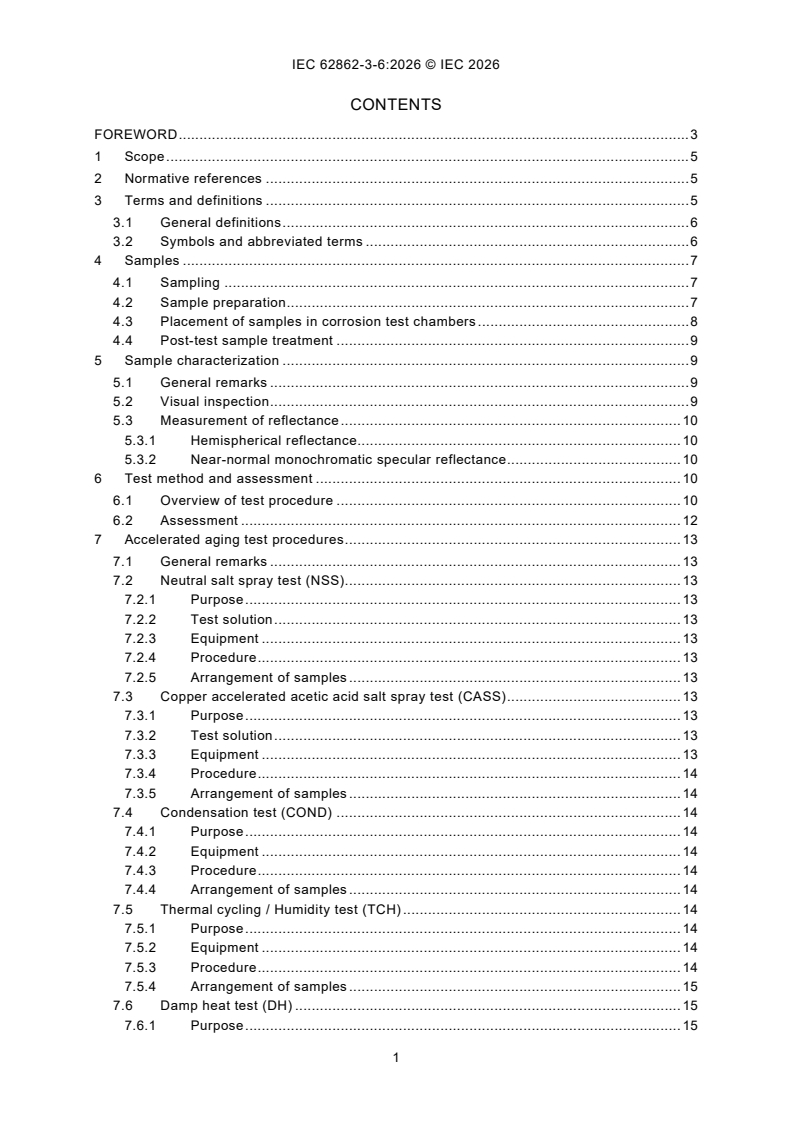
CONTENTS
FOREWORD . 3
1 Scope . 5
2 Normative references . 5
3 Terms and definitions . 5
3.1 General definitions . 6
3.2 Symbols and abbreviated terms . 6
4 Samples . 7
4.1 Sampling . 7
4.2 Sample preparation . 7
4.3 Placement of samples in corrosion test chambers . 8
4.4 Post-test sample treatment . 9
5 Sample characterization . 9
5.1 General remarks . 9
5.2 Visual inspection . 9
5.3 Measurement of reflectance . 10
5.3.1 Hemispherical reflectance. 10
5.3.2 Near-normal monochromatic specular reflectance. 10
6 Test method and assessment . 10
6.1 Overview of test procedure . 10
6.2 Assessment . 12
7 Accelerated aging test procedures . 13
7.1 General remarks . 13
7.2 Neutral salt spray test (NSS). 13
7.2.1 Purpose . 13
7.2.2 Test solution . 13
7.2.3 Equipment . 13
7.2.4 Procedure . 13
7.2.5 Arrangement of samples . 13
7.3 Copper accelerated acetic acid salt spray test (CASS) . 13
7.3.1 Purpose . 13
7.3.2 Test solution . 13
7.3.3 Equipment . 13
7.3.4 Procedure . 14
7.3.5 Arrangement of samples . 14
7.4 Condensation test (COND) . 14
7.4.1 Purpose . 14
7.4.2 Equipment . 14
7.4.3 Procedure . 14
7.4.4 Arrangement of samples . 14
7.5 Thermal cycling / Humidity test (TCH) . 14
7.5.1 Purpose . 14
7.5.2 Equipment . 14
7.5.3 Procedure . 14
7.5.4 Arrangement of samples . 15
7.6 Damp heat test (DH) . 15
7.6.1 Purpose . 15
7.6.2 Equipment . 15
7.6.3 Procedure . 15
7.6.4 Arrangement of samples . 15
7.7 UV and humidity test (UVH) . 16
7.7.1 Purpose . 16
7.7.2 Equipment . 16
7.7.3 Procedure . 16
7.7.4 Arrangement of samples . 16
7.8 Abrasion test (ABR) . 16
7.8.1 Purpose . 16
7.8.2 Equipment . 16
7.8.3 Procedure . 17
7.8.4 Inspection of samples . 17
7.9 Sand erosion test (SE) . 18
7.9.1 Purpose . 18
7.9.2 Equipment . 18
7.9.3 Procedure . 18
7.9.4 Arrangement of samples . 18
8 Reporting . 19
8.1 General . 19
8.2 General information . 19
8.3 Methodology . 19
8.4 Results . 20
8.5 Conclusions . 20
Annex A (informative) Testing of reflector types of different composition . 21
Annex B (informative) Estimation of degradation in outdoor environment . 22
B.1 General . 22
B.2 Estimation of erosion in different outdoor environments . 22
B.3 Estimation of corrosion in different outdoor environments . 22
B.4 Estimation of overall degradation . 23
Bibliography . 24
Figure 1 – Illustration of conditions in a TCH exposure cycle . 15
Table 1 – Edge and front glass, sample protection requirements. 8
Table 2 – Overview of accelerated aging tests . 11
Table 3 – Reflectance value criteria of silvered-glass reflectors, state-of-the-art, in
their initial state . 12
Table 4 – Acceptance criteria for the tests according to Table 2. 12
Table 5 – Conditions of steps in procedure TCH . 15
INTERNATIONAL ELECTROTECHNICAL COMMISSION
____________
Solar thermal electric plants -
Part 3-6: Durability of silvered-glass reflectors - Laboratory test methods
and assessment
FOREWORD
1) The International Electrotechnical Commission (IEC) is a worldwide organization for
standardization comprising all national electrotechnical committees (IEC National Committees).
The object of IEC is to promote international co-operation on all questions concerning
standardization in the electrical and electronic fields. To this end and in addition to other
activities, IEC publishes International Standards, Technical Specifications, Technical Reports,
Publicly Available Specifications (PAS) and Guides (hereafter referred to as “IEC
Publication(s)”). Their preparation is entrusted to technical committees; any IEC National
Committee interested in the subject dealt with may participate in this preparatory work.
International, governmental and non-governmental organizations liaising with the IEC also
participate in this preparation. IEC collaborates closely with the International Organization for
Standardization (ISO) in accordance with conditions determined by agreement between the two
organizations.
2) The formal decisions or agreements of IEC on technical matters express, as nearly as
possible, an international consensus of opinion on the relevant subjects since each technical
committee has representation from all interested IEC National Committees.
3) IEC Publications have the form of recommendations for international use and are accepted
by IEC National Committees in that sense. While all reasonable efforts are made to ensure that
the technical content of IEC Publications is accurate, IEC cannot be held responsible for the
way in which they are used or for any misinterpretation by any end user.
4) In order to promote international uniformity, IEC National Committees undertake to apply IEC
Publications transparently to the maximum extent possible in their national and regional
publications. Any divergence between any IEC Publication and the corresponding national or
regional publication shall be clearly indicated in the latter.
5) IEC itself does not provide any attestation of conformity. Independent certification bodies
provide conformity assessment services and, in some areas, access to IEC marks of conformity.
IEC is not responsible for any services carried out by independent certification bodies.
6) All users should ensure that they have the latest edition of this publication.
7) No liability shall attach to IEC or its directors, employees, servants or agents including
individual experts and members of its technical committees and IEC National Committees for
any personal injury, property damage or other damage of any nature whatsoever, whether direct
or indirect, or for costs (including legal fees) and expenses arising out of the publication, use
of, or reliance upon, this IEC Publication or any other IEC Publications.
8) Attention is drawn to the Normative references cited in this publication. Use of the referenced
publications is indispensable for the correct application of this publication.
9) IEC draws attention to the possibility that the implementation of this document may involve
the use of (a) patent(s). IEC takes no position concerning the evidence, validity or applicability
of any claimed patent rights in respect thereof. As of the date of publication of this document,
IEC had not received notice of (a) patent(s), which may be required to implement this document.
However, implementers are cautioned that this may not represent the latest information, which
may be obtained from the patent database available at https://patents.iec.ch. IEC shall not be
held responsible for identifying any or all such patent rights.
IEC 62862-3-6 has been prepared by IEC technical committee 117: Solar thermal electric
plants. It is an International Standard.
The text of this International Standard is based on the following documents:
Draft Report on voting
117/238/FDIS 117/245/RVD
Full information on the voting for its approval can be found in the report on voting indicated in
the above table.
The language used for the development of this International Standard is English.
A list of all parts in the IEC 62862 series, published under the general title Solar thermal electric
plants, can be found on the IEC website.
This document was drafted in accordance with ISO/IEC Directives, Part 2, and developed in
accordance with ISO/IEC Directives, Part 1 and ISO/IEC Directives, IEC Supplement, available
at www.iec.ch/members_experts/refdocs. The main document types developed by IEC are
described in greater detail at www.iec.ch/publications.
The committee has decided that the contents of this document will remain unchanged until the
stability date indicated on the IEC website under webstore.iec.ch in the data related to the
specific document. At this date, the document will be
– reconfirmed,
– withdrawn, or
– revised.
1 Scope
This document specifies laboratory test methods to assess the durability of silvered-glass
reflectors with high technical performance to be used in concentrating solar technologies. The
reflectors within the scope of this document are composed of a float-glass substrate and a
reflecting silver layer on its back-side, which is protected by a thin copper layer and an
anticorrosive paint system composed of a primer and a top coating, and an optional intermediate
coating.
This document defines multiple accelerated aging tests on reflector samples of size of 10 cm ×
10 cm or larger. It defines the measurement methods to determine the degradation parameters
used for assessment and the acceptance criteria of the accelerated aging tests.
Annex A of this document outlines the procedure to apply this document to reflector types of
different composition than that of the silvered float-glass reflectors described above.
Annex B provides information on how to approximately correlate the measured degradation of
selected accelerated aging tests with outdoor exposure in different environments. These
correlations are limited to silvered float-glass reflector types with the abovementioned layer
stack, since differing coating types are likely to introduce unforeseen degradation modes, which
possibly will not be triggered under the proposed testing conditions.
2 Normative references
The following documents are referred to in the text in such a way that some or all of their content
constitutes requirements of this document. For dated references, only the edition cited applies.
For undated references, the latest edition of the referenced document (including any
amendments) applies.
ISO 6270-2, Paints and varnishes — Determination of resistance to humidity — Part 2:
Condensation (in-cabinet exposure with heated water reservoir)
ISO 9227, Corrosion tests in artificial atmospheres — Salt spray tests
ISO 9488, Solar energy — Vocabulary
ISO 16474-3, Paints and varnishes — Methods of exposure to laboratory light sources - Part 3:
Fluorescent UV lamps
IEC 60904-3:2016, Photovoltaic devices - Part 3: Measurement principles for terrestrial
photovoltaic (PV) solar devices with reference spectral irradiance data
IEC 60904-3, Photovoltaic devices - Part 3: Measurement principles for terrestrial photovoltaic
(PV) solar devices with reference spectral irradiance data
IEC 62108, Concentrator photovoltaic (CPV) modules and assemblies - Design qualification
and type approval
IEC TS 62862-1-1, Solar thermal electric plants - Part 1-1: Terminology
3 Terms and definitions
For the purposes of this document, the terms and definitions given in ISO 9488, IEC TS 62862-1-1
and the following apply.
ISO and IEC maintain terminology databases for use in standardization at the following
addresses:
– IEC Electropedia: available at https://www.electropedia.org/
– ISO Online browsing platform: available at https://www.iso.org/obp
3.1 General definitions
3.1.1
silvered-glass reflector
clear float glass, whose rear surface has been coated with a thin layer of reflective silver
deposit, the rear part of which is protected by a thin copper layer
Note 1 to entry: The copper is protected by an anticorrosive paint system composed of a primer and a top coating
of typically 30 µm each.
Note 2 to entry: In some cases, there is an intermediate paint coating (also around 30 µm) between the base and
top coating.
3.1.2
sample
silvered-glass reflector specimen of 10 cm × 10 cm size or larger
Note 1 to entry: For corrosion testing at least one original edge, as applied during the manufacturing process, is
required.
Note 2 to entry: The other three edges can remain unprotected or, if required, be protected with a varnish of equal
or higher anticorrosive protection than the original anticorrosive paint system.
Note 3 to entry: Test 1 to Test 6 in Table 2 are corrosion tests; Test 7 and Test 8 are erosion tests and do not
require any edge protection.
3.2 Symbols and abbreviated terms
The symbols and abbreviated terms are given in the following list.
ρ Near-normal solar-weighted hemispherical reflectance
s,h
∆ρ Near-normal solar-weighted hemispherical reflectance difference caused by
s,h
degradation. It is computed by subtracting the initial ρ (before testing) and the
s,h
obtained ρ after testing.
s,h
ρ Near-normal monochromatic specular reflectance
λ,φ
Near-normal monochromatic specular reflectance difference caused by degradation.
∆ρ
λ,φ
It is computed by subtracting the initial ρ (before testing) and the obtained ρ after
λ,φ λ,φ
testing.
λ Wavelength of incident light on reflector
θ Incidence angle of incident light on reflector
i
φ Acceptance half-angle defining the captured scattering of the reflected light
intercepting the receiver or the reflectometer sensor.
T Temperature of the accelerated-aging chamber
RH Relative humidity of the accelerated-aging chamber
t Duration of exposure of the sample in the accelerated-aging chamber
m Impacting mass of blowing dust particles per surface area on the reflector over the
d
entire testing time
m Impacting mass of blowing sand particles per surface area on the reflector over the
s
entire testing time
d Number of corrosion spots in the reflective surface with 200 µm ≤ d ≤ 1 000 µm per
cs
surface area
l Maximum penetration depth or extension of corrosion starting from the original edge,
c
as applied during the manufacturing process of the sample
d Corrosion spot diameter corresponding to the maximum diameter enveloping the
degraded area not in contact with the sample edges
G AM1.5 direct spectral irradiance reported in IEC 60904-3:2016
b
AF Acceleration factor between CASS and environments with corrosivity classes
4 Samples
4.1 Sampling
At least three samples shall be tested in each of the tests listed in Table 2, to obtain statistically
valid results.
The sample size should be at least 10 cm × 10 cm. Other sizes may be used as long as they
are substantially larger than the optical measurement spot and allowing for at least 3
measurements on different positions. Cutting oil shall not be used to cut the sample.
As a minimum requirement, the samples intended for corrosion testing (Test 1 to Test 6 in Table 2)
shall contain at least one original edge. Samples intended for the abrasion or sand erosion tests
(Test 7 and Test 8 in Table 2) do not require any original edge.
The samples tested shall have the same composition, production process and surface finishes
as the reflector to be installed in the solar field. Upon request from the end-user of the solar
mirror, manufacturers of tempered glass reflectors, who want to provide non-tempered samples
for testing (to cut them into small pieces), shall be able to demonstrate that the durability of the
provided samples is representative for their final product. This shall be accomplished by testing
full-sized tempered reflector facets in appropriate large test chambers and comparing the
results with those of small-sized non-tempered samples. The full-sized reflector tests can be
conducted on selected tests but shall be conducted at a minimum for the neutral salt spray test
(Test 1 in Table 2). If similar degradation in terms of number of corrosion spots, edge corrosion
penetration, inner corroded area and reflectance loss is detected for both full-sized tempered
and small-sized non-tempered samples, it can be assumed that non-tempered samples are
representative for tempered samples. If both sample types (tempered and non-tempered) meet
the acceptance criteria described in this document, the non-tempered sample types should be
considered representative for tempered sample types.
4.2 Sample preparation
Before testing, any prior defect in the samples shall be recorded in accordance with 5.2 of this
document. An initial reflectance measurement in accordance with 5.3 shall be performed. The
samples shall be clean before the initial measurement. Compressed dry air (free of particles
and oil) should be applied. In case of remaining dust or soil, demineralized water, a mild
detergent and a soft tissue can be employed. Abrasive or dissolvent agents that can change
the properties of the sample shall never be employed by total immersion. Acetone can be used
to ensure that any type of dust or fingerprints are totally removed. The acetone should be
applied on the glass surface only, and with a soft tissue, avoiding contact with the back-side of
the sample and the edges.
Table 1 shows an overview of the edge and front glass protection requirements of the sample
during accelerated aging testing, in which the Test no. and Short name refers to the tests listed
in Table 2. See Annex A for details about the protection of reflector types of different
composition.
Corrosion tests involving long exposure to high humidity levels (such as Test 1 to Test 6
according to Table 2) can provoke glass corrosion in the form of non-removable grey stains on
the glass surface. According to current knowledge, this effect is not representative for outdoor
weathering. Therefore, it is recommended to test those samples with a protective tape or similar
on the glass surface, so that the reflectance measurement of the reflective layer is not
influenced by this effect. The employed tape shall be removed completely before carrying out
any reflectance measurement and no residue of tape shall be present after removal. Cleaning
with acetone or a mild detergent can be helpful for this purpose. During the cleaning only the
glass surface (and not the paint layers) shall come into contact with the acetone. The protective
tape employed shall be temperature and humidity stable to resist the conditions of the
accelerated test, and it shall not alter or react with the glass surface in any way. UV-stable
Polyvinyle chloride (PVC), Polyethylene (PE) and Polypropylene (PP) based protective tapes
with acrylic-based adhesive have shown to be suitable. It is recommended to carry out pretests
with the selected tape to make sure it withstands the accelerated aging conditions in the
chamber.
For aggressive corrosion tests (such as Test 1 and Test 2 according to Table 2), non-original
edges can be protected to prevent massive edge corrosion during the testing. In this case, non-
original edges shall be sealed (preferably by the manufacturer) with a protective paint or
varnish, which guarantees the anticorrosive protection. The type of edge-sealant employed,
and the non-original edges, to which the sealant has been applied, shall be clearly identified in
the test report.
Corrosion effects related to non-original edges shall be treated separately from original edges
in the analysis of the results. Corrosion penetration from non-original edges shall not be
considered for the acceptance criteria according to this document. Non-original edges shall be
clearly identified in the test report.
Table 1 – Edge and front glass, sample protection requirements
Test Short name as per Edge specification Protective tape on front glass?
no. Clause 7
1 NSS At least one original edge; Yes
optional non-original edge
protection
2 CASS At least one original edge; Yes
optional non-original edge
protection
3 COND At least one original edge Yes
4 TCH At least one original edge No
5 DH At least one original edge No
6 UVH At least one original edge No, during first 1 000 h (glass-side facing
lamps)
Yes, during second 1 000 h (paint-side
facing lamps)
7 ABR No original edge required No
8 SE No original edge required No
4.3 Placement of samples in corrosion test chambers
This Subclause 4.3 applies to corrosion tests only (Test 1 to Test 6 according to Table 2).
Samples shall be positioned with the reflective front side (glass-side) facing upwards in the
chambers, if not indicated differently in Clause 7.
Unless otherwise stated in Clause 7, the sample surface to be analyzed shall be positioned at
an angle as close as possible to 20° to the vertical, and in any case, this angle shall be between
15° and 25°. Sample supports shall be made of non-metallic inert materials. The following
minimum distances shall be ensured:
– Distance to the walls: ≥ 100 mm
– Distance from the water surface to the inferior edge of the samples: ≥ 200 mm (where relevant)
– Distance between samples: ≥ 20 mm
The sample should be arranged in such way that the original edge is oriented vertically.
4.4 Post-test sample treatment
After the test, the protective tape on the front glass, if applied, shall be removed. Any remnants
of adhesive shall be removed from the sample by employing a non-aggressive dissolvent (e.g.
acetone) with a soft tissue, avoiding contact with the back-side of the sample and the edges.
Afterwards, the front and back-side of the samples shall be rinsed with demineralized water to
remove possible deposits of sprayed solution. A soft cloth can be used to gently clean the
samples under the rinsing water stream. After this treatment, compressed air (free of particles
and oil) can be used to dry the samples.
5 Sample characterization
5.1 General remarks
All samples shall be visually inspected and measured in accordance with 5.2 and 5.3 before
and after each test outlined in Table 2. For the abrasion and sand erosion tests (number 7 and 8,
respectively), only measurement of near-normal monochromatic specular reflectance in
accordance with 5.3 is required, while measurement of near-normal solar-weighted
hemispherical reflectance is optional.
5.2 Visual inspection
Prior to and after finishing the accelerated aging test, the samples shall be analyzed according
to the following evaluation criteria:
– Front-side: Type, number and size of any defects of the reflective layer or front-side,
including corrosion or discoloration. Number of degradation spots per unit area of the
reflective surface not affected by edge corrosion, d . d can be determined with an optical
cs cs
microscope or image analysis device or via careful counting by visual inspection. Spots with
a diameter smaller than 200 µm shall be omitted. The corrosion spot diameter d corresponds
to the maximum diameter enveloping the degraded area. Corrosion spots touching the
edges shall be considered as edge corrosion and shall not be taken into account. d is
cs
calculated as the number of spots (200 µm ≤ d ≤ 1 000 µm) divided by the area of the test
sample excluding edge corrosion area. Corrosion spots with diameter larger than
d = 1 000 µm shall be counted separately. In order to comply with the acceptance criteria
outlined in Table 4, no corrosion spots with diameter larger than d = 1 000 µm shall be
present on any of the tested samples.
– Back-side: Type, number and size of defects appearing on the protective layers, including
delamination, flaking, peeling, blistering, discontinuities, discoloration or any other change
with respect to the original aspect of the sample. Designation of quantity, size and intensity
of defects and of uniform changes in appearance should be evaluated according to
ISO 4628-1, which classifies the quantity, size and intensity of the appearing defects on a
scale from 0 (no defects) to 5 (dense pattern of defects; larger than 5 mm; very marked
change).
– Edges: Maximum penetration depth of corrosion starting from the edge of the sample,
distinguishing between originally sealed edges (l ), protected edges and unprotected edges.
c
The corners between original, protected and unprotected edges shall not be considered for
the analysis. If it is not obvious from which edge the corrosion started, this should also be
stated in the test report.
5.3 Measurement of reflectance
5.3.1 Hemispherical reflectance
The near-normal solar-weighted hemispherical reflectance, ρ , shall be determined at least on
s,h
3 different positions on the sample that are averaged for the result.
The solar-weighted hemispherical reflectance ρ is calculated by weighting the spectral
s,h
with the direct spectral irradiance G on the earth surface for
hemispherical reflectance ρ
λ,h b
each wavelength according to Formula (1):
𝜆𝜆
max
𝜌𝜌 ·𝐺𝐺 (𝜆𝜆)𝑑𝑑𝜆𝜆
∫
λ,h b
𝜆𝜆
min
𝜌𝜌 = (1)
s,h
𝜆𝜆
max
𝐺𝐺 (𝜆𝜆)𝑑𝑑𝜆𝜆
∫
b
𝜆𝜆
min
where λ = 320 nm and λ = 2 500 nm. The recommended wavelength interval step of the
min max
measurement dλ is 5 nm. At a minimum, dλ shall be lower than or equal to 10 nm. The AM1.5
direct spectral irradiance G reported in IEC 60904-3 shall be used to conduct the solar-
b
weighting in Formula (1).
The spectrophotometer employed for the measurements shall have a high repeatability level. If
the same pristine sample is measured multiple times on the same spot and under the same
measurement conditions, the standard deviation of the measurements shall be ≤ 0,002.
Further information on the measurement procedure, recommended equipment and
measurement uncertainty can be found in the SolarPACES guideline.
5.3.2 Near-normal monochromatic specular reflectance
The near-normal monochromatic specular reflectance, ρ , (sometimes also referred to as
λ,φ
near-specular reflectance, direct reflectance, or sun-conic reflectance) shall be determined at
least on 3 different positions on the sample that are averaged for the result. The acceptance
half-angle of the measurements shall be φ = 12,5 mrad, or alternatively a fixed half-angle
between 7 mrad and 23 mrad. The wavelength of the measurements should be λ = 660 nm, or
alternatively a fixed wavelength between 500 nm and 680 nm. The measurement shall be
conducted at near-normal incidence (θ ≤ 15°).
i
The reflectometer employed for the measurements shall have a high repeatability. If the same
sample is measured multiple times on the same spot and under the same measurement
conditions, the standard deviation of the measurements shall be ≤ 0,003.
Further information on the measurement procedure, recommended equipment, and
measurement uncertainty can be found in the SolarPACES guideline.
6 Test method and assessment
6.1 Overview of test procedure
Table 2 shows an overview of the accelerated aging tests to be performed. More details on the
test procedure of each individual test is to be found in Clause 7.
Table 2 – Overview of accelerated aging tests
No. Short Test name Summary of testing conditions Duration
name
as per
Clause
1 NSS Neutral salt Sprayed NaCl solution of 50 g/l ± 5 g/l, pH= 480 h
spray ISO 9227 [6,5;7,2], T = 35 °C ± 2 °C, condensation rate of Optional for high
corrosivity sites ≥ C4
1,5 ml/h ± 0,5 ml/h on a surface of 80 cm
according to ISO 9223
(averaging categories of
zinc, copper, aluminum
and steel): 960 h
2a CASS Copper One cycle consists of: 1 cycle
accelerated 120 h of exposure to sprayed solution of 50 g/l ±
NOTE 1 See Clause B.3
acetic acid salt 5 g/l NaCl and 0,26 g/l ± 0,02 g/l CuCl , pH=
spray ISO 9227
[3,1;3,3], T = 50 °C ± 2 °C, condensation rate of
1,5 ml/h ± 0,5 ml/h on a surface of 80 cm .
48 h of drying phase under standard laboratory
conditions (T = 23 °C ± 2 °C, RH = 50 % ± 5 %)
in accordance with ISO 3270.
2b CASS Copper See row above 4 cycles
accelerated
acetic acid salt
spray
3 COND Condensation T = 40 °C ± 3 °C, RH = 100 % (condensation on 960 h
ISO 6270-2 the samples)
(test CH)
4 TCH Thermal One cycle consists of: 40 cycles
cycling / 4 h at T = 85 °C ± 2 °C,
humidity 4 h at T = -40 °C ± 2°C,
16 h at T = 40 °C ± 2 °C and RH = 97 % ± 3 %
5 DH Damp heat IEC T = 65 °C ± 2 °C and RH = 85 % ± 5 % 2 000 h
62108 (Test
Intermediate inspections after each 500 h.
10.7,
Procedure b)
6 UVH UV / Humidity One cycle consists of: Front side: 125 cycles
ISO 16474-3 4 h of UV-light exposure at T = 60 °C ± 3 °C (1 000 h) +
4 h at RH = 100 % at T = 50 °C ± 3 °C, lamp UV
Back-side: 125 cycles
Type 1A (UVA-340)
(1 000 h)
7 ABR Abrasion ISO Abradant of diameter 19 mm (¾”) producing mild 1 000 cycles
9211-4:2022 abrading action, pushed with a force of 3,4 N on
the reflector (0,012 N/mm ),
25 cycles per minute, and
8 cm ± 2 cm stroke length.
Intermediate inspections after 200, 400, 600,
and 800 cycles.
Blowing dust particles specified in, impinging The test finishes once m
8a SE Sand erosion
d
with 20 m/s on the 45° tilted reflector surface. 2
= 0,03 g/cm of dust
particles have impacted
on the glass surface
NOTE 2 See Clause B.2
8b SE Sand erosion Blowing dust and sand particles specified in, The test finishes once m
d
impinging with 20 m/s on the 45° tilted reflector
= 0,08 g/cm and m =
s
surface.
0,37 g/cm of dust and
sand particles have
impacted on the glass
surface
NOTE 3 See Clause B.2
For comparative testing campaigns (e.g. to identify the silvered-glass reflector type of highest
durability out of a set of different candidates with sufficiently similar coatings) the CASS and
SE tests are the most representative ones. For the CASS test, the ranking should be established
based on the corroded area (ideally determined via automated image analysis tools detecting
corrosion spots), while for the SE test, it should be established based on the near-normal
monochromatic specular reflectance loss Δρ .
λ,φ
6.2 Assessment
The acceptance criteria defined in this Subclause 6.2 are loosely based on a survey of
commercially available silvered-glass reflectors (see).
In order to comply with the state-of-the-art, the silvered-glass reflectors should at least reach
the reflectance values described in Table 3 in their initial state (without having been subjected
to any prior aging or exposure test).
Table 3 – Reflectance value criteria of silvered-glass reflectors, state-of-the-art,
in their initial state
Glass thickness in mm ρ (see 5.3.1) ρ = 660 nm, φ = 12,5 mrad (see 5.3.2)
s,h λ
±0,2 mm
1 ≥ 0,950 ≥ 0,957
2 ≥ 0,944 ≥ 0,954
3 ≥ 0,939 ≥ 0,951
4 ≥ 0,933 ≥ 0,947
To qualify for the accelerated aging test conditions described in this document, the average of
each parameter (∆ρ , ∆ρ , d , l ) of the three samples tested shall be smaller than the
s,h λ,φ cs c
acceptance criteria shown in Table 4, except for the abrasion and sand erosion tests, which
require measurement of ∆ρ only.
λ,φ
Annex B provides additional information for interpretation of results of selected tests, correlating
them with expected outdoor exposure performance.
Table 4 – Acceptance criteria for the tests according to Table 2
Test no. Short name in ∆ρ ∆ρ d l
s,h λ,φ cs c
accordance
(No spots >
with Clause 7
1 000 µm
allowed)
−2
1 NSS ≤ 0,005 ≤ 0,005 ≤ 0,1 cm
≤ 0,03 cm
−2
2a CASS (1 cycle) ≤ 0,005 ≤ 0,005
≤ 0,1 cm
≤ 0,02 cm
2b CASS (4 ≤ 0,020 ≤ 0,020 - ≤ 0,3 cm
cycles)
−2
3 COND ≤ 0,005 ≤ 0,005
≤ 0,1 cm
≤ 0,02 cm
−2
4 TCH ≤ 0,005 ≤ 0,005 ≤ 0,1 cm
≤ 0,02 cm
−2
5 DH ≤ 0,012 ≤ 0,012 ≤ 0,1 cm
≤ 0,02 cm
−2
6 UVH ≤ 0,010 ≤ 0,010 ≤ 0,1 cm
≤ 0,02 cm
8 ABR - ≤ 0,017 - -
9a SE - ≤ 0,007 - -
9b SE - ≤ 0,032 - -
7 Accelerated aging test procedures
7.1 General remarks
In the following Clause 7, the test conditions of the accelerated aging tests outlined in Table 2
are detailed. Further details can be found in the International Standards mentioned in 7.2 to 7.9.
7.2 Neutral salt spray test (NSS)
7.2.1 Purpose
The purpose of this test is to determine the resistance of the solar reflector to corrosion during
constant neutral salt spray exposure (NSS). This test shall be carried out in accordance with
ISO 9227.
7.2.2 Test solution
A saline solution shall be prepared containing 50 g/l ± 5 g/l of NaCl, as described in ISO 9227.
As stated in ISO 9227, the pH of the solution sprayed and collected in the salt spray cabinet
shall be from 6,5 to 7,2 at T = 25 ºC ± 2 ºC.
7.2.3 Equipment
The equipment used shall be as described in ISO 9227. The inside of the equipment shall be
made with chemically inert materials and be thermally insulated. The equipment shall be used
in a room with constant temperature of T = 23 ºC ± 2 ºC, without air currents. The equipment
shall be provided with a continuous temperature data acquisition system.
7.2.4 Procedure
Samples shall be subjected to constant neutral salt spray at a temperature of T = 35 ºC ± 2 ºC,
in conformance with ISO 9227. The condensation rate of the sprayed solution shall be 1,5 ml/h
± 0,5 ml/h on a collecting area of 80 cm .
7.2.5 Arrangement of samples
The arrangement of the samples in the chamber shall be in accordance with 4.3. The front side
(i.e. the reflective side) shall be protected with an adhesive tape to avoid stains on the glass.
7.3 Copper accelerated acetic acid salt spray test (CASS)
7.3.1 Purpose
The purpose of this test is to determine the resistance of the solar reflector to corrosion during
constant copper accelerated acetic acid salt spray exposure (CASS). This test is in accordance
with ISO 9227.
7.3.2 Test solution
A saline solution shall be prepared as described in ISO 9227. In particular, the pH of the solution
sprayed and collected in the salt spray cabinet shall be from 3,1 to 3,3 at T = 25 ºC ± 2 ºC.
7.3.3 Equipment
The equipment used shall be as specified in ISO 9227. The inside of the equipment shall be
made with chemically inert materials and thermally insulated. It shall be used in a room with
constant temperature of T = 23 ºC ± 2 ºC, without air currents. The equipment shall be provided
with a continuous temperature data acquisition system.
7.3.4 Procedure
Samples shall be subjected to constant copper accelerated acetic acid salt spray at a
temperature of T = 50 ºC ± 2 ºC,
...