

IEC 61966-12-1:2011
(Main)Multimedia systems and equipment - Colour measurement and management - Part 12-1: Metadata for identification of colour gamut (Gamut ID)
General Information
- Abstract
IEC 61966-12-1:2011 defines the colour gamut metadata scheme for video systems and similar applications. The metadata can be associated with wide gamut video colour content or to a piece of equipment to display the content. The colour gamut metadata may cover associated colour encoding information, which includes all information required for a controlled colour reproduction, when such information is not provided by the colour encoding specification. This bilingual version (2011-12) corresponds to the monolingual English version, published in 2011-01.
- Status
- Published
- Publication Date
- 11-Jan-2011
- Technical Committee
- TC 100 - Audio, video and multimedia systems and equipment
- Current Stage
- DELPUB - Deleted Publication
- Start Date
- 21-Sep-2020
- Completion Date
- 28-Aug-2026
Buy Documents
IEC 61966-12-1:2011 - Multimedia systems and equipment - Colour measurement and management - Part 12-1: Metadata for identification of colour gamut (Gamut ID) Released:1/12/2011
IEC 61966-12-1:2011 - Multimedia systems and equipment - Colour measurement and management - Part 12-1: Metadata for identification of colour gamut (Gamut ID) Released:1/12/2011
Overview
IEC 61966-12-1:2011 - also known as Gamut ID - specifies a standardized colour gamut metadata scheme for multimedia systems and equipment. The standard defines how to describe the colour gamut of video content or of a display device so that controlled and predictable colour reproduction can be achieved across heterogeneous systems (wide-gamut video, HDR displays, projectors, etc.). IEC 61966-12-1 defines metadata profiles (full, medium, simple), the logical structure of gamut descriptions, and optional colour-encoding information when the encoding specification does not provide it.
Key Topics
- Gamut ID metadata scheme: A formal structure to identify and describe a colour gamut associated with content or a display.
- Profiles for scalability: Full, medium and simple profiles allow trade-offs between precision and implementation complexity (professional vs consumer use).
- Gamut geometry description: Definitions for vertices, faces, gamut hulls and components; includes mechanisms for packing coordinates and indices for efficient metadata storage.
- Header and metadata structure: Standardized headers for Gamut ID and for the description of gamut geometry to enable interoperable parsing.
- Colour reproduction information: Metadata fields to carry additional colour encoding and reproduction requirements when not present in the colour encoding specification.
- Implementation scope: The standard defines the metadata format only - vendor-specific creation and end-use workflows are permitted.
Applications
- Ensuring accurate colour mapping when playing wide-gamut content on displays with different gamuts.
- Enabling content creators (post-production, digital cinema) to embed the target gamut so displays can perform controlled rendering and gamut mapping.
- Allowing display manufacturers to publish device gamut metadata so creative tools can optimize content for specific devices during mastering.
- Supporting broadcast, streaming and media workflows that must manage multiple display types and preserve appearance across platforms.
Who Uses This Standard
- Colour scientists and imaging engineers
- Display manufacturers and hardware vendors
- Video codec and metadata tool developers
- Post-production studios, digital cinema and broadcast engineers
- System integrators and platform providers managing wide-gamut/HDR distribution
Related Standards
- IEC 61966-2-4 (xvYCC) - wide-gamut video colour encoding
- ITU-R BT.709 and ITU-R BT.601 - legacy video colour gamuts and workflows
- Other parts of IEC 61966 series on multimedia colour measurement and management
IEC 61966-12-1:2011 is a practical, interoperable foundation for describing and exchanging colour gamut metadata, enabling consistent colour appearance across increasingly diverse video and display ecosystems.
Relations
- Effective Date
- 05-Sep-2023
Buy Documents
IEC 61966-12-1:2011 - Multimedia systems and equipment - Colour measurement and management - Part 12-1: Metadata for identification of colour gamut (Gamut ID) Released:1/12/2011
IEC 61966-12-1:2011 - Multimedia systems and equipment - Colour measurement and management - Part 12-1: Metadata for identification of colour gamut (Gamut ID) Released:1/12/2011
Get Certified
Connect with accredited certification bodies for this standard

ANCE
Mexican certification and testing association.

BSMI (Bureau of Standards, Metrology and Inspection)
Taiwan's standards and inspection authority.

Intertek Slovenia
Intertek testing, inspection, and certification services in Slovenia.
Sponsored listings
Frequently Asked Questions
IEC 61966-12-1:2011 is a standard published by the International Electrotechnical Commission (IEC). Its full title is "Multimedia systems and equipment - Colour measurement and management - Part 12-1: Metadata for identification of colour gamut (Gamut ID)". This standard covers: IEC 61966-12-1:2011 defines the colour gamut metadata scheme for video systems and similar applications. The metadata can be associated with wide gamut video colour content or to a piece of equipment to display the content. The colour gamut metadata may cover associated colour encoding information, which includes all information required for a controlled colour reproduction, when such information is not provided by the colour encoding specification. This bilingual version (2011-12) corresponds to the monolingual English version, published in 2011-01.
IEC 61966-12-1:2011 defines the colour gamut metadata scheme for video systems and similar applications. The metadata can be associated with wide gamut video colour content or to a piece of equipment to display the content. The colour gamut metadata may cover associated colour encoding information, which includes all information required for a controlled colour reproduction, when such information is not provided by the colour encoding specification. This bilingual version (2011-12) corresponds to the monolingual English version, published in 2011-01.
IEC 61966-12-1:2011 is classified under the following ICS (International Classification for Standards) categories: 01 - GENERALITIES. TERMINOLOGY. STANDARDIZATION. DOCUMENTATION; 17.180.20 - Colours and measurement of light; 33.160.40 - Video systems. The ICS classification helps identify the subject area and facilitates finding related standards.
IEC 61966-12-1:2011 has the following relationships with other standards: It is inter standard links to IEC 61966-12-1:2020. Understanding these relationships helps ensure you are using the most current and applicable version of the standard.
IEC 61966-12-1:2011 is available in PDF format for immediate download after purchase. The document can be added to your cart and obtained through the secure checkout process. Digital delivery ensures instant access to the complete standard document.
Standards Content (Sample)
IEC 61966-12-1 ®
Edition 1.0 2011-01
INTERNATIONAL
STANDARD
colour
inside
Multimedia systems and equipment – &olour measurement and management –
Part 12-1: Metadata for identification of colour gamut (Gamut ID)
All rights reserved. Unless otherwise specified, no part of this publication may be reproduced or utilized in any form
or by any means, electronic or mechanical, including photocopying and microfilm, without permission in writing from
either IEC or IEC's member National Committee in the country of the requester.
If you have any questions about IEC copyright or have an enquiry about obtaining additional rights to this publication,
please contact the address below or your local IEC member National Committee for further information.
IEC Central Office
3, rue de Varembé
CH-1211 Geneva 20
Switzerland
Email: inmail@iec.ch
Web: www.iec.ch
About the IEC
The International Electrotechnical Commission (IEC) is the leading global organization that prepares and publishes
International Standards for all electrical, electronic and related technologies.
About IEC publications
The technical content of IEC publications is kept under constant review by the IEC. Please make sure that you have the
latest edition, a corrigenda or an amendment might have been published.
§ Catalogue of IEC publications: www.iec.ch/searchpub
The IEC on-line Catalogue enables you to search by a variety of criteria (reference number, text, technical committee,…).
It also gives information on projects, withdrawn and replaced publications.
§ IEC Just Published: www.iec.ch/online_news/justpub
Stay up to date on all new IEC publications. Just Published details twice a month all new publications released. Available
on-line and also by email.
§ Electropedia: www.electropedia.org
The world's leading online dictionary of electronic and electrical terms containing more than 20 000 terms and definitions
in English and French, with equivalent terms in additional languages. Also known as the International Electrotechnical
Vocabulary online.
§ Customer Service Centre: www.iec.ch/webstore/custserv
If you wish to give us your feedback on this publication or need further assistance, please visit the Customer Service
Centre FAQ or contact us:
Email: csc@iec.ch
Tel.: +41 22 919 02 11
Fax: +41 22 919 03 00
IEC 61966-12-1 ®
Edition 1.0 2011-01
INTERNATIONAL
STANDARD
colour
inside
Multimedia systems and equipment – &olour measurement and management –
Part 12-1: Metadata for identification of colour gamut (Gamut ID)
INTERNATIONAL
ELECTROTECHNICAL
COMMISSION
PRICE CODE
W
ICS 17.180.20; 33.160 ISBN 978-2-88912-309-4
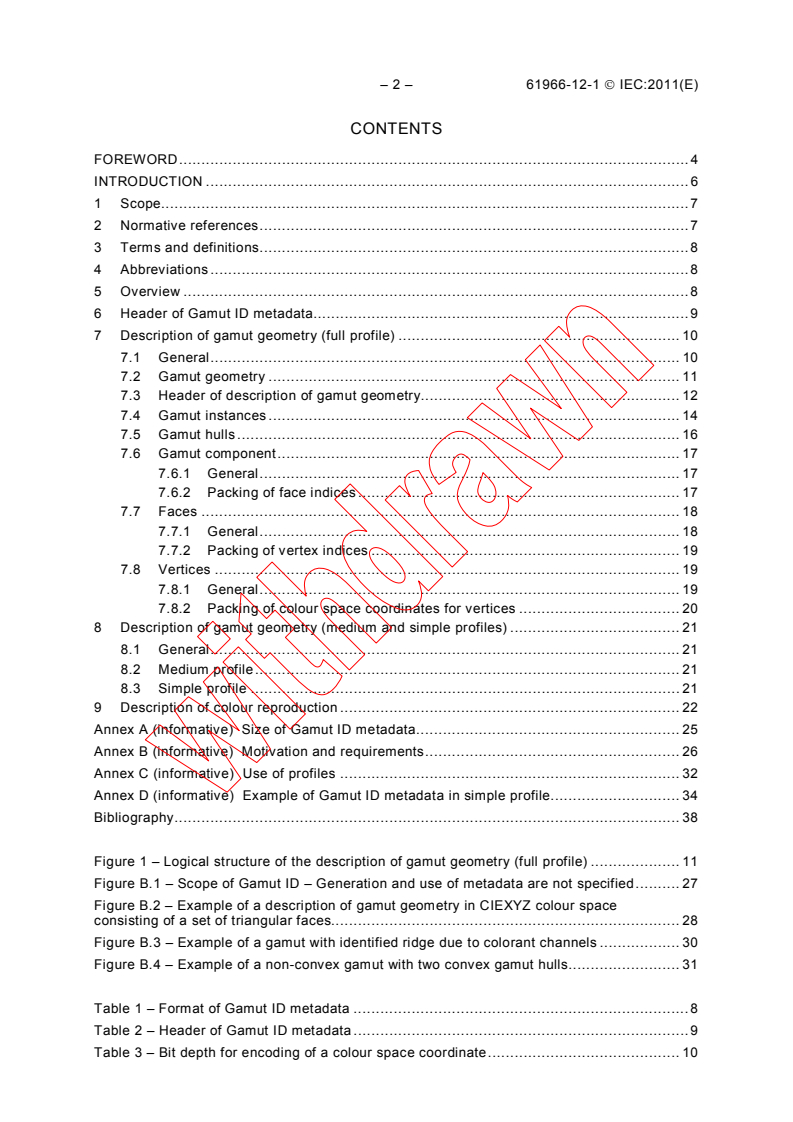
– 2 – 61966-12-1 Ó IEC:2011(E)
CONTENTS
FOREW ORD . 4
INTRODUCTION . 6
1 Sc o pe . 7
2 Normative references . 7
3 Terms and definitions . 8
4 Abbrev iations . 8
5 Overview . 8
6 Header of Gamut ID metadata. 9
7 Description of gamut geometry (full profile) . 10
7.1 General . 10
7.2 Gamut geometry . 11
7.3 Header of description of gamut geometry. 12
7.4 Gamut instances . 14
7.5 Gamut hulls . 16
7.6 Gamut component . 17
7.6.1 General . 17
7.6.2 Packing of face indices . 17
7.7 Faces . 18
7.7.1 General . 18
7.7.2 Packing of vertex indices . 19
7.8 Vertices . 19
7.8.1 General . 19
7.8.2 Packing of colour space coordinates for vertices . 20
8 Description of gamut geometry (medium and simple profiles) . 21
8.1 General . 21
8.2 Medium profile . 21
8.3 Simple profile . 21
9 Description of colour reproduction . 22
Annex A (informative) Size of Gamut ID metadata . 25
Annex B (informative) Motivation and requirements . 26
Annex C (informative) Use of profiles . 32
Annex D (informative) Example of Gamut ID metadata in simple profile . 34
Bibliography . 38
Figure 1 – Logical structure of the description of gamut geometry (full profile) . 11
Figure B.1 – Scope of Gamut ID – Generation and use of metadata are not specified . 27
Figure B.2 – Example of a description of gamut geometry in CIEXYZ colour space
consisting of a set of triangular faces. 28
Figure B.3 – Example of a gamut with identified ridge due to colorant channels . 30
Figure B.4 – Example of a non-convex gamut with two convex gamut hulls. 31
Table 1 – Format of Gamut ID metadata . 8
Table 2 – Header of Gamut ID metadata . 9
Table 3 – Bit depth for encoding of a colour space coordinate . 10
61966-12-1 Ó IEC:2011(E) – 3 –
Table 4 – Description of gamut geometry . 12
Table 5 – Header of description of gamut geometry . 13
Table 6 – Gamut instances . 14
Table 7 – ith Gamut instance . 15
Table 8 – Gamut hulls . 16
Table 9 – hth gamut hull . 16
Table 10 – Definition of gamut components . 17
Table 11 – cth gamut component. 17
Table 12 – Example for packing of gamut components . 18
Table 13 – Definition of faces . 18
Table 14 – Example for packing of faces . 19
Table 15 – Vertices. 20
Table 16 – Packing of 10-bit colour space coordinates . 20
Table 17 – Packing of 12-bit colour space coordinates . 21
Table 18 – Description of gamut geometry (simple profile) . 22
Table 19 – Header of description of gamut geometry (simple profile) . 22
Table 20 – Definition of vertices (simple profile) . 22
Table B.1 – Requirements and Gamut ID features . 29
Table C.1 – Profiles for the description of gamut geometry . 32
Table D.1 – Colour gamut for digital cinema . 34
Table D.2 – Example for the header . 34
Table D.3 – Example for the header of description of gamut geometry . 35
Table D.4 – Example of definition of vertices . 35
– 4 – 61966-12-1 Ó IEC:2011(E)
INTERNATIONAL ELECTROTECHNICAL COMMISSION
____________
MULTIMEDIA SYSTEMS AND EQUIPMENT –
COLOUR MEASUREMENT AND MANAGEMENT –
Part 12-1: Metadata for identification of colour gamut (Gamut ID)
FOREWORD
1) The International Electrotechnical Commission (IEC) is a worldwide organization for standardization comprising
all national electrotechnical committees (IEC National Committees). The object of IEC is to promote
international co-operation on all questions concerning standardization in the electrical and electronic fields. To
this end and in addition to other activities, IEC publishes International Standards, Technical Specifications,
Technical Reports, Publicly Available Specifications (PAS) and Guides (hereafter referred to as “IEC
Publication(s)”). Their preparation is entrusted to technical committees; any IEC National Committee interested
in the subject dealt with may participate in this preparatory work. International, governmental and non-
governmental organizations liaising with the IEC also participate in this preparation. IEC collaborates closely
with the International Organization for Standardization (ISO) in accordance with conditions determined by
agreement between the two organizations.
2) The formal decisions or agreements of IEC on technical matters express, as nearly as possible, an international
consensus of opinion on the relevant subjects since each technical committee has representation from all
interested IEC National Committees.
3) IEC Publications have the form of recommendations for international use and are accepted by IEC National
Committees in that sense. While all reasonable efforts are made to ensure that the technical content of IEC
Publications is accurate, IEC cannot be held responsible for the way in which they are used or for any
misinterpretation by any end user.
4) In order to promote international uniformity, IEC National Committees undertake to apply IEC Publications
transparently to the maximum extent possible in their national and regional publications. Any divergence
between any IEC Publication and the corresponding national or regional publication shall be clearly indicated in
the latter.
5) IEC itself does not provide any attestation of conformity. Independent certification bodies provide conformity
assessment services and, in some areas, access to IEC marks of conformity. IEC is not responsible for any
services carried out by independent certification bodies.
6) All users should ensure that they have the latest edition of this publication.
7) No liability shall attach to IEC or its directors, employees, servants or agents including individual experts and
members of its technical committees and IEC National Committees for any personal injury, property damage or
other damage of any nature whatsoever, whether direct or indirect, or for costs (including legal fees) and
expenses arising out of the publication, use of, or reliance upon, this IEC Publication or any other IEC
Publications.
8) Attention is drawn to the Normative references cited in this publication. Use of the referenced publications is
indispensable for the correct application of this publication.
9) Attention is drawn to the possibility that some of the elements of this IEC Publication may be the subject of
patent rights. IEC shall not be held responsible for identifying any or all such patent rights.
International Standard IEC 61966-12-1 has been prepared by technical area 2: Colour
measurement and management, of IEC technical committee 100: Audio, video and multimedia
systems and equipment.
The text of this standard is based on the following documents:
FDIS Report on voting
100/1757/FDIS 100/1776/RVD
Full information on the voting for the approval of this standard can be found in the report on
voting indicated in the above table.
This publication has been drafted in accordance with the ISO/IEC Directives, Part 2.
61966-12-1 Ó IEC:2011(E) – 5 –
A list of alll parts of the IEC 61966 series, published under the general title Multimedia
systems and equipment – Colour measurement and management, can be found on the IEC
website.
The committee has decided that the contents of this amendment and the base publication will
remain unchanged until the stability date indicated on the IEC web site under
"http://webstore.iec.ch" in the data related to the specific publication. At this date, the
publication will be
• reconfirmed,
• withdrawn,
• replaced by a revised edition, or
• amended.
A bilingual version of this document may be issued at a later date.
IMPORTANT – The “colour inside” logo on the cover page of this publication indicates
that it contains colours which are considered to be useful for the correct understanding
of its contents. Users should therefore print this publication using a colour printer.
– 6 – 61966-12-1 Ó IEC:2011(E)
INTRODUCTION
New technologies in capturing and displaying wide-gamut colour images enable a new market
of wide-gamut video colour content creation. Recent video standards for wide gamut colour
space encoding such as IEC 61966-2-4 (xvYCC) were established in order to be able to
distribute content with a colour gamut that is extended with respect to classical colour gamuts
such as defined by colorimetry standards ITU-R BT.601 (standard definition television) and
ITU-R BT.709 (high definition television). With the increasing popularity of wide gamut and
high dynamic range content and displays, the variety of colour gamuts of displays is expected
to increase. This issue can be an obstacle for adopting wide-gamut video colour content in
professional content creation since the compatibility of the content to the employed displays
as well as the compatibility among different displays is not ensured. The term display includes
here any video colour reproduction equipment, such as direct view displays and projectors.
Thanks to improvements of technology, the variety of colour gamut and colour reproduction
capacities of displays increases while the colour gamut and the colour encoding rules of
existing colour space encoding standards are fixed.
To address this issue, the IEC standard Gamut ID (IEC 61966-12-1) specifies a colour gamut
metadata scheme for video systems including information for colour reproduction. This
metadata can amend a video content or a display. More specifically, improvements can be
achieved if the wide-gamut colour content is created with the knowledge of the display colour
gamut as well as if the colour reproduction in the display is done with the knowledge of the
colour gamut of the pictorial content.
This standard enables video systems defining their own colour gamut. This standard defines
necessary metadata that allows managing inhomogeneous video systems with different colour
gamuts. This standard generalizes existing colour space encoding standards having a fixed
colour gamut.
61966-12-1 Ó IEC:2011(E) – 7 –
MULTIMEDIA SYSTEMS AND EQUIPMENT –
COLOUR MEASUREMENT AND MANAGEMENT –
Part 12-1: Metadata for identification of colour gamut (Gamut ID)
1 Scope
This part of IEC 61966 defines the colour gamut metadata scheme for video systems and
similar applications.
The metadata can be associated with wide gamut video colour content or to a piece of
equipment to display the content.
When associated with content, the colour gamut metadata defines the gamut for which the
content was created. It can be used by the display for controlled colour reproduction even if
the display’s colour gamut is different from that of the content.
When associated with a display, the colour gamut metadata defines the display colour gamut.
It can be used during content creation to enable improved colour reproduction.
The colour gamut metadata may cover associated colour encoding information, which
includes all information required for a controlled colour reproduction, when such information is
not provided by the colour encoding specification.
The colour gamut metadata scheme provides scalable solutions. For example, more flexible
solutions will be used for the professional use, while much simpler solutions will be used for
consumer use with easier product implementation.
This part of IEC 61966 only defines the colour gamut metadata scheme. Vendor-specific
solutions for creation and end-use of this metadata are allowed.
2 Normative references
The following referenced documents are indispensable for the application of this document.
For dated references, only the edition cited applies. For undated references, the latest edition
of the referenced document (including any amendments) applies.
IEC 60050(845):1987, International electrochnical vocabulary – Chapter 845: Lighting
IEC 61966-2-4:2006, Multimedia systems and equipment – Colour measurement and
management – Part 2-4: Colour management – Extended-gamut YCC colour space for video
applications – xvYCC
ISO 15076-1:2005 Image technology colour management – Architecture, profile format and
data structure – Part 1: Based on ICC.1:2004-10
ISO 22028-1:2004, Photography and graphic technology – Extended colour encodings for
digital image storage, manipulation and interchange – Part 1: Architecture and requirements
ITU-R BT.709-5:2002, Parameter values for the HDTV standards for production and
international programme exchange
– 8 – 61966-12-1 Ó IEC:2011(E)
CIE 15:2004, Colorimetry
SMPTE 274M:2005, SMPTE Standard for Television - 1920 x 1080 Image Sample Structure,
Digital Representation and Digital Timing Reference Sequences for Multiple Picture Rates
3 Terms and definitions
For the purposes of this document, the following terms and definitions as well as the terms
and definitions of colour space, illuminance, luminance, tristimulus, and other related lighting
terms of IEC 60050(845) apply.
3.1
content
video content in production, post-production or consumption
3.2
gamut
a solid in a colour space
3.3
gamut boundary description
description of the boundary of a colour gamut
3.4
radiometrically-linear colour space coordinates
colour space coordinates that are linear with respect to image radiance
4 Abbreviations
GBD Gamut Boundary Description
LSB Least Significant Bit
MSB Most Significant Bit
GI Gamut Instance
GH Gamut Hull
GC Gamut Component
5 Overview
This standard specifies metadata called “Gamut ID metadata” providing information on an
actual colour gamut.
The Gamut ID metadata contains four parts and its format is summarized in Table 1.
Table 1 – Format of Gamut ID metadata
Byte #
Metadata content
hex
0h0000 Header of Gamut ID metadata
ID_G Description of gamut geometry
ID_E Description of colour reproduction
Clause 6 specifies the header of Gamut ID metadata.
Clauses 7 and 8 specify the description of gamut geometry that corresponds to one of three
profiles as listed below:
ID_GBD_SPACE
ID_PRECISION
ID_PROFILE
61966-12-1 Ó IEC:2011(E) – 9 –
· full profile;
· medium profile;
· simple profile.
Clause 7 specifies the full profile of the description of gamut geometry. The medium and
simple profiles are specified in Clause 8.
Clause 9 specifies the description of colour reproduction.
6 Header of Gamut ID metadata
The Gamut ID metadata starts with the header shown in Table 2.
Table 2 – Header of Gamut ID metadata
Byte # Size Sym-
Description Values
hex bytes bols
7 6 5 4 3 2 1 0
00 1 N, P R R = reserved = 0b0 (1bit)
ID_PFOFILE (2 bits):
0b00: Full profile
0b01: Medium profile
0b10: Simple profile
0b11: Reserved
ID_PRECISION (2 bits):
0b00: 8 bits
0b01: 10 bits
0b10: 12 bits
0b11: Reserved
ID_GBD_SPACE (3bits):
0b000: ITU-R BT.709
RGB
0b001: xvYCC-601
(IEC 61966-2-4 -SD)
YCC
0b010: xvYCC-709
(IEC 61966-2-4 -HD)
YCC
0b011: XYZ (see below)
0b100: Reserved
0b101: Reserved
0b110: Reserved
0b111: Reserved
01 2 ID_G Byte # of start of the description [0h0009;0hFFFF]
of gamut geometry
03 2 ID_E Byte # of start of the description [0;0hFFFF]
of colour reproduction
05 2 Reserved. Shall be zero. 0h0000
07 2 Reserved. Shall be zero. 0h0000
– 10 – 61966-12-1 Ó IEC:2011(E)
ID_PROFILE indicates the profile of the Gamut ID metadata and shall be one of
· 0b00: Full profile,
· 0b01:Medium profile,
· 0b11: Simple profile.
ID_GBD_SPACE indicates the colour space and the colour space encoding for colour vertices
in the description of gamut geometry and shall be one of
· 0b000: ITU-R BT.709, RGB space, encoding according to SMPTE 274M,
· 0b001: xvYCC-601, YCbCr space, encoding according to IEC 61966-2-4 – SD,
· 0b010: xvYCC-709, YCbCr space, encoding according to IEC 61966-2-4 – HD,
· 0b011: XYZ; encoding shall use the XYZNumber format of ICC profiles specified in
ISO 15076-1:2005 taking 12 bytes for one XYZ triple.
aID_PRECISION and ID_GBD_SPACE specify according to Table 3 the number N of bits that
are used per colour channel in order to define the coordinates of a colour in a colour space.
Table 3 – Bit depth for encoding of a colour space coordinate
ID_GBD_SPACE ID_PRECISION Bit depth N
0b000 or 0b00 8 bits
0b001 or
0b01 10 bits
0b010
0b10 12 bits
0b11 Reserved
0b011 Any 32 bits
0b100 or Any Reserved
0b101 or
0b110 or
0b111
ID_G indicates the offset in bytes from the beginning of Gamut ID metadata to the beginning
of the description of gamut geometry.
If ID_E is different from 0h0000, the Gamut ID metadata contains a description of colour
reproduction and ID_E indicates the offset in bytes from the beginning of Gamut ID metadata
to the beginning of the description of colour reproduction. If ID_E has the value 0h0000, the
Gamut ID metadata does not contain a description of colour reproduction.
7 Description of gamut geometry (full profile)
7.1 General
In the header of Gamut ID metadata, if ID_PROFILE equals 0b00, the description of gamut
geometry shall correspond to the full profile.
61966-12-1 Ó IEC:2011(E) – 11 –
7.2 Gamut geometry
The description of gamut geometry of the Gamut ID metadata describes the boundary of the
actual colour gamut. The description of gamut geometry starts at byte number ID_G.
The description of gamut geometry contains five sets of different elements:
· gamut instances,
· gamut hulls,
· gamut components,
· faces, and
· vertices.
The logical structure of the Gamut ID description of colour gamut is shown in Figure 1.
Gamut
component Faces Verticles
(GC) (GC) (GC)
Gamut
Gamut hull
V0
GC0 F0
instance (GH)
V1
(GI)
F1
GC1
V2
GC2 F2
GH0
V3
GC3
GI0 GH1 F3
V4
GC4 F4
GI1 GH2
…. …. …. …. ….
IEC 2891/10
Figure 1 – Logical structure of the description of gamut geometry (full profile)
The description of gamut geometry contains one or more gamut boundary descriptions that
each describes the boundary of the same actual colour gamut. A GBD contains vertices and
triangular faces. Each face is defined by the indices of three vertices.
A gamut component is a group of connex triangular faces. A GC is a part of a boundary
description. A GC is defined by one ore more indices of faces.
A gamut hull is a group of connex gamut components building all together a closed surface.
This surface is the boundary description of a connex volume in CIEXYZ colour space. Each
GH is defined by one or more indices of GCs. A GH may refer to a single GC. In this case the
GC must be a closed surface boundary description by itself. A GH may refer to a list of GCs,
in that case all GCs together build a closed surface boundary description of a connex volume.
A gamut instance is a group of gamut hulls building all together a valid GBD of the actual
colour gamut. A GI is defined by one or more indices of gamut hulls. A GI may refer to a
single GH, in this case the single GH describes by itself the actual colour gamut. A GI may
refer to a list of GHs, in this case the union of the volumes of the GHs describes the actual
colour gamut.
The description of gamut geometry contains one or more different gamut instances. Each GI
is a complete and valid GBD. Two GIs differ in at least one of the following characteristics:
– 12 – 61966-12-1 Ó IEC:2011(E)
· Level of detail
à The higher the level, the higher the number of faces.
· Non-convex shape
à A GI may allow or not allow the use of non-convex shapes.
· Percentage of gamut colours
à GIs may contain different percentages of the colours of the actual colour gamut.
A GI may have additional, optional characteristics:
· Inverted gamut components
à A GC is used as inverted GC if it referenced by one ore more GH assuming that its
surface orientation is inverted.
· Indication of gamut ridges
à Vertices may be marked as gamut ridges if they correspond to positions on the surface
of the actual colour gamut having non continuous surface curvature.
The description of gamut geometry is summarized in Table 4.
Table 4 – Description of gamut geometry
Byte #
Description
hex
ID_G Header of description of gamut geometry
ID_GI Gamut instances
ID_GH Gamut hulls
ID_GC Gamut components
ID_F Faces
ID_V Vertices
7.3 Header of description of gamut geometry
The header of the description of gamut geometry follows the header of Gamut ID metadata
and is defined according to Table 5.
61966-12-1 Ó IEC:2011(E) – 13 –
Table 5 – Header of description of gamut geometry
Byte # Size Values
Symbol Description
hex bytes decimal
ID_G 2 ID_GI Byte # of start of gamut [0;0hFFFF]
instances
ID_G + 02 2 ID_GH [0;0hFFFF]
Byte # of start of gamut hulls
ID_G + 04 2 ID_GC Byte # of start of gamut [0;0hFFFF]
components
ID_G + 06 2 ID_F [0;0hFFFF]
Byte # of start of faces
ID_G + 08 2 ID_V [0;0hFFFF]
Byte # of start of vertices
ID_G + 0A 1 0
Reserved
ID_G + 0B 1 0
Reserved
ID_G + 0C 1 K Number of levels of detail 1 ≤ K ≤ 255
ID_G + 0D 2
F 1< F £ F
MAX MAX
Maximum number of faces in
(F see
lowest level of detail
Table 6)
ID_G + 0F 1 P Number of levels of colour 0 < P ≤ 128/K
population
ID_G + 10 1 Double of percentages of gamut [0;200]
2Q
colours
ID_G + 11 1 Double of percentages of gamut [0;200]
2Q
colours
:
:
ID_G + 10 + P-1 1 Double of percentages of gamut [0;200]
2Q
P-1
colours
X
ID_G + 10 + P 1 Convex or non-convex shape 1£ X£ 2
X=1: all GIs and all GHs shall be
convex
X=2: GIs and GHs may be
convex or non-convex
16 bit integer or address values are encoded into 2 bytes bytes using big endian, i.e. with the
MSBs in the first byte and the LSBs in the second byte.
ID_GI, ID_GH, ID_GC, ID_F and ID_V shall give the offset in bytes from the beginning of
Gamut ID metadata to the beginning of gamut instances, gamut hulls, gamut components,
faces and vertices data, respectively.
K indicates the number of levels of details. The Gamut ID metadata contains at least K GIs. If
K = 1 there are no different level of details. Each GI is marked individually with a level of
detail (0,1,…,K − 1), see Table 7.
F shall indicate the maximum number of faces for a GI having the lowest level of detail
MAX
(level 0). See Table 7 for definition of level of details. See Table 13 for faces definition.
P indicates the number of alternative GIs populated by different percentages of colours of the
actual colour gamut. If P > 1, there are P alternative GIs describing the same actual colour
gamut but containing different percentages of colours of the actual colour gamut. The Gamut
ID metadata contains at least P GIs. Each GI is marked individually with a population level
(0,1,…, P − 1), see Table 7.
– 14 – 61966-12-1 Ó IEC:2011(E)
2 Q …2 Q are the doubles of the percentages Q …Q of colours associated with the
0 P-1 0 P-1
population levels (0,1,…,P-1). A percentage shall approximately indicate how many percent of
colours (0.100) of the actual colour gamut are contained in the volume described by a GI of
the corresponding population level. As a matter of definition, Q …Q percentages can be
0 P-1
defined in steps of 0,5 points.
X indicates whether the Gamut ID uses only convex shapes (X = 1) or may use convex and
non-convex shapes (X = 2). When X = 1, each GI shall correspond to a convex shape and
each GH shall correspond to a convex shape. When X = 2, GIs are organized into pairs. Each
pair contains a first GI (marked as “convex”, see Table 7) that corresponds to a convex shape
and which references only GHs that correspond to a convex shape. The second GI of the pair
(marked as “non convex”, see Table 7) may correspond to a non-convex shape and may
reference GHs that correspond to non-convex shapes. The Gamut ID metadata contains at
least X GIs.
7.4 Gamut instances
The description of gamut geometry contains one or more gamut boundary descriptions of the
actual colour gamut. One single GBD is called gamut instance. A user of Gamut ID metadata
may use any one or any number of GIs of Gamut ID metadata. The GIs are defined by a list of
GIs from byte number ID_GI on according to Table 6. The order in the list is arbitrary but fixed.
Table 6 – Gamut instances
Byte # Size
Symbol Description Values
hex bytes
ID_GI 1 I Total number of gamut I = X P K
Instances
ID_GI + 01 see Table 7
6+ H
0 Definition of GI no. 0,
ID_GI + 01 6+ H see Table 7
Definition of GI no. 1
+ 6+ H
:
:
ID_GI + 01 see Table 7
6+ H
I-1
I-2
Definition of GI no. I-1
+ (6+ H)
å i
i=0
I is the number of GIs and shall be equal to the product of X, P and K as defined in Table 5.
The ith GI, i = 0…I − 1, is defined according to Table 7.
61966-12-1 Ó IEC:2011(E) – 15 –
Table 7 – ith Gamut instance
Relative byte # Size
Symbol Description Values
hex bytes
00 1 Level of detail of this GI 0£ K £ K-1
K
i
i
GI
GI i
01 2 Number of faces used by
F
i F £ 2 F
i MAX
this GI
( F see Table 5)
MAX
GI GI
03 1 This GI defines a convex
X
1£ X £ X
i i
GI
shape ( = 1) or may
X
i (X see Table 5)
define a non-convex
GI
shape ( =2)
X
i
04 1 Level of colour population
0£ P£ P-1
P
i
i
of this GI
(P see Table 5)
05 1 Number of gamut hulls
H 1 ≤ H ≤ H
i i
referenced by this GI
(H see Table 8)
06 Indices of referenced GHs [0;H − 1]
H
i
Shall be valid indices
of GH
K is the level of detail of the ith GI. The GI is of lowest level of detail is K = 0. If K is
i i i
larger than the level of detail K of a j-th GI of same type ( P= P , X = X ) then the ith GI
j i j i j
has a higher level of detail, i.e. a more precise geometric description , than the jth GI.
GI
F is the number of faces used by the ith GI. This number should correspond to the number
i
of faces referenced by those gamut components (see Table 10) that are referenced by those
GI
gamut hulls (see Table 8) that are referenced by the ith GI. The number F of faces should
i
K
i
be equal or smaller than 2 F ( F see Table 6).
MAX MAX
GI GI
X is an indicator on convex or non-convex shape. If X =1, the ith GI defines a convex
i i
GI
shape and each GH referenced by the ith GI defines a convex shape by itself. If = 2, the
X
i
ith GI may define a convex or a non-convex shape and each of the GHs referenced by the ith
GI may define a convex or a non-convex shape by itself.
P is the population level of the ith GI. The ith GI shall contain approximately Q percent of
i P
i
colours of the actual colour gamut. Different GIs with same population level shall contain
approximately the same percentage of colours of the actual colour gamut. A GI with
population level P shall contain at least all colours of another GI with population level P if
i j
P > P , K = K and X = X .
j i j i j i
H is the number of gamut hulls that are referenced by the ith GI. If an ith GI references one
i
gamut hull, then H =1 and the gamut hull describes the actual colour gamut. If an ith GI
i
references more than one gamut hull, then H > 1 and the union of the volumes of all
i
referenced gamut hulls describes the actual colour gamut.
– 16 – 61966-12-1 Ó IEC:2011(E)
The H indices of GHs have each one byte.
i
7.5 Gamut hulls
The description of gamut geometry contains one or more gamut hulls. Each GH is the closed
surface boundary description defining a connex, closed volume in colour space. A GH may be
referenced by one or more GIs. A GI may reference one or more GHs. A GH may describe by
itself the actual colour gamut or just a part of it. The GHs are defined by a list of GHs from
byte number ID_GH on according to Table 8. The order in the list is arbitrary but fixed.
H is the total number of GHs contained in the Gamut ID metadata. The hth GH, h = 0…H − 1,
is defined according to Table 9.
Table 8 – Gamut hulls
Byte # Size
Symbol Description Values
hex bytes
ID_GH 1 H Total number of 0 ≤ H ≤ 255
gamut hulls
ID_GH + 01 Definition of GH see Table 9
3+ C + C
0 0
no. 0
ID_GH + 01 Definition of GH see Table 9
3+ +
C C
1 1
no. 1
+ 2+ C + C
0 0
:
:
ID_GH + 01 Definition of GH see Table 9
3+ C + C
H-1 H-1
H-2 no. H − 1
+ (3 + C + C )
å h h
h=0
Table 9 – hth gamut hull
Relative byte
Size
# Symbol Description Values
bytes
hex
GH
GH
00 1 Indication whether this GH
X 1£ X £ X
h
h
defines a convex shape or
(X see Table 5)
any shape (convex or non-
GH
X =1: convex
convex) h
shape
GH
X =2: convex or
h
non-convex shape
01 1 Number referenced gamut
C 1£ C +C £ C
h k k
components that are used
(C see Table 10)
non-inverted by this GH
02 1
Number of referenced gamut
C
h
components that are used
inverted by this GH
03 Indices of referenced gamut [0;C − 1]
C
h
components shall be valid indices
Indices of referenced gamut of GCs
03 + C
C
h
h
components used in an
inverted manner
C +
C is the number of gamut components that are referenced by the hth GH. If a hth GH
h h
references one GC, then C + C = 1 and the GC defines by itself the closed surface of the
h h
GH. If a hth GH references more than one GC, then C + C > 1 and all referenced GCs
h h
61966-12-1 Ó IEC:2011(E) – 17 –
build together the closed surface of the GH. When a GC is used inverted, the surface normals
of the faces referenced by this GC are used in the inverse sense. For referenced faces, see
Table 10. For surface normals, see 7.7.
7.6 Gamut component
7.6.1 General
The description of gamut geometry contains one or more gamut components that each
defines a connex piece of a boundary description of a surface in CIEXYZ colour space. A GC
may be referenced by one or more GHs. A GH may reference one or more GCs. A GC may be
the boundary description of a closed surface in 3D colour space or a piece of it. The GCs are
defined by a list of GCs from byte number ID_GC on according to Table 10. The order in the
list is arbitrary but fixed.
Table 10 – Definition of gamut components
Byte # Size
Symbol Description Values
hex bytes
C
ID_GC 1 Total number 0 ≤ C ≤ 255
of gamut
components
ID_GC + 01 2 + F ld(F) / 8 Definition of see
é ù
GC no. 0 Table 11
ID_GC + 01 2 + Definition of see
F ld(F) / 8
é ù
+ 02 GC no. 1 Table 11
+
F ld(F) / 8
é é ù ù
:
:
ID_GC + 01 2 + F ld(F)/ 8 Definition of see
é ù
C-1
C-2
GC no. C − 1 Table 11
+
(02+ F ld()F /8)
é é ù ù
å c
c=0
C is the total number of GCs contained in the Gamut ID metadata. In Table 11, · is the
éù
operation that rounds to the next upper integer if the operand is not an integer and ld(·) is
the logarithm to the base of 2.
The cth GC, c = 0…C − 1, is defined according to Table 11.
Table 11 – cth gamut component
Relative
Size
byte # Symbol Description Values
bytes
hex
00 2 Number faces 1£ F £ F
c
F
c
referenced by this GC
(F see Table 13)
02 F ld(F) / 8 Indices of referenced [0;F − 1]
é é ù ù
c
faces shall be valid indices
of faces, F see
Table 13
7.6.2 Packing of face indices
The indices of the faces are packed into bytes. Each index of a face takes ld(F) bits. Packing
is organized GC wise, i.e. the first face index of a GC always starts at the beginning of a byte.
– 18 – 61966-12-1 Ó IEC:2011(E)
An example of packing is given for the case of C = 2 gamut components each using
F = F= 4 faces from a total of F = 8 faces. Each GC takes N× ld(F)× F /8 = ( ld8 4)/8 = 2
é ù
0 1 c éé ù ù
bytes for the indices of the faces. The definition of the GCs requires in total
C-1 1
1+2C+ ld(F)F /8 5+ (ld()8 4)/8 5+212/8 9 bytes. Packing is as shown in
é ù éé ù ù é ù
å c å
c 0 c 0
Table 12.
Table 12 – Example for packing of gamut components
Byte # Value
Size
hex binary
7 6 5 4 3 2 1 0
ID_GC 1 0b00000010
ID_GC + 01 1 0 (MSB)
ID_GC + 02 1 0b100 (LSB)
ID_GC + 03 1 1. index 2. index 3.
index
MSBs
ID_GC + 04 1 3. i. 4. index Unused
LSB
ID_GC + 05 1 0 (MSB)
ID_GC + 06 1 0b100 (LSB)
ID_GC + 07 1 1. index 2. index 3.
index
MSBs
ID_GC + 08 1 3. i. 4. index Unused
LSB
LSB are the least significant bits;
MSB are the most significant bits.
7.7 Faces
7.7.1 General
The faces are defined by a list of faces from byte number ID_F on according to Table 11. The
order in the list is arbitrary but fixed.
Table 13 – Definition of faces
Byte #
Size Symbol Description Values
hex
ID_F 2 F Total number 6 ≤ F < 65 535
of faces
3F ld(V) / 8
ID_F+02 3F indices of [0;V − 1]
é é ù ù
vertices Must be a valid
indices of vertices
F is the total number of faces of the description of gamut geometry and shall be at least 6 or
shall equal zero (see Clause 8). For each face, three indices of vertexes are indicated, in total
3F indices.
If a sample face is defined by three indices index of three vertices V , V , V , respectively, in
0 1 2
CIEXYZ space, the surface normal of the face is defined as follows:
= =
= = =
61966-12-1 Ó IEC:2011(E) – 19 –
(V -V )´(V -V )
2 0 1 0
n=
V -V × V -V
2 0 1 0
where
x is the vector cross product:
· is the vector length operator, and
n is the surface normal.
7.7.2 Packing of vertex indices
The indices of the vertices of all faces are packed into bytes. Each index of a face takes
ld(V) bits, for V see Table 15.
An example of packing is given for the case of F= 6 faces and V= 5 vertices. Each index of
a vertex takes ld(V)= 3 bits. All indices take 3F ld(V) / 8 = 7 bytes.
é é ù ù
Packing is as shown in Table 14.
Table 14 – Example for packing of faces
Byte #
Size Value
hex
Bits
7 6 5 4 3 2 1 0
ID_F 2 0h0006
ID_F + 02 1 F0 index0 F0 index1 F0 index2
MSBs
ID_F + 03 1 F0 F1 index0 F1 index1 F1 i.2
i.2 MSB
LSB
ID_F + 04 1 F1 i.2 F2 index0 F2 index1
LSBs
ID_F + 05 1 F2 index2 F3 index0 F3 index1
MSBs
ID_F + 06 1 F3 F3 index2 F4 index0 F4 i.1
i.1 MSB
LSB
ID_F + 07 1 F4 I.1 F4 index2 F5 index0
LSBs
ID_F + 08 1 F5 index1 F5 index2 0b00
7.8 Vertices
7.8.1 General
The vertices are defined by a list of vertices from byte number ID_V on, see Table 15.
The order in the list is arbitrary but fixed.
– 20 – 61966-12-1 Ó IEC:2011(E)
Table 15 – Vertices
Byte #
Size Symbol Description Values
hex
Total number of
5 ≤ V <
ID_V 2 V vertices
65 535
Number of vertices
0 ≤ R ≤ V
ID_V+02 2 R belonging to
gamut ridges
3V encoded colour Encoded
3VN /8
ID_V+04 space coordinates colour space
é ù
defining V vertices coordinates
[0; V − 1]
R indices of
ID_V+04+
R ld(V) / 8
Must be a
é é ù ù
vertices belonging
3VN / 8 valid indices
é ù
to gamut ridges
of vertices
Hereby is · the operation that rounds to the next upper integer. V is the total number of
éù
vertices of the description of gamut geometry.
The vertices belonging to gamut ridges are a subset of all vertices. Gamut ridges are
positions on the surface of the actual colour gamut having non continuous surface curvature
such as ridges or summits.
7.8.2 Packing of colour space coordinates for vertices
For 8 bit encoding, the 12 colour space coordinates are directly coded into 12 bytes. For 10
bit encoding, the vertices are packed according to Table 16. For 12 bit encoding, the vertices
are packed according to Table 17.
Table 16 – Packing of 10-bit colour space coordinates
Relative
Size
byte # Description
bytes
hex
7 6 5 4 3 2 1 0
00 1 A_high
01 1 A_low B_high
02 1 B_low C_high
03 1 C_low D_high
04 1 D_low
61966-12-1 Ó IEC:2011(E) – 21 –
Table 17 – Packing of 12-bit colour space coordinates
Relative
Size
byte # Description
bytes
hex
7 6 5 4 3 2 1 0
00 1 A_high
01 1 A_low B_high
02 1 B_low
03 1 C_high
04 1 C_low D_high
05 1 D_low
8 Description of gamut geometry (medium and simple profiles)
8.1 General
This clause specifies the simple and medium profile of the description of gamut geometry.
See Clause 7 for the f
...
IEC 61966-12-1 ®
Edition 1.0 2011-01
INTERNATIONAL
STANDARD
NORME
INTERNATIONALE
colour
inside
Multimedia systems and equipment – Colour measurement and management –
Part 12-1: Metadata for identification of colour gamut (Gamut ID)
Systèmes et appareils multimédia – Mesure et gestion de la couleur –
Partie 12-1: Métadonnées d'identification des gammes de couleurs (Gamut ID)
All rights reserved. Unless otherwise specified, no part of this publication may be reproduced or utilized in any form or by
any means, electronic or mechanical, including photocopying and microfilm, without permission in writing from either IEC or
IEC's member National Committee in the country of the requester.
If you have any questions about IEC copyright or have an enquiry about obtaining additional rights to this publication,
please contact the address below or your local IEC member National Committee for further information.
Droits de reproduction réservés. Sauf indication contraire, aucune partie de cette publication ne peut être reproduite
ni utilisée sous quelque forme que ce soit et par aucun procédé, électronique ou mécanique, y compris la photocopie
et les microfilms, sans l'accord écrit de la CEI ou du Comité national de la CEI du pays du demandeur.
Si vous avez des questions sur le copyright de la CEI ou si vous désirez obtenir des droits supplémentaires sur cette
publication, utilisez les coordonnées ci-après ou contactez le Comité national de la CEI de votre pays de résidence.
IEC Central Office
3, rue de Varembé
CH-1211 Geneva 20
Switzerland
Email: inmail@iec.ch
Web: www.iec.ch
About the IEC
The International Electrotechnical Commission (IEC) is the leading global organization that prepares and publishes
International Standards for all electrical, electronic and related technologies.
About IEC publications
The technical content of IEC publications is kept under constant review by the IEC. Please make sure that you have the
latest edition, a corrigenda or an amendment might have been published.
Catalogue of IEC publications: www.iec.ch/searchpub
The IEC on-line Catalogue enables you to search by a variety of criteria (reference number, text, technical committee,…).
It also gives information on projects, withdrawn and replaced publications.
IEC Just Published: www.iec.ch/online_news/justpub
Stay up to date on all new IEC publications. Just Published details twice a month all new publications released. Available
on-line and also by email.
Electropedia: www.electropedia.org
The world's leading online dictionary of electronic and electrical terms containing more than 20 000 terms and definitions
in English and French, with equivalent terms in additional languages. Also known as the International Electrotechnical
Vocabulary online.
Customer Service Centre: www.iec.ch/webstore/custserv
If you wish to give us your feedback on this publication or need further assistance, please visit the Customer Service
Centre FAQ or contact us:
Email: csc@iec.ch
Tel.: +41 22 919 02 11
Fax: +41 22 919 03 00
A propos de la CEI
La Commission Electrotechnique Internationale (CEI) est la première organisation mondiale qui élabore et publie des
normes internationales pour tout ce qui a trait à l'électricité, à l'électronique et aux technologies apparentées.
A propos des publications CEI
Le contenu technique des publications de la CEI est constamment revu. Veuillez vous assurer que vous possédez
l’édition la plus récente, un corrigendum ou amendement peut avoir été publié.
Catalogue des publications de la CEI: www.iec.ch/searchpub/cur_fut-f.htm
Le Catalogue en-ligne de la CEI vous permet d’effectuer des recherches en utilisant différents critères (numéro de référence,
texte, comité d’études,…). Il donne aussi des informations sur les projets et les publications retirées ou remplacées.
Just Published CEI: www.iec.ch/online_news/justpub
Restez informé sur les nouvelles publications de la CEI. Just Published détaille deux fois par mois les nouvelles
publications parues. Disponible en-ligne et aussi par email.
Electropedia: www.electropedia.org
Le premier dictionnaire en ligne au monde de termes électroniques et électriques. Il contient plus de 20 000 termes et
définitions en anglais et en français, ainsi que les termes équivalents dans les langues additionnelles. Egalement appelé
Vocabulaire Electrotechnique International en ligne.
Service Clients: www.iec.ch/webstore/custserv/custserv_entry-f.htm
Si vous désirez nous donner des commentaires sur cette publication ou si vous avez des questions, visitez le FAQ du
Service clients ou contactez-nous:
Email: csc@iec.ch
Tél.: +41 22 919 02 11
Fax: +41 22 919 03 00
IEC 61966-12-1 ®
Edition 1.0 2011-01
INTERNATIONAL
STANDARD
NORME
INTERNATIONALE
colour
inside
Multimedia systems and equipment – Colour measurement and management –
Part 12-1: Metadata for identification of colour gamut (Gamut ID)
Systèmes et appareils multimédia – Mesure et gestion de la couleur –
Partie 12-1: Métadonnées d'identification des gammes de couleurs (Gamut ID)
INTERNATIONAL
ELECTROTECHNICAL
COMMISSION
COMMISSION
ELECTROTECHNIQUE
PRICE CODE
INTERNATIONALE
CODE PRIX W
ICS 17.180.20; 33.160 ISBN 978-2-88912-826-6
– 2 – 61966-12-1 IEC:2011
CONTENTS
FOREWORD . 4
INTRODUCTION . 6
1 Scope . 7
2 Normative references . 7
3 Terms and definitions . 8
4 Abbreviations . 8
5 Overview . 8
6 Header of Gamut ID metadata . 9
7 Description of gamut geometry (full profile) . 10
7.1 General . 10
7.2 Gamut geometry . 11
7.3 Header of description of gamut geometry . 12
7.4 Gamut instances . 14
7.5 Gamut hulls . 16
7.6 Gamut component . 17
7.6.1 General . 17
7.6.2 Packing of face indices . 17
7.7 Faces . 18
7.7.1 General . 18
7.7.2 Packing of vertex indices . 19
7.8 Vertices . 19
7.8.1 General . 19
7.8.2 Packing of colour space coordinates for vertices . 20
8 Description of gamut geometry (medium and simple profiles) . 21
8.1 General . 21
8.2 Medium profile. 21
8.3 Simple profile . 21
9 Description of colour reproduction . 22
Annex A (informative) Size of Gamut ID metadata . 25
Annex B (informative) Motivation and requirements . 26
Annex C (informative) Use of profiles . 32
Annex D (informative) Example of Gamut ID metadata in simple profile . 34
Bibliography . 38
Figure 1 – Logical structure of the description of gamut geometry (full profile) . 11
Figure B.1 – Scope of Gamut ID – Generation and use of metadata are not specified . 27
Figure B.2 – Example of a description of gamut geometry in CIEXYZ colour space
consisting of a set of triangular faces . 28
Figure B.3 – Example of a gamut with identified ridge due to colorant channels . 30
Figure B.4 – Example of a non-convex gamut with two convex gamut hulls . 31
Table 1 – Format of Gamut ID metadata . 8
Table 2 – Header of Gamut ID metadata . 9
61966-12-1 IEC:2011 – 3 –
Table 3 – Bit depth for encoding of a colour space coordinate . 10
Table 4 – Description of gamut geometry . 12
Table 5 – Header of description of gamut geometry . 13
Table 6 – Gamut instances . 14
Table 7 – ith Gamut instance . 15
Table 8 – Gamut hulls . 16
Table 9 – hth gamut hull. 16
Table 10 – Definition of gamut components . 17
Table 11 – cth gamut component . 17
Table 12 – Example for packing of gamut components . 18
Table 13 – Definition of faces . 18
Table 14 – Example for packing of faces . 19
Table 15 – Vertices . 20
Table 16 – Packing of 10-bit colour space coordinates . 20
Table 17 – Packing of 12-bit colour space coordinates . 21
Table 18 – Description of gamut geometry (simple profile) . 22
Table 19 – Header of description of gamut geometry (simple profile) . 22
Table 20 – Definition of vertices (simple profile) . 22
Table 21 – Header of description of colour reproduction . 23
Table B.1 – Requirements and Gamut ID features . 29
Table C.1 – Profiles for the description of gamut geometry . 32
Table D.1 – Colour gamut for digital cinema . 34
Table D.2 – Example for the header . 34
Table D.3 – Example for the header of description of gamut geometry . 35
Table D.4 – Example of definition of vertices . 35
Table D.5 – Encoded colour space coordinates for vertices . 36
– 4 – 61966-12-1 IEC:2011
INTERNATIONAL ELECTROTECHNICAL COMMISSION
____________
MULTIMEDIA SYSTEMS AND EQUIPMENT –
COLOUR MEASUREMENT AND MANAGEMENT –
Part 12-1: Metadata for identification of colour gamut (Gamut ID)
FOREWORD
1) The International Electrotechnical Commission (IEC) is a worldwide organization for standardization comprising
all national electrotechnical committees (IEC National Committees). The object of IEC is to promote
international co-operation on all questions concerning standardization in the electrical and electronic fields. To
this end and in addition to other activities, IEC publishes International Standards, Technical Specifications,
Technical Reports, Publicly Available Specifications (PAS) and Guides (hereafter referred to as “IEC
Publication(s)”). Their preparation is entrusted to technical committees; any IEC National Committee interested
in the subject dealt with may participate in this preparatory work. International, governmental and non-
governmental organizations liaising with the IEC also participate in this preparation. IEC collaborates closely
with the International Organization for Standardization (ISO) in accordance with conditions determined by
agreement between the two organizations.
2) The formal decisions or agreements of IEC on technical matters express, as nearly as possible, an international
consensus of opinion on the relevant subjects since each technical committee has representation from all
interested IEC National Committees.
3) IEC Publications have the form of recommendations for international use and are accepted by IEC National
Committees in that sense. While all reasonable efforts are made to ensure that the technical content of IEC
Publications is accurate, IEC cannot be held responsible for the way in which they are used or for any
misinterpretation by any end user.
4) In order to promote international uniformity, IEC National Committees undertake to apply IEC Publications
transparently to the maximum extent possible in their national and regional publications. Any divergence
between any IEC Publication and the corresponding national or regional publication shall be clearly indicated in
the latter.
5) IEC itself does not provide any attestation of conformity. Independent certification bodies provide conformity
assessment services and, in some areas, access to IEC marks of conformity. IEC is not responsible for any
services carried out by independent certification bodies.
6) All users should ensure that they have the latest edition of this publication.
7) No liability shall attach to IEC or its directors, employees, servants or agents including individual experts and
members of its technical committees and IEC National Committees for any personal injury, property damage or
other damage of any nature whatsoever, whether direct or indirect, or for costs (including legal fees) and
expenses arising out of the publication, use of, or reliance upon, this IEC Publication or any other IEC
Publications.
8) Attention is drawn to the Normative references cited in this publication. Use of the referenced publications is
indispensable for the correct application of this publication.
9) Attention is drawn to the possibility that some of the elements of this IEC Publication may be the subject of
patent rights. IEC shall not be held responsible for identifying any or all such patent rights.
International Standard IEC 61966-12-1 has been prepared by technical area 2: Colour
measurement and management, of IEC technical committee 100: Audio, video and multimedia
systems and equipment.
This bilingual version (2011-12) corresponds to the monolingual English version, published in
2011-01.
The text of this standard is based on the following documents:
FDIS Report on voting
100/1757/FDIS 100/1776/RVD
Full information on the voting for the approval of this standard can be found in the report on
voting indicated in the above table.
61966-12-1 IEC:2011 – 5 –
This publication has been drafted in accordance with the ISO/IEC Directives, Part 2.
The French version of this standard has not been voted upon.
A list of alll parts of the IEC 61966 series, published under the general title Multimedia
systems and equipment – Colour measurement and management, can be found on the IEC
website.
The committee has decided that the contents of this amendment and the base publication will
remain unchanged until the stability date indicated on the IEC web site under
"http://webstore.iec.ch" in the data related to the specific publication. At this date, the
publication will be
• reconfirmed,
• withdrawn,
• replaced by a revised edition, or
• amended.
IMPORTANT – The “colour inside” logo on the cover page of this publication indicates
that it contains colours which are considered to be useful for the correct understanding
of its contents. Users should therefore print this publication using a colour printer.
– 6 – 61966-12-1 IEC:2011
INTRODUCTION
New technologies in capturing and displaying wide-gamut colour images enable a new market
of wide-gamut video colour content creation. Recent video standards for wide gamut colour
space encoding such as IEC 61966-2-4 (xvYCC) were established in order to be able to
distribute content with a colour gamut that is extended with respect to classical colour gamuts
such as defined by colorimetry standards ITU-R BT.601 (standard definition television) and
ITU-R BT.709 (high definition television). With the increasing popularity of wide gamut and
high dynamic range content and displays, the variety of colour gamuts of displays is expected
to increase. This issue can be an obstacle for adopting wide-gamut video colour content in
professional content creation since the compatibility of the content to the employed displays
as well as the compatibility among different displays is not ensured. The term display includes
here any video colour reproduction equipment, such as direct view displays and projectors.
Thanks to improvements of technology, the variety of colour gamut and colour reproduction
capacities of displays increases while the colour gamut and the colour encoding rules of
existing colour space encoding standards are fixed.
To address this issue, the IEC standard Gamut ID (IEC 61966-12-1) specifies a colour gamut
metadata scheme for video systems including information for colour reproduction. This
metadata can amend a video content or a display. More specifically, improvements can be
achieved if the wide-gamut colour content is created with the knowledge of the display colour
gamut as well as if the colour reproduction in the display is done with the knowledge of the
colour gamut of the pictorial content.
This standard enables video systems defining their own colour gamut. This standard defines
necessary metadata that allows managing inhomogeneous video systems with different colour
gamuts. This standard generalizes existing colour space encoding standards having a fixed
colour gamut.
61966-12-1 IEC:2011 – 7 –
MULTIMEDIA SYSTEMS AND EQUIPMENT –
COLOUR MEASUREMENT AND MANAGEMENT –
Part 12-1: Metadata for identification of colour gamut (Gamut ID)
1 Scope
This part of IEC 61966 defines the colour gamut metadata scheme for video systems and
similar applications.
The metadata can be associated with wide gamut video colour content or to a piece of
equipment to display the content.
When associated with content, the colour gamut metadata defines the gamut for which the
content was created. It can be used by the display for controlled colour reproduction even if
the display’s colour gamut is different from that of the content.
When associated with a display, the colour gamut metadata defines the display colour gamut.
It can be used during content creation to enable improved colour reproduction.
The colour gamut metadata may cover associated colour encoding information, which
includes all information required for a controlled colour reproduction, when such information is
not provided by the colour encoding specification.
The colour gamut metadata scheme provides scalable solutions. For example, more flexible
solutions will be used for the professional use, while much simpler solutions will be used for
consumer use with easier product implementation.
This part of IEC 61966 only defines the colour gamut metadata scheme. Vendor-specific
solutions for creation and end-use of this metadata are allowed.
2 Normative references
The following referenced documents are indispensable for the application of this document.
For dated references, only the edition cited applies. For undated references, the latest edition
of the referenced document (including any amendments) applies.
IEC 60050(845):1987, International electrochnical vocabulary – Chapter 845: Lighting
IEC 61966-2-4:2006, Multimedia systems and equipment – Colour measurement and
management – Part 2-4: Colour management – Extended-gamut YCC colour space for video
applications – xvYCC
ISO 15076-1:2005 Image technology colour management – Architecture, profile format and
data structure – Part 1: Based on ICC.1:2004-10
ISO 22028-1:2004, Photography and graphic technology – Extended colour encodings for
digital image storage, manipulation and interchange – Part 1: Architecture and requirements
ITU-R BT.709-5:2002, Parameter values for the HDTV standards for production and
international programme exchange
– 8 – 61966-12-1 IEC:2011
CIE 15:2004, Colorimetry
SMPTE 274M:2005, SMPTE Standard for Television - 1920 x 1080 Image Sample Structure,
Digital Representation and Digital Timing Reference Sequences for Multiple Picture Rates
3 Terms and definitions
For the purposes of this document, the following terms and definitions as well as the terms
and definitions of colour space, illuminance, luminance, tristimulus, and other related lighting
terms of IEC 60050(845) apply.
3.1
content
video content in production, post-production or consumption
3.2
gamut
a solid in a colour space
3.3
gamut boundary description
description of the boundary of a colour gamut
3.4
radiometrically-linear colour space coordinates
colour space coordinates that are linear with respect to image radiance
4 Abbreviations
GBD Gamut Boundary Description
LSB Least Significant Bit
MSB Most Significant Bit
GI Gamut Instance
GH Gamut Hull
GC Gamut Component
5 Overview
This standard specifies metadata called “Gamut ID metadata” providing information on an
actual colour gamut.
The Gamut ID metadata contains four parts and its format is summarized in Table 1.
Table 1 – Format of Gamut ID metadata
Byte #
Metadata content
hex
0h0000 Header of Gamut ID metadata
ID_G Description of gamut geometry
ID_E Description of colour reproduction
Clause 6 specifies the header of Gamut ID metadata.
Clauses 7 and 8 specify the description of gamut geometry that corresponds to one of three
profiles as listed below:
ID_GBD_SPACE
ID_PRECISION
ID_PROFILE
61966-12-1 IEC:2011 – 9 –
• full profile;
• medium profile;
• simple profile.
Clause 7 specifies the full profile of the description of gamut geometry. The medium and
simple profiles are specified in Clause 8.
Clause 9 specifies the description of colour reproduction.
6 Header of Gamut ID metadata
The Gamut ID metadata starts with the header shown in Table 2.
Table 2 – Header of Gamut ID metadata
Byte # Size Sym-
Description Values
hex bytes bols
7 6 5 4 3 2 1 0
00 1 N, P R R = reserved = 0b0 (1bit)
ID_PFOFILE (2 bits):
0b00: Full profile
0b01: Medium profile
0b10: Simple profile
0b11: Reserved
ID_PRECISION (2 bits):
0b00: 8 bits
0b01: 10 bits
0b10: 12 bits
0b11: Reserved
ID_GBD_SPACE (3bits):
0b000: ITU-R BT.709
RGB
0b001: xvYCC-601
(IEC 61966-2-4 -SD)
YCC
0b010: xvYCC-709
(IEC 61966-2-4 -HD)
YCC
0b011: XYZ (see below)
0b100: Reserved
0b101: Reserved
0b110: Reserved
0b111: Reserved
01 2 ID_G Byte # of start of the description [0h0009;0hFFFF]
of gamut geometry
03 2 ID_E Byte # of start of the description [0;0hFFFF]
of colour reproduction
05 2 Reserved. Shall be zero. 0h0000
07 2 Reserved. Shall be zero. 0h0000
– 10 – 61966-12-1 IEC:2011
ID_PROFILE indicates the profile of the Gamut ID metadata and shall be one of
• 0b00: Full profile,
• 0b01:Medium profile,
• 0b11: Simple profile.
ID_GBD_SPACE indicates the colour space and the colour space encoding for colour vertices
in the description of gamut geometry and shall be one of
• 0b000: ITU-R BT.709, RGB space, encoding according to SMPTE 274M,
• 0b001: xvYCC-601, YCbCr space, encoding according to IEC 61966-2-4 – SD,
• 0b010: xvYCC-709, YCbCr space, encoding according to IEC 61966-2-4 – HD,
• 0b011: XYZ; encoding shall use the XYZNumber format of ICC profiles specified in
ISO 15076-1:2005 taking 12 bytes for one XYZ triple.
aID_PRECISION and ID_GBD_SPACE specify according to Table 3 the number N of bits that
are used per colour channel in order to define the coordinates of a colour in a colour space.
Table 3 – Bit depth for encoding of a colour space coordinate
ID_GBD_SPACE ID_PRECISION Bit depth N
0b000 or 0b00 8 bits
0b001 or 0b01 10 bits
0b010
0b10 12 bits
0b11 Reserved
0b011 Any 32 bits
0b100 or Any Reserved
0b101 or
0b110 or
0b111
ID_G indicates the offset in bytes from the beginning of Gamut ID metadata to the beginning
of the description of gamut geometry.
If ID_E is different from 0h0000, the Gamut ID metadata contains a description of colour
reproduction and ID_E indicates the offset in bytes from the beginning of Gamut ID metadata
to the beginning of the description of colour reproduction. If ID_E has the value 0h0000, the
Gamut ID metadata does not contain a description of colour reproduction.
7 Description of gamut geometry (full profile)
7.1 General
In the header of Gamut ID metadata, if ID_PROFILE equals 0b00, the description of gamut
geometry shall correspond to the full profile.
61966-12-1 IEC:2011 – 11 –
7.2 Gamut geometry
The description of gamut geometry of the Gamut ID metadata describes the boundary of the
actual colour gamut. The description of gamut geometry starts at byte number ID_G.
The description of gamut geometry contains five sets of different elements:
• gamut instances,
• gamut hulls,
• gamut components,
• faces, and
• vertices.
The logical structure of the Gamut ID description of colour gamut is shown in Figure 1.
Gamut
component Faces Verticles
(GC) (GC) (GC)
Gamut
Gamut hull
V0
GC0 F0
instance (GH)
(GI) V1
GC1 F1
V2
F2
GC2
GH0
V3
GC3
F3
GI0 GH1
V4
GC4
F4
GI1
GH2
…. …. …. …. ….
IEC 2891/10
Figure 1 – Logical structure of the description of gamut geometry (full profile)
The description of gamut geometry contains one or more gamut boundary descriptions that
each describes the boundary of the same actual colour gamut. A GBD contains vertices and
triangular faces. Each face is defined by the indices of three vertices.
A gamut component is a group of connex triangular faces. A GC is a part of a boundary
description. A GC is defined by one ore more indices of faces.
A gamut hull is a group of connex gamut components building all together a closed surface.
This surface is the boundary description of a connex volume in CIEXYZ colour space. Each
GH is defined by one or more indices of GCs. A GH may refer to a single GC. In this case the
GC must be a closed surface boundary description by itself. A GH may refer to a list of GCs,
in that case all GCs together build a closed surface boundary description of a connex volume.
A gamut instance is a group of gamut hulls building all together a valid GBD of the actual
colour gamut. A GI is defined by one or more indices of gamut hulls. A GI may refer to a
single GH, in this case the single GH describes by itself the actual colour gamut. A GI may
refer to a list of GHs, in this case the union of the volumes of the GHs describes the actual
colour gamut.
The description of gamut geometry contains one or more different gamut instances. Each GI
is a complete and valid GBD. Two GIs differ in at least one of the following characteristics:
– 12 – 61966-12-1 IEC:2011
• Level of detail
The higher the level, the higher the number of faces.
• Non-convex shape
A GI may allow or not allow the use of non-convex shapes.
• Percentage of gamut colours
GIs may contain different percentages of the colours of the actual colour gamut.
A GI may have additional, optional characteristics:
• Inverted gamut components
A GC is used as inverted GC if it referenced by one ore more GH assuming that its
surface orientation is inverted.
• Indication of gamut ridges
Vertices may be marked as gamut ridges if they correspond to positions on the surface
of the actual colour gamut having non continuous surface curvature.
The description of gamut geometry is summarized in Table 4.
Table 4 – Description of gamut geometry
Byte #
Description
hex
ID_G Header of description of gamut geometry
ID_GI Gamut instances
ID_GH Gamut hulls
ID_GC Gamut components
ID_F Faces
ID_V Vertices
7.3 Header of description of gamut geometry
The header of the description of gamut geometry follows the header of Gamut ID metadata
and is defined according to Table 5.
61966-12-1 IEC:2011 – 13 –
Table 5 – Header of description of gamut geometry
Byte # Size Values
Symbol Description
hex bytes decimal
ID_G 2 ID_GI Byte # of start of gamut [0;0hFFFF]
instances
ID_G + 02 2 ID_GH [0;0hFFFF]
Byte # of start of gamut hulls
ID_G + 04 2 ID_GC Byte # of start of gamut [0;0hFFFF]
components
ID_G + 06 2 ID_F [0;0hFFFF]
Byte # of start of faces
ID_G + 08 2 ID_V [0;0hFFFF]
Byte # of start of vertices
ID_G + 0A 1 0
Reserved
ID_G + 0B 1 0
Reserved
ID_G + 0C 1 K Number of levels of detail 1 ≤ K ≤ 255
ID_G + 0D 2
F 1< F ≤ F
MAX MAX
Maximum number of faces in
(F see
lowest level of detail
Table 6)
ID_G + 0F 1 P Number of levels of colour 0 < P ≤ 128/K
population
ID_G + 10 1 Double of percentages of gamut [0;200]
2Q
colours
ID_G + 11 1 Double of percentages of gamut [0;200]
2Q
colours
:
:
ID_G + 10 + P-1 1 Double of percentages of gamut [0;200]
2Q
P−1
colours
ID_G + 10 + P 1 X Convex or non-convex shape 1≤ X≤ 2
X=1: all GIs and all GHs shall be
convex
X=2: GIs and GHs may be
convex or non-convex
16 bit integer or address values are encoded into 2 bytes bytes using big endian, i.e. with the
MSBs in the first byte and the LSBs in the second byte.
ID_GI, ID_GH, ID_GC, ID_F and ID_V shall give the offset in bytes from the beginning of
Gamut ID metadata to the beginning of gamut instances, gamut hulls, gamut components,
faces and vertices data, respectively.
K indicates the number of levels of details. The Gamut ID metadata contains at least K GIs. If
K = 1 there are no different level of details. Each GI is marked individually with a level of
detail (0,1,…,K − 1), see Table 7.
F shall indicate the maximum number of faces for a GI having the lowest level of detail
MAX
(level 0). See Table 7 for definition of level of details. See Table 13 for faces definition.
P indicates the number of alternative GIs populated by different percentages of colours of the
actual colour gamut. If P > 1, there are P alternative GIs describing the same actual colour
gamut but containing different percentages of colours of the actual colour gamut. The Gamut
ID metadata contains at least P GIs. Each GI is marked individually with a population level
(0,1,…, P − 1), see Table 7.
– 14 – 61966-12-1 IEC:2011
2 …2 are the doubles of the percentages … of colours associated with the
Q Q Q Q
0 P−1 0 P−1
population levels (0,1,…,P-1). A percentage shall approximately indicate how many percent of
colours (0.100) of the actual colour gamut are contained in the volume described by a GI of
the corresponding population level. As a matter of definition, Q … Q percentages can be
0 P−1
defined in steps of 0,5 points.
X indicates whether the Gamut ID uses only convex shapes (X = 1) or may use convex and
non-convex shapes (X = 2). When X = 1, each GI shall correspond to a convex shape and
each GH shall correspond to a convex shape. When X = 2, GIs are organized into pairs. Each
pair contains a first GI (marked as “convex”, see Table 7) that corresponds to a convex shape
and which references only GHs that correspond to a convex shape. The second GI of the pair
(marked as “non convex”, see Table 7) may correspond to a non-convex shape and may
reference GHs that correspond to non-convex shapes. The Gamut ID metadata contains at
least X GIs.
7.4 Gamut instances
The description of gamut geometry contains one or more gamut boundary descriptions of the
actual colour gamut. One single GBD is called gamut instance. A user of Gamut ID metadata
may use any one or any number of GIs of Gamut ID metadata. The GIs are defined by a list of
GIs from byte number ID_GI on according to Table 6. The order in the list is arbitrary but fixed.
Table 6 – Gamut instances
Byte # Size
Symbol Description Values
hex bytes
I I = X P K
ID_GI 1 Total number of gamut
Instances
ID_GI + 01 see Table 7
6+ H
0 Definition of GI no. 0,
ID_GI + 01 6+ H see Table 7
Definition of GI no. 1
+ 6+ H
:
:
ID_GI + 01 see Table 7
6+ H
I−1
I−2
Definition of GI no. I-1
+ (6+ H)
∑ i
i=0
I is the number of GIs and shall be equal to the product of X, P and K as defined in Table 5.
The ith GI, i = 0…I − 1, is defined according to Table 7.
61966-12-1 IEC:2011 – 15 –
Table 7 – ith Gamut instance
Relative byte # Size
Symbol Description Values
hex bytes
00 1 Level of detail of this GI 0≤ K ≤ K−1
K i
i
GI
GI i
01 2 Number of faces used by
F
i F ≤ 2 F
i MAX
this GI
( F see Table 5)
MAX
GI GI
03 1 This GI defines a convex
X
1≤ X ≤ X
i i
GI
shape ( = 1) or may
X
i (X see Table 5)
define a non-convex
GI
shape ( =2)
X
i
04 1 Level of colour population
0≤ P≤ P−1
P
i
i
of this GI
(P see Table 5)
05 1 Number of gamut hulls
H 1 ≤ H ≤ H
i i
referenced by this GI
(H see Table 8)
[0;H − 1]
06 Indices of referenced GHs
H
i
Shall be valid indices
of GH
K is the level of detail of the ith GI. The GI is of lowest level of detail is K = 0. If K is
i i i
larger than the level of detail K of a j-th GI of same type ( P= P , X = X ) then the ith GI
j i j i j
has a higher level of detail, i.e. a more precise geometric description , than the jth GI.
GI
F is the number of faces used by the ith GI. This number should correspond to the number
i
of faces referenced by those gamut components (see Table 10) that are referenced by those
GI
gamut hulls (see Table 8) that are referenced by the ith GI. The number F of faces should
i
K
i
be equal or smaller than 2 F ( F see Table 6).
MAX MAX
GI GI
X is an indicator on convex or non-convex shape. If X =1, the ith GI defines a convex
i i
GI
shape and each GH referenced by the ith GI defines a convex shape by itself. If = 2, the
X
i
ith GI may define a convex or a non-convex shape and each of the GHs referenced by the ith
GI may define a convex or a non-convex shape by itself.
P is the population level of the ith GI. The ith GI shall contain approximately Q percent of
i P
i
colours of the actual colour gamut. Different GIs with same population level shall contain
approximately the same percentage of colours of the actual colour gamut. A GI with
population level P shall contain at least all colours of another GI with population level P if
i j
P > P , K = K and X = X .
j i j i j i
H is the number of gamut hulls that are referenced by the ith GI. If an ith GI references one
i
gamut hull, then H =1 and the gamut hull describes the actual colour gamut. If an ith GI
i
references more than one gamut hull, then H > 1 and the union of the volumes of all
i
referenced gamut hulls describes the actual colour gamut.
– 16 – 61966-12-1 IEC:2011
The H indices of GHs have each one byte.
i
7.5 Gamut hulls
The description of gamut geometry contains one or more gamut hulls. Each GH is the closed
surface boundary description defining a connex, closed volume in colour space. A GH may be
referenced by one or more GIs. A GI may reference one or more GHs. A GH may describe by
itself the actual colour gamut or just a part of it. The GHs are defined by a list of GHs from
byte number ID_GH on according to Table 8. The order in the list is arbitrary but fixed.
H is the total number of GHs contained in the Gamut ID metadata. The hth GH, h = 0…H − 1,
is defined according to Table 9.
Table 8 – Gamut hulls
Byte # Size
Symbol Description Values
hex bytes
ID_GH 1 H Total number of 0 ≤ H ≤ 255
gamut hulls
ID_GH + 01 Definition of GH see Table 9
3+ C + C
no. 0
ID_GH + 01 Definition of GH see Table 9
3+ +
C C
1 1
no. 1
+ 2+ C + C
0 0
:
:
ID_GH + 01 Definition of GH see Table 9
3+ C +
C
H−1 H−1
H−2 no. H − 1
+ (3 + C + C )
∑ h h
h=0
Table 9 – hth gamut hull
Relative byte
Size
# Symbol Description Values
bytes
hex
GH
GH
00 1 Indication whether this GH
X 1≤ X ≤ X
h
h
defines a convex shape or
(X see Table 5)
any shape (convex or non-
GH
X =1: convex
h
convex)
shape
GH
=2: convex or
X
h
non-convex shape
01 1 Number referenced gamut
C 1≤ C + C ≤ C
h k k
components that are used
(C see Table 10)
non-inverted by this GH
02 1 Number of referenced gamut
C
h
components that are used
inverted by this GH
03 Indices of referenced gamut [0;C − 1]
C
h
components shall be valid indices
Indices of referenced gamut of GCs
03 + C
C
h
h
components used in an
inverted manner
+ is the number of gamut components that are referenced by the hth GH. If a hth GH
C C
h h
references one GC, then + = 1 and the GC defines by itself the closed surface of the
C C
h h
GH. If a hth GH references more than one GC, then C + > 1 and all referenced GCs
C
h h
61966-12-1 IEC:2011 – 17 –
build together the closed surface of the GH. When a GC is used inverted, the surface normals
of the faces referenced by this GC are used in the inverse sense. For referenced faces, see
Table 10. For surface normals, see 7.7.
7.6 Gamut component
7.6.1 General
The description of gamut geometry contains one or more gamut components that each
defines a connex piece of a boundary description of a surface in CIEXYZ colour space. A GC
may be referenced by one or more GHs. A GH may reference one or more GCs. A GC may be
the boundary description of a closed surface in 3D colour space or a piece of it. The GCs are
defined by a list of GCs from byte number ID_GC on according to Table 10. The order in the
list is arbitrary but fixed.
Table 10 – Definition of gamut components
Byte # Size
Symbol Description Values
hex bytes
ID_GC 1 C Total number 0 ≤ C ≤ 255
of gamut
components
ID_GC + 01 2 + Definition of see
F ld(F) / 8
GC no. 0 Table 11
ID_GC + 01 2 + Definition of see
F ld(F) / 8
1
+ 02 GC no. 1 Table 11
+
F ld(F) / 8
0
:
:
ID_GC + 01 2 + F ld(F) / 8 Definition of see
C−1
C−2
GC no. C − 1 Table 11
+
(02+ F ld(F) / 8)
∑ c
c=0
C is the total number of GCs contained in the Gamut ID metadata. In Table 11, • is the
operation that rounds to the next upper integer if the operand is not an integer and ld(•) is
the logarithm to the base of 2.
The cth GC, c = 0…C − 1, is defined according to Table 11.
Table 11 – cth gamut component
Relative
Size
byte #
Symbol Description Values
bytes
hex
00 2 Number faces 1≤ F ≤ F
c
F
c
referenced by this GC
(F see Table 13)
02 F ld(F) / 8 Indices of referenced [0;F − 1]
c
faces shall be valid indices
of faces, F see
Table 13
7.6.2 Packing of face indices
The indices of the faces are packed into bytes. Each index of a face takes ld(F) bits. Packing
is organized GC wise, i.e. the first face index of a GC always starts at the beginning of a byte.
– 18 – 61966-12-1 IEC:2011
An example of packing is given for the case of C = 2 gamut components each using
F = F = 4 faces from a total of F = 8 faces. Each GC takes N⋅ ld(F)⋅ F / 8 = ( ld8 4)/ 8 = 2
0 1 c
bytes for the indices of the faces. The definition of the GCs requires in total
C−1 1
1+ 2C+ ld(F)F / 8 =5+ ( ld(8) 4)/ 8 =5+ 2 12 / 8 = 9 bytes. Packing is as shown in
∑ c ∑
c=0 c=0
Table 12.
Table 12 – Example for packing of gamut components
Byte # Value
Size
hex binary
7 6 5 4 3 2 1 0
ID_GC 1 0b00000010
ID_GC + 01 1 0 (MSB)
ID_GC + 02 1 0b100 (LSB)
ID_GC + 03 1 1. index 2. index 3.
index
MSBs
ID_GC + 04 1 3. i. 4. index Unused
LSB
ID_GC + 05 1 0 (MSB)
ID_GC + 06 1 0b100 (LSB)
ID_GC + 07 1 1. index 2. index 3.
index
MSBs
ID_GC + 08 1 3. i. 4. index Unused
LSB
LSB are the least significant bits;
MSB are the most significant bits.
7.7 Faces
7.7.1 General
The faces are defined by a list of faces from byte number ID_F on according to Table 11. The
order in the list is arbitrary but fixed.
Table 13 – Definition of faces
Byte #
Size Symbol Description Values
hex
ID_F 2 F Total number 6 ≤ F < 65 535
of faces
3F ld(V) / 8
ID_F+02 3F indices of [0;V − 1]
vertices Must be a valid
indices of vertices
F is the total number of faces of the description of gamut geometry and shall be at least 6 or
shall equal zero (see Clause 8). For each face, three indices of vertexes are indicated, in total
3F indices.
If a sample face is defined by three indices index of three vertices V , V , V , respectively, in
0 1 2
CIEXYZ space, the surface normal of the face is defined as follows:
61966-12-1 IEC:2011 – 19 –
(V −V )×(V −V )
2 0 1 0
ν=
V −V ⋅ V −V
2 0 1 0
where
x is the vector cross product:
• is the vector length operator, and
ν is the surface normal.
7.7.2 Packing of vertex indices
The indices of the vertices of all faces are packed into bytes.
...