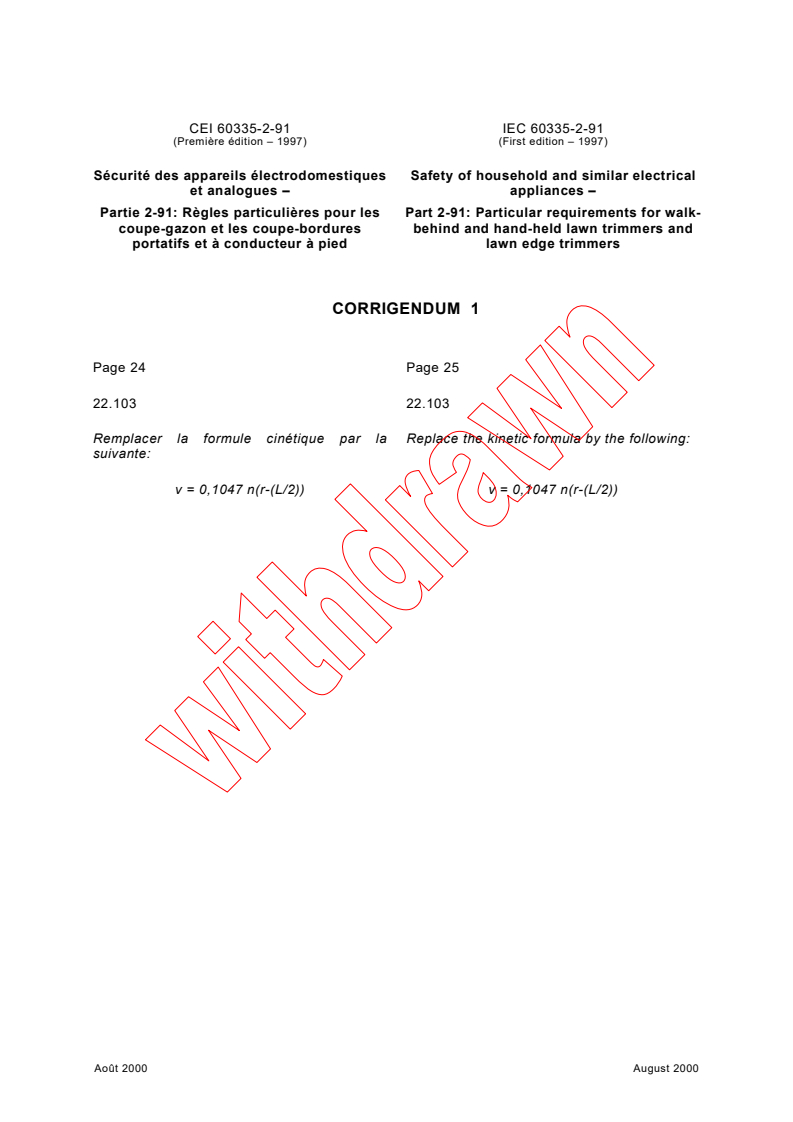
IEC 60335-2-91:1997/COR1:2000
(Corrigendum)Corrigendum No 1
Corrigendum No 1
General Information
- Status
- Published
- Publication Date
- 29-Aug-2000
- Technical Committee
- TC 116 - Safety of motor-operated electric tools
- Current Stage
- DELPUB - Deleted Publication
- Start Date
- 13-Aug-2002
- Completion Date
- 13-Feb-2026
Relations
- Effective Date
- 05-Sep-2023
- Effective Date
- 05-Sep-2023
Frequently Asked Questions
IEC 60335-2-91:1997/COR1:2000 is a standard published by the International Electrotechnical Commission (IEC). Its full title is "Corrigendum No 1". This standard covers: Corrigendum No 1
Corrigendum No 1
IEC 60335-2-91:1997/COR1:2000 has the following relationships with other standards: It is inter standard links to IEC 60335-2-91:1997, IEC 60335-2-91:2002. Understanding these relationships helps ensure you are using the most current and applicable version of the standard.
IEC 60335-2-91:1997/COR1:2000 is available in PDF format for immediate download after purchase. The document can be added to your cart and obtained through the secure checkout process. Digital delivery ensures instant access to the complete standard document.
Standards Content (Sample)
CEI 60335-2-91 IEC 60335-2-91
(Première édition – 1997) (First edition – 1997)
Sécurité des appareils électrodomestiques Safety of household and similar electrical
et analogues – appliances –
Partie 2-91: Règles particulières pour les Part 2-91: Particular requirements for walk-
coupe-gazon et les coupe-bordures behind and hand-held
...
This May Also Interest You
IEC 63378-6:2026 specifies a thermal resistance and capacitance model for semiconductor packages. This model is named the digital transformation using thermal resistance and capacitance (DXRC) model. It predicts transient temperature at junction and measurement points.
This document applies to semiconductor packages such as TO-252, TO-263, and HSOP. It supports single chip packages dissipated heat from single package surface.
- Standard28 pagesEnglish languagesale 15% off
- Standard29 pagesFrench languagesale 15% off
- Standard57 pagesEnglish and French languagesale 15% off
IEC 61290-1-2:2026 applies to all commercially available optical amplifiers (OAs) and optically amplified sub-systems. It applies to OAs using optically pumped fibres (OFAs based on either rare-earth doped fibres or on the Raman effect), semiconductors (SOAs), and planar optical waveguides (POWAs). This document does not apply to polarization-maintaining optical amplifiers. This document defines uniform requirements for accurate and reliable measurements, by means of the electrical spectrum analyzer test method, of the following OA parameters, as defined in IEC 61291-1, Clause 3:
a) nominal output signal power;
b) gain;
c) reverse gain;
d) maximum gain;
e) polarization-dependent gain.
In addition, this test method provides a means for measuring the following parameters:
- maximum gain wavelength;
- gain wavelength band.
This document specifically covers single-channel amplifiers. For multichannel amplifiers, the IEC 61290-10 series applies.
NOTE 1 The applicability of the test methods described in this document to distributed Raman amplifiers is for further study.
NOTE 2 A test method for polarization-maintaining optical amplifiers is for further study.
This third edition cancels and replaces the second edition published in 2005. This edition constitutes a technical revision. This edition includes the following significant technical changes with respect to the previous edition:
a) addition of information on the applicability of this document to the scope;
b) harmonization of the scope with the IEC 61290-1 series;
c) addition of safety recommendations to Clause 4 and Clause 5;
d) correction of an error in Clause 7, item e);
e) replacement of the term "wavelength measurement accuracy" with "wavelength accuracy".
- Standard47 pagesEnglish languagesale 15% off
IEC TS 61851-27:2026, in combination with IEC 61851-1 or IEC 61851-23, gives the requirements for EV supply equipment with automatic docking and undocking functions (aEVSE) of a vehicle coupler according to IEC 62196-2, IEC 62196-3 or IEC TS 62196-3-1 for power transfer with electrically propelled road vehicles according to ISO TS 5474-5.
Use of aEVSE with the megawatt charging system is under consideration.
This document provides requirements for aEVSE with a single vehicle connector.
Requirements for aEVSE with more than one vehicle connector are under consideration.
This document only applies to aEVSE with automatic couplers of category 1: using vehicle couplers defined by IEC 62196-2, IEC 62196-3 or IEC TS 62196-3-1.
This document only specifies automatic conductive energy transfer using a vehicle connector and a vehicle inlet; it does not specify automatic conductive power transfer using a plug and a socket-outlet.
This document does not apply to aEVSE with automatic couplers of category 2: using an electro-mechanical interface defined by EN 50696.
This document does not apply to aEVSE with automatic coupler of category 3 (see IEC TS 61851-26).
EMC requirements for EV supply equipment are defined in IEC 61851-21-2.
Interoperable communication for docking and undocking between an aEVSE and an EV, extending the communication between an EV supply equipment and an EV as specified in IEC 61851-1, IEC 61851-23, IEC 61851-24 and the ISO 15118 series, is under consideration.
This document does not cover all safety aspects related to maintenance
- Technical specification47 pagesEnglish languagesale 15% off
- Standard3 pagesEnglish languagesale 15% off
- Standard3 pagesFrench languagesale 15% off
- Standard6 pagesEnglish and French languagesale 15% off
IEC 63494-1:2026 specifies the safety requirements for electro-mechanical interfaces connecting lighting system devices to luminaires. These interfaces are used to mechanically connect, electrically power, and enable communication of lighting system devices on luminaires. Electro-mechanical interfaces up to and including 1 000 V AC or 1 500 V DC are included. This document specifies safety related mechanical, electrical, ambient conditions, and construction requirements for the interface components including protective covers. Specific requirements for the devices that can utilize the interface such as sensors, communication modules, cameras, etc., are not within the scope of this document.
- Standard17 pagesEnglish languagesale 15% off
- Standard18 pagesFrench languagesale 15% off
- Standard35 pagesEnglish and French languagesale 15% off
IEC TS 61851-26:2026, in combination with IEC 61851-1 or IEC 61851-23, gives the requirements for EV supply equipment with automatic docking and undocking functions (aEVSE) at the underbody of electrically propelled road vehicles according to ISO TS 5474-5.
Use of aEVSE with the megawatt charging system is under consideration.
This document provides requirements for aEVSE with a single vehicle connector or a single socket-outlet.
Requirements for aEVSE with more than one vehicle connector or more than one socket-outlet are under consideration.
This document only applies to automatic couplers of category 3, located at the underbody of an electric vehicle.
This document does not apply to automatic coupler of category 1: using a vehicle coupler defined by IEC 62196-2, IEC 62196-3 or IEC TS 62196-3-1.
This document does not apply to automatic couplers of category 2: using an electro-mechanical interface defined by EN 50696. EN 50696 also specifies automatic couplers located at the underbody of an electric vehicle. However, these couplers only provide DC power transfer.
Interoperable communication for docking and undocking between an aEVSE and an EV, extending the communication between an EV supply equipment and an EV as specified in IEC 61851-1, IEC 61851-23, IEC 61851-24 and the ISO 15118 series, is under consideration.
This document does not cover all safety aspects related to maintenance.
- Technical specification42 pagesEnglish languagesale 15% off
IEC TS 62885-1:2026 specifies the physical characteristics of test equipment and material used in tests common to several products covered by IEC 62285 series for surface cleaning appliances. In addition, it provides guidance regarding the evaluation of Wilton and other types of carpets to determine their acceptability for testing and regarding the pre-treatment of test dust.
This fourth edition cancels and replaces the third edition published in 2020.
This edition constitutes a technical revision.
This edition includes the following significant technical changes with respect to the previous edition:
a) Almost all of the test equipment is adopted from IEC 62885-2:2021.
b) Test equipment and materials for wet cleaning is included.
c) A description of the verification of an in-house reference vacuum cleaner is added.
d) Information about the reference vacuum cleaner system RSB is added.
- Technical specification65 pagesEnglish languagesale 15% off
IEC TS 60825-13:2026 provides manufacturers, test houses, safety personnel, and others with practical guidance on methods to perform radiometric measurements or analyses to establish the emission level of laser energy or power in accordance with IEC 60825-1:2014. The measurement procedures described in this document are guidance for classification of laser products in accordance with IEC 60825‑1:2014. It is possible that other procedures are better or more appropriate.
Information is provided for calculating accessible emission limits (AELs) and maximum permissible exposures (MPEs), since some parameters used in calculating the limits are dependent upon other measured quantities.
This document applies to lasers, including extended sources and laser arrays. The procedures described in this document for extended source viewing conditions can yield more conservative results than when using more rigorous methods.
NOTE Work continues on more complex source evaluations and will be provided as international agreement on the methods is reached.
This first edition cancels and replaces the second edition of IEC TR 60825-13 published in 2011. This edition constitutes a technical revision.
This edition includes the following significant technical changes with respect to IEC TR 60825-13:2011:
a) minor changes and additions have been made in the definitions;
b) classification flow has been updated;
c) apparent source sections have been clarified;
d) scanning has been updated;
e) more examples and useful conversions have been added to the annexes.
- Technical specification86 pagesEnglish languagesale 15% off
IEC 63601:2026 covers SiC-based PECS devices having a gate dielectric region biased to turn devices on and off. This typically refers to MOS devices such as MOSFETs and IGBTs. In this document, only NMOS (N-type MOS) devices are discussed as these are dominant for power device applications; however, the procedures apply to PMOS (P-type MOS) devices as well.
This document does not define device failure criteria, acceptable use conditions or acceptable lifetime targets. That is up to the device manufacturers and users. However, it provides stress procedures such that the threshold voltage stability over time as affected by gate bias and temperature can be demonstrated and evaluated.
- Standard44 pagesEnglish languagesale 15% off
IEC 60704-2-19:2026 applies to stationary freestanding and wall-mounted air cleaners for domestic and similar use, supplied from mains, d.c. voltage not exceeding 48 V or batteries. This document includes combination products, where air cleaning is combined with for example humidification, but can be used only for the air cleaning function.
This Part 2-19 is intended to be used in conjunction with IEC 60704-1:2021, Household and similar electrical appliances - Test code for the determination of airborne acoustical noise - Part 1: General requirements.
- Standard12 pagesEnglish languagesale 15% off
- Standard12 pagesFrench languagesale 15% off
- Standard24 pagesEnglish and French languagesale 15% off


Questions, Comments and Discussion
Ask us and Technical Secretary will try to provide an answer. You can facilitate discussion about the standard in here.
Loading comments...