


IEC 60068-2-54:2006
(Main)Environmental testing - Part 2-54: Tests - Test Ta: Solderability testing of electronic components by the wetting balance method
General Information
- Abstract
IEC 60068-2-54:2006 outlines Test Ta, solder bath wetting balance method applicable for any shape of component terminations to determine the solderability. It is especially suitable for reference testing and for components that cannot be quantitatively tested by other methods. For surface mounting devices (SMD), IEC 60068-2-69 should be applied if it is suitable. This standard provides the standard procedures for solder alloys containing lead (Pb) and for lead-free solder alloys. This second edition cancels and replaces the first edition, published in 1985 and constitutes a technical revision. The major technical changes with regard to the previous edition concern: - the addition of lead free solder alloy (see Clause 7, Materials); - reversal of force-time curves to align with IEC 60068-2-69 (see Figure 2 and Figure B.1); - modification to the test requirement for progress of wetting (see Clause 9).
- Status
- Replaced
- Publication Date
- 26-Apr-2006
- Technical Committee
- TC 91 - Electronics assembly technology
- Drafting Committee
- WG 3 - TC 91/WG 3
- Current Stage
- DELPUB - Deleted Publication
- Start Date
- 07-Mar-2017
- Completion Date
- 28-Aug-2026
Buy Documents
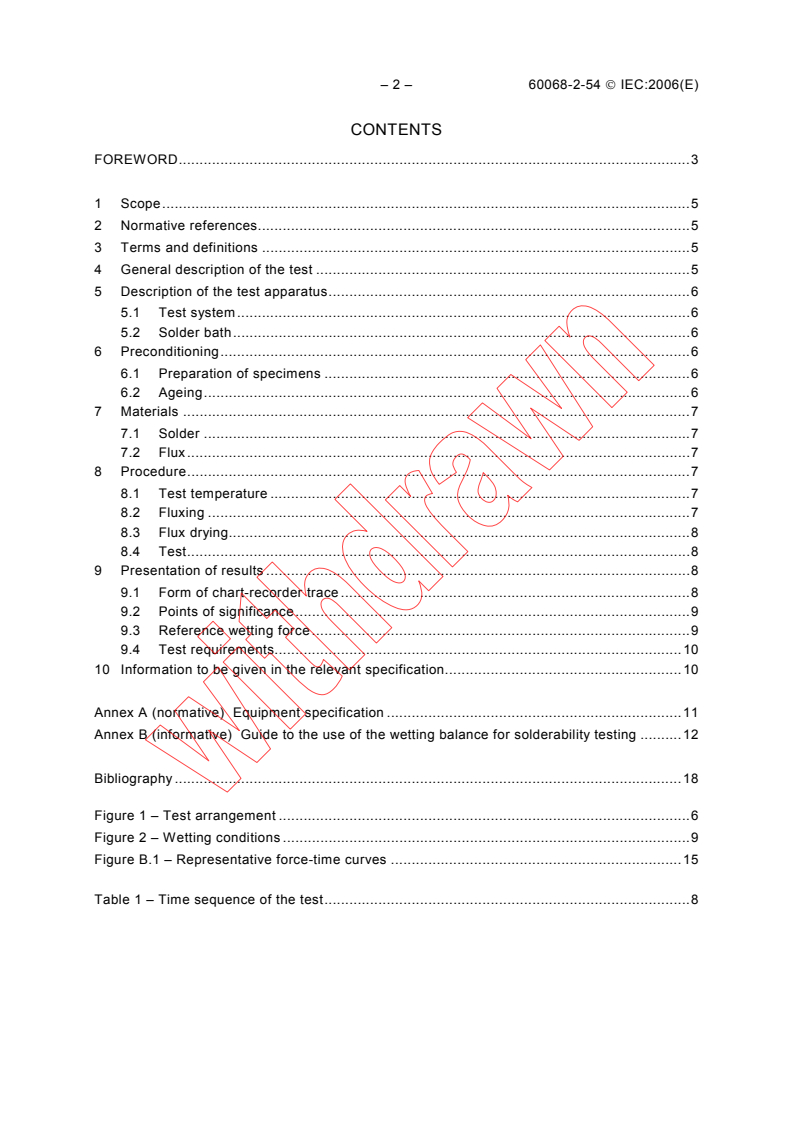
IEC 60068-2-54:2006 - Environmental testing - Part 2-54: Tests - Test Ta: Solderability testing of electronic components by the wetting balance method Released:4/27/2006
IEC 60068-2-54:2006 - Environmental testing - Part 2-54: Tests - Test Ta: Solderability testing of electronic components by the wetting balance method Released:4/27/2006
Relations
- Effective Date
- 05-Sep-2023
- Effective Date
- 25-Aug-2026
- Effective Date
- 25-Aug-2026
- Effective Date
- 25-Aug-2026
Buy Documents
IEC 60068-2-54:2006 - Environmental testing - Part 2-54: Tests - Test Ta: Solderability testing of electronic components by the wetting balance method Released:4/27/2006
IEC 60068-2-54:2006 - Environmental testing - Part 2-54: Tests - Test Ta: Solderability testing of electronic components by the wetting balance method Released:4/27/2006
Get Certified
Connect with accredited certification bodies for this standard

IMP NDT d.o.o.
Non-destructive testing services. Radiography, ultrasonic, magnetic particle, penetrant, visual inspection.
Inštitut za kovinske materiale in tehnologije
Institute of Metals and Technology. Materials testing, metallurgical analysis, NDT.
Q Techna d.o.o.
NDT and quality assurance specialist. 30+ years experience. NDT personnel certification per ISO 9712, nuclear and thermal power plant inspections, QA/
Sponsored listings
Frequently Asked Questions
IEC 60068-2-54:2006 is a standard published by the International Electrotechnical Commission (IEC). Its full title is "Environmental testing - Part 2-54: Tests - Test Ta: Solderability testing of electronic components by the wetting balance method". This standard covers: IEC 60068-2-54:2006 outlines Test Ta, solder bath wetting balance method applicable for any shape of component terminations to determine the solderability. It is especially suitable for reference testing and for components that cannot be quantitatively tested by other methods. For surface mounting devices (SMD), IEC 60068-2-69 should be applied if it is suitable. This standard provides the standard procedures for solder alloys containing lead (Pb) and for lead-free solder alloys. This second edition cancels and replaces the first edition, published in 1985 and constitutes a technical revision. The major technical changes with regard to the previous edition concern: - the addition of lead free solder alloy (see Clause 7, Materials); - reversal of force-time curves to align with IEC 60068-2-69 (see Figure 2 and Figure B.1); - modification to the test requirement for progress of wetting (see Clause 9).
IEC 60068-2-54:2006 outlines Test Ta, solder bath wetting balance method applicable for any shape of component terminations to determine the solderability. It is especially suitable for reference testing and for components that cannot be quantitatively tested by other methods. For surface mounting devices (SMD), IEC 60068-2-69 should be applied if it is suitable. This standard provides the standard procedures for solder alloys containing lead (Pb) and for lead-free solder alloys. This second edition cancels and replaces the first edition, published in 1985 and constitutes a technical revision. The major technical changes with regard to the previous edition concern: - the addition of lead free solder alloy (see Clause 7, Materials); - reversal of force-time curves to align with IEC 60068-2-69 (see Figure 2 and Figure B.1); - modification to the test requirement for progress of wetting (see Clause 9).
IEC 60068-2-54:2006 is classified under the following ICS (International Classification for Standards) categories: 19.040 - Environmental testing; 31.020 - Electronic components in general. The ICS classification helps identify the subject area and facilitates finding related standards.
IEC 60068-2-54:2006 has the following relationships with other standards: It is inter standard links to IEC 60068-2-69:2017, EN ISO 9455-16:2013, EN ISO 10374:1997, EN 15859:2010. Understanding these relationships helps ensure you are using the most current and applicable version of the standard.
IEC 60068-2-54:2006 is available in PDF format for immediate download after purchase. The document can be added to your cart and obtained through the secure checkout process. Digital delivery ensures instant access to the complete standard document.
Standards Content (Sample)
INTERNATIONAL IEC
STANDARD 60068-2-54
Second edition
2006-04
Environmental testing –
Part 2-54:
Tests – Test Ta: Solderability testing of
electronic components by the wetting
balance method
Reference number
Publication numbering
As from 1 January 1997 all IEC publications are issued with a designation in the
60000 series. For example, IEC 34-1 is now referred to as IEC 60034-1.
Consolidated editions
The IEC is now publishing consolidated versions of its publications. For example,
edition numbers 1.0, 1.1 and 1.2 refer, respectively, to the base publication, the
base publication incorporating amendment 1 and the base publication incorporating
amendments 1 and 2.
Further information on IEC publications
The technical content of IEC publications is kept under constant review by the IEC,
thus ensuring that the content reflects current technology. Information relating to
this publication, including its validity, is available in the IEC Catalogue of
publications (see below) in addition to new editions, amendments and corrigenda.
Information on the subjects under consideration and work in progress undertaken
by the technical committee which has prepared this publication, as well as the list
of publications issued, is also available from the following:
• IEC Web Site (www.iec.ch)
• Catalogue of IEC publications
The on-line catalogue on the IEC web site (www.iec.ch/searchpub) enables you to
search by a variety of criteria including text searches, technical committees
and date of publication. On-line information is also available on recently issued
publications, withdrawn and replaced publications, as well as corrigenda.
• IEC Just Published
This summary of recently issued publications (www.iec.ch/online_news/ justpub)
is also available by email. Please contact the Customer Service Centre (see
below) for further information.
• Customer Service Centre
If you have any questions regarding this publication or need further assistance,
please contact the Customer Service Centre:
Email: custserv@iec.ch
Tel: +41 22 919 02 11
Fax: +41 22 919 03 00
INTERNATIONAL IEC
STANDARD 60068-2-54
Second edition
2006-04
Environmental testing –
Part 2-54:
Tests – Test Ta: Solderability testing of
electronic components by the wetting
balance method
IEC 2006 Copyright - all rights reserved
No part of this publication may be reproduced or utilized in any form or by any means, electronic or
mechanical, including photocopying and microfilm, without permission in writing from the publisher.
International Electrotechnical Commission, 3, rue de Varembé, PO Box 131, CH-1211 Geneva 20, Switzerland
Telephone: +41 22 919 02 11 Telefax: +41 22 919 03 00 E-mail: inmail@iec.ch Web: www.iec.ch
PRICE CODE
Commission Electrotechnique Internationale R
International Electrotechnical Commission
МеждународнаяЭлектротехническаяКомиссия
For price, see current catalogue
– 2 – 60068-2-54 IEC:2006(E)
CONTENTS
FOREWORD.3
Scope.5
2 Normative references.5
3 Terms and definitions .5
4 General description of the test .5
5 Description of the test apparatus.6
5.1 Test system.6
5.2 Solder bath.6
6 Preconditioning.6
6.1 Preparation of specimens .6
6.2 Ageing.6
7 Materials .7
7.1 Solder .7
7.2 Flux.7
8 Procedure.7
8.1 Test temperature .7
8.2 Fluxing .7
8.3 Flux drying.8
8.4 Test.8
9 Presentation of results .8
9.1 Form of chart-recorder trace .8
9.2 Points of significance.9
9.3 Reference wetting force .9
9.4 Test requirements.10
10 Information to be given in the relevant specification.10
Annex A (normative) Equipment specification .11
Annex B (informative) Guide to the use of the wetting balance for solderability testing .12
Bibliography .18
Figure 1 – Test arrangement .6
Figure 2 – Wetting conditions .9
Figure B.1 – Representative force-time curves .15
Table 1 – Time sequence of the test.8
60068-2-54 IEC:2006(E) – 3 –
INTERNATIONAL ELECTROTECHNICAL COMMISSION
___________
ENVIRONMENTAL TESTING –
Part 2-54: Tests – Test Ta: Solderability testing
of electronic components by the wetting balance method
FOREWORD
1) The International Electrotechnical Commission (IEC) is a worldwide organization for standardization comprising
all national electrotechnical committees (IEC National Committees). The object of IEC is to promote
international co-operation on all questions concerning standardization in the electrical and electronic fields. To
this end and in addition to other activities, IEC publishes International Standards, Technical Specifications,
Technical Reports, Publicly Available Specifications (PAS) and Guides (hereafter referred to as “IEC
Publication(s)”). Their preparation is entrusted to technical committees; any IEC National Committee interested
in the subject dealt with may participate in this preparatory work. International, governmental and non-
governmental organizations liaising with the IEC also participate in this preparation. IEC collaborates closely
with the International Organization for Standardization (ISO) in accordance with conditions determined by
agreement between the two organizations.
2) The formal decisions or agreements of IEC on technical matters express, as nearly as possible, an international
consensus of opinion on the relevant subjects since each technical committee has representation from all
interested IEC National Committees.
3) IEC Publications have the form of recommendations for international use and are accepted by IEC National
Committees in that sense. While all reasonable efforts are made to ensure that the technical content of IEC
Publications is accurate, IEC cannot be held responsible for the way in which they are used or for any
misinterpretation by any end user.
4) In order to promote international uniformity, IEC National Committees undertake to apply IEC Publications
transparently to the maximum extent possible in their national and regional publications. Any divergence
between any IEC Publication and the corresponding national or regional publication shall be clearly indicated in
the latter.
5) IEC provides no marking procedure to indicate its approval and cannot be rendered responsible for any
equipment declared to be in conformity with an IEC Publication.
6) All users should ensure that they have the latest edition of this publication.
7) No liability shall attach to IEC or its directors, employees, servants or agents including individual experts and
members of its technical committees and IEC National Committees for any personal injury, property damage or
other damage of any nature whatsoever, whether direct or indirect, or for costs (including legal fees) and
expenses arising out of the publication, use of, or reliance upon, this IEC Publication or any other IEC
Publications.
8) Attention is drawn to the Normative references cited in this publication. Use of the referenced publications is
indispensable for the correct application of this publication.
9) Attention is drawn to the possibility that some of the elements of this IEC Publication may be the subject of
patent rights. IEC shall not be held responsible for identifying any or all such patent rights.
International Standard IEC 60068-2-54 has been prepared by IEC technical committee 91:
Electronics assembly technology.
This second edition cancels and replaces the first edition, published in 1985 and constitutes a
technical revision.
The major technical changes with regard to the previous edition concern:
– the addition of lead free solder alloy (see Clause 7, Materials);
– reversal of force-time curves to align with IEC 60068-2-69 (see Figure 2 and Figure B.1);
– modification to the test requirement for progress of wetting (see Clause 9).
– 4 – 60068-2-54 IEC:2006(E)
The text of this standard is based on the following documents:
FDIS Report on voting
91/576/FDIS 91/587/RVD
Full information on the voting for the approval of this standard can be found in the report on
voting indicated in the above table.
This publication has been drafted in accordance with the ISO/IEC Directives, Part 2.
IEC 60068 consists of the following parts, under the general title Environmental testing:
Part 1: General and guidance
Part 2: Tests
Part 3: Supporting documentation and guidance
Part 4: Information for specification writers - Test summaries
Part 5: Guide to drafting of test methods
The committee has decided that the contents of this publication will remain unchanged until the
maintenance result date indicated on the IEC web site under "http://webstore.iec.ch" in the data
related to the specific publication. At this date, the publication will be
• reconfirmed,
• withdrawn,
• replaced by a revised edition, or
• amended.
A bilingual version of this publication may be issued at a later date.
60068-2-54 IEC:2006(E) – 5 –
ENVIRONMENTAL TESTING –
Part 2-54: Tests – Test Ta: Solderability testing
of electronic components by the wetting balance method
1 Scope
This part of IEC 60068 outlines Test Ta, solder bath wetting balance method applicable for any
shape of component terminations to determine the solderability. It is especially suitable for
reference testing and for components that cannot be quantitatively tested by other methods.
For surface mounting devices (SMD), IEC 60068-2-69 should be applied if it is suitable.
This standard provides the standard procedures for solder alloys containing lead (Pb) and for
lead-free solder alloys.
2 Normative references
The following referenced documents are indispensable for the application of this document. For
dated references, only the edition cited applies. For undated references, the latest edition of
the referenced document (including any amendments) applies.
IEC 60068-1:1988, Environmental testing – Part 1: General and guidance
IEC 60068-2-20:1979, Environmental testing – Part 2: Tests – Test T: Soldering
IEC 61190-1-3, Attachment materials for electronic assembly – Part 1-3: Requirements for
electronic grade solder alloys and fluxed and non-fluxed solid solders for electronic soldering
applications
3 Terms and definitions
For the purposes of this document, the terms and definitions, as defined in IEC 60068-1 and
IEC 60068-2-20, apply.
4 General description of the test
The specimen is suspended from a sensitive balance (typically a spring system) and immersed
edgewise to a set depth in a bath of molten solder at a controlled temperature. The resultant of
the vertical forces of buoyancy and surface tension acting upon the immersed specimen is
detected by a transducer and converted into a signal which is continuously recorded as a
function of time on a high-speed chart recorder. The trace may be compared with that derived
from a perfectly wetted specimen of the same nature and dimensions.
Two modes of testing exist:
– The stationary mode, intended to study the solderability of a particular place on the
specimen. It is this mode which is standardized in this standard.
– The scanning mode, intended to study the homogeneity of the solderability of an extended
region of the surface of the specimen. The standardization of this mode is still under
consideration.
– 6 – 60068-2-54 IEC:2006(E)
5 Description of the test apparatus
5.1 Test system
A diagram of an arrangement suitable for the test is shown in Figure 1.
Balance and Signal Computer or
transducer conditioner chart recorder
Specimen
Solder bath
Bath lifting Control
mechanism box
IEC 477/06
Figure 1 – Test arrangement
Any other system capable of measuring the vertical forces acting on the specimen is
admissible, provided that the system has the characteristics given in Annex A.
5.2 Solder bath
The solder bath dimensions shall comply with the requirements of Clause A.7. The material of
the solder bath container shall be resistant to the relevant liquid solder alloy.
6 Preconditioning
6.1 Preparation of specimens
The specimen shall be tested in the “as-received“ condition unless otherwise specified by the
relevant specification. Care should be taken that no contamination, by contact with the fingers
or by other means, occurs.
The specimen may be cleaned by immersion in a neutral organic solvent at room temperature,
but only if required by the relevant specification; no other cleaning is permitted.
6.2 Ageing
When accelerated ageing is prescribed by the relevant specification, one of the methods of 4.5
of IEC 60068-2-20 shall be used.
60068-2-54 IEC:2006(E) – 7 –
7 Materials
7.1 Solder
7.1.1 General
Solder composition shall be specified in the relevant specification.
7.1.2 Solder alloy containing lead
The solder composition shall be either 60 % by mass (wt %) Sn(tin) and 40 wt % Pb(lead)
according to Appendix B of IEC 60068-2-20 (Sn60Pb40A, according to IEC 61190-1-3) or
63 wt % Sn (tin) and 37 wt % Pb(lead) (Sn63Pb37A, according to IEC 61190-1-3).
7.1.3 Lead-free solder alloy
Unless otherwise specified in the relevant specification, the solder composition shall be either
3,0 wt % Ag(silver), 0,5 wt % Cu(copper) and the remainder of Sn(tin), Sn96,5Ag3,0Cu0,5, or
0,7 wt % Cu(copper) and the remainder of Sn(tin), Sn99,3Cu0,7, is preferred.
NOTE The solder alloys consist of 3,0 wt % to 4,0 wt % Ag, 0,5 wt % to 1,0 wt %Cu, and the remainder of Sn may
be used instead of Sn96,5Ag3,0Cu0,5. The solder alloys consist of 0,45 wt % to 0,9 wt % Cu and the remainder of
Sn may be used instead of Sn99,3Cu0,7.
7.2 Flux
The flux to be used shall be either rosin based non-activated or rosin based activated as
follows:
a) rosin based non-activated: consist of 25 wt % of colophony in 75 wt % of 2-propanol
(isopropanol) or of ethyl alcohol (as specified in Appendix C of IEC 60068-2-20).
b) rosin based activated flux: the activated flux which is above flux with the addition of
diethylammonium chloride (analytical reagent grade), up to an amount of 0,2 % or 0,5 %
chloride (expressed as free chlorine based on the colophony content).
Information about the used flux type shall be given in the relevant specification.
8 Procedure
8.1 Test temperature
8.1.1 Solder alloy containing lead
Solder temperature prior to test and during test shall be 235 °C ± 3 °C.
8.1.2 Lead-free solder alloy
Unless otherwise specified in the relevant specification, solder temperature prior to test and
during test shall be 245 °C ± 3 °C for Sn96,5Ag3,0Cu0,5 alloy and 250 °C ± 3 °C for
Sn99,3Cu0,7 alloy respectively.
8.2 Fluxing
After mounting the specimen in a suitable holder, the portion of the surface specified shall be
immersed in flux at room temperature. Excess flux is immediately drained off by standing the
specimen vertically on clean filter paper for 1 s to 5 s.
– 8 – 60068-2-54 IEC:2006(E)
8.3 Flux drying
The temperature of the solder prior to test shall be as specified in 8.1. The specimen is then
suspended vertically with lower edge 20 mm ± 5 mm above the bath for 30 s ± 15 s to allow
most of the flux solvent to evaporate, before initiating the test. During this drying period the
suspension and the chart recorder trace shall be adjusted to the desired zero position, and
immediately before starting the test, the surface of the solder bath is scraped with a blade of
suitable material to remove oxides.
8.4 Test
The specimen is then immersed at a speed of 5 mm/s ± 1 mm/s to 20 mm/s ± 1 mm/s to the
specified depth in the molten solder and held in this position for a specified time and then
withdrawn. The relevant part of the recorder trace of force versus time is obtained when the
specimen is held stationary in the immersed position.
NOTE The specimen should be immersed to the required depth within 0,2 s.
The trace shall be recorded starting immediately before immersion into molten solder and
throughout test period.
Table 1 – Time sequence of the test
Procedure Time Duration
s s
1) Immersion in flux 0 ≈5
2) Flux drain 1 to 5
≈10
3) Hang the specimen on the apparatus --
≈15
4) Preheat ≈20 30 ± 15
5) Wipe the oxide from the solder surface
≈60
6) Start test 1 to 5
≈65
7) Solder immersion 70 max. 5
NOTE Time is elapsed time from immersion in flux. Duration is time for relevant procedure.
9 Presentation of results
9.1 Form of chart-recorder trace
The trace may be recorded in two forms, the only difference being the polarity of the force
readings.
In Figure 2, upward forces (non-wetting) are shown as negative and downward forces (wetting)
are positive. Usually, force at E is equal to force at D indicating stable wetting conditions. If
force at E is less than at D, some instability in wetting is present (see B.6.1.3).
60068-2-54 IEC:2006(E) – 9 –
+Ve
D
E
Force
C
F : Maximum wetting force
max
2/3 of F
max
t
Time
B
Buoyancy line
–Ve
A
IEC 478/06
Figure 2 – Wetting conditions
9.2 Points of significance
9.2.1 Time t is, the time at which the solder surface and the specimen first make contact, as
indicated by movement of the trace from the zero force line.
9.2.2 At point A the solder meniscus starts to rise up the specimen termination. Thi
...
IEC 60068-2-54 ®
Edition 2.0 2006-04
INTERNATIONAL
STANDARD
NORME
INTERNATIONALE
Environmental testing –
Part 2-54: Tests – Test Ta: Solderability testing of electronic components by
the wetting balance method
Essais d’environnement –
Partie 2-54: Essais – Essai Ta: Essais de la soudabilité des composants
électroniques à l'aide de la méthode de la balance de mouillage
All rights reserved. Unless otherwise specified, no part of this publication may be reproduced or utilized in any form
or by any means, electronic or mechanical, including photocopying and microfilm, without permission in writing from
either IEC or IEC's member National Committee in the country of the requester.
If you have any questions about IEC copyright or have an enquiry about obtaining additional rights to this publication,
please contact the address below or your local IEC member National Committee for further information.
Droits de reproduction réservés. Sauf indication contraire, aucune partie de cette publication ne peut être reproduite ni
utilisée sous quelque forme que ce soit et par aucun procédé, électronique ou mécanique, y compris la photocopie et les
microfilms, sans l'accord écrit de la CEI ou du Comité national de la CEI du pays du demandeur.
Si vous avez des questions sur le copyright de la CEI ou si vous désirez obtenir des droits supplémentaires sur cette
publication, utilisez les coordonnées ci-après ou contactez le Comité national de la CEI de votre pays de résidence.
IEC Central Office Tel.: +41 22 919 02 11
3, rue de Varembé Fax: +41 22 919 03 00
CH-1211 Geneva 20 info@iec.ch
Switzerland www.iec.ch
About the IEC
The International Electrotechnical Commission (IEC) is the leading global organization that prepares and publishes
International Standards for all electrical, electronic and related technologies.
About IEC publications
The technical content of IEC publications is kept under constant review by the IEC. Please make sure that you have the
latest edition, a corrigenda or an amendment might have been published.
Useful links:
IEC publications search - www.iec.ch/searchpub Electropedia - www.electropedia.org
The advanced search enables you to find IEC publications The world's leading online dictionary of electronic and
by a variety of criteria (reference number, text, technical electrical terms containing more than 30 000 terms and
committee,…). definitions in English and French, with equivalent terms in
It also gives information on projects, replaced and additional languages. Also known as the International
withdrawn publications. Electrotechnical Vocabulary (IEV) on-line.
IEC Just Published - webstore.iec.ch/justpublished Customer Service Centre - webstore.iec.ch/csc
Stay up to date on all new IEC publications. Just Published If you wish to give us your feedback on this publication
details all new publications released. Available on-line and or need further assistance, please contact the
also once a month by email. Customer Service Centre: csc@iec.ch.
A propos de la CEI
La Commission Electrotechnique Internationale (CEI) est la première organisation mondiale qui élabore et publie des
Normes internationales pour tout ce qui a trait à l'électricité, à l'électronique et aux technologies apparentées.
A propos des publications CEI
Le contenu technique des publications de la CEI est constamment revu. Veuillez vous assurer que vous possédez
l’édition la plus récente, un corrigendum ou amendement peut avoir été publié.
Liens utiles:
Recherche de publications CEI - www.iec.ch/searchpub Electropedia - www.electropedia.org
La recherche avancée vous permet de trouver des Le premier dictionnaire en ligne au monde de termes
publications CEI en utilisant différents critères (numéro de électroniques et électriques. Il contient plus de 30 000
référence, texte, comité d’études,…). termes et définitions en anglais et en français, ainsi que
Elle donne aussi des informations sur les projets et les les termes équivalents dans les langues additionnelles.
publications remplacées ou retirées. Egalement appelé Vocabulaire Electrotechnique
International (VEI) en ligne.
Just Published CEI - webstore.iec.ch/justpublished
Service Clients - webstore.iec.ch/csc
Restez informé sur les nouvelles publications de la CEI.
Just Published détaille les nouvelles publications parues. Si vous désirez nous donner des commentaires sur
Disponible en ligne et aussi une fois par mois par email. cette publication ou si vous avez des questions
contactez-nous: csc@iec.ch.
IEC 60068-2-54 ®
Edition 2.0 2006-04
INTERNATIONAL
STANDARD
NORME
INTERNATIONALE
Environmental testing –
Part 2-54: Tests – Test Ta: Solderability testing of electronic components by
the wetting balance method
Essais d’environnement –
Partie 2-54: Essais – Essai Ta: Essais de la soudabilité des composants
électroniques à l'aide de la méthode de la balance de mouillage
INTERNATIONAL
ELECTROTECHNICAL
COMMISSION
COMMISSION
ELECTROTECHNIQUE
PRICE CODE
INTERNATIONALE
CODE PRIX R
ICS 19.040; 31.020 ISBN 978-2-8322-0879-3
– 2 – 60068-2-54 IEC:2006
CONTENTS
FOREWORD . 3
1 Scope . 5
2 Normative references. 5
3 Terms and definitions . 5
4 General description of the test . 5
5 Description of the test apparatus . 6
5.1 Test system . 6
5.2 Solder bath . 6
6 Preconditioning . 6
6.1 Preparation of specimens . 6
6.2 Ageing . 6
7 Materials . 7
7.1 Solder . 7
7.2 Flux . 7
8 Procedure . 7
8.1 Test temperature . 7
8.2 Fluxing . 7
8.3 Flux drying . 8
8.4 Test . 8
9 Presentation of results . 8
9.1 Form of chart-recorder trace . 8
9.2 Points of significance . 9
9.3 Reference wetting force . 9
9.4 Test requirements. 10
10 Information to be given in the relevant specification . 10
Annex A (normative) Equipment specification . 11
Annex B (informative) Guide to the use of the wetting balance for solderability testing . 12
Bibliography . 18
Figure 1 – Test arrangement . 6
Figure 2 – Wetting conditions . 9
Figure B.1 – Representative force-time curves . 15
Table 1 – Time sequence of the test . 8
60068-2-54 IEC:2006 – 3 –
INTERNATIONAL ELECTROTECHNICAL COMMISSION
___________
ENVIRONMENTAL TESTING –
Part 2-54: Tests – Test Ta: Solderability testing
of electronic components by the wetting balance method
FOREWORD
1) The International Electrotechnical Commission (IEC) is a worldwide organization for standardization comprising
all national electrotechnical committees (IEC National Committees). The object of IEC is to promote
international co-operation on all questions concerning standardization in the electrical and electronic fields. To
this end and in addition to other activities, IEC publishes International Standards, Technical Specifications,
Technical Reports, Publicly Available Specifications (PAS) and Guides (hereafter referred to as “IEC
Publication(s)”). Their preparation is entrusted to technical committees; any IEC National Committee interested
in the subject dealt with may participate in this preparatory work. International, governmental and non-
governmental organizations liaising with the IEC also participate in this preparation. IEC collaborates closely
with the International Organization for Standardization (ISO) in accordance with conditions determined by
agreement between the two organizations.
2) The formal decisions or agreements of IEC on technical matters express, as nearly as possible, an international
consensus of opinion on the relevant subjects since each technical committee has representation from all
interested IEC National Committees.
3) IEC Publications have the form of recommendations for international use and are accepted by IEC National
Committees in that sense. While all reasonable efforts are made to ensure that the technical content of IEC
Publications is accurate, IEC cannot be held responsible for the way in which they are used or for any
misinterpretation by any end user.
4) In order to promote international uniformity, IEC National Committees undertake to apply IEC Publications
transparently to the maximum extent possible in their national and regional publications. Any divergence
between any IEC Publication and the corresponding national or regional publication shall be clearly indicated in
the latter.
5) IEC provides no marking procedure to indicate its approval and cannot be rendered responsible for any
equipment declared to be in conformity with an IEC Publication.
6) All users should ensure that they have the latest edition of this publication.
7) No liability shall attach to IEC or its directors, employees, servants or agents including individual experts and
members of its technical committees and IEC National Committees for any personal injury, property damage or
other damage of any nature whatsoever, whether direct or indirect, or for costs (including legal fees) and
expenses arising out of the publication, use of, or reliance upon, this IEC Publication or any other IEC
Publications.
8) Attention is drawn to the Normative references cited in this publication. Use of the referenced publications is
indispensable for the correct application of this publication.
9) Attention is drawn to the possibility that some of the elements of this IEC Publication may be the subject of
patent rights. IEC shall not be held responsible for identifying any or all such patent rights.
International Standard IEC 60068-2-54 has been prepared by IEC technical committee 91:
Electronics assembly technology.
This second edition cancels and replaces the first edition, published in 1985 and constitutes a
technical revision.
The major technical changes with regard to the previous edition concern:
– the addition of lead free solder alloy (see Clause 7, Materials);
– reversal of force-time curves to align with IEC 60068-2-69 (see Figure 2 and Figure B.1);
– modification to the test requirement for progress of wetting (see Clause 9).
– 4 – 60068-2-54 IEC:2006
This bilingual version (2013-07) corresponds to the monolingual English version, published in
2006-04.
The text of this standard is based on the following documents:
FDIS Report on voting
91/576/FDIS 91/587/RVD
Full information on the voting for the approval of this standard can be found in the report on
voting indicated in the above table.
The French version of this standard has not been voted upon.
This publication has been drafted in accordance with the ISO/IEC Directives, Part 2.
IEC 60068 consists of the following parts, under the general title Environmental testing:
Part 1: General and guidance
Part 2: Tests
Part 3: Supporting documentation and guidance
Part 4: Information for specification writers - Test summaries
Part 5: Guide to drafting of test methods
The committee has decided that the contents of this publication will remain unchanged until the
maintenance result date indicated on the IEC web site under "http://webstore.iec.ch" in the data
related to the specific publication. At this date, the publication will be
• reconfirmed,
• withdrawn,
• replaced by a revised edition, or
• amended.
60068-2-54 IEC:2006 – 5 –
ENVIRONMENTAL TESTING –
Part 2-54: Tests – Test Ta: Solderability testing
of electronic components by the wetting balance method
1 Scope
This part of IEC 60068 outlines Test Ta, solder bath wetting balance method applicable for any
shape of component terminations to determine the solderability. It is especially suitable for
reference testing and for components that cannot be quantitatively tested by other methods.
For surface mounting devices (SMD), IEC 60068-2-69 should be applied if it is suitable.
This standard provides the standard procedures for solder alloys containing lead (Pb) and for
lead-free solder alloys.
2 Normative references
The following referenced documents are indispensable for the application of this document. For
dated references, only the edition cited applies. For undated references, the latest edition of
the referenced document (including any amendments) applies.
IEC 60068-1:1988, Environmental testing – Part 1: General and guidance
IEC 60068-2-20:1979, Environmental testing – Part 2: Tests – Test T: Soldering
IEC 61190-1-3, Attachment materials for electronic assembly – Part 1-3: Requirements for
electronic grade solder alloys and fluxed and non-fluxed solid solders for electronic soldering
applications
3 Terms and definitions
For the purposes of this document, the terms and definitions, as defined in IEC 60068-1 and
IEC 60068-2-20, apply.
4 General description of the test
The specimen is suspended from a sensitive balance (typically a spring system) and immersed
edgewise to a set depth in a bath of molten solder at a controlled temperature. The resultant of
the vertical forces of buoyancy and surface tension acting upon the immersed specimen is
detected by a transducer and converted into a signal which is continuously recorded as a
function of time on a high-speed chart recorder. The trace may be compared with that derived
from a perfectly wetted specimen of the same nature and dimensions.
Two modes of testing exist:
– The stationary mode, intended to study the solderability of a particular place on the
specimen. It is this mode which is standardized in this standard.
– The scanning mode, intended to study the homogeneity of the solderability of an extended
region of the surface of the specimen. The standardization of this mode is still under
consideration.
– 6 – 60068-2-54 IEC:2006
5 Description of the test apparatus
5.1 Test system
A diagram of an arrangement suitable for the test is shown in Figure 1.
Balance and Signal Computer or
transducer conditioner
chart recorder
Specimen
Solder bath
Bath lifting Control
mechanism box
IEC 477/06
Figure 1 – Test arrangement
Any other system capable of measuring the vertical forces acting on the specimen is
admissible, provided that the system has the characteristics given in Annex A.
5.2 Solder bath
The solder bath dimensions shall comply with the requirements of Clause A.7. The material of
the solder bath container shall be resistant to the relevant liquid solder alloy.
6 Preconditioning
6.1 Preparation of specimens
The specimen shall be tested in the “as-received“ condition unless otherwise specified by the
relevant specification. Care should be taken that no contamination, by contact with the fingers
or by other means, occurs.
The specimen may be cleaned by immersion in a neutral organic solvent at room temperature,
but only if required by the relevant specification; no other cleaning is permitted.
6.2 Ageing
When accelerated ageing is prescribed by the relevant specification, one of the methods of 4.5
of IEC 60068-2-20 shall be used.
60068-2-54 IEC:2006 – 7 –
7 Materials
7.1 Solder
7.1.1 General
Solder composition shall be specified in the relevant specification.
7.1.2 Solder alloy containing lead
The solder composition shall be either 60 % by mass (wt %) Sn(tin) and 40 wt % Pb(lead)
according to Appendix B of IEC 60068-2-20 (Sn60Pb40A, according to IEC 61190-1-3) or
63 wt % Sn (tin) and 37 wt % Pb(lead) (Sn63Pb37A, according to IEC 61190-1-3).
7.1.3 Lead-free solder alloy
Unless otherwise specified in the relevant specification, the solder composition shall be either
3,0 wt % Ag(silver), 0,5 wt % Cu(copper) and the remainder of Sn(tin), Sn96,5Ag3,0Cu0,5, or
0,7 wt % Cu(copper) and the remainder of Sn(tin), Sn99,3Cu0,7, is preferred.
NOTE The solder alloys consist of 3,0 wt % to 4,0 wt % Ag, 0,5 wt % to 1,0 wt %Cu, and the remainder of Sn may
be used instead of Sn96,5Ag3,0Cu0,5. The solder alloys consist of 0,45 wt % to 0,9 wt % Cu and the remainder of
Sn may be used instead of Sn99,3Cu0,7.
7.2 Flux
The flux to be used shall be either rosin based non-activated or rosin based activated as
follows:
a) rosin based non-activated: consist of 25 wt % of colophony in 75 wt % of 2-propanol
(isopropanol) or of ethyl alcohol (as specified in Appendix C of IEC 60068-2-20).
b) rosin based activated flux: the activated flux which is above flux with the addition of
diethylammonium chloride (analytical reagent grade), up to an amount of 0,2 % or 0,5 %
chloride (expressed as free chlorine based on the colophony content).
Information about the used flux type shall be given in the relevant specification.
8 Procedure
8.1 Test temperature
8.1.1 Solder alloy containing lead
Solder temperature prior to test and during test shall be 235 °C ± 3 °C.
8.1.2 Lead-free solder alloy
Unless otherwise specified in the relevant specification, solder temperature prior to test and
during test shall be 245 °C ± 3 °C for Sn96,5Ag3,0Cu0,5 alloy and 250 °C ± 3 °C for
Sn99,3Cu0,7 alloy respectively.
8.2 Fluxing
After mounting the specimen in a suitable holder, the portion of the surface specified shall be
immersed in flux at room temperature. Excess flux is immediately drained off by standing the
specimen vertically on clean filter paper for 1 s to 5 s.
– 8 – 60068-2-54 IEC:2006
8.3 Flux drying
The temperature of the solder prior to test shall be as specified in 8.1. The specimen is then
suspended vertically with lower edge 20 mm ± 5 mm above the bath for 30 s ± 15 s to allow
most of the flux solvent to evaporate, before initiating the test. During this drying period the
suspension and the chart recorder trace shall be adjusted to the desired zero position, and
immediately before starting the test, the surface of the solder bath is scraped with a blade of
suitable material to remove oxides.
8.4 Test
The specimen is then immersed at a speed of 5 mm/s ± 1 mm/s to 20 mm/s ± 1 mm/s to the
specified depth in the molten solder and held in this position for a specified time and then
withdrawn. The relevant part of the recorder trace of force versus time is obtained when the
specimen is held stationary in the immersed position.
NOTE The specimen should be immersed to the required depth within 0,2 s.
The trace shall be recorded starting immediately before immersion into molten solder and
throughout test period.
Table 1 – Time sequence of the test
Procedure Time Duration
s s
1) Immersion in flux 0
≈5
2) Flux drain 1 to 5
≈10
3) Hang the specimen on the apparatus ≈15 --
4) Preheat
≈20 30 ± 15
5) Wipe the oxide from the solder surface
≈60
6) Start test ≈65 1 to 5
7) Solder immersion 70 max. 5
NOTE Time is elapsed time from immersion in flux. Duration is time for relevant procedure.
9 Presentation of results
9.1 Form of chart-recorder trace
The trace may be recorded in two forms, the only difference being the polarity of the force
readings.
In Figure 2, upward forces (non-wetting) are shown as negative and downward forces (wetting)
are positive. Usually, force at E is equal to force at D indicating stable wetting conditions. If
force at E is less than at D, some instability in wetting is present (see B.6.1.3).
60068-2-54 IEC:2006 – 9 –
+Ve
D
E
Force
C
F : Maximum wetting force
max
2/3 of F
max
t
Time
B
Buoyancy line
–Ve
A
IEC 478/06
Figure 2 – Wetting conditions
9.2 Points of significance
9.2.1 Time t is, the time at which the solder surface and the specimen first make contact, as
indicated by movement of the trace from the zero force line.
9.2.2 At point A the solder meniscus starts to rise up the specimen termination. This is
normally characterized by a significant increase in the wetting force.
9.2.3 At point B the contact angle is 90°. The measured force is that due to the buoyancy of
the component.
9.2.4 At point C the wetting force reaches two-thirds of the maximum value of the resultant
wetting force. At point C, the wetting force shall exceed a specified value within a specified
time.
9.2.5 Point D is the maximum value of the resultant wetting force is reached during the
specified immersion period.
9.2.6 Point E is the point at the end of the specified immersion period. Points D and E may
have the same force value on the same specimen (see B.6.1.3).
9.2.7 Interpretation of the trace formed during the withdrawal of the specimen is not
considered in the stationary mode.
9.3 Reference wetting force
In order to obtain a practical reference against which to compare experimental results, the
following procedure shall be carried out for each kind of component to be tested.
A specimen is taken from the sample to be tested and is pre-tinned under optimum conditions
using the activated flux (refer to 7.2). This pre-tinning can be done on the wetting balance, set
at the same conditions as are used for the wetting test. The procedure of pre-tinning shall be
repeated on the same specimen till the maximum force reading does not further increase. The
reference wetting force is this maximum force.
– 10 – 60068-2-54 IEC:2006
In order to investigate the general suitability for soldering of a certain material, the reference
wetting force can be compared with the theoretical wetting force obtained by calculation under
the assumptions of an appropriate surface tension constant and density of the solder alloy,
together with the occurrence of "perfect" wetting.
The theoretical wetting force is obtained from the formula:
F = – gρν + γP
where
g is the acceleration of gravity
ρ is the density of the solder
γ is the surface constant of the solder; and
F is obtained in mN, if
ν the volume of the immersed part of the specimen, is given in cubic millimetres
P the perimeter of the immersed part of the specimen, is given in millimetres.
NOTE The formula is appropriate only if the cross-section of the specimen in the vicinity of the meniscus is
constant through the length of the specimen. The constants are applicable only to the conditions described in the
test. It is dependent on the alloy, temperature and flux (see B.6.2).
9.4 Test requirements
Requirements for solderability shall be expressed in terms of one or more of the following
parameters:
– For the onset of wetting:
a maximum value for the time interval (t to B)
– For the progress of wetting:
a maximum value of the time interval (t to C )
– For the stability of the wetting:
force at E
a minimum value for the fraction: .
force at D
10 Information to be given in the relevant specification
When a solderability test by the wetting balance method is specified the following details shall
be defined:
Subclause
a) whether degreasing is required . 6.1
b) ageing method, if required . 6.2
c) solder alloy composition to be used . 7.1
d) the type of flux to be used . 7.2
e) test temperature . 8.1
f) the portion of the specimen to be tested . 8.2
g) the immersion depth . 8.4
h) the duration of immersion . 8.4
i) the immersion speed . 8.4
j) the parameters to be measured from the trace. 9.4
k) the acceptable values for these parameters . 9.4
60068-2-54 IEC:2006 – 11 –
Annex A
(normative)
Equipment specification
For specification purposes the complete apparatus, including the chart recorder, shall be
considered as a single piece of equipment having the following characteristics.
A.1 The response time of the writing device of the chart recorder shall be such that its return
to centre zero on removal of a maximum load shall be accomplished within 0,3 s, with an
overshoot not exceeding 1 % of the corresponding maximum reading.
A.2 The instrument system should have a number of sensitivity settings. On the most
sensitive range, the maximum deflection from centre shall be obtainable by suspending a mass
not exceeding 200 mg in the specimen holder.
A.3 The chart speed shall be not less than 10 mm/s.
A.4 Electrical and mechanical noise recorded in the trace shall not exceed the equivalent of
0,04 mN.
A.5 The deflection of the writing device shall be directly proportional to the force being
measured over the full scale to an accuracy of better than 95 %.
A.6 The stiffness of the spring system of the mechanical balance shall be such that a load of
10 mN causes a vertical displacement of the specimen suspension not exceeding 0,1 mm.
A.7 The dimensions of the solder bath shall be such that no portion of the specimen is less
than 15 mm from the wall, and the depth of the bath shall be not less than 15 mm.
A.8 The bath temperature shall be maintained, as specified in 8.1.
A.9 The immersion depth of the lowest point on the specimen shall be adjustable to any
specified position between 2 mm and 5 mm with a maximum error of ± 0,2 mm.
A.10 The speed of immersion shall be 5 mm/s ± 1 mm/s to 20 mm/s ± 1 mm/s for the
stationary mode.
A.11 The dwell time at the maximum immersion depth shall be adjustable from 0 s to 10 s.
– 12 – 60068-2-54 IEC:2006
Annex B
(informative)
Guide to the use of the wetting balance for solderability testing
B.1 Definition of the measure of "wettability"
The wetting balance method permits the measurement of the vertical forces acting on a
specimen as a function of time, when it is immersed in a bath of molten solder. The wettability
of the specimen is deduced from these observations as the time to reach a given degree of
wetting or as the degree of wetting reached within a given time.
A specification for wettability may require that several points on the force-time curve conform to
particular values. This guide suggests points and values that may be used.
The test equipment must conform to certain requirements if reproducible and quantitative
results are to be obtained; the requirements and methods of verifying that they are complied
with are also explained here.
B.2 Specimen shape
The specimen may be of any shape, but in order to simplify the interpretation of the curve and
the calculation of forces, it is preferable for the immersed portion of the specimen to be of
uniform cross-section. To reduce errors in calculation, the specimen should be immersed with
the surfaces to be tested within an angle ±15° from the vertical and, if the immersed end of the
specimen has to be cut, it must be cut at right angles to the vertical axis and be free of burrs.
The test can be applied to such specimens as chip capacitors or samples of printed circuit
board having large areas not wettable by solder. However, such areas may produce distortion
of the force-time curve. For this reason, the present standard is directed to the use of the
method in testing component terminations designed to be capable of being wetted by solder
round the entire perimeter of cross-section.
B.3 Specimen preparation
It is important that a standard procedure for fluxing and draining the specimens is used so that
the trace is not disturbed by the effects of solvent evaporation or dripping of flux during the
course of the test.
B.4 Characteristics of test apparatus
B.4.1 Recording device
B.4.1.1 Zero setting
During the test cycle, the force acting on the specimen reverses direction as non-wetting
changes to a wetted condition. In certain cases the buoyancy force may cause a considerable
vertical displacement of the recorded wetting trace. Therefore, in order to record the whole
sweep of the wetting trace at the highest possible sensitivity, it is necessary to operate the
chart recorder with a zero that is at the centre of the chart, or off-set to a level consistent with
keeping the whole curve on the chart.
60068-2-54 IEC:2006 – 13 –
B.4.1.2 Response time (see Clause A.1 )
The response time must be small enough to ensure that the recording device reproduces
accurately the rapid changes in force that take place, particularly at the commencement of
wetting. Although in theory this should be infinitely small, in practice a maximum response time
of 0,3 s has proved satisfactory. Thus a chart recorder can be used as the recording device.
The following procedure is used for testing the response time of the instrument and zero
stability. It requires the use of a known mass (which should be sufficient to give a full-scale
deflection of the recorder pen from the mid-point zero) and a specimen holder of a shape
suitable to carry it.
– With the specimen holder in position, set the recorder to zero.
– Start the chart moving at its maximum speed setting.
– Place the mass on the specimen holder.
– After 2 s or 3 s remove the mass, leaving the chart still running.
– After 2 s or 3 s more, replace the mass on the holder.
– Repeat the operation at least 5 times or 6 times, and switch off the chart drive.
The trace obtained on the chart will give the sensitivity of the instrument for the chosen settings,
the time required for the pen to respond, and the consistency of its return to the zero position.
B.4.1.3 Sensitivity settings (see Clause A.2)
The provision of a range of sensitivity settings allows specimens of different sizes to be tested.
Such a range is conveniently obtained by means of a chart recorder with a variety of amplifier
settings. If these settings allow full-scale presentation of forces between 20 mN and 1 mN
(corresponding to added masses of 2 g and 100 mg), specimens having a perimeter between
20 mm and 1 mm can be accommodated.
B.4.1.4 Chart speed (see Clause A.3)
A minimum chart speed of 10 mm/s is necessary to allow sufficient discrimination of the
important points on the force-time curve.
B.4.2 Balance system
B.4.2.1 Stiffness of spring (see Clause A.6)
The balance system measures the displacement of (typically) a spring assembly induced by the
applied force acting on the specimen. Such a displacement produces a change in depth to
which the specimen is immersed in the solder and in consequence a change in the buoyancy
force. It is therefore necessary that the spring system be sufficiently stiff so that its deflection
and the consequent change in buoyancy during the course of the test is negligible by
comparison with the other forces being measured.
B.4.2.2 Noise level (see Clause A.4)
The level of electrical and mechanical noise in balance and amplifier systems shall not exceed
10 % of the signal level in the most sensitive test range.
B.4.3 Solder bath (see Clause A.7)
The bath must be of sufficient thermal mass to enable the test temperature to be maintained to
the required precision. The specimen must be sufficiently distant from the walls of the bath
such that the forces acting on it are not affected by curvature of the solder surface at the edges.
The bath temperature, as specified in 8.1, is chosen in order to enhance the discrimination
offered by the test.
– 14 – 60068-2-54 IEC:2006
Certain coating dissolve into solder alloy during the test as impurities or shifting composition of
the solder alloy. Impurities in solder or shifted composition may change solderability property of
solder alloy and affect the trace of force. Therefore, it is strongly recommended to verify solder
alloy composition in the solder bath to ensure within the limit.
B.4.4 Bath lifting mechanism and controls
B.4.4.1 Depth of immersion (see Clause A.9)
The depth to which the specimen is immersed in the molten solder (which shall be specified)
has to fulfil the following conditions.
a) In the wetting process, the rising solder meniscus traverses the region of interest. It may be
necessary to trim off the end of the specimen in order to achieve this or to maintain a
clearance from the bottom of the solder bath.
b) The traverse should preferably be over a length of uniform cross-section.
c) Depth of immersion shall be reproducible to within 0,2 mm to ensure that the buoyancy
correction (which is in general small) is consistent to within ± 10 % in the worst case.
NOTE The deeper the immersion, the more the buoyancy offsets the zero force level from the centre zero until,
even for perfect wetting, the final signal may remain above the initial balance point.
The deeper the immersion, the greater the interface available for heat transfer from the solder
to the specimen, hence the less the wetting process is delayed by thermal transfer effects.
B.4.4.2 Speed of immersion (see Clause A.10)
For the standard mode of operation, it has been found that 16 mm/s to 25 mm/s is a
satisfactory compromise between a speed so fast that shock waves are produced in the solder
bath (which interfere with the force measurements) and one so slow that the solder bath is still
moving during the important initial period of the meniscus rise.
B.4.4.3 Duration of immersion (see Clause A.11)
Specimens where the soldering process takes longer than 10 s will in general be unacceptable.
However, a dwell time of less than 10 s may not allow time to collect sufficient information on
specimens of poor solderability or large thermal capacity. A dwell time of 5 s will usually be
found sufficient for small specimens such as lead-wires.
Comparison between the force value recorded early in the test cycle with that at the end of the
dwell time can provide information on the stability of the interface between the solder and the
specimen. See also B.6.1.3.
B.5 Some representative force-time curves
In these examples, the part of the curve representing forces acting upward on the specimen,
i.e. non-wetting state, is shown as negative, the curve representing forces acting downward, i.e.
wetting, is shown as positive.
60068-2-54 IEC:2006 – 15 –
Non-wetting
Slow-wetting
Poor-wetting
Buoyant specimen
Good-wetting
Very fast wetting
Fast wetting limited
by thermal demand
Unstable wetting
Retarded wetting
IEC 479/06
Figure B.1 – Representative force-time curves
The dotted line represents the condition at the start of the test cycle, having cancelled the
weight of the specimen. The full horizontal line shows the buoyancy offset, where the wetting
force is zero.
The buoyancy of the specimen can be calculated as the product of immersed volume and the
density of the molten solder which it displaces. At the specified test temperature of 235 °C the
rounded-off value of 8 g/cm should be used for the density of molten solder with 60 % tin and
40 % lead. For SnAgCu and SnCu solder alloys, the density of molten solder rounded-off value
of 7,1 g/cm should be used.
– 16 – 60068-2-54 IEC:2006
B.6 Parameters to be measured from the force-time trace
B.6.1 Choice of test criteria
Since one of the virtues of this test method is that the whole of the wetting process is examined,
it is appropriate to use more than one of the parameters listed in 9.2 when deciding the test
requirements to be met.
B.6.1.1 Time for onset of wetting
At point B (see Figure 2), the wetting process has advanced from a non-wetting state to the
point where the solder meniscus is about to start to rise above the level of the solder bath. The
time interval between B and t is thus the time for the onset of wetting. It is recommended that,
for components to be assembled by a mass soldering process, this time should be required to
be in the order of 1 s to 2,5 s, depending on the type of flux and the thermal characteristic of
the specimen.
B.6.1.2 Progress of wetting
The maximum wetting force is the maximum value obtained during a test. The reference
wetting force is the maximum value obtainable with a given system.
The measured force at a given time, or the time to reach a given force, should meet the
specified requirement.
B.6.1.3 Stability of wetting
After the maximum force value D is attained, the meniscus may remain steady and the force
value show no change. However, this stability may be disturbed by reactions between the
specimen and the solder leading to dissolution of the specimen surface by the solder or the
formation of a layer of reaction product at the interface. In addition, residual flux may be
evaporated or decomposed or migrate over the surface of the solder bath. These effects may
lead to a lowering of the measured force such that the value at the end of the test period E is
less than the value recorded at D. Such instability is undesirable.
force at E
For test periods of 5 s to 10 s it is therefore recommended that the ratio should be
force at D
required to exceed 0,8.
B.6.2 Reference wetting force
The procedure described in 9.3 for determining a reference wetting force utilizes treatments
which provide favourable conditions for the wetting of the surfaces to be tested.
In using such a measured reference value, the results of tests on specimens with unknown
surface condition are compared with the best wetting value that the material is capable of
showing in the given geometry and under conditions defined in the test.
If this procedure is applied to materials that are inherently difficult to wet with solder, the
measured reference force so obtained sets a standard that represents a too low degree of
wetting. In such cases the specimens certainly fail the first requirement: t to B.
In order to obtain a wetting standard that is independent of the specimen, the practical
reference wetting force can be compared with a theoretical wetting force obtained by
calculation, using the formula:
F = – gpv + γP
(mN)
60068-2-54 IEC:2006 – 17 –
where
P is the perimeter of the immersed part of the specimen (in millimetres); and
v is the volume of the immersed part of the specimen (in cubic millimetres).
This relationship is based on the assumptions that
a) the theoretical wetting force F acts in the plane of the specimen surface (i.e. zero angle of
contact);
b) the surface tension constant γ appropriate for the specified flux and solder at test
temperature is 0,4 mN/mm for SnPb solder alloys and 0,47 mN/mm for SnAgCu and SnCu
solder alloys;
c) the product gp (where g is the acceleration of gravity and p is the solder density at test
3 3
temperature) can be approximated to 0,08 N/cm (SnPb solder alloys) or 0,07 N/cm
(SnAgCu and SnCu solder alloys ) for the purposes of this calculation.
– 18 – 60068-2-54 IEC:2006
Bibliography
IEC 60068-2-44:1995, Environmental testing – Part 2: Tests – Guidance on test T: Soldering
IEC 60068-2-58:2004, Environmental testing – Part 2: Tests – Test Td: Test methods for
solderability, resistance to dissolution of metallization and to soldering heat of surface
mounting devices (SMD)
IEC 60068-2-69:1995, Environmental testing – Part 2: Tests – Test Te: Solderability testing of
electronic components for surface mount technology by the wetting balance method
IEC 61190-1-1:2002, Attachment materials for electronic assembly – Part 1-1: Requirements
for soldering fluxes for high-quality interconnections in electronics assembly
IEC 61190-1-3:2002, Attachment materials for electronic assembly – Part 1-3: Requirements
for electronic grade solder alloys and fluxed and non-fluxed solid solders for electronic
soldering applications
___________
– 20 – 60068-2-54 CEI:2006
SOMMAIRE
AVANT-PROPOS . 21
1 Domaine d’application . 23
2 Références normatives .
...