

IEC 60068-2-69:2017
(Main)Environmental testing - Part 2-69: Tests - Test Te/Tc: Solderability testing of electronic components and printed boards by the wetting balance (force measurement) method
General Information
- Abstract
IEC 60068-2-69:2017 outlines test Te/Tc, the solder bath wetting balance method and the solder globule wetting balance method to determine, quantitatively, the solderability of the terminations. Data obtained by these methods are not intended to be used as absolute quantitative data for pass–fail purposes.
The procedures describe the solder bath wetting balance method and the solder globule wetting balance method. They are applicable to components and printed boards with metallic terminations and metallized solder pads.
This document provides the measurement procedures for solder alloys both with and without lead (Pb).
This edition includes the following significant technical changes with respect to the previous edition:
- integration of IEC 60068-2-54;
- inclusion of tests of printed boards;
- inclusion of new component types, and updating test parameters for the whole component list;
- inclusion of a new gauge R & R test protocol to ensure that the respective wetting balance equipment is correctly calibrated.
The contents of the corrigendum of January 2018 have been included in this copy.
- Status
- Published
- Publication Date
- 18-Jun-2019
- Technical Committee
- TC 91 - Electronics assembly technology
- Drafting Committee
- WG 3 - TC 91/WG 3
- Current Stage
- PPUB - Publication issued
- Start Date
- 07-Mar-2017
- Completion Date
- 10-Mar-2017
Buy Documents
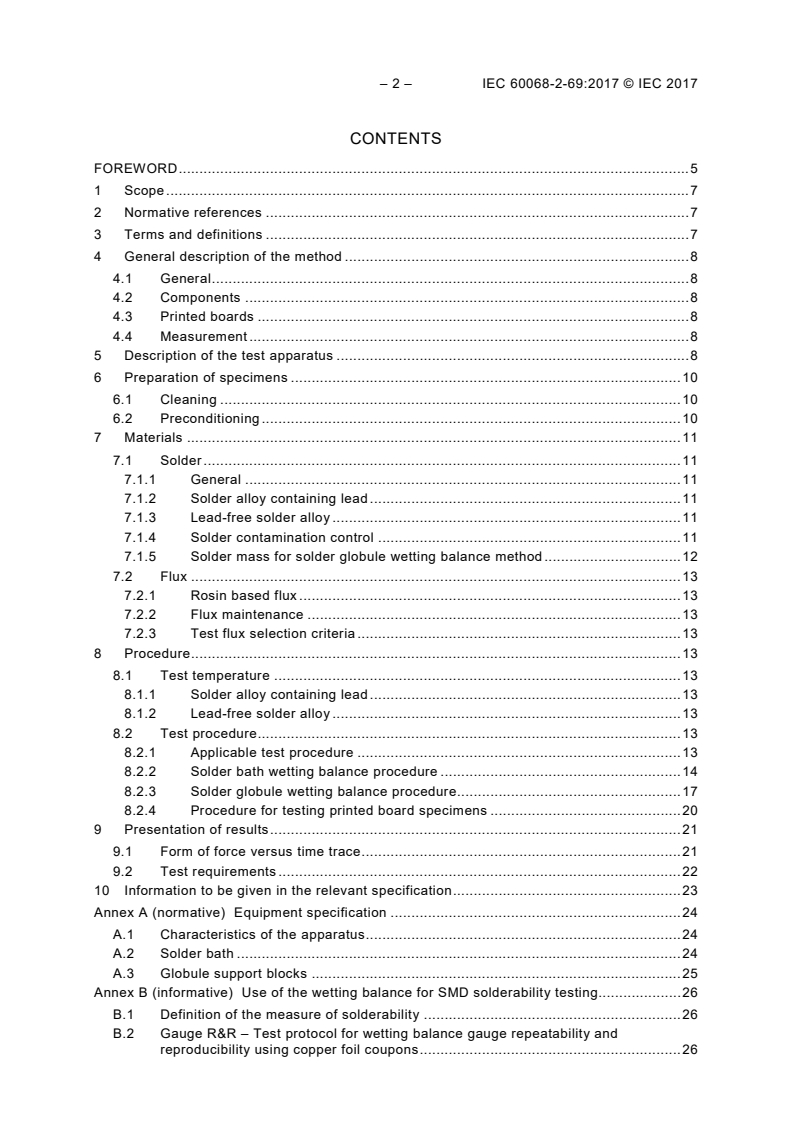
IEC 60068-2-69:2017 - Environmental testing - Part 2-69: Tests - Test Te/Tc: Solderability testing of electronic components and printed boards by the wetting balance (force measurement) method Released:3/7/2017

IEC 60068-2-69:2017+AMD1:2019 CSV - Environmental testing - Part 2-69: Tests - Test Te/Tc: Solderability testing of electronic components and printed boards by the wetting balance (force measurement) method Released:6/19/2019
Overview
IEC 60068-2-69:2017 is an internationally recognized standard published by the International Electrotechnical Commission (IEC). It focuses on environmental testing, specifically detailing Test Te/Tc: solderability testing of electronic components and printed circuit boards (PCBs) by the wetting balance (force measurement) method. The standard provides comprehensive procedures for assessing the solderability of metallic terminations and metallized solder pads on various electronic components and printed boards.
This 2017 edition consolidates and updates prior standards, including integrating IEC 60068-2-54. It introduces new component types, includes printed board testing, and updates test parameters and calibration protocols. The measurement techniques outlined include the solder bath wetting balance method and the solder globule wetting balance method, applicable to both lead-based and lead-free solder alloys.
Key Topics
Solderability Testing Methods:
- Solder bath wetting balance method measures the force of wetting over time as components or printed boards are immersed in a molten solder bath.
- Solder globule wetting balance method uses solder droplets (globules) for localized force measurement.
Applicable Materials:
- Components with metallic terminations.
- Printed circuit boards with metallized solder pads.
- Both lead-containing and lead-free solder alloys.
Test Procedures and Parameters:
- Preparation of specimens including cleaning and preconditioning.
- Detailed instructions on solder alloy composition and flux types.
- Test temperature specifications for different solder alloys.
- Instrument calibration using a gauge repeatability & reproducibility (R & R) test protocol.
Measurement and Data Presentation:
- Force vs. time traces generated during tests.
- Quantitative analysis of solderability; however, results are not meant for strict pass–fail classifications.
- Inclusion of criteria guidance for both components and printed boards.
Latest Enhancements:
- Integration of previous related IEC standards into a consolidated document.
- Expanded test coverage to include new component types and printed boards.
- Improved calibration and equipment verification methods.
Applications
Electronics Manufacturing Quality Control: Manufacturers use IEC 60068-2-69 to verify that components and PCBs meet solderability requirements critical to reliable solder joint formation in assembly operations. The force measurement method ensures objective evaluation beyond visual inspection.
Component and PCB Design Validation: Designers and engineers apply these tests to assess new materials and finishes, ensuring manufacturability and long-term reliability, especially with the industry transition to lead-free soldering.
Research and Development: R&D teams employ wetting balance methods to study the wetting behavior of novel solder alloys, flux formulations, and surface finishes on electronic components and substrates.
Supplier Qualification: Procurement and quality departments use IEC 60068-2-69 testing protocols to qualify components and printed boards from suppliers, ensuring compliance with solderability standards.
Environmental and Reliability Testing: The standard fits within broader environmental testing frameworks to evaluate how electronic assemblies will perform under various conditions and over time.
Related Standards
- IEC 60068-2-54: Related environmental test focusing on resistance to soldering heat, now integrated into IEC 60068-2-69.
- IPC-J-STD-002 and IPC-J-STD-003: Industry standards that specify requirements for solderability of component leads and printed circuit boards, referenced for flux selection and test flux rationale.
- IEC 60068 Series: Other related parts of IEC 60068 that cover environmental testing methods for electronic equipment.
- IPC-A-610: Acceptability standard for electronic assemblies, often used in conjunction with solderability tests to assess assembly quality.
- JEDEC JESD22-B102: Test method for solderability focused on different techniques but complementary in overall solder joint reliability assurance.
IEC 60068-2-69:2017 provides a robust and standardized approach for solderability testing via the wetting balance method, critical to ensuring high-quality solder joints and the reliability of electronic components and printed circuit boards. It supports manufacturers, designers, and quality professionals worldwide in setting consistent standards for electronic assembly processes.
Relations
- Effective Date
- 05-Sep-2023
- Effective Date
- 25-Aug-2026
- Effective Date
- 05-Sep-2023
- Effective Date
- 05-Sep-2023
- Effective Date
- 05-Sep-2023
Buy Documents
IEC 60068-2-69:2017 - Environmental testing - Part 2-69: Tests - Test Te/Tc: Solderability testing of electronic components and printed boards by the wetting balance (force measurement) method Released:3/7/2017
IEC 60068-2-69:2017+AMD1:2019 CSV - Environmental testing - Part 2-69: Tests - Test Te/Tc: Solderability testing of electronic components and printed boards by the wetting balance (force measurement) method Released:6/19/2019
Get Certified
Connect with accredited certification bodies for this standard

IMP NDT d.o.o.
Non-destructive testing services. Radiography, ultrasonic, magnetic particle, penetrant, visual inspection.
Inštitut za kovinske materiale in tehnologije
Institute of Metals and Technology. Materials testing, metallurgical analysis, NDT.
Q Techna d.o.o.
NDT and quality assurance specialist. 30+ years experience. NDT personnel certification per ISO 9712, nuclear and thermal power plant inspections, QA/
Sponsored listings
Frequently Asked Questions
IEC 60068-2-69:2017 is a standard published by the International Electrotechnical Commission (IEC). Its full title is "Environmental testing - Part 2-69: Tests - Test Te/Tc: Solderability testing of electronic components and printed boards by the wetting balance (force measurement) method". This standard covers: IEC 60068-2-69:2017 outlines test Te/Tc, the solder bath wetting balance method and the solder globule wetting balance method to determine, quantitatively, the solderability of the terminations. Data obtained by these methods are not intended to be used as absolute quantitative data for pass–fail purposes. The procedures describe the solder bath wetting balance method and the solder globule wetting balance method. They are applicable to components and printed boards with metallic terminations and metallized solder pads. This document provides the measurement procedures for solder alloys both with and without lead (Pb). This edition includes the following significant technical changes with respect to the previous edition: - integration of IEC 60068-2-54; - inclusion of tests of printed boards; - inclusion of new component types, and updating test parameters for the whole component list; - inclusion of a new gauge R & R test protocol to ensure that the respective wetting balance equipment is correctly calibrated. The contents of the corrigendum of January 2018 have been included in this copy.
IEC 60068-2-69:2017 outlines test Te/Tc, the solder bath wetting balance method and the solder globule wetting balance method to determine, quantitatively, the solderability of the terminations. Data obtained by these methods are not intended to be used as absolute quantitative data for pass–fail purposes. The procedures describe the solder bath wetting balance method and the solder globule wetting balance method. They are applicable to components and printed boards with metallic terminations and metallized solder pads. This document provides the measurement procedures for solder alloys both with and without lead (Pb). This edition includes the following significant technical changes with respect to the previous edition: - integration of IEC 60068-2-54; - inclusion of tests of printed boards; - inclusion of new component types, and updating test parameters for the whole component list; - inclusion of a new gauge R & R test protocol to ensure that the respective wetting balance equipment is correctly calibrated. The contents of the corrigendum of January 2018 have been included in this copy.
IEC 60068-2-69:2017 is classified under the following ICS (International Classification for Standards) categories: 19.040 - Environmental testing; 31.190 - Electronic component assemblies. The ICS classification helps identify the subject area and facilitates finding related standards.
IEC 60068-2-69:2017 has the following relationships with other standards: It is inter standard links to IEC 60068-2-54:2006, EN ISO 9455-16:2019, IEC 60068-2-69:2017/AMD1:2019, IEC 60068-2-69:2017/COR1:2018, IEC 60068-2-69:2007. Understanding these relationships helps ensure you are using the most current and applicable version of the standard.
IEC 60068-2-69:2017 is available in PDF format for immediate download after purchase. The document can be added to your cart and obtained through the secure checkout process. Digital delivery ensures instant access to the complete standard document.
Standards Content (Sample)
IEC 60068-2-69 ®
Edition 3.0 2017-03
INTERNATIONAL
STANDARD
NORME
INTERNATIONALE
Environmental testing –
Part 2-69: Tests – Test Te/Tc: Solderability testing of electronic components
and printed boards by the wetting balance (force measurement) method
Essais d'environnement –
Partie 2-69: Essais – Essai Te/Tc: Essai de brasabilité des composants
électroniques et cartes imprimées par la méthode de la balance de mouillage
(mesure de la force)
All rights reserved. Unless otherwise specified, no part of this publication may be reproduced or utilized in any form
or by any means, electronic or mechanical, including photocopying and microfilm, without permission in writing from
either IEC or IEC's member National Committee in the country of the requester. If you have any questions about IEC
copyright or have an enquiry about obtaining additional rights to this publication, please contact the address below or
your local IEC member National Committee for further information.
Droits de reproduction réservés. Sauf indication contraire, aucune partie de cette publication ne peut être reproduite
ni utilisée sous quelque forme que ce soit et par aucun procédé, électronique ou mécanique, y compris la photocopie
et les microfilms, sans l'accord écrit de l'IEC ou du Comité national de l'IEC du pays du demandeur. Si vous avez des
questions sur le copyright de l'IEC ou si vous désirez obtenir des droits supplémentaires sur cette publication, utilisez
les coordonnées ci-après ou contactez le Comité national de l'IEC de votre pays de résidence.
IEC Central Office Tel.: +41 22 919 02 11
3, rue de Varembé Fax: +41 22 919 03 00
CH-1211 Geneva 20 info@iec.ch
Switzerland www.iec.ch
About the IEC
The International Electrotechnical Commission (IEC) is the leading global organization that prepares and publishes
International Standards for all electrical, electronic and related technologies.
About IEC publications
The technical content of IEC publications is kept under constant review by the IEC. Please make sure that you have the
latest edition, a corrigenda or an amendment might have been published.
IEC Catalogue - webstore.iec.ch/catalogue Electropedia - www.electropedia.org
The stand-alone application for consulting the entire The world's leading online dictionary of electronic and
bibliographical information on IEC International Standards, electrical terms containing 20 000 terms and definitions in
Technical Specifications, Technical Reports and other English and French, with equivalent terms in 16 additional
documents. Available for PC, Mac OS, Android Tablets and languages. Also known as the International Electrotechnical
iPad. Vocabulary (IEV) online.
IEC publications search - www.iec.ch/searchpub IEC Glossary - std.iec.ch/glossary
The advanced search enables to find IEC publications by a 65 000 electrotechnical terminology entries in English and
variety of criteria (reference number, text, technical French extracted from the Terms and Definitions clause of
committee,…). It also gives information on projects, replaced IEC publications issued since 2002. Some entries have been
and withdrawn publications. collected from earlier publications of IEC TC 37, 77, 86 and
CISPR.
IEC Just Published - webstore.iec.ch/justpublished
Stay up to date on all new IEC publications. Just Published IEC Customer Service Centre - webstore.iec.ch/csc
details all new publications released. Available online and If you wish to give us your feedback on this publication or
also once a month by email. need further assistance, please contact the Customer Service
Centre: csc@iec.ch.
A propos de l'IEC
La Commission Electrotechnique Internationale (IEC) est la première organisation mondiale qui élabore et publie des
Normes internationales pour tout ce qui a trait à l'électricité, à l'électronique et aux technologies apparentées.
A propos des publications IEC
Le contenu technique des publications IEC est constamment revu. Veuillez vous assurer que vous possédez l’édition la
plus récente, un corrigendum ou amendement peut avoir été publié.
Catalogue IEC - webstore.iec.ch/catalogue Electropedia - www.electropedia.org
Application autonome pour consulter tous les renseignements
Le premier dictionnaire en ligne de termes électroniques et
bibliographiques sur les Normes internationales,
électriques. Il contient 20 000 termes et définitions en anglais
Spécifications techniques, Rapports techniques et autres
et en français, ainsi que les termes équivalents dans 16
documents de l'IEC. Disponible pour PC, Mac OS, tablettes
langues additionnelles. Egalement appelé Vocabulaire
Android et iPad.
Electrotechnique International (IEV) en ligne.
Recherche de publications IEC - www.iec.ch/searchpub
Glossaire IEC - std.iec.ch/glossary
65 000 entrées terminologiques électrotechniques, en anglais
La recherche avancée permet de trouver des publications IEC
en utilisant différents critères (numéro de référence, texte, et en français, extraites des articles Termes et Définitions des
comité d’études,…). Elle donne aussi des informations sur les publications IEC parues depuis 2002. Plus certaines entrées
projets et les publications remplacées ou retirées. antérieures extraites des publications des CE 37, 77, 86 et
CISPR de l'IEC.
IEC Just Published - webstore.iec.ch/justpublished
Service Clients - webstore.iec.ch/csc
Restez informé sur les nouvelles publications IEC. Just
Published détaille les nouvelles publications parues. Si vous désirez nous donner des commentaires sur cette
Disponible en ligne et aussi une fois par mois par email. publication ou si vous avez des questions contactez-nous:
csc@iec.ch.
IEC 60068-2-69 ®
Edition 3.0 2017-03
INTERNATIONAL
STANDARD
NORME
INTERNATIONALE
Environmental testing –
Part 2-69: Tests – Test Te/Tc: Solderability testing of electronic components
and printed boards by the wetting balance (force measurement) method
Essais d'environnement –
Partie 2-69: Essais – Essai Te/Tc: Essai de brasabilité des composants
électroniques et cartes imprimées par la méthode de la balance de mouillage
(mesure de la force)
INTERNATIONAL
ELECTROTECHNICAL
COMMISSION
COMMISSION
ELECTROTECHNIQUE
INTERNATIONALE
ICS 19.040; 31.190 ISBN 978-2-8322-3994-0
– 2 – IEC 60068-2-69:2017 © IEC 2017
CONTENTS
FOREWORD . 5
1 Scope . 7
2 Normative references . 7
3 Terms and definitions . 7
4 General description of the method . 8
4.1 General . 8
4.2 Components . 8
4.3 Printed boards . 8
4.4 Measurement . 8
5 Description of the test apparatus . 8
6 Preparation of specimens . 10
6.1 Cleaning . 10
6.2 Preconditioning . 10
7 Materials . 11
7.1 Solder . 11
7.1.1 General . 11
7.1.2 Solder alloy containing lead . 11
7.1.3 Lead-free solder alloy . 11
7.1.4 Solder contamination control . 11
7.1.5 Solder mass for solder globule wetting balance method . 12
7.2 Flux . 13
7.2.1 Rosin based flux . 13
7.2.2 Flux maintenance . 13
7.2.3 Test flux selection criteria . 13
8 Procedure . 13
8.1 Test temperature . 13
8.1.1 Solder alloy containing lead . 13
8.1.2 Lead-free solder alloy . 13
8.2 Test procedure . 13
8.2.1 Applicable test procedure . 13
8.2.2 Solder bath wetting balance procedure . 14
8.2.3 Solder globule wetting balance procedure. 17
8.2.4 Procedure for testing printed board specimens . 20
9 Presentation of results . 21
9.1 Form of force versus time trace . 21
9.2 Test requirements . 22
10 Information to be given in the relevant specification . 23
Annex A (normative) Equipment specification . 24
A.1 Characteristics of the apparatus . 24
A.2 Solder bath . 24
A.3 Globule support blocks . 25
Annex B (informative) Use of the wetting balance for SMD solderability testing. 26
B.1 Definition of the measure of solderability . 26
B.2 Gauge R&R – Test protocol for wetting balance gauge repeatability and
reproducibility using copper foil coupons . 26
B.2.1 Test coupon . 26
B.2.2 Test parameters . 27
B.2.3 Known good coupon . 27
B.3 Solder globule mass and pin size . 28
B.4 Specimen orientation and immersion depth . 28
B.4.1 General . 28
B.4.2 Resistors and capacitors . 29
B.4.3 Small-leaded components . 29
B.4.4 Multi-leaded devices . 29
B.5 Test flux . 30
B.6 Test temperature . 30
B.6.1 Solder alloy containing lead . 30
B.6.2 Solder alloy without lead . 31
B.7 Characteristics of the test apparatus . 31
B.7.1 Recording device . 31
B.7.2 Balance system . 32
B.7.3 Lifting mechanism and controls . 32
B.7.4 Parameters to be measured from the force-time trace . 37
B.7.5 Reference wetting force . 37
B.7.6 Equipment location . 38
B.7.7 Globule pins . 38
B.7.8 Globule modules . 38
B.8 Test flux – IPC-J-STD-002/J-STD-003 activated solderability test flux
rationale committee letter . 38
B.8.1 General . 38
B.8.2 Proactive solderability testing approach to the implementation of non-tin
finishes . 39
B.8.3 Reduced solderability test variability . 39
B.8.4 Standardization of solderability test flux composition on a global scale . 39
Annex C (normative) Test methods for SMD components sizes 0603M (0201) or
smaller . 40
C.1 General . 40
C.2 General description of the test method . 40
C.3 Preconditioning . 40
C.3.1 Preparation of the specimens . 40
C.3.2 Ageing . 40
C.4 Materials . 40
C.4.1 Solder . 40
C.4.2 Flux . 41
C.5 Method 1. 41
C.5.1 Description of the test apparatus . 41
C.5.2 Procedures . 41
C.5.3 Presentation of results . 44
C.5.4 Information to be given in the relevant specification . 45
C.6 Method 2. 46
C.6.1 Test apparatus . 46
C.6.2 Observation equipment . 46
C.6.3 Test method 2 . 46
C.6.4 Presentation of results . 47
– 4 – IEC 60068-2-69:2017 © IEC 2017
Annex D (informative) Evaluation criteria – Guidance . 48
D.1 General considerations . 48
D.2 Evaluation criteria for components . 48
D.3 Evaluation criteria for printed boards. 49
Annex E (informative) Method of calculating the maximum theoretical force and
integrated value of the area of the wetting curve for leaded non-SMD . 50
E.1 Method of calculating the maximum theoretical force . 50
E.2 Method of calculating the integrated value of the area of the wetting curve . 50
Bibliography . 52
Figure 1 – Arrangement for the test apparatus (solder bath wetting balance method) . 9
Figure 2 – Arrangement for the test apparatus (solder globule wetting balance method) . 9
Figure 3 – Immersion conditions for solder bath method . 16
Figure 4 – Immersion conditions for solder globule method . 19
Figure 5 – Suggested wetting balance test specimens and soldering immersion . 20
Figure 6 – Printed board immersion . 21
Figure 7 – Typical wetting balance trace . 22
Figure B.1 – Understanding wetting curves . 35
Figure B.2 – Typical wetting curve . 35
Figure B.3 – Representative force-time curves . 36
Figure C.1 – Cross-section of aluminium body . 41
Figure C.2 – Dipping position and relative position . 42
Figure C.3 – Time and test sequence . 44
Figure C.4 – Typical wetting balance trace . 45
Figure D.1 – Set A wetting curve . 49
Figure D.2 – Set B wetting curve . 49
Table 1 – Preconditioning . 10
Table 2 – Maximum limits of solder bath contaminants . 12
Table 3 – Globule and pellet sizes . 12
Table 4 – Rosin based flux compositions . 13
Table 5 – Recommended solder bath wetting balance test conditions . 15
Table 6 – Time sequence of the test (solder bath). 17
Table 7 – Recommended solder globule wetting balance test conditions . 18
Table 8 – Time sequence of the test (solder globule) . 20
Table B.1 – Carboxylic acid based flux (water solution) . 30
Table B.2 – Carboxylic acid based flux (alcohol solution) . 30
Table C.1 – Time sequence of the test procedure . 43
Table D.1 – Wetting balance parameter and suggested evaluation criteria . 48
Table D.2 – Printed board test parameter and suggested criteria . 49
INTERNATIONAL ELECTROTECHNICAL COMMISSION
____________
ENVIRONMENTAL TESTING –
Part 2-69: Tests – Test Te/Tc: Solderability testing of
electronic components and printed boards
by the wetting balance (force measurement) method
FOREWORD
1) The International Electrotechnical Commission (IEC) is a worldwide organization for standardization comprising
all national electrotechnical committees (IEC National Committees). The object of IEC is to promote
international co-operation on all questions concerning standardization in the electrical and electronic fields. To
this end and in addition to other activities, IEC publishes International Standards, Technical Specifications,
Technical Reports, Publicly Available Specifications (PAS) and Guides (hereafter referred to as “IEC
Publication(s)”). Their preparation is entrusted to technical committees; any IEC National Committee interested
in the subject dealt with may participate in this preparatory work. International, governmental and non-
governmental organizations liaising with the IEC also participate in this preparation. IEC collaborates closely
with the International Organization for Standardization (ISO) in accordance with conditions determined by
agreement between the two organizations.
2) The formal decisions or agreements of IEC on technical matters express, as nearly as possible, an international
consensus of opinion on the relevant subjects since each technical committee has representation from all
interested IEC National Committees.
3) IEC Publications have the form of recommendations for international use and are accepted by IEC National
Committees in that sense. While all reasonable efforts are made to ensure that the technical content of IEC
Publications is accurate, IEC cannot be held responsible for the way in which they are used or for any
misinterpretation by any end user.
4) In order to promote international uniformity, IEC National Committees undertake to apply IEC Publications
transparently to the maximum extent possible in their national and regional publications. Any divergence
between any IEC Publication and the corresponding national or regional publication shall be clearly indicated in
the latter.
5) IEC itself does not provide any attestation of conformity. Independent certification bodies provide conformity
assessment services and, in some areas, access to IEC marks of conformity. IEC is not responsible for any
services carried out by independent certification bodies.
6) All users should ensure that they have the latest edition of this publication.
7) No liability shall attach to IEC or its directors, employees, servants or agents including individual experts and
members of its technical committees and IEC National Committees for any personal injury, property damage or
other damage of any nature whatsoever, whether direct or indirect, or for costs (including legal fees) and
expenses arising out of the publication, use of, or reliance upon, this IEC Publication or any other IEC
Publications.
8) Attention is drawn to the Normative references cited in this publication. Use of the referenced publications is
indispensable for the correct application of this publication.
9) Attention is drawn to the possibility that some of the elements of this IEC Publication may be the subject of
patent rights. IEC shall not be held responsible for identifying any or all such patent rights.
International Standard IEC 60068-2-69 has been prepared by IEC technical committee 91:
Electronics assembly technology.
This third edition cancels and replaces the second edition published in 2007 as well as the
second edition of IEC 60068-2-54 published in 2006 and constitutes a technical revision.
This edition includes the following significant technical changes with respect to the previous
edition:
• integration of IEC 60068-2-54;
• inclusion of tests of printed boards;
• inclusion of new component types, and updating test parameters for the whole component
list;
– 6 – IEC 60068-2-69:2017 © IEC 2017
• inclusion of a new gauge R & R test protocol to ensure that the respective wetting balance
equipment is correctly calibrated.
The text of this standard is based on the following documents:
FDIS Report on voting
91/1405/FDIS 91/1426/RVD
Full information on the voting for the approval of this International Standard can be found in
the report on voting indicated in the above table.
This document has been drafted in accordance with the ISO/IEC Directives, Part 2.
A list of all parts in the IEC 60068 series, under the general title Environmental testing, can be
found on the IEC website.
The committee has decided that the contents of this document will remain unchanged until the
stability date indicated on the IEC website under "http://webstore.iec.ch" in the data related to
the specific document. At this date, the document will be
• reconfirmed,
• withdrawn,
• replaced by a revised edition, or
• amended.
The contents of the corrigendum of January 2018 have been included in this copy.
ENVIRONMENTAL TESTING –
Part 2-69: Tests – Test Te/Tc: Solderability testing of
electronic components and printed boards
by the wetting balance (force measurement) method
1 Scope
This part of IEC 60068 outlines test Te/Tc, the solder bath wetting balance method and the
solder globule wetting balance method to determine, quantitatively, the solderability of the
terminations. Data obtained by these methods are not intended to be used as absolute
quantitative data for pass–fail purposes.
The procedures describe the solder bath wetting balance method and the solder globule
wetting balance method. They are applicable to components and printed boards with metallic
terminations and metallized solder pads.
This document provides the measurement procedures for solder alloys both with and without
lead (Pb).
2 Normative references
The following documents are referred to in the text in such a way that some or all of their
content constitutes requirements of this document. For dated references, only the edition
cited applies. For undated references, the latest edition of the referenced document (including
any amendments) applies.
IEC 60068-1, Environmental testing – Part 1: General and guidance
IEC 60068-2-2, Environmental testing – Part 2-2: Tests – Test B: Dry heat
IEC 60068-2-20:2008, Environmental testing – Part 2-20: Tests – Test T: Test methods for
solderability and resistance to soldering heat of devices with leads
IEC 60068-2-66, Environmental testing − Part 2: Test methods − Test Cx: Damp heat, steady
state (unsaturated pressurized vapour)
IEC 61190-1-3:2007, Attachment materials for electronic assembly – Part 1-3: Requirements
for electronic grade solder alloys and fluxed and non-fluxed solid solders for electronic
soldering applications
IEC 61190-1-3:2007/AMD1:2010
ISO 683 (all parts), Heat-treatable steels, alloy steels and free-cutting steels
ISO 6362 (all parts), Wrought aluminium and aluminium alloys – Extruded rods/bars, tubes
and profiles
3 Terms and definitions
For the purposes of this document, the terms and definitions given in IEC 60068-1 and
IEC 60068-2-20 apply.
– 8 – IEC 60068-2-69:2017 © IEC 2017
ISO and IEC maintain terminological databases for use in standardization at the following
addresses:
• IEC Electropedia: available at http://www.electropedia.org/
• ISO Online browsing platform: available at http://www.iso.org/obp
4 General description of the method
4.1 General
The user should note that the test method specified in this document is intended to provide
consistent and discriminatory data between various test sites. Hence the choice of alloy,
temperature and flux shall be controlled.
Using this test method to control a production process is encouraged. However, as each
production process will employ different alloys, temperatures and fluxes, such test results
shall be agreed upon between user and supplier. In case of a dispute, the procedures of this
document shall prevail.
NOTE Information regarding wetting balance for SMD solderability testing is described in Annex B.
4.2 Components
The test specimen shall be a sample from the intended production batch. The test specimen
is mounted into a suitable holder that is suspended from a sensitive balance. Liquid flux is
then applied to the specimen that is brought into contact with the cleaned surface of the liquid
solder within a solder bath, or the apex of a solder globule. The solder in either case is at a
controlled temperature, and the lead or termination under test is immersed to the prescribed
depth.
4.3 Printed boards
The test specimen should be a representative test specimen, a portion of the printed board
being tested, or a whole board if within size limits, such that an immersion depth defined in
the individual method is possible. Test specimens may be used for rigid board surface
solderability and plated-through-hole solderability.
Liquid flux is then applied to the specimen that is brought into contact with the cleaned
surface of a solder bath, or the apex of a solder globule, that is at a controlled temperature
and immersed to the prescribed depth.
4.4 Measurement
The resultant forces, measured in mN, of buoyancy and surface tension acting upon the
immersed termination are detected by a transducer and converted into a signal that is
continuously monitored as a function of time, and recorded and displayed on a computer
screen.
The wetting speed and the extent of wetting are derived from the force against time curve.
The trace may be compared with that derived from a perfectly wetted specimen of the same
nature and dimensions.
5 Description of the test apparatus
Figure 1 and Figure 2 show a suitable arrangement for the test apparatus.
The apparatus specifications are given in Annex A.
The specimen is suspended from a sensitive balance and a mechanism used to either raise
the solder to meet the specimen or lower the specimen into the solder. After conditioning, the
transducer signal is passed to a computer, where the force against time curve may be
displayed and analysed.
4 5 6
1 →
→
3 7
IEC
Key
1 Specimen 2 Solder bath
3 Solder bath lifting mechanism 4 Balance and transducer
5 Signal conditioner 6 Computer
7 Control box
Figure 1 – Arrangement for the test apparatus (solder bath wetting balance method)
5 6
← 1
←
3 7
IEC
Key
1 Specimen 2 Globule block
3 Lift mechanism 4 Balance and transducer
5 Signal conditioner 6 Computer
7 Control box
Figure 2 – Arrangement for the test apparatus (solder globule wetting balance method)
– 10 – IEC 60068-2-69:2017 © IEC 2017
6 Preparation of specimens
6.1 Cleaning
Unless otherwise specified, the specimen shall be tested in the as-received condition and
care should be taken to ensure that no part of the surface to be tested becomes contaminated,
particularly by contact with the fingers, during the preparation and handling of the specimen.
If required by the component specification, the specimen may be cleaned by immersion in a
neutral organic solvent at room temperature. The specimen should be allowed to dry in air
before testing. No other cleaning is permitted.
6.2 Preconditioning
If required by the component specification, the component may be subjected to
preconditioning before testing. This shall be performed for 4 h at 155 °C unless otherwise
agreed between user and supplier (Table 1, condition F).
In the past, it had been practice to use the term accelerated ageing which, as given in
IEC 60068-2-20:2008, 4.1.1, has six alternative conditions that may be used as an alternative
if agreed between user and supplier:
A – ageing 1a of IEC 60068-2-20;
B – ageing 1b of IEC 60068-2-20;
C – ageing 1b of IEC 60068-2-20, but for 8 h;
D – ageing 1b of IEC 60068-2-20, but for 16 h;
E – ageing 4 of IEC 60068-2-20;
F – ageing 3a of IEC 60068-2-20.
Refer to Table 1, for preconditioning.
Table 1 – Preconditioning
Condition category Precondition type Exposure Use Applicability by
parameters recommendation finish
A Steam Preferred Non-tin and non-tin
1 h ± 5 min
alloy containing
finishes
B Preferred Non-tin and non-tin
4 h ± 10 min
alloy containing
finishes
C Optional Non-tin and non-tin
8 h ± 15 min
alloy containing
finishes
D Optional Non-tin and non-tin
16 h ± 30 min
alloy containing
finishes
E Unsaturated Preferred All finishes
4 h ± 10 min
pressurized vapour
(120 °C,85 % RH)
F 155 °C dry bake Preferred All finishes
4 h ± 15 min
7 Materials
7.1 Solder
7.1.1 General
The solder to be used for both the solder bath and for the solder globule wetting balance test
shall be as specified in 7.1.2 or 7.1.3.
7.1.2 Solder alloy containing lead
The solder shall be Sn60Pb40A, Sn63Pb37A or Sn62Pb36Ag02B (refer to the IEC 61190-1-3
alloy name).
NOTE The presence of silver in the solder reduces the dissolution effect on silver containing metallization on
components and therefore can be used when required by the relevant component specification.
7.1.3 Lead-free solder alloy
The preferred alloy composition to be used should consist of either a mass fraction of 3,0 %
Ag, 0,5 % Cu, 96,5 % Sn (Sn96,5Ag3Cu,5) or 0,7 % Cu, 99,3 % Sn (Sn99,3Cu,7). (Refer to
IEC 61190-1-3 for the alloy name.)
NOTE Sn96,5Ag3Cu,5 is also known as SAC 305.
Other lead-free solder alloys may be used upon agreement between user and supplier.
7.1.4 Solder contamination control
The solder in solder baths used for solderability testing shall be chemically or
spectrographically analyzed or replaced each 30 operating days. The levels of contamination
and Sn content shall be within those shown in Table 2. The intervals between analyses may
be lengthened if the test results indicate that the contamination limits are not being
approached. The composition of the lead-free solder, including contamination levels, shall be
maintained during testing with the silver and copper element levels adjusted for alloy
requirements.
An operating day consists of any eight-hour period, or any portion thereof, during which the
solder is liquefied and used. If contamination exceeds the limits specified in Table 2, then the
solder shall be changed and the intervals between analysis shall be shortened. A sampling
plan shall be developed, implemented, and documented. It shall also indicate the process
control of the solder contamination.
– 12 – IEC 60068-2-69:2017 © IEC 2017
Table 2 – Maximum limits of solder bath contaminants
Contaminant Maximum mass fraction contaminant limit
a b c d
, ,
SnPb alloys Lead-free alloys
% %
Copper 0,300 1,100
Gold 0,200 0,200
Cadmium 0,005 0,005
Zinc 0,005 0,005
Aluminium 0,006 0,006
Antimony 0,500 0,200
Iron 0,020 0,020
Arsenic 0,030 0,030
Bismuth 0,250 0,250
Silver 0,100 4,000
Nickel 0,010 0,050
Lead N/A 0,100
a
The tin content of the solder shall be maintained within ±1,5 % of the nominal alloy being used. Tin content
shall be tested at the same frequency as testing for copper/gold contamination. The balance of the bath shall
be lead and/or the items listed above.
b
The total of copper, gold, cadmium, zinc, and aluminium contaminants shall not exceed 0,4 %. Not
applicable to lead-free alloys.
c
The tin content of the solder shall be maintained within ±1 % of the nominal alloy being used. Tin content
shall be tested at the same frequency as testing for copper/silver concentration. The balance of the bath
shall be the items listed above.
d
Maximum contamination limits are applicable for Sn96,5Ag3Cu,5. Other lead-free solder alloy contamination
limits may be used upon agreement between user and vendor.
7.1.5 Solder mass for solder globule wetting balance method
For the solder globule wetting balance method, the solder shall be in the form of pellets or cut
wire with a mass of 200 mg ± 10 mg for use on a 4 mm diameter pin globule support block,
100 mg ± 10 mg for use on a 3,2 mm diameter pin support block, 25 mg ± 2,5 mg for use on a
2 mm diameter pin globule support block, and 5 mg ± 0,5 mg for use on a 1 mm diameter
globule support block. Refer to Table 3.
Table 3 – Globule and pellet sizes
Pin diameter Pellet mass Pellet mass tolerance
mm mg mg
1 5 ±0,5
2 25
±2,5
3,2 100
±10
4 200 ±10
A new solder pellet shall be used for each test except in the case of a step and repeat
technique. Separate dedicated globule support blocks should be used for tin-lead and lead-
free alloys to avoid cross-contamination. Refer to Annex C regarding dimple globule.
7.2 Flux
7.2.1 Rosin based flux
The preferred fluxes for the test are rosin based as shown below. See Table 4 for the details.
a) Non-activated
b) Low activated
c) High activated
Table 4 – Rosin based flux compositions
a
Constituent Composition by mass fraction
%
Non-activated Low activated High activated
Colophony 25 ± 0,5 25 ± 0,5 25 ± 0,5
Diethylammonium hydrochloride (CAS No. 660-68-4) None 0,15 ± 0,01 0,39 ± 0,01
2-propanol (Isopropyl alcohol) (CAS No. 67-63-0) or
75 ± 0,5 74,85 ± 0,5 74,61 ± 0,5
ethyl alcohol (CAS No. 64-17-5) as an alternative
b
Mass of chlorine of solids 0 0,2 0,5
a
See IEC 60068-2-20:2008, Annex B for specification.
b
Expressed as free chlorine based on the colophony content.
7.2.2 Flux maintenance
The flux to be used for testing should be taken from the supplied container and poured into a
small cup (beaker). Flux applied for testing should be taken from this cup. After use the
unused flux left in the cup should be discarded.
7.2.3 Test flux selection criteria
Refer to Clauses B.5 and B.8 for information regarding the adoption and use of these test
fluxes.
8 Procedure
8.1 Test temperature
8.1.1 Solder alloy containing lead
Solder temperature prior to test and during test shall be 235 °C ± 3 °C.
8.1.2 Lead-free solder alloy
Unless otherwise specified in the relevant specification, the temperature of the solder prior to
the test shall be 245 °C ± 3 °C for Sn96,5 Ag3 Cu,5 and 250 °C ± 3 °C for Sn99,3 Cu,7 alloys.
8.2 Test procedure
8.2.1 Applicable test procedure
Subclause 8.2.2 applies for leaded non-SMD.
Subclause 8.2.2 or 8.2.3 applies for non-leaded SMD or leaded SMD as applicable.
Subclause 8.2.4 applies for printed boards.
– 14 – IEC 60068-2-69:2017 © IEC 2017
8.2.2 Solder bath wetting balance procedure
The specimen is mounted in a suitable holder to give the desired dipping angle and the
termination(s) is/are centred above the solder bath. Preferred dipping angles are given in
Table 5.
The temperature of the solder prior to the test shall be as described in 8.1.
Prior to testing, a continuous layer of the appropriate flux is applied to the portion of the
component termination to be tested, using a cocktail stick, cotton bud or similar applicator,
and excess flux droplets are removed by touching against absorbent paper. It is very
important that excess flux is not allowed to enter the specimen holder or remain on the
component. The presence of excess flux will cause explosive boiling as the flux solvent
makes contact with the molten solder.
Immediately prior to testing, wipe the oxide from the solder bath surface with a non-wettable
blade. If required, the apparatus suspension and chart recorder are adjusted to the zero
position.
Leaded non-SMD component: Hang the specimen on the apparatus so that the lower edge of
the component is 20 mm ± 5 mm above the solder surface. The specimens are then brought
into contact at a speed between 5 mm/s and 20 mm/s so that they are immersed to the
required depth within 0,2 s.
SMD components: It is important to ensure that the test specimen, at the start of the test, is
positioned on the equipment at a distance not greater than 10 mm ± 2 mm and to allow the
specimen to preheat/dry for 30 s ± 15 s prior to immersion into the solder globule. This period
is required to remove the solvent from the flux prior to the test and to prevent explosive
boiling when the specimen and solder come into contact. Loading and unloading of test
specimens may, of course, be at a much greater distance, for example greater than 20 mm.
The specimen and solder are brought into contact at a speed between 1 mm/s and 5 mm/s.
The recommended immersion depth into the solder of the surface to be tested shall be as
specified in Table 5. See also Figure 3. Table 5 shows the solder dipping angle for SMD,
leaded SMD components as well as leaded non-SMD components.
Table 5 – Recommended solder bath wetting balance test conditions
a
Component examples Dipping angle Figure 3 Immersion depth
mm
Type Size code
Leaded non- N/A Vertical 1M, 1N, 1P, 1Q 2 to 4
SMD
) b
Capacitors 1608M (0603
b
2012M (0805) Horizontal, vertical or
1A,1B, 1C
) b
3216M (1206 20° to 45°
b
4532M (1812)
b
Resistors 1608M (0603)
Horizontal, vertical or 1A, 1B,1C,
b
2012M (0805)
d d
20° to 45° 1G ,1H
b
3216M (1206)
SOT 23
SOT 89
SOT 223
0,04 to 0,10
c
SOIC 16
c 1D, 1E, 1F
SOIC 28
Leaded SMD Vertical or 20° to 45°
c
VSO 40
1J, 1K, 1L
c
QFP 48
c
QFP 160
c
PLCC 44
c
PL
...
IEC 60068-2-69 ®
Edition 3.1 2019-06
CONSOLIDATED VERSION
INTERNATIONAL
STANDARD
NORME
INTERNATIONALE
colour
inside
Environmental testing –
Part 2-69: Tests – Test Te/Tc: Solderability testing of electronic components
and printed boards by the wetting balance (force measurement) method
Essais d'environnement –
Partie 2-69: Essais – Essai Te/Tc: Essai de brasabilité des composants
électroniques et cartes imprimées par la méthode de la balance de mouillage
(mesure de la force)
All rights reserved. Unless otherwise specified, no part of this publication may be reproduced or utilized in any form
or by any means, electronic or mechanical, including photocopying and microfilm, without permission in writing from
either IEC or IEC's member National Committee in the country of the requester. If you have any questions about IEC
copyright or have an enquiry about obtaining additional rights to this publication, please contact the address below or
your local IEC member National Committee for further information.
Droits de reproduction réservés. Sauf indication contraire, aucune partie de cette publication ne peut être reproduite
ni utilisée sous quelque forme que ce soit et par aucun procédé, électronique ou mécanique, y compris la photocopie
et les microfilms, sans l'accord écrit de l'IEC ou du Comité national de l'IEC du pays du demandeur. Si vous avez des
questions sur le copyright de l'IEC ou si vous désirez obtenir des droits supplémentaires sur cette publication, utilisez
les coordonnées ci-après ou contactez le Comité national de l'IEC de votre pays de résidence.
IEC Central Office Tel.: +41 22 919 02 11
3, rue de Varembé info@iec.ch
CH-1211 Geneva 20 www.iec.ch
Switzerland
About the IEC
The International Electrotechnical Commission (IEC) is the leading global organization that prepares and publishes
International Standards for all electrical, electronic and related technologies.
About IEC publications
The technical content of IEC publications is kept under constant review by the IEC. Please make sure that you have the
latest edition, a corrigendum or an amendment might have been published.
IEC publications search - webstore.iec.ch/advsearchform Electropedia - www.electropedia.org
The advanced search enables to find IEC publications by a The world's leading online dictionary on electrotechnology,
variety of criteria (reference number, text, technical containing more than 22 000 terminological entries in English
committee,…). It also gives information on projects, replaced and French, with equivalent terms in 16 additional languages.
and withdrawn publications. Also known as the International Electrotechnical Vocabulary
(IEV) online.
IEC Just Published - webstore.iec.ch/justpublished
Stay up to date on all new IEC publications. Just Published IEC Glossary - std.iec.ch/glossary
details all new publications released. Available online and 67 000 electrotechnical terminology entries in English and
once a month by email. French extracted from the Terms and Definitions clause of
IEC publications issued since 2002. Some entries have been
IEC Customer Service Centre - webstore.iec.ch/csc collected from earlier publications of IEC TC 37, 77, 86 and
If you wish to give us your feedback on this publication or CISPR.
need further assistance, please contact the Customer Service
Centre: sales@iec.ch.
A propos de l'IEC
La Commission Electrotechnique Internationale (IEC) est la première organisation mondiale qui élabore et publie des
Normes internationales pour tout ce qui a trait à l'électricité, à l'électronique et aux technologies apparentées.
A propos des publications IEC
Le contenu technique des publications IEC est constamment revu. Veuillez vous assurer que vous possédez l’édition la
plus récente, un corrigendum ou amendement peut avoir été publié.
Recherche de publications IEC - Electropedia - www.electropedia.org
webstore.iec.ch/advsearchform Le premier dictionnaire d'électrotechnologie en ligne au
La recherche avancée permet de trouver des publications IEC monde, avec plus de 22 000 articles terminologiques en
en utilisant différents critères (numéro de référence, texte, anglais et en français, ainsi que les termes équivalents dans
comité d’études,…). Elle donne aussi des informations sur les 16 langues additionnelles. Egalement appelé Vocabulaire
projets et les publications remplacées ou retirées. Electrotechnique International (IEV) en ligne.
IEC Just Published - webstore.iec.ch/justpublished Glossaire IEC - std.iec.ch/glossary
Restez informé sur les nouvelles publications IEC. Just 67 000 entrées terminologiques électrotechniques, en anglais
Published détaille les nouvelles publications parues. et en français, extraites des articles Termes et Définitions des
Disponible en ligne et une fois par mois par email. publications IEC parues depuis 2002. Plus certaines entrées
antérieures extraites des publications des CE 37, 77, 86 et
Service Clients - webstore.iec.ch/csc CISPR de l'IEC.
Si vous désirez nous donner des commentaires sur cette
publication ou si vous avez des questions contactez-nous:
sales@iec.ch.
IEC 60068-2-69 ®
Edition 3.1 2019-06
CONSOLIDATED VERSION
INTERNATIONAL
STANDARD
NORME
INTERNATIONALE
colour
inside
Environmental testing –
Part 2-69: Tests – Test Te/Tc: Solderability testing of electronic components
and printed boards by the wetting balance (force measurement) method
Essais d'environnement –
Partie 2-69: Essais – Essai Te/Tc: Essai de brasabilité des composants
électroniques et cartes imprimées par la méthode de la balance de mouillage
(mesure de la force)
INTERNATIONAL
ELECTROTECHNICAL
COMMISSION
COMMISSION
ELECTROTECHNIQUE
INTERNATIONALE
ICS 19.040; 31.190 ISBN 978-2-8322-7092-9
IEC 60068-2-69 ®
Edition 3.1 2019-06
CONSOLIDATED VERSION
REDLINE VERSION
VERSION REDLINE
colour
inside
Environmental testing –
Part 2-69: Tests – Test Te/Tc: Solderability testing of electronic components
and printed boards by the wetting balance (force measurement) method
Essais d'environnement –
Partie 2-69: Essais – Essai Te/Tc: Essai de brasabilité des composants
électroniques et cartes imprimées par la méthode de la balance de mouillage
(mesure de la force)
– 2 – IEC 60068-2-69:2017+AMD1:2019 CSV
© IEC 2019
CONTENTS
FOREWORD . 5
1 Scope . 7
2 Normative references . 7
3 Terms and definitions . 7
4 General description of the method . 8
4.1 General . 8
4.2 Components . 8
4.3 Printed boards . 8
4.4 Measurement . 8
5 Description of the test apparatus . 8
6 Preparation of specimens . 10
6.1 Cleaning . 10
6.2 Preconditioning . 10
7 Materials . 11
7.1 Solder . 11
7.1.1 General . 11
7.1.2 Solder alloy containing lead . 11
7.1.3 Lead-free solder alloy . 11
7.1.4 Solder contamination control . 11
7.1.5 Solder mass for solder globule wetting balance method . 12
7.2 Flux . 13
7.2.1 Rosin based flux . 13
7.2.2 Flux maintenance . 13
7.2.3 Test flux selection criteria . 13
8 Procedure . 13
8.1 Test temperature . 13
8.1.1 Solder alloy containing lead . 13
8.1.2 Lead-free solder alloy . 13
8.2 Test procedure . 13
8.2.1 Applicable test procedure . 13
8.2.2 Solder bath wetting balance procedure . 14
8.2.3 Solder globule wetting balance procedure. 17
8.2.4 Procedure for testing printed board specimens . 21
9 Presentation of results . 24
9.1 Form of force versus time trace . 24
9.2 Test requirements . 25
10 Information to be given in the relevant specification . 25
Annex A (normative) Equipment specification . 26
A.1 Characteristics of the apparatus . 26
A.2 Solder bath . 26
A.3 Globule support blocks . 27
Annex B (informative) Use of the wetting balance for SMD solderability testing. 28
B.1 Definition of the measure of solderability . 28
B.2 Gauge R&R – Test protocol for wetting balance gauge repeatability and
reproducibility using copper foil coupons . 28
© IEC 2019
B.2.1 Test coupon . 28
B.2.2 Test parameters . 29
B.2.3 Known good coupon . 29
B.3 Solder globule pellet mass and pin size . 30
B.4 Specimen orientation and immersion depth . 30
B.4.1 General . 30
B.4.2 Resistors and capacitors . 31
B.4.3 Small-leaded components . 31
B.4.4 Multi-leaded devices . 31
B.5 Test flux . 32
B.6 Test temperature . 33
B.6.1 Solder alloy containing lead . 33
B.6.2 Solder alloy without lead . 33
B.7 Characteristics of the test apparatus . 33
B.7.1 Recording device . 33
B.7.2 Balance system . 34
B.7.3 Lifting mechanism and controls . 34
B.7.4 Parameters to be measured from the force-time trace . 39
B.7.5 Reference wetting force . 40
B.7.6 Equipment location . 41
B.7.7 Globule pins . 41
B.7.8 Globule modules . 41
B.8 Test flux – IPC-J-STD-002/J-STD-003 activated solderability test flux
rationale committee letter . 41
B.8.1 General . 41
B.8.2 Proactive solderability testing approach to the implementation of non-tin
finishes . 41
B.8.3 Reduced solderability test variability . 42
B.8.4 Standardization of solderability test flux composition on a global scale . 42
Annex C (normative) Test methods for SMD components sizes 0603M (0201) or
smaller . 43
C.1 General . 43
C.2 General description of the test method . 43
C.3 Preconditioning . 43
C.3.1 Preparation of the specimens . 43
C.3.2 Ageing . 43
C.4 Materials . 43
C.4.1 Solder . 43
C.4.2 Flux . 44
C.5 Method 1. 44
C.5.1 Description of the test apparatus . 44
C.5.2 Procedures . 44
C.5.3 Presentation of results . 47
C.5.4 Information to be given in the relevant specification . 48
C.6 Method 2. 49
C.6.1 Test apparatus . 49
C.6.2 Observation equipment . 49
C.6.3 Test method 2 . 49
C.6.4 Presentation of results . 50
– 4 – IEC 60068-2-69:2017+AMD1:2019 CSV
© IEC 2019
Annex D (informative) Evaluation criteria – Guidance . 51
D.1 General considerations . 51
D.2 Evaluation criteria for components . 51
D.3 Evaluation criteria for printed boards. 52
Annex E (informative) Method of calculating the maximum theoretical force and
integrated value of the area of the wetting curve for leaded non-SMD . 53
E.1 Method of calculating the maximum theoretical force . 53
E.2 Method of calculating the integrated value of the area of the wetting curve . 53
Bibliography . 55
Figure 1 – Arrangement for the test apparatus (solder bath wetting balance method) . 9
Figure 2 – Arrangement for the test apparatus (solder globule wetting balance method) . 9
Figure 3 – Immersion conditions for solder bath method . 16
Figure 4 – Immersion conditions for solder globule method . 20
Figure 5 – Suggested wetting balance test specimens and soldering immersion
for printed boards . 22
Figure 6 – Printed board immersion . 23
Figure 7 – Typical wetting balance trace . 24
Figure B.1 – Understanding wetting curves . 37
Figure B.2 – Typical wetting curve . 38
Figure B.3 – Representative force-time curves . 39
Figure C.1 – Cross-section of aluminium body . 44
Figure C.2 – Dipping position and relative position . 45
Figure C.3 – Time and test sequence . 47
Figure C.4 – Typical wetting balance trace . 48
Figure D.1 – Set A wetting curve . 52
Figure D.2 – Set B wetting curve . 52
Table 1 – Preconditioning . 10
Table 2 – Maximum limits of solder bath contaminants . 12
Table 3 – Globule and pellet sizes Pin diameter and solder pellet mass . 12
Table 4 – Rosin based flux compositions . 13
Table 5 – Recommended solder bath wetting balance test conditions . 15
Table 6 – Time sequence of the test (solder bath). 17
Table 7 – Recommended solder globule wetting balance test conditions . 18
Table 8 – Time sequence of the test (solder globule) . 21
Table B.1 – Carboxylic acid based flux (water solution) . 32
Table B.2 – Carboxylic acid based flux (alcohol solution) . 32
Table C.1 – Time sequence of the test procedure . 46
Table D.1 – Wetting balance parameter and suggested evaluation criteria . 51
Table D.2 – Printed board test parameter and suggested criteria . 52
© IEC 2019
INTERNATIONAL ELECTROTECHNICAL COMMISSION
____________
ENVIRONMENTAL TESTING –
Part 2-69: Tests – Test Te/Tc: Solderability testing of
electronic components and printed boards
by the wetting balance (force measurement) method
FOREWORD
1) The International Electrotechnical Commission (IEC) is a worldwide organization for standardization comprising
all national electrotechnical committees (IEC National Committees). The object of IEC is to promote
international co-operation on all questions concerning standardization in the electrical and electronic fields. To
this end and in addition to other activities, IEC publishes International Standards, Technical Specifications,
Technical Reports, Publicly Available Specifications (PAS) and Guides (hereafter referred to as “IEC
Publication(s)”). Their preparation is entrusted to technical committees; any IEC National Committee interested
in the subject dealt with may participate in this preparatory work. International, governmental and non-
governmental organizations liaising with the IEC also participate in this preparation. IEC collaborates closely
with the International Organization for Standardization (ISO) in accordance with conditions determined by
agreement between the two organizations.
2) The formal decisions or agreements of IEC on technical matters express, as nearly as possible, an international
consensus of opinion on the relevant subjects since each technical committee has representation from all
interested IEC National Committees.
3) IEC Publications have the form of recommendations for international use and are accepted by IEC National
Committees in that sense. While all reasonable efforts are made to ensure that the technical content of IEC
Publications is accurate, IEC cannot be held responsible for the way in which they are used or for any
misinterpretation by any end user.
4) In order to promote international uniformity, IEC National Committees undertake to apply IEC Publications
transparently to the maximum extent possible in their national and regional publications. Any divergence
between any IEC Publication and the corresponding national or regional publication shall be clearly indicated in
the latter.
5) IEC itself does not provide any attestation of conformity. Independent certification bodies provide conformity
assessment services and, in some areas, access to IEC marks of conformity. IEC is not responsible for any
services carried out by independent certification bodies.
6) All users should ensure that they have the latest edition of this publication.
7) No liability shall attach to IEC or its directors, employees, servants or agents including individual experts and
members of its technical committees and IEC National Committees for any personal injury, property damage or
other damage of any nature whatsoever, whether direct or indirect, or for costs (including legal fees) and
expenses arising out of the publication, use of, or reliance upon, this IEC Publication or any other IEC
Publications.
8) Attention is drawn to the Normative references cited in this publication. Use of the referenced publications is
indispensable for the correct application of this publication.
9) Attention is drawn to the possibility that some of the elements of this IEC Publication may be the subject of
patent rights. IEC shall not be held responsible for identifying any or all such patent rights.
This consolidated version of the official IEC Standard and its amendment has been
prepared for user convenience.
IEC 60068-2-69 edition 3.1 contains the third edition (2017-03) [documents 91/1405/FDIS
and 91/1426/RVD] and its corrigendum (2018-01), and its amendment 1 (2019-06)
[documents 91/1566/FDIS and 91/1580/RVD].
In this Redline version, a vertical line in the margin shows where the technical content
is modified by amendment 1. Additions are in green text, deletions are in strikethrough
red text. A separate Final version with all changes accepted is available in this
publication.
– 6 – IEC 60068-2-69:2017+AMD1:2019 CSV
© IEC 2019
International Standard IEC 60068-2-69 has been prepared by IEC technical committee 91:
Electronics assembly technology.
This third edition constitutes a technical revision.
This edition includes the following significant technical changes with respect to the previous
edition:
• integration of IEC 60068-2-54;
• inclusion of tests of printed boards;
• inclusion of new component types, and updating test parameters for the whole component
list;
• inclusion of a new gauge R & R test protocol to ensure that the respective wetting balance
equipment is correctly calibrated.
This document has been drafted in accordance with the ISO/IEC Directives, Part 2.
A list of all parts in the IEC 60068 series, under the general title Environmental testing, can be
found on the IEC website.
The committee has decided that the contents of the base publication and its amendment will
remain unchanged until the stability date indicated on the IEC web site under
"http://webstore.iec.ch" in the data related to the specific publication. At this date, the
publication will be
• reconfirmed,
• withdrawn,
• replaced by a revised edition, or
• amended.
IMPORTANT – The 'colour inside' logo on the cover page of this publication indicates
that it contains colours which are considered to be useful for the correct
understanding of its contents. Users should therefore print this document using a
colour printer.
© IEC 2019
ENVIRONMENTAL TESTING –
Part 2-69: Tests – Test Te/Tc: Solderability testing of
electronic components and printed boards
by the wetting balance (force measurement) method
1 Scope
This part of IEC 60068 outlines test Te/Tc, the solder bath wetting balance method and the
solder globule wetting balance method to determine, quantitatively, the solderability of the
terminations. Data obtained by these methods are not intended to be used as absolute
quantitative data for pass–fail purposes.
The procedures describe the solder bath wetting balance method and the solder globule
wetting balance method. They are applicable to components and printed boards with metallic
terminations and metallized solder pads.
This document provides the measurement procedures for solder alloys both with and without
lead (Pb).
2 Normative references
The following documents are referred to in the text in such a way that some or all of their
content constitutes requirements of this document. For dated references, only the edition
cited applies. For undated references, the latest edition of the referenced document (including
any amendments) applies.
IEC 60068-1, Environmental testing – Part 1: General and guidance
IEC 60068-2-2, Environmental testing – Part 2-2: Tests – Test B: Dry heat
IEC 60068-2-20:2008, Environmental testing – Part 2-20: Tests – Test T: Test methods for
solderability and resistance to soldering heat of devices with leads
IEC 60068-2-66, Environmental testing − Part 2: Test methods − Test Cx: Damp heat, steady
state (unsaturated pressurized vapour)
IEC 61190-1-3:2007, Attachment materials for electronic assembly – Part 1-3: Requirements
for electronic grade solder alloys and fluxed and non-fluxed solid solders for electronic
soldering applications
IEC 61190-1-3:2007/AMD1:2010
ISO 683 (all parts), Heat-treatable steels, alloy steels and free-cutting steels
ISO 6362 (all parts), Wrought aluminium and aluminium alloys – Extruded rods/bars, tubes
and profiles
3 Terms and definitions
For the purposes of this document, the terms and definitions given in IEC 60068-1 and
IEC 60068-2-20 apply.
– 8 – IEC 60068-2-69:2017+AMD1:2019 CSV
© IEC 2019
ISO and IEC maintain terminological databases for use in standardization at the following
addresses:
• IEC Electropedia: available at http://www.electropedia.org/
• ISO Online browsing platform: available at http://www.iso.org/obp
4 General description of the method
4.1 General
The user should note that the test method specified in this document is intended to provide
consistent and discriminatory data between various test sites. Hence the choice of alloy,
temperature and flux shall be controlled.
Using this test method to control a production process is encouraged. However, as each
production process will employ different alloys, temperatures and fluxes, such test results
shall be agreed upon between user and supplier. In case of a dispute, the procedures of this
document shall prevail.
NOTE Information regarding wetting balance for SMD solderability testing is described in Annex B.
4.2 Components
The test specimen shall be a sample from the intended production batch. The test specimen
is mounted into a suitable holder that is suspended from a sensitive balance. Liquid flux is
then applied to the specimen that is brought into contact with the cleaned surface of the liquid
solder within a solder bath, or the apex of a solder globule. The solder in either case is at a
controlled temperature, and the lead or termination under test is immersed to the prescribed
depth.
4.3 Printed boards
The test specimen should be a representative test specimen, a portion of the printed board
being tested, or a whole board if within size limits, such that an immersion depth defined in
the individual method is possible. Test specimens may be used for rigid board surface
solderability and plated-through-hole solderability.
Liquid flux is then applied to the specimen that is brought into contact with the cleaned
surface of a solder bath, or the apex of a solder globule, that is at a controlled temperature
and immersed to the prescribed depth.
4.4 Measurement
The resultant forces, measured in mN, of buoyancy and surface tension acting upon the
immersed termination are detected by a transducer and converted into a signal that is
continuously monitored as a function of time, and recorded and displayed on a computer
screen.
The wetting speed and the extent of wetting are derived from the force against time curve.
The trace may be compared with that derived from a perfectly wetted specimen of the same
nature and dimensions.
5 Description of the test apparatus
Figure 1 and Figure 2 show a suitable arrangement for the test apparatus.
The apparatus specifications are given in Annex A.
© IEC 2019
The specimen is suspended from a sensitive balance and a mechanism used to either raise
the solder to meet the specimen or lower the specimen into the solder. After conditioning, the
transducer signal is passed to a computer, where the force against time curve may be
displayed and analysed.
4 5 6
1 →
2 →
3 7
IEC
Key
1 Specimen 2 Solder bath
3 Solder bath lifting mechanism 4 Balance and transducer
5 Signal conditioner 6 Computer
7 Control box
Figure 1 – Arrangement for the test apparatus (solder bath wetting balance method)
5 6
←
←
3 7
IEC
Key
1 Specimen 2 Globule support block
3 Lift mechanism 4 Balance and transducer
5 Signal conditioner 6 Computer
7 Control box
Figure 2 – Arrangement for the test apparatus (solder globule wetting balance method)
– 10 – IEC 60068-2-69:2017+AMD1:2019 CSV
© IEC 2019
6 Preparation of specimens
6.1 Cleaning
Unless otherwise specified, the specimen shall be tested in the as-received condition and
care should be taken to ensure that no part of the surface to be tested becomes contaminated,
particularly by contact with the fingers, during the preparation and handling of the specimen.
If required by the component specification, the specimen may be cleaned by immersion in a
neutral organic solvent at room temperature. The specimen should be allowed to dry in air
before testing. No other cleaning is permitted.
6.2 Preconditioning
If required by the component specification, the component may be subjected to
preconditioning before testing. This shall be performed for 4 h at 155 °C unless otherwise
agreed between user and supplier (Table 1, condition F).
In the past, it had been practice to use the term accelerated ageing which, as given in
IEC 60068-2-20:2008, 4.1.1, has six alternative conditions that may be used as an alternative
if agreed between user and supplier:
A – ageing 1a of IEC 60068-2-20;
B – ageing 1b of IEC 60068-2-20;
C – ageing 1b of IEC 60068-2-20, but for 8 h;
D – ageing 1b of IEC 60068-2-20, but for 16 h;
E – ageing 4 of IEC 60068-2-20;
F – ageing 3a of IEC 60068-2-20.
Refer to Table 1, for preconditioning.
Table 1 – Preconditioning
Condition category Precondition type Exposure Use Applicability by
parameters recommendation finish
A Steam Preferred Non-tin and non-tin
1 h ± 5 min
alloy containing
finishes
B Preferred Non-tin and non-tin
4 h ± 10 min
alloy containing
finishes
C Optional Non-tin and non-tin
8 h ± 15 min
alloy containing
finishes
D Optional Non-tin and non-tin
16 h ± 30 min
alloy containing
finishes
E Unsaturated 4 h ± 10 min Preferred All finishes
pressurized vapour
(120 °C,85 % RH)
F 155 °C dry bake 4 h ± 15 min Preferred All finishes
© IEC 2019
7 Materials
7.1 Solder
7.1.1 General
The solder to be used for both the solder bath and for the solder globule wetting balance test
shall be as specified in 7.1.2 or 7.1.3.
7.1.2 Solder alloy containing lead
The solder shall be Sn60Pb40A, Sn63Pb37A or Sn62Pb36Ag02B (refer to the IEC 61190-1-3
alloy name).
NOTE The presence of silver in the solder reduces the dissolution effect on silver containing metallization on
components and therefore can be used when required by the relevant component specification.
7.1.3 Lead-free solder alloy
The preferred alloy composition to be used should consist of either a mass fraction of 3,0 %
Ag, 0,5 % Cu, 96,5 % Sn (Sn96,5Ag3Cu,5) or 0,7 % Cu, 99,3 % Sn (Sn99,3Cu,7). (Refer to
IEC 61190-1-3 for the alloy name.)
NOTE Sn96,5Ag3Cu,5 is also known as SAC 305.
Other lead-free solder alloys may be used upon agreement between user and supplier.
7.1.4 Solder contamination control
The solder in solder baths used for solderability testing shall be chemically or
spectrographically analyzed or replaced each 30 operating days. The levels of contamination
and Sn content shall be within those shown in Table 2. The intervals between analyses may
be lengthened if the test results indicate that the contamination limits are not being
approached. The composition of the lead-free solder, including contamination levels, shall be
maintained during testing with the silver and copper element levels adjusted for alloy
requirements.
An operating day consists of any eight-hour period, or any portion thereof, during which the
solder is liquefied and used. If contamination exceeds the limits specified in Table 2, then the
solder shall be changed and the intervals between analysis shall be shortened. A sampling
plan shall be developed, implemented, and documented. It shall also indicate the process
control of the solder contamination.
– 12 – IEC 60068-2-69:2017+AMD1:2019 CSV
© IEC 2019
Table 2 – Maximum limits of solder bath contaminants
Contaminant Maximum mass fraction contaminant limit
a b c d
, ,
SnPb alloys Lead-free alloys
% %
Copper 0,300 1,100
Gold 0,200 0,200
Cadmium 0,005 0,005
Zinc 0,005 0,005
Aluminium 0,006 0,006
Antimony 0,500 0,200
Iron 0,020 0,020
Arsenic 0,030 0,030
Bismuth 0,250 0,250
Silver 0,100 4,000
Nickel 0,010 0,050
Lead N/A 0,100
a
The tin content of the solder shall be maintained within ±1,5 % of the nominal alloy being used. Tin content
shall be tested at the same frequency as testing for copper/gold contamination. The balance of the bath shall
be lead and/or the items listed above.
b
The total of copper, gold, cadmium, zinc, and aluminium contaminants shall not exceed 0,4 %. Not
applicable to lead-free alloys.
c
The tin content of the solder shall be maintained within ±1 % of the nominal alloy being used. Tin content
shall be tested at the same frequency as testing for copper/silver concentration. The balance of the bath
shall be the items listed above.
d
Maximum contamination limits are applicable for Sn96,5Ag3Cu,5. Other lead-free solder alloy contamination
limits may be used upon agreement between user and vendor.
7.1.5 Solder mass for solder globule wetting balance method
For the solder globule wetting balance method, the solder shall be in the form of pellets or cut
wire (here after referred to as "solder pellet") with a mass of 200 mg ± 10 mg for use on a the
4 mm diameter pin globule support block pin (here after referred to as "pin"), 100 mg ± 10 mg
for use on a 3,2 mm diameter pin support block, 25 mg ± 2,5 mg for use on a the 2 mm
diameter pin globule support block, and, 5 mg ± 0,5 mg for use on a the 1 mm diameter
globule support block pin. Refer to Table 3.
Table 3 – Globule and pellet sizes Pin diameter and solder pellet mass
Solder pellet mass
Pin diameter Pellet mass Pellet mass tolerance
mm mg mg
mg
1 5
±0,5 5 ± 0,5
2 25 ±2,5 25 ± 2,5
3,2 100 ±10 100 ± 10
4 200
±10 200 ± 10
A new solder pellet shall be used for each test except in the case of a step and repeat
technique. Separate dedicated globule support blocks should be used for tin-lead and lead-
free alloys to avoid cross-contamination. Refer to Annex C regarding dimple globule C.5.1.1
c) regarding the concave aluminium body head.
© IEC 2019
7.2 Flux
7.2.1 Rosin based flux
The preferred fluxes for the test are rosin based as shown below. See Table 4 for the details.
a) Non-activated
b) Low activated
c) High activated
Table 4 – Rosin based flux compositions
a
Constituent Composition by mass fraction
%
Non-activated Low activated High activated
Colophony 25 ± 0,5 25 ± 0,5 25 ± 0,5
Diethylammonium hydrochloride (CAS No. 660-68-4) None
0,15 ± 0,01 0,39 ± 0,01
2-propanol (Isopropyl alcohol) (CAS No. 67-63-0) or
75 ± 0,5 74,85 ± 0,5 74,61 ± 0,5
ethyl alcohol (CAS No. 64-17-5) as an alternative
b
Mass of chlorine of solids 0 0,2 0,5
a
See IEC 60068-2-20:2008, Annex B for specification.
b
Expressed as free chlorine based on the colophony content.
7.2.2 Flux maintenance
The flux to be used for testing should be taken from the supplied container and poured into a
small cup (beaker). Flux applied for testing should be taken from this cup. After use the
unused flux left in the cup should be discarded.
7.2.3 Test flux selection criteria
Refer to Clauses B.5 and B.8 for information regarding the adoption and use of these test
fluxes.
8 Procedure
8.1 Test temperature
8.1.1 Solder alloy containing lead
Solder temperature prior to test and during test shall be 235 °C ± 3 °C.
8.1.2 Lead-free solder alloy
Unless otherwise specified in the relevant specification, the temperature of the solder prior to
the test shall be 245 °C ± 3 °C for Sn96,5 Ag3 Cu,5 and 250 °C ± 3 °C for Sn99,3 Cu,7 alloys.
8.2 Test procedure
8.2.1 Applicable test procedure
Subclause 8.2.2 applies for leaded non-SMD.
Subclause 8.2.2 or 8.2.3 applies for non-leaded SMD or leaded SMD as applicable.
Subclause 8.2.4 applies for printed boards.
– 14 – IEC 60068-2-69:2017+AMD1:2019 CSV
© IEC 2019
8.2.2 Solder bath wetting balance procedure
The specimen is mounted in a suitable holder to give the desired dipping angle and the
termination(s) is/are centred above the solder bath. Preferred dipping angles are given in
Table 5.
The temperature of the solder prior to the test shall be as described in 8.1.
Prior to testing, a continuous layer of the appropriate flux is applied to the portion of the
component termination to be tested, using a cocktail stick, cotton bud or similar applicator,
and excess flux droplets are removed by touching against absorbent paper. It is very
important that excess flux is not allowed to enter the specimen holder or remain on the
component. The presence of excess flux will cause explosive boiling as the flux solvent
makes contact with the molten solder.
Immediately prior to testing, wipe the oxide from the solder bath surface with a non-wettable
blade. If required, the apparatus suspension and chart recorder are adjusted to the zero
position.
Leaded non-SMD component: Hang the specimen on the apparatus so that the lower edge of
the component is 20 mm ± 5 mm above the solder surface. The specimens are then brought
into contact at a speed between 5 mm/s and 20 mm/s so that they are immersed to the
required depth within 0,2 s.
SMD components: It is important to ensure that the test specimen, at the start of the test, is
positioned on the equipment at a distance not greater than 10 mm ± 2 mm and to allow the
specimen to preheat/dry for 30 s ± 15 s prior to immersion into the solder globule. This period
is required to remove the solvent from the flux prior to the test and to prevent explosive
boiling when the specimen and solder come into contact. Loading and unloading of test
specimens may, of course, be at a much greater distance, for example greater than 20 mm.
The sp
...