

IEC TR 60068-3-12:2022
(Main)Environmental testing - Part 3-12: Supporting documentation and guidance - Method to evaluate a possible lead-free solder reflow temperature profile
General Information
- Abstract
IEC TR 60068-3-12:2022(E) which is a Technical Report, describes the creation of temperature-time profiles (in specific envelope profiles) for reflow soldering of electronic assemblies, considering tolerances resulting from the accuracy of the measuring equipment, preparation method and specifications of the manufacturers of components, circuit boards, solder paste, etc.).
This edition includes the following significant technical changes with respect to the previous edition: a) Extended purpose Guidance is added on how to create a reflow profile considering the tolerances resulting from the accuracy of the measuring equipment, preparation method and specifications of the component manufacturers (components, PCB, solder paste, etc.). b) Distinction from existing standards The envelope profile given in this document does not represent a temperature-time profile for the qualification of materials but defines the reflow process limits for the soldering of electronic assemblies.
The schematic temperature-time-limit curves of the envelope profile are derived from generally valid findings (literature data). Additionally, tolerance considerations are given for all envelope points of the envelope profile.
In contrast to IEC TR 60068-3-12:2014, the creation of the envelope profile is not primarily linked to a concrete example. c) Subclause 8.2 presents an approach for establishing a possible temperature profile for a lead-free reflow soldering process using SnAgCu solder paste that is taken from IEC TR 60068-3-12:2014. d) Synergies with existing standards Limit values and tolerances from standards and guidelines for the qualification of materials are included in this document and are listed as examples in the references.
- Status
- Published
- Publication Date
- 13-Oct-2022
- Technical Committee
- TC 91 - Electronics assembly technology
- Drafting Committee
- WG 3 - TC 91/WG 3
- Current Stage
- PPUB - Publication issued
- Start Date
- 14-Oct-2022
- Completion Date
- 08-Nov-2022
Buy Documents
IEC TR 60068-3-12:2022 - Environmental testing - Part 3-12: Supporting documentation and guidance - Method to evaluate a possible lead-free solder reflow temperature profile Released:10/14/2022
Overview - IEC TR 60068-3-12:2022 (Environmental testing - Method to evaluate a possible lead-free solder reflow temperature profile)
IEC TR 60068-3-12:2022 is a Technical Report from the IEC 60068 series that provides supporting documentation and guidance for creating temperature–time (reflow) profiles used in reflow soldering of electronic assemblies. The report focuses on the derivation of envelope reflow profiles, tolerance considerations and measurement best practices - especially as they apply to lead‑free (SAC) solder processes - and reflects the 2022 third edition updates.
Key topics and technical requirements
- Envelope reflow profile definition: Schematic temperature‑time‑limit curves that define acceptable process limits for soldering electronic assemblies (not a materials qualification profile).
- Tolerance analysis: Guidance on incorporating measurement chain tolerances arising from thermocouple type, attachment method, equipment accuracy and operator influence.
- Temperature profile measurement: Recommended thermocouple types, attachment methods, optimal measurement locations on test boards, sampling rates and gradient calculations.
- Measurement chain and uncertainty: Identification of uncertainty contributors and how to quantify their impact on profile creation.
- Profile optimization: Practical procedures for iterating oven settings, preparing test boards, and using simulation tools to predict/verify profiles.
- Examples and templates: Envelope points, schematic profiles derived from literature, and an example approach for a lead‑free (SnAgCu / SAC) reflow process retained from the previous edition.
- Distinction from material qualification standards: Explicit statement that the envelope is for process limits on assemblies and references limit values and tolerances from other standards/guidelines as examples.
Practical applications
- Establishing robust reflow soldering process windows for SMT production lines.
- Developing and validating temperature profiling protocols for process engineers and production technicians.
- Creating repeatable measurement and documentation methods for quality assurance, supplier qualification, and process audits.
- Using simulation and test-board data to set oven zone temperatures and conveyor speeds while accounting for measurement uncertainty.
Who should use this standard
- Electronics assembly/process engineers and production managers
- Quality, reliability and test engineers in electronics manufacturing
- Test labs and profiling technicians
- PCB and component engineers involved in thermal risk assessment
Related standards and references
- IEC TR 60068 series (Environmental testing)
- ISO 857‑2 (definition of reflow soldering) and other material qualification guidance cited within the report
This Technical Report is essential reading when you need methodical, tolerance‑aware guidance for creating and documenting lead‑free reflow profiles, ensuring reliable solder joints while minimizing component or PCB thermal damage.
Relations
- Effective Date
- 05-Sep-2023
Buy Documents
IEC TR 60068-3-12:2022 - Environmental testing - Part 3-12: Supporting documentation and guidance - Method to evaluate a possible lead-free solder reflow temperature profile Released:10/14/2022
Get Certified
Connect with accredited certification bodies for this standard

IMP NDT d.o.o.
Non-destructive testing services. Radiography, ultrasonic, magnetic particle, penetrant, visual inspection.
Inštitut za kovinske materiale in tehnologije
Institute of Metals and Technology. Materials testing, metallurgical analysis, NDT.
Q Techna d.o.o.
NDT and quality assurance specialist. 30+ years experience. NDT personnel certification per ISO 9712, nuclear and thermal power plant inspections, QA/
Sponsored listings
Frequently Asked Questions
IEC TR 60068-3-12:2022 is a technical report published by the International Electrotechnical Commission (IEC). Its full title is "Environmental testing - Part 3-12: Supporting documentation and guidance - Method to evaluate a possible lead-free solder reflow temperature profile". This standard covers: IEC TR 60068-3-12:2022(E) which is a Technical Report, describes the creation of temperature-time profiles (in specific envelope profiles) for reflow soldering of electronic assemblies, considering tolerances resulting from the accuracy of the measuring equipment, preparation method and specifications of the manufacturers of components, circuit boards, solder paste, etc.). This edition includes the following significant technical changes with respect to the previous edition: a) Extended purpose Guidance is added on how to create a reflow profile considering the tolerances resulting from the accuracy of the measuring equipment, preparation method and specifications of the component manufacturers (components, PCB, solder paste, etc.). b) Distinction from existing standards The envelope profile given in this document does not represent a temperature-time profile for the qualification of materials but defines the reflow process limits for the soldering of electronic assemblies. The schematic temperature-time-limit curves of the envelope profile are derived from generally valid findings (literature data). Additionally, tolerance considerations are given for all envelope points of the envelope profile. In contrast to IEC TR 60068-3-12:2014, the creation of the envelope profile is not primarily linked to a concrete example. c) Subclause 8.2 presents an approach for establishing a possible temperature profile for a lead-free reflow soldering process using SnAgCu solder paste that is taken from IEC TR 60068-3-12:2014. d) Synergies with existing standards Limit values and tolerances from standards and guidelines for the qualification of materials are included in this document and are listed as examples in the references.
IEC TR 60068-3-12:2022(E) which is a Technical Report, describes the creation of temperature-time profiles (in specific envelope profiles) for reflow soldering of electronic assemblies, considering tolerances resulting from the accuracy of the measuring equipment, preparation method and specifications of the manufacturers of components, circuit boards, solder paste, etc.). This edition includes the following significant technical changes with respect to the previous edition: a) Extended purpose Guidance is added on how to create a reflow profile considering the tolerances resulting from the accuracy of the measuring equipment, preparation method and specifications of the component manufacturers (components, PCB, solder paste, etc.). b) Distinction from existing standards The envelope profile given in this document does not represent a temperature-time profile for the qualification of materials but defines the reflow process limits for the soldering of electronic assemblies. The schematic temperature-time-limit curves of the envelope profile are derived from generally valid findings (literature data). Additionally, tolerance considerations are given for all envelope points of the envelope profile. In contrast to IEC TR 60068-3-12:2014, the creation of the envelope profile is not primarily linked to a concrete example. c) Subclause 8.2 presents an approach for establishing a possible temperature profile for a lead-free reflow soldering process using SnAgCu solder paste that is taken from IEC TR 60068-3-12:2014. d) Synergies with existing standards Limit values and tolerances from standards and guidelines for the qualification of materials are included in this document and are listed as examples in the references.
IEC TR 60068-3-12:2022 is classified under the following ICS (International Classification for Standards) categories: 19.040 - Environmental testing; 31.190 - Electronic component assemblies. The ICS classification helps identify the subject area and facilitates finding related standards.
IEC TR 60068-3-12:2022 has the following relationships with other standards: It is inter standard links to IEC TR 60068-3-12:2014. Understanding these relationships helps ensure you are using the most current and applicable version of the standard.
IEC TR 60068-3-12:2022 is available in PDF format for immediate download after purchase. The document can be added to your cart and obtained through the secure checkout process. Digital delivery ensures instant access to the complete standard document.
Standards Content (Sample)
IEC TR 60068-3-12 ®
Edition 3.0 2022-10
TECHNICAL
REPORT
colour
inside
Environmental testing –
Part 3-12: Supporting documentation and guidance – Method to evaluate a
possible lead-free solder reflow temperature profile
All rights reserved. Unless otherwise specified, no part of this publication may be reproduced or utilized in any form
or by any means, electronic or mechanical, including photocopying and microfilm, without permission in writing from
either IEC or IEC's member National Committee in the country of the requester. If you have any questions about IEC
copyright or have an enquiry about obtaining additional rights to this publication, please contact the address below or
your local IEC member National Committee for further information.
IEC Secretariat Tel.: +41 22 919 02 11
3, rue de Varembé info@iec.ch
CH-1211 Geneva 20 www.iec.ch
Switzerland
About the IEC
The International Electrotechnical Commission (IEC) is the leading global organization that prepares and publishes
International Standards for all electrical, electronic and related technologies.
About IEC publications
The technical content of IEC publications is kept under constant review by the IEC. Please make sure that you have the
latest edition, a corrigendum or an amendment might have been published.
IEC publications search - webstore.iec.ch/advsearchform IEC Products & Services Portal - products.iec.ch
The advanced search enables to find IEC publications by a Discover our powerful search engine and read freely all the
variety of criteria (reference number, text, technical publications previews. With a subscription you will always
committee, …). It also gives information on projects, replaced have access to up to date content tailored to your needs.
and withdrawn publications.
Electropedia - www.electropedia.org
IEC Just Published - webstore.iec.ch/justpublished
The world's leading online dictionary on electrotechnology,
Stay up to date on all new IEC publications. Just Published
containing more than 22 300 terminological entries in English
details all new publications released. Available online and
and French, with equivalent terms in 19 additional languages.
once a month by email.
Also known as the International Electrotechnical Vocabulary
(IEV) online.
IEC Customer Service Centre - webstore.iec.ch/csc
If you wish to give us your feedback on this publication or
need further assistance, please contact the Customer Service
Centre: sales@iec.ch.
IEC TR 60068-3-12 ®
Edition 3.0 2022-10
TECHNICAL
REPORT
colour
inside
Environmental testing –
Part 3-12: Supporting documentation and guidance – Method to evaluate a
possible lead-free solder reflow temperature profile
INTERNATIONAL
ELECTROTECHNICAL
COMMISSION
ICS 19.040; 31.190 ISBN 978-2-8322-5818-7
– 2 – IEC TR 60068-3-12:2022 © IEC 2022
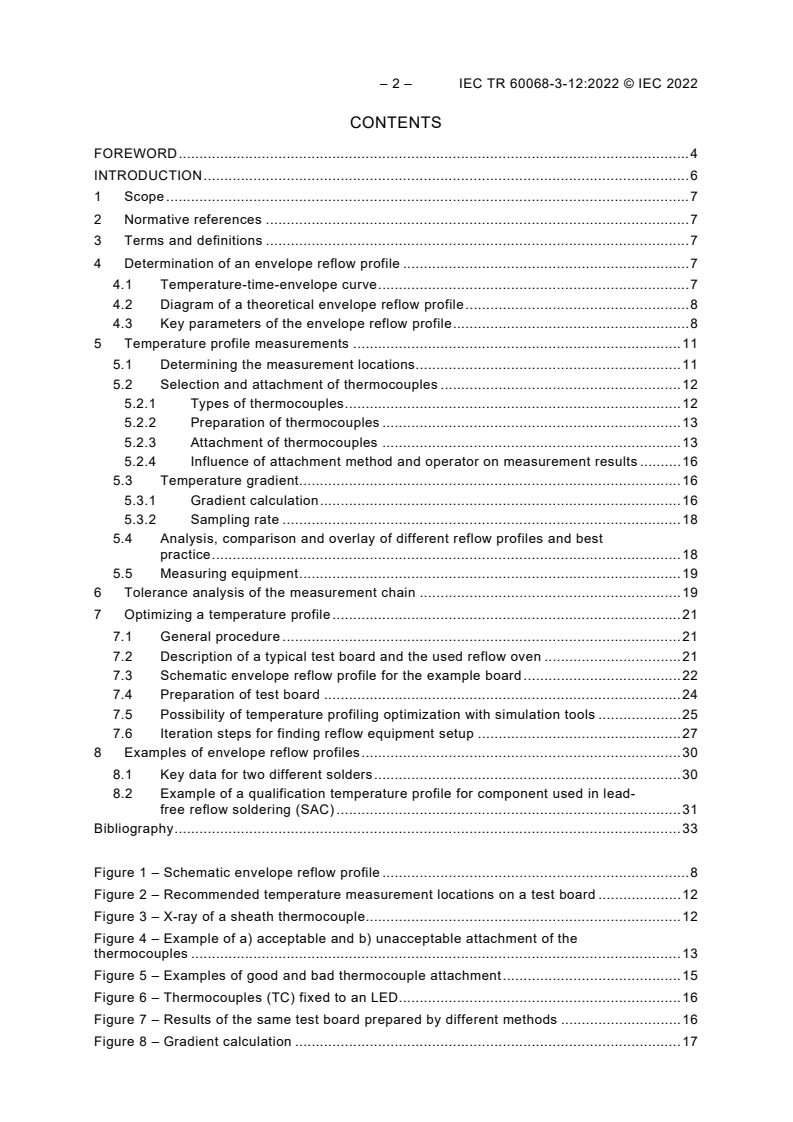
CONTENTS
FOREWORD . 4
INTRODUCTION . 6
1 Scope . 7
2 Normative references . 7
3 Terms and definitions . 7
4 Determination of an envelope reflow profile . 7
4.1 Temperature-time-envelope curve . 7
4.2 Diagram of a theoretical envelope reflow profile . 8
4.3 Key parameters of the envelope reflow profile . 8
5 Temperature profile measurements . 11
5.1 Determining the measurement locations. 11
5.2 Selection and attachment of thermocouples . 12
5.2.1 Types of thermocouples . 12
5.2.2 Preparation of thermocouples . 13
5.2.3 Attachment of thermocouples . 13
5.2.4 Influence of attachment method and operator on measurement results . 16
5.3 Temperature gradient. 16
5.3.1 Gradient calculation . 16
5.3.2 Sampling rate . 18
5.4 Analysis, comparison and overlay of different reflow profiles and best
practice . 18
5.5 Measuring equipment . 19
6 Tolerance analysis of the measurement chain . 19
7 Optimizing a temperature profile . 21
7.1 General procedure . 21
7.2 Description of a typical test board and the used reflow oven . 21
7.3 Schematic envelope reflow profile for the example board . 22
7.4 Preparation of test board . 24
7.5 Possibility of temperature profiling optimization with simulation tools . 25
7.6 Iteration steps for finding reflow equipment setup . 27
8 Examples of envelope reflow profiles . 30
8.1 Key data for two different solders . 30
8.2 Example of a qualification temperature profile for component used in lead-
free reflow soldering (SAC) . 31
Bibliography . 33
Figure 1 – Schematic envelope reflow profile . 8
Figure 2 – Recommended temperature measurement locations on a test board . 12
Figure 3 – X-ray of a sheath thermocouple. 12
Figure 4 – Example of a) acceptable and b) unacceptable attachment of the
thermocouples . 13
Figure 5 – Examples of good and bad thermocouple attachment . 15
Figure 6 – Thermocouples (TC) fixed to an LED. 16
Figure 7 – Results of the same test board prepared by different methods . 16
Figure 8 – Gradient calculation . 17
Figure 9 – Example of a gradient calculation on a temperature-time curve . 18
Figure 10 – Overlay of different reflow profiles (origin at oven entry) . 19
Figure 11 – Overlay of different reflow profiles (overlap at start of peak zone) . 19
Figure 12 – Measurement chain . 20
Figure 13 – Description of a test board (electronic assembly) . 22
Figure 14 – Envelope reflow profile for the test board . 24
Figure 15 – Thermal images of the test board after cooling down from 150 °C . 24
Figure 16 – Geometric and thermal description of the test board . 26
Figure 17 – Geometric and thermal description of the reflow soldering equipment. 26
Figure 18 – Predicted reflow profile with help of simulation (blue band) . 27
Figure 19 – Overlay envelope curves of the temperature-time curves of three profiling
steps, 0201-chip solder joint . 29
Figure 20 – Overlay envelope curves of the temperature-time curves of three profiling
steps, ERU25 solder joint . 30
Figure 21 – Exemplary qualification reflow temperature profile for the qualification of
components intended for use in assemblies with a wide variation of thermal masses . 32
Table 1 – Temperature-time curve – Units . 8
Table 2 – Envelope points of a reflow temperature-time-profile . 9
Table 3 – Thermocouple attachment methods . 14
Table 4 – Tolerances of the temperature measurement chain . 20
Table 5 – Envelope points at the envelope reflow profile for the test board . 23
Table 6 – Measurement locations on the sample assembly . 25
Table 7 – Settings according to experience . 28
Table 8 – Measurement results for the settings from Table 7 . 28
Table 9 – Settings for second run . 28
Table 10 – Measurement results for the settings from Table 9 . 28
Table 11 – Settings after adjustment of the heating zone temperatures . 29
Table 12 – Measurement results from Table 11, adaptation of heating zone
temperatures . 29
Table 13 – Examples for envelope reflow profile key data for two different solders . 31
Table 14 – Key parameters for a lead-free SAC reflow temperature profile for
component qualification . 32
– 4 – IEC TR 60068-3-12:2022 © IEC 2022
INTERNATIONAL ELECTROTECHNICAL COMMISSION
____________
ENVIRONMENTAL TESTING –
Part 3-12: Supporting documentation and guidance –
Method to evaluate a possible lead-free solder reflow temperature profile
FOREWORD
1) The International Electrotechnical Commission (IEC) is a worldwide organization for standardization comprising
all national electrotechnical committees (IEC National Committees). The object of IEC is to promote international
co-operation on all questions concerning standardization in the electrical and electronic fields. To this end and
in addition to other activities, IEC publishes International Standards, Technical Specifications, Technical Reports,
Publicly Available Specifications (PAS) and Guides (hereafter referred to as “IEC Publication(s)”). Their
preparation is entrusted to technical committees; any IEC National Committee interested in the subject dealt with
may participate in this preparatory work. International, governmental and non-governmental organizations liaising
with the IEC also participate in this preparation. IEC collaborates closely with the International Organization for
Standardization (ISO) in accordance with conditions determined by agreement between the two organizations.
2) The formal decisions or agreements of IEC on technical matters express, as nearly as possible, an international
consensus of opinion on the relevant subjects since each technical committee has representation from all
interested IEC National Committees.
3) IEC Publications have the form of recommendations for international use and are accepted by IEC National
Committees in that sense. While all reasonable efforts are made to ensure that the technical content of IEC
Publications is accurate, IEC cannot be held responsible for the way in which they are used or for any
misinterpretation by any end user.
4) In order to promote international uniformity, IEC National Committees undertake to apply IEC Publications
transparently to the maximum extent possible in their national and regional publications. Any divergence between
any IEC Publication and the corresponding national or regional publication shall be clearly indicated in the latter.
5) IEC itself does not provide any attestation of conformity. Independent certification bodies provide conformity
assessment services and, in some areas, access to IEC marks of conformity. IEC is not responsible for any
services carried out by independent certification bodies.
6) All users should ensure that they have the latest edition of this publication.
7) No liability shall attach to IEC or its directors, employees, servants or agents including individual experts and
members of its technical committees and IEC National Committees for any personal injury, property damage or
other damage of any nature whatsoever, whether direct or indirect, or for costs (including legal fees) and
expenses arising out of the publication, use of, or reliance upon, this IEC Publication or any other IEC
Publications.
8) Attention is drawn to the Normative references cited in this publication. Use of the referenced publications is
indispensable for the correct application of this publication.
9) Attention is drawn to the possibility that some of the elements of this IEC Publication may be the subject of patent
rights. IEC shall not be held responsible for identifying any or all such patent rights.
IEC TR 60068-3-12 has been prepared by IEC technical committee 91: Electronics assembly
technology. It is a Technical Report.
This third edition cancels and replaces the second edition published in 2014. This edition
constitutes a technical revision.
This edition includes the following significant technical changes with respect to the previous
edition:
a) Extended purpose
Guidance is added on how to create a reflow profile considering the tolerances resulting
from the accuracy of the measuring equipment, preparation method and specifications of
the component manufacturers (components, PCB, solder paste, etc.).
b) Distinction from existing standards
The envelope profile given in this document does not represent a temperature-time profile
for the qualification of materials but defines the reflow process limits for the soldering of
electronic assemblies.
The schematic temperature-time-limit curves of the envelope profile are derived from
generally valid findings (literature data). Additionally, tolerance considerations are given for
all envelope points of the envelope profile.
In contrast to IEC TR 60068-3-12:2014, the creation of the envelope profile is not primarily
linked to a concrete example.
c) Subclause 8.2 presents an approach for establishing a possible temperature profile for a
lead-free reflow soldering process using SnAgCu solder paste that is taken from
IEC TR 60068-3-12:2014.
d) Synergies with existing standards
Limit values and tolerances from standards and guidelines for the qualification of materials
are included in this document and are listed as examples in the references.
The text of this Technical Report is based on the following documents:
Draft Report on voting
91/1776/DTR 91/1804/RVDTR
Full information on the voting for its approval can be found in the report on voting indicated in
the above table.
The language used for the development of this Technical Report is English.
This document was drafted in accordance with ISO/IEC Directives, Part 2, and developed in
accordance with ISO/IEC Directives, Part 1 and ISO/IEC Directives, IEC Supplement, available
at www.iec.ch/members_experts/refdocs. The main document types developed by IEC are
described in greater detail at www.iec.ch/standardsdev/publications.
A list of all parts in the IEC 60068 series, published under the general title Environmental testing,
can be found on the IEC website.
The committee has decided that the contents of this document will remain unchanged until the
stability date indicated on the IEC website under "http://webstore.iec.ch" in the data related to
the specific document. At this date, the document will be
• reconfirmed,
• withdrawn,
• replaced by a revised edition, or
• amended.
IMPORTANT – The "colour inside" logo on the cover page of this document indicates that it
contains colours which are considered to be useful for the correct understanding of its
contents. Users should therefore print this document using a colour printer.
– 6 – IEC TR 60068-3-12:2022 © IEC 2022
INTRODUCTION
The enormous variety of materials and components processed in SMT requires to consider their
thermal properties, especially in reflow soldering.
Since the second edition essentially limited its focus to lead-free soldering, there is a need to
extend the contents in order to cover state of the art reflow soldering processes in general.
Reflow soldering is a joining process using an additional metal (solder) with a liquidus
temperature of 450 °C or less, in which solder paste or preforms are reflowed
(see ISO 857-2:2005).
Reflow soldering can be carried out with the technical processes of convection (air or nitrogen),
condensation (vapour phase), radiation (e.g. infrared) or contact heat as well as with the help
of low pressure (vacuum).
The goal of a qualified reflow soldering process is to create high quality and reliable solder
joints at product level. It is important to avoid soldering defects and damage to components and
printed circuit board.
In addition to the requirements for the formation of reliable solder joints, the specifications of
the connection partners and the production requirements (temperatures, final layers, alloys,
etc.), an adequate process control is an important factor. Primarily the resistance of the
components and circuit boards to solder heat, as well as the specifications of the solder paste
and/or flux, need to be considered. The sum of these physical limits is a theoretical temperature-
time curve for a specific product (see DVS 2613).
This document is intended for engineers (e.g. development, manufacturing technology, work
preparation) and operators (production) responsible for the creation and release of
temperature-time (T-t) profiles for reflow soldering in surface mount technology.
This document initially was prepared by the German DKE GUK 682.2 "Thermal joining
technology in electronics".
ENVIRONMENTAL TESTING –
Part 3-12: Supporting documentation and guidance –
Method to evaluate a possible lead-free solder reflow temperature profile
1 Scope
This part of IEC 60068, which is a Technical Report, describes the creation of temperature-time
profiles (in specific envelope profiles) for reflow soldering of electronic assemblies, considering
tolerances resulting from the accuracy of the measuring equipment, preparation method and
specifications of the manufacturers of components, circuit boards, solder paste, etc.).
The envelope profile given in this document does not represent a temperature-time profile for
qualification but defines the reflow process window for the soldering of electronic assemblies.
Qualification profiles can be found, for example, in IEC 60068-2-58 for resistance to soldering
heat, or in IEC 60749-20, IEC 61760-4 and IPC/JEDEC J-STD-020E for moisture sensitivity
classification of components.
2 Normative references
There are no normative references in this document.
3 Terms and definitions
No terms and definitions are listed in this document.
ISO and IEC maintain terminological databases for use in standardization at the following
addresses:
• IEC Electropedia: available at http://www.electropedia.org/
• ISO Online browsing platform: available at http://www.iso.org/obp
4 Determination of an envelope reflow profile
4.1 Temperature-time-envelope curve
According to IEC 61191-1:2018, 8.2.2, manufacturers of electronic assemblies need to
determine the parameters of a soldering process as follows:
"The process shall include, as a minimum, a reproducible time/temperature envelope
including the drying/degassing operation (when required), preheating operation (when
required), solder reflow operation, and a cooling operation."
The necessary envelope points for the creation of a temperature-time-envelope curve result
from the respective minima and maxima of the data for the solder heat resistance of the
components and PCBs, their minimum solderability temperatures, as well as from the
specifications of the solder paste and/or flux. The cycle time (time per electronic assembly) and
the process time (T to T end) influence each other.
0 3
The temperature-time curve is described by the units in Table 1.
– 8 – IEC TR 60068-3-12:2022 © IEC 2022
Table 1 – Temperature-time curve – Units
Physical quantity Symbol Units Remark
Temperature T °C or K ∆T, Temperature differences in kelvin (K)
1 K = 1 °C
0 °C = 273,15 K
Time t s or min
Gradient G K/s ∆T/∆t
4.2 Diagram of a theoretical envelope reflow profile
Figure 1 shows the maximum (upper line in red) and minimum (bottom line in green) theoretical
temperature-time curves for a reflow soldering process with all envelope points defining these
two curves. The reflow soldering profile measured in each case is expected to be located within
the boundaries of the envelope profile, as shown in Figure 1.
NOTE The calculation of gradients is described in 5.3.
Figure 1 – Schematic envelope reflow profile
4.3 Key parameters of the envelope reflow profile
Table 1 describes the main requirements for setting the envelope points for defining the upper
and lower limits of an envelope reflow profile.
The envelope points take into account material-specific data, in particular the resistance to
soldering heat, as well as findings for the reliable formation of the solder joints (alloy properties,
microstructure formation, etc.). Therefore, there are, for example, temperature-time curves
which are measured on the components (soldering heat resistance) and temperature-time
curves which are measured on or in the solder joint (soldering). In addition, the manufacturing
expectations regarding the cycle time of the individual product need to be taken into account.
The "Tolerance" column in Table 2 needs to be completed by the manufacturer of the electronic
assemblies. The measurement errors are treated as "inset" limits, which means that the
estimated measurement error (e.g. 5 K for the temperature measurement chain) is subtracted
from the upper limit values, and added to the lower limit values. This is to ensure that the limit
values cannot be exceeded.
In the "Comment" column in Table 2, corresponding notes are given for each parameter.
Table 2 – Envelope points of a reflow temperature-time-profile
Envelope point Explanation Typical value Tolerance Comment
T, temperature (y-axis)
T T > room
Start Reference temperature to determine the
0 0
temperature reflow profile.
temperature
Temperature is significantly above room
Typical: 50 °C
temperature – consider the production needs.
Temperature at which the recording begins.
T Lower +5 K Consider solder paste recommendations and
preheating needs of PCB-Assembly.
temperature
IEC 61760-1:2020, 6.2.2
IPC/JEDEC J-STD-020E: T (s = soak)
smin
T Upper −5 K Consider solder paste recommendations and
preheating needs of PCB-Assembly.
temperature
IEC 61760-1:2020, 6.2.2
IPC/JEDEC J-STD-020E: T (s = soak)
smax
T Liquidus Note the difference between solidus and
temperature liquidus temperature. The solder alloy is
completely fluid (liquidus temperature).
Consider solder paste recommendations.
IEC 61760-1:2020, 6.2.2
IPC/JEDEC J-STD-020E): T (T = liquidus
L L
temperature
T Maximum peak T is below the The maximum peak temperature is either the
Pmax P
temperature maximum allowed temperature at the
classification
termination (e.g. dissolution of metallization)
temperature T (i.e.
C
or the maximum temperature measured on
the max. soldering
the package top side (e.g. moisture/reflow
temperature T of
sensitivity of non-hermetic components).
the component)
IEC 61760-1:2020, 6.2.2: T
T = T – 5 K
pmax C
IEC 60068-2-58:2015, 7.6.4.4: T
IPC/JEDEC J-STD-020E: T
P
Consider: T = T – 5K,
P C
T : classification temperature
C
IPC TM 650 2.6.27A
T Minimum peak T + 15 K The minimum peak temperature is normally
pmin 3
temperature the temperature at the termination of the
component (solder joint). Reaching the
minimum peak temperature enables the
solderability.
IEC 60068-2-58:2015, 6.6.5
IPC-7093, IPC-7095,
IPC/JEDEC J-STD-020E
T = (T + 15 K)
pmin 3
– 10 – IEC TR 60068-3-12:2022 © IEC 2022
Envelope point Explanation Typical value Tolerance Comment
T End Reference temperature to determine the end
E
temperature of the reflow profile.
Temperature is significantly below the solidus
temperature. Consider the production needs.
Temperature at which the calculation ends.
t, time (x-axis)
t
Min. preheating Minimum time between T and T
1min
1 2
time
Consider that t is part of the time to peak.
Consider solder paste and component
recommendations.
IEC 61760-1:2020, 6.2.2
t Max. preheating Maximum time between T and T
1max 1 2
time
Consider that t is part of the time to peak.
Consider solder paste and component
recommendations.
IEC 61760-1:2020, 6.2.2
t Process time
from T to T
0 3
(end of peak)
t Min. time above
Typical: ≥ 30 s Time above T
3min
liquidus
Consider the solder alloy recommendations.
temperature
t in IEC 61760-1 and IEC 60068-2-58
t in IPC/JEDEC J-STD-020E
L
Additional reference: DVS 2613
t Max. time above Typical: ≤ 90 s Time above T
3max 3
liquidus
temperature Consider the component recommendation.
Additional reference: DVS 2613
t Time to peak Time between T and T
4 0 P
Process time
Consider the solder paste recommendation
from T to T
and component specification.
0 P
t in IEC 61760-1 and IEC 60068-2-58
t Time on peak Corresponding to Consider the component specification.
the component
The heat resistance of components limits t .
specification (T ) 5
C
IPC/JEDEC J-STD-020E, Time (t )* within
p
5 K of the specified classification
temperature (T )
C
t in IEC 61760-1 and IEC 60068-2-58
Ramp rate
G, gradient ∆T∕∆t
See the instructions of the component and
material suppliers.
G Max. heating −0,5 K/s Consider the solder paste and component
gradient to T , recommendation
preheating
IEC 61760-1:2020, 6.2.2
G Max. heating −0,5 K/s Consider the component recommendation
gradient from T
IEC 61760-1:2020, 6.2.2,
to T
4 IPC/JEDEC J-STD-020E
Max ramp-up rate (3 K/s)
Envelope point Explanation Typical value Tolerance Comment
G Max. cooling +0,5 K/s The cooling gradient is negative therefore the
gradient from T
tolerance is positive.
to T
Consider the component recommendation.
IEC 61760-1:2020, 6.2.2,
IPC/JEDEC J-STD-020E
Max. ramp-down rate (−6 K/s)
G Max. cooling +1 K/s The cooling gradient is negative therefore the
gradient from T tolerance is positive.
to T
E Consider the component recommendation for
cooling. The cooling gradient below liquidus
temperature is not separately specified in
IPC/JEDEC J-STD-020E and
IEC 60068-2-58.
5 Temperature profile measurements
5.1 Determining the measurement locations
The temperature-time profile is measured product-specific on a real assembly (electronic
assembly).
Figure 2 shows a schematic view of important measurement locations.
The following items are essential for the determination of the measurement locations.
– Position of the large and small thermal mass.
NOTE Here not only components are in focus, but also the areas on the test board with the largest and smallest
thermal demands.
– Materials or components with critical solder heat resistance (e.g. electrolytic capacitors,
optical components, sensors).
– The PCB material.
– Distinction between the solder joint and the position at the top of the package, which
essentially describes the solder heat resistance.
– Thermocouples can be required on both sides of the measurement assembly, especially if
the reflow soldering machine is equipped with top and bottom side heating.
– By means of the atmospheric temperature, information about the thermal interaction
between the measuring assembly and the reflow soldering machine can be collected.
However, it is not absolutely necessary for product profiling.
– Measuring points are limited to an essential number.
– The available channels of the data logger need to be considered.
– When contacting the thermocouples, the added thermal mass at the measurement location
is minimized. This is especially important when testing small components.
Generally, the temperature drops near the transport chains, especially when measuring close
to the CBS (centre board support).
PCB areas without components show the highest temperatures. This also applies for
measurements on the package top side of the highest components.
To determine the position of the large and small thermal masses on the test board, a thermal
imaging camera can be helpful. For this purpose, the test board is warmed up to a uniform
temperature, e.g. 150 °C, by a heat chamber, and then the cooling behaviour of the board is
observed. A large thermal mass will cool down more slowly than a small thermal mass.
– 12 – IEC TR 60068-3-12:2022 © IEC 2022
Key
T temperature on solder joint on sensitive component
Pmin (sensitive)
T temperature on the package top side
Pmax (sensitive)
T temperature on solder joint on smallest thermal mass
Pmin (small mass)
T temperature on solder joint on biggest thermal mass
Pmin (big mass)
T temperature on the package top side
Pmax (big mass)
T maximum temperature on PCB surface
Pmax (PCB)
T temperature approximately 6 mm above PCB surface
Atmosphere
Figure 2 – Recommended temperature measurement locations on a test board
5.2 Selection and attachment of thermocouples
5.2.1 Types of thermocouples
For reflow measurement applications NiCrNi K-type thermocouples are typically used, with a
limiting error of 1,5 K (see IEC 60584-1:2013, Table 12).
The use of sheath thermocouples can be a reasonable alternative to non-mantled types, which
visibly consist of only one wire and are therefore much easier to apply (Figure 3). Since the
components and their solder joints are becoming smaller and smaller, the thinnest possible wire
diameters are preferred (e.g. sheath thermocouples ø0,25 mm), which also have shorter
response times. The temperature resistance of the insulation material and connector material
(often recognizable by the colour or colour coding), which needs to withstand multiple reflow
passes in the soldering system, is also important, as well as sufficient strain relief. A clear
labelling of the measurement location and of the thermocouple connector is of advantage.
SOURCE: Trainalytics GmbH, Lippstadt 2019. Reproduced with permission.
Figure 3 – X-ray of a sheath thermocouple
It is important that the size of the thermocouple (wire diameter, etc.) corresponds to the
measurement location and that the thermocouple itself does not significantly distort the thermal
mass at the measurement location (Figure 4).
5.2.2 Preparation of thermocouples
Prior to installation, the thermocouples need to be checked thoroughly to avoid damage during
installation. For more information, see IPC-7801, Section 7.
It is important that the two exposed thermocouple wires do not touch each other up to the point
of connection (weld). Twisting of the thermocouple wires would shift the measurement location
and falsify the measurement results (Figure 4).
a) Good example b) Rejectable because of twisted wires
SOURCE: ERSA GmbH, Wertheim 2019. Reproduced with permission.
Figure 4 – Example of a) acceptable and b) unacceptable attachment of the
thermocouples
5.2.3 Attachment of thermocouples
Both, DVS 2613, 3.3 Preparation and IPC-7801, 7.5 contain valuable information on fixing the
thermocouples on the measuring assembly. Table 3 summarizes the main preparation methods
with their advantages and disadvantages.
When using adhesives for thermocouple attachment, the thermal energy will most likely be
conducted at least partially through the adhesive. The adhesive needs to be therefore thermally
conductive itself so as not to falsify the measurement result, IPC-7530A. A minimum value of
0,4 W/mK is stated by the IPC-CA-82.
– 14 – IEC TR 60068-3-12:2022 © IEC 2022
Table 3 – Thermocouple attachment methods
Preparation method Advantages Disadvantages
Polyimide tape Fast preparation Weak fixing, thermocouple usually
holds only one reflow pass
Multiple use of the thermocouples
possible Big measurement errors to be
expected
Aluminium tape Fast preparation Expensive
High adhesive force, therefore, The thermal mass is additionally
increased (especially for small
several reflow passes possible
components)
Multiple use of the thermocouples
possible
Good measurement results to be
expected
Thermal conductive paste Good measurement results to be Preparation requires practice and
expected skill, thermocouples require
additional fixing (e.g. wire)
Paste not always available, and
expensive
SMD adhesive Good measurement results to be Multiple use of the thermocouples
expected hardly possible
SMD adhesives mostly available Too much adhesive falsifies the
measuring results
High adhesive strength, therefore
several reflow passes possible Preparation requires practice and
skill
Soldering with high-temperature Good measurement results to be Multiple use of the thermocouples
solder expected hardly possible
Mechanically stable, therefore Preparation requires practice and
several reflow passes possible skill
High-temperature solder is not
always available, and solderable
surfaces are also required, which
is hardly possible with
thermocouples.
[SOURCE: Rehm, Thermal Systems GmbH, Blaubeuren 2019. Reproduced with permission.]
Figure 5 shows good and bad examples of how to fix thermocouples to the board with SMD
adhesive and polyimide tape.
Good example
Because:
1) Thermocouple is in contact with measurement
location
2) Thermocouple is at 90° to component axis on
measurement location
3) acceptable amount of adhesive
Bad example
Because:
1) Excesive SMD adhesive
2) Thermocouple is attached in the axial component (or
lead) direction on measurement location
Bad example
Because:
1) Thermocouple is not in contact with measurement
location.
2) Thermocouple is attached in the axial component (or
lead) direction on measurement point.
3) Twisted wires, see Figure 4.
4) Polyimide tape does not fit properly: too much space
between the tape, thermocouple and PCB.
SOURCE: Rehm, Thermal Systems GmbH, Blaubeuren 2019. Reproduced with permission.
Figure 5 – Examples of good and bad thermocouple attachment
To fix thermocouples to LEDs demands special care. LED manufacturers provide important
information on this in their LED specifications and accompanying documents. An example is
shown in Figure 6.
– 16 – IEC TR 60068-3-12:2022 © IEC 2022
SOURCE: OSRAM, Measuring of the Temperature Profile during the Reflow Solder Process, Application Note, 2013.
Reproduced with permission.
Figure 6 – Thermocouples (TC) fixed to an LED
5.2.4 Influence of attachment method and operator on measurement results
Figure 7 shows the results of field measurements of the same test board prepared by different
persons with the respective methods.
a) measurement location on the package top side b) solder joint of an electrolytic capacitor
Shown are mean values and standard deviations.
Samples were prepared by more than 100 persons.
SOURCE: Rehm, Thermal Systems GmbH, Blaubeuren 2019. Reproduced with permission.
Figure 7 – Results of the same test board prepared by different methods
5.3 Temperature gradient
5.3.1 Gradient calculation
The principle of gradient calculation is shown in Figure 8.
The gradient G is the slope ∆T∕∆t of the line through The gradient changes with the change of the time interval
points (t , T ) and (t , T ) ∆t.
1 1 2 2
NOTE The time interval ∆t can usually be set in the
software of the data loggers used.
SOURCE: OSRAM, Measuring of the Temperature Profile during the Reflow Solder Process, Application Note, 2013.
Reproduced with permission.
Figure 8 – Gradient calculation
Figure 9 shows an example of how the calculated gradient of a cooling curve changes when the
time interval ∆t is changed from 5 s to 10 s or 20 s. The maximum gradient of this curve is
calculated for the point (339 s, 150 °C) and an interval length of 5 s. The calculations with the
longer interval lengths result in flatter gradients of 5,7 K/s and 4,1 K/s.
– 18 – IEC TR 60068-3-12:2022 © IEC 2022
Figure 9 – Example of a gradient calculation on a temperature-time curve
5.3.2 Sampling rate
Electronic data loggers offer the possibility to set the sampling rate (measuring clock, measuring
frequency, sampling interval) and the interval length. Changing these settings has
consequences for the calculation of the gradient, as already shown in Figure 9.
By means of a correlation analysis it could be proven that an interval length ∆t of 10 s is best
suitable. 5 s is the lower reasonable limit. For an interval length of 5 s, a sampling rate of 0,1 s
is best suitable. For an interval length of 10 s, an increase of the sampling rate from 0,1 s to
0,2 s is not critical. A sampling rate greater than 0,2 s is not advisable.
Conclusion: Interval length 10 s, sampling rate 0,1 s had best results.
This conclusion is based on the following assumptions.
– There is a proper fixing of the thermocouples. Otherwise, the measurement results would
be close to an "air measurement".
– Systematic measurement errors, which are always present with thermocouples, are
irrelevant in gradient determination and are not included here.
– There are no random measuring errors at the measuring device (data logger).
– Fluctuations of the reflow soldering system and/or heat transfer within the measuring interval
remain unconsidered.
5.4 Analysis, comparison and overlay of different reflow profiles and best practice
The following examples demonstrate best practice when different reflow profiles need to be
analysed.
If the starting point for all profiles is at a fixed point like the reflow oven entry, it is hard to
compare the main profile features (see Figure 10).
Figure 10 – Overlay of different reflow profiles (origin at oven entry)
When evaluating temperature-time profiles of several measurement location points of an
electronic assembly, it is helpful for comparison to align these profiles according to their
maximum temperature.
The different profile curves need to be shifted on the time axis to create an overlay in the peak
temperature zones as shown in Figure 11.
Figure 11 – Overlay of different reflow profiles (overlap at start of peak zone)
In this case it can be confirmed whether all temperature-time curves of the respective
measurement locations are located within the defined envelope profile.
5.5 Measuring equipment
Requirements for thermocouples, data logger and accessories are described in IPC-7801.
6 Tolerance analysis of the measurement chain
The selected thermocouples create a continuous measurement chain with the data logger. A
calibrated data logger is a pre-requisite. The requirements for the data logger are described in
IPC-7801, Section 6, which requires an accuracy of the measuring equipment after calibration
of ±2 K.
– 20 – IEC TR 60068-3-12:2022 © IEC 2022
Figure 12 – Measurement chain
The entire measurement chain shown in Figure 12 is influenced by the following factors:
– the control behaviour of the reflow soldering system, which is a process fluctuation and
cannot be influenced by the user. Strictly speaking, it is not part of the characterization of
the measurement chain; however, it does result in fluctuations in heat transfer;
– the measuring system, which consists of the prepared test board, the attached
thermocouples, and the connected data logger;
– the transfer of the data to a final PC software.
The respective tolerances are explained in Table 4.
Table 4 – Tolerances of the temperature measurement chain
Link of the measuring Measurement differences Remark, source
chain in kelvin (K)
Best case Usual
Reflow equipment
Control behaviour ±0,5 K ±1 K Field experience
In IPC-7801, 10.4, ±2 K is required after calibration
Homogeneous heat ±1,5 K ±2,5 K Field experience and user specifications
transfer
Mostly influenced by the so-called cross profile
(measured over the transport width of the reflow
soldering machine)
Test board
Attachment of the ±2,0 K ±5,0 K Field experience
thermocouple on the
Fixing of the thermocouple with SMD adhesive or
measuring assembly
aluminium tape
Thermocouple ±0,5 K ±1,5 K IEC 60584-1:2013, Table 12, specifications and
tolerances.
Data recording unit ±0,5 K ±0,5 K General information of the manufacturers
PC software Here, particular attention is paid to the radio
transmission of the measuring data to complete data
transfer.
Under best conditions (proper p
...