

IEC 60068-2-21:2021
(Main)Environmental testing - Part 2-21: Tests - Test U: Robustness of terminations and integral mounting devices
General Information
- Abstract
IEC 60068-2-21:2021 is applicable to all electrical and electronic components whose terminations or integral mounting devices are liable to be submitted to stresses during normal assembly or handling operations and is also applicable to surface mount devices (SMDs).
This seventh edition cancels and replaces the sixth edition, published in 2006, and IEC 60068‑2‑77:1999. This edition constitutes a technical revision. This edition includes the following significant technical changes with respect to the previous edition:
integration of parts of IEC 60068-2-77 (see Annex X); IEC 60068-2-77 is withdrawn with the publication of this document;
Annex X is added to show the correlation of the clauses and subclauses in this edition of IEC 60068-2-21 with the clauses in IEC 60068-2-21:2006 and IEC 60068-2-77:1999.
- Status
- Published
- Publication Date
- 07-Jul-2021
- Technical Committee
- TC 91 - Electronics assembly technology
- Drafting Committee
- WG 3 - TC 91/WG 3
- Current Stage
- PPUB - Publication issued
- Start Date
- 08-Jul-2021
- Completion Date
- 13-Aug-2021
Overview
IEC 60068-2-21:2021 is an International Electrotechnical Commission (IEC) standard focused on environmental testing, specifically Test U, which assesses the robustness of terminations and integral mounting devices in electrical and electronic components. This seventh edition supersedes the 2006 sixth edition and the withdrawn IEC 60068-2-77:1999, presenting significant technical revisions and integration for enhanced applicability.
The standard applies to all electrical and electronic components that have terminations or integral mounting devices susceptible to mechanical stresses during normal assembly or handling. It is also relevant for surface mount devices (SMDs). The primary objective is to ensure these components maintain structural and functional integrity under mechanical stresses such as axial, bending, torsion, and torque forces, enhancing reliability in practical applications.
Key Topics
Test Ua: Robustness Against Axial Stresses
Evaluates how terminals withstand tensile and thrust forces with specific preconditioning and measurement protocols to ensure they can endure axial mechanical stress during handling and assembly.Test Ub: Robustness Against Bending Stresses
Covers the impact of bending forces on terminals, including pliable and rigid terminations. Methods include sequential bending tests designed to simulate real-world mechanical strain on leads and tags.Test Uc: Torsion
Focuses on the ability of terminals to resist twisting forces. The test procedures involve specimen preparation, application of torsional moments, and subsequent measurements.Test Ud: Torque
Examines threaded terminations or other configurations subject to torque. The standard specifies methods to test these components’ endurance under torque stresses related to fastening and mechanical operations.Test Ue: Robustness of SMD Terminations in the Mounted State
Addresses surface mount devices’ resilience to mechanical stresses such as substrate bending, pull-off, push-off, and shear forces. This test ensures that SMD components reliably survive typical production and operational stresses.Test Uf: Robustness of Component Body
Assesses component body strength and impact shock resistance, crucial for maintaining integrity during transportation and handling.Normative References and Specifications
Includes relevant terminology, preconditioning steps, test methods, and measurement procedures. Annex X provides cross-references to previous editions and withdrawn standards for clarity.
Applications
IEC 60068-2-21:2021 is crucial for manufacturers, quality assurance teams, and test engineers involved with electrical and electronic components requiring mechanical robustness validation. Specific applications include:
Component Design and Development
Designing terminals and integral mounting devices that meet mechanical durability requirements.Quality Assurance and Compliance Testing
Verifying that electrical and electronic components withstand mechanical stresses encountered during manufacturing, transportation, and operational use.Surface Mount Device (SMD) Assembly
Ensuring SMD components adhere reliably to substrates and maintain electrical and mechanical performance.Reliability Assessment in Harsh Environments
Testing components prone to mechanical handling stresses helps guarantee performance in demanding industrial, automotive, aerospace, and consumer electronics environments.Supplier and Vendor Qualification
Specifying and verifying component robustness as part of the procurement process to ensure consistency and durability.
Related Standards
When implementing IEC 60068-2-21:2021, consider the following related standards to complement robustness testing and environmental qualification:
IEC 60068 Series – A series of standards covering environmental testing for electrical and electronic equipment, including temperature, humidity, vibration, and shock tests.
IEC 60068-2-77 – Previously separate standard for robustness of terminations, now integrated into IEC 60068-2-21.
IEC 60999 – Standard concerning connection devices for electrical installations, relevant for termination provisions.
ISO 9001 – Quality management principles that often align with testing requirements for manufacturing consistency.
JEDEC and IPC Standards – Industry-specific norms for SMD handling and testing procedures.
Keywords: IEC 60068-2-21, environmental testing, robustness of terminations, integral mounting devices, mechanical stress testing, surface mount device (SMD) testing, axial stress, bending stress, torsion, torque testing, component reliability, electronic component durability, IEC standards, electrical testing protocols.
Relations
- Effective Date
- 05-Sep-2023
- Effective Date
- 05-Sep-2023
- Effective Date
- 05-Sep-2023
Get Certified
Connect with accredited certification bodies for this standard

IMP NDT d.o.o.
Non-destructive testing services. Radiography, ultrasonic, magnetic particle, penetrant, visual inspection.
Inštitut za kovinske materiale in tehnologije
Institute of Metals and Technology. Materials testing, metallurgical analysis, NDT.
Q Techna d.o.o.
NDT and quality assurance specialist. 30+ years experience. NDT personnel certification per ISO 9712, nuclear and thermal power plant inspections, QA/
Sponsored listings
Frequently Asked Questions
IEC 60068-2-21:2021 is a standard published by the International Electrotechnical Commission (IEC). Its full title is "Environmental testing - Part 2-21: Tests - Test U: Robustness of terminations and integral mounting devices". This standard covers: IEC 60068-2-21:2021 is applicable to all electrical and electronic components whose terminations or integral mounting devices are liable to be submitted to stresses during normal assembly or handling operations and is also applicable to surface mount devices (SMDs). This seventh edition cancels and replaces the sixth edition, published in 2006, and IEC 60068‑2‑77:1999. This edition constitutes a technical revision. This edition includes the following significant technical changes with respect to the previous edition: integration of parts of IEC 60068-2-77 (see Annex X); IEC 60068-2-77 is withdrawn with the publication of this document; Annex X is added to show the correlation of the clauses and subclauses in this edition of IEC 60068-2-21 with the clauses in IEC 60068-2-21:2006 and IEC 60068-2-77:1999.
IEC 60068-2-21:2021 is applicable to all electrical and electronic components whose terminations or integral mounting devices are liable to be submitted to stresses during normal assembly or handling operations and is also applicable to surface mount devices (SMDs). This seventh edition cancels and replaces the sixth edition, published in 2006, and IEC 60068‑2‑77:1999. This edition constitutes a technical revision. This edition includes the following significant technical changes with respect to the previous edition: integration of parts of IEC 60068-2-77 (see Annex X); IEC 60068-2-77 is withdrawn with the publication of this document; Annex X is added to show the correlation of the clauses and subclauses in this edition of IEC 60068-2-21 with the clauses in IEC 60068-2-21:2006 and IEC 60068-2-77:1999.
IEC 60068-2-21:2021 is classified under the following ICS (International Classification for Standards) categories: 19.040 - Environmental testing; 31.190 - Electronic component assemblies. The ICS classification helps identify the subject area and facilitates finding related standards.
IEC 60068-2-21:2021 has the following relationships with other standards: It is inter standard links to IEC 60068-2-77:1999, IEC 60068-2-21:2006/COR1:2012, IEC 60068-2-21:2006. Understanding these relationships helps ensure you are using the most current and applicable version of the standard.
IEC 60068-2-21:2021 is available in PDF format for immediate download after purchase. The document can be added to your cart and obtained through the secure checkout process. Digital delivery ensures instant access to the complete standard document.
Standards Content (Sample)
IEC 60068-2-21 ®
Edition 7.0 2021-07
INTERNATIONAL
STANDARD
NORME
INTERNATIONALE
Environmental testing –
Part 2-21: Tests – Test U: Robustness of terminations and integral mounting
devices
Essais d’environnement –
Partie 2-21: Essais – Essai U: Robustesse des sorties et des dispositifs de
montage incorporés
All rights reserved. Unless otherwise specified, no part of this publication may be reproduced or utilized in any form
or by any means, electronic or mechanical, including photocopying and microfilm, without permission in writing from
either IEC or IEC's member National Committee in the country of the requester. If you have any questions about IEC
copyright or have an enquiry about obtaining additional rights to this publication, please contact the address below or
your local IEC member National Committee for further information.
Droits de reproduction réservés. Sauf indication contraire, aucune partie de cette publication ne peut être reproduite
ni utilisée sous quelque forme que ce soit et par aucun procédé, électronique ou mécanique, y compris la photocopie
et les microfilms, sans l'accord écrit de l'IEC ou du Comité national de l'IEC du pays du demandeur. Si vous avez des
questions sur le copyright de l'IEC ou si vous désirez obtenir des droits supplémentaires sur cette publication, utilisez
les coordonnées ci-après ou contactez le Comité national de l'IEC de votre pays de résidence.
IEC Central Office Tel.: +41 22 919 02 11
3, rue de Varembé info@iec.ch
CH-1211 Geneva 20 www.iec.ch
Switzerland
About the IEC
The International Electrotechnical Commission (IEC) is the leading global organization that prepares and publishes
International Standards for all electrical, electronic and related technologies.
About IEC publications
The technical content of IEC publications is kept under constant review by the IEC. Please make sure that you have the
latest edition, a corrigendum or an amendment might have been published.
IEC publications search - webstore.iec.ch/advsearchform IEC online collection - oc.iec.ch
The advanced search enables to find IEC publications by a Discover our powerful search engine and read freely all the
variety of criteria (reference number, text, technical publications previews. With a subscription you will always
committee, …). It also gives information on projects, replaced have access to up to date content tailored to your needs.
and withdrawn publications.
Electropedia - www.electropedia.org
IEC Just Published - webstore.iec.ch/justpublished
The world's leading online dictionary on electrotechnology,
Stay up to date on all new IEC publications. Just Published
containing more than 22 000 terminological entries in English
details all new publications released. Available online and
and French, with equivalent terms in 18 additional languages.
once a month by email.
Also known as the International Electrotechnical Vocabulary
(IEV) online.
IEC Customer Service Centre - webstore.iec.ch/csc
If you wish to give us your feedback on this publication or
need further assistance, please contact the Customer Service
Centre: sales@iec.ch.
A propos de l'IEC
La Commission Electrotechnique Internationale (IEC) est la première organisation mondiale qui élabore et publie des
Normes internationales pour tout ce qui a trait à l'électricité, à l'électronique et aux technologies apparentées.
A propos des publications IEC
Le contenu technique des publications IEC est constamment revu. Veuillez vous assurer que vous possédez l’édition la
plus récente, un corrigendum ou amendement peut avoir été publié.
Recherche de publications IEC - IEC online collection - oc.iec.ch
webstore.iec.ch/advsearchform Découvrez notre puissant moteur de recherche et consultez
La recherche avancée permet de trouver des publications IEC gratuitement tous les aperçus des publications. Avec un
en utilisant différents critères (numéro de référence, texte, abonnement, vous aurez toujours accès à un contenu à jour
comité d’études, …). Elle donne aussi des informations sur adapté à vos besoins.
les projets et les publications remplacées ou retirées.
Electropedia - www.electropedia.org
IEC Just Published - webstore.iec.ch/justpublished
Le premier dictionnaire d'électrotechnologie en ligne au
Restez informé sur les nouvelles publications IEC. Just
monde, avec plus de 22 000 articles terminologiques en
Published détaille les nouvelles publications parues.
anglais et en français, ainsi que les termes équivalents dans
Disponible en ligne et une fois par mois par email.
16 langues additionnelles. Egalement appelé Vocabulaire
Electrotechnique International (IEV) en ligne.
Service Clients - webstore.iec.ch/csc
Si vous désirez nous donner des commentaires sur cette
publication ou si vous avez des questions contactez-nous:
sales@iec.ch.
IEC 60068-2-21 ®
Edition 7.0 2021-07
INTERNATIONAL
STANDARD
NORME
INTERNATIONALE
Environmental testing –
Part 2-21: Tests – Test U: Robustness of terminations and integral mounting
devices
Essais d’environnement –
Partie 2-21: Essais – Essai U: Robustesse des sorties et des dispositifs de
montage incorporés
INTERNATIONAL
ELECTROTECHNICAL
COMMISSION
COMMISSION
ELECTROTECHNIQUE
INTERNATIONALE
ICS 19.040; 31.190 ISBN 978-2-8322-9999-9
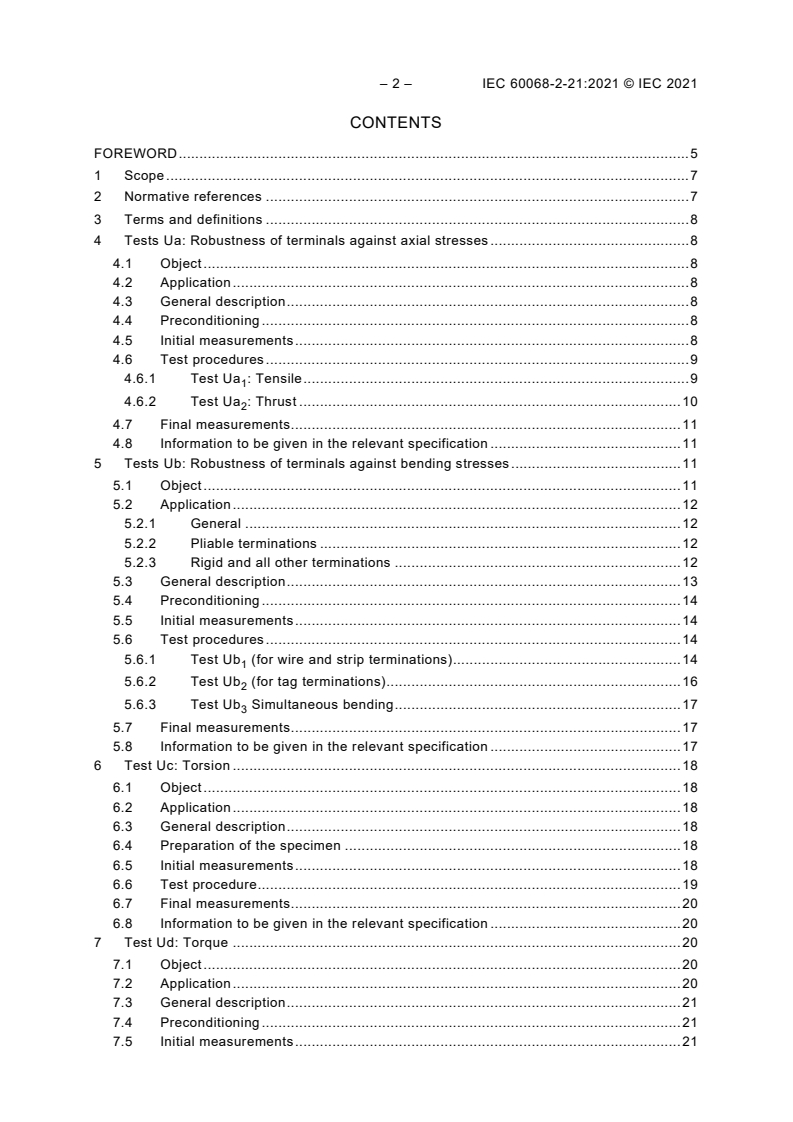
– 2 – IEC 60068-2-21:2021 © IEC 2021
CONTENTS
FOREWORD . 5
1 Scope . 7
2 Normative references . 7
3 Terms and definitions . 8
4 Tests Ua: Robustness of terminals against axial stresses . 8
4.1 Object . 8
4.2 Application . 8
4.3 General description . 8
4.4 Preconditioning . 8
4.5 Initial measurements . 8
4.6 Test procedures . 9
4.6.1 Test Ua : Tensile . 9
4.6.2 Test Ua : Thrust . 10
4.7 Final measurements . 11
4.8 Information to be given in the relevant specification . 11
5 Tests Ub: Robustness of terminals against bending stresses . 11
5.1 Object . 11
5.2 Application . 12
5.2.1 General . 12
5.2.2 Pliable terminations . 12
5.2.3 Rigid and all other terminations . 12
5.3 General description . 13
5.4 Preconditioning . 14
5.5 Initial measurements . 14
5.6 Test procedures . 14
5.6.1 Test Ub (for wire and strip terminations). 14
5.6.2 Test Ub (for tag terminations) . 16
5.6.3 Test Ub Simultaneous bending . 17
5.7 Final measurements . 17
5.8 Information to be given in the relevant specification . 17
6 Test Uc: Torsion . 18
6.1 Object . 18
6.2 Application . 18
6.3 General description . 18
6.4 Preparation of the specimen . 18
6.5 Initial measurements . 18
6.6 Test procedure . 19
6.7 Final measurements . 20
6.8 Information to be given in the relevant specification . 20
7 Test Ud: Torque . 20
7.1 Object . 20
7.2 Application . 20
7.3 General description . 21
7.4 Preconditioning . 21
7.5 Initial measurements . 21
7.6 Test procedure . 21
7.6.1 Terminations with threaded studs or screws . 21
7.6.2 Other test configurations. 23
7.7 Final measurements . 23
7.8 Information to be given in the relevant specification . 23
8 Test Ue: Robustness of terminations for SMD in the mounted state . 24
8.1 Object . 24
8.2 Application . 24
8.3 Substrate for test method Ue . 24
8.4 Mounting . 26
8.4.1 Dimensions . 26
8.4.2 Possible mounting methods . 26
8.4.3 Mounting method for substrate bending, pull-off, push-off and shear . 26
8.5 Preconditioning . 27
8.6 Initial measurements . 27
8.7 Test methods . 27
8.7.1 Test Ue : Substrate bending test . 27
8.7.2 Test Ue : Pull-off and push-off test . 28
8.7.3 Test Ue : Shear test . 30
8.8 Final measurements . 32
8.8.1 Recovery . 32
8.8.2 Visual examination of terminations . 32
8.8.3 Electrical characteristics . 32
8.8.4 Hidden defect . 32
8.9 Information to be given in the relevant specification . 32
9 Test Uf: Robustness of component body . 34
9.1 Object . 34
9.2 Application . 34
9.3 General description . 34
9.4 Preconditioning . 34
9.5 Initial measurement . 34
9.6 Test procedure . 34
9.6.1 Test Uf : Body strength . 34
9.6.2 Test Uf : Impact shock . 36
9.7 Final measurements . 38
9.7.1 Recovery . 38
9.7.2 Visual examination . 39
9.7.3 Electrical characteristics . 39
9.7.4 Hidden defect . 39
9.8 Information to be given in the relevant specification . 39
Annex X (informative) Cross-reference for references to the previous editions of this
document . 40
X.1 Cross-reference for references to the previous edition of IEC 60068‑2‑21 . 40
X.2 Cross-reference for references to the last edition of IEC 60068‑2‑77 . 41
Bibliography . 43
Figure 1 – Direction of the applied pull force F in test Ua . 9
p 1
– 4 – IEC 60068-2-21:2021 © IEC 2021
Figure 2 – Direction of the applied thrust F in test Ua . 10
t 2
Figure 3 – Displacement of pliable lead wires in test Ub . 12
Figure 4 – Bending force applied to a specimen with non-pliable terminations . 13
Figure 5 – Sequential test procedure of test Ub, Method 1 . 15
Figure 6 – Sequential test procedure of test Ub, Methods 2 and 3. 16
Figure 7 – Clamp for the testing of short terminations . 17
Figure 8 – Preparatory bending of a lead wire for test Uc . 18
Figure 9 – Torsion test method 1: Rotation of clamped specimen body . 19
Figure 10 – Torsion test method 2: Rotation of clamped other lead wire. 20
Figure 11 – Assembly for the torque test applied to a threaded stud . 22
Figure 12 – Preparation of a threaded termination for the torque test . 22
Figure 13 – Assembly for the torque test applied to an embedded nut . 23
Figure 14 – Example of substrate for test method Ue . 25
Figure 15 – Substrate bending test . 28
Figure 16 – Test Ue , pull-off test . 29
Figure 17 – Test Ue , push-off test . 30
Figure 18 – Test Ue , shear test . 31
Figure 19 – SMD Body strength test Uf applied to a rectangular specimen . 35
Figure 20 – SMD Body strength test Uf applied to a MELF specimen . 36
Figure 21 – Example of an apparatus for test Uf . 37
Figure 22 – Example of a piston . 37
Figure 23 – Examples of the application of the SMD Body impact shock test Uf . 38
Table 1 – Selection of test methods suitable for specific terminations/leads . 7
Table 2 – Value of applied pull force for test Ua . 10
Table 3 – Value of applied thrust for test Ua . 11
Table 4 – Value of applied force for test Ub . 13
Table 5 – Torque severity . 21
Table X.1 – Cross-reference to clauses . 40
Table X.2 – Cross-reference to figures . 41
Table X.3 – Cross reference to tables . 41
Table X.4 – Cross-reference to clauses . 42
Table X.5 – Cross-reference to figures . 42
INTERNATIONAL ELECTROTECHNICAL COMMISSION
____________
ENVIRONMENTAL TESTING –
Part 2-21: Tests – Test U: Robustness of
terminations and integral mounting devices
FOREWORD
1) The International Electrotechnical Commission (IEC) is a worldwide organization for standardization comprising
all national electrotechnical committees (IEC National Committees). The object of IEC is to promote international
co-operation on all questions concerning standardization in the electrical and electronic fields. To this end and
in addition to other activities, IEC publishes International Standards, Technical Specifications, Technical Reports,
Publicly Available Specifications (PAS) and Guides (hereafter referred to as “IEC Publication(s)”). Their
preparation is entrusted to technical committees; any IEC National Committee interested in the subject dealt with
may participate in this preparatory work. International, governmental and non-governmental organizations liaising
with the IEC also participate in this preparation. IEC collaborates closely with the International Organization for
Standardization (ISO) in accordance with conditions determined by agreement between the two organizations.
2) The formal decisions or agreements of IEC on technical matters express, as nearly as possible, an international
consensus of opinion on the relevant subjects since each technical committee has representation from all
interested IEC National Committees.
3) IEC Publications have the form of recommendations for international use and are accepted by IEC National
Committees in that sense. While all reasonable efforts are made to ensure that the technical content of IEC
Publications is accurate, IEC cannot be held responsible for the way in which they are used or for any
misinterpretation by any end user.
4) In order to promote international uniformity, IEC National Committees undertake to apply IEC Publications
transparently to the maximum extent possible in their national and regional publications. Any divergence between
any IEC Publication and the corresponding national or regional publication shall be clearly indicated in the latter.
5) IEC itself does not provide any attestation of conformity. Independent certification bodies provide conformity
assessment services and, in some areas, access to IEC marks of conformity. IEC is not responsible for any
services carried out by independent certification bodies.
6) All users should ensure that they have the latest edition of this publication.
7) No liability shall attach to IEC or its directors, employees, servants or agents including individual experts and
members of its technical committees and IEC National Committees for any personal injury, property damage or
other damage of any nature whatsoever, whether direct or indirect, or for costs (including legal fees) and
expenses arising out of the publication, use of, or reliance upon, this IEC Publication or any other IEC Publications.
8) Attention is drawn to the Normative references cited in this publication. Use of the referenced publications is
indispensable for the correct application of this publication.
9) Attention is drawn to the possibility that some of the elements of this IEC Publication may be the subject of patent
rights. IEC shall not be held responsible for identifying any or all such patent rights.
International Standard IEC 60068-2-21 has been prepared by IEC technical committee 91:
Electronics assembly technology.
This seventh edition cancels and replaces the sixth edition, published in 2006, and
IEC 60068-2-77:1999. This edition constitutes a technical revision.
This edition includes the following significant technical changes with respect to the previous
edition:
a) integration of parts of IEC 60068-2-77 (see Annex X); IEC 60068-2-77 is withdrawn with the
publication of this document;
b) Annex X is added to show the correlation of the clauses and subclauses in this edition of
IEC 60068-2-21 with the clauses in IEC 60068-2-21:2006 and IEC 60068-2-77:1999.
– 6 – IEC 60068-2-21:2021 © IEC 2021
The text of this International Standard is based on the following documents:
FDIS Report on voting
91/1732/FDIS 91/1742/RVD
Full information on the voting for its approval can be found in the report on voting indicated in
the above table.
The language used for the development of this International Standard is English.
This document was drafted in accordance with ISO/IEC Directives, Part 2, and developed in
accordance with ISO/IEC Directives, Part 1 and ISO/IEC Directives, IEC Supplement, available
at www.iec.ch/members_experts/refdocs. The main document types developed by IEC are
described in greater detail at www.iec.ch/standardsdev/publications.
A complete list of all parts comprising the IEC 60068 series, under the general title
Environmental testing, can be found on the IEC website.
The committee has decided that the contents of this document will remain unchanged until the
stability date indicated on the IEC website under webstore.iec.ch in the data related to the
specific document. At this date, the document will be
• reconfirmed,
• withdrawn,
• replaced by a revised edition, or
• amended.
ENVIRONMENTAL TESTING –
Part 2-21: Tests – Test U: Robustness of
terminations and integral mounting devices
1 Scope
This part of IEC 60068 is applicable to all electrical and electronic components whose
terminations or integral mounting devices are liable to be submitted to stresses during normal
assembly or handling operations and is also applicable to surface mount devices (SMDs).
The recommended test methods suitable for specific terminations/lead of devices are shown in
Table 1.
Table 1 – Selection of test methods suitable for specific terminations/leads
Test method Component Mounted/not See Clause
mounted
Test Type
Ua Tensile Leaded devices Not mounted Clause 4
Ua Thrust Leaded devices Not mounted Clause 4
Ub Bending Leaded devices Not mounted Clause 5
Uc Torsion Leaded devices Not mounted Clause 6
Ud Torque Threaded stud, screw or Not mounted Clause 7
other terminations
Ue Substrate Surface mount devices Mounted Clause 8
bending
Ue Pull/push Surface mount devices Mounted Clause 8
Ue Shear Surface mount devices Mounted Clause 8
Uf Body Surface mount devices Not mounted Clause 9
strength
Impact
Uf Surface mount devices Not mounted Clause 9
shock
2 Normative references
The following documents are referred to in the text in such a way that some or all of their content
constitutes requirements of this document. For dated references, only the edition cited applies.
For undated references, the latest edition of the referenced document (including any
amendments) applies.
IEC 60068-1:2013, Environmental testing – Part 1: General and guidance
IEC 60068-2-58:2015, Environmental testing – Part 2-58: Tests – Test Td – Test methods for
solderability, resistance to dissolution of metallization and to soldering heat of surface mounting
devices (SMD)
IEC 60194-2, Printed board design, manufacture and assembly – Vocabulary – Part 2: Common
usage in electronic technologies as well as printed board and electronic assembly technologies
– 8 – IEC 60068-2-21:2021 © IEC 2021
IEC 61191-2, Printed board assemblies – Part 2: Sectional specification – Requirements for
surface mount soldered assemblies
3 Terms and definitions
For the purposes of this document, the terms and definitions given in IEC 60194-2 and the
following apply.
ISO and IEC maintain terminological databases for use in standardization at the following
addresses:
• IEC Electropedia: available at http://www.electropedia.org/
• ISO Online browsing platform: available at http://www.iso.org/obp
3.1
integral mounting device
auxiliary means to make a mechanical connection of a terminal or other mounting element to
the inside of the component and its case
Note 1 to entry: Such means can be a stud, a nut, a bolt, or similar mechanical parts for fixing.
4 Tests Ua: Robustness of terminals against axial stresses
4.1 Object
The purpose of these tests is to verify that the terminations and their attachments to the body
of the component will withstand such axial stresses as are likely to be applied during normal
assembly or handling operations.
4.2 Application
The relevant specification shall state whether this test is applicable. It shall be carried out on
all the terminations, except where a component has more than three terminations, in which case
the specification shall state the number of terminations per component to be tested. The test
shall be carried out in such a manner that all the terminations of the component have an equal
probability of being subjected to the test.
4.3 General description
With the terminal in its normal position and the component held by its body, a force is applied
to the terminal as described in the test procedure.
4.4 Preconditioning
The method of preconditioning shall be as prescribed in the relevant specification.
4.5 Initial measurements
The specimen shall be visually inspected and electrically and mechanically checked as required
by the relevant specification.
4.6 Test procedures
4.6.1 Test Ua : Tensile
With the termination in its normal position and the component held by its body, a force with a
value as stated in Table 2 shall be applied to the termination in the direction of its axis and
acting in a direction away from the body of the component. The force shall be applied gradually
at a constant rate. The maximum force shall be reached within 5 s and maintained constant for
(10 ± 1) s and the force shall be applied along an axis within 5° to the normal. Refer to Figure 1.
a) Pull force F applied to an axial leaded specimen
p
b) Pull force F applied to a radial leaded specimen
p
Figure 1 – Direction of the applied pull force F in test Ua
p 1
The value of the applied force is as follows:
a) Wire terminations (circular section or strip) or pins:
The value of the force applied shall be that indicated in Table 2.
Insulated wires shall be stripped of the insulation at the point at which the load is applied.
Stranded wires shall be united mechanically at the point of application of the load (such as
by soldering or knotting), prior to the application of the load. Where the technical features
of insulated or stranded wires can give rise to difficulties during the stripping, joining or
knotting operations and be liable to cause dispute for the test results, such operations shall
be in accordance with the relevant specification or, where necessary, with the instructions
of the component manufacturer.
– 10 – IEC 60068-2-21:2021 © IEC 2021
Table 2 – Value of applied pull force for test Ua
a
Nominal cross-sectional area (s) Corresponding diameter (d) Pull force F
p
for circular-section wires
mm N
mm
s ≤ 0,05 d ≤ 0,25 1
0,05 < s ≤ 0,10 0,25 < d ≤ 0,35 2,5
0,10 < s ≤ 0,20 0,35 < d ≤ 0,50 5
0,20 < s ≤ 0,50 0,50 < d ≤ 0,80 10
0,50 < s ≤ 1,20 0,80 < d ≤ 1,25 20
s > 1,20 d > 1,25 40
A relative tolerance of ±10 % shall apply to the prescribed pull force F .
p
a
For circular-section wires, strips or pins, the nominal cross-sectional area is equal to the value calculated from
the nominal dimension(s) given in the relevant specification. For stranded wires, the nominal cross-sectional
area is obtained by taking the sum of the cross-sectional areas of the individual strands of the conductor
specified in the relevant specification.
b) Other terminations (tag terminations, threaded studs, screws, terminals, etc.):
The value of the force to be applied shall be given in the relevant specification.
4.6.2 Test Ua : Thrust
With the termination in its normal position and the component held by its body, thrust shall be
applied to the termination as close as possible to the body of the component, but leaving a clear
2 mm of wire between the body of the component and the nearest point of the device applying
the force. The force shall be applied gradually at a constant rate. The maximum force shall be
reached within 5 s and maintained constant for (10 ± 1) s and the force shall be applied along
an axis within 5° to the normal. Refer to Figure 2.
a) Thrust F applied to an axial leaded specimen
t
b) Thrust F applied to a radial leaded specimen
t
Figure 2 – Direction of the applied thrust F in test Ua
t 2
The value of the applied force is as follows:
a) Wire terminations (circular-section or strip) or pins
The value of the thrust applied shall be as given in Table 3.
Table 3 – Value of applied thrust for test Ua
a
Thrust F
Nominal cross-sectional area (s) Corresponding diameter (d) for
t
circular-section wire
mm N
mm
s ≤ 0,05 d ≤ 0,25 0,25
0,05 < s ≤ 0,10 0,25 < d ≤ 0,35 0,5
0,10 < s ≤ 0,20 0,35 < d ≤ 0,50 1
0,20 < s ≤ 0,50 0,50 < d ≤ 0,80 2
0,50 < s ≤ 1,20 0,80 < d ≤ 1,25 4
s > 1,20 d > 1,25 8
A relative tolerance of ±10 % shall apply to the prescribed thrust F .
t
a
For circular-section wires, strips or pins, the nominal cross-sectional area is equal to the value calculated from
the nominal dimension(s) given in the relevant specification.
Insulated wires shall be stripped of the insulation at the point at which the load is applied.
Where the technical features of insulated wires can give rise to difficulties during the
stripping, liable to cause dispute for the test results, such operations shall be in accordance
with the relevant specification or, where necessary, with the instructions of the component
manufacturer.
b) Other terminations (tag terminations, threaded studs, screws, terminals, etc.):
The value of the force to be applied shall be given in the relevant specification.
4.7 Final measurements
The specimen shall be visually inspected and electrically and mechanically checked as required
by the relevant specification.
4.8 Information to be given in the relevant specification
Subclause
a) Method of preconditioning 4.4
b) Initial measurements 4.5
c) Number of terminations to be tested, if more than three 4.2
d) Force 4.6
e) Details of stripping, joining or knotting operations, if necessary 4.6
f) Final measurements 4.7
5 Tests Ub: Robustness of terminals against bending stresses
5.1 Object
The purpose of this test is to verify that pliable and rigid terminations and attachment of such
terminations to the body of the component shall withstand such bending loads as are likely to
be applied during normal assembly or handling operations.
– 12 – IEC 60068-2-21:2021 © IEC 2021
5.2 Application
5.2.1 General
The relevant specification shall state the applicable test and the method to be used. If applicable,
the test shall be carried out on all the terminations, except where a component has more than
three terminations, in which case the specification shall state the number of terminations per
component to be tested. The test shall be carried out in such a manner that all the terminations
of the component have an equal probability of being subjected to testing. This limitation in the
number of terminations tested does not apply to simultaneous bending (see 5.6.3), which is
generally applicable to certain types of microelectronic packages with several terminations in
line on one or more sides.
5.2.2 Pliable terminations
Terminations able to bend at least 30° with respect to its initial position (see Figure 3) under
the applied force in accordance with Table 4:
Test Ub (see 5.6.1) or Ub (see 5.6.3) is applicable.
1 3
Key:
α displacement angle
b
F bending force
b
Figure 3 – Displacement of pliable lead wires in test Ub
5.2.3 Rigid and all other terminations
For terminations other than described in 5.2.2, test Ub (see 5.6.2) is applicable, except for
rigid terminations.
For rigid terminations (e.g. pin type terminations), test Ub (see 5.6.1.2) is applicable. Unless
otherwise specified in the relevant specification, a constant force F , according to the type of
b
termination given in Table 4 shall be applied to the termination as shown in Figure 4, causing
a displacement of less than 30°.
Key:
F bending force
b
Figure 4 – Bending force applied to a specimen with non-pliable terminations
5.3 General description
As described in 5.2, in principle two procedures are applicable: bending with a constant force
(see 5.2.3) or bending through a certain angle (see 5.2.2).
For each test procedure, three methods are applicable: one bend followed by a second bend in
the opposite direction (Method 1; see 5.6.1.2), or two bends in the same direction (Method 2;
see 5.6.1.3), or as specified (Method 3; see 5.6.1.4).
The value of the force to be applied is given in Table 4.
Table 4 – Value of applied force for test Ub
Section modulus (Z ) Diameter(d) Force F
x b
of corresponding round leads
mm N
mm
−3
0,5
Z ≤ 1,5 × 10 d ≤ 0,25
x
−3 −3
0,25 < d ≤ 0,35 1,25
1,5 × 10 < Z ≤ 4,2 × 10
x
−3 −2
0,35 < d ≤ 0,50 2,5
4,2 × 10 < Z ≤ 1,2 × 10
x
−2 −1
1,2 × 10 < Z ≤ 0,5 × 10 0,50 < d ≤ 0,80
x
−1 −1
0,5 × 10 < Z ≤ 1,9 × 10 0,80 < d ≤ 1,25
x
−1
1,9 × 10 < Z 1,25 < d
x
A relative tolerance of ±10 % shall apply to the prescribed force F .
b
For round terminations, the section modulus Z is given by the following formula:
x
πd
(1)
Z =
x
where
d is the lead wire diameter.
– 14 – IEC 60068-2-21:2021 © IEC 2021
For strip terminations, the section modulus Z is given by Formula (2)
x
ba
(2)
Z =
x
where
a is the thickness of the rectangular strip perpendicular to the bending axis;
b is the other dimension of the rectangular strip.
The section modulus is defined in ISO 80000-4:2019, item 4-22, and the derivation of the above
formula can be found in standard textbooks on mechanical engineering.
5.4 Preconditioning
The method of preconditioning shall be as prescribed in the relevant specification.
5.5 Initial measurements
The specimen shall be visually inspected and electrically and mechanically checked as required
by the relevant specification.
5.6 Test procedures
5.6.1 Test Ub (for wire and strip terminations)
5.6.1.1 General
With the termination in its normal position and the component held by its body in such a manner
that the axis of the termination is vertical, a mass applying a force of a value given in Table 4
is then suspended from the end of the termination. Between the body of the component and the
point of application of the force, no supporting device shall be placed.
The body of the component is then inclined, over a period of 2 s to 3 s, through an angle of
approximately 90° in the vertical plane and then returned to its original position over the same
period of time; this operation constitutes one bend.
The test shall be performed according to the relevant specification, stipulating method 1,
method 2 or method 3.
5.6.1.2 Method 1 (see Figure 5)
One bend immediately followed by a second bend in the opposite direction, or a larger number
of alternate bends where prescribed in the relevant specification.
a) Initial position b) First inclination c) End of first bend
d) Second inclination e) End of second bend
Key:
α angle of inclination
i
F bending force
b
Figure 5 – Sequential test procedure of test Ub, Method 1
5.6.1.3 Method 2 (see Figure 6)
Two bends in the same direction without interruption. Strip terminations shall be bent
perpendicularly to the widest surface of the strip.
– 16 – IEC 60068-2-21:2021 © IEC 2021
a) Initial position b) First inclination c) End of first bend
d) Second inclination e) End of second bend
Key:
α angle of inclination
i
F bending force
b
Figure 6 – Sequential test procedure of test Ub, Methods 2 and 3
5.6.1.4 Method 3 (see Figure 6)
More than two alternate bends in the same direction, without interruption, as prescribed in the
relevant specification.
5.6.2 Test Ub (for tag terminations)
5.6.2.1 General
The terminations shall be bent through 45° and then returned to their initial position; this
operation shall constitute one bend (see Figure 5). The test shall be performed in accordance
with the relevant specification, stipulating one or other of the procedures in 5.6.2.2 or 5.6.2.3.
5.6.2.2 Method 1
One bend immediately followed by a second bend in the opposite direction.
5.6.2.3 Method 2
Two bends in the same direction, without interruption. The relevant specification can stipulate
other details (such as use of pliers, place of bending, etc.).
5.6.3 Test Ub Simultaneous bending
All terminations on one side of the component shall be clamped at the seating plane or, where
it is not given, at a point approximately 3 mm from the seal between the termination and the
body of the component, in a clamp with a radius of 0,1 mm at the edge where bending will occur.
A mass shall be attached to the clamp with the terminations pointing downwards. This mass,
which shall include the mass of the clamp, shall apply a force equal to that given in Table 4,
multiplied by the number of leads clamped.
The body of the component is then inclined through an angle of 45°, taking 2 s to 3 s for the
operation, and returned to its initial position over the same period of time. The test shall be
performed once in one direction, and returned to the normal position, and once in the opposite
direction (method 1), and again returned to the normal position (see Figure 6).
For the testing of short terminations, the clamp should be so designed that its upper surface
will not touch the body of the component during the bending (which would cause a tensile stress
on the terminations). The front taper of the clamp shall be designed not to obstruct any intended
bending angle. The jaw of the clamp shall be designed to bite the termination at its full length.
See Figure 7 below.
Figure 7 – Clamp for the testing of short terminations
5.7 Final measurements
The specimen shall be visually inspected and electrically and mechanically checked, as
required by the relevant specification.
5.8 Information to be given in the relevant specification
Subclause
a) Method of preconditioning 5.4
b) Initial measurements 5.5
c) Number of terminations to be tested, if more than three 5.2
d) Test procedure, method and number of bends, if more than two 5.6
e) Method and particular details of application 5.6
f) Final measurements 5.7
– 18 – IEC 60068-2-21:2021 © IEC 2021
6 Test Uc: Torsion
6.1 Object
The purpose of this test is to verify tha
...