


IEC 60068-2-77:1999
(Main)Environmental testing - Part 2-77: Tests - Test 77: Body strength and impact shock
General Information
- Abstract
Provides test methods applicable to surface mounting devices made of glass or sintered materials such as capacitors, resistors and inductors incorporating ferrites. Two test methods exist: body strength and impact shock. The object of both tests is to evaluate the mechanical stresses applied to SMDs during and after mounting; these tests look at different mechanical stresses.
- Status
- Replaced
- Publication Date
- 14-Jan-1999
- Technical Committee
- TC 91 - Electronics assembly technology
- Drafting Committee
- WG 3 - TC 91/WG 3
- Current Stage
- DELPUB - Deleted Publication
- Start Date
- 25-Aug-2021
- Completion Date
- 31-Jul-2017
Buy Documents
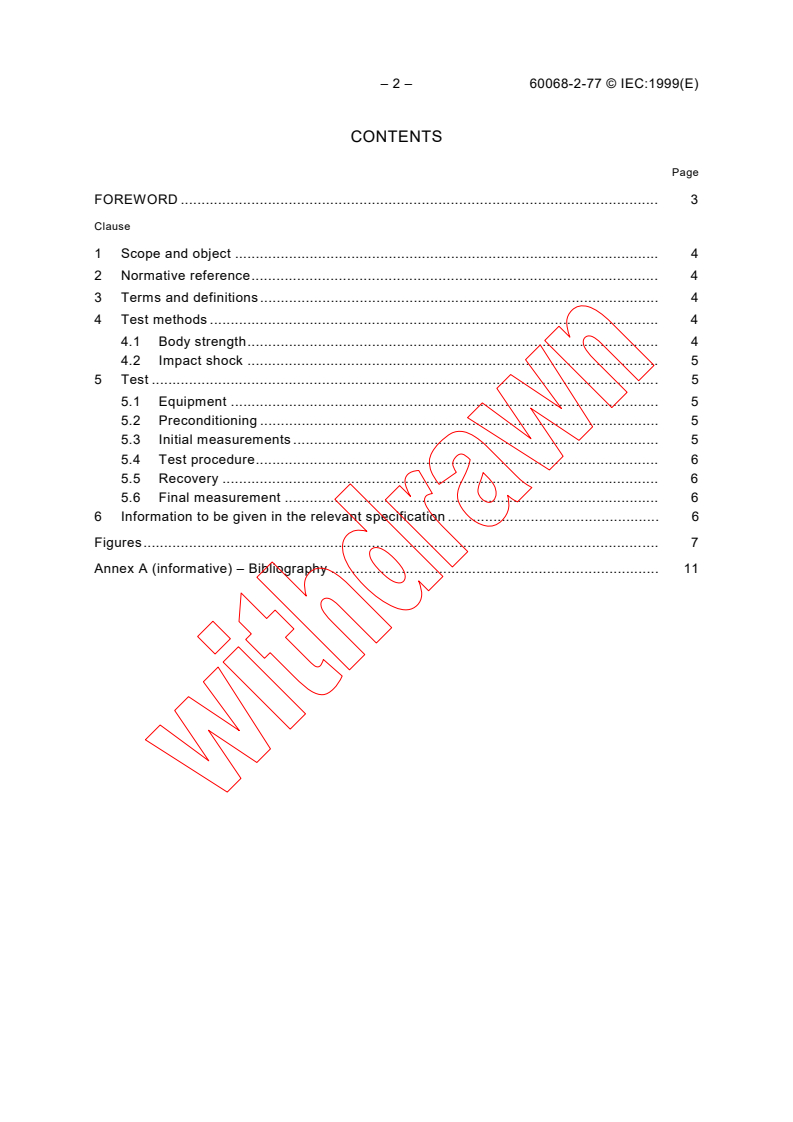
IEC 60068-2-77:1999 - Environmental testing - Part 2-77: Tests - Test 77: Body strength and impact shock Released:1/15/1999

IEC 60068-2-77:1999 - Environmental testing - Part 2-77: Tests - Test 77: Body strength and impact shock
IEC 60068-2-77:1999 - Environmental testing - Part 2-77: Tests - Test 77: Body strength and impact shock
Relations
- Effective Date
- 05-Sep-2023
- Effective Date
- 09-Feb-2026
- Effective Date
- 09-Feb-2026
Buy Documents
IEC 60068-2-77:1999 - Environmental testing - Part 2-77: Tests - Test 77: Body strength and impact shock Released:1/15/1999
IEC 60068-2-77:1999 - Environmental testing - Part 2-77: Tests - Test 77: Body strength and impact shock
IEC 60068-2-77:1999 - Environmental testing - Part 2-77: Tests - Test 77: Body strength and impact shock
Get Certified
Connect with accredited certification bodies for this standard

IMP NDT d.o.o.
Non-destructive testing services. Radiography, ultrasonic, magnetic particle, penetrant, visual inspection.
Inštitut za kovinske materiale in tehnologije
Institute of Metals and Technology. Materials testing, metallurgical analysis, NDT.
Q Techna d.o.o.
NDT and quality assurance specialist. 30+ years experience. NDT personnel certification per ISO 9712, nuclear and thermal power plant inspections, QA/
Sponsored listings
Frequently Asked Questions
IEC 60068-2-77:1999 is a standard published by the International Electrotechnical Commission (IEC). Its full title is "Environmental testing - Part 2-77: Tests - Test 77: Body strength and impact shock". This standard covers: Provides test methods applicable to surface mounting devices made of glass or sintered materials such as capacitors, resistors and inductors incorporating ferrites. Two test methods exist: body strength and impact shock. The object of both tests is to evaluate the mechanical stresses applied to SMDs during and after mounting; these tests look at different mechanical stresses.
Provides test methods applicable to surface mounting devices made of glass or sintered materials such as capacitors, resistors and inductors incorporating ferrites. Two test methods exist: body strength and impact shock. The object of both tests is to evaluate the mechanical stresses applied to SMDs during and after mounting; these tests look at different mechanical stresses.
IEC 60068-2-77:1999 is classified under the following ICS (International Classification for Standards) categories: 19.040 - Environmental testing; 31.190 - Electronic component assemblies. The ICS classification helps identify the subject area and facilitates finding related standards.
IEC 60068-2-77:1999 has the following relationships with other standards: It is inter standard links to IEC 60068-2-21:2021, EN 15859:2010, EN ISO 10374:1997. Understanding these relationships helps ensure you are using the most current and applicable version of the standard.
IEC 60068-2-77:1999 is available in PDF format for immediate download after purchase. The document can be added to your cart and obtained through the secure checkout process. Digital delivery ensures instant access to the complete standard document.
Standards Content (Sample)
INTERNATIONAL
IEC
STANDARD
60068-2-77
First edition
1999-01
Environmental testing –
Part 2-77:
Tests – Test 77 – Body strength and impact shock
Essais d’environnement –
Partie 2-77:
Essais – Essai 77 – Résistance du corps
et résistance au choc par impact
Reference number
Numbering
As from 1 January 1997 all IEC publications are issued with a designation in the
60000 series.
Consolidated publications
Consolidated versions of some IEC publications including amendments are
available. For example, edition numbers 1.0, 1.1 and 1.2 refer, respectively, to the
base publication, the base publication incorporating amendment 1 and the base
publication incorporating amendments 1 and 2.
Validity of this publication
The technical content of IEC publications is kept under constant review by the IEC,
thus ensuring that the content reflects current technology.
Information relating to the date of the reconfirmation of the publication is available
in the IEC catalogue.
Information on the subjects under consideration and work in progress undertaken by
the technical committee which has prepared this publication, as well as the list of
publications issued, is to be found at the following IEC sources:
• IEC web site*
• Catalogue of IEC publications
Published yearly with regular updates
(On-line catalogue)*
• IEC Bulletin
Available both at the IEC web site* and as a printed periodical
Terminology, graphical and letter symbols
For general terminology, readers are referred to IEC 60050: International
Electrotechnical Vocabulary (IEV).
For graphical symbols, and letter symbols and signs approved by the IEC for
general use, readers are referred to publications IEC 60027: Letter symbols to be
used in electrical technology, IEC 60417: Graphical symbols for use on equipment.
Index, survey and compilation of the single sheets and IEC 60617: Graphical symbols
for diagrams.
* See web site address on title page.
INTERNATIONAL
IEC
STANDARD
60068-2-77
First edition
1999-01
Environmental testing –
Part 2-77:
Tests – Test 77 – Body strength and impact shock
Essais d’environnement –
Partie 2-77:
Essais – Essai 77 – Résistance du corps
et résistance au choc par impact
IEC 1999 Copyright - all rights reserved
No part of this publication may be reproduced or utilized in any form or by any means, electronic or
mechanical, including photocopying and microfilm, without permission in writing from the publisher.
International Electrotechnical Commission 3, rue de Varembé Geneva, Switzerland
Telefax: +41 22 919 0300 e-mail: inmail@iec.ch IEC web site http://www.iec.ch
Commission Electrotechnique Internationale
PRICE CODE
L
International Electrotechnical Commission
For price, see current catalogue
– 2 – 60068-2-77 © IEC:1999(E)
CONTENTS
Page
FOREWORD . 3
Clause
1 Scope and object . 4
2 Normative reference. 4
3 Terms and definitions. 4
4 Test methods. 4
4.1 Body strength. 4
4.2 Impact shock. 5
5 Test.5
5.1 Equipment. 5
5.2 Preconditioning. 5
5.3 Initial measurements . 5
5.4 Test procedure. 6
5.5 Recovery. 6
5.6 Final measurement. 6
6 Information to be given in the relevant specification . 6
Figures. 7
Annex A (informative) – Bibliography . 11
60068-2-77 © IEC:1999(E) – 3 –
INTERNATIONAL ELECTROTECHNICAL COMMISSION
_________
ENVIRONMENTAL TESTING –
Part 2-77: Tests – Test 77: Body strength and impact shock
FOREWORD
1) The IEC (International Electrotechnical Commission) is a worldwide organization for standardization comprising
all national electrotechnical committees (IEC National Committees). The object of the IEC is to promote
international co-operation on all questions concerning standardization in the electrical and electronic fields. To
this end and in addition to other activities, the IEC publishes International Standards. Their preparation is
entrusted to technical committees; any IEC National Committee interested in the subject dealt with may
participate in this preparatory work. International, governmental and non-governmental organizations liaising
with the IEC also participate in this preparation. The IEC collaborates closely with the International Organization
for Standardization (ISO) in accordance with conditions determined by agreement between the two
organizations.
2) The formal decisions or agreements of the IEC on technical matters express, as nearly as possible, an
international consensus of opinion on the relevant subjects since each technical committee has representation
from all interested National Committees.
3) The documents produced have the form of recommendations for international use and are published in the form
of standards, technical reports or guides and they are accepted by the National Committees in that sense.
4) In order to promote international unification, IEC National Committees undertake to apply IEC International
Standards transparently to the maximum extent possible in their national and regional standards. Any
divergence between the IEC Standard and the corresponding national or regional standard shall be clearly
indicated in the latter.
5) The IEC provides no marking procedure to indicate its approval and cannot be rendered responsible for any
equipment declared to be in conformity with one of its standards.
6) Attention is drawn to the possibility that some of the elements of this International Standard may be the subject
of patent rights. The IEC shall not be held responsible for identifying any or all such patent rights.
International Standard IEC 60068-2-77 has been prepared by IEC technical committee 50:
Environmental testing, and is published by IEC technical committee 91: Surface mounting
technology.
The text of this standard is based on the following documents:
FDIS Report on voting
91/155/FDIS 91/162/RVD
Full information on the voting for the approval of this standard can be found in the report on
voting indicated in the above table.
Annex A is for information only.
– 4 – 60068-2-77 © IEC:1999(E)
ENVIRONMENTAL TESTING –
Part 2-77: Tests – Test 77: Body strength and impact shock
1 Scope and object
This part of IEC 60068 provides test methods applicable to surface mounting devices (SMDs)
made of glass or sintered materials such as capacitors, resistors and inductors incorporating
ferrites. Two test methods exist: body strength and impact shock.
The object of both tests is to evaluate the mechanical stresses applied to SMDs during and
after mounting; these tests look at different mechanical stresses. The relevant component
specification shall specify which test method or methods are applicable.
2 Normative reference
The following normative document contains provisions which, through reference in this text,
constitute provisions of this part of IEC 60068. At the time of publication, the edition indicated
was valid. All normative documents are subject to revision, and parties to agreements based
on this part of IEC 60068 are encouraged to investigate the possibility of applying the most
recent edition of the normative document indicated below. Members of IEC and ISO maintain
registers of currently valid International Standards.
IEC 60194:—, Terms and definitions for printed circuits
3 Terms and definitions
For the purpose of this part of IEC 60068, the terms and definitions given in IEC 60194 apply.
4 Test methods
4.1 Body strength
This test evaluates the strength of the body of the SMD against external static forces which are
applied to them during mounting, in the direction perpendicular to the printed board on which
the SMDs are mounted.
NOTE – The test evaluates the sturdiness of the body of the SMDs and not the adhesive strength at the interface
between the termination and solder of the body. These latter tests are described in IEC 60068-2-21.
This test simulates the static force applied to SMDs during picking up and centering in a
placement process with a rather slow speed mounting machine in which the forces are mainly
of a static nature.
A static force can have a different influence on a device from that of a dynamic force, whose
effects can be evaluated by a test separately described as an impact shock test. This simulates
the mechanical stress applied to the SMDs, during and after mounting the SMDs on a printed
board. This test shall be referred to in the relevant detail specification.
60068-2-77 © IEC:1999(E) – 5 –
4.2 Impact shock
This test evaluates the physical resistance of SMDs against impact shock. This test simulates
the dynamic forces applied by picking and placing tools on a high speed mounting machine.
The influence of a dynamic force on a device can differ from the influence of a static force.
This test shall be referred to in the relevant detail specification.
5 Test
5.1 Equipment
a) Body strength equipment
The equipment shall be able to apply the specified force to the specimen and maintain the
test load for the specified duration. The length (L) of the tip of the pushing tool shall be
wider than the width (W) of the specimen under test. Unless otherwise specified in the
relevant specification, the shape of the tip of the pushing tool shall be chamfered with a
radius of 0,5 mm. The thickness of the pushing tool is not specified (see figure 1). If this
specification cannot be applied due to the shape or construction of the specimen under test
or for any other reason, the shape of the pushing tool shall be
...
IEC 60068-2-77
Edition 1.0 1999-01
INTERNATIONAL
STANDARD
NORME
INTERNATIONALE
Environmental testing –
Part 2-77: Tests – Body strength and impact shock
Essais d’environnement –
Partie 2-77: Essais – Résistance du corps et résistance aux chocs par impact
Copyright © 1999 IEC, Geneva, Switzerland
All rights reserved. Unless otherwise specified, no part of this publication may be reproduced or utilized in any form or by
any means, electronic or mechanical, including photocopying and microfilm, without permission in writing from either IEC or
IEC's member National Committee in the country of the requester.
If you have any questions about IEC copyright or have an enquiry about obtaining additional rights to this publication,
please contact the address below or your local IEC member National Committee for further information.
Droits de reproduction réservés. Sauf indication contraire, aucune partie de cette publication ne peut être reproduite
ni utilisée sous quelque forme que ce soit et par aucun procédé, électronique ou mécanique, y compris la photocopie
et les microfilms, sans l'accord écrit de la CEI ou du Comité national de la CEI du pays du demandeur.
Si vous avez des questions sur le copyright de la CEI ou si vous désirez obtenir des droits supplémentaires sur cette
publication, utilisez les coordonnées ci-après ou contactez le Comité national de la CEI de votre pays de résidence.
IEC Central Office
3, rue de Varembé
CH-1211 Geneva 20
Switzerland
Email: inmail@iec.ch
Web: www.iec.ch
About the IEC
The International Electrotechnical Commission (IEC) is the leading global organization that prepares and publishes
International Standards for all electrical, electronic and related technologies.
About IEC publications
The technical content of IEC publications is kept under constant review by the IEC. Please make sure that you have the
latest edition, a corrigenda or an amendment might have been published.
ƒ Catalogue of IEC publications: www.iec.ch/searchpub
The IEC on-line Catalogue enables you to search by a variety of criteria (reference number, text, technical committee,…).
It also gives information on projects, withdrawn and replaced publications.
ƒ IEC Just Published: www.iec.ch/online_news/justpub
Stay up to date on all new IEC publications. Just Published details twice a month all new publications released. Available
on-line and also by email.
ƒ Electropedia: www.electropedia.org
The world's leading online dictionary of electronic and electrical terms containing more than 20 000 terms and definitions
in English and French, with equivalent terms in additional languages. Also known as the International Electrotechnical
Vocabulary online.
ƒ Customer Service Centre: www.iec.ch/webstore/custserv
If you wish to give us your feedback on this publication or need further assistance, please visit the Customer Service
Centre FAQ or contact us:
Email: csc@iec.ch
Tel.: +41 22 919 02 11
Fax: +41 22 919 03 00
A propos de la CEI
La Commission Electrotechnique Internationale (CEI) est la première organisation mondiale qui élabore et publie des
normes internationales pour tout ce qui a trait à l'électricité, à l'électronique et aux technologies apparentées.
A propos des publications CEI
Le contenu technique des publications de la CEI est constamment revu. Veuillez vous assurer que vous possédez
l’édition la plus récente, un corrigendum ou amendement peut avoir été publié.
ƒ Catalogue des publications de la CEI: www.iec.ch/searchpub/cur_fut-f.htm
Le Catalogue en-ligne de la CEI vous permet d’effectuer des recherches en utilisant différents critères (numéro de référence,
texte, comité d’études,…). Il donne aussi des informations sur les projets et les publications retirées ou remplacées.
ƒ Just Published CEI: www.iec.ch/online_news/justpub
Restez informé sur les nouvelles publications de la CEI. Just Published détaille deux fois par mois les nouvelles
publications parues. Disponible en-ligne et aussi par email.
ƒ Electropedia: www.electropedia.org
Le premier dictionnaire en ligne au monde de termes électroniques et électriques. Il contient plus de 20 000 termes et
définitions en anglais et en français, ainsi que les termes équivalents dans les langues additionnelles. Egalement appelé
Vocabulaire Electrotechnique International en ligne.
ƒ Service Clients: www.iec.ch/webstore/custserv/custserv_entry-f.htm
Si vous désirez nous donner des commentaires sur cette publication ou si vous avez des questions, visitez le FAQ du
Service clients ou contactez-nous:
Email: csc@iec.ch
Tél.: +41 22 919 02 11
Fax: +41 22 919 03 00
IEC 60068-2-77
Edition 1.0 1999-01
INTERNATIONAL
STANDARD
NORME
INTERNATIONALE
Environmental testing –
Part 2-77: Tests – Body strength and impact shock
Essais d’environnement –
Partie 2-77: Essais – Résistance du corps et résistance aux chocs par impact
INTERNATIONAL
ELECTROTECHNICAL
COMMISSION
COMMISSION
ELECTROTECHNIQUE
PRICE CODE
INTERNATIONALE
L
CODE PRIX
ICS 19.040; 31.190 ISBN 2-8318-5910-7
– 2 – 60068-2-77 © CEI:1999
SOMMAIRE
AVANT-PROPOS .4
1 Domaine d’application et objet .6
2 Références normatives .6
3 Termes et définitions .6
4 Méthodes d’essai.6
4.1 Résistance du corps .6
4.2 Chocs par impact.8
5 Essai.8
5.1 Equipement .8
5.2 Préconditionnement.8
5.3 Mesures initiales.8
5.4 Procédure d'essai.10
5.5 Reprise.10
5.6 Mesures finales .10
6 Renseignements à donner dans la spécification particulière .12
Figure 1 – Outil de poussée.12
Figure 2 – Exemple d’essai de résistance du corps
(par exemple condensateur pastille en céramique multicouche).14
Figure 3 – Exemple d’essai de résistance du corps
(pour condensateurs pastilles cylindriques en céramique).14
Figure 4 – Principe de l’équipement d’essai.16
Figure 5 – Exemple d’équipement d’essai de chocs par impact.16
Figure 6 – Exemple d’application d’impact .18
Figure 7 – Exemple de pointe.18
Bibliographie .20
60068-2-77 © IEC:1999 – 3 –
CONTENTS
FOREWORD.5
1 Scope and object .7
2 Normative references.7
3 Terms and definitions .7
4 Test methods.7
4.1 Body strength.7
4.2 Impact shock.9
5 Test.9
5.1 Equipment .9
5.2 Preconditioning.9
5.3 Initial measurements .9
5.4 Test procedure.11
5.5 Recovery.11
5.6 Final measurement.11
6 Information to be given in the relevant specification.13
Figure 1 – Pushing tool .13
Figure 2 – Example of a body strength test
(for example, multilayer ceramic chip capacitor) .15
Figure 3 – Example of a body strength test
(for cylindrical ceramic chip capacitors) .15
Figure 4 – Principle of test equipment.17
Figure 5 – Example of impact shock test equipment .17
Figure 6 – Example of the application of impact.19
Figure 7 – Example of collet .19
Bibliography .21
– 4 – 60068-2-77 © CEI:1999
COMMISSION ÉLECTROTECHNIQUE INTERNATIONALE
____________
ESSAIS D’ENVIRONNEMENT –
Partie 2-77: Essais –
Essai 77: Résistance du corps et résistance aux chocs par impact
AVANT-PROPOS
1) La Commission Electrotechnique Internationale (CEI) est une organisation mondiale de normalisation composée
de l'ensemble des comités électrotechniques nationaux (Comités nationaux de la CEI). La CEI a pour objet de
favoriser la coopération internationale pour toutes les questions de normalisation dans les domaines de
l'électricité et de l'électronique. A cet effet, la CEI – entre autres activités – publie des Normes internationales,
des Spécifications techniques, des Rapports techniques, des Spécifications accessibles au public (PAS) et des
Guides (ci-après dénommés "Publication(s) de la CEI"). Leur élaboration est confiée à des comités d'études,
aux travaux desquels tout Comité national intéressé par le sujet traité peut participer. Les organisations
internationales, gouvernementales et non gouvernementales, en liaison avec la CEI, participent également aux
travaux. La CEI collabore étroitement avec l'Organisation Internationale de Normalisation (ISO), selon des
conditions fixées par accord entre les deux organisations.
2) Les décisions ou accords officiels de la CEI concernant les questions techniques représentent, dans la mesure
du possible, un accord international sur les sujets étudiés, étant donné que les Comités nationaux de la CEI
intéressés sont représentés dans chaque comité d’études.
3) Les Publications de la CEI se présentent sous la forme de recommandations internationales et sont agréées
comme telles par les Comités nationaux de la CEI. Tous les efforts raisonnables sont entrepris afin que la CEI
s'assure de l'exactitude du contenu technique de ses publications; la CEI ne peut pas être tenue responsable de
l'éventuelle mauvaise utilisation ou interprétation qui en est faite par un quelconque utilisateur final.
4) Dans le but d'encourager l'uniformité internationale, les Comités nationaux de la CEI s'engagent, dans toute la
mesure possible, à appliquer de façon transparente les Publications de la CEI dans leurs publications
nationales et régionales. Toutes divergences entre toutes Publications de la CEI et toutes publications
nationales ou régionales correspondantes doivent être indiquées en termes clairs dans ces dernières.
5) La CEI n’a prévu aucune procédure de marquage valant indication d’approbation et n'engage pas sa
responsabilité pour les équipements déclarés conformes à une de ses Publications.
6) Tous les utilisateurs doivent s'assurer qu'ils sont en possession de la dernière édition de cette publication.
7) Aucune responsabilité ne doit être imputée à la CEI, à ses administrateurs, employés, auxiliaires ou
mandataires, y compris ses experts particuliers et les membres de ses comités d'études et des Comités
nationaux de la CEI, pour tout préjudice causé en cas de dommages corporels et matériels, ou de tout autre
dommage de quelque nature que ce soit, directe ou indirecte, ou pour supporter les coûts (y compris les frais
de justice) et les dépenses découlant de la publication ou de l'utilisation de cette Publication de la CEI ou de
toute autre Publication de la CEI, ou au crédit qui lui est accordé.
8) L'attention est attirée sur les références normatives citées dans cette publication. L'utilisation de publications
référencées est obligatoire pour une application correcte de la présente publication.
9) L’attention est attirée sur le fait que certains des éléments de la présente Publication de la CEI peuvent faire
l’objet de droits de propriété intellectuelle ou de droits analogues. La CEI ne saurait être tenue pour
responsable de ne pas avoir identifié de tels droits de propriété et de ne pas avoir signalé leur existence.
La Norme internationale CEI 60068-2-77 a été établie par le comité d'études 104 de la CEI:
Conditions, classification et essais d'environnement et est publiée par le comité d'études 91 de
la CEI: Techniques d'assemblage des composants électroniques.
La version française de cette norme n'a pas été soumise au vote.
Cette version bilingue, publiée en 2001-07, correspond à la version anglaise.
Le texte anglais de cette norme est basé sur les documents 91/155/FDIS et 91/162/RVD. Le
rapport de vote 91/162/RVD donne toute information sur le vote ayant abouti à l'approbation de
cette norme.
L’annexe A est donnée uniquement à titre d'information.
Cette publication a été rédigée selon les Directives ISO/CEI, Partie 3.
Le comité a décidé que le contenu de cette publication ne sera pas modifié avant 2004.
A cette date, la publication sera
• reconduite;
• supprimée;
• remplacée par une édition révisée, ou
• amendée.
60068-2-77 © IEC:1999 – 5 –
INTERNATIONAL ELECTROTECHNICAL COMMISSION
____________
ENVIRONMENTAL TESTING –
Part 2-77: Tests –
Test 77: Body strength and impact shock
FOREWORD
1) The International Electrotechnical Commission (IEC) is a worldwide organization for standardization comprising
all national electrotechnical committees (IEC National Committees). The object of IEC is to promote
international co-operation on all questions concerning standardization in the electrical and electronic fields. To
this end and in addition to other activities, IEC publishes International Standards, Technical Specifications,
Technical Reports, Publicly Available Specifications (PAS) and Guides (hereafter referred to as “IEC
Publication(s)”). Their preparation is entrusted to technical committees; any IEC National Committee interested
in the subject dealt with may participate in this preparatory work. International, governmental and non-
governmental organizations liaising with the IEC also participate in this preparation. IEC collaborates closely
with the International Organization for Standardization (ISO) in accordance with conditions determined by
agreement between the two organizations.
2) The formal decisions or agreements of IEC on technical matters express, as nearly as possible, an international
consensus of opinion on the relevant subjects since each technical committee has representation from all
interested IEC National Committees.
3) IEC Publications have the form of recommendations for international use and are accepted by IEC National
Committees in that sense. While all reasonable efforts are made to ensure that the technical content of IEC
Publications is accurate, IEC cannot be held responsible for the way in which they are used or for any
misinterpretation by any end user.
4) In order to promote international uniformity, IEC National Committees undertake to apply IEC Publications
transparently to the maximum extent possible in their national and regional publications. Any divergence between
any IEC Publication and the corresponding national or regional publication shall be clearly indicated in the latter.
5) IEC provides no marking procedure to indicate its approval and cannot be rendered responsible for any
equipment declared to be in conformity with an IEC Publication.
6) All users should ensure that they have the latest edition of this publication.
7) No liability shall attach to IEC or its directors, employees, servants or agents including individual experts and
members of its technical committees and IEC National Committees for any personal injury, property damage or
other damage of any nature whatsoever, whether direct or indirect, or for costs (including legal fees) and expenses
arising out of the publication, use of, or reliance upon, this IEC Publication or any other IEC Publications.
8) Attention is drawn to the Normative references cited in this publication. Use of the referenced publications is
indispensable for the correct application of this publication.
9) Attention is drawn to the possibility that some of the elements of this IEC Publication may be the subject of
patent rights. IEC shall not be held responsible for identifying any or all such patent rights.
International Standard IEC 60068-2-77 has been prepared by IEC technical committee 104:
Environmental conditions, classification and methods of test and is published by IEC technical
committee 91: Electronics assembly technology.
This bilingual version, published in 2001-07, corresponds to the English version.
The text of this standard is based on the following documents:
FDIS Report on voting
91/155/FDIS 91/162/RVD
Full information on the voting for the approval of this standard can be found in the report on
voting indicated in the above table.
Annex A is for information only.
This publication has been drafted in accordance with the ISO/IEC Directives, Part 3.
The committee has decided that the contents of this publication will remain unchanged
until 2004. At this date, the publication will be
• reconfirmed;
• withdrawn;
• replaced by a revised edition, or
• amended.
– 6 – 60068-2-77 © CEI:1999
ESSAIS D’ENVIRONNEMENT –
Partie 2-77: Essais –
Essai 77: Résistance du corps et résistance aux chocs par impact
1 Domaine d’application et objet
La présente partie de la CEI 60068 donne les méthodes d’essai applicables aux composants
montés en surface (CMS) en verre ou matériaux frittés tels que les condensateurs, les
résistances et les inductances incorporant des ferrites. Il existe deux méthodes d’essai, celle
de la résistance du corps et celle de la résistance aux chocs par impact.
Ces deux essais sont destinés à évaluer les contraintes mécaniques appliquées aux CMS
pendant et après le montage; ces essais traitent de contraintes mécaniques différentes.
La spécification de composant applicable doit spécifier la ou les méthodes d’essai applicables.
2 Références normatives
Les documents normatifs suivants contiennent des dispositions qui, par suite de la référence
qui y est faite, constituent des dispositions valables pour la présente partie de la CEI 60068.
Pour les références datées, les amendements ultérieurs ou les révisions de ces publications ne
s’appliquent pas. Toutefois, les parties prenantes aux accords fondés sur la présente partie de
la CEI 60068 sont invitées à rechercher la possibilité d'appliquer les éditions les plus récentes
des documents normatifs indiqués ci-après. Pour les références non datées, la dernière édition
du document normatif en référence s’applique. Les membres de la CEI et de l'ISO possèdent
le registre des Normes internationales en vigueur.
CEI 60194:—, Termes et définitions concernant les circuits imprimés
3 Termes et définitions
Pour les besoins de la présente partie de la CEI 60068, les termes et définitions donnés dans
la
...
IEC 60068-2-77
Edition 1.0 1999-01
INTERNATIONAL
STANDARD
NORME
INTERNATIONALE
Environmental testing –
Part 2-77: Tests – Body strength and impact shock
Essais d’environnement –
Partie 2-77: Essais – Résistance du corps et résistance aux chocs par impact
Copyright © 1999 IEC, Geneva, Switzerland
All rights reserved. Unless otherwise specified, no part of this publication may be reproduced or utilized in any form or by
any means, electronic or mechanical, including photocopying and microfilm, without permission in writing from either IEC or
IEC's member National Committee in the country of the requester.
If you have any questions about IEC copyright or have an enquiry about obtaining additional rights to this publication,
please contact the address below or your local IEC member National Committee for further information.
Droits de reproduction réservés. Sauf indication contraire, aucune partie de cette publication ne peut être reproduite
ni utilisée sous quelque forme que ce soit et par aucun procédé, électronique ou mécanique, y compris la photocopie
et les microfilms, sans l'accord écrit de la CEI ou du Comité national de la CEI du pays du demandeur.
Si vous avez des questions sur le copyright de la CEI ou si vous désirez obtenir des droits supplémentaires sur cette
publication, utilisez les coordonnées ci-après ou contactez le Comité national de la CEI de votre pays de résidence.
IEC Central Office
3, rue de Varembé
CH-1211 Geneva 20
Switzerland
Email: inmail@iec.ch
Web: www.iec.ch
About the IEC
The International Electrotechnical Commission (IEC) is the leading global organization that prepares and publishes
International Standards for all electrical, electronic and related technologies.
About IEC publications
The technical content of IEC publications is kept under constant review by the IEC. Please make sure that you have the
latest edition, a corrigenda or an amendment might have been published.
ƒ Catalogue of IEC publications: www.iec.ch/searchpub
The IEC on-line Catalogue enables you to search by a variety of criteria (reference number, text, technical committee,…).
It also gives information on projects, withdrawn and replaced publications.
ƒ IEC Just Published: www.iec.ch/online_news/justpub
Stay up to date on all new IEC publications. Just Published details twice a month all new publications released. Available
on-line and also by email.
ƒ Electropedia: www.electropedia.org
The world's leading online dictionary of electronic and electrical terms containing more than 20 000 terms and definitions
in English and French, with equivalent terms in additional languages. Also known as the International Electrotechnical
Vocabulary online.
ƒ Customer Service Centre: www.iec.ch/webstore/custserv
If you wish to give us your feedback on this publication or need further assistance, please visit the Customer Service
Centre FAQ or contact us:
Email: csc@iec.ch
Tel.: +41 22 919 02 11
Fax: +41 22 919 03 00
A propos de la CEI
La Commission Electrotechnique Internationale (CEI) est la première organisation mondiale qui élabore et publie des
normes internationales pour tout ce qui a trait à l'électricité, à l'électronique et aux technologies apparentées.
A propos des publications CEI
Le contenu technique des publications de la CEI est constamment revu. Veuillez vous assurer que vous possédez
l’édition la plus récente, un corrigendum ou amendement peut avoir été publié.
ƒ Catalogue des publications de la CEI: www.iec.ch/searchpub/cur_fut-f.htm
Le Catalogue en-ligne de la CEI vous permet d’effectuer des recherches en utilisant différents critères (numéro de référence,
texte, comité d’études,…). Il donne aussi des informations sur les projets et les publications retirées ou remplacées.
ƒ Just Published CEI: www.iec.ch/online_news/justpub
Restez informé sur les nouvelles publications de la CEI. Just Published détaille deux fois par mois les nouvelles
publications parues. Disponible en-ligne et aussi par email.
ƒ Electropedia: www.electropedia.org
Le premier dictionnaire en ligne au monde de termes électroniques et électriques. Il contient plus de 20 000 termes et
définitions en anglais et en français, ainsi que les termes équivalents dans les langues additionnelles. Egalement appelé
Vocabulaire Electrotechnique International en ligne.
ƒ Service Clients: www.iec.ch/webstore/custserv/custserv_entry-f.htm
Si vous désirez nous donner des commentaires sur cette publication ou si vous avez des questions, visitez le FAQ du
Service clients ou contactez-nous:
Email: csc@iec.ch
Tél.: +41 22 919 02 11
Fax: +41 22 919 03 00
IEC 60068-2-77
Edition 1.0 1999-01
INTERNATIONAL
STANDARD
NORME
INTERNATIONALE
Environmental testing –
Part 2-77: Tests – Body strength and impact shock
Essais d’environnement –
Partie 2-77: Essais – Résistance du corps et résistance aux chocs par impact
INTERNATIONAL
ELECTROTECHNICAL
COMMISSION
COMMISSION
ELECTROTECHNIQUE
PRICE CODE
INTERNATIONALE
L
CODE PRIX
ICS 19.040; 31.190 ISBN 2-8318-5910-7
– 2 – 60068-2-77 © CEI:1999
SOMMAIRE
AVANT-PROPOS .4
1 Domaine d’application et objet .6
2 Références normatives .6
3 Termes et définitions .6
4 Méthodes d’essai.6
4.1 Résistance du corps .6
4.2 Chocs par impact.8
5 Essai.8
5.1 Equipement .8
5.2 Préconditionnement.8
5.3 Mesures initiales.8
5.4 Procédure d'essai.10
5.5 Reprise.10
5.6 Mesures finales .10
6 Renseignements à donner dans la spécification particulière .12
Figure 1 – Outil de poussée.12
Figure 2 – Exemple d’essai de résistance du corps
(par exemple condensateur pastille en céramique multicouche).14
Figure 3 – Exemple d’essai de résistance du corps
(pour condensateurs pastilles cylindriques en céramique).14
Figure 4 – Principe de l’équipement d’essai.16
Figure 5 – Exemple d’équipement d’essai de chocs par impact.16
Figure 6 – Exemple d’application d’impact .18
Figure 7 – Exemple de pointe.18
Bibliographie .20
60068-2-77 © IEC:1999 – 3 –
CONTENTS
FOREWORD.5
1 Scope and object .7
2 Normative references.7
3 Terms and definitions .7
4 Test methods.7
4.1 Body strength.7
4.2 Impact shock.9
5 Test.9
5.1 Equipment .9
5.2 Preconditioning.9
5.3 Initial measurements .9
5.4 Test procedure.11
5.5 Recovery.11
5.6 Final measurement.11
6 Information to be given in the relevant specification.13
Figure 1 – Pushing tool .13
Figure 2 – Example of a body strength test
(for example, multilayer ceramic chip capacitor) .15
Figure 3 – Example of a body strength test
(for cylindrical ceramic chip capacitors) .15
Figure 4 – Principle of test equipment.17
Figure 5 – Example of impact shock test equipment .17
Figure 6 – Example of the application of impact.19
Figure 7 – Example of collet .19
Bibliography .21
– 4 – 60068-2-77 © CEI:1999
COMMISSION ÉLECTROTECHNIQUE INTERNATIONALE
____________
ESSAIS D’ENVIRONNEMENT –
Partie 2-77: Essais –
Essai 77: Résistance du corps et résistance aux chocs par impact
AVANT-PROPOS
1) La Commission Electrotechnique Internationale (CEI) est une organisation mondiale de normalisation composée
de l'ensemble des comités électrotechniques nationaux (Comités nationaux de la CEI). La CEI a pour objet de
favoriser la coopération internationale pour toutes les questions de normalisation dans les domaines de
l'électricité et de l'électronique. A cet effet, la CEI – entre autres activités – publie des Normes internationales,
des Spécifications techniques, des Rapports techniques, des Spécifications accessibles au public (PAS) et des
Guides (ci-après dénommés "Publication(s) de la CEI"). Leur élaboration est confiée à des comités d'études,
aux travaux desquels tout Comité national intéressé par le sujet traité peut participer. Les organisations
internationales, gouvernementales et non gouvernementales, en liaison avec la CEI, participent également aux
travaux. La CEI collabore étroitement avec l'Organisation Internationale de Normalisation (ISO), selon des
conditions fixées par accord entre les deux organisations.
2) Les décisions ou accords officiels de la CEI concernant les questions techniques représentent, dans la mesure
du possible, un accord international sur les sujets étudiés, étant donné que les Comités nationaux de la CEI
intéressés sont représentés dans chaque comité d’études.
3) Les Publications de la CEI se présentent sous la forme de recommandations internationales et sont agréées
comme telles par les Comités nationaux de la CEI. Tous les efforts raisonnables sont entrepris afin que la CEI
s'assure de l'exactitude du contenu technique de ses publications; la CEI ne peut pas être tenue responsable de
l'éventuelle mauvaise utilisation ou interprétation qui en est faite par un quelconque utilisateur final.
4) Dans le but d'encourager l'uniformité internationale, les Comités nationaux de la CEI s'engagent, dans toute la
mesure possible, à appliquer de façon transparente les Publications de la CEI dans leurs publications
nationales et régionales. Toutes divergences entre toutes Publications de la CEI et toutes publications
nationales ou régionales correspondantes doivent être indiquées en termes clairs dans ces dernières.
5) La CEI n’a prévu aucune procédure de marquage valant indication d’approbation et n'engage pas sa
responsabilité pour les équipements déclarés conformes à une de ses Publications.
6) Tous les utilisateurs doivent s'assurer qu'ils sont en possession de la dernière édition de cette publication.
7) Aucune responsabilité ne doit être imputée à la CEI, à ses administrateurs, employés, auxiliaires ou
mandataires, y compris ses experts particuliers et les membres de ses comités d'études et des Comités
nationaux de la CEI, pour tout préjudice causé en cas de dommages corporels et matériels, ou de tout autre
dommage de quelque nature que ce soit, directe ou indirecte, ou pour supporter les coûts (y compris les frais
de justice) et les dépenses découlant de la publication ou de l'utilisation de cette Publication de la CEI ou de
toute autre Publication de la CEI, ou au crédit qui lui est accordé.
8) L'attention est attirée sur les références normatives citées dans cette publication. L'utilisation de publications
référencées est obligatoire pour une application correcte de la présente publication.
9) L’attention est attirée sur le fait que certains des éléments de la présente Publication de la CEI peuvent faire
l’objet de droits de propriété intellectuelle ou de droits analogues. La CEI ne saurait être tenue pour
responsable de ne pas avoir identifié de tels droits de propriété et de ne pas avoir signalé leur existence.
La Norme internationale CEI 60068-2-77 a été établie par le comité d'études 104 de la CEI:
Conditions, classification et essais d'environnement et est publiée par le comité d'études 91 de
la CEI: Techniques d'assemblage des composants électroniques.
La version française de cette norme n'a pas été soumise au vote.
Cette version bilingue, publiée en 2001-07, correspond à la version anglaise.
Le texte anglais de cette norme est basé sur les documents 91/155/FDIS et 91/162/RVD. Le
rapport de vote 91/162/RVD donne toute information sur le vote ayant abouti à l'approbation de
cette norme.
L’annexe A est donnée uniquement à titre d'information.
Cette publication a été rédigée selon les Directives ISO/CEI, Partie 3.
Le comité a décidé que le contenu de cette publication ne sera pas modifié avant 2004.
A cette date, la publication sera
• reconduite;
• supprimée;
• remplacée par une édition révisée, ou
• amendée.
60068-2-77 © IEC:1999 – 5 –
INTERNATIONAL ELECTROTECHNICAL COMMISSION
____________
ENVIRONMENTAL TESTING –
Part 2-77: Tests –
Test 77: Body strength and impact shock
FOREWORD
1) The International Electrotechnical Commission (IEC) is a worldwide organization for standardization comprising
all national electrotechnical committees (IEC National Committees). The object of IEC is to promote
international co-operation on all questions concerning standardization in the electrical and electronic fields. To
this end and in addition to other activities, IEC publishes International Standards, Technical Specifications,
Technical Reports, Publicly Available Specifications (PAS) and Guides (hereafter referred to as “IEC
Publication(s)”). Their preparation is entrusted to technical committees; any IEC National Committee interested
in the subject dealt with may participate in this preparatory work. International, governmental and non-
governmental organizations liaising with the IEC also participate in this preparation. IEC collaborates closely
with the International Organization for Standardization (ISO) in accordance with conditions determined by
agreement between the two organizations.
2) The formal decisions or agreements of IEC on technical matters express, as nearly as possible, an international
consensus of opinion on the relevant subjects since each technical committee has representation from all
interested IEC National Committees.
3) IEC Publications have the form of recommendations for international use and are accepted by IEC National
Committees in that sense. While all reasonable efforts are made to ensure that the technical content of IEC
Publications is accurate, IEC cannot be held responsible for the way in which they are used or for any
misinterpretation by any end user.
4) In order to promote international uniformity, IEC National Committees undertake to apply IEC Publications
transparently to the maximum extent possible in their national and regional publications. Any divergence between
any IEC Publication and the corresponding national or regional publication shall be clearly indicated in the latter.
5) IEC provides no marking procedure to indicate its approval and cannot be rendered responsible for any
equipment declared to be in conformity with an IEC Publication.
6) All users should ensure that they have the latest edition of this publication.
7) No liability shall attach to IEC or its directors, employees, servants or agents including individual experts and
members of its technical committees and IEC National Committees for any personal injury, property damage or
other damage of any nature whatsoever, whether direct or indirect, or for costs (including legal fees) and expenses
arising out of the publication, use of, or reliance upon, this IEC Publication or any other IEC Publications.
8) Attention is drawn to the Normative references cited in this publication. Use of the referenced publications is
indispensable for the correct application of this publication.
9) Attention is drawn to the possibility that some of the elements of this IEC Publication may be the subject of
patent rights. IEC shall not be held responsible for identifying any or all such patent rights.
International Standard IEC 60068-2-77 has been prepared by IEC technical committee 104:
Environmental conditions, classification and methods of test and is published by IEC technical
committee 91: Electronics assembly technology.
This bilingual version, published in 2001-07, corresponds to the English version.
The text of this standard is based on the following documents:
FDIS Report on voting
91/155/FDIS 91/162/RVD
Full information on the voting for the approval of this standard can be found in the report on
voting indicated in the above table.
Annex A is for information only.
This publication has been drafted in accordance with the ISO/IEC Directives, Part 3.
The committee has decided that the contents of this publication will remain unchanged
until 2004. At this date, the publication will be
• reconfirmed;
• withdrawn;
• replaced by a revised edition, or
• amended.
– 6 – 60068-2-77 © CEI:1999
ESSAIS D’ENVIRONNEMENT –
Partie 2-77: Essais –
Essai 77: Résistance du corps et résistance aux chocs par impact
1 Domaine d’application et objet
La présente partie de la CEI 60068 donne les méthodes d’essai applicables aux composants
montés en surface (CMS) en verre ou matériaux frittés tels que les condensateurs, les
résistances et les inductances incorporant des ferrites. Il existe deux méthodes d’essai, celle
de la résistance du corps et celle de la résistance aux chocs par impact.
Ces deux essais sont destinés à évaluer les contraintes mécaniques appliquées aux CMS
pendant et après le montage; ces essais traitent de contraintes mécaniques différentes.
La spécification de composant applicable doit spécifier la ou les méthodes d’essai applicables.
2 Références normatives
Les documents normatifs suivants contiennent des dispositions qui, par suite de la référence
qui y est faite, constituent des dispositions valables pour la présente partie de la CEI 60068.
Pour les références datées, les amendements ultérieurs ou les révisions de ces publications ne
s’appliquent pas. Toutefois, les parties prenantes aux accords fondés sur la présente partie de
la CEI 60068 sont invitées à rechercher la possibilité d'appliquer les éditions les plus récentes
des documents normatifs indiqués ci-après. Pour les références non datées, la dernière édition
du document normatif en référence s’applique. Les membres de la CEI et de l'ISO possèdent
le registre des Normes internationales en vigueur.
CEI 60194:—, Termes et définitions concernant les circuits imprimés
3 Termes et définitions
Pour les besoins de la présente partie de la CEI 60068, les termes et définitions donnés dans
la CEI 60194 s’appliquent.
4 Méthodes d’essai
4.1 Résistance du corps
Cet essai évalue la résis
...