

IEC 62264-2:2013
(Main)Enterprise-control system integration - Part 2: Object and attributes for enterprise-control system integration
General Information
- Abstract
IEC 62264-2:2013 specifies generic interface content exchanged between manufacturing control functions and other enterprise functions. The interface considered is between Level 3 manufacturing systems and Level 4 business systems in the hierarchical model defined in IEC 62264-1. The goal is to reduce the risk, cost, and errors associated with implementing the interface. This second edition cancels and replaces the first edition published in 2004 and constitutes a technical revision. It includes the following technical:
- addition of object models for exchange information used in manufacturing operations management activities;
- displacement of the UML object models that were in IEC 62264-1:2003 into this standard so that the object models and the associated attribute tables were available in the same document;
- addition of the Hierarchy scope object definition to replace the Location attribute used in the previous edition;
- addition of a value type section to define the exchange of non-simple value types;
- definition of simple value types were defined using the ISO 15000-5.
- Status
- Published
- Publication Date
- 26-Jun-2013
- Technical Committee
- SC 65E - Devices and integration in enterprise systems
- Drafting Committee
- JWG 5 - TC 65/SC 65E/JWG 5
Overview
IEC 62264-2:2013 is part of the international standard IEC 62264 series focused on the integration between enterprise and control systems within manufacturing environments. Specifically, Part 2 of this standard defines the objects and attributes for enterprise-control system integration, serving as a critical guide to the interface between Level 3 manufacturing control systems and Level 4 enterprise business systems according to the hierarchical model outlined in IEC 62264-1.
This edition is a technical revision to the original 2004 version, aiming to reduce implementation risks, costs, and errors by standardizing object models and attribute definitions exchanged in manufacturing operations management activities. It includes enhancements such as updated UML object models, hierarchy scope object definitions replacing previous location attributes, and explicit value type definitions harmonized with ISO 15000-5.
Key Topics
Object Models for Manufacturing Operations
IEC 62264-2 specifies generic object models for representing core manufacturing information such as personnel, equipment, physical assets, materials, and process segments. These models enable consistent data exchange between enterprise and control systems.Attributes and Properties
The standard outlines detailed attribute tables and property extensibility mechanisms that support customizations within the defined object models, allowing for flexible yet standardized implementations.Hierarchy and Scope Definition
Introduction of the Hierarchy Scope object replaces the former Location attribute concept, improving the clarity and usability of organizational and operational hierarchies within system integration.Value Types and Syntax
Comprehensive definitions of simple and non-simple value types (including arrays, ranges, series, and structured types) facilitate robust data type exchanges between systems, supporting better interoperability.Functional Domains
Coverage includes personnel information, role-based equipment, physical assets, materials and all associated management specifications, test results, and segment dependencies relevant to manufacturing operations.
Applications
IEC 62264-2:2013 is essential for:
Manufacturing Execution Systems (MES) integration with Enterprise Resource Planning (ERP) systems, ensuring seamless information flow on operations, assets, and personnel.
Production Operations Management where precise exchange of information on process segments, materials, equipment capabilities, and personnel qualifications is critical for efficiency and quality.
Industrial Automation and Control Systems developers and integrators aiming to align system architecture with international standards for interoperability and consistency.
Quality Management and Testing Processes leveraging standardized test specifications and result representations to maintain compliance and traceability.
Asset and Resource Management by providing structured models for physical and role-based assets, enabling optimization and visibility in manufacturing environments.
Related Standards
IEC 62264-1: Provides the architecture and terminology for enterprise-control system integration, defining the hierarchical levels and overall framework.
ISO 15000-5 (ebXML): Used for defining simple value types and data exchange semantics referenced in IEC 62264-2 for consistent data typing.
Other IEC 62264 Parts: Complementary parts covering additional aspects of manufacturing operations management and integration methodologies.
Keywords: IEC 62264-2, enterprise-control system integration, manufacturing execution system, MES integration, production operations management, object models, attribute tables, hierarchy scope, value types, industrial automation standards, IEC standards manufacturing, ERP-MES interface, manufacturing information exchange.
Relations
- Effective Date
- 05-Sep-2023
- Effective Date
- 05-Sep-2023
Get Certified
Connect with accredited certification bodies for this standard

BSI Group
BSI (British Standards Institution) is the business standards company that helps organizations make excellence a habit.

DVS-ZERT GmbH
German welding certification society.

IMQ S.p.A. (Certification)
Italian electrical product certification.
Sponsored listings
Frequently Asked Questions
IEC 62264-2:2013 is a standard published by the International Electrotechnical Commission (IEC). Its full title is "Enterprise-control system integration - Part 2: Object and attributes for enterprise-control system integration". This standard covers: IEC 62264-2:2013 specifies generic interface content exchanged between manufacturing control functions and other enterprise functions. The interface considered is between Level 3 manufacturing systems and Level 4 business systems in the hierarchical model defined in IEC 62264-1. The goal is to reduce the risk, cost, and errors associated with implementing the interface. This second edition cancels and replaces the first edition published in 2004 and constitutes a technical revision. It includes the following technical: - addition of object models for exchange information used in manufacturing operations management activities; - displacement of the UML object models that were in IEC 62264-1:2003 into this standard so that the object models and the associated attribute tables were available in the same document; - addition of the Hierarchy scope object definition to replace the Location attribute used in the previous edition; - addition of a value type section to define the exchange of non-simple value types; - definition of simple value types were defined using the ISO 15000-5.
IEC 62264-2:2013 specifies generic interface content exchanged between manufacturing control functions and other enterprise functions. The interface considered is between Level 3 manufacturing systems and Level 4 business systems in the hierarchical model defined in IEC 62264-1. The goal is to reduce the risk, cost, and errors associated with implementing the interface. This second edition cancels and replaces the first edition published in 2004 and constitutes a technical revision. It includes the following technical: - addition of object models for exchange information used in manufacturing operations management activities; - displacement of the UML object models that were in IEC 62264-1:2003 into this standard so that the object models and the associated attribute tables were available in the same document; - addition of the Hierarchy scope object definition to replace the Location attribute used in the previous edition; - addition of a value type section to define the exchange of non-simple value types; - definition of simple value types were defined using the ISO 15000-5.
IEC 62264-2:2013 is classified under the following ICS (International Classification for Standards) categories: 25.040.40 - Industrial process measurement and control; 29.080.10 - Insulators; 35.240.50 - IT applications in industry. The ICS classification helps identify the subject area and facilitates finding related standards.
IEC 62264-2:2013 has the following relationships with other standards: It is inter standard links to IEC 62264-2:2026, IEC 62264-2:2004. Understanding these relationships helps ensure you are using the most current and applicable version of the standard.
IEC 62264-2:2013 is available in PDF format for immediate download after purchase. The document can be added to your cart and obtained through the secure checkout process. Digital delivery ensures instant access to the complete standard document.
Standards Content (Sample)
IEC 62264-2
Edition 2.0 2013-06
INTERNATIONAL
STANDARD
NORME
INTERNATIONALE
colour
inside
Enterprise-control system integration –
Part 2: Objects and attributes for enterprise-control system integration
Intégration des systèmes entreprise-contrôle –
Partie 2: Objets et attributs pour l’intégration des systèmes de commande
d'entreprise
All rights reserved. Unless otherwise specified, no part of this publication may be reproduced or utilized in any form
or by any means, electronic or mechanical, including photocopying and microfilm, without permission in writing from
either IEC or IEC's member National Committee in the country of the requester.
If you have any questions about IEC copyright or have an enquiry about obtaining additional rights to this publication,
please contact the address below or your local IEC member National Committee for further information.
Droits de reproduction réservés. Sauf indication contraire, aucune partie de cette publication ne peut être reproduite ni
utilisée sous quelque forme que ce soit et par aucun procédé, électronique ou mécanique, y compris la photocopie et les
microfilms, sans l'accord écrit de la CEI ou du Comité national de la CEI du pays du demandeur.
Si vous avez des questions sur le copyright de la CEI ou si vous désirez obtenir des droits supplémentaires sur cette
publication, utilisez les coordonnées ci-après ou contactez le Comité national de la CEI de votre pays de résidence.
IEC Central Office Tel.: +41 22 919 02 11
3, rue de Varembé Fax: +41 22 919 03 00
CH-1211 Geneva 20 info@iec.ch
Switzerland www.iec.ch
About the IEC
The International Electrotechnical Commission (IEC) is the leading global organization that prepares and publishes
International Standards for all electrical, electronic and related technologies.
About IEC publications
The technical content of IEC publications is kept under constant review by the IEC. Please make sure that you have the
latest edition, a corrigenda or an amendment might have been published.
Useful links:
IEC publications search - www.iec.ch/searchpub Electropedia - www.electropedia.org
The advanced search enables you to find IEC publications The world's leading online dictionary of electronic and
by a variety of criteria (reference number, text, technical electrical terms containing more than 30 000 terms and
committee,…). definitions in English and French, with equivalent terms in
It also gives information on projects, replaced and additional languages. Also known as the International
withdrawn publications. Electrotechnical Vocabulary (IEV) on-line.
IEC Just Published - webstore.iec.ch/justpublished Customer Service Centre - webstore.iec.ch/csc
Stay up to date on all new IEC publications. Just Published If you wish to give us your feedback on this publication
details all new publications released. Available on-line and or need further assistance, please contact the
also once a month by email. Customer Service Centre: csc@iec.ch.
A propos de la CEI
La Commission Electrotechnique Internationale (CEI) est la première organisation mondiale qui élabore et publie des
Normes internationales pour tout ce qui a trait à l'électricité, à l'électronique et aux technologies apparentées.
A propos des publications CEI
Le contenu technique des publications de la CEI est constamment revu. Veuillez vous assurer que vous possédez
l’édition la plus récente, un corrigendum ou amendement peut avoir été publié.
Liens utiles:
Recherche de publications CEI - www.iec.ch/searchpub Electropedia - www.electropedia.org
La recherche avancée vous permet de trouver des Le premier dictionnaire en ligne au monde de termes
publications CEI en utilisant différents critères (numéro de électroniques et électriques. Il contient plus de 30 000
référence, texte, comité d’études,…). termes et définitions en anglais et en français, ainsi que
Elle donne aussi des informations sur les projets et les les termes équivalents dans les langues additionnelles.
publications remplacées ou retirées. Egalement appelé Vocabulaire Electrotechnique
International (VEI) en ligne.
Just Published CEI - webstore.iec.ch/justpublished
Service Clients - webstore.iec.ch/csc
Restez informé sur les nouvelles publications de la CEI.
Just Published détaille les nouvelles publications parues. Si vous désirez nous donner des commentaires sur
Disponible en ligne et aussi une fois par mois par email. cette publication ou si vous avez des questions
contactez-nous: csc@iec.ch.
IEC 62264-2
Edition 2.0 2013-06
INTERNATIONAL
STANDARD
NORME
INTERNATIONALE
colour
inside
Enterprise-control system integration –
Part 2: Objects and attributes for enterprise-control system integration
Intégration des systèmes entreprise-contrôle –
Partie 2: Objets et attributs pour l’intégration des systèmes de commande
d'entreprise
INTERNATIONAL
ELECTROTECHNICAL
COMMISSION
COMMISSION
ELECTROTECHNIQUE
PRICE CODE
INTERNATIONALE
CODE PRIX XH
ICS 25.040.40; 35.240.50 ISBN 978-2-83220-833-5
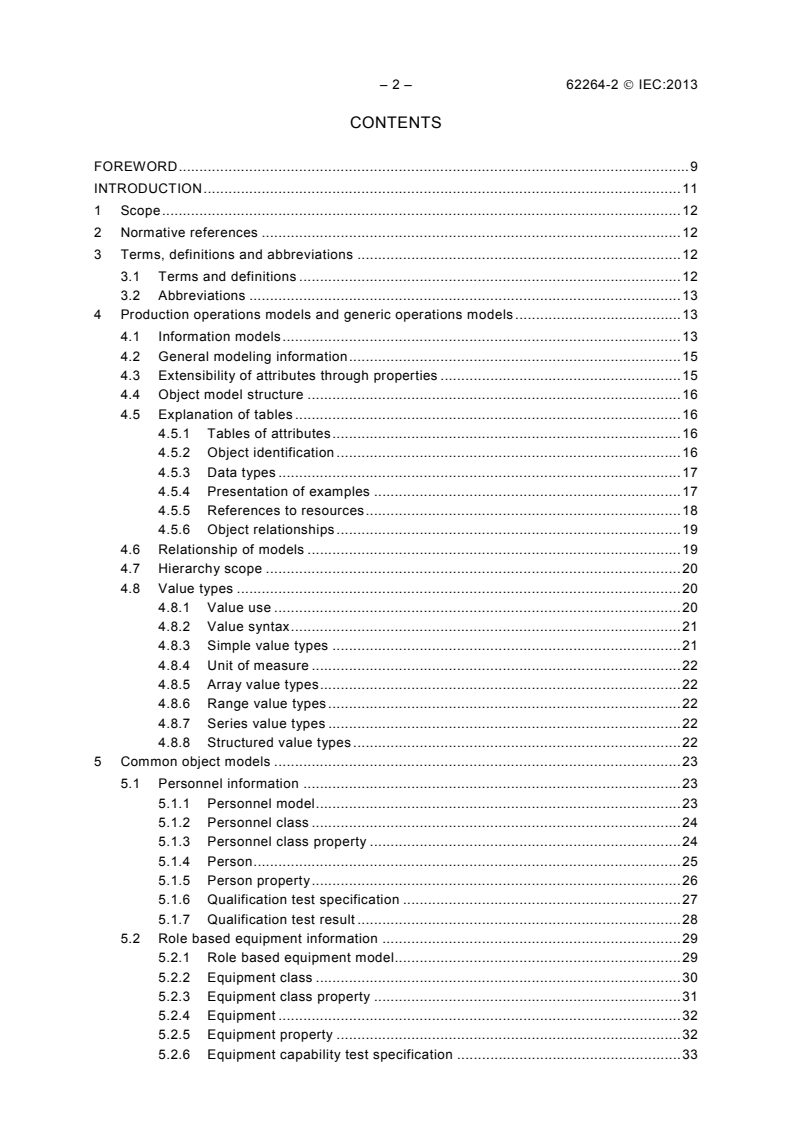
– 2 – 62264-2 IEC:2013
CONTENTS
FOREWORD . 9
INTRODUCTION . 11
1 Scope . 12
2 Normative references . 12
3 Terms, definitions and abbreviations . 12
3.1 Terms and definitions . 12
3.2 Abbreviations . 13
4 Production operations models and generic operations models . 13
4.1 Information models . 13
4.2 General modeling information . 15
4.3 Extensibility of attributes through properties . 15
4.4 Object model structure . 16
4.5 Explanation of tables . 16
4.5.1 Tables of attributes . 16
4.5.2 Object identification . 16
4.5.3 Data types . 17
4.5.4 Presentation of examples . 17
4.5.5 References to resources . 18
4.5.6 Object relationships . 19
4.6 Relationship of models . 19
4.7 Hierarchy scope . 20
4.8 Value types . 20
4.8.1 Value use . 20
4.8.2 Value syntax . 21
4.8.3 Simple value types . 21
4.8.4 Unit of measure . 22
4.8.5 Array value types . 22
4.8.6 Range value types . 22
4.8.7 Series value types . 22
4.8.8 Structured value types . 22
5 Common object models . 23
5.1 Personnel information . 23
5.1.1 Personnel model . 23
5.1.2 Personnel class . 24
5.1.3 Personnel class property . 24
5.1.4 Person . 25
5.1.5 Person property . 26
5.1.6 Qualification test specification . 27
5.1.7 Qualification test result . 28
5.2 Role based equipment information . 29
5.2.1 Role based equipment model. 29
5.2.2 Equipment class . 30
5.2.3 Equipment class property . 31
5.2.4 Equipment . 32
5.2.5 Equipment property . 32
5.2.6 Equipment capability test specification . 33
62264-2 IEC:2013 – 3 –
5.2.7 Equipment capability test result . 34
5.3 Physical asset information . 35
5.3.1 Physical asset model . 35
5.3.2 Physical asset . 36
5.3.3 Physical asset property . 37
5.3.4 Physical asset class . 37
5.3.5 Physical asset class property. 38
5.3.6 Physical asset capability test specification . 38
5.3.7 Physical asset capability test result . 39
5.3.8 Equipment asset mapping. 40
5.4 Material information . 40
5.4.1 Material model . 40
5.4.2 Material class . 41
5.4.3 Material class property . 42
5.4.4 Material definition . 43
5.4.5 Material definition property . 44
5.4.6 Material lot . 45
5.4.7 Material lot property . 47
5.4.8 Material sublot . 47
5.4.9 Material test specification . 49
5.4.10 Material test result . 50
5.4.11 Assemblies . 51
5.5 Process segment information . 52
5.5.1 Process segment model . 52
5.5.2 Process segment . 53
5.5.3 Personnel segment specification . 54
5.5.4 Personnel segment specification property . 55
5.5.5 Equipment segment specification. 56
5.5.6 Equipment segment specification property . 56
5.5.7 Material segment specification . 57
5.5.8 Material segment specification property . 59
5.5.9 Physical asset segment specification . 59
5.5.10 Physical asset segment specification property . 60
5.5.11 Process segment parameter . 61
5.5.12 Process segment dependency . 61
5.6 Containers, tools and software . 63
5.6.1 Containers . 63
5.6.2 Tools . 63
5.6.3 Software . 63
6 Operations management information . 63
6.1 Operations definition information . 63
6.1.1 Operations definition model . 63
6.1.2 Operations definition . 64
6.1.3 Operations material bill . 65
6.1.4 Operations material bill item . 66
6.1.5 Operations segment . 67
6.1.6 Parameter specification . 68
6.1.7 Personnel specification . 69
– 4 – 62264-2 IEC:2013
6.1.8 Personnel specification property . 70
6.1.9 Equipment specification . 71
6.1.10 Equipment specification property . 72
6.1.11 Physical asset specification . 73
6.1.12 Physical asset specification property . 74
6.1.13 Material specification . 75
6.1.14 Material specification property . 76
6.1.15 Operations segment dependency . 77
6.2 Operations schedule information . 77
6.2.1 Operations schedule model . 77
6.2.2 Operations schedule . 78
6.2.3 Operations request . 80
6.2.4 Segment requirement . 81
6.2.5 Segment parameter . 82
6.2.6 Personnel requirement . 83
6.2.7 Personnel requirement property . 84
6.2.8 Equipment requirement . 85
6.2.9 Equipment requirement property . 86
6.2.10 Physical asset requirement . 87
6.2.11 Physical asset requirement property . 89
6.2.12 Material requirement . 89
6.2.13 Material requirement property . 91
6.2.14 Requested segment response . 92
6.3 Operations performance information . 92
6.3.1 Operations performance model . 92
6.3.2 Operations performance . 93
6.3.3 Operations response . 94
6.3.4 Segment response . 95
6.3.5 Segment data . 96
6.3.6 Personnel actual . 97
6.3.7 Personnel actual property . 98
6.3.8 Equipment actual . 99
6.3.9 Equipment actual property . 100
6.3.10 Physical asset actual . 101
6.3.11 Physical asset actual property . 102
6.3.12 Material actual . 103
6.3.13 Material actual property . 105
6.4 Operations capability information . 105
6.4.1 Operations capability model . 105
6.4.2 Operations capability . 106
6.4.3 Personnel capability . 107
6.4.4 Personnel capability property. 109
6.4.5 Equipment capability . 109
6.4.6 Equipment capability property . 110
6.4.7 Physical asset capability . 111
6.4.8 Physical asset capability property . 112
6.4.9 Material capability . 113
6.4.10 Material capability property . 115
6.5 Process segment capability information . 116
62264-2 IEC:2013 – 5 –
6.5.1 Process segment capability model . 116
6.5.2 Process segment capability . 117
7 Object model inter-relationships . 118
8 List of objects . 120
9 Compliance . 123
Annex A (normative) Production specific information. 124
Annex B (informative) Use and examples . 132
Annex C (informative) Example data sets . 140
Annex D (informative) Questions and answers about object use . 148
Annex E (informative) Logical information flows . 162
Bibliography . 165
Figure 1 – Production operations management information models . 14
Figure 2 – Operations information models for operations management . 15
Figure 3 – Detailed resource relationship in models . 18
Figure 4 – Hierarchy scope model . 20
Figure 5 – Personnel model . 24
Figure 6 – Role based equipment model . 30
Figure 7 – Physical asset model . 35
Figure 8 – Physical asset and equipment relationship . 36
Figure 9 – Material model . 41
Figure 10 – Example of a material with an assembly . 52
Figure 11 – Process segment model . 53
Figure 12 – Segment dependency examples . 62
Figure 13 – Operations definition model . 64
Figure 14 – Operations schedule model . 78
Figure 15 – Operations performance model . 92
Figure 16 – Operations capability Model . 106
Figure 17 – Process segment capability object model . 116
Figure 18 – Object model inter-relationships . 118
Figure A.1 – Product definition model . 124
Figure A.2 – Production schedule model . 127
Figure A.3 – Production performance model . 129
Figure A.4 – Production capability model . 131
Figure B.1 – Personnel model . 133
Figure B.2 – Instances of a person class . 134
Figure B.3 – UML model for class and class properties . 134
Figure B.4 – Class property . 135
Figure B.5 – Instances of a person properties . 135
Figure B.6 – Instances of person and person properties . 135
Figure B.7 – XML schema for a person object . 138
Figure B.8 – XML schema for person properties . 138
Figure B.9 – Example of person and person property . 139
– 6 – 62264-2 IEC:2013
Figure B.10 – Example of person class information . 139
Figure B.11 – Adaptor to map different property IDs and values . 139
Figure D.1 – Class and property IDs used to identify elements. 151
Figure D.2 – A property defining overlapping subsets of the capability . 152
Figure D.3 – Routing for a product . 153
Figure D.4 – Routing with co-products and material dependencies . 154
Figure D.5 – Product and process capability relationships . 155
Figure D.6 – Time-based dependencies . 156
Figure D.7 – Mixed operation example . 160
Figure E.1 – Enterprise to manufacturing system logical information flows . 163
Figure E.2 – Logical information flows among multiple systems . 164
Table 1 – UML notation used . 16
Table 2 – Example table . 17
Table 3 – Attributes of hierarchy scope . 20
Table 4 – Commonly used CCTS types for exchange . 21
Table 5 – Attributes of personnel class . 24
Table 6 – Attributes of personnel class property . 25
Table 7 – Attributes of person . 26
Table 8 – Attributes of person property . 27
Table 9 – Attributes of qualification test specification . 28
Table 10 – Attributes of qualification test result . 29
Table 11 – Attributes of equipment class . 31
Table 12 – Attributes of equipment class property . 31
Table 13 – Attributes of equipment . 32
Table 14 – Attributes of equipment property . 33
Table 15 – Attributes of equipment capability test specification . 34
Table 16 – Attributes of equipment capability test result . 34
Table 17 – Attributes of physical asset . 36
Table 18 – Attributes of physical asset property . 37
Table 19 – Attributes of physical asset class . 38
Table 20 – Attributes of physical asset class property . 38
Table 21 – Attributes of physical asset capability test specification . 39
Table 22 – Attributes of physical asset capability test result . 40
Table 23 – Attributes of equipment asset mapping . 40
Table 24 – Attributes of material class . 42
Table 25 – Attributes of material class property . 43
Table 26 – Attributes of material definition . 44
Table 27 – Attributes of material definition property . 45
Table 28 – Attributes of material lot . 46
Table 29 – Attributes of material lot property . 47
Table 30 – Attributes of material sublot . 49
Table 31 – Attributes of material test specification . 50
62264-2 IEC:2013 – 7 –
Table 32 – Attributes of material test result . 51
Table 33 – Attributes of process segment . 54
Table 34 – Attributes of personnel segment specification . 55
Table 35 – Attributes of personnel segment specification property . 56
Table 36 – Attributes of equipment segment specification . 56
Table 37 – Attributes of equipment segment specification property . 57
Table 38 – Attributes of material segment specification . 58
Table 39 – Attributes of material segment specification property . 59
Table 40 – Attributes of physical asset segment specification . 60
Table 41 – Attributes of physical asset segment specification property . 60
Table 42 – Attributes of process segment parameter . 61
Table 43 – Attributes of process segment dependency . 62
Table 44 – Attributes of operations definition . 65
Table 45 – Attributes of operations material bill . 66
Table 46 – Attributes of operations material bill item . 67
Table 47 – Attributes of operations segment . 68
Table 48 – Attributes of parameter specification . 69
Table 49 – Attributes of personnel specification . 70
Table 50 – Attributes of personnel specification property . 71
Table 51 – Attributes of equipment specification . 72
Table 52 – Attributes of equipment specification property . 73
Table 53 – Attributes of physical asset specification . 74
Table 54 – Attributes of physical asset specification property. 74
Table 55 – Attributes of material specification . 75
Table 56 – Attributes of material specification property . 76
Table 57 – Attributes of operations segment dependency . 77
Table 58 – Attributes of operations schedule . 79
Table 59 – Attributes of operations request . 80
Table 60 – Attributes of segment requirement . 82
Table 61 – Attributes of segment parameter . 83
Table 62 – Attributes of personnel requirement . 84
Table 63 – Attributes of personnel requirement property . 85
Table 64 – Attributes of equipment requirement . 86
Table 65 – Attributes of equipment requirement property . 87
Table 66 – Attributes of physical asset requirement . 88
Table 67 – Attributes of physical asset requirement property . 89
Table 68 – Attributes of material requirement . 90
Table 69 – Attributes of material requirement property . 91
Table 70 – Attributes of operations performance . 93
Table 71 – Attributes of operations response . 94
Table 72 – Attributes of segment response . 96
Table 73 – Attributes of segment data . 97
Table 74 – Attributes of personnel actual . 98
– 8 – 62264-2 IEC:2013
Table 75 – Attributes of personnel actual property . 99
Table 76 – Attributes of equipment actual . 100
Table 77 – Attributes of equipment actual property . 101
Table 78 – Attributes of physical asset actual . 102
Table 79 – Attributes of physical asset actual property. 103
Table 80 – Attributes of material actual . 104
Table 81 – Attributes of material actual property . 105
Table 82 – Attributes of operations capability . 107
Table 83 – Attributes of personnel capability . 108
Table 84 – Attributes of personnel capability property . 109
Table 85 – Attributes of equipment capability . 110
Table 86 – Attributes of equipment capability property . 111
Table 87 – Attributes of physical asset capability . 112
Table 88 – Attributes of physical asset capability property . 113
Table 89 – Attributes of material capability. 114
Table 90 – Attributes of material capability property . 115
Table 91 – Attributes of process segment capability . 117
Table 92 – Model cross-reference (1 of 2) . 119
Table 93 – Common resource objects (1 of 4) . 120
Table B.1 – Attributes of person . 133
Table B.2 – Database structure for person . 136
Table B.3 – Database structure for person property . 136
Table B.4 – Database for person with data. 137
Table B.5 – Database for person property with data . 137
Table D.1 – Definition of segment types . 150
Table D.2 – Examples of materials and equipment . 158
Table D.3 – Equipment and physical assets . 158
62264-2 IEC:2013 – 9 –
INTERNATIONAL ELECTROTECHNICAL COMMISSION
_____________
ENTERPRISE-CONTROL SYSTEM INTEGRATION –
Part 2: Objects and attributes for enterprise-control system integration
FOREWORD
1) The International Electrotechnical Commission (IEC) is a worldwide organization for standardization comprising
all national electrotechnical committees (IEC National Committees). The object of IEC is to promote
international co-operation on all questions concerning standardization in the electrical and electronic fields. To
this end and in addition to other activities, IEC publishes International Standards, Technical Specifications,
Technical Reports, Publicly Available Specifications (PAS) and Guides (hereafter referred to as “IEC
Publication(s)”). Their preparation is entrusted to technical committees; any IEC National Committee interested
in the subject dealt with may participate in this preparatory work. International, governmental and non-
governmental organizations liaising with the IEC also participate in this preparation. IEC collaborates closely
with the International Organization for Standardization (ISO) in accordance with conditions determined by
agreement between the two organizations.
2) The formal decisions or agreements of IEC on technical matters express, as nearly as possible, an international
consensus of opinion on the relevant subjects since each technical committee has representation from all
interested IEC National Committees.
3) IEC Publications have the form of recommendations for international use and are accepted by IEC National
Committees in that sense. While all reasonable efforts are made to ensure that the technical content of IEC
Publications is accurate, IEC cannot be held responsible for the way in which they are used or for any
misinterpretation by any end user.
4) In order to promote international uniformity, IEC National Committees undertake to apply IEC Publications
transparently to the maximum extent possible in their national and regional publications. Any divergence
between any IEC Publication and the corresponding national or regional publication shall be clearly indicated in
the latter.
5) IEC itself does not provide any attestation of conformity. Independent certification bodies provide conformity
assessment services and, in some areas, access to IEC marks of conformity. IEC is not responsible for any
services carried out by independent certification bodies.
6) All users should ensure that they have the latest edition of this publication.
7) No liability shall attach to IEC or its directors, employees, servants or agents including individual experts and
members of its technical committees and IEC National Committees for any personal injury, property damage or
other damage of any nature whatsoever, whether direct or indirect, or for costs (including legal fees) and
expenses arising out of the publication, use of, or reliance upon, this IEC Publication or any other IEC
Publications.
8) Attention is drawn to the Normative references cited in this publication. Use of the referenced publications is
indispensable for the correct application of this publication.
9) Attention is drawn to the possibility that some of the elements of this IEC Publication may be the subject of
patent rights. IEC shall not be held responsible for identifying any or all such patent rights.
International Standard IEC 62264-2 has been developed by subcommittee 65E: Devices and
integration in enterprise systems, of IEC technical committee 65: Industrial-process
measurement, control and automation, and by ISO technical committee 184/SC5:
Interoperability, integration and architectures for enterprise systems and automation
applications. It is published as a double logo standard.
This standard is based upon ANSI/ISA-95.00.02-2010, Enterprise-Control System Integration
...