

IEC TS 60870-5-604:2016
(Main)Telecontrol equipment and systems - Part 5-604: Conformance test cases for the IEC 60870-5-104 companion standard
General Information
- Abstract
IEC TS 60870-5-604:2016(E) describes test cases for conformance testing of telecontrol equipment, Substation Automation Systems (SAS) and telecontrol systems, including front-end functions of SCADA, using the IEC 60870-5-104 companion standard and IEC 60870-5-6, Guidelines for conformance testing for the IEC 60870-5 companion standards. The use of this part of IEC 60870 facilitates interoperability by providing a standard method of testing protocol implementations. This new edition includes the following significant technical changes with respect to the previous edition:
- resolution of ambiguities;
- refinement of some test cases to enhance operability between tested devices;
- addition of some test cases (mainly negative test cases).
- Status
- Published
- Publication Date
- 17-Sep-2026
- Technical Committee
- TC 57 - Power systems management and associated information exchange
- Drafting Committee
- WG 3 - TC 57/WG 3
- Current Stage
- PPUB - Publication issued
- Start Date
- 09-Jun-2016
- Completion Date
- 31-Jul-2016
Buy Documents
IEC TS 60870-5-604:2016 - Telecontrol equipment and systems - Part 5-604: Conformance test cases for the IEC 60870-5-104 companion standard Released:6/9/2016
IEC TS 60870-5-604:2016 RLV - Telecontrol equipment and systems - Part 5-604: Conformance test cases for the IEC 60870-5-104 companion standard Released:6/9/2016
IEC TS 60870-5-604:2016+AMD1:2026 CSV - Telecontrol equipment and systems - Part 5-604: Transmission protocols - Conformance test cases for the IEC 60870-5-104 companion standard
Overview
IEC TS 60870-5-604:2016 is a technical specification developed by the International Electrotechnical Commission (IEC) that defines conformance test cases for telecontrol equipment and systems utilizing the IEC 60870-5-104 companion standard. This specification supports the assessment of Substation Automation Systems (SAS), telecontrol systems, and front-end functions of Supervisory Control and Data Acquisition (SCADA) systems. By aligning with IEC 60870-5-6 guidelines, it helps ensure standardized testing and improved device interoperability within power system management and telecontrol communications.
This second edition includes significant updates, such as the resolution of ambiguities, enhancements to test case operability, and the inclusion of new negative test cases. Such improvements streamline the process of validating implementations against the IEC 60870-5-104 protocol, promoting consistency and reliability in automation and communication infrastructure.
Key Topics
IEC TS 60870-5-604:2016 covers a comprehensive range of aspects relevant to conformance testing, including:
- Test Case Structure: Detailed specification of mandatory, conditional, and optional test cases based on device function and declared capabilities.
- Configuration Parameters: Defines the setup for devices under test (DUT), including system roles (controlling or controlled stations), frame lengths, addressing schemes, and transmission procedures.
- Protocol Tests: Addresses transport layer (TCP/IP) requirements, sequence numbers, timeout handling, and application protocols such as ASDU formatting and command transmission.
- Result Documentation: Provides structured charts for recording results, differentiating between passed, failed, or non-applicable test outcomes.
- Negative Test Cases: Introduces specific scenarios designed to verify correct device behavior when unexpected or erroneous conditions occur.
- Reference to Guidelines: Mandates alignment with IEC 60870-5-6 for test methodologies and environment setup.
- PICS/PIXIT Integration: Links tests with Protocol Implementation Conformance Statements (PICS) and Protocol Implementation Extra Information for Testing (PIXIT), ensuring that only relevant cases are executed.
Applications
IEC TS 60870-5-604:2016 is essential for various practical and industrial applications, including:
- SCADA System Testing: Ensures that SCADA front-end devices reliably implement the IEC 60870-5-104 protocol, facilitating integration and secure data exchange in substations and power networks.
- Substation Automation: Guides conformance assessment of SAS components, a critical step in deploying interoperable and standards-compliant automation hardware and software.
- Device Certification: Provides a reference for independent conformance testing and certification services, reducing the risk of non-interoperable implementations in multi-vendor environments.
- Protocol Development: Assists vendors and developers in verifying protocol stacks during product development and prior to field deployment.
- Quality Assurance: Supports utilities and system integrators in ensuring long-term reliability and interoperability of telecontrol equipment through standardized conformance assessment.
Related Standards
IEC TS 60870-5-604:2016 is closely related to other international standards in the telecontrol and power system management domain:
- IEC 60870-5-104: Companion standard for network access using standard transport profiles, forming the primary protocol under test.
- IEC 60870-5-6: Guidelines for conformance testing, outlining test environments and methodologies to which IEC TS 60870-5-604 aligns.
- IEC 60870-5-101: Basic telecontrol communication protocol, referenced for application layer conformance.
- IEC 60870-5-4 and IEC 60870-5-5: Define application information elements and basic application functions utilized in test definitions.
- IETF RFC2200: Specifies relevant TCP/IP requirements for transport testing of IEC 60870-5-104.
- Other Related IEC Standards: Cover aspects outside the immediate scope of protocol conformance such as safety and electromagnetic compatibility (EMC).
By providing a standardized and thorough framework for conformance testing, IEC TS 60870-5-604:2016 plays a crucial role in advancing reliable and interoperable telecontrol solutions for the global energy sector.
Relations
- Effective Date
- 26-Oct-2025
- Effective Date
- 05-Sep-2023
Buy Documents
IEC TS 60870-5-604:2016 - Telecontrol equipment and systems - Part 5-604: Conformance test cases for the IEC 60870-5-104 companion standard Released:6/9/2016
IEC TS 60870-5-604:2016 RLV - Telecontrol equipment and systems - Part 5-604: Conformance test cases for the IEC 60870-5-104 companion standard Released:6/9/2016
IEC TS 60870-5-604:2016+AMD1:2026 CSV - Telecontrol equipment and systems - Part 5-604: Transmission protocols - Conformance test cases for the IEC 60870-5-104 companion standard
Get Certified
Connect with accredited certification bodies for this standard

ANCE
Mexican certification and testing association.

Intertek Slovenia
Intertek testing, inspection, and certification services in Slovenia.

LNE (Laboratoire National de Métrologie et d'Essais)
French national laboratory for metrology and testing.
Sponsored listings
Frequently Asked Questions
IEC TS 60870-5-604:2016 is a technical specification published by the International Electrotechnical Commission (IEC). Its full title is "Telecontrol equipment and systems - Part 5-604: Conformance test cases for the IEC 60870-5-104 companion standard". This standard covers: IEC TS 60870-5-604:2016(E) describes test cases for conformance testing of telecontrol equipment, Substation Automation Systems (SAS) and telecontrol systems, including front-end functions of SCADA, using the IEC 60870-5-104 companion standard and IEC 60870-5-6, Guidelines for conformance testing for the IEC 60870-5 companion standards. The use of this part of IEC 60870 facilitates interoperability by providing a standard method of testing protocol implementations. This new edition includes the following significant technical changes with respect to the previous edition: - resolution of ambiguities; - refinement of some test cases to enhance operability between tested devices; - addition of some test cases (mainly negative test cases).
IEC TS 60870-5-604:2016(E) describes test cases for conformance testing of telecontrol equipment, Substation Automation Systems (SAS) and telecontrol systems, including front-end functions of SCADA, using the IEC 60870-5-104 companion standard and IEC 60870-5-6, Guidelines for conformance testing for the IEC 60870-5 companion standards. The use of this part of IEC 60870 facilitates interoperability by providing a standard method of testing protocol implementations. This new edition includes the following significant technical changes with respect to the previous edition: - resolution of ambiguities; - refinement of some test cases to enhance operability between tested devices; - addition of some test cases (mainly negative test cases).
IEC TS 60870-5-604:2016 is classified under the following ICS (International Classification for Standards) categories: 33.200 - Telecontrol. Telemetering. The ICS classification helps identify the subject area and facilitates finding related standards.
IEC TS 60870-5-604:2016 has the following relationships with other standards: It is inter standard links to IEC TS 60870-5-604:2016/AMD1:2026, IEC TS 60870-5-604:2007. Understanding these relationships helps ensure you are using the most current and applicable version of the standard.
IEC TS 60870-5-604:2016 is available in PDF format for immediate download after purchase. The document can be added to your cart and obtained through the secure checkout process. Digital delivery ensures instant access to the complete standard document.
Standards Content (Sample)
IEC TS 60870-5-604 ®
Edition 2.0 2016-06
TECHNICAL
SPECIFICATION
colour
inside
Telecontrol equipment and systems –
Part 5-604: Conformance test cases for the IEC 60870-5-104 companion standard
All rights reserved. Unless otherwise specified, no part of this publication may be reproduced or utilized in any form
or by any means, electronic or mechanical, including photocopying and microfilm, without permission in writing from
either IEC or IEC's member National Committee in the country of the requester. If you have any questions about IEC
copyright or have an enquiry about obtaining additional rights to this publication, please contact the address below or
your local IEC member National Committee for further information.
IEC Central Office Tel.: +41 22 919 02 11
3, rue de Varembé Fax: +41 22 919 03 00
CH-1211 Geneva 20 info@iec.ch
Switzerland www.iec.ch
About the IEC
The International Electrotechnical Commission (IEC) is the leading global organization that prepares and publishes
International Standards for all electrical, electronic and related technologies.
About IEC publications
The technical content of IEC publications is kept under constant review by the IEC. Please make sure that you have the
latest edition, a corrigenda or an amendment might have been published.
IEC Catalogue - webstore.iec.ch/catalogue Electropedia - www.electropedia.org
The stand-alone application for consulting the entire The world's leading online dictionary of electronic and
bibliographical information on IEC International Standards, electrical terms containing 20 000 terms and definitions in
Technical Specifications, Technical Reports and other English and French, with equivalent terms in 15 additional
documents. Available for PC, Mac OS, Android Tablets and languages. Also known as the International Electrotechnical
iPad. Vocabulary (IEV) online.
IEC publications search - www.iec.ch/searchpub IEC Glossary - std.iec.ch/glossary
The advanced search enables to find IEC publications by a 65 000 electrotechnical terminology entries in English and
variety of criteria (reference number, text, technical French extracted from the Terms and Definitions clause of
committee,…). It also gives information on projects, replaced IEC publications issued since 2002. Some entries have been
and withdrawn publications. collected from earlier publications of IEC TC 37, 77, 86 and
CISPR.
IEC Just Published - webstore.iec.ch/justpublished
Stay up to date on all new IEC publications. Just Published IEC Customer Service Centre - webstore.iec.ch/csc
details all new publications released. Available online and If you wish to give us your feedback on this publication or
also once a month by email. need further assistance, please contact the Customer Service
Centre: csc@iec.ch.
IEC TS 60870-5-604 ®
Edition 2.0 2016-06
TECHNICAL
SPECIFICATION
colour
inside
Telecontrol equipment and systems –
Part 5-604: Conformance test cases for the IEC 60870-5-104 companion standard
INTERNATIONAL
ELECTROTECHNICAL
COMMISSION
ICS 33.200 ISBN 978-2-8322-3425-9
– 2 – IEC TS 60870-5-604:2016 © IEC 2016
CONTENTS
FOREWORD . 4
INTRODUCTION . 6
1 Scope . 7
2 Normative references. 7
3 Terms and definitions . 8
4 Abbreviated terms . 8
5 Conformance testing for IEC 60870-5-104 . 8
5.1 Overview and legend . 8
5.2 Configuration parameters IEC 60870-5-104 . 10
5.3 Verification of IEC 60870-5-104 communication . 10
5.4 Conformance test procedures . 51
5.5 Test results chart . 88
5.6 Test results of command transmission . 95
5.6.1 General . 95
5.6.2 Test results of single command transmission . 96
5.6.3 Test results of double command transmission . 99
5.6.4 Test results of regulating step command transmission. 102
5.6.5 Test results of setpoint command transmission . 105
Figure 1 – Test procedure . 9
Table 1 – Run the Conformance Test Procedures for each of the following supported
configuration parameter values . 10
Table 2 – Tests on transport provider level (1 of 5) . 11
Table 3 – Tests on data unit identifier . 16
Table 4 – Verification of ASDUs for process information in monitor (normal) direction (1
of 18) . 17
Table 5 – Verification of ASDUs for process information in control (normal) direction (1
of 8) . 35
Table 6 – Verification of ASDUs for system information in monitor (normal) direction . 43
Table 7 – Verification of ASDUs for system information in control (normal) direction (1
of 3) . 43
Table 8 – Verification of ASDUs for parameters in control (normal) direction (1 of 2) . 46
Table 9 – Verification of ASDUs for file transfer (in monitor (normal) and control
direction) (1 of 4) . 48
Table 10 – Data unit identifier conformance test procedures (1 of 2) . 52
Table 11 – Information object address conformance test procedures . 53
Table 12 – Station initialisation function conformance test procedures (1 of 3) . 54
Table 13 – Redundant link conformance test procedures (1 of 3) . 57
Table 14 – Cyclic data transmission function conformance test procedures . 60
Table 15 – Data acquisition through read function conformance test procedures . 61
Table 16 – Acquisition of events function conformance test procedures . 62
Table 17 – General interrogation function conformance test procedures (1 of 5) . 63
Table 18 – Clock synchronisation function conformance test procedures . 68
Table 19 – Command transmission function conformance test procedures (1 of 9) . 69
Table 20 – Transmission of integrated totals (telecounting) function conformance test
procedures (1 of 4) . 77
Table 21 – Parameter loading function conformance test procedures . 81
Table 22 – Test procedure function conformance test procedures . 82
Table 23 – File transfer procedure function conformance test procedures (1 of 3) . 83
Table 24 – Additional conformance test procedures . 86
Table 25 – Negative conformance test procedures . 87
Table 26 – PIXIT related conformance test procedures . 88
Table 27 – Test results chart (1 of 7) . 89
Table 28 – Test results of single command transmission (1 of 3) . 96
Table 29 – Test results of double command transmission (1 of 3) . 99
Table 30 – Test results of regulating step command transmission (1 of 3) . 102
Table 31 – Test results of setpoint command transmission (1 of 2) . 105
– 4 – IEC TS 60870-5-604:2016 © IEC 2016
INTERNATIONAL ELECTROTECHNICAL COMMISSION
____________
TELECONTROL EQUIPMENT AND SYSTEMS –
Part 5-604: Conformance test cases for
the IEC 60870-5-104 companion standard
FOREWORD
1) The International Electrotechnical Commission (IEC) is a worldwide organization for standardization comprising
all national electrotechnical committees (IEC National Committees). The object of IEC is to promote
international co-operation on all questions concerning standardization in the electrical and electronic fields. To
this end and in addition to other activities, IEC publishes International Standards, Technical Specifications,
Technical Reports, Publicly Available Specifications (PAS) and Guides (hereafter referred to as “IEC
Publication(s)”). Their preparation is entrusted to technical committees; any IEC National Committee interested
in the subject dealt with may participate in this preparatory work. International, governmental and non-
governmental organizations liaising with the IEC also participate in this preparation. IEC collaborates closely
with the International Organization for Standardization (ISO) in accordance with conditions determined by
agreement between the two organizations.
2) The formal decisions or agreements of IEC on technical matters express, as nearly as possible, an international
consensus of opinion on the relevant subjects since each technical committee has representation from all
interested IEC National Committees.
3) IEC Publications have the form of recommendations for international use and are accepted by IEC National
Committees in that sense. While all reasonable efforts are made to ensure that the technical content of IEC
Publications is accurate, IEC cannot be held responsible for the way in which they are used or for any
misinterpretation by any end user.
4) In order to promote international uniformity, IEC National Committees undertake to apply IEC Publications
transparently to the maximum extent possible in their national and regional publications. Any divergence
between any IEC Publication and the corresponding national or regional publication shall be clearly indicated in
the latter.
5) IEC itself does not provide any attestation of conformity. Independent certification bodies provide conformity
assessment services and, in some areas, access to IEC marks of conformity. IEC is not responsible for any
services carried out by independent certification bodies.
6) All users should ensure that they have the latest edition of this publication.
7) No liability shall attach to IEC or its directors, employees, servants or agents including individual experts and
members of its technical committees and IEC National Committees for any personal injury, property damage or
other damage of any nature whatsoever, whether direct or indirect, or for costs (including legal fees) and
expenses arising out of the publication, use of, or reliance upon, this IEC Publication or any other IEC
Publications.
8) Attention is drawn to the Normative references cited in this publication. Use of the referenced publications is
indispensable for the correct application of this publication.
9) Attention is drawn to the possibility that some of the elements of this IEC Publication may be the subject of
patent rights. IEC shall not be held responsible for identifying any or all such patent rights.
The main task of IEC technical committees is to prepare International Standards. In
exceptional circumstances, a technical committee may propose the publication of a technical
specification when
• the required support cannot be obtained for the publication of an International Standard,
despite repeated efforts, or
• the subject is still under technical development or where, for any other reason, there is the
future but no immediate possibility of an agreement on an International Standard.
Technical specifications are subject to review within three years of publication to decide
whether they can be transformed into International Standards.
IEC 60870-5-604, which is a technical specification, has been prepared by IEC technical
committee 57: Power systems management and associated information exchange.
This second edition cancels and replaces the first edition published in 2007. This edition
constitutes a technical revision.
This edition includes the following significant technical changes with respect to the previous
edition:
a) Resolution of ambiguities between IEC 60870-5-104:2006 and IEC TS 60870-5-604:2016
(together with IEC 60870-5-104/AMD1);
b) Refinement of some test cases to enhance operability between tested devices;
c) Additional test cases (mainly negative test cases) added.
The text of this technical specification is based on the following documents:
Enquiry draft Report on voting
57/1614/DTS 57/1683/RVC
Full information on the voting for the approval of this technical specification can be found in
the report on voting indicated in the above table.
This publication has been drafted in accordance with the ISO/IEC Directives, Part 2.
A list of all parts of IEC 60870 series, published under the general title Telecontrol equipment
and systems, can be found on the IEC website.
The committee has decided that the contents of this publication will remain unchanged until
the stability date indicated on the IEC website under "http://webstore.iec.ch" in the data
related to the specific publication. At this date, the publication will be
• transformed into an International standard,
• reconfirmed,
• withdrawn,
• replaced by a revised edition, or
• amended.
A bilingual version of this publication may be issued at a later date.
IMPORTANT – The 'colour inside' logo on the cover page of this publication indicates
that it contains colours which are considered to be useful for the correct
understanding of its contents. Users should therefore print this document using a
colour printer.
– 6 – IEC TS 60870-5-604:2016 © IEC 2016
INTRODUCTION
This part of IEC 60870, which is a technical specification, describes test cases for
conformance testing of telecontrol equipment or systems using the IEC 60870-5-104
companion standard and IEC 60870-5-6, Guidelines for conformance testing for the
IEC 60870-5 companion standards.
TELECONTROL EQUIPMENT AND SYSTEMS –
Part 5-604: Conformance test cases for
the IEC 60870-5-104 companion standard
1 Scope
This part of IEC 60870, which is a technical specification, describes test cases for
conformance testing of telecontrol equipment, Substation Automation Systems (SAS) and
telecontrol systems, including front-end functions of SCADA, using the IEC 60870-5-104
companion standard and IEC 60870-5-6, Guidelines for conformance testing for the IEC
60870-5 companion standards.
The use of this part of IEC 60870 facilitates interoperability by providing a standard method of
testing protocol implementations, but it does not guarantee interoperability of devices. It is
expected that using this specification during testing will minimize the risk of non-
interoperability.
The goal of this part of IEC 60870 is to enable unambiguous and standardised evaluation of
IEC 60870-5 companion standard protocol implementations. The guidelines and conditions for
the testing environment are described in IEC 60870-5-6. The detailed test cases per
companion standard, containing among others mandatory and optional mandatory test cases
per Basic Application Function, ASDU and transmission procedure, will become available as a
technical specification. Other functionality may need additional test cases but this is outside
the scope of this part of IEC 60870. For proper testing, it is recommended to define these
additional test cases. This document is such a Technical Specification for the mentioned
companion standard.
This part of IEC 60870 deals mainly with communication conformance testing; therefore other
requirements, such as safety or EMC are not covered. These requirements are covered by
other standards (if applicable) and the proof of compliance for these topics is done according
to these standards.
2 Normative references
The following documents, in whole or in part, are normatively referenced in this document and
are indispensable for its application. For dated references, only the edition cited applies. For
undated references, the latest edition of the referenced document (including any
amendments) applies.
IEC 60870-5-4:1993, Telecontrol equipment and systems – Part 5: Transmission protocols –
Section 4: Definition and coding of application information elements
IEC 60870-5-5:1995, Telecontrol equipment and systems – Part 5: Transmission protocols –
Section 5: Basic application functions
___________
The base standard always takes precedence. In case of ambiguity between this technical specification and the
base standards (IEC 60870-5-1 to IEC 60870-5-5, IEC 60870-5-104), this part of IEC 60870 needs to be
clarified or amended.
When testing, negative behaviour is not described in the base standard, the behaviour described in this
document prevails and should be observed.
The conformance statement produced after testing indicates any lack of conformance to either the test plan or
the base standard.
– 8 – IEC TS 60870-5-604:2016 © IEC 2016
IEC 60870-5-6:2006, Telecontrol equipment and systems – Part 5-6: Guidelines for
conformance testing for the IEC 60870-5 companion standards
IEC 60870-5-101:2003, Telecontrol equipment and systems – Part 5-101: Transmission
protocols – Companion standard for basic telecontrol tasks
IEC 60870-5-104:2006, Telecontrol equipment and systems – Part 5-104: Transmission
protocols – Network access for IEC 60870-5-101 using standard transport profiles
IETF RFC2200, Internet Official Protocol Standards
3 Terms and definitions
For the purposes of this document, the terms and definitions given in IEC 60870-5-6 apply.
4 Abbreviated terms
For the purposes of this document, the abbreviations given in IEC 60870-5-6 apply.
5 Conformance testing for IEC 60870-5-104
5.1 Overview and legend
An overview of tests is given in Tables 1 to 26. Procedural and functional testing shall always
start with the Station Initialisation function and proceeds with the next Basic Application
Functions. The procedure in each test case shall be followed, which means that the DUT is
able to function as described in the specific test case.
The test procedures in Tables 1 through 11 shall be carried out with no errors detected during
testing of all the Basic Application Functions in Tables 12 through 26. These tests are
preferably automatically performed by the used test platform.
In addition to the performance criteria listed in the test procedures, 5.3 lists the protocol
specifications that shall be verified automatically by the testing software or verified manually
by review of the test history log after execution of the test procedures. The verification shall
result in no errors detected during the complete test procedure.
This test plan has a direct reference to the PICS and possibly a PIXIT. Without a reference to
a PICS or PIXIT this test plan is obsolete.
Test case numbering syntax is subclause number + table number + test case number.
Test cases are mandatory depending on the description in the column ‘Required’. The
following situations are possible:
M = Mandatory test case regardless if enabled in the PICS/PIXIT, not only in one
situation but during execution of all the tests as in the PICS and/or PIXIT
PICS, x.x = Mandatory test case if the functionality is enabled in the PICS (by marking the
applicable check box), with a reference to the section number of the PICS (x.x);
NOTE PICS 9.x always refers to 60870-5-104:2006, Clause 9.
PIXIT = Mandatory test case if the functionality is enabled/described in the PIXIT.
Verification of these test cases by the user/owner of the PIXIT is required before
the test is started.
For each test case the test results shall be marked in the appropriate column of the test result
chart in 5.5 and 5.6. Each test case can either pass the test (Passed), fail the test (Failed),
not applicable, when the configuration value is not supported by the device (N.A.), or the test case
was not performed (Empty). Ideally, there should be no empty boxes when testing is complete.
For testing reverse direction, the same test procedures apply in the opposite direction
(replace "Controlling" with "Controlled" and vice versa), except for COT44-47 which are only
defined in Monitor direction (only a controlled station is allowed to send these COT).
The test tables are divided into 5 subclauses:
• Subclause 5.2 Configuration parameters IEC 60870-5-104
• Subclause 5.3 Verification of IEC 60870-5-104 communication
• Subclause 5.4 Conformance test procedures
• Subclause 5.5 Test result chart
• Subclause 5.6 Test results of command transmission
The procedure to perform all the mandatory test cases, according to the PID, is shown in
Figure 1.
Tailored
test plan
Test
DUT configured according
to PID as in 5.2
Change the
configuration
Run the conformance test
and repeat
Perform each
procedures according 5.4
the tests in
mandatory test
5.3 and 5.4
case according
to the tailored
test plan for the
Do verification according to 5.3
configured DUT
for the mandatory test cases
Refer to Figure 2 in IEC 60870-5-6
Defects?
IEC
Figure 1 – Test procedure
– 10 – IEC TS 60870-5-604:2016 © IEC 2016
5.2 Configuration parameters IEC 60870-5-104
Since IEC 60870-5-104 contains a number of configuration parameters affecting protocol behaviour, the conformance test procedures in 5.4 and
verification in 5.3 shall be performed at least once for each supported value of the parameters listed in Table 1. Basically the DUT shall be tested if
the functionality in 5.3 and 5.4 behaviour is correct for the configuration(s) in Table 1.
Table 1 – Run the Conformance Test Procedures for
each of the following supported configuration parameter values
No. Test Description Reference Required
5.2.1.1 System definition Controlling station test (Master) PICS, 9.1
5.2.1.2 Controlled station test (Slave) PICS, 9.1
5.2.1.50 Frame length Maximum length L (control direction) IEC 60870-5-101:2003, 6.2 PICS, 9.4
5.2.1.51 Maximum length L (monitor direction) IEC 60870-5-101:2003, 6.2 PICS, 9.4
5.2.1.70 COMMON ADDRESS of ASDU Two (2) octets for Common Address of ASDU (CASDU) IEC 60870-5-101:2003, 7.2.4 PICS, 9.5
5.2.1.80 INFORMATION OBJECT ADDRESS Three (3) octets for Information Object Address (structured or unstructured) IEC 60870-5-101:2003, 7.2.5 PICS, 9.5
nd
5.2.1.90 CAUSE OF TRANSMISSION Two (2) octets for COT field (2 octet is Originator address) IEC 60870-5-101:2003, 7.2.3 PICS, 9.5
5.3 Verification of IEC 60870-5-104 communication
This subclause lists the protocol specifications that shall be verified automatically by the testing software or verified manually by review of the test
history log after execution of the test procedures. Every test case describes functionality that has passed the test if the functionality as in the the
description column was shown to be correct. Correct means: the functionality shall be checked either automatically or manually, and also be
checked by the test engineer in a human readable format log-file. For example to test the IV qualifier of some information elements, the ASDU
containing this element shall be sent with the IV=1. Every test case marked “Passed”, has to be verifiable during testing and archived in log-files for
post assessment.
To identify if a test case is mandatory, it is necessary to read 5.1 carefully.
Table 2 – Tests on transport provider level (1 of 5)
No. Test Description Reference Required
5.3.2.1 IP FRAME IP Header, IP Fragment Re-assembling IETF RFC2200 M
5.3.2.2 Source Address, Destination address IETF RFC2200 M
5.3.2.3 TCP FRAME TCP Header, TCP Control field (specifically ACK, RST, SYN, FIN), TCP Sequencing IETF RFC2200 M
5.3.2.4 [The server (controlled station) uses the] port number 2404 [(confirmed by IANA) in all IEC 60870-5-104:2006, 5.4 M
cases, both for the listening port and established connections. The client (controlling
station) is free to use ephemeral port number, e.g. as allocated by the client’s TCP/IP
implementation]
5.3.2.5 Actively opening a new TCP connection starts with a TCP frame containing (SYN) from the IETF RFC2200 M
node that takes the initiative to establish the TCP connection. This is answered by the other
IEC 60870-5-104:2006, 7.1
node with (SYN, ACK), which in turn is answered by the initiating node with (ACK).
Thereinafter the TCP connection is established
5.3.2.6 Actively closing an established TCP connection starts with a TCP frame containing (FIN) IETF RFC2200 M
from the node that takes the initiative to close the TCP connection. This is answered by the
IEC 60870-5-104:2006, 7.1, Figure
other node (ACK) followed by a TCP frame from this same other node containing also (FIN).
This in turn is answered by the initiating node with (ACK). Thereinafter the TCP connection
is closed.
It can be accepted if a node combines an (ACK) and a (FIN) in a single TCP frame in reply
to a TCP frame with a (FIN).
5.3.2.7 During the test no problems should be detected on TCP/IP level IETF RFC2200 M
5.3.2.10 CS104 APDU Start character of APDU: 68 IEC 60870-5-104:2006, Clause 5 M
H
FRAME
5.3.2.11 Configured number of octets L as the maximum number of Data octets (ASDU + Control IEC 60870-5-104:2006, Clause 5 M
LAYOUT
field) in APDU: The maximum length of APDU for both directions is 253. It is a fixed system
parameter.
5.3.2.12 4-octet Control field IEC 60870-5-104:2006, Clause 5 M
– 12 – IEC TS 60870-5-604:2016 © IEC 2016
Table 2 (2 of 5)
No. Test Description Reference Required
5.3.2.20 CS104 I-FORMAT APDU Control field octet 1 bit 1 (LSB) = 0 IEC 60870-5-104:2006, M
Clause 5
Information transfer frame
5.3.2.21 Control field octets 1-2, bit 2.16 contain end sequence number N(S) range IEC 60870-5-104:2006, M
0.Maximum value 32767 Clause 5
5.3.2.22 Control field octet 3 bit 1 (bit 17) = 0 IEC 60870-5-104:2006, M
Clause 5
5.3.2.23 Control field octets 3-4, bit 18.32 contain Receive sequence number N(R) range IEC 60870-5-104:2006, M
0.maximum value 32767 Clause 5
5.3.2.24 I-format frame contains exactly one ASDU IEC 60870-5-104:2006, M
Clause 5
5.3.2.25 CS104 S-FORMAT APDU Control field octet 1, bit 1-2 have value 01 IEC 60870-5-104:2006, M
B
Clause 5
Numbered Supervisory
function frame
5.3.2.26 Control field octets 1-2, bit 3.16 all contain value 0 IEC 60870-5-104:2006, M
Clause 5
5.3.2.27 Control field octet 3 bit 1 (bit 17) = 0 IEC 60870-5-104:2006, M
Clause 5
5.3.2.28 Control field octets 3-4, bit 18.32 contain Receive sequence number N(R) range IEC 60870-5-104:2006, M
0.maximum value 32767 Clause 5
5.3.2.29 S-frame APDU only contains a single APCI field IEC 60870-5-104:2006, M
Clause 5
5.3.2.30 CS104 U-FORMAT APDU Control field octet 1, bit 1-2 have value 11 IEC 60870-5-104:2006, M
B
Clause 5
Unnumbered Control function
frame
5.3.2.31 Control field octet 1, bit 3 used for control function STARTDT Activation IEC 60870-5-104:2006, M
Clause 5
5.3.2.32 Control field octet 1, bit 4 used for control function STARTDT Confirmation IEC 60870-5-104:2006, M
Clause 5
5.3.2.33 Control field octet 1, bit 5 used for control function STOPDT Activation IEC 60870-5-104:2006, M
Clause 5
5.3.2.34 Control field octet 1, bit 6 used for control function STOPDT Confirmation IEC 60870-5-104:2006, M
Clause 5
5.3.2.35 Control field octet 1, bit 7 used for control function TESTFR Activation IEC 60870-5-104:2006, M
Clause 5
5.3.2.36 Control field octet 1, bit 8 used for control function TESTFR Confirmation IEC 60870-5-104:2006, M
Clause 5
5.3.2.37 Control field bit 3.8 contains exactly one active (bit with value 1) Control IEC 60870-5-104:2006, M
function (TESTFR, STARTDT, STOPDT, either Activation or Confirmation) per U- Clause 5
frame
5.3.2.38 Control field octets 2-4, bit 9.32 all contain value 0 IEC 60870-5-104:2006, M
Clause 5
5.3.2.39 U-frame APDU only contains a single APCI field IEC 60870-5-104:2006, M
Clause 5
Table 2 (3 of 5)
No. Test Description Reference Required
5.3.2.50 TRANSMISSION Balanced transmission (after TCP connection has been established) IEC 60870-5-104:2006, M
PROCEDURE Introduction
The initial values of the Send sequence number N(S) and the Receive sequence IEC 60870-5-104:2006, 5.1 M
number N(R) are set to 0 (zero) after a new TCP connection is successfully
established which is then a Stopped connection
An I-frame contains the current values of the Send sequence number N(S) and IEC 60870-5-104:2006, 5.1 M
the Receive sequence number N(R)
After sending an I-frame, the Send sequence number N(S) in the Primary station IEC 60870-5-104:2006, 5.1 M
is incremented with 1
After receiving a valid I-frame, the Receive sequence number N(R) in the IEC 60870-5-104:2006, 5.1 M
Secondary station is incremented with 1
Yet unacknowledged I-frames from the Primary station are acknowledged by IEC 60870-5-104:2006, 5.1 M
either an I-frame or an S-frame from the Secondary station
The Receive sequence number N(R) acknowledges all yet unacknowledged I- IEC 60870-5-104:2006, 5.1 M
frames with N(S) < N(R)
A Primary station sends at most the configured amount of K IEC 60870-5-104:2006, 5.5 M
unacknowledged I-frames before it stops and waits for an acknowledgement
A Secondary station sends an acknowledgement after receiving at most the IEC 60870-5-104:2006, 5.5 M
configured amount of W I-frames
An APDU with a Send sequence number N(S) that is higher or lower (called “out IEC 60870-5-104:2006, 5.1 M
of sequence”) than the current Receive sequence number N(R), results in
[sending an S-frame to confirm the I-frames that it has received (if applicable)
after which] a TCP Active close (TCP Control field FIN) is given by the
Secondary Station (because one or more previous APDUs may have been lost
along the way to their destination due to connection failures)
U-Frame Control function STARTDT_ACT answered with STARTDT_CON IEC 60870-5-104:2006, 5.3 M
U-Frame Control function STOPDT_ACT answered with STOPDT_CON IEC 60870-5-104:2006, 5.3 M
U-Frame Control function TESTFR_ACT answered with TESTFR_CON IEC 60870-5-104:2006, 5.2 M
– 14 – IEC TS 60870-5-604:2016 © IEC 2016
Table 2 (4 of 5)
No. Test Description Reference Required
5.3.2.70 TRANSMISSION CONTROL After a TCP connection has been established, initially a Stopped connection is IEC 60870-5-104:2006, 5.3 M
USING START/STOP created (a Stopped connection is an open (“established”) TCP connection that is
in confirmed STOPDT state) and allows the exchange of U-frames in controlling
and controlled direction
The receipt of I- and S-frames in a Stopped connection results in a TCP Active IEC 60870-5-104:2006, 5.3 M
close (TCP Control field FIN).
The controlling station sends a STARTDT_ACT after which a Pending Started IEC 60870-5-104:2006, 5.3 M
connection is created.
If no redundant links are configured, the controlling station may send U-, I-, and
S- frames immediately after the STARTDT_ACT which will be accepted by the
controlled station
The controlled station explicitly disables the transfer of I- and S-frames and the IEC 60870-5-104:2006, 5.3 M
controlling station does not accept I- or S-frames in a Pending Started
connection, but only U-frames
After the controlling station has received STARTDT_CON, the Started IEC 60870-5-104:2006, 5.3 M
connection is created and the controlled station may sent U-, I-, and S- frames
immediately after the STARTDT_CON. Controlled and controlling stations are
allowed to send U-, I-, and S- frames
The Controlling station explicitly disables the transfer of I-frames in monitoring IEC 60870-5-104:2006, 5.3 M
direction by sending a STOPDT_ACT to the Controlled station, after which a
Pending Stopped connection is created
The controlled station disables the transfer of I-frames after the STOPDT_ACT is IEC 60870-5-104:2006, 5.3 M
received. The controlling station may receive I-frames, which are transferred
before the receipt of the STOPDT_ACT
If unconfirmed I-frames are in the controlled station, the Pending Stopped IEC 60870-5-104:2006, 5.3 M
connection is called the Pending Unconfirmed Stopped connection. If the
controlled station receives the S-frame to confirm the I-frames (immediately or
after time-out t2 of the controlling station expires) the controlled station sends
the STOPDT_CON after the Stopped connection is created
If NO unconfirmed I-frames are in the controlled station the controlled station IEC 60870-5-104:2006, 5.3 M
sends a STOPDT_CON to the controlling station after which the Stopped
connection is created
Send sequence number N(S) and Receive Sequence number N(R) remain IEC 60870-5-104:2006, 5.3 M
unchanged during the use of U-frames with STARTDT / STOPDT indications
Table 2 (5 of 5)
No. Test Description Reference Required
5.3.2.90 TIME OUT INTERVALS An unanswered TCP Active open by the (fixed) Controlling Station (TCP IEC 60870-5-104:2006, 7.1, PIXIT
Control field SYN: CONNECTION REQUEST) is actually cancelled after the Figure 19
configured time out t (range 1.255 s) and subsequently restarted. It is
highly recommended to cancel the current timed out TCP Active open, to
prevent against an increasing number of “not cancelled” TCP connections
because of the limited number of available open connections in a system
A TCP Passive open by the Controlled Station (LISTEN) remains active IEC 60870-5-104:2006, 7.1 M
infinitely until a CONNECT is received
An I-frame from the Primary Station that is not acknowledged within the IEC 60870-5-104:2006, 5.1, M
configured time out t (range 1.255 s) results in a TCP Active close (TCP Figure 12
Control field FIN) by the Primary Station. [The time out t runs for every I-
IEC 60870-5-104:2006, 5.2
frame individually and is cancelled if that particular I-frame has been
confirmed.]
IEC 60870-5-104:2006, 5.3
A U-frame from the Primary Station that is not confirmed within the IEC 60870-5-104:2006, 5.1 M
configured time out t (range 1.255 s) results in a TCP Active close (TCP
IEC 60870-5-104:2006, 5.2
Control field FIN) by the Primary Station
After the configured time period t (range 1.254 s) of transmitting I-frames, IEC 60870-5-104:2006, 5.1, M
[which starts after the first unconfirmed frame is received], from the Primary Figure 10
Station in one direction only, an S-frame is sent by the Secondary Station to
acknowledge the last I-frame
IEC 60870-5-104:2006, 9.6 M
t < t
2 1
After the configured time period t (range 1 s.48 h, resolution 1 s) of IEC 60870-5-104:2006, 5.2 M
inactivity (no reception of I-, S- or U-frames on the connection by either
Primary or Secondary station), a U-frame with TESTFR_ACT is sent. The
reception of every frame – I frame, S frame or U frame – retriggers timer t3
and all time out interval rules apply
t > t IEC 60870-5-104:2006, 9.6 M
3 1
– 16 – IEC TS 60870-5-604:2016 © IEC 2016
Table 3 – Tests on data unit identifier
No. Test Description Reference Required
5.3.3.1 TY PE IDENTIFICATION Compatible ASDU type used/accepted for all ASDUs as in the PICS IEC 60870-5-101:2003, 7.2.1.1 PICS, 9.5
IEC 60870-5-101:2003, 7.3.1
IEC 60870-5-104:2006, Clause 8
PID
5.3.3.2 VAR IABLE STRUCTURE Variable structure qualifier SQ (Sequence or Set) as defined for each ASDU IEC 60870-5-101:2003, 7.2.2 M
QUALIFIER
IEC 60870-5-101:2003, 7.3.1
5.3.3.3 SQ:=1 only for COT Spontaneous (3), Cyclic/Periodic (1), Background Scan IEC 60870-5-101:2003, 7.2.2 PIXIT
(2) or Interrogation (20.36). Check the PICS for the supported COT values
5.3.3.4 Variable structure qualifier i (Number of elements) according to transmitted IEC 60870-5-101:2003, 7.2.2 M
number of information elements
5.3.3.5 Defined number of octets for ASDU IEC 60870-5-101:2003, 7.2 M
5.3.3.10 CAU SE OF TRANSMISSION Originator address identifies source application of Primary station or 0 if IEC 60870-5-101:2003, 7.2.3 PIXIT
present but not used
IEC 60870-5-104:2006, 9.5
5.3.3.11 Compatible Cause Of Transmission (COT) used/accepted. Check the PICS IEC 60870-5-101:2003, 7.2.3 PICS, 9.5
for the supported COT values
IEC 60870-5-101:2003, 7.2.3
5.3.3.12 P/N bit = 0: positive confirmation of activation IEC 60870-5-101:2003, 7.2.3 M
5.3.3.13 P/N bit = 1: negative confirmation of activation IEC 60870-5-101:2003, 7.2.3 M
5.3.3.14 Test bit = 0: ASDU generated during normal conditions IEC 60870-5-101:2003, 7.2.3 M
5.3.3.15 Test bit = 1: ASDU generated during test conditions IEC 60870-5-101:2003, 7.2.3 PIXIT
Table 4 – Verification of ASDUs for process information in monitor (normal) direction (1 of 18)
No. Test Description Reference Required
5.3.4.10 M _SP_NA_1 SIQ with SQ = 0, each element with its own IOA IEC 60870-5-101:2003, 7.3.1.1 PICS, 9.5
st
5.3.4.11 A SDU 1 SIQ with SQ = 1, with only the IOA of the 1 element and the following IEC 60870-5-101:2003, 7.3.1.1 PIXIT
Information Elements are identified by numbers incrementing continuously by +1
Single-point information
from this offset (see IEC 60870-5-101:2003, 7.2.2.1)
5.3.4.12 COT as defined in the attached PICS IEC 60870-5-101:2003, 7.3.1.1 PICS, 9.5
5.3.4.13 S IQ SPI = 0 (OFF), 1 (ON) IEC 60870-5-101:2003, 7.2.6.1 PICS, 9.5
5.3.4.14 RES = 0 IEC 60870-5-101:2003, 7.2.6.1 PICS, 9.5
5.3.4.15 BL = 0,1 IEC 60870-5-101:2003, 7.2.6.1 PIXIT
5.3.4.16 SB = 0,1 IEC 60870-5-101:2003, 7.2.6.1 PIXIT
5.3.4.17 NT = 0,1 IEC 60870-5-101:2003, 7.2.6.1 PIXIT
5.3.4.18 IV = 0,1 IEC 60870-5-101:2003, 7.2.6.1 PICS, 9.5
5.3.4.30 M_DP_NA_1 DIQ with SQ = 0, each element with its own IOA IEC 60870-5-101:2003, 7.3.1.3 PICS, 9.5
5.3.4.31 ASDU 3 DIQ with SQ = 1, with only the IOA of the 1st element and the following IEC 60870-5-101:2003, 7.3.1.3 PIXIT
Information Elements are identified by numbers incrementing continuously by +1
Double-point information
from this offset (see IEC 60870-5-101:2003, 7.2.2.1)
5.3.4.32 COT as defined in the attached PICS IEC 60870-5-101:2003, 7.3.1.3 PICS, 9.5
5.3.4.33 DIQ DPI = 0 (indeterminate or intermediate state), 1 (OFF), 2 (ON), 3 (indeterminate IEC 60870-5-101:2003, 7.2.6.2 PICS, 9.5
state)
5.3.4.34 RES = 0 IEC 60870-5-101:2003, 7.2.6.2 PICS, 9.5
5.3.4.35 BL = 0,1 IEC 60870-5-101:2003, 7.2.6.2 PIXIT
5.3.4.36 SB = 0,1 IEC 60870-5-101:2003, 7.2.6.2 PIXIT
5.3.4.37 NT = 0,1 IEC 60870-5-101:2003, 7.2.6.2 PIXIT
5.3.4.38 IV = 0,1 IEC 60870-5-101:2003, 7.2.6.2 PICS, 9.5
– 18 – IEC TS 60870-5-604:2016 © IEC 2016
Table 4 (2 of 18)
No. Test Description Reference Required
5.3.4.50 M_ST_NA_1 VTI with SQ = 0, each element with its own IOA IEC 60870-5-101:2003, 7.3.1.5 PICS, 9.5
5.3.4.51 ASDU 5 VTI with SQ = 1, with only the IOA of the 1st element and the following IEC 60870-5-101:2003, 7.3.1.5 PIXIT
Information Elements are identified by numbers incrementing continuously by +1
Step-position information
from this offset (see IEC 60870-5-101:2003, 7.2.2.1)
5.3.4.52 COT as defined in the attached PICS IEC 60870-5-101:2003, 7.3.1.5 PICS, 9.5
5.3.4.53 VTI Value valid range −64.+63 IEC 60870-5-101:2003, 7.2.6.5 PICS, 9.5
5.3.4.54 Transient = 0,1 IEC 60870-5-101:2003, 7.2.6.5 PICS, 9.5
5.3.4.55 QDS RES = 0 IEC 60870-5-101:2003, 7.2.6.3 PICS, 9.5
5.3.4.56 BL = 0,1 IEC 60870-5-101:2003, 7.2.6.3 PIXIT
5.3.4.57 SB = 0,1 IEC 60870-5-101:2003, 7.2.6.3 PIXIT
5.3.4.58 NT = 0,1 IEC 60870-5-101:2003, 7.2.6.3 PIXIT
5.3.4.59 IV = 0,1 IEC 60870-5-101:2003, 7.2.6.3 PICS, 9.5
5.3.4.60 OV = 0,1 IEC 60870-5-101:2003, 7.2.6.3 PICS, 9.5
5.3.4.70 M _BO_NA_1 BSI with SQ = 0, each element with its own IOA IEC 60870-5-101:2003, 7.3.1.7 PICS, 9.5
ASDU 7
5.3.4.71 BSI with SQ = 1, with only the IOA of the 1st element and the following IEC 60870-5-101:2003, 7.3.1.7 PIXIT
Information Elements are identified by numbers incrementing continuously by +1
Bitstring of 32 bit
from this offset (see IEC 60870-5-101:2003, 7.2.2.1)
5.3.4.72 COT as defined in the attached PICS IEC 60870-5-101:2003, 7.3.1.7 PICS, 9.5
5.3.4.73 BSI BSI = 0,1 IEC 60870-5-101:2003, 7.2.6.13 PICS, 9.5
5.3.4.74 QD S RES = 0 IEC 60870-5-101:2003, 7.2.6.3 PICS, 9.5
5.3.4.75 BL = 0,1 IEC 60870-5-101:2003, 7.2.6.3 PIXIT
Table 4 (3 of 18)
No. Test Description Reference Required
5.3.4.76 SB = 0,1 IEC 60870-5-101:2003, 7.2.6.3 PIXIT
5.3.4.77 NT = 0,1 IEC 60870-5-101:2003, 7.2.6.3 PIXIT
5.3.4.78 IV = 0,1 IEC 60870-5-101:2003, 7.2.6.3 PICS, 9.5
5.3.4.79 OV = 0,1 IEC 60870-5-101:2003, 7.2.6.3 PICS, 9.5
5.3.4.90 M_ME_NA_1 NVA with SQ = 0, each element with its own IOA IEC 60870-5-101:2003, 7.3.1.9 PICS, 9.5
5.3.4.91 ASDU 9 NVA with SQ = 1, with only the IOA of the 1st element and the following IEC 60870-5-101:2003, 7.3.1.9 PIXIT
Information Elements are identified by numbers incrementing continuously by +1
Measured value,
from this offset (see IEC 60870-5-101:2003, 7.2.2.1)
normalised value
5.3.4.92 COT as defined in the attached PICS IEC 60870-5-101:2003, 7.3.1.9 PICS, 9.5
5.3.4.93 NVA Value (translation considering the scaling factor) IEC 60870-5-101:2003, 7.2.6.6 PICS, 9.5
PIXIT
–15
5.3.4.94
...
IEC TS 60870-5-604 ®
Edition 2.0 2016-06
REDLINE VERSION
TECHNICAL
SPECIFICATION
colour
inside
Telecontrol equipment and systems –
Part 5-604: Conformance test cases for the IEC 60870-5-104 companion standard
All rights reserved. Unless otherwise specified, no part of this publication may be reproduced or utilized in any form
or by any means, electronic or mechanical, including photocopying and microfilm, without permission in writing from
either IEC or IEC's member National Committee in the country of the requester. If you have any questions about IEC
copyright or have an enquiry about obtaining additional rights to this publication, please contact the address below or
your local IEC member National Committee for further information.
IEC Central Office Tel.: +41 22 919 02 11
3, rue de Varembé Fax: +41 22 919 03 00
CH-1211 Geneva 20 info@iec.ch
Switzerland www.iec.ch
About the IEC
The International Electrotechnical Commission (IEC) is the leading global organization that prepares and publishes
International Standards for all electrical, electronic and related technologies.
About IEC publications
The technical content of IEC publications is kept under constant review by the IEC. Please make sure that you have the
latest edition, a corrigenda or an amendment might have been published.
IEC Catalogue - webstore.iec.ch/catalogue Electropedia - www.electropedia.org
The stand-alone application for consulting the entire The world's leading online dictionary of electronic and
bibliographical information on IEC International Standards, electrical terms containing 20 000 terms and definitions in
Technical Specifications, Technical Reports and other English and French, with equivalent terms in 15 additional
documents. Available for PC, Mac OS, Android Tablets and languages. Also known as the International Electrotechnical
iPad. Vocabulary (IEV) online.
IEC publications search - www.iec.ch/searchpub IEC Glossary - std.iec.ch/glossary
The advanced search enables to find IEC publications by a 65 000 electrotechnical terminology entries in English and
variety of criteria (reference number, text, technical French extracted from the Terms and Definitions clause of
committee,…). It also gives information on projects, replaced IEC publications issued since 2002. Some entries have been
and withdrawn publications. collected from earlier publications of IEC TC 37, 77, 86 and
CISPR.
IEC Just Published - webstore.iec.ch/justpublished
Stay up to date on all new IEC publications. Just Published IEC Customer Service Centre - webstore.iec.ch/csc
details all new publications released. Available online and If you wish to give us your feedback on this publication or
also once a month by email. need further assistance, please contact the Customer Service
Centre: csc@iec.ch.
IEC TS 60870-5-604 ®
Edition 2.0 2016-06
REDLINE VERSION
TECHNICAL
SPECIFICATION
colour
inside
Telecontrol equipment and systems –
Part 5-604: Conformance test cases for the IEC 60870-5-104 companion standard
INTERNATIONAL
ELECTROTECHNICAL
COMMISSION
ICS 33.200 ISBN 978-2-8322-3457-0
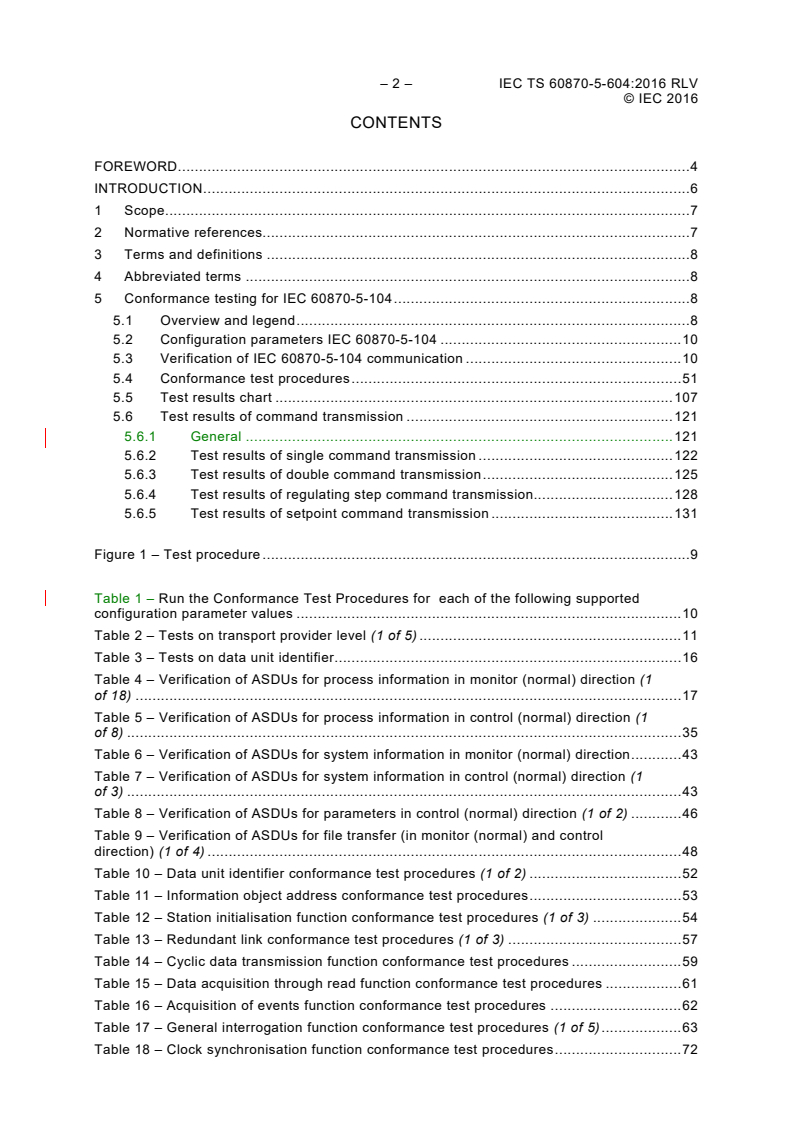
– 2 – IEC TS 60870-5-604:2016 RLV
© IEC 2016
CONTENTS
FOREWORD . 4
INTRODUCTION . 6
1 Scope . 7
2 Normative references. 7
3 Terms and definitions . 8
4 Abbreviated terms . 8
5 Conformance testing for IEC 60870-5-104 . 8
5.1 Overview and legend . 8
5.2 Configuration parameters IEC 60870-5-104 . 10
5.3 Verification of IEC 60870-5-104 communication . 10
5.4 Conformance test procedures . 51
5.5 Test results chart . 107
5.6 Test results of command transmission . 121
5.6.1 General . 121
5.6.2 Test results of single command transmission . 122
5.6.3 Test results of double command transmission . 125
5.6.4 Test results of regulating step command transmission. 128
5.6.5 Test results of setpoint command transmission . 131
Figure 1 – Test procedure . 9
Table 1 – Run the Conformance Test Procedures for each of the following supported
configuration parameter values . 10
Table 2 – Tests on transport provider level (1 of 5) . 11
Table 3 – Tests on data unit identifier . 16
Table 4 – Verification of ASDUs for process information in monitor (normal) direction (1
of 18) . 17
Table 5 – Verification of ASDUs for process information in control (normal) direction (1
of 8) . 35
Table 6 – Verification of ASDUs for system information in monitor (normal) direction . 43
Table 7 – Verification of ASDUs for system information in control (normal) direction (1
of 3) . 43
Table 8 – Verification of ASDUs for parameters in control (normal) direction (1 of 2) . 46
Table 9 – Verification of ASDUs for file transfer (in monitor (normal) and control
direction) (1 of 4) . 48
Table 10 – Data unit identifier conformance test procedures (1 of 2) . 52
Table 11 – Information object address conformance test procedures . 53
Table 12 – Station initialisation function conformance test procedures (1 of 3) . 54
Table 13 – Redundant link conformance test procedures (1 of 3) . 57
Table 14 – Cyclic data transmission function conformance test procedures . 59
Table 15 – Data acquisition through read function conformance test procedures . 61
Table 16 – Acquisition of events function conformance test procedures . 62
Table 17 – General interrogation function conformance test procedures (1 of 5) . 63
Table 18 – Clock synchronisation function conformance test procedures . 72
© IEC 2016
Table 19 – Command transmission function conformance test procedures (1 of 9) . 74
Table 20 – Transmission of integrated totals (telecounting) function conformance test
procedures (1 of 4) . 88
Table 21 – Parameter loading function conformance test procedures . 95
Table 22 – Test procedure function conformance test procedures . 97
Table 23 – File transfer procedure function conformance test procedures (1 of 3) . 98
Table 24 – Additional conformance test procedures . 103
Table 25 – Negative conformance test procedures . 105
Table 26 – PIXIT related conformance test procedures . 107
Table 27 – Test results chart . 108
Table 28 – Test results of single command transmission (1 of 3) . 122
Table 29 – Test results of double command transmission (1 of 3) . 125
Table 30 – Test results of regulating step command transmission (1 of 3) . 128
Table 31 – Test results of setpoint command transmission (1 of 2) . 131
– 4 – IEC TS 60870-5-604:2016 RLV
© IEC 2016
INTERNATIONAL ELECTROTECHNICAL COMMISSION
____________
TELECONTROL EQUIPMENT AND SYSTEMS –
Part 5-604: Conformance test cases for
the IEC 60870-5-104 companion standard
FOREWORD
1) The International Electrotechnical Commission (IEC) is a worldwide organization for standardization comprising
all national electrotechnical committees (IEC National Committees). The object of IEC is to promote
international co-operation on all questions concerning standardization in the electrical and electronic fields. To
this end and in addition to other activities, IEC publishes International Standards, Technical Specifications,
Technical Reports, Publicly Available Specifications (PAS) and Guides (hereafter referred to as “IEC
Publication(s)”). Their preparation is entrusted to technical committees; any IEC National Committee interested
in the subject dealt with may participate in this preparatory work. International, governmental and non-
governmental organizations liaising with the IEC also participate in this preparation. IEC collaborates closely
with the International Organization for Standardization (ISO) in accordance with conditions determined by
agreement between the two organizations.
2) The formal decisions or agreements of IEC on technical matters express, as nearly as possible, an international
consensus of opinion on the relevant subjects since each technical committee has representation from all
interested IEC National Committees.
3) IEC Publications have the form of recommendations for international use and are accepted by IEC National
Committees in that sense. While all reasonable efforts are made to ensure that the technical content of IEC
Publications is accurate, IEC cannot be held responsible for the way in which they are used or for any
misinterpretation by any end user.
4) In order to promote international uniformity, IEC National Committees undertake to apply IEC Publications
transparently to the maximum extent possible in their national and regional publications. Any divergence
between any IEC Publication and the corresponding national or regional publication shall be clearly indicated in
the latter.
5) IEC itself does not provide any attestation of conformity. Independent certification bodies provide conformity
assessment services and, in some areas, access to IEC marks of conformity. IEC is not responsible for any
services carried out by independent certification bodies.
6) All users should ensure that they have the latest edition of this publication.
7) No liability shall attach to IEC or its directors, employees, servants or agents including individual experts and
members of its technical committees and IEC National Committees for any personal injury, property damage or
other damage of any nature whatsoever, whether direct or indirect, or for costs (including legal fees) and
expenses arising out of the publication, use of, or reliance upon, this IEC Publication or any other IEC
Publications.
8) Attention is drawn to the Normative references cited in this publication. Use of the referenced publications is
indispensable for the correct application of this publication.
9) Attention is drawn to the possibility that some of the elements of this IEC Publication may be the subject of
patent rights. IEC shall not be held responsible for identifying any or all such patent rights.
This redline version of the official IEC Standard allows the user to identify the changes
made to the previous edition. A vertical bar appears in the margin wherever a change
has been made. Additions are in green text, deletions are in strikethrough red text.
© IEC 2016
The main task of IEC technical committees is to prepare International Standards. In
exceptional circumstances, a technical committee may propose the publication of a technical
specification when
• the required support cannot be obtained for the publication of an International Standard,
despite repeated efforts, or
• the subject is still under technical development or where, for any other reason, there is the
future but no immediate possibility of an agreement on an International Standard.
Technical specifications are subject to review within three years of publication to decide
whether they can be transformed into International Standards.
IEC 60870-5-604, which is a technical specification, has been prepared by IEC technical
committee 57: Power systems management and associated information exchange.
This second edition cancels and replaces the first edition published in 2007. This edition
constitutes a technical revision.
This edition includes the following significant technical changes with respect to the previous
edition:
a) Resolution of ambiguities between IEC 60870-5-104:2006 and IEC TS 60870-5-604:2016
(together with IEC 60870-5-104/AMD1);
b) Refinement of some test cases to enhance operability between tested devices;
c) Additional test cases (mainly negative test cases) added.
The text of this technical specification is based on the following documents:
Enquiry draft Report on voting
57/1614/DTS 57/1683/RVC
Full information on the voting for the approval of this technical specification can be found in
the report on voting indicated in the above table.
This publication has been drafted in accordance with the ISO/IEC Directives, Part 2.
A list of all parts of IEC 60870 series, published under the general title Telecontrol equipment
and systems, can be found on the IEC website.
The committee has decided that the contents of this publication will remain unchanged until
the stability date indicated on the IEC website under "http://webstore.iec.ch" in the data
related to the specific publication. At this date, the publication will be
• transformed into an International standard,
• reconfirmed,
• withdrawn,
• replaced by a revised edition, or
• amended.
A bilingual version of this publication may be issued at a later date.
IMPORTANT – The 'colour inside' logo on the cover page of this publication indicates
that it contains colours which are considered to be useful for the correct
understanding of its contents. Users should therefore print this document using a
colour printer.
– 6 – IEC TS 60870-5-604:2016 RLV
© IEC 2016
INTRODUCTION
This part of IEC 60870, which is a technical specification, describes test cases for
conformance testing of telecontrol equipment or systems using the IEC 60870-5 companion
standard 104 based on the IEC 60870-5-104 companion standard and IEC 60870-5-6,
Guidelines for conformance testing for the IEC 60870-5 companion standards.
© IEC 2016
TELECONTROL EQUIPMENT AND SYSTEMS –
Part 5-604: Conformance test cases for
the IEC 60870-5-104 companion standard
1 Scope
This part of IEC 60870, which is a technical specification which is part of the IEC 60870-5
series, describes test cases for conformance testing of telecontrol equipment, Substation
Automation Systems (SAS) and telecontrol systems, including front-end functions of SCADA,
using the IEC 60870-5-104 companion standard and IEC 60870-5-6, Guidelines for
conformance testing for the IEC 60870-5 companion standards.
The use of this part of IEC 60870 facilitates interoperability by providing a standard method of
testing protocol implementations, but it does not guarantee interoperability of devices. It is
expected that using this specification during testing will minimize the risk of non-
interoperability.
The goal of this part of IEC 60870 is to enable unambiguous and standardised evaluation of
IEC 60870-5 companion standard protocol implementations. The guidelines and conditions for
the testing environment are described in IEC 60870-5-6. The detailed test cases per
companion standard, containing among others mandatory and optional mandatory test cases
per Basic Application Function, ASDU and transmission procedure, will become available as a
technical specification. Other functionality may need additional test cases but this is outside
the scope of this part of IEC 60870. For proper testing, it is recommended to define these
additional test cases. This document is such a Technical Specification for the mentioned
companion standard.
This part of IEC 60870 deals mainly with communication conformance testing; therefore other
requirements, such as safety or EMC are not covered. These requirements are covered by
other standards (if applicable) and the proof of compliance for these topics is done according
to these standards.
2 Normative references
The following documents, in whole or in part, are normatively referenced in this document and
are indispensable for its application. For dated references, only the edition cited applies. For
undated references, the latest edition of the referenced document (including any
amendments) applies.
IEC 60870-5-4:1993, Telecontrol equipment and systems – Part 5: Transmission protocols –
Section 4: Definition and coding of application information elements
IEC 60870-5-5:1995, Telecontrol equipment and systems – Part 5: Transmission protocols –
Section 5: Basic application functions
___________
The base standard always takes precedence. In case of ambiguity between this technical specification and the
base standards (IEC 60870-5-1 to IEC 60870-5-5, IEC 60870-5-104), this part of IEC 60870 needs to be
clarified or amended.
When testing, negative behaviour is not described in the base standard, the behaviour described in this
document prevails and should be observed.
The conformance statement produced after testing indicates any lack of conformance to either the test plan or
the base standard.
– 8 – IEC TS 60870-5-604:2016 RLV
© IEC 2016
IEC 60870-5-6:2006, Telecontrol equipment and systems – Part 5-6: Guidelines for
conformance testing for the IEC 60870-5 companion standards
IEC 60870-5-101:2003, Telecontrol equipment and systems – Part 5-101: Transmission
protocols – Companion standard for basic telecontrol tasks
IEC 60870-5-104:2006, Telecontrol equipment and systems – Part 5-104: Transmission
protocols – Network access for IEC 60870-5-101 using standard transport profiles
IETF RFC2200, Internet Official Protocol Standards
3 Terms and definitions
For the purposes of this document, the terms and definitions given in IEC 60870-5-6 apply.
4 Abbreviated terms
For the purposes of this document, the abbreviations given in IEC 60870-5-6 apply.
5 Conformance testing for IEC 60870-5-104
5.1 Overview and legend
An overview of tests is given in Tables 1 to 26. Procedural and functional testing must shall
always start with the Station Initialisation function and proceeds with the next Basic
Application Functions. The procedure in each test case must shall be followed, which means
that the DUT is able to function as described in the specific test case.
The test procedures in Tables 1 through 11 must shall be carried out with no errors detected
during testing of all the Basic Application Functions in Tables 12 through 26. These tests are
preferably automatically performed by the used test platform.
In addition to the performance criteria listed in the test procedures, 5.3 lists the protocol
specifications that must shall be verified automatically by the testing software or verified
manually by review of the test history log after execution of the test procedures. The
verification must shall result in no errors detected during the complete test procedure.
This test plan has a direct reference to the PICS and possibly a PIXIT. Without a reference to
a PICS or PIXIT this test plan is obsolete.
Test case numbering syntax is subclause number + table number + test case number.
Test cases are mandatory depending on the description in the column ‘Required’. The
following situations are possible:
M = Mandatory test case regardless if enabled in the PICS/PIXIT, not only in one
situation but during execution of all the tests as in the PICS and/or PIXIT
PICS, x.x = Mandatory test case if the functionality is enabled in the PICS (by marking the
applicable check box), with a reference to the section number of the PICS (x.x);
NOTE PICS 9.x always refers to 60870-5-104:2006, Clause 9.
PIXIT = Mandatory test case if the functionality is enabled/described in the PIXIT.
Verification of these test cases by the user/owner of the PIXIT is required before
the test is started.
© IEC 2016
For each test case the test results need to shall be marked in the appropriate column of the
test result chart in 5.5 and 5.6. Each test case can either pass the test (Passed), fail the test
(Failed), not applicable, when the configuration value is not supported by the device (N.A.), or the
test case was not performed (Empty). Ideally, there should be no empty boxes when testing is
complete.
For testing reverse direction, the same test procedures apply in the opposite direction
(replace "Controlling" with "Controlled" and vice versa), except for COT44-47 which are only
defined in Monitor direction (only a controlled station is allowed to send these COT).
The test tables are divided into 5 subclauses:
• Subclause 5.2 Configuration parameters IEC 60870-5-104
• Subclause 5.3 Verification of IEC 60870-5-104 communication
• Subclause 5.4 Conformance test procedures
• Subclause 5.5 Test result chart
• Subclause 5.6 Test results of command transmission
The procedure to perform all the mandatory test cases, according to the PID, is shown in
Figure 1.
Tailored
test plan
Test
DUT configured according
to PID as in 5.2
Change the
configuration
Run the conformance test
and repeat
Perform each
procedures according 5.4
the tests in
mandatory test
5.3 and 5.4
case according
to the tailored
test plan for the
Do verification according to 5.3
configured DUT
for the mandatory test cases
Refer to Figure 2 in IEC 60870-5-6
Defects?
IEC
Figure 1 – Test procedure
– 10 – IEC TS 60870-5-604:2016 RLV
© IEC 2016
5.2 Configuration parameters IEC 60870-5-104
Since IEC 60870-5-104 contains a number of configuration parameters affecting protocol behaviour, the conformance test procedures in 5.4 and
verification in 5.3 must shall be performed at least once for each supported value of the parameters listed in Table 1. Basically the DUT must shall
be tested if the functionality in 5.3 and 5.4 behaviour is correct for the configuration(s) in Table 1.
Table 1 – Run the Conformance Test Procedures for
each of the following supported configuration parameter values
No. Test Description Reference Required
5.2.1.1 System definition Controlling station test (Master) PICS, 9.1
5.2.1.2 Controlled station test (Slave) PICS, 9.1
5.2.1.50 Frame length Maximum length L (control direction) IEC 60870-5-101:2003, 6.2 PICS, 9.4
5.2.1.51 Maximum length L (monitor direction) IEC 60870-5-101:2003, 6.2 PICS, 9.4
5.2.1.70 COMMON ADDRESS of ASDU Two (2) octets for Common Address of ASDU (CASDU) IEC 60870-5-101:2003, 7.2.4 PICS, 9.5
5.2.1.80 INFORMATION OBJECT ADDRESS Three (3) octets for Information Object Address (structured or unstructured) IEC 60870-5-101:2003, 7.2.5 PICS, 9.5
nd
5.2.1.90 CAUSE OF TRANSMISSION Two (2) octets for COT field (2 octet is Originator address) IEC 60870-5-101:2003, 7.2.3 PICS, 9.5
5.3 Verification of IEC 60870-5-104 communication
This subclause lists the protocol specifications that must shall be verified automatically by the testing software or verified manually by review of the
test history log after execution of the test procedures. Every test case describes functionality that has passed the test if the functionality as in the
the description column was shown to be correct. Correct means: the functionality must shall be checked either automatically or manually, and also
be checked by the test engineer in a human readable format log-file. For example to test the IV qualifier of some information elements, the ASDU
containing this element must shall be sent with the IV=1. Every test case marked “Passed”, has to be verifiable during testing and archived in log-
files for post assessment.
To identify if a test case is mandatory, it is necessary to read 5.1 carefully.
© IEC 2016
Table 2 – Tests on transport provider level (1 of 5)
No. Test Description Reference Required
5.3.2.1 IP FRAME IP Header, IP Fragment Re-assembling IETF RFC2200 M
5.3.2.2 Source Address, Destination address IETF RFC2200 M
5.3.2.3 TCP FRAME TCP Header, TCP Control field (specifically ACK, RST, SYN, FIN), TCP Sequencing IETF RFC2200 M
IEC 60870-5-104:2006, 5.4
5.3.2.4 [The server (controlled station) uses the] port number 2404 [(confirmed by IANA) in all M
cases, both for the listening port and established connections. The client (controlling
[MOM WG03 15 June 2001
station) is free to use ephemeral port number, e.g. as allocated by the client’s TCP/IP
4.2.2.4] (Especially marked
implementation]
because it is not yet in the
standard!)
5.3.2.5 Actively opening a new TCP connection starts with a TCP frame containing (SYN) from the IETF RFC2200 M
node that takes the initiative to establish the TCP connection. This is answered by the other
IEC 60870-5-104:2006, 7.1
node with (SYN, ACK), which in turn is answered by the initiating node with (ACK).
Thereinafter the TCP connection is established
5.3.2.6 Actively closing an established TCP connection starts with a TCP frame containing (FIN) IETF RFC2200 M
from the node that takes the initiative to close the TCP connection. This is answered by the
IEC 60870-5-104:2006, 7.1, Figure
other node (ACK) followed by a TCP frame from this same other node containing also (FIN).
This in turn is answered by the initiating node with (ACK). Thereinafter the TCP connection
is closed.
It can be accepted if a node combines an (ACK) and a (FIN) in a single TCP frame in reply
to a TCP frame with a (FIN).
5.3.2.7 TCP Data stream on an established TCP connection contains APDU's. APDU’s are correctly IEC 60870-5-104, Clause 5 M
assembled when divided over multiple TCP frames IETF RFC2200
During the test no problems should be detected on TCP/IP level
5.3.2.10 CS104 APDU Start character of APDU: 68 IEC 60870-5-104:2006, Clause 5 M
H
FRAME
5.3.2.11 Configured number of octets L as the maximum number of Data octets (ASDU + Control IEC 60870-5-104:2006, Clause 5 PICS, 9.4
LAYOUT
field) in APDU: The maximum length of APDU for both directions is 253. It is a fixed system M
parameter.
5.3.2.12 4-octet Control field IEC 60870-5-104:2006, Clause 5 M
– 12 – IEC TS 60870-5-604:2016 RLV
© IEC 2016
Table 2 (2 of 5)
No. Test Description Reference Required
5.3.2.20 CS104 I-FORMAT APDU Control field octet 1 bit 1 (LSB) = 0 IEC 60870-5-104:2006, M
Clause 5
Information transfer frame
5.3.2.21 Control field octets 1-2, bit 2.16 contain end sequence number N(S) range IEC 60870-5-104:2006, M
0.Maximum value 32767 Clause 5
5.3.2.22 Control field octet 3 bit 1 (bit 17) = 0 IEC 60870-5-104:2006, M
Clause 5
5.3.2.23 Control field octets 3-4, bit 18.32 contain Receive sequence number N(R) range IEC 60870-5-104:2006, M
0.maximum value 32767 Clause 5
5.3.2.24 I-format frame contains exactly one ASDU IEC 60870-5-104:2006, M
Clause 5
5.3.2.25 CS104 S-FORMAT APDU Control field octet 1, bit 1-2 have value 01 IEC 60870-5-104:2006, M
B
Clause 5
Numbered Supervisory
function frame
5.3.2.26 Control field octets 1-2, bit 3.16 all contain value 0 IEC 60870-5-104:2006, M
Clause 5
5.3.2.27 Control field octet 3 bit 1 (bit 17) = 0 IEC 60870-5-104:2006, M
Clause 5
5.3.2.28 Control field octets 3-4, bit 18.32 contain Receive sequence number N(R) range IEC 60870-5-104:2006, M
0.maximum value 32767 Clause 5
5.3.2.29 S-frame APDU only contains a single APCI field IEC 60870-5-104:2006, M
Clause 5
5.3.2.30 CS104 U-FORMAT APDU Control field octet 1, bit 1-2 have value 11 IEC 60870-5-104:2006, M
B
Clause 5
Unnumbered Control function
frame
5.3.2.31 Control field octet 1, bit 3 used for control function STARTDT Activation IEC 60870-5-104:2006, M
Clause 5
5.3.2.32 Control field octet 1, bit 4 used for control function STARTDT Confirmation IEC 60870-5-104:2006, M
Clause 5
5.3.2.33 Control field octet 1, bit 5 used for control function STOPDT Activation IEC 60870-5-104:2006, M
Clause 5
5.3.2.34 Control field octet 1, bit 6 used for control function STOPDT Confirmation IEC 60870-5-104:2006, M
Clause 5
5.3.2.35 Control field octet 1, bit 7 used for control function TESTFR Activation IEC 60870-5-104:2006, M
Clause 5
5.3.2.36 Control field octet 1, bit 8 used for control function TESTFR Confirmation IEC 60870-5-104:2006, M
Clause 5
5.3.2.37 Control field bit 3.8 contains exactly one active (bit with value 1) Control IEC 60870-5-104:2006, M
function (TESTFR, STARTDT, STOPDT, either Activation or Confirmation) per U- Clause 5
frame
5.3.2.38 Control field octets 2-4, bit 9.32 all contain value 0 IEC 60870-5-104:2006, M
Clause 5
5.3.2.39 U-frame APDU only contains a single APCI field IEC 60870-5-104:2006, M
Clause 5
© IEC 2016
Table 2 (3 of 5)
No. Test Description Reference Required
5.3.2.50 TRANSMISSION Balanced transmission (after TCP connection has been established) IEC 60870-5-104:2006, M
PROCEDURE Introduction
The initial values of the Send sequence number N(S) and the Receive sequence IEC 60870-5-104:2006, 5.1 M
number N(R) are set to 0 (zero) after a new TCP connection is successfully
established which is then a Stopped connection
An I-frame contains the current values of the Send sequence number N(S) and IEC 60870-5-104:2006, 5.1 M
the Receive sequence number N(R)
After sending an I-frame, the Send sequence number N(S) in the Primary station IEC 60870-5-104:2006, 5.1 M
is incremented with 1
After receiving a valid I-frame, the Receive sequence number N(R) in the IEC 60870-5-104:2006, 5.1 M
Secondary station is incremented with 1
Yet unacknowledged I-frames from the Primary station are acknowledged by IEC 60870-5-104:2006, 5.1 M
either an I-frame or an S-frame from the Secondary station
The Receive sequence number N(R) acknowledges all yet unacknowledged I- IEC 60870-5-104:2006, 5.1 M
frames with N(S) < N(R)
A Primary station sends at most the configured amount of K IEC 60870-5-104:2006, 5.5 M
unacknowledged I-frames before it stops and waits for an acknowledgement
A Secondary station sends an acknowledgement after receiving at most the IEC 60870-5-104:2006, 5.5 M
configured amount of W I-frames
An APDU with a Send sequence number N(S) that is higher or lower (called “out IEC 60870-5-104:2006, 5.1 M
of sequence”) than the current Receive sequence number N(R), results in
[MOM WG03 15 June 2001
[sending an S-frame to confirm the I-frames that it has received (if applicable)
4.2.1/4.2.2.3 ]
after which] a TCP Active close (TCP Control field FIN) is given by the
Secondary Station (because one or more previous APDUs may have been lost
along the way to their destination due to connection failures)
U-Frame Control function STARTDT_ACT answered with STARTDT_CON IEC 60870-5-104:2006, 5.3 M
U-Frame Control function STOPDT_ACT answered with STOPDT_CON IEC 60870-5-104:2006, 5.3 M
U-Frame Control function TESTFR_ACT answered with TESTFR_CON IEC 60870-5-104:2006, 5.2 M
– 14 – IEC TS 60870-5-604:2016 RLV
© IEC 2016
Table 2 (4 of 5)
No. Test Description Reference Required
5.3.2.70 TRANSMISSION CONTROL After a TCP connection has been established, initially a Stopped connection is IEC 60870-5-104:2006, 5.3 M
USING START/STOP created (a Stopped connection is an open (“established”) TCP connection that is
in confirmed STOPDT state) and allows the exchange of U-frames in controlling
and controlled direction
Both the Controlling and Controlled station explicitly disable the transfer and do IEC 60870-5-104:2006, 5.3 M
not answer The receipt of I- and S-frames in a Stopped connection results in a
[MOM WG03 15 June 2001
TCP Active close (TCP Control field FIN).
4.2.2.5]
The controlling station sends a STARTDT_ACT after which a Pending Started IEC 60870-5-104:2006, 5.3 M
connection is created.
[MOM WG03 15 June 2001
If no redundant links are configured, the controlling station may send U-, I-, and 4.2.2.5]
S- frames immediately after the STARTDT_ACT which will be accepted by the
controlled station
The controlled station explicitly disables the transfer of I- and S-frames and the IEC 60870-5-104:2006, 5.3 M
controlling station does not accept I- or S-frames in a Pending Started
[MOM WG03 15 June 2001
connection, but only U-frames
4.2.2.5]
After the controlling station has received STARTDT_CON, the Started IEC 60870-5-104:2006, 5.3 M
connection is created and the controlled station may sent U-, I-, and S- frames
[MOM WG03 15 June 2001
immediately after the STARTDT_CON. Controlled and controlling stations are
4.2.2.5]
allowed to send U-, I-, and S- frames
The Controlling station explicitly disables the transfer of I-frames in monitoring IEC 60870-5-104:2006, 5.3 M
direction by sending a STOPDT_ACT to the Controlled station, after which a
[MOM WG03 15 June 2001
Pending Stopped connection is created
4.2.2.5]
The controlled station disables the transfer of I-frames after the STOPDT_ACT is IEC 60870-5-104:2006, 5.3 M
received. The controlling station may receive I-frames, which are transferred
[MOM WG03 15 June 2001
before the receipt of the STOPDT_ACT
4.2.2.5]
If unconfirmed I-frames are in the controlled station, the Pending Stopped IEC 60870-5-104:2006, 5.3 M
connection is called the Pending Unconfirmed Stopped connection. If the
[MOM WG03 15 June 2001
controlled station receives the S-frame to confirm the I-frames (immediately or
4.2.2.5]
after time-out t2 of the controlling station expires) the controlled station sends
the STOPDT_CON after the Stopped connection is created
If NO unconfirmed I-frames are in the controlled station the controlled station IEC 60870-5-104:2006, 5.3 M
sends a STOPDT_CON to the controlling station after which the Stopped
[MOM WG03 15 June 2001
connection is created
4.2.2.5]
Send sequence number N(S) and Receive Sequence number N(R) remain IEC 60870-5-104:2006, 5.3 M
unchanged during the use of U-frames with STARTDT / STOPDT indications
© IEC 2016
Table 2 (5 of 5)
No. Test Description Reference Required
5.3.2.90 TIME OUT INTERVALS An unanswered TCP Active open by the (fixed) Controlling Station (TCP IEC 60870-5-104:2006, 7.1, M
Control field SYN: CONNECTION REQUEST) is actually cancelled after the Figure 19 PIXIT
configured time out t
(range 1.255 s) and subsequently restarted. It is
highly recommended to cancel the current timed out TCP Active open, to
prevent against an increasing number of “not cancelled” TCP connections
because of the limited number of available open connections in a system
A TCP Passive open by the Controlled Station (LISTEN) remains active IEC 60870-5-104:2006, 7.1 M
infinitely until a CONNECT is received
An I-frame from the Primary Station that is not acknowledged within the IEC 60870-5-104:2006, 5.1, M
configured time out t (range 1.255 s) results in a TCP Active close (TCP
Figure 12
Control field FIN) by the Primary Station. [The time out t runs for every I-
IEC 60870-5-104:2006, 5.2
frame individually and is cancelled if that particular I-frame has been
confirmed.] IEC 60870-5-104:2006, 5.3
[MOM WG03 15 June 2001
4.2.1/4.2.2.3]
A U-frame from the Primary Station that is not confirmed within the IEC 60870-5-104:2006, 5.1 M
configured time out t (range 1.255 s) results in a TCP Active close (TCP
IEC 60870-5-104:2006, 5.2
Control field FIN) by the Primary Station
After the configured time period t (range 1.254 s) of transmitting I-frames, IEC 60870-5-104:2006, 5.1,
M
[which starts after the first unconfirmed frame is received], from the Primary Figure 10
Station in one direction only, an S-frame is sent by the Secondary Station to
[MOM WG03 15 June 2001
acknowledge the last I-frame
4.2.1/4.2.2.3]
IEC 60870-5-104:2006, 9.6 M
t < t
2 1
After the configured time period t (range 1.255 s 1.s 48 h, resolution 1 s) IEC 60870-5-104:2006, 5.2 M
of inactivity (no transmission reception of I-, S- or U-frames on the
connection by either Primary or Secondary station), a U-frame with
TESTFR_ACT is sent. The reception of every frame – I frame, S frame or U
frame – retriggers timer t3 and all time out interval rules apply
IEC 60870-5-104:2006, 9.6 M
t > t
3 1
– 16 – IEC TS 60870-5-604:2016 RLV
© IEC 2016
Table 3 – Tests on data unit identifier
No. Test Description Reference Required
5.3.3.1 TY PE IDENTIFICATION Compatible ASDU type used/accepted for all ASDUs as in the PICS IEC 60870-5-101:2003, 7.2.1.1 PICS, 9.5
IEC 60870-5-101:2003, 7.3.1
IEC 60870-5-104:2006, Clause 8
PID
5.3.3.2 VAR IABLE STRUCTURE Variable structure qualifier SQ (Sequence or Set) as defined for each ASDU IEC 60870-5-101:2003, 7.2.2 M
QUALIFIER
IEC 60870-5-101:2003, 7.3.1
5.3.3.3 SQ:=1 only for COT Spontaneous (3), Cyclic/Periodic (1), Requested (5) IEC 60870-5-101:2003, 7.2.2 PIXIT
Background Scan (2) or Interrogation (20.36). Check the PICS for the
supported COT values
5.3.3.4 Variable structure qualifier i (Number of elements) according to transmitted IEC 60870-5-101:2003, 7.2.2 M
number of information elements
5.3.3.5 Defined number of octets for ASDU IEC 60870-5-101:2003, 7.2 M
5.3.3.1 CAUSE OF TRANSMISSION Originator address identifies source application of Primary station or 0 if IEC 60870-5-101:2003, 7.2.3 PIXIT
0 present but not used
IEC 60870-5-104:2006, 9.5
5.3.3.1 Compatible Cause Of Transmission (COT) used/accepted. Check the PICS IEC 60870-5-101:2003, 7.2.3 PICS, 9.5
1 for the supported COT values
IEC 60870-5-101:2003, 7.2.3
5.3.3.1 P/N bit = 0: positive confirmation of activation IEC 60870-5-101:2003, 7.2.3 M
5.3.3.1 P/N bit = 1: negative confirmation of activation IEC 60870-5-101:2003, 7.2.3 M
5.3.3.1 Test bit = 0: ASDU generated during normal conditions IEC 60870-5-101:2003, 7.2.3 M
5.3.3.1 Test bit = 1: ASDU generated during test conditions IEC 60870-5-101:2003, 7.2.3 PIXIT
© IEC 2016
Table 4 – Verification of ASDUs for process information in monitor (normal) direction (1 of 18)
No. Test Description Reference Required
5.3.4.10 M _SP_NA_1 SIQ with SQ = 0, each element with its own IOA IEC 60870-5-101:2003, 7.3.1.1 PICS, 9.5
st
5.3.4.11 A SDU 1 SIQ with SQ = 1, with only the IOA of the 1 element and the following IEC 60870-5-101:2003, 7.3.1.1 PIXIT
Information Elements are identified by numbers incrementing continuously by +1
Single-point information
from this offset (see IEC 60870-5-101:2003, 7.2.2.1)
5.3.4.12 COT as defined in the attached PICS IEC 60870-5-101:2003, 7.3.1.1 PICS, 9.5
5.3.4.13 S IQ SPI = 0 (OFF), 1 (ON) IEC 60870-5-101:2003, 7.2.6.1 PICS, 9.5
5.3.4.14 RES = 0 IEC 60870-5-101:2003, 7.2.6.1 PICS, 9.5
5.3.4.15 BL = 0,1 IEC 60870-5-101:2003, 7.2.6.1 PIXIT
5.3.4.16 SB = 0,1 IEC 60870-5-101:2003, 7.2.6.1 PIXIT
5.3.4.17 NT = 0,1 IEC 60870-5-101:2003, 7.2.6.1 PIXIT
5.3.4.18 IV = 0,1 IEC 60870-5-101:2003, 7.2.6.1 PICS, 9.5
5.3.4.30 M_DP_NA_1 DIQ with SQ = 0, each element with its own IOA IEC 60870-5-101:2003, 7.3.1.3 PICS, 9.5
5.3.4.31 ASDU 3 DIQ with SQ = 1, with only the IOA of the 1st element and the following IEC 60870-5-101:2003, 7.3.1.3 PIXIT
Information Elements are identified by numbers incrementing continuously by +1
Double-point information
from this offset (see IEC 60870-5-101:2003, 7.2.2.1)
5.3.4.32 COT as defined in the attached PICS IEC 60870-5-101:2003, 7.3.1.3 PICS, 9.5
5.3.4.33 DIQ DPI = 0 (indeterminate or intermediate state), 1 (OFF), 2 (ON), 3 (indeterminate IEC 60870-5-101:2003, 7.2.6.2 PICS, 9.5
state)
5.3.4.34 RES = 0 IEC 60870-5-101:2003, 7.2.6.2 PICS, 9.5
5.3.4.35 BL = 0,1 IEC 60870-5-101:2003, 7.2.6.2 PIXIT
5.3.4.36 SB = 0,1 IEC 60870-5-101:2003, 7.2.6.2 PIXIT
5.3.4.37 NT = 0,1 IEC 60870-5-101:2003, 7.2.6.2 PIXIT
5.3.4.38 IV = 0,1 IEC 60870-5-101:2003, 7.2.6.2 PICS, 9.5
– 18 – IEC TS 60870-5-604:2016 RLV
© IEC 2016
Table 4 (2 of 18)
No. Test Description Reference Required
5.3.4.50 M_ST_NA_1 VTI with SQ = 0, each element with its own IOA IEC 60870-5-101:2003, 7.3.1.5 PICS, 9.5
5.3.4.51 ASDU 5 VTI with SQ = 1, with only the IOA of the 1st element and the following IEC 60870-5-101:2003, 7.3.1.5 PIXIT
Information Elements are identified by numbers incrementing continuously by +1
Step-position information
from this offset (see IEC 60870-5-101:2003, 7.2.2.1)
5.3.4.52 COT as defined in the attached PICS IEC 60870-5-101:2003, 7.3.1.5 PICS, 9.5
5.3.4.53 VTI Value valid range −64.+63 IEC 60870-5-101:2003, 7.2.6.5 PICS, 9.5
5.3.4.54 Transient = 0,1 IEC 60870-5-101:2003, 7.2.6.5 PICS, 9.5
5.3.4.55 QDS RES = 0 IEC 60870-5-101:2003, 7.2.6.3 PICS, 9.5
5.3.4.56 BL = 0,1 IEC 60870-5-101:2003, 7.2.6.3 PIXIT
5.3.4.57 SB = 0,1 IEC 60870-5-101:2003, 7.2.6.3 PIXIT
5.3.4.58 NT = 0,1 IEC 60870-5-101:2003, 7.2.6.3 PIXIT
5.3.4.59 IV = 0,1 IEC 60870-5-101:2003, 7.2.6.3 PICS, 9.5
5.3.4.60 OV = 0,1 IEC 60870-5-101:2003, 7.2.6.3 PICS, 9.5
5.3.4.70 M _BO_NA_1 BSI with SQ = 0, each element with its own IOA IEC 60870-5-101:2003, 7.3.1.7 PICS, 9.5
ASDU 7
5.3.4.71 BSI with SQ = 1, with only the IOA of the 1st element and the following IEC 60870-5-101:2003, 7.3.1.7 PIXIT
Information Elements are identified by numbers incrementing continuous
...
IEC TS 60870-5-604 ®
Edition 2.1 2026-09
TECHNICAL
SPECIFICATION
CONSOLIDATED VERSION
Telecontrol equipment and systems -
Part 5-604: Transmission protocols - Conformance test cases for the
IEC 60870-5-104 companion standard
ICS 33.200 ISBN 978-2-8327-1522-2
All rights reserved. Unless otherwise specified, no part of this publication may be reproduced or utilized in any form or
by any means, electronic or mechanical, including photocopying and microfilm, without permission in writing from either
IEC or IEC's member National Committee in the country of the requester. If you have any questions about IEC copyright
or have an enquiry about obtaining additional rights to this publication, please contact the address below or your local
IEC member National Committee for further information.
IEC Secretariat Tel.: +41 22 919 02 11
3, rue de Varembé info@iec.ch
CH-1211 Geneva 20 www.iec.ch
Switzerland
About the IEC
The International Electrotechnical Commission (IEC) is the leading global organization that prepares and publishes
International Standards for all electrical, electronic and related technologies.
About IEC publications
The technical content of IEC publications is kept under constant review by the IEC. Please make sure that you have the
latest edition, a corrigendum or an amendment might have been published.
IEC publications search - IEC Products & Services Portal - products.iec.ch
webstore.iec.ch/advsearchform Discover our powerful search engine and read freely all the
The advanced search enables to find IEC publications by a publications previews, graphical symbols and the glossary.
variety of criteria (reference number, text, technical With a subscription you will always have access to up to date
committee, …). It also gives information on projects, content tailored to your needs.
replaced and withdrawn publications.
Electropedia - www.electropedia.org
The world's leading online dictionary on electrotechnology,
IEC Just Published - webstore.iec.ch/justpublished
Stay up to date on all new IEC publications. Just Published containing more than 22 500 terminological entries in English
details all new publications released. Available online and and French, with equivalent terms in 25 additional languages.
once a month by email. Also known as the International Electrotechnical Vocabulary
(IEV) online.
IEC Customer Service Centre - webstore.iec.ch/csc
If you wish to give us your feedback on this publication or
need further assistance, please contact the Customer
Service Centre: sales@iec.ch.
CONTENTS
FOREWORD . 3
INTRODUCTION . 5
1 Scope . 6
2 Normative references . 6
3 Terms and definitions . 7
4 Abbreviated terms . 7
5 Conformance testing for IEC 60870-5-104 . 7
5.1 Overview and legend . 7
5.2 Configuration parameters IEC 60870-5-104 . 9
5.3 Verification of IEC 60870-5-104 communication . 9
5.4 Conformance test procedures . 51
5.5 Test results chart . 92
5.6 Test results of command transmission . 99
5.6.1 General . 99
5.6.2 Test results of single command transmission . 100
5.6.3 Test results of double command transmission . 103
5.6.4 Test results of regulating step command transmission . 106
5.6.5 Test results of setpoint command transmission . 109
Figure 1 – Test procedure . 8
Table 1 – Run the Conformance Test Procedures for each of the following supported
configuration parameter values . 9
Table 2 – Tests on transport provider level (1 of 5) . 10
Table 3 – Tests on data unit identifier . 16
Table 4 – Verification of ASDUs for process information in monitor (normal) direction (1
of 18) . 17
Table 5 – Verification of ASDUs for process information in control (normal) direction (1
of 8) . 35
Table 6 – Verification of ASDUs for system information in monitor (normal) direction . 43
Table 7 – Verification of ASDUs for system information in control (normal) direction (1
of 3) . 43
Table 8 – Verification of ASDUs for parameters in control (normal) direction (1 of 2) . 46
Table 9 – Verification of ASDUs for file transfer (in monitor (normal) and control
direction) (1 of 4) . 48
Table 10 – Data unit identifier conformance test procedures (1 of 2) . 52
Table 11 – Information object address conformance test procedures . 53
Table 12 – Station initialisation function conformance test procedures (1 of 3) . 54
Table 13 – Redundant link conformance test procedures (1 of 3) . 57
Table 14 – Cyclic data transmission function conformance test procedures . 60
Table 15 – Data acquisition through read function conformance test procedures . 61
Table 16 – Acquisition of events function conformance test procedures . 62
Table 17 – General interrogation function conformance test procedures (1 of 5) . 64
Table 18 – Clock synchronisation function conformance test procedures . 70
Table 19 – Command transmission function conformance test procedures (1 of 9) . 71
Table 20 – Transmission of integrated totals (telecounting) function conformance test
procedures (1 of 4) . 80
Table 21 – Parameter loading function conformance test procedures . 85
Table 22 – Test procedure function conformance test procedures . 86
Table 23 – File transfer procedure function conformance test procedures (1 of 3) . 87
Table 24 – Additional conformance test procedures . 90
Table 25 – Negative conformance test procedures . 91
Table 26 – PIXIT related conformance test procedures . 92
Table 27 – Test results chart (1 of 7) . 93
Table 28 – Test results of single command transmission (1 of 3) . 100
Table 29 – Test results of double command transmission (1 of 3) . 103
Table 30 – Test results of regulating step command transmission (1 of 3) . 106
Table 31 – Test results of setpoint command transmission (1 of 2) . 109
INTERNATIONAL ELECTROTECHNICAL COMMISSION
____________
Telecontrol equipment and systems -
Part 5-604: Transmission protocols - Conformance test cases
for the IEC 60870-5-104 companion standard
FOREWORD
1) The International Electrotechnical Commission (IEC) is a worldwide organization for standardization comprising
all national electrotechnical committees (IEC National Committees). The object of IEC is to promote
international co-operation on all questions concerning standardization in the electrical and electronic fields. To
this end and in addition to other activities, IEC publishes International Standards, Technical Specifications,
Technical Reports, Publicly Available Specifications (PAS) and Guides (hereafter referred to as "IEC
Publication(s)"). Their preparation is entrusted to technical committees; any IEC National Committee interested
in the subject dealt with may participate in this preparatory work. International, governmental and non-
governmental organizations liaising with the IEC also participate in this preparation. IEC collaborates closely
with the International Organization for Standardization (ISO) in accordance with conditions determined by
agreement between the two organizations.
2) The formal decisions or agreements of IEC on technical matters express, as nearly as possible, an international
consensus of opinion on the relevant subjects since each technical committee has representation from all
interested IEC National Committees.
3) IEC Publications have the form of recommendations for international use and are accepted by IEC National
Committees in that sense. While all reasonable efforts are made to ensure that the technical content of IEC
Publications is accurate, IEC cannot be held responsible for the way in which they are used or for any
misinterpretation by any end user.
4) In order to promote international uniformity, IEC National Committees undertake to apply IEC Publications
transparently to the maximum extent possible in their national and regional publications. Any divergence
between any IEC Publication and the corresponding national or regional publication shall be clearly indicated in
the latter.
5) IEC itself does not provide any attestation of conformity. Independent certification bodies provide conformity
assessment services and, in some areas, access to IEC marks of conformity. IEC is not responsible for any
services carried out by independent certification bodies.
6) All users should ensure that they have the latest edition of this publication.
7) No liability shall attach to IEC or its directors, employees, servants or agents including individual experts and
members of its technical committees and IEC National Committees for any personal injury, property damage or
other damage of any nature whatsoever, whether direct or indirect, or for costs (including legal fees) and
expenses arising out of the publication, use of, or reliance upon, this IEC Publication or any other IEC
Publications.
8) Attention is drawn to the Normative references cited in this publication. Use of the referenced publications is
indispensable for the correct application of this publication.
9) IEC draws attention to the possibility that the implementation of this document may involve the use of (a)
patent(s). IEC takes no position concerning the evidence, validity or applicability of any claimed patent rights in
respect thereof. As of the date of publication of this document, IEC had not received notice of (a) patent(s),
which may be required to implement this document. However, implementers are cautioned that this may not
represent the latest information, which may be obtained from the patent database available at
https://patents.iec.ch. IEC shall not be held responsible for identifying any or all such patent rights.
This consolidated version of the official IEC Standard and its amendment has been prepared
for user convenience.
IEC 60870-5-604 edition 2.1 contains the second edition (2016-06) [documents 57/1614/DTS
and 57/1683/RVC] and its amendment 1 (2026-09) [documents 57/2939/DTS and
57/2979/RVDTS].
In this Redline version, a vertical line in the margin shows where the technical content is
modified by amendment 1. Additions are in green text, deletions are in strikethrough red text.
A separate Final version with all changes accepted is available in this publication.
The main task of IEC technical committees is to prepare International Standards. In
exceptional circumstances, a technical committee may propose the publication of a technical
specification when
• the required support cannot be obtained for the publication of an International Standard,
despite repeated efforts, or
• the subject is still under technical development or where, for any other reason, there is the
future but no immediate possibility of an agreement on an International Standard.
Technical specifications are subject to review within three years of publication to decide
whether they can be transformed into International Standards.
IEC 60870-5-604, which is a technical specification, has been prepared by IEC technical
committee 57: Power systems management and associated information exchange.
This second edition cancels and replaces the first edition published in 2007. This edition
constitutes a technical revision.
This edition includes the following significant technical changes with respect to the previous
edition:
a) Resolution of ambiguities between IEC 60870-5-104:2006 and IEC TS 60870-5-604:2016
(together with IEC 60870-5-104/AMD1);
b) Refinement of some test cases to enhance operability between tested devices;
c) Additional test cases (mainly negative test cases) added.
The text of this technical specification is based on the following documents:
Enquiry draft Report on voting
57/1614/DTS 57/1683/RVC
Full information on the voting for the approval of this technical specification can be found in
the report on voting indicated in the above table.
This publication has been drafted in accordance with the ISO/IEC Directives, Part 2.
A list of all parts of IEC 60870 series, published under the general title Telecontrol equipment
and systems, can be found on the IEC website.
The committee has decided that the contents of this document and its amendment will remain
unchanged until the stability date indicated on the IEC website under webstore.iec.ch in the
data related to the specific document. At this date, the document will be
• reconfirmed,
• withdrawn, or
• revised.
INTRODUCTION
This part of IEC 60870, which is a technical specification, describes test cases for
conformance testing of telecontrol equipment or systems using the IEC 60870-5-104
companion standard and IEC 60870-5-6, Guidelines for conformance testing for the
IEC 60870-5 companion standards.
1 Scope
This part of IEC 60870, which is a technical specification, describes test cases for
conformance testing of telecontrol equipment, Substation Automation Systems (SAS) and
telecontrol systems, including front-end functions of SCADA, using the IEC 60870-5-104
companion standard and IEC 60870-5-6, Guidelines for conformance testing for the IEC
60870-5 companion standards.
The use of this part of IEC 60870 facilitates interoperability by providing a standard method of
testing protocol implementations, but it does not guarantee interoperability of devices. It is
expected that using this specification during testing will minimize the risk of non-
interoperability.
The goal of this part of IEC 60870 is to enable unambiguous and standardised evaluation of
IEC 60870-5 companion standard protocol implementations. The guidelines and conditions for
the testing environment are described in IEC 60870-5-6. The detailed test cases per
companion standard, containing among others mandatory and optional mandatory test cases
per Basic Application Function, ASDU and transmission procedure, will become available as a
technical specification. Other functionality may need additional test cases but this is outside
the scope of this part of IEC 60870. For proper testing, it is recommended to define these
additional test cases. This document is such a Technical Specification for the mentioned
companion standard.
This part of IEC 60870 deals mainly with communication conformance testing; therefore other
requirements, such as safety or EMC are not covered. These requirements are covered by
other standards (if applicable) and the proof of compliance for these topics is done according
to these standards.
2 Normative references
The following documents, in whole or in part, are normatively referenced in this document and
are indispensable for its application. For dated references, only the edition cited applies. For
undated references, the latest edition of the referenced document (including any
amendments) applies.
IEC 60870-5-4:1993, Telecontrol equipment and systems – Part 5: Transmission protocols –
Section 4: Definition and coding of application information elements
IEC 60870-5-5:1995, Telecontrol equipment and systems – Part 5: Transmission protocols –
Section 5: Basic application functions
IEC 60870-5-6:2006, Telecontrol equipment and systems – Part 5-6: Guidelines for
conformance testing for the IEC 60870-5 companion standards
IEC 60870-5-101:2003, Telecontrol equipment and systems – Part 5-101: Transmission
protocols – Companion standard for basic telecontrol tasks
___________
The base standard always takes precedence. In case of ambiguity between this technical specification and the
base standards (IEC 60870-5-1 to IEC 60870-5-5, IEC 60870-5-104), this part of IEC 60870 needs to be
clarified or amended.
When testing, negative behaviour is not described in the base standard, the behaviour described in this
document prevails and should be observed.
The conformance statement produced after testing indicates any lack of conformance to either the test plan or
the base standard.
IEC 60870-5-104:2006, Telecontrol equipment and systems – Part 5-104: Transmission
protocols – Network access for IEC 60870-5-101 using standard transport profiles
IETF RFC2200, Internet Official Protocol Standards
3 Terms and definitions
For the purposes of this document, the terms and definitions given in IEC 60870-5-6 apply.
4 Abbreviated terms
For the purposes of this document, the abbreviations given in IEC 60870-5-6 apply.
5 Conformance testing for IEC 60870-5-104
5.1 Overview and legend
An overview of tests is given in Tables 1 to 26. Procedural and functional testing shall always
start with the Station Initialisation function and proceeds with the next Basic Application
Functions. The procedure in each test case shall be followed, which means that the DUT is
able to function as described in the specific test case.
The test procedures in Tables 1 through 11 shall be carried out with no errors detected during
testing of all the Basic Application Functions in Tables 12 through 26. These tests are
preferably automatically performed by the used test platform.
In addition to the performance criteria listed in the test procedures, 5.3 lists the protocol
specifications that shall be verified automatically by the testing software or verified manually
by review of the test history log after execution of the test procedures. The verification shall
result in no errors detected during the complete test procedure.
This test plan has a direct reference to the PICS and possibly a PIXIT. Without a reference to
a PICS or PIXIT this test plan is obsolete.
Test case numbering syntax is subclause number + table number + test case number.
Test cases are mandatory depending on the description in the column ‘Required’. The
following situations are possible:
M = Mandatory test case regardless if enabled in the PICS/PIXIT, not only in one
situation but during execution of all the tests as in the PICS and/or PIXIT
PICS, x.x = Mandatory test case if the functionality is enabled in the PICS (by marking the
applicable check box), with a reference to the section number of the PICS (x.x);
NOTE PICS 9.x always refers to 60870-5-104:2006, Clause 9.
PIXIT = Mandatory test case if the functionality is enabled/described in the PIXIT.
Verification of these test cases by the user/owner of the PIXIT is required before
the test is started.
For each test case the test results shall be marked in the appropriate column of the test result
chart in 5.5 and 5.6. Each test case can either pass the test (Passed), fail the test (Failed),
not applicable, when the configuration value is not supported by the device (N.A.), or the test case
was not performed (Empty). Ideally, there should be no empty boxes when testing is complete.
For testing reverse direction, the same test procedures apply in the opposite direction
(replace "Controlling" with "Controlled" and vice versa), except for COT44-47 which are only
defined in Monitor direction (only a controlled station is allowed to send these COT).
The test tables are divided into 5 subclauses:
• Subclause 5.2 Configuration parameters IEC 60870-5-104
• Subclause 5.3 Verification of IEC 60870-5-104 communication
• Subclause 5.4 Conformance test procedures
• Subclause 5.5 Test result chart
• Subclause 5.6 Test results of command transmission
The procedure to perform all the mandatory test cases, according to the PID, is shown in
Figure 1.
Tailored
test plan
Test
DUT configured according
to PID as in 5.2
Change the
configuration
Run the conformance test
and repeat
Perform each
procedures according 5.4
the tests in
mandatory test
5.3 and 5.4
case according
to the tailored
test plan for the
Do verification according to 5.3
configured DUT
for the mandatory test cases
Refer to Figure 2 in IEC 60870-5-6
Defects?
IEC
Figure 1 – Test procedure
5.2 Configuration parameters IEC 60870-5-104
Since IEC 60870-5-104 contains a number of configuration parameters affecting protocol behaviour, the conformance test procedures in 5.4 and
verification in 5.3 shall be performed at least once for each supported value of the parameters listed in Table 1. Basically the DUT shall be tested if
the functionality in 5.3 and 5.4 behaviour is correct for the configuration(s) in Table 1.
Table 1 – Run the Conformance Test Procedures for
each of the following supported configuration parameter values
No. Test Description Reference Required
5.2.1.1 System definition Controlling station test (Master) PICS, 9.1
5.2.1.2 Controlled station test (Slave) PICS, 9.1
5.2.1.50 Frame length Maximum length L (control direction) IEC 60870-5-101:2003, 6.2 PICS, 9.4
5.2.1.51 Maximum length L (monitor direction) IEC 60870-5-101:2003, 6.2 PICS, 9.4
5.2.1.70 COMMON ADDRESS of ASDU Two (2) octets for Common Address of ASDU (CASDU) IEC 60870-5-101:2003, 7.2.4 PICS, 9.5
5.2.1.80 INFORMATION OBJECT ADDRESS Three (3) octets for Information Object Address (structured or unstructured) IEC 60870-5-101:2003, 7.2.5 PICS, 9.5
nd
5.2.1.90 CAUSE OF TRANSMISSION Two (2) octets for COT field (2 octet is Originator address) IEC 60870-5-101:2003, 7.2.3 PICS, 9.5
5.3 Verification of IEC 60870-5-104 communication
This subclause lists the protocol specifications that shall be verified automatically by the testing software or verified manually by review of the test
history log after execution of the test procedures. Every test case describes functionality that has passed the test if the functionality as in the the
description column was shown to be correct. Correct means: the functionality shall be checked either automatically or manually, and also be
checked by the test engineer in a human readable format log-file. For example to test the IV qualifier of some information elements, the ASDU
containing this element shall be sent with the IV=1. Every test case marked “Passed”, has to be verifiable during testing and archived in log-files for
post assessment.
To identify if a test case is mandatory, it is necessary to read 5.1 carefully.
Table 2 – Tests on transport provider level (1 of 5)
No. Test Description Reference Required
5.3.2.1 IP FRAME IP Header, IP Fragment Re-assembling IETF RFC2200 M
5.3.2.2 Source Address, Destination address IETF RFC2200 M
5.3.2.3 TCP FRAME TCP Header, TCP Control field (specifically ACK, RST, SYN, FIN), TCP Sequencing IETF RFC2200 M
5.3.2.4 [The server (controlled station) uses the] port number 2404 [(confirmed by IANA) in all IEC 60870-5-104:2006, 5.4 M
cases, both for the listening port and established connections. The client (controlling
station) is free to use ephemeral port number, e.g. as allocated by the client’s TCP/IP
implementation]
5.3.2.5 Actively opening a new TCP connection starts with a TCP frame containing (SYN) from the IETF RFC2200 M
node that takes the initiative to establish the TCP connection. This is answered by the other
IEC 60870-5-104:2006, 7.1
node with (SYN, ACK), which in turn is answered by the initiating node with (ACK).
Thereinafter the TCP connection is established
5.3.2.6 Actively closing an established TCP connection starts with a TCP frame containing (FIN) IETF RFC2200 M
from the node that takes the initiative to close the TCP connection. This is answered by the
IEC 60870-5-104:2006, 7.1, Figure
other node (ACK) followed by a TCP frame from this same other node containing also (FIN).
This in turn is answered by the initiating node with (ACK). Thereinafter the TCP connection
is closed.
It can be accepted if a node combines an (ACK) and a (FIN) in a single TCP frame in reply
to a TCP frame with a (FIN).
5.3.2.7 During the test no problems should be detected on TCP/IP level IETF RFC2200 M
5.3.2.10 CS104 APDU Start character of APDU: 68 IEC 60870-5-104:2006, Clause 5 M
H
FRAME
5.3.2.11 Configured number of octets L as the maximum number of Data octets (ASDU + Control IEC 60870-5-104:2006, Clause 5 M
LAYOUT
field) in APDU: The maximum length of APDU for both directions is 253. It is a fixed system
parameter.
5.3.2.12 4-octet Control field IEC 60870-5-104:2006, Clause 5 M
Table 2 (2 of 5)
No. Test Description Reference Required
5.3.2.20 CS104 I-FORMAT APDU Control field octet 1 bit 1 (LSB) = 0 IEC 60870-5-104:2006, M
Clause 5
Information transfer frame
5.3.2.21 Control field octets 1-2, bit 2.16 contain end sequence number N(S) range IEC 60870-5-104:2006, M
0.Maximum value 32767 Clause 5
5.3.2.22 Control field octet 3 bit 1 (bit 17) = 0 IEC 60870-5-104:2006, M
Clause 5
5.3.2.23 Control field octets 3-4, bit 18.32 contain Receive sequence number N(R) range IEC 60870-5-104:2006, M
0.maximum value 32767 Clause 5
5.3.2.24 I-format frame contains exactly one ASDU IEC 60870-5-104:2006, M
Clause 5
5.3.2.25 CS104 S-FORMAT APDU Control field octet 1, bit 1-2 have value 01 IEC 60870-5-104:2006, M
B
Clause 5
Numbered Supervisory
function frame
5.3.2.26 Control field octets 1-2, bit 3.16 all contain value 0 IEC 60870-5-104:2006, M
Clause 5
5.3.2.27 Control field octet 3 bit 1 (bit 17) = 0 IEC 60870-5-104:2006, M
Clause 5
5.3.2.28 Control field octets 3-4, bit 18.32 contain Receive sequence number N(R) range IEC 60870-5-104:2006, M
0.maximum value 32767 Clause 5
5.3.2.29 S-frame APDU only contains a single APCI field IEC 60870-5-104:2006, M
Clause 5
5.3.2.30 CS104 U-FORMAT APDU Control field octet 1, bit 1-2 have value 11 IEC 60870-5-104:2006, M
B
Clause 5
Unnumbered Control function
5.3.2.31 frame Control field octet 1, bit 3 used for control function STARTDT Activation IEC 60870-5-104:2006, M
Clause 5
5.3.2.32 Control field octet 1, bit 4 used for control function STARTDT Confirmation IEC 60870-5-104:2006, M
Clause 5
5.3.2.33 Control field octet 1, bit 5 used for control function STOPDT Activation IEC 60870-5-104:2006, M
Clause 5
5.3.2.34 Control field octet 1, bit 6 used for control function STOPDT Confirmation IEC 60870-5-104:2006, M
Clause 5
5.3.2.35 Control field octet 1, bit 7 used for control function TESTFR Activation IEC 60870-5-104:2006, M
Clause 5
5.3.2.36 Control field octet 1, bit 8 used for control function TESTFR Confirmation IEC 60870-5-104:2006, M
Clause 5
5.3.2.37 Control field bit 3.8 contains exactly one active (bit with value 1) Control IEC 60870-5-104:2006, M
function (TESTFR, STARTDT, STOPDT, either Activation or Confirmation) per U- Clause 5
frame
5.3.2.38 Control field octets 2-4, bit 9.32 all contain value 0 IEC 60870-5-104:2006, M
Clause 5
No. Test Description Reference Required
5.3.2.39 U-frame APDU only contains a single APCI field IEC 60870-5-104:2006, M
Clause 5
Table 2 (3 of 5)
No. Test Description Reference Required
5.3.2.50 TRANSMISSION Balanced transmission (after TCP connection has been established) IEC 60870-5-104:2006, M
PROCEDURE Introduction
The initial values of the Send sequence number N(S) and the Receive sequence IEC 60870-5-104:2006, 5.1 M
number N(R) are set to 0 (zero) after a new TCP connection is successfully
established which is then a Stopped connection
An I-frame contains the current values of the Send sequence number N(S) and IEC 60870-5-104:2006, 5.1 M
the Receive sequence number N(R)
After sending an I-frame, the Send sequence number N(S) in the Primary station
IEC 60870-5-104:2006, 5.1 M
is incremented with 1
After receiving a valid I-frame, the Receive sequence number N(R) in the IEC 60870-5-104:2006, 5.1 M
Secondary station is incremented with 1
Yet unacknowledged I-frames from the Primary station are acknowledged by IEC 60870-5-104:2006, 5.1 M
either an I-frame or an S-frame from the Secondary station
The Receive sequence number N(R) acknowledges all yet unacknowledged I- IEC 60870-5-104:2006, 5.1 M
frames with N(S) < N(R)
A Primary station sends at most the configured amount of K IEC 60870-5-104:2006, 5.5 M
unacknowledged I-frames before it stops and waits for an acknowledgement
A Secondary station sends an acknowledgement after receiving at most the IEC 60870-5-104:2006, 5.5 M
configured amount of W I-frames
An APDU with a Send sequence number N(S) that is higher or lower (called “out IEC 60870-5-104:2006, 5.1 M
of sequence”) than the current Receive sequence number N(R), results in
[sending an S-frame to confirm the I-frames that it has received (if applicable)
after which] a TCP Active close (TCP Control field FIN) is given by the
Secondary Station (because one or more previous APDUs may have been lost
along the way to their destination due to connection failures)
U-Frame Control function STARTDT_ACT answered with STARTDT_CON IEC 60870-5-104:2006, 5.3 M
U-Frame Control function STOPDT_ACT answered with STOPDT_CON IEC 60870-5-104:2006, 5.3 M
U-Frame Control function TESTFR_ACT answered with TESTFR_CON IEC 60870-5-104:2006, 5.2 M
Table 2 (4 of 5)
No. Test Description Reference Required
5.3.2.70 TRANSMISSION CONTROL After a TCP connection has been established, initially a Stopped connection is IEC 60870-5-104:2006, 5.3 M
USING START/STOP created (a Stopped connection is an open (“established”) TCP connection that is
in confirmed STOPDT state) and allows the exchange of U-frames in controlling
and controlled direction
The receipt of I- and S-frames in a Stopped connection results in a TCP Active IEC 60870-5-104:2006, 5.3 M
close (TCP Control field FIN).
The controlling station sends a STARTDT_ACT after which a Pending Started
IEC 60870-5-104:2006, 5.3 M
connection is created.
If no redundant links are configured, the controlling station may send U-, I-, and
S- frames immediately after the STARTDT_ACT which will be accepted by the
controlled station
The controlled station explicitly disables the transfer of I- and S-frames and the IEC 60870-5-104:2006, 5.3 M
controlling station does not accept I- or S-frames in a Pending Started
connection, but only U-frames
After the controlling station has received STARTDT_CON, the Started IEC 60870-5-104:2006, 5.3 M
connection is created and the controlled station may sent U-, I-, and S- frames
immediately after the STARTDT_CON. Controlled and controlling stations are
allowed to send U-, I-, and S- frames
The Controlling station explicitly disables the transfer of I-frames in monitoring IEC 60870-5-104:2006, 5.3 M
direction by sending a STOPDT_ACT to the Controlled station, after which a
Pending Stopped connection is created
The controlled station disables the transfer of I-frames after the STOPDT_ACT is
IEC 60870-5-104:2006, 5.3 M
received. The controlling station may receive I-frames, which are transferred
before the receipt of the STOPDT_ACT
If unconfirmed I-frames are in the controlled station, the Pending Stopped IEC 60870-5-104:2006, 5.3 M
connection is called the Pending Unconfirmed Stopped connection. If the
controlled station receives the S-frame to confirm the I-frames (immediately or
after time-out t2 of the controlling station expires) the controlled station sends
the STOPDT_CON after the Stopped connection is created
If NO unconfirmed I-frames are in the controlled station the controlled station IEC 60870-5-104:2006, 5.3 M
sends a STOPDT_CON to the controlling station after which the Stopped
connection is created
Send sequence number N(S) and Receive Sequence number N(R) remain IEC 60870-5-104:2006, 5.3 M
unchanged during the use of U-frames with STARTDT / STOPDT indications
Table 2 (5 of 5)
No. Test Description Reference Required
5.3.2.90 TIME OUT INTERVALS An unanswered TCP Active open by the (fixed) Controlling Station (TCP IEC 60870-5-104:2006, 7.1, PIXIT
Control field SYN: CONNECTION REQUEST) is actually cancelled after the Figure 19
configured time out t (range 1.255 s) and subsequently restarted. It is
highly recommended to cancel the current timed out TCP Active open, to
prevent against an increasing number of “not cancelled” TCP connections
because of the limited number of available open connections in a system
A TCP Passive open by the Controlled Station (LISTEN) remains active IEC 60870-5-104:2006, 7.1 M
infinitely until a CONNECT is received
An I-frame from the Primary Station that is not acknowledged within the IEC 60870-5-104:2006, 5.1, M
configured time out t (range 1.255 s) results in a TCP Active close (TCP Figure 12
Control field FIN) by the Primary Station. [The time out t runs for every I-
IEC 60870-5-104:2006, 5.2
frame individually and is cancelled if that particular I-frame has been
confirmed.]
IEC 60870-5-104:2006, 5.3
A U-frame from the Primary Station that is not confirmed within the IEC 60870-5-104:2006, 5.1 M
configured time out t (range 1.255 s) results in a TCP Active close (TCP
IEC 60870-5-104:2006, 5.2
Control field FIN) by the Primary Station
After the configured time period t (range 1.254 s) of transmitting I-frames, IEC 60870-5-104:2006, 5.1, M
[which starts after the first unconfirmed frame is received], from the Primary Figure 10
Station in one direction only, an S-frame is sent by the Secondary Station to
acknowledge the last I-frame
IEC 60870-5-104:2006, 9.6 M
t < t
2 1
After the configured time period t (range 1 s.48 h, resolution 1 s) of IEC 60870-5-104:2006, 5.2 M
inactivity (no reception of I-, S- or U-frames on the connection by either
Primary or Secondary station), a U-frame with TESTFR_ACT is sent. The
reception of every frame – I frame, S frame or U frame – retriggers timer t3
and all time out interval rules apply
t > t IEC 60870-5-104:2006, 9.6 M
3 1
Table 3 – Tests on data unit identifier
No. Test Description Reference Required
5.3.3.1 TYPE IDENTIFICATION Compatible ASDU type used/accepted for all ASDUs as in the PICS IEC 60870-5-101:2003, 7.2.1.1 PICS, 9.5
IEC 60870-5-101:2003, 7.3.1
IEC 60870-5-104:2006, Clause 8
PID
5.3.3.2 VAR IABLE STRUCTURE Variable structure qualifier SQ (Sequence or Set) as defined for each ASDU IEC 60870-5-101:2003, 7.2.2 M
QUALIFIER
IEC 60870-5-101:2003, 7.3.1
SQ:=1 only for COT Spontaneous (3), Cyclic/Periodic (1), Background Scan
5.3.3.3 IEC 60870-5-101:2003, 7.2.2 PIXIT
(2) or Interrogation (20.36). Check the PICS for the supported COT values
5.3.3.4 Variable structure qualifier i (Number of elements) according to transmitted IEC 60870-5-101:2003, 7.2.2 M
number of information elements
5.3.3.5 Defined number of octets for ASDU IEC 60870-5-101:2003, 7.2 M
5.3.3.10 CAU SE OF TRANSMISSION Originator address identifies source application of Primary station or 0 if IEC 60870-5-101:2003, 7.2.3 PIXIT
present but not used
IEC 60870-5-104:2006, 9.5
5.3.3.11 Compatible Cause Of Transmission (COT) used/accepted. Check the PICS IEC 60870-5-101:2003, 7.2.3 PICS, 9.5
for the supported COT values
IEC 60870-5-101:2003, 7.2.3
5.3.3.12 P/N bit = 0: positive confirmation of activation IEC 60870-5-101:2003, 7.2.3 M
5.3.3.13 P/N bit = 1: negative confirmation of activation IEC 60870-5-101:2003, 7.2.3 M
5.3.3.14 Test bit = 0: ASDU generated during normal conditions IEC 60870-5-101:2003, 7.2.3 M
5.3.3.15 Test bit = 1: ASDU generated during test conditions IEC 60870-5-101:2003, 7.2.3 PIXIT
Table 4 – Verification of ASDUs for process information in monitor (normal) direction (1 of 18)
No. Test Description Reference Required
5.3.4.10 M _SP_NA_1 SIQ with SQ = 0, each element with its own IOA IEC 60870-5-101:2003, 7.3.1.1 PICS, 9.5
st
5.3.4.11 A SDU 1 SIQ with SQ = 1, with only the IOA of the 1 element and the following IEC 60870-5-101:2003, 7.3.1.1 PIXIT
Information Elements are identified by numbers incrementing continuously by +1
Single-point information
from this offset (see IEC 60870-5-101:2003, 7.2.2.1)
5.3.4.12 COT as defined in the attached PICS IEC 60870-5-101:2003, 7.3.1.1 PICS, 9.5
5.3.4.13 SI Q SPI = 0 (OFF), 1 (ON) IEC 60870-5-101:2003, 7.2.6.1 PICS, 9.5
5.3.4.14 RES = 0 IEC 60870-5-101:2003, 7.2.6.1 PICS, 9.5
5.3.4.15 BL = 0,1 IEC 60870-5-101:2003, 7.2.6.1 PIXIT
5.3.4.16 SB = 0,1 IEC 60870-5-101:2003, 7.2.6.1 PIXIT
5.3.4.17 NT = 0,1 IEC 60870-5-101:2003, 7.2.6.1 PIXIT
5.3.4.18 IV = 0,1 IEC 60870-5-101:2003, 7.2.6.1 PICS, 9.5
5.3.4.30 M_DP_NA_1 DIQ with SQ = 0, each element with its own IOA IEC 60870-5-101:2003, 7.3.1.3 PICS, 9.5
ASDU 3
5.3.4.31 DIQ with SQ = 1, with only the IOA of the 1st element and the following IEC 60870-5-101:2003, 7.3.1.3 PIXIT
Information Elements are identified by numbers incrementing continuously by +1
Double-point information
from this offset (see IEC 60870-5-101:2003, 7.2.2.1)
5.3.4.32 COT as defined in the attached PICS IEC 60870-5-101:2003, 7.3.1.3 PICS, 9.5
DPI = 0 (indeterminate or intermediate state), 1 (OFF), 2 (ON), 3 (indeterminate
5.3.4.33 DIQ IEC 60870-5-101:2003, 7.2.6.2 PICS, 9.5
state)
5.3.4.34 RES = 0 IEC 60870-5-101:2003, 7.2.6.2 PICS, 9.5
5.3.4.35 BL = 0,1 IEC 60870-5-101:2003, 7.2.6.2 PIXIT
5.3.4.36 SB = 0,1 IEC 60870-5-101:2003, 7.2.6.2 PIXIT
5.3.4.37 NT = 0,1 IEC 60870-5-101:2003, 7.2.6.2 PIXIT
5.3.4.38 IV = 0,1 IEC 60870-5-101:2003, 7.2.6.2 PICS, 9.5
Table 4 (2 of 18)
No. Test Description Reference Required
5.3.4.50 M_ST_NA_1 VTI with SQ = 0, each element with its own IOA IEC 60870-5-101:2003, 7.3.1.5 PICS, 9.5
5.3.4.51 ASDU 5 VTI with SQ = 1, with only the IOA of the 1st element and the following IEC 60870-5-101:2003, 7.3.1.5 PIXIT
Information Elements are identified by numbers incrementing continuously by +1
Step-position information
from this offset (see IEC 60870-5-101:2003, 7.2.2.1)
5.3.4.52 COT as defined in the attached PICS IEC 60870-5-101:2003, 7.3.1.5 PICS, 9.5
5.3.4.53 VTI Value valid range −64.+63 IEC 60870-5-101:2003, 7.2.6.5 PICS, 9.5
5.3.4.54 Transient = 0,1 IEC 60870-5-101:2003, 7.2.6.5 PICS, 9.5
5.3.4.55 QDS RES = 0 IEC 60870-5-101:2003, 7.2.6.3 PICS, 9.5
5.3.4.56 BL = 0,1 IEC 60870-5-101:2003, 7.2.6.3 PIXIT
5.3.4.57 SB = 0,1 IEC 60870-5-101:2003, 7.2.6.3 PIXIT
5.3.4.58 NT = 0,1 IEC 60870-5-101:2003, 7.2.6.3 PIXIT
5.3.4.59 IV = 0,1 IEC 60870-5-101:2003, 7.2.6.3 PICS, 9.5
5.3.4.60 OV = 0,1 IEC 60870-5-101:2003, 7.2.6.3 PICS, 9.5
5.3.4.70 M _BO_NA_1 BSI with SQ = 0, each element with its own IOA IEC 60870-5-101:2003, 7.3.1.7 PICS, 9.5
ASDU 7
5.3.4.71 BSI with SQ = 1, with only the IOA of the 1st element and the following IEC 60870-5-101:2003, 7.3.1.7 PIXIT
Information Elements are identified by numbers incrementing continuously by +1
Bitstring of 32 bit
from this offset (see IEC 60870-5-101:2003, 7.2.2.1)
5.3.4.72 COT as defined in the attached PICS IEC 60870-5-101:2003, 7.3.1.7 PICS, 9.5
5.3.4.73 BSI BSI = 0,1 IEC 60870-5-101:2003, 7.2.6.13 PICS, 9.5
5.3.4.74 Q DS RES = 0 IEC 60870-5-101:2003, 7.2.6.3 PICS, 9.5
5.3.4.75 BL = 0,1 IEC 60870-5-101:2003, 7.2.6.3 PIXIT
Table 4 (3 of 18)
No. Test Description Reference Required
5.3.4.76 SB = 0,1 IEC 60870-5-101:2003, 7.2.6.3 PIXIT
5.3.4.77 NT = 0,1 IEC 60870-5-101:2003, 7.2.6.3 PIXIT
5.3.4.78 IV = 0,1 IEC 60870-5-101:2003, 7.2.6.3 PICS, 9.5
5.3.4.79 OV = 0,1 IEC 60870-5-101:2003, 7.2.6.3 PICS, 9.5
5.3.4.90 M_ME_NA_1 NVA with SQ = 0, each element with its own IOA IEC 60870-5-101:2003, 7.3.1.9 PICS, 9.5
5.3.4.91 ASDU 9 NVA with SQ = 1, with on
...