


IEC TR 61850-90-21:2025
(Main)Communication networks and systems for power utility automation - Part 90-21: Travelling Wave Fault Location
Communication networks and systems for power utility automation - Part 90-21: Travelling Wave Fault Location
IEC TR 61850-90-21:2025, which is a Technical Report, aims to provide background information, use cases, data models and guidance on the application of such a technique.
This document will
1) describe the principles of fault location based on travelling waves aided by communications;
2) specify use cases for this method under the following application scenarios:
a) Single-ended fault location,
b) Double-ended fault location through communications between two devices,
c) Double-ended fault location with communications to a master station,
d) Wide area fault location applications,
e) Pulse radar echo method,
f) Substation integration with other fault location and disturbance recording functions,
g) Testing and calibration;
3) describe the information model for each use case;
4) give guidance on scheme configuration.
General Information
- Status
- Published
- Publication Date
- 11-Feb-2025
- Technical Committee
- TC 57 - Power systems management and associated information exchange
- Current Stage
- PPUB - Publication issued
- Start Date
- 12-Feb-2025
- Completion Date
- 29-Nov-2024
Overview
IEC TR 61850-90-21:2025 is a key Technical Report from the International Electrotechnical Commission (IEC) under its renowned IEC 61850 series. Titled “Communication Networks and Systems for Power Utility Automation - Part 90-21: Travelling Wave Fault Location,” this document provides comprehensive guidance for integrating travelling wave fault location (TWFL) techniques into power utility automation networks. Its objective is to improve the accuracy and efficiency of fault location in power transmission, distribution, and cable networks, supporting enhanced grid reliability and operational effectiveness.
Key Topics
- Principles of Travelling Wave Fault Location: Explains the foundational concepts for detecting and locating faults using travelling wave signals and leveraging communications for data exchange.
- TWFL Use Cases: Details practical scenarios including:
- Single-ended fault location
- Double-ended fault location (device-to-device and through master station)
- Wide area fault location applications
- Pulse radar echo methods
- Substation integration and disturbance recording
- Testing and calibration methods
- Information Models: Describes the required data models and logical nodes for TWFL integration within IEC 61850-compliant automation systems.
- Scheme Configuration Guidance: Offers recommendations for configuring communication schemes and integrating TWFL devices into existing infrastructures.
Applications
Power Transmission & Distribution
- Accurate Fault Location: Implementation of TWFL enables utilities to quickly and precisely pinpoint faults on overhead lines, underground cables, and hybrid networks, minimizing outage durations and improving service continuity.
- Wide-area Monitoring: Using synchronized measurements and communication networks, wide area applications expand TWFL capabilities across geographically dispersed substations, increasing the reliability of fault diagnosis.
Substation Automation
- Device Integration: The standard supports seamless integration of TWFL devices with other substation automation systems, such as protection relays and disturbance recorders, promoting intelligent substations and improved operational visibility.
- Testing and Calibration: Guidance on automated testing, calibration, and simulation of fault events ensures consistent performance and compliance with regulatory or safety requirements.
Network Management & Future Grids
- Master Station Communications: Double-ended and wide area TWFL methods leverage centralized data collection and analysis, aligning with trends in digitized and centrally managed power networks.
- Flexibility for Future Standardization: The report’s data models and namespace structure are designed for future expansion, supporting evolving needs in grid automation and renewable integration.
Related Standards
- IEC 61850 Series: The broader IEC 61850 framework standardizes communication networks and systems in substations and for power utility automation.
- IEC TS 61850-2: Provides glossary and definitions crucial for TWFL terminology.
- IEC 61850-7-2: Specifies abstract communication service interface, fundamental for data exchange models used by TWFL devices.
- IEC 61850-7-4: Underpins logical node models that are extended or referenced in TWFL applications.
For power utilities, automation engineers, and protection system designers, IEC TR 61850-90-21:2025 is an essential resource for developing advanced, interoperable fault location systems based on the latest travelling wave methodologies. Adopting this guidance ensures reliable integration, improved network performance, and alignment with global utility automation standards. For further information and official documents, consult the IEC Webstore and related technical committees.
Buy Documents
iectr61850-90-21{ed1.0}en - IEC TR 61850-90-21:2025 - Communication networks and systems for power utility automation - Part 90-21: Travelling Wave Fault Location Released:12. 02. 2025
Get Certified
Connect with accredited certification bodies for this standard

ANCE
Mexican certification and testing association.

Intertek Slovenia
Intertek testing, inspection, and certification services in Slovenia.

LNE (Laboratoire National de Métrologie et d'Essais)
French national laboratory for metrology and testing.
Sponsored listings
Frequently Asked Questions
IEC TR 61850-90-21:2025 is a technical report published by the International Electrotechnical Commission (IEC). Its full title is "Communication networks and systems for power utility automation - Part 90-21: Travelling Wave Fault Location". This standard covers: IEC TR 61850-90-21:2025, which is a Technical Report, aims to provide background information, use cases, data models and guidance on the application of such a technique. This document will 1) describe the principles of fault location based on travelling waves aided by communications; 2) specify use cases for this method under the following application scenarios: a) Single-ended fault location, b) Double-ended fault location through communications between two devices, c) Double-ended fault location with communications to a master station, d) Wide area fault location applications, e) Pulse radar echo method, f) Substation integration with other fault location and disturbance recording functions, g) Testing and calibration; 3) describe the information model for each use case; 4) give guidance on scheme configuration.
IEC TR 61850-90-21:2025, which is a Technical Report, aims to provide background information, use cases, data models and guidance on the application of such a technique. This document will 1) describe the principles of fault location based on travelling waves aided by communications; 2) specify use cases for this method under the following application scenarios: a) Single-ended fault location, b) Double-ended fault location through communications between two devices, c) Double-ended fault location with communications to a master station, d) Wide area fault location applications, e) Pulse radar echo method, f) Substation integration with other fault location and disturbance recording functions, g) Testing and calibration; 3) describe the information model for each use case; 4) give guidance on scheme configuration.
IEC TR 61850-90-21:2025 is classified under the following ICS (International Classification for Standards) categories: 33.200 - Telecontrol. Telemetering. The ICS classification helps identify the subject area and facilitates finding related standards.
IEC TR 61850-90-21:2025 is available in PDF format for immediate download after purchase. The document can be added to your cart and obtained through the secure checkout process. Digital delivery ensures instant access to the complete standard document.
Standards Content (Sample)
IEC TR 61850-90-21 ®
Edition 1.0 2025-02
TECHNICAL
REPORT
Communication networks and systems for power utility automation –
Part 90-21: Travelling Wave Fault Location
All rights reserved. Unless otherwise specified, no part of this publication may be reproduced or utilized in any form
or by any means, electronic or mechanical, including photocopying and microfilm, without permission in writing from
either IEC or IEC's member National Committee in the country of the requester. If you have any questions about IEC
copyright or have an enquiry about obtaining additional rights to this publication, please contact the address below or
your local IEC member National Committee for further information.
IEC Secretariat Tel.: +41 22 919 02 11
3, rue de Varembé info@iec.ch
CH-1211 Geneva 20 www.iec.ch
Switzerland
About the IEC
The International Electrotechnical Commission (IEC) is the leading global organization that prepares and publishes
International Standards for all electrical, electronic and related technologies.
About IEC publications
The technical content of IEC publications is kept under constant review by the IEC. Please make sure that you have the
latest edition, a corrigendum or an amendment might have been published.
IEC publications search - webstore.iec.ch/advsearchform IEC Products & Services Portal - products.iec.ch
The advanced search enables to find IEC publications by a Discover our powerful search engine and read freely all the
variety of criteria (reference number, text, technical publications previews, graphical symbols and the glossary.
committee, …). It also gives information on projects, replaced With a subscription you will always have access to up to date
and withdrawn publications. content tailored to your needs.
IEC Just Published - webstore.iec.ch/justpublished
Electropedia - www.electropedia.org
Stay up to date on all new IEC publications. Just Published
The world's leading online dictionary on electrotechnology,
details all new publications released. Available online and once
containing more than 22 500 terminological entries in English
a month by email.
and French, with equivalent terms in 25 additional languages.
Also known as the International Electrotechnical Vocabulary
IEC Customer Service Centre - webstore.iec.ch/csc
(IEV) online.
If you wish to give us your feedback on this publication or need
further assistance, please contact the Customer Service
Centre: sales@iec.ch.
IEC TR 61850-90-21 ®
Edition 1.0 2025-02
TECHNICAL
REPORT
Communication networks and systems for power utility automation –
Part 90-21: Travelling Wave Fault Location
INTERNATIONAL
ELECTROTECHNICAL
COMMISSION
ICS 33.200 ISBN 978-2-8327-0163-8
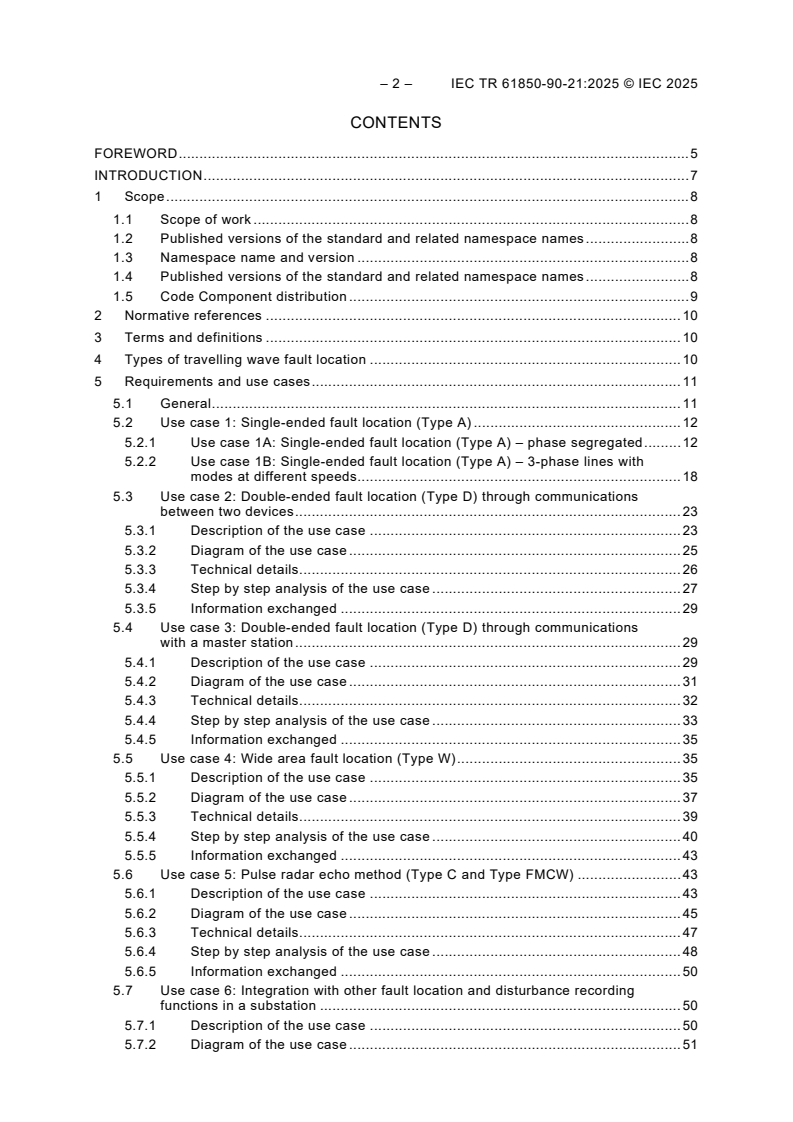
– 2 – IEC TR 61850-90-21:2025 © IEC 2025
CONTENTS
FOREWORD . 5
INTRODUCTION . 7
1 Scope . 8
1.1 Scope of work . 8
1.2 Published versions of the standard and related namespace names . 8
1.3 Namespace name and version . 8
1.4 Published versions of the standard and related namespace names . 8
1.5 Code Component distribution . 9
2 Normative references . 10
3 Terms and definitions . 10
4 Types of travelling wave fault location . 10
5 Requirements and use cases . 11
5.1 General . 11
5.2 Use case 1: Single-ended fault location (Type A) . 12
5.2.1 Use case 1A: Single-ended fault location (Type A) – phase segregated . 12
5.2.2 Use case 1B: Single-ended fault location (Type A) – 3-phase lines with
modes at different speeds. 18
5.3 Use case 2: Double-ended fault location (Type D) through communications
between two devices . 23
5.3.1 Description of the use case . 23
5.3.2 Diagram of the use case . 25
5.3.3 Technical details . 26
5.3.4 Step by step analysis of the use case . 27
5.3.5 Information exchanged . 29
5.4 Use case 3: Double-ended fault location (Type D) through communications
with a master station . 29
5.4.1 Description of the use case . 29
5.4.2 Diagram of the use case . 31
5.4.3 Technical details . 32
5.4.4 Step by step analysis of the use case . 33
5.4.5 Information exchanged . 35
5.5 Use case 4: Wide area fault location (Type W) . 35
5.5.1 Description of the use case . 35
5.5.2 Diagram of the use case . 37
5.5.3 Technical details . 39
5.5.4 Step by step analysis of the use case . 40
5.5.5 Information exchanged . 43
5.6 Use case 5: Pulse radar echo method (Type C and Type FMCW) . 43
5.6.1 Description of the use case . 43
5.6.2 Diagram of the use case . 45
5.6.3 Technical details . 47
5.6.4 Step by step analysis of the use case . 48
5.6.5 Information exchanged . 50
5.7 Use case 6: Integration with other fault location and disturbance recording
functions in a substation . 50
5.7.1 Description of the use case . 50
5.7.2 Diagram of the use case . 51
5.7.3 Technical details . 52
5.7.4 Step by step analysis of the use case . 53
5.7.5 Information exchanged . 55
5.8 Use case 7: Testing and calibration . 55
5.8.1 Use case 7a: Wave velocity calibration . 55
5.8.2 Use case 7b: Simulation testing by remote commands . 60
5.8.3 Use case 7c: Calibration for the pulse radar echo method . 64
5.9 Use case 8: Fault location for hybrid lines . 68
6 Information models . 69
6.1.1 Mapping of the requirements of use case 1 . 69
6.1.2 Mapping of the requirements of use case 2 . 70
6.1.3 Mapping of the requirements of use case 3 . 71
6.1.4 Mapping of the requirements of use case 4 . 72
6.1.5 Mapping of the requirements of use case 5 . 73
6.1.6 Mapping of the requirements of use case 6 . 74
6.1.7 Mapping of the requirements of use case 7a . 75
6.1.8 Mapping of the requirements of use case 7b . 76
6.1.9 Mapping of the requirements of use case 7c . 77
7 Logical node classes and data objects modelling . 78
7.1 General . 78
7.2 Abbreviated terms used in data object names . 78
7.3 Logical node classes . 78
7.3.1 General . 78
7.3.2 Classes list . 79
7.3.3 Logical nodes for protection related functions of 90-21 (LNGroupR) . 79
7.3.4 Logical nodes for further power system equipment of 90-21 (LNGroupZ) . 86
7.4 Data object name semantics . 91
8 System configuration . 92
8.1 General . 92
8.2 Double-circuit line . 92
8.3 Topology for single line with aerial mode and zero mode . 94
Annex A (normative) Conditions for element presence . 95
Annex B (informative) Explanation of percentage full scale . 97
Bibliography . 98
Figure 1 – Wide-area travelling wave fault location system . 36
Figure 2 – Class diagram LogicalNodes_90_21:LogicalNodes_90_21 . 79
Figure 3 – Class diagram LNGroupR::LNGroupRext. 80
Figure 4 – Class diagram LNGroupZ:LNGroupZext . 86
Table 1 – Published versions of the namespace . 8
Table 2 – Attributes of (Tr)IEC 61850-90-21:2022A namespace . 9
Table 3 – Single-ended fault location use case requirement mapping over LNs. 70
Table 4 – Double-ended fault location through communications between two devices
use case requirement mapping over LNs . 71
Table 5 – Double-ended fault location through master station communications use
case requirement mapping over LNs . 71
– 4 – IEC TR 61850-90-21:2025 © IEC 2025
Table 6 – Wide Area fault location use case requirement mapping over LNs . 72
Table 7 – Pulse radar echo method use case requirement mapping over LNs . 73
Table 8 – Integration with other equipment use case requirement mapping over LNs . 74
Table 9 – Line calibration use case requirement mapping over LNs . 75
Table 10 – Testing by remote commands use case requirement mapping over LNs . 76
Table 11 – Calibration for the pulse radar echo method – use case requirement
mapping over LNs . 77
Table 12 – Normative abbreviations for data object names . 78
Table 13 – List of classes defined in LogicalNodes_90_21 package . 79
Table 14 – List of classes defined in LNGroupR package . 80
Table 15 – Data objects of RTWD . 81
Table 16 – Data objects of RTWI . 83
Table 17 – Data objects of RTWL . 84
Table 18 – List of classes defined in LNGroupZ package . 86
Table 19 – Data objects of ZCABExt . 87
Table 20 – Data objects of ZLINExt . 89
Table 21 – Attributes defined on classes of LogicalNodes_90_21 package . 91
Table A.1 – Conditions for presence of elements within a context . 95
INTERNATIONAL ELECTROTECHNICAL COMMISSION
____________
COMMUNICATION NETWORKS AND SYSTEMS
FOR POWER UTILITY AUTOMATION –
Part 90-21: Travelling Wave Fault Location
FOREWORD
1) The International Electrotechnical Commission (IEC) is a worldwide organization for standardization comprising
all national electrotechnical committees (IEC National Committees). The object of IEC is to promote international
co-operation on all questions concerning standardization in the electrical and electronic fields. To this end and
in addition to other activities, IEC publishes International Standards, Technical Specifications, Technical Reports,
Publicly Available Specifications (PAS) and Guides (hereafter referred to as "IEC Publication(s)"). Their
preparation is entrusted to technical committees; any IEC National Committee interested in the subject dealt with
may participate in this preparatory work. International, governmental and non-governmental organizations liaising
with the IEC also participate in this preparation. IEC collaborates closely with the International Organization for
Standardization (ISO) in accordance with conditions determined by agreement between the two organizations.
2) The formal decisions or agreements of IEC on technical matters express, as nearly as possible, an international
consensus of opinion on the relevant subjects since each technical committee has representation from all
interested IEC National Committees.
3) IEC Publications have the form of recommendations for international use and are accepted by IEC National
Committees in that sense. While all reasonable efforts are made to ensure that the technical content of IEC
Publications is accurate, IEC cannot be held responsible for the way in which they are used or for any
misinterpretation by any end user.
4) In order to promote international uniformity, IEC National Committees undertake to apply IEC Publications
transparently to the maximum extent possible in their national and regional publications. Any divergence between
any IEC Publication and the corresponding national or regional publication shall be clearly indicated in the latter.
5) IEC itself does not provide any attestation of conformity. Independent certification bodies provide conformity
assessment services and, in some areas, access to IEC marks of conformity. IEC is not responsible for any
services carried out by independent certification bodies.
6) All users should ensure that they have the latest edition of this publication.
7) No liability shall attach to IEC or its directors, employees, servants or agents including individual experts and
members of its technical committees and IEC National Committees for any personal injury, property damage or
other damage of any nature whatsoever, whether direct or indirect, or for costs (including legal fees) and
expenses arising out of the publication, use of, or reliance upon, this IEC Publication or any other IEC
Publications.
8) Attention is drawn to the Normative references cited in this publication. Use of the referenced publications is
indispensable for the correct application of this publication.
9) IEC draws attention to the possibility that the implementation of this document may involve the use of (a)
patent(s). IEC takes no position concerning the evidence, validity or applicability of any claimed patent rights in
respect thereof. As of the date of publication of this document, IEC had not received notice of (a) patent(s), which
may be required to implement this document. However, implementers are cautioned that this may not represent
the latest information, which may be obtained from the patent database available at https://patents.iec.ch. IEC
shall not be held responsible for identifying any or all such patent rights.
IEC TR 61850-90-21 has been prepared by IEC technical committee 57: Power systems
management and associated information exchange. It is a Technical Report.
The text of this Technical Report is based on the following documents:
Draft Report on voting
57/2718A/DTR 57/2738/RVDTR
Full information on the voting for its approval can be found in the report on voting indicated in
the above table.
The language used for the development of this Technical Report is English.
– 6 – IEC TR 61850-90-21:2025 © IEC 2025
This document was drafted in accordance with ISO/IEC Directives, Part 2, and developed in
accordance with ISO/IEC Directives, Part 1 and ISO/IEC Directives, IEC Supplement, available
at www.iec.ch/members_experts/refdocs. The main document types developed by IEC are
described in greater detail at www.iec.ch/publications.
A list of all parts in the IEC 61850 series, published under the general title Communication
networks and security systems for power utility automation, can be found on the IEC website.
The committee has decided that the contents of this document will remain unchanged until the
stability date indicated on the IEC website under webstore.iec.ch in the data related to the
specific document. At this date, the document will be
• reconfirmed,
• withdrawn, or
• revised.
INTRODUCTION
The travelling wave technique for locating faults in transmission, distribution and cable network
system has been maturing in recent years due to the advancement in technology. The technique
is potentially more accurate and has a much wider application scope when compared with the
traditional impedance-based method. However, the technique and its associated information
exchange have not yet been fully modelled in IEC 61850. There is a need to do this so that the
equipment can be integrated with other IEC 61850 compliant equipment, both in the substation
level and in the network level.
– 8 – IEC TR 61850-90-21:2025 © IEC 2025
COMMUNICATION NETWORKS AND SYSTEMS
FOR POWER UTILITY AUTOMATION –
Part 90-21: Travelling Wave Fault Location
1 Scope
1.1 Scope of work
This part of IEC 61850, which is a Technical Report, aims to provide background information,
use cases, data models and guidance on the application of such a technique.
This document will
1) describe the principles of fault location based on travelling waves aided by communications;
2) specify use cases for this method under the following application scenarios:
a) Single-ended fault location,
b) Double-ended fault location through communications between two devices,
c) Double-ended fault location with communications to a master station,
d) Wide area fault location applications,
e) Pulse radar echo method,
f) Substation integration with other fault location and disturbance recording functions,
g) Testing and calibration;
3) describe the information model for each use case;
4) give guidance on scheme configuration.
1.2 Published versions of the standard and related namespace names
The table below provides a reference between all published editions, amendments or corrigenda
of this document and the full name of the namespace.
Table 1 – Published versions of the namespace
Edition Publication date Webstore Namespace
Edition 1.0 2024-10 IEC 61850-90-21:2024 (Tr)IEC 61850-90-21:2022A2
1.3 Namespace name and version
The parameters which identify this new release of this namespace are as follows:
1.4 Published versions of the standard and related namespace names
shows all attributes of (Tr)IEC 61850-90-21:2022A namespace.
Table 2 – Attributes of (Tr)IEC 61850-90-21:2022A namespace
Attribute Content
Namespace nameplate
Namespace Identifier (Tr)IEC 61850-90-21
Version 2022
Revision A
Release 2
Full Namespace Name (Tr)IEC 61850-90-21:2022A2
Full Code Component Name IEC_TR_61850-90-21.NSD.2022A2.Full
Light Code Component Name IEC_TR_61850-90-21.NSD.2022A2.Light
Namespace Type transitional
Namespace dependencies
extends IEC 61850-7-4:2007B version:2007 revision:B
Namespace transitional status
Future handling of namespace content The name space (Tr)IEC 61850-90-21:2022A is considered as
"transitional" since the models are expected to be included in
further editions IEC 61850-7-4xx. Potential
extensions/modifications may happen if/when the models are
moved to the International Standard status.
1.5 Code Component distribution
Each Code Component is a ZIP package containing the electronic representation of the Code
Component itself, with a file describing the content of the package (IECManifest.xml).
The life cycle of a code component is not restricted to the life cycle of the related publication.
The publication life cycle goes through two stages, Version (corresponding to an edition) and
Revision (corresponding to an amendment). A third publication stage (Release) allows
publication of Code Component in case of urgent fixes of InterOp Tissues, thus without need to
publish an amendment.
Consequently new release(s) of the Code Component may be released, which supersede(s) the
previous release, and will be distributed through the IEC TC57 web site at:
http://www.iec.ch/tc57/supportdocuments.
The code component associated to this TR is an nsd file. It is available as a full version and a
light version. The light version is freely accessible on the IEC website for download at:
http://www.iec.ch/tc57/supportdocuments, but the usage remains under the licensing conditions.
The latest version/release of the document will be found by selecting the file for the code
component with the highest value for VersionStateInfo e.g. IEC_TR_61850-90-
21.NSD.{VersionStateInfo}.Light
In case of any differences between the downloadable code component and the IEC pdf
published content, the downloadable code component is the valid one; it may be subject to
updates. See included history files.
– 10 – IEC TR 61850-90-21:2025 © IEC 2025
2 Normative references
The following documents are referred to in the text in such a way that some or all of their content
constitutes requirements of this document. For dated references, only the edition cited applies.
For undated references, the latest edition of the referenced document (including any
amendments) applies.
IEC TS 61850-2, Communication networks and systems for power utility automation – Part 2:
Glossary
IEC 61850-7-2, Communication networks and systems for power utility automation – Part 7-2:
Basic information and communication structure – Abstract communication service interface
(ACSI)
3 Terms and definitions
For the purposes of this document, the terms and definitions given in IEC TS 61850-2 and
IEC 61850-7-2 apply.
ISO and IEC maintain terminology databases for use in standardization at the following
addresses:
• IEC Electropedia: available at https://www.electropedia.org/
• ISO Online browsing platform: available at https://www.iso.org/obp
4 Types of travelling wave fault location
The types of travelling wave fault location are described as follows:
Type A TWFL – Fault distance is calculated based on the time difference between the first
arrival of the surge and the surge reflected by the fault or by the opposite end. Also known as
single-ended travelling wave fault location.
Type B TWFL – Fault distance is calculated by the difference in the time of arrival of fault surge
detected by the devices located at both ends of the line. One of the devices transmit timing
signal to opposite end after detecting surge to synchronize them.
Type C TWFL – Fault locator transmits and receives an impulse signal on the line and measures
a propagation time from transmitting an impulse till receiving an echo signal to calculate a fault
distance.
Type D TWFL – Fault distance is calculated by the difference in the time of arrival of fault surge
detected by the devices located at both ends of the line. These two devices are time-
synchronized by the same resources such as GNSS. Also known as double-ended travelling
wave fault location.
Type E TWFL (single-ended) – Fault locator picks-up the transients generated when a line is
s
re-energized by circuit breaker. It is applicable to permanent faults.
Type E TWFL (double-ended) – Almost the same as B type, except fault locator transmits
d
timing signals repeatedly.
Type F/K TWFL – Type F fault locator transmits and receives equal interval impulse signals
repeatedly on the line and measures a reciprocating time from transmitting an impulse till
receiving an echo signal to measure a fault distance. Type K fault locator is almost the same
as type F, except sweep trigger of oscilloscope is synchronized with interval of impulse signals.
Type FMCW TWFL – Fault locator transmits and receives a FMCW (frequency modulated
continuous wave), and measures beat frequency by mixed wave of transmitted and received
FMCWs. Fault distance is calculated by beat frequency.
Type W TWFL – Type W traveling wave fault location makes use of traveling wave data from
various substations across the monitored transmission network to achieve reliable fault location
even in the case that a detection device installed at a substation fails and/or that such a device
is not installed. This method uses information exchange between devices located at the nodes
of the network with a central station which determines the location of the fault based on the
network topology and the information received. This is also known as wide-area fault location.
This approach can also be employed by other applications using travelling waves.
5 Requirements and use cases
5.1 General
The objective of this clause is to go down to the general high-level requirements of the
information exchange for travelling wave fault location systems. This is the starting point for
proposing new logical nodes (LNs), the extension of the existing LNs, new communication
services, communication profiles and configuration methods. This approach can also be
employed to other applications using travelling waves.
The following use cases for travelling wave fault location do require the definition of new LNs
and extension of the existing LNs as follows:
• Single ended fault location – To locate the fault position of a transmission line based on
travelling wave signals measured at one end of the line only.
• Double-ended fault location through communications between two devices – To locate
the position of the fault on a transmission line based on the travelling wave signals measured
at both ends of the line. This method uses information exchange between the devices
located at the line ends to achieve fault location.
• Double-ended fault location through communications with a master station – To locate
the position of the fault on a transmission line based on the travelling wave signals measured
at both ends of the line. This method uses information exchange between the devices
located at the line ends with a master station. The master station determines the location of
the fault using the information received.
• Wide area fault location – To locate the position of a fault on a transmission network,
based on the travelling wave signals measured on various nodes of the network. This
method uses information exchange between devices located at the nodes of a network with
a master station. The master station determines the location of the fault using the
information received.
• Pulse radar echo method – To locate the fault position on a transmission line based on
time difference between transmitted and echo pulse. This method injects a pulse or burst of
some probe waveform into transmission line.
• Substation integration with other fault location and disturbance recoding functions –
to integrate travelling wave fault location device with other devices in the substation to
achieve more intelligent and comprehensive fault location.
• Testing and calibration – To test and to calibrate the travelling wave fault location system
by commands and info exchange through communications. E.g., commands can be sent by
the master station to the devices to simulate a fault so as to check the integrity of the system.
Line length calibration typically requires line energisation and single-ended analysis to
determine the actual line length.
Travelling wave signals contain both voltage and current components. Acquisition of the
travelling wave signals can be done through instrument voltage or current transformers with the
suitable frequency response. For high voltage transmission systems with capacitive voltage
transformers, or for HVDC systems, the signal can also be captured with current transformers
located at the earth path, which captures the capacitance currents to earth.
– 12 – IEC TR 61850-90-21:2025 © IEC 2025
5.2 Use case 1: Single-ended fault location (Type A)
5.2.1 Use case 1A: Single-ended fault location (Type A) – phase segregated
5.2.1.1 Description of the use case
5.2.1.1.1 Name of use case
Use case identification
ID Domain(s) Name of use case
Travelling wave fault location Single-ended fault location
5.2.1.1.2 Version management
Version management
Version management Date Domain Area of expertise / Title Approval status
changes / Version expert Domain / Role
draft, for comments,
for voting, final
5.2.1.1.3 Scope and objective of use case
Scope and objectives of use case
Related business case None
Scope Travelling wave fault location by a single device at one end of the line
Objective Achieve fault location by analysis of the records acquired at one end.
5.2.1.1.4 Narrative of use case
Narrative of use case
Short description
Single-ended travelling wave fault location is achieved by a device at one end of the line only. The device
records the travelling wave signals generated by the fault, including those reflected from the line ends or other
line feature causing a change of surge impedance. Through automatic or manual analysis of the record, the
location of the fault can be established. This method works on a per-phase basis and does not require mode
derivations for three-phase lines (see Use Case 1B).
Complete description
Transient travelling waves are produced when a stable power system is disturbed, which can be under a fault,
open conductor, CB operation or lightning condition. The disturbance can be represented as a voltage source at
the fault point which produces both voltage and current surges propagating into two opposite directions.
When the travelling wave signal reaches the end of the line terminated by a busbar, some of the signal will be
transmitted through and some will be reflected back. When the reflected signal reaches the fault point, there will
again be a reflection so that the signal will return back to the busbar a second time. The time difference between
the first incident wave and the second incident wave is equivalent to twice the distance from the busbar to the
fault. By multiplying this time with the wave speed and dividing the result by two, the distance to the fault can be
established.
This method is achieved by a device located at the line end capturing voltage and/or current signals from the
line at high speed. When a fault occurs, the first incident wave and the second incident wave are captured and
stored as a disturbance record. The record can be analysed either manually or automatically. The time
difference between the first incident wave and the second incident wave is established through the analysis,
from which the fault distance is then calculated.
X= ν×=Δt νT× −T
( )
s s1 s2
Where
= fault distance from S
X
s
ν = wave velocity
T = time of arrival of the incident wave
s1
T = time of arrival of the second incident wave
s2
5.2.1.1.5 General remarks
None.
– 14 – IEC TR 61850-90-21:2025 © IEC 2025
5.2.1.2 Diagram of the use case
5.2.1.3 Technical details
5.2.1.3.1 Actors: People, systems, applications, databases, the power system, and
other stakeholders
Actors
Grouping (community) Group description
Actor name Actor Actor description Further
type information
Electric Grid System Transmission, distribution and cable network
Protection Device Protection device
Circuit Breaker Device Circuit breaker device
Travelling wave Device Travelling wave signal detector at the local substation
detector – local end
Master Station System Master station communicating with the travelling wave
detectors, obtaining fault records and performing fault
location function
Electric system Person System operator managing the power system
operator
Field Operation Person Operator working in the field of the power system
Personnel
5.2.1.3.2 Preconditions, assumptions, post condition, events
Use case conditions
Actor/System/Information/Contract Triggering Pre-conditions Assumption
event
Electric grid Continuous The electric grid is continuously
being monitored
Travelling wave detector – local end Line fault Travelling wave The first arrival of the travelling
signal level exceeds waves and the reflections from
the trigger threshold the fault and from the remote
of detector end are captured, recorded and
time-stamped
Master Station Continuous Continuously monitoring the grid
and performs fault location
function
Electric system operator Alarm from Able to interpret the fault record
Master
Station
5.2.1.3.3 References / Issues
None.
– 16 – IEC TR 61850-90-21:2025 © IEC 2025
5.2.1.4 Step by step analysis of the use case
5.2.1.4.1 General
Scenario conditions
No. Scenario Primary Triggering Pre-condition Post-condition
name actor event
1 Line Fault Travelling Fault detector is Travelling Both the initial wave and the reflections
wave triggered by the wave exceeds from the fault and from the remote end
detector travelling wave the trigger are captured and recorded in a
threshold disturbance record, which can be
interpreted either manually or
automatically
5.2.1.4.2 Steps – Normal
Scenario
Scenario name: Normal
Step Event Name of Description of process/ activity Service Information Information Information Additional
No. process/ producer receiver exchanged notes or
activity (actor) (actor) requirements
1 A line fault, open Initial surge Grid
conductor, CB
operations or
lightning has
occurred
2 Detector detects the Traveling wave Grid Travelling Initial Traveling
travelling wave detection wave detector wave signal
3 Recording of initial Information Grid Travelling Initial and
and reflected waves recording wave detector reflected
Traveling wave
signals
4 Time tag record and Record The time tag record contains the precise Travelling Master Station Time tag record
disturbance record transfer time tag when the trigger occurs. The wave detector and disturbance
transfer to Master disturbance record contains precise record
Station timing of each sample, allowing ∆t
between incident wave and reflected
waves to be measured
5 Interpretation of Waveform Master Station Electric Location of fault
waveforms to interpretation system
determine the fault operator
location
6 Field personnel visits Site visit Electric Field Location of the
site for fault system operation fault
investigation operator personnel
– 18 – IEC TR 61850-90-21:2025 © IEC 2025
5.2.1.5 Information exchanged
Information exchanged
Name of information Description of information exchanged Requirements to
exchanged information data
R-ID
Fault Record For each detected surge: arrival time of travelling wave,
channel triggered, type of fault, time of trigger
Disturbance Record For each detected surge: a record containing initial and
reflected waves
5.2.2 Use case 1B: Single-ended fault location (Type A) – 3-phase lines with modes
at different speeds
5.2.2.1 Description of the use case
5.2.2.1.1 Name of use case
Use case identification
ID Domain(s) Name of use case
Travelling wave fault location Single-ended fault location using modes with different travelling speeds
5.2.2.1.2 Version management
Version management
Version management Date Domain Area of expertise / Title Approval status
changes / Version Expert Domain / Role
draft, for comments,
for voting, final
5.2.2.1.3 Scope and objective of use case
Scope and Objectives of use case
Related None
business
case
Scope Travelling wave fault location by a single device at one end of the line
Objective Achieve fault location by analysis of the records acquired at one end. The method uses different
modes of travelling waves. Enhance fault location of a double-side fault locator to
interconnected lines (when fault is outside of line supervised by double ended fault locator)
5.2.2.1.4 Narrative of use case
Narrative of use case
Short description
Single-ended travelling wave fault location is achieved by a device at one end of the line only. The device
records the three-phase travelling wave signals generated by the fault. Through analysis of the record, the
location of the fault is established by measuring the time delay between the arrivals of the aerial mode and zero
sequence mode of the three-phase travelling wave signals.
Complete description
Transient travelling waves are produced when a stable power system is disturbed, which can be under a fault,
open conductor, CB operation or lightning condition. The disturbance can be represented as a voltage source at
the fault point which produces both voltage and current surges propagating into two opposite directions.
In 3 phase circuits it is common practice to use mathematical transformation such as Clarke or eigenvalue
transformation to simply analysis. Clarke transformation converts three phase quantities into α, β and zero
modes, where α and β modes are stationary orthogonal axes. The transformation projects the three phase
quantities onto two stationary quadrature axes, thus simplifying the three-phase calculations to two coordinate
calculations under balanced conditions.
Analysis has shown that three phase line's aerial and zero sequence modes have different travelling speeds.
Whilst the aerial mode's wave velocity is relatively constant irrespective of distance, the zero sequence mode
travels with reduced velocity as distance increases. The time difference between the arrival of the aerial mode
and zero sequence mode can thus be used to calculate the fault distance.
This method is achieved by a device located at the line end capturing voltage and/or current measurements from
the line at high sampling frequency. When a fault occurs, the first incident wave in aerial and zero sequence
mode are captured and stored as a disturbance record. Using signal processing technique such as wavelet
transform, the time difference between the arrivals of the aerial mode and the zero mode can be established,
from which the fault distance is then calculated.
tt−
a0 a
d=
−
vv
0 a
Where
d = distance to the fault
t = time of arrival of zero sequence mode
a0
v = Wave velocity of zero sequence mode
t = time of arrival of aerial mode
a
v = Wave velocity of aerial mode
a
5.2.2.1.5 General remarks
None.
– 20 – IEC TR 61850-90-21:2025 © IEC 2025
5.2.2.2 Diagram of the use case
5.2.2.3 Technical details
5.2.2.3.1 Actors: People, systems, applications, databases, the power system, and
other stakeholders
Actors
Grouping (community) Group description
Actor name Actor Actor description Further
type information
Electric Grid System Transmission, distribution and cable network
Protection Device Protection device
Circuit Breaker Device Circuit breaker device
Travelling wave Device Travelling wave signal detector at the local substation
detector – local end
Master Station System Master station communicati
...
Questions, Comments and Discussion
Ask us and Technical Secretary will try to provide an answer. You can facilitate discussion about the standard in here.
Loading comments...