


IEC 62488-1:2025
(Main)Power line communication systems for power utility applications - Part 1: Planning of analogue and digital power line carrier systems operating over HV electricity grids
Power line communication systems for power utility applications - Part 1: Planning of analogue and digital power line carrier systems operating over HV electricity grids
IEC 62488-1:2025 applies to the planning of analogue (APLC), digital (DPLC) and hybrid analogue-digital (ADPLC) power line carrier communication systems operating over HV electric power networks. The object of this document is to establish the planning of the services and performance parameters for the operational requirements to transmit and receive data efficiently and reliably.
Such analogue and digital power line carrier systems are used by the different electricity supply industries and integrated into their communication infrastructure using common communication technologies such as radio links, fibre optic and satellite networks
This second edition cancels and replaces the first edition published in 2012. This edition constitutes a technical revision.
This edition includes the following significant technical changes with respect to the previous edition:
a) Complete revision of this edition with respect to the previous edition with the main focus on planning of analogue and digital power line carrier systems operating over HV power networks;
b) A general structure of a bidirectional point-to-multipoint APLC, DPLC or ADPLC link has been introduced;
c) Introduction of a new approach for global frequency planning.
Systèmes de communication sur lignes d'énergie pour les applications des compagnies d'électricité - Partie 1: Conception des systèmes à courants porteurs de lignes d'énergie analogiques et numériques fonctionnant sur des réseaux d'électricité HT
IEC 62488-1:2025 s’applique à la conception des systèmes de communication par courant porteur sur ligne d’énergie analogiques (APLC), numériques (DPLC) et hybrides analogiques/numériques (ADPLC, Analogue-Digital Power Line Carrier) installés sur des réseaux d’alimentation électrique HT. Le présent document a pour objet de définir la conception des services et des paramètres de performance relatifs aux exigences opérationnelles en matière d’émission et de réception efficaces et fiables des données.
Ces systèmes à courant porteur sur ligne d’énergie analogiques et numériques sont utilisés par les différentes compagnies d’électricité et sont intégrés à leur infrastructure de communication à l’aide des technologies de communication habituelles (les liaisons radioélectriques, la fibre optique et les réseaux satellite, par exemple).
Cette deuxième édition annule et remplace la première édition parue en 2012. Cette édition constitue une révision technique.
Cette édition inclut les modifications techniques majeures suivantes par rapport à l’édition précédente:
a) Révision complète de la présente édition par rapport à l'édition précédente, portant principalement sur la conception des systèmes à courants porteurs de lignes d’énergie analogiques et numériques fonctionnant sur des réseaux d’électricité HT;
b) Une structure générale d’une liaison bidirectionnelle point à multipoint APLC, DPLC ou ADPLC a été introduite;
c) Introduction d’une nouvelle approche en matière de planification globale des fréquences.
General Information
- Status
- Published
- Publication Date
- 02-Jul-2025
- Technical Committee
- TC 57 - Power systems management and associated information exchange
- Drafting Committee
- WG 20 - TC 57/WG 20
- Current Stage
- PPUB - Publication issued
- Start Date
- 03-Jul-2025
- Completion Date
- 18-Jul-2025
Relations
- Effective Date
- 05-Sep-2023
Overview
IEC 62488-1:2025 - "Power line communication systems for power utility applications - Part 1" is the 2025 second edition standard for planning analogue (APLC), digital (DPLC) and hybrid (ADPLC) power line carrier systems operating over high-voltage (HV) electricity grids. It replaces the 2012 edition and provides updated technical guidance for the planning of services, performance parameters and operational requirements to transmit and receive data reliably over HV power lines.
Key topics and technical requirements
This planning standard addresses the full lifecycle of HV power line communication (PLC) links and networks with emphasis on practical engineering parameters:
- System architectures: point-to-point and bidirectional point-to-multipoint APLC / DPLC / ADPLC link structures.
- Coupling and line equipment: coupling capacitors, line traps, blocking impedances and coupling configurations for overhead HV lines and cables.
- Frequency planning: channel plans, spectral characteristics, a new approach for global frequency planning and guidance on channeling, allocation and paralleling.
- Modulation and transmission: overview of modulation schemes used in HV PLC (AM-SSB, QAM, OFDM), echo cancellation and HF modulated signal characteristics.
- Channel characteristics: characteristic impedance, overall link attenuation, frequency/impulse response, noise and interference modelling.
- Link budgeting & performance: APLC and DPLC link budgets, BER/BLER metrics, transmission capacity, latency, sync loss and recovery, and testing recommendations (including ITU-T M.1020 references).
- Network planning: topologies, redundancy strategies, integration with radio, fibre and satellite networks.
- Operational & security aspects: cyber security considerations with references to IEC 62443 and IEC 62351, management systems and operational requirements for SCADA/teleprotection (IEC 60870‑5 series).
Practical applications and users
IEC 62488-1:2025 is a planning resource for:
- Electricity utilities designing PLC links for telecontrol, teleprotection, telephony and data backhaul over HV networks.
- Communication and power systems engineers performing link budgets, frequency allocation and interference assessments.
- Vendors and integrators specifying PLC terminals, coupling devices and line traps for HV deployments.
- Consultants and regulators who assess compliance, spectrum planning and coexistence with other communication media (fibre, radio, satellite).
Practical use cases include teleprotection signalling, SCADA connectivity (IEC 60870‑5), voice and legacy analogue services, and hybrid solutions that combine PLC with modern IP networking.
Related standards
- IEC 62488 series (other parts e.g., terminal and protocol guidance)
- IEC 62443 (industrial cyber security)
- IEC 62351 (power system information security)
- IEC 60870‑5‑101 / IEC 60870‑5‑104 (SCADA/RTU protocols)
- ITU‑T M.1020 (reference for voice-quality related limits)
Keywords: IEC 62488-1:2025, power line communication, HV PLC, APLC, DPLC, ADPLC, frequency planning, link budget, teleprotection, SCADA, IEC 62443.

IEC 62488-1:2025 - Power line communication systems for power utility applications - Part 1: Planning of analogue and digital power line carrier systems operating over HV electricity grids Released:3. 07. 2025 Isbn:9782832705070
IEC 62488-1:2025 - Systèmes de communication sur lignes d'énergie pour les applications des compagnies d'électricité - Partie 1: Conception des systèmes à courants porteurs de lignes d'énergie analogiques et numériques fonctionnant sur des réseaux d'électricité HT Released:3. 07. 2025 Isbn:9782832705070
IEC 62488-1:2025 - Power line communication systems for power utility applications - Part 1: Planning of analogue and digital power line carrier systems operating over HV electricity grids Released:3. 07. 2025 Isbn:9782832705070
Get Certified
Connect with accredited certification bodies for this standard

TL 9000 QuEST Forum
Telecommunications quality management system.

ANCE
Mexican certification and testing association.

Intertek Slovenia
Intertek testing, inspection, and certification services in Slovenia.
Sponsored listings
Frequently Asked Questions
IEC 62488-1:2025 is a standard published by the International Electrotechnical Commission (IEC). Its full title is "Power line communication systems for power utility applications - Part 1: Planning of analogue and digital power line carrier systems operating over HV electricity grids". This standard covers: IEC 62488-1:2025 applies to the planning of analogue (APLC), digital (DPLC) and hybrid analogue-digital (ADPLC) power line carrier communication systems operating over HV electric power networks. The object of this document is to establish the planning of the services and performance parameters for the operational requirements to transmit and receive data efficiently and reliably. Such analogue and digital power line carrier systems are used by the different electricity supply industries and integrated into their communication infrastructure using common communication technologies such as radio links, fibre optic and satellite networks This second edition cancels and replaces the first edition published in 2012. This edition constitutes a technical revision. This edition includes the following significant technical changes with respect to the previous edition: a) Complete revision of this edition with respect to the previous edition with the main focus on planning of analogue and digital power line carrier systems operating over HV power networks; b) A general structure of a bidirectional point-to-multipoint APLC, DPLC or ADPLC link has been introduced; c) Introduction of a new approach for global frequency planning.
IEC 62488-1:2025 applies to the planning of analogue (APLC), digital (DPLC) and hybrid analogue-digital (ADPLC) power line carrier communication systems operating over HV electric power networks. The object of this document is to establish the planning of the services and performance parameters for the operational requirements to transmit and receive data efficiently and reliably. Such analogue and digital power line carrier systems are used by the different electricity supply industries and integrated into their communication infrastructure using common communication technologies such as radio links, fibre optic and satellite networks This second edition cancels and replaces the first edition published in 2012. This edition constitutes a technical revision. This edition includes the following significant technical changes with respect to the previous edition: a) Complete revision of this edition with respect to the previous edition with the main focus on planning of analogue and digital power line carrier systems operating over HV power networks; b) A general structure of a bidirectional point-to-multipoint APLC, DPLC or ADPLC link has been introduced; c) Introduction of a new approach for global frequency planning.
IEC 62488-1:2025 is classified under the following ICS (International Classification for Standards) categories: 33.200 - Telecontrol. Telemetering. The ICS classification helps identify the subject area and facilitates finding related standards.
IEC 62488-1:2025 has the following relationships with other standards: It is inter standard links to IEC 62488-1:2012. Understanding these relationships helps ensure you are using the most current and applicable version of the standard.
IEC 62488-1:2025 is available in PDF format for immediate download after purchase. The document can be added to your cart and obtained through the secure checkout process. Digital delivery ensures instant access to the complete standard document.
Standards Content (Sample)
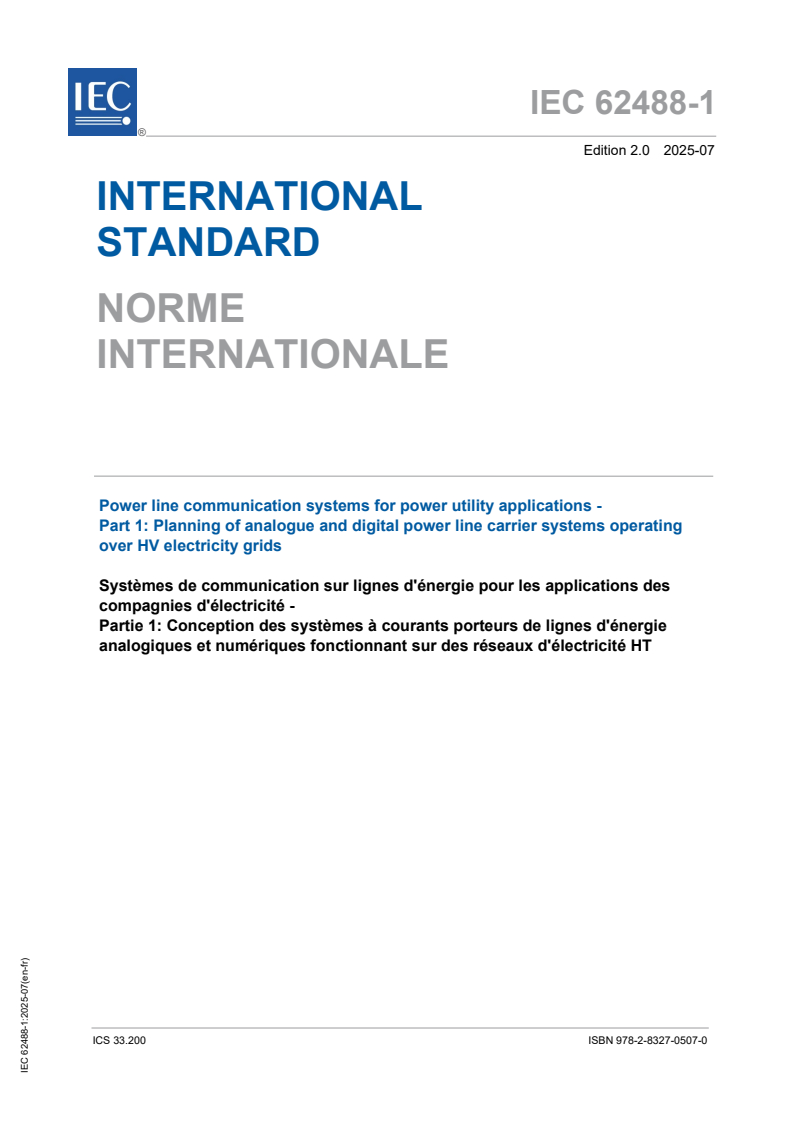
IEC 62488-1 ®
Edition 2.0 2025-07
INTERNATIONAL
STANDARD
Power line communication systems for power utility applications –
Part 1: Planning of analogue and digital power line carrier systems operating
over HV electricity grids
ICS 33.200 ISBN 978-2-8327-0507-0
All rights reserved. Unless otherwise specified, no part of this publication may be reproduced or utilized in any form or
by any means, electronic or mechanical, including photocopying and microfilm, without permission in writing from either
IEC or IEC's member National Committee in the country of the requester. If you have any questions about IEC copyright
or have an enquiry about obtaining additional rights to this publication, please contact the address below or your local
IEC member National Committee for further information.
IEC Secretariat Tel.: +41 22 919 02 11
3, rue de Varembé info@iec.ch
CH-1211 Geneva 20 www.iec.ch
Switzerland
About the IEC
The International Electrotechnical Commission (IEC) is the leading global organization that prepares and publishes
International Standards for all electrical, electronic and related technologies.
About IEC publications
The technical content of IEC publications is kept under constant review by the IEC. Please make sure that you have the
latest edition, a corrigendum or an amendment might have been published.
IEC publications search - IEC Products & Services Portal - products.iec.ch
webstore.iec.ch/advsearchform Discover our powerful search engine and read freely all the
The advanced search enables to find IEC publications by a
publications previews, graphical symbols and the glossary.
variety of criteria (reference number, text, technical With a subscription you will always have access to up to date
committee, …). It also gives information on projects, content tailored to your needs.
replaced and withdrawn publications.
Electropedia - www.electropedia.org
IEC Just Published - webstore.iec.ch/justpublished The world's leading online dictionary on electrotechnology,
Stay up to date on all new IEC publications. Just Published containing more than 22 500 terminological entries in English
details all new publications released. Available online and and French, with equivalent terms in 25 additional languages.
once a month by email. Also known as the International Electrotechnical Vocabulary
(IEV) online.
IEC Customer Service Centre - webstore.iec.ch/csc
If you wish to give us your feedback on this publication or
need further assistance, please contact the Customer
Service Centre: sales@iec.ch.
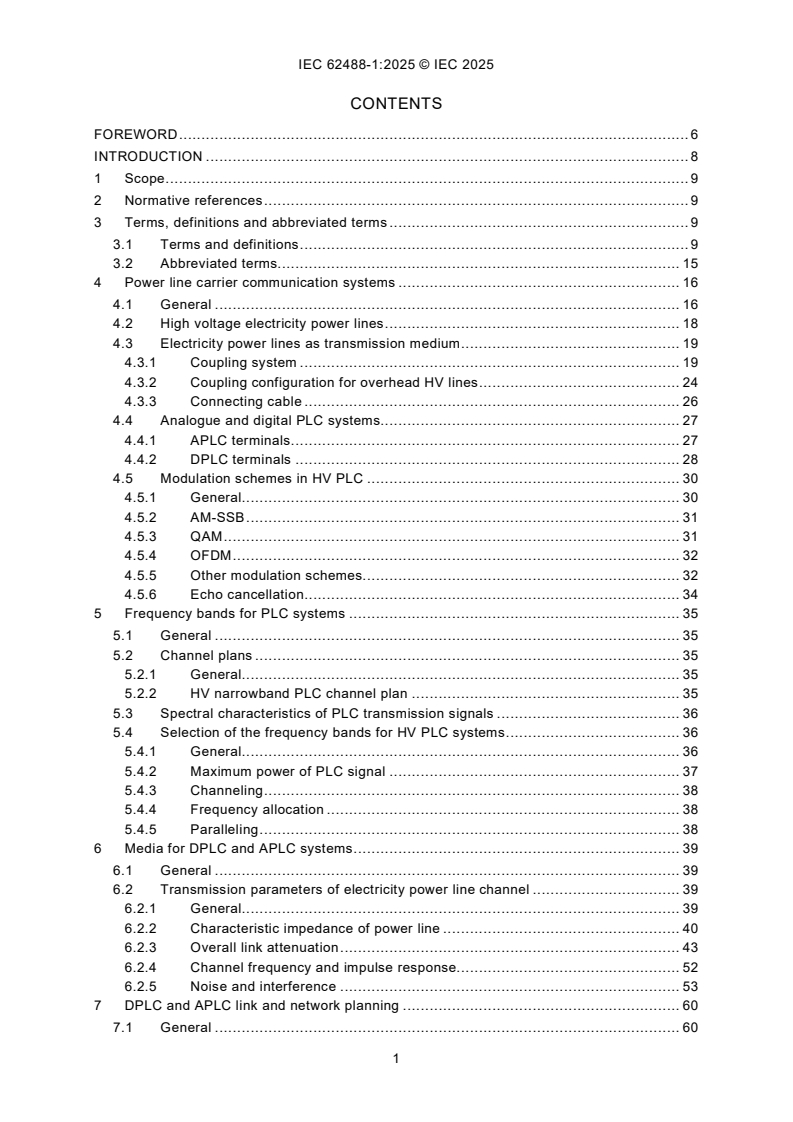
CONTENTS
FOREWORD . 6
INTRODUCTION . 8
1 Scope . 9
2 Normative references . 9
3 Terms, definitions and abbreviated terms . 9
3.1 Terms and definitions . 9
3.2 Abbreviated terms. 15
4 Power line carrier communication systems . 16
4.1 General . 16
4.2 High voltage electricity power lines . 18
4.3 Electricity power lines as transmission medium . 19
4.3.1 Coupling system . 19
4.3.2 Coupling configuration for overhead HV lines . 24
4.3.3 Connecting cable . 26
4.4 Analogue and digital PLC systems. 27
4.4.1 APLC terminals . 27
4.4.2 DPLC terminals . 28
4.5 Modulation schemes in HV PLC . 30
4.5.1 General. 30
4.5.2 AM-SSB . 31
4.5.3 QAM . 31
4.5.4 OFDM . 32
4.5.5 Other modulation schemes. 32
4.5.6 Echo cancellation . 34
5 Frequency bands for PLC systems . 35
5.1 General . 35
5.2 Channel plans . 35
5.2.1 General. 35
5.2.2 HV narrowband PLC channel plan . 35
5.3 Spectral characteristics of PLC transmission signals . 36
5.4 Selection of the frequency bands for HV PLC systems . 36
5.4.1 General. 36
5.4.2 Maximum power of PLC signal . 37
5.4.3 Channeling . 38
5.4.4 Frequency allocation . 38
5.4.5 Paralleling . 38
6 Media for DPLC and APLC systems . 39
6.1 General . 39
6.2 Transmission parameters of electricity power line channel . 39
6.2.1 General. 39
6.2.2 Characteristic impedance of power line . 40
6.2.3 Overall link attenuation . 43
6.2.4 Channel frequency and impulse response. 52
6.2.5 Noise and interference . 53
7 DPLC and APLC link and network planning . 60
7.1 General . 60
7.2 APLC link budget . 62
7.3 DPLC link budget . 65
7.4 Frequency plan. 70
7.4.1 General. 70
7.4.2 Links over the same HV line between two substations . 70
7.4.3 Global frequency planning . 71
7.4.4 Other considerations . 72
7.5 Network planning . 73
7.5.1 General. 73
7.5.2 Redundancy . 73
7.5.3 Integration with other transmission technologies . 74
7.6 Cyber security . 74
7.6.1 General. 74
7.6.2 IEC 62443 . 74
7.6.3 IEC 62351 . 74
7.6.4 Cyber security aspects of PLC systems . 75
7.7 Management system . 77
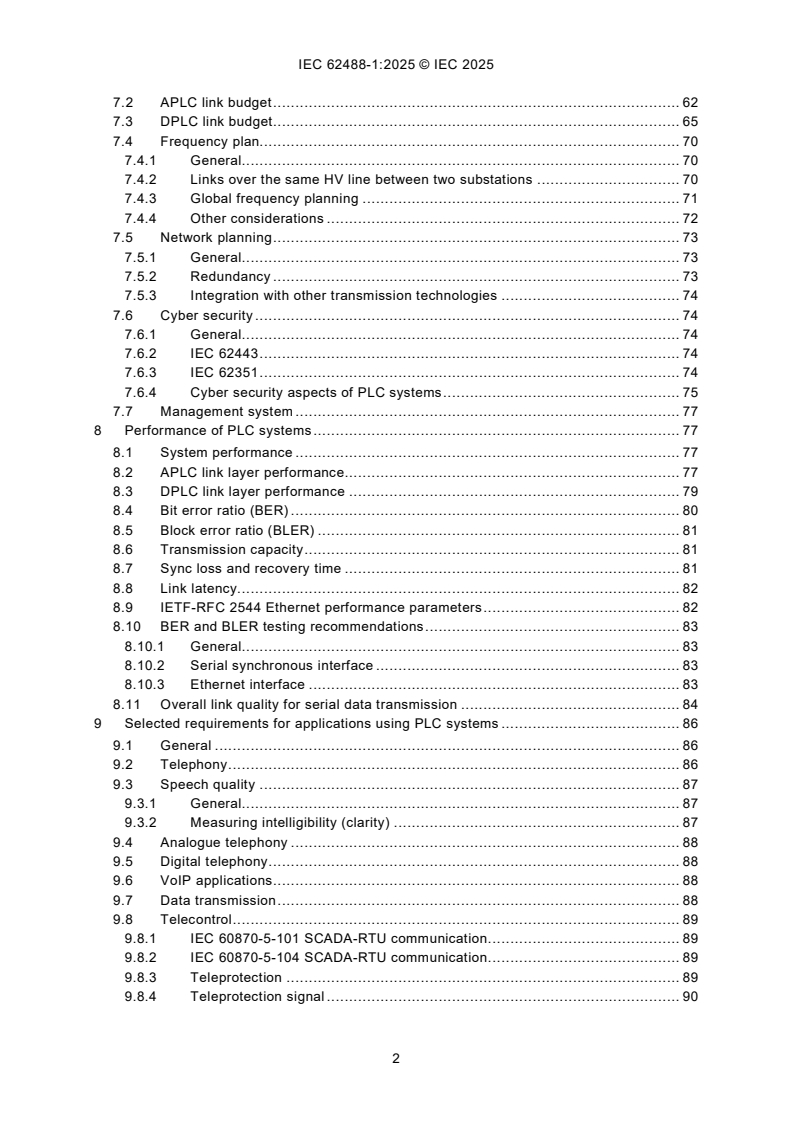
8 Performance of PLC systems . 77
8.1 System performance . 77
8.2 APLC link layer performance . 77
8.3 DPLC link layer performance . 79
8.4 Bit error ratio (BER) . 80
8.5 Block error ratio (BLER) . 81
8.6 Transmission capacity . 81
8.7 Sync loss and recovery time . 81
8.8 Link latency. 82
8.9 IETF-RFC 2544 Ethernet performance parameters . 82
8.10 BER and BLER testing recommendations . 83
8.10.1 General. 83
8.10.2 Serial synchronous interface . 83
8.10.3 Ethernet interface . 83
8.11 Overall link quality for serial data transmission . 84
9 Selected requirements for applications using PLC systems . 86
9.1 General . 86
9.2 Telephony . 86
9.3 Speech quality . 87
9.3.1 General. 87
9.3.2 Measuring intelligibility (clarity) . 87
9.4 Analogue telephony . 88
9.5 Digital telephony . 88
9.6 VoIP applications . 88
9.7 Data transmission . 88
9.8 Telecontrol . 89
9.8.1 IEC 60870-5-101 SCADA-RTU communication . 89
9.8.2 IEC 60870-5-104 SCADA-RTU communication . 89
9.8.3 Teleprotection . 89
9.8.4 Teleprotection signal . 90
Annex A (informative) HF modulated power signal . 91
A.1 General . 91
A.2 HF modulated bandwidth and power signal . 95
Annex B (informative) Bandwidth efficiency . 99
Annex C (informative) Power line noise measurement . 103
Bibliography . 104
Figure 1 – PLC link . 17
Figure 2 – General structure of a bidirectional point-to-point APLC, DPLC or ADPLC
link (in phase to ground configuration) . 17
Figure 3 – General structure of a bidirectional point-to-multipoint APLC, DPLC or
ADPLC link (in phase to ground configuration). 18
Figure 4 – HV typical coupling capacitor . 20
Figure 5 – Example of HV capacitive coupling system (single phase conductor to earth) . 20
Figure 6 – Line trap electrical scheme . 21
Figure 7 – HV line trap . 21
Figure 8 – Line trap impedance versus frequency . 21
Figure 9 – Blocking impedance characteristic of a narrowband line trap . 22
Figure 10 – Blocking impedance characteristic of a double band line trap . 22
Figure 11 – Blocking impedance characteristic of a broadband line trap . 22
Figure 12 – Example of coupling device components and electric scheme . 23
Figure 13 – Coupling device characteristics with a coupling capacitor of 4 000 pF . 24
Figure 14 – Phase-to-earth coupling . 25
Figure 15 – Phase-to-phase coupling . 25
Figure 16 – Generic architecture of an APLC terminal acc. to IEC 62488-2 . 28
Figure 17 – Generic architecture of a DPLC terminal acc. to IEC 62488-3 . 29
Figure 18 – Generic structure of an ADPLC terminal . 30
Figure 19 – Signal space for a 16-QAM constellation . 31
Figure 20 – Echo cancellation method for a DPLC link. 34
Figure 21 – An example of a APLC narrowband channel plan. 36
Figure 22 – Minimum frequency gap . 38
Figure 23 – GMR of conductor bundles . 41
Figure 24 – Terminating network for a three-phase line . 42
Figure 25 – Optimum coupling arrangements and modal conversion loss a . 46
c
Figure 26 – Optimum phase to earth and phase to phase coupling arrangements for
long lines with transpositions . 47
Figure 27 – Junctions of overhead lines with power cables . 50
Figure 28 – Example of HV H(f) and h(t) channel response . 53
Figure 29 – Attenuation versus frequency of a real HV power line channel . 53
Figure 30 – Background noise . 54
Figure 31 – Background noise over frequency . 56
Figure 32 – Example of the background noise spectrum variations over time . 56
Figure 33 – Example of an isolated pulse . 57
Figure 34 – Example of a transient pulse . 57
Figure 35 – Example of net-synchronous periodic pulses . 58
Figure 36 – Example of burst pulses . 58
Figure 37 – Typical PLC network topologies base on APLC, DPLC or ADPLC links in
HV power network . 61
Figure 38 – Example for a signal arrangement in two 4 kHz channels . 63
Figure 39 – Example for a DPLC channel arrangement. . 66
-6
Figure 40 – Typical DPLC bandwidth efficiency for a BER of 10 . 68
Figure 41 – Example of the HV line voltage ranges under considered conditions . 69
Figure 42 – Example for DPLC system with automatic data rate adaptation . 70
Figure 43 – Example of frequency planning based on cellular frequency channel
clustering. 72
Figure 44 – Limits for overall loss of the circuit relative to that at 1 020 Hz
(ITU-T M.1020) . 79
Figure 45 – Limits for group delay relative to the minimum measured group delay in the
500 Hz – 2 800 Hz band (ITU-T M.1020) . 79
Figure 46 – Some theoretical BER curves . 80
Figure 47 – DPLC "C/SNR" characteristic in comparison to the Shannon limit efficiency
for BER = 1E-4 and 1E-6 and Shannon limit . 81
Figure 48 – Ethernet standard structure of frame format . 83
Figure 49 – Example of unavailability determination (ITU-T G.826) . 85
Figure 50 – Example of the unavailable state of a bidirectional path (ITU-T G.826) . 85
Figure 51 – Quality performance estimation based on ITU-T G.821 and G.826. 85
Figure 52 – Relationship between clarity, delay, and echo with regards to speech
quality . 87
Figure A.1 – Power concepts . 91
Figure A.2 – Single tone . 93
Figure A.3 – Two tones . 94
Figure A.4 – Example of noise equivalent bands for different services . 95
Figure A.5 – Noise equivalent band for different services. 96
Figure B.1 – 8-PAM signal constellation . 99
Figure B.2 – SNR gap of DPLC efficiency to Shannon limit . 101
–4 –6
Figure B.3 – DPLC efficiency for BER = 10 and 10 and Shannon limit . 102
Table 1 – Characteristics of typical DPLC modulation schemes . 33
Table 2 – Single- and multicarrier QAM DPLC modulation scheme characteristics . 33
Table 3 – Power line carrier communication techniques and frequencies . 35
Table 4 – HF spectrum allocated for PLC systems . 36
Table 5 – Range of characteristic impedances for PLC circuits on HV overhead lines . 42
Table 6 – Additional loss a [dB] for various line configurations and optimum
add
coupling arrangements . 48
Table 7 – Typical power of corona noise power levels, referring to a 4 kHz bandwidth
for various HV system voltages . 55
Table 8 – Typical average impulse-type noise levels, measured at the HF-cable side of
the coupling across 150 Ω in a bandwidth of 4 kHz . 59
Table 9 – Signal parameters . 63
Table 10 – Link budget. 64
Table 11 – Signal and allowed noise levels at the receiver input . 64
Table 12 – Possible solutions for the example of Figure 39 . 67
Table 13 – Main cyber security threats and security risks related to PLC systems . 77
Table 14 – Quality mask objectives (sample) . 86
INTERNATIONAL ELECTROTECHNICAL COMMISSION
____________
Power line communication systems for power utility applications -
Part 1: Planning of analogue and digital power line carrier
systems operating over HV electricity grids
FOREWORD
1) The International Electrotechnical Commission (IEC) is a worldwide organization for standardization comprising
all national electrotechnical committees (IEC National Committees). The object of IEC is to promote international
co-operation on all questions concerning standardization in the electrical and electronic fields. To this end and
in addition to other activities, IEC publishes International Standards, Technical Specifications, Technical Reports,
Publicly Available Specifications (PAS) and Guides (hereafter referred to as "IEC Publication(s)"). Their
preparation is entrusted to technical committees; any IEC National Committee interested in the subject dealt with
may participate in this preparatory work. International, governmental and non-governmental organizations liaising
with the IEC also participate in this preparation. IEC collaborates closely with the International Organization for
Standardization (ISO) in accordance with conditions determined by agreement between the two organizations.
2) The formal decisions or agreements of IEC on technical matters express, as nearly as possible, an international
consensus of opinion on the relevant subjects since each technical committee has representation from all
interested IEC National Committees.
3) IEC Publications have the form of recommendations for international use and are accepted by IEC National
Committees in that sense. While all reasonable efforts are made to ensure that the technical content of IEC
Publications is accurate, IEC cannot be held responsible for the way in which they are used or for any
misinterpretation by any end user.
4) In order to promote international uniformity, IEC National Committees undertake to apply IEC Publications
transparently to the maximum extent possible in their national and regional publications. Any divergence between
any IEC Publication and the corresponding national or regional publication shall be clearly indicated in the latter.
5) IEC itself does not provide any attestation of conformity. Independent certification bodies provide conformity
assessment services and, in some areas, access to IEC marks of conformity. IEC is not responsible for any
services carried out by independent certification bodies.
6) All users should ensure that they have the latest edition of this publication.
7) No liability shall attach to IEC or its directors, employees, servants or agents including individual experts and
members of its technical committees and IEC National Committees for any personal injury, property damage or
other damage of any nature whatsoever, whether direct or indirect, or for costs (including legal fees) and
expenses arising out of the publication, use of, or reliance upon, this IEC Publication or any other IEC
Publications.
8) Attention is drawn to the Normative references cited in this publication. Use of the referenced publications is
indispensable for the correct application of this publication.
9) IEC draws attention to the possibility that the implementation of this document may involve the use of (a)
patent(s). IEC takes no position concerning the evidence, validity or applicability of any claimed patent rights in
respect thereof. As of the date of publication of this document, IEC had not received notice of (a) patent(s), which
may be required to implement this document. However, implementers are cautioned that this may not represent
the latest information, which may be obtained from the patent database available at https://patents.iec.ch. IEC
shall not be held responsible for identifying any or all such patent rights.
IEC 62488-1 has been prepared by IEC technical committee 57: Power systems management
and associated information exchange. It is an International Standard.
This second edition cancels and replaces the first edition published in 2012. This edition
constitutes a technical revision.
This edition includes the following significant technical changes with respect to the previous
edition:
a) Complete revision of this edition with respect to the previous edition with the main focus on
planning of analogue and digital power line carrier systems operating over HV power
networks;
b) A general structure of a bidirectional point-to-multipoint APLC, DPLC or ADPLC link has
been introduced;
c) Introduction of a new approach for global frequency planning.
The text of this International Standard is based on the following documents:
Draft Report on voting
57/2773/FDIS 57/2794/RVD
Full information on the voting for its approval can be found in the report on voting indicated in
the above table.
The language used for the development of this International Standard is English.
This document was drafted in accordance with ISO/IEC Directives, Part 2, and developed in
accordance with ISO/IEC Directives, Part 1 and ISO/IEC Directives, IEC Supplement, available
at www.iec.ch/members_experts/refdocs. The main document types developed by IEC are
described in greater detail at www.iec.ch/publications.
A list of all parts of IEC 62488 series, under the general title Power line communication systems
for power utility applications, can be found on the IEC website.
The committee has decided that the contents of this document will remain unchanged until the
stability date indicated on the IEC website under webstore.iec.ch in the data related to the
specific document. At this date, the document will be
• reconfirmed,
• withdrawn, or
• revised.
INTRODUCTION
The complexity and extensive size of present-day electricity generation, transmission and
distribution systems are such that it is possible to control them only by means of an associated
and often equally large and complex telecommunication system having a high order of reliability.
The simultaneous use of the power distribution network for both energy transmission and data
communication is unique and reduces the costs of installing two services over one transmission
path. This communication technology is called generically power line carrier (PLC)
communications.
Therefore, by using either analogue power line carrier communication (APLC) or digital power
line carrier communication (DPLC) or a combination of both types of system (ADPLC), seamless
efficient communication can be maintained throughout the power network.
The development of digital techniques for communications in the HV electrical power networks
is now very widespread along with other applications in electronics. This is especially relevant
for the electrical distribution network where many of the PLC devices use analogue to digital
converters together with digital signal processing techniques enabling higher flexibility and HW
efficiency.
The development of the technical report "Planning of power line carrier systems" was first
produced by the International Electrotechnical Commission through publication IEC 60663 [1]
in 1980 entitled Planning of (single sideband) power line carrier systems. In 1993, the
International Electrotechnical Commission produced IEC 60495 [2], "Single sideband power-
line carrier terminals". In the intervening years, electronic systems and the associated
communications systems for electronic devices evolved and developed considerably. The
introduction of digital communication techniques improved the quality of transmission and
reception PLC signals within electronic devices, enabling them to provide more detailed quality
analysis and control of the data being communicated throughout the electricity distribution
network, from control centre to service provider.
Both of these standards, IEC 60663 and IEC 60495, are being updated and replaced by the
following: IEC 60663 is replaced by IEC 62488-1 and IEC 60495 is replaced by IEC 62488-2 [3]
and IEC 62488-3 [4] covering respectively analogue, digital and hybrid analogue-digital power
line carrier terminals.
These documents apply to power line carrier (PLC) terminals used to transmit information over
HV power networks. Both analogue and digital modulation systems will be considered.
The IEC 62488 series consists of the following parts under the general title: Power line
communication systems for power utility applications:
Part 1: Planning of analogue and digital power line carrier systems operating over HV power
networks;
Part 2: Analogue power line carrier terminals or APLC;
Part 3: Digital power line carrier (DPLC) terminals and hybrid ADPLC terminals.
___________
Numbers in square brackets refer to the Bibliography.
1 Scope
This part of IEC 62488 applies to the planning of analogue (APLC), digital (DPLC) and hybrid
analogue-digital (ADPLC) power line carrier communication systems operating over HV electric
power networks. The object of this document is to establish the planning of the services and
performance parameters for the operational requirements to transmit and receive data
efficiently and reliably.
Such analogue and digital power line carrier systems are used by the different electricity supply
industries and integrated into their communication infrastructure using common communication
technologies such as radio links, fibre optic and satellite networks.
2 Normative references
There are no normative references in this document.
3 Terms, definitions and abbreviated terms
3.1 Terms and definitions
For the purposes of this document, the following terms and definitions apply.
ISO and IEC maintain terminology databases for use in standardization at the following
addresses:
• IEC Electropedia: available at https://www.electropedia.org/
• ISO Online browsing platform: available at https://www.iso.org/obp
NOTE Other terms used in this document and not defined in this clause have the meaning attributed to them
according to the International Electrotechnical Vocabulary (IEV).
3.1.1
amplitude modulation
AM
modulation technique in which information is transmitted through amplitude variation of a carrier
wave
3.1.2
analogue interface
interface dedicated to the processing of voiceband analogue signals
3.1.3
attenuation
power reduction along a transmission line for the mode or modes under consideration,
quantitatively expressed either by the ratio or the logarithm of the ratio of an input power at the
initial point to the corresponding output power at the final point
3.1.4
availability
time or fraction of time a system is operational over a given time interval
3.1.5
background noise
noise present over all real high voltage power-line channels, due mainly to corona and partial
discharges and electromagnetic interference with other PLC equipments operated over the
same electricity grid and other interferences due to radio stations working in the same radio
frequency spectrum
3.1.6
bit error ratio
BER
ratio of the number of bit errors received divided by the total number of bits sent
3.1.7
carrier-frequency range
bandwidth available for a specific power line carrier communication technology
Note 1 to entry: In Europe, the typical carrier-frequency range for narrowband HV PLC is 3 kHz to 148,5 kHz or for
broadband PLC is 1,6 MHz to 30 MHz. For the USA IEEE PLC standard the frequency range is 45 kHz to 450 kHz.
Parts of the range may be barred by national regulations.
3.1.8
channelling
elementary subdivision of the carrier frequency range or part thereof allocated to a single PLC
transmit and receive channel (bidirectional)
3.1.9
coloured gaussian noise
non-white gaussian noise or any wideband noise whose spectrum has a non-flat shape
Note 1 to entry: Also called non-white noise; examples are pink noise, brown noise and autoregressive noise.
3.1.10
corona noise
noise caused by partial discharges on insulators and in air surrounding electrical conductors of
overhead power lines
Note 1 to entry: Discharges occur on the three different phase conductors at different times. The corona noise level
is considerably dependent on weather conditions. The effect of the corona noise is particularly strong under foul
weather conditions.
3.1.11
coupling capacitor
capacitor used for the coupling of the carrier signal to the power line in a PLC system
3.1.12
coupling device
unit which interfaces the HV side of power line with the PLC equipment (also known as line
matching unit (LMU))
Note 1 to entry: It usually consists of a box mounted near the coupling capacitor. Its characteristics are normalized
by IEC 60481.
3.1.13
coupling system
group of devices used to couple the PLC high frequency signals to the power line
Note 1 to entry: Usually a coupling system consists of an line trap, a coupling capacitor and a coupling device.
3.1.14
defect
large discrepancy between the data actually received and the data desired
Note 1 to entry: Defects cause interruptions of the applications using the transmitted data and are used as input
for performance monitoring, the control of consequent actions, and the determination of fault causes. Examples are:
loss of signal, sync loss, alarm indication signal, slip, loss of frame alignment.
3.1.15
distribution line carrier
DLC
system for communication over the distribution power lines
Note 1 to entry: The DLC systems can be narrowband high speed communication systems on the medium voltage
distribution network, or broadband/narrowband communication systems on the low voltage distribution network.
3.1.16
environment
external conditions in which a system operates
Note 1 to entry: Different classes of constraints and limits for EMC/EMI are defined for environment classes such
as industrial, commercial, domestic.
3.1.17
error free second
EFS
one second period without bit error
3.1.18
errored second
ES
one-second period in which one or more bits are in error
3.1.19
errored second ratio
ESR
ratio of errored seconds ES to total seconds in available time during a fixed measurement
interval
3.1.20
Ethernet interface
interface dedicated to the processing of data signals in accordance with IEEE 802.3
3.1.21
frame check sequence
FCS
extra bits or characters added to a data frame for error detection
3.1.22
frame loss rate
the number of frames that never reached the destination divided by the number of frames
transmitted successfully by the source
Note 1 to entry: It is usually expressed as a percentage.
3.1.23
frequency division multiplexing
FDM
multiplexing technique in which several transmitters are allotted separate frequency bands for
transmission over a common channel
3.1.24
frequency shift keying modulation
FSK
a frequency modulation technique in which coded information is transmitted through discrete
frequency changes of a carrier wave
3.1.25
group delay
propagation time of a narrowband signal from input to output of a linear system
Note 1 to entry: Mathematically, group delay equals the negative derivative of the phase shift in radians between
input and output of a linear system versus angular frequency.
3.1.26
impulsive noise
noise consisting of short-duration pulses of random amplitude and random duration
3.1.27
jitter
short-term variations of the significant instants of a timing signal from their ideal positions in
time (where short-term implies that these variations are of frequency greater than or equal to
10 Hz)
3.1.28
latency
time from the source sending a packet into a packet switched network to the destination
receiving it
Note 1 to entry: One-way latency is distinguished from round trip latency, which is the one-way latency from source
to destination plus the one-way latency from the destination back to the source. Round-trip latency is more often
quoted, because it can be measured from a single point. Note that round trip latency excludes the amount of time
that a destination system spends processing the packet.
3.1.29
line trap
a device presenting high impedance at the carrier frequency band while introducing negligible
impedance at the power frequency
Note 1 to entry: The high impedance limits the power of the carrier signal within the power system. Line traps are
connected in series with transmission lines. In most cases the line trap is mounted directly on top of the coupling
capacitor. Its characteristics are normalized by IEC 60353[1].
3.1.30
modulation scheme
technique used to convert a baseband signal into a high frequency carrier signal suitable for
transmission over power line
Note 1 to entry: Examples are: AM-SSB, Spread Spectrum, QAM, OFDM.
3.1.31
multiplexing techniques
method by which multiple analogue message signals or digital data streams are combined into
one signal over a shared medium
3.1.32
narrowband noise
noise process with a narrow bandwidth such as a 50 or 60 Hz 'hum' from the electricity supply
3.1.33
nominal impedance
value of impedance for which an input or output circuit has been designed and for which the
prescribed requirements apply
3.1.34
operating conditions
set of conditions (e.g. voltage, temperature, humidity, and the like) over which the specified
parameters maintain their stated performance rating
3.1.35
orthogonal frequency division multiplexing
OFDM
modulation scheme that distributes the data over a large number of sub-carriers with
frequencies such that the sub-carriers are orthogonal, which prevents the demodulators from
seeing sub-carriers other than their own
Note 1 to entry: Each sub-carrier is modulated with a conventional modulation scheme (such as QAM or PSK) at a
low symbol rate, maintaining total data rates similar to conventional single-carrier modulation schemes in the same
bandwidth.
3.1.36
peak envelope power
PEP
average power of a carrier signal present during one cycle of the carrier-frequency at the
highest crest of the modulation
Note 1 to entry: It is recommended that in order to determine the peak envelope power, the transmitter should be
modulated by two sinusoidal voice-frequency signals of equal amplitude, located within the effectively transmitted
frequency band. The transmitter is terminated by a resistive load equal to its nominal impedance and the limiter is
not in operation. The amplitude of the modulation signals must be chosen as to satisfy the requirements for spurious
emissions. The peak envelope power is then considered to be four times the power of one of these signals, selectively
measured (CCIR Recommendation 326-1:1970 [5], point 3.1.3.1).
3.1.37
peak to average power ratio
PAPR
peak power of a signal divided by its average power
3.1.38
phase shift keying
PSK
modulation scheme that conveys data by changing, or modulating, the phase carrier signal
3.1.39
PLC link
telecommunication facility between two PLC terminals provided by means of electrical signals
transmitted between them via power lines. A PLC link can be unidirectional or bidirectional
3.1.40
PLC nominal output power
output power of a PLC terminal expressed as the peak envelope power (PEP) for which the
equipment has been designed, compatible with the requirements for spurious emissions,
available at the carrier frequency output across a resistive load equal to the nominal impedance
3.1.41
PLC terminal equipment
equipment able to manage a telecommunication link over a high voltage power line, mainly used
to reliably transmit speech, data and power system protection signals
3.1.42
power line
installation used to transfer electric energy from one point to another in an electric power system
3.1.43
quadrature amplitude modulation
QAM
analogue or digital modulation scheme conveying two analogue message signals, or two digital
bit streams, by changing (modulating) the amplitudes of two carrier waves with 90° phase
difference, using the amplitude-shift keying (ASK) digital modulation scheme or amplitude
modulation (AM) analogue modulation scheme
3.1.44
quality of service
QoS
defined measure of performance in a data communications system
3.1.45
reliability
degree of the ability of a system to consistently perform ac
...
IEC 62488-1 ®
Edition 2.0 2025-07
NORME
INTERNATIONALE
Systèmes de communication sur lignes d'énergie pour les applications des
compagnies d'électricité –
Partie 1: Conception des systèmes à courants porteurs de lignes d'énergie
analogiques et numériques fonctionnant sur des réseaux d'électricité HT
ICS 33.200 ISBN 978-2-8327-0507-0
Droits de reproduction réservés. Sauf indication contraire, aucune partie de cette publication ne peut être reproduite ni
utilisée sous quelque forme que ce soit et par aucun procédé, électronique ou mécanique, y compris la photocopie et
les microfilms, sans l'accord écrit de l'IEC ou du Comité national de l'IEC du pays du demandeur. Si vous avez des
questions sur le copyright de l'IEC ou si vous désirez obtenir des droits supplémentaires sur cette publication, utilisez
les coordonnées ci-après ou contactez le Comité national de l'IEC de votre pays de résidence.
IEC Secretariat Tel.: +41 22 919 02 11
3, rue de Varembé info@iec.ch
CH-1211 Geneva 20 www.iec.ch
Switzerland
A propos de l'IEC
La Commission Electrotechnique Internationale (IEC) est la première organisation mondiale qui élabore et publie des
Normes internationales pour tout ce qui a trait à l'électricité, à l'électronique et aux technologies apparentées.
A propos des publications IEC
Le contenu technique des publications IEC est constamment revu. Veuillez vous assurer que vous possédez l’édition la
plus récente, un corrigendum ou amendement peut avoir été publié.
Recherche de publications IEC - IEC Products & Services Portal - products.iec.ch
webstore.iec.ch/advsearchform Découvrez notre puissant moteur de recherche et consultez
La recherche avancée permet de trouver des publications gratuitement tous les aperçus des publications, symboles
IEC en utilisant différents critères (numéro de référence, graphiques et le glossaire. Avec un abonnement, vous aurez
texte, comité d’études, …). Elle donne aussi des toujours accès à un contenu à jour adapté à vos besoins.
informations sur les projets et les publications remplacées
ou retirées. Electropedia - www.electropedia.org
Le premier dictionnaire d'électrotechnologie en ligne au
IEC Just Published - webstore.iec.ch/justpublished monde, avec plus de 22 500 articles terminologiques en
Restez informé sur les nouvelles publications IEC. Just anglais et en français, ainsi que les termes équivalents
Published détaille les nouvelles publications parues. dans 25 langues additionnelles. Egalement appelé
Disponible en ligne et une fois par mois par email. Vocabulaire Electrotechnique International (IEV) en ligne.
Service Clients - webstore.iec.ch/csc
Si vous désirez nous donner des commentaires sur cette
publication ou si vous avez des questions contactez-
nous: sales@iec.ch.
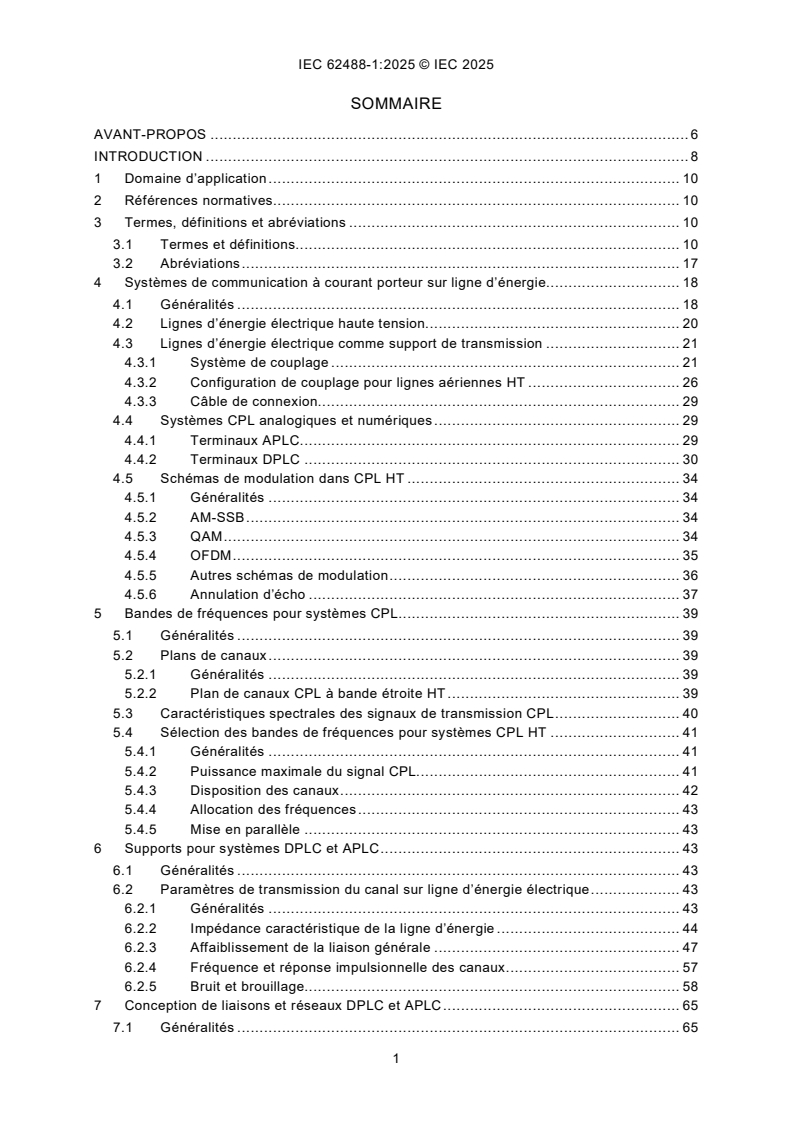
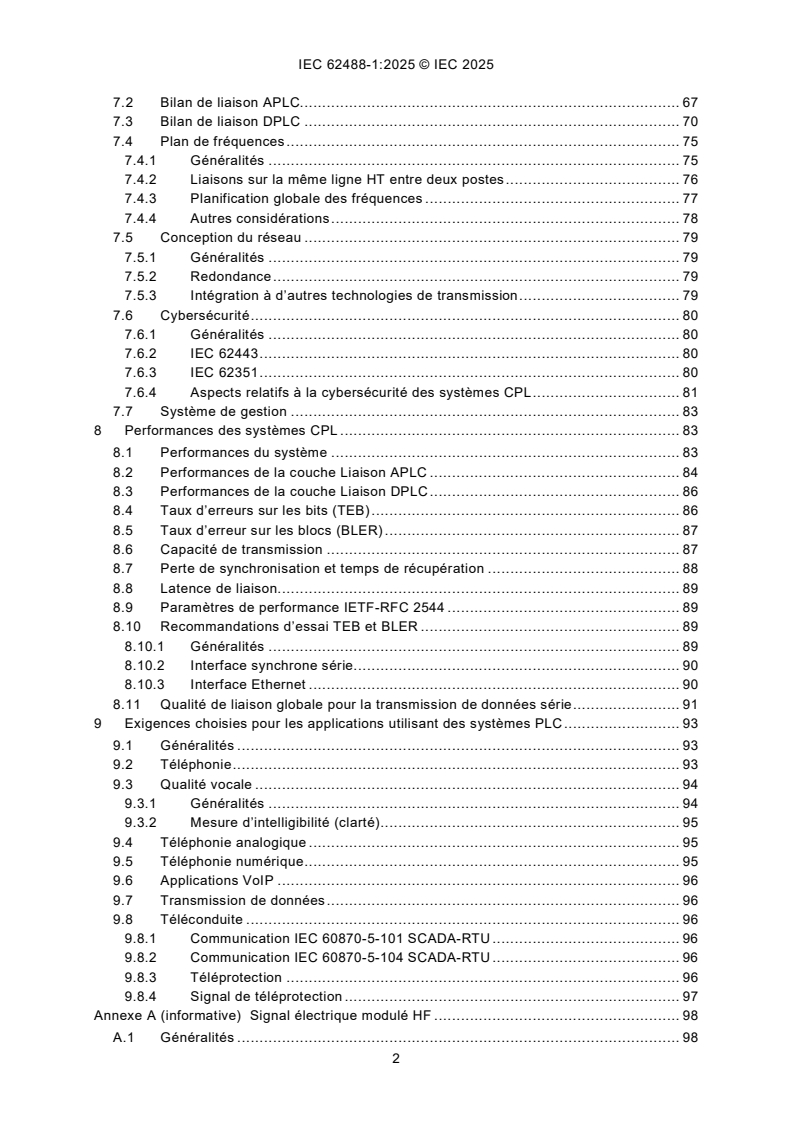
SOMMAIRE
AVANT-PROPOS . 6
INTRODUCTION . 8
1 Domaine d’application . 10
2 Références normatives . 10
3 Termes, définitions et abréviations . 10
3.1 Termes et définitions. 10
3.2 Abréviations . 17
4 Systèmes de communication à courant porteur sur ligne d’énergie. 18
4.1 Généralités . 18
4.2 Lignes d’énergie électrique haute tension. 20
4.3 Lignes d’énergie électrique comme support de transmission . 21
4.3.1 Système de couplage . 21
4.3.2 Configuration de couplage pour lignes aériennes HT . 26
4.3.3 Câble de connexion. 29
4.4 Systèmes CPL analogiques et numériques . 29
4.4.1 Terminaux APLC . 29
4.4.2 Terminaux DPLC . 30
4.5 Schémas de modulation dans CPL HT . 34
4.5.1 Généralités . 34
4.5.2 AM-SSB . 34
4.5.3 QAM . 34
4.5.4 OFDM . 35
4.5.5 Autres schémas de modulation . 36
4.5.6 Annulation d’écho . 37
5 Bandes de fréquences pour systèmes CPL . 39
5.1 Généralités . 39
5.2 Plans de canaux . 39
5.2.1 Généralités . 39
5.2.2 Plan de canaux CPL à bande étroite HT . 39
5.3 Caractéristiques spectrales des signaux de transmission CPL . 40
5.4 Sélection des bandes de fréquences pour systèmes CPL HT . 41
5.4.1 Généralités . 41
5.4.2 Puissance maximale du signal CPL. 41
5.4.3 Disposition des canaux . 42
5.4.4 Allocation des fréquences . 43
5.4.5 Mise en parallèle . 43
6 Supports pour systèmes DPLC et APLC . 43
6.1 Généralités . 43
6.2 Paramètres de transmission du canal sur ligne d’énergie électrique . 43
6.2.1 Généralités . 43
6.2.2 Impédance caractéristique de la ligne d’énergie . 44
6.2.3 Affaiblissement de la liaison générale . 47
6.2.4 Fréquence et réponse impulsionnelle des canaux . 57
6.2.5 Bruit et brouillage. 58
7 Conception de liaisons et réseaux DPLC et APLC . 65
7.1 Généralités . 65
7.2 Bilan de liaison APLC. 67
7.3 Bilan de liaison DPLC . 70
7.4 Plan de fréquences . 75
7.4.1 Généralités . 75
7.4.2 Liaisons sur la même ligne HT entre deux postes . 76
7.4.3 Planification globale des fréquences . 77
7.4.4 Autres considérations . 78
7.5 Conception du réseau . 79
7.5.1 Généralités . 79
7.5.2 Redondance . 79
7.5.3 Intégration à d’autres technologies de transmission . 79
7.6 Cybersécurité . 80
7.6.1 Généralités . 80
7.6.2 IEC 62443 . 80
7.6.3 IEC 62351 . 80
7.6.4 Aspects relatifs à la cybersécurité des systèmes CPL . 81
7.7 Système de gestion . 83
8 Performances des systèmes CPL . 83
8.1 Performances du système . 83
8.2 Performances de la couche Liaison APLC . 84
8.3 Performances de la couche Liaison DPLC . 86
8.4 Taux d’erreurs sur les bits (TEB) . 86
8.5 Taux d’erreur sur les blocs (BLER) . 87
8.6 Capacité de transmission . 87
8.7 Perte de synchronisation et temps de récupération . 88
8.8 Latence de liaison. 89
8.9 Paramètres de performance IETF-RFC 2544 . 89
8.10 Recommandations d’essai TEB et BLER . 89
8.10.1 Généralités . 89
8.10.2 Interface synchrone série . 90
8.10.3 Interface Ethernet . 90
8.11 Qualité de liaison globale pour la transmission de données série . 91
9 Exigences choisies pour les applications utilisant des systèmes PLC . 93
9.1 Généralités . 93
9.2 Téléphonie . 93
9.3 Qualité vocale . 94
9.3.1 Généralités . 94
9.3.2 Mesure d’intelligibilité (clarté) . 95
9.4 Téléphonie analogique . 95
9.5 Téléphonie numérique . 95
9.6 Applications VoIP . 96
9.7 Transmission de données . 96
9.8 Téléconduite . 96
9.8.1 Communication IEC 60870-5-101 SCADA-RTU . 96
9.8.2 Communication IEC 60870-5-104 SCADA-RTU . 96
9.8.3 Téléprotection . 96
9.8.4 Signal de téléprotection . 97
Annexe A (informative) Signal électrique modulé HF . 98
A.1 Généralités . 98
A.2 Bande passante modulée HF et signal de puissance . 102
Annexe B (informative) Rendement de bande passante . 106
Annexe C (informative) Mesure du bruit de ligne d’énergie . 110
Bibliographie . 111
Figure 1 – Liaison CPL . 19
Figure 2 – Structure générale d’une liaison bidirectionnelle point à point APLC, DPLC
ou ADPLC (en configuration phase-terre) . 19
Figure 3 – Structure générale d’une liaison bidirectionnelle point à multipoint APLC,
DPLC ou ADPLC (en configuration phase-terre) . 20
Figure 4 – Condensateur de couplage classique HT . 22
Figure 5 – Exemple de système de couplage capacitif classique HT
(conducteur monophasé à la terre) . 22
Figure 6 – Schéma électrique d’un circuit-bouchon . 23
Figure 7 – Circuit-bouchon HT . 23
Figure 8 – Impédance du circuit-bouchon en fonction de la fréquence . 23
Figure 9 – Caractéristique d’impédance de blocage d’un circuit-bouchon à bande
étroite . 24
Figure 10 – Caractéristique d’impédance de blocage d’un circuit-bouchon à double
bande . 24
Figure 11 – Caractéristique d’impédance de blocage d’un circuit-bouchon à bande
large . 25
Figure 12 – Exemple de composants de dispositif de couplage et de schéma électrique . 25
Figure 13 – Caractéristiques du dispositif de couplage avec un condensateur de
couplage de 4 000 pF . 26
Figure 14 – Couplage phase-terre . 27
Figure 15 – Couplage phase-phase . 27
Figure 16 – Architecture générique d’un terminal APLC conformément à l’IEC 62488-2 . 30
Figure 17 – Architecture générique d’un terminal DPLC conformément à l’IEC 62488-3 . 32
Figure 18 – Structure générique d’un terminal ADPLC . 33
Figure 19 – Espace des signaux pour une constellation 16-QAM . 35
Figure 20 – Méthode d’annulation d’écho pour une liaison DPLC . 38
Figure 21 – Exemple de plan de canaux à bande étroite APLC . 40
Figure 22 – Écart de fréquence minimal . 42
Figure 23 – GMR des faisceaux de conducteurs . 46
Figure 24 – Réseau de terminaison pour une ligne triphasée . 46
Figure 25 – Agencements de couplage optimaux et perte de conversion modale a . 51
c
Figure 26 – Agencements de couplage phase-terre et phase-phase optimaux pour les
longues lignes avec transpositions . 52
Figure 27 – Jonctions de lignes aériennes à des câbles d’alimentation . 55
Figure 28 – Exemple de réponse de canal HT H(f) et h(t) . 58
Figure 29 – Affaiblissement en fonction de la fréquence d’un canal sur ligne d’énergie
HT réel . 58
Figure 30 – Bruit de fond . 60
Figure 31 – Bruit de fond en fonction de la fréquence . 61
Figure 32 – Exemple de variations du spectre de bruit de fond en fonction du temps . 61
Figure 33 – Exemple d’impulsion isolée . 62
Figure 34 – Exemple d’impulsion transitoire . 62
Figure 35 – Exemple d’impulsions périodiques nettes synchrones . 63
Figure 36 – Exemple de salves d’impulsions . 63
Figure 37 – Topologies de réseau CPL types sur des liaisons APLC, DPLC ou ADPLC
dans le réseau d’alimentation HT . 66
Figure 38 – Exemple d’une configuration de signal dans deux canaux de 4 kHz . 68
Figure 39 – Exemple de configuration de canal DPLC. . 72
-6
Figure 40 – Rendement de bande passante DPLC type pour un TEB de 10 . 73
Figure 41 – Exemple de plages de tensions de ligne HT dans des conditions
considérées . 74
Figure 42 – Exemple pour un système DPLC avec adaptation automatique du débit de
données . 75
Figure 43 – Exemple de planification des fréquences basée sur le regroupement des
canaux de fréquences cellulaires. . 78
Figure 44 – Limites de perte totale du circuit par rapport à celle à 1 020 Hz
(Recommandation M.1020 de l’UIT-T) . 85
Figure 45 – Limites pour le temps de propagation de groupe par rapport au temps de
propagation de groupe minimal mesuré dans la bande de 500 Hz à 2 800 Hz
(Recommandation M.1020 de l’UIT-T) . 86
Figure 46 – Quelques courbes de TEB théoriques . 87
Figure 47 – Caractéristique "C/SNR" DPLC comparée au rendement limite de Shannon
pour un TEB = 11E-4 et 1E-6 et limite de Shannon . 88
Figure 48 – Structure normale Ethernet du format des trames . 90
Figure 49 – Exemple de détermination d’indisponibilité (Recommandation G.826
de l’UIT-T) . 92
Figure 50 – Exemple de l’état indisponible d’un trajet bidirectionnel
(Recommandation G.826 de l’UIT-T) . 92
Figure 51 – Estimation de qualité de performance basée sur les
Recommandations G.821 et G.826 de l’UIT-T . 92
Figure 52 – Relation entre clarté, retard et écho concernant la qualité vocale . 94
Figure A.1 – Concepts de puissance . 98
Figure A.2 – Tonalité unique . 100
Figure A.3 – Deux tonalités . 101
Figure A.4 – Exemple de bandes équivalentes de bruit pour différents services . 102
Figure A.5 – Bande équivalente de bruit pour différents services . 103
Figure B.1 – Constellation 8-MIA . 106
Figure B.2 – Intervalle de SNR de rendement DPLC à la limite de Shannon . 109
–4 –6
Figure B.3 – Rendement DPLC pour TEB = 10 et 10 et limite de Shannon . 109
Tableau 1 – Caractéristiques des schémas de modulation DPLC classiques . 36
Tableau 2 – Caractéristiques des schémas de modulation DPLC QAM à porteuse
unique et à plusieurs porteuses . 37
Tableau 3 – Techniques et fréquences de communication par courant porteur sur ligne
d’énergie . 39
Tableau 4 – Spectre HF alloué aux systèmes CPL . 40
Tableau 5 – Plage des impédances caractéristiques des circuits CPL sur lignes
aériennes HT . 47
Tableau 6 – Perte supplémentaire a [dB] pour différentes configurations de ligne et
sup
agencements de couplage optimaux . 54
Tableau 7 – Valeur type des niveaux de puissance de bruit d’effet de couronne,
rapportée à une bande passante de 4 kHz pour diverses tensions de systèmes HT . 60
Tableau 8 – Niveaux moyens types pour le bruit de type impulsionnel, mesurés côté
câble HF du couplage aux bornes de 150 Ω dans une bande passante de 4 kHz. 64
Tableau 9 – Paramètres des signaux . 69
Tableau 10 – Bilan de liaison . 69
Tableau 11 – Niveaux de signal et de bruit admissibles à l’entrée du récepteur . 70
Tableau 12 – Solutions possibles pour l’exemple de la Figure 39 . 72
Tableau 13 – Principales menaces de cyber sécurité et principaux risques de sécurité
auxquels sont confrontés les systèmes CPL . 83
Tableau 14 – Objectifs du masque de qualité (échantillon) . 93
COMMISSION ÉLECTROTECHNIQUE INTERNATIONALE
____________
Systèmes de communication sur lignes d’énergie
pour les applications des compagnies d’électricité -
Partie 1: Conception des systèmes à courants porteurs
de lignes d’énergie analogiques et numériques fonctionnant
sur des réseaux d’électricité HT
AVANT-PROPOS
1) La Commission Électrotechnique Internationale (IEC) est une organisation mondiale de normalisation composée
de l’ensemble des comités électrotechniques nationaux (Comités nationaux de l’IEC). L’IEC a pour objet de
favoriser la coopération internationale pour toutes les questions de normalisation dans les domaines de
l’électricité et de l’électronique. À cet effet, l’IEC – entre autres activités – publie des Normes internationales,
des Spécifications techniques, des Rapports techniques, des Spécifications accessibles au public (PAS) et des
Guides (ci-après dénommés "Publication(s) de l’IEC"). Leur élaboration est confiée à des comités d’études,
aux travaux desquels tout Comité national intéressé par le sujet traité peut participer. Les organisations
internationales, gouvernementales et non gouvernementales, en liaison avec l’IEC, participent également aux
travaux. L’IEC collabore étroitement avec l’Organisation Internationale de Normalisation (ISO), selon des
conditions fixées par accord entre les deux organisations.
2) Les décisions ou accords officiels de l’IEC concernant les questions techniques représentent, dans la mesure du
possible, un accord international sur les sujets étudiés, étant donné que les Comités nationaux de l’IEC intéressés
sont représentés dans chaque comité d’études.
3) Les Publications de l’IEC se présentent sous la forme de recommandations internationales et sont agréées
comme telles par les Comités nationaux de l’IEC. Tous les efforts raisonnables sont entrepris afin que l’IEC
s’assure de l’exactitude du contenu technique de ses publications; l’IEC ne peut pas être tenue responsable de
l’éventuelle mauvaise utilisation ou interprétation qui en est faite par un quelconque utilisateur final.
4) Dans le but d’encourager l’uniformité internationale, les Comités nationaux de l’IEC s’engagent, dans toute la
mesure possible, à appliquer de façon transparente les Publications de l’IEC dans leurs publications nationales
et régionales. Toutes divergences entre toutes Publications de l’IEC et toutes publications nationales ou
régionales correspondantes doivent être indiquées en termes clairs dans ces dernières.
5) L’IEC elle-même ne fournit aucune attestation de conformité. Des organismes de certification indépendants
fournissent des services d’évaluation de conformité et, dans certains secteurs, accèdent aux marques de
conformité de l’IEC. L’IEC n’est responsable d’aucun des services effectués par les organismes de certification
indépendants.
6) Tous les utilisateurs doivent s’assurer qu’ils sont en possession de la dernière édition de cette publication.
7) Aucune responsabilité ne doit être imputée à l’IEC, à ses administrateurs, employés, auxiliaires ou mandataires,
y compris ses experts particuliers et les membres de ses comités d’études et des Comités nationaux de l’IEC,
pour tout préjudice causé en cas de dommages corporels et matériels, ou de tout autre dommage de quelque
nature que ce soit, directe ou indirecte, ou pour supporter les coûts (y compris les frais de justice) et les dépenses
découlant de la publication ou de l’utilisation de cette Publication de l’IEC ou de toute autre Publication de l’IEC,
ou au crédit qui lui est accordé.
8) L’attention est attirée sur les références normatives citées dans cette publication. L’utilisation de publications
référencées est obligatoire pour une application correcte de la présente publication.
9) L’IEC attire l’attention sur le fait que la mise en application du présent document peut entraîner l’utilisation d’un
ou de plusieurs brevets. L’IEC ne prend pas position quant à la preuve, à la validité et à l’applicabilité de tout
droit de brevet revendiqué à cet égard. À la date de publication du présent document, l’IEC n’avait pas reçu
notification qu’un ou plusieurs brevets pouvaient être nécessaires à sa mise en application. Toutefois, il y a lieu
d’avertir les responsables de la mise en application du présent document que des informations plus récentes
sont susceptibles de figurer dans la base de données de brevets, disponible à l’adresse https://patents.iec.ch.
L’IEC ne saurait être tenue pour responsable de ne pas avoir identifié de tels droits de brevet.
L’IEC 62488-1 a été établie par le comité d’études 57 de l’IEC: Gestion des systèmes de
puissance et échanges d’informations associés. Il s’agit d’une Norme internationale.
Cette deuxième édition annule et remplace la première édition parue en 2012. Cette édition
constitue une révision technique.
Cette édition inclut les modifications techniques majeures suivantes par rapport à l’édition
précédente:
a) Révision complète de la présente édition par rapport à l'édition précédente,
portant principalement sur la conception des systèmes à courants porteurs de lignes
d’énergie analogiques et numériques fonctionnant sur des réseaux d’électricité HT;
b) Une structure générale d’une liaison bidirectionnelle point à multipoint APLC, DPLC ou
ADPLC a été introduite;
c) Introduction d’une nouvelle approche en matière de planification globale des fréquences.
Le texte de cette Norme internationale est issu des documents suivants:
Projet Rapport de vote
57/2773/FDIS 57/2794/RVD
Le rapport de vote indiqué dans le tableau ci-dessus donne toute information sur le vote ayant
abouti à son approbation.
La langue employée pour l’élaboration de cette Norme internationale est l’anglais.
La version française de la norme n’a pas été soumise au vote.
Ce document a été rédigé selon les Directives ISO/IEC, Partie 2, il a été développé selon les
Directives ISO/IEC, Partie 1 et les Directives ISO/IEC, Supplément IEC, disponibles sous
www.iec.ch/members_experts/refdocs. Les principaux types de documents développés par
l’IEC sont décrits plus en détail sous www.iec.ch/publications.
Une liste de toutes les parties de la série IEC 62488, publiées sous le titre général Systèmes de
communication sur lignes d’énergie pour les applications des compagnies d’électricité,
se trouve sur le site Web de l’IEC.
Le comité a décidé que le contenu de ce document ne sera pas modifié avant la date de stabilité
indiquée sur le site web de l’IEC sous webstore.iec.ch dans les données relatives au document
recherché. À cette date, le document sera
• reconduit,
• supprimé, ou
• révisé.
INTRODUCTION
La complexité et la taille importante des systèmes actuels de génération, de transmission et de
distribution d’électricité sont telles qu’il est possible de contrôler ces systèmes uniquement au
moyen d’un système de télécommunication associé, souvent tout aussi étendu et complexe que
les systèmes, et présentant une fiabilité très élevée.
L’utilisation simultanée du réseau de distribution de puissance pour la transmission d’énergie
et la communication de données est unique. Elle réduit le coût de l’installation des deux
services en n’utilisant qu’un seul trajet de transmission. Cette technologie de communication
est appelée "communications par courant porteur sur ligne d’énergie" (CPL).
Par conséquent, à l’aide d’une communication par courant porteur sur ligne d’énergie
analogique (APLC) et/ou d’une communication par courant porteur sur ligne d’énergie
numérique (DPLC), la communication peut rester efficace sans raccord sur l’ensemble du
réseau électrique.
Le développement de techniques numériques pour les communications dans les réseaux
électriques HT est maintenant très répandu, ainsi que d’autres applications du domaine de
l’électronique. Cela est particulièrement vrai concernant les réseaux de distribution électrique
dans lesquels les dispositifs CPL utilisent des convertisseurs analogiques/numériques associés
à des techniques de traitement du signal numérique visant à assurer une plus grande flexibilité
et une meilleure efficacité du matériel.
Le rapport technique sur la "conception des systèmes à courant porteur sur ligne d’énergie" a
d’abord été élaboré par la Commission Électrotechnique Internationale dans l’IEC 60663 [1]
parue en 1980 intitulée Conception des systèmes à courants porteurs (à bande latérale unique)
sur lignes d’énergie. En 1993, la Commission Électrotechnique Internationale a élaboré
l’IEC 60495 [2], Équipements terminaux à courants porteurs sur lignes d’énergie, à bande
latérale unique. Dans les années qui ont suivi, les systèmes électroniques et les systèmes de
communication associés pour dispositifs électroniques ont évolué et se sont considérablement
développés. L’introduction de techniques de communications numériques a amélioré la qualité
de l’émission et de la réception des signaux CPL dans les dispositifs électroniques,
leur permettant de fournir une analyse de la qualité plus détaillée et de contrôler les données
communiquées sur l’ensemble du réseau de distribution de l’énergie électrique, du centre de
commande au fournisseur de service.
Ces deux normes, IEC 60663 et IEC 60495, ont été mises à jour et remplacées par les normes
suivantes: L’IEC 60663 est remplacée par l’IEC 62488-1, et l’IEC 60495 est remplacée par
l’IEC 62488-2 [3] et l’IEC 62488-3 [4], couvrant respectivement les équipements terminaux à
courant porteur sur ligne d’énergie analogiques, numériques et hybrides
analogiques/numériques.
Ces documents s’appliquent aux équipements terminaux à courant porteur sur ligne d’énergie
(CPL) utilisés pour transmettre des informations sur des réseaux d’alimentation électrique HT.
Les systèmes de modulation analogiques et numériques sont pris en compte.
___________
Les chiffres entre crochets renvoient à la Bibliographie.
La série IEC 62488 comprend les parties suivantes, présentées sous le titre général:
Systèmes de communication sur lignes d’énergie pour les applications des compagnies
d’électricité:
Partie 1: Conception des systèmes à courants porteurs de lignes d’énergie analogiques et
numériques fonctionnant sur des réseaux d’électricité HT;
Partie 2: Bornes analogiques à courant porteur en ligne (CPL);
Partie 3: Équipements terminaux à courants porteurs sur lignes d’énergie numériques (DPLC)
et équipements terminaux hybrides ADPLC.
1 Domaine d’application
La présente partie de l’IEC 62488 s’applique à la conception des systèmes de communication
par courant porteur sur ligne d’énergie analogiques (APLC), numériques (DPLC) et hybrides
analogiques/numériques (ADPLC, Analogue-Digital Power Line Carrier) installés sur des
réseaux d’alimentation électrique HT. Le présent document a pour objet de définir la conception
des services et des paramètres de performance relatifs aux exigences opérationnelles en
matière d’émission et de réception efficaces et fiables des données.
Ces systèmes à courant porteur sur ligne d’énergie analogiques et numériques sont utilisés par
les différentes compagnies d’électricité et sont intégrés à leur infrastructure de communication
à l’aide des technologies de communication habituelles (les liaisons radioélectriques, la fibre
optique et les réseaux satellite, par exemple).
2 Références normatives
Le présent document ne contient aucune référence normative.
3 Termes, définitions et abréviations
3.1 Termes et définitions
Pour les besoins du présent document, les termes et définitions suivants s’appliquent.
L’ISO et l’IEC tiennent à jour des bases de données terminologiques destinées à être utilisées
en normalisation, consultables aux adresses suivantes :
• IEC Electropedia: disponible à l’adresse https://www.electropedia.org/
• ISO Online browsing platform: disponible à l’adresse https://www.iso.org/obp
NOTE D’autres termes utilisés dans le présent document et non définis dans le présent article ont la signification
qui leur est attribuée par le Vocabulaire Électrotechnique International (IEV).
3.1.1
Amplitude Modulation (modulation d’amplitude)
AM
technique de modulation dans laquelle les informations sont transmises par la variation
d’amplitude d’une onde porteuse
3.1.2
interface analogique
interface réservée au traitement de signaux analogiques à bande vocale
3.1.3
affaiblissement
réduction de puissance le long d’une ligne de transmission pour le ou les modes à l’étude,
exprimée de manière quantitative par le rapport ou le logarithme du rapport de la puissance
d’entrée au point initial à la puissance de sortie correspondante au point final
3.1.4
disponibilité
temps ou fraction de temps pendant lequel ou laquelle un système est opérationnel sur un
intervalle de temps donné
3.1.5
bruit de fond
bruit présent dans tous les canaux des lignes d’énergie haute tension réelles en raison,
principalement, de l’effet de couronne, des décharges partielles et du brouillage
électromagnétique avec d’autres équipements CPL utilisés sur le même réseau électrique,
ainsi que du brouillage dû aux stations de radio fonctionnant sur le même spectre de fréquences
radio
3.1.6
taux d’erreur sur les bits
TEB
rapport du nombre d’erreurs sur bits reçus au nombre total de bits envoyés
3.1.7
plage de fréquences porteuses
bande passante disponible pour une technologie spécifique de communication par courant
porteur sur ligne d’énergie
Note 1 à l’article: En Europe, la plage classique des fréquences porteuses du CPL HT à bande étroite est comprise
entre 3 kHz et 148,5 kHz, celle du CPL à bande large étant comprise entre 1,6 MHz et 30 MHz. Pour la norme
américaine CPL de l’IEEE, la plage de fréquences est comprise entre 45 kHz et 450 kHz. Les réglementations
nationales peuvent exclure certaines parties de la plage.
3.1.8
disposition des canaux
sous-division élémentaire de la plage de fréquences porteuses ou d’une partie de celle-ci,
allouée à un canal d’émission et réception CPL unique (bidirectionnel)
3.1.9
bruit gaussien coloré
bruit gaussien non blanc ou tout bruit à bande large dont le spectre a une forme non plate
Note 1 à l’article: Également appelé bruit non blanc; il s’agit par exemple du bruit rose, du bruit brun ou du bruit
autorégressif.
3.1.10
bruit d’effet de couronne
bruit provoqué par des décharges partielles sur les isolateurs et dans l’air, au voisinage
immédiat des conducteurs électriques des lignes d’énergie aériennes
Note 1 à l’article: Les décharges se produisent sur les trois conducteurs de phase différents à des moments
différents. Le niveau de bruit d’effet de couronne dépend fortement des conditions météorologiques. Le bruit d’effet
de couronne est particulièrement intense quand les conditions météorologiques sont mauvaises.
3.1.11
condensateur de couplage
condensateur utilisé pour le couplage du signal porteur avec la ligne d’énergie dans un système
CPL
3.1.12
Coupling Device (dispositif de couplage)
unité assurant l’interface entre le côté HT de la ligne d’énergie et l’équipement CPL
(également appelé unité d’adaptation de ligne (LMU))
Note 1 à l’article: Il comprend généralement une boîte montée à proximité du condensateur de couplage.
Ses caractéristiques sont normalisées par l’IEC 60481.
3.1.13
système de couplage
groupe de dispositifs utilisés pour coupler les signaux haute fréquence CPL à la ligne d’énergie
Note 1 à l’article: En règle générale, un système de couplage est composé d’un circuit-bouchon, d’un condensateur
de couplage et d’un dispositif de couplage
3.1.14
défaut
divergence importante entre les données réellement reçues et les données souhaitées
Note 1 à l’article: Les défauts tendent à interrompre le fonctionnement des applications qui utilisent les données
transmises; les défauts sont utilisés comme entrées pour la surveillance des performances, la commande des actions
à effectuer en conséquence de ces défauts et la détermination des causes des défauts. Par exemple: perte de signal,
perte de synchronisation, signal d’indication d’alarme, glissement, perte d’alignement de trames.
3.1.15
Distribution Line Carrier (système de distribution à courant porteur)
DLC
système pour la communication sur lignes de distribution d’électricité
Note 1 à l’article: Les systèmes DLC peuvent être des systèmes de communication à grande vitesse et bande
étroite sur le réseau de distribution moyenne tension ou des systèmes de communication à bande large / bande
étroite sur le réseau de distribution basse tension.
3.1.16
environnement
conditions extérieures dans lesquelles un système fonctionne
Note 1 à l’article: Différentes classes de contraintes et de limites concernant la CEM/l’EMI, sont définies pour des
classes d’environnement telles que les classes industrielles, commerciales, domestiques.
3.1.17
Error Free Second (seconde sans erreurs)
EFS
période d’une seconde sans erreurs sur les bits
3.1.18
Errored Second (seconde avec erreurs)
ES
période d’une seconde dans laquelle un ou plusieurs bits comportent des erreurs
3.1.19
Errored Second Ratio (taux de secondes avec erreurs)
ESR
rapport des secondes avec erreurs (ES) au nombre total de secondes dans le temps disponible
pendant un intervalle de mesure fixé
3.1.20
Interface Éthernet
interface réservée au traitement de signaux de données conformément à l’IEEE 802.3
3.1.21
Frame Check Sequence (séquence de vérification de la trame)
FCS
bits ou caractères supplémentaires ajoutés à une trame de données pour la détection d’erreur
3.1.22
taux de perte de trames
nombre de trames qui ne sont jamais parvenues à destination, divisé par le nombre de trames
émises avec succès par la source
Note 1 à l’article: Ce nombre est habituellement exprimé sous forme de pourcentage.
3.1.23
Multiplexage par répartition en fréquence
MRF
technique de multiplexage consistant à allouer à plusieurs émetteurs des bandes de fréquences
distinctes pour la transmission sur un canal commun
3.1.24
modulation par déplacement de fréquence
MDF
technique de modulation de fréquence dans laquelle des informations codées sont transmises
au moyen de modifications discrètes de la fréquence d’une onde porteuse
3.1.25
temps de propagation de groupe
temps de propagation d’un signal à bande étroite de l’entrée à la sortie d’un système linéaire
Note 1 à l’article: Mathématiquement, le temps de propagation de groupe est égal à la dérivée négative du
déplacement de phase en radians entre l’entrée et la sortie d’un système linéaire en fonction de la pulsation.
3.1.26
bruit impulsif
bruit constitué d’impulsions de courte durée, d’amplitude et de durée aléatoires
3.1.27
gigue
variations à court terme des instants importants d’un signal de synchronisation par rapport à
leurs positions idéales dans le temps (court terme signifiant que ces variations sont de
fréquence supérieure ou égale à 10 Hz)
3.1.28
latence
temps entre l’envoi d’un paquet sur un réseau à commutation de paquets par la source, et la
réception de ce paquet par la destination
Note 1 à l’article: La latence à sens uniqu
...
IEC 62488-1 ®
Edition 2.0 2025-07
INTERNATIONAL
STANDARD
NORME
INTERNATIONALE
Power line communication systems for power utility applications -
Part 1: Planning of analogue and digital power line carrier systems operating
over HV electricity grids
Systèmes de communication sur lignes d'énergie pour les applications des
compagnies d'électricité -
Partie 1: Conception des systèmes à courants porteurs de lignes d'énergie
analogiques et numériques fonctionnant sur des réseaux d'électricité HT
ICS 33.200 ISBN 978-2-8327-0507-0
All rights reserved. Unless otherwise specified, no part of this publication may be reproduced or utilized in any form or
by any means, electronic or mechanical, including photocopying and microfilm, without permission in writing from either
IEC or IEC's member National Committee in the country of the requester. If you have any questions about IEC copyright
or have an enquiry about obtaining additional rights to this publication, please contact the address below or your local
IEC member National Committee for further information.
Droits de reproduction réservés. Sauf indication contraire, aucune partie de cette publication ne peut être reproduite ni
utilisée sous quelque forme que ce soit et par aucun procédé, électronique ou mécanique, y compris la photocopie et
les microfilms, sans l'accord écrit de l'IEC ou du Comité national de l'IEC du pays du demandeur. Si vous avez des
questions sur le copyright de l'IEC ou si vous désirez obtenir des droits supplémentaires sur cette publication, utilisez
les coordonnées ci-après ou contactez le Comité national de l'IEC de votre pays de résidence.
IEC Secretariat Tel.: +41 22 919 02 11
3, rue de Varembé info@iec.ch
CH-1211 Geneva 20 www.iec.ch
Switzerland
About the IEC
The International Electrotechnical Commission (IEC) is the leading global organization that prepares and publishes
International Standards for all electrical, electronic and related technologies.
About IEC publications
The technical content of IEC publications is kept under constant review by the IEC. Please make sure that you have the
latest edition, a corrigendum or an amendment might have been published.
IEC publications search - IEC Products & Services Portal - products.iec.ch
webstore.iec.ch/advsearchform Discover our powerful search engine and read freely all the
The advanced search enables to find IEC publications by a publications previews, graphical symbols and the glossary.
variety of criteria (reference number, text, technical With a subscription you will always have access to up to date
committee, …). It also gives information on projects, content tailored to your needs.
replaced and withdrawn publications.
Electropedia - www.electropedia.org
IEC Just Published - webstore.iec.ch/justpublished The world's leading online dictionary on electrotechnology,
Stay up to date on all new IEC publications. Just Published containing more than 22 500 terminological entries in English
details all new publications released. Available online and and French, with equivalent terms in 25 additional languages.
Also known as the International Electrotechnical Vocabulary
once a month by email.
(IEV) online.
IEC Customer Service Centre - webstore.iec.ch/csc
If you wish to give us your feedback on this publication or
need further assistance, please contact the Customer
Service Centre: sales@iec.ch.
A propos de l'IEC
La Commission Electrotechnique Internationale (IEC) est la première organisation mondiale qui élabore et publie des
Normes internationales pour tout ce qui a trait à l'électricité, à l'électronique et aux technologies apparentées.
A propos des publications IEC
Le contenu technique des publications IEC est constamment revu. Veuillez vous assurer que vous possédez l’édition la
plus récente, un corrigendum ou amendement peut avoir été publié.
Recherche de publications IEC - IEC Products & Services Portal - products.iec.ch
webstore.iec.ch/advsearchform Découvrez notre puissant moteur de recherche et consultez
La recherche avancée permet de trouver des publications gratuitement tous les aperçus des publications, symboles
IEC en utilisant différents critères (numéro de référence, graphiques et le glossaire. Avec un abonnement, vous aurez
texte, comité d’études, …). Elle donne aussi des toujours accès à un contenu à jour adapté à vos besoins.
informations sur les projets et les publications remplacées
ou retirées. Electropedia - www.electropedia.org
Le premier dictionnaire d'électrotechnologie en ligne au
IEC Just Published - webstore.iec.ch/justpublished monde, avec plus de 22 500 articles terminologiques en
Restez informé sur les nouvelles publications IEC. Just anglais et en français, ainsi que les termes équivalents
Published détaille les nouvelles publications parues. dans 25 langues additionnelles. Egalement appelé
Disponible en ligne et une fois par mois par email. Vocabulaire Electrotechnique International (IEV) en ligne.
Service Clients - webstore.iec.ch/csc
Si vous désirez nous donner des commentaires sur cette
publication ou si vous avez des questions contactez-
nous: sales@iec.ch.
CONTENTS
FOREWORD . 6
INTRODUCTION . 8
1 Scope . 9
2 Normative references . 9
3 Terms, definitions and abbreviated terms . 9
3.1 Terms and definitions . 9
3.2 Abbreviated terms. 15
4 Power line carrier communication systems . 16
4.1 General . 16
4.2 High voltage electricity power lines . 18
4.3 Electricity power lines as transmission medium . 19
4.3.1 Coupling system . 19
4.3.2 Coupling configuration for overhead HV lines . 24
4.3.3 Connecting cable . 26
4.4 Analogue and digital PLC systems. 27
4.4.1 APLC terminals . 27
4.4.2 DPLC terminals . 28
4.5 Modulation schemes in HV PLC . 30
4.5.1 General. 30
4.5.2 AM-SSB . 31
4.5.3 QAM . 31
4.5.4 OFDM . 32
4.5.5 Other modulation schemes. 32
4.5.6 Echo cancellation . 34
5 Frequency bands for PLC systems . 35
5.1 General . 35
5.2 Channel plans . 35
5.2.1 General. 35
5.2.2 HV narrowband PLC channel plan . 35
5.3 Spectral characteristics of PLC transmission signals . 36
5.4 Selection of the frequency bands for HV PLC systems . 36
5.4.1 General. 36
5.4.2 Maximum power of PLC signal . 37
5.4.3 Channeling . 38
5.4.4 Frequency allocation . 38
5.4.5 Paralleling . 38
6 Media for DPLC and APLC systems . 39
6.1 General . 39
6.2 Transmission parameters of electricity power line channel . 39
6.2.1 General. 39
6.2.2 Characteristic impedance of power line . 40
6.2.3 Overall link attenuation . 43
6.2.4 Channel frequency and impulse response. 52
6.2.5 Noise and interference . 53
7 DPLC and APLC link and network planning . 60
7.1 General . 60
7.2 APLC link budget . 62
7.3 DPLC link budget . 65
7.4 Frequency plan. 70
7.4.1 General. 70
7.4.2 Links over the same HV line between two substations . 70
7.4.3 Global frequency planning . 71
7.4.4 Other considerations . 72
7.5 Network planning . 73
7.5.1 General. 73
7.5.2 Redundancy . 73
7.5.3 Integration with other transmission technologies . 74
7.6 Cyber security . 74
7.6.1 General. 74
7.6.2 IEC 62443 . 74
7.6.3 IEC 62351 . 74
7.6.4 Cyber security aspects of PLC systems . 75
7.7 Management system . 77
8 Performance of PLC systems . 77
8.1 System performance . 77
8.2 APLC link layer performance . 77
8.3 DPLC link layer performance . 79
8.4 Bit error ratio (BER) . 80
8.5 Block error ratio (BLER) . 81
8.6 Transmission capacity . 81
8.7 Sync loss and recovery time . 81
8.8 Link latency. 82
8.9 IETF-RFC 2544 Ethernet performance parameters . 82
8.10 BER and BLER testing recommendations . 83
8.10.1 General. 83
8.10.2 Serial synchronous interface . 83
8.10.3 Ethernet interface . 83
8.11 Overall link quality for serial data transmission . 84
9 Selected requirements for applications using PLC systems . 86
9.1 General . 86
9.2 Telephony . 86
9.3 Speech quality . 87
9.3.1 General. 87
9.3.2 Measuring intelligibility (clarity) . 87
9.4 Analogue telephony . 88
9.5 Digital telephony . 88
9.6 VoIP applications . 88
9.7 Data transmission . 88
9.8 Telecontrol . 89
9.8.1 IEC 60870-5-101 SCADA-RTU communication . 89
9.8.2 IEC 60870-5-104 SCADA-RTU communication . 89
9.8.3 Teleprotection . 89
9.8.4 Teleprotection signal . 90
Annex A (informative) HF modulated power signal . 91
A.1 General . 91
A.2 HF modulated bandwidth and power signal . 95
Annex B (informative) Bandwidth efficiency . 99
Annex C (informative) Power line noise measurement . 103
Bibliography . 104
Figure 1 – PLC link . 17
Figure 2 – General structure of a bidirectional point-to-point APLC, DPLC or ADPLC
link (in phase to ground configuration) . 17
Figure 3 – General structure of a bidirectional point-to-multipoint APLC, DPLC or
ADPLC link (in phase to ground configuration). 18
Figure 4 – HV typical coupling capacitor . 20
Figure 5 – Example of HV capacitive coupling system (single phase conductor to earth) . 20
Figure 6 – Line trap electrical scheme . 21
Figure 7 – HV line trap . 21
Figure 8 – Line trap impedance versus frequency . 21
Figure 9 – Blocking impedance characteristic of a narrowband line trap . 22
Figure 10 – Blocking impedance characteristic of a double band line trap . 22
Figure 11 – Blocking impedance characteristic of a broadband line trap . 22
Figure 12 – Example of coupling device components and electric scheme . 23
Figure 13 – Coupling device characteristics with a coupling capacitor of 4 000 pF . 24
Figure 14 – Phase-to-earth coupling . 25
Figure 15 – Phase-to-phase coupling . 25
Figure 16 – Generic architecture of an APLC terminal acc. to IEC 62488-2 . 28
Figure 17 – Generic architecture of a DPLC terminal acc. to IEC 62488-3 . 29
Figure 18 – Generic structure of an ADPLC terminal . 30
Figure 19 – Signal space for a 16-QAM constellation . 31
Figure 20 – Echo cancellation method for a DPLC link. 34
Figure 21 – An example of a APLC narrowband channel plan. 36
Figure 22 – Minimum frequency gap . 38
Figure 23 – GMR of conductor bundles . 41
Figure 24 – Terminating network for a three-phase line . 42
Figure 25 – Optimum coupling arrangements and modal conversion loss a . 46
c
Figure 26 – Optimum phase to earth and phase to phase coupling arrangements for
long lines with transpositions . 47
Figure 27 – Junctions of overhead lines with power cables . 50
Figure 28 – Example of HV H(f) and h(t) channel response . 53
Figure 29 – Attenuation versus frequency of a real HV power line channel . 53
Figure 30 – Background noise . 54
Figure 31 – Background noise over frequency . 56
Figure 32 – Example of the background noise spectrum variations over time . 56
Figure 33 – Example of an isolated pulse . 57
Figure 34 – Example of a transient pulse . 57
Figure 35 – Example of net-synchronous periodic pulses . 58
Figure 36 – Example of burst pulses . 58
Figure 37 – Typical PLC network topologies base on APLC, DPLC or ADPLC links in
HV power network . 61
Figure 38 – Example for a signal arrangement in two 4 kHz channels . 63
Figure 39 – Example for a DPLC channel arrangement. . 66
-6
Figure 40 – Typical DPLC bandwidth efficiency for a BER of 10 . 68
Figure 41 – Example of the HV line voltage ranges under considered conditions . 69
Figure 42 – Example for DPLC system with automatic data rate adaptation . 70
Figure 43 – Example of frequency planning based on cellular frequency channel
clustering. 72
Figure 44 – Limits for overall loss of the circuit relative to that at 1 020 Hz
(ITU-T M.1020) . 79
Figure 45 – Limits for group delay relative to the minimum measured group delay in the
500 Hz – 2 800 Hz band (ITU-T M.1020) . 79
Figure 46 – Some theoretical BER curves . 80
Figure 47 – DPLC "C/SNR" characteristic in comparison to the Shannon limit efficiency
for BER = 1E-4 and 1E-6 and Shannon limit . 81
Figure 48 – Ethernet standard structure of frame format . 83
Figure 49 – Example of unavailability determination (ITU-T G.826) . 85
Figure 50 – Example of the unavailable state of a bidirectional path (ITU-T G.826) . 85
Figure 51 – Quality performance estimation based on ITU-T G.821 and G.826. 85
Figure 52 – Relationship between clarity, delay, and echo with regards to speech
quality . 87
Figure A.1 – Power concepts . 91
Figure A.2 – Single tone . 93
Figure A.3 – Two tones . 94
Figure A.4 – Example of noise equivalent bands for different services . 95
Figure A.5 – Noise equivalent band for different services. 96
Figure B.1 – 8-PAM signal constellation . 99
Figure B.2 – SNR gap of DPLC efficiency to Shannon limit . 101
–4 –6
Figure B.3 – DPLC efficiency for BER = 10 and 10 and Shannon limit . 102
Table 1 – Characteristics of typical DPLC modulation schemes . 33
Table 2 – Single- and multicarrier QAM DPLC modulation scheme characteristics . 33
Table 3 – Power line carrier communication techniques and frequencies . 35
Table 4 – HF spectrum allocated for PLC systems . 36
Table 5 – Range of characteristic impedances for PLC circuits on HV overhead lines . 42
Table 6 – Additional loss a [dB] for various line configurations and optimum
add
coupling arrangements . 48
Table 7 – Typical power of corona noise power levels, referring to a 4 kHz bandwidth
for various HV system voltages . 55
Table 8 – Typical average impulse-type noise levels, measured at the HF-cable side of
the coupling across 150 Ω in a bandwidth of 4 kHz . 59
Table 9 – Signal parameters . 63
Table 10 – Link budget. 64
Table 11 – Signal and allowed noise levels at the receiver input . 64
Table 12 – Possible solutions for the example of Figure 39 . 67
Table 13 – Main cyber security threats and security risks related to PLC systems . 77
Table 14 – Quality mask objectives (sample) . 86
INTERNATIONAL ELECTROTECHNICAL COMMISSION
____________
Power line communication systems for power utility applications -
Part 1: Planning of analogue and digital power line carrier
systems operating over HV electricity grids
FOREWORD
1) The International Electrotechnical Commission (IEC) is a worldwide organization for standardization comprising
all national electrotechnical committees (IEC National Committees). The object of IEC is to promote international
co-operation on all questions concerning standardization in the electrical and electronic fields. To this end and
in addition to other activities, IEC publishes International Standards, Technical Specifications, Technical Reports,
Publicly Available Specifications (PAS) and Guides (hereafter referred to as "IEC Publication(s)"). Their
preparation is entrusted to technical committees; any IEC National Committee interested in the subject dealt with
may participate in this preparatory work. International, governmental and non-governmental organizations liaising
with the IEC also participate in this preparation. IEC collaborates closely with the International Organization for
Standardization (ISO) in accordance with conditions determined by agreement between the two organizations.
2) The formal decisions or agreements of IEC on technical matters express, as nearly as possible, an international
consensus of opinion on the relevant subjects since each technical committee has representation from all
interested IEC National Committees.
3) IEC Publications have the form of recommendations for international use and are accepted by IEC National
Committees in that sense. While all reasonable efforts are made to ensure that the technical content of IEC
Publications is accurate, IEC cannot be held responsible for the way in which they are used or for any
misinterpretation by any end user.
4) In order to promote international uniformity, IEC National Committees undertake to apply IEC Publications
transparently to the maximum extent possible in their national and regional publications. Any divergence between
any IEC Publication and the corresponding national or regional publication shall be clearly indicated in the latter.
5) IEC itself does not provide any attestation of conformity. Independent certification bodies provide conformity
assessment services and, in some areas, access to IEC marks of conformity. IEC is not responsible for any
services carried out by independent certification bodies.
6) All users should ensure that they have the latest edition of this publication.
7) No liability shall attach to IEC or its directors, employees, servants or agents including individual experts and
members of its technical committees and IEC National Committees for any personal injury, property damage or
other damage of any nature whatsoever, whether direct or indirect, or for costs (including legal fees) and
expenses arising out of the publication, use of, or reliance upon, this IEC Publication or any other IEC
Publications.
8) Attention is drawn to the Normative references cited in this publication. Use of the referenced publications is
indispensable for the correct application of this publication.
9) IEC draws attention to the possibility that the implementation of this document may involve the use of (a)
patent(s). IEC takes no position concerning the evidence, validity or applicability of any claimed patent rights in
respect thereof. As of the date of publication of this document, IEC had not received notice of (a) patent(s), which
may be required to implement this document. However, implementers are cautioned that this may not represent
the latest information, which may be obtained from the patent database available at https://patents.iec.ch. IEC
shall not be held responsible for identifying any or all such patent rights.
IEC 62488-1 has been prepared by IEC technical committee 57: Power systems management
and associated information exchange. It is an International Standard.
This second edition cancels and replaces the first edition published in 2012. This edition
constitutes a technical revision.
This edition includes the following significant technical changes with respect to the previous
edition:
a) Complete revision of this edition with respect to the previous edition with the main focus on
planning of analogue and digital power line carrier systems operating over HV power
networks;
b) A general structure of a bidirectional point-to-multipoint APLC, DPLC or ADPLC link has
been introduced;
c) Introduction of a new approach for global frequency planning.
The text of this International Standard is based on the following documents:
Draft Report on voting
57/2773/FDIS 57/2794/RVD
Full information on the voting for its approval can be found in the report on voting indicated in
the above table.
The language used for the development of this International Standard is English.
This document was drafted in accordance with ISO/IEC Directives, Part 2, and developed in
accordance with ISO/IEC Directives, Part 1 and ISO/IEC Directives, IEC Supplement, available
at www.iec.ch/members_experts/refdocs. The main document types developed by IEC are
described in greater detail at www.iec.ch/publications.
A list of all parts of IEC 62488 series, under the general title Power line communication systems
for power utility applications, can be found on the IEC website.
The committee has decided that the contents of this document will remain unchanged until the
stability date indicated on the IEC website under webstore.iec.ch in the data related to the
specific document. At this date, the document will be
• reconfirmed,
• withdrawn, or
• revised.
INTRODUCTION
The complexity and extensive size of present-day electricity generation, transmission and
distribution systems are such that it is possible to control them only by means of an associated
and often equally large and complex telecommunication system having a high order of reliability.
The simultaneous use of the power distribution network for both energy transmission and data
communication is unique and reduces the costs of installing two services over one transmission
path. This communication technology is called generically power line carrier (PLC)
communications.
Therefore, by using either analogue power line carrier communication (APLC) or digital power
line carrier communication (DPLC) or a combination of both types of system (ADPLC), seamless
efficient communication can be maintained throughout the power network.
The development of digital techniques for communications in the HV electrical power networks
is now very widespread along with other applications in electronics. This is especially relevant
for the electrical distribution network where many of the PLC devices use analogue to digital
converters together with digital signal processing techniques enabling higher flexibility and HW
efficiency.
The development of the technical report "Planning of power line carrier systems" was first
produced by the International Electrotechnical Commission through publication IEC 60663 [1]
in 1980 entitled Planning of (single sideband) power line carrier systems. In 1993, the
International Electrotechnical Commission produced IEC 60495 [2], "Single sideband power-
line carrier terminals". In the intervening years, electronic systems and the associated
communications systems for electronic devices evolved and developed considerably. The
introduction of digital communication techniques improved the quality of transmission and
reception PLC signals within electronic devices, enabling them to provide more detailed quality
analysis and control of the data being communicated throughout the electricity distribution
network, from control centre to service provider.
Both of these standards, IEC 60663 and IEC 60495, are being updated and replaced by the
following: IEC 60663 is replaced by IEC 62488-1 and IEC 60495 is replaced by IEC 62488-2 [3]
and IEC 62488-3 [4] covering respectively analogue, digital and hybrid analogue-digital power
line carrier terminals.
These documents apply to power line carrier (PLC) terminals used to transmit information over
HV power networks. Both analogue and digital modulation systems will be considered.
The IEC 62488 series consists of the following parts under the general title: Power line
communication systems for power utility applications:
Part 1: Planning of analogue and digital power line carrier systems operating over HV power
networks;
Part 2: Analogue power line carrier terminals or APLC;
Part 3: Digital power line carrier (DPLC) terminals and hybrid ADPLC terminals.
___________
Numbers in square brackets refer to the Bibliography.
1 Scope
This part of IEC 62488 applies to the planning of analogue (APLC), digital (DPLC) and hybrid
analogue-digital (ADPLC) power line carrier communication systems operating over HV electric
power networks. The object of this document is to establish the planning of the services and
performance parameters for the operational requirements to transmit and receive data
efficiently and reliably.
Such analogue and digital power line carrier systems are used by the different electricity supply
industries and integrated into their communication infrastructure using common communication
technologies such as radio links, fibre optic and satellite networks.
2 Normative references
There are no normative references in this document.
3 Terms, definitions and abbreviated terms
3.1 Terms and definitions
For the purposes of this document, the following terms and definitions apply.
ISO and IEC maintain terminology databases for use in standardization at the following
addresses:
• IEC Electropedia: available at https://www.electropedia.org/
• ISO Online browsing platform: available at https://www.iso.org/obp
NOTE Other terms used in this document and not defined in this clause have the meaning attributed to them
according to the International Electrotechnical Vocabulary (IEV).
3.1.1
amplitude modulation
AM
modulation technique in which information is transmitted through amplitude variation of a carrier
wave
3.1.2
analogue interface
interface dedicated to the processing of voiceband analogue signals
3.1.3
attenuation
power reduction along a transmission line for the mode or modes under consideration,
quantitatively expressed either by the ratio or the logarithm of the ratio of an input power at the
initial point to the corresponding output power at the final point
3.1.4
availability
time or fraction of time a system is operational over a given time interval
3.1.5
background noise
noise present over all real high voltage power-line channels, due mainly to corona and partial
discharges and electromagnetic interference with other PLC equipments operated over the
same electricity grid and other interferences due to radio stations working in the same radio
frequency spectrum
3.1.6
bit error ratio
BER
ratio of the number of bit errors received divided by the total number of bits sent
3.1.7
carrier-frequency range
bandwidth available for a specific power line carrier communication technology
Note 1 to entry: In Europe, the typical carrier-frequency range for narrowband HV PLC is 3 kHz to 148,5 kHz or for
broadband PLC is 1,6 MHz to 30 MHz. For the USA IEEE PLC standard the frequency range is 45 kHz to 450 kHz.
Parts of the range may be barred by national regulations.
3.1.8
channelling
elementary subdivision of the carrier frequency range or part thereof allocated to a single PLC
transmit and receive channel (bidirectional)
3.1.9
coloured gaussian noise
non-white gaussian noise or any wideband noise whose spectrum has a non-flat shape
Note 1 to entry: Also called non-white noise; examples are pink noise, brown noise and autoregressive noise.
3.1.10
corona noise
noise caused by partial discharges on insulators and in air surrounding electrical conductors of
overhead power lines
Note 1 to entry: Discharges occur on the three different phase conductors at different times. The corona noise level
is considerably dependent on weather conditions. The effect of the corona noise is particularly strong under foul
weather conditions.
3.1.11
coupling capacitor
capacitor used for the coupling of the carrier signal to the power line in a PLC system
3.1.12
coupling device
unit which interfaces the HV side of power line with the PLC equipment (also known as line
matching unit (LMU))
Note 1 to entry: It usually consists of a box mounted near the coupling capacitor. Its characteristics are normalized
by IEC 60481.
3.1.13
coupling system
group of devices used to couple the PLC high frequency signals to the power line
Note 1 to entry: Usually a coupling system consists of an line trap, a coupling capacitor and a coupling device.
3.1.14
defect
large discrepancy between the data actually received and the data desired
Note 1 to entry: Defects cause interruptions of the applications using the transmitted data and are used as input
for performance monitoring, the control of consequent actions, and the determination of fault causes. Examples are:
loss of signal, sync loss, alarm indication signal, slip, loss of frame alignment.
3.1.15
distribution line carrier
DLC
system for communication over the distribution power lines
Note 1 to entry: The DLC systems can be narrowband high speed communication systems on the medium voltage
distribution network, or broadband/narrowband communication systems on the low voltage distribution network.
3.1.16
environment
external conditions in which a system operates
Note 1 to entry: Different classes of constraints and limits for EMC/EMI are defined for environment classes such
as industrial, commercial, domestic.
3.1.17
error free second
EFS
one second period without bit error
3.1.18
errored second
ES
one-second period in which one or more bits are in error
3.1.19
errored second ratio
ESR
ratio of errored seconds ES to total seconds in available time during a fixed measurement
interval
3.1.20
Ethernet interface
interface dedicated to the processing of data signals in accordance with IEEE 802.3
3.1.21
frame check sequence
FCS
extra bits or characters added to a data frame for error detection
3.1.22
frame loss rate
the number of frames that never reached the destination divided by the number of frames
transmitted successfully by the source
Note 1 to entry: It is usually expressed as a percentage.
3.1.23
frequency division multiplexing
FDM
multiplexing technique in which several transmitters are allotted separate frequency bands for
transmission over a common channel
3.1.24
frequency shift keying modulation
FSK
a frequency modulation technique in which coded information is transmitted through discrete
frequency changes of a carrier wave
3.1.25
group delay
propagation time of a narrowband signal from input to output of a linear system
Note 1 to entry: Mathematically, group delay equals the negative derivative of the phase shift in radians between
input and output of a linear system versus angular frequency.
3.1.26
impulsive noise
noise consisting of short-duration pulses of random amplitude and random duration
3.1.27
jitter
short-term variations of the significant instants of a timing signal from their ideal positions in
time (where short-term implies that these variations are of frequency greater than or equal to
10 Hz)
3.1.28
latency
time from the source sending a packet into a packet switched network to the destination
receiving it
Note 1 to entry: One-way latency is distinguished from round trip latency, which is the one-way latency from source
to destination plus the one-way latency from the destination back to the source. Round-trip latency is more often
quoted, because it can be measured from a single point. Note that round trip latency excludes the amount of time
that a destination system spends processing the packet.
3.1.29
line trap
a device presenting high impedance at the carrier frequency band while introducing negligible
impedance at the power frequency
Note 1 to entry: The high impedance limits the power of the carrier signal within the power system. Line traps are
connected in series with transmission lines. In most cases the line trap is mounted directly on top of the coupling
capacitor. Its characteristics are normalized by IEC 60353[1].
3.1.30
modulation scheme
technique used to convert a baseband signal into a high frequency carrier signal suitable for
transmission over power line
Note 1 to entry: Examples are: AM-SSB, Spread Spectrum, QAM, OFDM.
3.1.31
multiplexing techniques
method by which multiple analogue message signals or digital data streams are combined into
one signal over a shared medium
3.1.32
narrowband noise
noise process with a narrow bandwidth such as a 50 or 60 Hz 'hum' from the electricity supply
3.1.33
nominal impedance
value of impedance for which an input or output circuit has been designed and for which the
prescribed requirements apply
3.1.34
operating conditions
set of conditions (e.g. voltage, temperature, humidity, and the like) over which the specified
parameters maintain their stated performance rating
3.1.35
orthogonal frequency division multiplexing
OFDM
modulation scheme that distributes the data over a large number of sub-carriers with
frequencies such that the sub-carriers are orthogonal, which prevents the demodulators from
seeing sub-carriers other than their own
Note 1 to entry: Each
...
Questions, Comments and Discussion
Ask us and Technical Secretary will try to provide an answer. You can facilitate discussion about the standard in here.
Loading comments...