

IEC 62431:2008
(Main)Reflectivity of electromagnetic wave absorbers in millimetre wave frequency - Measurement methods
General Information
- Abstract
IEC 62431:2008 specifies the measurement methods for the reflectivity of electromagnetic wave absorbers (EMA) for the normal incident, oblique incident and each polarized wave in the millimetre-wave range. In addition, these methods are also equally effective for the reflectivity measurement of other materials:
- measurement frequency range: 30 GHz to 300 GHz;
- reflectivity: 0 dB to -50 dB;
- incident angle: 0° to 80°. It replaces and cancels IEC/PAS 62431. This bilingual version published in 2011-11, corresponds to the English version published in 2008-07.
- Status
- Published
- Publication Date
- 08-Jul-2008
- Technical Committee
- SC 46F - RF and microwave passive components
- Current Stage
- PPUB - Publication issued
- Start Date
- 09-Jul-2008
- Completion Date
- 15-Jul-2008
Buy Documents
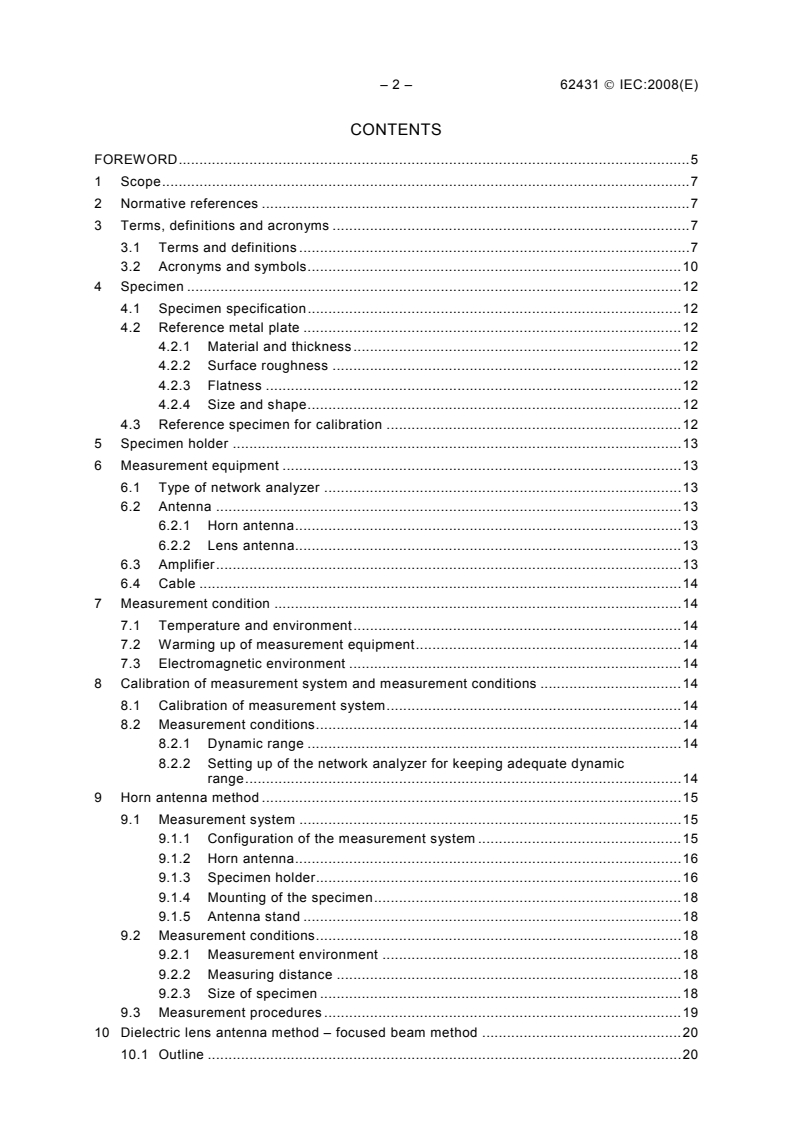
IEC 62431:2008 - Reflectivity of electromagnetic wave absorbers in millimetre wave frequency - Measurement methods Released:7/9/2008
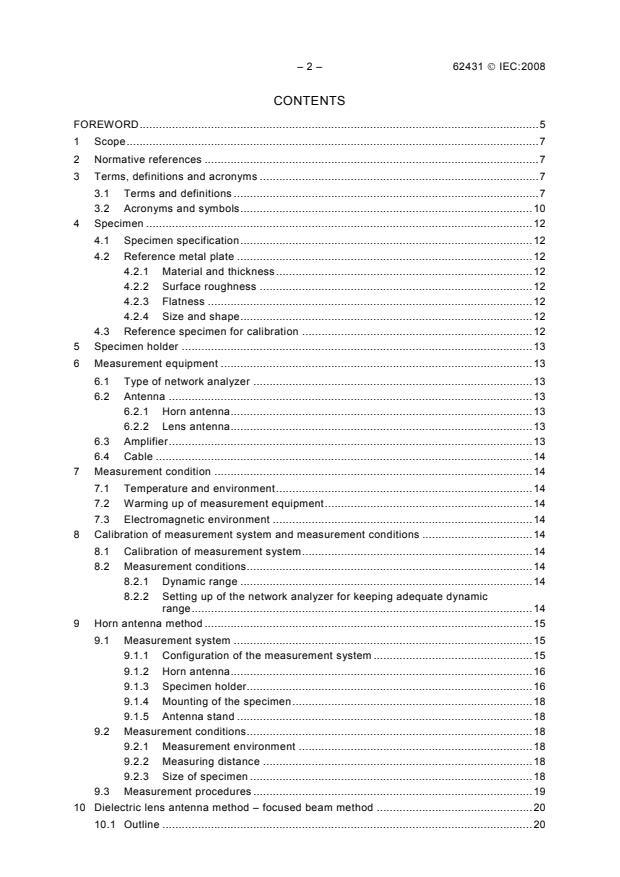
IEC 62431:2008 - Reflectivity of electromagnetic wave absorbers in millimetre wave frequency - Measurement methods Released:7/9/2008
Overview
IEC 62431:2008 - Reflectivity of electromagnetic wave absorbers in millimetre wave frequency - Measurement methods - defines standardized measurement procedures for determining the reflectivity of electromagnetic wave absorbers (EMA) in the millimetre‑wave (mmWave) band. The standard covers normal and oblique incidence and measurements for each polarization. It applies across the 30 GHz to 300 GHz frequency range, for reflectivity values from 0 dB to −50 dB, and for incident angles between 0° and 80°. IEC 62431:2008 replaces IEC/PAS 62431 and the bilingual 2011 publication corresponds to the 2008 English edition.
Key Topics and Requirements
- Measurement scope: Normal incidence, oblique incidence and both polarizations in the mmWave range.
- Frequency & range: 30–300 GHz; reflectivity measurement range 0 dB to −50 dB; incident angles 0°–80°.
- Specimen preparation: Requirements for specimen size, reference metal plate, surface roughness, flatness and mounting/holder methods.
- Measurement methods:
- Horn antenna method (typical far‑field configuration).
- Dielectric lens antenna methods: focused‑beam and parallel‑beam approaches.
- Instrumentation & calibration:
- Use of Vector Network Analyzers (VNA) and directional couplers.
- Calibration procedures (response calibration, isolation calibration, TRL concepts referenced).
- Dynamic range considerations and methods to enlarge dynamic range and reduce spurious reflections.
- Environmental and procedural controls: Temperature, electromagnetic environment, equipment warm‑up, measurement distances (Fraunhofer region) and test report content.
- Performance and error analysis: Guidance on dynamic range, measurement errors and reference specimen behavior.
Applications
IEC 62431 is used to ensure reliable, repeatable reflectivity data for materials and absorber products in applications such as:
- mmWave radar and sensor development (automotive and industrial radar)
- 5G/FR2 mmWave component and chamber design
- Anechoic chamber absorbers and EMC testing facilities
- Aerospace, defense and satellite payload design where mmWave scattering control is critical
- Material R&D for low‑reflectivity coatings and absorber panels
Who should use this standard
- EMC and antenna test engineers
- Absorber and materials manufacturers
- Test laboratories and certification bodies
- Radar, telecom and automotive mmWave system designers
- Research institutions working on mmWave propagation and material characterization
Related standards
Refer to other IEC/ISO standards and measurement guides covering EMC, antenna measurements, VNA calibration and material test methods for complementary procedures and traceability.
Keywords: IEC 62431, reflectivity measurement, electromagnetic wave absorbers, millimetre wave, mmWave reflectivity, horn antenna, dielectric lens antenna, VNA calibration, absorber testing.
Relations
- Effective Date
- 05-Sep-2023
Buy Documents
IEC 62431:2008 - Reflectivity of electromagnetic wave absorbers in millimetre wave frequency - Measurement methods Released:7/9/2008
IEC 62431:2008 - Reflectivity of electromagnetic wave absorbers in millimetre wave frequency - Measurement methods Released:7/9/2008
Get Certified
Connect with accredited certification bodies for this standard

IMQ S.p.A. (Certification)
Italian electrical product certification.

SLG Prüf- und Zertifizierungs GmbH
German testing and certification body.

UL Solutions
Global safety science company with testing, inspection and certification.
Sponsored listings
Frequently Asked Questions
IEC 62431:2008 is a standard published by the International Electrotechnical Commission (IEC). Its full title is "Reflectivity of electromagnetic wave absorbers in millimetre wave frequency - Measurement methods". This standard covers: IEC 62431:2008 specifies the measurement methods for the reflectivity of electromagnetic wave absorbers (EMA) for the normal incident, oblique incident and each polarized wave in the millimetre-wave range. In addition, these methods are also equally effective for the reflectivity measurement of other materials: - measurement frequency range: 30 GHz to 300 GHz; - reflectivity: 0 dB to -50 dB; - incident angle: 0° to 80°. It replaces and cancels IEC/PAS 62431. This bilingual version published in 2011-11, corresponds to the English version published in 2008-07.
IEC 62431:2008 specifies the measurement methods for the reflectivity of electromagnetic wave absorbers (EMA) for the normal incident, oblique incident and each polarized wave in the millimetre-wave range. In addition, these methods are also equally effective for the reflectivity measurement of other materials: - measurement frequency range: 30 GHz to 300 GHz; - reflectivity: 0 dB to -50 dB; - incident angle: 0° to 80°. It replaces and cancels IEC/PAS 62431. This bilingual version published in 2011-11, corresponds to the English version published in 2008-07.
IEC 62431:2008 is classified under the following ICS (International Classification for Standards) categories: 17.120.01 - Measurement of fluid flow in general; 19.080 - Electrical and electronic testing; 29.120.10 - Conduits for electrical purposes. The ICS classification helps identify the subject area and facilitates finding related standards.
IEC 62431:2008 has the following relationships with other standards: It is inter standard links to IEC PAS 62431:2005. Understanding these relationships helps ensure you are using the most current and applicable version of the standard.
IEC 62431:2008 is available in PDF format for immediate download after purchase. The document can be added to your cart and obtained through the secure checkout process. Digital delivery ensures instant access to the complete standard document.
Standards Content (Sample)
IEC 62431
Edition 1.0 2008-07
INTERNATIONAL
STANDARD
Reflectivity of electromagnetic wave absorbers in millimetre wave frequency –
Measurement methods
All rights reserved. Unless otherwise specified, no part of this publication may be reproduced or utilized in any form
or by any means, electronic or mechanical, including photocopying and microfilm, without permission in writing from
either IEC or IEC's member National Committee in the country of the requester.
If you have any questions about IEC copyright or have an enquiry about obtaining additional rights to this publication,
please contact the address below or your local IEC member National Committee for further information.
IEC Central Office
3, rue de Varembé
CH-1211 Geneva 20
Switzerland
Email: inmail@iec.ch
Web: www.iec.ch
About the IEC
The International Electrotechnical Commission (IEC) is the leading global organization that prepares and publishes
International Standards for all electrical, electronic and related technologies.
About IEC publications
The technical content of IEC publications is kept under constant review by the IEC. Please make sure that you have the
latest edition, a corrigenda or an amendment might have been published.
ƒ Catalogue of IEC publications: www.iec.ch/searchpub
The IEC on-line Catalogue enables you to search by a variety of criteria (reference number, text, technical committee,…).
It also gives information on projects, withdrawn and replaced publications.
ƒ IEC Just Published: www.iec.ch/online_news/justpub
Stay up to date on all new IEC publications. Just Published details twice a month all new publications released. Available
on-line and also by email.
ƒ Electropedia: www.electropedia.org
The world's leading online dictionary of electronic and electrical terms containing more than 20 000 terms and definitions
in English and French, with equivalent terms in additional languages. Also known as the International Electrotechnical
Vocabulary online.
ƒ Customer Service Centre: www.iec.ch/webstore/custserv
If you wish to give us your feedback on this publication or need further assistance, please visit the Customer Service
Centre FAQ or contact us:
Email: csc@iec.ch
Tel.: +41 22 919 02 11
Fax: +41 22 919 03 00
IEC 62431
Edition 1.0 2008-07
INTERNATIONAL
STANDARD
Reflectivity of electromagnetic wave absorbers in millimetre wave frequency –
Measurement methods
INTERNATIONAL
ELECTROTECHNICAL
COMMISSION
PRICE CODE
XA
ICS 19.080; 17.120; 29.120.10 ISBN 2-8318-9895-1
– 2 – 62431 © IEC:2008(E)
CONTENTS
FOREWORD.5
1 Scope.7
2 Normative references .7
3 Terms, definitions and acronyms .7
3.1 Terms and definitions .7
3.2 Acronyms and symbols.10
4 Specimen .12
4.1 Specimen specification.12
4.2 Reference metal plate .12
4.2.1 Material and thickness.12
4.2.2 Surface roughness .12
4.2.3 Flatness .12
4.2.4 Size and shape.12
4.3 Reference specimen for calibration .12
5 Specimen holder .13
6 Measurement equipment .13
6.1 Type of network analyzer .13
6.2 Antenna .13
6.2.1 Horn antenna.13
6.2.2 Lens antenna.13
6.3 Amplifier.13
6.4 Cable .14
7 Measurement condition .14
7.1 Temperature and environment.14
7.2 Warming up of measurement equipment.14
7.3 Electromagnetic environment .14
8 Calibration of measurement system and measurement conditions .14
8.1 Calibration of measurement system.14
8.2 Measurement conditions.14
8.2.1 Dynamic range .14
8.2.2 Setting up of the network analyzer for keeping adequate dynamic
range.14
9 Horn antenna method .15
9.1 Measurement system .15
9.1.1 Configuration of the measurement system .15
9.1.2 Horn antenna.16
9.1.3 Specimen holder.16
9.1.4 Mounting of the specimen.18
9.1.5 Antenna stand .18
9.2 Measurement conditions.18
9.2.1 Measurement environment .18
9.2.2 Measuring distance .18
9.2.3 Size of specimen .18
9.3 Measurement procedures .19
10 Dielectric lens antenna method – focused beam method .20
10.1 Outline .20
62431 © IEC:2008(E) – 3 –
10.2 Measurement system .20
10.2.1 Transmitting and receiving antennas .20
10.2.2 Focused beam horn antenna .21
10.2.3 Specimen size .22
10.2.4 Reference metal plate size .22
10.2.5 Specimen holder.22
10.2.6 Method of fixing the specimen and the reference metal plate.23
10.3 Measurement procedures .23
11 Dielectric lens antenna method – parallel beam method .25
11.1 Principle.25
11.1.1 Outline .25
11.1.2 Parallel EM wave beam formed using a EM wave lens.25
11.2 Measurement system .26
11.2.1 Composition of measurement system .26
11.2.2 Dielectric lens antenna .29
11.3 Specimen .29
11.3.1 General .29
11.3.2 Reference metal plate .29
11.3.3 Size of specimen .30
11.4 Measurement procedures .30
11.4.1 Normal incidence.30
11.4.2 Oblique Incidence.30
12 Test report.31
Annex A (informative) Reflection and scattering from metal plate – Horn antenna
method .33
Annex B (informative) Reflectivity of reference specimens using horn antenna method.38
Annex C (informative) Specifications of commercially available antennas .39
Annex D (normative) Calibration using VNA.42
Annex E (informative) Dynamic range and measurement errors .51
Annex F (informative) Enlargement of dynamic range – Calibration by isolation .53
Annex G (informative) Relative permittivity of styrofoam and foamed polyethylene
based on foam ratio .54
Annex H (informative) Calculation of Fraunhofer region – Horn antenna method.55
Figure 1 – Definition of reflectivity.10
Figure 2 – Configuration of the measurement system normal incidence (S ).15
Figure 3 – Configuration of the measurement system oblique incidence (S ) .16
Figure 4 – Mounting method of specimen.17
Figure 5 – The mechanism of adjusting azimuth and elevation.17
Figure 6 – Measurement system for normal incidence (side view) .20
Figure 7 – Measurement system for oblique incidence (top view).21
Figure 8 – Structure of a dielectric lens antenna .22
Figure 9 – Structure of specimen holder.23
Figure 10 – EM wave propagation using a horn antenna and a dielectric lens .26
Figure 11 – Block diagram of the measurement system .27
Figure 12 – A measurement system for normal incidence .28
– 4 – 62431 © IEC:2008(E)
Figure 13 – Measurement system for oblique incidence .28
Figure 14 – Position of a shielding plate .29
Figure 15 – Items to be mentioned in a test report .32
Figure A.1 – Reflection from the reference metal plate versus measurement distance
between the antenna and the metal plate.33
Figure A.2 – Reflectivity of reference metal plate versus size.34
Figure A.3 – Reflectivity of reference metal plate at 40 GHz .35
Figure A.4 – Reflectivity of reference metal plate with cross section of 200 mm ×
200 mm at 40 GHz.35
Figure A.5 – Analysis of reflection from a metal plate.37
Figure B.1 – Reflectivity of a 200 mm × 200 mm silica-glass plate in millimetre wave
frequency.38
Figure C.1 – Representative specifications of a horn antenna.39
Figure C.2 – Structure of cylindrical horn antenna with dielectric lens in Table C.2, A
used at 50 GHz - 75 GHz.
Figure C.3 – A structure of dielectric lens and horn antenna in Table C.2, D.41
Figure D.1 – Measurement configuration for the case of normal incidence with a
directional coupler connected directly to the horn antenna .42
Figure D.2 – Configuration for response calibration using a reference metal plate in the
case of normal incidence .43
Figure D.3 – Configuration for response calibration using a reference metal plate in the
case of oblique incidence.44
Figure D.4 – Configuration for response and isolation calibration in the case of normal
incidence .45
Figure D.5a – Response calibration Figure D.5b – Isolation calibration.45
Figure D.5 – Configuration for response and isolation calibration in the case of oblique
incidence .45
Figure D.6 – Configuration for S 1-port full calibration in the case of normal
incidence .
Figure D.7 – Precision antenna positioner configuration.48
Figure D.8 – TRL calibration procedure.49
Figure D.9 – Measurement and TRL calibration of transmission line .50
Figure E.1 – An example of receiving level of a reference metal plate and that without
a specimen .51
Figure E.2 – Dynamic range and measurement error of reflectivity.52
Figure F.1 – A method to remove spurious waves .53
Figure H.1 – Fraunhofer region and antenna gain .55
Table 1 – Acronyms .11
Table 2 – Symbols .11
Table C.1 – Antenna gain 24 dB (example A).39
Table C.2 – Some specifications of antennas with dielectric lenses .40
Table G.1 – Relative permittivity and foam ratio of styrofoam.54
Table G.2 – Relative permittivity and foam ratio of foamed polyethylene.54
62431 © IEC:2008(E) – 5 –
INTERNATIONAL ELECTROTECHNICAL COMMISSION
____________
REFLECTIVITY OF ELECTROMAGNETIC
WAVE ABSORBERS IN MILLIMETRE WAVE FREQUENCY –
MEASUREMENT METHODS
FOREWORD
1) The International Electrotechnical Commission (IEC) is a worldwide organization for standardization comprising
all national electrotechnical committees (IEC National Committees). The object of IEC is to promote
international co-operation on all questions concerning standardization in the electrical and electronic fields. To
this end and in addition to other activities, IEC publishes International Standards, Technical Specifications,
Technical Reports, Publicly Available Specifications (PAS) and Guides (hereafter referred to as “IEC
Publication(s)”. Their preparation is entrusted to technical committees; any IEC National Committee interested
in the subject dealt with may participate in this preparatory work. International, governmental and non-
governmental organizations liaising with the IEC also participate in this preparation. IEC collaborates closely
with the International Organization for Standardization (ISO) in accordance with conditions determined by
agreement between the two organizations.
2) The formal decisions or agreements of IEC on technical matters express, as nearly as possible, an international
consensus of opinion on the relevant subjects since each technical committee has representation from all
interested National Committees.
3) IEC Publications have the form of recommendations for international use and are accepted by IEC National
Committees in that sense. While all reasonable efforts are made to ensure that the technical content IEC
Publications is accurate, IEC cannot be held responsible for the way in which they are used or for any
misinterpretation by any end user.
4) In order to promote international uniformity, IEC National Committees undertake to apply IEC Publications
transparently to the maximum extent possible in their national and regional publications. Any divergence
between any IEC Publication and the corresponding national or regional publication shall be clearly indicated in
the latter.
5) EC provides no marking procedure to indicate its approval and cannot be rendered responsible for any
equipment declared to be in conformity with an IEC Publication.
6) All users should ensure that they have the latest edition of this publication.
7) No liability shall attach to IEC or its directors, employees, servants or agents including individual experts and
members of its technical committees and IEC National Committees for any personal injury, property damages
or other damage of any nature whatsoever, whether direct or indirect, or for costs (including legal fees) and
expenses arising out of the publication, use of, or reliance upon, this IEC Publication or any other IEC
Publications.
8) Attention is drawn to the Normative references cited in this publication. Use of the referenced publications is
indispensable for the correct application of this publication.
9) Attention is drawn to the possibility that some of the elements of this IEC Publication may be the subject of
patent rights. IEC shall not be held responsible for identifying any or all such patent rights.
International Standard IEC 62431 has been prepared by subcommittee SC46F: RF and
microwave passive components, of IEC technical committee 46: Cables, wires, waveguides,
R.F. connectors, R.F. and microwave passive components and accessories.
IEC 62431 replaces and cancels IEC/PAS 62431 with corrections of obvious errors as noted
in 46F/29A/RVN.
The text of this standard is based on the following documents:
CDV Report on voting
46F/65/CDV 46F/72/RVC
Full information on the voting for the approval of this standard can be found in the report on
voting indicated in the above table.
This publication has been drafted in accordance with the ISO/IEC Directives, Part 2.
– 6 – 62431 © IEC:2008(E)
The committee has decided that the contents of this publication will remain unchanged until
the maintenance result date indicated on the IEC web site under “http://webstore.iec.ch” in the
data related to the specific publication. At this date, the publication will be
• reconfirmed,
• withdrawn,
• replaced by a revised edition, or
• amended.
A bilingual version of this publication may be issued at a later date.
62431 © IEC:2008(E) – 7 –
REFLECTIVITY OF ELECTROMAGNETIC
WAVE ABSORBERS IN MILLIMETRE WAVE FREQUENCY –
MEASUREMENT METHODS
1 Scope
This International Standard specifies the measurement methods for the reflectivity of
electromagnetic wave absorbers (EMA) for the normal incident, oblique incident and each
polarized wave in the millimetre-wave range. In addition, these methods are also equally
effective for the reflectivity measurement of other materials:
– measurement frequency range: 30 GHz to 300 GHz;
– reflectivity: 0 dB to –50 dB;
– incident angle: 0° to 80°.
NOTE This standard is applicable not only to those EMA which are widely used as counter-measures against
communication faults, radio interference etc. , but also to those used in an anechoic chamber in some cases. EMAs
may be any kind of material, and may have any arbitrary shape, configuration, or layered structure as pointed out
below.
Material: Conductive material, dielectric material, magnetic material.
Shape: planar-, pyramidal-, wedge-type, or other specific shapes.
Layer structure: single layer, multi layers, or graded-index material.
2 Normative references
The following referenced documents are indispensable for the application of this document.
For dated references, only the edition cited applies. For undated references, the latest edition
of the referenced document (including any amendments) applies.
ISO/IEC 17025, General requirements for the competence of testing and calibration
laboratories
3 Terms, definitions and acronyms
For the purposes of this document, the following terms and definitions apply.
3.1 Terms and definitions
3.1.1
ambient level
the value of radiation power or noise which exists when no measurement is being carried out
at the experiment site
3.1.2
associated equipment
an apparatus or product connected for convenience or operation of the equipment
3.1.3
beam diameter
the diameter where the electric field strength decreases by 3 dB from the centre of the
focused beam
– 8 – 62431 © IEC:2008(E)
3.1.4
beam waist
the portion at which the diameter of the focused beam becomes minimum when the
electromagnetic waves radiated from a transmit antenna are converged using a dielectric lens
3.1.5
beam waist diameter
beam diameter at the beam waist
3.1.6
bistatic measurement
measurement where the incident and reflection angle are equal
3.1.7
dielectric lens
electromagnetic wave lens that is composed of dielectric material
Usually, it is used by mounting in front of a pyramidal or conical horn.
3.1.8
directional gain
ratio of the radiated power density in a particular direction to the average power density that
would be radiated in all directions
3.1.9
dynamic range
difference in decibels between the receiving level from the reference metal plate and the
receiving level measured when the metal plate is removed
3.1.10
electromagnetic wave absorber
material ingredient which absorbs the electromagnetic wave energy and dissipates it
thermally
3.1.11
focal distance
distance between the centre of the dielectric lens and the focal point
3.1.12
focal point
centre of the beam waist when the electromagnetic waves are converged using a dielectric
lens
3.1.13
focused beam
focused electromagnetic wave converged by the dielectric lens mounted in front of the horn
antenna
The focused beam diameter is a few times the wavelength or more at the beam waist, which
depends on the focal distance of the lens.
3.1.14
fraunhofer region
region where the angular radiation pattern of an aperture antenna is nearly independent of the
distance
62431 © IEC:2008(E) – 9 –
3.1.15
free-space method
measurement method that employs a single or pair of horn antennas where the specimen and
the antennas are put in free space
3.1.16
fresnel region
region where the angular radiation pattern of an aperture antenna depends on the distance
except for the region extremely near to the aperture
3.1.17
horn antenna
aperture antenna where impedance matching is taken gradually from the waveguide aperture
to free space
3.1.18
monostatic measurement
measurement where the incident and reflected waves follow the same direction and which lie
at an arbitrary angle with respect to normal to the specimen surface
3.1.19
normal incidence
the incidence for which an electromagnetic wave strikes to the specimen surface normally
The reflectivity in normal incidence is usually measured in the configuration where the
incident angle of a transmitting antenna and that of a receiving antenna are within 0° to 5°
with respect to the normal direction of the specimen surface.
3.1.20
oblique incidence
the incidence for which an electromagnetic wave strikes to the specimen surface at an oblique
angle
The reflectivity in oblique incidence is usually measured with a transmitting and receiving
antenna set up so that the incident and reflected angle of EM wave may be equal.
3.1.21
parallel beam
EM wave, which has a nearly flat phase front on the surface normal to the antenna axis, and
which is formed using a dielectric lens set-up in front of a horn antenna
3.1.22
reference metal plate
metal plate with the same shape and an equal surface projected area in normal to the
specimen
3.1.23
reflectivity
the ratio between reflected EM wave voltage received by the receiving antenna when a
specimen is irradiated by the EM wave, and the voltage of the EM wave reflected from a metal
plate with equal size and with the same projection shape in normal to the specimen surface
expressed in decibel by
V
S
reflectivity = 20log = 20log V − 20log V[dB] (1)
10 10 S 10 m
V
m
where V is the reflected EM wave voltage received by the receiving antenna when a
s
specimen is irradiated by the EM wave, and V is the voltage of the EM wave reflected from a
m
– 10 – 62431 © IEC:2008(E)
metal plate with equal size and with the same projection shape in normal to the specimen
surface. See Figure 1.
2 1
V V
m
s
3 4
IEC 1094/08
Key
1 Tx antenna
2 Rx antenna
3 EMA
4 Metal plate
Figure 1 – Definition of reflectivity
3.1.24
time domain function
a function that is implemented in VNA to transform the measured frequency domain data to
time evolution data using inverse Fourier transform because the VNA can measure both the
amplitude and phase of EM wave
Using this function, the reflected wave only from the specimen can be extracted by applying a
suitable time gating to the time evolution output signal and Fourier transform.
3.1.25
transverse electric wave
TE wave
EM wave in which the electric field is perpendicular to the plane of incidence when the EM
wave is incident to the specimen surface at an oblique angle
3.1.26
transverse electromagnetic wave
TEM wave
EM wave in which both the electric and magnetic fields are perpendicular to the direction of
incidence when an EM wave is incident normally to the specimen surface
3.1.27
transverse magnetic wave
TM wave
EM wave in which the magnetic field is perpendicular to the plane of incidence when the EM
wave is incident to the specimen surface at an oblique angle
3.2 Acronyms and symbols
The acronyms and symbols are shown in Table 1 and Table 2.
62431 © IEC:2008(E) – 11 –
Table 1 – Acronyms
Acronyms
CW Continuous wave
EMA Electromagnetic wave absorber
FFT Fast Fourier transformation
IF Intermediate frequency
NWA Network analyzer
PTFE Polytetrafruorethylene
SNA Scalar network analyzer
TE Transverse electric
TEM Transverse electromagnetic
TM Transverse magnetic
TRL Thru-reflect-line
VNA Vector network analyzer
VSWR Voltage standing wave ratio
Table 2 – Symbols
Symbol Meaning
A A half size of the aperture of an ideal absorber wall (a half side of metal plate with
squared shape (Annex A)
a Longer side size at aperture of pyramidal horn antenna
b Shorter side size at the aperture of a pyramidal horn antenna
c Length of pyramidal horn antenna
C(x) Fresnel integral
D Diameter of the aperture of a conical horn antenna
d Distance from mirror image of transmit antenna to the aperture of ideal absorber wall
d Distance from the aperture of an ideal absorber wall to receiving antenna
D Effective maximum dimension of the antenna aperture
m
E
Electric field strength at the position of an ideal absorber(Annex A)
E Receiving electric field strength in the case that an ideal absorber has a square-
r
shaped aperture with size 2a(Annex A)
E
Receiving electric field strength in the case that ideal absorber is not put(Annex A)
s0
G Directional gain of horn antenna
d
R Distance from the aperture of horn antenna to the specimen
R
Receiving level in the case that the test specimen is put on the specimen holder (dB)
a
R Receiving level in the case that the reference metal plate is put on the specimen
m
holder(dB)
S Reflection coefficient
S Transmission coefficient
S(x) Fresnel integral
V Receiving voltage in the case that the test specimen is put on the specimen holder
a
V Receiving voltage by direct wave from the transmitting and receiving antenna
d
V Receiving voltage by the reflected wave from the metal plate with the same cross
m
section and shape as the test specimen
V Receiving voltage by the reflected wave except for the test specimen
r
– 12 – 62431 © IEC:2008(E)
Table 2 (continued)
Symbol Meaning
V Receiving voltage by the reflected wave only from the test specimen
s
β Phase constant (=2π/λ)
Γ Receiving level in the case that the electromagnetic absorber is put on the specimen
a
holder (vector quantity)
Γ Receiving level in the case that the reference metal plate is put on the specimen
m
holder (vector quantity)
Γ Receiving level in the case that the test specimen is not put on the specimen holder
r
(vector quantity)
ε ’ Real part of relative permittivity
r
θ Incident angle of electromagnetic wave
λ
Wavelength of electromagnetic wave in free-space
4 Specimen
4.1 Specimen specification
It is recommended that the specimen have a flat surface and rigid structure having a
dimension equal to or larger than 10 λ , where λ is the wavelength of the EM wave at the
l l
lowest frequency in the measurement frequency range. However, detailed specifications are
given in each type of the three measurement methods described in Clauses 9, 10, and 11.
4.2 Reference metal plate
4.2.1 Material and thickness
Aluminium, copper, stainless steel or other metal, which has thickness of about 1 mm to 2 mm,
is preferred.
4.2.2 Surface roughness
The surface roughness of a reference metal plate should be less than λ /10, although less
m
than λ /20 is preferred, where λ is the wavelength that corresponds to maximum frequency
m m
in the measurement frequencies range. For example, if the maximum frequency is 300 GHz,
then λ is 1 mm, and the preferable roughness becomes 0,05 mm.
4.2.3 Flatness
It is recommended that the flatness be less than 0,5 mm for a reference metal plate with size
1 m × 1 m.
4.2.4 Size and shape
The reference metal plate should have the same size and same projection shape normal to
the specimen surface. However, it is desirable to use the size specified by each method in
Clauses 9, 10, and 11. Care should be taken in selecting the size of the reference metal plate
because the reflection and scattering characteristics may depend on its size due to the
Fresnel refraction. The dependence of the reflection and scattering characteristics on the size
in the case of the horn antenna method is illustrated in Annex A.
4.3 Reference specimen for calibration
The reference specimen for calibration should be silica-glass plate or sapphire single crystal
(001) plate with uniform thickness and smooth surface roughness. Relative permittivity should
62431 © IEC:2008(E) – 13 –
be known in advance. When dielectric material is selected, it is necessary to measure the
reflectivity of the specimen without putting anything on the backward surface of the reference
specimen. The reference specimen should be fixed by a material such as foamed plastics,
which has relative permittivity near to 1, and in which EM waves do not reflect like they do in
free space. It is recommended to verify the accuracy of the measurement system by
comparing the measured reflectivity with the theoretical one. The reflectivity of a silica-glass
plate measured in the millimetre wave range is given in Annex B.
5 Specimen holder
A specimen holder might be different by the any type of measurement method mentioned in
Clauses 9, 10, and 11. It should be recommended that the specimen holder possess functions
for adjusting azimuth and elevation.
6 Measurement equipment
The equipment must be calibrated according to the procedure established by the
manufacturers, or calibration laboratories accredited by ISO/IEC 17025. The items to be
calibrated include frequency, voltage, and attenuation, which depend on the measurement
accuracy or uncertainty of the measurement apparatuses. Correct usage of the measurement
equipment is very important in order to obtain the exact results. The measurement of the
reflectivity of EMA shall be performed using either a VNA or SNA. When there are
discrepancies in the measured results, it is necessary to make calibration of the measurement
system using a reference specimen. Various necessary apparatuses should be selected
according to the type of used measurement methods as shown below.
6.1 Type of network analyzer
The VNA is recommended because it can measure both the magnitude and phase of S and
S and it has a time domain function.
The SNA can measure only the magnitude of S and S .
11 21
6.2 Antenna
6.2.1 Horn antenna
Both a commercial as well as an in-built horn antenna can be used for the reflectivity
measurement of EMA except in special cases. However, the commercial horn antenna is
recommended in order to obtain the required measurement accuracy, which has an accurate
gain, VSWR, and size. The commercial coaxial-waveguide transducer is also recommended
where the VSWR or sizes are verified in each frequency band. The specifications of some
commercial horn antennas are shown in Annex C.
6.2.2 Lens antenna
Not only a dielectric lens antenna but also a metal plate lens antenna or Luneberg lens
antenna can also be used for the reflectivity measurement of EMA in this standard. Either a
commercially available or an in-built product can also be applicable. However, the use of a
commercial lens antenna, in which antenna gain, VSWR, and sizes are specified, will be
recommended in order to realize the required measurement accuracy. The specifications of
commercial horn antennas and dielectric lenses are illustrated in Annex C.
6.3 Amplifier
An amplifier is generally used in order to get a sufficient dynamic range for the measurement
system. The warming up of the amplifier is required and the temperature should be kept as
– 14 – 62431 © IEC:2008(E)
constant as possible because the total gain of the amplifier will vary due to the temperature
drift as it is described in Clause 7.
6.4 Cable
Degradation in transmission characteristics of cables must be checked in the measurement
frequency range when the cables are connected directly.
7 Measurement condition
7.1 Temperature and environment
The measurement should be carried out in the atmosphere from 860 hPa to 1 060 hPa, and in
the room from 5 °C to 35 °C, and relative humidity from 45 % to 85 %. If the operation
temperature and humidity range of the measurement apparatuses are narrower than the
above range, the specifications of the measurement apparatuses should be followed. It is
desirable to control the measurement temperature within ±3 °C in order to suppress the
influence of the temperature drift of measurement apparatuses to a minimum. The
measurement temperature or humidity of the specimen should be specified when the
reflectivity depends on temperature or humidity.
7.2 Warming up of measurement equipment
The warming-up time, typically from 15 min to 45 min, must be written in the specifications of
the measurement equipment or systems. Moreover, the warming up time should be taken to
be longest among all of the measurement equipment.
7.3 Electromagnetic environment
When the EM wave power density in the measurement environment exceeds that specified in
public regulations, and when the EM environment is judged to be negative, the measurement
should be carried out in an anechoic room. When the directional gain of an antenna is large,
however, an anechoic chamber may not necessarily be required.
8 Calibration of measurement system and measurement conditions
8.1 Calibration of measurement system
Calibration of the measurement system must be carried out according to the recommended
methods by NWA. Typical calibration methods are shown in Annex D. If the temperature at
which the measurement system is calibrated is within ±3 °C of the measurement temperature,
measurement errors can be minimized. However, if the measurement temperature is outside
of the range of ±3 °C, then it is recommended to carry out the calibration again.
8.2 Measurement conditions
8.2.1 Dynamic range
Both the receiving levels with and without the reference metal plate must be measured initially
when the measurement system is set up. Dynamic range is defined as the difference of these
measured values in decibels. Annex E illustrates the relation between the dynamic range and
the measurement error. If the dynamic range of the measurement system is 40 dB and
reflectivity of specimen is –20 dB, an error bar lies from –0,92 dB to +0,83 dB.
8.2.2 Setting up of the network analyzer for keeping adequate dynamic range
The dynamic range of the measurement system can be increased by modifying the IF band or
by utilizing the averaging function of NWA when the dynamic range does not exceed a
62431 © IEC:2008(E) – 15 –
necessary value. The dynamic range increases by use of the isolation calibration of the VNA
as shown in Annex F.
9 Horn antenna method
9.1 Measurement system
9.1.1 Configuration of the measurement system
Figure 2 and Figure 3 show a block diagram of the measurement system. The arrangement of
transmitting and receiving antennas, and the block diagram of the measurement system in the
horn antenna method are illustrated below for normal and oblique incidence measurement.
For measuring the transmission coefficient S , a pair of antennas is used, whereas only one
antenna is used for measuring the reflection coefficient S in normal incidence.
For the case of oblique incidence, transmitting antenna should be arranged in such a way that
the central axis makes the same angle to the normal direction of the specimen surface with
that of receiving antenna. Here, if S is measured using two horn antennas in normal
incidence, then the vertical alignment of transmitting and receiving antennas should be fixed
within 5°. The measurement equipment including a NWA is given in Clause 6.
プリン5 タ
IEC 1095/08
Key
1 Tx antenna
2 Rx antenna
3 VNA/SNA
4 Computer
5 Printer
6 Specimen holder
7 Specimen
Figure 2 – Configuration of the measurement system normal incidence (S )
– 16 – 62431 © IEC:2008(E)
θ
θ
IEC 1096/08
Key
1 Tx antenna
2 Rx antenna
Figure 3 – Configuration of the measurement system
oblique incidence (S )
9.1.2 Horn antenna
Both a commercial as well as an in-built horn antenna can be used for the reflectivity
measurement of EMA except in special cases. Before measuring the reflectivity, it is
necessary to calculate the directional gain of the horn antenna to determine the distance from
the antenna to the specimen. The directional gain, VSWR and sizes must be checked from the
catalogue when a commercial horn antenna is used.
9.1.3 Specimen holder
9.1.3.1 Material and shape
9.1.3.1.1 Material
The reflection of the EM wave from the specimen holder can be minimized by making use of
foamed polystyrene with a high foaming ratio as a specimen holder, because foamed plastics
have a very low relative permittivity (near 1). Annex G shows relative permittivity of foamed
polystyrene as a function of the foaming ratio.
9.1.3.1.2 Shape
The shape in normal projection to the specimen surface and the area of a specimen holder
which mounts a specimen should be equal to those of the specimen in order to suppress the
reflection of the EM wave from the specimen holder. The uncovered portion of the specimen
holder should be covered by a pyramidal-type wave absorber, and the shape of the uncovered
portion should have a wedge form as Illustrated in Figure 4.
62431 © IEC:2008(E) – 17 –
Side view
Top view
IEC 1097/08
Key
1 Pyramidal EMA
2 Specimen holder
3 Mounting point of specimen
4 Wedge form
Figure 4 – Mounting method of specimen
9.1.3.2 Azimuth and elevation angle adjustment function
Figure 5 shows elevation angle adjustment as well as the lifting and descending mechanism.
An azimuth table under the specimen holder, which has the mechanism adjusting the
elevation and the azimuth angle, should be installed in order to enable the accurate
installation of the specimen with respect to transmitting antenna. Accuracy of elevation
...
IEC 62431 ®
Edition 1.0 2008-07
INTERNATIONAL
STANDARD
NORME
INTERNATIONALE
colour
inside
Reflectivity of electromagnetic wave absorbers in millimetre wave frequency –
Measurement methods
Réflectivité des absorbeurs d’ondes électromagnétiques dans la plage des
fréquences des ondes millimétriques – Méthodes de mesure
All rights reserved. Unless otherwise specified, no part of this publication may be reproduced or utilized in any form or by
any means, electronic or mechanical, including photocopying and microfilm, without permission in writing from either IEC or
IEC's member National Committee in the country of the requester.
If you have any questions about IEC copyright or have an enquiry about obtaining additional rights to this publication,
please contact the address below or your local IEC member National Committee for further information.
Droits de reproduction réservés. Sauf indication contraire, aucune partie de cette publication ne peut être reproduite
ni utilisée sous quelque forme que ce soit et par aucun procédé, électronique ou mécanique, y compris la photocopie
et les microfilms, sans l'accord écrit de la CEI ou du Comité national de la CEI du pays du demandeur.
Si vous avez des questions sur le copyright de la CEI ou si vous désirez obtenir des droits supplémentaires sur cette
publication, utilisez les coordonnées ci-après ou contactez le Comité national de la CEI de votre pays de résidence.
IEC Central Office
3, rue de Varembé
CH-1211 Geneva 20
Switzerland
Email: inmail@iec.ch
Web: www.iec.ch
About the IEC
The International Electrotechnical Commission (IEC) is the leading global organization that prepares and publishes
International Standards for all electrical, electronic and related technologies.
About IEC publications
The technical content of IEC publications is kept under constant review by the IEC. Please make sure that you have the
latest edition, a corrigenda or an amendment might have been published.
Catalogue of IEC publications: www.iec.ch/searchpub
The IEC on-line Catalogue enables you to search by a variety of criteria (reference number, text, technical committee,…).
It also gives information on projects, withdrawn and replaced publications.
IEC Just Published: www.iec.ch/online_news/justpub
Stay up to date on all new IEC publications. Just Published details twice a month all new publications released. Available
on-line and also by email.
Electropedia: www.electropedia.org
The world's leading online dictionary of electronic and electrical terms containing more than 20 000 terms and definitions
in English and French, with equivalent terms in additional languages. Also known as the International Electrotechnical
Vocabulary online.
Customer Service Centre: www.iec.ch/webstore/custserv
If you wish to give us your feedback on this publication or need further assistance, please visit the Customer Service
Centre FAQ or contact us:
Email: csc@iec.ch
Tel.: +41 22 919 02 11
Fax: +41 22 919 03 00
A propos de la CEI
La Commission Electrotechnique Internationale (CEI) est la première organisation mondiale qui élabore et publie des
normes internationales pour tout ce qui a trait à l'électricité, à l'électronique et aux technologies apparentées.
A propos des publications CEI
Le contenu technique des publications de la CEI est constamment revu. Veuillez vous assurer que vous possédez
l’édition la plus récente, un corrigendum ou amendement peut avoir été publié.
Catalogue des publications de la CEI: www.iec.ch/searchpub/cur_fut-f.htm
Le Catalogue en-ligne de la CEI vous permet d’effectuer des recherches en utilisant différents critères (numéro de référence,
texte, comité d’études,…). Il donne aussi des informations sur les projets et les publications retirées ou remplacées.
Just Published CEI: www.iec.ch/online_news/justpub
Restez informé sur les nouvelles publications de la CEI. Just Published détaille deux fois par mois les nouvelles
publications parues. Disponible en-ligne et aussi par email.
Electropedia: www.electropedia.org
Le premier dictionnaire en ligne au monde de termes électroniques et électriques. Il contient plus de 20 000 termes et
définitions en anglais et en français, ainsi que les termes équivalents dans les langues additionnelles. Egalement appelé
Vocabulaire Electrotechnique International en ligne.
Service Clients: www.iec.ch/webstore/custserv/custserv_entry-f.htm
Si vous désirez nous donner des commentaires sur cette publication ou si vous avez des questions, visitez le FAQ du
Service clients ou contactez-nous:
Email: csc@iec.ch
Tél.: +41 22 919 02 11
Fax: +41 22 919 03 00
IEC 62431 ®
Edition 1.0 2008-07
INTERNATIONAL
STANDARD
NORME
INTERNATIONALE
colour
inside
Reflectivity of electromagnetic wave absorbers in millimetre wave frequency –
Measurement methods
Réflectivité des absorbeurs d’ondes électromagnétiques dans la plage des
fréquences des ondes millimétriques – Méthodes de mesure
INTERNATIONAL
ELECTROTECHNICAL
COMMISSION
COMMISSION
ELECTROTECHNIQUE
PRICE CODE
INTERNATIONALE
CODE PRIX XA
ICS 17.120; 19.080; 29.120.10 ISBN 978-2-88912-802-0
– 2 – 62431 IEC:2008
CONTENTS
FOREWORD . 5
1 Scope . 7
2 Normative references . 7
3 Terms, definitions and acronyms . 7
3.1 Terms and definitions . 7
3.2 Acronyms and symbols . 10
4 Specimen . 12
4.1 Specimen specification . 12
4.2 Reference metal plate . 12
4.2.1 Material and thickness . 12
4.2.2 Surface roughness . 12
4.2.3 Flatness . 12
4.2.4 Size and shape . 12
4.3 Reference specimen for calibration . 12
5 Specimen holder . 13
6 Measurement equipment . 13
6.1 Type of network analyzer . 13
6.2 Antenna . 13
6.2.1 Horn antenna . 13
6.2.2 Lens antenna . 13
6.3 Amplifier . 13
6.4 Cable . 14
7 Measurement condition . 14
7.1 Temperature and environment . 14
7.2 Warming up of measurement equipment . 14
7.3 Electromagnetic environment . 14
8 Calibration of measurement system and measurement conditions . 14
8.1 Calibration of measurement system . 14
8.2 Measurement conditions . 14
8.2.1 Dynamic range . 14
8.2.2 Setting up of the network analyzer for keeping adequate dynamic
range . 14
9 Horn antenna method . 15
9.1 Measurement system . 15
9.1.1 Configuration of the measurement system . 15
9.1.2 Horn antenna . 16
9.1.3 Specimen holder . 16
9.1.4 Mounting of the specimen . 18
9.1.5 Antenna stand . 18
9.2 Measurement conditions . 18
9.2.1 Measurement environment . 18
9.2.2 Measuring distance . 18
9.2.3 Size of specimen . 18
9.3 Measurement procedures . 19
10 Dielectric lens antenna method – focused beam method . 20
10.1 Outline . 20
62431 IEC:2008 – 3 –
10.2 Measurement system . 20
10.2.1 Transmitting and receiving antennas . 20
10.2.2 Focused beam horn antenna . 21
10.2.3 Specimen size . 22
10.2.4 Reference metal plate size . 22
10.2.5 Specimen holder . 22
10.2.6 Method of fixing the specimen and the reference metal plate . 23
10.3 Measurement procedures . 23
11 Dielectric lens antenna method – parallel beam method . 25
11.1 Principle . 25
11.1.1 Outline . 25
11.1.2 Parallel EM wave beam formed using a EM wave lens . 25
11.2 Measurement system . 26
11.2.1 Composition of measurement system . 26
11.2.2 Dielectric lens antenna . 29
11.3 Specimen . 29
11.3.1 General . 29
11.3.2 Reference metal plate . 29
11.3.3 Size of specimen . 30
11.4 Measurement procedures . 30
11.4.1 Normal incidence . 30
11.4.2 Oblique Incidence . 30
12 Test report. 31
Annex A (informative) Reflection and scattering from metal plate – Horn antenna
method . 33
Annex B (informative) Reflectivity of reference specimens using horn antenna method . 38
Annex C (informative) Specifications of commercially available antennas . 39
Annex D (normative) Calibration using VNA . 42
Annex E (informative) Dynamic range and measurement errors . 50
Annex F (informative) Enlargement of dynamic range – Calibration by isolation . 52
Annex G (informative) Relative permittivity of styrofoam and foamed polyethylene
based on foam ratio . 53
Annex H (informative) Calculation of Fraunhofer region – Horn antenna method . 54
Figure 1 – Definition of reflectivity . 10
Figure 2 – Configuration of the measurement system normal incidence (S ) . 15
Figure 3 – Configuration of the measurement system oblique incidence (S ) . 16
Figure 4 – Mounting method of specimen . 17
Figure 5 – The mechanism of adjusting azimuth and elevation . 17
Figure 6 – Measurement system for normal incidence (side view) . 20
Figure 7 – Measurement system for oblique incidence (top view) . 21
Figure 8 – Structure of a dielectric lens antenna . 22
Figure 9 – Structure of specimen holder. 23
Figure 10 – EM wave propagation using a horn antenna and a dielectric lens . 26
Figure 11 – Block diagram of the measurement system . 27
Figure 12 – A measurement system for normal incidence . 28
– 4 – 62431 IEC:2008
Figure 13 – Measurement system for oblique incidence . 28
Figure 14 – Position of a shielding plate . 29
Figure 15 – Items to be mentioned in a test report . 32
Figure A.1 – Reflection from the reference metal plate versus measurement distance
between the antenna and the metal plate . 33
Figure A.2 – Reflectivity of reference metal plate versus size. 34
Figure A.3 – Reflectivity of reference metal plate at 40 GHz . 35
Figure A.4 – Reflectivity of reference metal plate with cross section of 200 mm ×
200 mm at 40 GHz . 35
Figure A.5 – Analysis of reflection from a metal plate . 37
Figure B.1 – Reflectivity of a 200 mm × 200 mm silica-glass plate in millimetre wave
frequency . 38
Figure C.1 – Representative specifications of a horn antenna . 39
Figure C.2 – Structure of cylindrical horn antenna with dielectric lens in Table C.2, A
used at 50 GHz - 75 GHz . 40
Figure C.3 – A structure of dielectric lens and horn antenna in Table C.2, D . 41
Figure D.1 – Measurement configuration for the case of normal incidence with a
directional coupler connected directly to the horn antenna . 42
Figure D.2 – Configuration for response calibration using a reference metal plate in the
case of normal incidence . 43
Figure D.3 – Configuration for response calibration using a reference metal plate in the
case of oblique incidence . 44
Figure D.4 – Configuration for response and isolation calibration in the case of normal
incidence . 45
Figure D.5 – Configuration for response and isolation calibration in the case of oblique
incidence . 45
Figure D.6 – Configuration for S 1-port full calibration in the case of normal
incidence . 46
Figure D.7 – Precision antenna positioner configuration. 47
Figure D.8 – TRL calibration procedure. 48
Figure D.9 – Measurement and TRL calibration of transmission line . 49
Figure E.1 – An example of receiving level of a reference metal plate and that without
a specimen . 50
Figure E.2 – Dynamic range and measurement error of reflectivity . 51
Figure F.1 – A method to remove spurious waves . 52
Figure H.1 – Fraunhofer region and antenna gain . 54
Table 1 – Acronyms . 11
Table 2 – Symbols . 11
Table C.1 – Antenna gain 24 dB (example A) . 39
Table C.2 – Some specifications of antennas with dielectric lenses . 40
Table G.1 – Relative permittivity and foam ratio of styrofoam . 53
Table G.2 – Relative permittivity and foam ratio of foamed polyethylene . 53
62431 IEC:2008 – 5 –
INTERNATIONAL ELECTROTECHNICAL COMMISSION
____________
REFLECTIVITY OF ELECTROMAGNETIC
WAVE ABSORBERS IN MILLIMETRE WAVE FREQUENCY –
MEASUREMENT METHODS
FOREWORD
1) The International Electrotechnical Commission (IEC) is a worldwide organization for standardization comprising
all national electrotechnical committees (IEC National Committees). The object of IEC is to promote
international co-operation on all questions concerning standardization in the electrical and electronic fields. To
this end and in addition to other activities, IEC publishes International Standards, Technical Specifications,
Technical Reports, Publicly Available Specifications (PAS) and Guides (hereafter referred to as “IEC
Publication(s)”. Their preparation is entrusted to technical committees; any IEC National Committee interested
in the subject dealt with may participate in this preparatory work. International, governmental and non-
governmental organizations liaising with the IEC also participate in this preparation. IEC collaborates closely
with the International Organization for Standardization (ISO) in accordance with conditions determined by
agreement between the two organizations.
2) The formal decisions or agreements of IEC on technical matters express, as nearly as possible, an international
consensus of opinion on the relevant subjects since each technical committee has representation from all
interested National Committees.
3) IEC Publications have the form of recommendations for international use and are accepted by IEC National
Committees in that sense. While all reasonable efforts are made to ensure that the technical content IEC
Publications is accurate, IEC cannot be held responsible for the way in which they are used or for any
misinterpretation by any end user.
4) In order to promote international uniformity, IEC National Committees undertake to apply IEC Publications
transparently to the maximum extent possible in their national and regional publications. Any divergence
between any IEC Publication and the corresponding national or regional publication shall be clearly indicated in
the latter.
5) EC provides no marking procedure to indicate its approval and cannot be rendered responsible for any
equipment declared to be in conformity with an IEC Publication.
6) All users should ensure that they have the latest edition of this publication.
7) No liability shall attach to IEC or its directors, employees, servants or agents including individual experts and
members of its technical committees and IEC National Committees for any personal injury, property damages
or other damage of any nature whatsoever, whether direct or indirect, or for costs (including legal fees) and
expenses arising out of the publication, use of, or reliance upon, this IEC Publication or any other IEC
Publications.
8) Attention is drawn to the Normative references cited in this publication. Use of the referenced publications is
indispensable for the correct application of this publication.
9) Attention is drawn to the possibility that some of the elements of this IEC Publication may be the subject of
patent rights. IEC shall not be held responsible for identifying any or all such patent rights.
International Standard IEC 62431 has been prepared by subcommittee SC46F: RF and
microwave passive components, of IEC technical committee 46: Cables, wires, waveguides,
R.F. connectors, R.F. and microwave passive components and accessories.
IEC 62431 replaces and cancels IEC/PAS 62431 with corrections of obvious errors as noted
in 46F/29A/RVN.
This bilingual version published in 2011-11, corresponds to the English version published in
2008-07.
The text of this standard is based on the following documents:
CDV Report on voting
46F/65/CDV 46F/72/RVC
Full information on the voting for the approval of this standard can be found in the report on
voting indicated in the above table.
– 6 – 62431 IEC:2008
This publication has been drafted in accordance with the ISO/IEC Directives, Part 2.
The committee has decided that the contents of this publication will remain unchanged until
the maintenance result date indicated on the IEC web site under “http://webstore.iec.ch” in the
data related to the specific publication. At this date, the publication will be
• reconfirmed,
• withdrawn,
• replaced by a revised edition, or
• amended.
IMPORTANT – The 'colour inside' logo on the cover page of this publication indicates
that it contains colours which are considered to be useful for the correct
understanding of its contents. Users should therefore print this document using a
colour printer.
62431 IEC:2008 – 7 –
REFLECTIVITY OF ELECTROMAGNETIC
WAVE ABSORBERS IN MILLIMETRE WAVE FREQUENCY –
MEASUREMENT METHODS
1 Scope
This International Standard specifies the measurement methods for the reflectivity of
electromagnetic wave absorbers (EMA) for the normal incident, oblique incident and each
polarized wave in the millimetre-wave range. In addition, these methods are also equally
effective for the reflectivity measurement of other materials:
– measurement frequency range: 30 GHz to 300 GHz;
– reflectivity: 0 dB to –50 dB;
– incident angle: 0° to 80°.
NOTE This standard is applicable not only to those EMA which are widely used as counter-measures against
communication faults, radio interference etc. , but also to those used in an anechoic chamber in some cases. EMAs
may be any kind of material, and may have any arbitrary shape, configuration, or layered structure as pointed out
below.
Material: Conductive material, dielectric material, magnetic material.
Shape: planar-, pyramidal-, wedge-type, or other specific shapes.
Layer structure: single layer, multi layers, or graded-index material.
2 Normative references
The following referenced documents are indispensable for the application of this document.
For dated references, only the edition cited applies. For undated references, the latest edition
of the referenced document (including any amendments) applies.
ISO/IEC 17025, General requirements for the competence of testing and calibration
laboratories
3 Terms, definitions and acronyms
For the purposes of this document, the following terms and definitions apply.
3.1 Terms and definitions
3.1.1
ambient level
the value of radiation power or noise which exists when no measurement is being carried out
at the experiment site
3.1.2
associated equipment
an apparatus or product connected for convenience or operation of the equipment
3.1.3
beam diameter
the diameter where the electric field strength decreases by 3 dB from the centre of the
focused beam
– 8 – 62431 IEC:2008
3.1.4
beam waist
the portion at which the diameter of the focused beam becomes minimum when the
electromagnetic waves radiated from a transmit antenna are converged using a dielectric lens
3.1.5
beam waist diameter
beam diameter at the beam waist
3.1.6
bistatic measurement
measurement where the incident and reflection angle are equal
3.1.7
dielectric lens
electromagnetic wave lens that is composed of dielectric material
Usually, it is used by mounting in front of a pyramidal or conical horn.
3.1.8
directional gain
ratio of the radiated power density in a particular direction to the average power density that
would be radiated in all directions
3.1.9
dynamic range
difference in decibels between the receiving level from the reference metal plate and the
receiving level measured when the metal plate is removed
3.1.10
electromagnetic wave absorber
material ingredient which absorbs the electromagnetic wave energy and dissipates it
thermally
3.1.11
focal distance
distance between the centre of the dielectric lens and the focal point
3.1.12
focal point
centre of the beam waist when the electromagnetic waves are converged using a dielectric
lens
3.1.13
focused beam
focused electromagnetic wave converged by the dielectric lens mounted in front of the horn
antenna
The focused beam diameter is a few times the wavelength or more at the beam waist, which
depends on the focal distance of the lens.
3.1.14
fraunhofer region
region where the angular radiation pattern of an aperture antenna is nearly independent of the
distance
62431 IEC:2008 – 9 –
3.1.15
free-space method
measurement method that employs a single or pair of horn antennas where the specimen and
the antennas are put in free space
3.1.16
fresnel region
region where the angular radiation pattern of an aperture antenna depends on the distance
except for the region extremely near to the aperture
3.1.17
horn antenna
aperture antenna where impedance matching is taken gradually from the waveguide aperture
to free space
3.1.18
monostatic measurement
measurement where the incident and reflected waves follow the same direction and which lie
at an arbitrary angle with respect to normal to the specimen surface
3.1.19
normal incidence
the incidence for which an electromagnetic wave strikes to the specimen surface normally
The reflectivity in normal incidence is usually measured in the configuration where the
incident angle of a transmitting antenna and that of a receiving antenna are within 0° to 5°
with respect to the normal direction of the specimen surface.
3.1.20
oblique incidence
the incidence for which an electromagnetic wave strikes to the specimen surface at an oblique
angle
The reflectivity in oblique incidence is usually measured with a transmitting and receiving
antenna set up so that the incident and reflected angle of EM wave may be equal.
3.1.21
parallel beam
EM wave, which has a nearly flat phase front on the surface normal to the antenna axis, and
which is formed using a dielectric lens set-up in front of a horn antenna
3.1.22
reference metal plate
metal plate with the same shape and an equal surface projected area in normal to the
specimen
3.1.23
reflectivity
the ratio between reflected EM wave voltage received by the receiving antenna when a
specimen is irradiated by the EM wave, and the voltage of the EM wave reflected from a metal
plate with equal size and with the same projection shape in normal to the specimen surface
expressed in decibel by
V
S
reflectivity = 20log = 20log V − 20log V [dB] (1)
10 10 S 10 m
V
m
where V is the reflected EM wave voltage received by the receiving antenna when a
s
specimen is irradiated by the EM wave, and V is the voltage of the EM wave reflected from a
m
– 10 – 62431 IEC:2008
metal plate with equal size and with the same projection shape in normal to the specimen
surface. See Figure 1.
2 2
V V
s m
3 4
IEC 1094/08
Key
1 Tx antenna
2 Rx antenna
3 EMA
4 Metal plate
Figure 1 – Definition of reflectivity
3.1.24
time domain function
a function that is implemented in VNA to transform the measured frequency domain data to
time evolution data using inverse Fourier transform because the VNA can measure both the
amplitude and phase of EM wave
Using this function, the reflected wave only from the specimen can be extracted by applying a
suitable time gating to the time evolution output signal and Fourier transform.
3.1.25
transverse electric wave
TE wave
EM wave in which the electric field is perpendicular to the plane of incidence when the EM
wave is incident to the specimen surface at an oblique angle
3.1.26
transverse electromagnetic wave
TEM wave
EM wave in which both the electric and magnetic fields are perpendicular to the direction of
incidence when an EM wave is incident normally to the specimen surface
3.1.27
transverse magnetic wave
TM wave
EM wave in which the magnetic field is perpendicular to the plane of incidence when the EM
wave is incident to the specimen surface at an oblique angle
3.2 Acronyms and symbols
The acronyms and symbols are shown in Table 1 and Table 2.
62431 IEC:2008 – 11 –
Table 1 – Acronyms
Acronyms
CW Continuous wave
EMA Electromagnetic wave absorber
FFT Fast Fourier transformation
IF Intermediate frequency
NWA Network analyzer
PTFE Polytetrafruorethylene
SNA Scalar network analyzer
TE Transverse electric
TEM Transverse electromagnetic
TM Transverse magnetic
TRL Thru-reflect-line
VNA Vector network analyzer
VSWR Voltage standing wave ratio
Table 2 – Symbols
Symbol Meaning
A A half size of the aperture of an ideal absorber wall (a half side of metal plate with
squared shape (Annex A)
a Longer side size at aperture of pyramidal horn antenna
b Shorter side size at the aperture of a pyramidal horn antenna
c Length of pyramidal horn antenna
C(x) Fresnel integral
D Diameter of the aperture of a conical horn antenna
d Distance from mirror image of transmit antenna to the aperture of ideal absorber wall
d Distance from the aperture of an ideal absorber wall to receiving antenna
D Effective maximum dimension of the antenna aperture
m
E
Electric field strength at the position of an ideal absorber(Annex A)
E Receiving electric field strength in the case that an ideal absorber has a square-
r
shaped aperture with size 2a(Annex A)
E
Receiving electric field strength in the case that ideal absorber is not put(Annex A)
s0
G Directional gain of horn antenna
d
R Distance from the aperture of horn antenna to the specimen
R
Receiving level in the case that the test specimen is put on the specimen holder (dB)
a
R Receiving level in the case that the reference metal plate is put on the specimen
m
holder(dB)
S Reflection coefficient
S Transmission coefficient
S(x) Fresnel integral
V Receiving voltage in the case that the test specimen is put on the specimen holder
a
V Receiving voltage by direct wave from the transmitting and receiving antenna
d
V Receiving voltage by the reflected wave from the metal plate with the same cross
m
section and shape as the test specimen
V Receiving voltage by the reflected wave except for the test specimen
r
– 12 – 62431 IEC:2008
Table 2 (continued)
Symbol Meaning
V Receiving voltage by the reflected wave only from the test specimen
s
β Phase constant (=2π/λ)
Γ
Receiving level in the case that the electromagnetic absorber is put on the specimen
a
holder (vector quantity)
Γ
Receiving level in the case that the reference metal plate is put on the specimen
m
holder (vector quantity)
Γ Receiving level in the case that the test specimen is not put on the specimen holder
r
(vector quantity)
ε ’ Real part of relative permittivity
r
θ Incident angle of electromagnetic wave
λ
Wavelength of electromagnetic wave in free-space
4 Specimen
4.1 Specimen specification
It is recommended that the specimen have a flat surface and rigid structure having a
dimension equal to or larger than 10 λ , where λ is the wavelength of the EM wave at the
l l
lowest frequency in the measurement frequency range. However, detailed specifications are
given in each type of the three measurement methods described in Clauses 9, 10, and 11.
4.2 Reference metal plate
4.2.1 Material and thickness
Aluminium, copper, stainless steel or other metal, which has thickness of about 1 mm to 2 mm,
is preferred.
4.2.2 Surface roughness
The surface roughness of a reference metal plate should be less than λ /10, although less
m
than λ /20 is preferred, where λ is the wavelength that corresponds to maximum frequency
m m
in the measurement frequencies range. For example, if the maximum frequency is 300 GHz,
then λ is 1 mm, and the preferable roughness becomes 0,05 mm.
4.2.3 Flatness
It is recommended that the flatness be less than 0,5 mm for a reference metal plate with size
1 m × 1 m.
4.2.4 Size and shape
The reference metal plate should have the same size and same projection shape normal to
the specimen surface. However, it is desirable to use the size specified by each method in
Clauses 9, 10, and 11. Care should be taken in selecting the size of the reference metal plate
because the reflection and scattering characteristics may depend on its size due to the
Fresnel refraction. The dependence of the reflection and scattering characteristics on the size
in the case of the horn antenna method is illustrated in Annex A.
4.3 Reference specimen for calibration
The reference specimen for calibration should be silica-glass plate or sapphire single crystal
(001) plate with uniform thickness and smooth surface roughness. Relative permittivity should
62431 IEC:2008 – 13 –
be known in advance. When dielectric material is selected, it is necessary to measure the
reflectivity of the specimen without putting anything on the backward surface of the reference
specimen. The reference specimen should be fixed by a material such as foamed plastics,
which has relative permittivity near to 1, and in which EM waves do not reflect like they do in
free space. It is recommended to verify the accuracy of the measurement system by
comparing the measured reflectivity with the theoretical one. The reflectivity of a silica-glass
plate measured in the millimetre wave range is given in Annex B.
5 Specimen holder
A specimen holder might be different by the any type of measurement method mentioned in
Clauses 9, 10, and 11. It should be recommended that the specimen holder possess functions
for adjusting azimuth and elevation.
6 Measurement equipment
The equipment must be calibrated according to the procedure established by the
manufacturers, or calibration laboratories accredited by ISO/IEC 17025. The items to be
calibrated include frequency, voltage, and attenuation, which depend on the measurement
accuracy or uncertainty of the measurement apparatuses. Correct usage of the measurement
equipment is very important in order to obtain the exact results. The measurement of the
reflectivity of EMA shall be performed using either a VNA or SNA. When there are
discrepancies in the measured results, it is necessary to make calibration of the measurement
system using a reference specimen. Various necessary apparatuses should be selected
according to the type of used measurement methods as shown below.
6.1 Type of network analyzer
The VNA is recommended because it can measure both the magnitude and phase of S and
S and it has a time domain function.
The SNA can measure only the magnitude of S and S .
11 21
6.2 Antenna
6.2.1 Horn antenna
Both a commercial as well as an in-built horn antenna can be used for the reflectivity
measurement of EMA except in special cases. However, the commercial horn antenna is
recommended in order to obtain the required measurement accuracy, which has an accurate
gain, VSWR, and size. The commercial coaxial-waveguide transducer is also recommended
where the VSWR or sizes are verified in each frequency band. The specifications of some
commercial horn antennas are shown in Annex C.
6.2.2 Lens antenna
Not only a dielectric lens antenna but also a metal plate lens antenna or Luneberg lens
antenna can also be used for the reflectivity measurement of EMA in this standard. Either a
commercially available or an in-built product can also be applicable. However, the use of a
commercial lens antenna, in which antenna gain, VSWR, and sizes are specified, will be
recommended in order to realize the required measurement accuracy. The specifications of
commercial horn antennas and dielectric lenses are illustrated in Annex C.
6.3 Amplifier
An amplifier is generally used in order to get a sufficient dynamic range for the measurement
system. The warming up of the amplifier is required and the temperature should be kept as
– 14 – 62431 IEC:2008
constant as possible because the total gain of the amplifier will vary due to the temperature
drift as it is described in Clause 7.
6.4 Cable
Degradation in transmission characteristics of cables must be checked in the measurement
frequency range when the cables are connected directly.
7 Measurement condition
7.1 Temperature and environment
The measurement should be carried out in the atmosphere from 860 hPa to 1 060 hPa, and in
the room from 5 °C to 35 °C, and relative humidity from 45 % to 85 %. If the operation
temperature and humidity range of the measurement apparatuses are narrower than the
above range, the specifications of the measurement apparatuses should be followed. It is
desirable to control the measurement temperature within ±3 °C in order to suppress the
influence of the temperature drift of measurement apparatuses to a minimum. The
measurement temperature or humidity of the specimen should be specified when the
reflectivity depends on temperature or humidity.
7.2 Warming up of measurement equipment
The warming-up time, typically from 15 min to 45 min, must be written in the specifications of
the measurement equipment or systems. Moreover, the warming up time should be taken to
be longest among all of the measurement equipment.
7.3 Electromagnetic environment
When the EM wave power density in the measurement environment exceeds that specified in
public regulations, and when the EM environment is judged to be negative, the measurement
should be carried out in an anechoic room. When the directional gain of an antenna is large,
however, an anechoic chamber may not necessarily be required.
8 Calibration of measurement system and measurement conditions
8.1 Calibration of measurement system
Calibration of the measurement system must be carried out according to the recommended
methods by NWA. Typical calibration methods are shown in Annex D. If the temperature at
which the measurement system is calibrated is within ±3 °C of the measurement temperature,
measurement errors can be minimized. However, if the measurement temperature is outside
of the range of ±3 °C, then it is recommended to carry out the calibration again.
8.2 Measurement conditions
8.2.1 Dynamic range
Both the receiving levels with and without the reference metal plate must be measured initially
when the measurement system is set up. Dynamic range is defined as the difference of these
measured values in decibels. Annex E illustrates the relation between the dynamic range and
the measurement error. If the dynamic range of the measurement system is 40 dB and
reflectivity of specimen is –20 dB, an error bar lies from –0,92 dB to +0,83 dB.
8.2.2 Setting up of the network analyzer for keeping adequate dynamic range
The dynamic range of the measurement system can be increased by modifying the IF band or
by utilizing the averaging function of NWA when the dynamic range does not exceed a
62431 IEC:2008 – 15 –
necessary value. The dynamic range increases by use of the isolation calibration of the VNA
as shown in Annex F.
9 Horn antenna method
9.1 Measurement system
9.1.1 Configuration of the measurement system
Figure 2 and Figure 3 show a block diagram of the measurement system. The arrangement of
transmitting and receiving antennas, and the block diagram of the measurement system in the
horn antenna method are illustrated below for normal and oblique incidence measurement.
...