


IEC PAS 62587:2008
(Main)Method for measuring performance of portable household electric room air cleaners
General Information
- Abstract
IEC/PAS 62587:2008(E) establishes a system of uniform, repeatable procedures and standard methods for measuring specified product characteristics of portable household electric room air cleaners.
- Status
- Replaced
- Publication Date
- 07-Sep-2008
- Technical Committee
- TC 59 - Performance of household and similar electrical appliances
- Current Stage
- DELPUB - Deleted Publication
- Start Date
- 09-Apr-2020
- Completion Date
- 28-Aug-2026
Relations
- Effective Date
- 05-Sep-2023
Get Certified
Connect with accredited certification bodies for this standard

IMQ S.p.A. (Certification)
Italian electrical product certification.

SLG Prüf- und Zertifizierungs GmbH
German testing and certification body.

UL Solutions
Global safety science company with testing, inspection and certification.
Sponsored listings
Frequently Asked Questions
IEC PAS 62587:2008 is a technical specification published by the International Electrotechnical Commission (IEC). Its full title is "Method for measuring performance of portable household electric room air cleaners". This standard covers: IEC/PAS 62587:2008(E) establishes a system of uniform, repeatable procedures and standard methods for measuring specified product characteristics of portable household electric room air cleaners.
IEC/PAS 62587:2008(E) establishes a system of uniform, repeatable procedures and standard methods for measuring specified product characteristics of portable household electric room air cleaners.
IEC PAS 62587:2008 is classified under the following ICS (International Classification for Standards) categories: 13.040.20 - Ambient atmospheres; 29.080.01 - Electrical insulation in general; 29.160.01 - Rotating machinery in general. The ICS classification helps identify the subject area and facilitates finding related standards.
IEC PAS 62587:2008 has the following relationships with other standards: It is inter standard links to IEC 63086-1:2020. Understanding these relationships helps ensure you are using the most current and applicable version of the standard.
IEC PAS 62587:2008 is available in PDF format for immediate download after purchase. The document can be added to your cart and obtained through the secure checkout process. Digital delivery ensures instant access to the complete standard document.
Standards Content (Sample)
IEC/PAS 62587
Edition 1.0 2008-09
PUBLICLY AVAILABLE
SPECIFICATION
PRE-STANDARD
Method for measuring performance of portable household electric room air
cleaners
IEC/PAS 62587:2008(E)
All rights reserved. Unless otherwise specified, no part of this publication may be reproduced or utilized in any form
or by any means, electronic or mechanical, including photocopying and microfilm, without permission in writing from
either IEC or IEC's member National Committee in the country of the requester.
If you have any questions about IEC copyright or have an enquiry about obtaining additional rights to this publication,
please contact the address below or your local IEC member National Committee for further information.
IEC Central Office
3, rue de Varembé
CH-1211 Geneva 20
Switzerland
Email: inmail@iec.ch
Web: www.iec.ch
About the IEC
The International Electrotechnical Commission (IEC) is the leading global organization that prepares and publishes
International Standards for all electrical, electronic and related technologies.
About IEC publications
The technical content of IEC publications is kept under constant review by the IEC. Please make sure that you have the
latest edition, a corrigenda or an amendment might have been published.
ƒ Catalogue of IEC publications: www.iec.ch/searchpub
The IEC on-line Catalogue enables you to search by a variety of criteria (reference number, text, technical committee,…).
It also gives information on projects, withdrawn and replaced publications.
ƒ IEC Just Published: www.iec.ch/online_news/justpub
Stay up to date on all new IEC publications. Just Published details twice a month all new publications released. Available
on-line and also by email.
ƒ Electropedia: www.electropedia.org
The world's leading online dictionary of electronic and electrical terms containing more than 20 000 terms and definitions
in English and French, with equivalent terms in additional languages. Also known as the International Electrotechnical
Vocabulary online.
ƒ Customer Service Centre: www.iec.ch/webstore/custserv
If you wish to give us your feedback on this publication or need further assistance, please visit the Customer Service
Centre FAQ or contact us:
Email: csc@iec.ch
Tel.: +41 22 919 02 11
Fax: +41 22 919 03 00
IEC/PAS 62587
Edition 1.0 2008-09
PUBLICLY AVAILABLE
SPECIFICATION
PRE-STANDARD
Method for measuring performance of portable household electric room air
cleaners
INTERNATIONAL
ELECTROTECHNICAL
COMMISSION
PRICE CODE
X
ICS 13.040.20 ISBN 2-8318-9932-X
– 2 – PAS 62587 © IEC:2008(E)
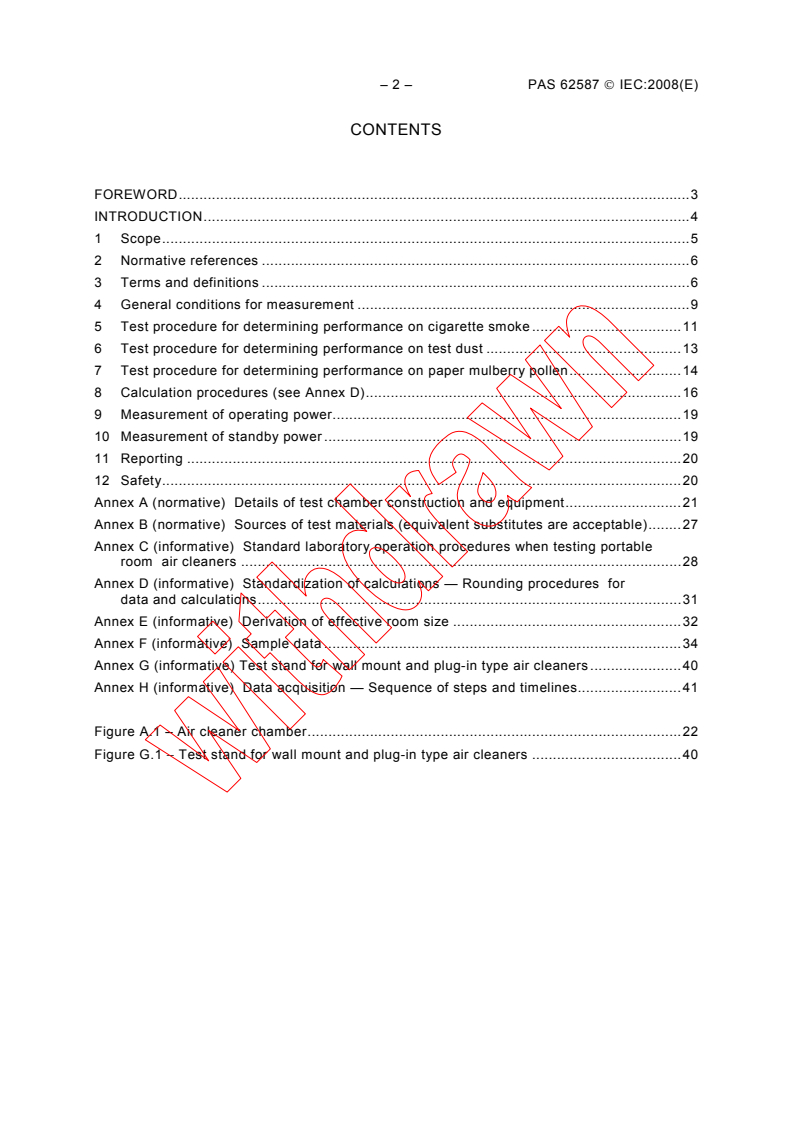
CONTENTS
FOREWORD.3
INTRODUCTION.4
1 Scope.5
2 Normative references .6
3 Terms and definitions .6
4 General conditions for measurement .9
5 Test procedure for determining performance on cigarette smoke .11
6 Test procedure for determining performance on test dust .13
7 Test procedure for determining performance on paper mulberry pollen.14
8 Calculation procedures (see Annex D).16
9 Measurement of operating power.19
10 Measurement of standby power .19
11 Reporting .20
12 Safety.20
Annex A (normative) Details of test chamber construction and equipment.21
Annex B (normative) Sources of test materials (equivalent substitutes are acceptable).27
Annex C (informative) Standard laboratory operation procedures when testing portable
room air cleaners .28
Annex D (informative) Standardization of calculations — Rounding procedures for
data and calculations.31
Annex E (informative) Derivation of effective room size .32
Annex F (informative) Sample data .34
Annex G (informative) Test stand for wall mount and plug-in type air cleaners.40
Annex H (informative) Data acquisition — Sequence of steps and timelines.41
Figure A.1 – Air cleaner chamber.22
Figure G.1 − Test stand for wall mount and plug-in type air cleaners .40
PAS 62587 © IEC:2008(E) – 3 –
INTERNATIONAL ELECTROTECHNICAL COMMISSION
____________
METHOD FOR MEASURING PERFORMANCE OF PORTABLE
HOUSEHOLD ELECTRIC ROOM AIR CLEANERS
FOREWORD
1) The International Electrotechnical Commission (IEC) is a worldwide organization for standardization comprising
all national electrotechnical committees (IEC National Committees). The object of IEC is to promote
international co-operation on all questions concerning standardization in the electrical and electronic fields. To
this end and in addition to other activities, IEC publishes International Standards, Technical Specifications,
Technical Reports, Publicly Available Specifications (PAS) and Guides (hereafter referred to as “IEC
Publication(s)”). Their preparation is entrusted to technical committees; any IEC National Committee interested
in the subject dealt with may participate in this preparatory work. International, governmental and non-
governmental organizations liaising with the IEC also participate in this preparation. IEC collaborates closely
with the International Organization for Standardization (ISO) in accordance with conditions determined by
agreement between the two organizations.
2) The formal decisions or agreements of IEC on technical matters express, as nearly as possible, an international
consensus of opinion on the relevant subjects since each technical committee has representation from all
interested IEC National Committees.
3) IEC Publications have the form of recommendations for international use and are accepted by IEC National
Committees in that sense. While all reasonable efforts are made to ensure that the technical content of IEC
Publications is accurate, IEC cannot be held responsible for the way in which they are used or for any
misinterpretation by any end user.
4) In order to promote international uniformity, IEC National Committees undertake to apply IEC Publications
transparently to the maximum extent possible in their national and regional publications. Any divergence
between any IEC Publication and the corresponding national or regional publication shall be clearly indicated in
the latter.
5) IEC provides no marking procedure to indicate its approval and cannot be rendered responsible for any
equipment declared to be in conformity with an IEC Publication.
6) All users should ensure that they have the latest edition of this publication.
7) No liability shall attach to IEC or its directors, employees, servants or agents including individual experts and
members of its technical committees and IEC National Committees for any personal injury, property damage or
other damage of any nature whatsoever, whether direct or indirect, or for costs (including legal fees) and
expenses arising out of the publication, use of, or reliance upon, this IEC Publication or any other IEC
Publications.
8) Attention is drawn to the Normative references cited in this publication. Use of the referenced publications is
indispensable for the correct application of this publication.
9) Attention is drawn to the possibility that some of the elements of this IEC Publication may be the subject of
patent rights. IEC shall not be held responsible for identifying any or all such patent rights.
A PAS is a technical specification not fulfilling the requirements for a standard, but made
available to the public.
IEC-PAS 62587 has been prepared by the Association of Home Appliance Manufacturers
(AHAM) and processed by IEC technical committee 59: Performance of household and similar
electrical appliances. It is based on ANSI/AHAM AC-1-2006
The text of this PAS is based on the This PAS was approved for
following document: publication by the P-members of the
committee concerned as indicated in
the following document
Draft PAS Report on voting
59/499/PAS 59/506/RVD
Following publication of this PAS, which is a pre-standard publication, the technical committee
or subcommittee concerned will transform it into an International Standard.
This PAS shall remain valid for an initial maximum period of 3 years starting from the
publication date. The validity may be extended for a single 3-year period, following which it
shall be revised to become another type of normative document, or shall be withdrawn.
– 4 – PAS 62587 © IEC:2008(E)
INTRODUCTION
This Publicly Available Specification (PAS) contains test procedures for measuring the
relative reduction by the air cleaner of particulate matter suspended in the air in a specified
test chamber. It also prescribes a method for measuring the operating power and standby
power of the air cleaner. The test procedures may be applied to any brand or model of
portable household electric room air cleaners within the stated confines of the standard's
limits of measurability for measuring performance
The annexes to this PAS are included for informative purposes only unless the annexes are
noted as normative.
This PAS may involve hazardous materials, operations, and equipment. This PAS does not
purport to address all of the safety problems associated with its use. It is the responsibility of
whoever uses this PAS to consult and establish appropriate safety and health practices and
determine the applicability of any regulatory limitations prior to use.
PAS 62587 © IEC:2008(E) – 5 –
METHOD FOR MEASURING PERFORMANCE OF PORTABLE
HOUSEHOLD ELECTRIC ROOM AIR CLEANERS
1 Scope and object
This Publicly Available Specification establishes a system of uniform, repeatable procedures
and standard methods for measuring specified product characteristics of portable household
electric room air cleaners.
The standard methods provide a means to compare and evaluate different brands of portable
household electric room air cleaners regarding characteristics significant to product use.
The standard methods of measurement are not intended to inhibit improvement and
innovation in product testing, design or performance.
This standard method applies to portable household electric room air cleaners as defined in
Clause 3.
This standard method includes definitions and safety characteristics of portable household
electric room air cleaners of the types indicated.
This standard method measures the relative reduction by the air cleaner of particulate matter
suspended in the air in a specified test chamber. It also prescribes a method for measuring
the operating power and standby power of the air cleaner.
This standard method has defined limits of measurability based on the statistical accuracy of
the methods. Based on a 95 % confidence limit (2 standard deviations), a clean air delivery
rate (CADR) (see 3.5) cannot be distinguished between zero (0) and a CADR rating less than
those CADR limits shown below. Therefore, this PAS only applies to air cleaners with
minimum CADR ratings of:
Dust CADR = 10 cfm
Cigarette smoke CADR = 10 cfm
Pollen CADR = 25 cfm
The maximum CADR values are determined based on theoretical maximum limits. The
theoretical maximum limits are determined by the maximum number of initial available
particles, the acceptable minimum number of available particles, an average background
natural decay rate (from statistical study), the size of the chamber, and the available minimum
experiment time. CADR values greater than those listed will not have the necessary statistical
data required by this method. Therefore, the document only applies to air cleaners with
maximum CADR ratings of:
Dust CADR = 400 cfm
Cigarette smoke CADR = 450 cfm
Pollen CADR = 450 cfm
The precision of this document as based on a 0 CADR air cleaner expressed as 2 standard
deviation limits (95 %) are:
Dust CADR = ± 10 cfm
Cigarette Smoke CADR = ± 10 cfm
Pollen CADR = ± 25 cfm
– 6 – PAS 62587 © IEC:2008(E)
2 Normative references
The following referenced documents are indispensable for the application of this document.
For dated references, only the edition cited applies. For undated references, the latest edition
of the referenced document (including any amendments) applies.
ASTM E747, Standard Test Method for Determining Air Change in a Single Zone by Means of
a Tracer Gas Dilution
3 Terms and definitions
For the purposes of this document, the following terms and definitions apply.
3.1
aerosol spectrometer
device for measuring particle size distribution in room air (see Annex A)
3.2 Air circulating equipment
3.2.1
ceiling mixing fan
high volume ceiling fan used to mix the chamber during contaminant aerosol generation
3.2.2
recirculation fan
fan capable of producing between 300 cfm and 400 cfm and used for the purpose of
maintaining a homogeneous environment within the chamber (as specified in Annex A)
3.3
aerodynamic particle size
classification of particle sizes as spheres of unit density based on terminal settling velocities
3.4
cigarette smoke diluter
device for reducing the concentration of cigarette smoke by a known factor to a level suitable
for measurement
3.5
Clean Air Delivery Rate
CADR
measure of air cleaner performance by this test procedure.
NOTE Within the scope of this PAS, CADR is defined as the measure of the delivery of contaminant free air by a
portable household electric room air cleaner, expressed in cubic feet per minute (cfm). More technically, clean air
delivery rates are the rates of contaminant reduction in the test chamber when the unit is turned on, minus the rate
of natural decay when the unit is not running, times the volume of the test chamber as measured in cubic feet (see
8.5). CADRs are always the measurement of a unit’s performance as a complete system, and they have no linear
relationship to air movement per se or to the characteristics of any particular particle removal methodology.
3.6 Design characteristics
3.6.1
fan with filter
air cleaners which operate with an electrical source of power and which contain a motor and
fan for drawing air through a filter media
PAS 62587 © IEC:2008(E) – 7 –
3.6.2
fan and electrostatic plates
air cleaners which operate with a fan with electrostatic plate or wires to electrostatically
collect particulate matter; may include a filter(s)
3.6.3
fan filter with ion generator
air cleaners which incorporate an ion generator in addition to a fan and filter
3.6.4
ion generator
air cleaners which incorporate an ion generator only
3.6.5
other types
device which has the stated capability to reduce the concentration of particulate matter in a
room
NOTE Such devices do not have to contain a fan and can incorporate any of the particle removal methods noted
above.
3.7 Generators
3.7.1
aerosol generator
device which produces and disseminates liquid or solid particles that are suspended in air
3.7.2
cigarette smoke generator
aerosol generator which disseminates test cigarette smoke with particle sizes specified in
3.16.1 into the air.
3.7.3
dust generator
aerosol generator which disseminates test dust with particle sizes specified in 3.16.2 into the
air
3.7.4
pollen generator
aerosol generator which disseminates test pollen with particle sizes specified in 3.16.3 into
the air
3.8
High Efficiency Particulate Air filter
HEPA
air filter with greater than or equal to 99,97 % removal of dioctyl phthalate at 0,3 μm diameter
NOTE The fractional efficiency of such filters can be verified using Mil-Std-282 or IEST-RP-CC007.1.
3.9
natural decay
reduction of particulate matter due to the natural phenomena in the test chamber, principally
agglomeration, surface deposition (including sedimentation), and air exchange
3.10
particulate matter removal
reduction of particle number concentration in air due to the operation of the air cleaner
– 8 – PAS 62587 © IEC:2008(E)
3.11 Portable room air cleaners
3.11.1
portable household electric room air cleaner
electric appliance with the function of removing particulate matter from the air and which may
be moved from room to room
3.11.2
floor type room air cleaner
designed to stand alone on the floor of a room and are designated as stand-alone floor
models by the manufacturer
NOTE Appliances of this type are tested on the floor as close to the center of the chamber as possible.
3.11.3
table type room air cleaner
designed to set on a table or counter by the manufacturer
NOTE Appliances of this type are tested on the table stand at the center of the chamber.
3.11.4
wall type room air cleaner
designed either to attach to a wall and are designated as wall mountable by the manufacturer
or as a plug-in unit
NOTE A wall type unit includes the appropriate wall mounting brackets or specifically designated instructions to
mount the room air cleaner integrally to the wall (i.e. not a shelf). Appliances of this type are tested on the wall
mount stand placed at the center of the chamber (see Figure G.1).
3.11.5
combination type room air cleaner
designed to operate in one or more orientations/positions (floor, table, wall) as designed by
the manufacturer
NOTE A combination type room air cleaner may be tested at the center of the room on either the floor, table, or
wall mount stand, according to how it has been designated by the manufacturer (see 3.11.2, 3.11.3, 3.11.4).
3.11.6
ceiling type room air cleaner
designed to be mounted on the ceiling and are considered outside the scope of this method
as defined in Clause 3
NOTE Uniform testing practices and statistical examination of such appliances have not been conducted.
3.11.7
plug-in type room air cleaner
fixed location appliance directly connected to an electric receptacle (outlet) by means of direct
plug-in (no electric cord)
NOTE Appliances of this type are tested at the lower level electrical receptacle of the plug-in type test stand as
shown in Figure G.1.
3.12
particle number concentration
number of particles per cubic centimeter of room air
3.13
room size
maximum suggested room size for an air cleaner
PAS 62587 © IEC:2008(E) – 9 –
NOTE The room size is determined by mathematical modelling of steady state and is based on the CADR
requirement to remove 80 % of cigarette smoke particles between 0,1 micron and 1,0 microns on a continuously
steady-state basis. See 8.6 and Annex E.
3.14
terminal settling velocity
maximum velocity achieved by a particle under given conditions
3.15
test chamber
room size chamber for determining performance in removing particulate matter from the air
NOTE The specifications for the chamber are in Annex A.
3.16 Test particulate matter
3.16.1
cigarette smoke
produced by burning cigarette tobacco with air forced through the cigarette's filter having
particle sizes detected from 0,10 μm to 1,0 μm diameter
3.16.2
air cleaner fine fraction test dust (Arizona road dust)
commercially available test dust with particle sizes detected from 0,5 μm to 3,0 μm
3.16.3
pollen
particulate matter naturally occurring from plants; pollen used is paper mulberry pollen (non-
defatted) with a particle size range of 5 μm to 11 μm, including fragments
4 General conditions for measurement
4.1 Electrical supply
4.1.1 General
Standard frequencies and voltages for the CADR testing and operating power test are listed
under 4.1.2 and 4.1.3. Other frequencies and voltages may be used to produce CADR values.
The specific electrical supply conditions shall be concurrently reported with the applicable
CADR values.
NOTE Refer to Clause 9 for the measurement of operating power test.
4.1.2 Frequencies
Operate air cleaner at one of the following frequencies:
Europe 50 Hertz
North America 60 Hertz
Japan 50/60 Hertz
China 50 Hertz
Australia and New Zealand 50 Hertz
– 10 – PAS 62587 © IEC:2008(E)
4.1.3 Voltage
Operate air cleaner at one of the following voltages:
Europe 230V
North America 115V
Japan 100 V
China 220 V
Australia and New Zealand 230 V
NOTE See Clause 10 for the voltage requirements for the measurement of standby power test.
4.2 Test chamber ambient temperature
Chamber ambient temperature shall be 21 ºC ± 3 ºC (70 ºF ± 5 ºF) with a relative humidity
(RH) of 40 % ± 5 % for CADR and the measurement of operating power tests.
NOTE Refer to Clause 10 for the temperature for the measurement of standby power test.
4.3 Chamber air exchange rate
The chamber air exchange rate shall be less than 0,03 air changes per hour as determined by
ASTM E747 or an equivalent method.
4.4 Chamber particulate concentrations
4.4.1 Measurability
The acceptable range of particle concentrations for the initial test condition (time (t) =2
minutes for cigarette smoke; t = 0 minutes for dust and pollen) are:
3 3
Cigarette smoke 24 000 particles/cm to 35 000 particles/cm (diluter may be
required)
Sampling period (20 s at 0,06 L/min ± 5 %)
3 3
Dust 200 particles/cm to 400 particles/cm
Sampling period (20 s at 1 L/min ± 5 %)
3 3
Pollen 4 particles/cm to 9 particles/cm
Sampling period (20 s at 1 L/min ± 5 %)
NOTE Use of a particle counter with different flow rates than the ones specified above is acceptable as long as
the particle counter provides equivalent performance characteristics.
The lower limit of instrument measurability is based on a minimum of 10 particle counts and is
defined by the practical counting limits of particle measuring instrumentation. These are:
Dust 0,03 particles/cm
Cigarette smoke 20 particles/cm
Pollen 0,03 particles/cm
4.4.2 Test chamber background level
This is the allowable level of particulate matter in the test chamber prior to the introduction of
the test material. This level is not to be greater than the lower limit of instrument
measurability.
PAS 62587 © IEC:2008(E) – 11 –
NOTE If the instrument's measurability lower limit cannot readily be achieved, further chamber cleaning
procedures should be performed.
4.5 Chamber equipment
The recirculation fan shall be operated throughout all tests in Clause 5, Clause 6, and
Clause 7. See Annex A for proper positioning of the recirculation fan.
4.6 Test equipment preparation
4.6.1 General
Check contaminant generating, measuring and recording instruments, and data processing
equipment for readiness as specified in the manufacturer's instructions (see Annex C).
4.6.2 Test unit set-up
Test unit is installed in accordance with the manufacturer's instructions, placing the unit (or
test fixture containing the unit) in the center of the room, positioned with its air discharge as
close as possible to the room center. For test units which discharge air in a specific direction,
the air discharge shall not be pointed toward the particle monitors. If manufacturer's
instructions do not specify (and unit is not a floor model), place the air cleaner on the table for
test. See 3.11 for positioning of specify types of room air cleaners in the chamber.
Room air cleaners with multi-level performance fan settings are typically adjusted to the
highest air cleaning mode setting for test. Other performance settings shall be concurrently
reported with the applicable CADR values (see Annex C).
5 Test procedure for determining performance on cigarette smoke
5.1 General
To determine the performance on cigarette smoke, perform the test procedures prescribed in
5.2 and 5.3 sequentially during the same day (see C.3.a)). An appropriate cigarette smoke
sample diluter (see Annex A) shall be used with the cigarette smoke monitor.
5.2 Natural decay measurement
a) Place the air cleaner to be tested in the chamber in accordance with 4.6.2 and set the air
cleaner controls to the conditions for test. Test for proper operation, then shut off with
switch external to test chamber.
b) Operate the ceiling mixing fan and create a log file for the run.
c) Using the chamber HEPA filter, allow the test chamber air to clean until the background
particulate matter for particles in the size range of 0,1 μm to 1,0 μm reaches a level of
less than 20 particles/cm . Simultaneously operate the environmental control devices
until the room conditions (temperature and RH) are as specified in 4.2.
d) Procedure
1) When an acceptable test chamber background level is achieved (as indicated in 5.2 c))
record the background concentration, turn off the chamber environmental control
system (humidifiers, HEPA filter, blowers, supply dampers and return dampers).
2) Immediately light, then place one standard cigarette in the cigarette smoke generator,
seal generator, open valve to chamber, and turn on 4-6 scfh air supply to the cigarette
generator to provide the required initial concentration (24 000 to 35 000 particles/cm
as noted in 4.4.1).
NOTE It should take approximately 45 s to reach the required initial concentration.
3) Turn off air supply and close chamber valve.
– 12 – PAS 62587 © IEC:2008(E)
4) Mix cigarette smoke for one minute after the initial concentration has been reached,
then turn off ceiling mixing fan. The recirculation fan will continue to operate for the
duration of the test.
e) Three minutes after turning off ceiling mixing fan, begin to acquire the cigarette smoke
particulate concentration. This test point is the initial chamber concentration (t = 0 min). If
the cigarette smoke concentration is not within the initial limits (refer to 4.4.1), terminate
the run.
f) Acquire particle concentration data at one-minute intervals for 20 min. A minimum of nine
data points having particle concentrations greater than the lower limit of instrument
measurability are required.
g) Record the average RH and temperature of the chamber during the test period. Values
outside the limits in 4.2 and 4.3 invalidate the run.
h) Calculate the decay constant for cigarette smoke as specified in 8.2.
i) Determine the acceptability of the run by calculating the standard deviation of the natural
decay in accordance with 8.3. A standard deviation of less than the 95 % confidence limit
-1
of 0,002 min or 10 %, whichever is greater, determines the acceptability of the run.
5.3 Cigarette smoke particulate matter removal measurement with air cleaner
operating (includes natural decay)
a) Operate the ceiling mixing fan and create a log file for the run.
b) Using the chamber HEPA filter, allow the test chamber air to clean until the
background particulate matter or particles in size range of 0,1 μm to 1,0 μm reaches a
level of less than 20 particles/cm and simultaneously operate the environmental
control devices until the room conditions (temperature and RH) are as specified in 4.2.
c) Procedure
i) When an acceptable test chamber background level is achieved (as indicated in
5.2 b), record the background concentration, turn off the chamber environmental
control system (humidifiers, HEPA filter, blowers, supply dampers and return
dampers).
ii) Immediately light, then place one standard cigarette in the cigarette smoke
generator, seal generator, open valve to chamber, and turn on 4 to 6 scfh (about 45
s) air supply to the cigarette generator to provide the required concentration (as
noted in 4.4.1).
iii) Turn off air supply and close chamber valve.
iv) Mix cigarette smoke for 1 min, then turn off ceiling mixing fan. The recirculation
fan will continue to operate for the duration of the test. Wait 1 min for fan to stop.
Turn on air cleaner. The time at which the air cleaner is turned on is defined as
time (t) = 0 min.
d) Two minutes after turning on the air cleaner, begin to acquire the cigarette smoke
particulate concentration. This test point is the initial chamber concentration. If the
cigarette smoke concentration is not within the initial limits (refer to 4.4.1), terminate
the run.
e) Acquire particle concentration data at 1 min intervals for 20 min, beginning at the
two minute point (t = 2 min). Use all acceptable data points. Refer to 8.1 for
elimination of data points to determine acceptability. A minimum of nine acceptable
data points are required.
NOTE The operating power test described in Clause 9 can be conducted during this particle concentration data
acquisition phase if desired.
f) Turn off the air cleaner. Record the average RH and temperature of the chamber
during the test period. Values outside the limits in 4.2 and 4.3 invalidate the run.
g) Calculate the decay constant for cigarette smoke as specified in 8.2.
h) Determine the acceptability of the run by calculating the standard deviation of the
particulate matter removal in accordance with 8.3. A standard deviation of less than
PAS 62587 © IEC:2008(E) – 13 –
-1
the 95 % confidence limit of 0,008 min or 10 %, whichever is greater, determines the
acceptability of the run.
i) Determine the CADR of the air cleaner in accordance with 8.4.
j) Determine the acceptability of the test by calculating an estimate of the standard
deviation for a single test CADR according to 8.5. A two standard deviation estimate of
less than CADR of 9 cfm or 10 %, whichever is greater, determine an acceptable test.
6 Test procedure for determining performance on test dust
6.1 General
To determine the performance on test dust, perform the test procedures prescribed in 6.2 and
6.3 sequentially during the same day (see C.3.b))
6.2 Natural decay measurement
a) Place the air cleaner to be tested in the chamber in accordance with 4.6.2 and set the
air cleaner controls to the conditions for test. Test for proper operation, then shut off
with switch external to test chamber.
b) Operate the ceiling mixing fan and create a log file for the run.
c) Using the chamber HEPA filter, allow the test chamber air to clean until the
background particulate matter for particles in the size range of 0,5 μm to 3,0 μm
reaches a level of less than 0,03 particle/cm . Simultaneously operate environmental
control devices until the room conditions (temperature and RH) are as specified in 4.2.
d) Procedure
1) When an acceptable test chamber background level is achieved (as indicated in
6.2 c) record the background concentration. Turn off the chamber environmental
control system (humidifiers, HEPA filter, blowers, supply dampers and return
dampers.)
2) Immediately turn on the air supply to the aerosol generator and then the aerosol
generator. Continue to generate test dust until the particle concentration in the
chamber reaches the required initial concentration (200 particles/cm to 400
particles/cm as noted in 4.4.1).
3) When the concentration is within initial test limits, turn off the aerosol generator
air supply and aerosol generator.
CAUTION A radioactive source is utilized by the dust generator for charge
neutralization.
4) Mix dust for 1 min after the initial concentration has been reached, then turn off
ceiling mixing fan. Wait one minute for the fan to stop. The recirculation fan will
continue to operate for the duration of the test.
e) Begin to acquire the particle concentration with the dust monitor. This test point is the
initial chamber concentration (t =0 min). If the test dust concentration is not within
initial limits, terminate the run.
f) Acquire particle concentration data at one-minute intervals for 20 min. A minimum of
nine data points having particle concentrations greater than the lower limit of
instrument measurability are required.
g) Record the average RH and temperature of the chamber during the test period.
h) Calculate the decay constant for test dust as specified in 8.2.
i) Determine the acceptability of the run by calculating the standard deviation of the
natural decay in accordance with 8.3. A standard deviation of less than the 95 %
-1
confidence limit of 0,001 min or 10 %, whichever is greater, determines the
acceptability of the run.
– 14 – PAS 62587 © IEC:2008(E)
6.3 Dust particulate matter removal measurement with air cleaner operating (includes
natural decay)
a) Operate the ceiling mixing fan and create a log file for the run.
b) Using the chamber HEPA filter, allow the test chamber air to clean until the
background particulate matter for particles is in the size range of 0,5 μm to 3,0 μm
reaches a level of less than 0,03 particle/cm. Simultaneously operate the
environmental control devices until the room conditions (temperature and RH) are as
specified in 4.2.
c) Procedure
5) When an acceptable test chamber background level is achieved (as indicated in
6.2 c), record the background concentration, turn off the chamber environmental
control system (humidifiers, HEPA filter, blowers, supply dampers and return
dampers).
6) Immediately turn on the air supply to the aerosol generator and then the aerosol
generator. Continue to generate test dust until the particle concentration in the
chamber reaches the required initial concentration (200 particles/cm to 400
particles/cm as noted in 4.4.1).
7) When the concentration is within initial test limits, turn off the aerosol generator air
supply and aerosol generator.
CAUTION A radioactive source is utilized by the dust generator for
neutralization.
8) Mix dust for one minute, then turn off ceiling mixing fan. Wait one minute for fan to
stop. Turn on air cleaner. This is t=0 min.
d) Begin to acquire the particle concentration with the dust monitor at t = 0 min. This test
point is the initial chamber concentration. If the test dust concentration is not within
the initial limits, terminate the run.
e) Acquire particle concentration data at one-minute intervals for 20 min, beginning at
t = 0 min. Use all acceptable data points. Refer to 8.1 to determine acceptability. A
minimum of nine acceptable data points are required.
NOTE The operating power test described in Clause 9 may be conducted during this particle
concentration data acquisition phase if desired.
f) Turn off the air cleaner. Record the average RH and temperature of the chamber
during the test period. Values outside the limits in 4.2 and 4.3 invalidate the run.
g) Calculate the decay constant for test dust as specified in 8.2.
h) Determine the acceptability of the run by calculating the standard deviation of the
particulate matter removal in accordance with 8.3. A standard deviation of less than
-1
or 10 %, whichever is greater, determines the
the 95 % confidence limit of 0,003 min
acceptability of the run.
i) Determine the CADR of the air cleaner in accordance with 8.4.
j) Determine the acceptability of the test by calculating an estimate of the standard
deviation for a single test CADR according to 8.5. A two standard deviation estimate of
less than a CADR of 10 cfm or 10 %, whichever is greater, determines an acceptable
test.
7 Test procedure for determining performance on paper mulberry pollen
7.1 General
To determine the performance on paper mulberry pollen, perform the test procedures
prescribed in 7.2 and 7.3 sequentially during the same day (see C.3.c)).
PAS 62587 © IEC:2008(E) – 15 –
7.2 Natural decay measurement
a) Place the air cleaner to be tested in the center of the chamber in accordance with
4.6.2 and set the air cleaner controls to the conditions for test. Test for proper
operation, then shut off and switch external to test chamber.
b) Operate the ceiling mixing fan and create a log file for the run.
c) Using the chamber HEPA filter, allow the test chamber air to clean until the
background particulate matter for particles in the size range of 5 μm to 11 μm reaches
a level of less than 0,03 particle/cm . Simultaneously operate the environmental
control devices until the room conditions (temperature and RH) are as specified in 4.2.
d) Procedure
1) When an acceptable test chamber background level is achieved (as indicated
in 7.2 c), record the background concentration, turn off the chamber
environmental control system (humidifiers, HEPA filter, blowers, supply
dampers and return dampers.)
2) Attach one of the pre-weighed paper mulberry pollen sample bottles to the
pollen generator (see C.3.c)).
3) Open the chamber valve to the pollen generator and turn on the pollen
generator air supply at 1,4 kg/cm (20 psig) for 10 s. Turn off the air supply
and close the chamber valve.
4) Mix pollen for one minute after the initial concentration has been reached, then
turn off ceiling mixing fan. Wait one minute for the fan to stop. The
recirculation fan will continue operation for the duration of the test.
e) Begin to acquire the particle concentration with the dust monitor. This test point is the
initial chamber concentration (t = 0 min). If the pollen concentration is not within the
3 3
initial limits (4 particles/cm to 9 particles/cm as noted in 4.4.1), terminate the run.
f) Acquire particle concentration data at one-minute intervals for 10 min. A minimum of
five points having particle concentrations greater than the lower limit of instrument
measurability are required.
NOTE The minimum of five points required for pollen is less than the minimum of nine points required for
tobacco smoke and dust due to pollen’s faster decay rate and due to the shorter data acquisition period
specified for pollen.
g) Record the average RH and temperature of the chamber during the test period.
h) Calculate the decay constant for pollen as specified in 8.2.
i) Determine the acceptability of the run by calculating the standard deviation of the
natural decay in accordance with 8.3. A standard deviation of less than the 95 %
-1
confidence limit of 0,009 min or 10 %, whichever is greater, determines the
acceptability of the run.
7.3 Pollen particulate matter removal measurement with air cleaner operating
(includes natural decay)
a) Operate the ceiling mixing fan and create a log file for the run.
b) Using the chamber HEPA filter allow the test chamber air to clean until the background
particulate matter for particles in the size range of 5 μm to 11 μm reaches a level of
less than 0,03 particle/cm . Simultaneously operate the environmental control devices
until the room conditions (temperature and RH) are as specified.
c) Procedure
1) When an acceptable test chamber background level is achieved (as indicated
in 7.3 b) record the background concentration, turn off the chamber
environmental control system (humidifiers, HEPA filter, blowers, supply
dampers and return dampers).
2) Attach one of the pre-weighed paper mulberry pollen sample bottles to the
pollen generator (see C.3.c)).
– 16 – PAS 62587 © IEC:2008(E)
3) Open the chamber valve to the pollen generator and turn on the pollen
generator air supply at 1,4 kg/cm (20 psig) for 10 s. Turn off the air supply
and close the chamber valve.
4) Mix pollen for 1 min, then turn off the ceiling mixing fan. Wait 1 min for fan to
stop. Turn on air cleaner. This is t = 0 min.
d) Begin to acquire the particle concentration with the dust monitor at t = 0 min. This test
point is the initial chamber concentration. If the test pollen concentration is not within
the initial limits, terminate the run.
e) Acquire particle concentration data at one-minute intervals for 10 min, beginning at
t = 0 min. Use all acceptable data points. Refer to 8.1 to determine acceptability. A
minimum of five acceptable data points are required.
NOTE The minimum of five points required for pollen is less than the minimum of nine points required for
tobacco smoke and dust due to pollen’s faster decay rate and due to the shorter data acquisition period
specified for pollen.
f) Turn off the air cleaner. Record the average RH and temperature of the chamber
during the test period. Values outside the limits in 4.2 and 4.3 invalidate the run.
g) Calculate the decay constant for pollen as specified in 8.2.
h) Determine the acceptability of the run by calculating the standard deviation of the
particulate matter removal in accordance with 8.3. A standard deviation of less than
-1
the 95 % confidence limit of 0,022 min or 10 %, whichever is greater, determine an
acceptable run.
i) Determine the CADR of the air cleaner in accordance with 8.4.
j) Determine the acceptability of the test by calculating the standard deviation for a
single test CADR according to 8.5. A two standard deviation estimate of less than
CADR = 23 cfm or 20 %, whichever is greater, determines an acceptable test.
8 Calculation procedures (see Annex D)
8.1 Criteria for elimination of data points from a run
There are four criteria for eliminating a data point from a run. The first is operator error. The
second is equipment error either in the sensing, recording, or reporting of information. The
third is the data point is not within the 95 % prediction limit of the regression line. The fourth
is decay below the minimum acceptable concentration limits of the instrument.
– Criterion 1. Any noted operator error results in the elimination of the data point whether or
not the data point (corresponding to the time the error is noted) is found within acceptable
or anticipated concentration ranges.
– Criterion 2. Any noted equipment error will result in the elimination of the data point
(corresponding to the time the error is noted) whether or not the data point is found within
acceptable or anticipated concentration ranges.
– Criterion 3. Any data points found to be outside the 95 % prediction limits of the
regression slope line will result in the elimination of the data point. The cause of the outlier
data may or may not be due to chamber instrumentation, air cleaner inconsistency, or
other chamber effects.
– Criterion 4. Any data point resulting in a reported concentration below the instrument
measurability limit will be eliminated along with all subsequent data points in the run.
Subsequ
...