

CEN/TR 17993:2023
(Main)Calibration and accuracy of non-catching precipitation measurement instruments
- Abstract
Non-catching type gauges are the emerging class of in situ precipitation measurement instruments. For these instruments, rigorous testing and calibration are more challenging than for traditional gauges. Hydrometeors’ characteristics like particle size, shape, fall velocity and density need to be reproduced in a controlled environment to provide the reference precipitation, instead of the equivalent water flow used for catching-type gauges. They are generally calibrated by the manufacturers using internal procedures developed for the specific technology employed. No agreed methodology exists, and the adopted procedures are rarely traceable to internationally recognized standards. This document describes calibration and accuracy issues of non-catching instruments used for liquid/solid atmospheric precipitation measurement. An overview of the existing models of non-catching type instruments is included, together with an overview and a description of their working principles and the adopted calibration procedures. The literature and technical manuals disclosed by manufacturers are summarized and discussed, while current limitations and metrological requirements are identified.
- Status
- Published
- Publication Date
- 17-Oct-2023
- Technical Committee
- CEN/TC 318 - Hydrometry
- Drafting Committee
- CEN/TC 318/WG 12 - Measurement of rainfall intensity
- Current Stage
- 6060 - Definitive text made available (DAV) - Publishing
- Start Date
- 18-Oct-2023
- Due Date
- 04-Oct-2023
- Completion Date
- 18-Oct-2023

Overview
CEN/TR 17993:2023 - "Calibration and accuracy of non-catching precipitation measurement instruments" is a CEN Technical Report that reviews calibration challenges, accuracy issues and metrological requirements for in‑situ, non‑catching precipitation gauges. Non‑catching instruments (optical, impact disdrometers, microwave/radar types) measure hydrometeors without collecting water; therefore calibration must reproduce particle characteristics (size, shape, fall velocity, density) rather than rely on an equivalent water flow used for catching gauges. The report summarizes existing models and working principles, surveys manufacturer procedures and literature, and identifies current limitations and needs for traceable calibration and uncertainty evaluation.
Key Topics
- Instrument types and working principles
- Optical gauges: transmission, scattering, imaging methods
- Impact disdrometers: mechanical and electro‑acoustic devices
- Microwave/radar disdrometers
- Hydrometeor characteristics required for calibration
- Particle size distribution (PSD), drop/particle shape, terminal fall velocity, density
- Calibration challenges
- Reproducing realistic hydrometeors in laboratory rainfall/ice particle simulators
- Lack of standardized, SI‑traceable procedures - many manufacturers use proprietary methods
- Difficulty establishing reproducible reference conditions for non‑catching measurements
- Influence and bias sources
- Wind effects, simultaneous particle crossings, drop shape variability
- Instrument‑specific biases for optical, impact and radar devices
- Metrological requirements
- Need for uncertainty budgets, traceability to SI, and standardized test methods
- Development and characterization of rainfall generators and calibration protocols
Applications and Users
Who benefits from CEN/TR 17993:2023:
- National Meteorological and Hydrological Services (NMHS) deploying automated networks and seeking reduced maintenance and higher temporal resolution
- Calibration laboratories and national metrology institutes developing SI‑traceable procedures for non‑catching gauges
- Instrument manufacturers aiming to align calibration methods with metrological best practice
- Hydrology, meteorology and climate researchers using disdrometer or non‑catching gauge outputs (drop size distributions, fall speeds)
- Operational network managers evaluating instrument performance, uncertainty and suitability for deployment
Practical uses:
- Designing laboratory calibration campaigns and rainfall/particle simulators
- Building uncertainty budgets and traceability chains for non‑catching precipitation data
- Informing procurement, network design and data quality control for precipitation monitoring
Related Standards and Projects
- EN 17277:2019 (calibration of catching‑type gauges) - referenced as the established approach for collectors
- UNI 11452:2012 (Italian experience for catching gauges)
- WMO Guides and SPICE (solid precipitation intercomparison) - provide context for field intercomparisons
- EURAMET/INCIPIT and MeteoMet projects - research efforts supporting metrological development for non‑catching gauges
Keywords: non‑catching precipitation measurement instruments, calibration, accuracy, particle size distribution, terminal fall velocity, optical gauges, impact disdrometers, microwave radar, traceability, uncertainty.
Relations
- Effective Date
- 28-Jan-2026
- Effective Date
- 28-Jan-2026
- Effective Date
- 28-Jan-2026
- Effective Date
- 28-Jan-2026
- Effective Date
- 28-Jan-2026
- Effective Date
- 28-Jan-2026
- Effective Date
- 28-Jan-2026
- Effective Date
- 28-Jan-2026
- Effective Date
- 28-Jan-2026
- Effective Date
- 28-Jan-2026
- Effective Date
- 28-Jan-2026
- Effective Date
- 28-Jan-2026
- Effective Date
- 28-Jan-2026
- Effective Date
- 28-Jan-2026
- Effective Date
- 28-Jan-2026
Get Certified
Connect with accredited certification bodies for this standard

BSMI (Bureau of Standards, Metrology and Inspection)
Taiwan's standards and inspection authority.
Sponsored listings
Frequently Asked Questions
CEN/TR 17993:2023 is a technical report published by the European Committee for Standardization (CEN). Its full title is "Calibration and accuracy of non-catching precipitation measurement instruments". This standard covers: Non-catching type gauges are the emerging class of in situ precipitation measurement instruments. For these instruments, rigorous testing and calibration are more challenging than for traditional gauges. Hydrometeors’ characteristics like particle size, shape, fall velocity and density need to be reproduced in a controlled environment to provide the reference precipitation, instead of the equivalent water flow used for catching-type gauges. They are generally calibrated by the manufacturers using internal procedures developed for the specific technology employed. No agreed methodology exists, and the adopted procedures are rarely traceable to internationally recognized standards. This document describes calibration and accuracy issues of non-catching instruments used for liquid/solid atmospheric precipitation measurement. An overview of the existing models of non-catching type instruments is included, together with an overview and a description of their working principles and the adopted calibration procedures. The literature and technical manuals disclosed by manufacturers are summarized and discussed, while current limitations and metrological requirements are identified.
Non-catching type gauges are the emerging class of in situ precipitation measurement instruments. For these instruments, rigorous testing and calibration are more challenging than for traditional gauges. Hydrometeors’ characteristics like particle size, shape, fall velocity and density need to be reproduced in a controlled environment to provide the reference precipitation, instead of the equivalent water flow used for catching-type gauges. They are generally calibrated by the manufacturers using internal procedures developed for the specific technology employed. No agreed methodology exists, and the adopted procedures are rarely traceable to internationally recognized standards. This document describes calibration and accuracy issues of non-catching instruments used for liquid/solid atmospheric precipitation measurement. An overview of the existing models of non-catching type instruments is included, together with an overview and a description of their working principles and the adopted calibration procedures. The literature and technical manuals disclosed by manufacturers are summarized and discussed, while current limitations and metrological requirements are identified.
CEN/TR 17993:2023 is classified under the following ICS (International Classification for Standards) categories: 07.060 - Geology. Meteorology. Hydrology; 17.120.20 - Flow in open channels. The ICS classification helps identify the subject area and facilitates finding related standards.
CEN/TR 17993:2023 has the following relationships with other standards: It is inter standard links to EN ISO 18797-2:2021, EN ISO 23153-1:2020, EN ISO 22007-4:2024, EN ISO 14631:2021, EN ISO 527-4:2023, CEN/TS 17889:2024, EN ISO 12736-1:2023, EN ISO 14632:2021, EN ISO 11296-9:2022, EN ISO 527-4:2021, EN ISO 527-2:2025, EN ISO/ASTM 52924:2023, EN ISO 23153-2:2020, EN ISO 21970-2:2019, EN ISO 19063-2:2020. Understanding these relationships helps ensure you are using the most current and applicable version of the standard.
CEN/TR 17993:2023 is available in PDF format for immediate download after purchase. The document can be added to your cart and obtained through the secure checkout process. Digital delivery ensures instant access to the complete standard document.
Standards Content (Sample)
SLOVENSKI STANDARD
01-december-2023
Kalibracija in točnost instrumentov za merjenje padavin brez njihovega zajemanja
Calibration and accuracy of non-catching precipitation measurement instruments
Kalibrierung und Genauigkeit von nicht auffangenden Niederschlagsmessgeräten
Étalonnage et précision des pluviomètres sans captage
Ta slovenski standard je istoveten z: CEN/TR 17993:2023
ICS:
07.060 Geologija. Meteorologija. Geology. Meteorology.
Hidrologija Hydrology
17.120.20 Pretok v odprtih kanalih Flow in open channels
2003-01.Slovenski inštitut za standardizacijo. Razmnoževanje celote ali delov tega standarda ni dovoljeno.
CEN/TR 17993
TECHNICAL REPORT
RAPPORT TECHNIQUE
October 2023
TECHNISCHER REPORT
ICS 07.060; 17.120.20
English Version
Calibration and accuracy of non-catching precipitation
measurement instruments
Étalonnage et précision des pluviomètres sans captage Kalibrierung und Genauigkeit von nicht auffangenden
Niederschlagsmessgeräten
This Technical Report was approved by CEN on 8 October 2023. It has been drawn up by the Technical Committee CEN/TC 318.
CEN members are the national standards bodies of Austria, Belgium, Bulgaria, Croatia, Cyprus, Czech Republic, Denmark, Estonia,
Finland, France, Germany, Greece, Hungary, Iceland, Ireland, Italy, Latvia, Lithuania, Luxembourg, Malta, Netherlands, Norway,
Poland, Portugal, Republic of North Macedonia, Romania, Serbia, Slovakia, Slovenia, Spain, Sweden, Switzerland, Türkiye and
United Kingdom.
EUROPEAN COMMITTEE FOR STANDARDIZATION
COMITÉ EUROPÉEN DE NORMALISATION
EUROPÄISCHES KOMITEE FÜR NORMUNG
CEN-CENELEC Management Centre: Rue de la Science 23, B-1040 Brussels
© 2023 CEN All rights of exploitation in any form and by any means reserved Ref. No. CEN/TR 17993:2023 E
worldwide for CEN national Members.
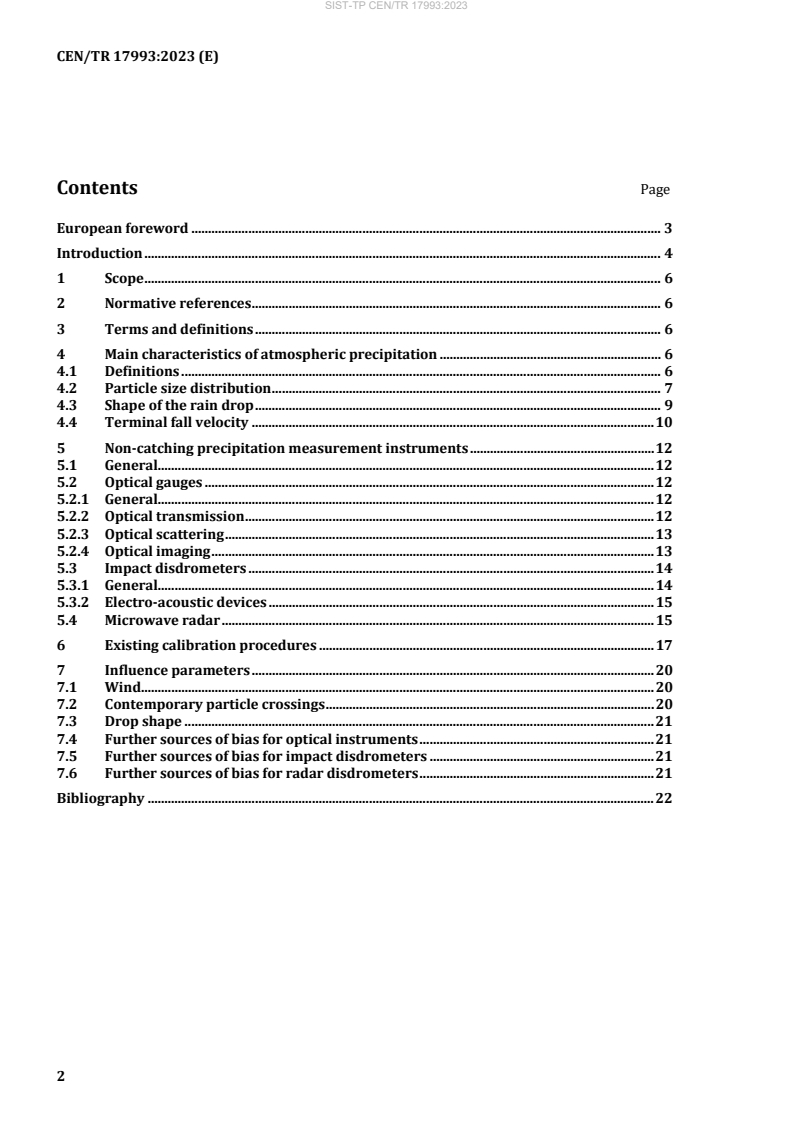
Contents Page
European foreword . 3
Introduction . 4
1 Scope . 6
2 Normative references . 6
3 Terms and definitions . 6
4 Main characteristics of atmospheric precipitation . 6
4.1 Definitions . 6
4.2 Particle size distribution . 7
4.3 Shape of the rain drop . 9
4.4 Terminal fall velocity . 10
5 Non-catching precipitation measurement instruments . 12
5.1 General. 12
5.2 Optical gauges . 12
5.2.1 General. 12
5.2.2 Optical transmission . 12
5.2.3 Optical scattering . 13
5.2.4 Optical imaging . 13
5.3 Impact disdrometers . 14
5.3.1 General. 14
5.3.2 Electro-acoustic devices . 15
5.4 Microwave radar . 15
6 Existing calibration procedures . 17
7 Influence parameters . 20
7.1 Wind. 20
7.2 Contemporary particle crossings . 20
7.3 Drop shape . 21
7.4 Further sources of bias for optical instruments . 21
7.5 Further sources of bias for impact disdrometers . 21
7.6 Further sources of bias for radar disdrometers . 21
Bibliography . 22
European foreword
This document (CEN/TR 17993:2023) has been prepared by Technical Committee CEN/TC 318
“Hydrometry”, the secretariat of which is held by BSI.
Attention is drawn to the possibility that some of the elements of this document may be the subject of
patent rights. CEN shall not be held responsible for identifying any or all such patent rights.
The document was prepared following a request for research development submitted by CEN/TC 318 in
October 2017 to EURAMET, the European Association of National Metrology Institutes, through the
cooperation programme between STAIR (the joint CEN-CENELEC strategic Working Group supporting
standardization in research and innovation) and EMPIR (the European Metrology Programme for
Innovation and Research of EURAMET).
This led to the approval and funding of the EURAMET pre-normative project 18NRM-03 "INCIPIT -
Calibration and accuracy of non-catching instruments to measure liquid/solid atmospheric precipitation"
(2019-2021). The project Deliverable D1, "Overview of existing models and working principles of non-
catching precipitation gauges together with test/calibration schemes for different types of non-catching
precipitation gauges" was provided as a supporting document to CEN/TC 318 and is the basis of the
present CEN/TR draft.
Any feedback and questions on this document should be directed to the users’ national standards body.
A complete listing of these bodies can be found on the CEN website.
Introduction
The development of highly accurate precipitation gauges for both liquid and solid precipitation is an
increasingly relevant and pressing requirement in the environmental sciences and their applications
(Lanza and Stagi, 2008). Non-catching instruments, which do not use a container to collect the
hydrometeors when approaching the ground, are the emerging class of in-situ precipitation gauges
(Cauteruccio et al., 2021). They detect the microphysical and dynamic characteristics of single or multiple
hydrometeors while these cross a given section, or a volume, of the atmosphere (or directly impact the
sensor) by employing optical, acoustic, and microwave principles.
National Meteorological and Hydrological Services (NMHS) and other organizations, in charge of the
management of monitoring observation networks over large regions, increasingly look at such kind of
instruments as a potential improvement over the more traditional catching-type gauges (typically
tipping-bucket and weighing gauges), notwithstanding the higher lifecycle cost. The reasons are their
potential in reducing the maintenance burden (by eliminating any moving part or containers to be
periodically emptied and serviced), the high temporal resolution, the large number of parameters
provided, and their suitability to be part of a fully automated monitoring observation network.
Drawbacks can be easily identified in the higher complexity of the exploited technology, so that the
capability of the user to correctly manipulate, maintain and calibrate the instrument might be limited.
Non-catching instruments are generally calibrated by the manufacturers, using internal procedures
developed for the specific technology employed. No widely agreed procedure – nor any documentary
standard – exists within national or international institutions. The adopted procedures are rarely
traceable to the International System of Units (SI) and are often not even reproducible. Limited
information is generally provided by the manufacturers about the methodology and instrumentation
adopted for calibration purposes.
Having no funnel to collect the rainwater, traceable calibration and uncertainty evaluation for non-
catching gauges are more difficult than for catching type gauges, and the use of an equivalent, reference
flow rate (see e.g. Colli et al., 2014) is not possible. Rather, for an appropriate metrological
characterization of non-catching instruments, reproducing the actual rain event characteristics is needed,
including particle size distribution, shape, density and fall velocity. A considerable metrological effort is
therefore needed to resolve traceability and uncertainty issues and to support new calibration methods
including the development of standardized laboratory rainfall simulators.
As regards solid precipitation, non-catching instruments were included in the recent WMO SPICE (Solid
Precipitation InterComparison Experiment) and compared with gauge measurements in a DFIR (Double
Fence Intercomparison Reference) at various test sites (Nitu et al., 2018). The study concluded that
further analysis is needed to better understand the behaviour of non-contact type measurement
instruments, especially working with the raw data (drop size and fall speed distribution), and exploiting
the full capacity of such devices, that can provide much more information than the precipitation
accumulation (precipitation type, SYNOP and METAR codes, etc.). Field tests on SPICE reference sites
have been continued in that sense after the official end of the project (Smith et al., 2020) to enhance the
knowledge on the operational use of non-catching type instruments in winter conditions.
For liquid precipitation measurements, the evidence from the last WMO intercomparison of rainfall
intensity gauges in the field (Vuerich et al, 2009) is that, due to calibration issues, caution should be posed
in using the information obtained from non-catching instruments in any real-world application and in
assessing the results of scientific investigations based on such measurements.
The main effort to develop standard procedures for the calibration of precipitation measurement
instruments is presently being performed at the European level. The first experience was the
development of the Italian national standard UNI 11452:2012, and the follow-up extension of such
initiative at the European scale, leading to the publication of the recent standard EN 17277:2019. The
scope of the standard is however limited to catching type gauges, which – due to the presence of the rain
collector – can be calibrated using a known and constant flow rate generated in the laboratory as the
reference (Santana et al., 2015). Traceable instrument calibration for non-catching gauges is the next step
of the ongoing normative effort at the European scale under CEN/TC 318/WG12, but various scientific
and methodological aspects are still open issues.
The project MeteoMet (Merlone et al., 2015), funded under the European Metrology Research
Programme (EMRP), initiated a series of experimental activities in metrology for meteorology, with the
MeteoMet2 specifically addressing the issue of atmospheric precipitation measurements from a
metrological perspective. An associated research grant focused on rainfall measurements using catching
and non-catching gauges. It is under this framework that, to support the ongoing normative effort, the
INCIPIT project “Calibration and accuracy of non-catching instruments to measure liquid/solid
atmospheric precipitation” was initiated in July 2019 (Merlone et al., 2020).
The project aimed at introducing metrological soundness, reproducibility, and standardization in the
calibration of non-catching type instruments, so that an uncertainty budget can be determined, and
measurements made traceable to the SI. A rigorous metrological approach based on modelling the
measurement process and expressing the influence parameters in a model function was implemented,
taking in account different types of rain-gauges and the different calibration schemes. By developing,
characterizing, testing, and comparing different types of rain generators, test calibration of a
representative number of different non-catching rain gauges was performed.
This document provides an overview of the existing models of non-catching instruments with a
description of the working principle exploited and the calibration procedures currently adopted. The
literature and technical manuals disclosed by manufactures are summarized and discussed. The report
allows knowledge to be shared and provides consistent background information needed to advance the
standardization activities towards the development of traceable procedures for the calibration of non-
catching gauges and the associated calibration uncertainty assessment, as well as the evaluation of the
accuracy of non-catching precipitation measurement instruments.
1 Scope
Non-catching type gauges are the emerging class of in situ precipitation measurement instruments. For
these instruments, rigorous testing and calibration are more challenging than for traditional gauges.
Hydrometeors’ characteristics like particle size, shape, fall velocity and density need to be reproduced in
a controlled environment to provide the reference precipitation, instead of the equivalent water flow
used for catching-type gauges. They are generally calibrated by the manufacturers using internal
procedures developed for the specific technology employed. No agreed methodology exists, and the
adopted procedures are rarely traceable to internationally recognized standards. This document
describes calibration and accuracy issues of non-catching instruments used for liquid/solid atmospheric
precipitation measurement. An overview of the existing models of non-catching type instruments is
included, together with an overview and a description of their working principles and the adopted
calibration procedures. The literature and technical manuals disclosed by manufacturers are
summarized and discussed, while current limitations and metrological requirements are identified.
2 Normative references
There are no normative references in this document.
3 Terms and definitions
No terms and definitions are listed in this document.
ISO and IEC maintain terminology databases for use in standardization at the following addresses:
— ISO Online browsing platform: available at https://www.iso.org/obp/
— IEC Electropedia: available at https://www.electropedia.org/
4 Main characteristics of atmospheric precipitation
4.1 Definitions
The World Meteorological Organization (WMO), in its Guide to Meteorological Instruments and Methods
of Observation (WMO, 2014 updated 2017), defines atmospheric precipitation as “the liquid or solid
products of the condensation of water vapour falling from clouds or deposited from air onto the ground".
Hydrometeors falling through the atmosphere can have different size, shape, velocity (magnitude and
components) and density. The precipitation intensity (usually indicated as Snowfall Intensity – SI for
solid and Rainfall Intensity – RI for liquid precipitation) and the associated Particle Size Distribution
(PSD) are two main factors used to characterize a precipitation event. The precipitation intensity is
defined by the WMO/CIMO guide as “the amount of precipitation collected per unit time interval" while
-3 -1
the PSD, usually indicated with N(d) and expressed in [L L ], provides the number of particles (liquid or
solid) per unit volume of air and unit size interval having a volume equal to the sphere of diameter d [L].
The most common types of rain are stratiform, that falls from nimbostratus, and convective that falls from
cumulus and cumulonimbus.
Stratiform precipitation originates in high clouds, where small ice crystals are formed. In these clouds,
the vertical wind is on average much smaller than the fall speed of the ice crystals, hence the wind cannot
prevent them from falling. When they fall in a supersaturated air, they grow by vapor deposition. They
can also grow by aggregation of ice particles. When the ice crystals reach an altitude where the air
temperature (T) is above 0 °C they melt and can still grow by aggregation, but this phenomenon is of
minor importance. This type of rain therefore tends to have small droplets (Rulfová and Kyselý, 2013).
-1 -1
In convective precipitations, the vertical wind is more important (1 m s to 10 m s ) and can carry the
growing particles upward until they become heavy enough to overcome the updraft and begin to fall to
the ground. During this period where the droplets are suspended, they can grow by accretion of liquid
water. Since there are strong upward winds, the small droplets cannot fall and the rain has on average
larger droplets than in stratiform precipitations (Penide et al., 2013).
The text of Clause 4 is derived from the work of Cauteruccio (2020).
4.2 Particle size distribution
The PSD is usually depicted in a (d, N(d)) semi-logarithmic plot. A universal formulation for the PSD is
not available since it is influenced by the regional and seasonal climatology governing the formation of
hydrometeors in the atmosphere. Information about the PSD comes from observations. Physical
properties of solid and liquid particles were derived in the past by employing raindrop spectrometers or
radar sensors (see e.g. Waldvogel, 1974), while disdrometers are currently used to observe the size
distribution characteristics of the precipitation process (see e.g. Caracciolo et al., 2008). Moreover, PSD
measurements are affected by the limitation of disdrometers to detect small size particles, especially
when d < 1 mm (Caracciolo et al. 2008).
Two formulations for the PSD are commonly used in the literature: the Exponential (Marshall and Palmer,
1948) – hereinafter MP – and the Gamma (Ulbrich, 1983) distributions. Marshall and Palmer (1948), by
fitting experimental observations, provided the exponential form of the PSD as follows:
-Λd -1 -3
N(d) = N e [mm m ] (1)
-1 -3
where N and Λ are two suitable parameters, with N [mm m ] the intercept and Λ the slope of the linear
0 0
form of this curve in a semi-log plot.
Marshall and Palmer, for a widespread mid-latitude rain, found a constant value for N (Formula (2)) and
a relationship for Λ, as a function of the rainfall intensity (RI), as reported in Formula (3).
-1 -3
N0 = 8 000 [mm m ] (2)
-0.21 -1
Λ = 41 RI [cm ] (3)
This distribution is valid for stratiform precipitations and has the tendency to overestimate the
concentration of small droplets (typically under 0,5 mm). Indeed, these small droplets cannot fall in case
of upward wind and tend to evaporate when they enter non-saturated air. Integration of this distribution
-1
between 0,5 mm and 6 mm for a rainfall rate of e.g. 5 mm h gives a total concentration of droplets of
-4 -3 3
6,4×10 [cm ]. This means that there are typically between 100 and 1 000 droplets/m during stratiform
rain, corresponding to an approximate distance between drops of 20 cm and 10 cm.
Waldvogel (1974), by measuring the distribution of raindrops with an electromechanical spectrometer
and by means of a radar reflectivity analysis, for different types of precipitation (showers, thunderstorms,
is not constant and changes abruptly. He called this
and widespread rain), showed that the parameter N0
phenomenon “The N jump”. Radar measurements indicated that the N jump occurred when one of the
0 0
mesoscale convective areas moved in or out the region above the station, which means that the situation
changed from uniform (widespread rain) to convective (shower or thunderstorm) or vice versa.
For very small drop diameters (below 1 mm) the N(d) values decrease with decreasing the particle
diameter, therefore, a downward concavity of the PSD is obtained. Currently, it is not clear whether this
characteristic is ascribable to the limitation of the measuring instruments to detect very small particles
or it is physically based. Moreover, some disdrometers, especially radars, provide higher N(d) values for
small diameters causing an upward concavity in the distribution.
Ulbrich (1983) proposed the Gamma distribution in the form:
μ -ΛD -1 -3
N(D) = N D e [mm m ] (4)
where the exponent µ is the shape parameter and can have positive or negative values and the intercept
-1-µ -3
N is in [mm m ].
Ulbrich summarized experimental observations reported by other authors including Mueller (1965),
Caton (1966) and Blanchard (1953). In the work of Mueller, a variety of rainfall types including
continuous rain, showers and thunderstorms were observed and for all of them the observed PSDs are
concave downward. When fitted with the gamma formulation these PSDs would have µ > 0. Almost all
Caton’s PSDs are like those reported by Mueller and can be described by a Gamma distribution with µ > 0.
Differently, orographic precipitation, as observed by Blanchard, is characterized by numerous small size
drops. This type of precipitation events can be described by a Gamma distribution with µ < 0. In addition,
Ulbrich conducted a theoretical analysis with the aim to describe the modification of the distribution from
the exponential form to a concave shape. The author affirmed that the variation in N is independent from
the variation of Λ, while a direct relationship between N and μ exists in the form:
4 3.2μ -1-μ -3
N = 6x10 e [cm m ] (5)
Caracciolo et al. (2006) provided a discrimination algorithm to classify precipitation in convective or
stratiform classes based on a large dataset covering about three years of observations (2001–2004) for
about 1 900 min of rain, collected in Ferrara (northern Italy) using a Joss-Waldvogel (JW) disdrometer
and supported by radar measurements.
First, both precipitation intensity (RI) and radar reflectivity (Z) were used for the classification into
convective and stratiform precipitation as reported below:
-1
RI < 10 mm h and Z < 38 dBZ stratiform;
-1
RI < 10 mm h and Z > 38 dBZ convective;
-1
RI > 10 mm h convective.
Then, based on the PSD parameters the so-called peak (or modal) diameter D was defined as:
p
-1
D = μ Λ [mm] (6)
p
Using this criterion, the stratiform spectra are characterized by lower D values with respect to the
p
convective ones and the threshold between the two precipitation types is defined by the curve:
1,635Λ - μ = 1 (7)
The work of Caracciolo et al. (2008) is based on rain events measured in the Italian territory by employing
radar and two different types of disdrometers (JW and Pludix) with a sampling time of one minute. Each
one-minute PSD value was classified into one of six categories, based on the measured precipitation
intensity (RI).
Both the exponential and Gamma formulations were used by the authors to provide new discrimination
criteria between convective and stratiform precipitation according to radar reflectivity measurements.
Using the JW data, a convective/stratiform discrimination criterion considering also shallow convective
and heavy stratiform rain was developed:
-1
RI < 10 mm h and Z < 38 dBZ stratiform;
-1
RI > 10 mm h and Z < 38 dBZ heavy stratiform;
-1
RI >= 10 mm h and Z >= 38 dBZ convective;
-1
RI < 10 mm h and Z > 38 dBZ shallow convective.
From these classes a new discrimination line in the (Λ, μ) diagram was identified:
1,635Λ – μ = 2 (8)
By analysing the Pludix exponential PSD parameters, the shallow convective and heavy stratiform
-1 -1
precipitation, characterized by RI between 2 mm h and 10 mm h , fall in the middle between the
-1 -1
stratiform (RI < 2 mm h ) and convective (RI > 10 mm h ) categories and the threshold can be expressed
as:
Λ + 4,17 = 1,92 logN (9)
As for solid precipitation, in the work of Houze et al. (1979) the parameters of the MP distribution were
derived as a function of the air temperature from measurements in frontal clouds obtained using an
optical particle spectrometer. The temperature T at flight altitude during the probe measurements
ranged from -42 °C to +6 °C. Results showed that both N and Λ decrease with increasing T and a sudden
“jump” of the Λ value occurred for T > 0 °C when aggregated snow particles melt to much smaller and
faster falling droplets.
4.3 Shape of the rain drop
An important parameter for the characterization of rain is the shape of the droplets. Indeed, some
measurement principles exploited by non-catching gauges detect the dimension of the horizontal axis of
the droplet to calculate its volume.
Small droplets, up to 1 mm diameter, are almost perfectly spherical. Larger drops are flattened by the
dynamical pressure applied by the air. Different theories exist to model the shape of the drops as a
function of their equivalent diameter (diameter of a sphere with an equal volume).
Some theories, such as the model of Pruppacher and Pitter (1971), predict a recurved base (a small dent
present at the base of the droplet) for large droplets. Further to this equilibrium shape, vibrations appear
in falling droplets. These oscillations are typically at a frequency of a few tens of Hz or an oscillation
period of a few tens of milliseconds (Szakall et al., 2009).
The balance among the forces of surface tension, hydrostatic pressure, and aerodynamic pressure from
airflow around the drop determines the shape and the terminal fall velocity of hydrometeors. Green
(1975), using a simple hydrostatic model, represented droplets as oblate spheroids with axis ratios
determined by the balance of surface tension and hydrostatic forces. Pruppacher and Beard (1970), by
means of wind tunnel experiments, found that the raindrop shape can be defined in terms of the axial
ratio (b/a) between the vertical (b) and the horizontal axis (a). For raindrops with the equivolumetric
drop diameter D > 0,5 mm, they obtained the following empirical equation as given in Formula (10):
b/a = 1,03 – 0,062 D (10)
whilst for D < 0,5 mm, the axial ratio is b/a = 1.
Beard and Chuang (1987), introducing the contribution of the aerodynamic pressure in the equilibrium
condition, provided a model able to explain the drop shape with its characteristic flattened base that
increases with drop size and can be expressed in terms of the following polynomial given in Formula (11):
-4 -2 2 -3 3 -4 4
b/a = 1,0048 + 5,7 10 D – 2,628 10 D + 3,682 10 D – 1,677 10 D (11)
Model results of Beard and Chuang (1987) were consistent with the experiments of Chandrasekar et al.
(1988) and by Bringi et al. (1998), which employed aircrafts to study the shape of raindrops in natural
rainfall.
4.4 Terminal fall velocity
Since droplets fall from a high altitude, they reach the ground with their terminal velocity, w . The
T
terminal velocity is defined as the maximum velocity attainable by an object as it falls through a fluid.
This condition is reached when the sum of the drag force and the buoyancy force is equal to the downward
force of gravity acting on the object. In this condition, the motion of the object is not accelerated.
The motion of a falling particle in the atmosphere is described by Formula (12):
(12)
ρ Va =− C Aρvv−vv−+V ρρ− g
( ) ( )
p p p D p a pa pa p a p
where
a is the particle acceleration,
p
v , v are the velocity vectors of the air and the particle, respectively,
a p
g is the gravity acceleration,
C is the drag coefficient,
D
A is the particle cross section area
p
ρ , ρ are the density of the air and the particle, respectively.
a p
Formula (12) is written assuming the positive orientation of the z axis upward and the velocity and
acceleration components are positive in the positive direction of the related axes. The quantity v - v
p a
indicates the relative particle-to-air velocity.
The vertical component of Formula (12) becomes Formula (13):
ρ −ρ
( )
1 ρ
pa
a
a =− CA w −wv −+v g (13)
( )
pz Dp p a p a
2 ρρV
pp p
-2
where the gravity acceleration (g) assumes the negative value of -9,81 m s .
When a generic drop falls in a stagnant air, from Formula (13) its terminal velocity is obtained as
Formula (14):
1/2
2Vgρ −ρ
( )
pp a
w = (14)
T
CAρ
D pa
The drag coefficient (C ) is a dimensionless quantity used to represent the resistance of an object in
D
motion in a fluid, such as air or water and associated with the cross-sectional area of the object (A ).
p
The estimation of the drag coefficient is not easy. In the literature, various experiments were carried out
with the objective to identify a relationship between the drag coefficient and the particle dimension
and/or its terminal velocity for hydrometeors which fall in the atmosphere.
In the work of Khvorostyanov and Curry (2005), hereinafter KC05, different formulations of the CD
obtained from experimental studies and analytical models, were summarized. The drag coefficient is
expressed as a function of the particle Reynolds number (Re ), which represents the ratio between the
p
inertial and viscous forces acting on the particle in motion in a fluid. When a particle falls in a stagnant
air its Reynold number is expressed as Formula (15):
w d
T
Re = (15)
p
υ
where
2 -1
υ is the fluid cinematic viscosity in m s .
Some of the following curves derived by KC05 are derived for spherical particles and others for snow
crystals. The authors introduce a correction parametrization, when the particle Reynolds number
exceeds the value of 103, to account for the turbulence effect due to the flow.
Snowfall measurements are more complicated because many different types of snowflakes exist. Many
studies have examined the characteristics of the various types of snowflakes often observed during
winter storms (e.g. Sekhon and Srivastava 1970; Locatelli and Hobbs 1974; Passarelli 1978; Brandes et
al. 2007). Yuter et al. (2006) showed that the snowflake terminal velocity is highly variable and could
-1 -1
vary from 0,5 m s to 3 m s and this variability could affect the measurements.
In the work of Rasmussen et al. (1999), observed data from the Marshall Snowfall Test Site, near Boulder
(Colorado), of the National Centre for Atmospheric Research, were classified in various crystal types (e.g.
dendrites, hexagonal plates, lump graupels, etc.) and aggregated in two macro categories: ‘‘dry’’ and
‘‘wet’’ snow. In that work, the volume V , the cross-section area A , density ρ and terminal velocity w of
p p p T
each type of snowflake are parametrized with a power law curve as a function of the equivalent particle
diameter d as Formula (16):
b
Y
Yd =a d (16)
( )
Y
where
Y assumes the nomenclature of the volume Vp, the cross-section area Ap, density ρp and
,
terminal velocity wT
a , b are the best-fit parameters associated with each type of snowflake.
Y Y
In Table 1, as an example, the values of the power law parameters for dry and wet snow as provided by
Rasmussen et al. (1999) are reported. When the particle diameter is expressed in centimetres the
-1 3 2 -3
following parameters provide w in m s , V in cm , A in cm , and ρ in g cm .
T p p p
Table 1 — Power law parameters a and b , from Rasmussen et al (1999), for the computation of
Y Y
the snowflake terminal velocity w , volume V , cross-section area A and density ρ
T p p p.
Crystal type a(w ) b(wT) a(Vp) b(V ) a(A ) b(A ) a(ρ ) b(ρ )
T p p p p p
Dry snow 107 0,2 π/6 3 π/4 2 0,017 -1
Wet snow 214 0,2 π/6 3 π/4 2 0,072 -1
5 Non-catching precipitation measurement instruments
5.1 General
The initial manual measurement methods for the study of the hydrometeor’s characteristics evolved due
to advances in technology and electronics. Nowadays different techniques are involved in the
determination of liquid/solid particle characteristics, like devices to measure the displacement and
mechanical energy caused by raindrops/graupels hitting a surface, and optical detection, whereby the
size, shape, velocity, and diameter of hydrometeors are measured while they cross a light or laser beam,
etc.
5.2 Optical gauges
5.2.1 General
Optical disdrometers use visible or infrared (IR) light to detect falling hydrometeors. The available
instruments use different technical solutions but all of them present a similar structure. The instrument
is equipped with an IR or visible light emitter/transmitter that illuminates a volume of the atmosphere
and with an optical sensor to detect the emitted light. The illuminated measuring volume is usually
determined by the shape of the lens and the relative position between the emitter and the receiver. When
droplets cross the sensing volume, the light changes its intensity and scatters in various directions. This
variation is detected by the sensor allowing the physical properties of the particle (e.g. the diameter and
the falling speed) to be derived. Scattering can be broadly defined as the redirection of radiation out of
the original direction of propagation.
Three physical configurations for optical gauges are commonly adopted. In the first case, here called
optical transmission, the receiver is in front of the emitter and captures the direct beam of light. When
hydrometeors intersect the beam, light is partially scattered and its intensity at the receiver is lower. In
the second case, here called optical scattering, the receiver is not located in front of the transmitter but
at a given angle, therefore, in the absence of any obstruction, the signal at the receiver is very low. When
hydrometeors cross the measurement volume the light is scattered in various directions and reaches also
the receiver therefore increasing the signal amplitude. The last type of instruments is based on optical
imaging technology. This kind of instruments capture an image of the passing hydrometeors that can be
further processed to obtain their physical properties.
5.2.2 Optical transmission
Non-catching instruments based on optical transmission principles are composed of a light source
(typically an infrared light emitting diode, IR-LED), that produces a homogeneous light beam, and a
receiver (typically a photodiode). The light sheet has a width of few centimetres, a length of a few tens of
centimetre, and a thickness on the order of 1 mm, resulting in an analysed volume of a few cubic
centimetres. When no hydrometeors are present within the measuring volume, the intensity of the light
measured by the receiver is the maximum admissible one and corresponds to the reference level. When
a droplet crosses the analysed volume, it casts a shadow over the detector, and the measured voltage
drops.
The amplitude of the voltage drop is proportional to the surface of the shadow, while the duration of the
shadow depends on the velocity of the falling particle. Based on such information, the sensor derives the
fall velocity and the size of the hydrometeors. The measured particles are classified by the sensor within
classes fixed a priori by coupling the particle fall velocity with the expected diameter. Measurements are
flagged and discarded by the instrument if the measured fall velocity of the hydrometeor is far from the
theoretical value expected for the measured diameter. This could occur if an insect, leaf, etc. is detected
rather than hydrometeors. From these measurements the PSD is also calculated and by integrating over
a short time (typically in the order of one minute), the precipitation rate is derived. When measurements
are integrated over larger time periods the total amount of precipitation can be calculated.
5.2.3 Optical scattering
When light encounters a droplet, part of the intensity is scattered in different directions, depending on
the wavelength of the signal and the size of the droplet. For infrared light and typical drop sizes (0,1 mm
to 6 mm), the angle of maximum diffraction is around 45°. This principle is used by optical scattering
instruments to detect hydrometeors in the atmosphere and derive precipitation rate. A light source
(typically IR-LED) sends a cone of light. A photodetector is placed with an angle of 45° with the source.
The intersection of the light source and the cone of vision of the photodetector defines the analysed
volume (typically, a few hundreds of cubic centimetres). Instead of a cone of light, the source can also be
a light sheet, to decrease the analysed volume (down to a few cubic centimetres) and increase the
resolution between different droplets. Since the scattered intensity is low, light sources with a sharp
bandwidth are used, with a filter in front of the detector to measure only the wavelengths emitted by the
source. A lock-in can also be used to increase the accuracy, with a light source being modulated at a
certain frequency, and the electrical signal being analysed at that frequency.
In undisturbed conditions, when no particle is in the analysed volume, the signal measured by the
photodetector is very low because the direction of the light differs from that of its cone of vision. Contrary,
when a particle travels through the measuring volume, the light is scattered in different directions and
partly detected by the photodetector, which records a peak in the signal. From the characteristic
frequency of the emitted signal, the returned signal is filtered to obtain only the components related to
the falling hydrometeors. The small particles in suspension induce a base level of this characteristic
frequency that can be linked to the visibility. Each time a raindrop falls in the analysed volume, a peak is
observed. The amplitude of the peak is proportional to the droplet size; hence it is possible to obtain the
DSD, therefore, the total precipitation and precipitation rate.
More recently developed instruments are equipped with two receivers. One of the detectors identifies
the forward scatter radiation and it is usually located between 39° to 51°, meanwhile the other detector
identifies the backward scattered radiation (107° to 119°). The second receiver improves considerably
the performance of these instruments because it allows discriminating between liquid and solid
precipitation by combining the two signals. The ratio between the back and forward scattered signals
estimates the visibility and discriminates between different types of precipitation, such as rain or snow.
Snow and other frozen hydrometeors have a much higher proportion of back scattered light when
compared to rain drops.
5.2.4 Optical imaging
Optical imaging uses a Charge-Coupled Device (CCD) or Complementary Metal–Oxide–Semiconductor
(CMOS) photographic sensor operating in the visible band of the light spectrum to capture an image of
each hydrometeor that crosses the sensing volume. Line-scan and total image sensors can be used. The
first is composed by a single line of pixels that can be read at high frequency; the image is therefore
obtained after pre-processing and assembling of the consecutive slices. These sensors are commonly
used by the industry for high-speed machine vision operations and can reach very high spatial and
temporal resolution. Total image sensors are instead composed of a two-dimensional array of pixels and
capture still pictures of the hydrometeors, the data obtained is directly usable without pre-processing
but usually have lower spatial and temporal resolution.
One instrument using the line-scan camera is the two-dimensional video disdrometer (2DVD),
manufactured by Joanneum Research at the Institute for Applied Systems Technology in Graz, Austria. A
visible light source generates a light sheet that is projected onto a line-scan camera. The 2DVD uses two
orthogonal light sheets and two synchronized cameras. The light sheets are quite bright and particles
falling through them cast shadows on the photodetectors. The photodetector signals are compared
against a threshold to determine if a pixel is lit or obscured. The combination of bright light and video
thresholding renders the raindrops opaque and makes the 2DVD insensitive to ambient light. The two
orthogonal projections provide, in principle, three-dimensional raindrop shape information and can limit
the shadowing effect that can happen when two hydrometeors cross the beam exactly at the same time.
Shape information allows computation of the drop volume and equivalent drop diameter D, as well as the
oblateness.
The light sheets are spaced 6,2 mm apart and the 2DVD software matches particles shadows in the upper
light sheet with particles shadows in the lower sheet. By measuring the time needed for the particle to
move 6,2 mm vertically, its vertical velocity is obtained. Also, the same principle can be used to estimate
the particle’s horizontal velocity. The 512 photodetectors are read out at a rate f = 34,1 kHz, creating
slices of the image projection and to reconstruct the shape of the hydrometeor using the same principle
of a flatbed scanner.
Calibration of the instrument is performed by the manufacturer by releasing metallic spheres of a known
diameter through the measuring area. Also, proper optical alignment and calibration is crucial, the
manufacturer discourages major optical realignment since it is easy to seriously misalign the optics,
however, moving the 2DVD from one
...